Healthcare HR breaks in ways generic HR software never anticipates. A nurse's license expires on a Tuesday, and the credential isn't flagged until Thursday, when the schedule is already set. Overtime spills across two locations and four pay rates because nobody reconciled the time clock with payroll. A new hire starts on Monday with no onboarding workflow because the last person who built it left six months ago.
These aren't edge cases. According to the Relias 2025 Technology in Healthcare Report, two-thirds of healthcare professionals cited workforce shortages and recruitment difficulties as their top challenge. The HR system your team runs directly affects whether that pressure compounds or gets contained.
Generic HR software handles employee records. Healthcare HR software handles employee records plus credential expiration alerts, shift-based overtime rules, compliance documentation, and the integrations that tie them together. Choosing the wrong category costs you a full quarter of recovery time.
This guide cuts to the 15 tools that matter most, organized by what each one actually replaces.
What's inside
This guide is for healthcare operators, HR leaders, practice owners, and executives building a shortlist to hand to a Head of People or COO. Tools were selected based on:
- Healthcare depth: Credential tracking, scheduling rules, compliance workflows, and payroll complexity
- Operational fit: Multi-location support, employee self-service, and practical onboarding
- Pricing clarity: Verified from vendor pricing pages and cross-referenced with G2 and Capterra
- Buyer signal: G2 ratings from current listings, not cached figures
TL;DR
- Best healthcare-specific HR platform: HR for Health, for dental, medical, optometry, and veterinary practices needing software plus HR advisor access
- Best for consolidating HR, payroll, and IT: Rippling, for multi-state healthcare teams replacing several administrative tools at once
- Best for compliance and credentialing: MedTrainer, for healthcare teams where credential tracking and training are the core bottleneck
- Best for enterprise health systems: Workday and Oracle Cloud HCM, for large organizations with mature finance and HR operations
- Best payroll-first options: Paylocity, Paycom, ADP Workforce Now, Paycor, and Dayforce for teams where payroll accuracy and scheduling drive the selection
- Best for smaller teams: Gusto, Zoho People, BambooHR, and CEDR HR Solutions for clinics and practices that need a clean, maintainable foundation
What is healthcare HR software?
Healthcare HR software is human resources software built to manage employee records, payroll, scheduling, credential tracking, compliance, recruiting, onboarding, and workforce operations for healthcare organizations.
The gap between this category and generic HR software is real. Generic platforms handle standard employee lifecycle events. Healthcare HR software has to handle the same events under conditions that are operationally unique: Staff rotate shifts across locations, credentials determine whether someone is legally eligible to work a given shift, payroll must account for differentials and overtime rules that generic platforms weren't built for, and compliance documentation needs an audit trail that holds up under regulatory scrutiny.
Core capabilities healthcare HR software provides:
- Employee records and core HRIS functions
- Payroll, overtime, benefits, and tax workflows
- Shift scheduling and coverage management
- Credential, license, and certification tracking with expiration alerts
- Recruiting, applicant tracking, and onboarding
- Training, policy, and compliance documentation management
- Audit trails and regulatory reporting
- Employee self-service and mobile access
- Workforce cost reporting, turnover tracking, and staffing analytics
- Integrations with payroll, accounting, identity management, EHR, and clinical systems
Where the category splits: Some tools are full HCM suites built for health systems with thousands of employees. Others are practice-specific platforms designed for a 20-person dental group. A third cluster focuses on compliance and credentialing as the primary job. The right fit depends on which operational problem is costing you the most right now.
Look at your biggest HR pain point. If it's payroll errors and shift coverage, start with workforce management platforms. If it's credential gaps and compliance exposure, MedTrainer solves that more directly than a full HCM suite. If it's onboarding chaos from rapid hiring, a clean HRIS with strong onboarding workflows gets you moving faster than an enterprise platform.
When to use healthcare HR software
Manage credentials before they affect coverage
Healthcare teams need to know whether staff are licensed, trained, and eligible before putting them on the schedule. A credential expiration that slips through creates both a compliance problem and a staffing gap. Healthcare HR software that ties credential status to scheduling eligibility closes that loop automatically, rather than relying on a manager to catch it in a spreadsheet.
Keep payroll accurate across shifts and locations
Healthcare payroll gets complex fast: Overtime, shift differentials, multiple worksites, per-diem staff, and role-based pay rates all compound on each other. Payroll errors create employee trust problems that compound into retention issues. Healthcare-specific payroll tools calculate these rules correctly by default instead of requiring manual configuration every pay period.
Scale onboarding without adding HR headcount
Fast hiring cycles, high turnover, and multi-location hiring create repeatable onboarding work that overwhelms small HR teams. Healthcare HR software automates the documentation, compliance training, and new-hire workflows so a two-person HR team can onboard at the pace the organization actually hires.
Healthcare HR software comparison
The table below covers all 15 tools, sorted by the order they appear in this guide. Pricing and G2 ratings reflect verified data from vendor pricing pages and G2 listings.
| # | Product | Best for | Key differentiator | Pricing | G2 rating |
|---|---|---|---|---|---|
| 1 | HR for Health | Small and mid-sized healthcare practices | Healthcare-specific HR with built-in advisor support | From $179/mo | Not verified on G2 |
| 2 | Rippling | Multi-state healthcare teams | Unified HR, payroll, and IT administration | Custom pricing | 4.7/5 |
| 3 | Paylocity | Healthcare payroll and workforce operations | Payroll, scheduling, learning, and engagement | Custom pricing | 4.4/5 |
| 4 | Paycom | Employee-driven payroll and HR | Single-database payroll with employee self-service | Custom pricing | 4.7/5 |
| 5 | MedTrainer | Compliance-heavy healthcare teams | Credential, training, and policy management | Custom pricing | 4.4/5 |
| 6 | UKG | Hospitals and larger healthcare workforces | Workforce management and scheduling depth | Custom pricing | 4.3/5 |
| 7 | Workday | Enterprise health systems | Enterprise HCM, finance, and workforce analytics | Custom pricing | 4.2/5 |
| 8 | Oracle Cloud HCM | Large Oracle-stack organizations | Enterprise HR, talent, payroll, and analytics | From $2/employee/mo | 3.8/5 |
| 9 | Dayforce | Complex pay rules and workforce management | Continuous payroll calculation and labor planning | From $6.36/employee/yr | 4.2/5 |
| 10 | BambooHR | Clinics needing clean HRIS and onboarding | People operations usability and reporting | From $10/employee/mo | 4.4/5 |
| 11 | ADP Workforce Now | Payroll-first healthcare teams | Payroll, tax, benefits, and compliance at scale | Custom pricing | 4.2/5 |
| 12 | Paycor | Small and mid-market healthcare employers | HR, payroll, scheduling, and talent tools | From $99/mo + $5/employee | 4.0/5 |
| 13 | Gusto | Small clinics and wellness practices | Simple payroll, benefits, and onboarding | From $49/mo + $6/person | 4.6/5 |
| 14 | Zoho People | Budget-conscious teams in the Zoho ecosystem | Configurable HR workflows at low per-user cost | From $1.25/user/mo (annual) | 4.5/5 |
| 15 | CEDR HR Solutions | Dental and medical practices | HR software plus healthcare HR advisory support | From $120/mo | Not verified on G2 |
Best 15 healthcare HR software tools for 2026
1. HR for Health
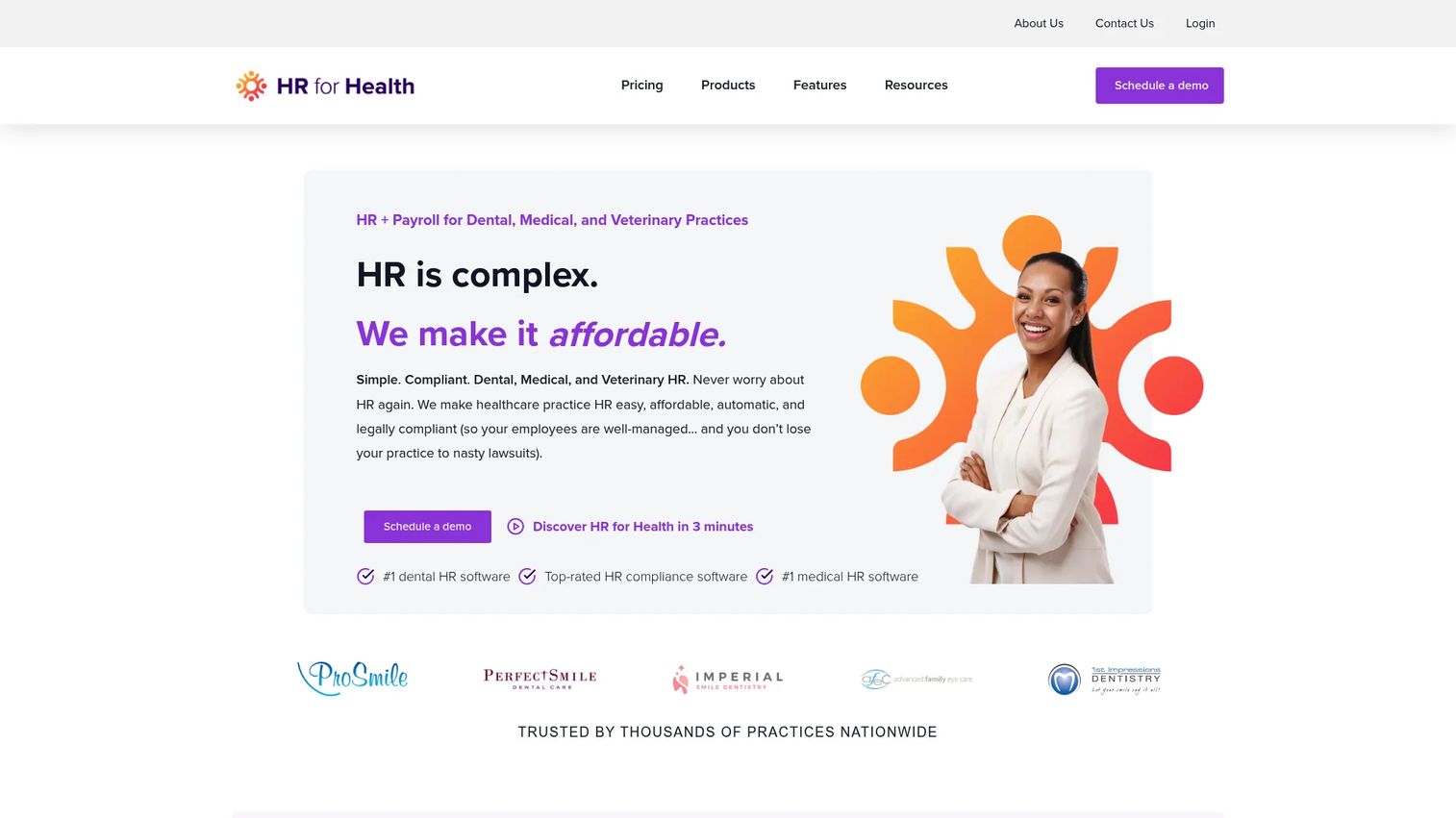
HR for Health is a healthcare-practice-specific HR platform built for medical, dental, veterinary, optometry, and similar practices. It covers HR compliance, employee handbooks, onboarding, document management, performance workflows, payroll processing, time tracking, and HR advisor access from a single platform.
Best for: Small and mid-sized healthcare practices that want software and human HR guidance together.
Key features
- Healthcare-specific HR compliance workflows
- Custom employee handbooks with e-signatures
- Onboarding, document storage, and performance reviews
- Time clock, PTO, and overtime tracking
- HR advisor support included in higher tiers
Why choose HR for Health: Practices that don't have an in-house HR team get both software and advisory support in one subscription. That combination is harder to replicate by patching a generic HRIS with a part-time HR consultant.
HR for Health pricing: Plans start at $179/month (Basic), with Essentials at $249/month, Plus at $348/month, and Premium at $374/month. Plus and Premium include payroll billed by employee count. One-time setup fees range from $1,200 to $2,000 depending on the tier.
2. Rippling
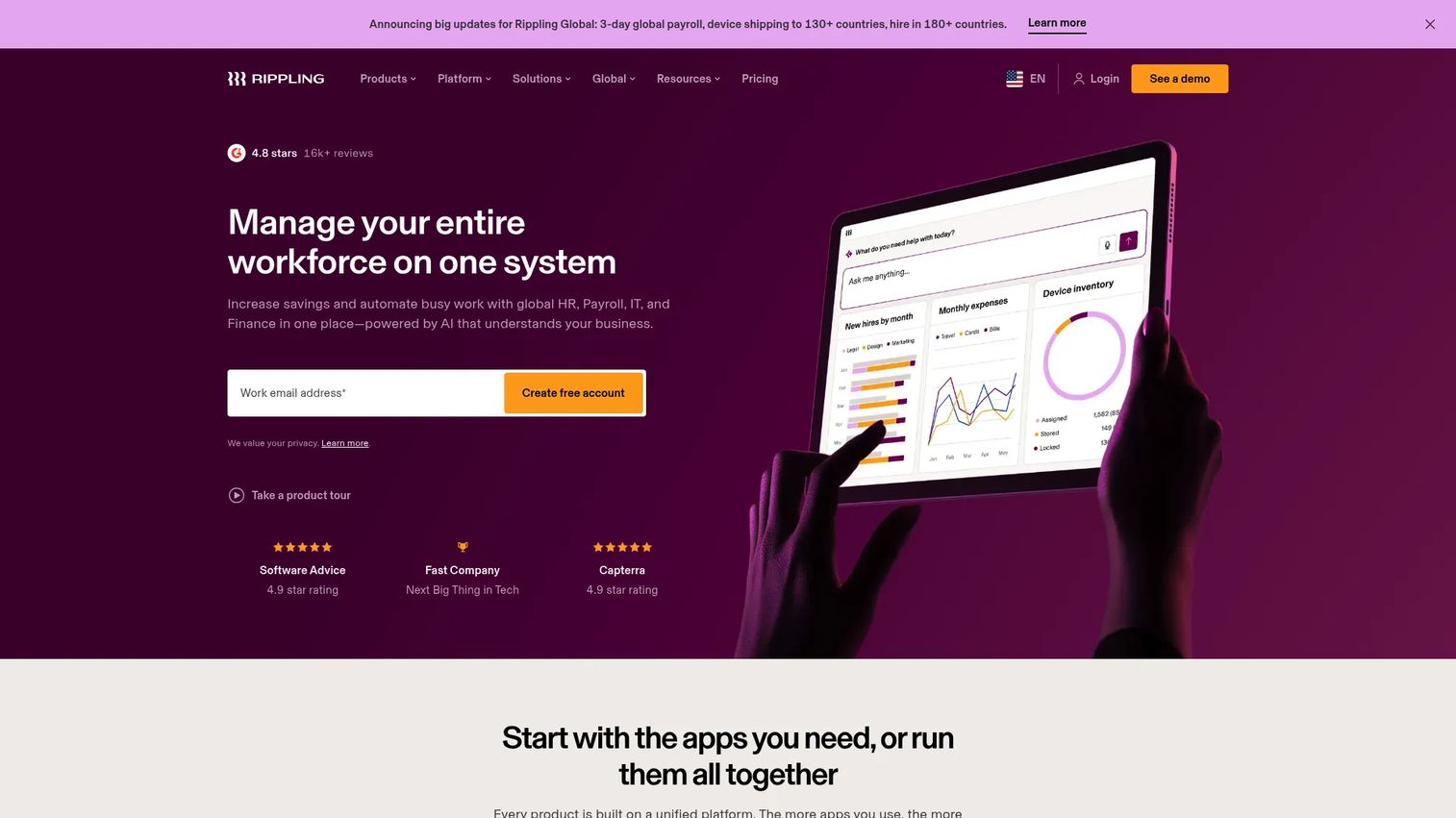
Rippling is a broad workforce management platform covering HRIS, payroll, benefits, app provisioning, device management, time, and workflow automation. For healthcare teams, it's most useful when multiple administrative tools need to be replaced with a single system that handles HR, payroll, and IT onboarding together.
Best for: Healthcare organizations with distributed or multi-state teams replacing several disconnected administrative tools.
Key features
- HRIS and full employee lifecycle management
- Payroll, benefits, and tax administration
- IT identity, app provisioning, and device management
- Workflow automation across HR and IT events
- Time, attendance, and analytics
Why choose Rippling: The appeal for healthcare operators is consolidation. Onboarding a new hire in Rippling can simultaneously provision their email, payroll, benefits enrollment, and device access. That matters for teams running locations across multiple states with inconsistent onboarding processes.
Rippling pricing: Rippling uses a modular structure with the core platform required and HR, Finance, and IT products priced separately. The vendor requires a custom quote. Contact Rippling directly for pricing based on employee count and selected modules.
Rippling holds a 4.7/5 rating on G2.
3. Paylocity
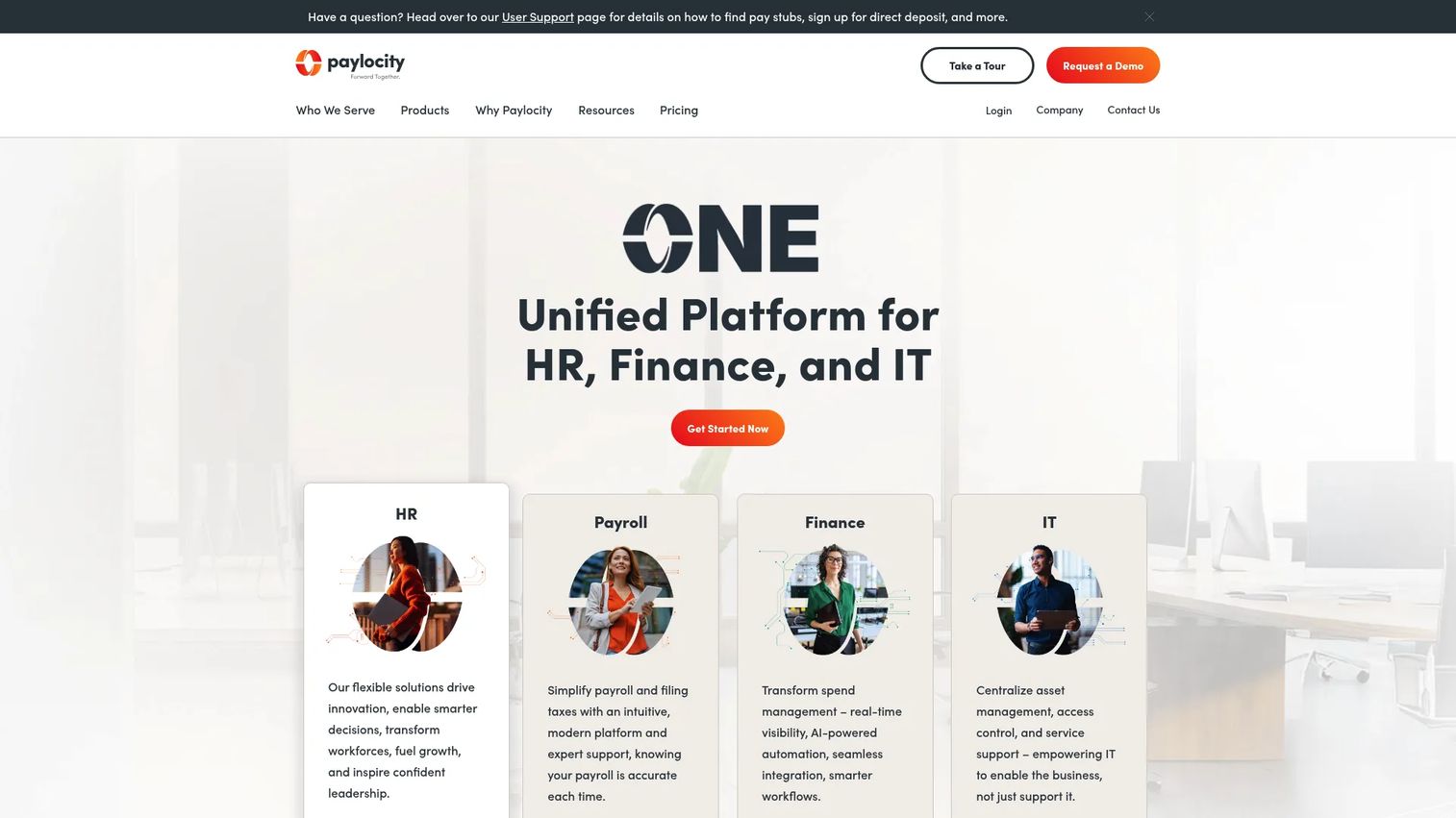
Paylocity is a unified platform for HR, payroll, workforce management, learning, employee engagement, and finance. Healthcare employers use it for payroll accuracy, workforce scheduling, and employee retention tools without moving to a full enterprise HCM suite.
Best for: Healthcare employers that want payroll, workforce management, and employee engagement in one system without enterprise complexity.
Key features
- Payroll and tax filing with compliance tools
- Time, attendance, and workforce scheduling
- Learning management system
- Employee self-service and engagement tools
- HR analytics and workforce reporting
Why choose Paylocity: It sits in a practical middle ground. Larger than a basic HRIS, smaller and faster to implement than a full HCM suite. For a healthcare organization with 50 to 500 employees dealing with scheduling and payroll complexity, Paylocity covers the core operations without requiring a lengthy implementation project.
Paylocity pricing: Paylocity prices by custom quote. The cost depends on employee count, selected modules, and service configuration. Contact Paylocity for a proposal based on your workforce size and feature requirements.
Paylocity holds a 4.4/5 rating on G2.
4. Paycom
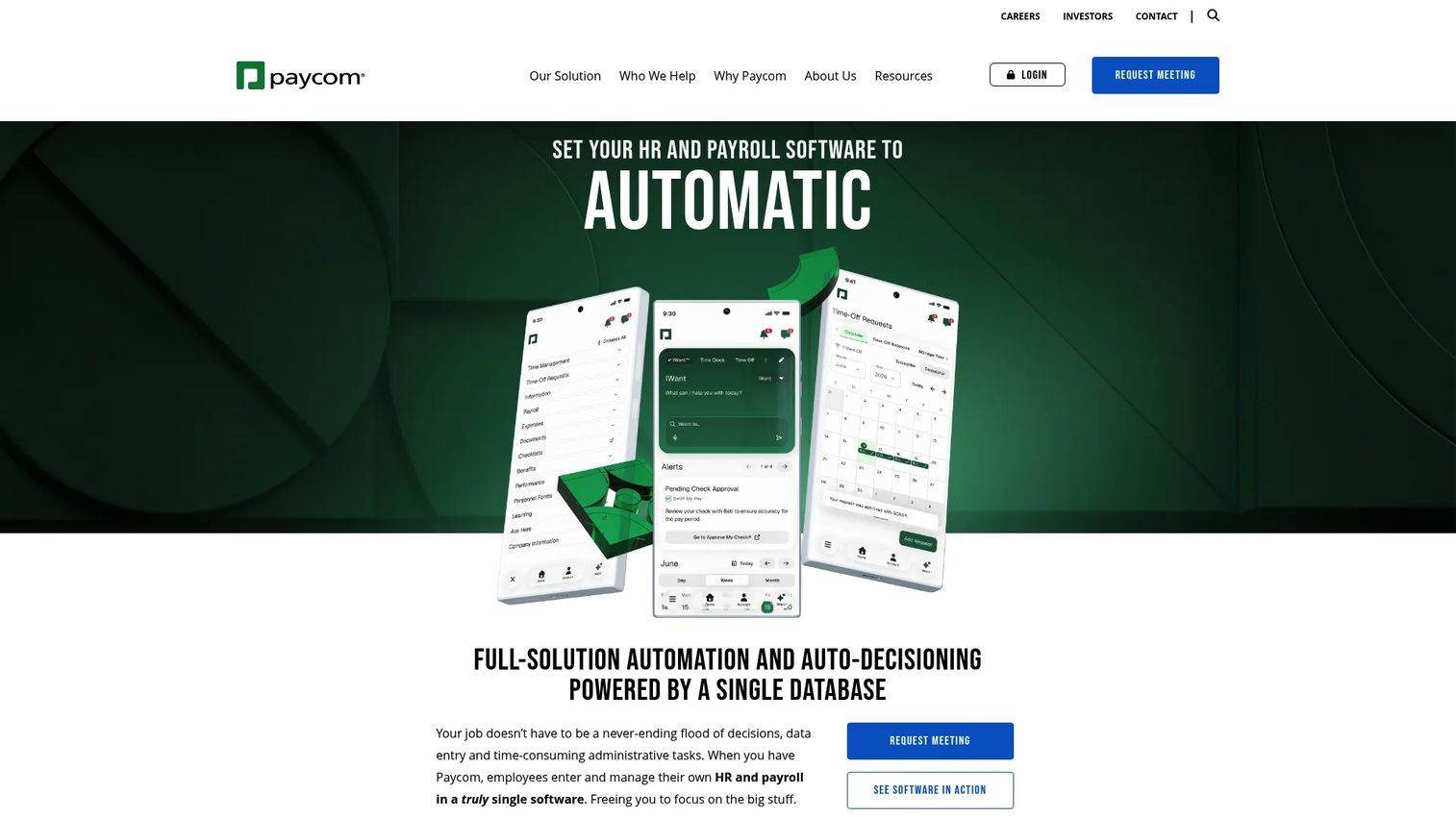
Paycom is a cloud-based HCM platform built around a single database for payroll, HR, time and labor, talent acquisition, benefits, and performance management. Its differentiating feature is employee-driven payroll, where employees verify their own pay data before processing rather than relying on payroll corrections after the fact.
Best for: Healthcare employers where payroll errors and correction cycles drain manager time.
Key features
- Single-database payroll processing
- Employee self-service with Beti payroll verification
- Time and labor management
- Applicant tracking and onboarding
- Benefits administration
Why choose Paycom: When payroll corrections are a recurring cost in management hours, Paycom's employee-driven model reduces those cycles. Employees catch errors before the payroll run rather than after, which is a meaningful operational difference for healthcare teams running complex shift schedules.
Paycom pricing: Paycom uses custom quote pricing with two package configurations: Core and Complete. The implementation fee is included in the contract. Contact Paycom for pricing based on workforce size and selected tools.
Paycom holds a 4.7/5 rating on G2.
5. MedTrainer
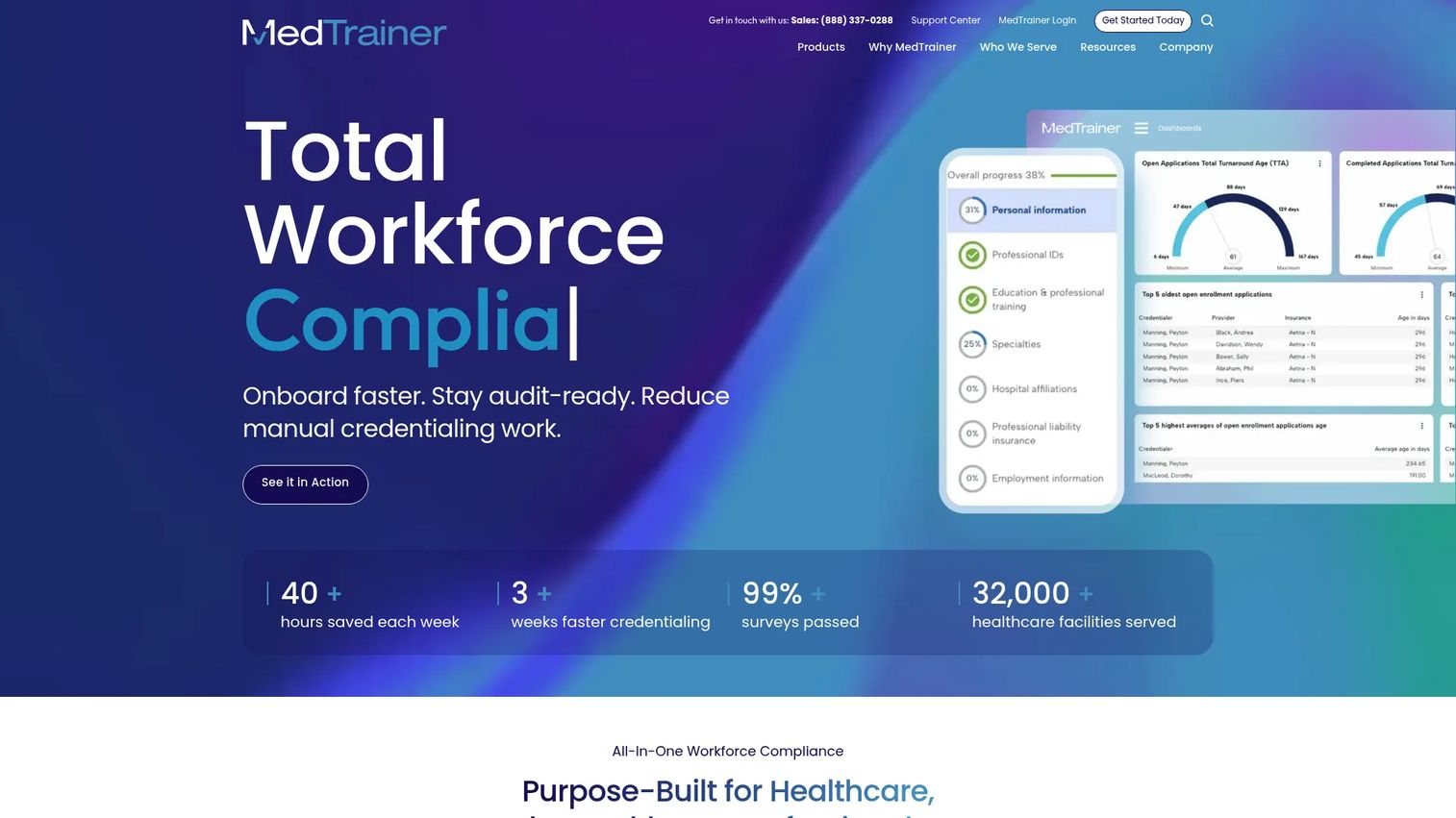
MedTrainer is a healthcare compliance and workforce readiness platform. It covers credentialing, learning management, policy management, incident reporting, and accreditation support. Unlike the broader HR platforms on this list, MedTrainer focuses specifically on the compliance and credential management layer.
Best for: Healthcare teams where credential tracking, training records, and policy compliance are the primary operational risk.
Key features
- Credential tracking with primary source verification and exclusions monitoring
- Healthcare learning management with nearly 1,000 courses including CEU content
- Policy and document management
- Incident reporting and accreditation support
- Enterprise compliance reporting
Why choose MedTrainer: Choose it when HR risk sits in certifications and training records rather than in payroll or general HRIS administration. It works well as a companion to payroll-first platforms that don't have deep credentialing functionality. Healthcare teams managing accreditation cycles, sanction screening, or provider enrollment will find dedicated tooling here that generic HR platforms don't offer.
MedTrainer pricing: MedTrainer offers Select, Premier, and Signature plans, all priced by custom quote. The cost depends on licensed user count, selected modules, and content requirements. Contact MedTrainer for a proposal.
MedTrainer holds a 4.4/5 rating on G2.
6. UKG
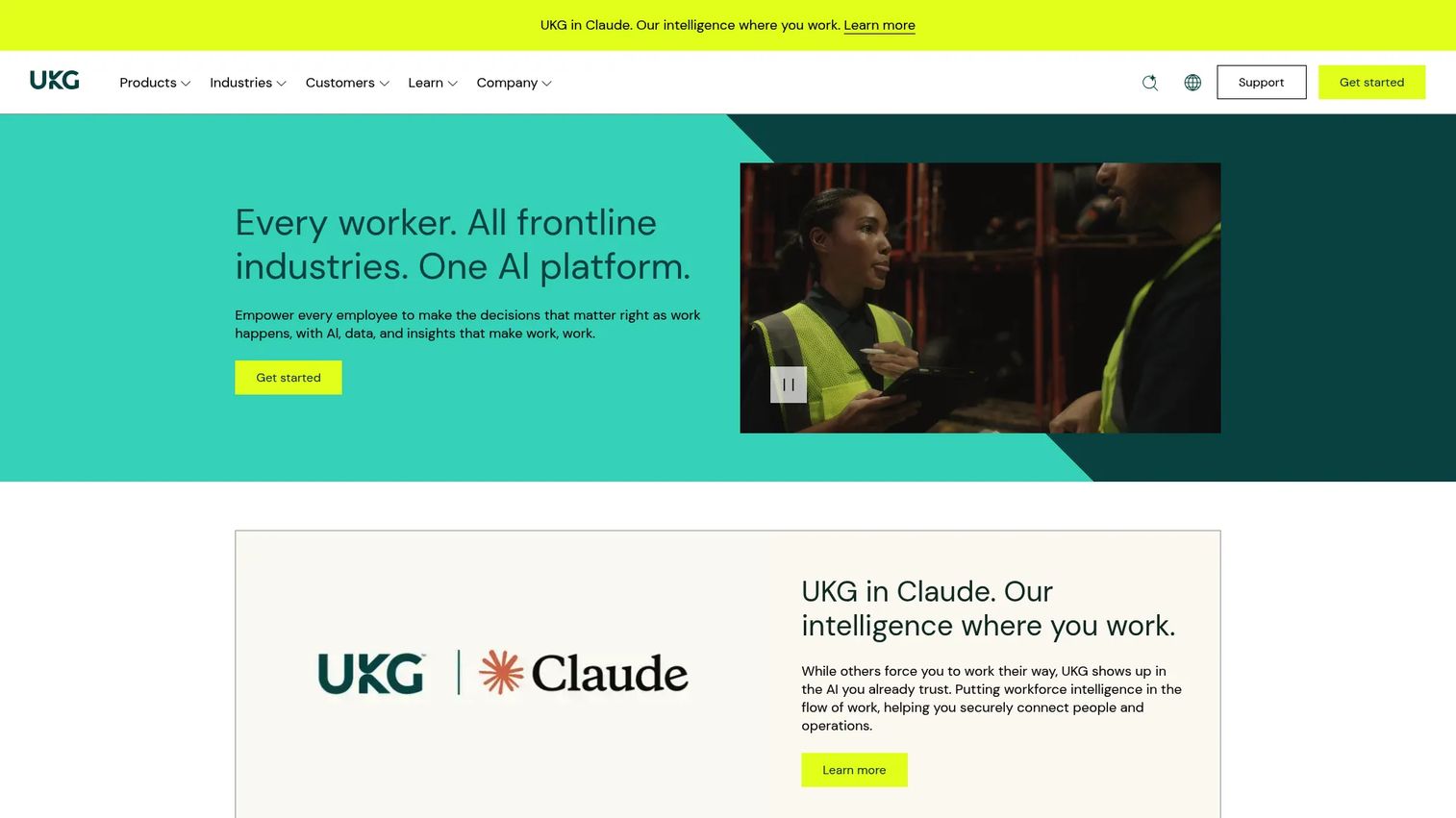
UKG provides HR, payroll, and workforce management software with deep scheduling, time, labor analytics, and frontline employee experience capabilities. For healthcare, the platform's strength is in managing large, complex workforces with variable staffing demands.
Best for: Hospitals, senior care facilities, and larger healthcare employers where labor forecasting and shift coverage are board-level concerns.
Key features
- Workforce scheduling with labor forecasting
- Time, attendance, and absence management
- Payroll and HR administration
- Labor analytics and reporting
- Mobile employee self-service
Why choose UKG: UKG makes sense when workforce coverage and labor cost management are the primary operational problems. Its scheduling and workforce management capabilities are built for high-complexity environments. It's typically more relevant for health systems and large multi-site employers than for single-location practices. UKG Ready offers four plan tiers (Start, Core, Plus, Advanced), all requiring a personalized quote.
UKG pricing: Pricing requires a quote from UKG and varies by workforce size, selected products, and implementation scope. UKG Ready plans are available; contact UKG for current pricing.
UKG Pro holds a 4.3/5 rating on G2.
7. Workday
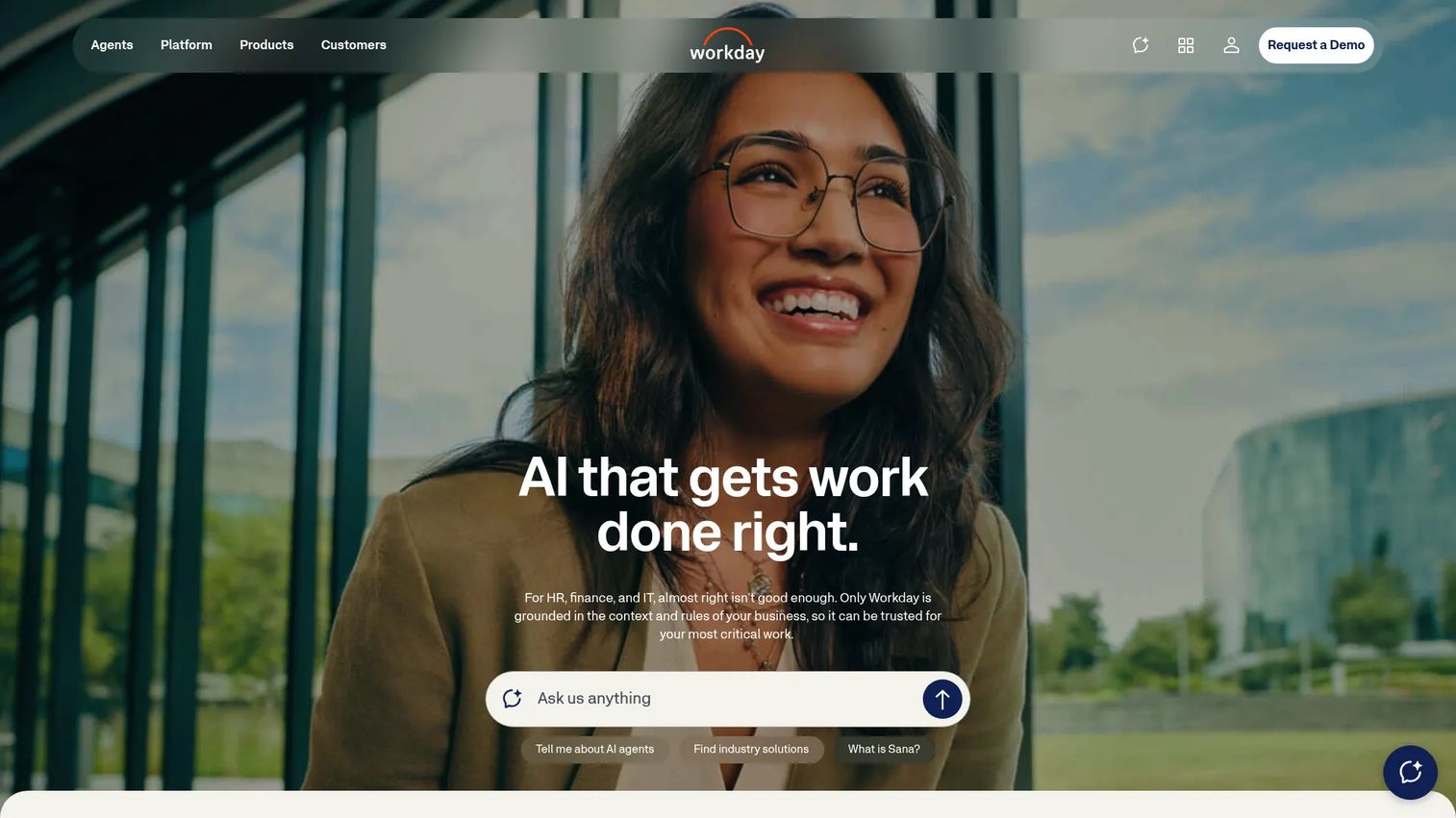
Workday is an enterprise AI platform for managing people, money, and business operations. For healthcare, it serves large health systems that need core HCM, talent, payroll, workforce planning, finance, and people analytics to work together inside an enterprise operating model.
Best for: Large health systems that need enterprise HCM and finance integrated with workforce analytics and planning.
Key features
- Core HCM and talent management
- Payroll, time tracking, and absence management
- Workforce planning and people analytics
- Financial management and planning
- Embedded AI agents and conversational self-service
Why choose Workday: When HR data, finance planning, and workforce analytics need to live in an enterprise system built for organizational complexity, Workday is the reference-tier choice. The implementation timeline and cost are substantial. This is not a fast-path option for a clinic or mid-market practice.
Workday pricing: Custom pricing only. Workday GO offers packaged configurations for mid-sized businesses. Contact Workday for pricing based on company size, modules, and implementation scope.
Workday holds a 4.2/5 rating on G2.
8. Oracle Cloud HCM
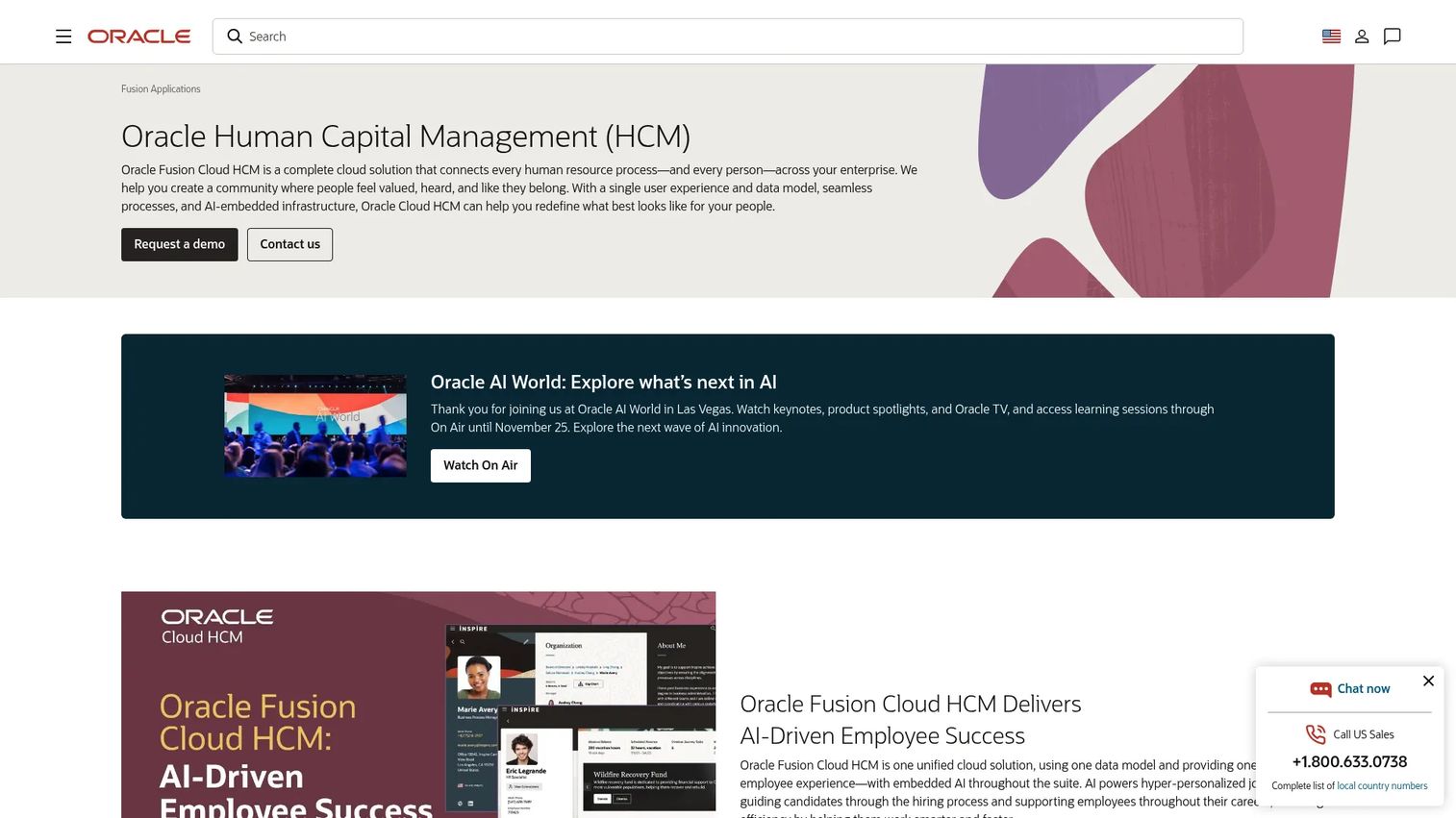
Oracle Cloud HCM is an integrated enterprise HCM suite covering core HR, recruiting, onboarding, talent management, payroll, time, workforce management, and analytics. For healthcare, it fits large organizations already running Oracle infrastructure.
Best for: Large healthcare organizations with existing Oracle systems that need enterprise-grade HR, talent, and workforce management.
Key features
- Core HR and workforce data management
- Recruiting, onboarding, and talent management
- Payroll, time tracking, and workforce scheduling
- Embedded AI tools and analytics
- Learning and performance management
Why choose Oracle Cloud HCM: The case for Oracle is strongest when the healthcare organization already has Oracle expertise and Oracle infrastructure. Implementation is demanding. For organizations outside the Oracle ecosystem, switching costs are high and other enterprise platforms often present a faster path.
Oracle Cloud HCM pricing: Oracle publishes component-level prices rather than conventional bundled plans. The base HR service starts from $15.00 per hosted employee per month, with talent management from $7.00 per hosted named user per month. Full implementation pricing requires a direct quote from Oracle.
Oracle Cloud HCM (Global Human Resources Cloud) holds a 3.8/5 rating on G2.
9. Dayforce
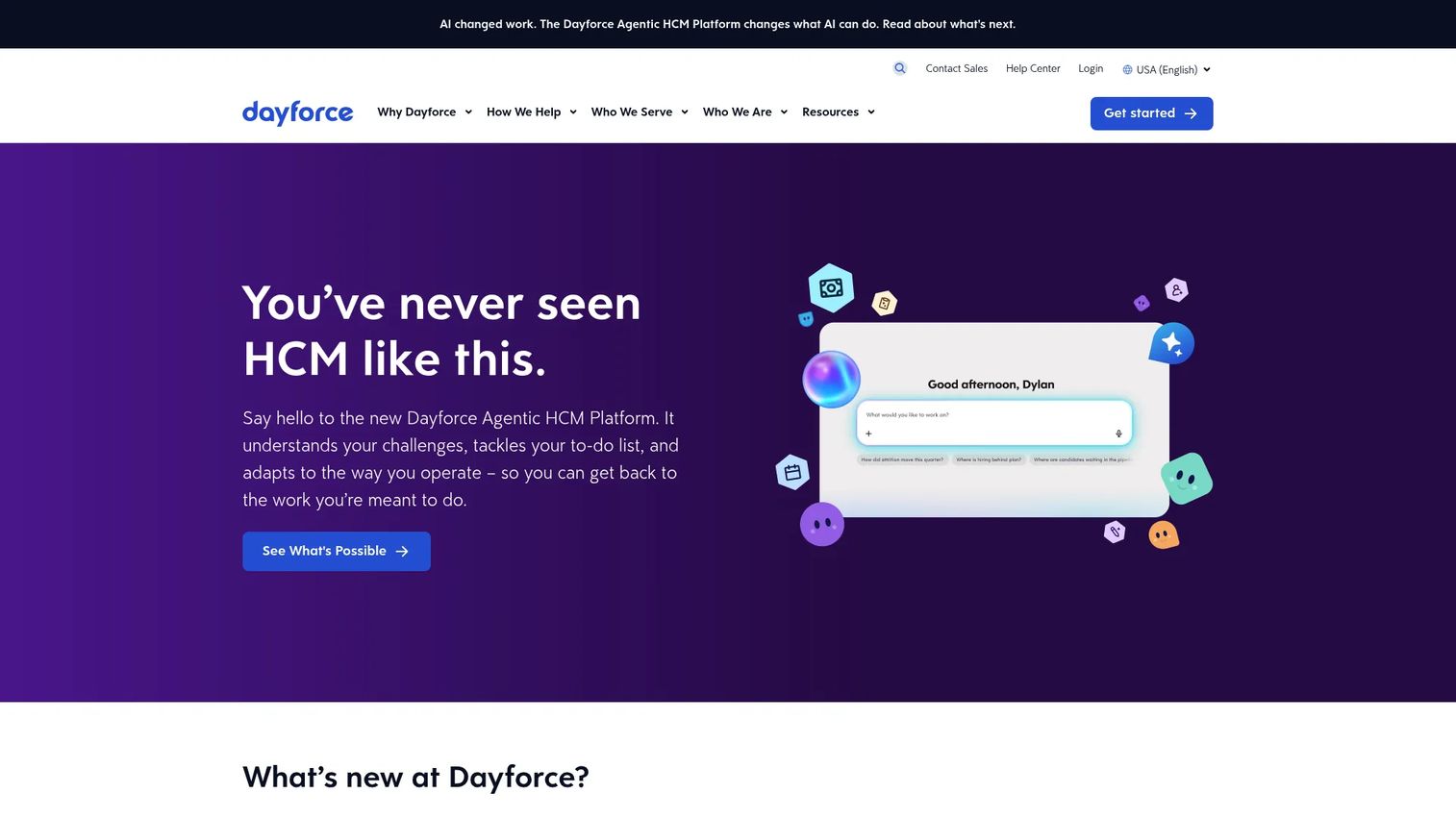
Dayforce is a global HCM platform covering payroll, workforce management, HR, benefits, talent, analytics, and AI. Its defining characteristic is continuous payroll calculation, where pay is computed in real time as time and attendance data comes in rather than in a batch run at period end.
Best for: Healthcare teams with complex pay rules, multi-location workforce management, and high demand for labor cost visibility.
Key features
- Payroll with continuous calculation and global payroll support
- Workforce management: Scheduling, time, attendance, absence, and labor planning
- Benefits administration
- Talent acquisition, performance, and learning
- People analytics and strategic workforce planning
Why choose Dayforce: When pay complexity and labor planning create recurring operational risk, Dayforce's continuous payroll model reduces the exposure. Healthcare organizations managing differentials, overtime, and variable staffing across multiple sites benefit from real-time payroll accuracy rather than finding errors after a batch run.
Dayforce pricing: Dayforce publishes MSRP pricing. The platform starts at $171.96 per employee per year, payroll at $90.72 per employee per year, and time and attendance at $54.84 per employee per year. Additional modules are priced separately.
Dayforce holds a 4.2/5 rating on G2.
10. BambooHR
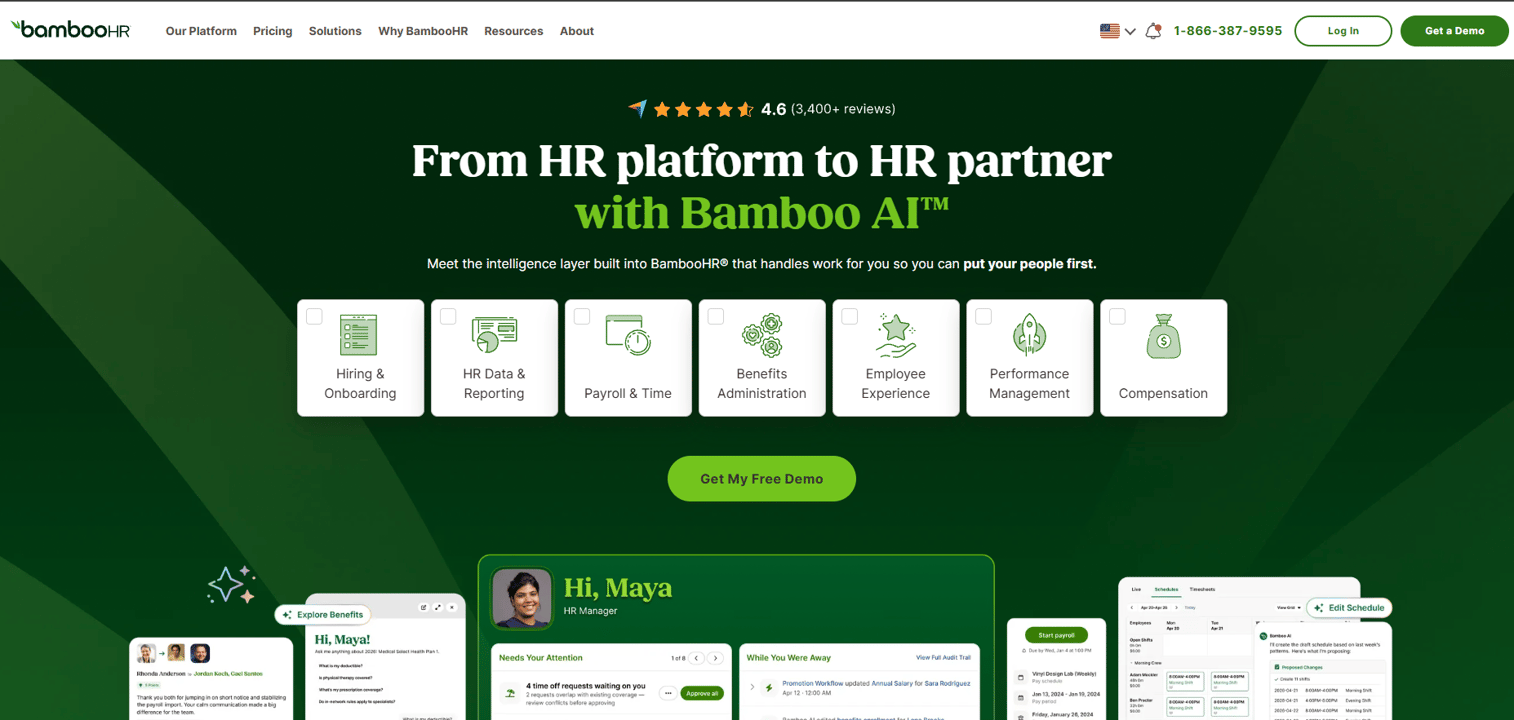
BambooHR is an HRIS platform focused on employee records, hiring, onboarding, payroll, benefits, performance management, and compensation planning. It's known for its usability and clean adoption curve, which makes it a strong fit for small and mid-sized teams building HR foundations.
Best for: Small to mid-sized clinics and healthcare practices that need a reliable HRIS and onboarding system without enterprise complexity.
Key features
- Employee records and HR reporting
- Hiring workflows and applicant tracking
- Onboarding automation and document management
- Payroll, time-off tracking, and benefits administration
- Performance management and compensation planning
Why choose BambooHR: BambooHR earns its place when the team needs dependable HR foundations and fast adoption. It won't cover deep healthcare compliance or complex scheduling, so teams with credential-heavy workflows or large shift-based operations should evaluate whether they need a companion tool or a more specialized platform.
BambooHR pricing: Plans start at $10 per employee per month (Core), with Pro at $17 per employee per month and Elite at $25 per employee per month. For teams with 25 or fewer employees, flat monthly rates apply: $250, $425, and $650 respectively.
BambooHR holds a 4.4/5 rating on G2.
11. ADP Workforce Now
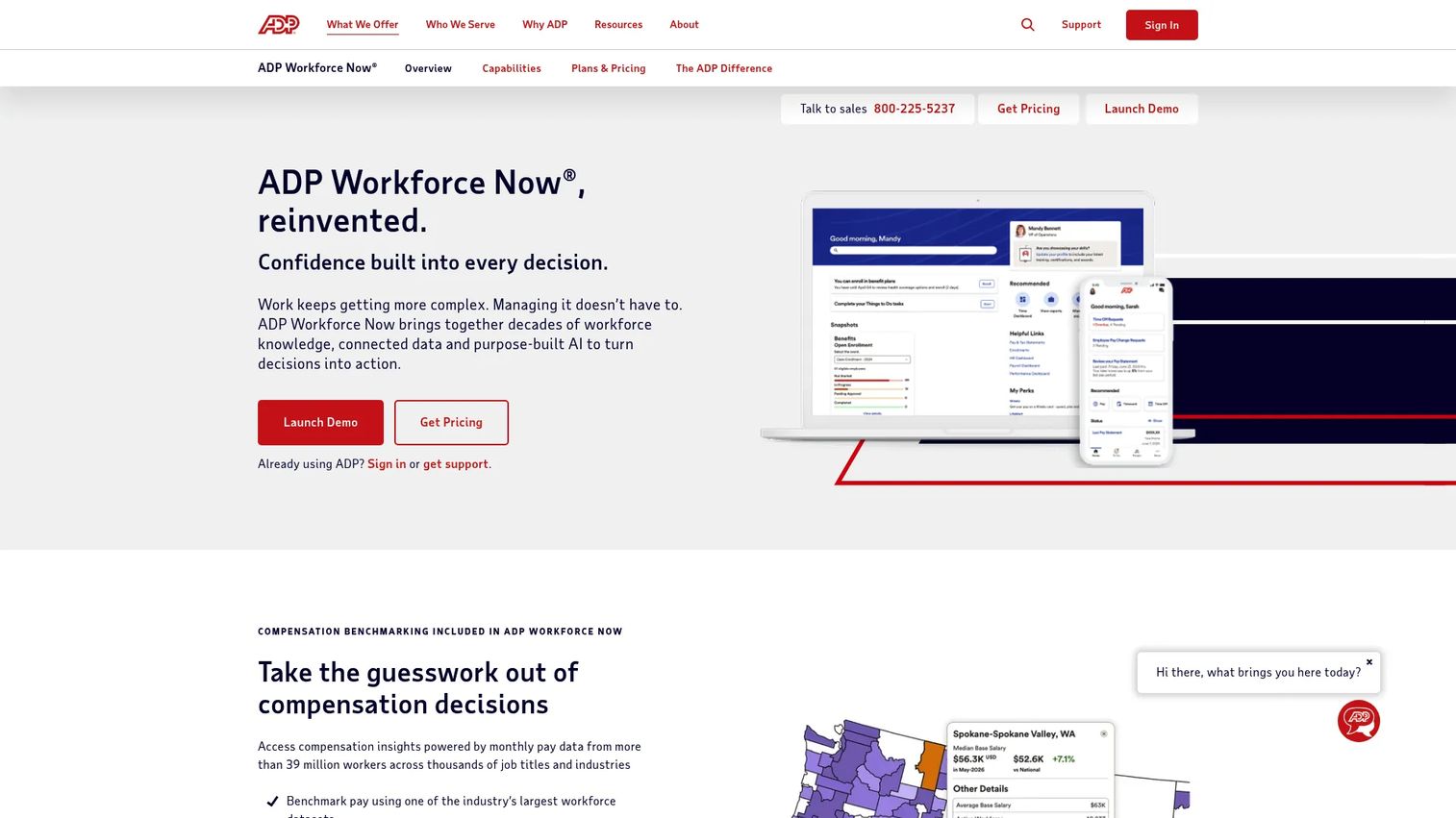
ADP Workforce Now is a payroll and HR platform for growing and mid-sized organizations. It covers payroll, tax, benefits, time, talent, compliance, and analytics. Healthcare employers use it primarily for payroll reliability and broad compliance support across multiple states.
Best for: Healthcare employers where payroll accuracy and multi-state tax compliance are the core selection criteria.
Key features
- Payroll and tax processing with real-time reporting
- Benefits administration and digital open enrollment
- Time, scheduling, and attendance management
- Talent acquisition, learning, and performance management
- AI-powered workforce analytics
Why choose ADP Workforce Now: ADP's depth in payroll and compliance is well established. For healthcare organizations scaling across states or managing complex benefits and tax situations, ADP's compliance infrastructure reduces risk. Evaluate module packaging carefully; the base plan covers payroll essentials, and cost grows with added HR and talent features.
ADP Workforce Now pricing: ADP offers Select, Plus, and Premium packages, with pricing by custom quote based on employee count, payroll complexity, and selected modules. Contact ADP for current rates.
ADP Workforce Now holds a 4.2/5 rating on G2.
12. Paycor
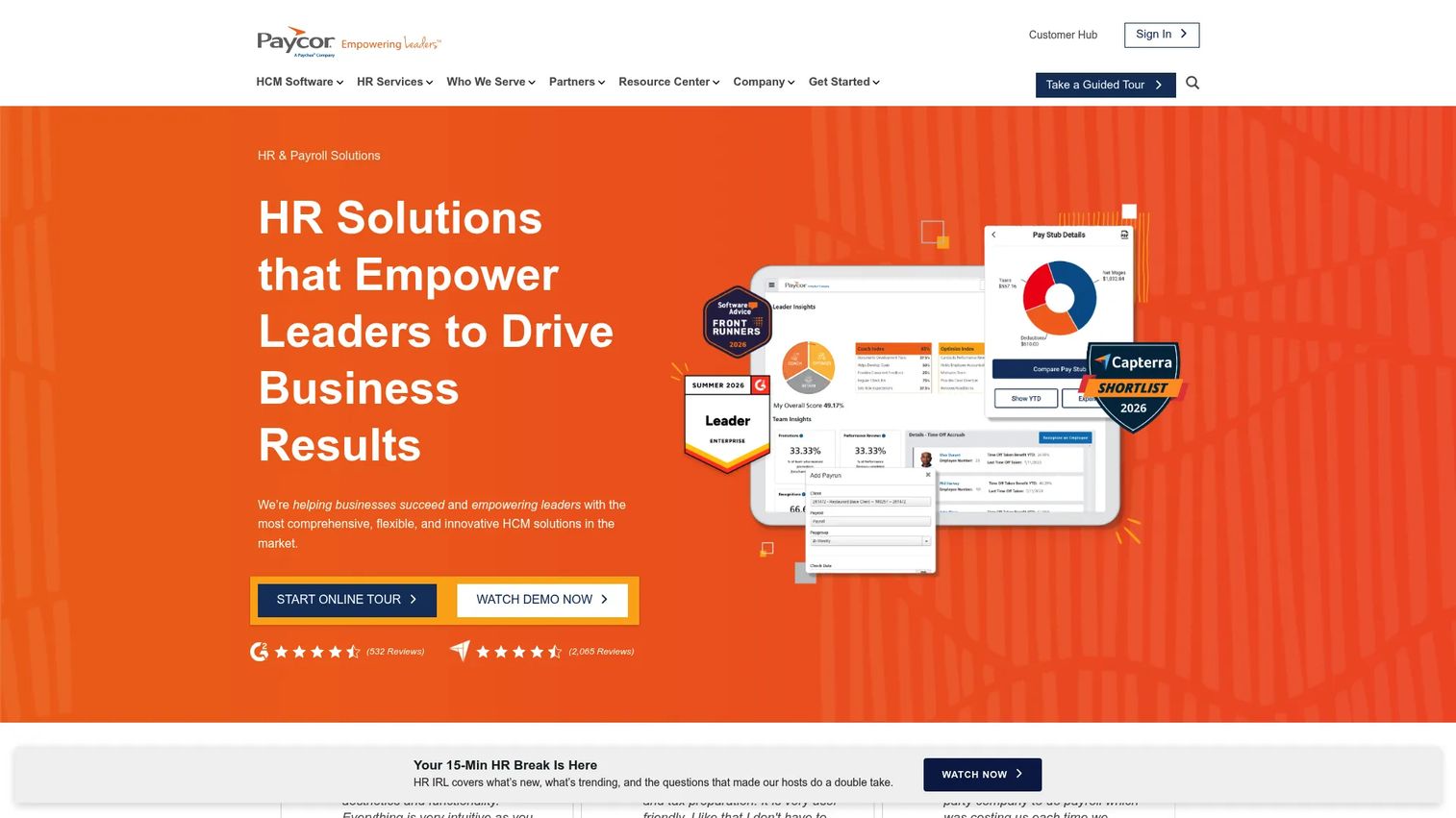
Paycor provides HR, payroll, recruiting, time and attendance, employee scheduling, benefits, and workforce analytics software. It's positioned for small and mid-market employers that want HR and payroll in a single system without committing to a large enterprise platform.
Best for: Small and mid-market healthcare employers growing beyond spreadsheets and looking for HR and payroll in one place.
Key features
- Payroll and tax services
- Recruiting and onboarding workflows
- Time, attendance, and employee scheduling
- Benefits administration
- Performance reviews and goal tracking
Why choose Paycor: Paycor gives healthcare organizations more structure than a small-business payroll tool without requiring the implementation overhead of an enterprise HCM platform. It's a practical step up for practices and clinics that have outgrown basic tools and need HR, scheduling, and payroll working together.
Paycor pricing: Published pricing for businesses under 50 employees starts at $99/month plus $5 per employee per month (Basic). Larger organizations require a custom quote. Essential, Complete, and HCM tiers add recruiting, analytics, and broader functionality.
Paycor holds a 4.0/5 rating on G2.
13. Gusto
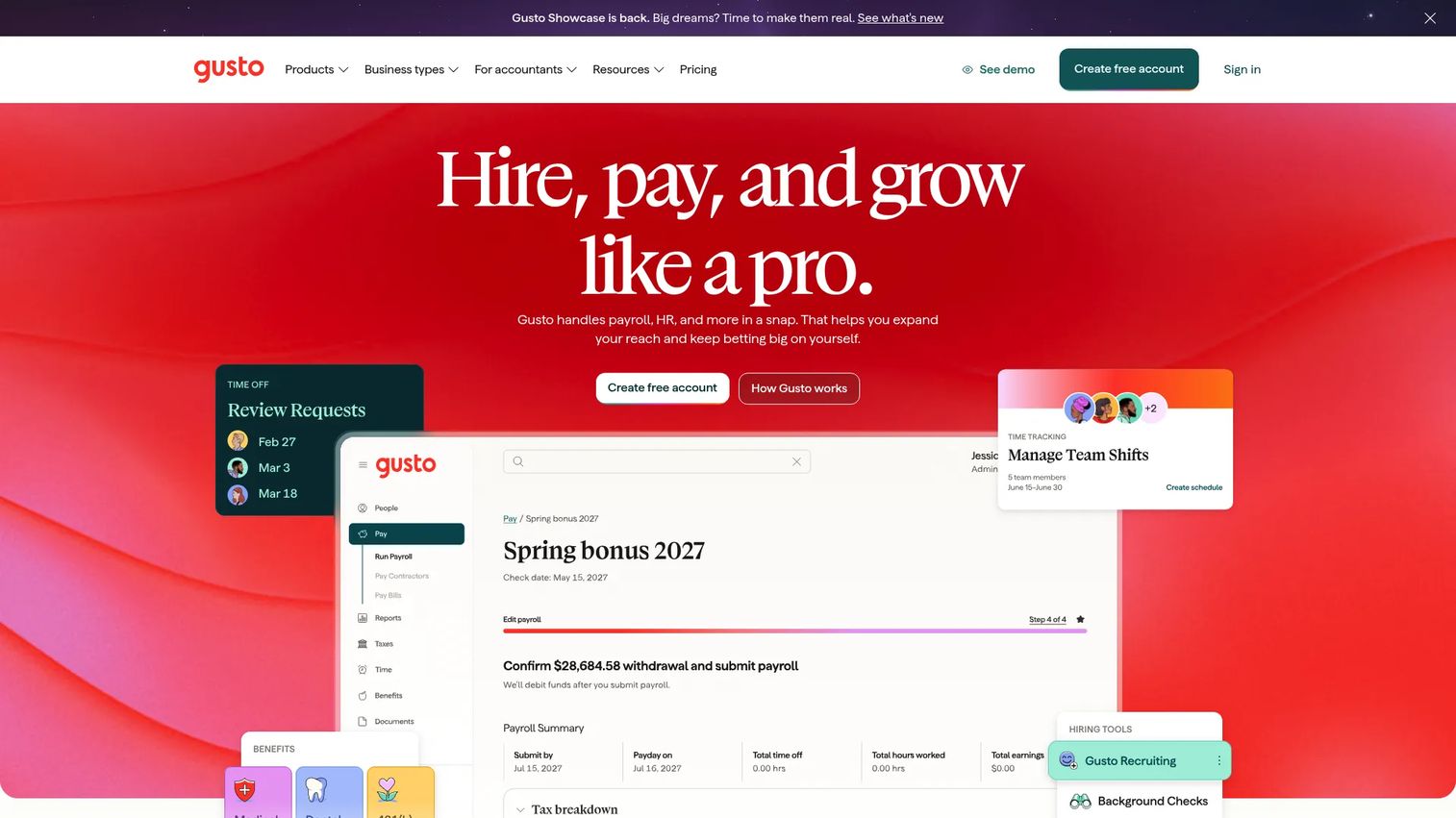
Gusto is payroll, benefits, onboarding, and HR software built for small businesses. For healthcare, it fits small clinics, wellness practices, and early-stage teams with straightforward payroll and HR needs. It's fast to set up and handles full-service payroll, contractor payments, and basic benefits administration.
Best for: Small healthcare employers that need reliable payroll and basic HR without deep compliance or scheduling complexity.
Key features
- Automated payroll with tax calculations and filings
- Employee benefits including health insurance and 401(k)
- Employee onboarding and HR documentation
- Time tracking and scheduling
- Contractor payments
Why choose Gusto: Gusto earns its place through simplicity and speed. If the team is small, the payroll is straightforward, and compliance needs are basic, Gusto delivers fast time-to-value. Healthcare organizations with credential-heavy workflows or complex scheduling requirements will outgrow it, but for a small practice that needs clean payroll and onboarding, it's a strong starting point.
Gusto pricing: Plans start at $49/month plus $6 per person per month (Simple). Plus is $80/month plus $12 per person per month. Premium is $180/month plus $22 per person per month.
Gusto holds a 4.6/5 rating on G2.
14. Zoho People
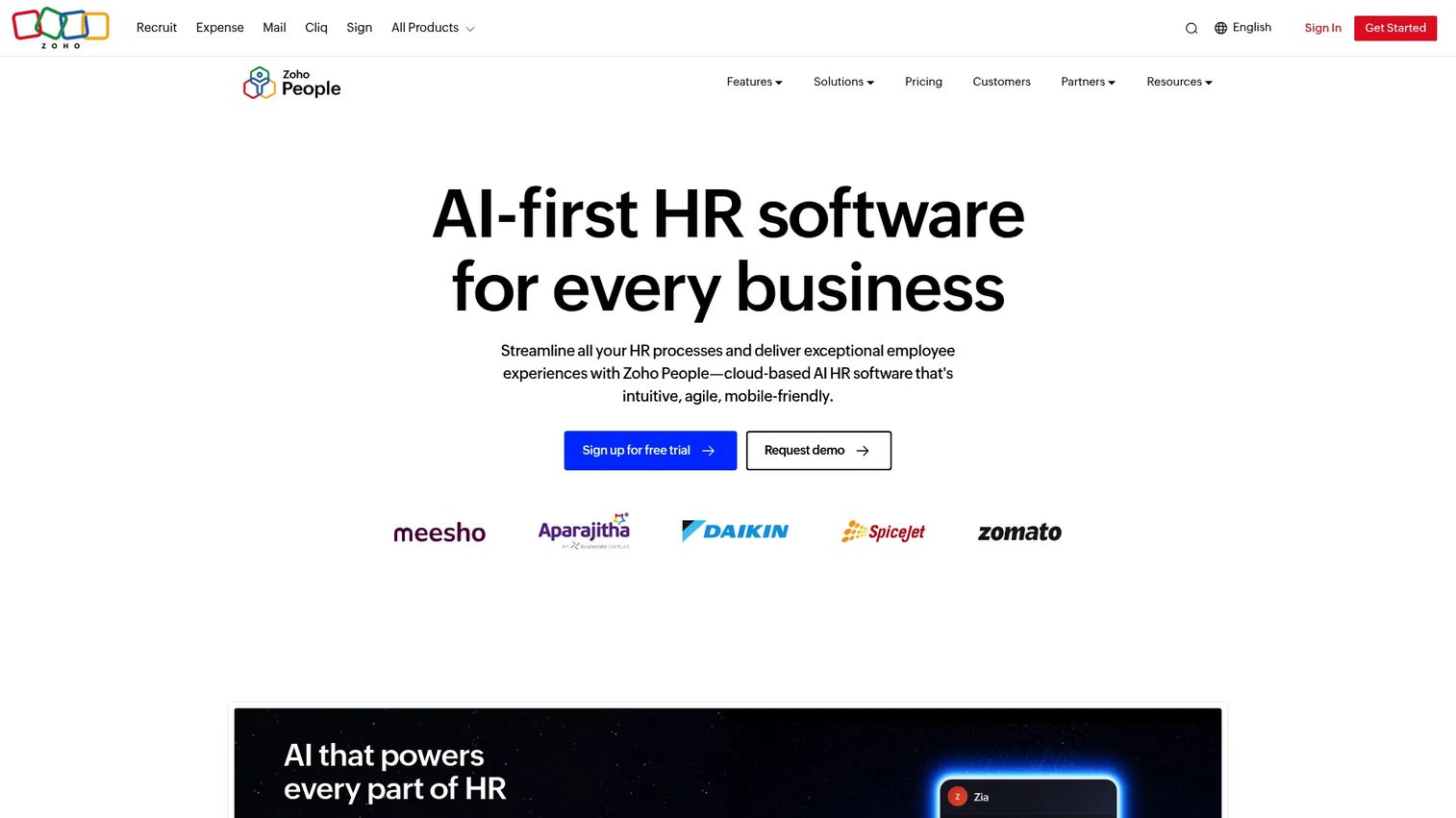
Zoho People is an AI-first HR platform covering employee records, leave management, attendance, timesheets, performance, learning, engagement surveys, and HR automation. It's part of the Zoho product family, making it a natural fit for teams already running Zoho apps.
Best for: Budget-conscious healthcare teams or those in the Zoho stack that want configurable HR workflows at low per-user cost.
Key features
- Employee database and self-service portal
- Leave, attendance, timesheets, and roster management
- Performance, OKR, and learning management
- Employee engagement surveys and HR help desk
- Workflow automation and integrations
Why choose Zoho People: Cost and flexibility are the main arguments. At $1.25 to $4.50 per user per month (billed annually), it's the most affordable per-user option on this list. Healthcare teams with complex credentialing or high-volume scheduling should validate integration capabilities before committing, as specialized healthcare workflows may require additional configuration.
Zoho People pricing: A free plan covers up to five users. Paid plans start at $1.25 per user per month (Essential HR, billed annually) through $4.50 per user per month (Enterprise). Monthly billing is also available at higher rates.
Zoho People holds a 4.5/5 rating on G2.
15. CEDR HR Solutions
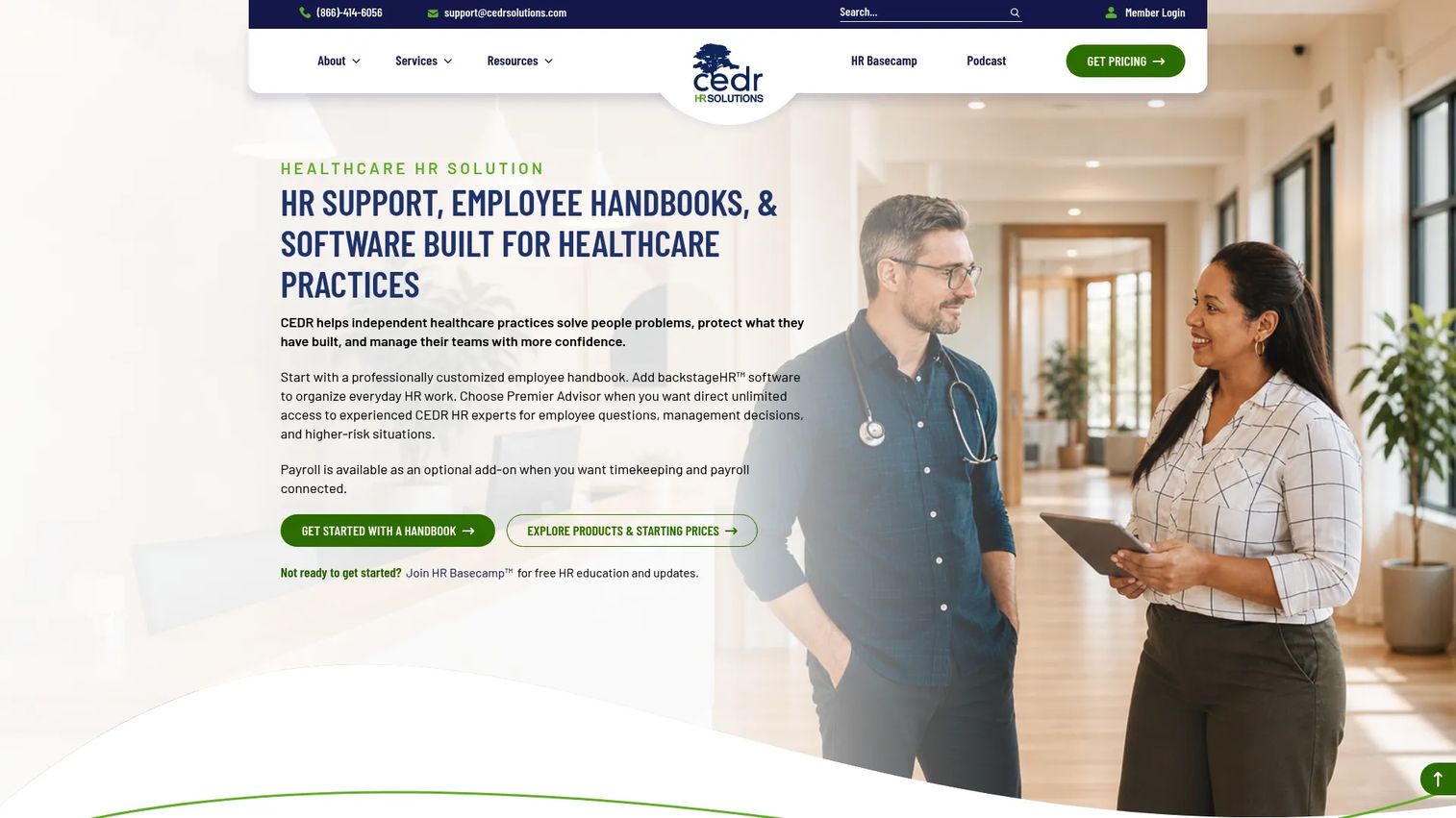
CEDR HR Solutions is HR software and advisory support built specifically for dental, medical, and wellness practices. It combines employee management tools with direct access to HR experts for issue resolution, compliance guidance, and handbook support.
Best for: Independent healthcare practices that want HR guidance alongside employee management tools, particularly dental and medical practices without in-house HR staff.
Key features
- Employee records, document storage, and electronic signatures
- Timekeeping and PTO tracking
- HIPAA training and compliance resources
- Direct access to HR advisors
- Optional white-glove payroll add-on
Why choose CEDR HR Solutions: CEDR is the right call when the practice needs help navigating HR situations, not just storing employee data. The advisory access means that when a disciplinary issue, termination question, or state-specific compliance question comes up, there's an expert on the other end. That's especially valuable for dental and medical practices without a dedicated HR team.
CEDR HR Solutions pricing: Opening Act with backstageHR software (up to five employees) starts at $120/month. Premier Advisor, which adds direct HR expert access, is $230/month and requires a CEDR handbook. A standalone employee handbook is $2,499 (or $1,999 when bundled). White-glove payroll is an additional $105/month.
Considerations when choosing healthcare HR software
Match the tool to your operating model
A single-site clinic, a 10-location dental group, and a regional health system have fundamentally different requirements. The wrong tier of platform creates implementation drag immediately. A small practice buying enterprise HCM will spend six months on configuration that doesn't improve a single HR workflow. A health system buying a small-business HRIS will hit its ceiling within the first year.
Check credential-to-schedule readiness
Credential tracking alone doesn't solve the problem if schedulers still work from a separate system. Ask specifically whether expired licenses, missing certifications, or incomplete compliance training can block scheduling eligibility. For teams where staffing compliance is an active risk, this connection matters more than the depth of any other feature.
Price the full workflow, not the base plan
The base plan price on most platforms covers payroll essentials or core HRIS. Add scheduling, compliance modules, time clocks, benefits administration, implementation services, and ongoing support, and the cost looks different. Ask vendors to quote the full configuration your team will actually need, not just the entry tier.
Validate integrations before signing
Healthcare teams often need connections to payroll processors, accounting software, identity management, benefits brokers, and clinical systems. For large organizations, ask specifically about Epic and Cerner integration paths if workforce or credentialing data needs to connect to clinical scheduling. Discovering an integration gap after signing is expensive.
Plan implementation around HR capacity
Data cleanup, policy setup, handbook migration, training record imports, and manager adoption all require internal effort. For a two-person HR team managing active hiring alongside an implementation, the rollout schedule needs to reflect actual bandwidth. Ask what the vendor's standard onboarding timeline looks like, and what your team owns versus what their implementation team handles.
Conclusion
The right healthcare HR software depends on the gap that's costing you the most. For practices that need software and HR guidance together, HR for Health and CEDR HR Solutions both provide that combination at different price points. For multi-state teams replacing several administrative tools at once, Rippling's unified approach reduces tool sprawl faster than adding another point solution.
For payroll-centered buying, Paylocity, Paycom, ADP Workforce Now, Paycor, and Dayforce each fit different workforce sizes and complexity levels. MedTrainer stands alone when credentialing and compliance training are the primary operational risk. For large health systems, Workday and Oracle Cloud HCM are the enterprise reference choices. Smaller teams should evaluate BambooHR, Gusto, and Zoho People, which offer clean foundations without implementation overhead.
Forward this list to your Head of People or COO with a note on which operational problem is most urgent. That framing will cut the shortlist to three vendors worth demoing.
For healthcare software buyers also evaluating adjacent tools, our guides on benefits administration software, applicant tracking system software, and ACA compliance software cover the adjacent categories in the same format.
FAQs
Healthcare HR software is human resources software built to manage employee records, payroll, shift scheduling, credential tracking, compliance documentation, recruiting, onboarding, benefits, and workforce reporting for healthcare organizations. It differs from generic HR software in its support for credential expiration alerts, healthcare-specific payroll rules, shift-based scheduling, and audit trail requirements tied to regulatory compliance.
Core features include employee records and HRIS, payroll with overtime and differential support, time and attendance tracking, credential and license management with expiration alerts, shift scheduling, training and compliance documentation, employee self-service, and integration with payroll, accounting, and clinical systems. The right feature priority depends on whether your biggest operational gap is in payroll, compliance, scheduling, or onboarding.
Pricing varies significantly by tool category and organization size. Small-practice platforms like CEDR start at $120/month and Gusto starts at $49/month plus per-person fees. Mid-market tools like BambooHR start at $10 per employee per month, and Paycor starts at $99/month plus per-employee fees. Enterprise platforms like Workday, Oracle, Rippling, Paylocity, and UKG use custom quote pricing tied to employee count, selected modules, locations, implementation, and support requirements.
HR for Health is the strongest option when advisory support matters alongside software. CEDR HR Solutions serves dental and medical practices specifically, with direct HR expert access starting at $120/month. Gusto suits very small teams that need clean payroll and basic onboarding. BambooHR works well when employee records, onboarding workflows, and performance management are the priority, without deep compliance complexity.
UKG, Workday, Oracle Cloud HCM, and Dayforce are the platforms built for this scale. UKG focuses on workforce management and scheduling depth. Workday integrates enterprise HCM with finance and workforce planning. Oracle Cloud HCM suits organizations already running Oracle infrastructure. Dayforce's continuous payroll model fits health systems with complex, high-volume pay rules across multiple locations.
Many healthcare HR tools include credential tracking for license expiration, certifications, training completion, and compliance documents. The depth varies significantly. Dedicated platforms like MedTrainer include primary source verification, exclusions monitoring, and provider enrollment. Full HCM suites like Workday and Dayforce include credential management but as one module among many. When asking vendors, verify specifically whether expired credentials can trigger scheduling blocks or automated alerts, not just whether the data is stored.
Not every healthcare HR tool requires a direct EHR integration. For small practices, payroll, accounting, and benefits connections typically cover the operational workflow. For larger health systems, workforce data, credential status, and clinical scheduling may need to connect to EHR platforms. If your organization runs Epic or Cerner, ask vendors specifically about documented integration paths before shortlisting.
Healthcare HR software centralizes the records that compliance audits typically examine: Employee documents, training completion, credential status, policy acknowledgments, time records, and HR action documentation. Platforms like MedTrainer focus specifically on compliance workflows and audit-ready reporting. Broader HCM platforms handle compliance as part of the larger HR record. Software supports compliance processes but does not substitute for legal, HR, or regulatory counsel on specific obligations.