A single vehicle off the road costs more than the repair. It costs the missed job, the idle driver, the rescheduled route, and the customer who calls a competitor. Multiply that across a fleet and the leak is real: unplanned downtime, maintenance managed in spreadsheets, fuel spend nobody can explain, and compliance gaps that surface during an audit instead of before one.
The market reflects how much this matters. Fortune Business Insights (2024) values the global fleet management software market at $38.28B in 2026, growing to $152.89B by 2034 at an 18.9% CAGR. North America alone accounted for 38.6% of demand in 2025, at a market size of $12.48B. That growth is not vendors chasing hype. It is operations teams trying to stop the bleed.
If you run or evaluate a fleet, the pressure is specific. You need to cut downtime, control maintenance and fuel costs, keep drivers compliant, and get visibility into where vehicles are and how they are being used. The tools below approach those jobs differently. Some lead with maintenance depth. Some lead with real-time telematics. Some fit a five-truck operation better than a five-hundred-truck one.
This kind of category-by-category evaluation is common when teams build out an operational stack, the same way they compare business intelligence platforms or contract lifecycle management software. The goal here is the same: cut through feature checklists and match a tool to the outcome you actually need.
What's inside
This guide is for operations leaders, fleet managers, small business owners, and procurement teams comparing fleet management platforms before booking a demo or trial. It covers eight tools spanning maintenance-first systems, telematics-heavy platforms, and budget GPS tracking.
We selected and ranked tools on four criteria that matter to a metrics-driven buyer:
- Breadth of workflow coverage: maintenance, tracking, compliance, and reporting in one system.
- Maintenance and tracking depth: how far the tool goes beyond basic location.
- Pricing transparency: whether you can find a real number before a sales call.
- Fit by fleet size: small business simplicity versus enterprise configurability.
We used verified pricing and G2 ratings where publicly available, and wrote around any figure a vendor gates behind sales.
TL;DR
Short on time? Here is the fast version, matched to what you are optimizing for.
- Best overall for full fleet operations: Fleetio, for maintenance-heavy control with strong inspections and asset tracking.
- Best for unified tracking, safety, and operations: Samsara, for large physical operations teams.
- Best for connected telematics and workflow automation: Motive, for compliance and driver safety at scale.
- Best for reporting and integrations: Geotab, for analytical teams that want configurable fleet data.
- Best for route, driver, and field visibility: Verizon Connect, for day-to-day movement oversight.
- Best for small-business-friendly tracking: Azuga, for smaller fleets wanting core functionality.
- Best for compliance-heavy or mixed-asset teams: Teletrac Navman, for regulated operations.
- Best for budget-conscious GPS tracking: Rhino Fleet Tracking, when tracking is the core need.
What is fleet management software?
Fleet management software is a system that helps organizations track, maintain, and manage their vehicles, drivers, and assets from a single platform. It replaces the patchwork of spreadsheets, paper inspection forms, and disconnected GPS units that most fleets start with.
A complete fleet management system usually covers five core modules:
- Vehicle and asset tracking: real-time GPS location, utilization, idle time, geofencing, and exception alerts across cars, trucks, trailers, and equipment.
- Preventive maintenance: service scheduling triggered by mileage, engine hours, or telematics data, plus work orders and full service history.
- Inspections and compliance: driver vehicle inspection reports (DVIR), electronic logging devices (ELD), hours of service (HOS) tracking, and audit-ready documentation.
- Fuel and cost control: fuel card integration, spend tracking, and cost-per-mile reporting to surface where money leaks.
- Reporting and dashboards: operational visibility, driver scorecards, and analytics that turn raw telematics into decisions.
One distinction confuses buyers often: fleet management software versus fleet maintenance software. Fleet maintenance software focuses narrowly on service scheduling, work orders, parts, and repair history. Full fleet management software includes that maintenance layer but adds tracking, telematics, compliance, and driver management on top. If your only pain is service follow-up, a maintenance-first tool may be enough. If you need location, compliance, and cost control together, you want the broader category. This same layering shows up in adjacent categories, from audit management software to contract management platforms, where a focused tool and a full suite solve overlapping but different problems.
When to use fleet management software
Not every fleet needs every module on day one. Here is how to match the software to your actual pain.
Track vehicles and reduce blind spots
Use fleet tracking software when dispatch, operations, or field teams need real-time visibility into where vehicles are and how they are being used. The value shows up in route visibility, utilization data, idle time reduction, and exception handling when a vehicle strays off a planned route or sits too long. If you are guessing where your trucks are, or reconstructing routes after the fact, tracking is the first gap to close.
Prevent downtime with maintenance automation
Use fleet maintenance software when preventive maintenance schedules, service reminders, and work orders still live in spreadsheets or someone's memory. The strongest systems trigger service off mileage, engine hours, or telematics data, then generate work orders and hold a complete service history. This is where downtime reduction becomes measurable: catch the issue on a schedule instead of on the shoulder of a highway.
Improve compliance and safety
Use a fleet management solution when inspections, ELD and HOS logging, DVIR, or driver scorecards are operational pain points. Tying software to audit readiness matters most for regulated fleets, where a missing log is a fine and a failed inspection is downtime. Look for issue tracking that turns a flagged inspection into a scheduled repair, not just a record.
Comparison table
The table below sorts the eight tools by relevance to full fleet management. A note on how to read it: pricing is per vehicle per month where published, and several enterprise platforms gate pricing behind a sales conversation, which is normal for telematics vendors bundling hardware. G2 ratings reflect current public listings; where a vendor's rating was not clearly verifiable from a primary source, we left it out rather than guess.
| # | Product | Intent | Key use case | Pricing | G2 rating |
|---|---|---|---|---|---|
| 1 | Fleetio | Maintenance-first fleet operations | PM scheduling, inspections, asset tracking | From $4/vehicle/mo | 4.6/5 |
| 2 | Samsara | Unified operations and safety | Telematics, dash cams, automation | Quote-based | 4.5/5 |
| 3 | Motive | Connected telematics and compliance | ELD, driver safety, workforce | Quote-based | 4.4/5 |
| 4 | Geotab | Reporting and integrations | Configurable telematics, dashboards | Quote-based | 4.5/5 |
| 5 | Verizon Connect | Tracking and route oversight | Live tracking, driver monitoring | Quote-based | Not published |
| 6 | Azuga | Small-business fleet tracking | GPS, safety scoring, coaching | From $25/vehicle/mo | 4.7/5 |
| 7 | Teletrac Navman | Compliance and mixed assets | Telematics, ELD, asset visibility | Quote-based | 3.6/5 |
| 8 | Rhino Fleet Tracking | Budget GPS tracking | Real-time tracking, alerts, reports | From $16.95 | 3.5/5 |
Teams comparing operational tooling across departments often run a similar grid for event management software or marketing resource management platforms. Same principle: line up intent, use case, price, and proof, then shortlist.
1. Fleetio
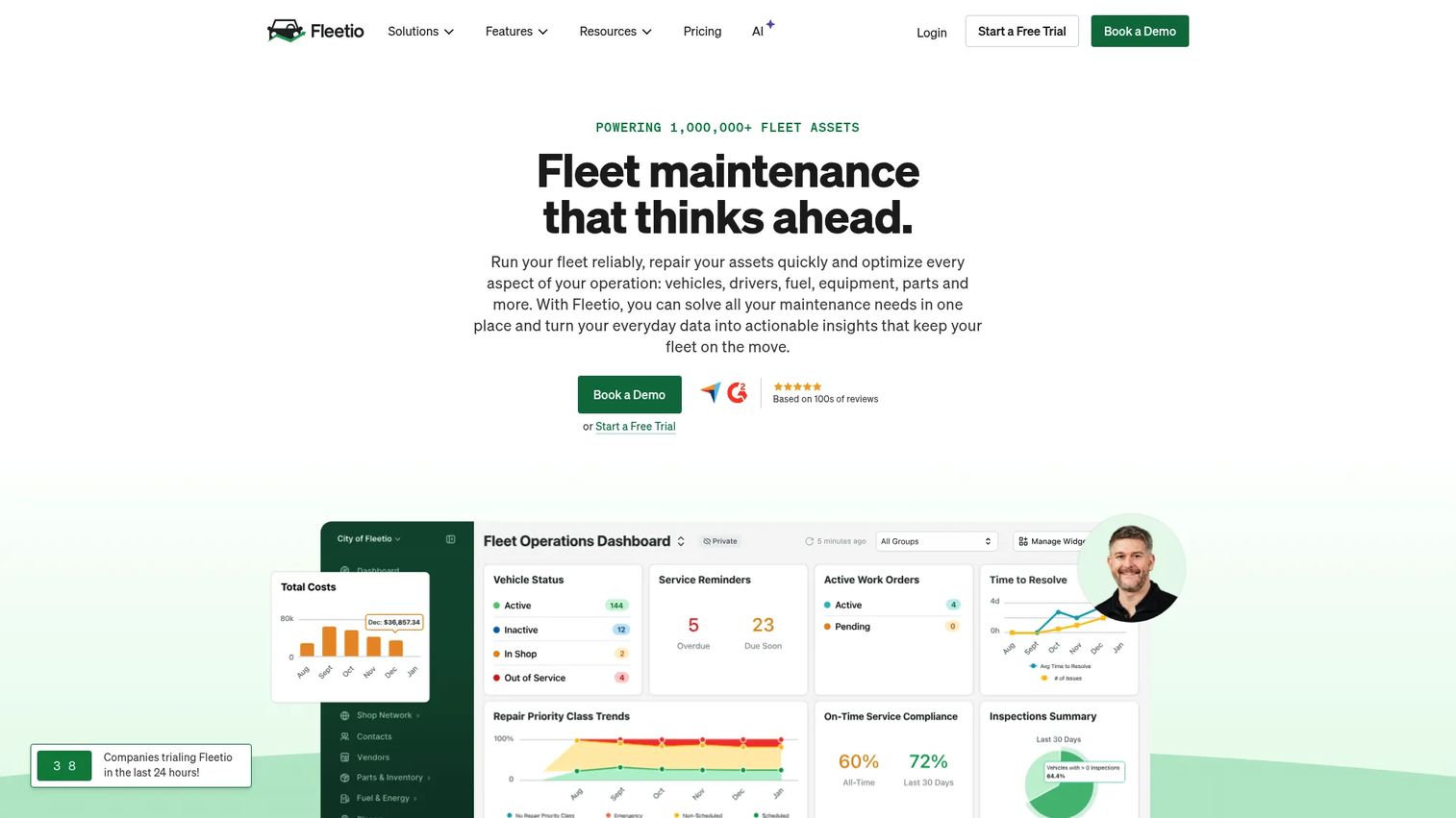
Fleetio is a cloud-based fleet maintenance platform for managing vehicles, equipment, inspections, fuel, parts, and service in one system. It leans harder into maintenance and asset control than most tracking-first competitors, which makes it a strong fit for teams whose biggest leak is unplanned downtime and disorganized service history. If your fleet lives and dies by whether the next PM gets scheduled, this is the tool built for that job.
Best for: fleet teams that need maintenance, inspection, and asset tracking together in one system.
Key strengths
- Preventive maintenance scheduling: trigger service off mileage or engine hours, then generate work orders automatically.
- Inspections and service history: run digital vehicle inspections and hold a complete, auditable repair record.
- Asset, parts, and fuel management: track parts inventory, fuel spend, and equipment alongside vehicles.
Why choose Fleetio: choose it when maintenance and operational control matter more than raw location tracking. It is the strongest pick for teams that want work orders, inspections, and service history to drive downtime reduction, rather than just watching dots move on a map. It pairs well with a dedicated telematics feed for fleets that need both.
Fleetio pricing: three per-vehicle plans. Essential starts at $4 per vehicle per month billed annually, or $5 billed monthly. Professional is $7 per vehicle per month, billed annually. Premium is $10 per vehicle per month, billed annually. There is a 14-day free trial but no permanent free tier.
2. Samsara
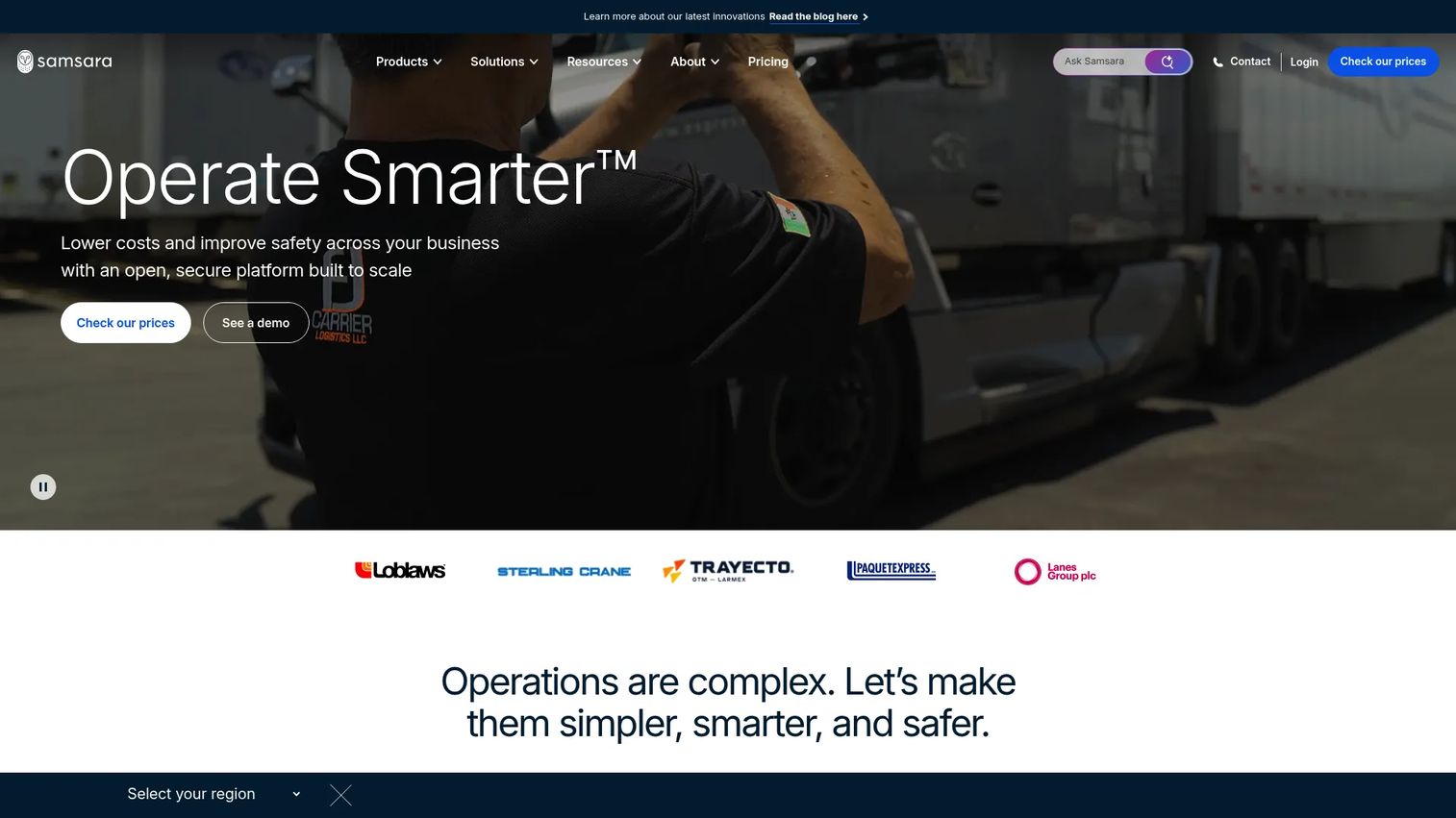
Samsara is a connected operations platform spanning fleets, equipment, sites, and people. It is built for large physical operations teams that want real-time visibility, video-based safety, and automation across the whole operation, not just the vehicles. Where maintenance-first tools start with the wrench, Samsara starts with the network of sensors feeding a live operational picture.
Best for: large fleets and physical operations teams needing safety, visibility, and automation in one platform.
Key strengths
- AI-powered dash cams and video safety: capture and review incidents with 45+ safety risk detections.
- Connected telematics: live GPS, vehicle diagnostics, and equipment monitoring across the operation.
- Platform automation and integrations: AI agents and integrations that push operational data into existing workflows.
Why choose Samsara: choose it when your fleet program is tightly tied to real-time oversight and driver safety, especially at scale. The video safety layer and breadth of connected sensors make it a fit for operations leaders who manage more than vehicles. It suits teams that treat safety scoring and incident review as core to the program.
Samsara pricing: Samsara uses a quote-based model driven by vehicle and asset count, with pricing that typically bundles hardware. Public numeric pricing is not displayed on its site, so request a quote scoped to your fleet size to compare accurately against per-vehicle competitors.
3. Motive
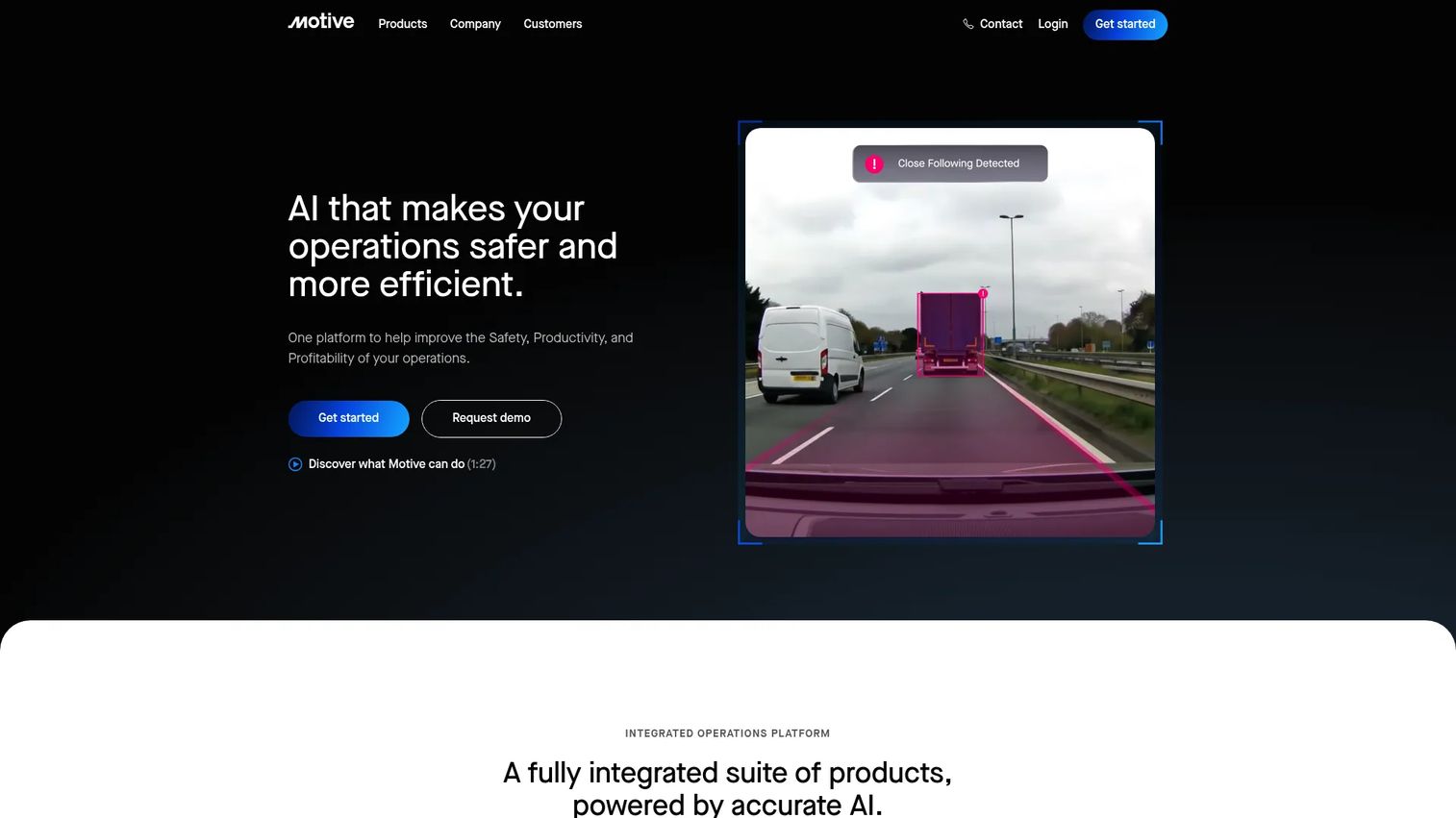
Motive is a fleet operations platform covering safety, telematics, compliance, maintenance, spend, and workforce management. It is built for commercial fleets that want driver safety and compliance handled inside one integrated system rather than stitched across point tools. For operations that live under ELD and HOS rules, that consolidation is the appeal.
Best for: commercial fleets needing an integrated operations platform with strong compliance and safety.
Key strengths
- Driver safety: AI-driven detection and coaching workflows tied to driver behavior.
- Fleet telematics: real-time tracking and vehicle diagnostics across the fleet.
- Compliance and workforce management: ELD, HOS support, and tools that extend to the broader workforce.
Why choose Motive: choose it when compliance and operational accountability sit at the top of your priority list. The combination of telematics, safety, and workforce management makes it strong for fleets that need driver behavior and regulatory logging in the same platform. It fits teams that want spend and compliance data feeding the same dashboards.
Motive pricing: Motive's public pricing page routes to a contact form rather than displaying numeric prices. Pricing is quote-based and typically scoped to fleet size and hardware needs, so plan on a sales conversation to get a figure you can budget against.
4. Geotab
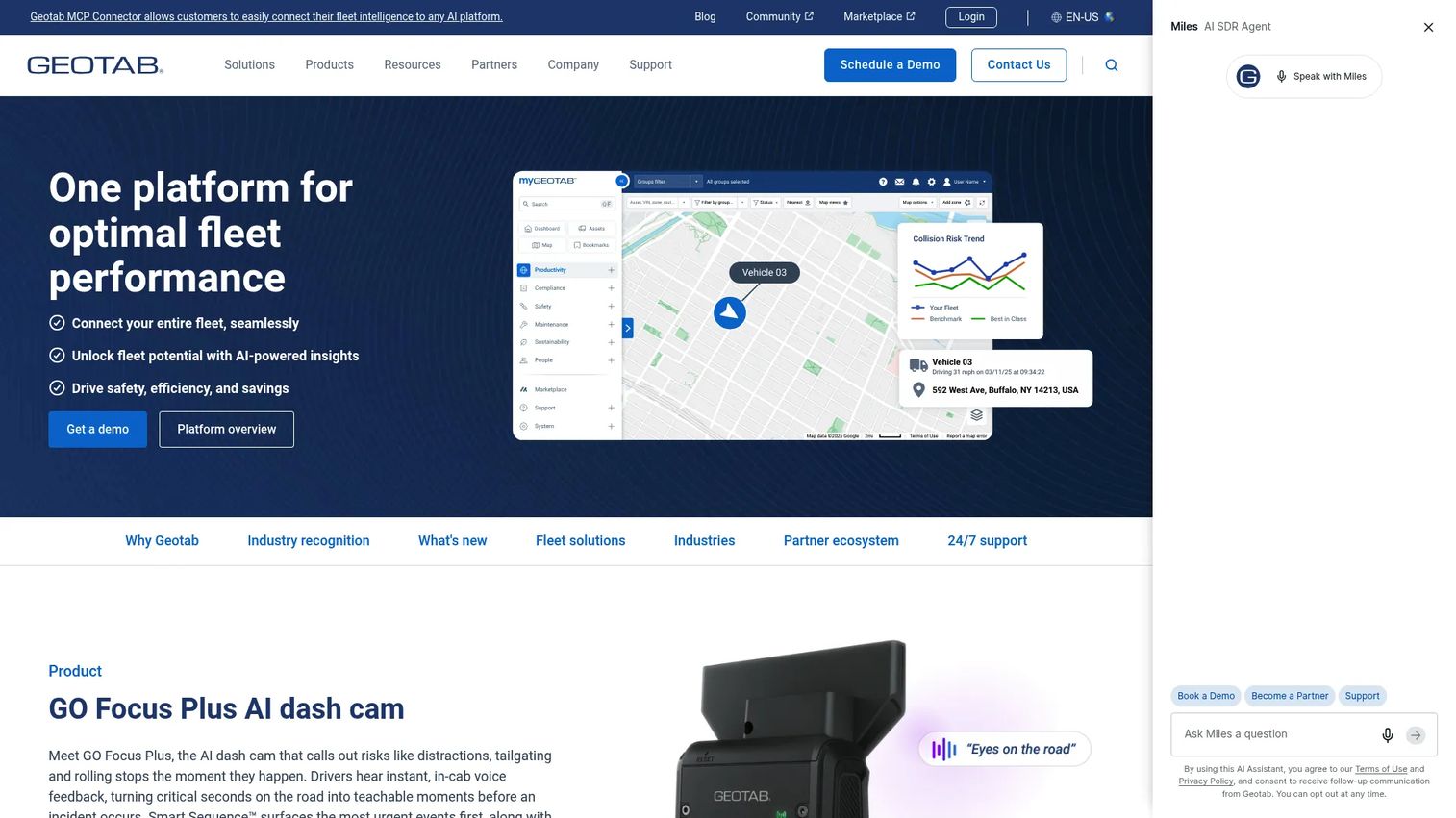
Geotab is an AI-driven connected fleet management platform built around telematics, safety, compliance, and asset tracking, with unusually deep reporting and integration options. Its MyGeotab software and open marketplace make it the choice for analytical teams that want to shape fleet data to their own questions rather than accept a fixed dashboard.
Best for: mid-market to enterprise fleets needing configurable telematics and compliance workflows.
Key strengths
- Customizable reporting: dashboards, benchmarking, and reports you can configure to the metrics you track.
- Open-platform integrations: an API, SDK, and marketplace for extending the platform.
- Telematics-driven insights: vehicle tracking, driver behavior monitoring, and ELD/HOS/DVIR compliance support.
Why choose Geotab: choose it when reporting depth and integration flexibility outweigh out-of-the-box simplicity. Geotab fits data-minded teams that want to route fleet telematics into their existing stack and build custom views. It publicly lists software packages, including a worldwide GO Plan and North American Basic, Regulatory, Pro, and ProPlus tiers.
Geotab pricing: Geotab lists plan names and packages publicly but shows a "Get prices" prompt rather than numeric pricing, which is typical for telematics vendors bundling hardware. Expect quote-based pricing scoped to your plan tier and device count.
5. Verizon Connect
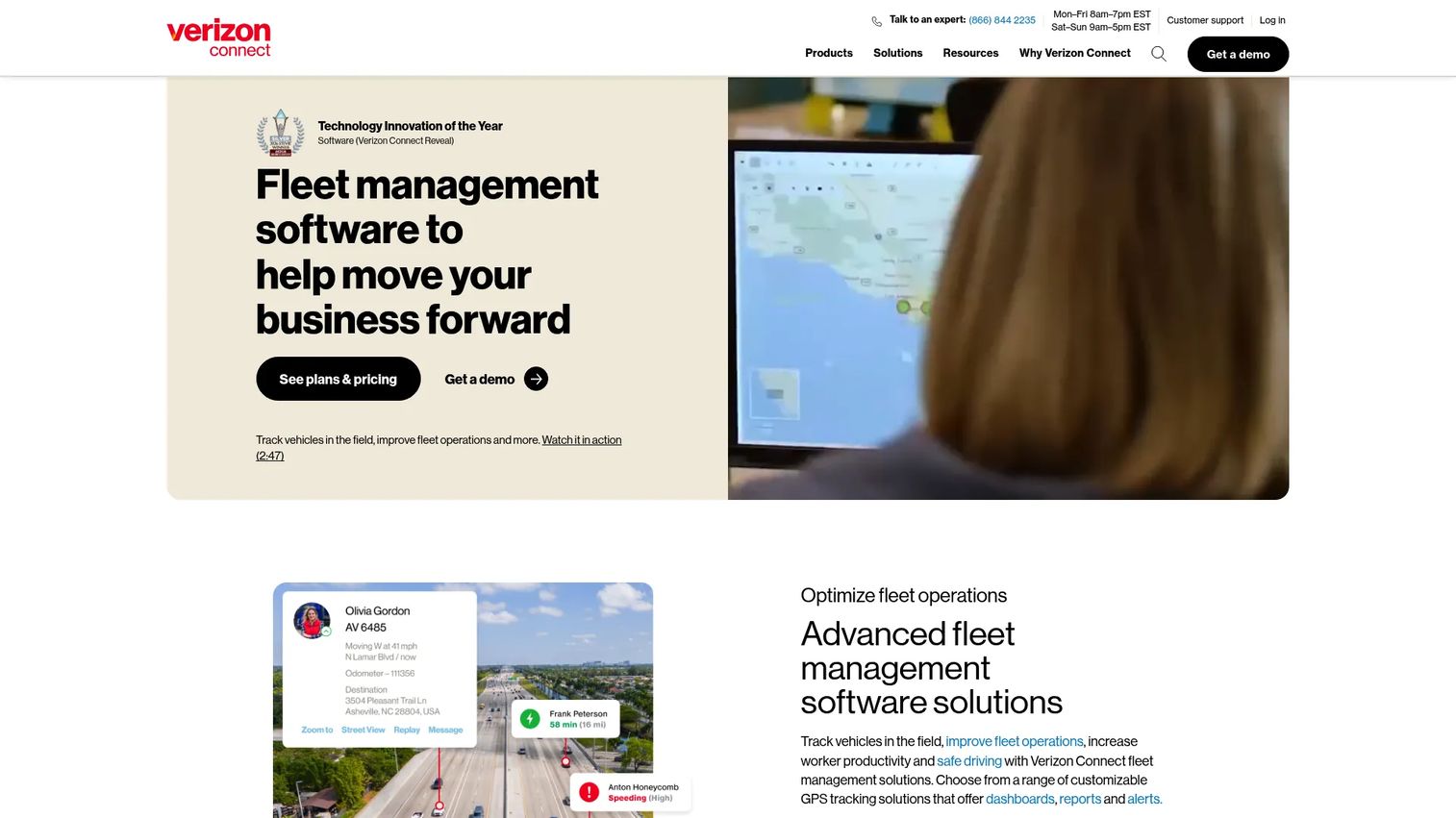
Verizon Connect is a fleet management and telematics platform oriented around tracking vehicles, assets, drivers, and compliance. Its strength is dependable, near-real-time visibility into where vehicles are and how drivers are performing, which makes it a practical fit for operations teams focused on day-to-day movement and route accountability.
Best for: operations teams that need dependable tracking, route oversight, and driver monitoring.
Key strengths
- Near-real-time tracking: live vehicle and asset location for dispatch and field visibility.
- Driver behavior monitoring: alerts and scoring tied to how drivers operate.
- Compliance tools: HOS, ELD, and DVIR support for regulated operations.
Why choose Verizon Connect: choose it when daily vehicle movement and route accountability drive the decision. The tracking and driver monitoring combination suits teams that manage active field operations and want dependable location data plus compliance coverage in one platform. It fits fleets that prioritize movement visibility over deep maintenance workflows.
Verizon Connect pricing: Verizon Connect does not display public numeric pricing on its site. Plans route to demo and quote prompts and reference flexible contract terms, so request a scoped quote to compare against transparently priced per-vehicle options.
6. Azuga
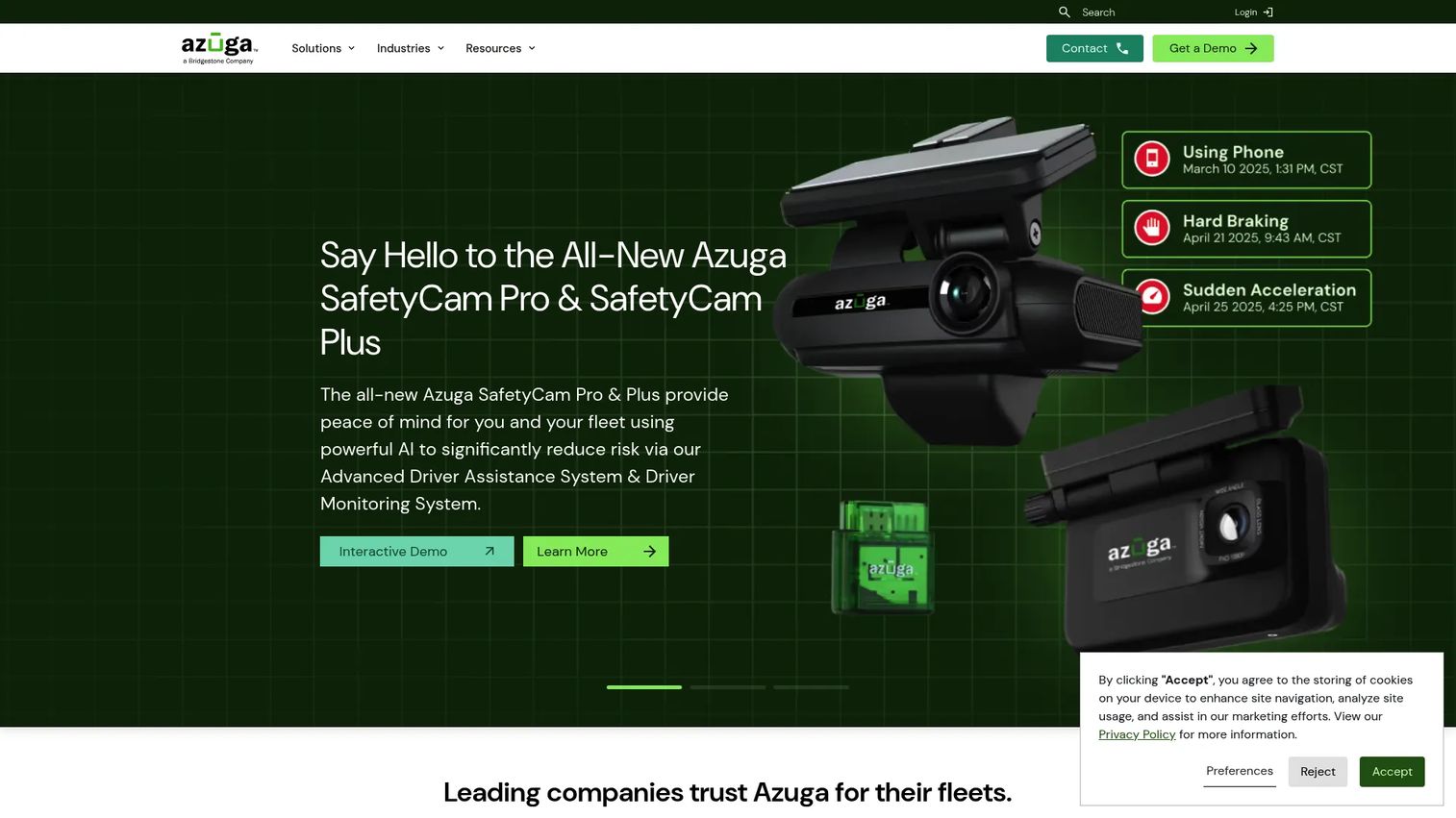
Azuga is a cloud-based fleet management platform for GPS tracking, safety, and driver coaching, positioned for teams that want core functionality without an oversized stack. Its published per-vehicle pricing and driver-reward approach make it one of the more approachable options for smaller fleets that still want real safety tooling.
Best for: fleet operators that want GPS tracking with safety scoring and driver coaching, especially smaller teams.
Key strengths
- GPS fleet tracking: real-time location and utilization visibility across the fleet.
- Driver safety scores and rewards: scoring and incentive programs that encourage safer driving.
- Dashcam and coaching tools: video capture and coaching workflows tied to driver behavior.
Why choose Azuga: choose it when you want practical tracking and safety without the complexity of an enterprise telematics rollout. It is a strong fit for small and mid-sized fleets that want driver coaching and transparent pricing. The safety-reward model appeals to teams looking to change driver behavior, not just monitor it.
Azuga pricing: three published per-vehicle plans. BasicFleet is $25 per vehicle per month, SafeFleet is $30 per vehicle per month, and CompleteFleet is $35 per vehicle per month. No permanent free tier is publicly shown.
7. Teletrac Navman
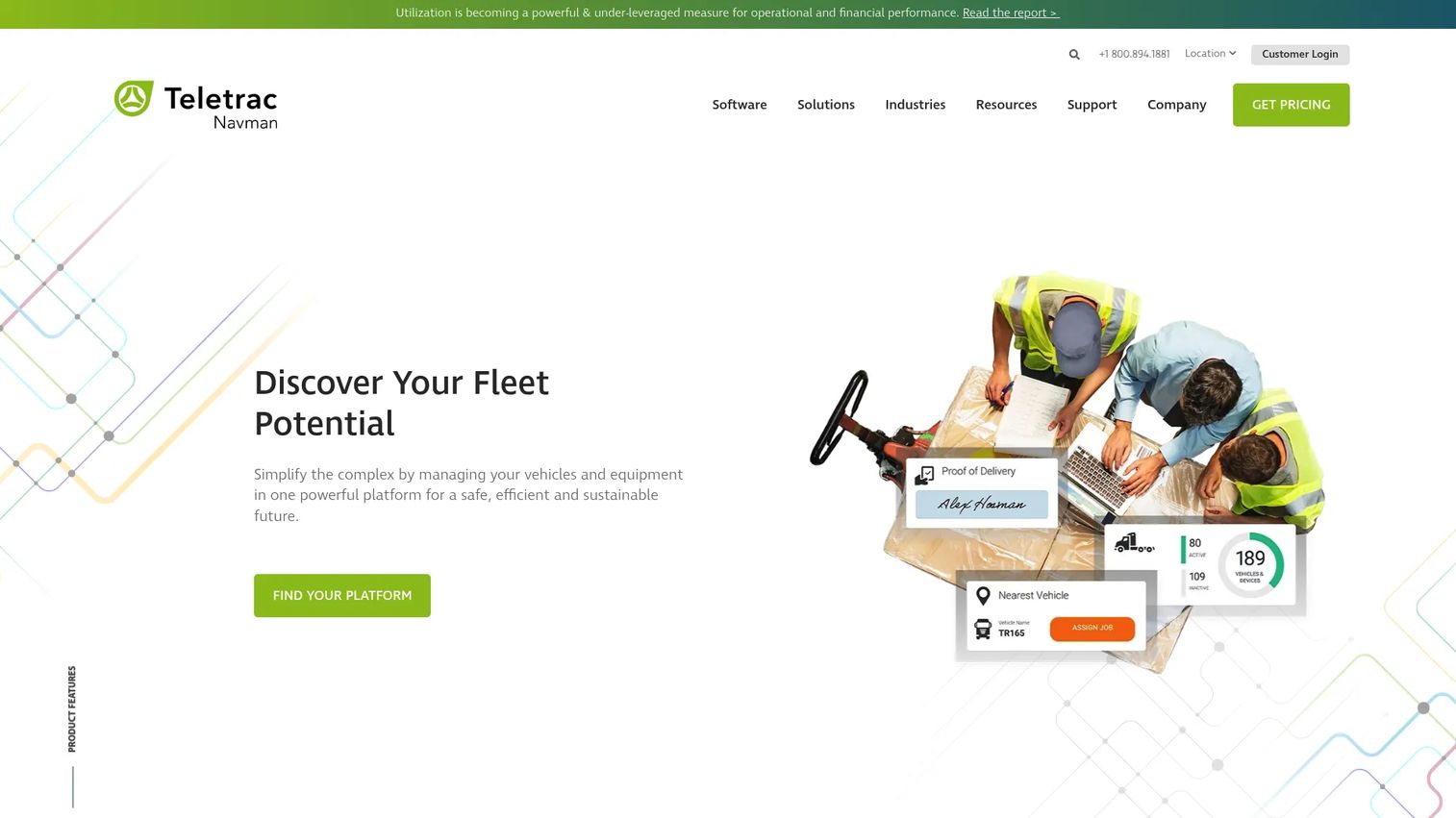
Teletrac Navman is a connected mobility and fleet telematics platform for vehicles and equipment assets, with a strong lean toward compliance, tracking, and asset visibility. It fits fleet-heavy businesses that carry heavier regulatory requirements and need telematics and compliance documentation working together.
Best for: fleet-heavy businesses that need telematics, compliance, and mixed-asset visibility.
Key strengths
- Real-time vehicle and asset tracking: live visibility across vehicles and equipment.
- Maintenance and utilization monitoring: track service needs and how assets are being used.
- Compliance and ELD support: regulatory logging and documentation for regulated fleets.
Why choose Teletrac Navman: choose it when compliance and documentation sit at the center of the buying decision. The platform's asset tracking and compliance workflows fit operations that mix vehicles with equipment and carry audit obligations. It suits teams that need one system covering both moving and stationary assets.
Teletrac Navman pricing: Teletrac Navman does not publish first-party numeric pricing; the site directs visitors to contact sales for a quote. Pricing is quote-based, so scope a conversation around your asset count and compliance needs to compare accurately.
8. Rhino Fleet Tracking
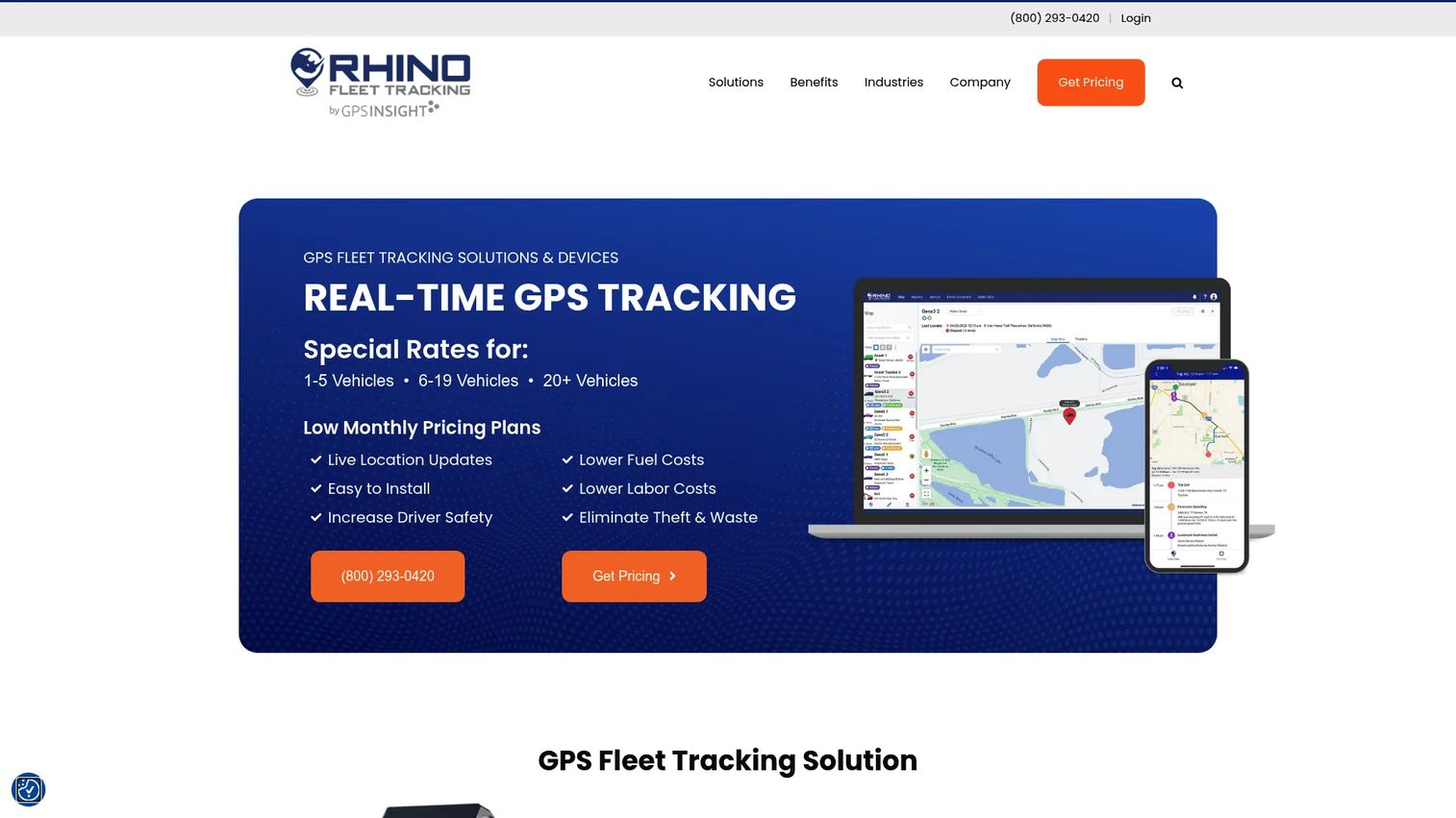
Rhino Fleet Tracking is a GPS fleet tracking platform, software plus hardware, for vehicles and assets. It is the budget-conscious option here, built for teams whose core need is dependable location tracking and basic oversight rather than a full operational suite. When tracking is the job and cost matters, it is a straightforward starting point.
Best for: businesses needing affordable fleet GPS tracking with vehicle and asset monitoring.
Key strengths
- Real-time GPS tracking: live location data across vehicles, trailers, and equipment.
- Alerts, reports, and route history: exception alerts and historical route reconstruction.
- Vehicle, trailer, and equipment tracking: coverage across mixed asset types.
Why choose Rhino Fleet Tracking: choose it when the core need is tracking, not a full operational platform, and budget is a real constraint. It fits smaller teams and cost-sensitive operations that want reliable location data with a simple rollout. It is a practical entry point that leaves room to move up-market later.
Rhino Fleet Tracking pricing: Rhino's own pricing page notes that pricing varies by device quantity and does not show a public figure. A publicly displayed starting price of $16.95 appears on its Capterra listing, which makes it one of the lower entry points in this list.
Considerations before you buy
A demo looks great until the tool meets your actual operation. Run every shortlisted platform against this checklist before you commit.
Fleet size and complexity
Small teams need simplicity and a fast rollout. Larger fleets need role-based access, deeper reporting, and automation to avoid drowning in data. A tool that fits five trucks may not scale to five hundred, and an enterprise platform can bury a small operation in configuration. Match the tool to where your fleet is now and where it will be in two years.
Maintenance depth
Confirm the specifics: does it schedule preventive maintenance off mileage and engine hours, generate work orders, run digital inspections, and hold a full service history? Fleet maintenance software varies widely in depth. If downtime reduction is your goal, this is where you scrutinize hardest.
Compliance needs
Verify ELD, DVIR, and HOS support against your actual regulatory requirements before purchase. For regulated fleets, audit-ready documentation and issue tracking are not nice-to-haves; they are the reason you are buying. Ask to see the audit workflow, not just the checkbox.
Tracking and telematics
Assess live visibility, geofencing, and exception alerts. Test the refresh rate and how quickly an off-route or extended-idle event surfaces. Location data is only useful if it is timely enough to act on.
Cost and total ownership
Look past the per-vehicle sticker. Evaluate hardware costs, add-on modules, implementation, contract terms, and support quality. Quote-based telematics vendors often bundle hardware, so compare total cost of ownership, not just the headline rate.
Conclusion
The right fleet management software depends on what you are optimizing for, not on which vendor markets hardest. If maintenance and downtime reduction are your biggest leak, Fleetio leads with the deepest service, inspection, and asset control. If you run large physical operations and want video safety plus telematics in one platform, Samsara fits. Motive suits compliance-heavy commercial fleets, Geotab rewards analytical teams that want configurable reporting, and Verizon Connect covers dependable tracking and route oversight. For smaller and cost-sensitive operations, Azuga offers transparent pricing with safety coaching, Teletrac Navman handles compliance-heavy mixed-asset fleets, and Rhino Fleet Tracking keeps GPS tracking affordable.
The practical next step: shortlist two or three tools that match your primary pain, then compare them side by side using a live demo or free trial. Bring your real numbers, fleet size, compliance requirements, current downtime, and evaluate each against the checklist above. The tool that wins is the one that measurably reduces your specific cost, not the one with the longest feature list.
FAQs
Fleet maintenance software focuses narrowly on service scheduling, work orders, parts, and repair history. Full fleet management software includes that maintenance layer and adds vehicle tracking, telematics, compliance, and driver management. If your only pain is service follow-up, a maintenance-first tool may be enough; if you need location and compliance too, choose the broader category.
The core modules are vehicle and asset tracking, preventive maintenance scheduling, inspections and compliance (ELD, HOS, DVIR), fuel and cost control, and reporting dashboards. Which matters most depends on your pain: downtime-heavy fleets prioritize maintenance depth, while regulated fleets prioritize compliance workflows and audit readiness.
Transparent per-vehicle pricing ranges from around $4 per vehicle per month for maintenance-first tools like Fleetio to $25 to $35 per vehicle per month for GPS and safety platforms like Azuga. Rhino Fleet Tracking lists a starting price around $16.95. Telematics-heavy vendors including Samsara, Motive, Geotab, and Verizon Connect use quote-based pricing that typically bundles hardware.
For small businesses, Azuga offers transparent per-vehicle pricing with GPS tracking and safety coaching, while Rhino Fleet Tracking is a budget-friendly option focused on location tracking. Fleetio also scales down well for smaller fleets that prioritize maintenance. The best fit depends on whether tracking, maintenance, or cost is your primary concern.
Fleetio is built around maintenance, with preventive maintenance scheduling, work orders, digital inspections, and full service history. It is the strongest fit when unplanned downtime and disorganized service records are your biggest cost. Geotab and Teletrac Navman also include maintenance and utilization monitoring within broader telematics platforms.
Yes. Most full platforms support ELD, HOS logging, and DVIR to keep drivers and vehicles compliant. Motive, Geotab, Verizon Connect, and Teletrac Navman all include compliance workflows. For regulated fleets, verify that the tool's audit documentation and issue tracking match your specific requirements before buying.
Yes. Tracking idle time, monitoring driver behavior, optimizing routes, and integrating fuel card data all surface where fuel spend leaks. Platforms with fuel management and cost-per-mile reporting, like Fleetio, and driver-behavior scoring, like Azuga and Motive, give you the data to cut waste. The savings come from acting on the data, not just collecting it.
Compare fleet size fit, maintenance depth, compliance support, tracking and telematics quality, and total cost of ownership including hardware and implementation. Shortlist two or three tools that match your primary pain, then test each with a live demo or trial using your real fleet numbers before you commit.