A portfolio can hold thousands of bonds, but a single stale or poorly supported price can distort everything downstream: Valuation, risk reporting, client statements, and investment decisions that boards and auditors will scrutinize.
The hard part is not finding a number. Any broker can send a quote. The real problem is understanding whether a price is observed, evaluated, modeled, timely, licensed for your intended use, and available in the workflow where decisions happen. Global fixed-income debt outstanding reached $160.7 trillion in 2025, up 10.6% year over year, according to SIFMA (2026). The market is large enough that every category of data provider has carved out defensible territory, which makes the shortlisting decision genuinely complex.
For a Series B fintech founder, a bad data-architecture decision creates product delays, weak pricing credibility, and escalating vendor costs before you ever reach enterprise scale. This guide gives you a decision framework, not just a list of names.
What's inside
- Eight fixed income pricing data tools evaluated for coverage, methodology, delivery, and workflow fit
- How each provider handles price type, asset-class scope, and data delivery
- What to compare before signing a data license for a product, portfolio workflow, or internal platform
- Selection criteria framed for founders, data leaders, and quant teams choosing between build and license
Tools were chosen for institutional fixed income relevance, pricing methodology transparency, delivery options, and coverage breadth across asset classes. No single provider is ranked as universally best.
TL;DR
- Best for broad evaluated pricing in the Bloomberg ecosystem: Bloomberg BVAL for institutions that already operate in Bloomberg workflows and need defensible marks across bonds and OTC instruments
- Best for continuous evaluated pricing with liquidity context: ICE Data Services for intraday and end-of-day workflows across liquid and less-liquid fixed income markets
- Best for pricing governance and portfolio valuation: S&P Global Market Intelligence for independent pricing, methodology depth, and challenge workflows
- Best for global data infrastructure: LSEG Data & Analytics for firms that need fixed income pricing alongside reference data, curves, and historical time series
- Best for credit and municipal price discovery: SOLVE for quote aggregation, predictive pricing, and relative-value analysis in fragmented markets
- Best starting point for U.S. trade transparency: FINRA TRACE for observed transaction data, security lookup, and a publicly accessible baseline before committing to a full enterprise license
What is fixed income pricing data software?
Fixed income pricing data software provides bond prices, trade activity, valuation inputs, reference data, and analytics used to value securities, assess liquidity, manage risk, research relative value, and support trading decisions.
The main price types you will encounter
Understanding which type of price your workflow actually needs is the most important decision before comparing vendors. Each type answers a different question.
- Observed trade prices: Reported transactions or executable market activity, such as TRACE prints. Best for understanding what bonds actually traded at, but sparse for less-liquid instruments
- Evaluated prices: Independent estimates produced from market inputs and defined methodologies. Used for portfolio valuation, NAV calculation, and audit review where a single observed trade may not exist
- Composite prices: Aggregated quotes or market levels from multiple dealer contributors. Common in corporate and government bond markets
- Predictive prices: Model-generated estimates that use historical and current market signals to infer value. Useful where trading is infrequent and observed data is thin
- Derived data: Yields, spreads, duration, yield curves, volatility surfaces, liquidity indicators, and relative-value measures built from underlying price inputs
What strong fixed income pricing software should include
- Coverage across the bond types your product, portfolio, or model actually touches
- Clear pricing methodology with documented inputs and a challenge process
- Intraday, end-of-day, and historical availability matched to your workflow timing
- Reference data and identifiers for reliable security matching
- Liquidity or confidence context for difficult-to-price instruments
- API, file, feed, terminal, or Excel delivery matched to your technical stack
- Licensing rights that cover internal analytics, customer-facing display, and any redistribution
No single price type is automatically superior. A valuation workflow needs evaluated prices with methodology documentation. A trading desk may prioritize live market color, quote depth, and liquidity signals. A fintech building a customer-facing bond analytics product needs all three, plus confirmed display rights.
When to use fixed income pricing data software
Value portfolios and support finance reporting
Fund accounting, NAV oversight, fair-value review, internal model validation, and portfolio reconciliation all depend on a daily pricing process that can survive audit. Evaluated pricing and methodology documentation matter here far more than millisecond latency. The question your valuation-control team will ask is not "what is the price?" but "how was it formed, and can we defend it?"
Improve trade decisions and price discovery
Credit trading desks, municipal traders, and sales teams working bid-wanted-in-competition flows need more than a daily mark. They need quotes, predictive prices, liquidity scores, and observed transaction context that supports pre-trade analysis and execution decisions. Electronic trading has grown fast: 49% of U.S. investment-grade corporate bond trading was electronic in 2024, according to Numerix (2025).
Build fixed income features into a fintech product
This is the high-stakes use case for a Series B founder. Before writing the integration, answer four questions:
- Is the price licensed for our intended customer-facing workflow?
- Can our data team integrate and monitor it reliably?
- Do we need broad global coverage or one deep asset class?
- Will customers, partners, or investors ask for methodology, history, and confidence signals?
A data license that only permits internal consumption cannot support a customer-facing bond pricing feature. Involve legal and product before your team writes a single line of integration code.
Fixed income pricing data software comparison
The table below routes buyers by core workflow priority. The right provider depends on whether your priority is valuation governance, continuous market color, global reference data, predictive prices, public trade transparency, or integrated research workflows. Use it as a starting filter, not a final decision.
| # | Product | Best for | Key differentiator | Pricing | G2 rating |
|---|---|---|---|---|---|
| 1 | Bloomberg BVAL | Enterprise valuation in Bloomberg workflows | Evaluated pricing for 2.7M+ securities with BVAL Score transparency | Contact for pricing | N/A |
| 2 | ICE Data Services | Continuous evaluated pricing and liquidity workflows | Intraday and end-of-day evaluated pricing across broad asset classes | Contact for pricing | N/A |
| 3 | S&P Global Market Intelligence | Independent pricing governance and portfolio valuation | Evaluated pricing, liquidity scores, price challenge workflows | Contact for pricing | 4.3/5 |
| 4 | LSEG Data & Analytics | Global data infrastructure and multi-asset research | 3M+ securities, curves, reference data, API and desktop delivery | Contact for pricing | 3.8/5 |
| 5 | SOLVE | Credit and municipal price discovery | Predictive pricing, confidence scores, dealer quote aggregation | Contact for pricing | 5.0/5 |
| 6 | FactSet | Research and portfolio workflows with fixed income data | Workstation and data-feed access with investment research integration | Contact for pricing | 4.2/5 |
| 7 | FINRA TRACE | U.S. fixed income trade transparency | Reported trade data, CUSIP lookup, tiered public and subscription access | From $20/month | N/A |
| 8 | Morningstar DBRS | Credit-sensitive fixed income workflows | Independent credit ratings, research, and API/SFTP data feeds | Contact for pricing | N/A |
Best 8 fixed income pricing data software tools for 2026
1. Bloomberg BVAL
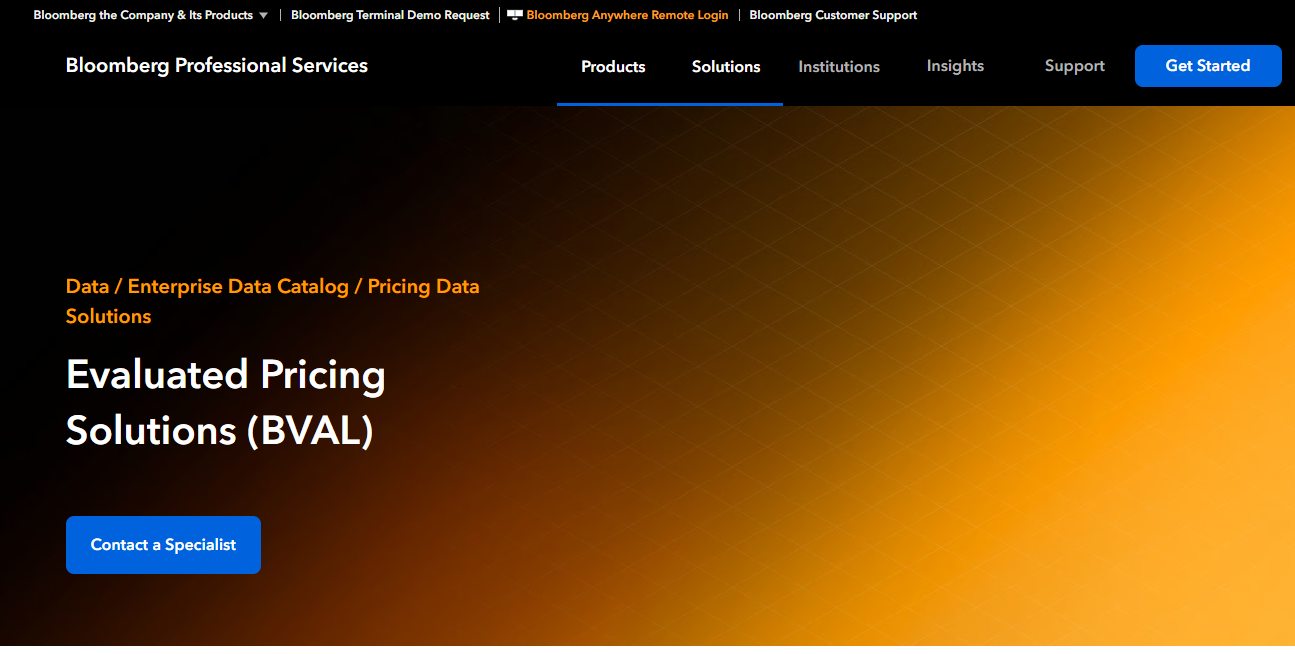
Bloomberg BVAL is Bloomberg's independent, transparent evaluated pricing and valuation service for fixed income securities and OTC derivatives. It produces daily evaluated prices for more than 2.7 million securities across asset classes. What makes it distinctive is the BVAL Score: A proprietary measure showing the relative amount and consistency of market data used to generate each evaluated price, so users understand how well-supported any given mark is.
Best for: Institutional teams already embedded in Bloomberg workflows that need evaluated pricing with documented methodology for securities, derivatives, and portfolio valuation.
Key features
- Daily evaluated pricing for 2.7M+ fixed income and OTC instruments
- BVAL Score showing market data depth behind each price
- Transparent methodology documentation with data inputs
- Independent OTC derivatives valuation
- Access via Bloomberg Terminal or enterprise data feed
Why choose Bloomberg BVAL: The strongest case for BVAL is integration depth. If your firm already runs Bloomberg for research, indices, and market data, adding BVAL keeps pricing within a connected environment. A narrow fintech use case that only needs a focused API dataset may find the broader Bloomberg relationship harder to justify at early stage.
Bloomberg BVAL pricing: Bloomberg sells BVAL through enterprise arrangements with no publicly displayed rates. When you contact their team, ask specifically about workstation access costs, data-feed entitlements, historical depth, permitted redistribution, and customer-facing display rights. Those terms vary significantly by use case.
2. ICE Data Services
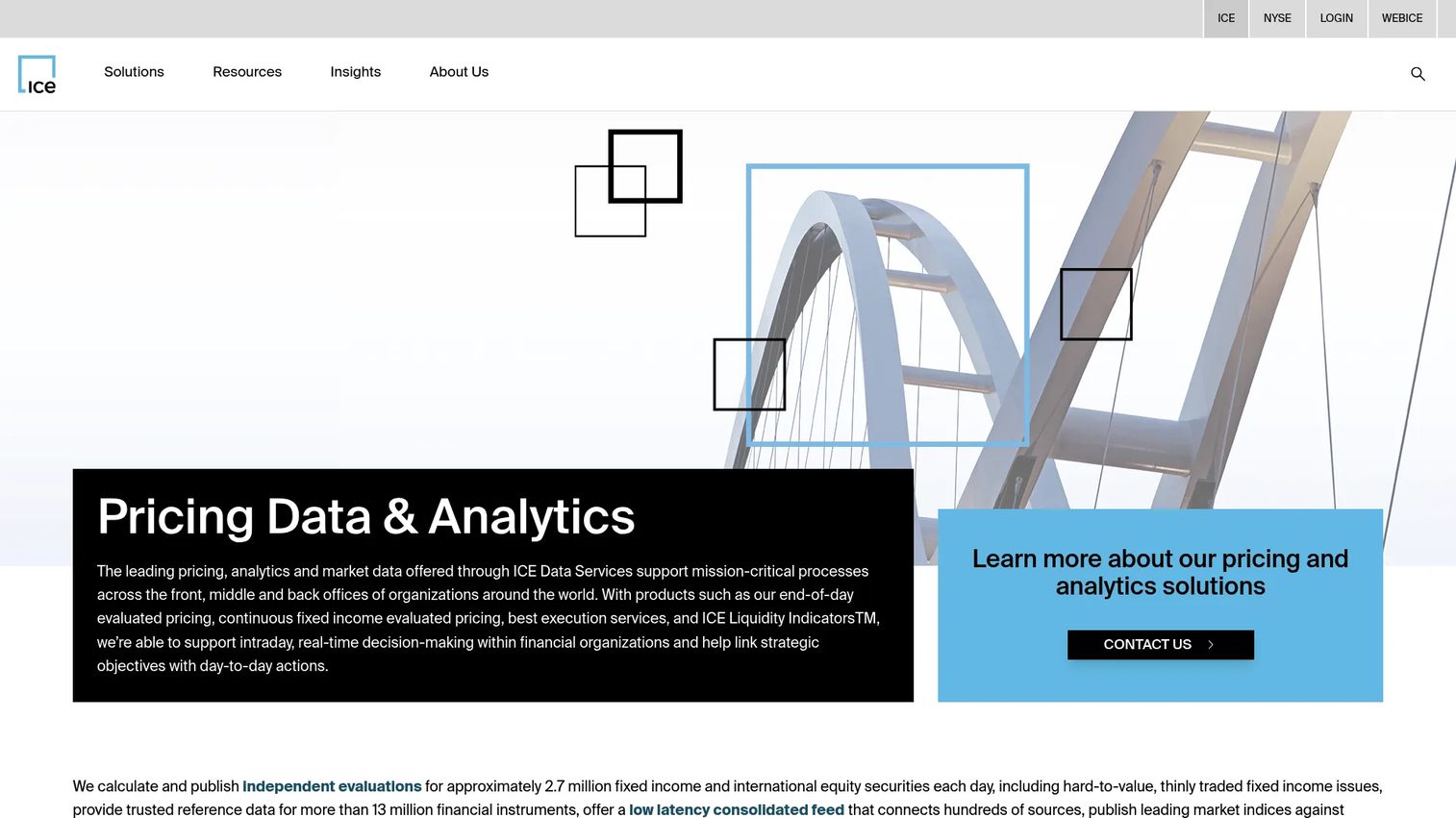
ICE Data Services provides evaluated pricing, analytics, reference data, and index services for financial institutions globally. Its coverage spans government bonds, corporate bonds, municipal bonds, structured products, loans, and money markets. The key distinction from a pure end-of-day provider is continuous evaluated pricing: Intraday price updates that support trading and risk workflows between settlement times.
Best for: Trading, valuation, and risk teams that need independent pricing with intraday updates and broad fixed income asset-class coverage.
Key features
- End-of-day and continuous (intraday) evaluated pricing
- Fixed income liquidity indicators and analytics
- Reference data covering financial instruments
- Portfolio valuation delivery options
- Best-execution and compliance analytics
Why choose ICE Data Services: ICE suits workflows where a daily closing mark is not sufficient. If your product or trading desk needs to monitor price movement through the day across liquid and less-liquid instruments, continuous evaluated pricing provides that layer. Front, middle, and back-office teams often use different components of the same ICE subscription.
ICE Data Services pricing: ICE does not publish standard pricing tiers. The cost depends on instruments covered, timing requirements, user access levels, feed delivery format, redistribution rights, and historical data depth. Request an itemized proposal rather than a package quote.
3. S&P Global Market Intelligence
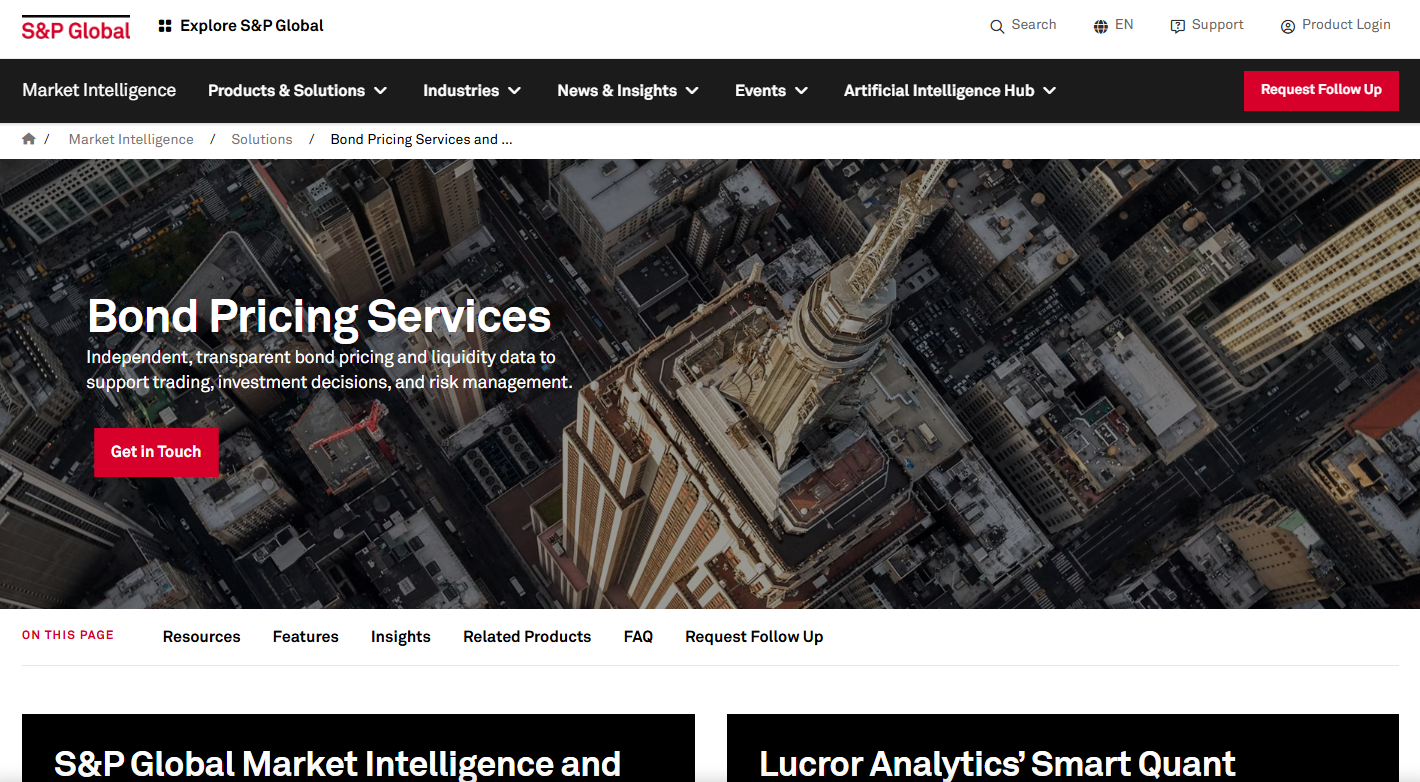
S&P Global Market Intelligence provides independent bond pricing, liquidity data, analytics, and reference data for asset managers, banks, insurers, fund administrators, and valuation-control teams. Its bond pricing service covers approximately 2.3 million bonds, including more than 1.1 million municipal bonds priced daily. Delivery runs through API, SFTP, a web-based Price Viewer, Portfolio Valuations, and Excel.
Best for: Valuation and finance-control teams that need independent marks, governance documentation, liquidity measures, and a formal price challenge process.
Key features
- Daily intraday and end-of-day bond pricing
- Liquidity metrics including bid/offer spreads and quoting-source data
- Price challenge workflows for mark disputes
- API, SFTP, Portfolio Valuations, and Excel delivery
- Coverage of hard-to-value and illiquid securities
Why choose S&P Global Market Intelligence: The differentiator is governance depth. If your buying committee includes valuation control, fund accounting, or compliance stakeholders who need to explain and defend marks, S&P's methodology documentation and price challenge process give them the infrastructure to do that. The liquidity scores add context that a raw evaluated price alone does not provide.
S&P Global Market Intelligence pricing: Pricing is sold through enterprise agreements. Ask whether your required asset classes, historical depth, challenge support, and integration options are included in the proposed package, as components often carry separate entitlements.
G2 rating: 4.3/5
4. LSEG Data & Analytics
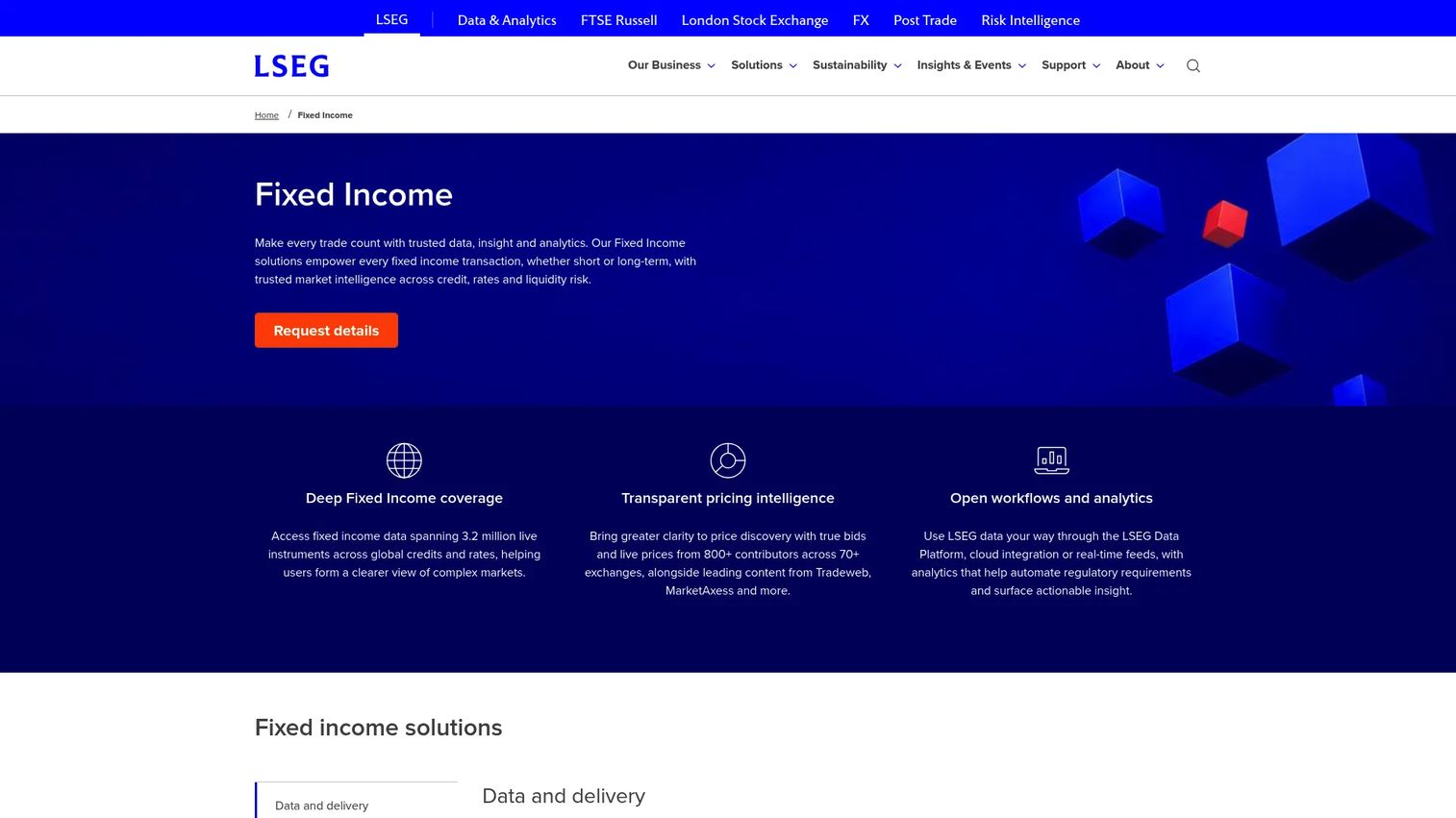
LSEG Data & Analytics offers global fixed income pricing, reference data, trading data, yield curves, credit analytics, and portfolio tools for financial professionals. Its evaluated pricing covers more than 3 million fixed income securities and derivatives. Delivery options include LSEG Workspace (the primary desktop product, formerly Refinitiv Eikon), APIs, cloud integration, and real-time data feeds.
LSEG is the right frame when the decision is about data infrastructure breadth, not a single pricing feed. Teams building big data analytics software for financial workflows will recognize the pattern: The platform value comes from combining pricing with curves, reference data, and historical time series in one place.
Best for: Global investment, research, risk, and fintech teams that need fixed income pricing as part of a broader data foundation covering reference data, indices, and multi-asset workflows.
Key features
- Evaluated pricing for 3M+ fixed income securities and derivatives
- Yield curves, credit models, and derived analytics
- Reference and trading data with historical time series
- LSEG Workspace, API, cloud, and real-time feed delivery
- Fixed income analytics including portfolio analysis and stress testing
Why choose LSEG Data & Analytics: Breadth is the primary argument. LSEG fits buyers who need a data foundation that can expand from bond pricing into equities, derivatives, benchmarks, and global reference data without switching vendors. For a fintech building an international product, the multi-asset and multi-geography coverage reduces the number of separate data relationships to manage.
LSEG Data & Analytics pricing: LSEG uses quote-based enterprise packages with no public rates. Request an itemized proposal and confirm what is included for API calls, real-time entitlements, historical access, derived data, and redistribution.
G2 rating: 3.8/5 for LSEG Workspace
5. SOLVE
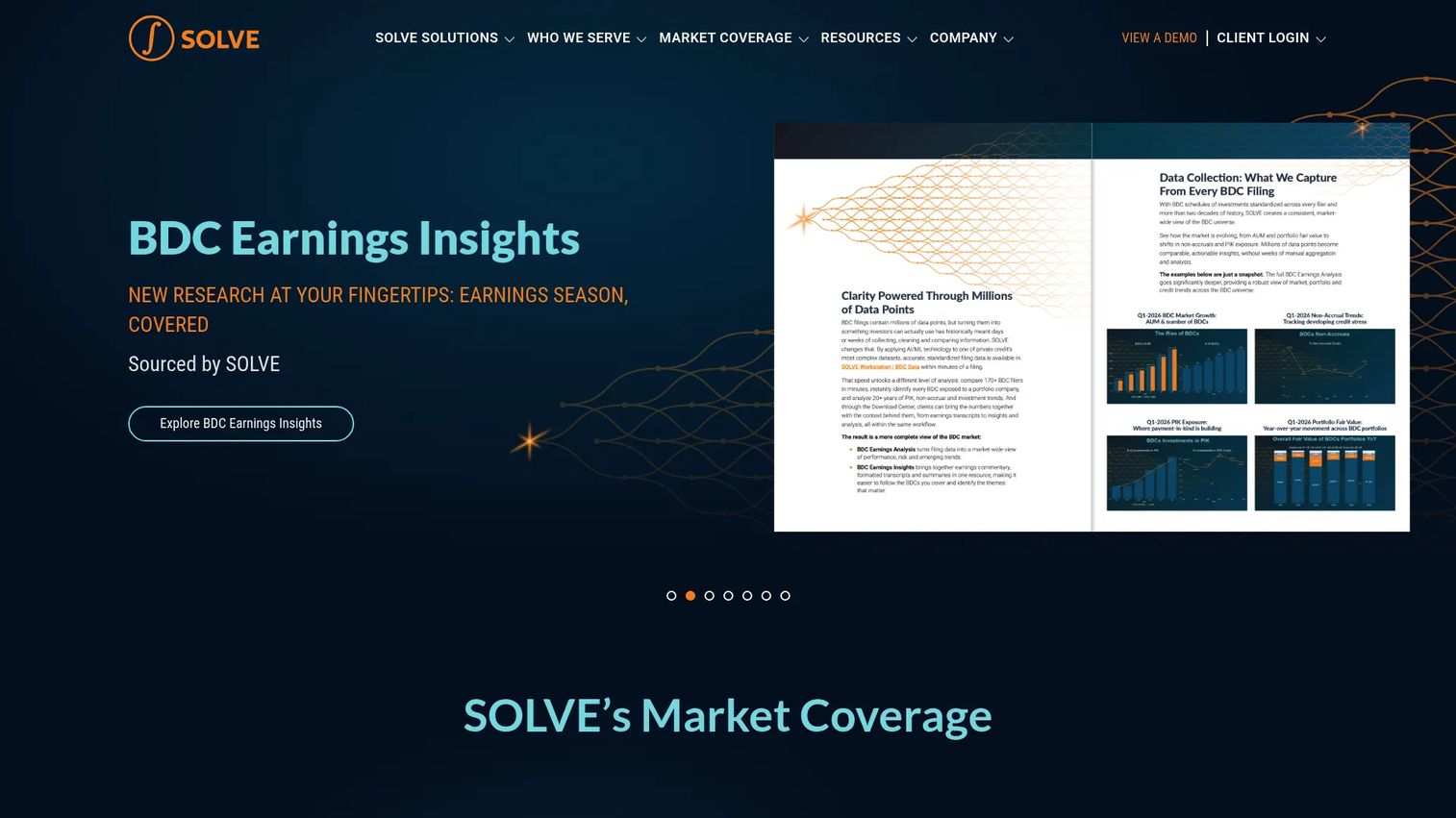
SOLVE is a specialized fixed income data and workflow platform focused on price discovery in markets where observed trades are sparse. Its predictive pricing uses AI-driven models to generate price estimates with confidence scores for corporate bonds, municipal bonds, loans, structured products, credit default swaps, and private credit. Dealer quote aggregation gives context on where the market is before an execution decision.
Teams evaluating predictive analytics software tools for financial use cases will find SOLVE's confidence-scoring approach familiar: The output is not just a price, but a measure of how much the model knows.
Best for: Credit investors, municipal traders, valuation teams, and fintech data teams that need price discovery support in fragmented corporate and municipal bond markets.
Key features
- AI-driven predictive trade pricing with confidence scores
- Aggregated dealer quotes and market data
- Relative-value analysis using bond and cohort comparisons
- Municipal pricing tools and 15c2-12 regulatory workflow support
- BDC and private-credit portfolio analytics
Why choose SOLVE: Use SOLVE when the team needs to investigate why a bond is priced at a level, compare it against peers, and work through sparse trading activity with both quote context and model estimates. It is particularly valuable for municipal bond pricing data, where TRACE prints alone often leave significant gaps. SOLVE is trusted by hundreds of buy-side, sell-side, public finance, and private credit institutions.
SOLVE pricing: SOLVE uses sales-led enterprise pricing with no public rate card. Ask about the asset classes included, history depth, API access, user seat structure, and whether municipal datasets and workflow modules carry separate entitlements.
G2 rating: 5.0/5
6. FactSet
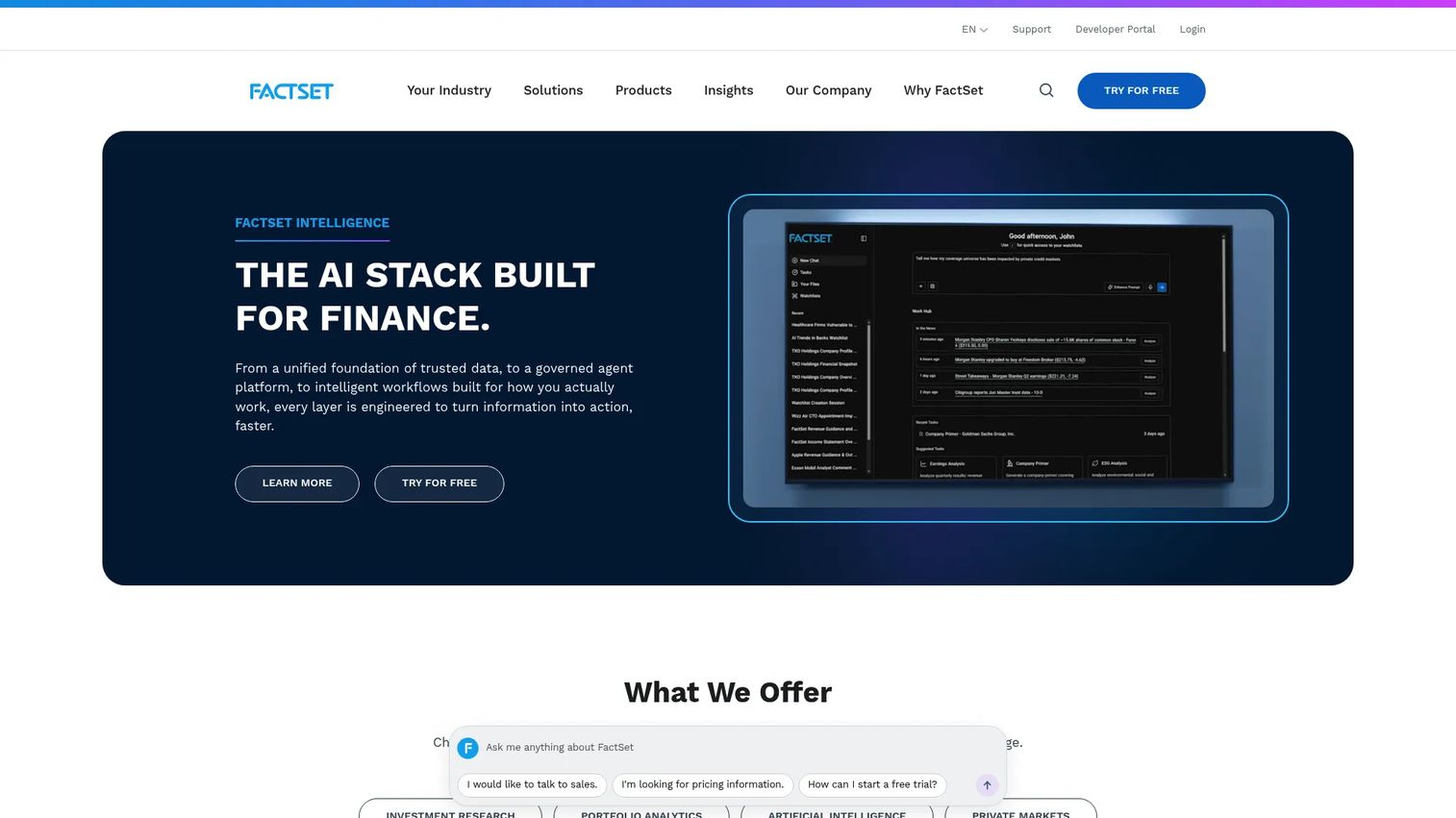
FactSet is an investment research and portfolio analytics platform with fixed income data capabilities. For teams that need bond pricing inside a broader research workflow covering equities, ownership data, financials, and enterprise analytics, FactSet provides connectivity across those datasets in one workstation environment. It also offers data feeds and APIs for teams building quantitative or product workflows.
If your team is already evaluating API development tools and API monitoring tools for a financial data product, FactSet's feed and API layer warrants inclusion on the shortlist for connected research workflows.
Best for: Investment teams and fintechs that want fixed income pricing connected to equity research, portfolio analytics, security identifiers, and enterprise data services in one environment.
Key features
- Fixed income pricing data and real-time feeds
- Investment research workstation with multi-asset coverage
- Portfolio analytics and risk analysis integration
- AI-powered tools and financial data APIs
- Security identifier and reference data access
Why choose FactSet: FactSet suits organizations that want a connected research and portfolio workflow rather than a pricing-only provider. If your users also need equity, ownership, financials, and analyst research alongside bond pricing, the integrated environment reduces the number of vendor relationships and data reconciliation tasks your team manages.
FactSet pricing: FactSet uses quote-based subscription pricing with no public tiers. Separate your workstation access costs from data-feed usage, API rights, historical data, and customer-facing product permissions during procurement. These components often carry distinct entitlements.
G2 rating: 4.2/5 for FactSet Workstation
7. FINRA TRACE
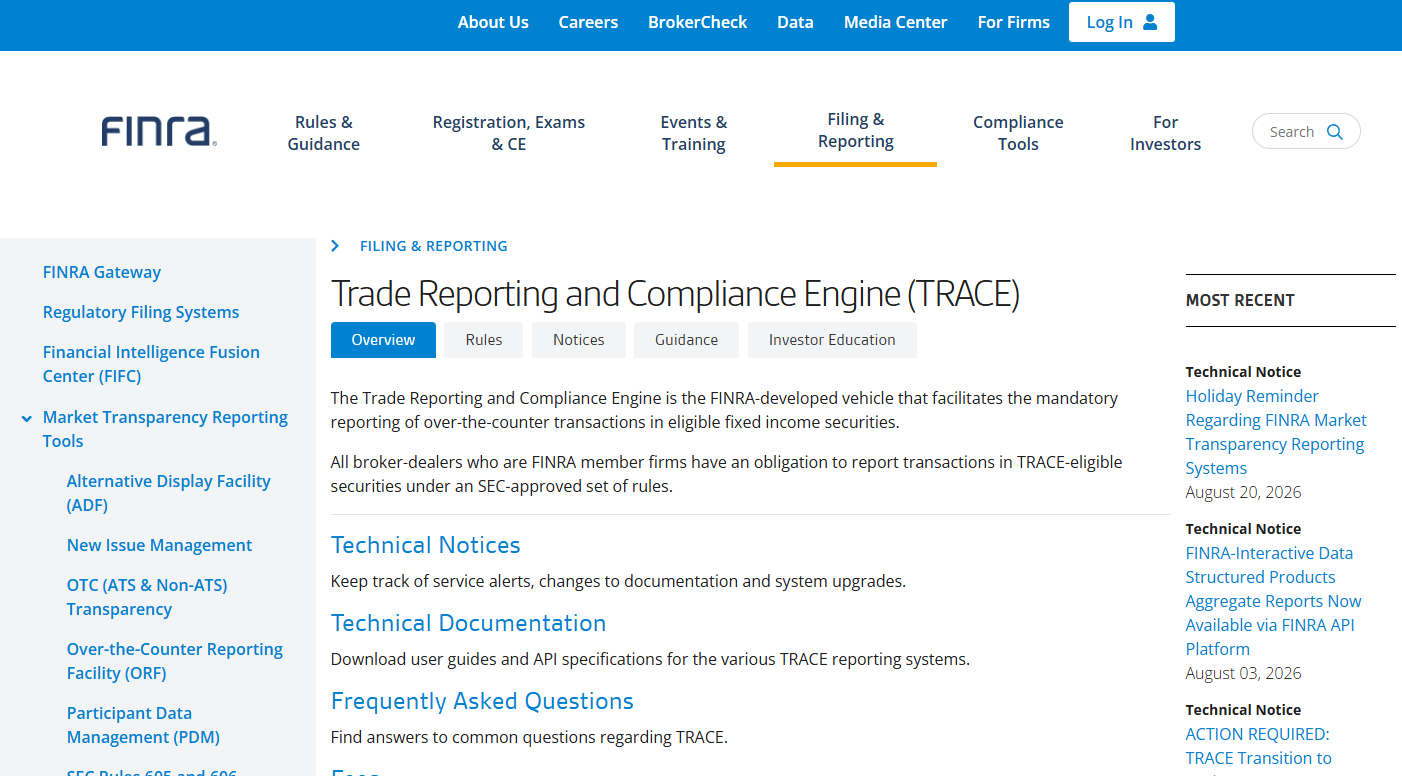
FINRA TRACE (Trade Reporting and Compliance Engine) is FINRA's mandatory trade reporting and market-data dissemination service for eligible U.S. fixed income securities. It is a transparency mechanism, not a full evaluated pricing platform. Every FINRA member broker-dealer must report eligible transactions, and TRACE disseminates that data in real time and with a delay.
For a fintech founder, TRACE matters for two reasons. First, it is the primary source of observed U.S. corporate and municipal bond trade prints. Second, its public and subscription products can serve as a validation or reference layer alongside evaluated pricing from a commercial vendor.
Best for: Teams that need U.S. fixed income trade transparency, CUSIP-level security lookup, market statistics, and a transaction-based foundation for corporate and municipal bond research.
Key features
- Mandatory trade reporting from FINRA member broker-dealers
- Real-time and delayed market-data dissemination
- Security lookup by CUSIP or TRACE symbol
- End-of-day transaction files and historical trade data
- Data access through web browser, feeds, FTP, and FINRA APIs
Why choose FINRA TRACE: TRACE is the starting point for understanding actual U.S. fixed income transaction activity. It works as a validation layer and a price-discovery reference, particularly for corporate and municipal bond workflows. It does not replace evaluated prices for illiquid instruments, and it does not provide global coverage, reference data, or derived analytics. Use it alongside a commercial vendor rather than instead of one.
FINRA TRACE pricing: Some tools and market statistics are publicly accessible at no charge. Web browser access starts at $20/month per user ID for Level I (trade report only) and $50/month for Level II (full service with one data set). Enterprise real-time data licenses run $7,500/month per data set. Redistribution of TRACE-derived data in a commercial product requires a separate agreement, so confirm usage rights with FINRA before embedding the data in a customer-facing feature.
8. Morningstar DBRS
Morningstar DBRS provides independent credit ratings, research, and data solutions for assessing credit risk across global markets. It is not a direct replacement for a real-time evaluated pricing feed. Its value lies in combining credit opinion, issuer analysis, ratings data, and structured credit research with the pricing or reference data a team already uses.
Best for: Credit-focused teams where ratings, issuer context, and research matter alongside bond valuation, including risk, underwriting, credit selection, and issuer review workflows.
Key features
- Independent credit ratings and credit opinions
- Global ratings data via automated API or SFTP feeds
- Credit research, methodologies, and analytical models
- Issuer and instrument context for structured credit
- Access-controlled data delivery for enterprise clients
Why choose Morningstar DBRS: The fit is specific: Morningstar DBRS belongs on the shortlist when your workflow depends heavily on credit assessment and ratings as inputs to pricing or risk decisions. A portfolio that weights credit quality signals heavily, or an underwriting workflow that needs issuer-level depth, benefits from combining a DBRS data feed with a pricing source from elsewhere in this list.
Morningstar DBRS pricing: Professional data and research access is sold through quote-based arrangements. Clarify API use terms, bulk data rights, user access scope, historical data, and commercial redistribution rights before signing.
Considerations when choosing fixed income pricing data software
Match the price type to the workflow
A public trade print, an evaluated price, and a predictive price answer different questions. Define the primary job before comparing vendors: Daily valuation, execution support, risk monitoring, portfolio reporting, customer-facing analytics, or relative-value research. Conflating these will lead to a data relationship that overserves one workflow while leaving another unfunded.
Verify coverage at the instrument level
Do not accept broad "fixed income coverage" claims without a representative security test. Build a list that includes liquid bonds, thinly traded positions, municipals, structured products, and edge cases your product or portfolio actually holds. Run it against each shortlisted vendor before committing. Missing data behavior matters as much as coverage depth.
Treat methodology as a product requirement
Require documentation for inputs, pricing hierarchy, confidence measures, quality controls, historical revisions, and challenge processes. This is not an academic concern. When a customer, auditor, or risk committee asks why a mark changed, your team needs a defensible answer backed by vendor documentation.
Audit data rights before writing integration code
Internal analytics rights, customer-facing display rights, data redistribution, derivative data product creation, caching, and historical storage can all require separate contractual terms. A founder should involve legal and product early in the procurement conversation, not after the integration is built.
Price the integration, not only the subscription
The contract is one cost. The real total includes engineering time, entitlement management, symbol mapping, data quality monitoring, historical backfill, ongoing support, and vendor-switching risk. Build the full business case before the commercial negotiation.
How to choose the right fixed income pricing data software for your team
If you are building a broad institutional data product
Prioritize LSEG Data & Analytics and Bloomberg BVAL if global coverage, reference data, historical content, and enterprise delivery matter more than a single pricing model. ICE Data Services is worth adding to the shortlist if intraday pricing across multiple asset classes is a core product requirement.
If you need defensible daily valuation marks
Bloomberg BVAL, ICE Data Services, and S&P Global Market Intelligence are the primary candidates. Focus your evaluation on evaluated-pricing methodology, asset-class support, challenge process, historical auditability, and operational delivery format. S&P's price challenge workflow and liquidity scores add governance depth that some audit processes specifically require.
If you run a credit or municipal trading workflow
SOLVE, ICE Data Services, and FINRA TRACE together cover the ground. SOLVE provides predictive prices and quote aggregation where observed trades are thin. ICE adds intraday evaluated pricing. FINRA TRACE anchors the observed transaction layer for U.S. markets. The combination gives a credit trading or municipal desk most of what it needs for bond price discovery without over-licensing a full global platform.
If credit analysis is the deciding factor
Include Morningstar DBRS and FactSet in the shortlist alongside a pricing-focused vendor. Ratings, issuer data, research, and portfolio context can carry more weight in credit selection and underwriting than the price feed itself. FactSet's connected research workstation suits investment teams that move between fixed income and equity analysis.
If you are a Series B fintech founder
Run a two-stage process. Start with the narrowest provider that covers the product you can ship in the next 12 months. Run a live data-quality test against a representative universe before committing to a multi-year agreement. Review rights for customer display and derived outputs before your team writes the integration. Maintain a provider abstraction layer in your architecture where possible, because coverage and commercial terms change as the company expands. A data vendor relationship that fits your seed-stage product scope may need renegotiating before your Series C closes.
Conclusion
Fixed income pricing data is not a commodity purchase. Bloomberg BVAL and ICE Data Services anchor the evaluated pricing category for institutions needing methodology depth and continuous market coverage. S&P Global Market Intelligence adds governance infrastructure that valuation-control and compliance teams value. LSEG Data & Analytics suits multi-asset and global data needs. SOLVE fills the credit and municipal price discovery gap where observed trades are sparse.
FINRA TRACE belongs in every U.S.-focused workflow as a transaction transparency layer, regardless of which commercial vendor handles the rest. FactSet suits research-driven investment teams. Morningstar DBRS supplements any workflow where credit ratings and issuer-level analysis matter.
The practical next step: Build a representative instrument sample covering liquid bonds, thinly traded positions, and the edge cases your product or portfolio actually holds. Write down the intended product and reporting use cases. Then request sample data and licensing terms from the two or three strongest candidates on the list above.
The right data vendor is the one whose prices, methodology, rights, and delivery model hold up when your product, portfolio, and customer base get more complex.
Start your journey with Guideflow today!
FAQs
Trade data reflects actual reported transactions, such as the prints disseminated through FINRA TRACE. Evaluated pricing is an independent estimate of a security's market value produced by applying a pricing methodology to available market inputs, which may include quotes, comparable trades, and model-derived spreads. Thinly traded bonds often require evaluated prices because observed transactions are too infrequent or too stale to support a reliable daily mark.
The answer depends on the workflow. FINRA TRACE provides U.S. municipal trade transparency as a public resource. SOLVE offers predictive pricing, dealer quote aggregation, and specialized municipal tools for teams that need price discovery in markets where trades are sparse. ICE Data Services and S&P Global Market Intelligence both cover municipals within their broader evaluated pricing services. For a fintech building a municipal bond feature, the licensing question matters as much as coverage depth.
It depends entirely on the data contract. Internal use, customer display, redistribution to third parties, creation of derivative data products, caching, and historical storage often require separate and distinct rights. Most institutional data licenses start with internal use only. Involve legal and product leaders before shipping any customer-facing feature that relies on licensed market data.
Trading and execution workflows typically need intraday market context, either continuous evaluated prices or live quote feeds. Portfolio valuation, fund accounting, risk reporting, and many analytics products can run reliably on end-of-day data. The right answer depends on the promise you have made to your user, not on a general assumption about what institutional-grade means.
Build a representative instrument test set. Include highly liquid bonds, thinly traded corporate names, municipal securities, and at least a few structured product CUSIPs relevant to your workflow. Run the set against each candidate vendor and evaluate coverage completeness, price confidence or quality signals, missing-data behavior, API latency, and historical fill rate. Ask each vendor to explain how they handle instruments that return no price on a given day.
No. An evaluated price is typically produced through a defined valuation methodology that incorporates available market inputs such as trades, quotes, and comparable securities. A predictive price is model-driven and usually includes a confidence score or explanatory signal indicating how much the model is extrapolating versus anchoring to observed market data. Both are legitimate for different workflows, but the buyer should understand which one is being delivered and how it will be described to end users, auditors, or investors.
APIs suit product development and application integration where data needs to flow programmatically into a system. Data feeds suit high-volume recurring workflows where latency and completeness matter most. SFTP works for batch operations and overnight file-based processes. Desktop platforms fit analyst-led research. Most institutional teams use more than one delivery method across different parts of the organization, so confirm that your shortlisted vendors support the format your technical team will actually use.
Ask about asset class scope, update timing, historical depth, user seat limits, API call caps, professional access rights, customer-facing display rights, redistribution terms, derivative data product rights, and minimum contract duration. Also ask what happens to your access and pricing if your user base or covered instrument universe grows significantly. The headline subscription figure rarely reflects what you will pay at the point where the data relationship actually matters to your business.