Paper pick lists slow your floor down. So do RF scanners that force a picker to stop, read a screen, scan, and look back at the shelf. Every one of those micro-interruptions adds seconds per line, and seconds compound across thousands of picks per shift. Worse, they invite errors, and a single mispick can cascade into a return, a credit, and a lost customer.
Voice picking software removes the screen and the scan gun from the critical path. A picker wears a headset, hears the next location, walks, confirms with a spoken check digit, and moves on. Hands stay free. Eyes stay on the product. The system talks to your warehouse management system in real time, so inventory and order status stay current without a manual keystroke.
The stakes are real. The global voice picking solution market was valued at roughly $6.45 billion in 2025 and is forecast to grow at a 14.04% CAGR through 2030, according to Mordor Intelligence (2025). Market.us (2024) reports that voice picking systems deliver 10 to 40% productivity gains and 25 to 40% error reduction, with some deployments approaching 99.99% picking accuracy. Those numbers are why operations leaders keep moving budget toward voice.
But the vendor landscape is confusing. Some tools cover only picking. Others extend voice across replenishment, putaway, receiving, loading, returns, and cycle counting. Some plug into any WMS or ERP. Others expect you to run their full stack. This guide sorts that out. We compare seven voice picking systems on workflow breadth, integration depth, worker adoption, and proof, so you can shortlist based on your actual operation instead of a hero landing page.
What's inside
This guide is for warehouse operations leaders, distribution managers, and systems buyers comparing voice-directed picking vendors. We selected the seven platforms based on four criteria that matter when you own the outcome: workflow breadth beyond picking, integration support for your WMS and ERP, documented operational proof, and real customer traction in distribution and fulfillment.
Every tool here handles core order picking. Where they differ is scope. We flag which ones extend voice into replenishment, receiving, putaway, packing, loading, returns, and cycle counting, and which pair software with hardware or systems integration services. You get a comparison table near the top, then a detailed section on each vendor, then a buyer's checklist and FAQs.
TL;DR
- Best for broad workflow coverage and analytics: Voxware covers picking, replenishment, cycle counting, and augmented workflows with published pricing tiers.
- Best for enterprise fulfillment at scale: Honeywell Voice handles order picking and fulfillment with text-to-speech and speech-to-text in more than 40 languages.
- Best for multilingual adoption and hardware flexibility: Lydia Voice uses AI-based speech recognition that needs no template training, with parallel multi-language support.
- Best for AI-driven warehouse execution: Lucasware pairs voice-directed work with warehouse execution, labor analytics, and slotting optimization.
- Best for a customized WMS-integrated deployment: eSmart Voice from BEC builds voice picking around your existing WMS or ERP.
- Best for end-to-end automation and integration support: Bastian Solutions delivers voice inside a full warehouse automation and systems integration portfolio.
- Best for intralogistics and custom storage projects: Promag combines warehouse equipment, automation, and storage design.
What is voice picking software?
Voice picking software is a warehouse system that directs workers through picking and other tasks using spoken audio prompts and voice confirmations instead of paper lists or handheld screens. A picker wears a headset connected to a mobile device, and the software converts warehouse management system data into spoken instructions, then converts the worker's spoken responses back into data the host system can act on.
The workflow is a loop. The system tells the picker a location. The picker walks there and reads back a check digit to confirm arrival. The system states the quantity to pick. The picker confirms the pick out loud. The system updates the WMS and issues the next instruction. This hands-free, eyes-free cycle is why voice-directed picking earns its productivity and accuracy gains.
Voice picking systems typically deliver:
- Hands-free, eyes-free productivity so pickers keep both hands on product and both eyes on the shelf.
- Higher accuracy through spoken check digits and confirmation, cutting the mispicks common to paper and label picking.
- Faster training and onboarding, especially with modern speaker-independent recognition that needs little or no per-worker voice setup.
- WMS, ERP, and labor management integration so orders, inventory, and productivity data stay synchronized in real time.
- Real-time visibility and exception handling for supervisors who need to see progress and reroute work mid-shift.
- Multilingual support and ergonomic hardware for diverse workforces and long shifts.
Modern voice picking is not limited to picking. Leading systems extend voice into replenishment, putaway, receiving, loading, returns, quality control, and cycle counting, which turns a single headset into a multi-task workstation.
When to use voice picking software
Voice picking is not right for every warehouse. Here is where it earns its keep.
Speed up high-volume warehouse picking
If your distribution center runs repetitive pick tasks with many concurrent pickers across large zones, voice picking pays back fast. Removing the read-and-scan cycle recovers seconds on every line, and those seconds multiply across high line-per-order counts. Voice fits case picking, each picking, and split-case operations where throughput is the constraint and workers cover long travel paths.
Extend voice into replenishment, receiving, putaway, and returns
Order picking is the entry point, not the ceiling. If you want one hands-free system across the building, look for vendors that support replenishment, receiving, putaway, packing, loading, returns, and cycle counting. Consolidating these tasks under one voice platform reduces device sprawl and gives supervisors a single view of labor across the operation.
Reduce training time and improve accuracy in noisy environments
Voice suits operations with high turnover, seasonal peaks, or multilingual crews. Speaker-independent recognition shortens ramp time because new hires do not spend a shift building voice templates. In cold storage, freezers, and loud dock areas where screens fog and gloves defeat touchscreens, spoken confirmation keeps accuracy high where visual picking struggles.
Comparison table
Below is a side-by-side view of the seven voice picking systems in this guide. Pricing transparency varies widely in this category. Voxware publishes tiered annual pricing, while most enterprise voice vendors sell through quotes tied to seats, sites, and hardware. Where a vendor does not publish a public price or a verified rating, we note that directly rather than guess.
| # | Product | Intent | Key use case | Pricing | G2 rating |
|---|---|---|---|---|---|
| 1 | Voxware | Voice-directed workflow suite | Picking, replenishment, cycle counting, augmented workflows | From $30k annual | 4.3/5 |
| 2 | Honeywell Voice | Enterprise fulfillment voice | Order picking and fulfillment in 40+ languages | Quote-based | Not listed |
| 3 | Lydia Voice | Multilingual voice picking | Picking with AI speech recognition, no template training | Subscription, quote-based | Not listed |
| 4 | Lucasware | AI warehouse execution | Voice-directed work with labor and slotting optimization | Quote-based | Not listed |
| 5 | eSmart Voice | Customized WMS-integrated voice | Voice picking built around existing WMS or ERP | Quote-based | Not listed |
| 6 | Bastian Solutions | Automation and integration | Voice inside full warehouse automation projects | Quote-based | Not listed |
| 7 | Promag | Intralogistics and storage | Warehouse equipment, automation, and storage design | Quote-based | Not listed |
1. Voxware
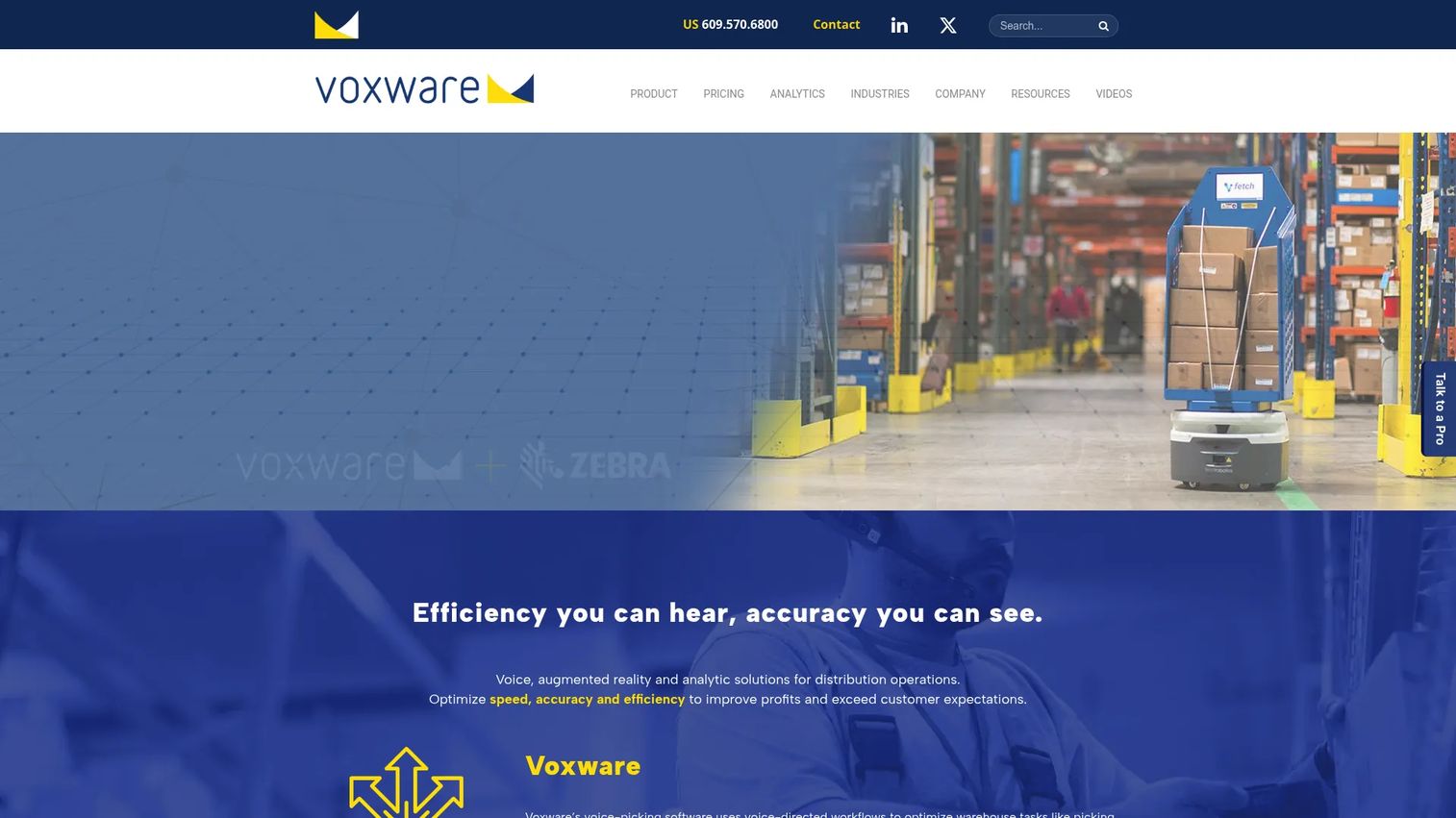
Voxware is a voice-directed warehouse software platform built for picking, replenishment, and related distribution workflows. It stands out in this category for publishing pricing openly and for extending voice beyond picking into augmented workflows that combine voice with scanning, vision, and image or video capture. Voxware customers report pick accuracy improvements reaching 99.9%, the kind of number that pays for itself in avoided returns and credits.
Best for: Distribution centers that need voice-directed picking plus workflow automation across multiple tasks, with clear budget visibility.
Key strengths
- Voice-directed picking workflows: Guides pickers hands-free and eyes-free with spoken instructions and confirmation.
- Augmented workflows: Combines voice with scanning, vision, and image or video capture for tasks that benefit from more than audio alone.
- VoxStudio configuration: Lets teams configure and adjust voice workflows without heavy developer involvement.
Why choose Voxware: If you want to start with picking and expand into replenishment and cycle counting on the same platform, Voxware gives you room to grow without switching vendors. The published pricing is a rarity here, which helps operations leaders build a business case and defend spend to finance without waiting on a sales cycle.
Voxware pricing: Voxware publishes three tiers on its pricing page. Express starts at $30k annual on a one-year term, Professional at $60k annual on a three-year term, and Enterprise at $120k annual on a five-year term. Each plan carries a one-time setup fee, and additional users are sold separately. There is no free tier. Voxware holds a 4.3 out of 5 rating on G2.
2. Honeywell Voice
Honeywell Voice is a voice-guided warehouse software product for order picking and fulfillment, built on decades of voice deployment across global distribution operations. It is the choice for enterprise fulfillment teams that need proven scale, deep host-system integration, and broad language coverage across a diverse workforce. Honeywell Voice converts worker confirmations into data that updates the host system in real time, keeping inventory and order status current across the operation.
Best for: Large distribution centers and fulfillment operations that need enterprise-grade voice with extensive multilingual support and tight WMS data flow.
Key strengths
- Voice-guided workflows for picking, replenishment, and fulfillment: Extends voice beyond order picking into adjacent tasks across the building.
- Text-to-speech and speech-to-text in more than 40 languages: Supports diverse and multilingual warehouse crews without separate deployments.
- Host-system data conversion: Turns spoken worker confirmations into structured data for real-time host-system updates.
Why choose Honeywell Voice: For operations running at enterprise scale with global or multilingual teams, Honeywell brings credibility and workflow breadth that reduce deployment risk. The 40-plus language support is a genuine differentiator for warehouses staffing a mixed-language workforce, where a single platform can serve every picker in their own language.
Honeywell Voice pricing: Honeywell does not publish a public price for this product. Pricing is handled through direct contact and scoped to your operation, seats, sites, and hardware. There is no publicly listed G2 rating for this specific product. Buyers should request a scoped quote and a proof-of-value using their own WMS flows before committing.
3. Lydia Voice
Lydia Voice is voice-directed warehouse picking software and hardware for logistics, production, and related industrial workflows. Its positioning centers on AI-based speech recognition that requires no speech template training, which shortens onboarding, plus parallel multi-language support that suits international operations. Lydia Voice reports a large global user base with hundreds of thousands of daily voice users, a signal of adoption depth in warehouse and industrial settings.
Best for: Warehouses and industrial operations that need fast worker adoption, strong multilingual support, and hardware flexibility including headset-free options.
Key strengths
- AI-based speech recognition: Recognizes speech accurately without per-worker template training, so new hires ramp quickly.
- Parallel multi-language support: Handles multiple languages at once for mixed-language crews on the same floor.
- VoiceWear and Warehouse Intelligence: Enables pick-by-voice without a traditional headset and surfaces real-time KPI analytics for supervisors.
Why choose Lydia Voice: If your operation staffs a high-turnover or multilingual workforce, the no-template-training recognition removes a real onboarding bottleneck. The hardware flexibility, including VoiceWear for headset-free picking, gives you options for ergonomics and worker comfort across long shifts.
Lydia Voice pricing: Lydia Voice offers a rental and subscription model with fixed monthly rates, but does not display a numeric price on its subscription page. Pricing is scoped through the vendor. There is no publicly verified G2 rating available for the product. As with other enterprise voice vendors, request a scoped quote tied to your seat count, sites, and hardware needs.
4. Lucasware
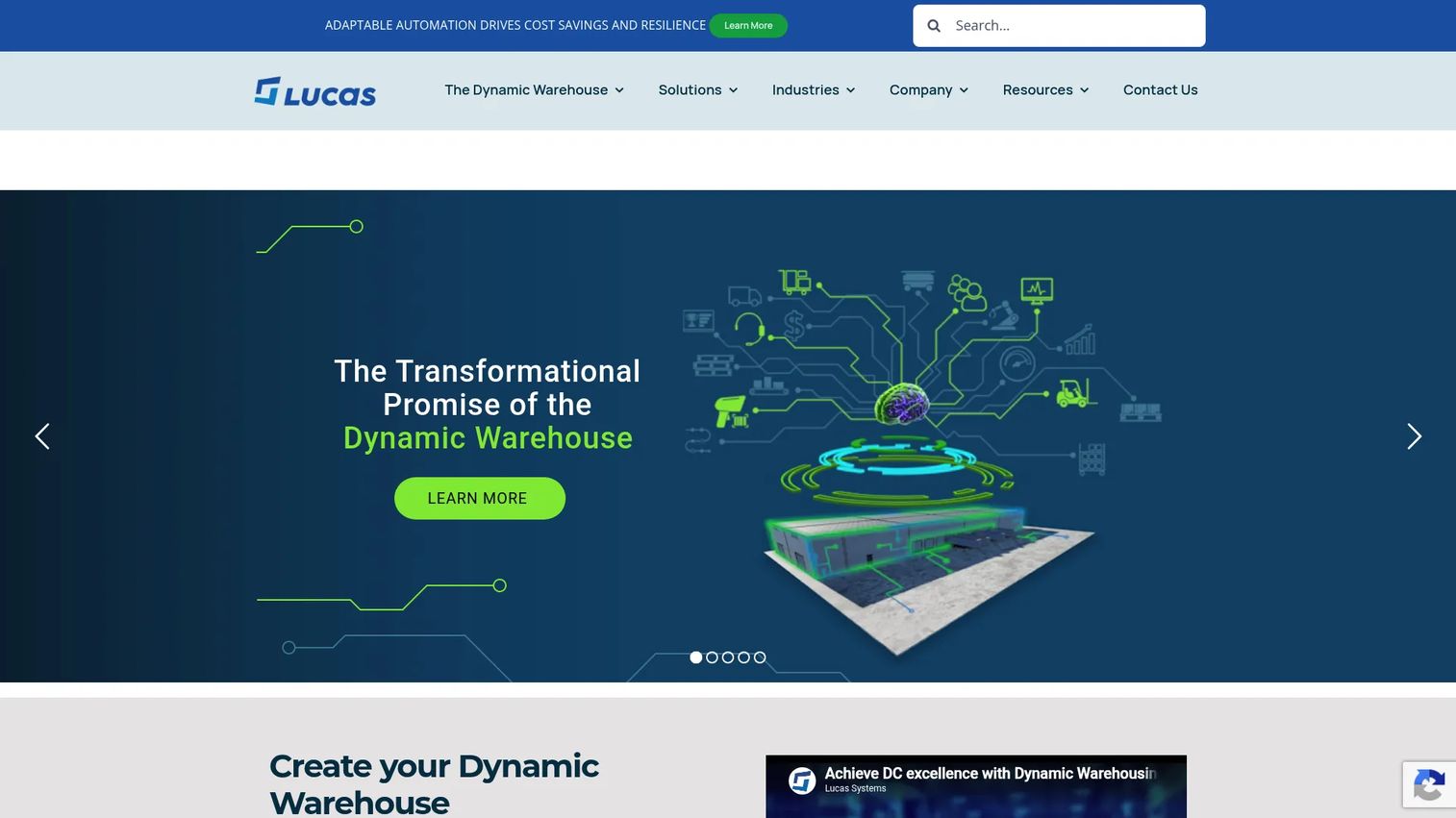
Lucasware, the software from Lucas Systems, is warehouse optimization software for distribution centers that combines voice-directed warehousing with warehouse execution, labor performance management, robotics, and slotting. It fits buyers who want voice as part of a broader optimization layer rather than a standalone picking tool. Lucasware emphasizes AI-based optimization for labor, travel, batching, and slotting, and reports average picking productivity gains around 36% for voice deployments.
Best for: Distribution centers that want AI-driven warehouse execution and analytics alongside voice-directed workflows.
Key strengths
- Voice-directed mobile applications: Combines voice, scanning, display, and RFID in a single mobile workflow.
- Warehouse execution with real-time reporting: Delivers real-time analytics and reporting across warehouse tasks.
- AI-based optimization: Optimizes labor, travel, batching, and slotting to cut walk time and balance workload.
Why choose Lucasware: If your bottleneck is not just the pick confirmation but the travel path, batching logic, and slotting behind it, Lucasware's optimization focus addresses the whole picture. Speaker-independent recognition means Lucas voice requires no user training, which removes the 20 to 30 minute per-worker setup that older speaker-dependent systems demanded.
Lucasware pricing: Lucasware does not publish public pricing on its site. The company sells through scoped engagements tied to your warehouse execution needs, workflow scope, and site count. There is no publicly verified G2 rating for the product. Ask for a proof-of-value that models your actual pick paths and labor data so the ROI reflects your operation, not a generic benchmark.
5. eSmart Voice
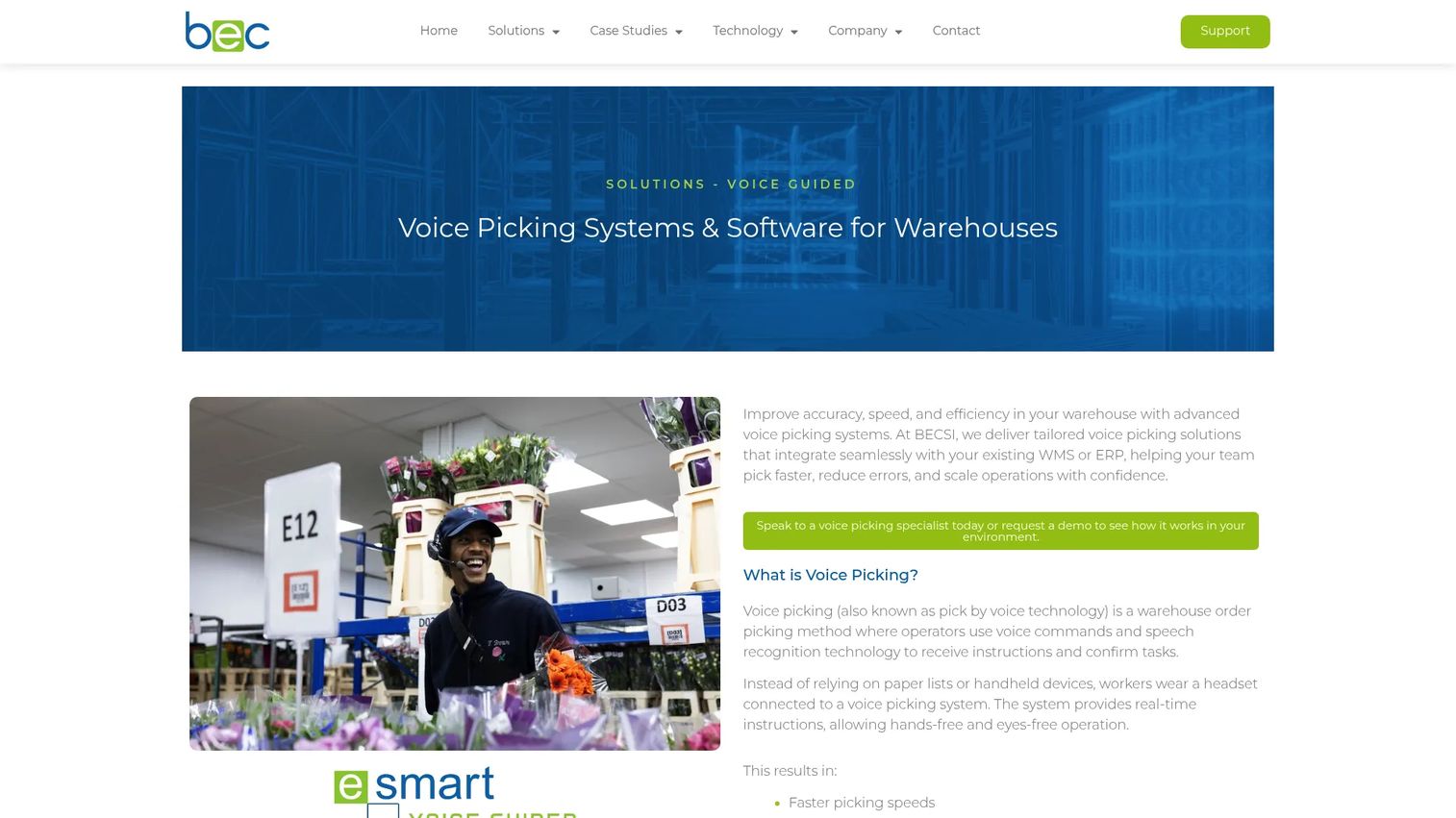
eSmart Voice is a BEC voice picking solution for warehouse order picking that uses voice commands and speech recognition to guide hands-free, eyes-free work. Its defining trait is that it integrates with your existing WMS or ERP rather than requiring you to adopt a full new stack, which suits operations that already have a system of record they want to keep. eSmart Voice reports worker productivity gains up to 35% and picking error reduction up to 85% compared to paper or label-based picking.
Best for: Warehouses that want a customized voice-directed picking system layered onto the WMS or ERP they already run.
Key strengths
- WMS and ERP integration: Connects to your existing system of record instead of forcing a platform migration.
- Hands-free, eyes-free picking: Keeps workers' hands on product and eyes on the shelf throughout the pick.
- Real-time updates and confirmation: Confirms picks and updates the host system in real time to keep inventory accurate.
Why choose eSmart Voice: If you have already invested in a WMS or ERP and do not want to rip it out, a solution built to integrate around your existing stack lowers the switching cost and shortens deployment. The customization posture fits operations with non-standard workflows that off-the-shelf voice tools do not model cleanly.
eSmart Voice pricing: BEC does not publish public pricing for eSmart Voice. The solution is scoped and customized per operation, so pricing depends on your workflow complexity, integration needs, and hardware. There is no publicly verified G2 rating for the product. Request a scoped quote and confirm the integration approach against your specific WMS or ERP version.
6. Bastian Solutions
Bastian Solutions is a warehouse automation and systems integration provider for distribution and manufacturing operations, with voice-directed picking sitting inside a broader end-to-end automation portfolio. It fits teams that need implementation support and warehouse workflow design alongside the voice software itself, rather than buying voice as an isolated point solution. Bastian brings warehouse software including warehouse execution and control systems, plus integration and lifecycle services.
Best for: Enterprises that need custom warehouse automation and systems integration, with voice as one part of a larger project.
Key strengths
- End-to-end warehouse automation: Designs and integrates full material handling and automation systems, not just voice.
- Warehouse software (WES, WCS): Provides warehouse execution and control systems to orchestrate work across the building.
- Integration and lifecycle services: Delivers system integration, lifecycle planning, training, and ongoing support.
Why choose Bastian Solutions: If your project involves conveyors, robotics, or a full automation redesign, buying voice from a systems integrator who owns the whole build reduces the number of vendors you coordinate. This suits operations that want a single accountable partner for design, integration, training, and support rather than stitching voice into automation themselves.
Bastian Solutions pricing: Bastian sells through quote and request-based engagements scoped to each project. There is no public plan pricing, which is expected for a systems integrator delivering custom automation. Its G2 listing currently shows no reviews. Scope a project quote and ask for references from operations similar to yours in size and workflow mix.
7. Promag
Promag is a Polish intralogistics company offering warehouse equipment, automation, storage systems, and related industrial solutions. It fits buyers comparing smaller or region-specific vendors, particularly those who want voice-directed picking evaluated alongside physical storage and material handling design in one engagement. Promag reports operating efficiency gains of 3 to 4 times, storage density increases of 80 to 130%, and picking accuracy up to 99.99% across its intralogistics projects.
Best for: Warehouses and industrial operations needing intralogistics equipment and custom storage solutions alongside voice-directed picking.
Key strengths
- Automated storage and material handling: Designs and delivers automated storage and handling systems for the physical warehouse.
- Storage racks, shelving, and platforms: Supplies the structural storage layer that voice picking runs against.
- 3D configurators: Lets teams design and price selected products online before committing to a full engagement.
Why choose Promag: If your project starts with the physical warehouse, racking, storage density, and layout, and voice picking is one workflow inside that redesign, Promag's intralogistics breadth is a natural fit. The 3D configurators give you a way to model and price parts of the project before a full sales conversation, which is useful for early scoping.
Promag pricing: Promag does not publish general product pricing, though some 3D configurators can generate a price estimate for selected products. Full projects are scoped and quoted per operation. There is no publicly verified G2 rating for the company. Use the configurators for early estimates, then request a scoped quote for the voice and storage components together.
Considerations before you buy
Shortlisting is only half the work. Before you sign, pressure-test each vendor against the realities of your operation.
Integration requirements
Confirm WMS, ERP, and labor management system compatibility before you shortlist, not after. Ask for the exact versions the vendor has integrated with, and whether the connection is native, middleware-based, or custom. A voice system that cannot update your system of record in real time defeats the purpose. Get the integration approach in writing.
Workflow breadth
Decide now whether you need voice for picking alone or across putaway, replenishment, receiving, loading, returns, and cycle counting. Buying a picking-only tool and later needing multi-task coverage means a second procurement cycle. If breadth matters, prioritize vendors that support the full task set on one platform.
Worker adoption
Evaluate training time, device ergonomics, language support, and noise tolerance. Speaker-independent recognition that needs no per-worker template training cuts ramp time, which matters most in high-turnover and seasonal operations. Test the hardware on a real shift, in your actual noise and temperature conditions, before you commit.
Reporting and visibility
Confirm real-time productivity tracking, exception handling, and management dashboards. Supervisors need to see progress mid-shift and reroute work when a zone falls behind. Ask whether reporting is real-time or batched, and whether you can export the data into your existing analytics or labor systems.
Scalability and deployment
Review support for multi-site rollouts, hardware flexibility, and rollout speed. If you run several distribution centers, ask how the vendor handles configuration consistency and central management across sites. A pilot at one site should give you a repeatable playbook for the rest.
Conclusion
The right voice picking software depends on your operation, not on which vendor has the loudest landing page. For broad workflow coverage with published pricing you can defend to finance, Voxware is the practical starting point. For enterprise fulfillment at scale with deep multilingual support, Honeywell Voice brings proven credibility. For fast worker adoption and multilingual crews, Lydia Voice removes the onboarding bottleneck with no-template-training recognition.
If your bottleneck is optimization rather than confirmation, Lucasware pairs voice with labor and slotting intelligence. If you want to keep your existing WMS or ERP, eSmart Voice integrates around it. And if voice is one workflow inside a larger automation or storage project, Bastian Solutions and Promag deliver it as part of an end-to-end build.
The practical next step is simple. Shortlist two or three vendors based on your workflow scope and integration needs, then request a proof-of-value that runs your actual WMS flows, your real pick paths, and your labor data. A demo on generic data proves nothing. A pilot on your own operation tells you exactly what payback to expect.
FAQs
Voice picking software directs warehouse workers through picking and other tasks using spoken audio prompts and voice confirmations instead of paper lists or handheld screens. It converts WMS data into spoken instructions and turns the worker's spoken responses back into data the host system acts on, keeping hands and eyes free for the product.
The system tells the picker a location through a headset. The picker walks there, reads back a check digit to confirm arrival, and hears the quantity to pick. After picking, the worker confirms out loud, the software updates the WMS, and the next instruction follows. The loop repeats hands-free and eyes-free across the shift.
Leading systems extend voice into replenishment, receiving, putaway, packing, loading, returns, quality control, and cycle counting. Consolidating these tasks under one voice platform reduces device sprawl and gives supervisors a single view of labor across the operation. Confirm which workflows a vendor supports before you shortlist.
For high-volume, repetitive picking, voice usually wins on throughput because it removes the stop-read-scan cycle and keeps both hands on product. RF scanning still fits tasks that need serial number or barcode capture. Many operations run both, and some vendors combine voice with scanning in augmented workflows so you do not have to choose.
Yes. Well-designed voice picking systems integrate with your existing WMS and ERP so orders, inventory, and productivity data stay synchronized in real time. Ask each vendor for the exact systems and versions they have integrated with, and whether the connection is native, middleware-based, or custom, before you commit.
Modern speaker-independent systems require little or no per-worker voice training, so new hires can ramp in a shift or less. Older speaker-dependent systems required 20 to 30 minute per-worker template sessions. If you run high-turnover or seasonal operations, prioritize no-template-training recognition to cut onboarding time.
Ask about WMS and ERP integration versions, which workflows beyond picking are supported, training time and hardware ergonomics, real-time reporting and exception handling, and multi-site deployment support. Then request a proof-of-value using your actual WMS flows and pick paths, so the projected ROI reflects your operation rather than a generic benchmark.