You can fix a broken schedule after a complaint. You cannot undo a fatigue-related incident after the shift is over.
According to the National Safety Council (2026), 97% of workers carry at least one workplace fatigue risk factor, and more than 80% carry two or more. For operators running 24/7 coverage, that number is not a wellness talking point. It is a liability sitting inside every night shift, every quick turnaround, every understaffed weekend.
The software category built to address this, fatigue risk management software, has grown from a niche aviation compliance tool into a cross-industry market projected to reach $2.26 billion by 2032, up from $1.03 billion in 2025, according to iResearch Services (2026). What was once a pilot fatigue problem is now a mining, logistics, healthcare, and energy problem.
The harder question is not whether fatigue risk matters. It is which software category, and which specific tool, fits the operational constraint you are actually trying to solve: Schedule design, worker readiness, real-time alertness, audit documentation, or full FRMS maturity. This guide maps each of the 10 tools below to that question.
What's inside
This guide compares 10 fatigue risk management software options across different operational models. It is built for safety, HSE, operations, workforce planning, and executive teams evaluating FRMS software for shift-based or safety-sensitive workforces.
Selection criteria:
- Fatigue modeling depth and scientific validation
- Monitoring, testing, and alert capabilities
- Schedule analysis and roster fatigue assessment
- Audit trail, reporting, and safety program integration
- Evidence base: Vendor product pages, review listings, pricing pages, and category research
TL;DR
- Best for impairment testing and fatigue alerts: SafetyIQ, with mobile-first readiness screening and real-time dashboards for field operations starting at $2,500/year
- Best for FRMS design plus software: Circadian, which combines consulting, audits, training, and modeling tools for organizations building a formal fatigue risk management system
- Best for predictive fatigue scores at workforce scale: Fatigue Science Readi, with individualized hour-by-hour forecasts and supervisor alert workflows
- Best for biomathematical fatigue modeling: SAFTE-FAST, built on the SAFTE model for schedule analysis, alertness prediction, and scenario comparison
- Best for scheduling compliance and rule enforcement: Shiftboard or Indeavor Schedule, both suited to complex shift operations where roster design is the primary risk surface
- Best decision rule for founders and operators: Match the tool to where fatigue risk enters your system, not to the longest feature list
What is fatigue risk management software?
Fatigue risk management software helps organizations identify, predict, monitor, and reduce fatigue-related safety risks across shift-based or safety-sensitive workforces.
A Fatigue Risk Management System (FRMS) is a data-driven safety process. The software is one layer of that process. Strong programs combine schedule design, worker reporting, monitoring, training, and continuous review. Software supports those activities but does not replace policy, leadership, or safety culture.
Tools in this category fall into four operational types:
Predictive tools use biomathematical fatigue models to forecast alertness and performance risk from schedule and sleep data before shifts begin. SAFTE-FAST, Fatigue Science Readi, and Circadian sit here.
Proactive monitoring tools collect worker readiness data, run fatigue assessments, and alert supervisors before safety-sensitive tasks start. SafetyIQ and Optalert sit here, along with Fatigue Science Readi for pre-shift forecasting.
Reactive incident review tools help teams analyze whether fatigue contributed to a near-miss or incident, using schedule history, alertness data, and model outputs. Circadian's FACTS tool is a clear example.
Scheduling and compliance tools reduce fatigue risk by enforcing work-hour limits, fatigue rules, and coverage logic during roster creation. Shiftboard, Indeavor Schedule, RASP, and Prometheus WorkTech sit here.
Core capabilities to evaluate across any FRMS software:
- Biomathematical fatigue modeling and sleep-based risk scoring
- Roster and shift schedule analysis for aviation compliance monitoring and other regulated industries
- Worker readiness or impairment testing
- Fatigue dashboards and threshold alerts
- Corrective action tracking and incident linkage
- Audit trails and regulatory documentation
- Integration with safety management systems and broader workforce tools
When to use fatigue risk management software
Predict shift risk before the roster goes live
Schedule-based fatigue risk is cheapest to fix before shifts are assigned. Night shifts, quick turnarounds, consecutive workdays, and excessive overtime all create predictable risk patterns that modeling tools can flag before anyone starts work. If your planning team is building rosters without fatigue visibility, that is a gap a predictive FRMS tool closes.
Monitor readiness before safety-sensitive work
Pre-shift testing and fatigue score alerts give supervisors a decision point before a worker starts a high-risk task. This is where worker impairment software and psychomotor testing tools earn their place. The goal is not to catch tired workers; it is to give supervisors a consistent, documented basis for intervention decisions.
Prove your fatigue controls during audits and reviews
Dashboards, score history, exceptions, corrective actions, and exportable reports give safety teams something concrete to show during regulatory audits, insurer reviews, or internal safety program assessments. Software helps document that controls exist and are being used. Compliance still depends on how the organization applies those controls.
Fatigue risk management software comparison
Different tools solve different entry points into the fatigue risk problem. Some center on modeling, some on worker testing, some on scheduling enforcement, and some combine consulting with software. The right choice depends on where your exposure actually lives.
| # | Product | Best for | Key differentiator | Pricing | G2 rating |
|---|---|---|---|---|---|
| 1 | SafetyIQ | Field operations: Fatigue monitoring and alerts | Mobile-first EHS platform with readiness assessments and shift-risk dashboards | From $2,500/year | 4.8/5 |
| 2 | Circadian | Formal FRMS with expert implementation support | Combines CAS fatigue modeling, FACTS incident analysis, training, and consulting | Quote-based | N/A |
| 3 | Fatigue Science Readi | Predictive fatigue scores for large shift workforces | Hour-by-hour fatigue forecasts from sleep and schedule inputs, no wearable required | Quote-based | N/A |
| 4 | SAFTE-FAST | Biomathematical fatigue modeling and schedule analysis | SAFTE model, scenario comparison, alertness prediction, and API integration | Quote-based | N/A |
| 5 | FRMSc | Aviation and safety-critical FRMS integrations | Validated fatigue models, roster risk prediction, and HARVEST analytics | Quote-based | N/A |
| 6 | RASP | Complex shift operations with scheduling and fatigue controls | Workforce scheduling platform with fatigue management as an integrated module | Quote-based | N/A |
| 7 | Shiftboard | Scheduling compliance and fatigue rule enforcement | Automated scheduling with compliance controls for large shift-based operations | Quote-based | 4.6/5 |
| 8 | Prometheus WorkTech | Industrial contractor workforces with fatigue monitoring | Fatigue scores and violation alerts within contractor management workflows | Quote-based | 4.0/5 |
| 9 | Indeavor Schedule | Complex 24/7 scheduling with fatigue-risk visibility | Automated schedule generation with labor rules, fatigue limits, and demand planning | Quote-based | 4.2/5 |
| 10 | Optalert | Driver and operator real-time drowsiness detection | Johns Drowsiness Scale for objective, continuous alertness monitoring | Quote-based | N/A |
Best 10 fatigue risk management software tools for 2026
1. SafetyIQ
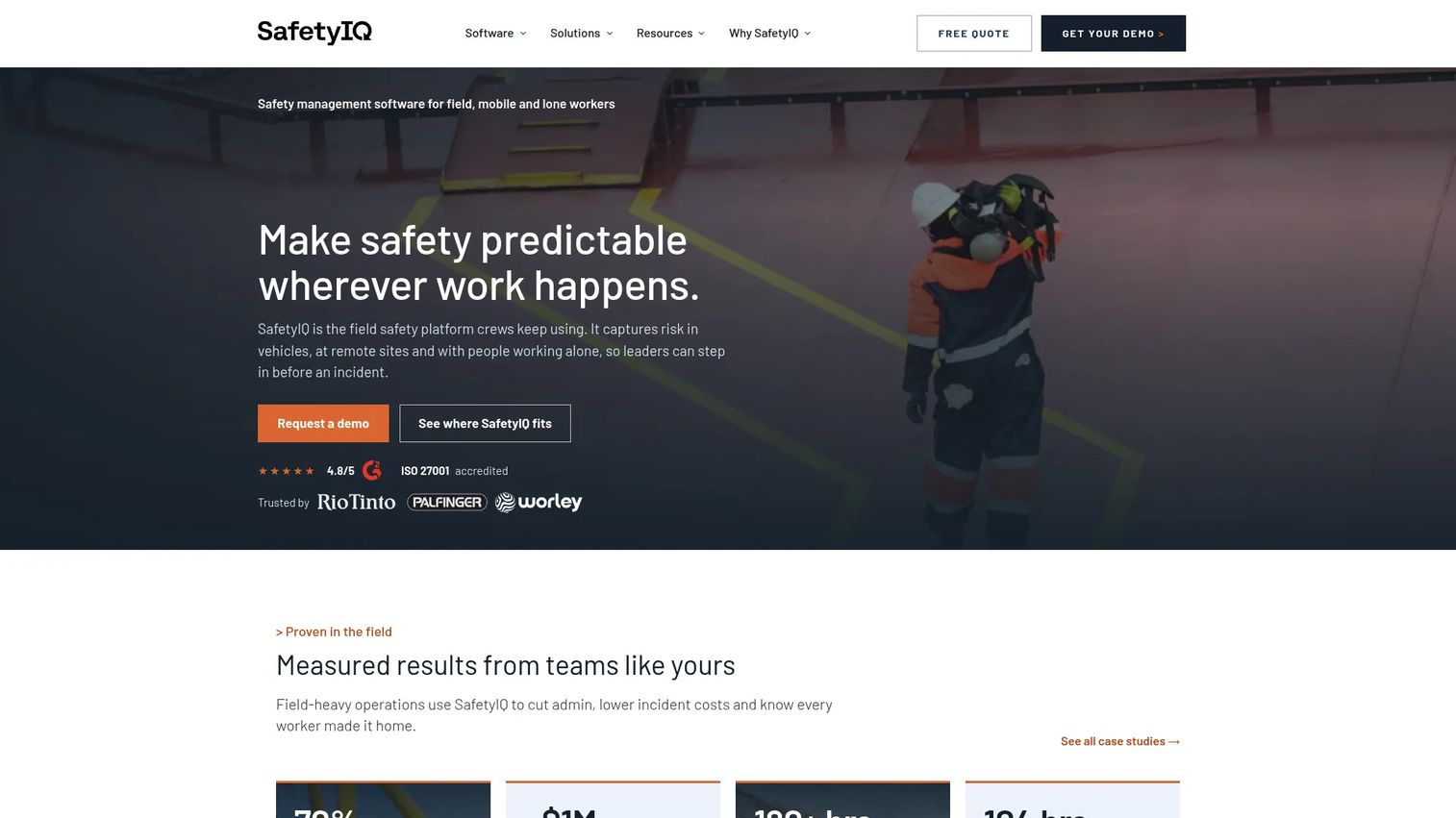
SafetyIQ is a mobile-first EHS platform that covers incident management, lone-worker protection, journey management, and fatigue risk across field operations. The fatigue module centers on worker readiness assessments, shift-risk monitoring, and trend analysis designed for safety-sensitive environments like mining, energy, and construction. Teams can run readiness checks, track fatigue trends, and receive alerts before workers begin high-risk tasks. The platform works offline with automatic synchronization, which matters in environments where connectivity is unreliable.
Best for: Safety, operations, and compliance teams in field-heavy industries that need daily worker fatigue visibility and pre-shift readiness data.
Key features
- Fatigue readiness assessments and shift-risk monitoring
- Fatigue trend analysis and dashboards
- Incident management, audits, and corrective action workflows
- Offline mobile operation with automatic sync
- Real-time dashboards and automated reporting
Why choose SafetyIQ: It fits organizations that need to catch fatigue risk before a shift starts, not reconstruct it after an incident. The broader EHS coverage means fatigue data sits alongside incident reports, hazard observations, and training records in a single system.
SafetyIQ pricing: Subscription pricing starts at $2,500 per year and scales with operational requirements. Customers can purchase the full EHS suite or individual modules. Contact sales for a quote based on workforce size and the specific modules needed.
SafetyIQ G2 rating: 4.8/5
2. Circadian
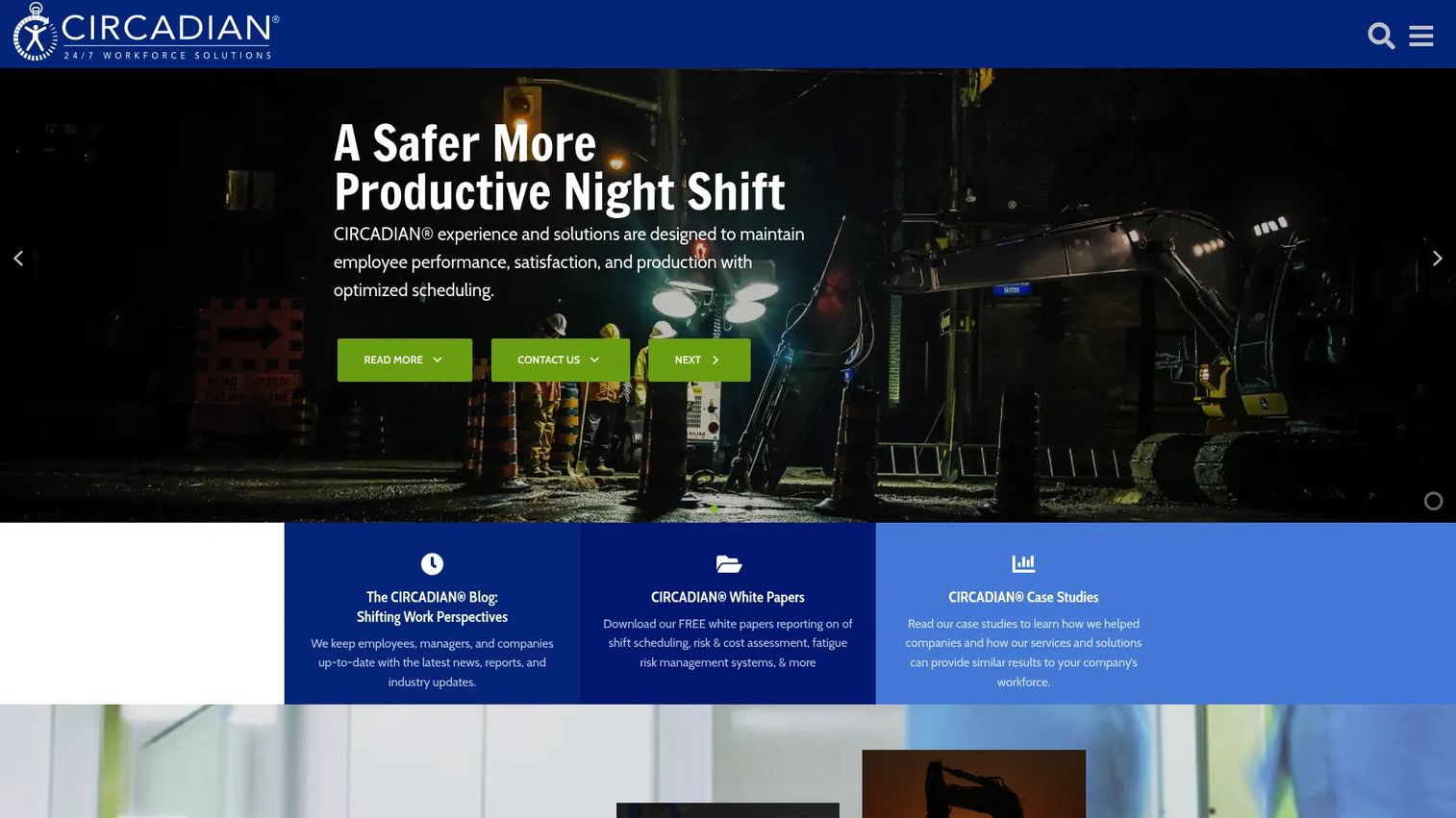
Circadian Technologies is one of the more established names in FRMS, offering a combination of cloud-based fatigue modeling software, incident analysis tools, shift schedule optimization, and consulting services. The CAS Fatigue Risk Model analyzes schedules for fatigue exposure, while the FACTS tool helps teams investigate whether fatigue contributed to a specific incident or near-miss. Circadian also provides structured FRMS gap analysis, training programs, and regulatory support, making it closer to an implementation partner than a pure software vendor.
Best for: Organizations building or maturing a formal fatigue risk management system who need expert support alongside software tools.
Key features
- CAS cloud-based fatigue risk modeling and schedule analysis
- FACTS accident and incident fatigue-causation analysis
- FRMS gap analysis and design support
- Fatigue management training and education
- Regulatory compliance support for 24/7 operations
Why choose Circadian: It fits high-risk 24/7 operations in aviation, energy, healthcare, and transport that want software backed by structured FRMS expertise. If your team is building an FRMS from scratch and needs both modeling tools and implementation guidance, Circadian covers both.
Circadian pricing: CAS pricing is usage-based and varies by operation size and monthly report volume. FACTS offers a complimentary five-case trial. Contact Circadian for a formal pricing proposal, and ask about report volume, consulting scope, and training seats.
3. Fatigue Science Readi
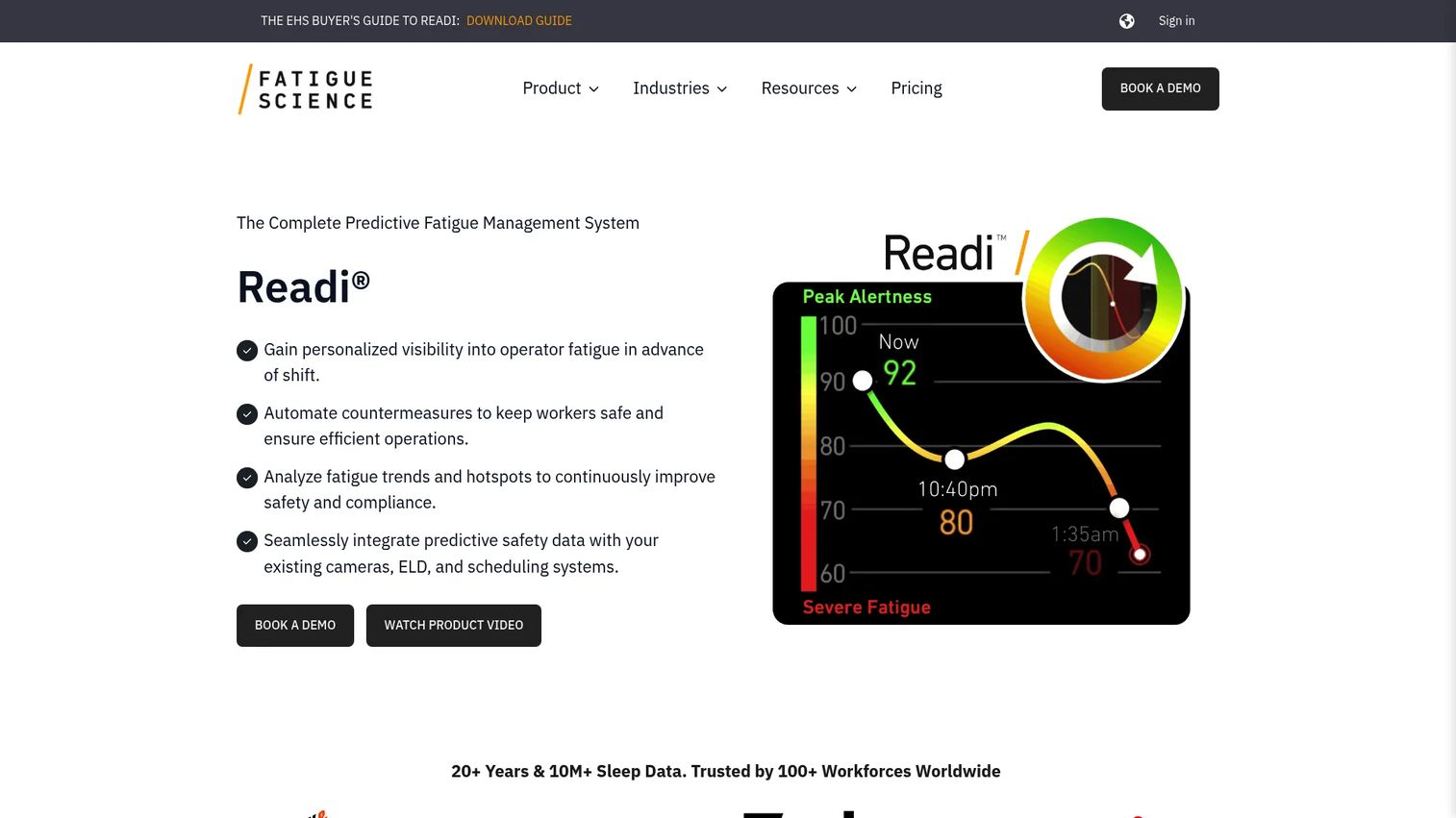
Fatigue Science Readi is a predictive fatigue management platform that generates individualized, hour-by-hour fatigue forecasts for workers up to 18 hours in advance. The system draws on sleep data and schedule inputs, requiring no wearable device by default, though an optional ReadiWatch wearable is available. Supervisors receive alerts when a worker's forecast crosses a risk threshold, along with countermeasure recommendations and intervention logging. The platform integrates with telematics, scheduling, ELD, and time-and-attendance systems, and can operate offline with pre-computed scores cached for field use.
Best for: Mining, transportation, fleet operations, and other safety-sensitive organizations managing fatigue risk across large shift workforces.
Key features
- Hour-by-hour individualized fatigue forecasts up to 18 hours ahead
- Supervisor alerts and intervention logging with countermeasure recommendations
- Schedule simulations and fatigue trend analysis via HSE analytics
- Integration with telematics, AI dash cameras, ELD, and scheduling systems
- Offline operation with cached pre-computed scores
Why choose Fatigue Science Readi: It is the strongest option for organizations that need personalized, predictive fatigue risk data at crew or fleet scale without requiring every worker to wear a device. The intervention logging also creates the documentation trail safety teams need for audits and reviews.
Fatigue Science Readi pricing: Customized subscription pricing following a pilot program. When requesting a quote, ask about workforce size, data inputs used (schedule only vs. wearable), dashboard access, and implementation scope.
4. SAFTE-FAST
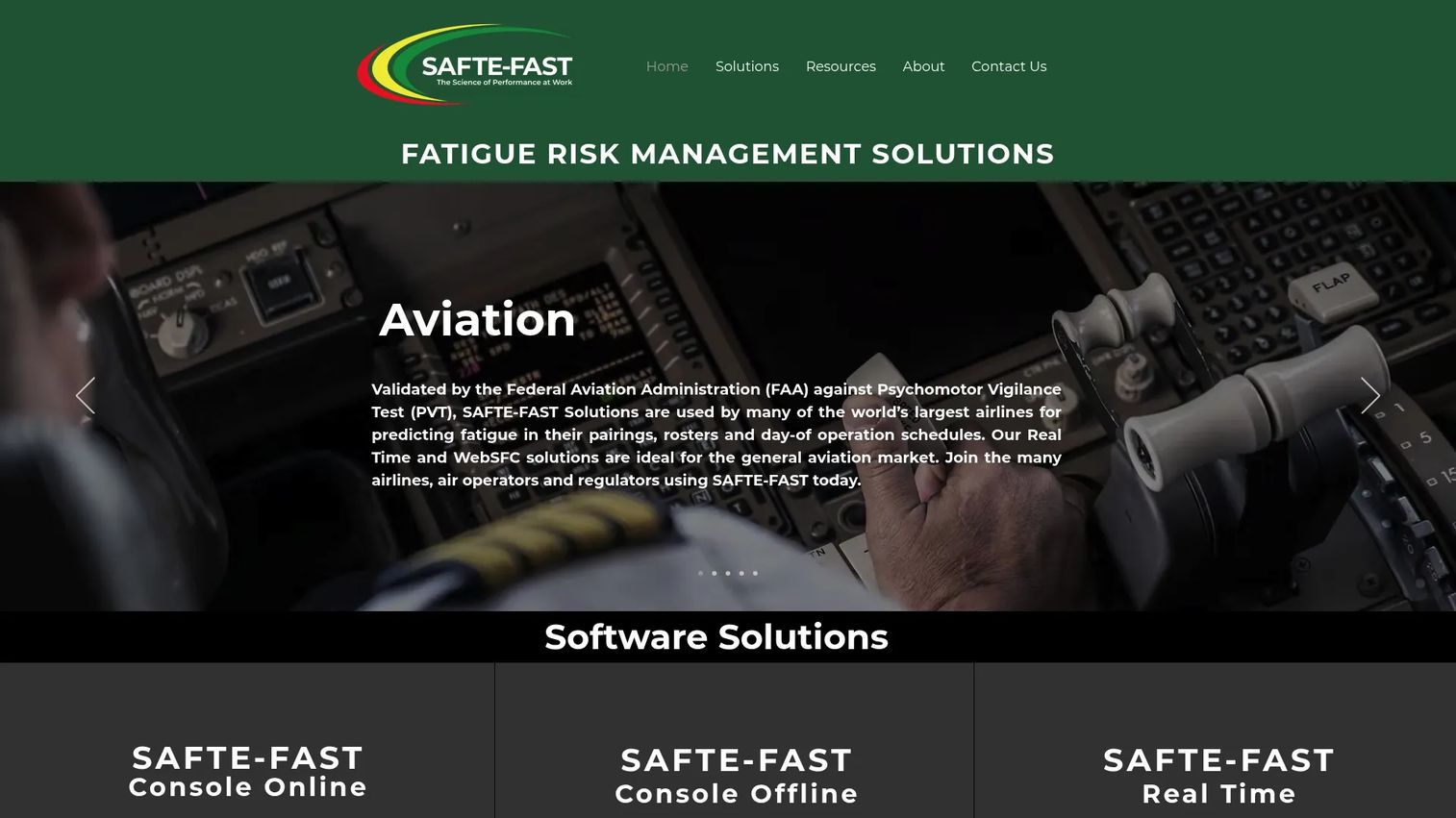
SAFTE-FAST is fatigue modeling software built on the Sleep, Activity, Fatigue, and Task Effectiveness (SAFTE) biomathematical model. It analyzes planned, actual, and historical schedules to predict fatigue-related risk and estimate alertness and performance effectiveness across different work patterns. Teams can compare schedule scenarios, apply configurable workload rules, and run what-if analysis to identify when risk peaks across a roster. An API integration supports real-time fatigue and sleep metrics, and the Zulu Watch sleep-data import adds wearable input options.
Best for: Airlines, rail and transit operators, researchers, and safety teams that need model-based fatigue prediction and schedule scenario analysis.
Key features
- SAFTE biomathematical model for fatigue and alertness prediction
- Analysis of planned, actual, and historical workforce schedules
- Schedule builder with configurable workload rules and Insights analysis
- API integration for real-time fatigue and sleep metrics
- Zulu Watch sleep-data import and sleep-event tracking
Why choose SAFTE-FAST: It fits teams that need fatigue science depth and schedule scenario analysis rather than app-based worker testing. If the core requirement is understanding how proposed schedule changes affect fatigue exposure across a fleet or crew, SAFTE-FAST is built for that job.
SAFTE-FAST pricing: SAFTE-FAST appears to price through direct engagement. Ask about license type, number of users or operations, model access scope, training, and ongoing support costs.
5. FRMSc
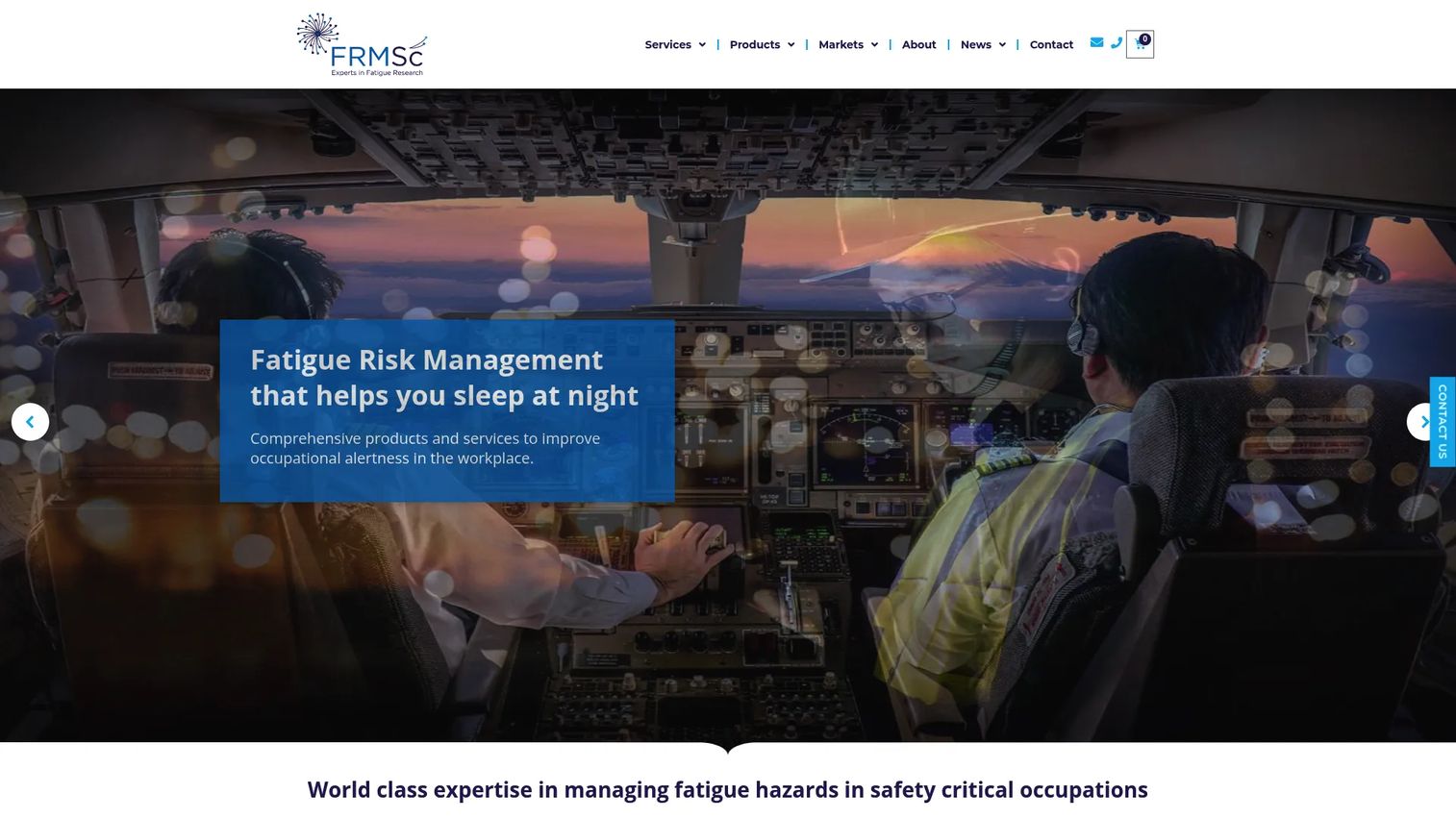
FRMSc (Fatigue Risk Management Science Limited) provides validated biomathematical fatigue models, mobile data-collection tools, roster fatigue-risk prediction, and analytics for safety-critical industries. The iOS and Android apps integrate with Apple Watch and health data, feeding sleep and activity inputs into the fatigue models. The HARVEST analytics module delivers metrics, charts, cohort analysis, and reporting. FRMSc also offers consultancy, research, and training alongside the software products, positioning it similarly to Circadian as a science-led FRMS partner rather than a standalone scheduling tool.
Best for: Aviation, rail, healthcare, and other safety-critical organizations that need scientifically validated fatigue models and roster risk prediction supported by research expertise.
Key features
- Validated biomathematical fatigue models for aviation, cabin crew, and shift workers
- Roster fatigue-risk prediction with what-if scenario analysis
- iOS and Android apps integrating with Apple Watch and health data
- HARVEST analytics with metrics, charts, reports, and cohort analysis
- Consultancy, research, regulatory advice, and training services
Why choose FRMSc: It fits organizations operating under regulatory scrutiny in aviation or healthcare that need models backed by published research. The combination of roster prediction, mobile data collection, and consultancy support makes it a viable option for teams building FRMS programs in regulated environments.
FRMSc pricing: When requesting a quote, ask about model licensing, mobile app deployment, HARVEST access, and consulting scope.
6. RASP
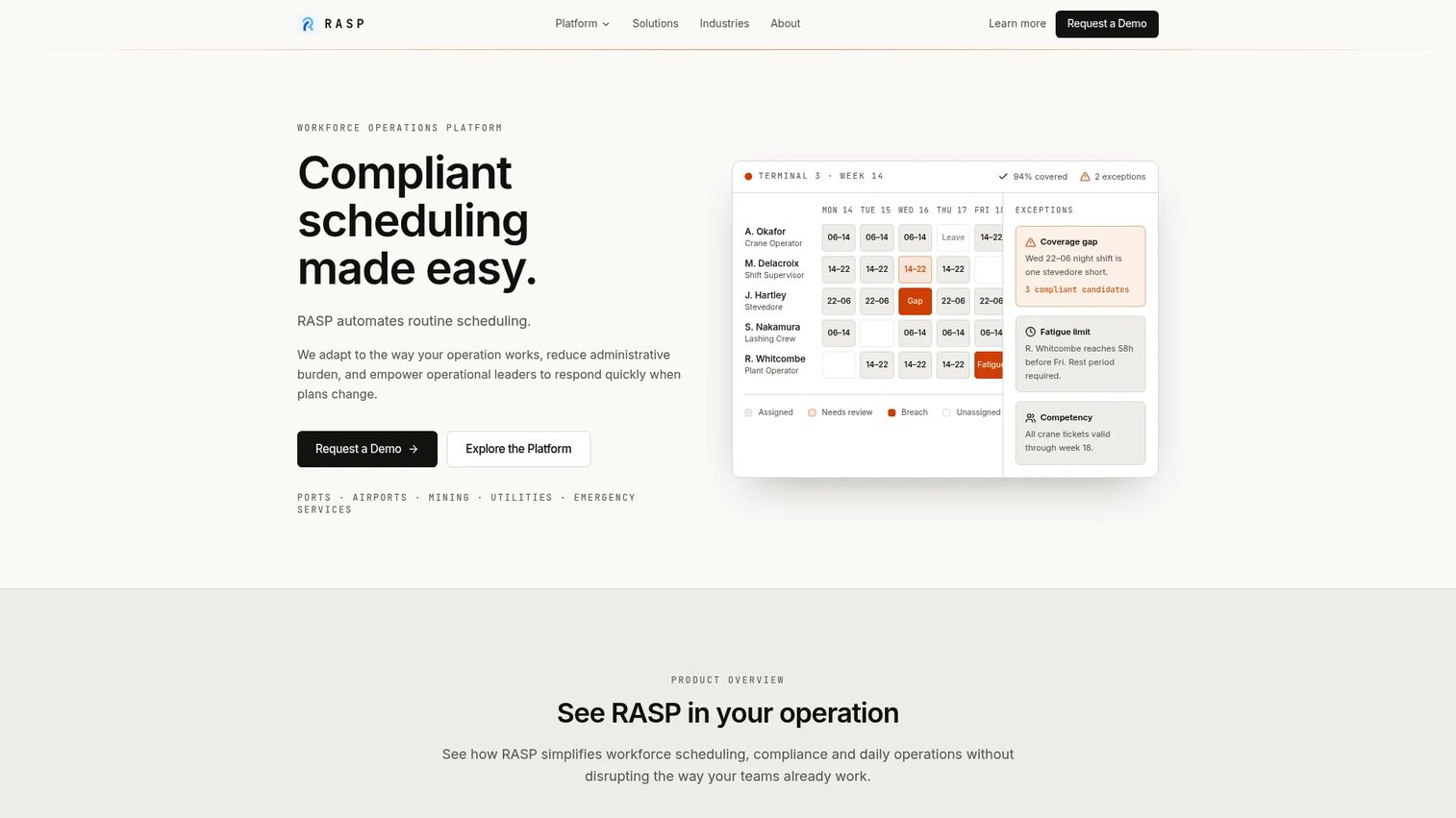
RASP is a workforce operations platform for complex, shift-based organizations, with fatigue management built as an integrated module rather than a standalone product. The platform covers scheduling and rostering, compliance management, leave and availability, qualifications and eligibility, payroll workflows, and fatigue management in a connected system. That integration matters: A fatigue flag in RASP connects directly to the scheduling and compliance layers, so a risk signal can trigger a roster adjustment rather than sitting in a separate dashboard. RASP serves ports, airports, mining, utilities, healthcare, and emergency services.
Best for: Shift-heavy organizations with complex compliance requirements that want fatigue controls embedded inside a broader workforce scheduling and operations platform.
Key features
- Integrated fatigue management within workforce scheduling and rostering
- Compliance management for labor rules, qualifications, and shift regulations
- Leave and availability management with operational visibility
- Payroll workflow integration
- Reporting and analytics across scheduling and workforce operations
Why choose RASP: It fits teams that want fatigue risk tied to roster decisions at the point of planning, not surfaced in a separate system after schedules are built. The integration across scheduling, compliance, and payroll reduces the operational overhead of managing fatigue risk as an isolated process. For audit management teams that need connected data across workforce decisions, this architecture is worth evaluating.
RASP pricing: Pricing requires a direct request. Ask about workforce size, number of sites, the specific modules required, and implementation scope.
7. Shiftboard
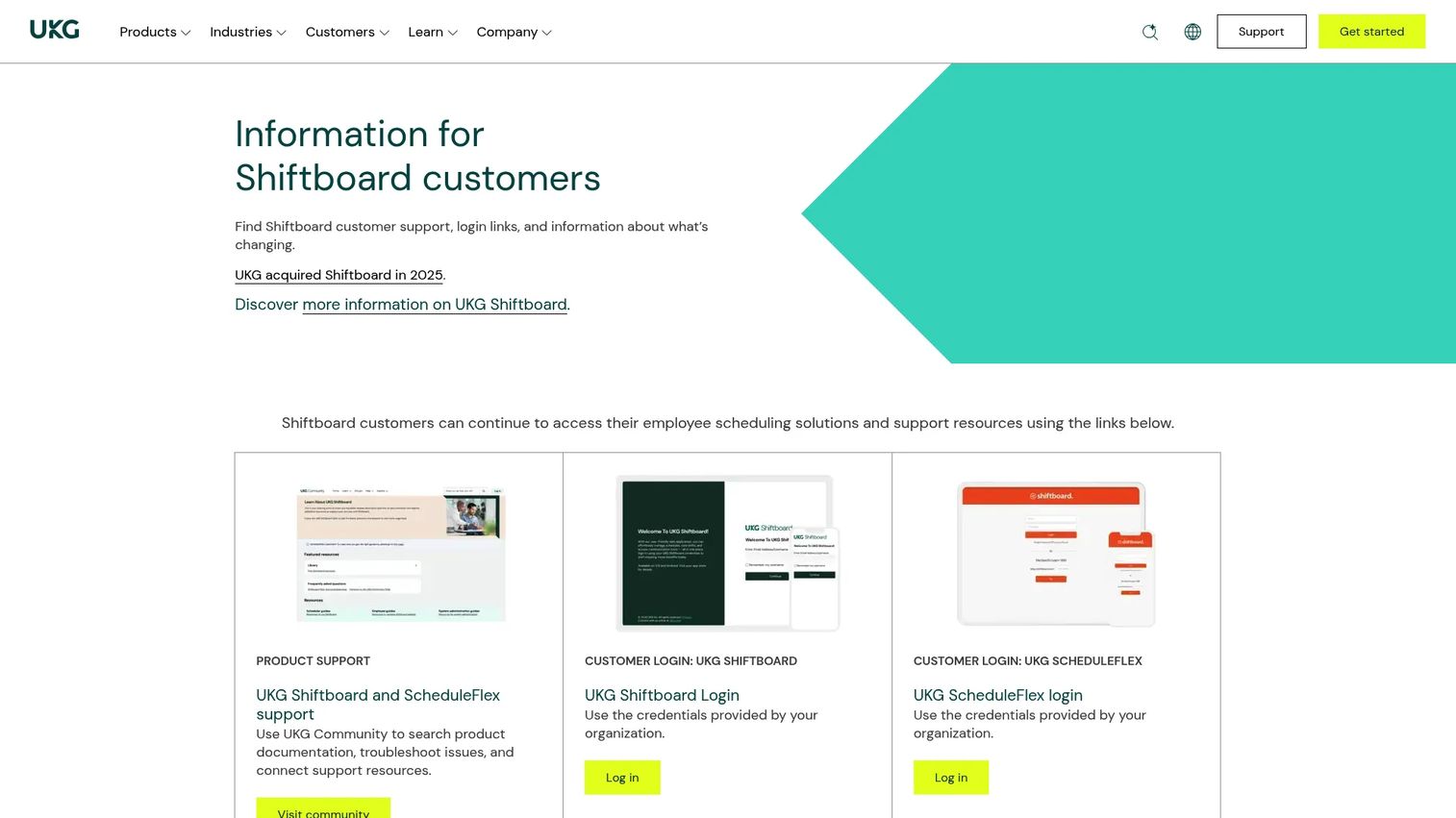
Shiftboard is workforce scheduling software for complex, shift-based operations, now part of UKG resources following acquisition. The platform automates schedule generation, enforces compliance controls for labor laws, union rules, and fatigue-related scheduling policies, and gives workers self-service access for shift pickup, trading, and leave requests. Fatigue risk in Shiftboard is addressed primarily through the scheduling and compliance layer: Rule enforcement, exceptions management, and audit tools that document when and how scheduling decisions were made.
Best for: Large operations in manufacturing, energy, healthcare, and emergency services where the main fatigue risk comes from schedule design, overtime patterns, and coverage gaps.
Key features
- Schedule automation with coverage optimization and demand planning
- Compliance enforcement for labor laws, union rules, and fatigue scheduling policies
- Exceptions management and audit tools
- Worker self-service for schedule access, shift trading, and leave requests
- Leave and timesheet management
Why choose Shiftboard: It fits teams where the primary fatigue exposure lives in how rosters are built, not in real-time worker impairment. If your incident history points to chronic overtime, quick turnarounds, or understaffed shifts as the root cause, scheduling compliance enforcement is the more direct fix than a monitoring tool.
Shiftboard pricing: The former pricing page currently returns a redirect to UKG resources. Contact Shiftboard or UKG sales and ask about workforce size, number of locations, scheduling complexity, and integration requirements.
Shiftboard G2 rating: 4.6/5
8. Prometheus WorkTech
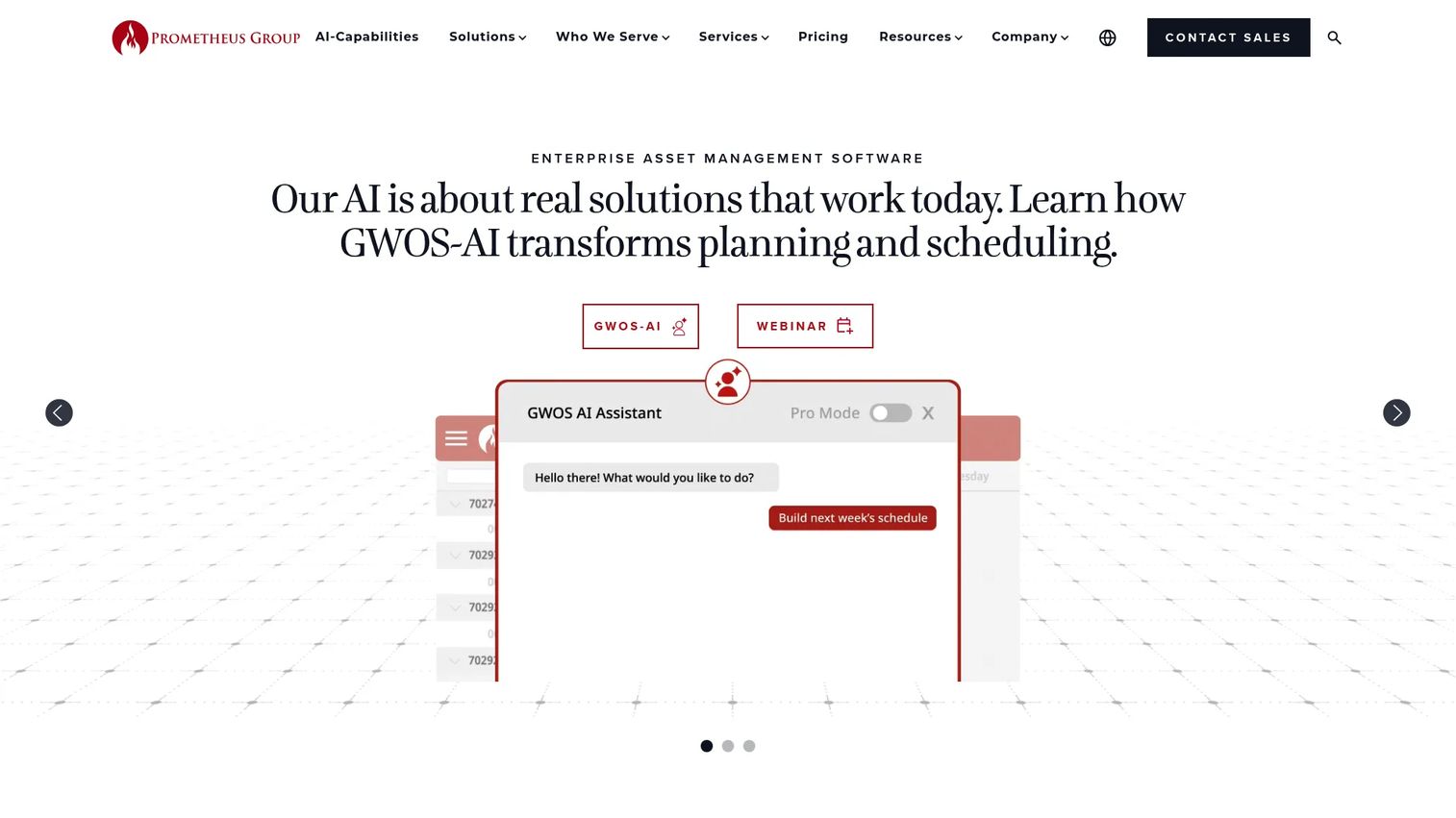
Prometheus WorkTech is now represented primarily as Prometheus Contractor Management, within the broader Prometheus Group portfolio. The platform covers contractor cost tracking, time and attendance, onboarding, qualifications, assignment management, and fatigue monitoring with fatigue scores and violation alerts. It integrates with SAP, IBM Maximo, Oracle, and other ERP and EAM systems, making it a fit for asset-intensive operations that already run on enterprise infrastructure. The G2 rating reflects the broader Prometheus Platform listing.
Best for: Energy, utilities, manufacturing, and other asset-intensive organizations managing fatigue risk within contractor and field workforce operations.
Key features
- Fatigue monitoring with fatigue scores and violation alerts
- Contractor onboarding, qualifications, assignments, and compliance management
- Time, attendance, and cost tracking for contractor workforces
- Automated rate validation, approvals, and gate reconciliation
- Integration with SAP, Oracle, IBM Maximo, ERP, EAM, CMMS, and HR systems
Why choose Prometheus WorkTech: It fits organizations that already run asset-heavy operations on enterprise ERP infrastructure and need fatigue risk embedded in contractor workforce management. The integration depth across SAP and Oracle environments is a practical differentiator for industrial operations rather than a marketing claim.
Prometheus WorkTech pricing: Annual subscription pricing varies by solution, user volume, and site. Contact sales for a proposal. Ask about WorkTech module pricing, workforce and contractor count, integration scope, and implementation services.
Prometheus WorkTech G2 rating: 4.0/5
9. Indeavor Schedule
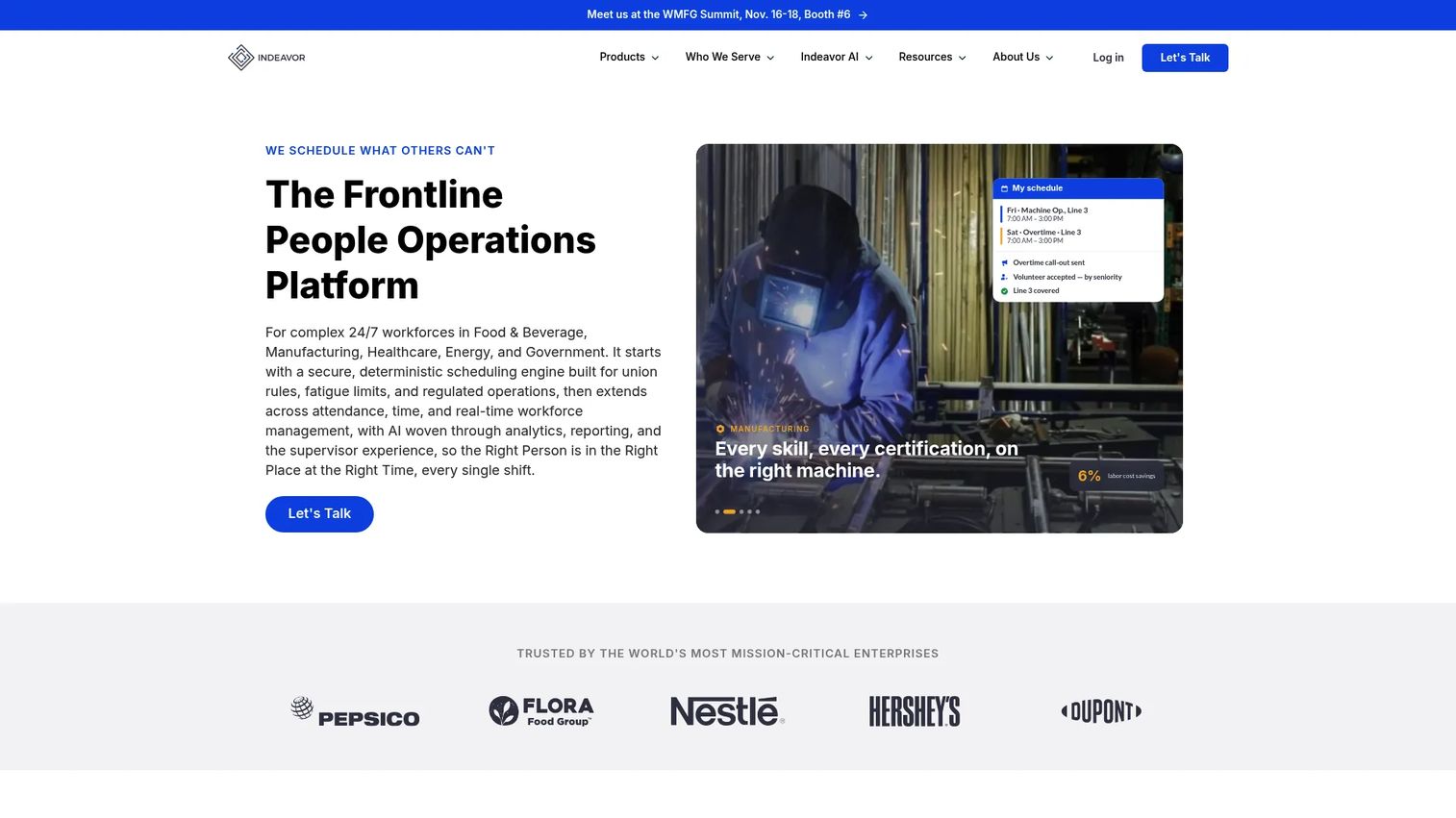
Indeavor is workforce scheduling and people-operations software for complex 24/7, unionized, and regulated workforces. The platform automates schedule generation based on demand, skills, qualifications, fatigue limits, and union rules, and handles absence management and automated backfill in the same system. Indeavor appears in the G2 fatigue risk management category, where it addresses roster fatigue analysis through scheduling automation rather than standalone fatigue modeling or worker testing.
Best for: Large manufacturing, food and beverage, energy, healthcare, and government organizations that need scheduling automation with fatigue-limit compliance and labor rule enforcement built in.
Key features
- Automated schedule generation with fatigue limits, labor rules, and demand planning
- Absence management and automated backfill workflows
- Mobile employee self-service for schedule access and time-off requests
- Skills, qualifications, eligibility, and union rule enforcement
- Operational reporting across scheduling and workforce data
Why choose Indeavor Schedule: It fits workforce planning teams that want to control fatigue risk upstream, through how schedules are built, rather than adding a monitoring layer on top of an existing scheduling problem. For organizations in regulated industries where fatigue hour limits are part of the compliance framework, automated enforcement during schedule creation reduces manual checking and audit exposure.
Indeavor Schedule pricing: Enterprise pricing is customized and not displayed on the website. Request a demonstration directly and ask about employee count, number of locations, union or regulatory complexity, and scheduling rule scope.
Indeavor Schedule G2 rating: 4.2/5
10. Optalert
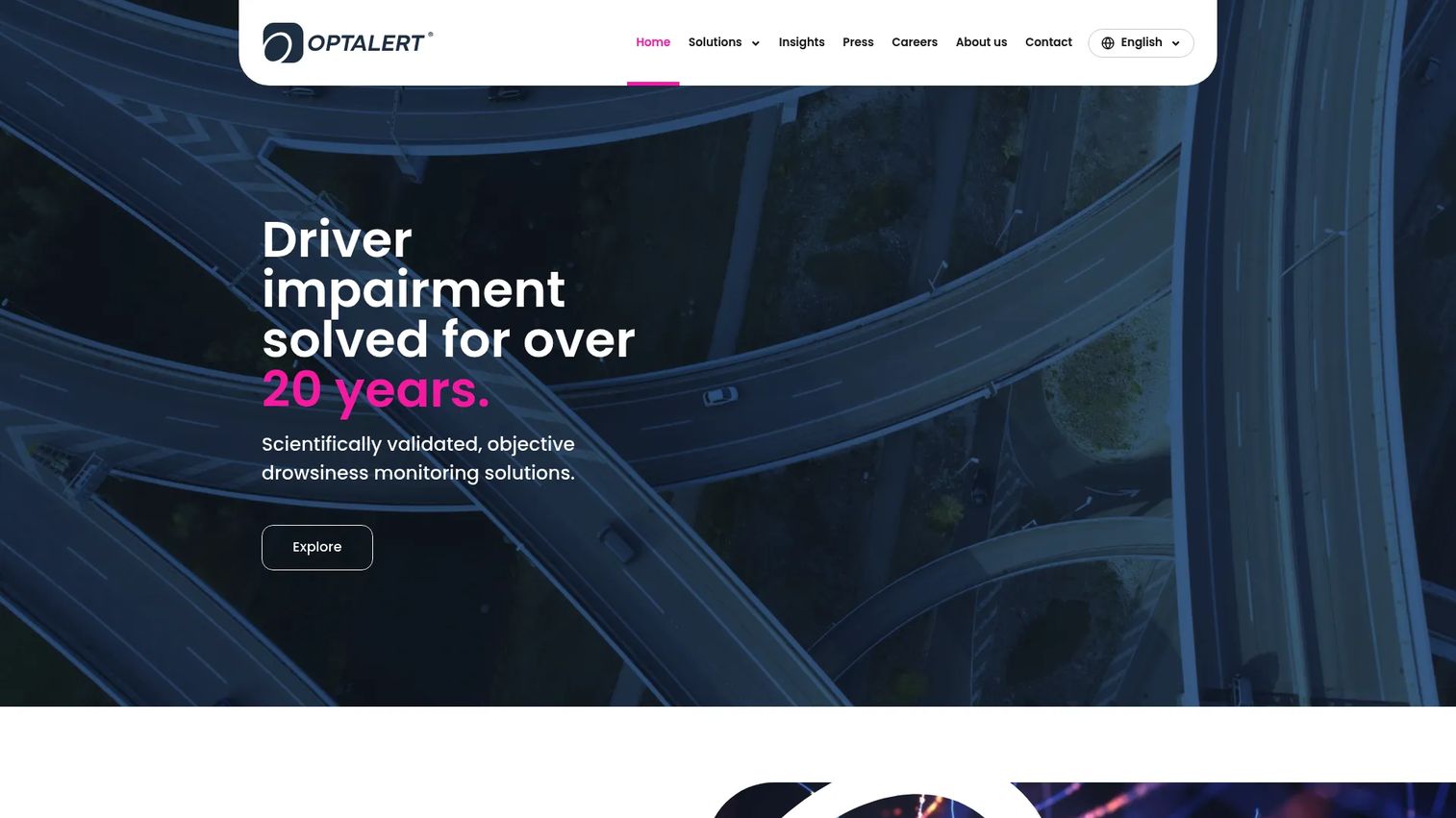
Optalert provides drowsiness detection and fatigue monitoring technology based on eyelid-movement analysis and the Johns Drowsiness Scale (JDS), a validated objective measure of alertness. The platform combines hardware (glasses with infrared sensors) with software for real-time driver and operator monitoring, fatigue alerts, and event reporting. The IRIS cloud-based platform covers fleet monitoring, reporting, and alerts. Optalert also offers the Owl Eye app for sleep-apnoea risk screening, and an automotive dataset validation tool for manufacturers developing driver monitoring systems.
Best for: Transport, mining, logistics, and industrial teams that need objective, real-time drowsiness detection for drivers or machine operators during safety-critical tasks.
Key features
- Johns Drowsiness Scale for objective, continuous drowsiness measurement
- Real-time driver and operator monitoring with fatigue alerts
- IRIS cloud-based fleet monitoring, reporting, and event tracking
- Automotive DMS software and SDK integration for manufacturers
- Owl Eye app for sleep-apnoea risk screening
Why choose Optalert: It fits environments where the fatigue risk is not schedule design but real-time alertness during the task itself. A driver who passed a pre-shift readiness check can still become drowsy two hours into a long-haul run. Optalert addresses that window, which schedule modeling and roster tools do not.
Optalert pricing: Commercial product pricing requires direct contact with Optalert. For fleet monitoring and driver alert systems, ask about hardware cost, software licensing, fleet size, and support terms.
Considerations when choosing fatigue risk management software
Start with your primary fatigue risk
Before evaluating features, identify where fatigue risk actually enters your operations. If the problem is chronic overtime and poorly built rosters, start with scheduling and compliance tools. If the risk appears at shift start in a safety-sensitive role, pre-shift readiness testing matters more. If the risk is real-time impairment for drivers or machine operators, monitoring hardware and alertness detection tools address a different problem entirely. Matching the tool type to the risk source prevents buying a modeling platform when what you need is a scheduling rule engine.
Check whether the tool feeds your safety management system
FRMS software should connect to your broader safety program. Look for incident linkage, corrective action tracking, role-based permissions, escalation workflows, and exportable reports. A fatigue score sitting in an isolated dashboard that does not connect to incident records or supervisor workflows will not drive the program behavior regulators and insurers want to see. Good audit management software integration is a strong signal that a vendor understands how safety programs operate.
Validate the fatigue model and data inputs
Ask vendors what drives the risk scores. Some tools use validated biomathematical models fed by schedule and sleep data. Others use psychomotor test results, wearable data, or self-reported fatigue. The input quality determines what you can claim from the output. A tool that runs on schedule data alone will not detect individual variation in sleep quality. A tool that depends on wearable uptake will fail if workers do not wear the device consistently. Know what your data sources are before committing to a platform.
Evaluate alert quality, not alert volume
A system that triggers constant alerts will be ignored by supervisors within weeks. Before purchasing, ask vendors how thresholds are set, whether supervisors can configure sensitivity, what the false-positive rate looks like in practice, and how escalation workflows are structured. A smaller number of well-calibrated alerts tied to clear supervisor actions will drive better program outcomes than high-volume noise that trains teams to dismiss notifications.
Make auditability part of the buying decision
Score history, schedule exceptions, intervention records, supervisor actions, and training logs all become relevant during regulatory audits, insurer reviews, or litigation. Platforms that store this data in exportable, timestamped formats give safety teams something defensible. Ask specifically about data retention periods, export formats, and whether the system logs both the alert and the supervisor response.
Conclusion
The right fatigue risk management software depends on a single diagnostic question: Where does fatigue risk enter your system?
If your exposure lives in roster design, start with Shiftboard or Indeavor Schedule for scheduling compliance, or RASP if you need fatigue controls inside a broader workforce operations platform. If you need a formal FRMS with expert implementation support, Circadian is the most established option in this space. For predictive fatigue scoring at crew or fleet scale, Fatigue Science Readi leads on personalization and forecast depth. Teams that need model-based schedule analysis for aviation, rail, or research contexts should evaluate SAFTE-FAST or FRMSc. For daily worker readiness screening and field-operation fatigue dashboards, SafetyIQ starts at $2,500/year and covers the broader EHS workflow alongside fatigue. For real-time driver or operator alertness monitoring, Optalert is the most scientifically grounded option.
No software alone prevents a fatigue-related incident. What it does is give your team better information earlier, and a documented trail showing that your controls were active and your supervisors had the data they needed to act.
Before you evaluate vendors, write down the answer to three questions: Where does fatigue risk enter your system? Who must act on the alert? What proof will leadership or regulators need six months from now? The answers will tell you which category of tool to shortlist, which will narrow the field faster than any feature comparison.
Start your journey with Guideflow today!
FAQs
Fatigue risk management software helps organizations predict, monitor, and reduce fatigue-related safety risk using schedules, worker readiness data, alerts, dashboards, and reporting. It is the technology layer that supports a Fatigue Risk Management System (FRMS), which also includes policy, training, supervision, and continuous improvement. The software category covers biomathematical fatigue modeling, roster analysis, pre-shift testing, real-time alertness monitoring, and audit documentation.
An FRMS is the full management system: It includes policy, ownership, risk controls, worker participation, training, reporting, and continuous review. Fatigue management software supports parts of that system, typically the data collection, risk prediction, alerting, and documentation functions. Software without supporting policies and supervisor training will not produce a functioning FRMS. The two are complementary, not interchangeable.
Aviation, mining, energy, oil and gas, rail, trucking, healthcare, utilities, construction, manufacturing, and emergency services are the most common adopters. Any industry with safety-sensitive roles, 24/7 operations, significant shift-work exposure, or regulatory fatigue-hour requirements is a candidate. For organizations in regulated industries, tools that support aviation compliance monitoring and similar frameworks often double as fatigue risk documentation platforms.
The most important features depend on your risk source. Across most implementations, look for fatigue modeling or risk scoring, roster and schedule analysis, worker readiness or impairment testing, fatigue dashboards and alerts, incident linkage, corrective action tracking, audit trails, and integration with scheduling, HR, or safety management systems. Also evaluate how the system handles supervisor workflows and whether alerts are configurable rather than fixed.
Software can help document fatigue controls, exceptions, supervisor interventions, and training records. That documentation is useful during regulatory audits, insurer reviews, and legal proceedings. Compliance itself depends on the applicable rules, your organization's policies, and how consistently those policies are applied. No software certifies compliance. It creates evidence that controls existed and were used.
They address different problems. Predictive modeling uses schedule and sleep inputs to forecast fatigue risk before the shift, which helps planners build safer rosters and allows proactive intervention the day before. Pre-shift testing measures individual readiness close to the task, which catches workers who are more fatigued than their schedule would predict. The strongest programs use both: Modeling to plan and test to verify. Choosing one over the other depends on whether your primary control point is scheduling or task readiness.
Most vendors in this category price by quote. The main cost drivers are workforce size, number of sites, the specific modules purchased (modeling, testing, scheduling, analytics), integration complexity, hardware requirements if applicable, and implementation or consulting scope. SafetyIQ is an exception, starting at $2,500 per year for smaller operations. For enterprise platforms like Shiftboard, Indeavor, Circadian, or SAFTE-FAST, expect annual contracts with pricing tied to employee count or operational scope.
Start with one risk surface, one team, and a clear supervisor workflow. Train workers on how fatigue data will be used before the system goes live, with an emphasis on support rather than surveillance. Review alert quality in the first four to six weeks and adjust thresholds if supervisors are receiving too many low-value notifications. Expand to other teams or sites once the core workflow is stable. Tools that generate high alert volume and lack clear escalation paths will fail adoption regardless of the underlying science.