Your finance lead spends the last three days of every month chasing receipts. Reps submit expenses two weeks late. A vendor charge slips through with no approval. By the time the numbers are clean, the board deck is due tomorrow.
That is the tax of running spend on spreadsheets and a shared card. It is quiet, it compounds, and it gets worse the moment you cross 50 people. Around 76% of employees still manage expenses with tools that were never built for the job, according to OFX (2026). That is a lot of manual reconciliation hiding inside otherwise well-run companies.
The category is growing for a reason. Straits Research (2026) projects the expense management software market at USD 8.62B in 2026, on the way to USD 19.23B by 2034. Buyers are moving off manual workflows and onto platforms that automate receipt capture, approvals, reimbursements, and accounting sync in one place.
For a scaling SaaS company, the real question is not "what is expense management software." It is "which tool removes finance drag without becoming another system the founder has to babysit." You want tight controls, clean visibility, fast reimbursements, and an accounting sync that just works.
This guide compares eight platforms through that lens. If you are also cleaning up adjacent finance workflows, our roundups on audit management software and contract lifecycle management software pair well with this one. And if your team is evaluating tools broadly, the best business intelligence software guide helps you connect spend data to the rest of your reporting.
What's inside
This guide is for founders, heads of finance, and RevOps leaders at growing SaaS companies who are past the spreadsheet stage and comparing real platforms. We picked tools based on four things that matter at this stage: automation depth (how much manual work disappears), spend controls (cards, policies, approvals), accounting integrations (QuickBooks, Xero, NetSuite), and time-to-value (how fast finance actually feels the difference). Every tool below solves a core expense workflow. The differences are in scope, stage fit, and how far they extend into cards, travel, and full spend management.
TL;DR
- Best all-in-one for scaling SaaS: Ramp combines free corporate cards, expense automation, and real-time spend visibility in one platform.
- Best for receipt capture and reimbursements: Expensify is fast to adopt for lean teams that want SmartScan and mobile-first workflows.
- Best low-cost entry: Zoho Expense starts free and fits companies already in the Zoho ecosystem.
- Best for enterprise and heavy travel: SAP Concur handles complex approvals, governance, and global travel at scale.
- Best for venture-backed spend management: Brex pairs corporate cards with expense automation and higher credit limits.
- Best travel plus expense combo: Navan unifies booking, cards, and expense in one workflow.
- Best for mid-market spend control: Spendesk connects cards, approvals, and budgets for finance teams.
What is expense management software?
Expense management software is a platform that automates how a business captures, approves, reimburses, and reports employee and company spend. It replaces manual receipt collection, spreadsheet expense reports, and end-of-month reconciliation with automated workflows that sync directly to your accounting system.
Modern expense management platforms usually combine several capabilities in one place. Instead of stitching together a card provider, a reimbursement tool, and a bookkeeping export, teams get one system that covers the full spend lifecycle.
Core features to expect:
- Receipt capture and OCR: Snap a photo, and the software reads the merchant, amount, and date automatically. This is the backbone of most expense tracking software.
- Corporate cards and controls: Issue physical or virtual cards with per-merchant, per-category, and per-employee spend limits built in.
- Approval workflows: Route expenses to the right approver based on amount, department, or policy, with exceptions flagged automatically.
- Reimbursement automation: Pay employees back for out-of-pocket spend through direct ACH, without manual payment runs.
- Accounting integrations: Sync coded transactions to QuickBooks, Xero, or NetSuite so the books stay current in real time.
- Spend visibility and reporting: See where money is going by team, vendor, and category, with real-time dashboards instead of month-old exports.
- Policy and compliance controls: Enforce spend rules automatically and catch out-of-policy charges before they post.
The best business expense software reduces manual finance work while tightening control. That combination is exactly what a scaling company needs: fewer hours spent reconciling, and fewer surprises when the numbers close.
When to use expense management software
Not every company needs a full platform on day one. Here is how to think about timing and fit.
Replace spreadsheets before they break
If your team still submits expenses in a shared sheet and gets reimbursed by manual bank transfer, you have already outgrown it. Once you pass 20 to 30 employees, the manual load grows faster than headcount. This is the moment cloud based expense management software starts paying for itself in reclaimed finance hours.
Tighten controls as spend scales
When more people can spend company money, policy exceptions multiply. Corporate cards with built-in limits and automated approvals let you set guardrails once and enforce them everywhere. This matters most when you are hiring fast and the founder can no longer eyeball every charge.
Clean up accounting friction
If your bookkeeper spends days each month re-coding transactions and matching receipts, an accounting integration solves it. Expense management software that syncs to QuickBooks, Xero, or NetSuite keeps the ledger current and shortens the close.
Manage travel without chaos
Teams with real travel volume need travel expense management software that combines booking, cards, and expense capture. Bundling travel and expense removes the reconciliation nightmare of matching trips to charges after the fact.
Comparison table
Here is a side-by-side view of the eight platforms. Use it to shortlist two or three, then read the detailed sections below. Pricing and ratings are current as of mid-2026 and pulled from each vendor's own pricing page and G2 listing where available.
| # | Product | Intent | Key use case | Pricing | G2 rating |
|---|---|---|---|---|---|
| 1 | Ramp | All-in-one spend | Cards, expense, AP, and procurement in one platform | Free from $0/user/mo | 4.8/5 |
| 2 | Expensify | Receipts and reimbursements | SmartScan capture and mobile expense reports | From $5/member/mo | 4.5/5 |
| 3 | Zoho Expense | Low-cost entry | Configurable expense reporting and approvals | Free; Standard $4/user/mo | Not listed |
| 4 | SAP Concur | Enterprise travel and expense | Complex approvals and global governance | Quote-based | Not listed |
| 5 | Brex | Venture-backed spend | Corporate cards with expense automation | Free from $0/user/mo | 4.8/5 |
| 6 | Navan | Travel plus expense | Unified booking, cards, and expense | Free up to 300 employees | 4.7/5 |
| 7 | Spendesk | Mid-market spend control | Cards, approvals, and budgets for finance | Quote-based | 4.6/5 |
| 8 | Fyle | Receipt and card reconciliation | Expense capture and accounting sync | Contact vendor | Not listed |
1. Ramp
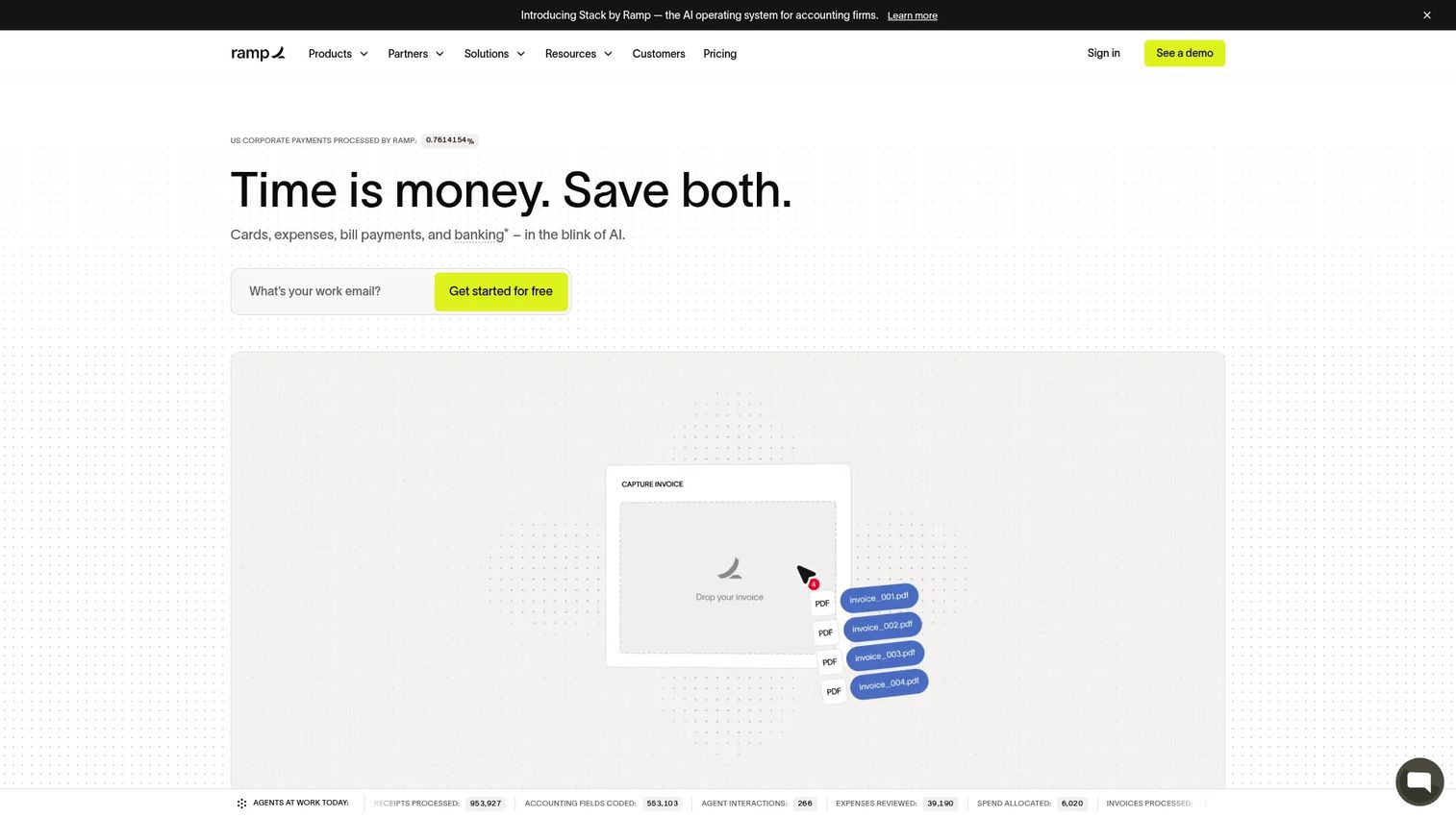
Ramp is a finance automation platform that combines corporate cards, expense management, accounts payable, procurement, and business banking in one place. For a scaling SaaS company, it is the strongest all-in-one option because it collapses several point tools into a single system with real-time spend visibility. Instead of running a card provider, a reimbursement tool, and an AP process separately, finance gets one platform that automates the whole spend lifecycle.
Best for: Teams that want an all-in-one spend, AP, and procurement platform without paying for the core card and expense product.
Key strengths
- Unlimited cards and controls: Issue physical and virtual cards with per-merchant and per-category limits baked in.
- Expense automation: Receipt matching, approvals, and coding happen automatically, cutting manual reconciliation.
- AP automation: Invoice OCR and payments handle accounts payable inside the same platform.
Why choose Ramp: Ramp earns its place by reducing finance work while tightening control, which is exactly the tradeoff a founder wants when spend outpaces oversight. The core card and expense management product is free, so the cost of getting real spend visibility is low relative to the finance hours it saves. Its 200+ integrations mean it plugs into the accounting and reporting stack you already run.
Ramp pricing: The Free plan starts at $0 per user per month and covers cards and expense management. Plus is $15 per user per month plus a platform fee based on team size, with 20% off annual billing. Enterprise is custom and billed annually. Pricing is verified from Ramp's own pricing page.
2. Expensify
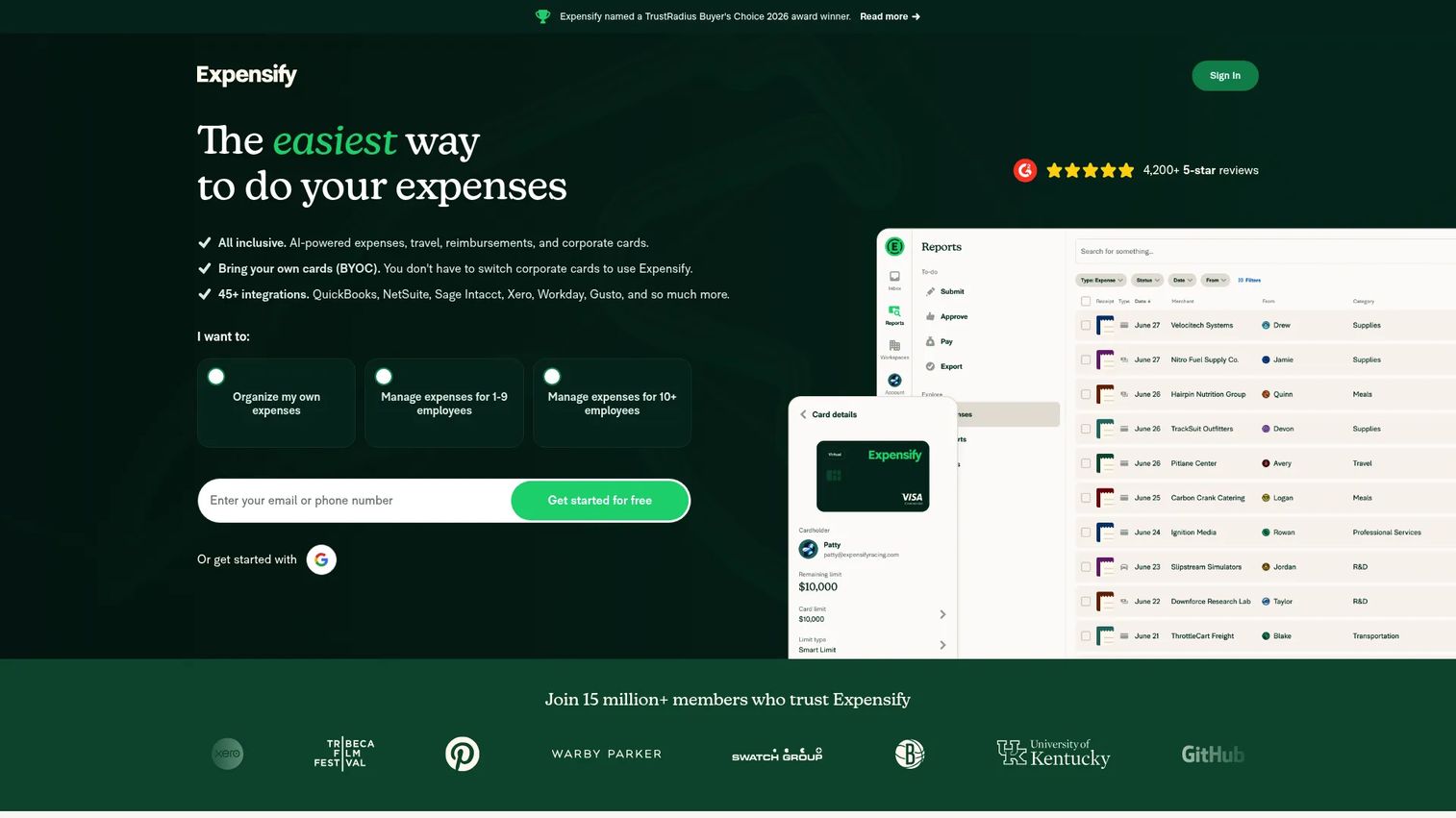
Expensify is expense management and spend management software built for both businesses and individuals. Its reputation rests on SmartScan receipt capture and a mobile-first workflow that lean teams adopt quickly. If your primary pain is receipts and reimbursements rather than full spend management, Expensify gets a team productive fast without a heavy implementation.
Best for: Teams that want receipt capture, reimbursements, and spend controls in one easy-to-adopt app.
Key strengths
- SmartScan receipt capture: Photograph a receipt and Expensify reads and codes it automatically.
- Reimbursements and approvals: Route reports for approval and pay employees back through direct deposit.
- Travel and card management: Handle travel booking and corporate card expenses in the same tool.
Why choose Expensify: Expensify fits lean teams that want expense reporting software they can roll out in an afternoon. It is less about deep procurement and more about clean receipt-to-reimbursement flow, which is often exactly what a smaller finance function needs first. The mobile experience is strong enough that adoption rarely becomes a fight.
Expensify pricing: The Collect plan starts at $5 per member per month. The Control plan is custom, reported as low as $9 per active member per month. A free tier covers SmartScan, sending and receiving money, and chat on New Expensify. Pricing is verified from Expensify's own pricing page.
3. Zoho Expense
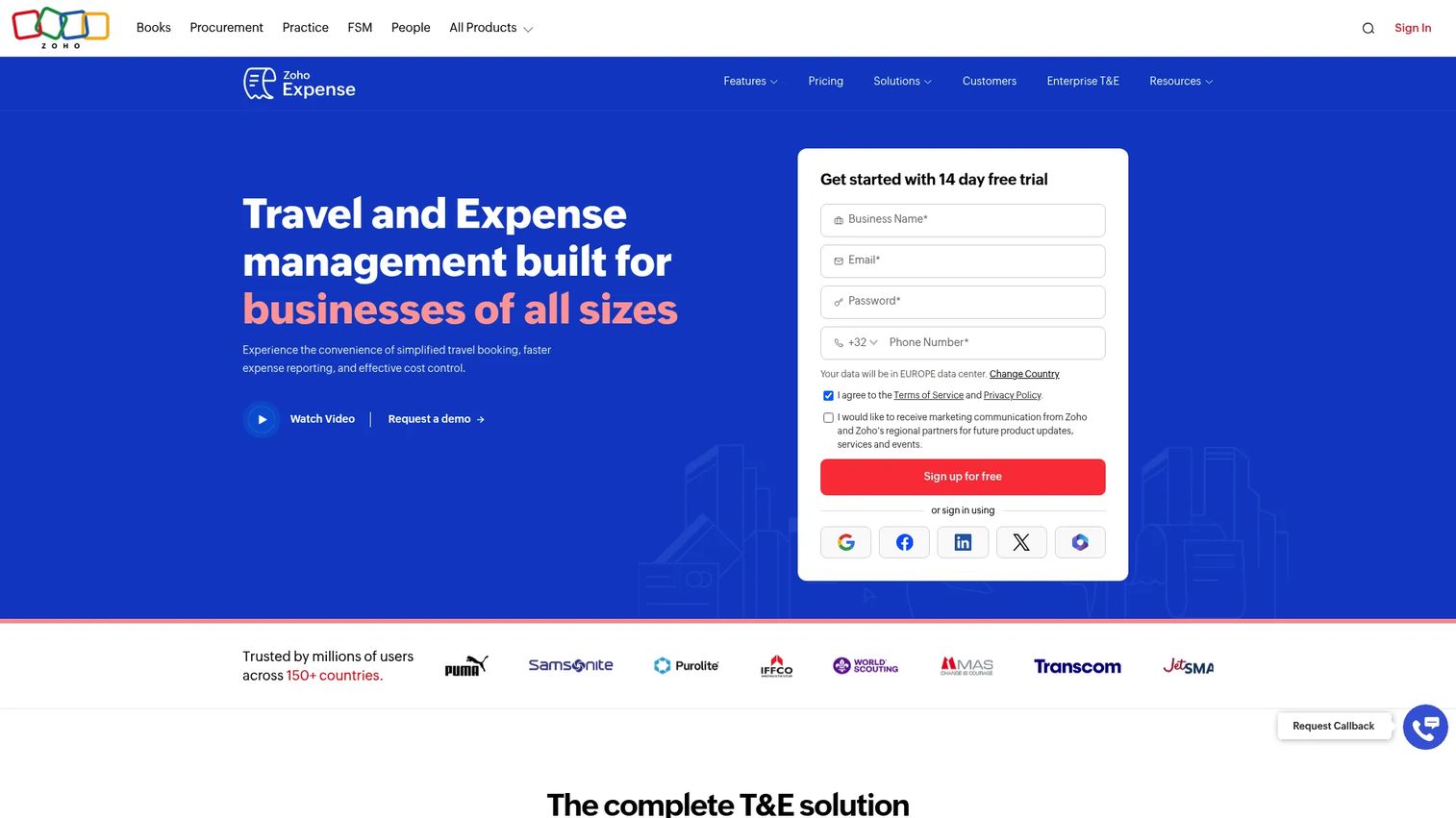
Zoho Expense is travel and expense management software for tracking, reporting, approvals, and reimbursements. It is one of the strongest low-cost entry points, especially for small businesses and teams already running other Zoho apps. The configurable approval workflows let you match expense policy to how your company actually operates without heavy setup.
Best for: Businesses that need a configurable expense platform with receipt capture and approvals at a low price point.
Key strengths
- Expense reporting and tracking: Full expense report creation, submission, and tracking in one place.
- Receipt autoscan and mileage: Autoscan reads receipts, and built-in mileage tracking captures travel spend.
- Corporate cards and approvals: Card feeds plus configurable approval workflows tied to your policy.
Why choose Zoho Expense: For expense management software for small business, the low entry price and free tier make it easy to start. If you already use Zoho CRM or Books, the native fit removes integration friction. It scales configuration to match your policy rather than forcing you into a rigid template.
Zoho Expense pricing: There is a Free plan at $0. The Standard plan is $4 per user per month, and Premium is $6 per user per month. Prices are shown on the US pricing page and exclude local taxes. Pricing is verified from Zoho's own pricing page.
4. SAP Concur
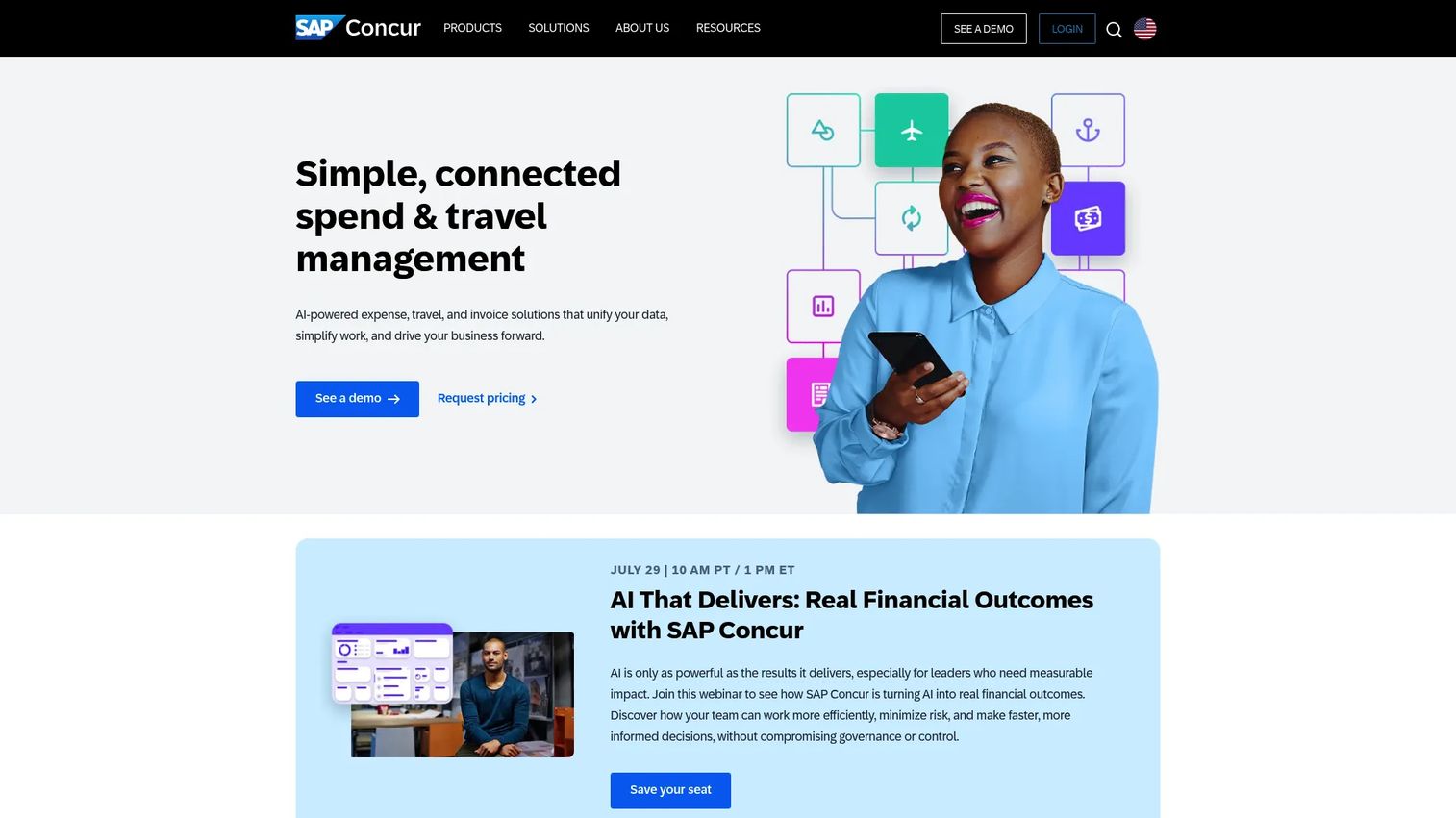
SAP Concur is cloud-based spend management software covering travel, expense, and invoice processes. It is the enterprise-heavy option, built for larger finance organizations with complex approval chains, global governance needs, and heavy travel volume. If you operate across multiple entities and geographies with strict compliance requirements, Concur's depth is the reason it stays a category standard.
Best for: Mid-sized to large organizations needing unified travel, expense, and invoice management with deep governance.
Key strengths
- Expense management: Structured expense capture, coding, and reporting at scale.
- Travel management: Integrated booking and travel policy enforcement for high-volume teams.
- Invoice management: Accounts payable and invoice processing inside the same platform.
Why choose SAP Concur: Concur is worth evaluating when governance and complexity outweigh speed of setup. Larger organizations choose it for the reporting depth and the ability to enforce policy across regions. Employees can capture and submit expenses through the SAP Concur mobile app, which keeps field and travel-heavy teams moving.
SAP Concur pricing: Pricing is customized and quote-based, with no public numeric price listed on the pricing page. You contact SAP Concur for a quote sized to your organization and modules. This is verified from Concur's own pricing page.
5. Brex
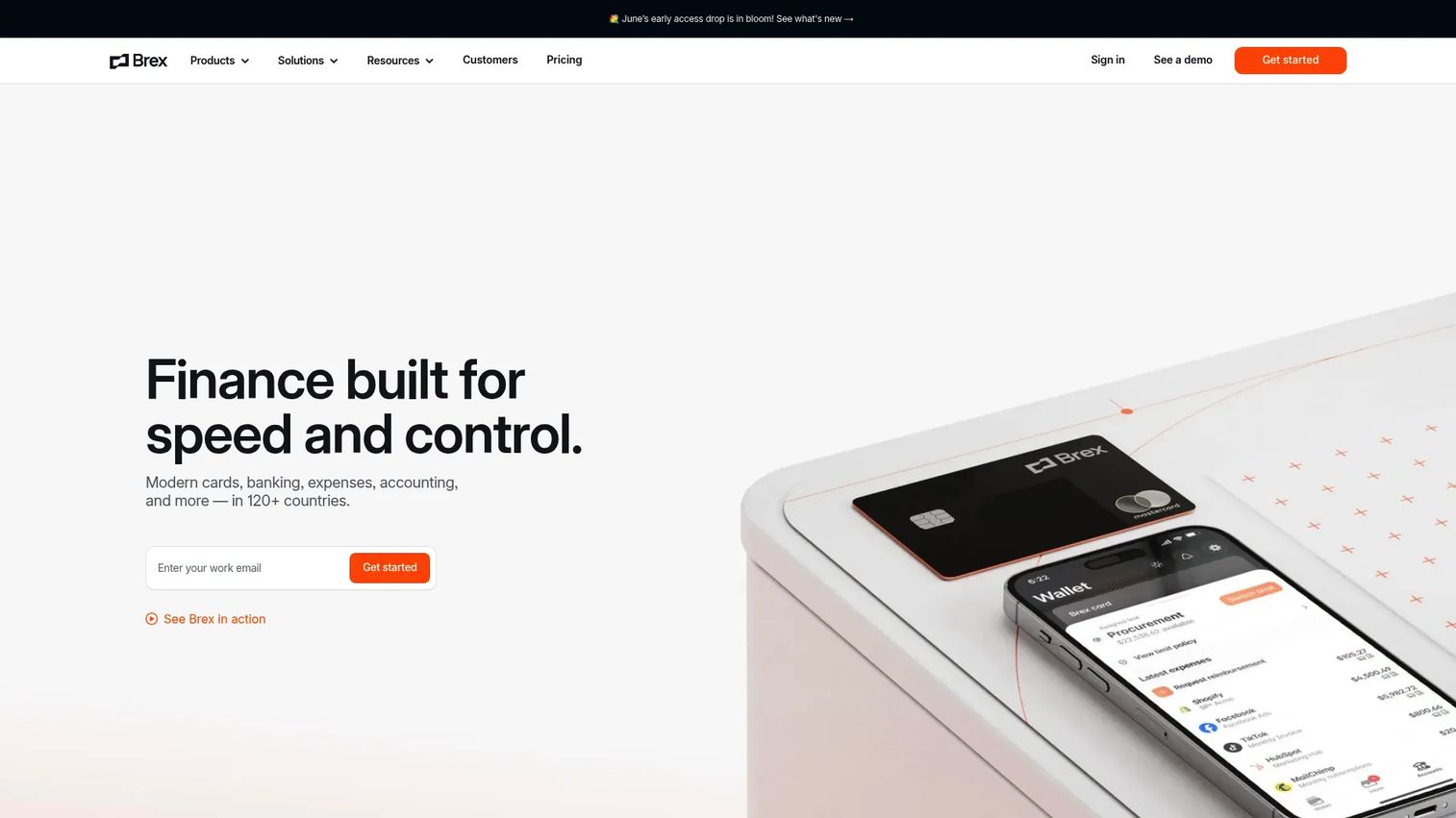
Brex is a unified spend management platform covering corporate cards, expense management, bill pay, travel, and business accounts. It is a strong fit for venture-backed startups and growing companies that want corporate cards with higher limits alongside expense automation. Brex leans into the reality that funded companies need credit and controls that scale with their runway, not their trailing revenue.
Best for: Startups and growing companies needing an all-in-one spend management platform with corporate cards.
Key strengths
- Corporate cards with high limits: Cards with up to 30x higher credit limits than traditional options for funded companies.
- Expense automation and bill pay: Receipt capture, reimbursements, and bill pay in one platform.
- Business accounts and travel: Banking and travel management alongside cards and expense.
Why choose Brex: Brex fits founders who want a spend platform tuned to venture-backed economics. The Essentials plan is free, so early teams can start with cards and expense management at no cost, then move up as needs grow. The rewards structure and higher credit limits appeal to companies scaling spend quickly.
Brex pricing: The Essentials plan is $0 per user per month. Premium is $12 per user per month. Enterprise and Smart Card plans are custom and require contacting sales. Pricing is verified from Brex's own pricing page.
6. Navan
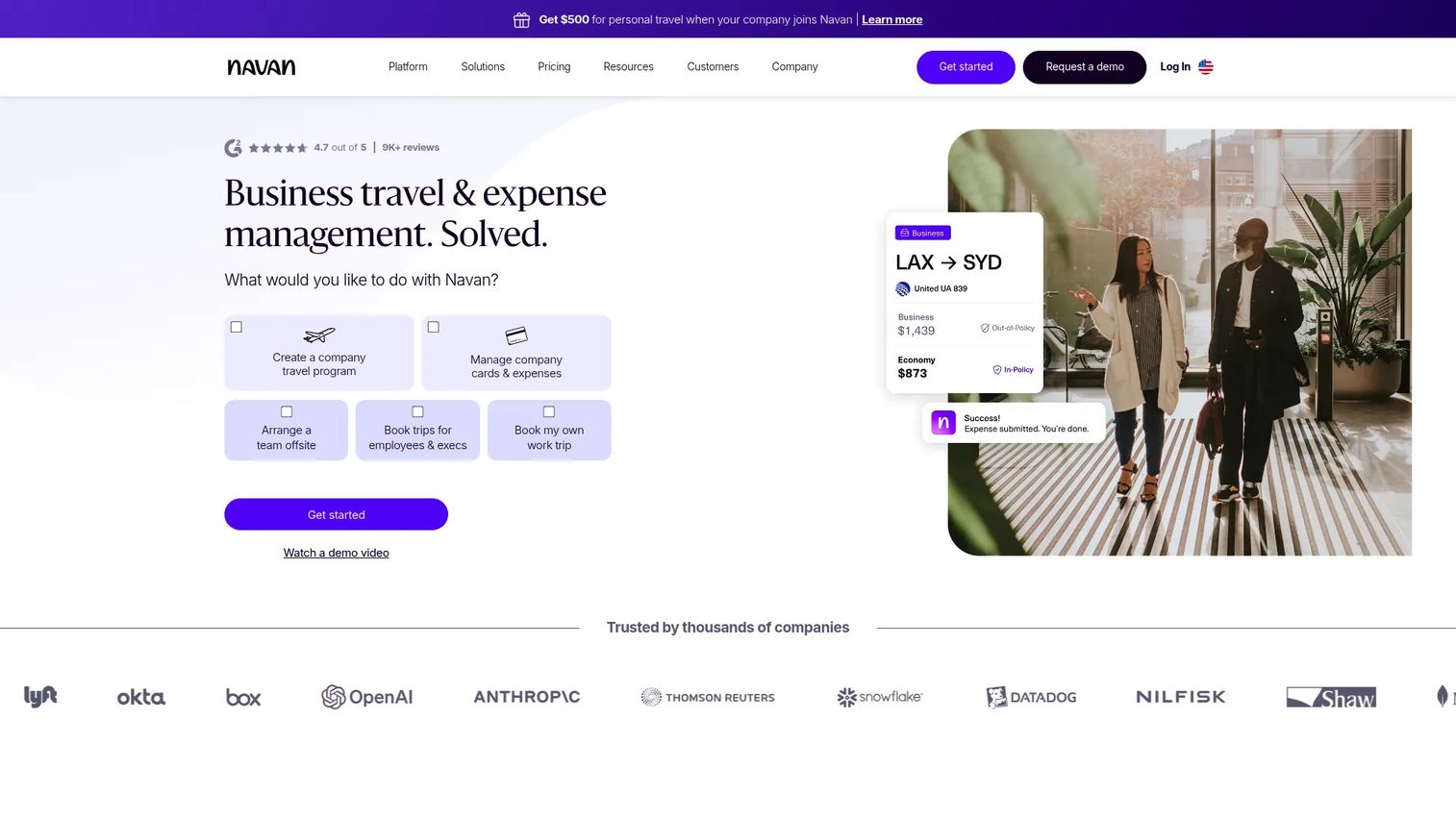
Navan is an AI-powered business travel and expense management platform that combines booking, cards, and expense in one workflow. For teams with real travel volume, this is the differentiator: instead of matching trips to charges after the fact, booking and expense are connected from the start. It is the cleanest way to run travel expense management software and corporate cards as a single system.
Best for: Companies that want to manage corporate travel, cards, and expenses in one platform.
Key strengths
- Business travel booking: Book flights, hotels, and rail inside the platform with policy controls applied.
- Expense management and reimbursements: Capture, approve, and reimburse expenses tied to trips automatically.
- AI travel and expense agents: AI agents handle routine travel and expense tasks to cut manual work.
Why choose Navan: Navan makes the most sense when travel is a meaningful line item and you are tired of reconciling it manually. Bundling booking and expense removes an entire category of month-end cleanup. For smaller teams, the free tier makes it accessible before travel volume justifies an enterprise contract.
Navan pricing: Navan Business is free for companies up to 300 employees. Navan Expense is free for the first 5 monthly expensing users, then $15 per user per month. Navan Enterprise requires contacting sales for a quote. Pricing is verified from Navan's own pricing page.
7. Spendesk
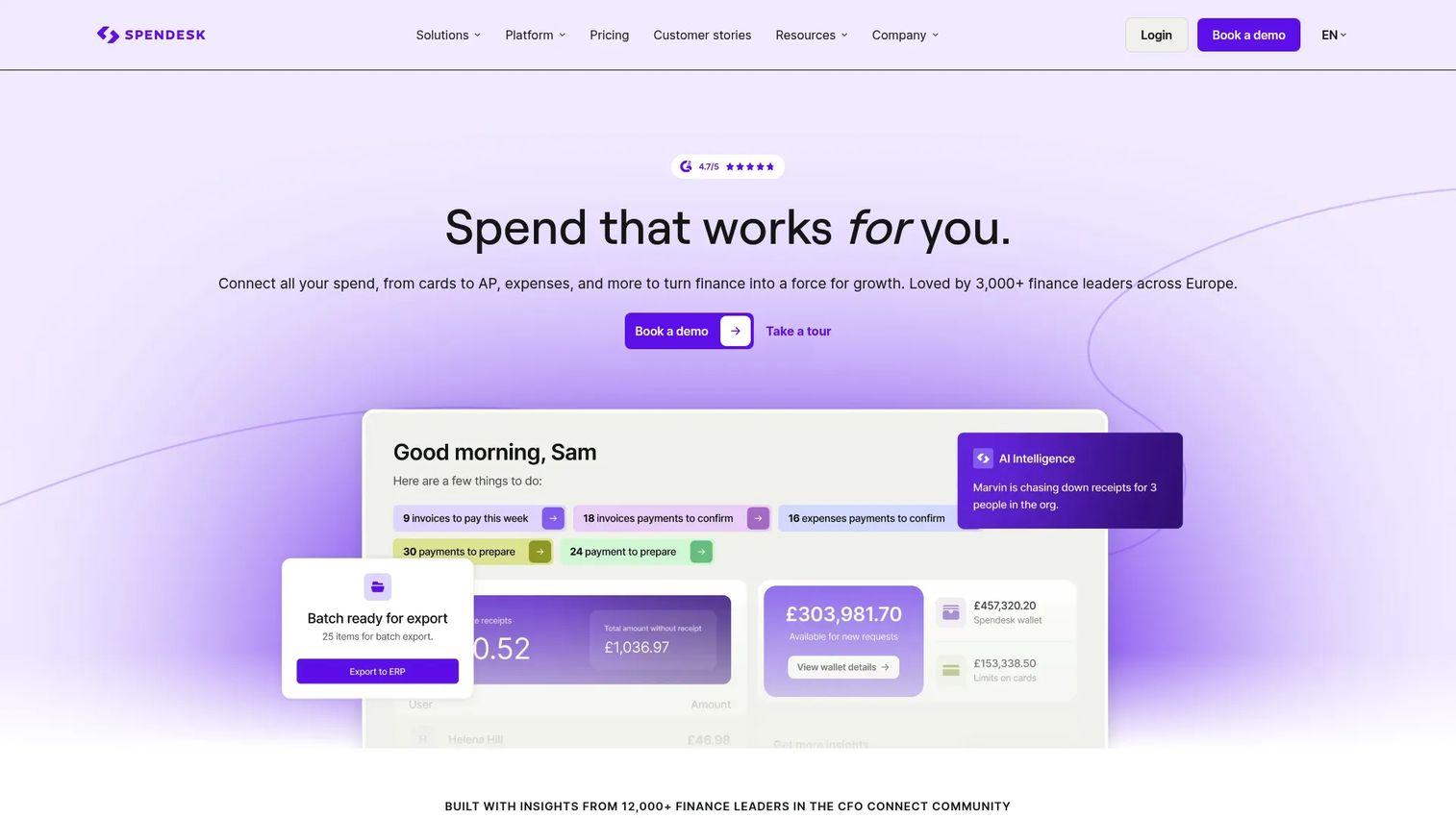
Spendesk is a spend management platform that connects cards, expenses, accounts payable, procurement, and budgets in one system. It fits mid-market finance teams that want spend control without stitching tools together. Spendesk is often evaluated by finance leaders who want approvals, budgets, and card controls unified rather than run across separate products.
Best for: Finance teams at growing companies that need spend control across cards, expenses, AP, and procurement.
Key strengths
- Cards with spend controls: Corporate cards with built-in controls and receipt capture at the point of spend.
- AP automation: Approvals and OCR invoice extraction automate accounts payable.
- Procure-to-pay and budgets: Multi-entity spend management with procurement and budget tracking.
Why choose Spendesk: Spendesk is a good fit when the finance team wants budgets, approvals, and cards working together as one control layer. It is built for the mid-market moment when spend has outgrown manual oversight but you do not need full enterprise governance. The budgeting features give finance a forward view rather than a rear-view report.
Spendesk pricing: Spendesk uses custom, quote-based pricing with a fixed monthly platform fee plus variable usage-based fees. CFO Connect Pro is shown as free for Spendesk customers, while core platform pricing is request-a-quote. This is verified from Spendesk's own pricing page.
8. Fyle

Fyle is expense management software focused on capturing receipts, managing employee spend, and syncing with accounting workflows. Finance teams like it for quick adoption and clean card reconciliation. If your main goal is tightening up receipt collection and matching card transactions without a heavy platform rollout, Fyle is built for that job.
Best for: Finance teams needing straightforward expense and receipt management software with accounting sync.
Key strengths
- Receipt capture: Capture receipts across channels and code them automatically.
- Expense management: Manage employee spend, reports, and approvals in one place.
- Accounting integrations: Sync expenses and reconciled card transactions to your accounting system.
Why choose Fyle: Fyle appeals to teams that want to fix reimbursement cleanup and card reconciliation quickly. It focuses on the receipt-to-accounting path rather than trying to be a full spend platform, which keeps adoption light. That focus makes it a practical pick for finance teams that already have cards and just need the expense layer tightened.
Fyle pricing: Fyle does not publish numeric pricing publicly, so you contact the vendor for a quote based on your team size and needs. Because pricing is not confirmed on a public page, evaluate it directly with their team during your shortlist.
Considerations before you buy
Shortlisting is easy. Choosing well takes a few pointed questions. Here is what to pressure-test before you commit.
Automation depth
Look past the feature list and ask how much manual work actually disappears. Does receipt capture code transactions automatically, or does someone still touch every line? The value of expense management platforms lives in the reconciliation hours they remove, so measure against your current close.
Spend controls and cards
Decide whether you need corporate cards bundled in or just a reimbursement layer on top of existing cards. Card-native platforms let you set per-employee and per-category limits before money moves, which prevents policy exceptions instead of catching them late.
Accounting integrations
Confirm the tool syncs cleanly with your ledger, whether that is QuickBooks, Xero, or NetSuite. A shallow integration that only exports a CSV creates new work. A deep one keeps the books current and shortens your monthly close.
Time-to-value and adoption
The best expense reimbursement software is the one your team actually uses. Check how fast finance can go live and how quickly employees adopt the mobile app. A tool nobody submits to on time is worse than the spreadsheet it replaced.
Stage and scale fit
Match the platform to where you are, not where you hope to be in three years. A lean team may thrive on receipt-first tools, while a multi-entity company needs governance depth. Buy for the next 18 months, not the next decade.
Conclusion
The right pick comes down to stage and what hurts most right now.
For an all-in-one spend platform that scales with a growing SaaS company, Ramp is the strongest overall choice, with free cards and expense automation in one system. If receipts and reimbursements are your bottleneck, Expensify gets a lean team productive fast. For a low-cost entry, Zoho Expense is hard to beat, especially inside the Zoho ecosystem. Brex fits venture-backed teams that need higher card limits, and Navan wins when travel volume is real. Spendesk suits mid-market finance teams wanting unified control, and Fyle is a clean pick for receipt and card reconciliation. SAP Concur remains the enterprise standard for complex, global finance operations.
The next step is simple: shortlist two tools that match your stage, run a two-week trial with your actual expense volume, and measure the finance hours saved. That number, not the feature list, tells you which platform earns its place in your stack.
If you are also rethinking how your team shows and explains your own product to buyers, Guideflow helps you turn it into self-serve interactive demos in minutes. Start your journey with Guideflow today!
FAQs
It automates how a business captures, approves, reimburses, and reports spend. Instead of manual receipt collection and spreadsheet expense reports, it handles receipt capture, approvals, reimbursements, and accounting sync in one workflow. The result is fewer finance hours spent reconciling and tighter control over where money goes.
Ramp is the strongest all-in-one option because it combines free corporate cards, expense automation, and real-time spend visibility in a single platform. Brex is a close alternative for venture-backed teams that need higher credit limits. Both reduce finance drag while tightening controls, which is what matters most as headcount and spend scale.
Not always, but they help. Card-native platforms like Ramp, Brex, and Spendesk let you set spend limits before money moves, which prevents policy exceptions instead of catching them after the fact. If you already have cards you are happy with, a reimbursement-focused tool like Expensify or Fyle can sit on top of them.
Most modern platforms sync with both. Ramp, Expensify, Zoho Expense, and Fyle all offer accounting integrations that push coded transactions into QuickBooks or Xero. The thing to verify is depth: confirm the integration syncs live and matches your chart of accounts rather than just exporting a CSV.
Automation depth, spend controls, accounting integrations, and time-to-value. The goal is to remove manual finance work without adding a system the founder has to babysit. Prioritize tools that cut reconciliation hours and enforce policy automatically, then confirm they sync cleanly with your existing accounting stack.
Test with your real expense volume, not a demo dataset. Submit a few out-of-pocket expenses end to end and time how long approval and payout take. Good expense reimbursement software pays employees back through direct ACH without a manual payment run, and flags out-of-policy items before they post.
Yes. Travel expense management software combines booking, cards, and expense capture so trips and charges are connected from the start. Navan and SAP Concur are built for this, which removes the reconciliation work of matching travel to card transactions after the fact. If travel is a small line item, a general expense tool is usually enough.
Expensify and Zoho Expense are among the fastest to roll out for lean teams, thanks to strong mobile receipt capture and light setup. Fyle is also built for quick adoption when the main goal is receipt and card reconciliation. The real test is employee uptake: the easiest tool is the one your team actually submits to on time.