Someone on your team just resigned. In two weeks they walk out the door, and with them goes the single most honest data point you will ever get about what is actually wrong with your company. The reason they gave your manager? Probably sanitized. The reason they will tell a well-designed, confidential survey? That is the signal you need.
Most scaling companies fumble this. Exit feedback lives in a manager's inbox, a half-finished spreadsheet, or a rushed 20-minute chat that nobody logs. By the time three engineers leave the same team for the same reason, leadership finds out from the fourth one during their notice period. That is a pattern you paid for in attrition and never got to read.
Exit interview software fixes the collection and analysis gap. It automates the sending, standardizes the questions, protects anonymity so people tell the truth, and rolls individual answers into turnover trends you can act on. For a founder, this is not an HR checkbox. It is an early-warning system for manager problems, onboarding gaps, comp drift, and product-org dysfunction that shows up in your churn numbers a quarter later.
The market reflects how seriously teams now take this. The global exit interview software market was estimated at USD 2.45B in 2024 and is projected to reach USD 7.74B by 2035, an 11.02% CAGR, according to Market Research Future (2024). North America alone accounts for roughly 45% of that share. The category is growing because the cost of guessing why people leave is finally visible on the P&L.
This guide breaks down eight exit survey software and exit interview vendors worth shortlisting in 2026. If you also track team sentiment while people are still around, our roundup of 360 feedback software pairs well with anything here.
What's inside
This is a buyer's guide to exit interview software, exit survey software, and exit interview survey software for teams that want more than a form. We looked at tools across two groups: dedicated exit and offboarding platforms, and broader employee listening suites with strong exit use cases.
We ranked and evaluated each tool against four criteria that matter for a scaling company:
- Automation: how much of the send, remind, and route workflow runs without a human.
- Analytics depth: whether it surfaces turnover trends and themes, not just raw responses.
- HRIS integrations: how cleanly it syncs employee and offboarding data.
- Privacy and rollout: anonymous feedback controls and how fast you can deploy across teams.
We used verified pricing and current G2 ratings where available, and wrote around anything a vendor does not publish.
TL;DR
Short on time? Here is the decision shortcut by use case.
- Best for enterprise analytics and attrition prediction: Qualtrics Employee Experience, the strongest analytics-heavy option when you need real signal and text analytics, not just collection.
- Best for turnkey exit automation: ExitPro, built specifically for automated exit interviews and turnover dashboards.
- Best for flexible survey building: ProProfs Survey Maker, with a large template library and a free tier.
- Best for response completion: SurveySparrow, using conversational surveys that lift participation.
- Best for tailored exit workflows: PointerPro, when you want personalized questionnaire paths and automated reports.
- Best for frontline and high-volume workforces: WorkStep, purpose-built for operational turnover pressure.
- Best for lightweight, familiar survey capture: SurveyMonkey.
- Best for broader employee listening with exit use cases: Quantum Workplace.
If you want related buying guides, our writeups on marketing analytics software and analytics platforms that drive ROI use the same evaluation approach applied to other categories.
What is exit interview software?
Exit interview software is a tool that collects, structures, and analyzes feedback from departing employees so companies can identify why people leave and reduce future turnover.
It differs from adjacent terms in useful ways. Exit interviews are the live or written conversations themselves. Exit survey software and employee exit survey software refer to the questionnaire layer that standardizes and automates those conversations. Exit interview management software is the broader system that handles the full workflow: scheduling, sending, collecting, reporting, and action planning across an entire org.
Core capabilities you should expect from any serious platform:
- Automation: triggered sending tied to offboarding, plus reminders and routing.
- Confidential feedback: anonymous collection so responses are honest, not defensive.
- Exit interview dashboards: reporting dashboards that turn individual answers into turnover trends.
- Text analytics: qualitative feedback analysis that clusters open-text comments into themes.
- HRIS integrations: clean sync with your HR system for employee data and offboarding triggers.
- Action planning: tools to assign owners and track follow-through on recurring issues.
The strongest tools connect employee turnover analytics to the rest of your people data, so exit signals become part of a continuous employee listening motion rather than a one-off form at the end.
What exit interview software should do for a scaling company
For a founder, exit data is not paperwork. It is one of the cleanest organizational signals you will ever get, because a leaving employee has nothing left to lose by being honest.
Treat it like any other operating metric. The same discipline you apply to pipeline coverage or NRR applies here. You want structured, repeatable collection that produces comparable data quarter over quarter, not a pile of anecdotes you interpret differently each time a VP reads them.
Here is what good looks like when the system is working:
- Turnover reduction becomes measurable. You can tie a specific fix, a manager change, a comp adjustment, an onboarding revamp, to a drop in regretted attrition.
- Manager effectiveness gets visible. Repeated themes tied to one team tell you where leadership coaching is overdue before the whole team turns over.
- Onboarding gaps surface early. Early-tenure departures usually point to activation problems in your own hiring and ramp process.
- Role-specific trends emerge. Engineers, AEs, and CS reps leave for different reasons. Segmented turnover trends let you act on each without averaging them into noise.
The point is repeatability. A founder trying to build a company that runs without founder heroics needs systems that surface problems automatically. Exit interview software is one of those systems, and the reporting dashboards are where the retention insights actually live.
When to use exit interview software
Not every team needs a dedicated platform on day one. Here is when it earns its place in your stack.
Use it when turnover starts to become a pattern
One resignation is noise. Three departures from the same team in a quarter is a pattern, and patterns are exactly what structured exit data reveals. If you are seeing repeat exits and cannot explain them cleanly, you need consistent collection.
Use it when manual sending and follow-up is breaking down
If someone in People Ops is manually emailing surveys, chasing responses, and pasting answers into a sheet, that process breaks the moment volume rises. Survey automation removes the human bottleneck and makes sure no departure goes uncaptured.
Use it when leadership needs clean reporting, not anecdotes
Board members and your leadership team do not want a story about the last person who quit. They want turnover trends, themes, and real-time reporting they can trust. Exit interview dashboards turn scattered feedback into numbers that survive scrutiny.
Use it when privacy and consistency matter across teams
As you add locations and teams, confidential feedback and consistent questions stop being nice-to-haves. Anonymous collection with proper data privacy controls is what makes people tell the truth, and consistency is what makes the data comparable.
Comparison of the best exit interview software
The table below ranks tools by relevance to the exit interview software keyword and fit for a scaling company. Pricing and G2 ratings reflect verified values at publishing time and should be reconfirmed on each vendor's live pricing page before you buy.
| # | Product | Intent | Key differentiation | Pricing | G2 rating |
|---|---|---|---|---|---|
| 1 | Qualtrics Employee Experience | Enterprise analytics and lifecycle listening | Attrition prediction, text analytics, full lifecycle | Request pricing (by employee count) | 4.4/5 |
| 2 | ExitPro | Dedicated exit automation | Turnkey exit dashboards, turnover prediction | From $79/mo (billed quarterly) | 4.2/5 |
| 3 | ProProfs Survey Maker | Flexible survey building | Large template library, AI survey maker | Free; Business $49.99/mo | 4.3/5 |
| 4 | SurveySparrow | Conversational surveys | Higher completion via chat-style surveys | Free plan; paid tiers on request | 4.4/5 |
| 5 | PointerPro | Tailored assessments and reports | Personalized paths, automated PDF reports | From $69/mo | 4.5/5 |
| 6 | WorkStep | Frontline and high-volume feedback | Multi-channel listening, turnover analytics | Custom (by employee count) | 4.6/5 |
| 7 | SurveyMonkey | Lightweight survey capture | Familiar builder, AI survey analysis | From €30/user/mo | 4.4/5 |
| 8 | Quantum Workplace | Broader employee listening | Engagement plus exit and retention insights | From $15,000/yr | 4.3/5 |
1. Qualtrics Employee Experience
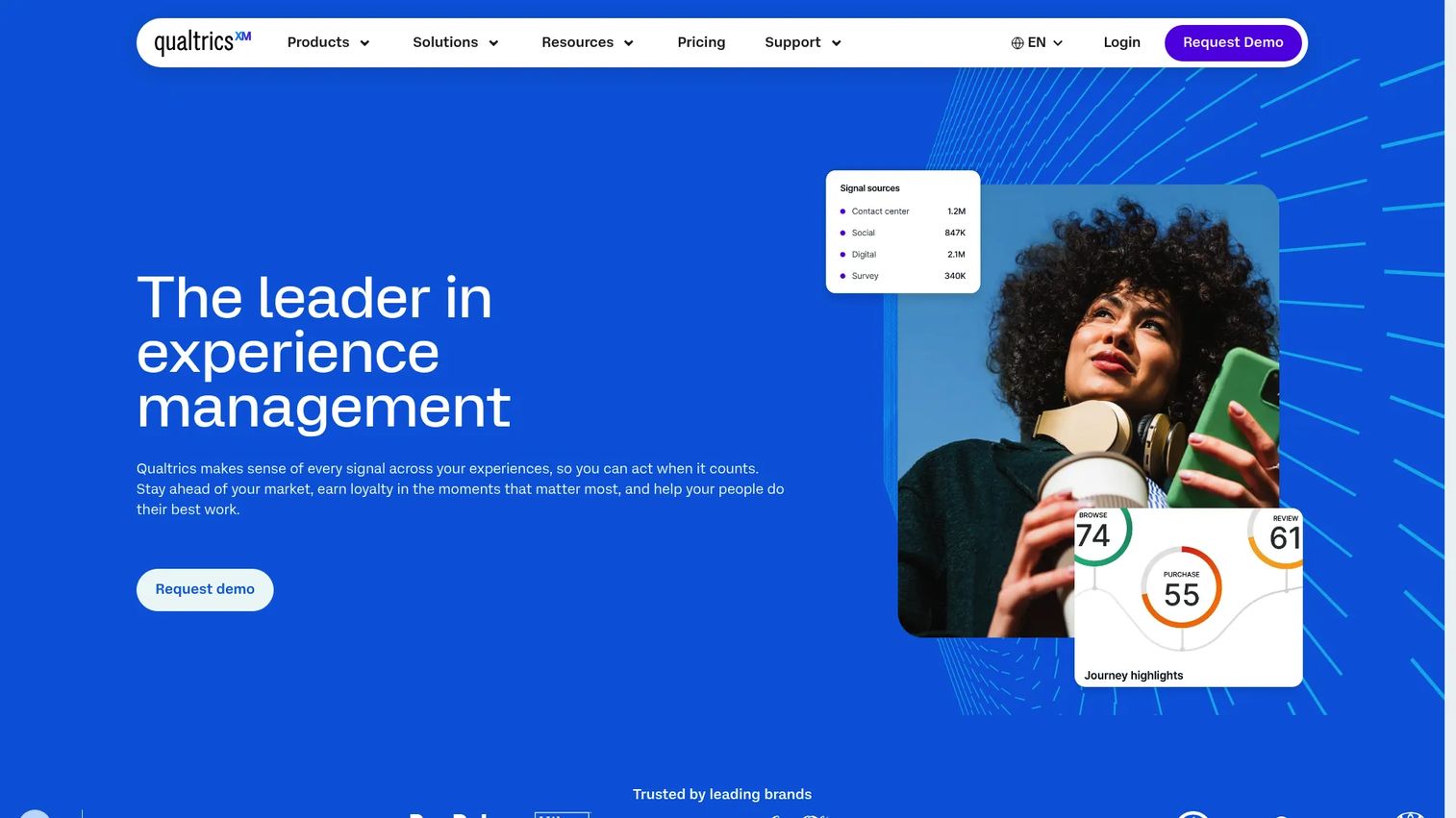
Qualtrics Employee Experience is employee experience software for listening, analyzing feedback, and driving action across the entire employee lifecycle. Exit interviews are one moment inside a broader system that also covers engagement, onboarding, and 360 development feedback. For a company that wants real signal rather than raw collection, this is the analytics-heavy pick.
What sets it apart is depth. Its text analytics cluster open-ended exit comments into themes automatically, so you are not reading 200 free-text responses by hand. Its attrition prediction models flag which teams or segments carry the most turnover risk before the resignations land. That predictive layer is why enterprise HR and people teams standardize on it.
Best for: HR and people teams that want enterprise employee listening and action planning across the full lifecycle.
Key strengths
- Employee engagement and pulse surveys: capture sentiment continuously, not just at exit.
- Employee lifecycle management: connect onboarding, engagement, and exit data in one system.
- 360 development feedback: round out exit signals with manager and peer feedback.
Why choose Qualtrics: Choose it when exit data needs to feed a company-wide employee turnover analytics program and you have the org maturity to act on predictive insights. It is the strongest option here for teams that treat feedback as a data science problem, not a form to send. Smaller teams may find it more platform than they need day one.
Qualtrics pricing: Qualtrics lists its EX offerings as product SKUs, People Engage and People Lifecycle, with pricing based on employee count. No public numeric price is shown, so plan on a sales-led quote scoped to your headcount. There is no published free tier.
2. ExitPro
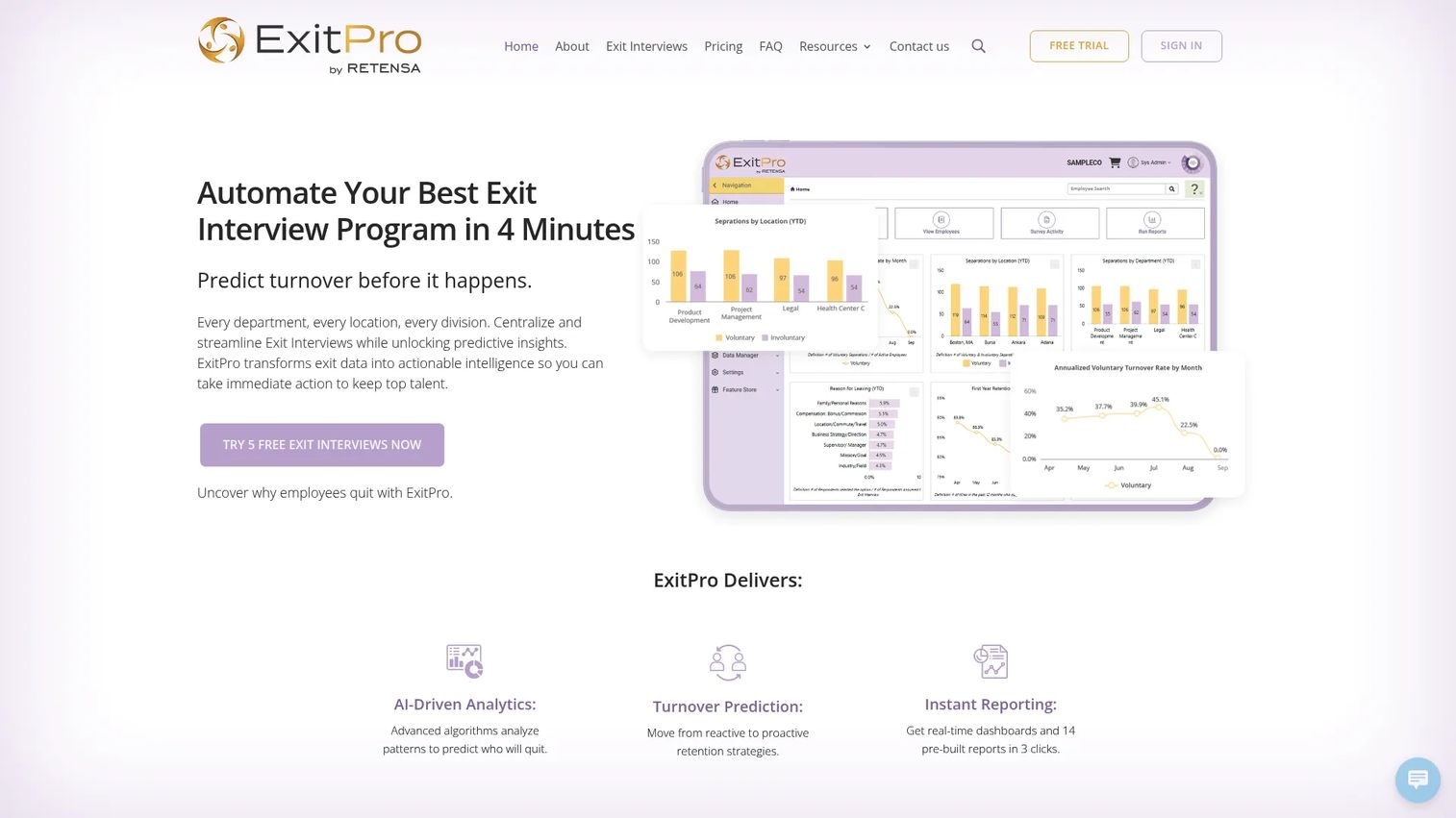
ExitPro is exit interview software built specifically for automating offboarding surveys and turnover analytics. Unlike broad survey suites, it does one job and does it end to end: trigger the exit survey, collect responses confidentially, and surface turnover risk in real-time dashboards. If you want a category-specific tool rather than a general platform you have to configure, this is the direct fit.
The positioning leans hard on speed and prediction. ExitPro emphasizes fast deployment and AI-driven analytics that flag turnover patterns as responses come in. Pre-built reports mean you are not building dashboards from scratch, which matters when People Ops is a team of one.
Best for: HR teams that want to automate exit interviews and track turnover risk without stitching together a general survey tool.
Key strengths
- AI-driven analytics: automatically surface themes and risk signals from exit responses.
- Turnover prediction: flag at-risk segments before attrition compounds.
- Real-time dashboards and pre-built reports: get reporting out of the box, not after setup.
Why choose ExitPro: Choose ExitPro when your primary job is exit and offboarding feedback and you want turnkey reporting fast. It fits teams that value a focused tool over a configurable platform. If you also need engagement, onboarding, and performance data in the same system, a broader suite may serve you better.
ExitPro pricing: ExitPro Basic starts at $79/mo billed quarterly, ExitPro Plus is $249/mo billed quarterly, and ExitPro Enterprise is a custom quote. The site also offers a trial of five free exit interviews, so you can test the workflow before committing.
3. ProProfs Survey Maker
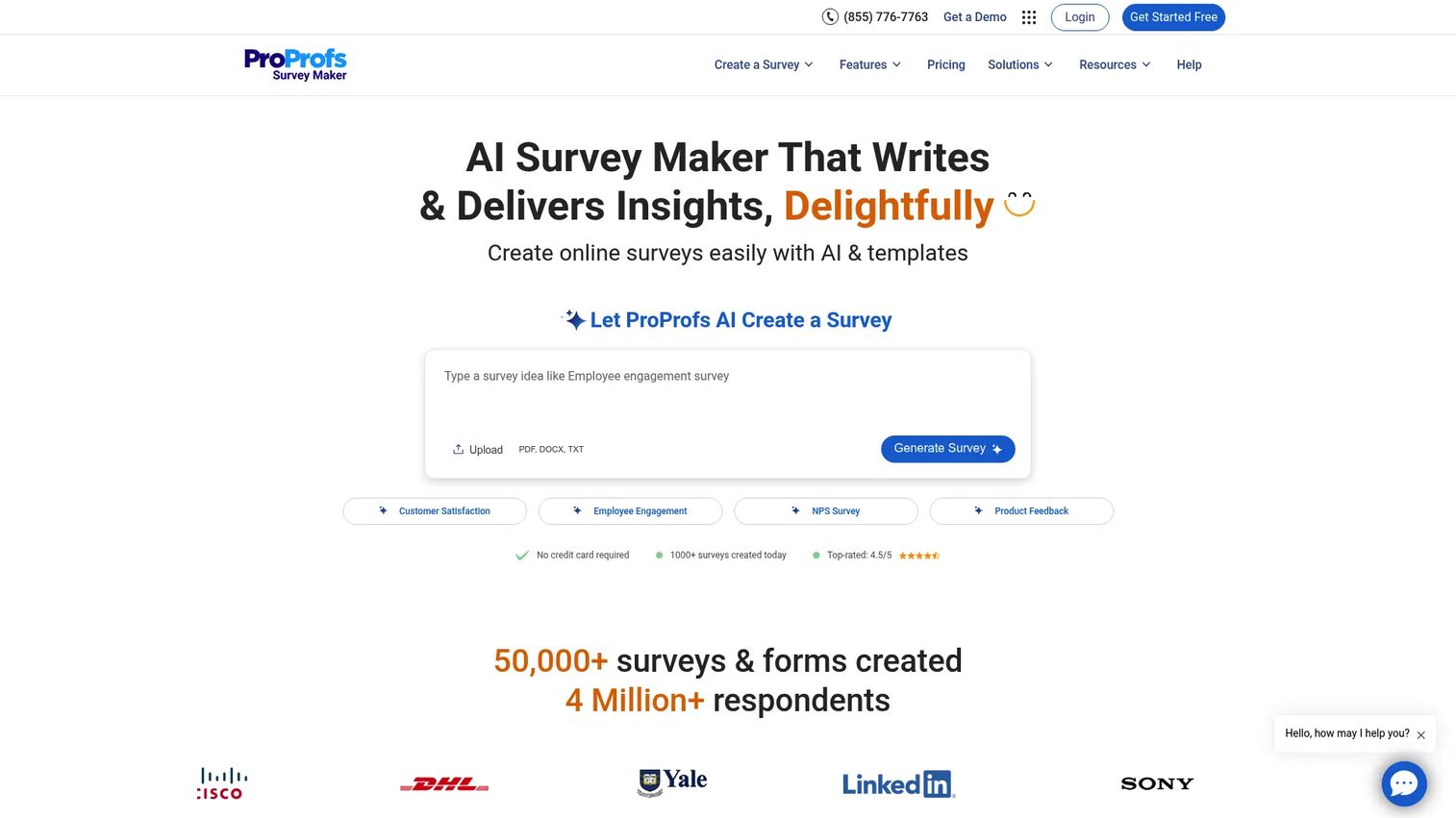
ProProfs Survey Maker is online survey software for creating, distributing, and analyzing surveys, including exit surveys. It is not a dedicated exit platform, but its strength is flexibility. If your team wants to build exit survey software workflows quickly with full control over questions and branching, ProProfs gives you a fast path with a low barrier to entry.
The template library is the practical selling point. With a large bank of ready questions and an AI survey maker, you can stand up an exit survey in minutes and distribute it by email, link, embed, or social. That speed suits smaller teams that do not need attrition prediction, just clean, consistent collection.
Best for: Teams that want a simple survey builder with templates, distribution, and basic analytics.
Key strengths
- AI survey maker: generate exit survey drafts fast instead of writing from scratch.
- 1,000,000+ ready questions: pull proven exit questions from a large library.
- Flexible distribution: share by email, link, embed, and social media.
Why choose ProProfs Survey Maker: Choose it when you want configurable forms and quick setup over deep employee turnover analytics. It fits early-stage teams building their first structured exit process. Teams needing predictive modeling or deep HRIS integrations will outgrow the basic tiers.
ProProfs pricing: The Free plan is forever free for up to 50 responses. Business is $49.99/month, billed annually at $599.88/year. Enterprise starts at $149.99 on annual plans only. The free tier makes it easy to pilot an exit survey before you commit budget.
4. SurveySparrow
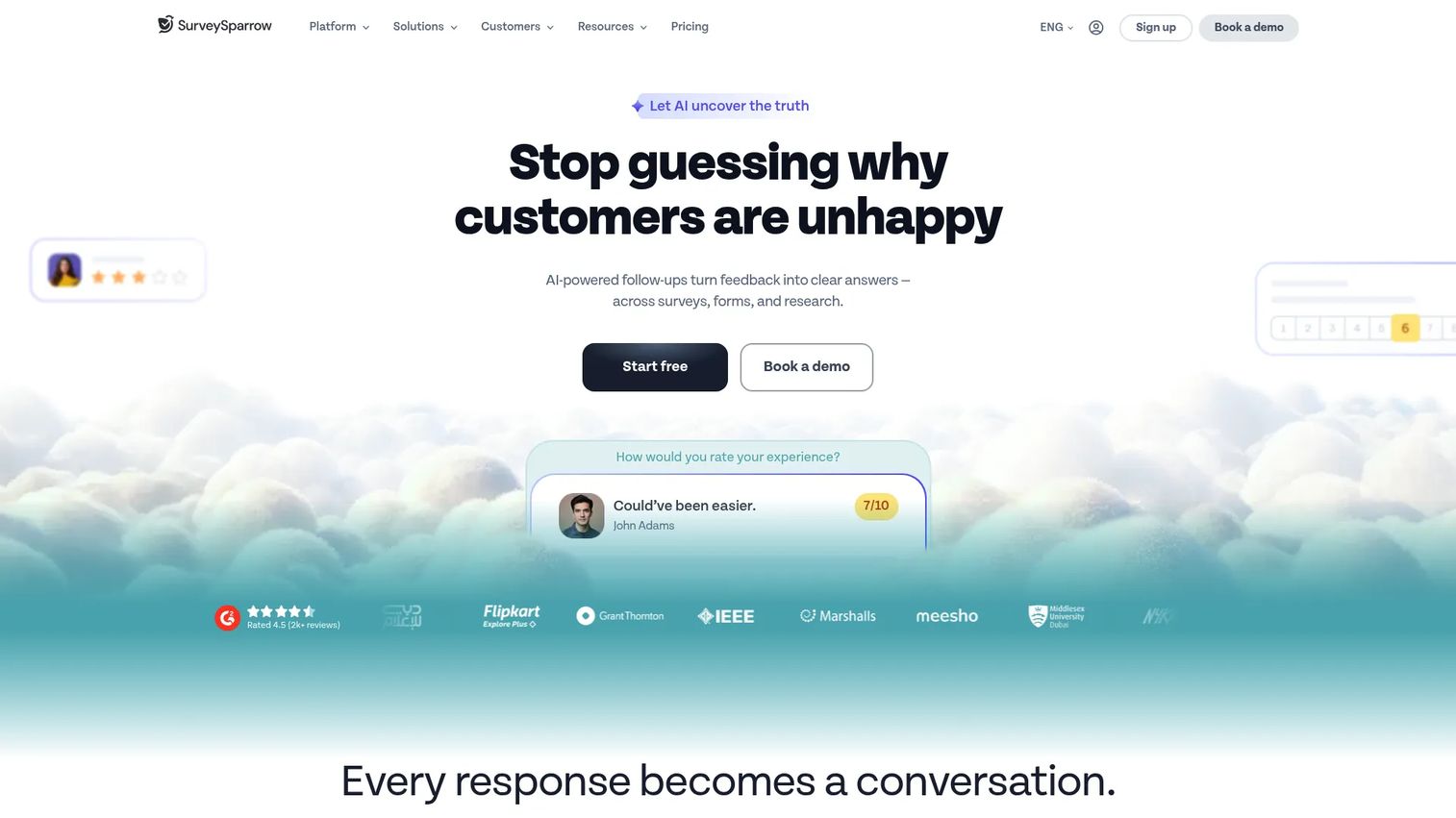
SurveySparrow is an AI-powered feedback and survey platform known for conversational surveys that feel more like a chat than a form. For exit surveys, that format matters: departing employees are more likely to finish a survey that feels human, which means more complete data and fewer half-filled responses.
Beyond the survey experience, it offers real-time reports, automation, workflows, webhooks, and APIs. That makes it usable well past the survey itself, routing responses and triggering follow-up actions. The focus here is participation and distribution, getting honest, complete feedback from people on their way out.
Best for: Teams that want conversational surveys and feedback workflows that lift completion rates.
Key strengths
- Conversational surveys: chat-style format that improves response completion.
- Real-time reports and analysis: watch exit trends update as responses land.
- Automation and integrations: workflows, webhooks, and APIs to route feedback.
Why choose SurveySparrow: Choose it when participation is your bottleneck and you want a survey experience people actually finish. It fits teams prioritizing response quality and distribution. If you need dedicated attrition prediction, a specialized exit platform will go deeper.
SurveySparrow pricing: SurveySparrow offers a forever free plan plus Basic, Starter, Business, and Enterprise tiers billed yearly. Paid plan prices are not consistently published, so confirm current figures on their pricing page. The free plan lets you validate the conversational format before upgrading.
5. PointerPro
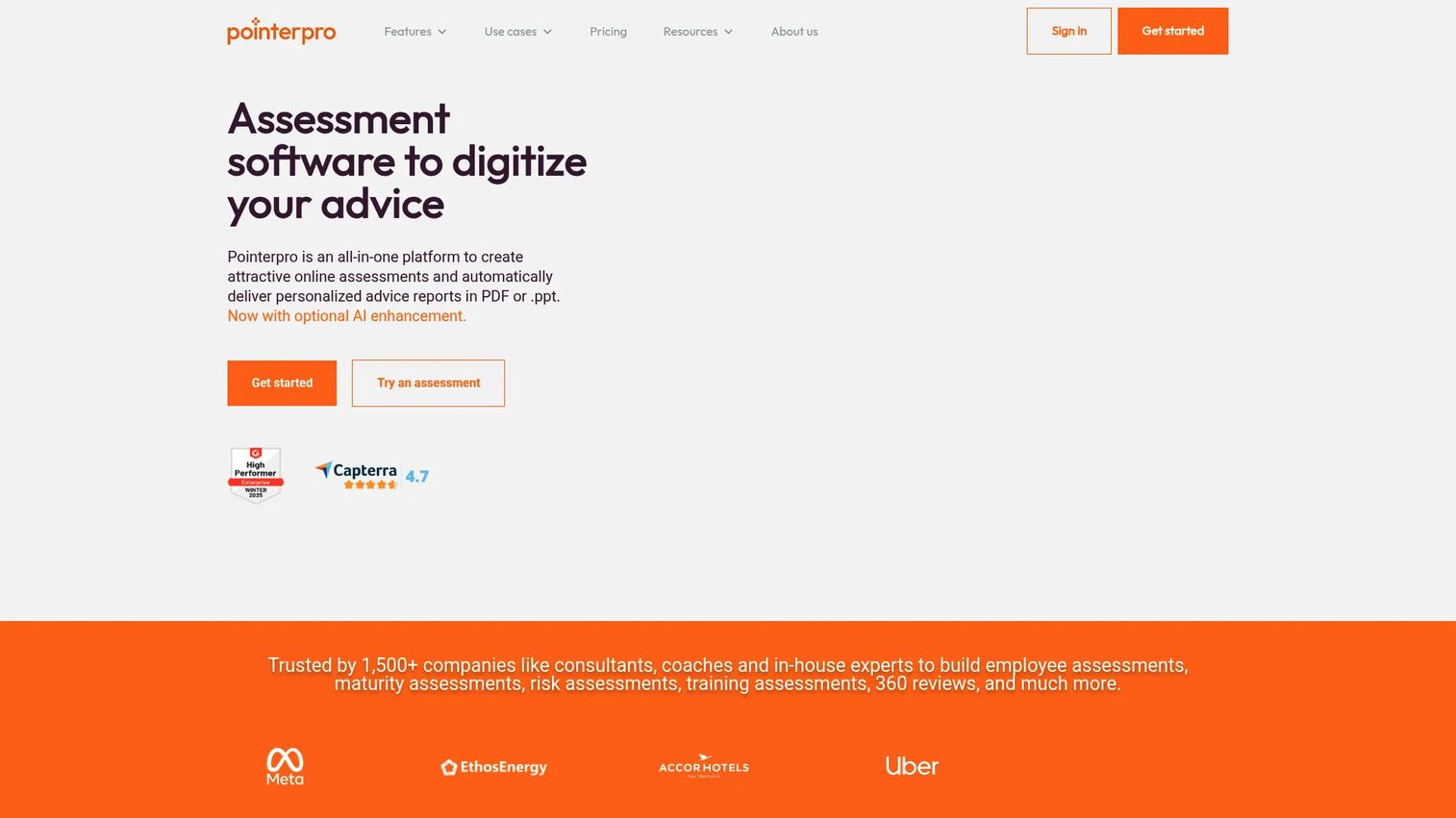
PointerPro is assessment software for building branded questionnaires that automatically generate personalized reports. For exit interviews, that means you can build tailored questionnaire paths, branching based on department, tenure, or role, and hand each stakeholder a clean report without manual work. It is a strong fit for teams that want more structure than a flat survey.
The 2-in-1 model, survey building plus report generation, is the differentiator. Instead of exporting raw data and building slides, PointerPro turns responses into formatted reports automatically. That saves People Ops real time when they need to brief leadership on turnover trends.
Best for: Consultants, HR teams, and marketers building assessments with automated personalized reports.
Key strengths
- Unlimited questionnaires and questions: build as many tailored exit paths as you need.
- Automated personalized reports: turn responses into formatted PDF-style reports automatically.
- Integrations including Zapier, Make, webhooks, and API: connect exit data to the rest of your stack.
Why choose PointerPro: Choose it when you want tailored exit workflows and automated reporting over enterprise-grade analytics. It fits teams that value personalized paths and polished output. For predictive attrition modeling at scale, an enterprise platform will carry more analytics depth.
PointerPro pricing: The Professional plan starts at $69/month, with a 14-day free trial. Enterprise, ReportR, and DistributR tiers are priced on request. The trial lets you test the assessment and report workflow before committing.
6. WorkStep
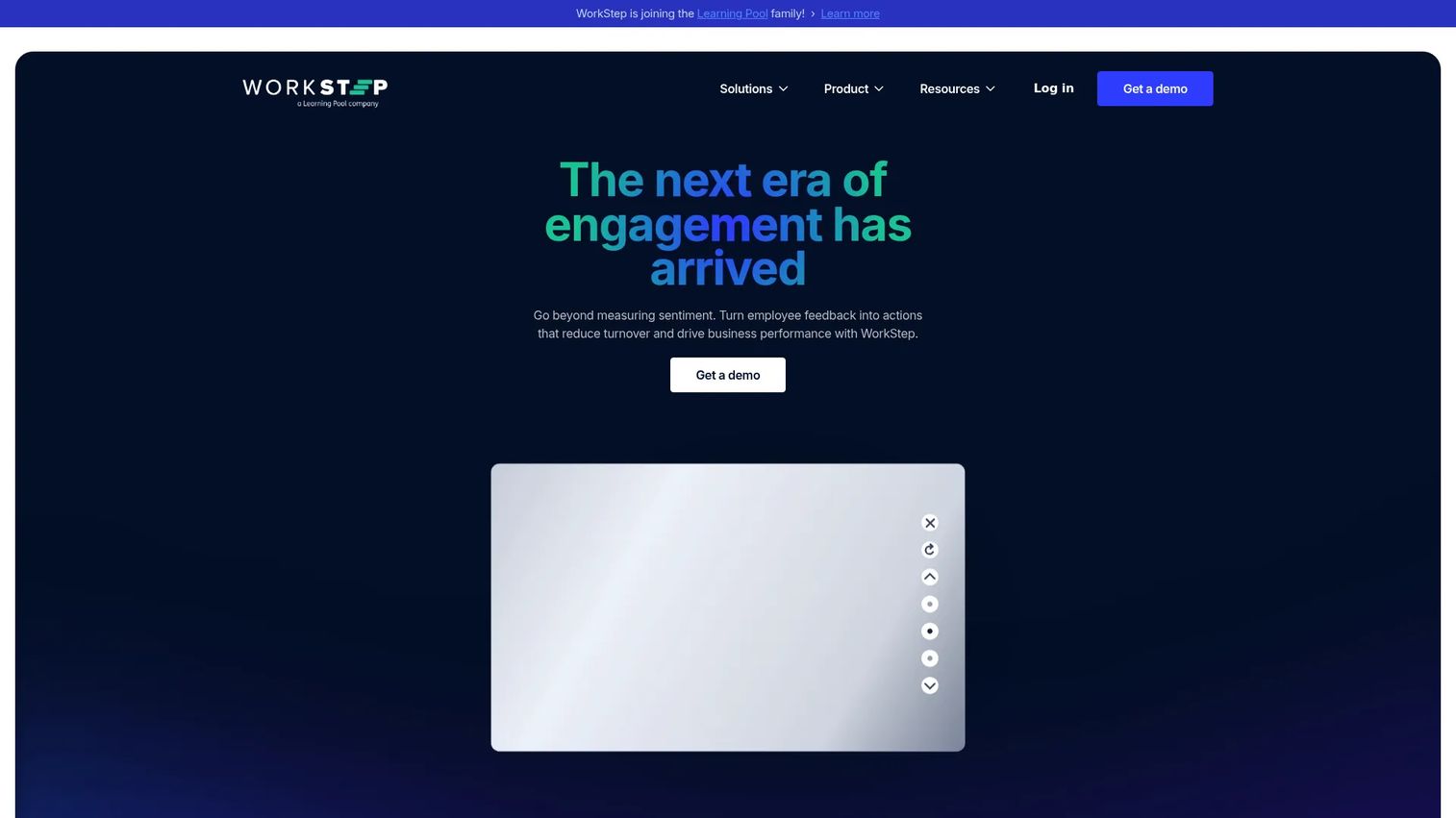
WorkStep is an employee engagement platform built for frontline workforces. If your turnover pressure sits in operations, warehouses, retail, or field roles, WorkStep is designed for exactly that context. It handles continuous lifecycle listening across employee milestones, including exit, and meets frontline workers where they are.
Its multi-channel approach is the standout: surveys go out via email, SMS, WhatsApp, and QR code, which matters for workers who do not sit at a desk. On top of that, AI suggested actions, alerts, and turnover analytics turn responses into next steps. For high-volume operational turnover, that combination is hard to match with a generic tool.
Best for: Enterprise frontline organizations needing employee engagement and retention tools.
Key strengths
- Continuous lifecycle listening: capture feedback across milestones, not just at exit.
- Multi-channel surveys: reach frontline workers via email, SMS, WhatsApp, and QR code.
- AI suggested actions and turnover analytics: turn responses into retention moves.
Why choose WorkStep: Choose WorkStep when your workforce is frontline or high-volume and desk-based tools miss most of your people. It fits operational organizations with real attrition pressure. Software companies with purely desk-based teams may not need its frontline-specific channels.
WorkStep pricing: WorkStep prices by the number of employees in scope and provides a customized quote on request. No public numeric price is shown, so reach out with your headcount for scoping. Its G2 rating of 4.6/5 is the highest on this list.
7. SurveyMonkey
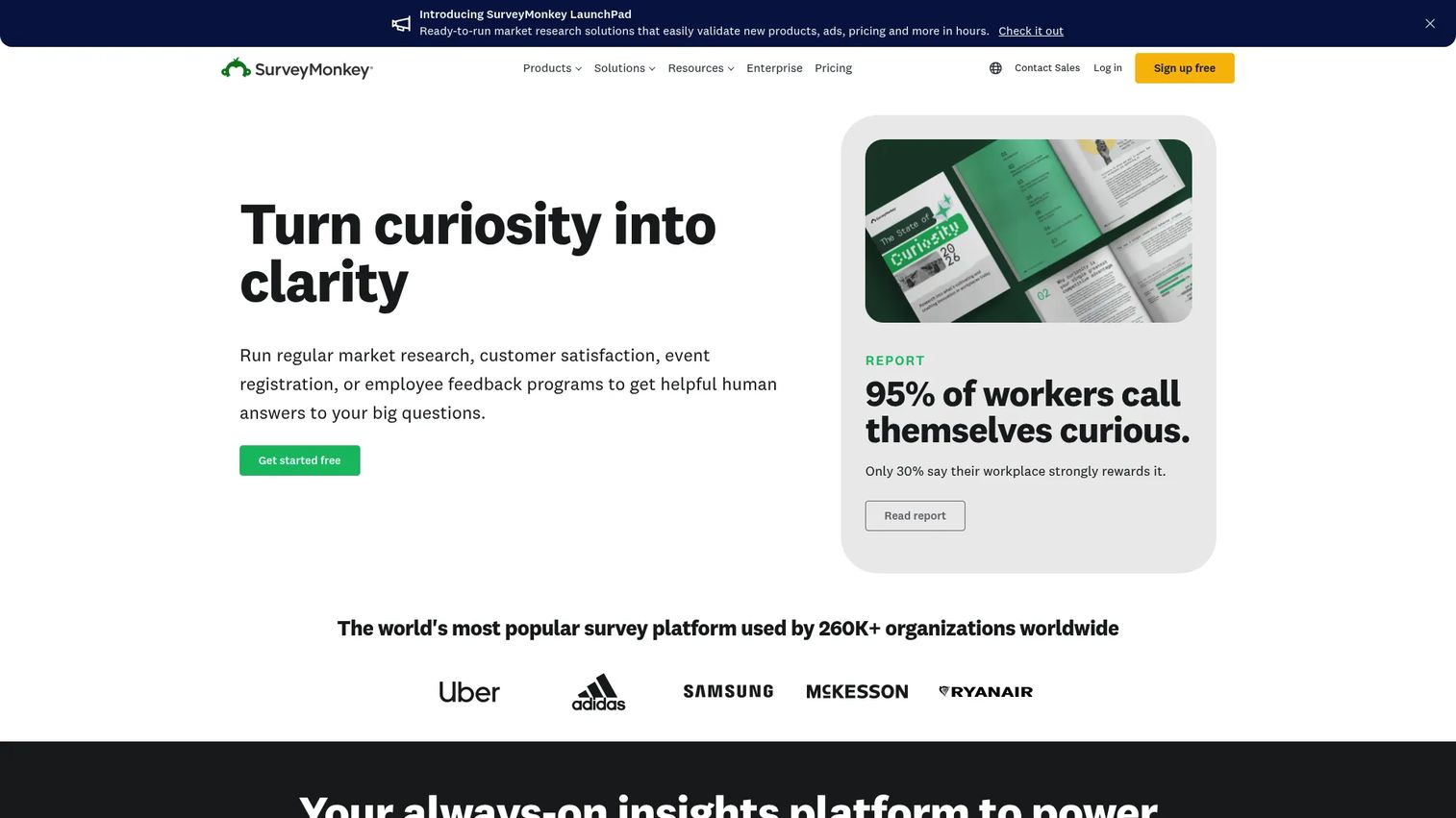
SurveyMonkey is a survey and feedback platform for creating, sending, and analyzing surveys, and it remains one of the most familiar names in the category. For exit interviews, its appeal is simplicity and reach: most people have used it, so building and distributing an exit survey carries almost no learning curve.
It has grown well past basic forms. AI survey creation, AI survey analysis, and survey logic (skip, branch, disqualification) let you build reasonably sophisticated exit flows. For lightweight exit processes where you want quick deployment over deep employee turnover analytics, it is a practical default.
Best for: Teams needing survey creation, collection, and analysis with AI-assisted workflows.
Key strengths
- AI survey creation: generate exit survey drafts quickly.
- AI survey analysis: summarize open-text responses without manual coding.
- Survey logic: skip, branch, and disqualification for tailored exit flows.
Why choose SurveyMonkey: Choose it when you want a familiar, fast survey tool for a lightweight exit process. It fits teams that value speed and low friction over specialized exit workflows. For deeper HRIS integrations and predictive analytics, a dedicated platform will require less workaround.
SurveyMonkey pricing: Public pricing shows Team Advantage at €30/user/month and Team Premier at €75/user/month, both billed annually starting at three users. Enterprise pricing is available via demo. A free Basic plan exists for simple, single-survey use.
8. Quantum Workplace
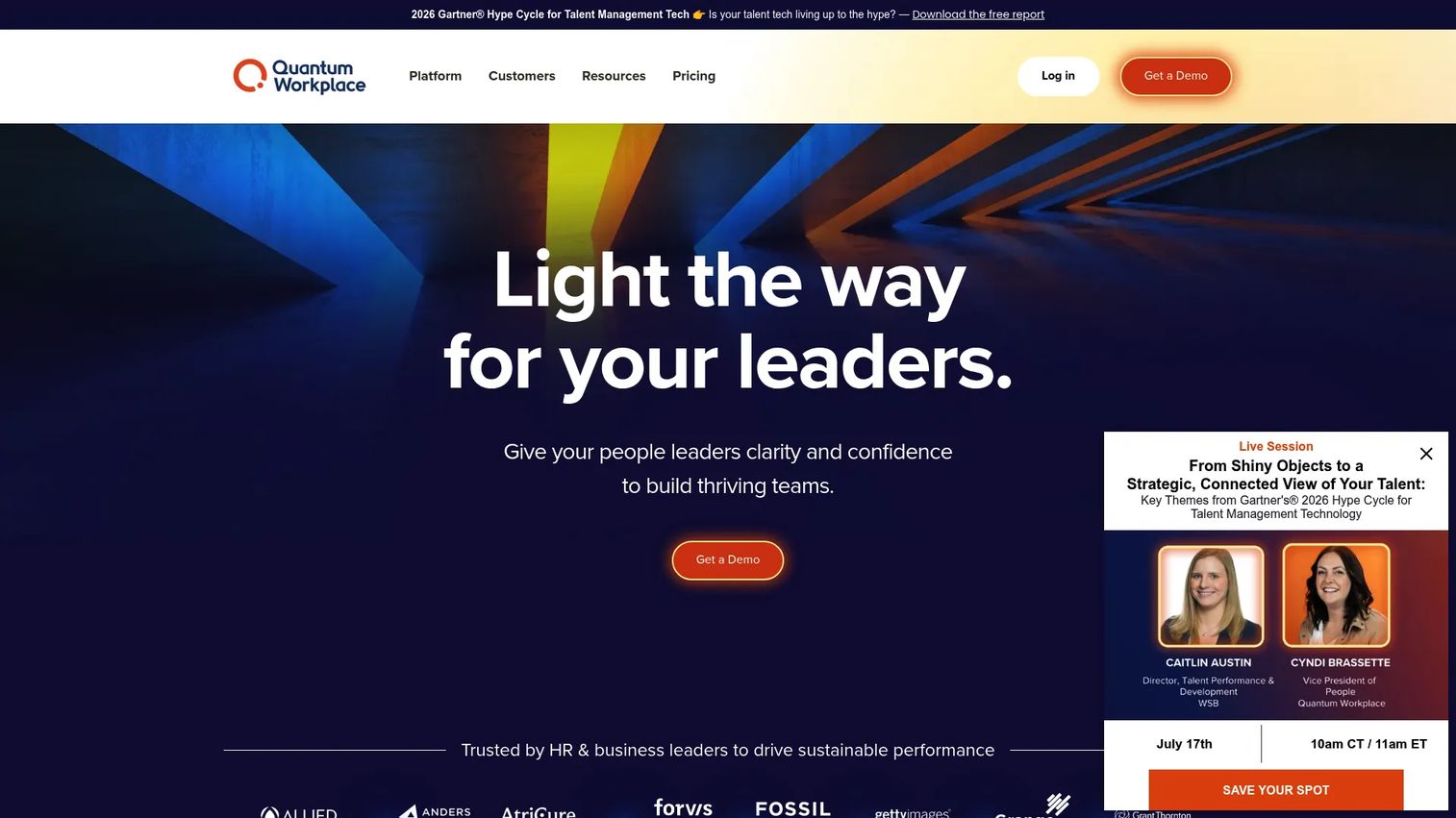
Quantum Workplace is all-in-one HR software for employee engagement, performance, development, and recognition, with exit and retention use cases built into a broader employee listening motion. Teams rarely buy it for exit interviews alone. They buy it to connect exit signals to the engagement and performance data that predicts turnover in the first place.
That breadth is the point. Exit feedback is more useful when you can see it next to engagement survey scores, performance trends, and action plans. Quantum Workplace ties those together so retention insights are not isolated to the moment someone quits. In early 2025 the company acquired WorkDove to expand its performance management footprint.
Best for: HR teams that want one platform for listening, performance, development, and recognition.
Key strengths
- Employee engagement surveys and action planning: connect exit data to ongoing sentiment.
- Performance management: goals, feedback, and 1:1s in the same system.
- Employee development: career paths and succession planning to reduce regretted attrition.
Why choose Quantum Workplace: Choose it when you want exit data inside a broader employee experience platform rather than a standalone exit tool. It fits teams consolidating listening, performance, and recognition. If you only need exit interviews right now, a focused tool will be lighter and faster to deploy.
Quantum Workplace pricing: Pricing is quote-based and varies by the products purchased and total employee count, with packages starting at a $15,000 minimum annual contract. There is no free tier, so this is a commitment scoped to teams ready to consolidate their people data.
What to check before you buy
Before you shortlist, run every candidate through these criteria. They separate a tool that produces action from one that just collects forms.
Analytics depth versus basic reporting
Decide whether you need employee turnover analytics that cluster themes and predict attrition, or whether structured reporting dashboards are enough. Enterprise platforms model risk; simpler tools chart responses. Match the depth to how you will actually use the data.
HRIS integrations
Check that the tool syncs cleanly with your HR system so exit surveys trigger automatically on offboarding. Without HRIS integrations, someone has to send every survey manually, which is the exact bottleneck you are trying to remove. Confirm your specific HRIS is supported.
Anonymous and confidential feedback
Verify how the tool handles anonymous feedback and confidential feedback. If employees suspect their answers are traceable, they sanitize them, and you lose the signal. Look for real anonymity controls, not just a checkbox.
Data privacy and compliance
Confirm GDPR and CCPA compliance if you operate across regions. Exit data is sensitive employee data, and data privacy handling should be documented, not assumed.
Rollout speed and ease
Assess how fast you can deploy across teams and locations. A tool your People Ops lead can configure in a week beats one that needs a quarter-long implementation, especially at Series B scale where speed matters.
Conclusion
The best exit interview software depends on what you are optimizing for. If you want deep analytics and attrition prediction, Qualtrics Employee Experience is the strongest analytics-heavy pick. If you want turnkey exit automation, ExitPro is the focused choice. For flexible survey building, ProProfs Survey Maker and SurveyMonkey keep it light, while SurveySparrow wins on completion and PointerPro on tailored reporting. WorkStep owns frontline and high-volume workforces, and Quantum Workplace fits teams consolidating exit into broader employee listening.
The next step is simple. Shortlist two or three of these exit interview vendors based on three factors: implementation speed, reporting depth, and whether they support your HRIS integrations. Run a small pilot on your next few departures, compare the quality of the data and the ease of rollout, then commit. Treat exit feedback like the operating signal it is, and you will catch retention problems a quarter before they show up in your numbers.
FAQs
Exit interview software is used to collect, standardize, and analyze feedback from departing employees. It automates sending exit surveys, protects respondent anonymity, and rolls individual answers into turnover trends. Teams use it to understand why people leave and to reduce future attrition.
Exit survey software refers specifically to the questionnaire layer that standardizes and automates the questions departing employees answer. Exit interview software is often used more broadly to include the full workflow: scheduling, collection, reporting, and action planning. In practice the terms overlap heavily, and most exit interview survey software includes both survey and analysis capabilities.
Indirectly, yes. The software does not reduce turnover by itself, but it surfaces the patterns, bad managers, comp gaps, onboarding problems, that drive people out. When you act on those turnover trends, you address root causes before they compound. Turnover reduction comes from the action, and the software makes the signal reliable enough to act on.
Look for text analytics that cluster open-ended responses into themes, segmentation by team, tenure, and role, and ideally attrition prediction that flags at-risk groups early. For a scaling company, the value is in employee turnover analytics you can trust in a board meeting, not just raw response counts. Real-time reporting dashboards matter more than survey volume.
Very important once you pass a certain size. HRIS integrations let exit surveys trigger automatically when someone is offboarded, which removes manual sending and ensures no departure is missed. Without that sync, your process depends on a person remembering to send each survey, which breaks under volume.
Yes. Most platforms offer anonymous feedback and confidential feedback controls specifically because honesty depends on it. Departing employees give more candid answers when they trust responses are not traceable. Verify the tool's anonymity settings and its data privacy handling, including GDPR and CCPA compliance if you operate across regions.
It can be, especially the lighter tools. Smaller teams often start with a free or low-cost survey builder to establish a consistent, structured exit process before turnover becomes a pattern. The value is building the habit early, so when you scale, you already have comparable data and a workflow that does not depend on one person's memory.
Match the tool to your data maturity and volume. A simple survey tool fits teams that need consistent collection and basic reporting without predictive analytics. A dedicated exit interview management platform fits teams with recurring turnover, multiple locations, or a need for attrition prediction and deep HRIS integrations. Start simple, and upgrade when manual work or analytics gaps start costing you real retention.