An enterprise prospect asks your sales team whether your product supports customer-managed encryption keys. Engineering checks three cloud accounts, a legacy database tier, and a Kubernetes cluster. Nobody can give a confident answer about how rotation behaves across every service, or what happens to encrypted data if a key needs to be revoked urgently.
That scenario lands on a PM's plate more often than most roadmaps account for. The hard part isn't enabling encryption. It's maintaining consistent governance over the cryptographic keys that protect that encrypted data, across workloads, cloud accounts, regions, and release cycles. NIST Special Publication 800-57 defines the full scope: Secure key generation, storage, distribution, use, and destruction. Each stage is an operational responsibility, and gaps in any one of them create real risk.
According to the Thales 2025 Cloud Security Study, only 8% of organizations encrypt 80% or more of their cloud data, even as 54% classify the majority of that data as sensitive. The keys protecting that data need active governance, not passive storage.
This guide cuts through the noise so you can match the right encryption key management software to your deployment model and customer requirements.
What's inside
This guide is written for product managers, platform engineers, and DevSecOps leads who influence security architecture decisions. Tools were selected based on four criteria:
- Deployment coverage: Cloud-native, hybrid, multi-cloud, and on-premises support
- Lifecycle depth: Key generation, rotation, revocation, recovery, and destruction capabilities
- Integration fit: API, SDK, KMIP, and HSM interoperability
- Pricing transparency: Verified pricing from vendor pages and G2 at generation time
TL;DR
- Best for AWS-native products: AWS Key Management Service offers native service integrations, IAM-based access policies, and usage-based pricing starting at $1 per customer-managed key per month
- Best for Microsoft environments: Microsoft Azure Key Vault covers keys, secrets, and certificates with RBAC controls across Standard, Premium, and Managed HSM tiers
- Best for Google Cloud workloads: Google Cloud Key Management Service supports Cloud HSM and external key management paths alongside Cloud KMS key versioning
- Best for hybrid and multi-cloud governance: Thales CipherTrust Manager, Fortanix Data Security Manager, Entrust KeyControl, and IBM Guardium Key Lifecycle Manager each centralize lifecycle controls across heterogeneous environments
- Best for application secrets alongside encryption keys: HashiCorp Vault and Akeyless Vault handle dynamic credentials, certificates, and policy-driven access in the same platform
- Best for SSH key governance: ManageEngine Key Manager Plus covers SSH key discovery, rotation, and audit workflows as a specialist tool
What is encryption key management software?
Encryption key management software is a system that creates, stores, controls, rotates, audits, recovers, revokes, and destroys cryptographic keys used to encrypt data and services.
This category is distinct from the encryption algorithms themselves and from encrypted storage. A key management system (KMS) governs who can create a key, which services can use it, when it must rotate, what happens after compromise, and how recovery is authorized. According to NIST SP 800-57, a key can move through multiple operational states from generation to destruction, and compromise can trigger revocation at any stage.
Key lifecycle capabilities
Platforms in this category typically handle:
- Key generation and secure import
- HSM-backed cryptographic storage
- Encryption and decryption authorization
- Rotation policies and cryptoperiod management
- Revocation, replacement, and scheduled destruction
- Backup, replication, and disaster recovery
- Access control, segregation of duties, and audit logging
- API, SDK, and KMIP interoperability
Main deployment models
Cloud-native key management services integrate directly with one provider's storage, compute, and identity services. They suit teams building primarily in a single cloud.
Enterprise and hybrid key management platforms centralize governance across on-premises infrastructure, multiple clouds, and databases. These are the right choice when key policy must be consistent across business units or acquired product lines.
Secrets platforms with key-management capabilities handle application credentials, tokens, certificates, and dynamic secrets alongside encryption keys. They serve different governance needs than a pure enterprise KMS; evaluate them separately.
HSM-backed key custody provides hardware-based cryptographic operations for workloads where customer requirements or compliance objectives demand stronger isolation than software-based key stores offer.
The key lifecycle at a glance:
Generate → Store → Authorize use → Rotate → Revoke or replace → Recover when permitted → Destroy
When to use encryption key management software
Support customer-managed encryption keys as a product feature
Enterprise buyers increasingly ask for control over their own key material, separation from vendor-operated keys, or proof of key ownership. Adding customer-managed key support affects tenancy architecture, support runbooks, and documentation. The engineering opportunity cost is real; it should be scoped as a product requirement, not an afterthought.
Centralize key governance across cloud accounts
Multiple cloud accounts, acquired products, or business units running separate encryption policies create a fragmented audit trail. A centralized key inventory with enforced rotation policies makes it possible to answer a security questionnaire without pulling engineers off active work.
Reduce operational risk during rotation, recovery, and decommissioning
Key rotation without dependency mapping is one of the most common causes of production encryption failures. Before rotating any key in use, teams need to know every service that calls it, have a tested rollback path, and have documented recovery authorization. The right tooling makes that process repeatable across release cycles.
Encryption key management software comparison
No single tool wins every scenario. Cloud-native KMS fits cleanly when workloads stay within one provider's boundaries. Hybrid and multi-cloud environments usually need centralized governance. Application-layer secrets add a separate dimension that some platforms cover alongside key management and others do not. Use the table below as a starting framework, then verify pricing and ratings on each vendor's page before committing to an evaluation.
| # | Product | Best for | Key differentiator | Pricing | G2 rating |
|---|---|---|---|---|---|
| 1 | AWS Key Management Service | AWS-native applications | Native AWS service integrations and IAM-based key policies | From $1/mo per key | 4.4/5 |
| 2 | Microsoft Azure Key Vault | Azure and Microsoft environments | HSM-backed key, secret, and certificate management with RBAC | Consumption-based; verify current rates | 4.5/5 |
| 3 | Google Cloud Key Management Service | Google Cloud workloads | Cloud KMS, Cloud HSM, and External Key Manager paths | From $0.000082/hr per active key version | 4.6/5 |
| 4 | HashiCorp Vault | Application secrets and encryption workflows | Policy-based secrets, transit encryption, and dynamic credentials | Free trial; enterprise pricing on request | 4.3/5 |
| 5 | Thales CipherTrust Manager | Hybrid and multi-cloud key governance | Centralized lifecycle controls with KMIP and HSM integration | Custom pricing | N/A on G2 |
| 6 | Fortanix Data Security Manager | HSM-backed multi-cloud control | Software-defined HSM with centralized key lifecycle management | 30-day free trial; enterprise subscription | 4.5/5 |
| 7 | Entrust KeyControl | Distributed enterprise key governance | Decentralized vault architecture with centralized compliance dashboard | 30-day free trial; contact for pricing | N/A on G2 |
| 8 | Akeyless Vault | Cloud-native secrets and key operations | SaaS-delivered vaulting with Distributed Fragments Cryptography | Free tier; enterprise pricing on request | 4.6/5 |
| 9 | IBM Guardium Key Lifecycle Manager | IBM-heavy and regulated environments | Key lifecycle governance with KMIP and FIPS 140-3 support | 30-day free trial; contact for pricing | 4.2/5 |
| 10 | Oracle Cloud Infrastructure Vault | Oracle Cloud workloads | OCI-native key versioning with HSM-backed options | Software keys free; HSM keys from $0.53/version | N/A on G2 |
| 11 | Townsend Security Alliance Key Manager | Historical users only | Reached end of life November 30, 2023 | N/A | N/A |
| 12 | ManageEngine Key Manager Plus | SSH and certificate governance | SSH key discovery, rotation, and audit with a free tier | Free for up to 5 keys; from $475/yr | 4.5/5 |
Pricing and ratings verified October 2026 from each vendor's pricing page and G2 listing.
Best 12 encryption key management software tools for 2026
1. AWS Key Management Service
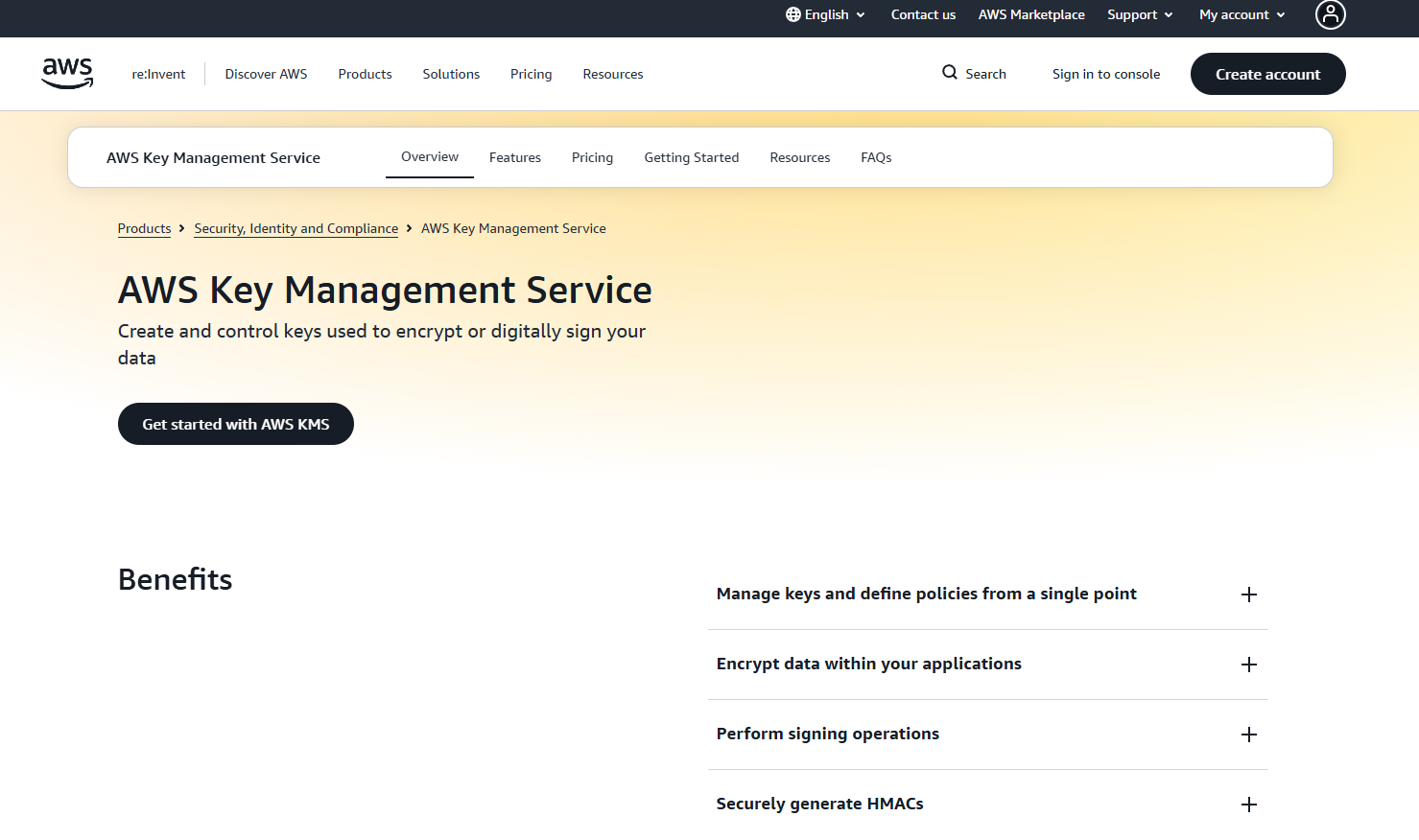
AWS Key Management Service is a managed AWS service for creating and controlling cryptographic keys used to encrypt and digitally sign data. It integrates directly with over 100 AWS services and stores keys in FIPS 140-3 validated HSMs. For product teams building primarily in AWS, it removes the need for a separate key management layer in most standard use cases.
Best for: Product teams whose application data and infrastructure run primarily in AWS and need native service-level encryption without a separate enterprise key management platform.
Key features
- Customer-managed KMS keys with IAM and resource-based policies
- Symmetric, asymmetric, HMAC, and multi-Region key support
- External Key Store for keys held outside AWS
- FIPS 140-3 validated HSM protection
- AWS CloudTrail integration for key usage audit logs
Why choose AWS Key Management Service: Choose it when your engineering team needs native encryption integration across AWS services without adding another platform to maintain. The tradeoff is governance scope: If future enterprise requirements extend beyond AWS, an external key store or a separate enterprise platform may be necessary.
AWS Key Management Service pricing: Customer-managed KMS keys cost $1 per key per month, prorated hourly. API requests above the free tier cost $0.03 per 10,000 requests. Key rotation and custom key store operations add incremental charges; verify current rates at aws.amazon.com/kms/pricing.
G2 rating: 4.4/5
2. Microsoft Azure Key Vault
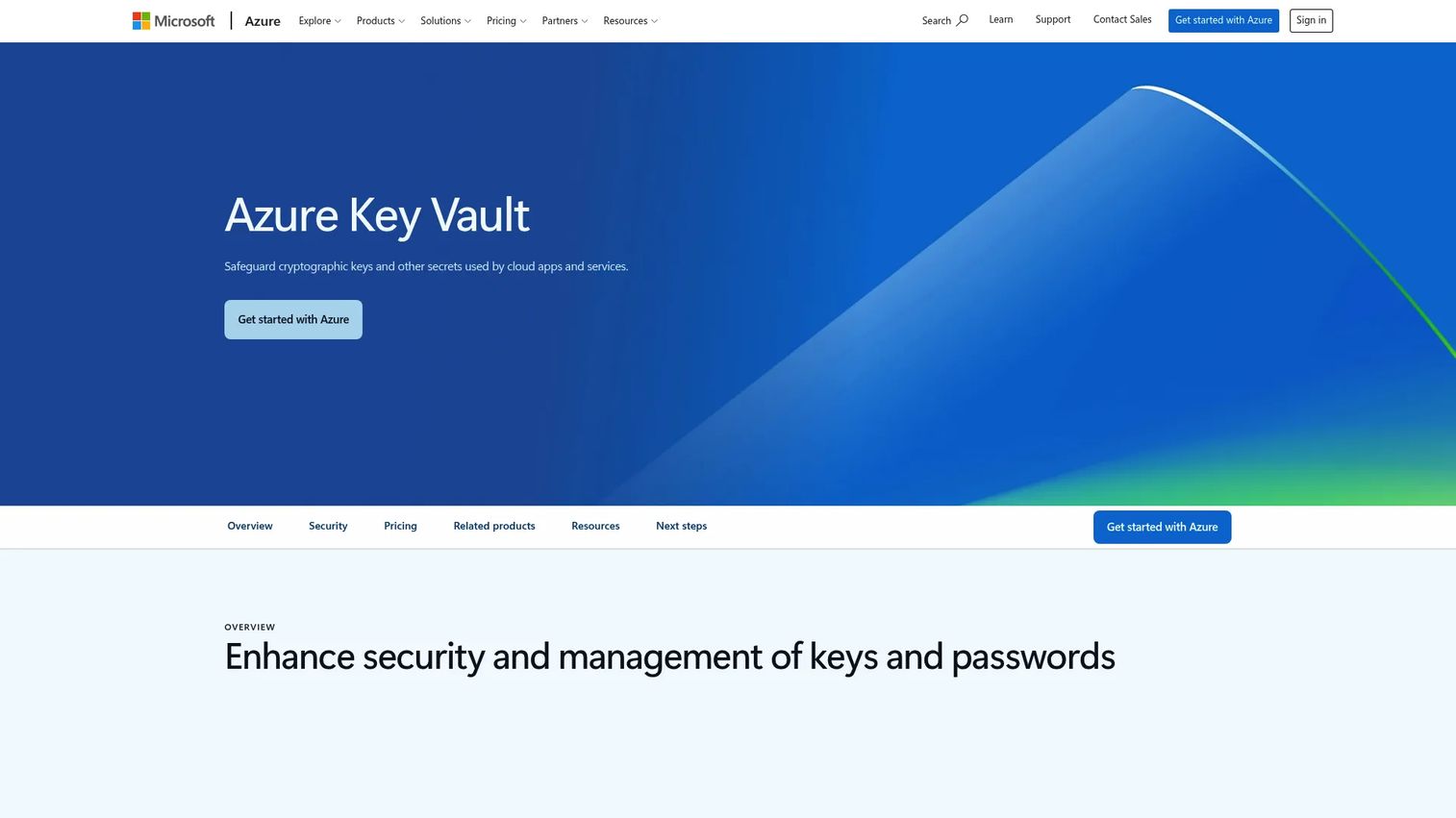
Microsoft Azure Key Vault is a cloud service for safeguarding cryptographic keys, secrets, and certificates used by applications and services. It covers three tiers: Standard for software-protected keys, Premium for HSM-backed keys, and Managed HSM for dedicated single-tenant HSM pools. Integration with Microsoft Entra ID makes it a natural fit for organizations standardized on the Microsoft identity stack.
Best for: PMs whose security and engineering teams already operate on Azure services and Microsoft Entra ID, and who need key, secret, and certificate management from a single service.
Key features
- Azure RBAC and managed identity access control
- HSM-backed key protection on Premium and Managed HSM tiers
- Storage for keys, secrets, and SSL/TLS certificates
- Customer-managed key support across Azure services
- Azure Monitor and audit logging integration
Why choose Microsoft Azure Key Vault: It consolidates key, secret, and certificate management under the Azure identity model your team already governs. For PMs mapping customer-managed-key promises against Azure services, check regional feature availability and which services support RBAC versus vault access policies before committing to a roadmap feature.
Microsoft Azure Key Vault pricing: Standard and Premium vaults bill per operation; Premium adds an HSM-protected key monthly charge. Managed HSM pools use an hourly capacity model. Microsoft displays rate placeholders on some regional pages; verify exact figures at the Azure Key Vault pricing page before publishing a cost estimate to stakeholders.
G2 rating: 4.5/5
3. Google Cloud Key Management Service
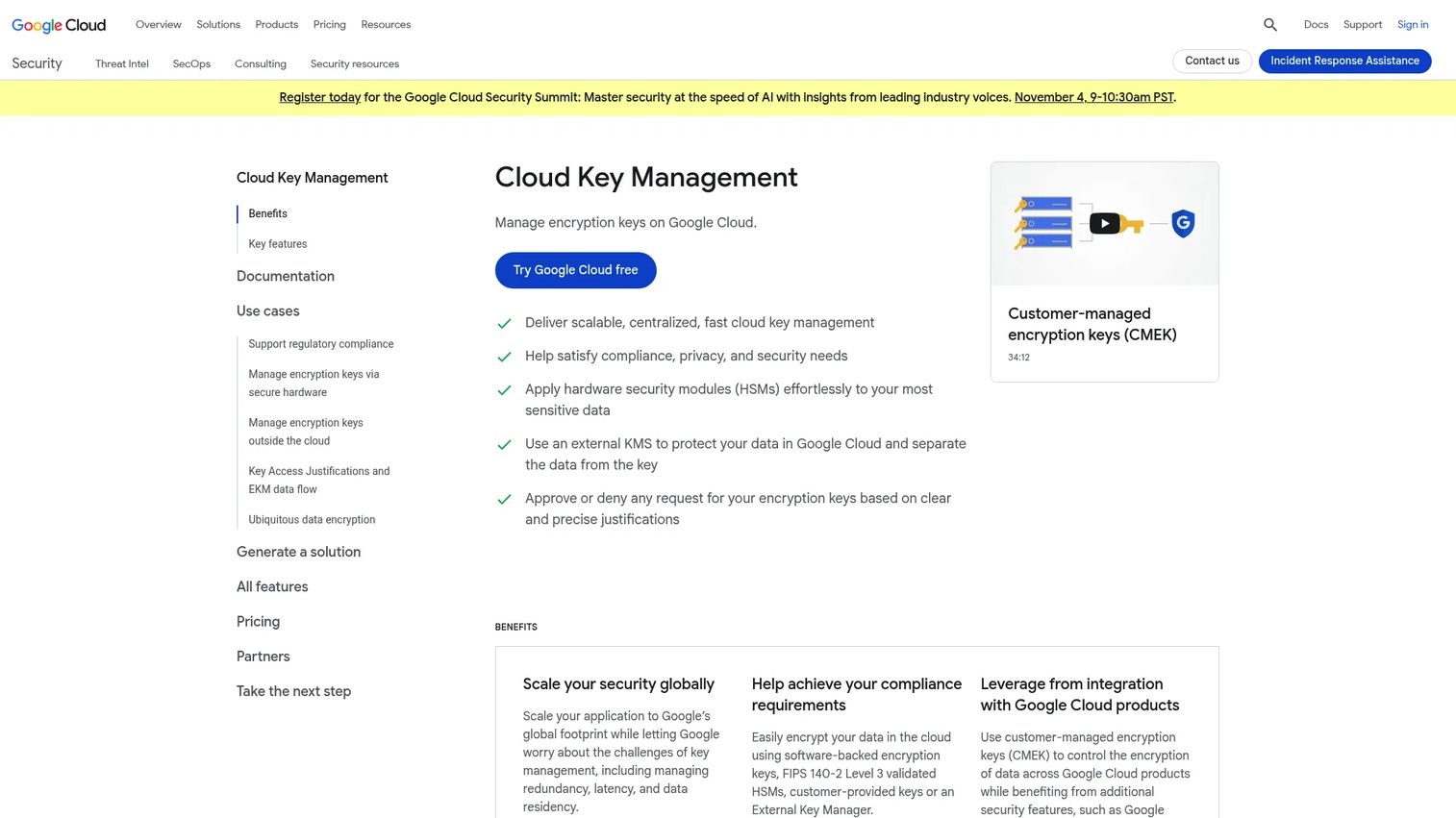
Google Cloud Key Management Service is a centralized cloud service for creating and managing cryptographic keys tied to Google Cloud resources. It covers software-protected keys through Cloud KMS, hardware-backed keys through Cloud HSM, and keys held outside Google through the External Key Manager. Cloud KMS Autokey automates key provisioning and assignment for compatible services, reducing the instrumentation burden on platform teams.
Best for: Teams operating primarily on Google Cloud that need provider-native controls with options for external key custody or hardware-backed operations.
Key features
- Cloud KMS key versioning and key ring organization
- Cloud HSM for hardware-backed cryptographic operations
- External Key Manager for keys held outside Google
- CMEK integrations across compatible Google Cloud services
- Organization policy controls for encryption enforcement
Why choose Google Cloud Key Management Service: Choose it when your product runs on Google Cloud and you need direct links between cloud resource encryption and key policy. The External Key Manager path also opens a route to HYOK-style control for customers who require keys outside Google's infrastructure.
Google Cloud Key Management Service pricing: Software-protected keys cost $0.000082192 per active key version per hour (approximately $0.06 per version per month). HSM-protected versions cost $0.001369863 per hour. Cryptographic operations run $0.03 per 10,000 requests after the free monthly allotment. Verify current regional rates at cloud.google.com/kms/pricing.
G2 rating: 4.6/5
4. HashiCorp Vault
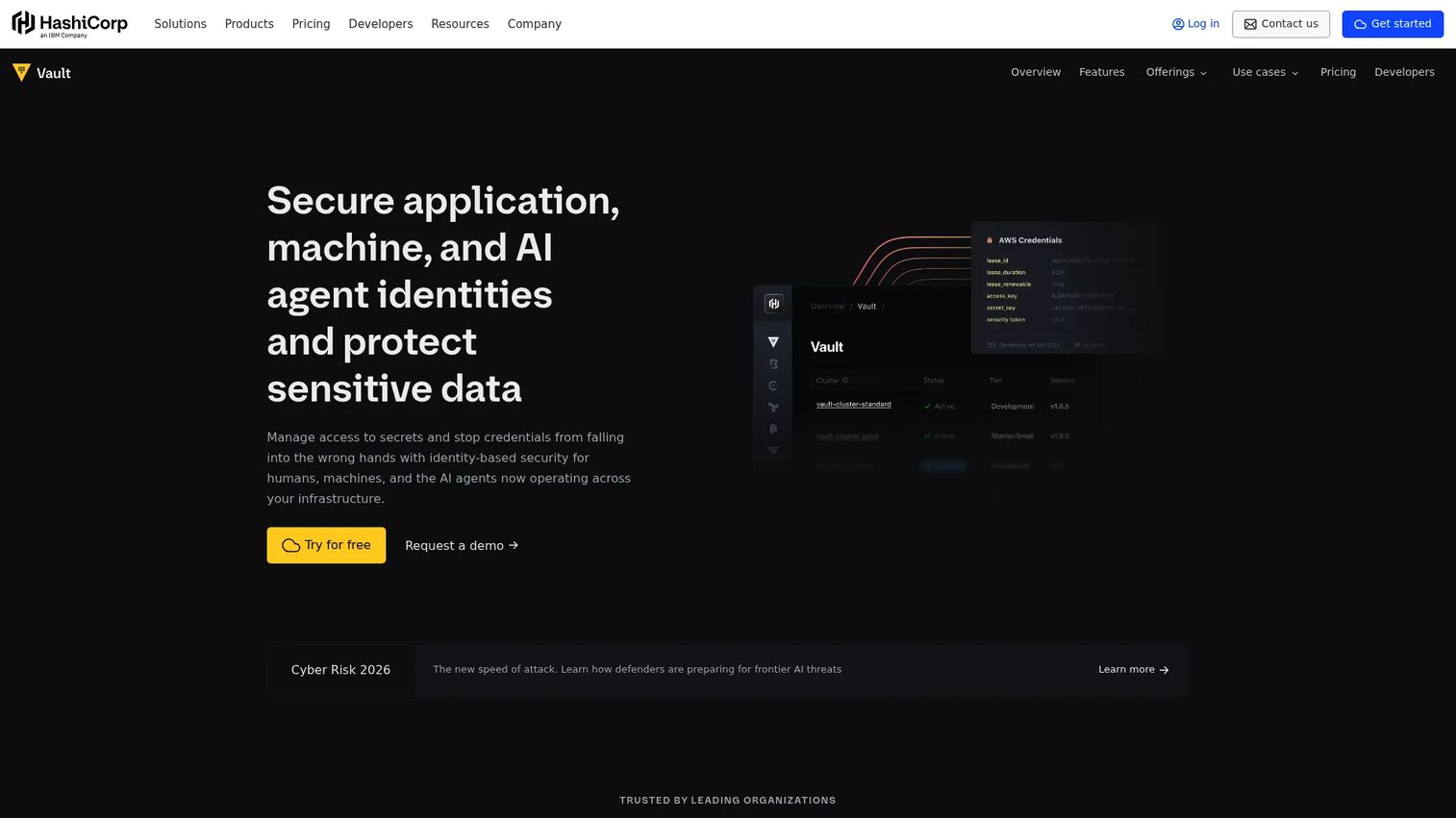
HashiCorp Vault (now IBM Vault) is an identity-based secrets management platform that handles application credentials, certificates, encryption keys, and dynamic access across hybrid and multi-cloud environments. Its transit secrets engine provides encryption-as-a-service so applications can encrypt data without managing keys directly. Policy-as-code governs who can access which secrets engine and under what conditions.
Best for: Platform and security teams that need to centralize application secrets, dynamic credentials, and encryption services under a single policy layer, rather than teams looking only for cloud-native KMS replacement.
Key features
- Transit secrets engine for encryption-as-a-service
- Dynamic credentials with automated expiration and rotation
- Policy-as-code with fine-grained access controls
- Audit devices for detailed access logging
- Multiple secrets engines: Databases, PKI, cloud IAM, SSH
Why choose HashiCorp Vault: Choose it when application-layer secrets, dynamic database credentials, and certificate workflows sit alongside your encryption key requirements. This is a platform ownership decision, not a point feature; it requires a team to govern policies, monitor audit logs, and maintain the deployment through releases.
HashiCorp Vault pricing: A free trial is available. The platform offers pay-as-you-go, Flex, and Enterprise Self Managed plans; pricing is not published numerically on the official site and varies by usage and contract model. Contact HashiCorp for a quote, or check G2 reviewer comments for reported enterprise ranges.
G2 rating: 4.3/5
5. Thales CipherTrust Manager
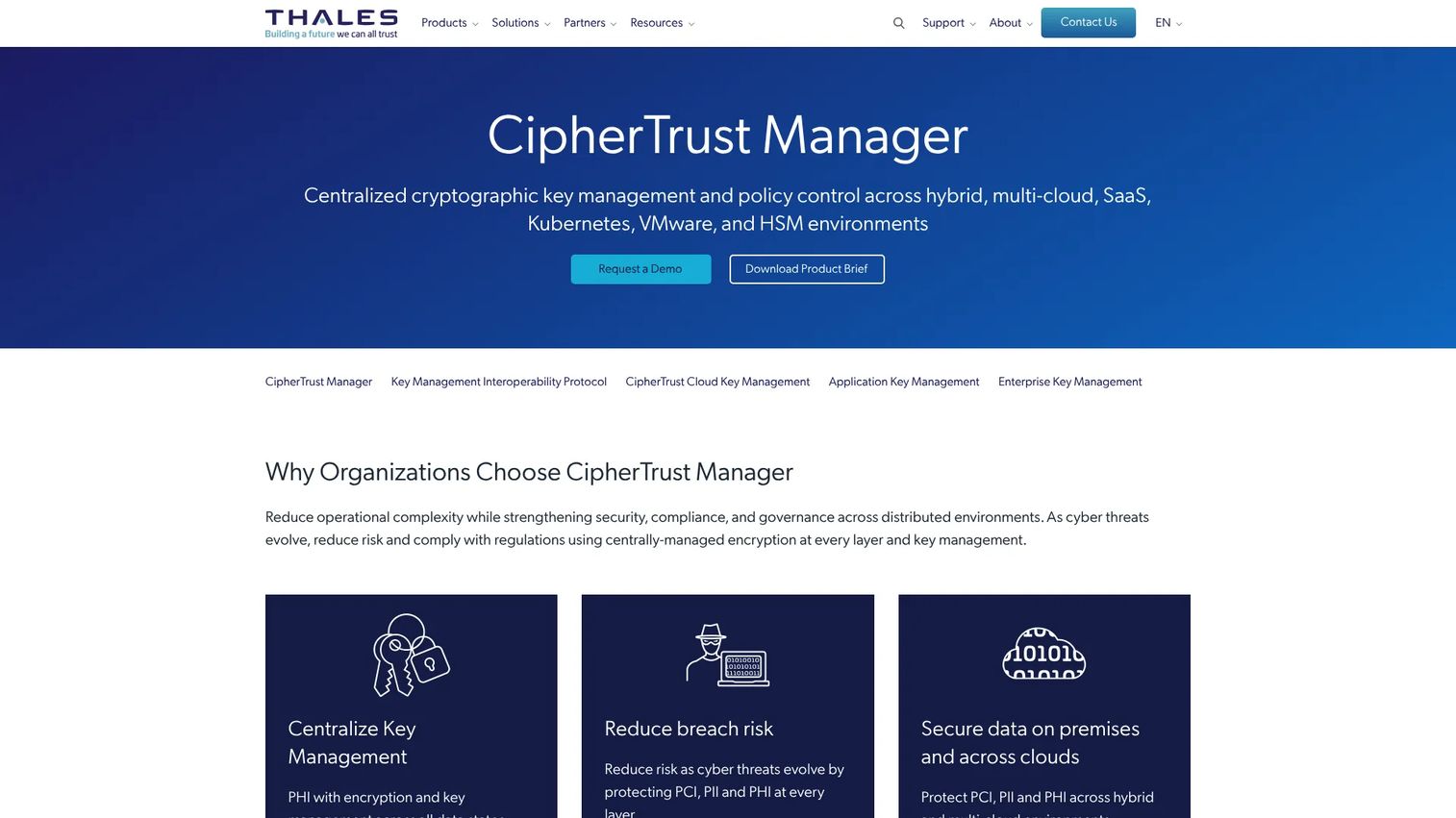
Thales CipherTrust Manager is a centralized enterprise key management platform that governs encryption keys, secrets, and certificates across hybrid, multi-cloud, SaaS, database, Kubernetes, VMware, and HSM environments. It connects to AWS KMS, Azure Key Vault, and Google Cloud KMS as an external governance layer, making it relevant when key policy must be consistent across providers. KMIP interoperability supports integrations with storage systems and database encryption engines.
Best for: Enterprises that need standardized key policy across databases, storage appliances, and multiple cloud providers without rebuilding governance for each environment separately.
Key features
- Centralized encryption key lifecycle management
- Multi-cloud key management with AWS, Azure, and Google Cloud connectors
- KMIP interoperability for storage and database integrations
- HSM integration for hardware-backed cryptographic operations
- Role-based access controls, audit trails, and policy reporting
Why choose Thales CipherTrust Manager: It fits organizations where key governance has grown into a cross-platform architecture program. For PMs answering enterprise RFP questions about BYOK, HYOK, key residency, and separation of duties, CipherTrust Manager is designed specifically for that evidence conversation.
Thales CipherTrust Manager pricing: Thales does not publish numerical pricing on its product pages. Contact Thales directly for a quote based on deployment model and environment scope. G2 currently lists one review with a 0.0/5 rating; this reflects low review volume rather than product performance.
6. Fortanix Data Security Manager
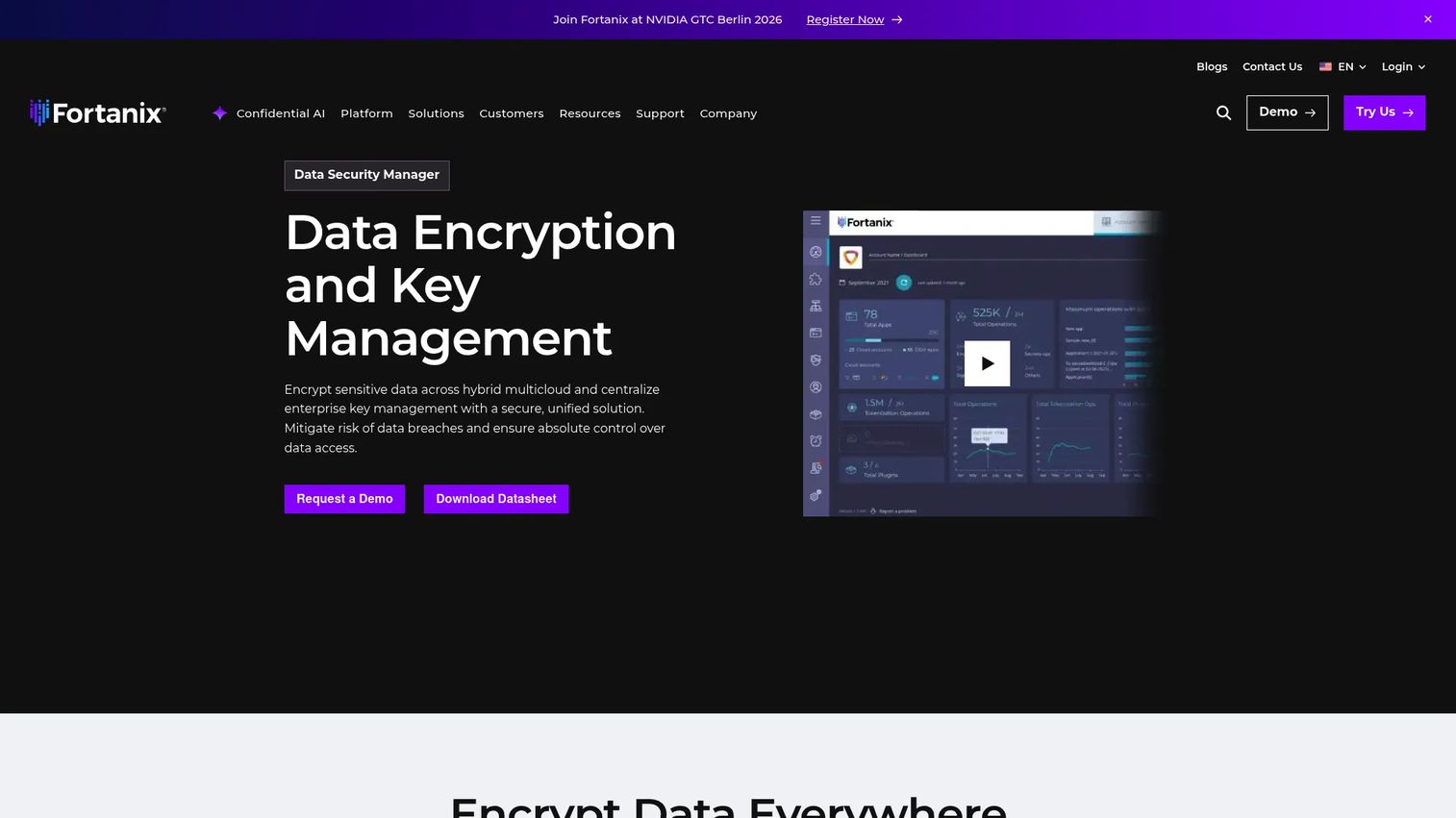
Fortanix Data Security Manager is a data encryption and enterprise key management platform built around a software-defined HSM architecture. It centralizes key lifecycle management, file-system encryption, database encryption, tokenization, secrets management, and code signing under a single control plane. Deployments span cloud and on-premises environments without requiring physical HSM hardware at every location.
Best for: Security architecture teams that need HSM-backed cryptographic operations across cloud environments without purchasing physical HSM appliances at each deployment site.
Key features
- Software-defined HSM with hardware-backed cryptographic operations
- Multicloud key lifecycle management from a centralized console
- File-system and transparent database encryption
- Data tokenization and secrets management
- Code signing capabilities
Why choose Fortanix Data Security Manager: Choose it when higher-assurance cryptographic operations are a customer requirement and your team wants a cloud operating model rather than physical HSM management. The 30-day free trial makes it practical to validate integration fit before committing to an enterprise subscription.
Fortanix Data Security Manager pricing: A 30-day free trial of the Enterprise Tier is available. Paid subscriptions use a monthly billing model with a minimum one-year term; numerical pricing is not published. Contact Fortanix for a quote, or check G2 and Capterra for reported ranges from current customers.
G2 rating: 4.5/5
7. Entrust KeyControl
Entrust KeyControl is enterprise key management software for managing cryptographic keys and secrets across on-premises, multi-cloud, and hybrid environments. Its decentralized vault architecture lets organizations distribute key storage while maintaining a centralized compliance dashboard that shows risk scores, policy status, and audit trails across all vaults. Key lifecycle controls cover storage, backup, distribution, rotation, and revocation.
Best for: Regulated enterprises managing encryption across multiple data stores, infrastructure types, and geographic regions that need centralized visibility without consolidating all keys into a single vault location.
Key features
- Decentralized vault-based architecture with centralized dashboard
- Encryption key lifecycle management including rotation and revocation
- KMIP interoperability for third-party storage and database integrations
- HSM integration options
- Compliance dashboard with risk scoring and audit trails
Why choose Entrust KeyControl: Choose it when enterprise customers ask where keys reside and how recovery is controlled across regions. The decentralized architecture addresses data sovereignty requirements without forcing all key material into one geographic boundary.
Entrust KeyControl pricing: A 30-day free trial is available. Entrust does not publish numerical paid pricing; contact their sales team for a quote. No G2 reviewer-reported pricing range was available at generation time.
G2 rating: Not available on G2 at time of publication.
8. Akeyless Vault
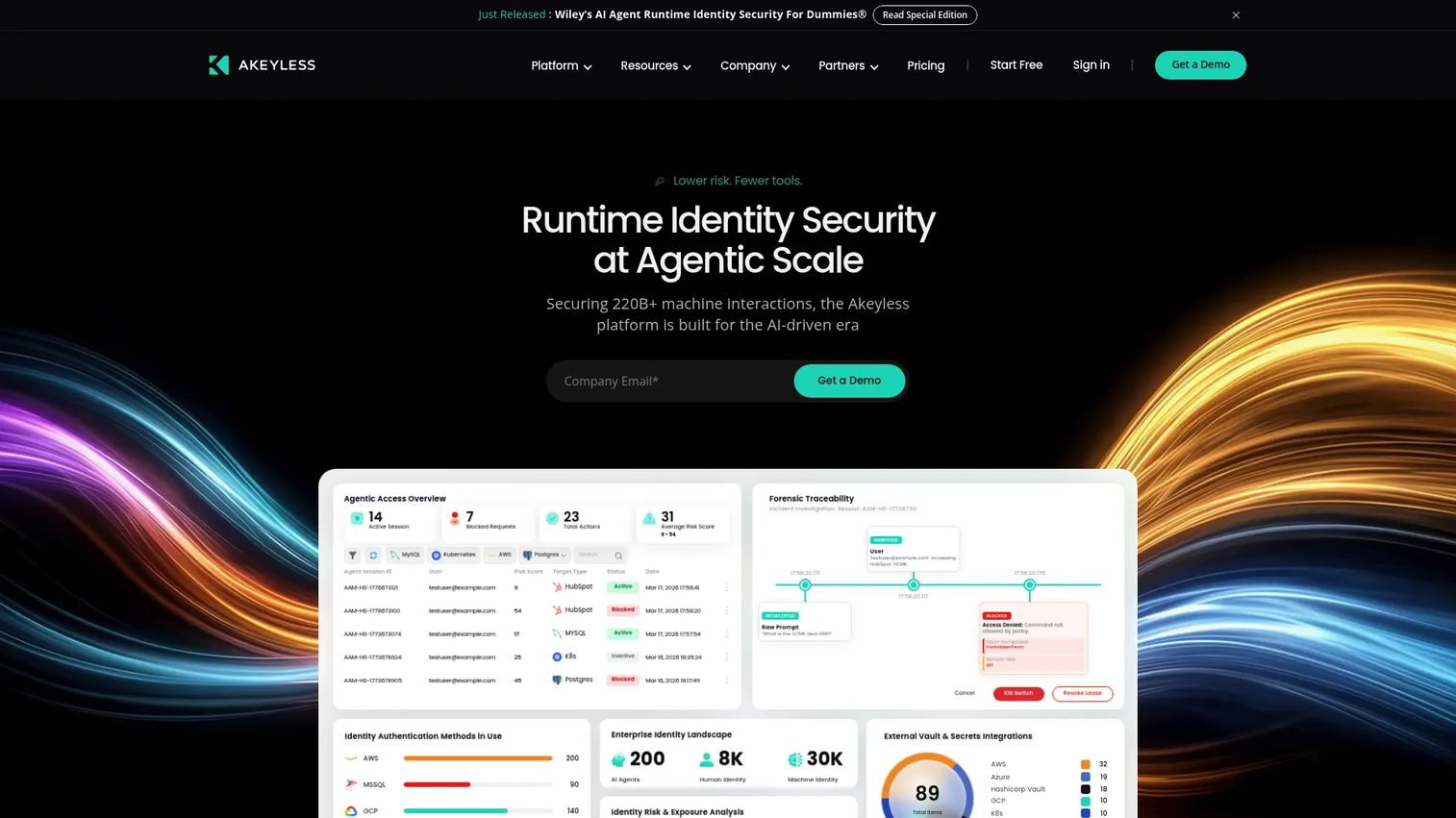
Akeyless Vault is a cloud-native identity security platform for managing secrets, credentials, certificates, encryption keys, and privileged access without self-hosting a vaulting infrastructure. Its Distributed Fragments Cryptography architecture splits key material across multiple locations so no single point ever holds a complete key. A gateway model brings access controls close to applications without routing all operations through a central vault.
Best for: Cloud-native platform teams that want centrally managed secrets and access controls without the operational overhead of running and maintaining a self-hosted vaulting environment.
Key features
- Static, dynamic, and rotated secrets management
- Certificate lifecycle management and PKI
- Distributed Fragments Cryptography for key management
- Zero-trust remote access with just-in-time credentials
- Role-based access controls and full audit logging
Why choose Akeyless Vault: Choose it when platform teams need a SaaS-delivered secrets and key management layer that minimizes infrastructure ownership. The free tier supports up to 5 clients, 500 static secrets, and 5 dynamic secrets, which is useful for evaluating fit before committing to an enterprise agreement.
Akeyless Vault pricing: A free tier is available with defined limits on clients, static secrets, and dynamic secrets. Enterprise pricing is customized; Akeyless does not publish numerical rates. Contact their team or check G2's pricing tab for reviewer-reported context.
G2 rating: 4.6/5
9. IBM Guardium Key Lifecycle Manager
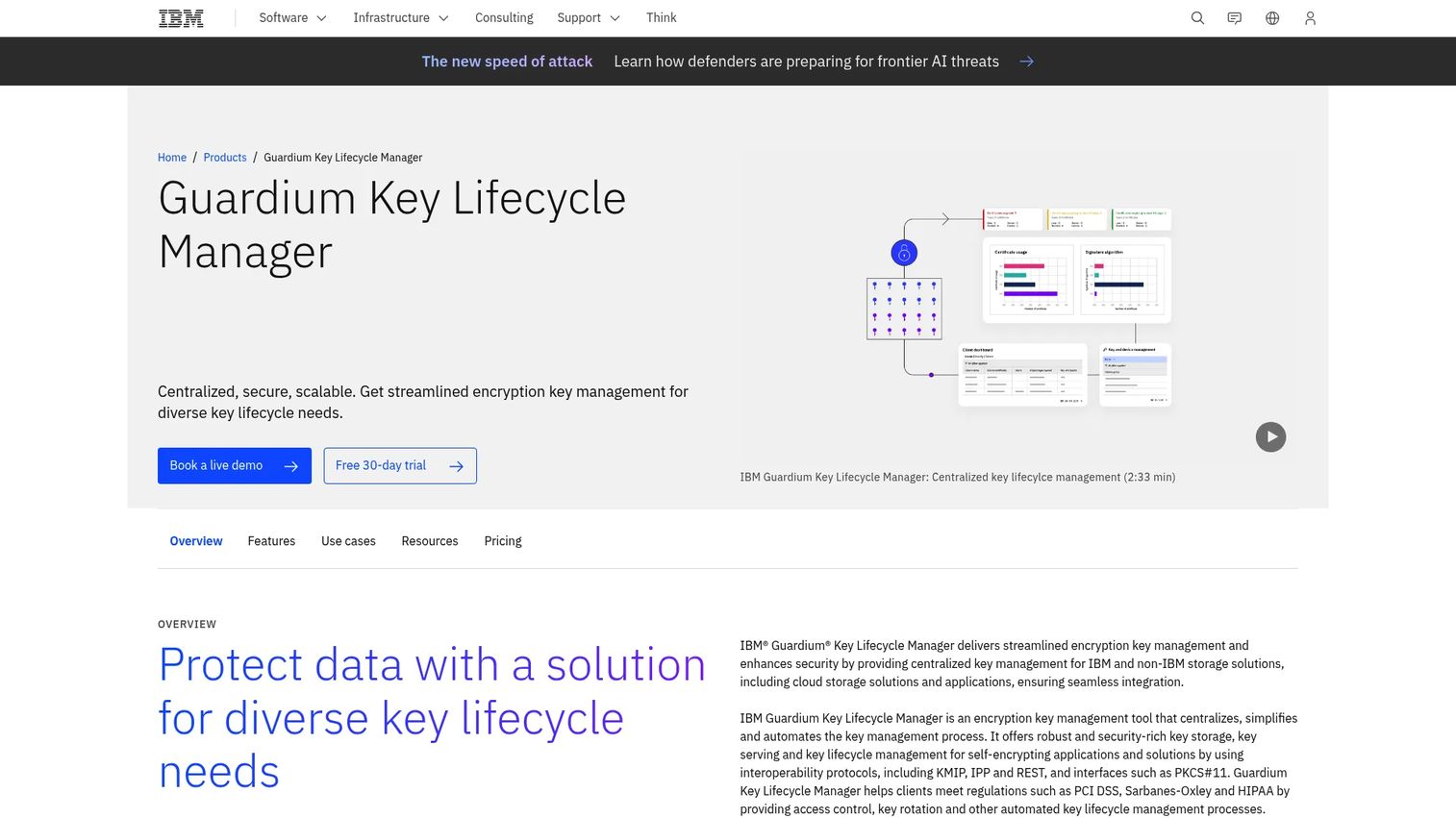
IBM Guardium Key Lifecycle Manager provides centralized key management for IBM and non-IBM storage solutions, cloud storage, and enterprise applications. It automates key provisioning, rotation, destruction, and replication, and adds a Certificate Vision dashboard for monitoring certificate health and expiration across the estate. Interoperability spans KMIP, IPP, REST, and PKCS#11 protocols, covering a wide range of legacy and modern infrastructure.
Best for: Large organizations with IBM storage or data infrastructure, or regulated environments that need lifecycle governance tied to existing enterprise infrastructure controls.
Key features
- Centralized key storage, serving, and lifecycle management
- KMIP, IPP, REST, and PKCS#11 interoperability
- Automated key provisioning, rotation, and destruction
- Certificate Vision dashboard for certificate expiration monitoring
- FIPS 140-3 Level 1 support with optional Level 3 hardware
Why choose IBM Guardium Key Lifecycle Manager: Choose it when your product's encryption key management intersects with IBM storage or enterprise database infrastructure. For PMs navigating a modernization roadmap after an acquisition, its broad protocol support means it can manage keys across both legacy and current systems during transition.
IBM Guardium Key Lifecycle Manager pricing: A 30-day free trial is available. Paid licensing is based on Resource Value Units or device-type licenses across three editions (Basic, Container for Distributed Platforms, Container for zCX). IBM does not publish numerical rates; contact IBM for a quote.
G2 rating: 4.2/5
10. Oracle Cloud Infrastructure Vault
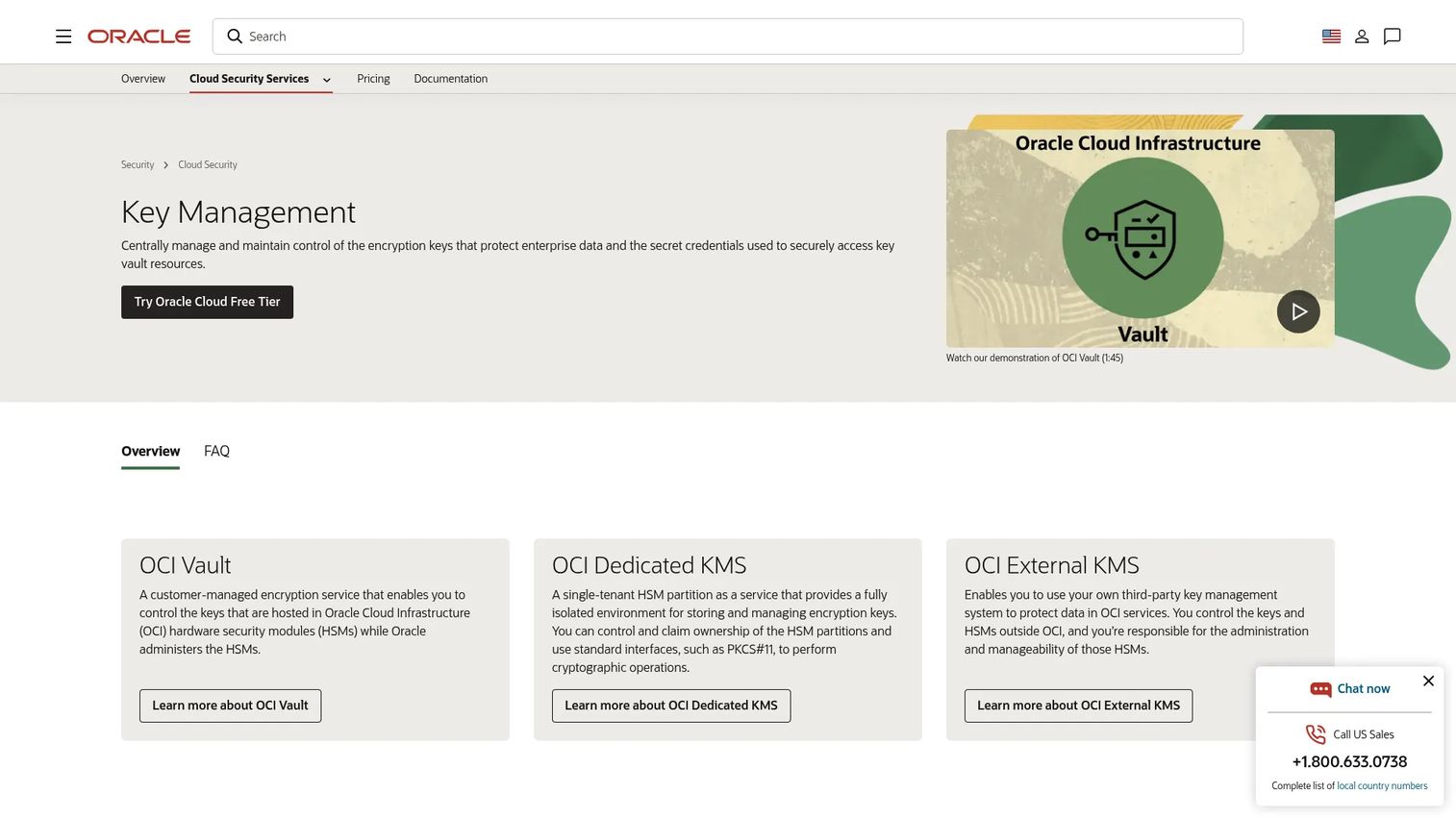
Oracle Cloud Infrastructure Vault is a customer-managed encryption service for controlling keys hosted in Oracle-managed HSMs. It covers AES, RSA, and ECDSA key types, BYOK import, key rotation, digital signatures, and fine-grained OCI IAM permissions. Integration with OCI storage, database, streaming, and Kubernetes services makes it the practical native choice when the product architecture is OCI-first.
Best for: Product and platform teams running critical workloads in Oracle Cloud Infrastructure who need provider-native key management with FIPS 140-2 Level 3 HSM backing.
Key features
- AES, RSA, and ECDSA key support with versioning
- BYOK import for customer-supplied key material
- Key rotation, digital signatures, and scheduled deletion
- FIPS 140-2 Level 3 HSM protection
- OCI IAM compartment-based access controls
Why choose Oracle Cloud Infrastructure Vault: Choose it when enterprise requirements stay within OCI's supported customer-managed-key capabilities. The free software-protected key tier makes it straightforward to add basic key governance without incremental cost, with HSM-backed keys available as a paid upgrade.
Oracle Cloud Infrastructure Vault pricing: Software-protected key versions are free. HSM-protected key versions cost $0.53 each, with the first 20 versions free. Private Vault pools bill hourly; consult the OCI price list for current regional rates.
G2 rating: Not available on G2 at time of publication.
11. Townsend Security Alliance Key Manager

Townsend Security Alliance Key Manager was an encryption key management solution for databases and enterprise applications. Townsend Security officially announced it reached end of life on November 30, 2023, with no replacement product announced. It remains in this list for completeness because some organizations may still run it in production.
Best for: Historical users only. Organizations still running Alliance Key Manager should evaluate migration to a supported platform.
Key features
- KMIP-compatible key retrieval and management
- Microsoft SQL Server TDE and cell-level encryption support
- On-device encryption service
Why choose Townsend Security Alliance Key Manager: It is not recommended for new deployments. If you are currently a customer, contact Townsend Security about your migration path and evaluate the other tools in this list for your replacement selection.
Townsend Security Alliance Key Manager pricing: The product has reached end of life. Pricing for replacement platforms requires separate vendor evaluations.
12. ManageEngine Key Manager Plus
ManageEngine Key Manager Plus is web-based machine identity management software covering SSL/TLS certificates, SSH keys, Azure secrets, and PGP keys. SSH key discovery scans infrastructure to find unmanaged keys, then provides rotation, access control, and session auditing workflows. This is a specialist tool for the specific operational gap of unmanaged SSH keys; it is not a replacement for cloud KMS or enterprise encryption key governance.
Best for: IT and security operations teams that need visibility and lifecycle control over SSH keys across servers and administrative access paths, particularly where unmanaged SSH keys create audit risk.
Key features
- SSH key discovery across server infrastructure
- SSH key rotation workflows and secure remote access controls
- SSL/TLS certificate discovery, renewal, and deployment
- Azure application secrets and key vault management
- Role-based access controls and ITSM integrations
Why choose ManageEngine Key Manager Plus: Choose it when unmanaged SSH keys are the specific operational gap, not when the requirement is encryption-at-rest key governance. SSH key management typically belongs in an operational security program rather than in the product's encryption architecture, so scope the evaluation accordingly.
ManageEngine Key Manager Plus pricing: A free edition covers up to 5 keys permanently. Subscription plans start at $475 per year for 25 keys. A one-time perpetual license for 25 keys costs $1,188. Both paid options scale with the number of managed keys.
G2 rating: 4.5/5
Considerations when choosing encryption key management software
Match the tool to your deployment model
Ask where data and workloads live today and where the product will run in the next two release cycles. A cloud-native KMS is the cleanest fit inside one provider. Multiple cloud accounts, acquired products, or on-premises data stores usually need centralized governance with a tool that can enforce consistent policy across all environments.
Verify the full key lifecycle, not just creation
Stopping the evaluation at key creation misses the most failure-prone stages. Confirm how the platform handles rotation, versioning, revocation, backup, recovery, and destruction, and verify that your team can test each stage before it matters in production. Rotation without dependency mapping has caused availability incidents; the right tool makes dependency discovery part of the workflow.
Separate encryption keys from operational secrets
Application passwords, API tokens, database credentials, certificates, SSH keys, and encryption keys often share tooling. Their governance requirements differ. An SSH governance tool does not replace a cloud KMS. A secrets platform does not automatically satisfy enterprise key lifecycle requirements. Document the governance boundary before consolidating platforms.
Test access controls and audit evidence
Evaluate policy models, role separation, approval workflows, and log retention. Enterprise security reviews ask for specific evidence: Audit log exports, access control documentation, recovery authorization records. Build the evidence review into your evaluation, not into a later sprint.
Model the total operating cost
Usage-based cloud KMS pricing scales with keys, regions, API requests, and HSM capacity. Enterprise platforms add licensing, professional services, and internal operating ownership. Compare the full picture across a two-year horizon, including engineering time for integration, maintenance, and incident response.
Conclusion
The right encryption key management software comes down to where your workloads run and what your enterprise customers will ask for next.
Cloud-native KMS (AWS Key Management Service, Microsoft Azure Key Vault, Google Cloud Key Management Service, Oracle Cloud Infrastructure Vault) fits cleanly when your product stays within a single provider's boundaries. Hybrid and multi-cloud governance belongs with a platform designed for that scope: Thales CipherTrust Manager, Fortanix Data Security Manager, Entrust KeyControl, or IBM Guardium Key Lifecycle Manager. HashiCorp Vault and Akeyless Vault handle application secrets and dynamic credentials alongside encryption key policies. ManageEngine Key Manager Plus addresses SSH key discovery and rotation as a specialist tool.
Townsend Security Alliance Key Manager reached end of life in November 2023 and should not be considered for new deployments.
Before requesting vendor evaluations, create a short architecture decision record that documents your required deployment model, key lifecycle controls, recovery process, and integration dependencies. That document will sharpen the evaluation criteria and give your security and engineering teams a shared reference through the selection process and into implementation.
Create a short architecture decision record that documents your required deployment model, key lifecycle controls, recovery process, and integration dependencies before requesting vendor evaluations.
FAQs
Encryption key management software is a system that generates, stores, distributes, controls access to, rotates, recovers, revokes, and destroys cryptographic keys. It is distinct from the encryption algorithms themselves and from the encrypted data storage. The software governs the full key lifecycle, so encryption remains enforceable even as keys change hands, rotate, or are decommissioned.
A KMS manages cryptographic keys and the encryption operations they perform. A secrets manager typically protects application credentials, API tokens, database passwords, and dynamic secrets. Some platforms support both in the same product, but the governance models differ. Evaluate lifecycle controls, access policies, and audit requirements separately for each category before consolidating on a single platform.
Not always, but enterprise customers ask for them more frequently as deal size grows. The requirement becomes relevant when customers need control over key revocation, separation from the vendor's key material, or proof of key ownership for their own compliance obligations. Adding the feature affects tenancy architecture, support runbooks, and customer documentation, so scope it as a product requirement with clear engineering dependencies.
Rotation frequency depends on key type, cryptoperiod policy, service support, customer commitments, and how thoroughly rotation has been tested. NIST SP 800-57 provides guidance by key type rather than a universal schedule. Rotation without dependency mapping can cause availability failures; the right cadence is one your team can execute repeatably, with a tested rollback path for every service that uses the key.
KMIP stands for Key Management Interoperability Protocol, an OASIS standard that defines how key management systems communicate with encryption clients. KMIP support means a key manager can serve keys to storage systems, databases, backup appliances, and other encryption engines from different vendors without requiring custom integrations. For enterprise environments with heterogeneous infrastructure, KMIP is a practical requirement.
BYOK (Bring Your Own Key) means a customer supplies their own key material or keys into the provider's supported key management path. The provider still manages the key within their infrastructure. HYOK (Hold Your Own Key) means the customer retains key control entirely outside the service provider's environment, typically in a customer-managed HSM. The implementation approach differs significantly by cloud platform and service.
Many platforms support HSMs to provide hardware-backed cryptographic operations. AWS KMS uses FIPS 140-3 validated HSMs for all customer-managed keys. Azure Key Vault's Premium tier and Managed HSM option offer HSM-backed keys. Google Cloud HSM covers hardware-backed operations within Google Cloud. Enterprise platforms like Fortanix, Thales, and Entrust provide HSM integration as a core capability. HSM support varies by deployment model and pricing tier, so verify what each platform includes at your target tier.
Start with deployment compatibility: Which cloud accounts, databases, and on-premises systems need key governance, and does the platform support all of them? Then verify the full key lifecycle: Generation, rotation, revocation, recovery, and destruction. Check customer-managed-key support, access control granularity, audit log exportability, disaster recovery procedures, and API integration with your existing cloud file storage software and data infrastructure. Finally, model the total operating cost across licensing, API requests, HSM capacity, and internal engineering ownership. A contract lifecycle management process that captures vendor commitments at each stage makes the evaluation repeatable for future renewals or platform migrations. For teams also evaluating asset lifecycle management software alongside key management, keep the governance scopes separate until you have confirmed which platform covers which lifecycle stage.