

Your reps just got their statements. Within an hour, three of them are in your DMs asking why the numbers are off. One accelerator didn't apply. A clawback hit the wrong deal. A late-stage correction from finance never made it into the calculation. You spend the afternoon in a spreadsheet reverse-engineering a payout that should have been automatic.
This is the quiet tax on sales orgs that still run comp on manual math. Errors are one problem. Trust is the bigger one. When reps stop believing the number, they stop trusting the plan, and quota attainment stops driving behavior the way it should.
That is exactly what sales commission software exists to fix. The category has grown from about USD 2.1 billion in 2020 toward a projected USD 4.7 billion by 2028, a 10.4% CAGR, according to Adroit Market Research (2022). In the United States, over 45% of mid-to-large enterprises now run dedicated commission management software, per Industry Research Biz (2024). The move off spreadsheets is no longer an edge case.
This guide is written for the people who feel the fallout when comp goes wrong: sales enablement, RevOps, and finance leaders who need payout accuracy, real-time earnings visibility, and audit trails they can defend.
What's inside
This guide compares eight sales compensation software platforms and adjacent systems that shape how commissions get calculated, paid, and trusted.
We selected and evaluated tools based on four criteria that matter across enablement, RevOps, and finance:
- Payout accuracy and traceability: can it show exactly how each number was calculated
- Rep transparency: self-serve statements, progress-to-goal, and real-time earnings visibility
- Integrations: CRM integration, ERP integration, and payroll connections
- Governance and reporting: audit trails, versioning, and commission forecasting
Four of the eight are dedicated commission engines. The other four are source systems (CRM, ERP, HRIS) that your commission process depends on, framed honestly as infrastructure, not standalone comp tools.
TL;DR
- Best for enterprise sales performance management: CaptivateIQ, if you want compensation, planning, and analytics in one platform.
- Best for rep-facing transparency and clean workflows: QuotaPath, built around real-time earnings visibility and self-serve clarity.
- Best for Salesforce-native teams: Salesforce Spiff, with commission tracing and audit trails inside the CRM you already live in.
- Best for flexible plan management and RevOps depth: Everstage, strong on workflow flexibility and a buyer-friendly evaluation.
- Best adjacent source systems: Salesforce, HubSpot, NetSuite, and Workday feed clean CRM, ERP, and HRIS data into your commission software rather than replacing it.
Whether you lead enablement or sales ops, the right commission software should cut admin work and raise rep trust at the same time.
What is sales commission software?
Sales commission software is a tool that automates how sales commissions are calculated, tracked, paid, and audited, replacing spreadsheets with a system that reps, managers, and finance can all trust. It ingests deal data from your CRM and other source systems, applies your comp plans, and produces accurate, traceable payouts on a schedule.
That distinction matters. A spreadsheet calculates once and forgets. A commission calculator handles a single formula. A full sales performance management suite layers quota planning, territory design, and analytics on top. Commission software sits in the middle: purpose-built for incentive compensation management at scale, with the governance finance needs and the transparency reps demand.
Core capabilities to expect:
- Automated commission calculation: apply accelerators, tiers, clawbacks, and draws without manual math
- Rep statements: self-serve, real-time earnings visibility and progress-to-goal views
- Dispute handling: structured submission and resolution instead of Slack threads
- Commission forecasting: project earnings and liability from live pipeline
- Audit trails: a full record of every calculation, change, and override
- Integrations: CRM integration, ERP integration, and payroll integration
- Comp plan modeling: test new plan designs before you roll them out
Why enablement leaders should care: comp is a behavior system, not just a payroll input. When reps trust the number, they trust the plan, and the plan drives the behavior you built it to drive. When they don't, adoption of your plays and your process erodes right alongside it.
When to use sales commission software
You have outgrown spreadsheets
The tipping point is rarely one big plan. It is the accumulation: multiple plans across segments, one-off exceptions, mid-quarter accelerators, clawbacks on churned deals, and late corrections from finance. Every exception is a formula someone has to remember and maintain. One broken cell cascades into a wrong payout, and you find out when a rep does. Time loss and error risk both scale with headcount.
Reps are asking for payout visibility
When reps can see real-time earnings and progress-to-goal on demand, the questions stop landing in your inbox. Visibility does two things: it removes the anxiety that fuels disputes, and it keeps the plan in front of reps as a live scoreboard. That is where quota attainment turns into daily motivation instead of a quarterly surprise.
Finance and RevOps need auditable processes
As the team grows, so does the compliance burden. Finance needs audit trails, locked historical statements, and approval workflows to sign off on payouts and survive scrutiny. Commission software gives every payout a paper trail: what data fed it, which plan version applied, who approved it. That auditability is the difference between a clean close and a fire drill.
Sales commission software comparison
Below, the first four rows are dedicated commission and sales compensation software. Rows five through eight are adjacent source systems that supply the CRM, ERP, and HRIS data your commission process runs on. Compare on payout accuracy, rep transparency, integrations, and reporting depth, and weigh where a dedicated commission engine differs from lighter-weight commission tracking software.
| # | Product | Best for | Key differentiator | Pricing | G2 rating |
|---|---|---|---|---|---|
| 1 | Salesforce Spiff | Salesforce-native commission automation | Commission estimator, tracing, and audit trails inside Salesforce | $75/user/mo, billed annually | 4.6/5 |
| 2 | CaptivateIQ | Complex incentive compensation management | SmartGrid calculation engine plus AI Assist | Custom | 4.7/5 |
| 3 | Everstage | RevOps-led comp at scale | Drag-and-drop plan builder, live forecasts | Custom | 4.8/5 |
| 4 | QuotaPath | Rep transparency and clean workflows | Real-time earnings visibility, AI plan builder | From $35/user/mo | 4.7/5 |
| 5 | Salesforce | CRM as the commission data anchor | System of record for deal and forecasting data | From $25/user/mo | 4.4/5 |
| 6 | HubSpot | SMB and mid-market CRM data flows | Clean CRM data with a free tier | Free; paid from $7/mo/seat | 4.4/5 |
| 7 | NetSuite | Finance-led ERP alignment | Revenue and order data for payout accuracy | Custom | 4.1/5 |
| 8 | Workday | HRIS and employee data governance | Employee records and approval governance | Custom | 4.2/5 |
The pattern is clear. Rows one through four calculate and pay commissions. Rows five through eight feed them. Enterprise-grade tools like CaptivateIQ and Everstage lean into complex plan logic and sales performance management, while lighter-weight commission tracking software like QuotaPath prioritizes rep-facing clarity and speed to launch.
Best 8 sales commission software for 2026
1. Salesforce Spiff
Salesforce Spiff is incentive compensation management built natively inside Salesforce. For teams already deep in the CRM, it removes the export-and-reconcile step: deal data, commission logic, and rep statements all live in one place. Reps see real-time earnings visibility without leaving the tools they use to sell.
Best for: Sales teams standardized on Salesforce that want commission automation and rep visibility without a separate data pipeline.
Key strengths
- Real-time commission visibility for reps
- Automated commission calculations across plans
- Commission estimator for forecasting future earnings
- Tracing and audit trails on every payout
- Native Salesforce data and workflow context
The commission estimator lets reps model what a deal is worth before it closes, which pushes the comp plan into daily selling decisions. Tracing and audit trails give finance a defensible record for every calculation, and both support ASC 606 and IFRS 15 alignment for compliant revenue and commission accounting. That combination of rep transparency and audit-grade governance is where Spiff earns its place.
Why choose Salesforce Spiff: If your CRM integration story is "everything already lives in Salesforce," Spiff avoids the friction of syncing comp data across systems and keeps reps inside one interface.
Salesforce Spiff pricing: Listed publicly at $75 per user per month, billed annually. Includes the Commission Estimator, Spiff Designer, and Tracing and Audit Trails.
2. CaptivateIQ

CaptivateIQ is a sales commissions and incentive compensation platform built for complex pay plans. It brings compensation, planning, and analytics together, so RevOps and finance manage the whole comp lifecycle in one system rather than stitching tools together. That unified sales performance management approach is what draws mid-market and enterprise teams.
Best for: Organizations managing complex sales commissions that want compensation, planning, and analytics under one roof.
Key strengths
- Per-seat pricing model with a one-time setup fee
- SmartGrid ELT and calculation engine
- AI-powered Assist with admin co-pilot and plan advisor
- Payee coach for rep-facing questions
- Enterprise compliance controls and audit trails
The SmartGrid engine handles the kind of layered logic (accelerators stacked on tiers stacked on exceptions) that breaks spreadsheets. AI Assist reduces the admin load with a co-pilot for comp admins and a payee coach that answers rep questions before they become disputes. For a Sales Enablement Manager, that means fewer comp escalations and more consistent messaging on how pay works.
Why choose CaptivateIQ: Choose it when plan complexity is your real constraint and you want commission forecasting, compensation analytics, and payout workflows in a single platform built to scale.
CaptivateIQ pricing: Custom, based on number of payees, plan complexity, and required integrations. Contact sales for a quote.
3. Everstage
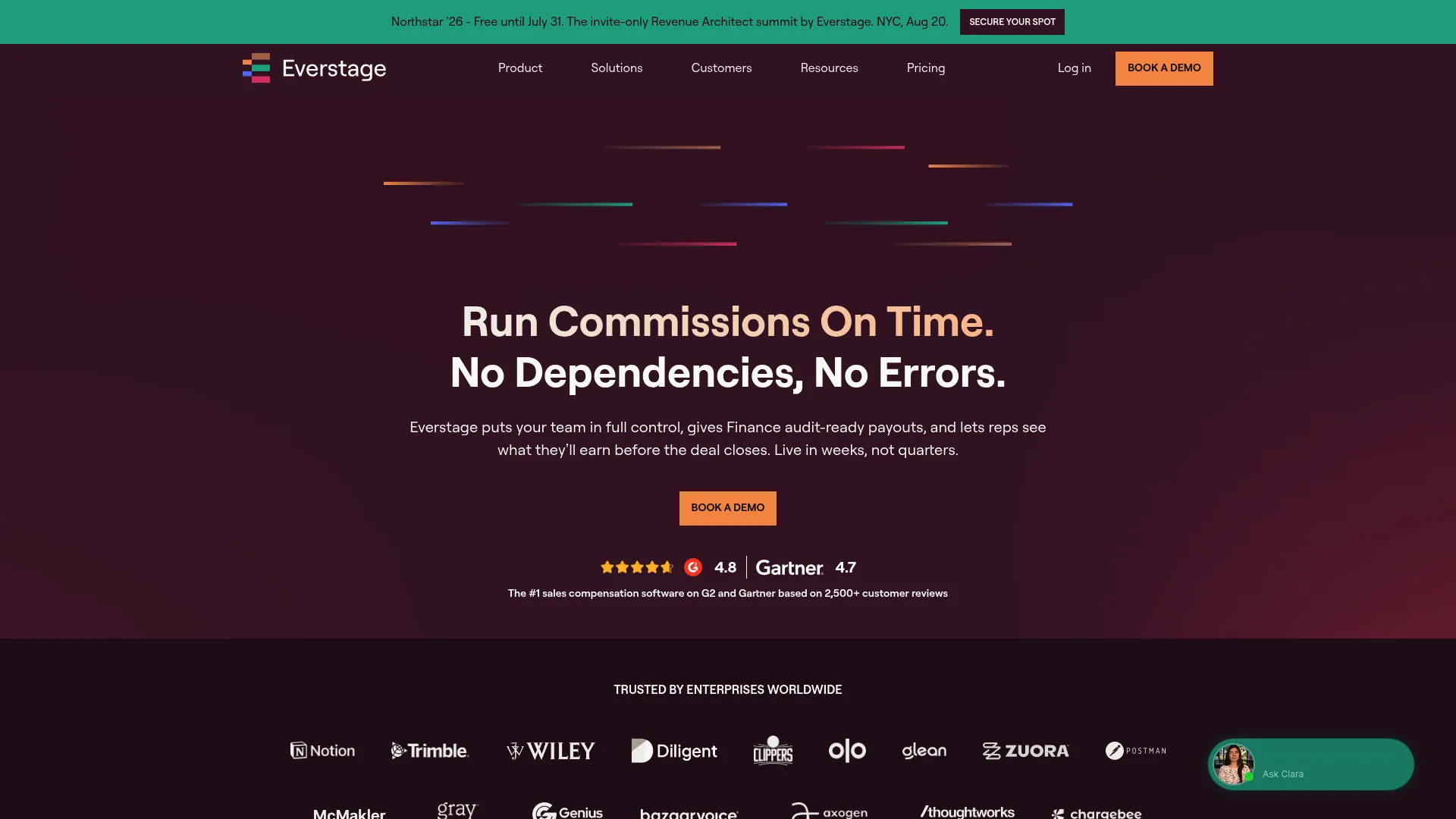
Everstage is sales compensation and commission management software built for RevOps, finance, and sales to work from the same data. It pairs strong workflow flexibility with a buyer-friendly evaluation experience, which is why it shows up on so many shortlists. The platform handles complex commission programs without forcing you into a rigid template.
Best for: Enterprises managing complex sales commission programs that want workflow flexibility and RevOps depth.
Key strengths
- Drag-and-drop plan builder for fast comp changes
- Live pipeline-based commission forecasts
- Audit trail and ASC 606-ready reporting
- Compensation analytics for managers
- Dispute handling and payout workflows
The drag-and-drop plan builder means comp admins adjust plans without engineering help, and live forecasts tie commission liability directly to the pipeline. For enablement leaders, live forecasts double as a motivation tool: reps see what their open pipeline is worth in real earnings, which keeps quota attainment front of mind. ASC 606-ready reporting keeps finance covered at close.
Why choose Everstage: Choose it when you need flexible plan management, strong analytics, and implementation support, and you want a tool that RevOps can own without heavy technical overhead.
Everstage pricing: Custom and per-payee, with an annual platform license plus onboarding and implementation quoted upfront. No public price is listed.
4. QuotaPath
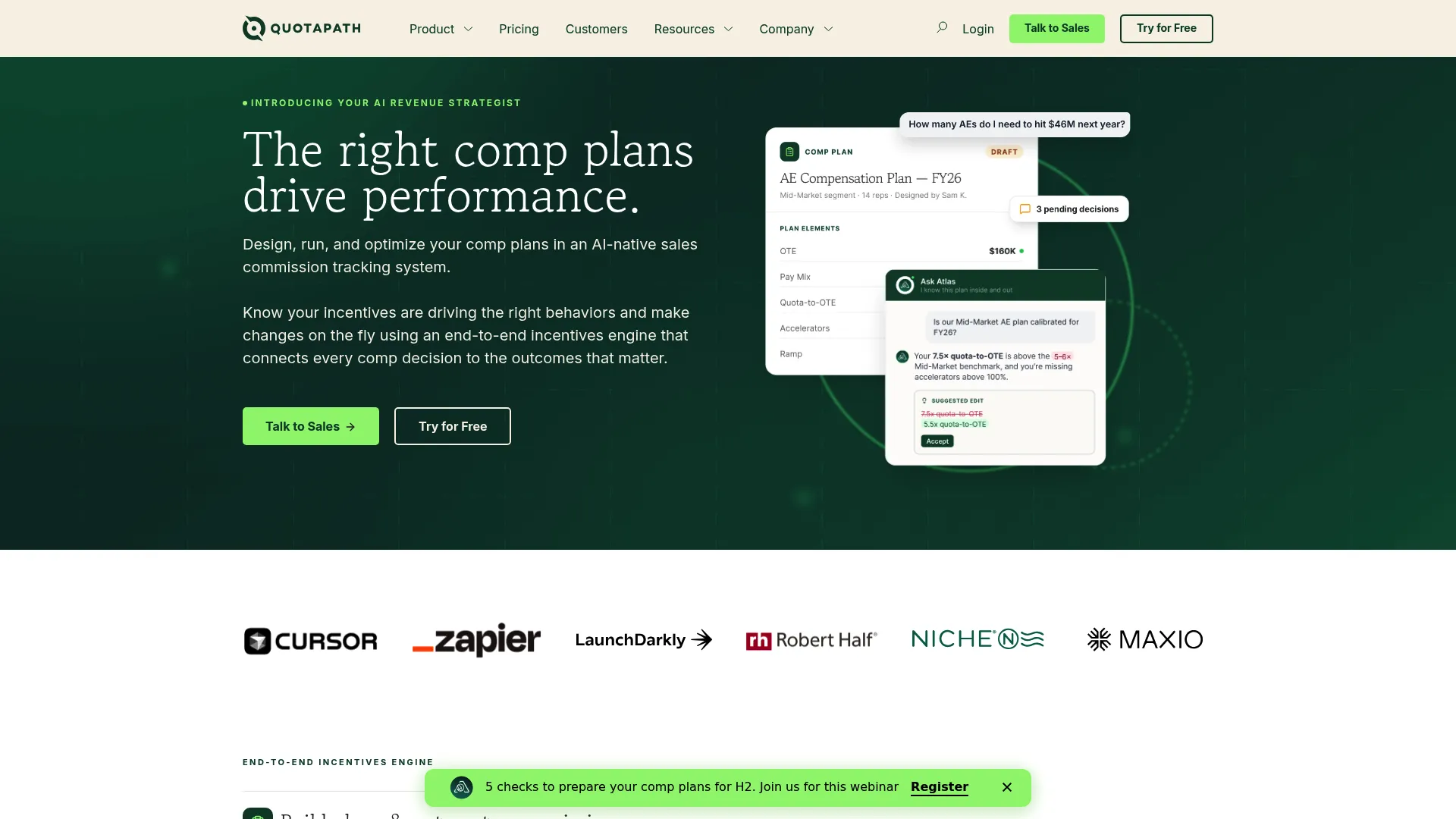
QuotaPath is sales compensation and commission management software built around rep transparency. It leans hard into real-time earnings visibility and clean, self-serve workflows, so reps understand exactly what they have earned and what is in flight. That clarity is the whole point: less time defending numbers, more time trusting them.
Best for: Teams that want transparent commission tracking software with fast setup and clear rep-facing statements.
Key strengths
- AI-powered plan builder for quick comp setup
- Commission forecasting and payout workflows
- Real-time earnings visibility for reps
- ASC 606 and commission accounting support
- Benchmark views and collaboration features
The AI plan builder shortens setup, and the self-serve statements mean reps answer their own "what did I earn" questions instead of routing them to you. Dispute handling is structured rather than ad hoc, which cuts the back-and-forth that erodes trust. For enablement teams that care about adoption, QuotaPath's clarity is its strongest lever.
Why choose QuotaPath: Choose it when rep transparency and speed to launch matter more than deep enterprise plan complexity, and you want reps to self-serve on payout questions.
QuotaPath pricing: Public plans billed annually. Growth is $35 per user per month plus a monthly platform fee. Premium is $50 per user per month plus a monthly platform fee. A Strategic plan is available with custom pricing. A free tier is available.
5. Salesforce

Salesforce is not a commission engine, and treating it like one is a mistake. It is the system of record where deal data, forecasting, and workflow context live. Your commission software is only as accurate as the CRM data feeding it, which makes Salesforce the anchor that determines payout accuracy downstream.
Best for: Teams whose commission process depends heavily on clean Salesforce deal data and forecasting.
Key strengths
- CRM system of record for sales data
- Forecasting and pipeline context
- Agentforce Sales editions and AI capabilities
- Broad integration surface for comp tools
- Reporting and dashboards for RevOps
When a payout is wrong, the root cause is often dirty CRM data, not the comp engine. Field hygiene, correct close dates, and accurate deal amounts in Salesforce feed straight into every commission calculation. Getting the source of truth right is the unglamorous prerequisite to trustworthy comp.
Why choose Salesforce: Choose it as the ecosystem infrastructure your commission software plugs into, not as a replacement for a dedicated comp tool.
Salesforce pricing: Starter Suite from $25 per user per month, Pro Suite at $100, Enterprise at $175, and Unlimited at $350, with higher Agentforce editions above that. A 30-day free trial is available.
6. HubSpot

HubSpot matters to commissions the same way Salesforce does: as the CRM that supplies clean deal data downstream. For SMB and mid-market teams where adoption and simplicity beat complex comp logic, HubSpot keeps the source data tidy so your commission software calculates against numbers reps actually entered.
Best for: SMB and mid-market teams where CRM simplicity and adoption matter more than heavy comp complexity.
Key strengths
- Free CRM with strong adoption
- Clean deal and pipeline data for downstream comp
- Live chat and AI content tools
- Workflow automation to keep data current
- Broad integration options for comp platforms
To be clear, HubSpot is not a dedicated commission engine. Its role in the comp stack is data cleanliness and workflow integration: when reps keep deals updated because the CRM is easy to use, the commission software downstream inherits accurate inputs. That adoption effect is easy to underrate and hard to replace.
Why choose HubSpot: Choose it as the CRM layer feeding your commission process when ease of use drives the data hygiene your payouts depend on.
HubSpot pricing: Free tier available. Starter from $7 per seat per month, Professional from $800 per month, and Enterprise from $3,600 per month, priced by hub and edition.
7. NetSuite
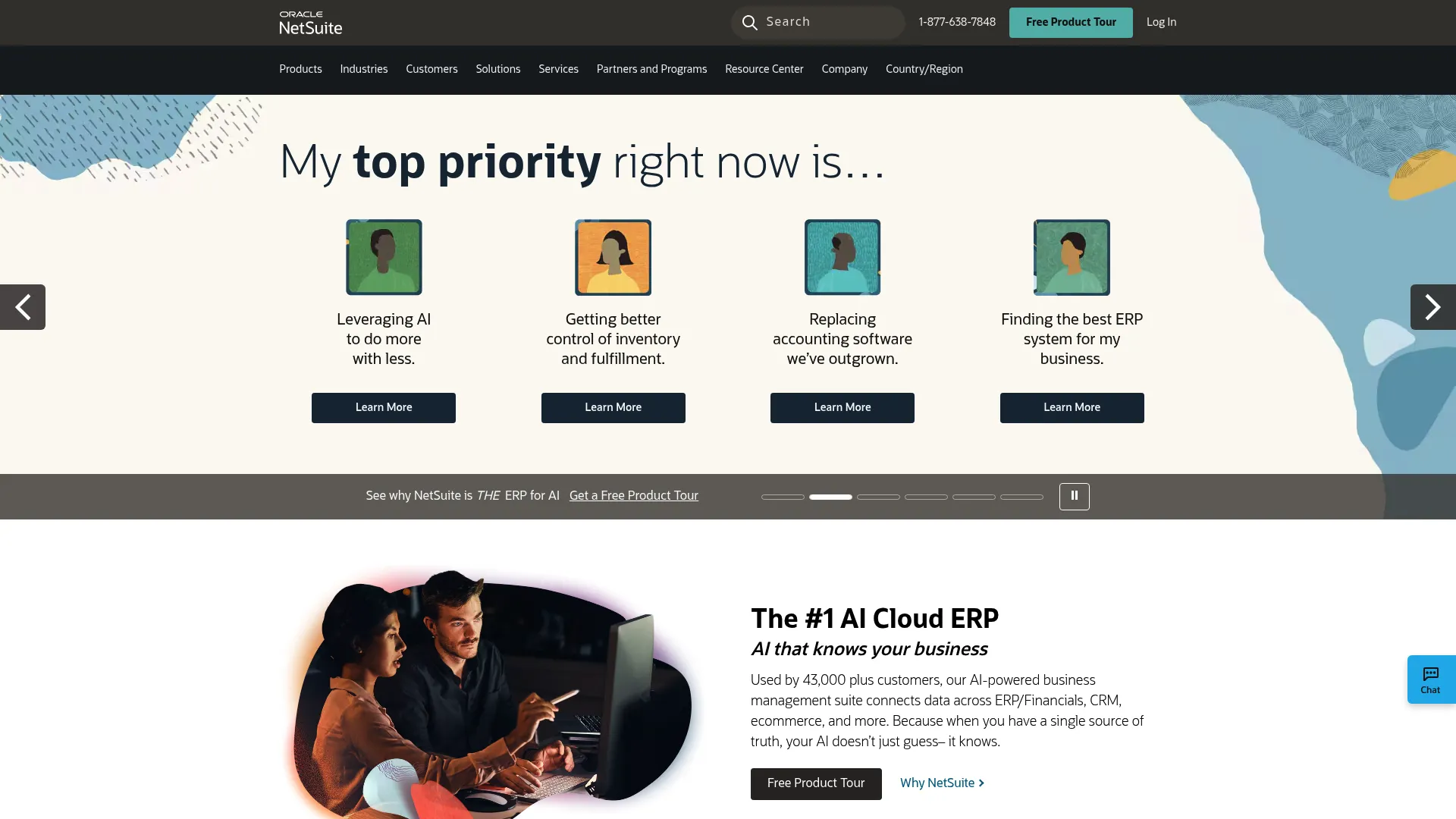
NetSuite is Oracle's cloud ERP suite, and it enters the commission conversation when payouts touch finance data: order records, revenue recognition, and accounting workflows. When commissions must align with recognized revenue rather than booked deals, ERP integration is what keeps the two systems consistent.
Best for: Finance-led organizations that need commissions to align with accounting and revenue recognition.
Key strengths
- Cloud ERP and financials
- CRM and ecommerce modules
- Real-time dashboards and KPIs
- AI-powered business management suite
- Order and revenue data for comp alignment
Commissions paid on revenue that later gets adjusted create clawbacks and disputes. Pulling order and revenue data from NetSuite into your commission software keeps payouts tied to what finance actually recognized, which reduces the corrections that trigger rep frustration. This is adjacent infrastructure, not a dedicated commission tool.
Why choose NetSuite: Choose it when finance leads the comp process and payouts must reconcile with accounting, revenue recognition, and order data.
NetSuite pricing: Quote-based. NetSuite does not publish public pricing; contact sales for a custom quote.
8. Workday
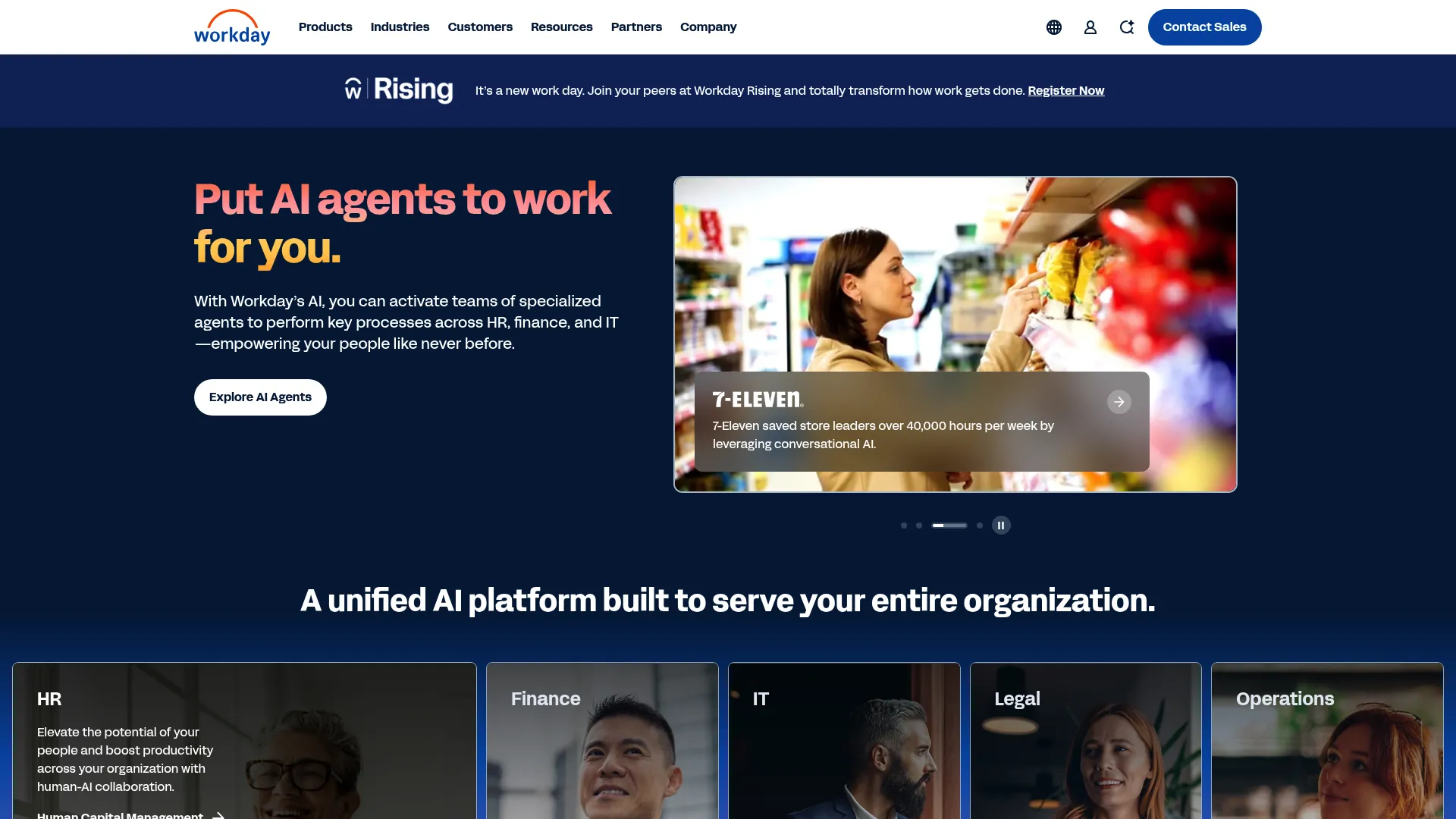
Workday is an enterprise platform for HR, finance, and IT, and it belongs in the commission conversation as the HRIS that governs employee data. In larger organizations, commission programs need to align with accurate employee records: who reports to whom, effective dates, role changes, and approval chains.
Best for: Large organizations where commission data needs to align with governed employee records.
Key strengths
- Unified HCM suite with core HR and payroll
- Financial management and reporting
- AI agents for HR, finance, and IT workflows
- Employee records for comp accuracy
- Approval and governance workflows
Comp plans break when employee data drifts: a rep changes territory, a manager approval chain is stale, an effective date is wrong. Workday keeps the employee record clean, which feeds accurate rep mapping and approval governance into downstream commission processes and payroll integration. Like the other source systems here, it is adjacent infrastructure rather than a standalone commission engine.
Why choose Workday: Choose it when employee data governance and approval workflows underpin how commissions get assigned and paid at enterprise scale.
Workday pricing: Not publicly listed. Workday directs buyers to contact sales for a custom quote.
Considerations
Accuracy and traceability
The first question to ask any vendor: can it show exactly how each payout was calculated, line by line. Then ask whether users can trace every change, adjustment, and override back to its source. Payout accuracy without traceability is a black box, and a black box is where trust goes to die. Demand a live example, not a slide.
Integrations and source systems
Map your source systems before you shortlist. Confirm CRM integration with Salesforce or HubSpot, ERP integration with tools like NetSuite, and HRIS and payroll integration where comp touches employee records. Then verify whether each integration is native, API-based, or partner-led, because that determines maintenance load and how quickly data flows.
Rep visibility and trust
Check whether reps can self-serve their statements, progress-to-goal, and quota attainment without asking anyone. Then ask how the tool handles commission disputes: is there a structured submission and notification flow, or does it fall back to email. Real-time earnings visibility is the single biggest driver of rep trust, so treat it as a requirement, not a nice-to-have.
Governance and plan changes
Confirm the tool supports versioning, approvals, and effective dates, so a mid-quarter plan change does not corrupt prior calculations. Make sure historical statements stay locked once approved. Without locked history and audit trails, every plan change becomes a compliance risk and a potential dispute.
Reporting and forecasting
Confirm managers can see payout trends, quota attainment, and forecasted commission liability from live pipeline. Ask to see real dashboards and export formats, not marketing screenshots. Strong compensation analytics and commission forecasting turn comp from a backward-looking cost into a forward-looking planning input.
Conclusion
The right pick depends on where your complexity lives. For enterprise incentive compensation management with planning and analytics in one platform, CaptivateIQ is the strongest fit. For rep-facing transparency and fast setup, QuotaPath leads on real-time earnings visibility. Salesforce-native teams get the least friction from Salesforce Spiff, and RevOps teams that want flexible plan management should shortlist Everstage.
The four adjacent systems, Salesforce, HubSpot, NetSuite, and Workday, are not commission engines. They are the CRM, ERP, and HRIS sources that feed clean data into whichever commission management software you choose, and payout accuracy starts there.
Your next step: map your comp plan complexity and your source systems, then demo two dedicated tools against a real plan with real edge cases. The right commission software should cut your admin work and raise rep trust in the same rollout. That is the outcome that moves quota attainment and keeps your sales ops and RevOps teams out of the spreadsheet.
FAQs
Sales commission software automates how commissions are calculated, tracked, paid, and audited, replacing manual spreadsheets. It pulls deal data from your CRM, applies your comp plans, and produces accurate, traceable payouts. The core benefit is fewer errors and more trust: reps see how their pay was calculated instead of taking it on faith.
It ingests deal and revenue data from source systems, then applies your plan rules: rates, tiers, accelerators, clawbacks, and draws. Each calculation is logged with an audit trail, so you can trace any payout back to the data and plan version that produced it. That traceability is what makes the number defensible when a rep questions it.
Prioritize payout accuracy, real-time earnings visibility for reps, structured dispute handling, and audit trails for finance. Integrations with your CRM, ERP, and payroll come next, because bad source data produces bad payouts. Comp plan modeling and commission forecasting round out the list for teams planning ahead.
The terms overlap heavily and are often used interchangeably. Commission software typically emphasizes calculating and paying commissions accurately. Sales compensation software usually implies a broader scope that can include quota planning, plan modeling, and sales performance management analytics. Most modern platforms span both.
Yes, and it is one of the clearest wins. When reps get real-time earnings visibility and self-serve statements that show exactly how each number was calculated, most "why is my pay wrong" questions resolve before they become disputes. Structured dispute workflows and audit trails handle the rest, replacing Slack threads with a traceable process.
At minimum, CRM integration with Salesforce or HubSpot to pull deal data. Add ERP integration with a tool like NetSuite when payouts depend on revenue recognition, and payroll integration so approved commissions flow to payment. HRIS integration with a platform like Workday matters at scale for accurate rep mapping. Confirm whether each connection is native or API-based.
Not always. A small team on one simple plan can often manage in a spreadsheet or a lightweight commission calculator. The tipping point is complexity: multiple plans, accelerators, clawbacks, exceptions, and reps who question their numbers. Once manual math costs you real hours and creates disputes, dedicated software pays for itself.
Score each tool on traceability, governance, and integrations, the three things cross-functional teams care about most. RevOps wants clean CRM data flow and flexible plan management. Finance wants locked historical statements, audit trails, and revenue alignment. Run a shared evaluation against a real comp plan so both teams pressure-test the same edge cases before you buy.