You bought an EMR to save time. Instead, your front desk is triple-entering patient data, your providers are typing SOAP notes at 9pm, and your billing team is chasing claims through three disconnected screens. The software was supposed to be the operating system for the clinic. It became another job.
The category itself is not the problem. Cloud and web-based delivery now accounts for roughly 81 to 87 percent of EMR/EHR deployments, according to Grand View Research (2025). Adoption in leading primary-care markets like the Netherlands, UK, and Australia exceeds 97 to 99 percent, per Market.us (2024). Practices are not deciding whether to run an EMR. They are deciding which one runs their clinic without getting in the way.
That decision is harder than it looks. A solo therapist and a 40-provider health system have almost nothing in common in what they need from an electronic medical record system. Deployment model, compliance depth, interoperability, billing scope, patient portal quality, and cost structure all shift with practice size. Pick the wrong fit and you inherit years of switching cost.
This guide sorts seven EMR platforms by the operational reality of running a practice, not a feature checklist. If you are still weighing adjacent operations software, our roundups of appointment reminder software and AI customer service software cover the tools that sit next to your EMR in the stack.
What's inside
This is a buyer-first shortlist for clinic owners, practice managers, and healthcare operators comparing EMR platforms before they commit. We selected the seven based on four factors that decide whether an EMR actually fits: deployment model (cloud, on-prem, or hybrid), compliance and security posture, interoperability and integration scope, and cost structure relative to practice size. We pulled pricing and ratings from first-party sources and verified review platforms, and we flag exactly which practice profile each system serves best.
TL;DR
- Best free and open source pick: OpenEMR, for practices that want full control and no license fee.
- Best for mobile-first and smaller practices: DrChrono, built around native mobile charting.
- Best for growing ambulatory practices: athenahealth, with revenue-cycle depth baked in.
- Best for large, complex health systems: Epic Systems, the enterprise interoperability standard.
- Best for enterprise standardization: Oracle Health (formerly Cerner), for multi-site footprints.
- Best for lean wellness and allied-health clinics: Zanda Health, simple practice management plus records.
- Best low-cost all-in-one entry point: Hippocrate, a free tier with telemedicine and AI notes.
What is EMR software?
EMR software is a digital system that stores, manages, and organizes a patient's medical records inside a single practice or clinic. It replaces paper charts with structured electronic records covering diagnoses, medications, treatment history, lab results, and clinical notes, and it typically bundles scheduling, charting, and billing-adjacent workflows into one platform.
The term stands for electronic medical record. EMR systems are built around clinical documentation for a specific practice, and modern electronic medical record systems increasingly add practice management, patient portals, and interoperability so records can move between providers when needed.
Core features to expect across most medical EMR software:
- Clinical charting and documentation: structured notes, problem lists, medication history, and increasingly AI SOAP notes that draft documentation from a visit.
- Scheduling and appointment management: calendars, waitlists, and appointment reminders to cut no-shows.
- E-prescribing: send prescriptions electronically, including controlled substances where certified.
- Billing and revenue-cycle support: coding, claims, and eligibility checks, either native or through integrations.
- Patient portal: a secure space where patients view records, book visits, message the practice, and complete forms.
- Interoperability: standards like HL7 and FHIR that let records exchange with labs, pharmacies, and other systems.
- Security and compliance: HIPAA-compliant EMR controls such as encryption, audit logs, and role-based access.
- Telemedicine: video consultation built into the record so virtual visits document like in-person ones.
When to use each type of EMR
Standardize a single clinic's records
If you run one location and your main pain is paper charts, scattered spreadsheets, or a legacy system nobody likes, a focused EMR built for small clinics solves it. You want fast charting, clean scheduling, and a patient portal without an enterprise implementation. Cloud-based EMR software wins here because there is no server to maintain and updates ship automatically.
Run billing and clinical work in one system
Practices that live and die on collections need an EMR with revenue-cycle depth, not a bolt-on. When claims, coding, eligibility, and clinical documentation share one database, denials drop and staff stop re-keying. This is where broader operating-layer platforms earn their cost, especially for growing multi-provider groups.
Coordinate care across a large organization
Hospitals and multi-site health systems have a different job entirely: move a patient's record across departments, facilities, and external providers without losing fidelity. Here interoperability, governance, and scale outweigh setup speed. Enterprise EMR platforms are built for care coordination first, and their implementation timelines reflect that scope.
Comparison table
Every platform below serves a distinct practice profile. Use this table to shortlist before reading the full sections, then match your deployment model, compliance needs, and budget to the right fit.
| # | Product | Intent | Key use case | Pricing | G2 rating |
|---|---|---|---|---|---|
| 1 | OpenEMR | Open source, self-hosted control | Customizable EHR for practices wanting no license fee | Free (open source); third-party support ~$50-$150/hr | 3.5/5 |
| 2 | DrChrono | Mobile-first practice management | Integrated EHR, scheduling, billing for mobile practices | Quote-based (Foundation, Growth, Premium) | Not listed |
| 3 | athenahealth | Cloud EHR plus revenue cycle | Ambulatory practices needing billing depth | Percent-of-collections, custom | 3.6/5 |
| 4 | Epic Systems | Enterprise clinical platform | Large health systems needing interoperability | Custom; open.epic free, Vendor Services from $1,900/yr | Not listed |
| 5 | Oracle Health | Enterprise standardization | Multi-site clinical and operational infrastructure | Custom; certified API fees from $1,000/yr | 4.1/5 |
| 6 | Zanda Health | Lean practice management plus EMR | Solo and group wellness/allied-health clinics | From US$9.50/mo (promo), then US$19/mo | 4.7/5 |
| 7 | Hippocrate | Free all-in-one entry point | Small practices wanting telemedicine and AI notes | Free tier; Small Practice $25/mo per provider | 5.0/5 |
1. OpenEMR
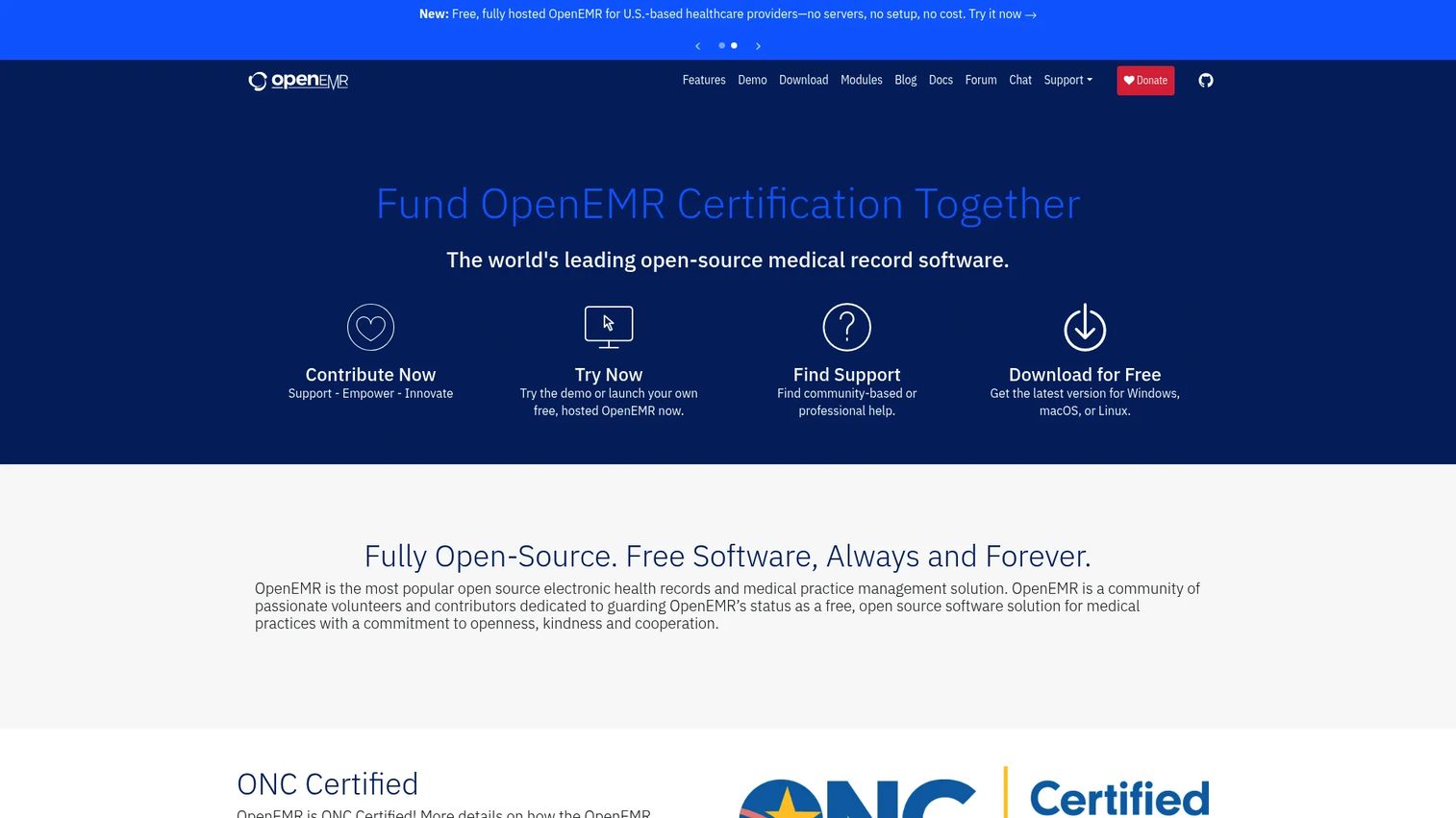
OpenEMR is a free and open source electronic health records and medical practice management platform, backed by one of the largest open source communities in healthcare. It runs on your own server or a cloud host you choose, and because the source is open, you can customize workflows, forms, and integrations without waiting on a vendor roadmap. For practices that want control and cost predictability, it removes the license fee entirely.
Best for: Clinics and practices that want a self-hosted, open source EHR with fully customizable workflows.
Key strengths
- No license cost: The software is free to download, use, and modify, so budget goes to hosting and support rather than seats.
- Deployment flexibility: Run it on-premises for full data residency control or on a cloud host, whichever fits your compliance and IT posture.
- Broad clinical scope: Patient scheduling, electronic medical records, medical billing, patient portal, e-prescribing, and direct messaging come standard.
Why choose OpenEMR: The trade-off with open source is where your budget goes. You avoid per-seat licensing but invest in setup, hosting, and support. For practices with even light technical resources, or willingness to hire a certified vendor, that trade lands in your favor. It is also multilingual and ONC-certified, which matters for practices that need documented compliance.
OpenEMR pricing: The software itself is free and open source. There is no subscription or license fee. Professional support is available from third-party vendors, with hourly rates the project notes as varying roughly from $50 to $150 per hour depending on scope. If you self-host and self-support, your only hard costs are infrastructure.
2. DrChrono
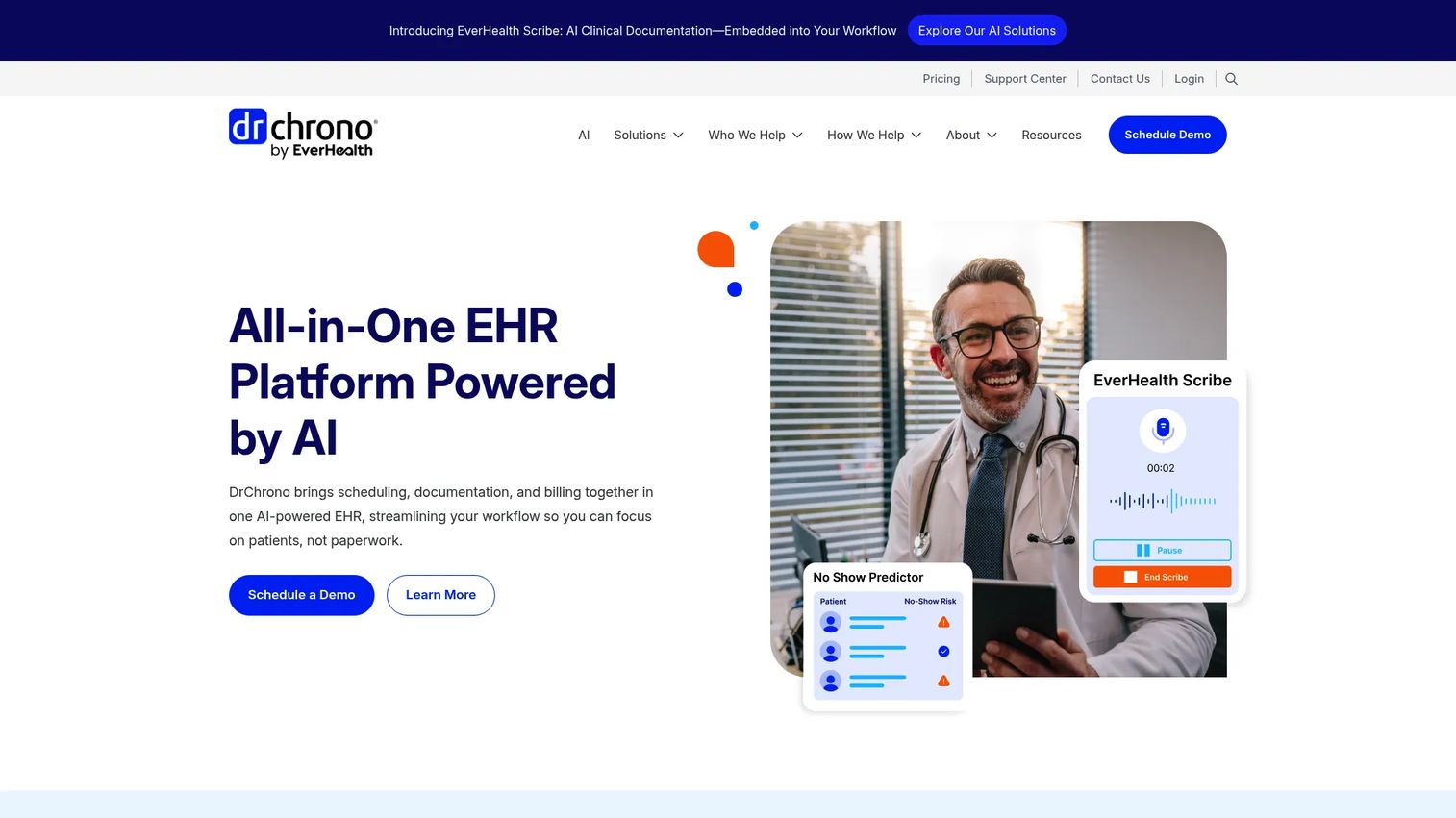
DrChrono is a cloud-based, mobile-friendly EHR platform that pairs practice management, billing, and patient engagement with AI automation. Its differentiator is genuine mobile-native charting: providers can document, prescribe, and manage schedules from a tablet or phone without a stripped-down experience. For practices that move between rooms, sites, or homes, that mobility is the point.
Best for: Medical practices that want an integrated EHR, scheduling, and billing platform they can run from mobile devices.
Key strengths
- Mobile-native workflow: Full charting and scheduling on tablet and phone, not a companion app bolted onto a desktop system.
- Integrated practice management: EHR, scheduling, and billing share one platform, so patient data flows without re-entry.
- Revenue-cycle workflows: Built-in billing and claims support keeps clinical and financial work in the same system.
Why choose DrChrono: If your providers chart on the move or your practice is mobile-first by design, DrChrono fits the workflow better than a desktop-anchored system. It suits smaller and mid-size practices that want an integrated stack without an enterprise implementation. Larger organizations with complex multi-site governance should weigh it against the enterprise platforms below.
DrChrono pricing: DrChrono does not publish public plan prices. The site lists three tiers, Foundation, Growth, and Premium, and directs prospective buyers to request a quote based on practice size and needs. Expect pricing to scale with provider count and the modules you enable, so scope your requirements before the sales conversation.
3. athenahealth

athenahealth delivers cloud-based healthcare software centered on athenaOne, which combines EHR, practice management, revenue cycle, and patient engagement in one platform. Its strength is the operating layer around clinical work: billing, claims, and collections are core, not add-ons. That makes it a strong fit for practices where financial performance is as important as clinical documentation.
Best for: Ambulatory practices that want an integrated EHR, billing, and patient engagement platform in one cloud system.
Key strengths
- AI-native charting: AI-assisted chart review and documentation reduce the time providers spend typing notes.
- Revenue-cycle depth: Practice management and billing are built in, with a services model that helps chase collections.
- Patient engagement: Mobile and telehealth capabilities extend the record to virtual and asynchronous care.
Why choose athenahealth: The pricing model is the deciding factor. athenahealth charges a percent of collections rather than a flat per-seat fee, which aligns the vendor's incentive with your revenue but means cost scales with billings. Growing practices that value a broad operating layer, and that want the vendor invested in collections, tend to find the model fits.
athenahealth pricing: athenahealth does not publish a public starting price. Pricing is individualized and based on a percent of your practice's collections rather than a fixed subscription. Because cost moves with revenue, model it against your monthly billings before committing, and ask exactly which services are included at your collections tier.
4. Epic Systems
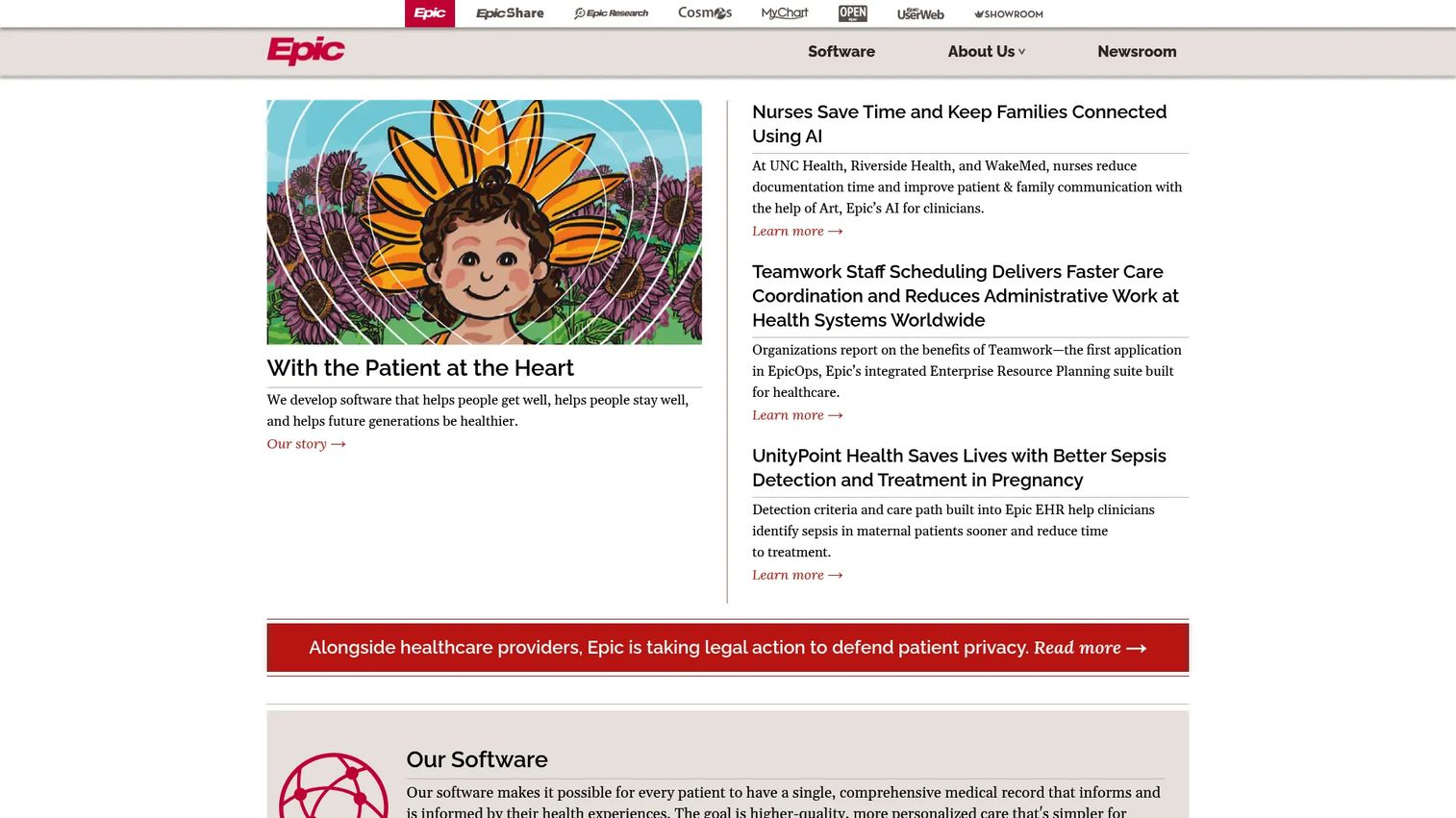
Epic Systems is the healthcare software company best known for its enterprise electronic health record and interoperability software. It runs a large share of the hospital and academic-medical-center market, and its depth in clinical documentation, care coordination, and data exchange is why. If your organization needs a record that moves cleanly across departments, facilities, and external providers, Epic is the reference standard.
Best for: Large healthcare organizations and vendors that need enterprise-grade clinical depth and interoperability.
Key strengths
- Interoperability specifications: Robust APIs and data-sharing standards let records flow across systems and organizations.
- Clinical and financial breadth: EHR, billing, claims, and managed-care workflows cover the full enterprise footprint.
- Care coordination at scale: Built for multi-department, multi-facility organizations where a patient touches many teams.
Why choose Epic Systems: Epic is an enterprise commitment, not a small-clinic tool. Implementation is a multi-month program with governance, training, and integration work. The payoff is a single clinical record across a large organization and interoperability that few systems match. Match it to the scale of the problem: large systems get outsized value, small practices rarely need the full platform.
Epic Systems pricing: Epic does not publicly list pricing for its core healthcare software; enterprise deals are custom and negotiated. The one public price is for its integration program: open.epic has no membership fee, and Vendor Services for third-party integrators starts at $1,900 per year. Core platform cost depends entirely on organization size and scope.
5. Oracle Health
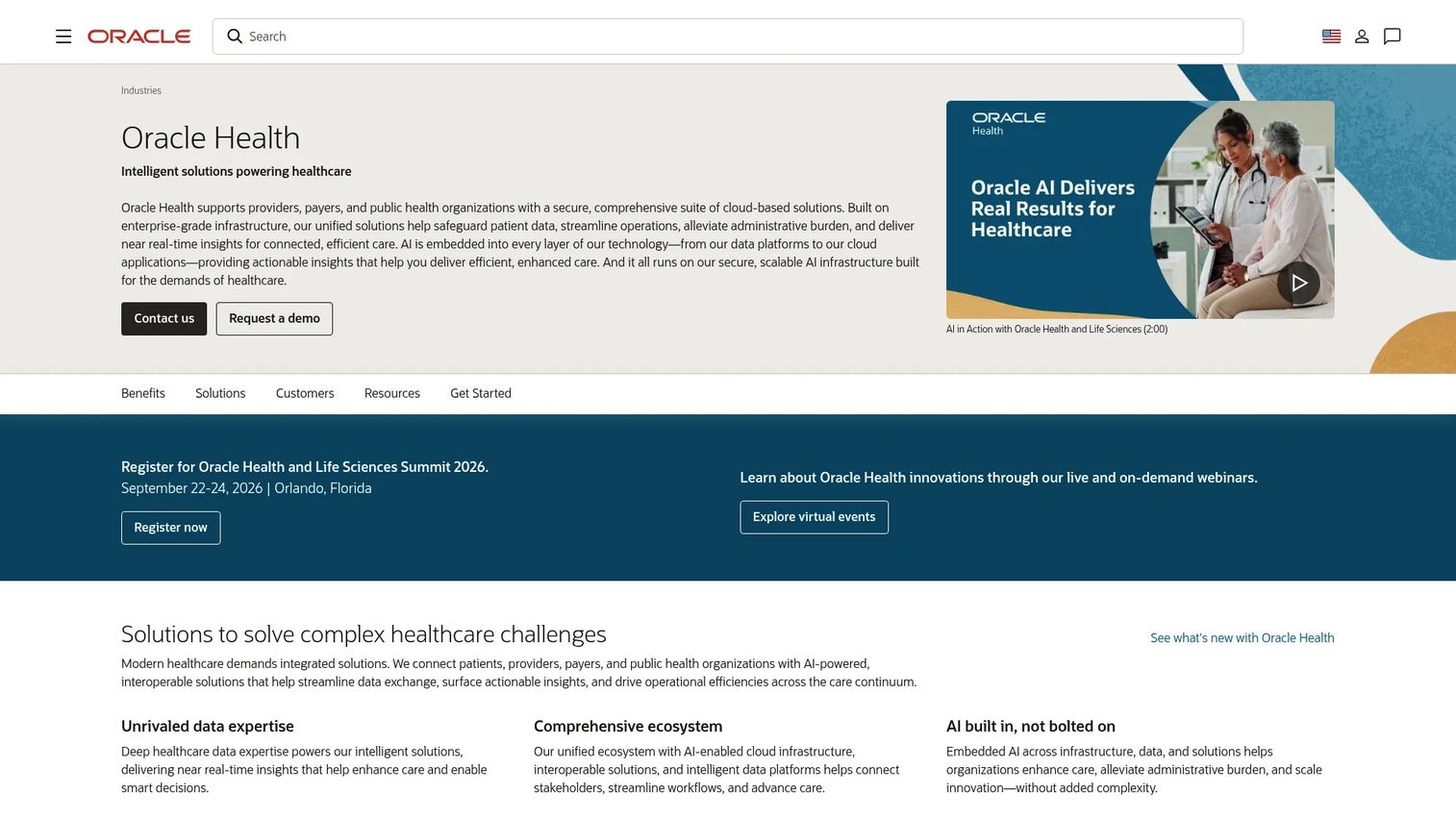
Oracle Health, the former Cerner business now under the Oracle brand, provides cloud-based healthcare software for providers, payers, and public-health organizations. It covers ambulatory and enterprise workflows, with a strong emphasis on interoperability, health information exchange, and data analytics. For organizations standardizing across a larger footprint, its clinical and operational infrastructure is built to scale.
Best for: Healthcare organizations that need enterprise clinical, operational, and health IT infrastructure across multiple sites.
Key strengths
- AI-enabled clinical applications: Modern clinical tools with AI assistance layered into documentation and review.
- Clinical and financial operations: Integrated tools for both care delivery and the financial side of running a system.
- Population health and analytics: Data and consumer-experience solutions that support standardization across a footprint.
Why choose Oracle Health: The move from Cerner to Oracle brought deeper cloud and data-platform investment, which shows in analytics and interoperability. It suits organizations that want to standardize on one vendor across sites and value enterprise data capabilities. Like Epic, it is an enterprise-scale deployment; smaller practices will find lighter systems a better fit.
Oracle Health pricing: Oracle Health does not publish standard subscription pricing for its core platform; those deals are contact-sales. The publicly listed prices cover its certified APIs, with annual fees ranging from $1,000 for a shared Continuum ASP environment up to $28,000 for a standalone Standard-XL environment, plus a one-time $10,000 setup fee for first-time implementations. G2 rates Oracle at the seller level 4.1/5.
6. Zanda Health
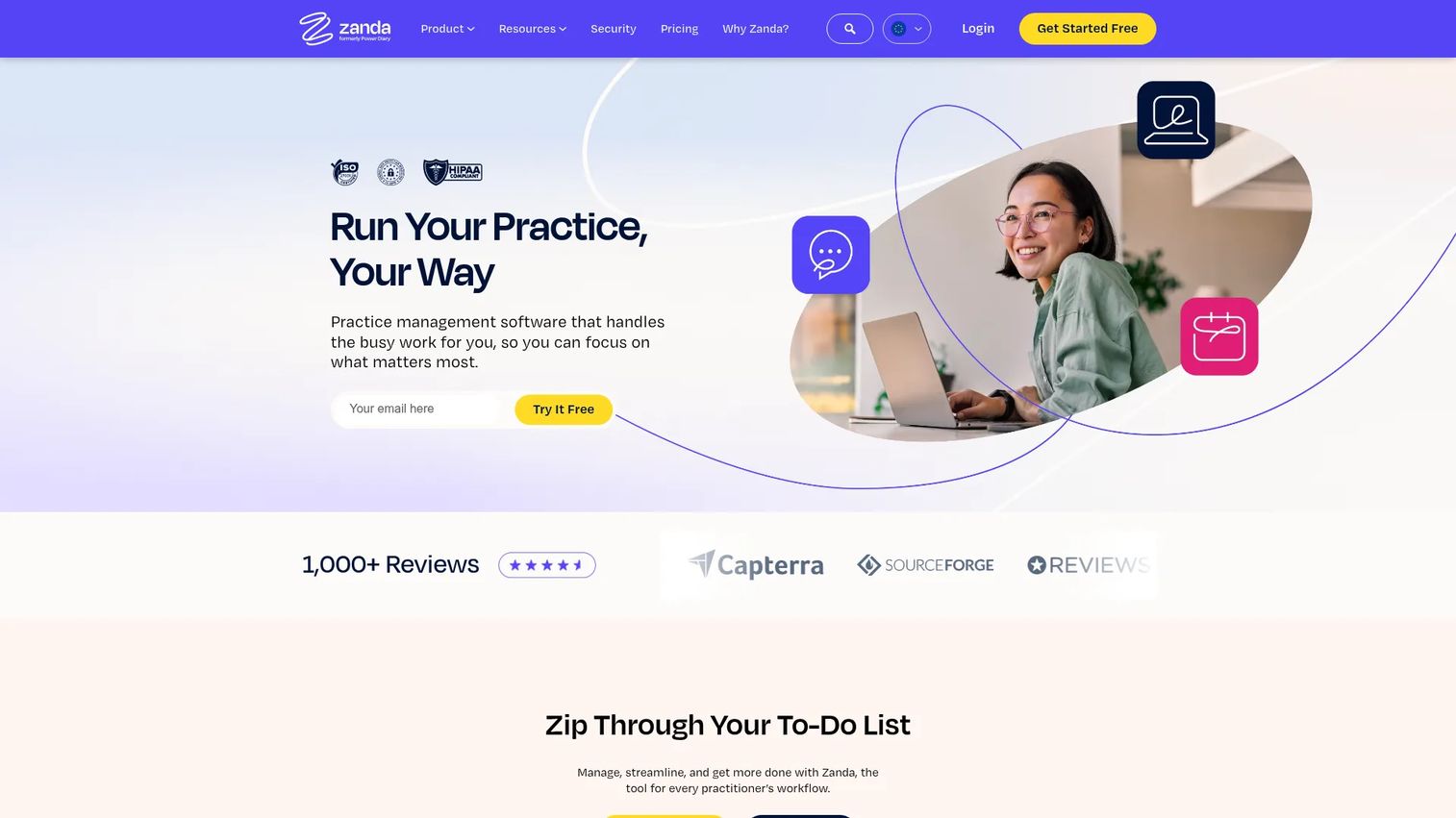
Zanda Health is all-in-one practice management software built for health practices that want scheduling, forms, notes, and billing in one clean system. It is especially strong for solo practitioners and group wellness or allied-health clinics that need simple administration without enterprise overhead. Cloud access and an approachable interface make it a favorite among lean teams.
Best for: Solo and group health practices that need scheduling, forms, clinical notes, and billing in one simple system.
Key strengths
- Appointment scheduling: Clean calendar management with appointment reminders that reduce no-shows.
- Online forms and intake: Digital forms streamline patient intake and keep records complete from the first visit.
- Clinical notes: Structured note-taking that fits allied-health and wellness workflows, not just medical ones.
Why choose Zanda Health: Zanda trades enterprise breadth for genuine ease of use. For a solo therapist, chiropractor, or small wellness group, that is exactly the right trade. Larger multi-specialty groups with heavy billing needs will outgrow it, but lean teams that want to run administration without a dedicated IT person get real value fast.
Zanda Health pricing: Zanda publishes transparent pricing with a 14-day free trial. The Starter plan for a single practitioner is US$9.50 per month for the first six months, then US$19 per month. The Growth plan, built for 1 to 100+ practitioners, is US$34 per month for the first six months, then US$68 per month. A promotional 50 percent discount for the first six months is currently shown on the pricing page. G2 rates it 4.7/5.
7. Hippocrate
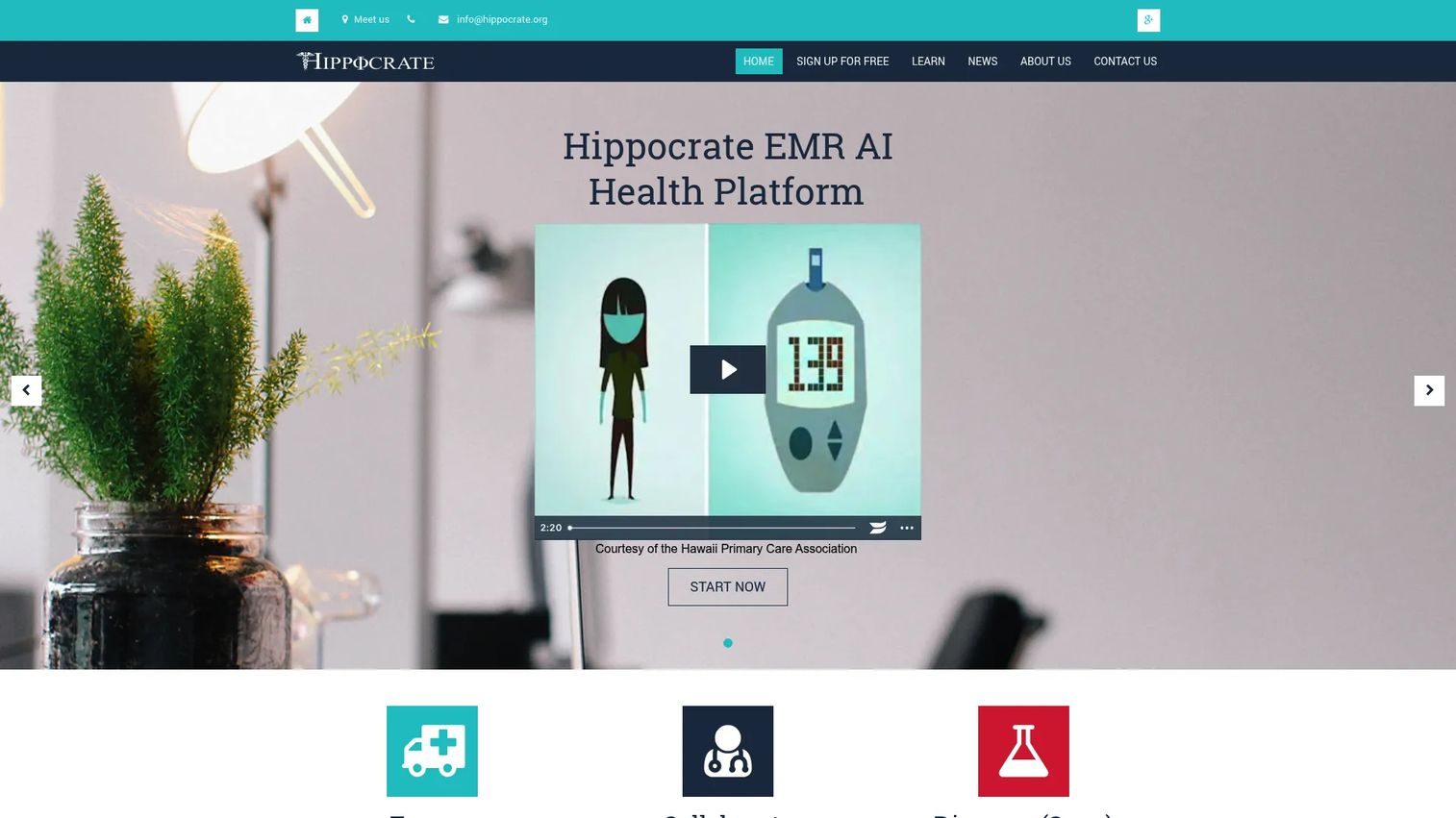
Hippocrate is a cloud-based EHR/EMR platform that bundles patient engagement, telemedicine, and practice management, with a free tier that lowers the barrier to entry. It targets small medical practices that want AI SOAP notes, e-prescriptions, video consultations, and even a medical website in one package. For a solo provider getting off paper, the free Solo Practice plan is a genuine starting point.
Best for: Small medical practices that want a low-cost EHR with telemedicine, AI notes, and patient engagement built in.
Key strengths
- Free entry tier: The Solo Practice plan is free, removing the cost barrier for solo providers.
- Telemedicine built in: Video consultations document inside the record, so virtual visits work like in-person ones.
- Patient acquisition tools: Online appointment scheduling and a medical-website bundle help practices attract patients.
Why choose Hippocrate: The all-in-one bundle and free tier make Hippocrate an easy first EHR for a small or new practice. Be honest about fit, though: a free tier fits a solo provider getting started, while practices with complex billing, multi-site needs, or deep interoperability requirements will need to test whether the platform scales to their workflow before committing.
Hippocrate pricing: The Solo Practice plan is free. Small Practice is $25 per month per provider and adds capacity for growing teams. Large Practice pricing is custom and quoted based on scale. The free tier makes it low-risk to trial, so start there and upgrade only when your provider count or feature needs cross the free plan's limits.
What to evaluate before you buy
Deployment model
Decide between cloud-based, on-premises, or hybrid before anything else, because it shapes cost, maintenance, and data control. Cloud-based EMR software dominates the market for good reason: no servers to maintain, automatic updates, and access anywhere. On-prem or open source suits practices that need full data residency control and have IT resources to match.
Compliance and security
Any system touching patient data must be a HIPAA-compliant EMR with encryption, audit logs, and role-based access as a baseline. Ask for the vendor's certifications, breach history, and where data is hosted. Secure EMR software is not a premium feature; it is table stakes, and the cost of getting it wrong dwarfs any license fee.
Interoperability
Interoperability decides whether your records can move to labs, pharmacies, referrals, and other providers. Confirm support for HL7 and FHIR standards, and ask which specific systems the EMR already exchanges data with. For growing or multi-site organizations, this is often the criterion that separates a system you keep from one you replace.
Total cost and fit for size
Match the platform to your practice size and billing model. A solo clinic overspends on an enterprise system it never fully uses; a large system underserves itself with a lean tool it outgrows in a year. Weigh per-seat versus percent-of-collections versus free-plus-hosting, and model the real three-year cost, not the sticker price.
Conclusion
The right EMR is the one that matches how your practice actually operates. For solo and small clinics, Zanda Health and Hippocrate keep administration simple and cost low. For mobile-first or integrated smaller practices, DrChrono fits the workflow. Growing ambulatory practices that live on collections get real value from athenahealth's revenue-cycle depth. Practices that want full control and no license fee should look hard at OpenEMR. And for large, complex health systems, Epic Systems and Oracle Health remain the enterprise interoperability standards.
Keep the EMR versus EHR distinction in mind as you shortlist: an EMR centers on records inside your practice, while an EHR is built to share records across providers. Most modern electronic medical record systems now blur that line, but your interoperability needs will tell you how far toward the EHR end you need to sit.
Your next step is a scoped trial. Pick two platforms that match your deployment style, compliance needs, and workflow complexity, run your real intake-to-billing flow through each, and let the daily reality decide. The best system is the one your team stops noticing because it just works.
FAQs
EMR software is a digital system that stores and manages a patient's medical records within a single practice, replacing paper charts. It typically covers clinical charting, scheduling, e-prescribing, and billing-adjacent workflows in one platform. Modern EMR systems increasingly add patient portals, telemedicine, and interoperability so records can move between providers.
An EMR (electronic medical record) is focused on the records inside one practice or clinic. An EHR (electronic health record) is built to share a patient's record across multiple providers, facilities, and organizations. In practice the terms overlap heavily, and most platforms marketed today do both, so the real question is how much cross-provider interoperability you need.
Yes, when the vendor implements proper controls. Cloud-based EMR software from reputable vendors uses encryption in transit and at rest, audit logging, role-based access, and HIPAA-compliant hosting. Cloud delivery now accounts for the large majority of EMR deployments precisely because it can meet security standards while removing the burden of maintaining your own servers. Always confirm certifications and hosting location before signing.
For EMR software for small clinics, prioritize fast charting, clean scheduling with appointment reminders, a usable patient portal, and simple billing. Cloud-based delivery matters most so there is no server to maintain. Avoid over-buying: enterprise interoperability and heavy governance features add cost a small practice rarely uses in its first years.
Free EMR software can absolutely run a real practice, especially open source options like OpenEMR or a free tier like Hippocrate's Solo Practice plan. The cost moves from licensing to setup, hosting, and support. For solo providers and small clinics with light technical resources, that trade often works well. Larger practices with complex billing should model the full cost of support before assuming free means cheap.
Most modern EMR platforms include both, either natively or through tight integrations. Billing and revenue-cycle tools handle coding, claims, and eligibility, while the patient portal lets patients view records, book visits, and message the practice. Coverage depth varies, so confirm whether billing is a core module or an add-on, and how full-featured the portal is, before you commit.
Interoperability is critical if your patients see other providers, use external labs, or move between facilities. Support for HL7 and FHIR standards lets records exchange cleanly instead of trapping data in one system. For a single-location clinic it matters less; for growing or multi-site organizations it is often the deciding factor between a system you keep and one you replace.
For growing ambulatory practices, athenahealth stands out because its revenue cycle, practice management, and patient engagement scale together in one cloud platform. DrChrono suits growing mobile-first practices that want an integrated stack. Organizations scaling toward multiple sites or hospital-level complexity should evaluate Epic Systems and Oracle Health, which are built for enterprise interoperability and care coordination.