A recruiter opens a spreadsheet to find a candidate's status. Then a separate inbox to check the last email. Then a third tool to confirm whether the client ever approved the submission. By the time the answer surfaces, the candidate has taken another offer.
That is the real cost of fragmented staffing workflows. Not one broken tool, but the gaps between tools, where context dies and placements slip. The global staffing software market is projected to grow from $8.7 billion in 2025 to $16.2 billion by 2033, per Dataintelo (2025), and the spend is concentrating on platforms that stitch the recruiting lifecycle into one system instead of five tabs.
The right staffing software solutions reduce manual handoffs across sourcing, messaging, scheduling, and placement tracking. They put ATS and CRM under one roof, layer in automation, and report on fill rate and time-to-fill without a recruiter building the dashboard by hand. If you are evaluating software for staffing agencies because admin is eating selling time, this guide is the decision shortcut. It treats the choice the way an operator would: stack fit, ROI, and whether the ranking is defensible.
Adjacent categories matter too. If your motion leans heavily on sourcing automation, a focused look at ai recruiting software pairs well with this list, and back-office heavy firms often weigh staffing platforms against general-purpose best crm software before deciding.
What's inside
This guide covers eight real staffing software options chosen for ATS and CRM depth, automation, integrations, scalability, pricing clarity, and support. Each entry includes who it fits, key strengths, verified pricing where the vendor publishes it, and a current G2 rating. The list is built for teams comparing staffing management software across the recruiting lifecycle, from lean recruiter workflows to full front office and back office coverage. We sorted by relevance to the keyword and staffing operations maturity, not alphabetically, so you can pattern-match to your own stage.
TL;DR
- Best for full-suite staffing operations: Bullhorn pairs deep ATS and CRM with a large integration marketplace and back-office workflows.
- Best for integrated front and back office: TempWorks and Avionté combine recruiting with payroll and billing in one system.
- Best for all-in-one AI recruiting: Loxo unifies ATS, CRM, sourcing, and outreach with a free starting tier.
- Best for lean recruiter productivity: Recruit CRM delivers ATS plus CRM with a high ease-of-use reputation.
- Best for flexible, affordable workflows: Zoho Recruit offers a free tier and low per-recruiter pricing inside a broad ecosystem.
- Best for automation and scale: CEIPAL focuses on sourcing, matching, and workforce management for high-volume teams.
What is staffing software?
Staffing software is a category of recruiting and staffing tools that helps agencies and internal teams source, track, place, and sometimes pay candidates from one connected system. Modern staffing and recruiting software usually combines an applicant tracking system (ATS), a recruiting CRM, candidate sourcing, outreach, interview scheduling, onboarding, reporting, and, for full-suite platforms, payroll and billing.
The ATS manages the candidate side: requisitions, pipelines, submissions, interviews, and placements. The CRM manages the relationship side: clients, prospects, contacts, and business development. Strong staffing industry software keeps both in sync so a recruiter is never copying data between systems.
Core capabilities buyers should expect from the category:
- Applicant tracking across the full recruiting lifecycle, from req to placement
- Recruiting CRM for client and candidate relationship management
- Sourcing and outreach with job board and email integrations
- Automation for repetitive steps like status updates, follow-ups, and screening
- Reporting and analytics on fill rate, time-to-fill, and recruiter productivity
- Onboarding and compliance workflows for placed candidates
- Payroll and billing for firms that run pay and invoicing in-house
- Integrations with job boards, email, calendars, and back-office tools
The dividing line is usually front office versus back office. Front office covers sourcing through placement. Back office covers timekeeping, payroll, and billing. Some platforms own both. Others focus on recruiter-facing workflows and integrate the rest.
When to use staffing software
Replace spreadsheets and disconnected inbox workflows
Spreadsheets work until they don't. Once a team is juggling more than a handful of open reqs, manual tracking gets slow and error-prone. Candidate statuses go stale, submissions get double-sent, and no one trusts the numbers. Staffing software becomes worth the switch when the cost of lost context, missed follow-ups, and re-keyed data outweighs the comfort of a familiar sheet. This is usually the first real trigger for a staffing agency software purchase.
Standardize the recruiting lifecycle
A repeatable process beats individual heroics. Staffing software helps teams manage sourcing, screening, submission, interview scheduling, placement, and follow-up the same way every time. That consistency is what lets a new recruiter ramp without shadowing your top biller for a month. It also produces clean stage data, so submission-to-placement ratios actually mean something. When you want the motion to work without your best person in every deal, standardization is the reason to buy.
Improve visibility across recruiting and operations
Leadership needs more than a gut feel. When the partner meeting turns into a debate about why fill rates dropped, you need reporting that answers it. Staffing software gives pipeline visibility, fill rate, time-to-fill, and recruiter productivity in one place. That visibility matters most when a firm is scaling, raising, or trying to forecast capacity. If you cannot see what is working without stitching together five exports, that is the signal to consolidate.
Comparison table
The table below summarizes intent, key differentiation, verified pricing, and current G2 ratings for each platform. Pricing reflects publicly listed figures at time of writing. Where a vendor sells through quotes, that is noted directly.
| # | Product | Intent | Key differentiation | Pricing | G2 rating |
|---|---|---|---|---|---|
| 1 | Bullhorn | Full-suite staffing ops | ATS, CRM, automation, 300+ partner marketplace | From $99/user/mo | 4.2/5 |
| 2 | TempWorks | Front and back office | ATS, CRM, payroll, billing, mobile portal | Quote-based | 4.1/5 |
| 3 | Loxo | All-in-one AI recruiting | ATS, CRM, sourcing, outreach, AI matching | Free; Basic $169/user/mo | 4.6/5 |
| 4 | Recruit CRM | Lean recruiter ATS+CRM | Chrome sourcing, AI parsing, automation | Free trial; quote-based tiers | 4.8/5 |
| 5 | Zoho Recruit | Flexible, affordable | ATS+CRM in the Zoho ecosystem | Free; Standard $25/recruiter/mo | 4.4/5 |
| 6 | CEIPAL | Automation and scale | ATS, VMS, workforce management | Quote-based | 4.6/5 |
| 7 | Crelate | Relationship-driven ATS/CRM | ATS, CRM, AI agents, onboarding | From $85/user/mo | 4.4/5 |
| 8 | Avionté | Integrated front and back office | CRM, ATS, payroll, billing | Quote-based | 4.3/5 |
1. Bullhorn
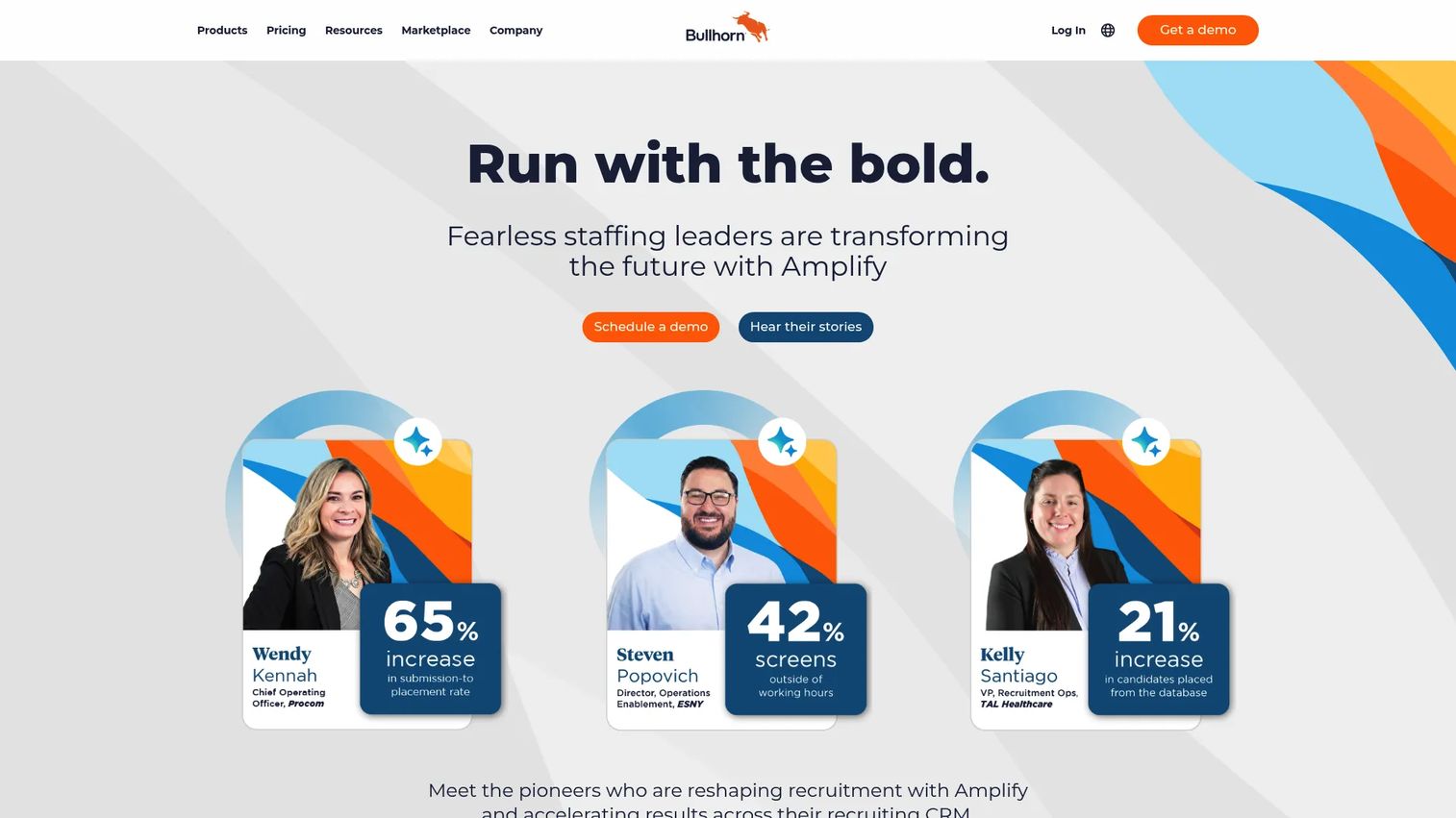
Bullhorn is the default answer when staffing teams ask which platform scales with them. It is cloud-based recruiting software built specifically for staffing and recruitment firms, pairing a deep ATS with a recruiting CRM and layering automation and AI on top. The marketplace of 300-plus pre-integrated technology partners means most tools you already run can plug in rather than fight the system.
Best for: Staffing and recruitment agencies that want one platform for front office and back office at scale.
Key strengths
- ATS and CRM depth: Manages the full recruiting lifecycle and client relationships in a single record.
- Automation and AI: Handles repetitive status updates, follow-ups, and candidate engagement so recruiters stay on revenue work.
- Marketplace breadth: 300-plus pre-integrated partners cover sourcing, assessments, onboarding, and back-office needs.
Why choose Bullhorn: If you are scaling and need a system that grows from front office into time, billing, and payroll workflows, Bullhorn is the safe operator pick. Its install base across the staffing industry means peers can vouch for it, which shortens internal buy-in. The tradeoff is that breadth comes with a learning curve; smaller teams sometimes want lighter.
Bullhorn pricing: Public pricing covers the Bullhorn Platform ATS plans. Starter is listed at $99 per user per month and Core at $165 per user per month, both billed monthly. Pro, Amplify Digital Workers, Onboarding, Middle Office, and Bullhorn One are quote-based. There is no free tier.
2. TempWorks
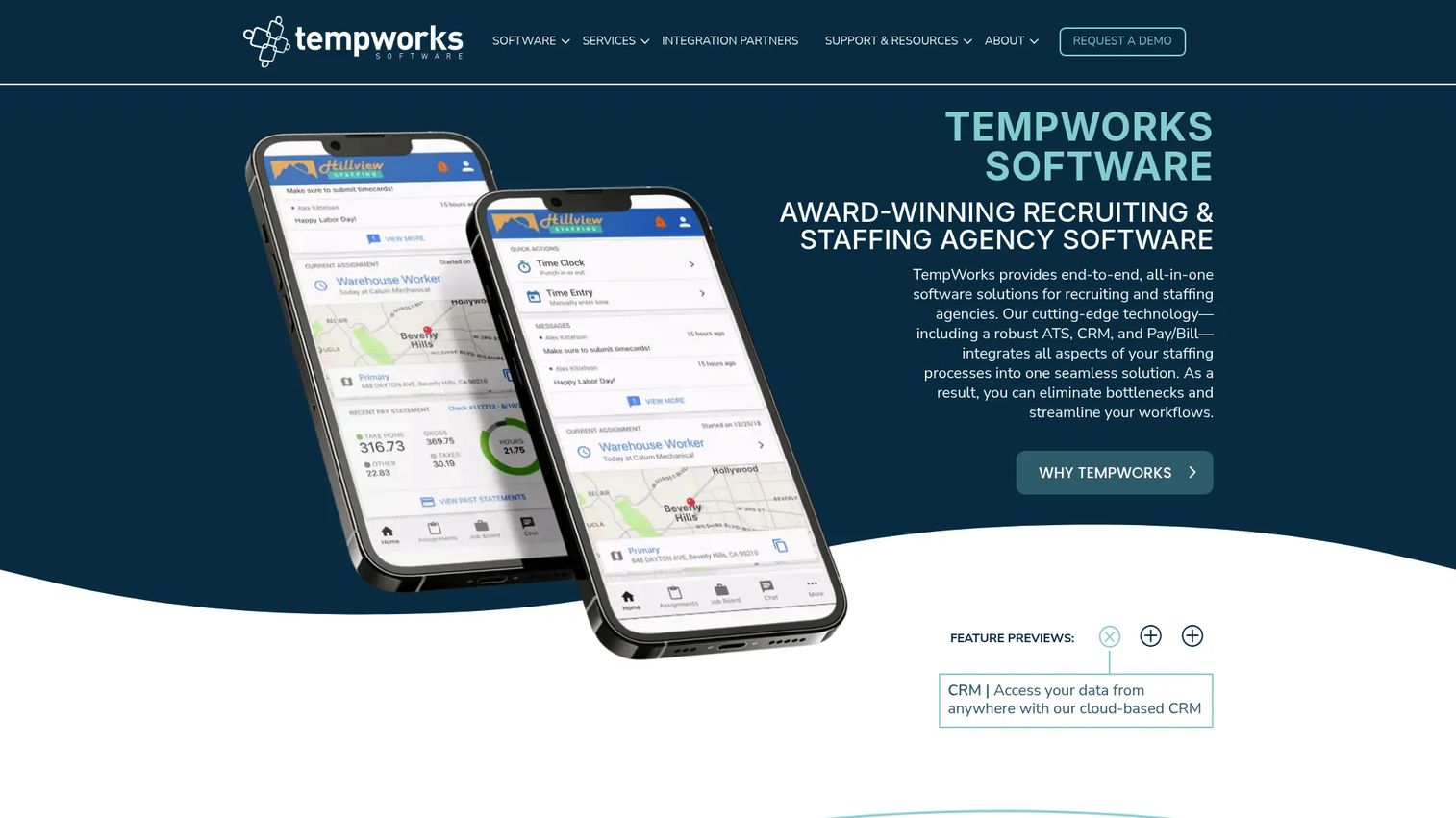
TempWorks is built for staffing agencies that need recruiting and the back office in one platform. It provides ATS and recruitment workflow tools, a cloud-based CRM, and payroll and billing alongside a workforce portal. Its mobile ATS, TempWorks Beyond, extends front-office work to recruiters and field staff on the move, which matters for high-volume light-industrial and temp placement.
Best for: Staffing firms running temp and contract placement that need front office and back office in a single integrated system.
Key strengths
- Front-to-back coverage: ATS, CRM, payroll, and billing live in one platform, reducing cross-system handoffs.
- Mobile workflow: TempWorks Beyond keeps recruiters productive outside the office.
- Workforce portal: Gives placed workers a self-serve surface for the operational side of staffing.
Why choose TempWorks: For agencies that run pay and invoicing in-house, owning the back office inside the same system removes a whole category of reconciliation work. The candidate experience and recruiter experience stay consistent from submission through paycheck. It fits operationally deep firms more than lean recruiter-only teams.
TempWorks pricing: TempWorks does not publish public pricing and sells through a quote and demo process. Plan structure is tailored to firm size and the modules you need across front and back office. Budget for an implementation conversation rather than a self-serve signup.
3. Loxo
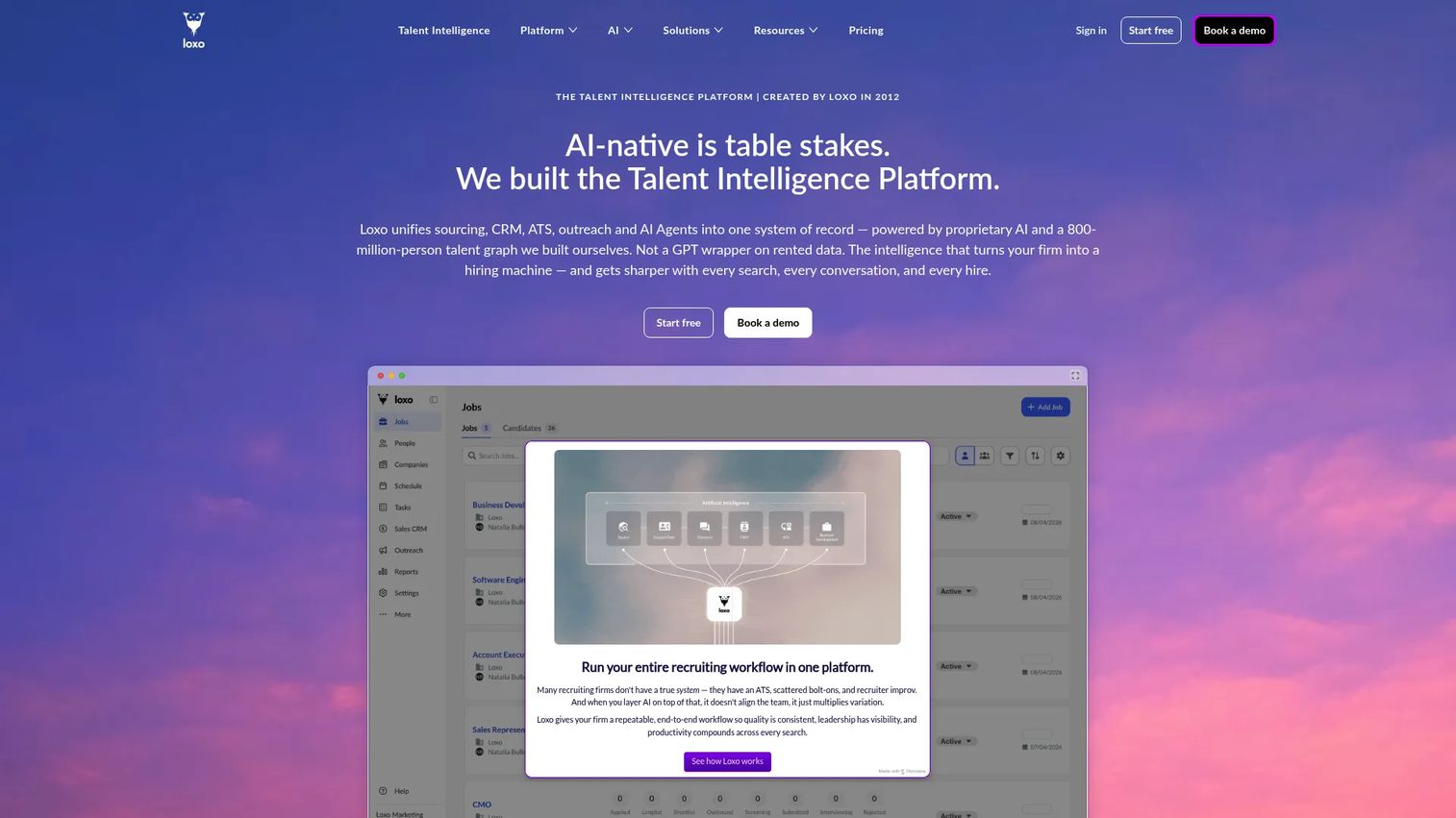
Loxo unifies sourcing, CRM, ATS, outreach, and AI agents into one system of record, powered by proprietary AI and a talent graph the company built itself. It positions as a Talent Intelligence Platform, which in practice means the sourcing and matching layer is native rather than bolted on. For recruiting teams tired of paying for a separate sourcing tool, an ATS, and an outreach platform, the consolidation is the point.
Best for: Recruiting agencies and hiring teams that want an all-in-one ATS and CRM with sourcing and AI built in.
Key strengths
- Unified system of record: ATS, recruiting CRM, sourcing, and outreach in one platform.
- AI candidate matching: Native AI and an AI Notetaker speed up screening and surface fit.
- Free entry point: A genuine free tier lets small teams start without a procurement cycle.
Why choose Loxo: The free plan plus a low published entry price makes Loxo unusually easy to test before committing budget, which fits a founder who wants first-week proof. Consolidating sourcing into the ATS reduces tool sprawl, a common Series B objection. Larger firms that need deep back-office payroll will pair it with other systems.
Loxo pricing: Loxo publishes a Free plan at $0 forever that includes ATS, recruiting CRM, Loxo Boost, one user, unlimited jobs, and the Chrome extension. Basic is $169 per user per month billed annually and adds Sales CRM, job posting, multiple users, custom dashboards, analytics, and resume parsing. Professional and Enterprise are quote-based.
4. Recruit CRM
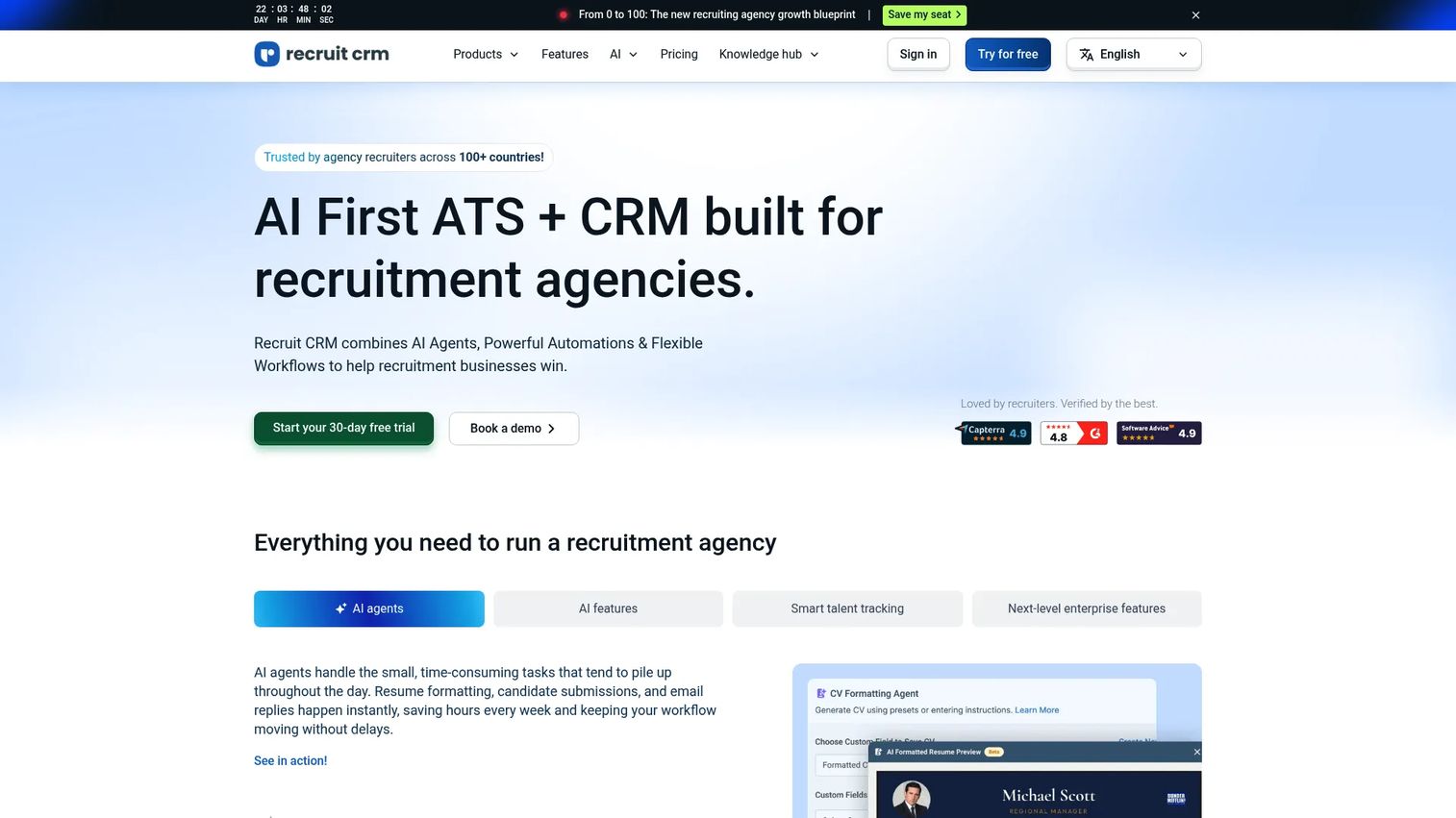
Recruit CRM is an AI-powered ATS and CRM built for recruitment agencies and executive search firms, and it carries one of the strongest ease-of-use reputations in the category at 4.8/5 on G2. It is just as workable for in-house recruiting teams and freelance recruiters. The Chrome sourcing extension, AI resume parsing, and workflow automation keep recruiters moving without fighting the interface.
Best for: Recruitment agencies and executive search teams that want a clean ATS plus CRM in one place.
Key strengths
- Chrome sourcing extension: Capture candidates from anywhere on the web without manual entry.
- AI resume parsing: Turns inbound resumes into structured records automatically.
- Workflow automation: Removes repetitive steps so recruiters spend time on placements.
Why choose Recruit CRM: When usability is the deciding factor, Recruit CRM's 4.8/5 rating across reviews is hard to argue with. It nails the core recruiter workflow without forcing the operational complexity a full back-office suite carries. Lean teams that want productivity on day one tend to land here, and timesheet, invoicing, and contractor-pay automation extend it further.
Recruit CRM pricing: The pricing page lists Pro, Business, and Enterprise plans plus a free trial, with monthly or annual billing. Public price values were not readable at time of writing, so confirm current figures directly with the vendor. The free trial lets you validate the workflow before committing.
5. Zoho Recruit
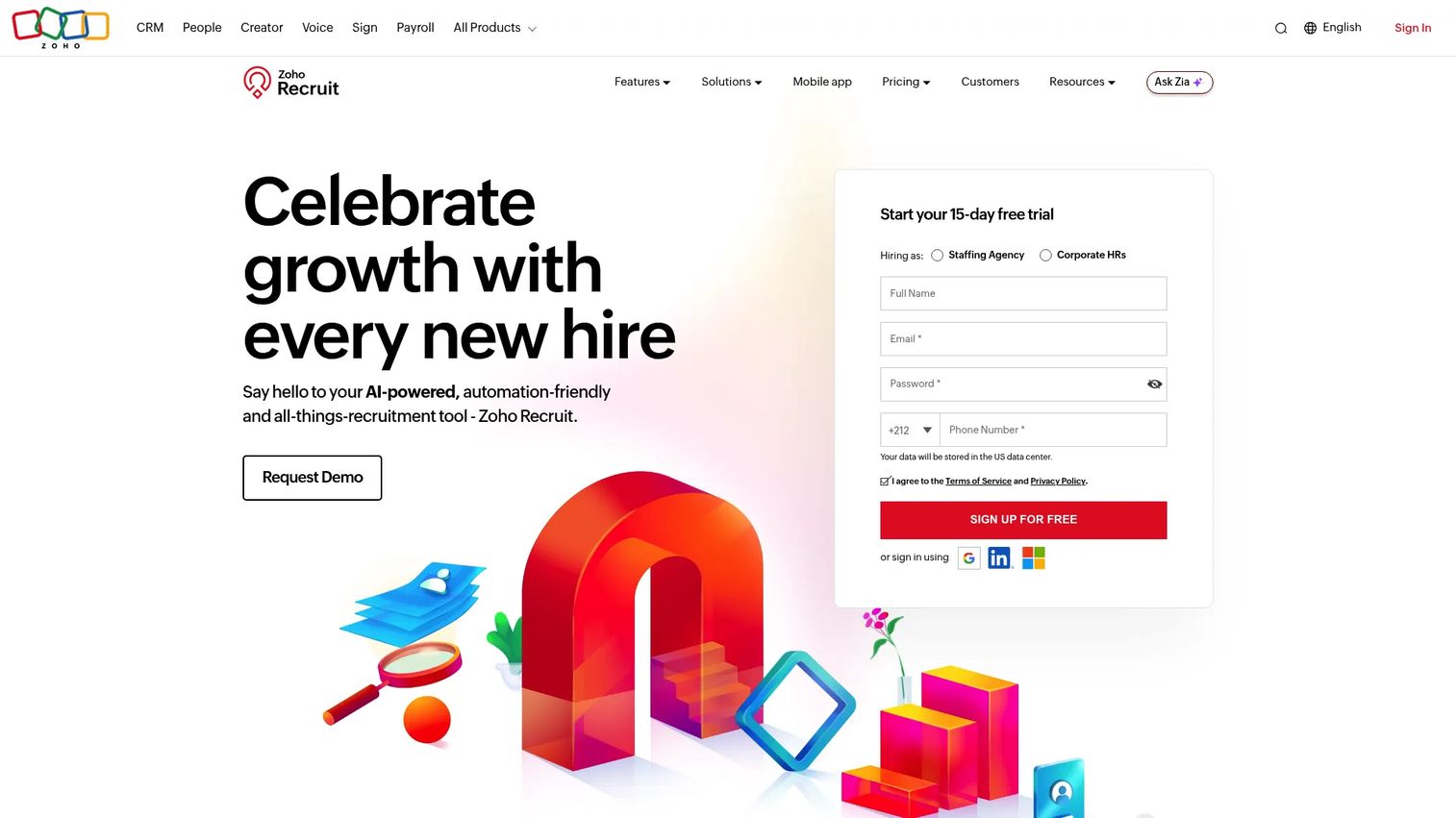
Zoho Recruit is a cloud-based ATS and recruitment CRM for HR teams and staffing agencies that want flexibility and a low entry price. It fits teams already living in the broader Zoho ecosystem, since data and workflows connect cleanly across Zoho's other apps. Job board and social posting, resume management, and AI candidate matching cover the core recruiting lifecycle.
Best for: Teams that need an all-in-one ATS with CRM-style recruiting workflows at an accessible price.
Key strengths
- Job boards and social posting: Distribute openings across channels from one place.
- Resume management and tracking: Keep candidate records organized through every stage.
- Automation and AI matching: Workflows and AI matching reduce manual screening.
Why choose Zoho Recruit: Affordability and customization are the draw. A free tier plus $25 per recruiter pricing makes it one of the lowest-friction ways to stand up real staffing software, especially for small agencies and internal teams. If you already run Zoho, the ecosystem fit removes integration headaches.
Zoho Recruit pricing: A Free Forever plan is available. Standard runs $25 per recruiter per month billed annually or $30 billed monthly. Enterprise is $50 per recruiter per month annually or $60 monthly. A 15-day free trial covers the paid tiers.
6. CEIPAL
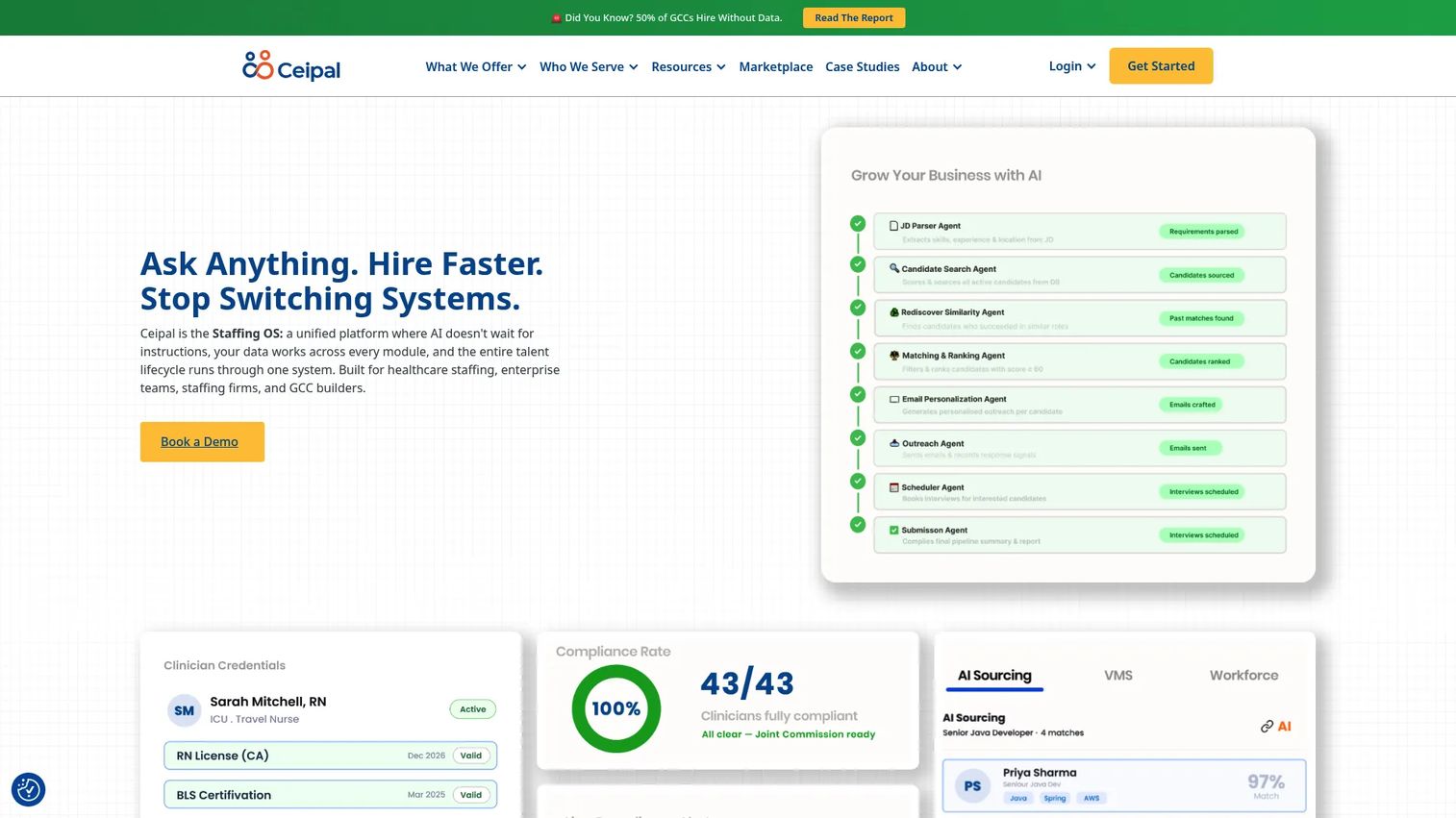
CEIPAL is an AI-powered talent acquisition and workforce management platform built for staffing, healthcare, corporate recruiting, and GCC teams. It combines an ATS, a Vendor Management System, and workforce and employee management, which makes it a fit for high-volume operations that need automation and matching at scale. Recruiters and hiring managers across many teams rely on it as the staffing operating layer.
Best for: Staffing and recruiting teams that need ATS, VMS, and workforce management in one platform.
Key strengths
- AI sourcing and matching: Automates candidate discovery and ranking for high-volume reqs.
- Vendor Management System: Handles VMS workflows that high-throughput staffing models require.
- Workforce management: Extends beyond placement into managing the deployed workforce.
Why choose CEIPAL: When the bottleneck is volume, CEIPAL's automation and matching are the reason to look closely. The VMS layer matters for firms working through vendor channels, which most lean ATS tools do not handle. It is built for operational scale rather than the simplest recruiter workflow.
CEIPAL pricing: CEIPAL does not display public numeric pricing and directs prospects to book a demo. Pricing is tailored to team size, modules, and volume. Plan on a sales conversation to scope ATS, VMS, and workforce management together.
7. Crelate
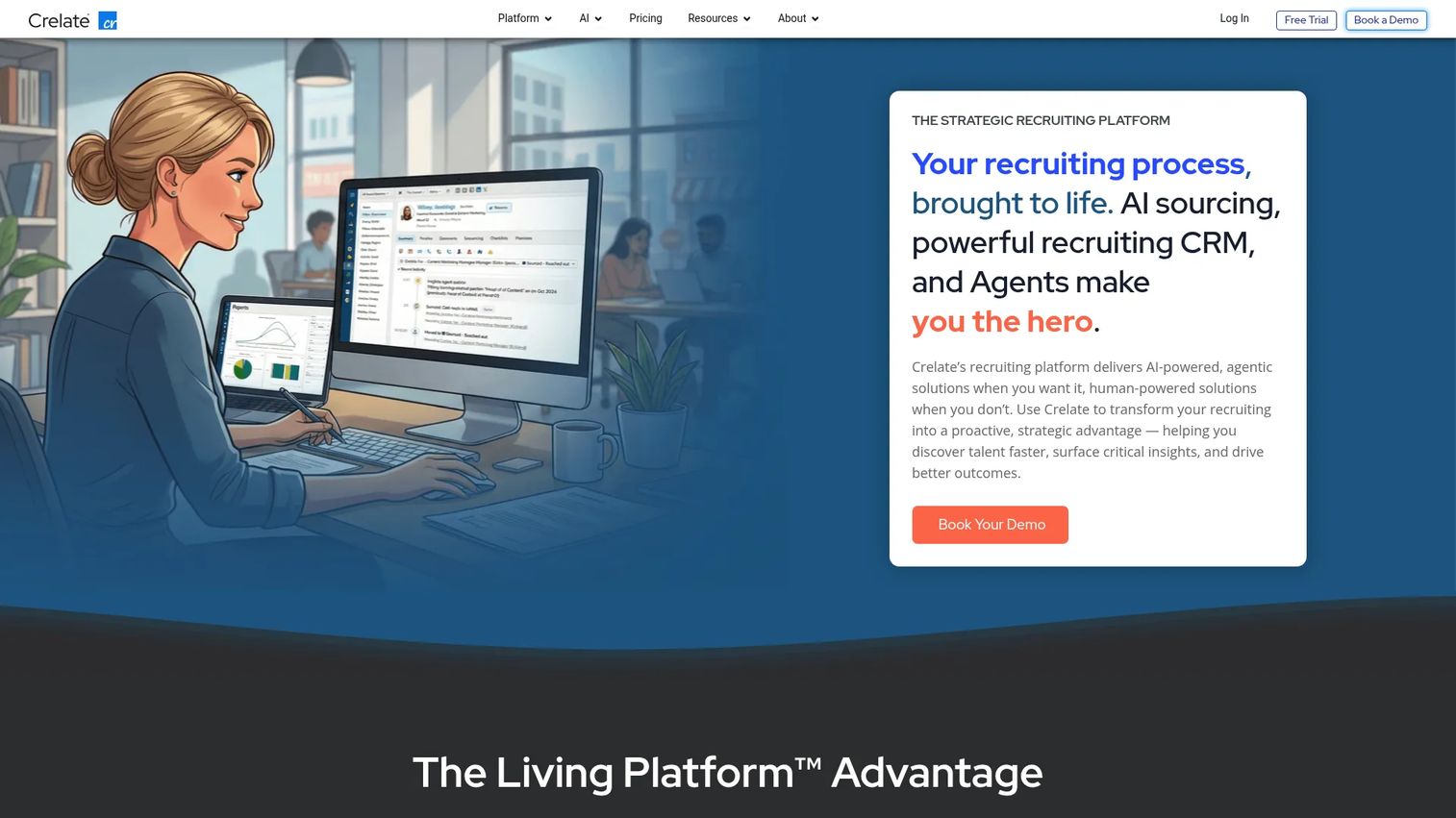
Crelate is an AI-powered recruiting platform combining an ATS, a recruiting CRM, sourcing, analytics, and onboarding workflows. It leans toward relationship-driven teams that live and die by pipeline and candidate nurture, with AI features including a Discovery Agent, an Insights Agent, and a Co-Pilot. The published pricing makes it easy to scope before talking to sales.
Best for: Recruiting and staffing teams that want a flexible ATS and CRM with AI and onboarding options.
Key strengths
- ATS and recruiting CRM: Pipeline management and client relationship management in one view.
- AI agents: Discovery, Insights, and Co-Pilot agents assist sourcing and decision-making.
- Onboarding workflows: Extends past placement into onboarding and compliance modules.
Why choose Crelate: For relationship-led firms, Crelate's emphasis on nurture and pipeline visibility fits how the work actually happens. Transparent published pricing helps a buyer model cost before a demo, which operators appreciate. Some modules like Data Sync and onboarding are priced separately, so scope the full picture.
Crelate pricing: Essentials is $85 per user per month paid annually. Business is $119 per user per month, billed monthly or annually. Business Plus and Platform Pricing are custom, and modules such as Data Sync Service and Onboarding/Compliance are priced separately. No free tier is shown.
8. Avionté
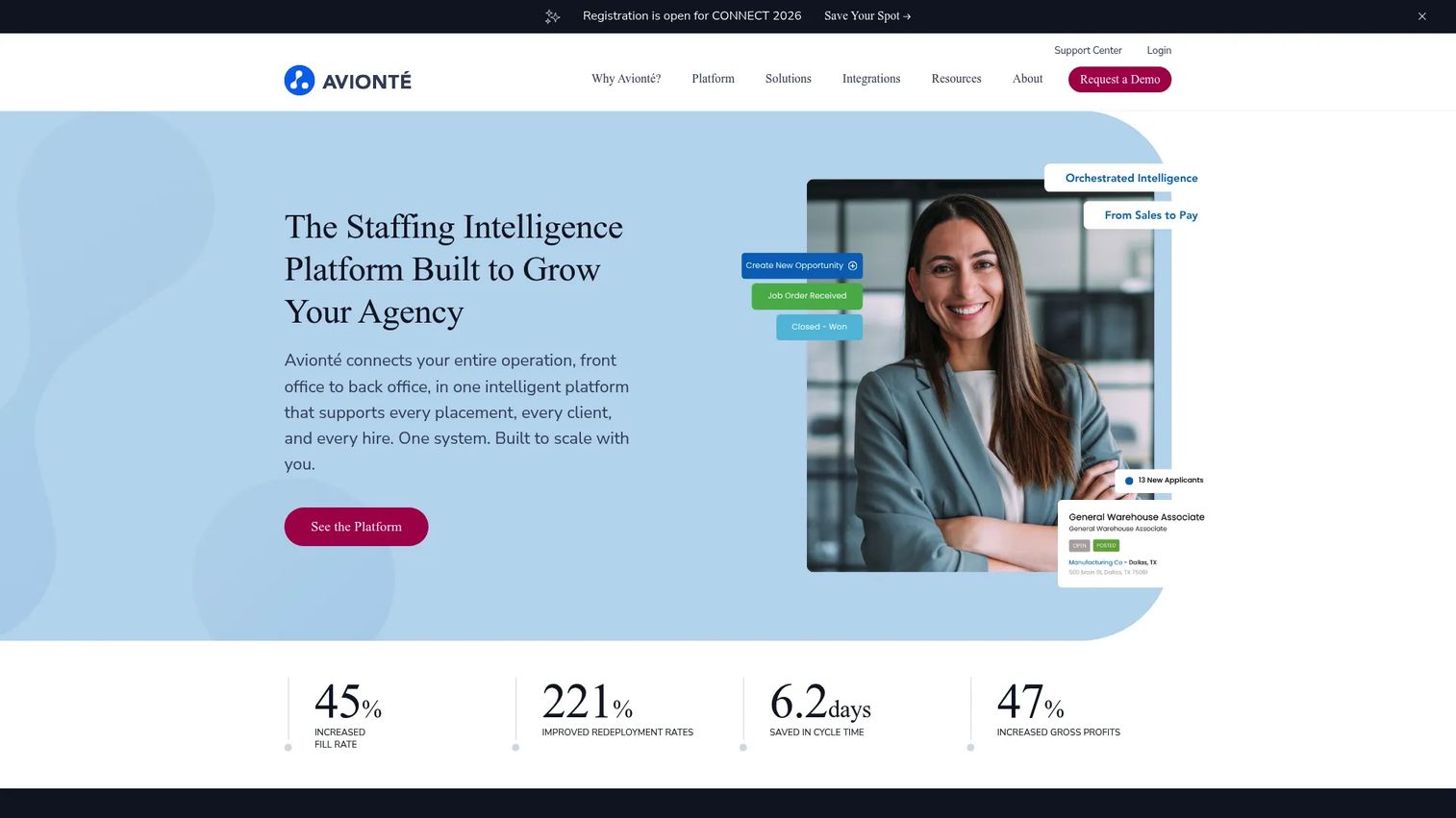
Avionté is all-in-one staffing and recruiting software that pairs CRM and ATS with payroll and billing in a single system. Built on two decades of staffing expertise, it targets agencies that want one platform spanning recruiting and back-office operations. Reporting and analytics round out the candidate and client workflows so leadership can see performance without exports.
Best for: Staffing agencies that need a single system for recruiting and back-office operations.
Key strengths
- CRM and ATS in one: Manages candidates and clients without separate systems.
- Payroll and billing: Runs pay and invoicing inside the same platform as recruiting.
- Reporting and analytics: Surfaces staffing performance for operational decisions.
Why choose Avionté: For firms that process significant payroll volume and want recruiting and back office unified, Avionté's combined front and back office is the operational draw. The platform reports outcomes like improved redeployment rates and reduced cycle time for staffing customers. It fits operationally heavy agencies more than recruiter-only teams.
Avionté pricing: Avionté does not publish public pricing on its site, so plan on a quote and demo conversation. Pricing scopes to your front and back office module needs and firm size. Confirm current figures directly with the vendor.
What to look for in staffing software
A defensible shortlist comes down to a handful of criteria. Use this checklist to pressure-test any platform before you commit.
ATS and CRM depth
The core question is whether the candidate side and client side stay in sync without re-keying. Evaluate how requisitions, pipelines, submissions, and client records connect. Shallow integration here creates the exact fragmentation you are trying to escape.
Automation and AI matching
Look at which repetitive steps the platform removes: status updates, follow-ups, resume parsing, candidate ranking. Automation is where recruiter productivity actually moves. Test it against your real workflow, not a canned demo flow.
Integrations
Confirm the platform connects to your job boards, email, calendars, and back-office tools. A large marketplace or open API decides whether the system fits your stack or fights it. Verify the specific integrations you depend on, not just the count.
Reporting and metrics
You need fill rate, time-to-fill, submission-to-placement ratio, and recruiter productivity without building dashboards by hand. Check whether reporting is native and exportable. If leadership cannot get clean numbers, the tool will not survive a partner meeting.
Front office versus back office
Decide whether you need payroll and billing inside the system or integrated. Full-suite platforms own both; recruiter-focused tools integrate the back office. Matching this to your operating model avoids paying for coverage you will not use.
Conclusion
The right pick depends on your staffing operations maturity, not a feature count. For enterprise depth across front and back office, Bullhorn is the operator default with a marketplace that fits most stacks. For firms that run payroll and billing in-house, TempWorks and Avionté unify recruiting with the back office. For all-in-one AI recruiting with a free starting point, Loxo consolidates sourcing into the ATS. For lean recruiter productivity, Recruit CRM's usability is hard to beat, and Zoho Recruit wins on affordability and ecosystem fit. For automation at volume, CEIPAL and its VMS layer scale, while Crelate suits relationship-driven teams with transparent pricing.
The next step is simple: shortlist two platforms that match your operating model, then run a real workflow through each, ideally with a free trial or scoped demo. Watch how the candidate experience and recruiter experience feel in practice, and confirm the reporting answers the questions your leadership actually asks.
FAQs
Staffing software is a system that helps agencies and internal teams source, track, place, and sometimes pay candidates from one connected platform. It usually combines an ATS for managing candidates and pipelines with a recruiting CRM for managing clients and business development. Full-suite tools add payroll, billing, and onboarding so the front office and back office run together.
An ATS manages the candidate journey: requisitions, applications, screening, submissions, interviews, and placements. A recruiting CRM manages relationships on the client and prospect side, including business development and contact history. Staffing platforms keep both in sync so recruiters never copy data between a candidate record and a client record.
Pricing varies widely because staffing software pricing depends on modules, seats, and whether you need back-office coverage. Some vendors publish per-user rates, from roughly $25 per recruiter on the low end to $85 to $165 per user for fuller platforms. Many full-suite providers sell through custom quotes because payroll and billing scope changes the price. Always confirm current figures with the vendor.
Prioritize automation, integrations, reporting, candidate experience, and scalability. Automation drives recruiter productivity, integrations decide stack fit, and reporting gives leadership the fill rate and time-to-fill numbers they need. Strong candidate experience keeps placements from slipping, and scalability ensures the tool still fits as you grow.
Yes. Most staffing software connects to major job boards, email, and calendars, and many platforms run large integration marketplaces or open APIs. Integration depth matters because shallow connections force manual re-keying, which recreates the fragmentation you bought the software to solve. Verify the specific job boards and tools your team relies on before committing.
The core operational metrics are fill rate, time-to-fill, submission-to-placement ratio, and recruiter productivity. Fill rate shows how reliably you close open reqs, time-to-fill measures speed, and submission-to-placement ratio reveals pipeline quality. Tracking these consistently is what turns a gut feel into a forecast leadership can trust.
Small agencies should prioritize usability and affordability over breadth. Tools with a free tier or low per-recruiter pricing, like Zoho Recruit and Loxo, let lean teams stand up real workflows without a procurement cycle. Recruit CRM is a strong pick when ease of use and fast ramp matter most.
Larger firms usually need broader ATS, CRM, payroll, and reporting coverage in one system. Bullhorn fits scale with deep front and back office plus a large integration marketplace, while TempWorks and Avionté unify recruiting with in-house payroll and billing. CEIPAL suits high-volume operations that need automation, VMS, and workforce management together.