You can rebuild a pricing page in a week. Swapping your core banking system is a different kind of problem entirely. The wrong platform shapes every product decision you make for years, limits which regulatory markets you can enter, and creates a migration bill that follows you through your next two fundraises.
The global core banking software market stood at $13.3 billion in 2025 and is projected to reach $28.5 billion by 2033, according to Grand View Research (2026). That growth is being pulled by one force: Banks, credit unions and fintech companies that have outgrown batch-processing, legacy infrastructure and the product velocity it kills.
According to the FIS Global State of Bank Modernization and Technology Transformation report (2025), 86% of banking executives rated modernization as very important or critical to long-term strategic goals. Meanwhile, 68% of financial institutions surveyed by Hanover Research and Temenos (2025) were already investing in cloud-based core banking systems. The direction is clear. The hard part is choosing the right platform for your operating model.
So which core banking software actually fits the company you are building, not just the one you are describing to investors?
What's inside
This guide compares 15 core banking software platforms for 2026. It is built for fintech founders, banking technology leaders and operators evaluating core infrastructure decisions that affect compliance, product velocity and investor due diligence.
Tools were selected based on:
- Account, deposit and lending coverage
- Deployment model: Cloud-native, cloud-ready, hosted or on-premises
- API depth and integration readiness
- Fit for banks, credit unions, fintechs or embedded finance
- Modernization track record and operational risk profile
TL;DR
- Best for U.S. banks and credit unions: DNA offers mature core processing, open architecture and relationship-level account management built for American financial institutions
- Best cloud-native core from a major vendor: Finxact delivers event-driven, API-first architecture for institutions that need modern product velocity
- Best for large bank modernization: TCS BaNCS and Finacle Core Banking Solution suit institutions with complex portfolios and transformation teams
- Best for global universal banking: Temenos Core Banking covers retail, corporate, private and Islamic banking with cloud-native deployment options
- Best for neobanks and composable banking: Mambu Cloud Banking Platform and Thought Machine Vault Core give fintech teams programmable, cloud-native infrastructure
- Best for embedded finance: Unit provides embedded accounts, cards and payments for SaaS platforms that want banking features without operating a bank core
What is core banking software?
Core banking software is the system of record that financial institutions use to manage customer accounts, deposits, loans, ledger balances, interest, fees, transactions, payments and operational workflows. It is the back-office engine that keeps every financial position current, regardless of what channel a customer uses.
Core banking systems, often called CBS, sit at the center of a financial institution's technology stack. Every account opening, deposit posting, loan disbursement, payment instruction and fee calculation flows through this layer. Adjacent systems, including digital banking platforms, card processors, KYC providers and payment rails, connect to the core rather than replace it.
Key capabilities of core banking software include:
- Account and customer record management: Centralized customer data, relationship hierarchies and account structures
- Deposit and loan product configuration: Parameterized product factories for savings, checking, term deposits and lending products
- Ledger and transaction posting: General ledger with real-time or batch transaction posting and reconciliation
- Interest, fee and statement processing: Automated accrual, fee charging and periodic statement generation
- Payment and channel integration: Connections to ACH, wire, RTP, SWIFT and card networks
- Risk, audit and compliance controls: Regulatory reporting hooks, transaction monitoring signals and audit trails
- APIs for digital banking and partner systems: Open interfaces for digital channels, CRM, KYC, AML and analytics
- Reporting, analytics and operational automation: Management information, regulatory reports and workflow automation
Deployment models range from on-premises and hosted to cloud-ready, cloud-native, SaaS and hybrid configurations. These are not interchangeable terms. Cloud-native systems are built from the ground up for cloud infrastructure. Cloud-ready systems are adapted from older architectures. The distinction matters when you are modeling uptime commitments, data residency obligations and long-term vendor dependency.
One boundary worth stating plainly: Core banking software handles the financial record and transaction logic. Digital banking platforms typically power the customer-facing web and mobile experience. You usually need both, and they are separate procurement decisions.
When to use core banking software
Replace a legacy core without freezing product velocity
Banks and credit unions that run batch-processing cores find that every new product requires months of internal configuration work. If your team waits two quarters to launch a new savings product because the core does not support it natively, the core is writing your product roadmap. Modernization programs typically start here: Identify where the legacy system constrains product launches, then evaluate cloud-native or cloud-based core banking systems that support configurable product factories and real-time posting.
Launch a neobank, wallet or embedded finance product
A polished mobile app without reliable core infrastructure creates reconciliation and compliance debt from day one. Fintech teams launching deposits, wallets, cards or lending products need ledgering, account structures, transaction processing and compliance hooks before they scale. Choosing cloud native core banking infrastructure early avoids the situation where product velocity outpaces the financial ledger underneath it.
Add real-time payments, open banking or new deposit products
Institutions adding instant payments, multi-currency accounts, new savings products or sponsor bank programs need a core that supports API-first integration and modular product configuration. Legacy cores that require custom development for each new payment rail or product type create engineering bottlenecks that slow down the entire go-to-market motion. The right core banking platform makes these additions a configuration exercise, not a development project.
Core banking software comparison
The table below covers all 15 platforms in this guide. Pricing across this category is quote-based. Implementation, modules, institution size and migration complexity drive the final contract. Contact each vendor's sales team to model the actual cost for your operating scenario.
| # | Product | Best for | Key differentiator | Pricing | G2 rating |
|---|---|---|---|---|---|
| 1 | DNA | U.S. banks and credit unions | Real-time processing with open AppMarket extensibility | Quote-based | 4.3/5 |
| 2 | Finxact | Cloud-native core from a major vendor | Event-driven, API-first architecture for modern banking | Quote-based | N/A |
| 3 | TCS BaNCS | Large bank modernization | Cloud-native microservices covering banking, payments and wealth | Quote-based | 4.3/5 |
| 4 | Finacle Core Banking Solution | Global retail and corporate banking | Flexible product factory with multi-entity, multi-currency support | Quote-based | 4.2/5 |
| 5 | Temenos Core Banking | Global universal banking | Modular cloud-native core covering retail to Islamic banking | Quote-based | 4.5/5 |
| 6 | Oracle FLEXCUBE | Enterprise banking across multiple lines | Multientity, multitenancy with Oracle stack integration | Quote-based | N/A |
| 7 | Mambu Cloud Banking Platform | Digital banks and fintechs | Composable SaaS core for lending, deposits and API connectivity | Quote-based | 3.8/5 |
| 8 | FIS Profile | Banks needing mature core processing | Real-time multicurrency core with flexible deployment options | Quote-based | N/A |
| 9 | Thought Machine Vault Core | Programmable cloud-native architecture | Smart-contract product engine with unified real-time ledger | Quote-based | N/A |
| 10 | Jack Henry | Community banks and credit unions | Integrated core, digital banking and payments technology partnership | Quote-based | 3.9/5 |
| 11 | 10x Banking | Modern product launches on cloud-native core | AI-powered configuration with polyglot extensibility | Quote-based | N/A |
| 12 | Nymbus | Digital bank launches for existing institutions | Bundled core, digital banking, onboarding and managed services | Quote-based | N/A |
| 13 | Skaleet Core Banking Platform | Modular API-first banking | Event-driven SaaS core for banks and fintechs | Quote-based | 5.0/5 |
| 14 | SDK.finance | Fintech wallet and payment infrastructure | Source-code licensing with 650+ APIs and white-label apps | Quote-based | 5.0/5 |
| 15 | Unit | Embedded finance for SaaS platforms | API-first embedded accounts, cards and credit with compliance workflows | Quote-based | 3.5/5 |
Best 15 core banking software platforms for 2026
1. DNA
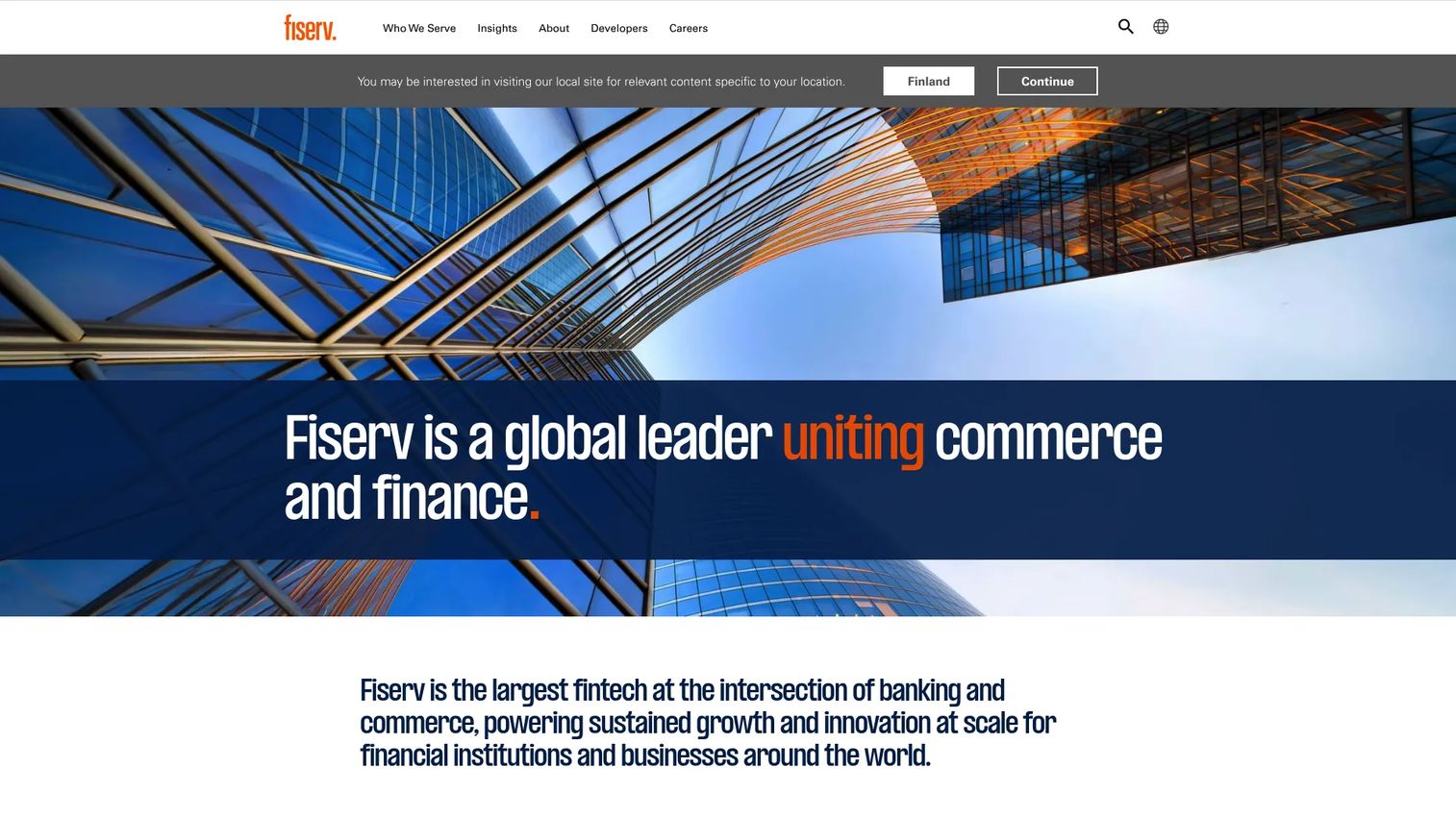
DNA is Fiserv's core account processing platform for financial institutions, built around real-time banking, relationship-level data and an open architecture that supports both native and third-party extensibility. The platform organizes data around people and relationships rather than accounts, which means a single customer view spans all products. It supports 24/7 real-time transaction processing, modern responsive interfaces and a toolkit for custom application development.
Best for: Banks and credit unions that need a mature, configurable U.S.-focused core with proven institutional depth.
Key features
- Open architecture with AppMarket for third-party integrations
- 24/7 real-time transaction processing across all accounts
- Relational data model organized around people and relationships
- DNAcreator toolkit and DNAapps for custom extensions
- eSignature, photo ID and biometric authentication support
Why choose DNA: DNA is a strong fit when you want a core with a deep U.S. community banking and credit union track record, broad integration options and the ability to extend the platform without replacing it.
DNA pricing: Pricing goes through Fiserv's sales team. Implementation, module selection and institution size determine the final contract.
G2 rating: 4.3/5
2. Finxact
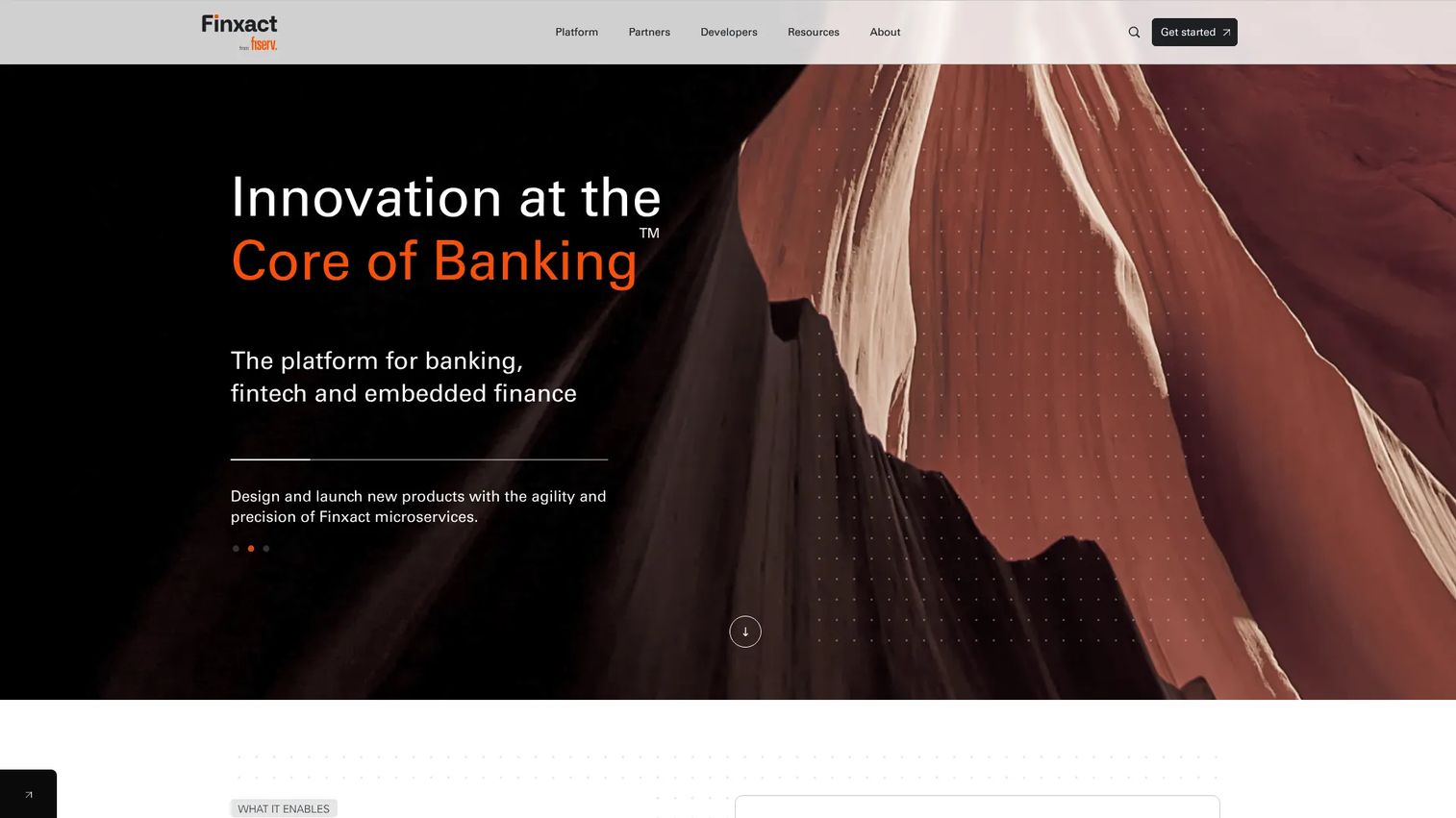
Finxact is a cloud-native, event-driven core banking platform with an API-first design for financial institutions, fintechs and embedded finance builders. The platform uses an adaptive open data model with a customizable schema, which means institutions can define financial products without waiting for vendor development cycles. It supports real-time, in-balance transaction processing and native payment capabilities including ACH, RTP and wire. Finxact is now part of the Fiserv ecosystem, giving it access to a major vendor's infrastructure and distribution while maintaining its modern architecture.
Best for: Financial institutions and fintechs that want cloud-native core architecture backed by a major banking technology vendor.
Key features
- Event-driven microservice architecture with real-time in-balance processing
- Adaptive, open data model with customizable schema
- RESTful API-first access to all banking data
- Multi-asset and multi-currency account support
- Native ACH, RTP and wire payment capabilities
Why choose Finxact: Finxact is a fit for teams that need product velocity without building a proprietary core. The Fiserv backing reduces the vendor-stability risk that pure-play cloud-native startups carry.
Finxact pricing: Pricing runs through Fiserv's sales process. Contract terms are negotiated based on institution size and product scope.
3. TCS BaNCS
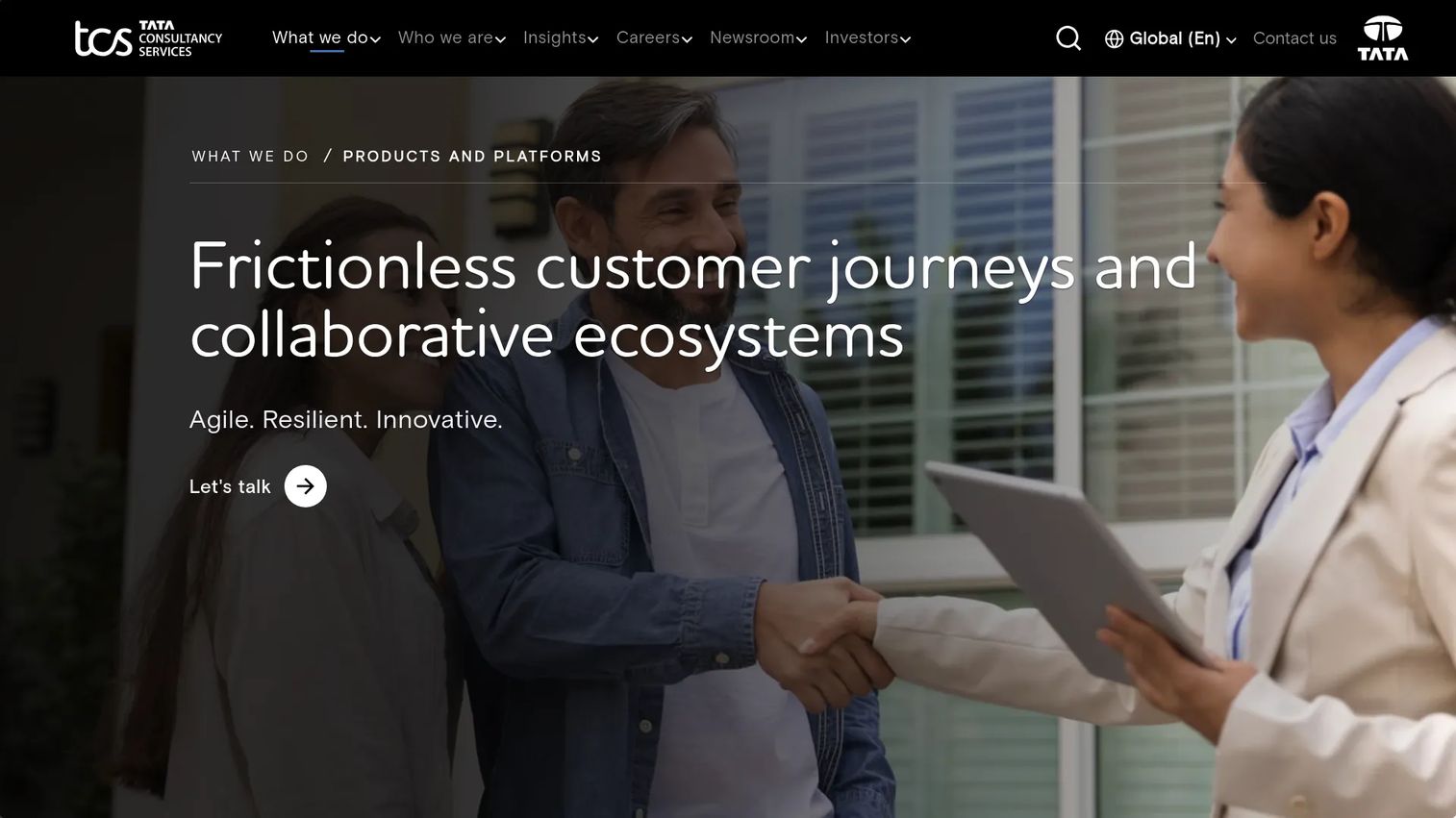
TCS BaNCS is a cloud-enabled financial services platform covering core banking, payments, capital markets, insurance and wealth management. For banking institutions specifically, it addresses deposits, savings, lending, trade finance, fees, pricing and digital account opening. The platform uses a cloud-native microservices architecture with open APIs, and it supports both domestic and cross-border real-time payment processing. TCS brings implementation capacity through its global consulting organization, which matters when a transformation program spans multiple business lines and geographies.
Best for: Large banks and financial institutions with complex portfolios and transformation teams that can support an enterprise-scale implementation.
Key features
- Cloud-native microservices with rich API connectivity
- Core banking covering lending, savings, deposits and payments
- Digital banking and online account opening
- Cross-border, real-time and domestic payment processing
- Wealth management, treasury and loan origination modules
Why choose TCS BaNCS: TCS BaNCS suits institutions running multi-country or multi-entity programs where a single vendor with deep implementation capacity reduces coordination risk across a transformation.
TCS BaNCS pricing: Enterprise quote-based pricing. Institution size, geographic scope and module selection drive the contract. Engage TCS directly for a scoped estimate.
G2 rating: 4.3/5 (TCS BaNCS listing on G2, based on 13 reviews).
4. Finacle Core Banking Solution
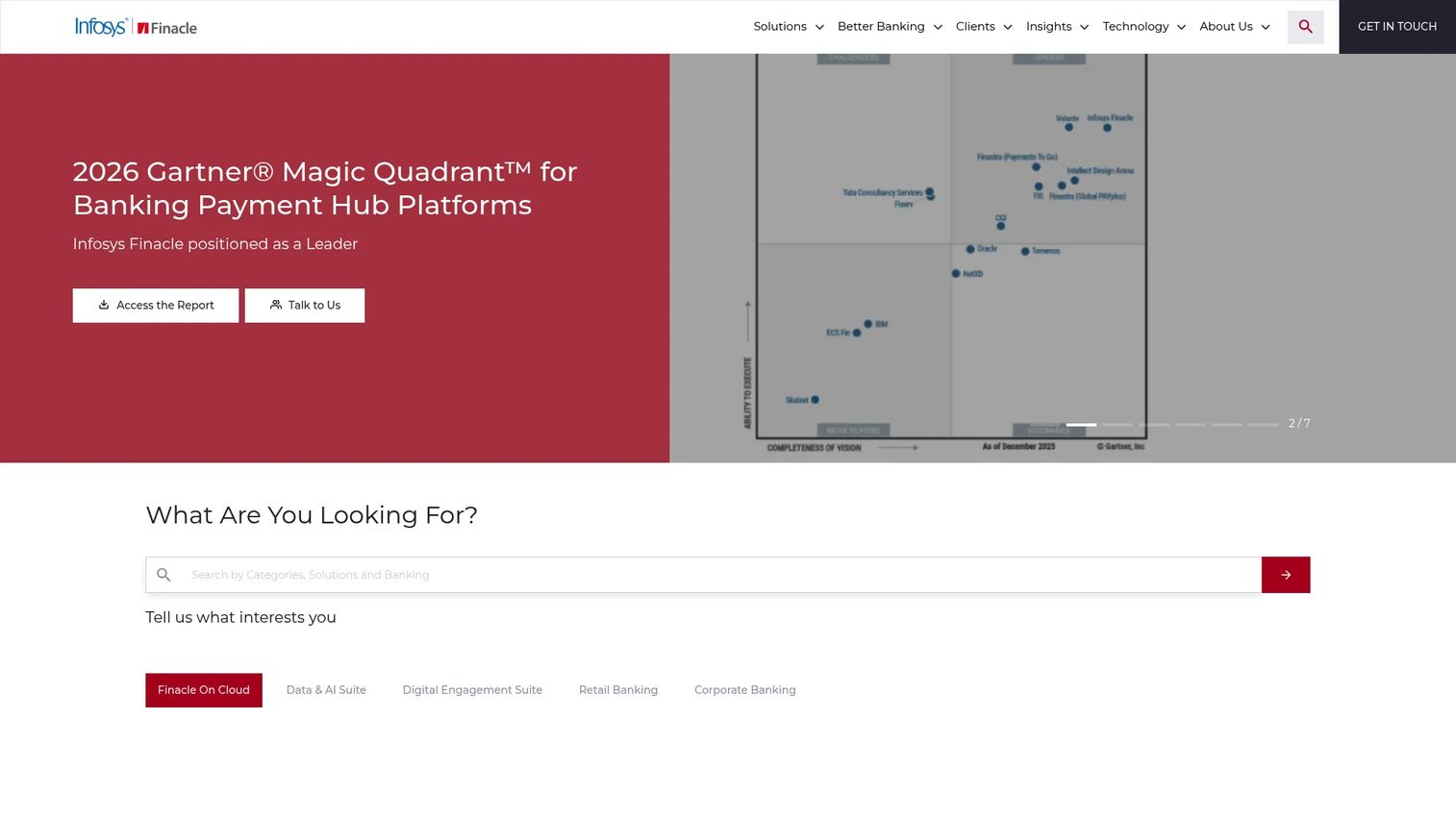
Finacle Core Banking Solution from Infosys is a widely adopted cloud-native core banking platform for retail, corporate and universal banking. The platform includes a flexible product factory that lets banks configure new financial products through parameterization rather than development. Open APIs and event-driven connectivity support digital channels, fintech partnerships and ecosystem integrations. Finacle supports multi-entity, multi-currency, multilingual and multi-time-zone deployments, making it a common choice for banks operating across borders or planning geographic expansion.
Best for: Banks seeking a global core platform with a mature implementation ecosystem and broad banking product coverage.
Key features
- Real-time processing engine with open API integration
- Flexible product factory and reusable business components
- Cloud-native, cloud-agnostic deployment architecture
- Multi-channel, multi-entity, multi-currency and multilingual support
- Analytics, reporting and embedded customer insights
Why choose Finacle Core Banking Solution: Finacle fits institutions that need a mature enterprise platform with a large global partner network for implementation, customization and ongoing support.
Finacle pricing: Quote-based. Pricing is negotiated with Infosys based on institution size, product scope and deployment model. No tier information is posted.
G2 rating: 4.2/5
5. Temenos Core Banking
Temenos Core Banking is a modular, cloud-native banking platform for retail, business, corporate, private, wealth, payments, treasury and Islamic banking. The platform supports progressive modernization: Institutions can replace specific banking domains without a full-core swap. A Product Builder and Extensibility Framework let teams configure banking products and extend the platform. Temenos offers cloud-native and cloud-agnostic deployment, including SaaS delivery, and it has embedded AI through Temenos Copilots and AI Agents for operational automation.
Best for: Banks balancing modernization goals with broad banking product coverage across multiple customer segments.
Key features
- Modular architecture for progressive, domain-by-domain modernization
- Cloud-native and SaaS deployment options
- Product Builder and Extensibility Framework for configuration
- Retail, corporate, wealth, treasury and Islamic banking coverage
- Embedded AI through Copilots and AI Agents
Why choose Temenos Core Banking: Temenos is a practical choice when you need to modernize incrementally rather than in a single migration. The modular model reduces the operational risk of a full core replacement.
Temenos pricing: Pricing is handled through Temenos sales.
G2 rating: 4.5/5
6. Oracle FLEXCUBE
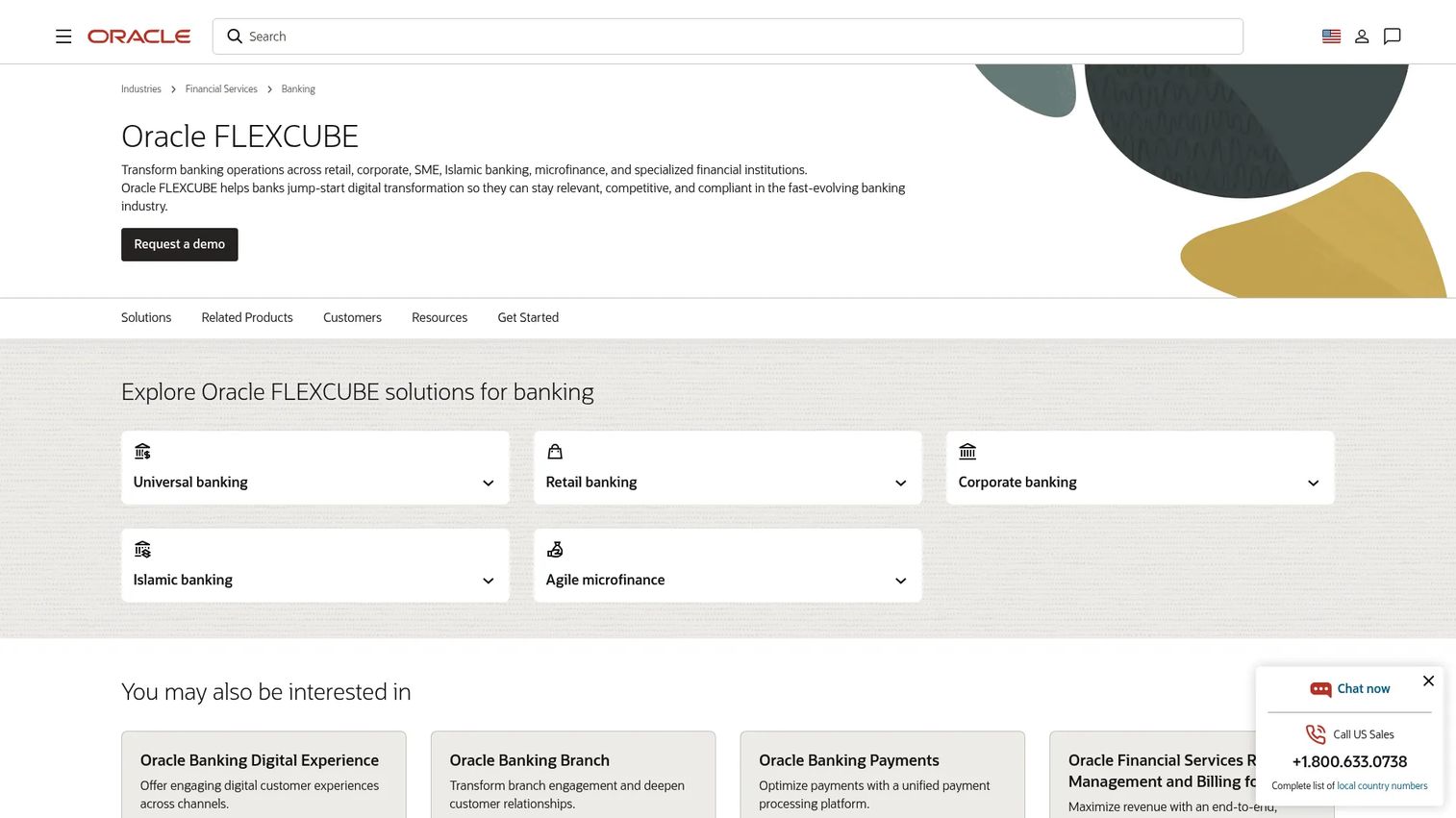
Oracle FLEXCUBE is an enterprise core banking platform for retail, corporate, SME, Islamic banking, microfinance and specialized financial institutions. It supports multientity, multitenancy, multicountry and multilingual deployments. The platform includes REST APIs, an integration hub, SAML 2.0 support and ISO 20022 connectivity. For institutions already running Oracle infrastructure, FLEXCUBE integrates within that environment. It handles both real-time and batch processing, with configurable workflows, pricing, interest and charge structures.
Best for: Large banks that need enterprise banking functionality across multiple business lines, often within an Oracle technology environment.
Key features
- Universal banking covering retail, corporate, SME and Islamic banking
- Multientity, multitenancy, multicountry and multilingual support
- REST APIs, integration hub and ISO 20022 connectivity
- Configurable workflows, pricing, interest and charge structures
- 24/7 real-time and batch processing capability
Why choose Oracle FLEXCUBE: FLEXCUBE suits institutions with complex organizational structures, multiple banking lines and existing Oracle infrastructure investments. The integration with Oracle's broader stack reduces point-to-point integration overhead.
Oracle FLEXCUBE pricing: Quote-based enterprise pricing. Scope, entity count and module selection drive the contract. Engage Oracle Financial Services sales directly.
7. Mambu Cloud Banking Platform
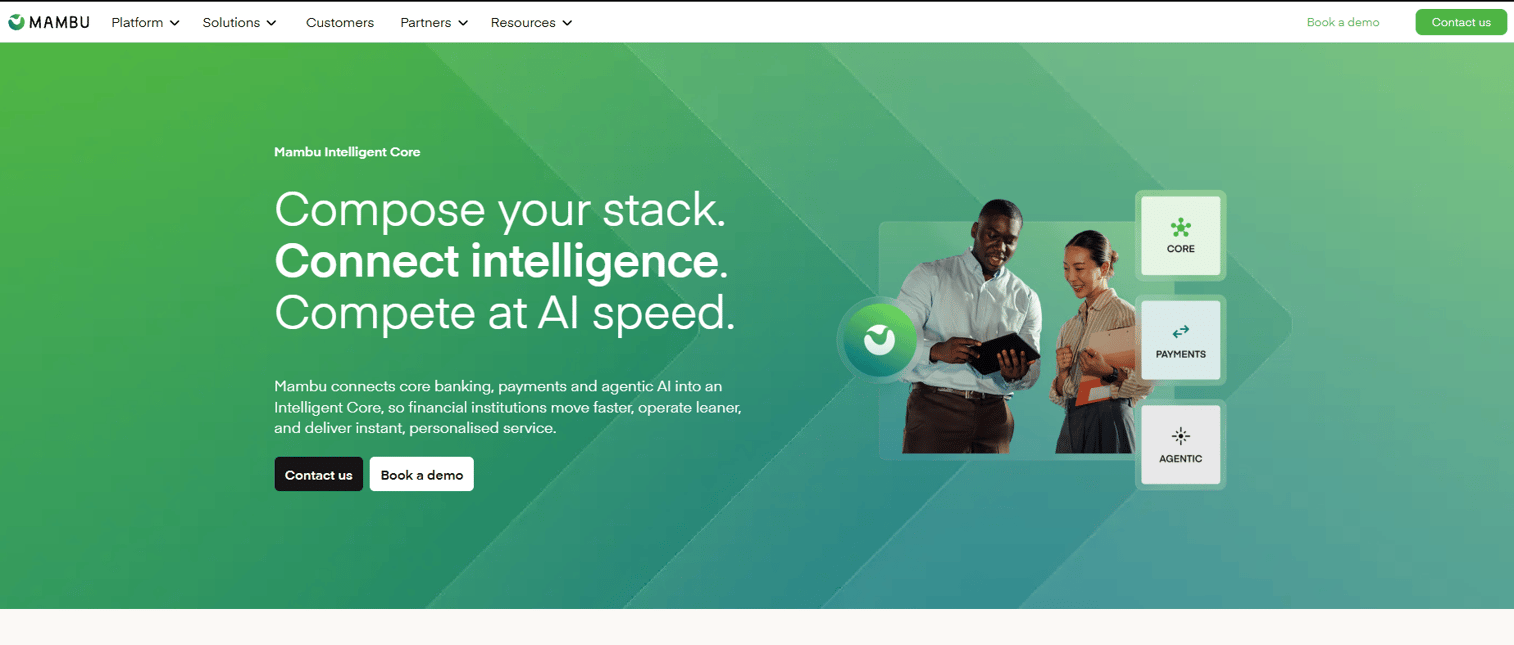
Mambu Cloud Banking Platform is a cloud-native, API-first core banking platform built on a composable architecture. It serves banks, lenders, fintechs and neobanks looking to configure and launch deposit and lending products without traditional core constraints. The platform runs on multi-cloud infrastructure across AWS, Google Cloud and Azure. Financial products and processes are configurable rather than coded, and the composable model means teams can add or swap components through third-party integrations. Payments connectivity and orchestration round out the banking stack.
Best for: Digital banks and fintech teams that need composable, cloud-native banking infrastructure with speed-to-market as a primary constraint.
Key features
- Cloud-native, API-first SaaS core banking
- Composable architecture with configurable financial products
- Lending, deposits and Islamic banking engines
- Multi-cloud deployment across AWS, Google Cloud and Azure
- Payments connectivity and third-party ecosystem integrations
Why choose Mambu Cloud Banking Platform: Mambu fits teams that want to build and iterate on banking products quickly, without managing core banking infrastructure internally. The composable model avoids vendor lock-in on specific product logic.
Mambu pricing: Mambu directs prospects to contact its team for pricing.
G2 rating: 3.8/5
8. FIS Profile
FIS Profile is a modern, real-time, multicurrency core banking platform for retail and commercial financial organizations. The platform is built for 24/7 availability and scales to millions of accounts, with configurable features that support faster product launches. It covers multicurrency deposits and loans, and it offers deployment flexibility across cloud, hosted, SaaS and licensed models. FIS is one of the largest financial technology providers globally, which means Profile comes with broad support infrastructure and adjacent products across payments, risk and digital banking.
Best for: Banks that need mature core banking capabilities from a large financial technology provider with deep implementation and support capacity.
Key features
- 24/7 real-time availability at scale
- Configurable features for faster product launches
- Multicurrency deposit and loan support
- Cloud, hosted, SaaS and licensed deployment options
- Payments integration across major rails
Why choose FIS Profile: Profile fits institutions that value provider depth and want a core backed by FIS's broader payments, risk and digital banking portfolio. The deployment flexibility is useful when data residency or internal hosting requirements constrain cloud options.
FIS Profile pricing: Pricing is handled through FIS's enterprise sales process. Contract scope depends on institution size, modules and deployment model.
9. Thought Machine Vault Core
Thought Machine Vault Core is an AI-native, cloud-native core banking platform that uses a programmable smart-contract product engine to define financial products as code. The unified real-time ledger supports current accounts, savings, term deposits, loans, mortgages, credit cards, BNPL, wallets and multi-currency products. The platform runs on multi-cloud infrastructure with event-driven streaming and real-time data. Vault Core is designed for institutions that want full control over product logic without being constrained by a vendor's pre-built product catalog.
Best for: Banks and fintechs with strong engineering capacity that want programmable, cloud-native architecture for launching highly configurable financial products.
Key features
- Programmable smart-contract product engine for full product flexibility
- Unified real-time ledger with high-performance banking workflows
- AI-native operations with event-driven streaming
- Multi-cloud deployment across major cloud providers
- Current accounts, savings, loans, credit cards, BNPL and wallets
Why choose Thought Machine Vault Core: Vault Core fits teams that have the engineering depth to define products as code and want to avoid the configuration ceilings of traditional core platforms. It is not the right call for teams that want a pre-configured product library.
Vault Core pricing: Pricing is handled through Thought Machine's sales team.
10. Jack Henry
Jack Henry provides financial technology for banks, credit unions, fintechs and businesses, with a focus on community and regional financial institutions. Its offering covers core banking, digital banking, payments, lending, financial operations and cybersecurity. Rather than a single point product, Jack Henry acts as a long-term technology partner for institutions that want core processing alongside adjacent services like faster payments, bill pay, card processing and fraud risk tools. Its cloud-native banking platform and open banking integrations support digital modernization without requiring a full infrastructure replacement.
Best for: Community banks and credit unions that want a long-term banking technology partner rather than a narrow core-only vendor.
Key features
- Cloud-native banking platform with digital banking connections
- Faster payments including FedNow, RTP, ACH and wire
- Core banking and credit union processing platforms
- Lending, financial operations and card processing support
- Cybersecurity and fraud risk tools
Why choose Jack Henry: Jack Henry fits institutions that want a single relationship covering core and adjacent technology. The community bank and credit union focus means the support model and product development priorities align with that segment's actual operating constraints.
Jack Henry pricing: Quote-based. Engage Jack Henry's sales team. Contract scope depends on institution size and product bundle.
G2 rating: 3.9/5
11. 10x Banking
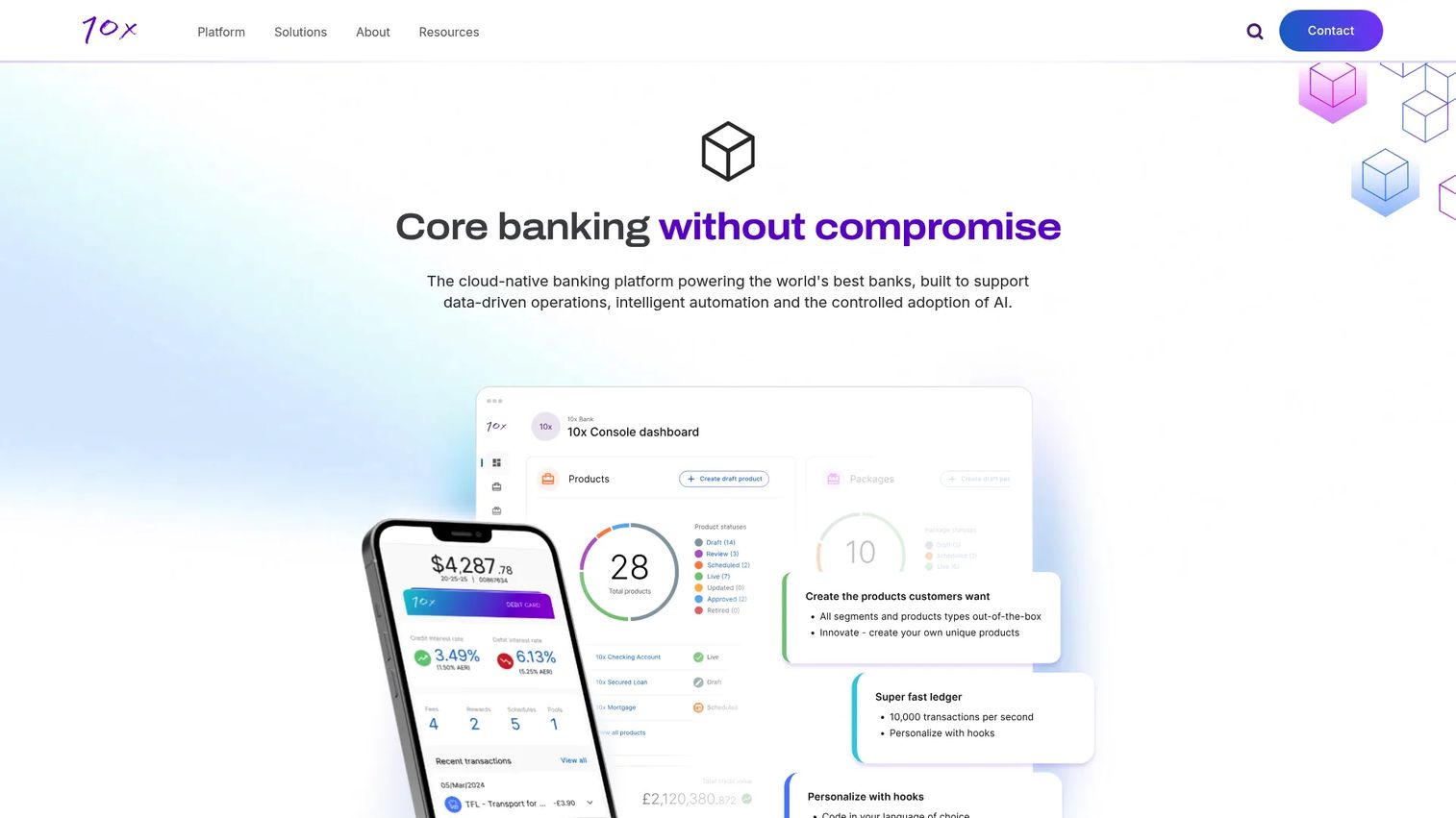
10x Banking provides a cloud-native core banking platform for financial institutions launching modern digital propositions. The platform uses AI-powered product configuration, data querying and legacy data migration to reduce the engineering effort of a core replacement. Its API-first, event-driven architecture delivers real-time data across all products. Teams can configure banking products through a no-code interface or extend through custom code using a polyglot runtime supporting Java, JavaScript, Python, Go, Ruby and .NET. Built-in support covers deposits, lending, credit cards, mortgages, payments, pricing, fees, rewards and virtual accounts.
Best for: Established banks modernizing core infrastructure or launching new digital banking propositions at scale.
Key features
- AI-powered product configuration and data querying
- API-first, event-driven real-time architecture
- No-code UI with polyglot extensibility
- Deposits, lending, credit cards, mortgages and payments
- Built-in pricing, fees, rewards and virtual accounts
Why choose 10x Banking: 10x Banking fits institutions that want modern core capabilities without a proprietary constraint on how products are built. The AI-powered migration tooling reduces the data risk of moving off a legacy system.
10x Banking pricing: Pricing is defined in statements of work or private offers. Contact 10x Banking's sales team for a scoped engagement.
12. Nymbus
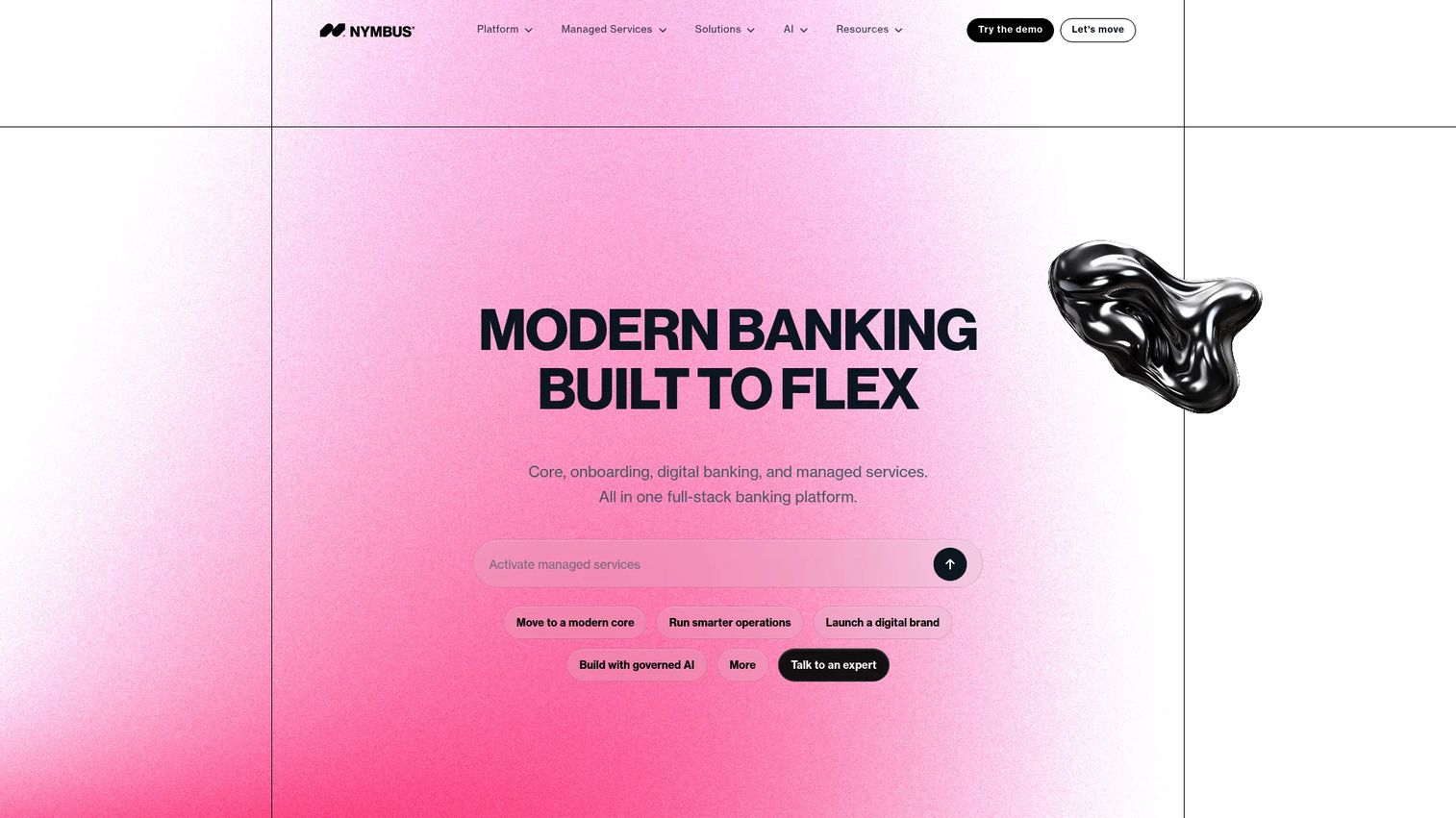
Nymbus provides a modern banking platform that bundles core processing, digital banking, account opening, payments, managed services, analytics, rewards and governed AI into a single offering for banks and credit unions. The managed services layer covers contact center, onboarding, servicing, compliance, fraud and back-office operations, which reduces the internal headcount a bank needs to run a new digital banking brand. Payment rails include debit, ACH, FedNow, RTP, wires and card-to-card. The governed AI layer includes permissions, approvals and audit trails.
Best for: Banks and credit unions launching a new digital banking brand or niche market proposition who want more than a raw core platform.
Key features
- Core banking and account servicing platform
- Digital banking, account opening and onboarding
- Payments across debit, ACH, FedNow, RTP and wires
- Managed services for compliance, fraud, contact center and back office
- Governed AI with permissions, approvals and audit trails
Why choose Nymbus: Nymbus makes sense when speed to launch matters and the institution does not want to build a full operations team from scratch. The bundled managed services model trades customization depth for operational speed.
Nymbus pricing: Pricing goes through Nymbus's sales team.
13. Skaleet Core Banking Platform
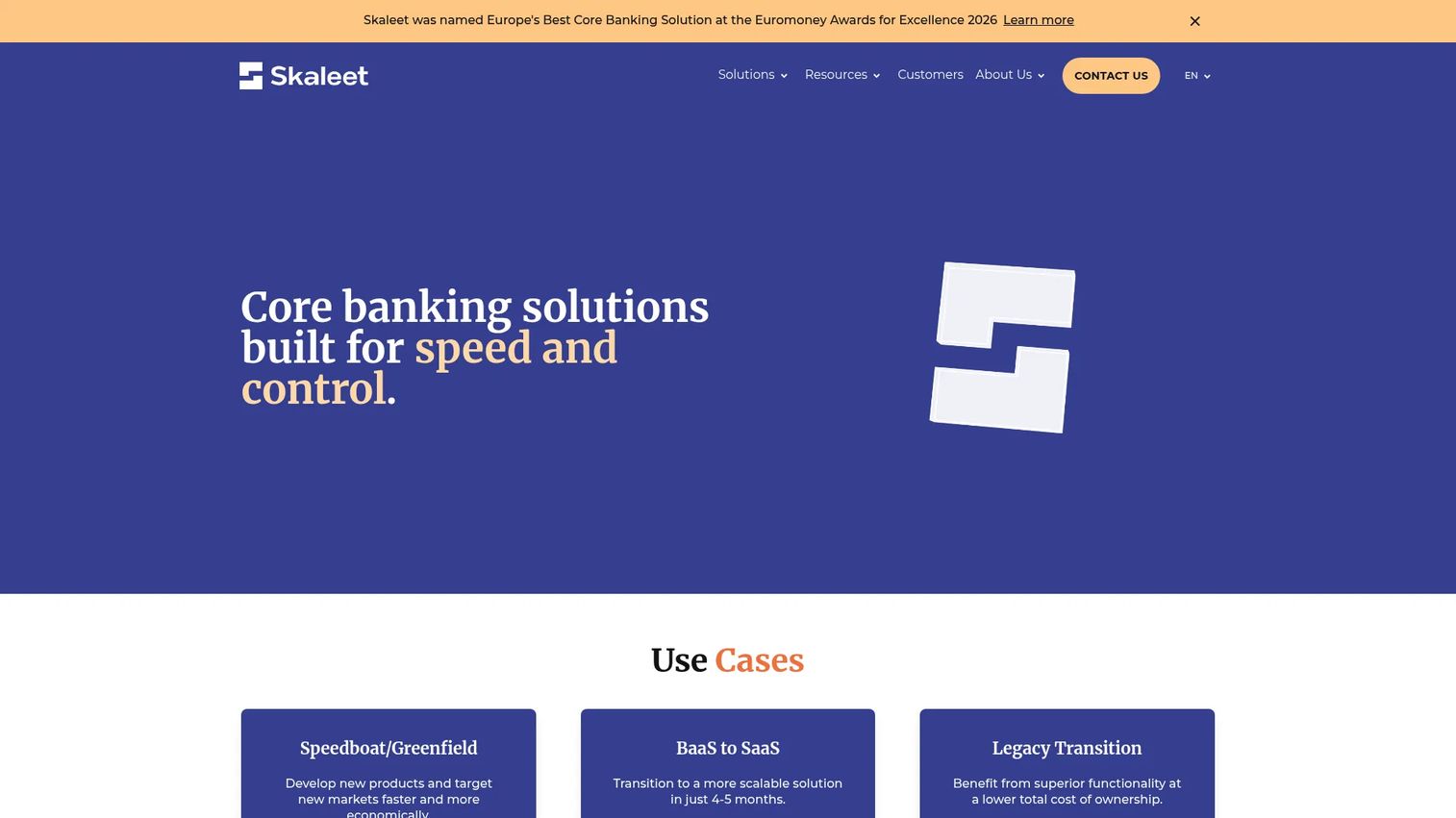
Skaleet Core Banking Platform is a SaaS core banking solution for banks, fintechs, payment service providers and banking-as-a-service providers. The platform is built on a modular, configurable architecture with event-driven, real-time processing and API-first integrations. It covers accounts, cards, payments, loans, savings and customer management, with process automation across banking workflows. The banking as a service model Skaleet supports makes it relevant for institutions that want to offer embedded financial products to third parties.
Best for: Financial institutions and fintechs modernizing core banking infrastructure or launching configurable financial products through an API-first model.
Key features
- Modular, configurable SaaS architecture
- API-first integrations with event-driven real-time processing
- Accounts, cards, payments, loans and savings
- Customer management and process automation
- Banking-as-a-service support for third-party product distribution
Why choose Skaleet Core Banking Platform: Skaleet fits teams that want API flexibility without the overhead of building a full core stack internally. The SaaS model reduces operational maintenance compared to self-hosted alternatives.
Skaleet pricing: Pricing is not posted. Contact Skaleet's sales team for a quote.
G2 rating: 5.0/5
14. SDK.finance
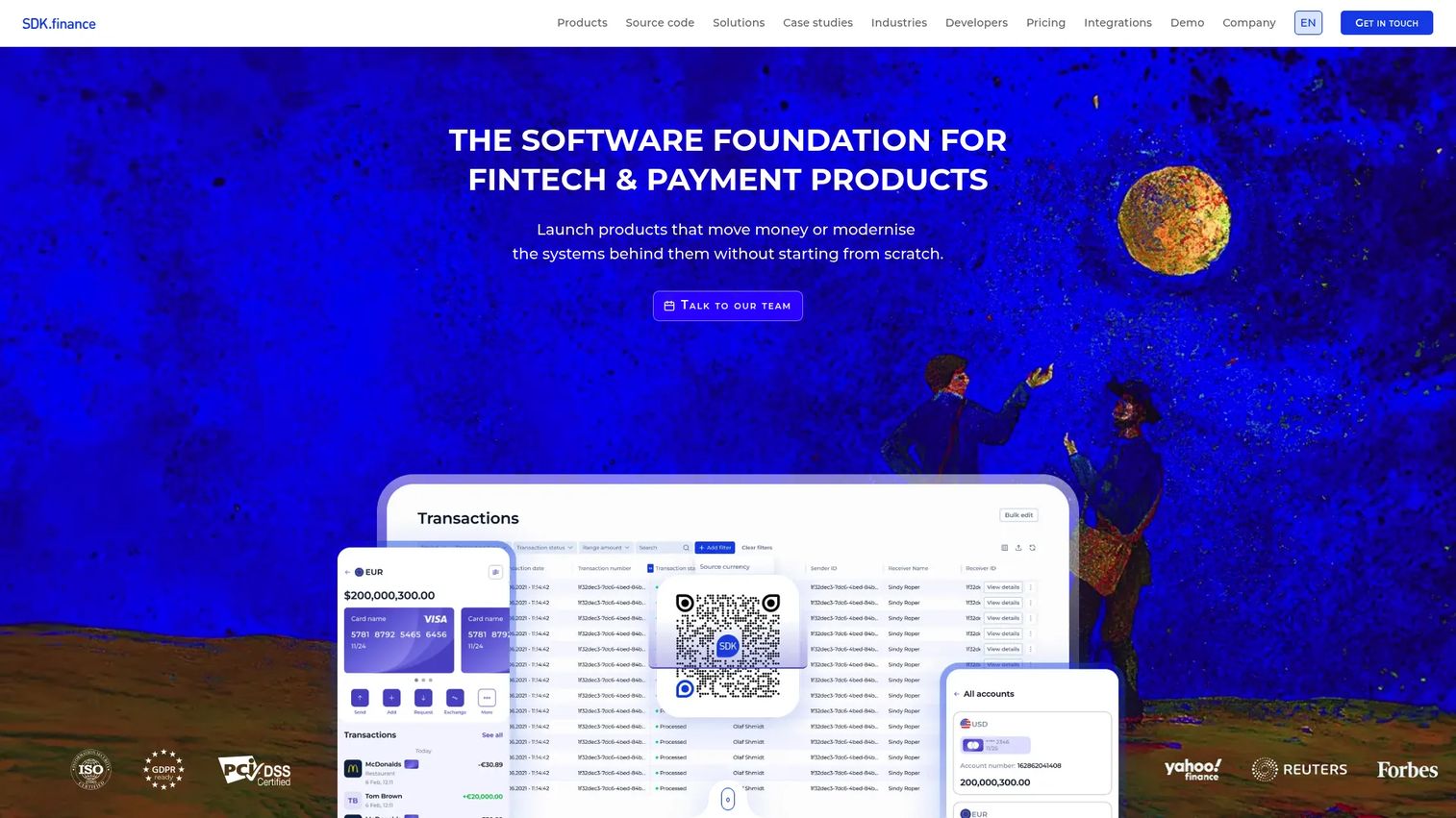
SDK.finance is an enterprise fintech platform for building and modernizing payment, banking, wallet, money-transfer, card-issuing and embedded finance products. The platform includes a general ledger with double-entry journal entries, reconciliation and audit-ready financial data. It connects to 650+ APIs and integrations covering payment rails, IBAN infrastructure, FX, crypto, KYC/KYB and AML services. SDK.finance offers white-label web, iOS and Android applications alongside a merchant portal and checkout page. The source-code licensing model, available as an annual or lifetime license alongside SaaS, gives buyers more control over infrastructure than a pure SaaS core typically allows.
Best for: Fintech teams building wallets, payment products, EMI products or embedded finance infrastructure who want ownership over the codebase.
Key features
- General ledger with double-entry accounting and reconciliation
- 650+ APIs for payment rails, KYC/KYB, AML and FX
- White-label web, iOS and Android applications
- Merchant portal and checkout page
- SaaS and source-code licensing options (annual or lifetime)
Why choose SDK.finance: SDK.finance is the right call when a fintech wants infrastructure flexibility, product ownership and faster buildout than traditional bank-core procurement allows. The source-code licensing model is unusual in this category and worth evaluating if vendor dependency is a strategic concern.
SDK.finance pricing: SDK.finance offers SaaS pricing structured as recurring platform fees plus transaction-based charges. Source-code licensing is available as annual or lifetime options.
G2 rating: 5.0/5
15. Unit
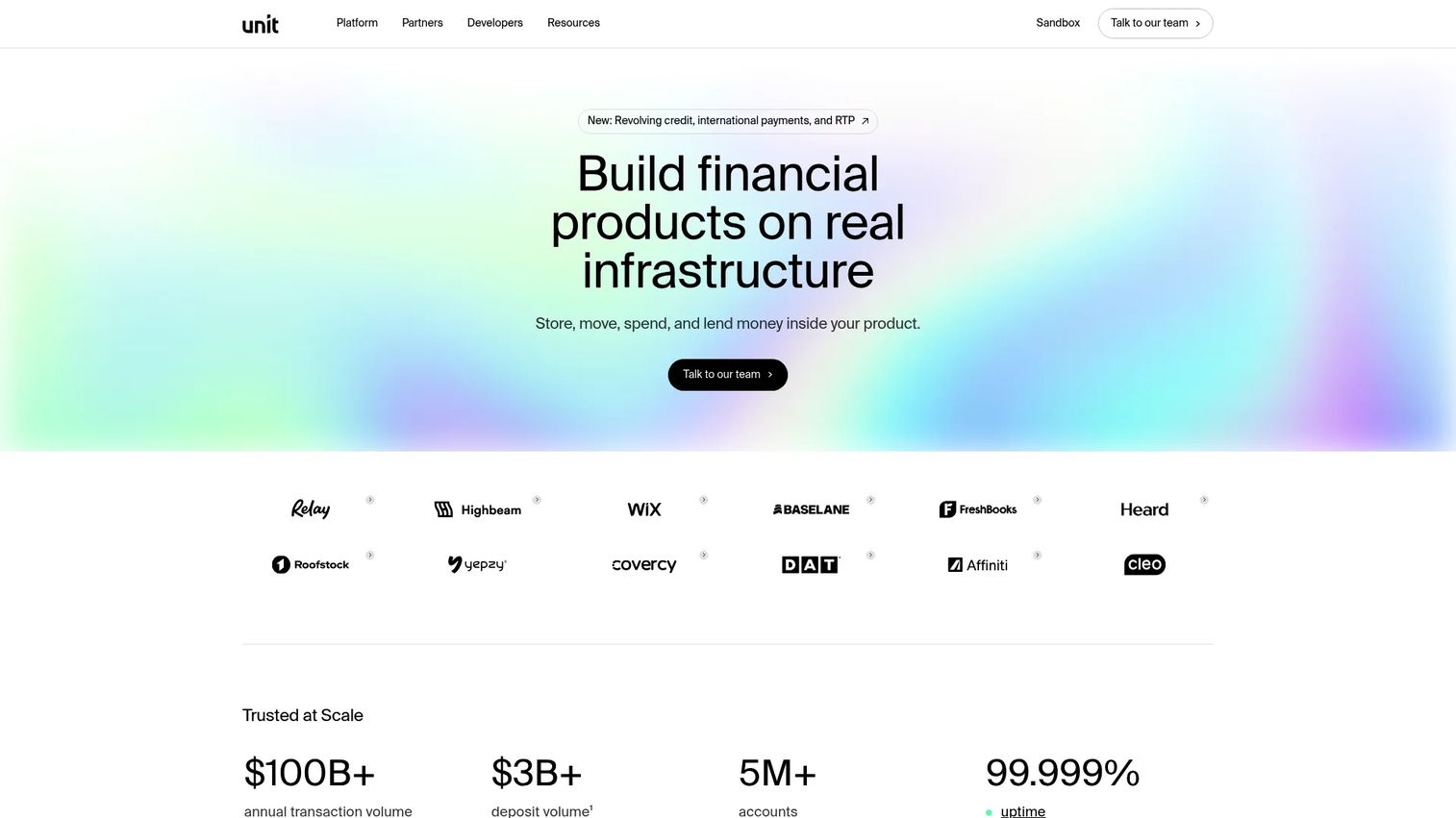
Unit is an enterprise-grade financial infrastructure platform for software companies embedding accounts, payments, cards and credit into their products. It covers deposit and wallet accounts, ACH, wires, checks, RTP and international payments, debit and credit cards, credit accounts and lending primitives. KYC/KYB, AML monitoring, disputes, reconciliation, reporting and statement generation are built in. Unit is a financial technology company, not a bank; banking services are provided through partner banks. This distinction matters for founders evaluating sponsor bank risk and compliance ownership.
Best for: SaaS platforms and fintech companies that want to embed banking features through a partner-based model without operating like a bank-core transformation team.
Key features
- Deposit and wallet accounts with full ledger support
- ACH, wires, checks, RTP and international payments
- Debit, charge and revolving credit cards
- Credit accounts and lending primitives
- KYC/KYB, AML monitoring, reconciliation and statement generation
Why choose Unit: Unit is a fit when a founder wants to add banking features to a SaaS product without the compliance infrastructure of a full core banking program. It handles the regulatory and banking partner complexity so the product team can focus on the user experience.
Unit pricing: Unit directs prospects to contact its team. The documentation notes that native fees default to $0 and can be updated through Unit directly.
G2 rating: 3.5/5
Considerations when choosing core banking software
Match the platform to your institution type
A community bank, credit union, global bank, fintech and embedded finance company do not need the same core. Before comparing features, map each product to your operating model. A cloud-native composable platform designed for neobanks will have different support infrastructure, implementation timelines and product depth than an enterprise suite built for multi-country banks.
Verify deployment and migration reality
Cloud-native, cloud-ready, hosted and SaaS are not synonyms. Ask each vendor to confirm hosting model, data residency controls, migration path from your current system, uptime commitments and who owns operational responsibility day-to-day. A migration estimate that does not include data conversion, parallel-run periods and cutover risk is not a real estimate.
Test API depth before signing
"API-first" appears in nearly every vendor's materials. What matters is the actual documentation: Endpoint coverage, sandbox availability, webhook behavior, rate limits, error handling and which third-party systems have existing integration libraries. Run a technical proof-of-concept against your KYC provider, payment processor and digital banking layer before committing.
Model compliance and reporting workflows
Core banking software touches regulatory reporting, transaction monitoring, fraud signals, audit trails and customer records. Compliance, finance ops and risk teams should evaluate these workflows directly before procurement closes. A system that cannot produce a specific regulatory report without custom development is a problem that surfaces after go-live, not before.
Price the implementation, not just the license
For bank cores, the software contract is only part of the cost. Implementation, data migration, customization, integrations, training, parallel-run operations, ongoing support and vendor change requests add materially to the total. Build a five-year total cost model before comparing headline quotes across vendors.
Conclusion
The core banking software market gives you meaningful choices, but the right answer is determined by your operating model, not by which vendor has the most impressive demo.
DNA and Jack Henry are strong fits for many U.S. community banks and credit unions that want a long-term technology partner with broad institutional support. Finxact, Thought Machine Vault Core and 10x Banking serve institutions that need cloud-native architecture and programmable product configuration. TCS BaNCS, Finacle, Temenos and Oracle FLEXCUBE carry the scope for large enterprise banking programs with complex portfolios and transformation timelines. Mambu, Skaleet and SDK.finance suit fintech and neobank teams building on composable, API-first infrastructure. Unit belongs in the conversation for SaaS founders adding banking features through an embedded model.
Shortlist three platforms by operating model, not by brand familiarity. Then ask each vendor to walk through the same account-opening, ledger-posting, exception-handling and regulatory reporting workflow. How they answer that question tells you more than any sales deck.
If your team sells complex software to financial institutions, give buyers a clearer way to understand your product before the next call. Start your journey with Guideflow today!
FAQs
Core banking software is the system of record that financial institutions use to manage customer accounts, deposits, loans, ledger balances, interest, fees, transactions, payments and operational workflows. It processes every financial event across all channels and keeps account positions current in real time. Adjacent systems, including digital banking platforms, card processors and payment rails, connect to the core rather than replace it.
Core banking software runs the back-office system of record: Account structures, ledger posting, transaction processing, interest calculation and regulatory reporting. Digital banking software typically powers the customer-facing web and mobile experience. The two are separate systems. Most institutions need both, and a strong digital banking layer does not compensate for a weak core banking system underneath it.
The answer depends on whether the startup needs a full core, ledger infrastructure or an embedded finance model. Mambu Cloud Banking Platform and Thought Machine Vault Core suit fintechs building deposit and lending products on cloud-native infrastructure. SDK.finance fits teams building wallets, payment products or EMI infrastructure with source-code ownership. Unit is the most direct fit for SaaS founders adding banking features through a partner-based model without running a bank core internally.
For U.S. community banks and credit unions, DNA and Jack Henry have the deepest institutional track record and the broadest ecosystem of adjacent services. Temenos Core Banking, Finacle Core Banking Solution and FIS Profile are worth evaluating for institutions with larger asset bases or international operations. The right answer depends on asset size, deployment preference, product scope and whether the institution is replacing an existing core or launching a new one.
Most core banking software is quote-based. Cost depends on institution size, deployment model, the number of modules selected, migration complexity, implementation partner, customization scope and ongoing support requirements. For context, enterprise core banking programs regularly run into seven figures when implementation and migration costs are included alongside the software contract. Require a fully itemized estimate before comparing vendors.
Verify product coverage against your specific banking lines, the migration path and timeline from your current system, API documentation and sandbox access, regulatory reporting capabilities for your markets, uptime commitments and data residency controls, implementation track record with comparable institutions and the vendor's approach to ongoing product development. Involve your compliance, finance ops and technology teams in the evaluation, not just procurement.
Cloud-native deployment can improve product velocity, system elasticity and vendor-managed infrastructure operations. On-premises or hosted models may still fit institutions with specific data residency requirements, regulatory constraints on cloud hosting or internal preferences for operational control. The right deployment model is the one that fits your regulatory environment and operating model, not the one with the best marketing narrative in 2026.
Embedded finance platforms support specific banking-like features for SaaS and fintech products, but they do not automatically replace a full bank core for regulated financial institutions with broad deposit, lending, ledger and reporting obligations. Unit, for example, is well suited for a SaaS company adding checking accounts and cards. It is not the right infrastructure for a credit union running a full loan portfolio and regulatory reporting program. Understand which regulated obligations your institution carries before deciding whether an embedded model covers your scope.