Your plant runs three shifts. Each one has its own version of the procedure. The binder is somewhere near the line. The experienced operator who actually knows the process retires in six months.
This is the problem connected worker platforms solve. Not "digital transformation" in the abstract, but the specific failure mode where work gets done differently depending on who showed up, what they remembered, and whether the paper checklist survived the previous shift.
According to a Weavix 2025 State of Frontline Communications Survey, 67% of surveyed U.S. frontline manufacturing workers still rely primarily on two-way radios as their main communication tool. The execution layer between people, machines, procedures, and enterprise systems is still largely analog for most manufacturers. Connected worker software changes that by putting digital work instructions, task context, safety workflows, and real-time data directly in a worker's hands.
This guide compares 8 connected worker platforms for 2026. Each was selected for manufacturing and industrial relevance, not generic workforce management.
What's inside
This guide is for operations executives, founders, and plant leaders building a shortlist. Tools were selected based on:
- Depth of digital work instructions and workflow execution
- Mobile, tablet, and device compatibility for shop-floor conditions
- Integration readiness with ERP, MES, EAM, and IoT systems
- Pricing transparency and verified G2 review signals
These 8 platforms cover safety-first mobile tools, low-code app builders, enterprise maintenance suites, training platforms, remote collaboration, and machine connectivity.
TL;DR
- Best for enterprise industrial operations: Innovapptive Connected Worker Platform, for large asset-intensive organizations needing ERP/EAM integration, predictive maintenance, and AI-assisted workflows
- Best for low-code manufacturing apps: Tulip Connected Worker Platform, for manufacturers who want flexible frontline apps their own teams can build and iterate
- Best for frontline safety and lone-worker support: Mitti, for industrial and field teams where worker safety, emergency escalation, and mobile access are the primary concern
- Best for training and knowledge retention: Poka Connected Worker Platform, for manufacturers fighting skills gaps and tribal knowledge loss before experienced workers retire
- Best for remote expert support: Librestream Onsight NOW, for teams that need visual collaboration and expert guidance at the point of work
- Best for plant-floor machine connectivity: L2L Connect, for maintenance and operations teams that need real-time machine data tied to production workflows
What are connected worker platforms?
Connected worker platforms are software systems that give frontline and industrial workers digital access to instructions, tasks, data, communication, and operational context at the point of work.
They act as an execution layer between workers and the enterprise. Instead of a binder of SOPs or a Slack thread from the previous shift, workers get structured digital guidance on a tablet or phone, linked to the machine they are standing next to and the work order already logged in the ERP.
These platforms are used across manufacturing, maintenance, energy, logistics, and field operations. They replace paper procedures, disconnected spreadsheets, manual shift notes, and delayed reporting. What makes them distinct from single-purpose apps is that they connect workflows, work instructions, communication, and data capture in one operational layer.
Key capabilities to look for:
- Digital work instructions and mobile SOPs
- Digital checklists and quality inspections
- Work-order execution and task management
- Real-time collaboration and issue escalation
- IoT and sensor data integration
- ERP, MES, EAM, and EHS system connections
- Wearable device support
- Training content and skills management
- Analytics, OEE tracking, and KPI dashboards
- AI-assisted recommendations and safety alerts
Connected worker software vs. connected workforce platform: The terms are often used interchangeably. "Software" usually refers to a specific capability such as digital checklists or lone-worker safety. A platform typically connects multiple workflows including instructions, tasks, communication, analytics, and integrations into a single operational layer.
The category sits at the intersection of industrial IoT, mobile execution, and enterprise integration. For a Series B founder evaluating the space, the useful frame is simpler: Does this create repeatable execution that your VP of Operations can manage without you in the room?
When to use connected worker platforms
Standardize frontline execution across sites
Growing teams cannot rely on a few experienced operators to explain every process. Connected worker platforms encode procedures into digital workflows, so plants, shifts, and teams execute work the same way. For founders building toward repeatable operations, this is what execution infrastructure looks like beyond the GTM team.
Reduce downtime with better work-order context
Downtime stretches when operators, maintenance teams, and supervisors lack shared context. Connected worker platforms bring work orders, equipment history, parts data, machine alarms, and issue notes to the point of work. The right tool reduces time spent reconstructing what happened after a shift ends.
Improve safety, training, and knowledge retention
Frontline teams face retirements, high turnover, and complex procedures. Connected worker software guides new workers, documents tribal knowledge, enforces safety checks, and escalates incidents faster. If your operations depend on a handful of veterans to hold institutional memory, this category addresses that dependency directly.
Connected worker platforms comparison
The table below gives a shortlist view. Each platform's pricing and G2 rating was verified from live vendor pricing pages and G2 listings.
| # | Product | Best for | Key differentiator | Pricing | G2 rating |
|---|---|---|---|---|---|
| 1 | Mitti | Frontline safety and mobile operations | Safety-first platform with IoT monitoring and free tier | Free / $24 per seat/month (annual) | 4.6/5 |
| 2 | Workerbase | Configurable shop-floor workflows | AI-powered app builder for frontline digitization | Quote-based | 4.7/5 |
| 3 | Tulip | Low-code manufacturing apps | Composable frontline apps with machine connectivity | From $100/month per interface (annual) | 4.5/5 |
| 4 | Innovapptive | Enterprise industrial operations | Deep ERP/EAM integration and AI-assisted maintenance | Quote-based | 4.5/5 |
| 5 | Poka | Training and knowledge sharing | Digital work instructions plus factory knowledge base | Quote-based | 4.6/5 |
| 6 | Smart Work Station by Andonix | Digital factory collaboration | AI manufacturing copilot with digital Andon and checklists | From $250/month (50 users) | 4.8/5 |
| 7 | Librestream Onsight NOW | Remote expert support | High-resolution video collaboration with AI knowledge capture | Quote-based | 4.7/5 |
| 8 | L2L Connect | Plant-floor machine connectivity | Real-time machine data integration with OEE dashboards | Quote-based | 4.3/5 |
Best 8 connected worker platforms for 2026
1. Mitti
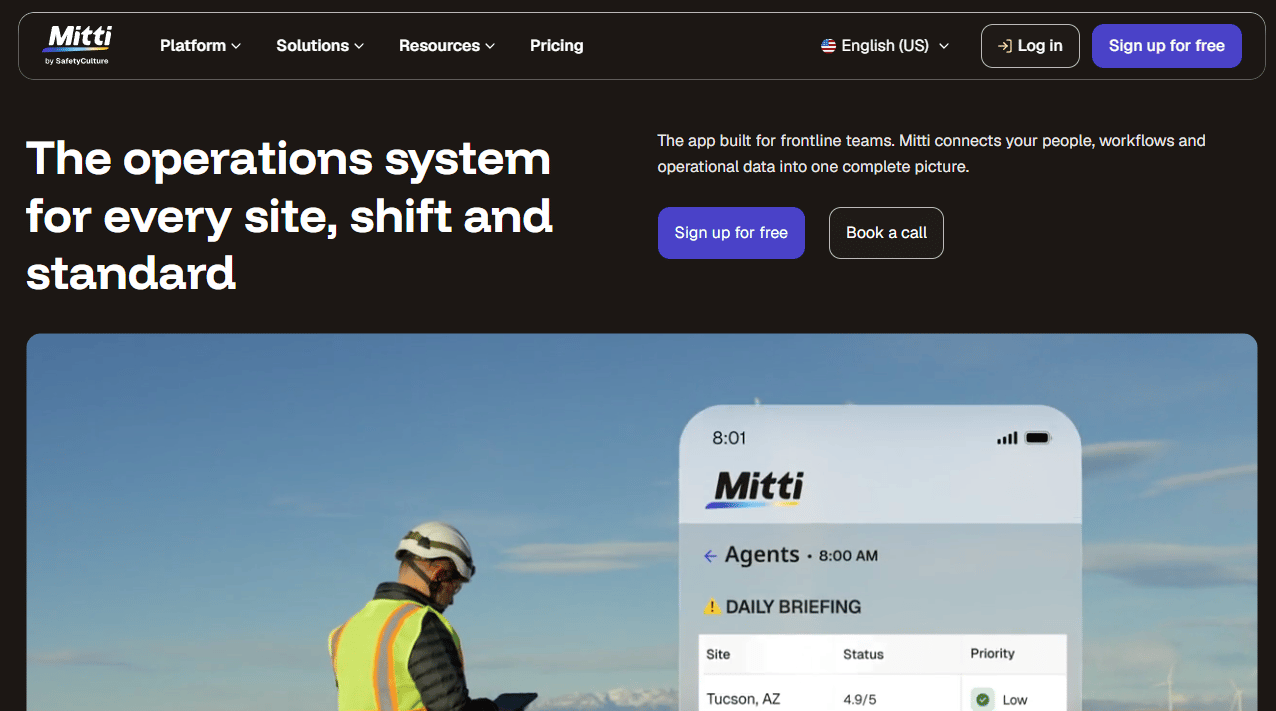
Mitti is a frontline workplace operations platform covering inspections, issue management, asset tracking, training, IoT sensor monitoring, and contractor management. It is built for field and industrial teams where safety and operational visibility need to live in the same system. The platform includes an AI assistant and AI-powered operational insights to surface patterns across teams and sites.
Best for: Industrial or field teams where worker safety, mobile workflows, and emergency escalation matter as much as production execution.
Key features
- Lone-worker safety and emergency escalation
- Inspections, reports, and digital checklists
- Asset tracking and issue management
- IoT and sensor monitoring
- Training content and skills management
Why choose Mitti: Mitti is the right starting point when a connected worker initiative begins with safety and workforce visibility rather than production optimization. Its free tier makes piloting accessible, and its mobile-first design fits field conditions where a desktop experience fails.
Mitti pricing: Free plan covers teams of up to 10 users. Premium runs $24 per seat per month billed annually, or $29 per seat per month on monthly billing. Enterprise pricing requires contacting sales, and adds SCIM provisioning, priority support, advanced integrations, and sandbox testing.
G2 rating: 4.6/5
2. Workerbase Connected Worker Platform
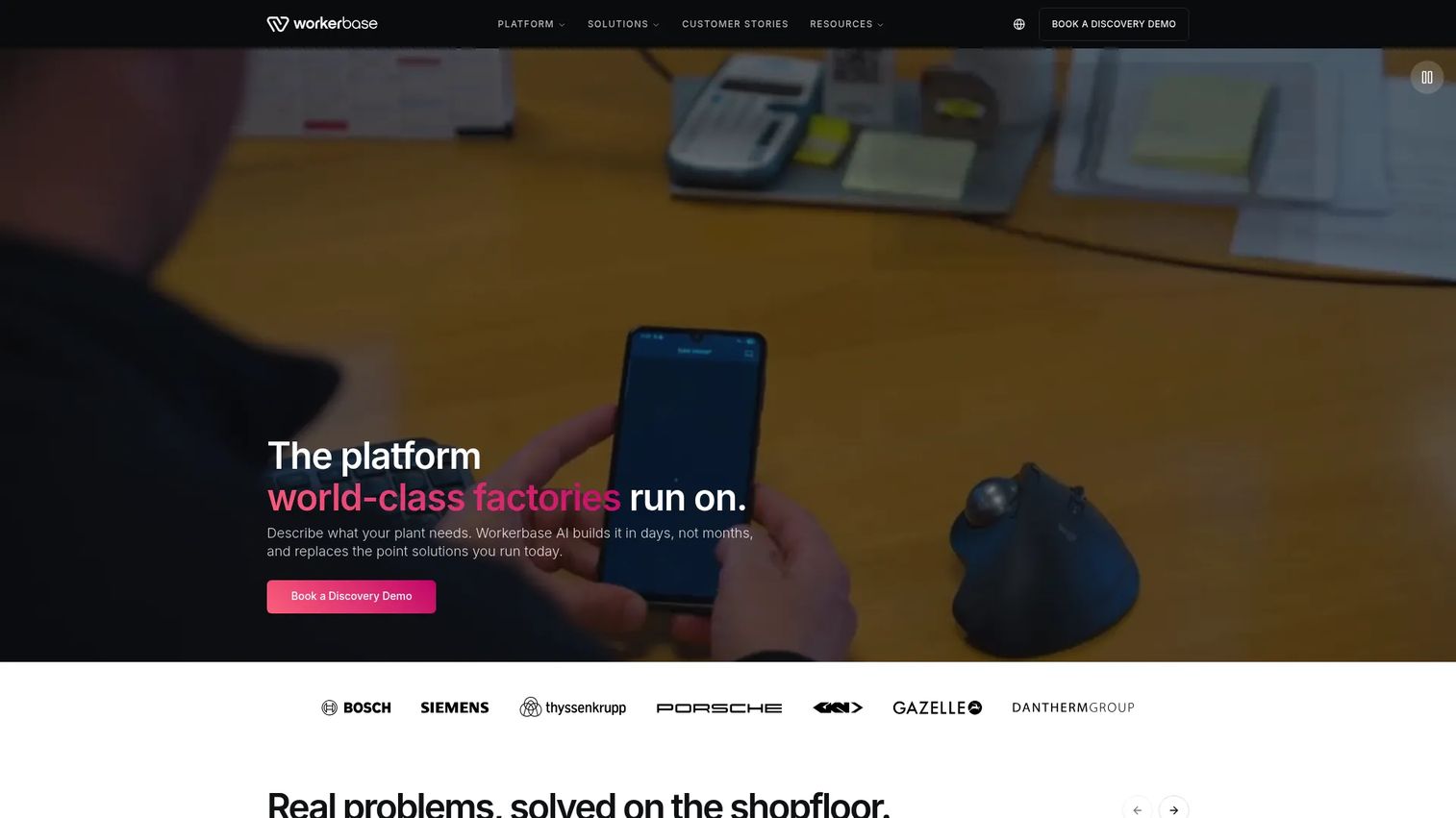
Workerbase is an AI-powered shop-floor platform for building, governing, and deploying connected worker applications. Teams use plain-language prompts to assemble frontline apps from tested modular components, without writing code. The platform supports role-based governance with approvals, versioning, and audit logs, and deploys across smartphones, tablets, terminals, and smartwatches.
Best for: Manufacturing teams that want to digitize many small workflows across the plant without waiting on long IT development cycles.
Key features
- AI-powered plain-language app building
- Digital work instructions, forms, and quality inspections
- ERP, MES, SCADA, and machine integrations
- Role-based governance with versioning and audit logs
- Multi-device deployment including smartwatches
Why choose Workerbase: Workerbase fits operations leaders who need local teams to improve execution without rebuilding core systems. Its governance layer makes it practical for manufacturers that need approvals and reversibility before changes go live across a plant.
Workerbase pricing: Pricing requires contacting sales. Three plans are available (Essentials, Professional, and Enterprise), covering foundational digitization through multi-site global deployment. Ask sales about user count, sites, integration scope, and onboarding support to get an accurate quote.
G2 rating: 4.7/5
3. Tulip Connected Worker Platform
Tulip is a composable frontline operations platform for building connected worker applications, automations, analytics, and integrations across manufacturing operations. Teams use a no-code and low-code app editor to create production, quality, and maintenance workflows linked to machines, sensors, cameras, and enterprise systems. AI capabilities include app generation, computer vision, and operational insights.
Best for: Manufacturers that want to build, test, and scale custom frontline apps across production, quality, and maintenance workflows.
Key features
- No-code and low-code manufacturing app builder
- Machine and sensor connectivity with real-time data
- AI-powered app generation, translation, and computer vision
- Real-time analytics and operational dashboards
- Governance features: Permissions, workspaces, approvals, and auditability
Why choose Tulip: Tulip is compelling when teams want a flexible platform rather than a fixed workflow package. It suits manufacturers with internal process owners who can build and iterate their own frontline apps. The interface pricing model (per deployed interface, not per user) changes the economics for large floor deployments.
Tulip pricing: Essentials starts at $100 per interface per month billed annually, with a 10-interface minimum. Professional runs $250 per interface per month (annual, 10-interface minimum). Enterprise and Regulated Industries plans require contacting sales. Confirm app-builder access, machine connectivity, edge devices, sites, and support coverage during procurement.
G2 rating: 4.5/5
4. Innovapptive Connected Worker Platform
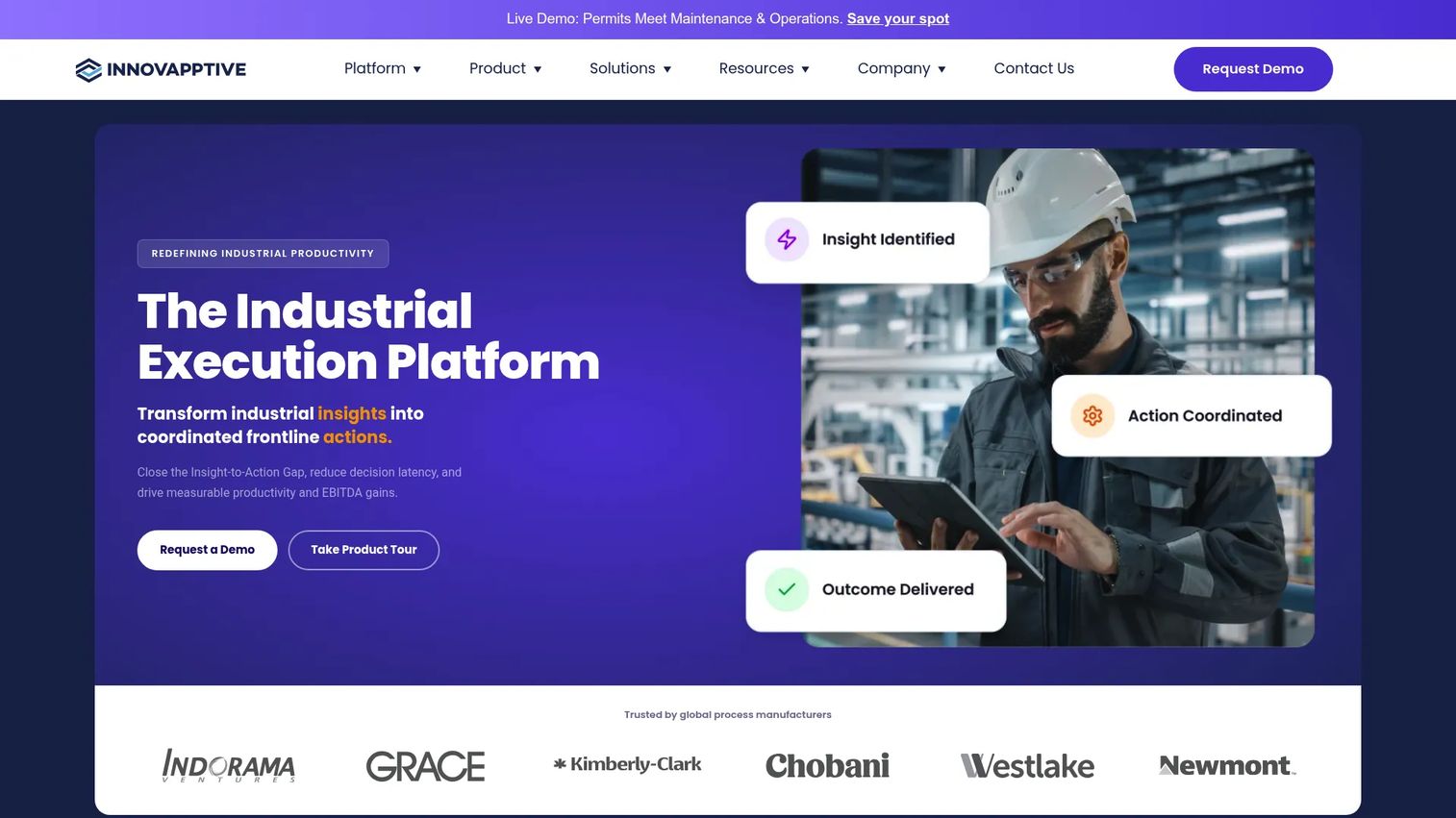
Innovapptive is a unified industrial platform connecting frontline operations, maintenance, warehouse, safety, and quality workflows with enterprise systems. It is built for asset-intensive industries including manufacturing, energy, chemicals, utilities, and oil and gas. The platform integrates with SAP, IBM Maximo, Oracle, EAM systems, IoT platforms, and enterprise data historians where those connections are part of the deployment.
Best for: Large industrial organizations that need connected worker execution tied directly into their operational backbone.
Key features
- WorkSmartAI and AI agent capabilities
- Integration Manager for ERP, EAM, IoT, and historian connections
- Digital work instructions and operator rounds
- Shift handover reports and collaboration engine
- RapidSync offline mode for connectivity gaps
Why choose Innovapptive: Innovapptive is strongest when the connected worker initiative must sit on top of an existing enterprise data layer. Maintenance execution, reliability workflows, and work-order context are the scenarios where it earns its place fastest. For large plants already running SAP or Maximo, the integration depth reduces the time from deployment to operational signal.
Innovapptive pricing: Pricing is quote-based. Ask sales about modules needed, enterprise system integrations, site count, implementation scope, AI capabilities, and support tier. G2 reviewers report this is an enterprise contract, so budget for implementation alongside license costs.
G2 rating: 4.5/5
5. Poka Connected Worker Platform
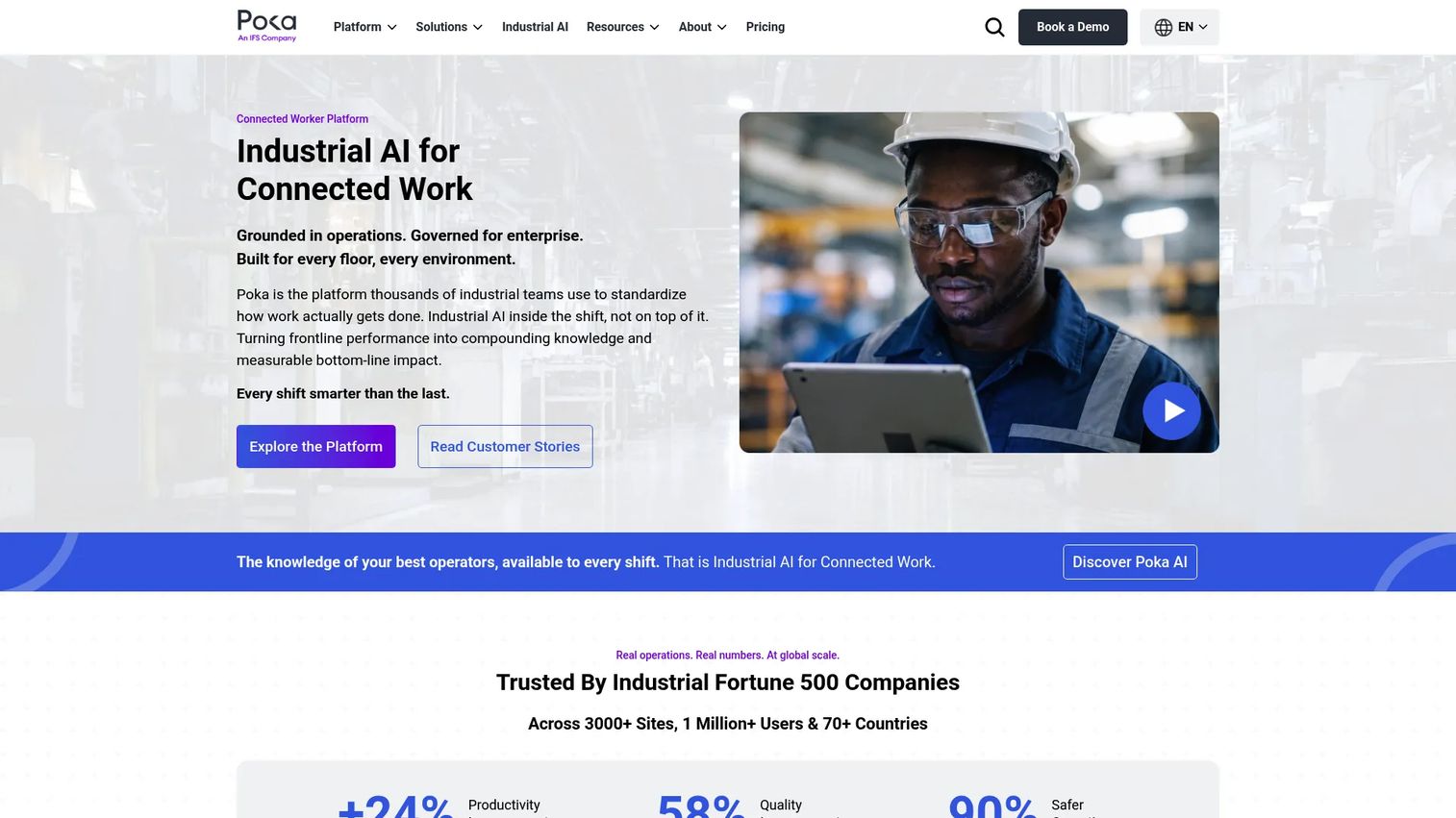
Poka is an enterprise connected worker platform for industrial and manufacturing frontline operations, with particular depth in knowledge management, skills development, and operational communication. The platform covers digital work instructions, skills and training management, digital forms and checklists, issue management, Factory Feed communication, and integrations via REST API, MCP, and a data lake.
Best for: Manufacturers trying to preserve tribal knowledge and train frontline workers faster before experienced operators retire.
Key features
- Industrial AI agents and AI-assisted knowledge retrieval
- Digital work instructions and skills management
- Factory Feed communication and huddle boards
- Digital forms, checklists, and issues management
- Enterprise integrations via Poka Automate and REST API
Why choose Poka: Poka fits when the primary problem is knowledge transfer, not just task execution. For a founder who has seen operations slow down every time a veteran leaves, this is the platform that encodes what those veterans know. The communication layer also reduces the dependency on informal channels like radio or group texts.
Poka pricing: Pricing is not publicly displayed. Contact Poka to get a quote covering users, sites, training content modules, and implementation scope.
G2 rating: 4.6/5
6. Smart Work Station by Andonix
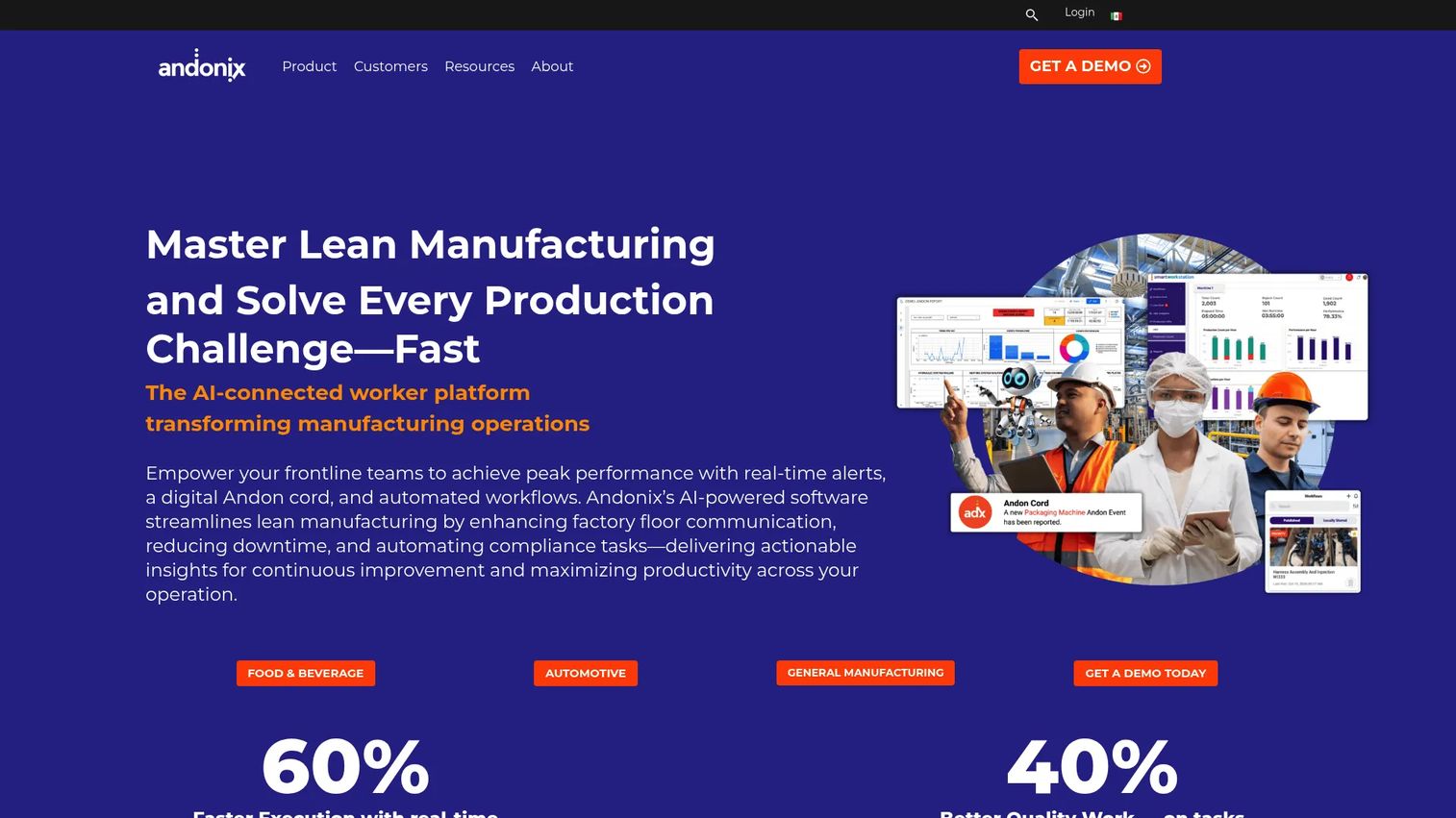
Smart Work Station by Andonix is an AI-connected worker platform for manufacturing that digitizes frontline workflows, connects people and machines, and helps teams detect and resolve operational disruptions faster. Core capabilities include a digital Andon cord with real-time escalation, digital operating procedures and checklists, operator training and guidance, machine connectivity, ERP integration, and an AI manufacturing copilot for troubleshooting and knowledge transfer.
Best for: Plant teams that want practical digital workstations, checklists, and operational visibility without starting a large transformation program.
Key features
- Digital Andon cord with real-time alerts and escalation
- Digital operating procedures and workflow checklists
- AI manufacturing copilot for troubleshooting and knowledge transfer
- Machine and tools connectivity with BI connectors
- In-app chat and ERP integration
Why choose Smart Work Station by Andonix: Andonix fits teams that need faster execution on the floor today. Digitizing checks, capturing issues, and making local work visible are the immediate wins. The AI copilot layer makes it useful for troubleshooting scenarios where a newer operator would otherwise wait for a supervisor.
Smart Work Station by Andonix pricing: Andi, a component of the platform suite, is available at $250 per month for 50 users as an introductory offer following a free trial. Contact Andonix for full Smart Work Station platform pricing covering users, sites, workstation configuration, analytics, and implementation.
G2 rating: 4.8/5
7. Librestream Onsight NOW
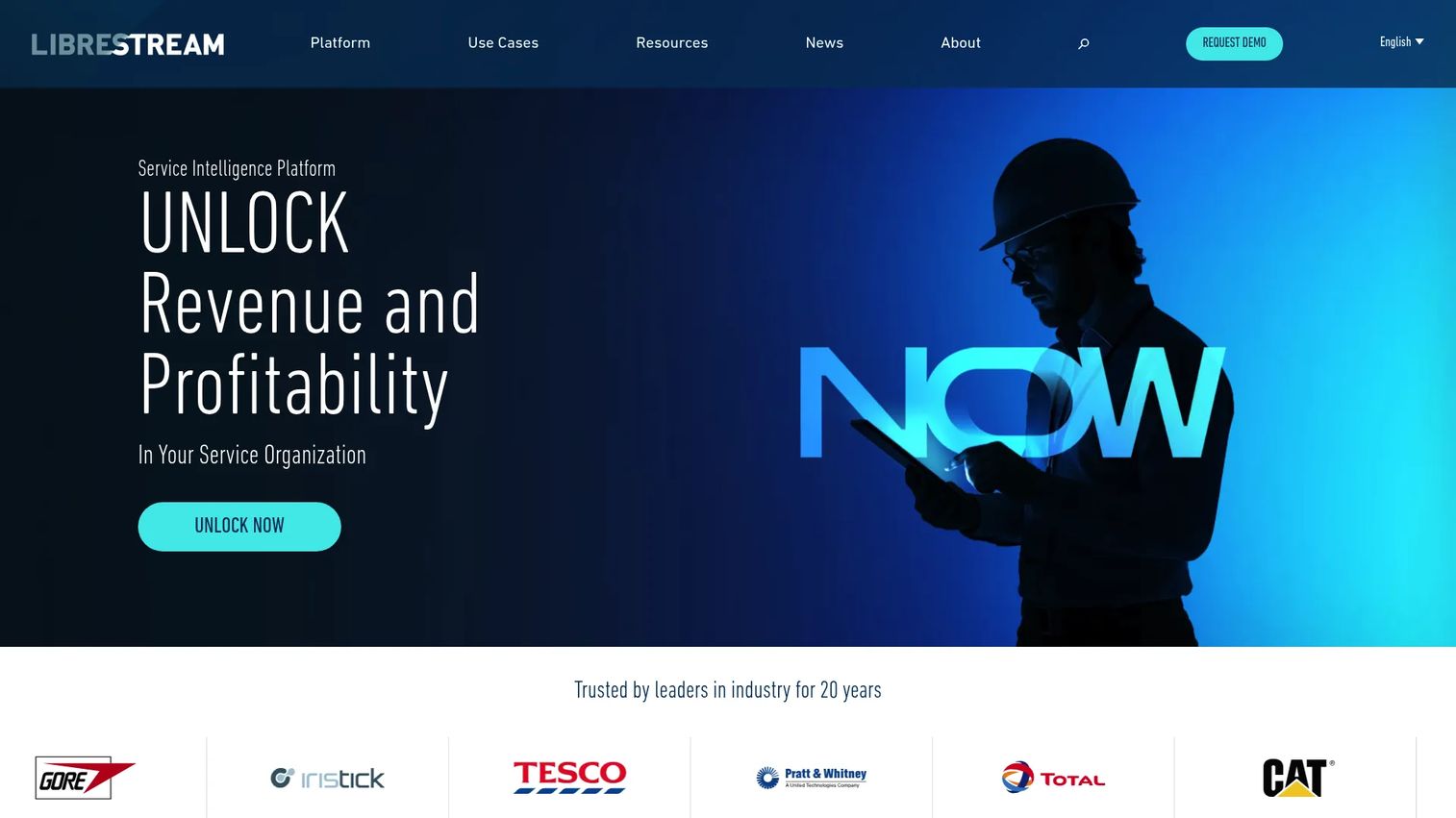
Librestream Onsight NOW is a service intelligence platform providing real-time insights, AI support, knowledge capture, and remote expert collaboration for industrial service teams. The platform includes Industrial Co-Pilot (Ida) for AI-powered knowledge retrieval, real-time language translation, automated service report generation, high-resolution video streaming, screen sharing, and annotation for remote collaboration. It integrates with SAP, Salesforce, and SharePoint where relevant to the deployment.
Best for: Teams that need experts to support field or plant workers remotely through visual collaboration rather than scheduling on-site visits.
Key features
- High-resolution video and annotation for remote expert sessions
- Industrial Co-Pilot (Ida) for AI knowledge retrieval
- Real-time language translation during field calls
- Automated service report generation
- Integrations with SAP, Salesforce, and SharePoint
Why choose Librestream Onsight NOW: Onsight NOW is the strongest pick when the core problem is access to expertise, not broad workflow digitization. Junior workers get real-time expert guidance without travel delays, which shortens troubleshooting time and reduces the cost of an on-site visit. For manufacturers with geographically distributed plants and a small team of senior specialists, the math on travel reduction alone can justify the platform.
Librestream Onsight NOW pricing: Pricing is not displayed on the Librestream website. Contact sales to get a quote covering users, devices, video usage, security requirements, and deployment scope.
G2 rating: 4.7/5
8. L2L Connect
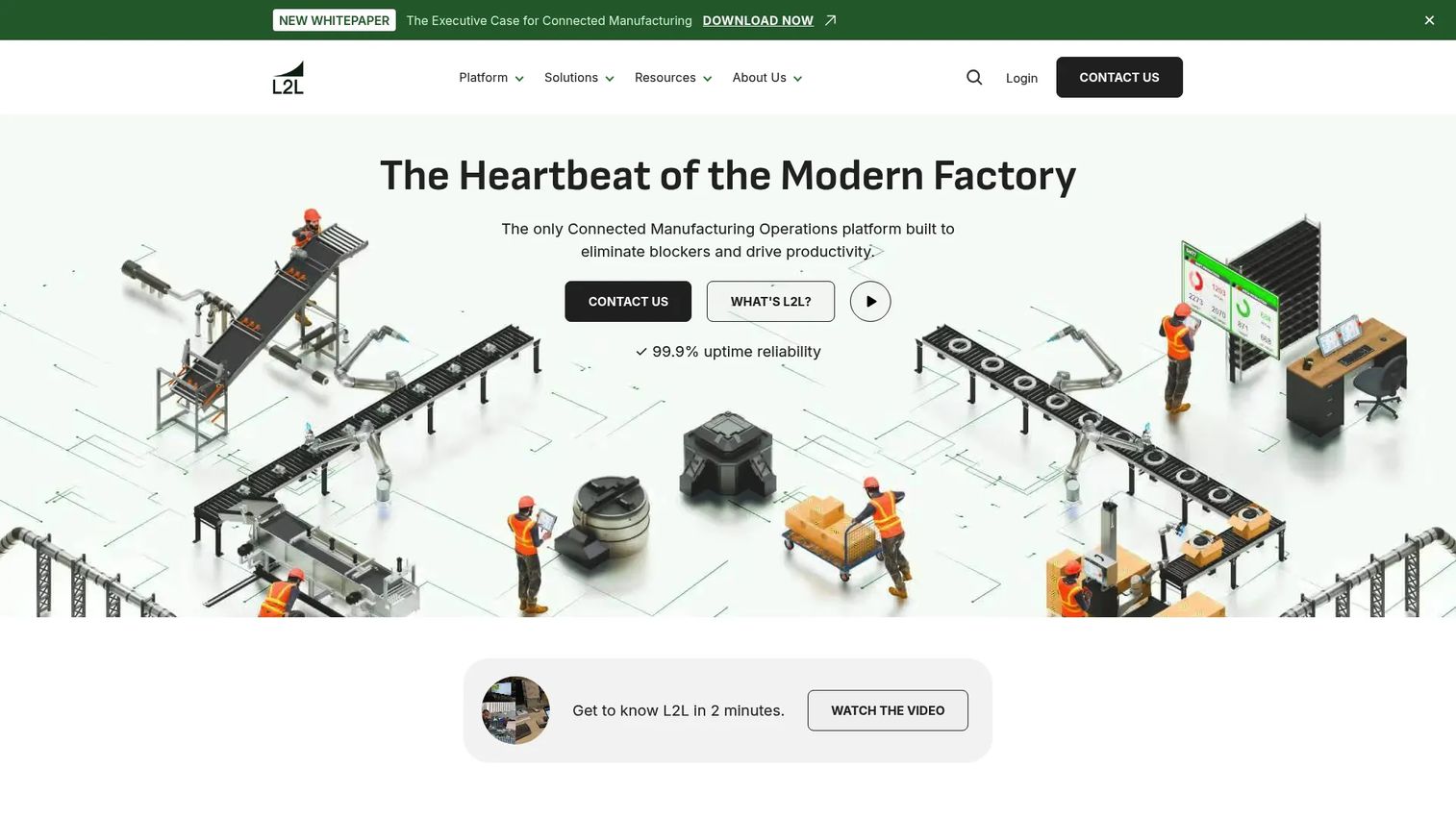
L2L Connect is L2L's machine and system connectivity component within its Connected Manufacturing Operations Platform. It integrates real-time data from PLCs, SCADA systems, and IIoT devices into frontline workflows, surfacing part counts, scrap, defects, and line-running data alongside OEE dashboards and condition-based maintenance alerts. The platform also supports asset tracking software use cases through its operational data layer.
Best for: Manufacturing teams focused on improving coordination between maintenance, operators, and production leaders through shared machine data.
Key features
- Real-time machine data from PLCs and SCADA systems
- OEE dashboards and KPI tracking
- Condition-based alerts and maintenance workflows
- Part counts, scrap, and defect tracking
- Digital checklists and plant-floor visibility
Why choose L2L Connect: L2L Connect suits teams whose top priority is closing the gap between what machines are reporting and what operators and maintenance crews know. It is positioned as part of L2L's broader platform rather than a standalone tool, so evaluate the full suite if machine-to-workflow connectivity is the primary use case.
L2L Connect pricing: Pricing requires contacting L2L sales. Ask about plant count, user scope, module selection, integrations, onboarding, and support. G2 reviewers describe this as an enterprise contract.
G2 rating: 4.3/5
Considerations when choosing connected worker platforms
Start with the workflow that breaks most often
Do not begin with a vague digitization mandate. Pick one decisive workflow: Operator rounds, safety checks, quality inspections, maintenance work orders, or shift handovers. The platform that solves that workflow well earns the right to expand. A general platform bought without a specific problem to solve sits unused.
Check integration depth before buying
A connected worker platform only works if it connects to the systems your team already trusts. Evaluate ERP, MES, EAM, EHS, IoT, historians, and data warehouse compatibility. Ask vendors specifically what fields sync, how frequently, and who owns failed sync errors. Integration claims in demos rarely survive contact with production systems.
Test mobile usability on the floor
Desktop demos hide adoption problems. Test the platform on tablets or phones, in gloves, in a noisy environment, and across shift-change conditions. This is where a VP of Operations can run a one-week pilot with a single team. If workers on the floor find the interface awkward, adoption stalls regardless of feature depth.
Look for analytics that change decisions
Avoid platforms that surface only activity metrics. Strong connected worker software shows bottlenecks, repeat defects, overdue work orders, safety patterns, training gaps, downtime causes, and site-by-site performance. If the dashboard only tells you that tasks were completed, it is not giving leadership the signal needed to act.
Budget for implementation, not only licenses
Connected worker platforms involve workflows, integrations, device procurement, frontline adoption, and change management. Get quotes that include software, implementation services, training, integration development, device costs, and ongoing support. The license is often the smallest part of the total first-year spend.
Conclusion
Each platform in this list addresses a different primary constraint.
Innovapptive is the pick for large industrial organizations that need maintenance execution and enterprise integration depth. Tulip fits manufacturers that want flexibility and the ability to build their own frontline apps. Mitti is the choice for teams starting with safety and mobile-first adoption, and it is the only platform here with a free tier. Poka is strongest when knowledge transfer and skills development are the main problem. Librestream Onsight NOW is purpose-built for remote expert collaboration. L2L Connect is the right tool when machine data needs to flow directly into production workflows.
Workerbase and Smart Work Station by Andonix both serve teams looking for configurable frontline workflows and faster digitization without major transformation programs.
The best connected worker platform is the one your frontline team uses during the work, not after it. If the platform creates cleaner execution, faster ramp for new operators, and better operational signal within one quarter, it earns its place.
If you sell complex industrial or manufacturing software, your buyers face the same evaluation challenge. Showing your product clearly before a buying committee forms makes a material difference. Start your journey with Guideflow today!
FAQs
A connected worker platform is software that gives frontline and industrial workers digital access to work instructions, tasks, real-time data, and communication at the point of work. These platforms connect workers to procedures, machines, supervisors, and enterprise systems, replacing paper binders, static SOPs, and disconnected checklists. They are common in manufacturing, maintenance, energy, logistics, and field operations.
Connected worker software typically refers to a single capability, such as digital checklists, lone-worker safety, or mobile work instructions. A connected worker platform connects multiple workflows, including instructions, tasks, communication, analytics, and enterprise integrations, into one operational layer. Most enterprise deployments require a platform rather than a point tool.
Innovapptive is the strongest option for large asset-intensive manufacturers that need ERP and EAM integration with maintenance workflows. Tulip is the pick for manufacturers that want a low-code app builder to create custom frontline applications. Poka is the best fit for training and knowledge retention across factory teams. L2L Connect is strongest when real-time machine data needs to feed directly into production and maintenance coordination.
No. Connected worker platforms complement MES and ERP systems rather than replace them. They sit closer to the point of work and capture cleaner execution data, which then feeds back into enterprise systems. The integration between a connected worker platform and an existing MES or ERP is one of the most important evaluation criteria before buying.
Core features include digital work instructions, mobile access, digital checklists, task and work-order management, real-time collaboration, and analytics. Depending on the use case, you may also need wearable device support, IoT sensor integration, lone-worker safety and escalation, AI-assisted recommendations, training content management, and connections to approval workflow software or asset tracking software already in the stack.
Pricing varies significantly. Mitti has a free tier and a Premium plan at $24 per seat per month billed annually. Tulip starts at $100 per interface per month. Most enterprise platforms in this category, including Innovapptive, Poka, Workerbase, and L2L Connect, price by quote. The total deployment cost covers software licenses, implementation, integrations, device procurement, training, and ongoing support. For a single site deployment, first-year costs typically run well above the license figure alone.
No. Manufacturing is the most common deployment context, but connected worker technology is used across field service, energy, utilities, logistics, construction, and maintenance operations. Any environment where frontline workers execute structured tasks with limited real-time visibility is a candidate for a connected worker platform.
Run a focused pilot. Choose one workflow, one site, one team, and one measurable operational outcome, such as inspection completion rate, downtime response time, training completion, or safety incident reporting time. Measure the baseline before deploying and compare after four weeks. A platform that cannot show a clear improvement on one workflow within the first month is unlikely to deliver broader operational impact. For more context on building evaluation criteria for operational software, see our guides on additive manufacturing software and aviation MRO software as parallel evaluation frameworks.