Bundled payment teams often find themselves managing financial risk with data that arrives too late to act on. Claims files land weeks after the episode closes. EHR exports don't connect to payer contracts. Quality reports come through a separate portal. And the reconciliation cycle ends before anyone had a clear picture of where the costs accumulated.
For health system operators, revenue cycle leaders, and health tech founders mapping this space, that lag is the real problem. According to the Health Care Payment Learning & Action Network's 2024 APM Measurement Report, approximately 60% of U.S. healthcare payments are now tied to quality or value in some form. Episode-based, bundled payment arrangements are a growing slice of that shift. The infrastructure to manage them, however, is still fragmented across official CMS systems, claims analytics tools, care coordination platforms, and service vendors.
This guide maps the full stack clearly so you can hand it to your VP of Operations or CFO with a concrete starting point.
What's inside
This guide compares 9 tools, programs, and software-enabled services used in bundled payment workflows. Some entries are official CMS program infrastructure. Others are reporting interfaces, service vendors, patient engagement platforms, or EHR categories.
Selection criteria:
- Episode management and claims analytics capability
- Payment reconciliation and reporting support
- Healthcare workflow fit and integration depth
- Practical value for operators and finance leaders evaluating this category
TL;DR
- Best official source of truth: CMS for Medicare program rules, model participation, and bundled payment infrastructure
- Best CMS model reference: Bundled Payments for Care Improvement Advanced (BPCI-A) for organizations studying episode-based Medicare risk and retrospective reconciliation
- Best reporting layer: Bundled Payment Reporting Interface (a Milliman product) for claims-based episode analytics and performance visualization
- Best service-heavy operational support: Signature Performance for organizations that need revenue cycle expertise alongside workflow tools
- Best patient engagement and care coordination: CipherHealth LLC for outreach and rounding workflows that support episode performance
What is bundled pay management software?
Bundled pay management software helps healthcare organizations manage episode-based payment arrangements by tracking patients, claims, costs, quality metrics, payment rules, and reconciliation across a defined episode of care.
Unlike fee-for-service billing, where each service is paid independently, bundled payments treat an entire episode, such as a hip replacement with 90 days of post-acute care, as a single financial unit. The payer sets a target price. The provider organization is accountable for staying within it while meeting quality standards.
Software in this category typically connects several systems: Claims files from payers, clinical documentation from EHRs, quality measure data, and payer contract terms. It applies that data to episode definitions, attributes providers and facilities, groups claims into episodes, tracks cost and utilization, and supports reconciliation after claims settle.
Core capabilities to look for
- Episode definition and scope rules
- Provider and facility attribution
- Claims grouping and claims analytics
- Benchmarking and target price modeling
- Quality metric tracking and reporting
- Payment reconciliation workflows
- Care coordination triggers and patient outreach
- Gainsharing and risk reporting
- CMS and payer reporting support
What bundled pay management software is not
This category is distinct from a generic EHR, a revenue cycle management platform, a claims clearinghouse, or a standalone patient engagement app. An EHR stores clinical events. A clearinghouse routes claims. A BI dashboard visualizes data. Bundled payment software specifically manages the financial episode lifecycle, including episode setup, attribution, grouping, and reconciliation.
Buyers who confuse these categories often end up with a tool that answers one part of the workflow while leaving gaps in the others. The goal of this guide is to show which system owns which piece.
When to use bundled pay management software
Manage episode-based financial risk
Bundled payments create a fixed financial frame around a care episode. Without the right data infrastructure, teams often discover whether an episode was profitable only after reconciliation, when it's too late to intervene. Software that tracks cost, utilization, readmissions, and post-acute spend in near real time gives finance and operations teams enough lead time to course-correct within the model period.
Coordinate care across providers
Episodes routinely span hospital admissions, physician visits, post-acute facilities, and follow-up care. Care coordination software helps teams identify care gaps, track patient milestones, and standardize protocols across the full journey. When a patient misses a follow-up appointment or gets readmitted unexpectedly, those events hit the episode cost directly. Coordination tools create visibility before those events become losses.
Reconcile payments and quality performance
The final financial result of a bundled episode depends on claims, contract rules, quality thresholds, and attribution logic all landing correctly. A reconciliation-capable platform lets finance trace why a bundle produced savings, losses, or no opportunity at all. That visibility is what turns a one-time CMS report into an operational feedback loop.
Bundled pay management software comparison
This category mixes official CMS infrastructure, reporting tools, service vendors, patient engagement platforms, and an EHR category. Not every entry is a commercial SaaS subscription, and not every entry replaces the others. The table below reflects that mix honestly. Use it as a starting map, not a head-to-head comparison.
| # | Product | Best for | Key differentiator | Pricing | G2 rating |
|---|---|---|---|---|---|
| 1 | CMS | Official Medicare program rules and infrastructure | Authoritative source for all CMS bundled payment models | N/A | N/A |
| 2 | Bundled Payments for Care Improvement Advanced (BPCI-A) | Medicare episode payment model reference | Advanced bundled payment model with target prices and retrospective reconciliation | N/A | N/A |
| 3 | Bundled Payment Reporting Interface | Claims-based episode analytics | Self-service claims visualization for bundled payment participants | N/A | N/A |
| 4 | Signature Performance | Revenue cycle managed services | Combines healthcare operations expertise with workflow tooling | Custom pricing | N/A |
| 5 | CipherHealth LLC | Patient engagement and care coordination | Outreach, rounding, and EHR-integrated communication | Custom pricing | 5.0/5 |
| 6 | Healthegy | Ophthalmology and aesthetics industry events | Industry summits, media, and networking for ophthalmic professionals | Custom pricing | N/A |
| 7 | Wellbe | Digital care pathways and episode navigation | Patient-facing CarePaths and CareTeam coordination | Custom pricing | N/A |
| 8 | Electronic health record (EHR) | Clinical documentation and source data | Stores clinical events that feed bundled payment workflows | Varies by vendor | Varies by vendor |
| 9 | BPCI-A | CMS model shorthand and participation research | Practical reference for locating Medicare bundled payment requirements | N/A | N/A |
Best 9 bundled pay management tools for 2026
1. CMS
CMS is the Centers for Medicare and Medicaid Services, the federal agency that administers Medicare, Medicaid, and the CHIP program. For bundled payment operations, CMS functions as the definitive source of program rules, model documentation, participation resources, and official methodology. It is not commercial software. It belongs in this list because every organization running a CMS-tied bundled payment model depends on CMS resources to understand what they are accountable for.
Best for: Healthcare organizations that need authoritative Medicare bundled payment program guidance before evaluating or implementing any commercial tool.
Key features
- Medicare program documentation and model updates
- Quality measure guidance and reporting requirements
- Payment methodology documentation and Web Pricers
- CMS Innovation Center model resources
- Downloadable program data and policy guidance
Why choose CMS: Choose CMS first when the question is regulatory, methodological, or program-specific. No commercial tool overrides CMS definitions of episode scope, attribution, or target price logic. Build your internal understanding of CMS requirements before selecting any platform.
CMS pricing: CMS resources are federal government program materials and carry no subscription cost or licensing fee.
2. Bundled Payments for Care Improvement Advanced (BPCI-A)
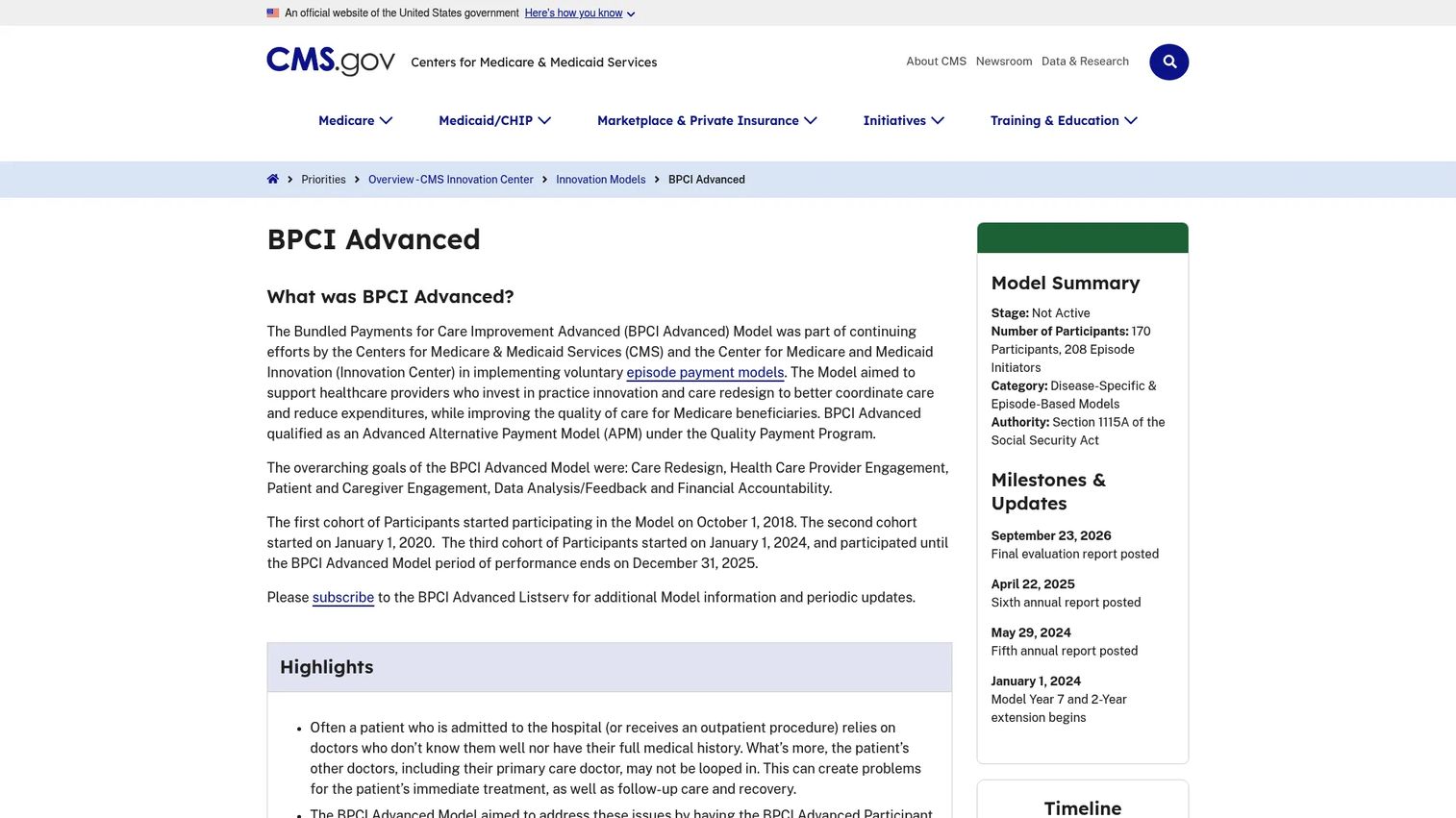
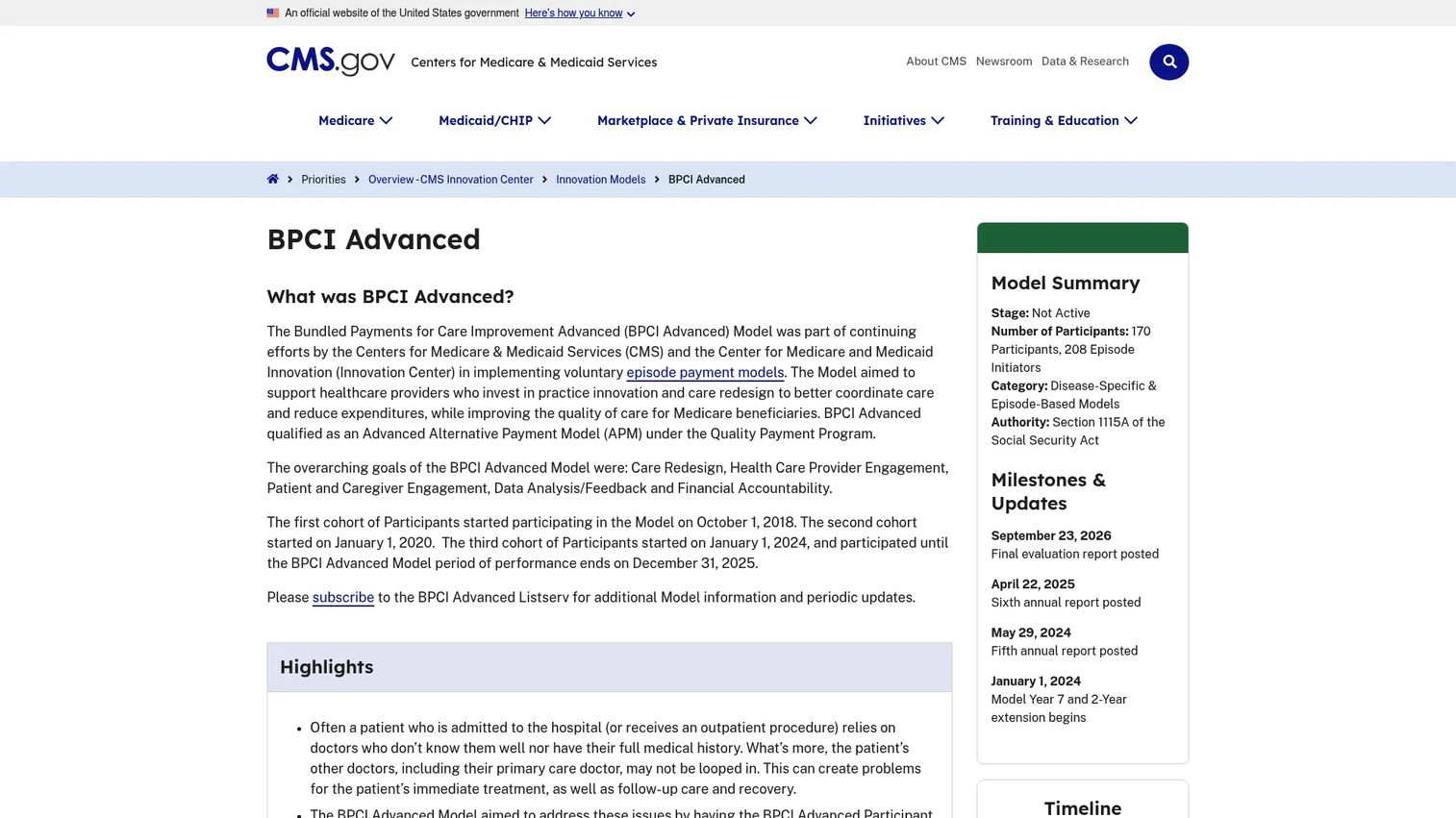
Bundled Payments for Care Improvement Advanced was a voluntary CMS Innovation Center payment model that covered defined clinical episodes tied to inpatient admissions or outpatient procedures. Episodes ran for 90 days. Organizations were held accountable for total Medicare spend across those episodes, reconciled retrospectively against target prices. Participant organizations also needed to meet quality measure requirements, and the model qualified as an Advanced Alternative Payment Model under the Quality Payment Program. The model's performance period ended December 31, 2025, per CMS documentation.
Best for: Provider organizations studying Medicare episode-based payment risk and the structural requirements that any future CMS bundled payment participation would involve.
Key features
- 90-day clinical episode framework
- Target price methodology and retrospective reconciliation
- Quality measure requirements and Composite Quality Score
- Advanced Alternative Payment Model qualification criteria
- Administrative and alternate quality-measure reporting options
Why choose Bundled Payments for Care Improvement Advanced: Use this section of the guide to understand what software and reporting workflows need to support. BPCI-A is a payment model, not a vendor. The commercial tools in this list exist largely to help organizations manage the operational complexity it created.
Bundled Payments for Care Improvement Advanced pricing: No subscription cost applies. Participation involved organizational investments in analytics, care redesign, advisory support, and internal operations, with costs varying by episode volume and program complexity.
3. Bundled Payment Reporting Interface
The Bundled Payment Reporting Interface is a Milliman product that provides self-service claims data visualization and guided analytics for healthcare organizations managing episodes under Medicare bundled payment models. It supports filtering by time period, provider, and beneficiary demographics. Dashboards and reports cover episode costs, anchor hospitalizations, related expenditures, and post-acute care costs, giving teams a claims-based performance view without building a custom analytics infrastructure from scratch.
Best for: Healthcare organizations participating in Medicare bundled payment programs that need claims-based episode reporting and utilization analysis without building custom tooling.
Key features
- Self-service claims data visualization
- Filtering by time period, provider, and demographics
- Episode cost and anchor hospitalization dashboards
- Related expenditure and post-acute care reporting
- Participant data reports and performance views
Why choose Bundled Payment Reporting Interface: Choose it when your team needs structured access to episode-level claims data tied to CMS model reporting. It complements, rather than replaces, broader analytics, care coordination, or financial planning platforms. Teams that need visibility into where post-acute costs accumulate will find the reporting structure useful.
Bundled Payment Reporting Interface pricing: Contact Milliman directly to discuss scope, episode volume, and access requirements.
4. Signature Performance
Signature Performance is a healthcare technology and administrative services company that provides advisory, managed services, and workflow tools for payer and provider organizations. Its work spans revenue cycle managed services, claims administration, federal healthcare program operations, and analytics-assisted workflow support. For organizations running bundled payment programs, Signature Performance functions as an operational partner that brings both domain expertise and technology infrastructure.
Best for: Healthcare payer and provider organizations that need revenue cycle expertise and operational bandwidth alongside bundled payment workflow support.
Key features
- Revenue cycle managed services
- Claims administration and workflow tools
- Federal healthcare program operational support
- Analytics and reporting dashboards
- Advisory services for healthcare operations
Why choose Signature Performance: Choose Signature Performance when internal teams lack the specialized knowledge or capacity to manage bundled payment workflows independently. This is a services-and-technology decision rather than a self-serve SaaS purchase. Organizations entering bundled payment arrangements for the first time often benefit from an operational partner that has worked through the edge cases.
Signature Performance pricing: Fees reflect scope of services, claims volume, program complexity, and contract length. Request a quote directly.
5. CipherHealth LLC
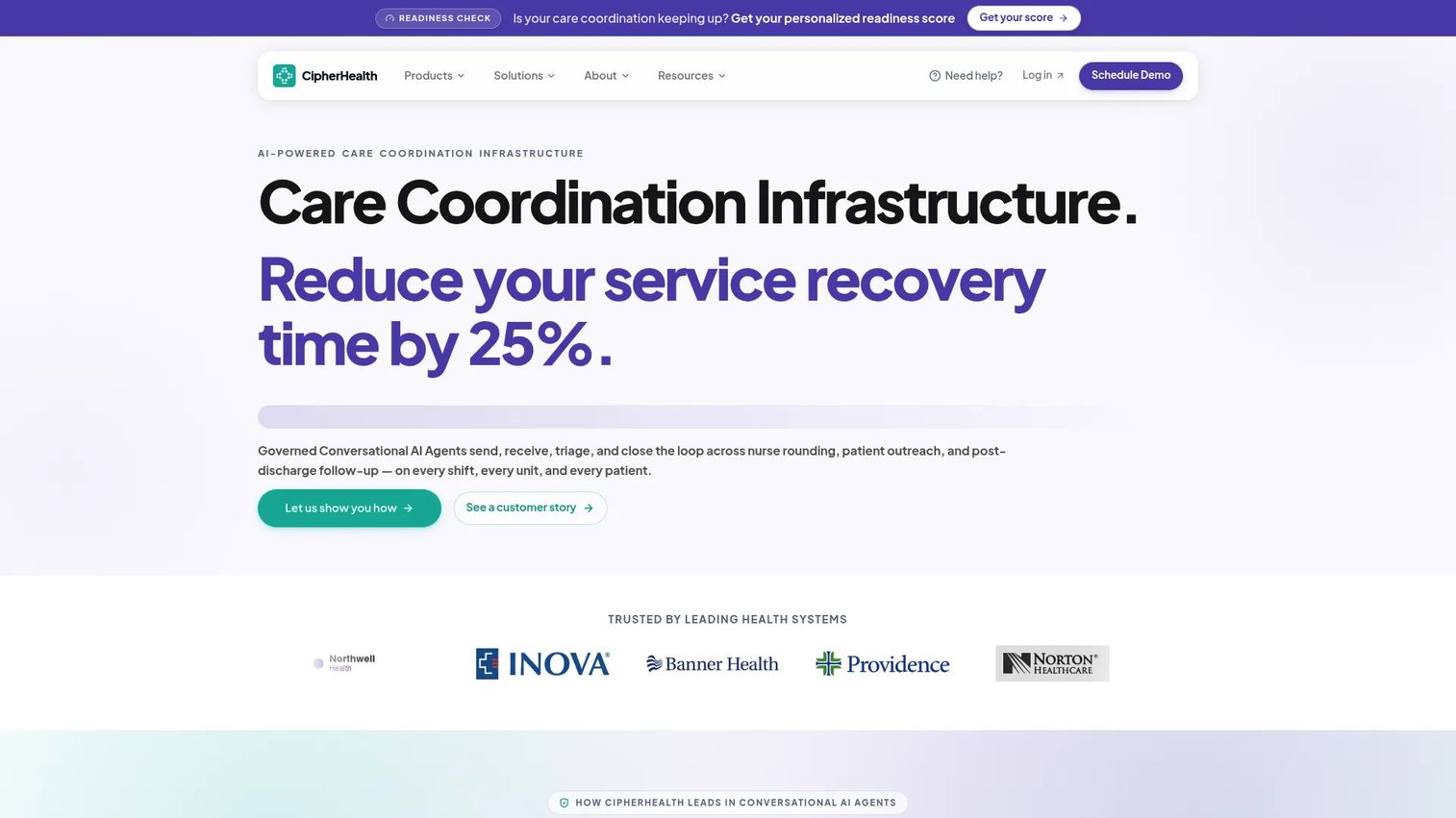
CipherHealth is a healthcare technology company that provides patient engagement and care coordination workflows for health systems. Its platform covers patient outreach through calls and messages, staff and patient rounding with service-recovery workflows, and bidirectional EHR integrations using HL7 and FHIR. AI-powered capabilities include sentiment analysis, ambient documentation, and predictive analytics. For bundled payment operations, CipherHealth supports the care coordination layer, specifically the outreach and follow-up activity that influences readmissions, complications, and episode cost.
Best for: Hospitals and health systems that need integrated patient engagement, outreach, and care coordination workflows to support episode-based payment performance.
Key features
- Patient outreach via automated calls and messages
- Staff and patient rounding with service-recovery tools
- Bidirectional EHR integration using HL7 and FHIR
- Real-time analytics and reporting dashboards
- AI-powered sentiment analysis and predictive analytics
Why choose CipherHealth LLC: Choose CipherHealth when patient engagement is the weak link in bundled payment performance. Strong discharge communication and rounding workflows can directly affect readmission rates, which feed directly into episode cost. The EHR integration depth makes it easier to connect outreach activity to clinical workflows rather than running a separate system.
CipherHealth LLC pricing: CipherHealth requires a demo or sales conversation for pricing. Fees vary by patient volume, outreach channel configuration, and integration requirements.
G2 rating: 5.0/5 on G2.
6. Healthegy
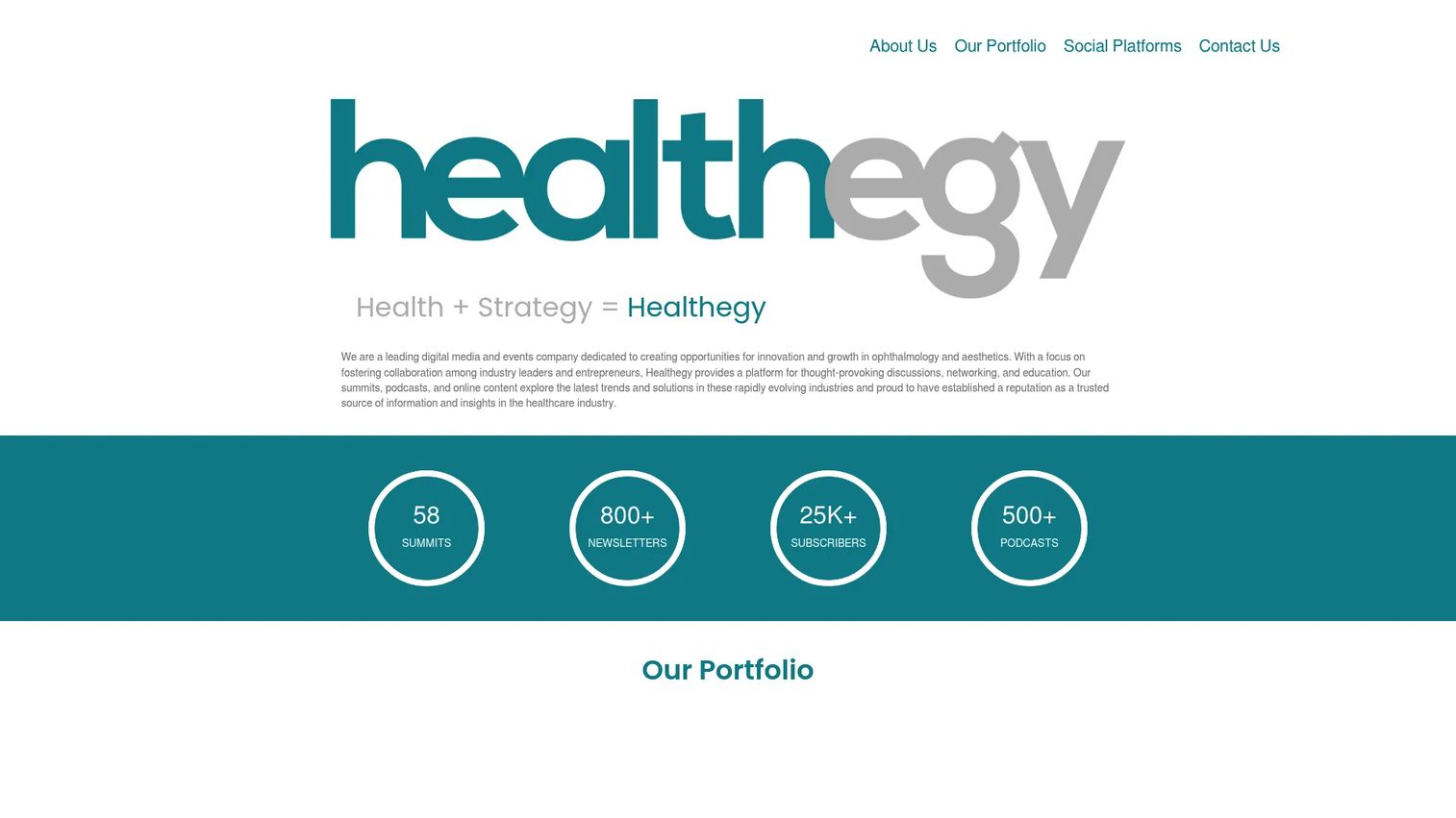
Healthegy is a digital media and events company focused on innovation and growth in ophthalmology and aesthetics. Its work includes industry summits, podcasts, online content, and a membership-based ophthalmic startup and investor database. For readers who encountered Healthegy in a bundled payment context, the connection is likely through its healthcare industry event and education programming rather than through episode management or claims analytics software.
Best for: Healthcare professionals, entrepreneurs, and investors in ophthalmology and aesthetics who need industry networking, education, and market intelligence.
Key features
- Industry summits and events
- Podcasts and online content
- Networking for ophthalmology and aesthetics professionals
- Membership-based ophthalmic startup database
- Investor and industry leader programming
Why choose Healthegy: Choose Healthegy if your work intersects the ophthalmology or aesthetics market and you need industry intelligence, event access, or networking with entrepreneurs and investors in that space. It is not an episode analytics or payment reconciliation platform.
Healthegy pricing: Healthegy does not display subscription or event pricing on its homepage. Contact Healthegy for membership, event, or sponsorship rates.
7. Wellbe

Wellbe provides digital care pathways and episode navigation for patients and care teams. Accessible pages confirm the product uses online CarePaths and CareTeams to guide patients through care journeys, with task reminders and coordination support built in. For bundled payment operations, Wellbe fits the patient-facing coordination layer, supporting patients in completing the right steps before and after care events within an episode.
Best for: Provider teams that need digital care pathways and patient navigation tools to support episode-based care performance.
Key features
- Digital CarePaths for guided patient journeys
- CareTeam coordination and visibility
- Episode education and task reminders
- Patient navigation through pre- and post-care steps
- Care team and patient communication support
Why choose Wellbe: Choose Wellbe when bundled payment performance depends on patients following through on the right activities between care events. It fits the care coordination and patient education layer rather than the claims reconciliation or financial analytics layer. Research the platform directly, as full product documentation was not fully accessible during article preparation.
Wellbe pricing: Contact Wellbe to discuss patient volume, pathway complexity, and integration requirements.
8. Electronic health record (EHR)
EHR systems are a platform category, not a single vendor. The Office of the National Coordinator for Health IT defines an EHR as a digital, patient-centered record that securely documents, stores, retrieves, shares, and analyzes patient care information. EHRs hold the clinical documentation, encounters, orders, and care events that bundled payment systems depend on as source data. The boundary matters: An EHR stores what happened clinically. Bundled payment software applies episode logic, attribution rules, and financial reconciliation to that data.
Best for: Clinical documentation and source data that feeds downstream bundled payment analytics, claims grouping, and episode tracking workflows.
Key features
- Patient demographic and clinical documentation
- Computerized provider order entry
- Clinical decision support
- Clinical quality measure recording and export
- Electronic health information exchange and interoperability
Why choose Electronic health record (EHR): Every bundled payment operation needs an EHR as the clinical system of record. Do not rely on the EHR alone for episode pricing, claims grouping, or reconciliation unless you have specifically verified those capabilities in your implementation. Most teams need to connect EHR data to a separate analytics or bundled payment management layer.
Electronic health record (EHR) pricing: Varies by vendor, deployment model, module selection, user count, implementation scope, and ongoing support structure. No single price applies across the EHR category.
9. BPCI-A
BPCI-A is the working shorthand that healthcare operators, finance teams, and analytics professionals use when searching for Medicare bundled payment requirements, participation guidance, model updates, and reporting workflows. Where entry 2 in this guide covers the full BPCI Advanced model structure, this entry is about how teams actually use the acronym: As a search and navigation label that helps internal stakeholders align on the same CMS framework. When a CFO, clinical quality lead, and operations manager need to get on the same page about what a "bundle" means in the Medicare context, BPCI-A is the shared vocabulary.
Best for: Teams researching BPCI Advanced requirements, aligning internal language across finance and operations, and navigating CMS resources on episode payment models.
Key features
- Model shorthand for internal alignment
- Participation research and episode category reference
- Reconciliation terminology and reporting guidance
- CMS resource navigation for model participants
- Common search term for Medicare bundled payment content
Why choose BPCI-A: Use BPCI-A as the practical shorthand that helps your team locate and reference Medicare bundled payment information. It is especially useful during vendor evaluation, board presentations, and internal planning conversations where everyone needs to speak the same language about episode scope and financial accountability.
Considerations when choosing bundled pay management software
Define the episode before evaluating software
A platform cannot fix unclear episode design. Before talking to vendors, map the episode trigger, included services, time window, attribution logic, and exclusion criteria. Software built around a 90-day joint replacement episode does not automatically fit a 30-day cardiac care episode with different attribution rules. Get the design right first.
Separate claims analytics from clinical workflow
Claims data tells the finance team what happened after services were billed. Clinical workflows and patient engagement tools influence what happens during the episode. Most organizations need both layers, but they serve different purposes. Buying a claims analytics tool and expecting it to coordinate post-discharge follow-up is a common mismatch.
Check reconciliation logic early
Reconciliation is where operational complexity becomes visible. Ask vendors specifically how they handle payer rules, target prices, quality thresholds, stop-loss provisions, and retroactive claim adjustments. Many teams discover reconciliation gaps only after the first model year closes.
Verify integration depth
Go beyond "integrates with EHR" in vendor conversations. Ask whether the system ingests claims files, ADT event feeds, quality data, payer reports, and patient engagement events. Each missing feed creates a manual step that someone has to manage every reporting cycle.
Match the tool to the risk model
A platform built for tracking post-episode reconciliation may not support prospective pricing, real-time operational alerts, or pre-episode contracting. Know whether your organization is managing retrospective bundles, prospective arrangements, or both before shortlisting tools.
Conclusion
The bundled payment software landscape is not a single category. It's a stack of overlapping systems, each owning a different part of the workflow.
CMS, BPCI-A, and the Bundled Payment Reporting Interface cover the official program and reporting layer. Signature Performance brings operational services and revenue cycle expertise. CipherHealth and Wellbe support the patient engagement and care coordination layer. EHR infrastructure provides the clinical source data everything else depends on. BPCI-A as shorthand helps teams navigate model requirements and align internal stakeholders.
Before selecting any tool, map your workflow against six questions: Where does the episode get defined? How does claims data get ingested? How are episodes grouped and tracked? How is care coordination managed? How does reconciliation happen? Who owns quality reporting?
The answers tell you which gaps you're actually solving for and which part of the stack you need to build or buy next.
For related reading on how software stacks support healthcare payment operations, see our guide to care coordination software and our overview of bundled payment software.
FAQs
Bundled pay management software helps healthcare organizations manage episode-based payment arrangements. It tracks episode setup, claims grouping, cost and utilization, quality metrics, payment reconciliation, and reporting across a defined care episode. The category spans official CMS infrastructure, claims analytics platforms, and care coordination tools.
An EHR stores clinical data: Encounters, orders, notes, and care events. Bundled payment software applies financial episode logic to that data, grouping claims into episodes, tracking costs against target prices, and supporting reconciliation against payer contract terms. EHRs are essential source data infrastructure. They rarely manage the financial episode lifecycle by themselves.
A prospective bundle sets the payment amount before or at the start of the episode. The payer pays a fixed price upfront, and the provider bears the risk of managing cost within that frame. A retrospective bundle pays services as incurred, then reconciles total spending against a target price after claims settle. BPCI-A used a retrospective model.
No. CMS models are the most visible, but commercial payers, employers, workers' compensation programs, and provider-payer networks can all design and operate bundled payment arrangements. Commercial bundles often use different episode definitions, attribution rules, and gainsharing structures than Medicare models. Each arrangement may require different software and reporting capabilities.
A well-functioning bundled payment platform typically needs claims data, patient demographics, provider attribution files, episode definitions, payer contract terms, quality metrics, EHR event feeds, and care coordination activity records. Missing any of these inputs creates analytical gaps that show up during reconciliation.
Patient engagement software can support bundled payment performance, particularly by reducing readmissions and improving post-discharge follow-through, but it typically does not replace episode analytics or reconciliation infrastructure. It fits the care coordination layer. Organizations usually need it alongside, not instead of, a claims analytics or financial reconciliation platform.
Evaluate episode scope and definition clarity, claims ingestion method and data freshness, reconciliation logic and payer rule handling, reporting depth for CMS or commercial models, integration with existing EHR and payer systems, and internal ownership of ongoing operations and updates.
No. BPCI-A is shorthand for Bundled Payments for Care Improvement Advanced, a CMS Innovation Center payment model. Organizations manage BPCI-A workflows using a combination of internal analytics, reporting interfaces, consulting support, and care coordination tools. The acronym identifies a model and a set of requirements, not a software product.