

You spent 20 minutes researching an account. Then you found out they already run the exact tool you sell against, on a three-year contract. That touch is dead before you send it.
Multiply that by 40 accounts a week. That is the real cost of prospecting without technographic signals.
Technographic data tells you which technologies a company already uses, so you stop guessing which accounts fit and which are wasting your time. According to Landbase (2025), more than 80% of businesses now fold technographic data into their decision-making, and organizations that use it report 28% higher B2B conversion rates than teams relying on traditional targeting alone.
That is not a marketing-only advantage. For an SDR, cleaner technographic signals mean fewer wasted touches, sharper openers, and lists you can actually trust. A good technographic data provider turns "who might fit" into "who fits, and why, right now." The right platform feeds those signals straight into your CRM enrichment workflow, your sequencer, and your account prioritization.
This guide skips the definition-only content and gets to the shortlist. If you also personalize outreach with product content, tools like an interactive demo pair naturally with technographic targeting, but this article is about the data itself.
What's inside
This guide is for SDRs, RevOps, and demand gen teams comparing technographic data platforms in 2026. It covers the 9 tools worth evaluating, how technographic data gets collected, and how to turn tech-stack signals into cleaner lists.
We chose tools based on four criteria that matter for real prospecting workflows:
- Coverage: how many companies and technology categories the provider detects
- Freshness: how recently a technology was detected and how often data refreshes
- Confidence: whether the provider signals detection quality or a confidence score
- Integration fit: CRM, sequencer, warehouse, and technographic data API support
TL;DR
- Best overall: ZoomInfo, for broad sales intelligence plus technographics in one workflow
- Best for enrichment workflows: Cognism, especially for compliant European coverage
- Best for account intelligence: 6sense, when technographics pair with intent
- Best for lean teams: Clearbit, for fast enrichment inside HubSpot
- Best for deep technology visibility: HG Insights, the technographic specialist
- Best for ABM orchestration: Demandbase, for coordinated account plays
- Best for intent-adjacent signal fusion: Bombora, for timing and buying signals
- Best for prospecting volume: Apollo, for speed and scale at a low entry price
- Best for website-level tech detection: BuiltWith, for quick technology lookups
Most teams end up running two of these together: one technographic data provider for enrichment, and one for prioritization or intent.
What technographic data is
Technographic data is information about the technology stack a company uses, including its software, hardware, cloud services, website technologies, security tools, databases, and programming languages.
Think of it as the tech-stack layer of B2B technographic data. Firmographics tell you a company's size, industry, and revenue. Technographics tell you what they run, so you can judge fit, spot gaps, and time your outreach.
Good technographic data software should give you:
- Broad detection across software, cloud, security, and web technologies
- A confidence signal so you know how reliable each detection is
- Refresh cadence that keeps signals current as stacks change
- Category depth, not just one obvious tool per company
- Clean delivery into your CRM, sequencer, and data warehouse
- Technology change alerts when an account adopts or drops a tool
The point is not to collect trivia about accounts. It is to answer one question fast: does this company look like the ones that already buy from us?
How technographic data is collected
Most providers use a mix of passive and active detection, and the difference matters for confidence and coverage.
Passive detection analyzes public signals without touching the target. Providers scan HTML source, JavaScript footprints, subdomain patterns, DNS lookups, and job postings that name specific tools. If a site loads a known analytics tag or a specific chat widget, that is a passive technographic signal.
Active detection goes further, probing or querying to confirm what a company runs. This tends to raise confidence but requires more sophistication to do well.
Passive vs active technographic detection is not a purity contest. The strongest providers blend both, then attach a confidence score so you know whether a signal is a strong match or a soft guess.
Refresh cadence is the other half of the story. Tech stacks change. A company that ran a competitor last quarter may have churned off it this quarter. If your data is stale, your "perfect fit" opener lands wrong and your credibility takes the hit.
Why technographic data matters for SDRs
SDR time is the scarce resource. Every hour spent researching an account that will never convert is an hour not spent booking meetings.
Technographic data compresses that research. Instead of clicking through a company's site to guess their stack, you get the stack up front. That feeds four things directly:
- Prioritization: rank accounts by fit and timing, not gut feel
- Personalization: reference a known tool in your opener without sounding creepy
- Segmentation: build lists by stack, not just industry or size
- Handoffs: give the AE context on what the account runs before the call
Cleaner signals mean fewer wasted touches and higher reply rates. That is the whole game.
When to use technographic data software
Prioritizing accounts
Use technographics to rank accounts by fit and timing. If your best customers all run a specific CRM or cloud provider, filter your list to accounts that match that profile.
Tech-stack gaps signal opportunity too. A company running an outdated or competing tool is a company you can position against. That is a warmer account than a random name on a firmographic list.
Personalizing outbound
Known stack information makes outreach specific. A subject line that references the actual tool a prospect uses beats a generic "quick question" every time.
The trick is to reference the stack as context, not as surveillance. "Teams running [tool X] often hit [problem]" feels helpful. Listing everything you know about their infrastructure feels invasive. Use the signal to frame a pain point, not to show off your data.
Building cleaner lists
Use technographics to exclude poor-fit accounts before you touch them. If an account already runs a locked-in competitor on a long contract, you can deprioritize it and spend that time on accounts that can actually move.
For an SDR juggling volume targets, list quality is everything. A shorter list of accounts that fit beats a bloated list you burn touches on. That is where technographic data earns its keep.
Comparison table
The list below is ordered by relevance to SDR and GTM prospecting workflows, not alphabetically. Broad sales intelligence platforms that combine technographics with contact data and workflow tools sit near the top, since they fit the daily prospecting motion. Specialist detection tools rank lower for list building but shine for their specific job. Pricing and ratings reflect verified values where a provider publishes them; several use custom quotes.
| # | Product | Best for | Key differentiation | Pricing | G2 rating |
|---|---|---|---|---|---|
| 1 | ZoomInfo | Broad sales intelligence + technographics | Company, contact, intent, and workflow tools in one platform | Custom quote | Not published |
| 2 | Cognism | Compliant enrichment workflows | Strong European coverage and CRM enrichment | Custom quote | 4.5/5 |
| 3 | 6sense | Account intelligence | Technographics fused with predictive intent | Free to start; custom | Not published |
| 4 | Clearbit | Lean teams inside HubSpot | Real-time enrichment and form shortening | Part of HubSpot | 4.4/5 |
| 5 | HG Insights | Deep technology visibility | Market sizing and technographic depth | Quote-based (Starter, Growth, Enterprise) | 4.3/5 |
| 6 | Demandbase | ABM orchestration | GTM plays across sales, marketing, and ads | Custom quote | 4.4/5 |
| 7 | Bombora | Intent-adjacent signals | Company Surge intent data | Custom quote | 4.4/5 |
| 8 | Apollo | Prospecting volume | Data, enrichment, and outreach in one tool | Free; from $49/user/mo | 4.7/5 |
| 9 | BuiltWith | Website tech detection | Deep web technology profiling | Free lookups; from $295/mo | 4.3/5 |
Best technographic data software for 2026
1. ZoomInfo

ZoomInfo is a B2B go-to-market intelligence platform that combines company data, contact data, intent signals, and sales workflow tools. Technographics sit alongside firmographics and intent, so you can filter accounts by stack without leaving your prospecting workflow. For an SDR, that means list building, account research, and CRM enrichment happen in one place.
The pitch for ZoomInfo is breadth. You are not stitching a technographic data provider into three other tools. You get the tech-stack layer, the contacts, and the buying signals together, which cuts down the tab sprawl that eats SDR time.
Best for: Enterprise GTM teams that want technographics plus contact data and workflow tools in one platform.
Key strengths
- Company and contact data at scale
- Intent and buying-signal data
- Technographic filters for account targeting
- Sales and marketing workflow tools
- CRM enrichment and integrations
Why choose ZoomInfo: If you want one platform to cover prospecting data end to end, ZoomInfo is the broadest option here. It fits teams that value consolidation over stitching together point tools.
ZoomInfo pricing: Pricing is custom and quoted through sales. ZoomInfo does not publish standard plan prices, so budget-sensitive teams should request a quote scoped to seat count and data needs.
2. Cognism

Cognism is a B2B sales intelligence and data platform built for prospecting, CRM enrichment, and data delivery. It is known for compliant contact data and strong European coverage, which matters if your territory includes the UK and EU. Technographic and intent signals help you target accounts by stack and timing.
For outbound teams, Cognism fits the enrichment workflow well. You can prospect inside the platform, then push clean data into your CRM through its CRM Enrichment and Data-as-a-Service packages.
Best for: Revenue teams needing compliant contact data and prospecting workflows, especially across Europe.
Key strengths
- Contact and company data with compliance focus
- Intent data and signal-based targeting
- CRM enrichment and API or bulk delivery
- Strong European coverage
- Prospecting workflows for outbound teams
Why choose Cognism: Choose Cognism when compliant European data and clean enrichment matter more than the widest possible North American database. It is a strong fit for teams selling into the UK and EU.
Cognism pricing: Cognism uses tailored pricing across Standard, Pro, CRM Enrichment, and Data-as-a-Service packages. Prices are quoted based on usage and delivery needs, so you request a custom quote.
3. 6sense

6sense is a B2B go-to-market intelligence platform that leans into account intelligence and predictive AI. Technographics here are one signal in a larger fusion of intent, engagement, and account prioritization. That combination helps revenue teams decide not just which accounts fit, but which are in-market now.
6sense is stronger for account prioritization and ABM than for raw list building. If your motion is account-based and you want technographics to sharpen timing, it fits well.
Best for: Revenue teams that need account intelligence, intent data, and sales workflow automation.
Key strengths
- Sales Intelligence and account data
- Sales Copilot for rep workflows
- Account prioritization and buyer intent signals
- Technographics fused with predictive AI
- ABM-ready segmentation
Why choose 6sense: Choose 6sense when your team runs account-based plays and wants technographic signals blended with predictive intent. It rewards teams that prioritize accounts over volume.
6sense pricing: 6sense lets you get started for free and offers Sales Intelligence packages with data credits and predictive AI. Public numeric pricing is not displayed, so full plans are quoted through sales.
4. Clearbit
Clearbit, now part of HubSpot, is a B2B data enrichment and buying-intent tool. It handles real-time enrichment of leads, contacts, and accounts, plus form shortening and website visitor identification. Its lightweight technographic signals fit teams that want speed and a clean API over exhaustive depth.
For lean teams already in HubSpot, Clearbit fits naturally. Enrichment happens where you already work, and the technographic data API makes it straightforward to wire into your stack.
Best for: Teams needing B2B company and contact enrichment and form shortening inside HubSpot.
Key strengths
- Real-time enrichment of leads, contacts, and accounts
- Form shortening for higher conversion
- Buying-intent and website visitor identification
- Clean API for enrichment workflows
- Native fit with HubSpot
Why choose Clearbit: Choose Clearbit when your team runs on HubSpot and wants fast, low-maintenance enrichment. It suits smaller teams that value simplicity and API fit over deep technographic coverage.
Clearbit pricing: Clearbit is no longer offering new standalone subscriptions and is available through HubSpot. Batch enrichment is priced at $0.30 per row with a $5 minimum increment. Full plan pricing is not publicly listed.
5. HG Insights

HG Insights is a B2B revenue growth intelligence platform built around deep technology data. If technographic visibility is your primary concern, this is the specialist. It covers market sizing, whitespace analysis, and signal-based selling, with CRM enrichment to push detected technologies into your workflow.
The depth is the draw. HG Insights goes beyond "does this company use tool X" into how much they spend, where the whitespace is, and which accounts to target. That makes it a strong choice for teams whose entire play depends on technology visibility.
Best for: Mid-market and enterprise GTM teams needing integrated market and account intelligence.
Key strengths
- Market sizing and whitespace analysis
- AI copilots and agentic workflows
- CRM enrichment and signal-based selling
- Deep technographic detection
- Account intelligence for targeting
Why choose HG Insights: Choose HG Insights when technology visibility is the center of your GTM strategy, not a side signal. It rewards teams that build territory and targeting around tech-stack data.
HG Insights pricing: HG Insights uses quote-based pricing across Starter, Growth, and Enterprise plans, billed annually, with modules and credits. Public dollar prices are not shown, and a free trial is not available.
6. Demandbase

Demandbase is a B2B go-to-market platform for account-based sales, marketing, advertising, and data. Technographics and intent give context to account prioritization, and the platform coordinates targeting across teams. For ABM programs, that cross-functional orchestration is the point.
Demandbase fits teams running structured account-based plays where marketing and sales need to work the same list. Technographic signals help segment accounts, and the platform pushes those signals into campaigns and rep workflows.
Best for: Enterprise B2B teams running account-based go-to-market programs.
Key strengths
- AI-driven signal analysis and account prioritization
- GTM orchestration across marketing, sales, advertising, and data
- Account intelligence from first- and third-party data
- Technographic and intent context for segmentation
- Coordinated ABM targeting
Why choose Demandbase: Choose Demandbase when your GTM motion is account-based and needs marketing and sales aligned on the same accounts. It is built for coordinated ABM, not solo prospecting.
Demandbase pricing: Pricing is customized through a form. Demandbase describes a platform fee plus a flat fee per user for its sales and marketing offering, with no public numeric prices shown.
7. Bombora

Bombora is a B2B intent data and audience activation platform. It is intent-first, best known for Company Surge, which flags accounts researching topics relevant to your product. Bombora is not a pure technographic data provider, but it pairs well with one when you want timing on top of fit.
Think of Bombora as the "when" to a technographic provider's "who." Technographics tell you an account fits your profile. Bombora's intent signals tell you they are actively researching now. Together, that is a sharper prioritization signal than either alone.
Best for: B2B teams needing intent signals to prioritize accounts and activate campaigns.
Key strengths
- Company Surge intent data
- Audience Solutions for B2B targeting
- Market Insights and analytics
- Timing signals that complement technographics
- Campaign activation across channels
Why choose Bombora: Choose Bombora when you already have fit data and want timing on top. It complements a technographic data provider rather than replacing it, which is why many teams run both.
Bombora pricing: Bombora does not publish public pricing. Its pages direct visitors to request a demo or contact sales for a quote scoped to your needs.
8. Apollo

Apollo is a B2B sales intelligence and engagement platform that combines a large contact database, enrichment, and outreach in one tool. Technographic filters fit into a broader prospecting workflow, so you can build lists by stack and move straight into sequences. For SDRs who need speed and scale, that all-in-one setup is the draw.
Apollo's entry pricing is the most accessible on this list, which makes it a common starting point for lean and growing teams. You can filter, enrich, and sequence without stitching together separate tools.
Best for: B2B teams that want prospecting data, outreach, and enrichment in one platform.
Key strengths
- Contact database and lead search
- Sales engagement automation
- Enrichment and AI research
- Technographic filters for list building
- Accessible entry pricing
Why choose Apollo: Choose Apollo when prospecting volume and speed matter and you want data plus outreach in one place. It is a strong fit for lean teams that need scale without a big data budget.
Apollo pricing: Apollo offers a free-forever plan, plus Basic at $49/user/month, Professional at $79/user/month, and Organization at $119/user/month, all billed annually. Annual billing saves 20% versus monthly rates.
9. BuiltWith
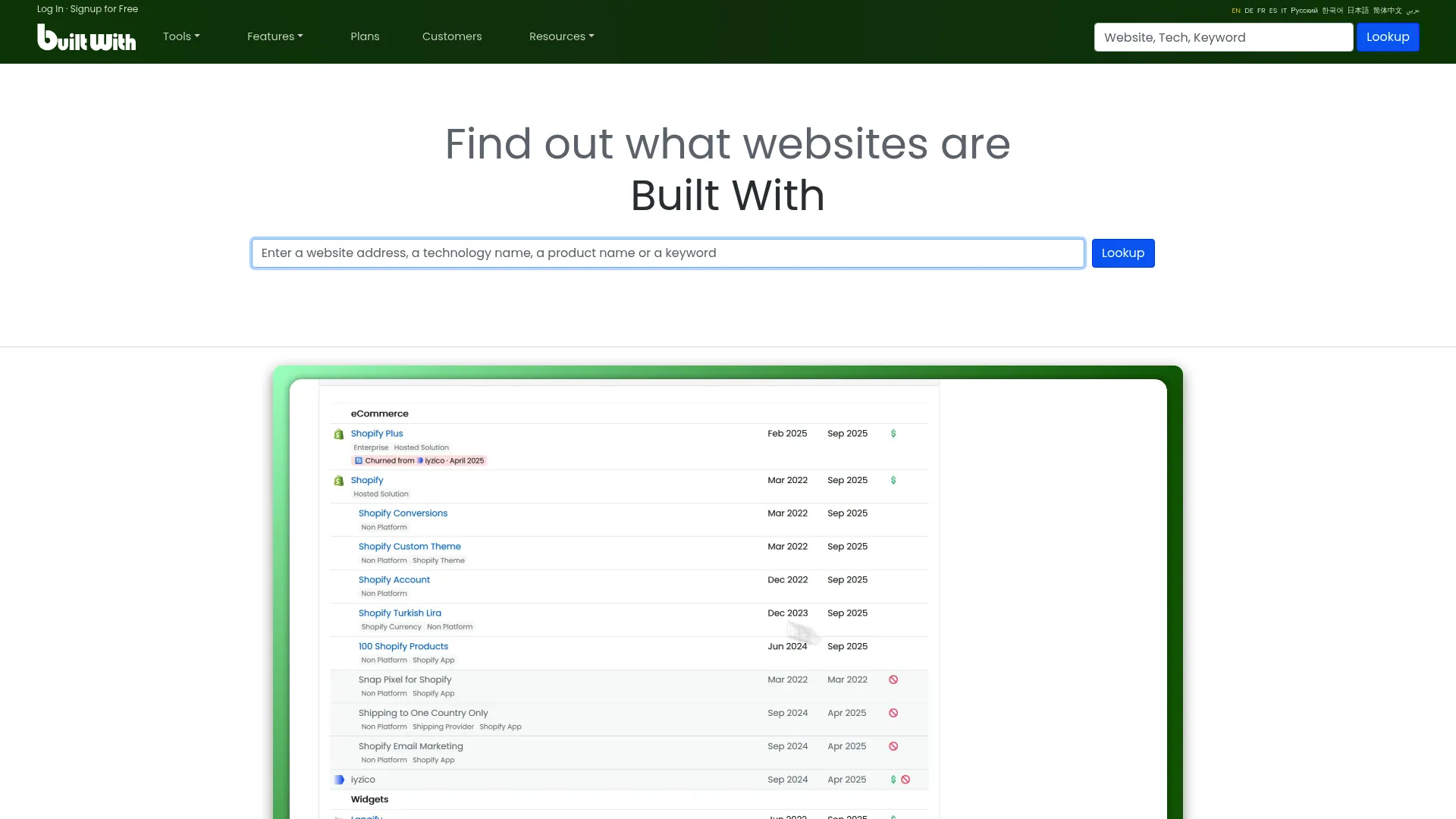
BuiltWith is a web technology profiling, lead generation, and market analysis platform. It excels at website-level tech detection, showing you exactly what technologies a site runs. For quick checks and top-of-funnel targeting, it is fast and specific.
BuiltWith is stronger on detection than on broader sales workflows. It does not replace a full sales intelligence platform, but it is a sharp tool for verifying a company's web stack or building a targeted list based on a specific technology.
Best for: Sales, marketing, and research teams that need website technology intelligence.
Key strengths
- Technology profiling and detailed website profiles
- Lead generation and competitor comparison
- CRM integrations and API access
- Browser extensions for quick lookups
- Free individual site lookups
Why choose BuiltWith: Choose BuiltWith when you need precise website technology detection and quick lookups. It pairs well with a broader data platform rather than serving as your only prospecting tool.
BuiltWith pricing: BuiltWith is free for individual site lookups. Paid plans are Basic at $295/month, Pro at $495/month, and Team at $995/month, billed monthly.
Considerations
Before you commit to a technographic data provider, run each option against your real target accounts and check these criteria.
Data freshness
Evaluate refresh cadence and how recently each technology was detected. Ask when a signal was last confirmed, not just whether it exists. Stale technographics create bad outreach assumptions, and a wrong opener costs you credibility you cannot get back.
Detection method
Check whether the provider uses passive, active, or mixed collection. Passive vs active technographic detection influences both confidence and coverage. Providers that blend methods and attach a confidence score give you signals you can actually act on.
Integration fit
Verify CRM, sequencer, warehouse, and technographic data API support. The best data is worthless if it does not reach your daily workflow. Make sure the provider pushes signals into the tools you already use, so enrichment happens without manual cleanup.
Coverage and confidence
Check geography, company size, and technology category coverage against your ICP. A provider strong in North America may be thin in Europe, or vice versa. Look for confidence scoring or signal quality indicators so you know how much to trust each detection.
SDR usability
Evaluate how fast the data gets into daily use. Prefer tools that help list building and prioritization without extra cleanup. If your reps need a data analyst to make the signals usable, the tool is slowing them down, not speeding them up.
Conclusion
The best technographic data software depends on your motion, not on a single "winner."
If you want breadth in one platform, ZoomInfo covers technographics, contacts, and workflow tools together. For compliant European enrichment, Cognism is the pick. Running account-based plays, 6sense and Demandbase blend technographics with intent and orchestration. Lean HubSpot teams get fast enrichment from Clearbit, while HG Insights and BuiltWith go deep on technology visibility. For volume and speed, Apollo is the accessible starting point, and Bombora adds timing on top of fit.
The pattern most teams land on: pick one technographic data provider for CRM enrichment, and one for prioritization or intent. That combination turns raw technographic signals into cleaner lists, sharper personalization, and better AE handoffs.
Start by testing two options against your real target accounts. The right platform is the one that turns tech-stack signals into meetings, not just data.
Start your journey with Guideflow today!
FAQs
Technographic data software identifies the technology stack a company uses, including its software, cloud services, security tools, and website technologies. It gives sales and marketing teams a fit signal for targeting, so they can prioritize accounts and personalize outreach based on what a company actually runs.
Most providers combine passive and active detection. Passive detection analyzes public signals like HTML source, JavaScript footprints, DNS lookups, and job postings. Active detection probes or queries to confirm what a company runs. The strongest technographic data platforms blend both methods and attach a confidence score.
The difference between technographic data vs firmographic data comes down to what each describes. Firmographics describe the company itself, such as size, industry, revenue, and location. Technographics describe the technology stack the company uses. Both matter together: firmographics tell you if a company fits your ICP, and technographics tell you what they run and where the opportunity sits.
Yes, especially for account prioritization and personalization. Technographic data helps SDRs rank accounts by fit, exclude poor-fit companies before touching them, and reference a known tool in outreach. That means fewer wasted touches and higher reply rates, since your list and your messaging are grounded in what the account actually uses.
Look for tools with strong API and CRM integration rather than raw coverage alone. Cognism offers dedicated CRM Enrichment and Data-as-a-Service packages, Clearbit fits natively inside HubSpot, and ZoomInfo enriches across a broad workflow. Prioritize workflow fit, so enriched data reaches your reps without manual cleanup.
As often as the provider can confirm detections, because tech stacks change constantly. A company can churn off a tool or adopt a new one within a quarter. Outdated technographic signals reduce trust and hurt conversion, since a wrong assumption in your opener costs credibility. Ask each provider about refresh cadence and technology change alerts.
Yes. Technographic data supports segmentation, personalization, and timing in account-based marketing. It helps you build target account lists by stack, tailor messaging by technology fit, and align sales and marketing on the same accounts. The signal is strongest for ABM when you combine it with intent data, which is why buyer intent data vs technographics is a pairing question, not an either-or choice.
Check coverage, freshness, confidence, integrations, and ease of use. Verify the provider covers your geography and technology categories, refreshes data often, and signals detection confidence. Confirm it integrates with your CRM and sequencer through a technographic data API. Then test it against your real target accounts before committing, since coverage claims mean little until you check them on your own list.