Your VP of Marketing says analyst relations matters. Your board asks why the category narrative isn't showing up in reports. Meanwhile, analyst notes live in spreadsheets, briefing decks sit in scattered folders, and relationship history is split across three inboxes.
That's not a messaging problem. It's an infrastructure problem.
According to CCGroup's 2025 research, only 35% of marketers plan to prioritize analyst relations in the 2026-27 cycle, even as analyst influence over enterprise buying decisions has grown. The companies that do prioritize AR tend to win category positioning before competitors know there's a race.
For a Series B founder, the inflection point is clear: Analyst relations becomes operationally unsustainable the moment it depends on your memory. The goal isn't to make you better at remembering analyst relationships. The goal is to make analyst engagement survive when a VP, PMM, or comms lead takes over the program.
This guide covers 11 analyst relations software options to help you build that system.
What's inside
This guide is for founders, heads of marketing, and AR practitioners evaluating dedicated analyst relations tooling. It covers:
- Who the guide is for: SaaS teams moving AR out of founder memory and into a repeatable GTM process
- Selection criteria: Native fit for AR workflows, analyst discovery depth, relationship and project management, and monitoring plus reporting coverage
- What's covered: 11 tools and modules across the AR software landscape, from broad platforms to specialist intelligence layers
- Verification: Pricing and G2 ratings reflect information available at publication time; verify with vendors before purchasing
TL;DR
- Best overall AR suite: ARInsights for teams that need analyst database, relationship tracking, portal, and reporting in one system
- Best for AR program management: ARchitect for teams standardizing analyst engagement across product lines or regions
- Best for controlled content sharing: Analyst Portal for teams that need a branded hub for briefing materials and follow-up assets
- Best for founder-to-team handoff: ARInsights Project Manager for turning AR into a workflow a new VP can run on day one
- Best for analyst intelligence: Spotlight Oz for teams focused on perception tracking and category-level competitive coverage
- Best for leadership reporting: ARInsights Analytics for AR dashboards that survive board scrutiny
What is analyst relations software?
Analyst relations software helps companies manage analyst contacts, briefing history, research intelligence, outreach workflows, content sharing, monitoring, and AR program performance from a central system.
It sits between product marketing, communications, PR, executive leadership, and sales enablement. For scaling SaaS teams, it replaces the spreadsheet-and-inbox setup that works for one founder but breaks the moment a second person needs to own the relationship.
Core jobs analyst relations software handles
- Analyst and influencer discovery: Searchable databases of analysts by firm, coverage area, topic, and region
- Relationship tracking: Interaction history, preferences, sentiment, and engagement cadence per analyst
- Research monitoring: Alerts and tracking across analyst research, media mentions, peer reviews, and social coverage
- Project management: Workflow coordination for briefings, evaluations, deadlines, and evidence requests
- Content portals: Branded destinations for sharing briefing decks, recordings, product updates, and follow-up assets with analysts
- Reporting and analytics: Activity tracking, coverage metrics, share of voice, and leadership-ready dashboards
Where it fits in a SaaS GTM system
AR software is most valuable when analyst relationships have business consequences but are still managed informally. The purchase signal is usually one of these: A new VP Marketing needs context they don't have, an evaluation deadline arrives without a coordinated response, or a competitor shows up in a report before you do.
You can browse our guide to best competitive intelligence tools if competitive analyst coverage is the primary driver for evaluating this category.
When to use analyst relations software
Move analyst context out of founder memory
Early analyst relationships often live with the founder, CMO, or PR lead. When a new VP or PMM joins, they inherit an email thread, not a system. Software becomes the transfer mechanism: Interaction history, analyst preferences, coverage areas, and open commitments all live in one place a new leader can access on day one.
For a Series B company with 30 to 150 employees, that handoff is not theoretical. It happens when you hire the VP your board has been asking for.
Prepare for analyst evaluations without scrambling
Research evaluations like the Gartner Magic Quadrant, Forrester Wave, and IDC MarketScape require coordination across customer proof, product evidence, briefing preparation, fact-checking, and deadline tracking. Teams that treat each evaluation as a fresh project lose time and credibility. Software keeps the evidence library, analyst context, and workflow in one place across cycles.
It cannot guarantee placement. It does make preparation less chaotic.
Track perception and competitive coverage
AR is partly relationship management and partly market intelligence. Founders need to know which competitors are gaining analyst attention, where category language is shifting, and which narratives are gaining ground. If you only hear about perception shifts during the next board meeting, the feedback loop is already too slow.
Analyst relations software comparison
The table below compares all 11 tools and modules across their primary use case. Because most of these products price by quote, the pricing column reflects verified packaging information. G2 ratings reflect available listings at time of writing.
| # | Product | Best for | Key differentiator | Pricing | G2 rating |
|---|---|---|---|---|---|
| 1 | ARInsights | End-to-end AR program management | Full AR suite: Database, workflows, portals, and reporting | Quote-based | 4.8/5 |
| 2 | ARchitect | Enterprise AR operations | Analyst discovery, program management, and engagement workflows | Quote-based | 4.8/5 |
| 3 | Analyst Portal | Controlled analyst content sharing | Branded portal for briefing materials and asset distribution | Quote-based | 4.8/5 |
| 4 | ARInsights Analyst Relations Agency | Software plus execution support | Services layer for strategy, outreach, and program delivery | Quote-based | 4.8/5 |
| 5 | ARInsights Influencer Database | Analyst and influencer discovery | 10,000+ searchable analyst profiles with daily updates | Quote-based | 4.8/5 |
| 6 | ARInsights Project Manager | AR workflow coordination | Project tracking for briefings, evaluations, and follow-up | Quote-based | 4.8/5 |
| 7 | ARInsights Relationship Manager | Analyst relationship tracking | Interaction history and engagement management | Quote-based | 4.8/5 |
| 8 | ARInsights Analytics | AR reporting and leadership visibility | Power BI-powered dashboards for activity and sentiment | Quote-based | 4.8/5 |
| 9 | Premium Content | Analyst research intelligence | Monitors 35+ analyst firms plus social and peer review channels | Quote-based | 4.8/5 |
| 10 | AR Connect | Analyst engagement and content sharing | AI-assisted content creation with access controls and analytics | Quote-based | 4.8/5 |
| 11 | Spotlight Oz | Analyst perception and category intelligence | Tracks analyst coverage, competitive mentions, and AI visibility | Quote-based | 4.9/5 |
Best 11 analyst relations software tools for 2026
1. ARInsights
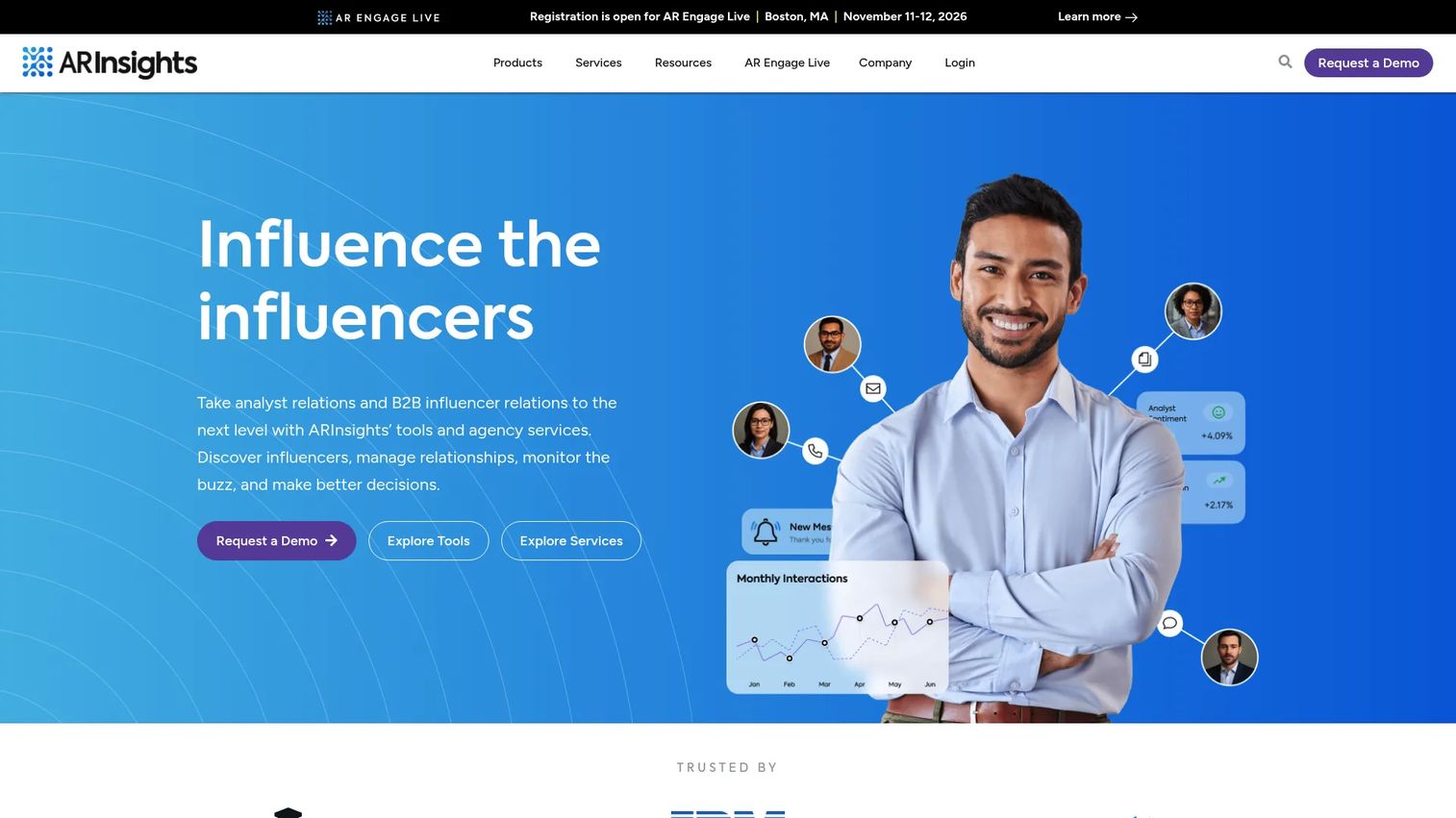
ARInsights is a broad analyst relations platform for technology vendors that need to manage the full AR program in one system. It spans analyst and influencer discovery, relationship management, project workflows, content portals, and reporting. Teams that have outgrown the spreadsheet-and-inbox model typically find ARInsights covers the gap without requiring multiple separate tools.
Best for: SaaS teams building a structured analyst relations function across marketing, communications, and executive leadership.
Key features
- 10,000+ analyst and B2B influencer profiles with daily updates
- Relationship and interaction tracking with sentiment monitoring
- Customizable project templates for briefings, evaluations, and events
- Briefing books, email outreach, and research event tracking
- Outlook, Google Workspace, Slack, and Smart Email Capture integrations
Why choose ARInsights: It fits teams that want one AR operating layer rather than separate tools stitched together. For a founder handing AR to a new marketing leader, the breadth means the incoming VP can find what they need without rebuilding the system.
ARInsights pricing: ARInsights prices by quote. Seats drive the base cost, and add-on modules are sold by capacity. A 14-day free trial is available after a personalized demo.
G2 rating: 4.8/5
2. ARchitect
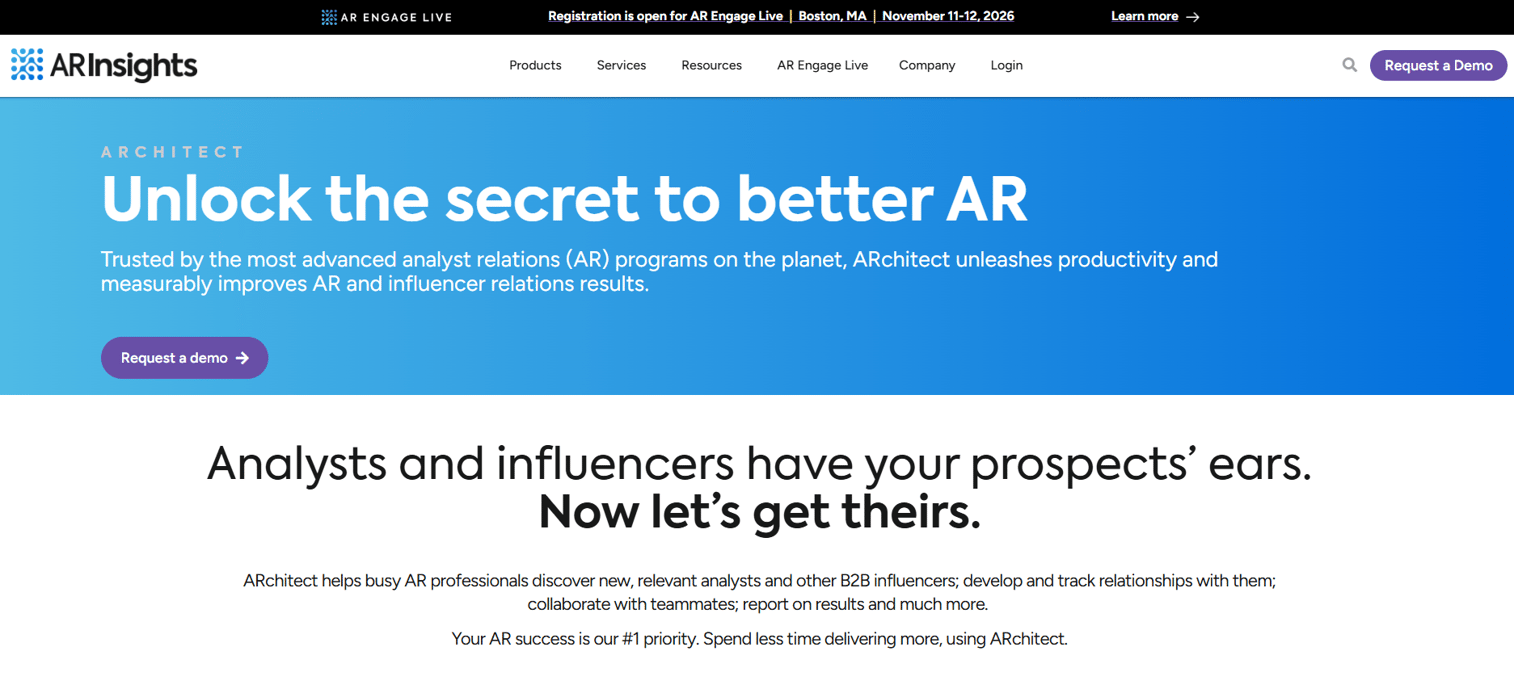
ARchitect is the core platform within the ARInsights product family. It covers analyst discovery, program management, outreach, market intelligence, and portal workflows from a single interface. It's the right fit for teams that need to standardize analyst engagement across product lines, regions, or a growing AR function.
Best for: Enterprise and scaleup teams that need structured AR program management and consistent analyst engagement across the organization.
Key features
- Analyst discovery with coverage area and firm filtering
- AR program management with configurable stage restrictions
- Analyst outreach campaigns with email creation and tracking
- Market intelligence and competitive analyst monitoring
- Portal workflows for analyst-facing content
Why choose ARchitect: When analyst relations is no longer a PR side project, ARchitect gives the function an owned operating system. A Series B founder should consider it when the board is asking for category credibility, not just contact management.
ARchitect pricing: ARchitect prices per seat, with add-on modules sold by capacity. Pricing requires a custom proposal. Ask sales how database access, portal use, and user seat count affect the quote.
G2 rating: 4.8/5
3. Analyst Portal
Analyst Portal is a controlled content destination within the ARInsights ecosystem. It gives analyst relations teams a branded hub for sharing briefing decks, recordings, product updates, and follow-up assets. Analysts access what's relevant to them; teams see who engaged and with what.
Best for: Teams that need a controlled hub for analyst-facing content and want to reduce message drift across briefing follow-ups.
Key features
- Centralized sharing of documents, links, videos, and event materials
- Permission-based analyst access control
- AI-assisted content drafting
- Corporate branding and customized login pages
- Engagement analytics showing content interactions
Why choose Analyst Portal: If your team keeps sending analysts different versions of the same deck over email, a portal removes that drift. It also creates a record of what each analyst has seen, which is useful context before the next briefing.
Analyst Portal pricing: Analyst Portal is available as part of the ARInsights suite. Pricing is quote-based and connected to the broader ARchitect subscription. Contact ARInsights to confirm whether a standalone configuration is available.
G2 rating: 4.8/5 rating on G2.
4. ARInsights Analyst Relations Agency
ARInsights Analyst Relations Agency is the services arm of ARInsights. It provides strategic AR guidance and operational execution support for technology companies, not standalone software. It belongs in this list because some SaaS teams need both tooling and execution help, particularly when founder-led AR is being transferred to a formal owner with limited AR experience.
Best for: Technology companies that need AR strategy and execution support alongside software, especially during a first formal AR program build.
Key features
- AR strategy development and program execution
- RFI automation and evaluative report support (covering Magic Quadrant, Wave, and MarketScape processes)
- Peer review management and advocacy
- Sales enablement connected to analyst engagement
- Analyst event support and outreach planning
Why choose ARInsights Analyst Relations Agency: Services are the right call when the team lacks AR experience and hiring a dedicated AR head isn't yet justified. For a Series B founder, paying for agency expertise often costs less than asking a new marketing leader to build an AR program from scratch while also running demand gen.
ARInsights Analyst Relations Agency pricing: Services are quoted by engagement. Ask sales how strategy scope, outreach support, and reporting requirements affect the total. Software pricing follows the ARchitect seat-based model separately.
5. ARInsights Influencer Database
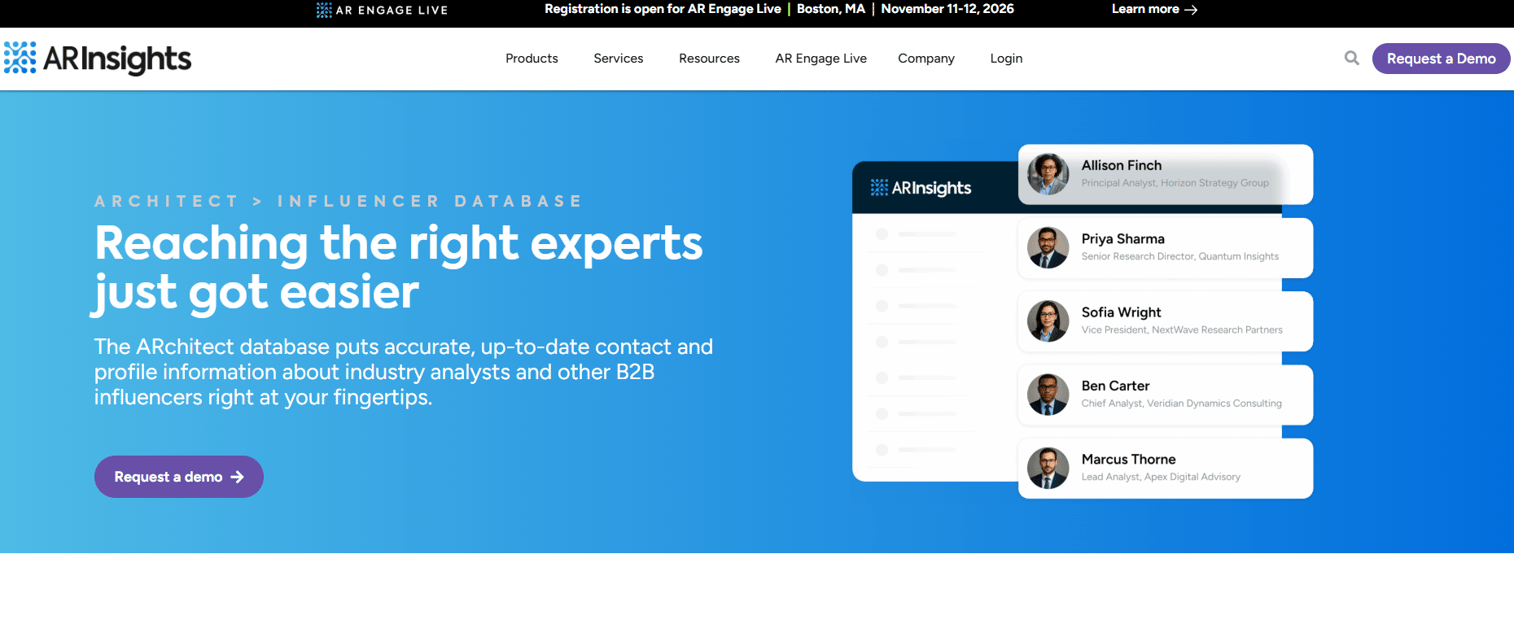
ARInsights Influencer Database is the analyst and B2B influencer discovery module within the ARchitect platform. It gives AR teams a searchable, maintained database of over 10,000 analyst and influencer profiles, updated daily. Poor analyst targeting wastes briefing capacity and weakens category positioning. This module addresses that problem at the front of the program.
Best for: Teams that need better analyst targeting before outreach or briefing programs, particularly when entering a new category or market.
Key features
- 10,000+ searchable analyst and influencer profiles with contact information
- Coverage area and firm filtering for precise targeting
- Research and event tracking for planned analyst output
- Integration with ARchitect relationship management and outreach
- Daily database updates across profiles
Why choose ARInsights Influencer Database: It's useful when the team knows analyst engagement matters but can't confidently identify which analysts cover the company's category, competitors, and buyers. Better targeting produces better briefing ROI.
ARInsights Influencer Database pricing: The database is included as part of the ARchitect platform subscription, sold per seat. Capacity-based add-ons may apply depending on the scope of database access required. Request a quote to confirm packaging.
G2 rating: 4.8/5 under the ARInsights/ARchitect listing on G2.
6. ARInsights Project Manager
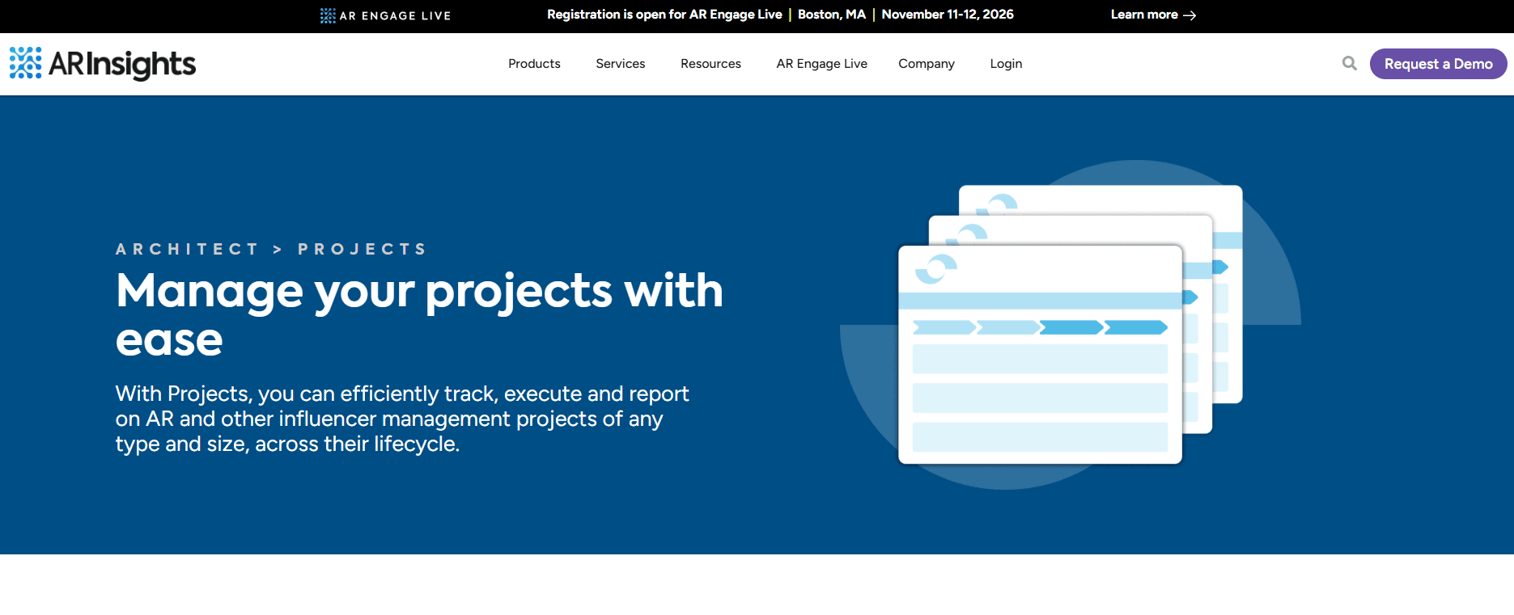
ARInsights Project Manager is the workflow coordination module inside ARchitect. It tracks briefings, evaluation deadlines, evidence requests, customer reference coordination, and follow-up ownership across the AR team. It's the module that turns analyst relations from ad hoc activity into a repeatable operating process.
Best for: Teams turning analyst relations from ad hoc activity into a repeatable process a new VP or PMM can inherit without losing context.
Key features
- Customizable project templates for briefings, evaluations, and events
- Configurable stage restrictions and task assignment
- Cross-team collaboration on deliverables and timelines
- Project filtering, sorting, and outcome trend reporting
- Follow-up ownership tracking with deadline coordination
Why choose ARInsights Project Manager: This is the founder handoff module. It gives an incoming VP Marketing or comms lead a clear system for who owns what before the next analyst deadline. Without it, briefing preparation tends to happen reactively rather than on a cadence.
ARInsights Project Manager pricing: Included within the ARchitect platform subscription. Pricing is seat-based with capacity-based add-ons. Ask sales whether the project management module requires a specific tier or package.
G2 rating: 4.8/5, under the ARInsights G2 listing.
7. ARInsights Relationship Manager
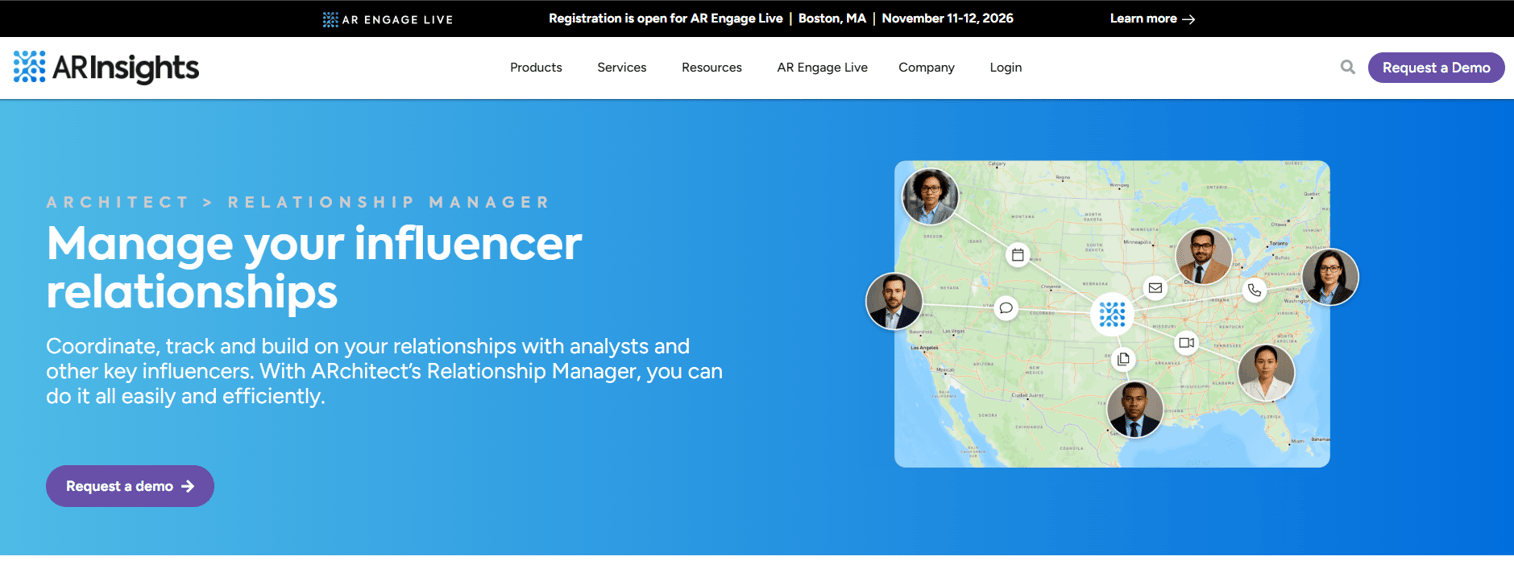
ARInsights Relationship Manager is the relationship memory layer within ARchitect. It stores analyst interaction history, preferences, sentiment, coverage interests, and engagement cadence. The core problem it solves: Analyst relationships compound over time only if the organization remembers them. This module protects continuity when leadership changes.
Best for: Teams that need durable analyst relationship history that survives leadership changes, regional expansion, and program growth.
Key features
- Centralized interaction history for analysts and influencers
- Automatic interaction capture through Outlook, Google, and Smart Email Capture
- Analyst insight capture associated with each interaction
- Custom fields for organization-specific relationship data
- Project organization connecting interactions, timelines, and participants
Why choose ARInsights Relationship Manager: A new VP inheriting a blank analyst CRM spends their first quarter rebuilding context. This module means that context is already there. It's particularly valuable when the founder has been the relationship memory and is stepping back.
ARInsights Relationship Manager pricing: Included in the ARchitect platform. Pricing follows the per-seat model with capacity-based add-ons. Ask sales how the relationship manager module is packaged within the quote.
G2 rating: 4.8/5, per the ARInsights G2 listing.
8. ARInsights Analytics
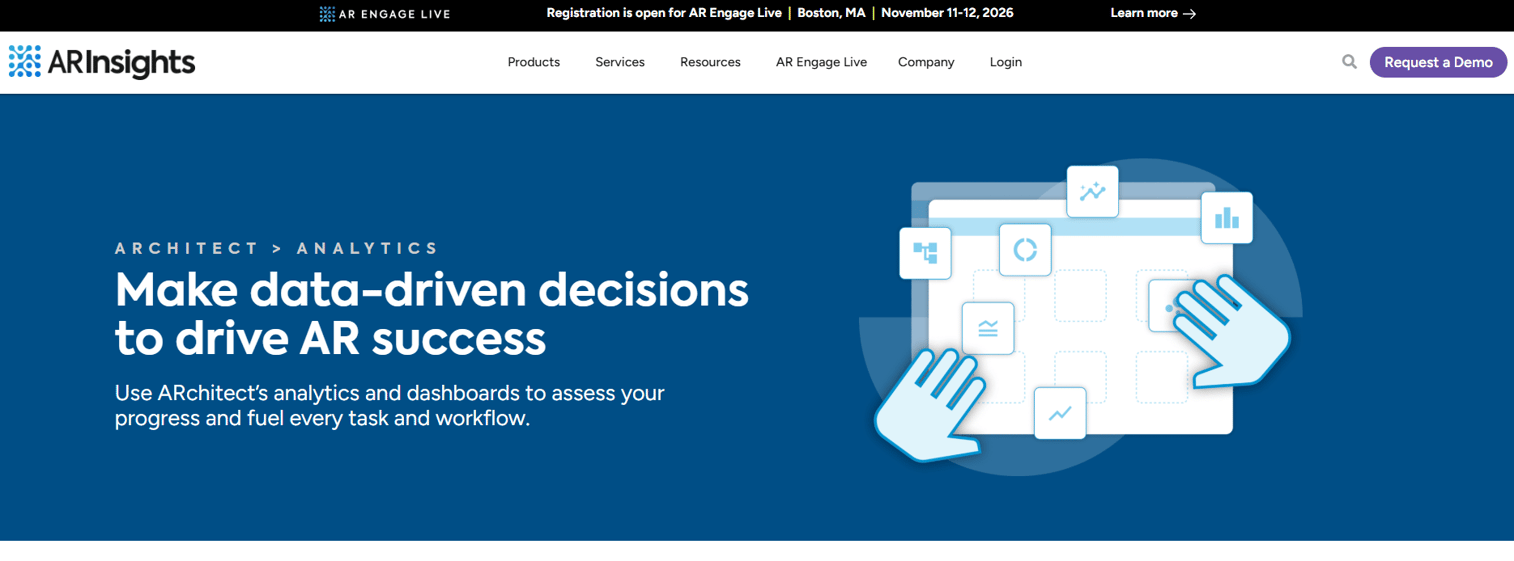
ARInsights Analytics is the reporting layer within ARchitect. It uses Microsoft Power BI to deliver interactive dashboards across analyst interactions, research inclusions, project outcomes, sentiment, and share of voice. The goal is to move reporting from "we had several analyst calls this quarter" to something a board can interpret.
Best for: AR leaders who need to defend program activity and outcomes in leadership or board conversations without building their own reporting stack.
Key features
- Interactive Power BI dashboards across interactions, projects, and content
- Tracking of analyst sentiment, share of voice, and research inclusions
- Drill-down filtering by influencer, time period, content, and project
- Outcome trend analysis for program performance
- Leadership-ready reporting across coverage and engagement metrics
Why choose ARInsights Analytics: If the board asks whether analyst relations is worth the investment, the answer needs more than a list of meetings. This module connects AR activity to coverage trends, sentiment shifts, and strategic learnings that map to board-level language.
ARInsights Analytics pricing: Analytics is a module within the ARchitect platform. The base platform is seat-priced; add-on modules are capacity-based. Ask sales whether analytics requires a separate module purchase within the quote.
G2 rating: 4.8/5, under the ARInsights ARchitect listing on G2.
9. Premium Content
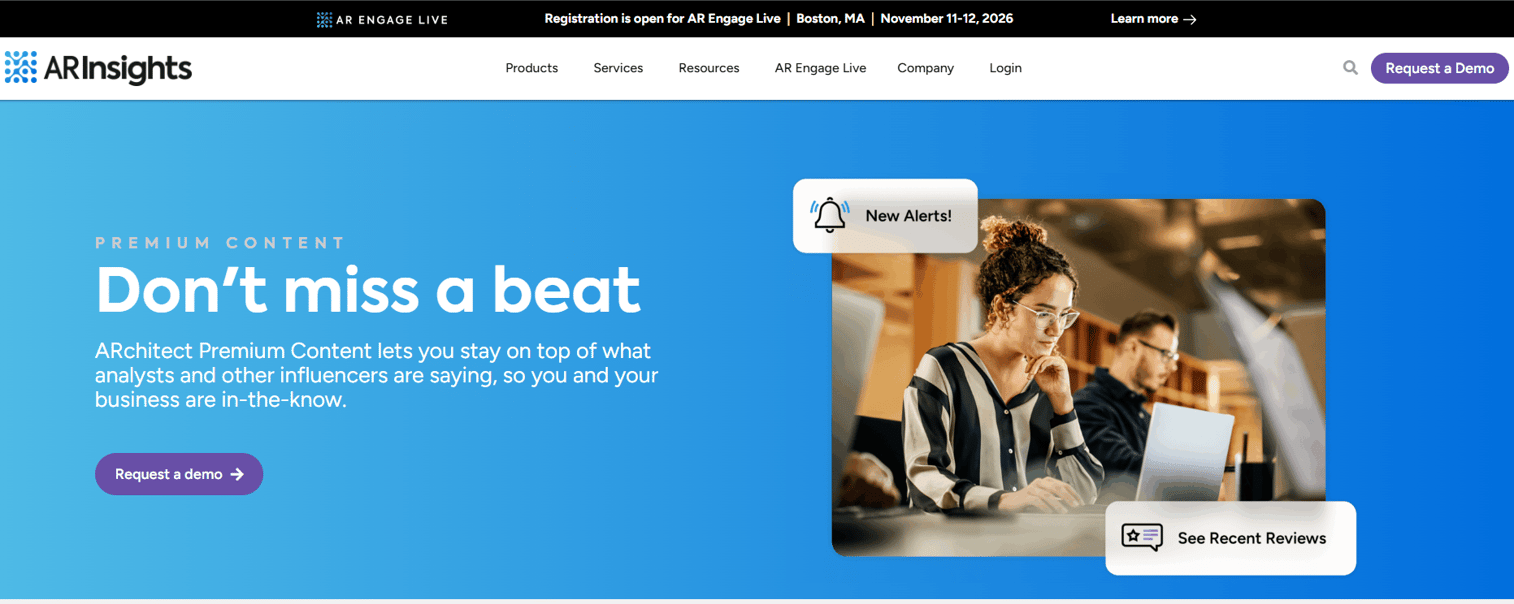
Premium Content is the research and monitoring intelligence layer within ARchitect. It consolidates analyst mentions across research output from 35+ leading analyst firms, including Gartner, IDC, and Forrester, plus blogs, media, Twitter, LinkedIn, and peer review platforms like G2 and PeerSpot. Teams use it to stay ahead of shifts in analyst language before those shifts show up in market perception.
Best for: Teams that need to understand how analysts are describing their category and competitors before preparing briefings or building positioning.
Key features
- Research coverage from 35+ analyst firms, including Gartner, IDC, and Forrester
- Monitoring across blogs, media, social channels, and peer reviews
- In-app, email, and Slack alerts for relevant mentions
- Competitive monitoring, sentiment tracking, and share of voice reporting
- Web content capture for broader coverage
Why choose Premium Content: Category positioning changes before anyone announces it. This module is useful when leadership needs to know which competitor narratives are gaining analyst traction, or when preparing for an evaluation and needing to understand where the company currently sits in analyst thinking.
Premium Content pricing: Premium Content is an add-on module within the ARchitect platform. Capacity determines cost. Ask ARInsights how research access scope and alert volume factor into the proposal.
G2 rating: 4.8/5, under the ARInsights G2 listing.
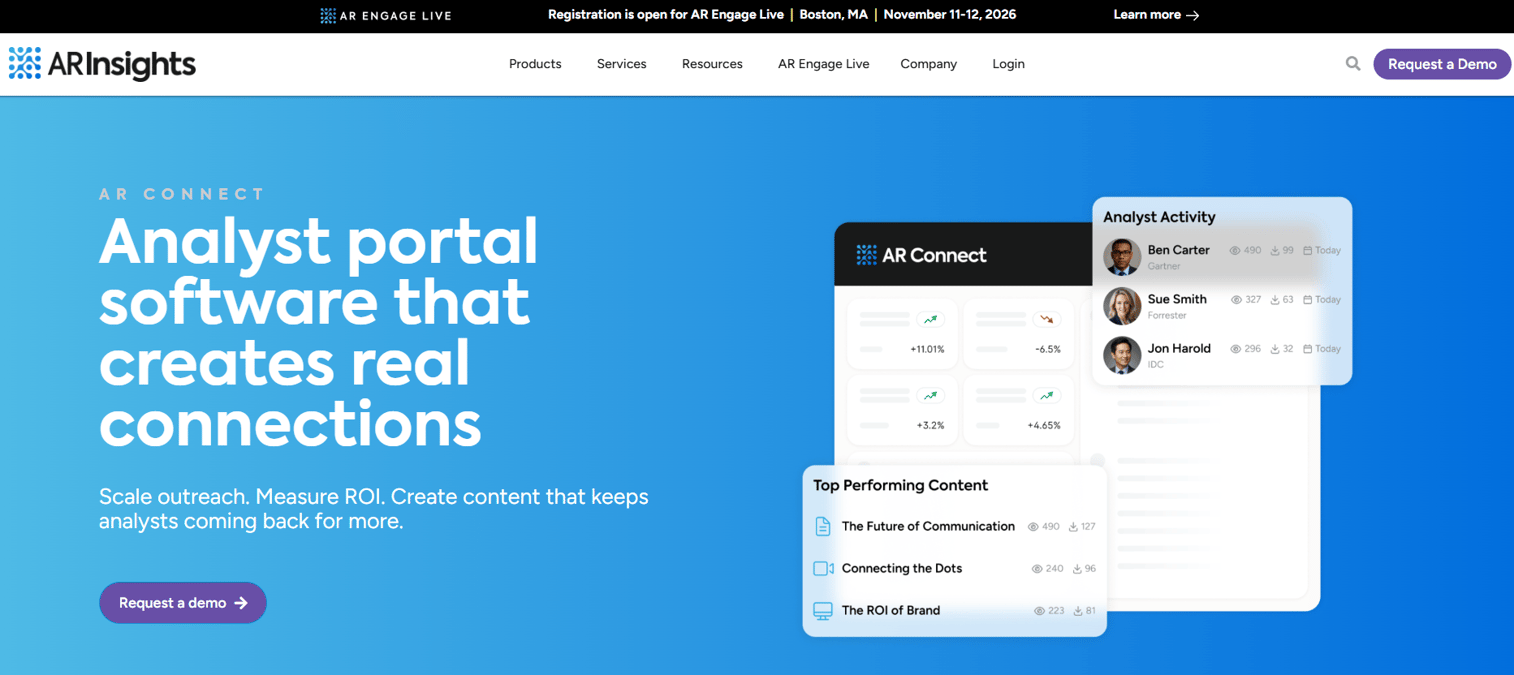
10. AR Connect
AR Connect is an analyst portal and engagement product within the ARInsights platform. It helps AR teams create and distribute analyst-facing content with AI assistance, control who sees what, and measure how analysts engage with shared materials. It is positioned as a newer evolution of the portal workflow, with AI-assisted content drafting added to the content distribution and analytics layer.
Best for: AR teams coordinating analyst outreach campaigns and ongoing engagement with a need for content creation support and access controls.
Key features
- AI-assisted creation of analyst-facing content from URLs or uploaded files
- Granular content visibility and analyst access controls
- Engagement analytics covering views, time spent, bookmarks, and downloads
- Native team collaboration tools
- Analyst search and direct contact-request functionality
Why choose AR Connect: It reduces the time between briefing and follow-up by giving teams a tool to create and distribute analyst-ready content faster. Engagement analytics show which analysts are reading and which materials drive the most interaction, making follow-up decisions easier to prioritize.
AR Connect pricing: Ask ARInsights sales how this module is packaged, whether it replaces or supplements the Analyst Portal module, and how pricing maps to the broader ARchitect subscription.
G2 rating: 4.8/5
11. Spotlight Oz
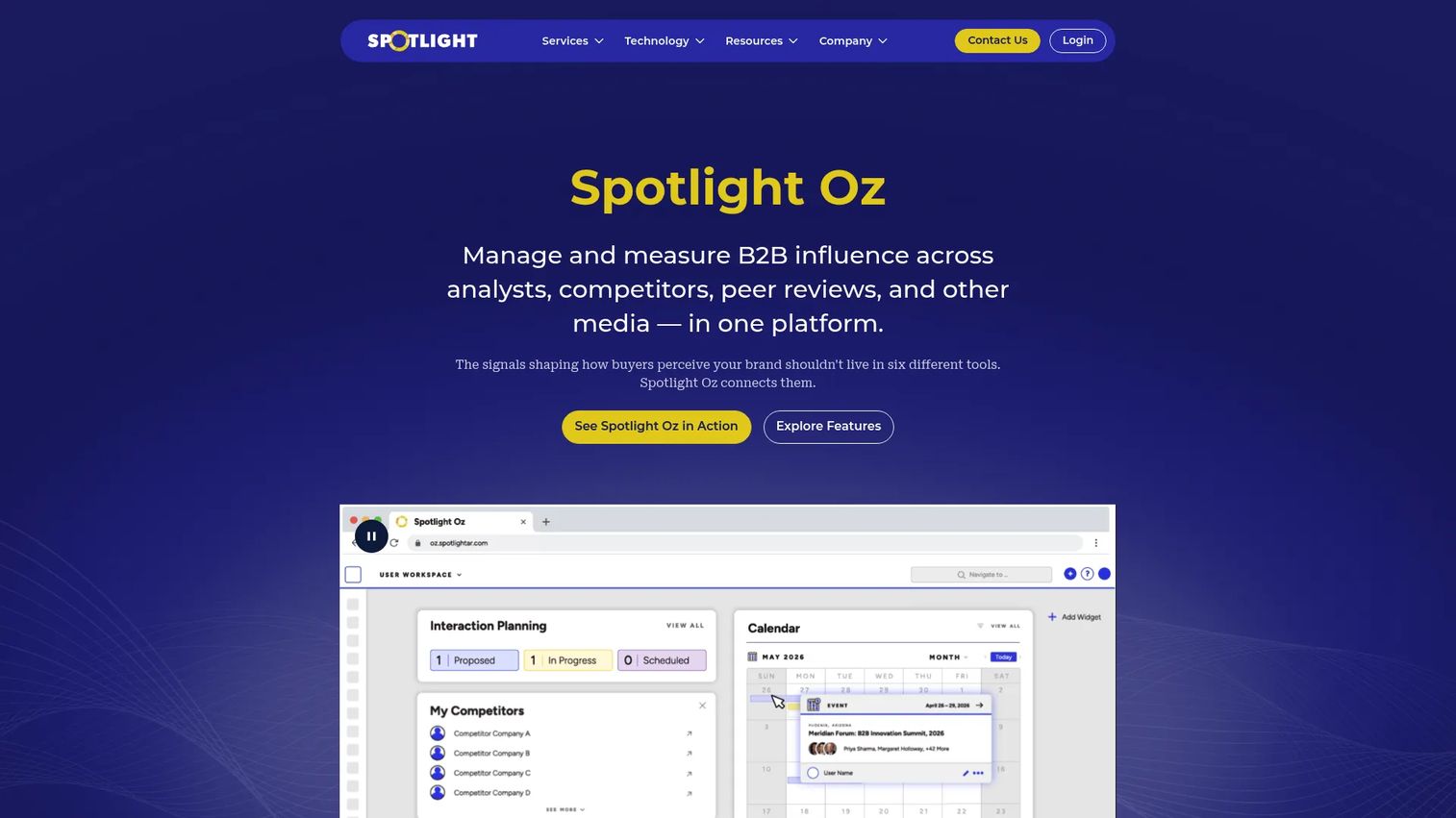
Spotlight Oz is a B2B influence orchestration platform that focuses on analyst coverage tracking, competitive intelligence, peer review advocacy, media mention monitoring, and AI and LLM visibility. It feels distinct from database-first AR tools. Where most AR platforms start with contact management, Spotlight Oz starts with perception.
Best for: Teams that want to track how analysts describe their category and competitors, and need to monitor influence across research, media, peer reviews, and AI-generated outputs.
Key features
- Analyst interaction management and relationship tracking
- Report and milestone management with briefing books
- Customizable metrics dashboards for AR activity
- AI and LLM visibility monitoring for how the brand appears in AI-generated content
- Competitive intelligence and media sentiment tracking
Why choose Spotlight Oz: It's useful when leadership cares about market perception, not only analyst contact management. For a Series B founder building toward enterprise expansion or a fundraise, understanding how the company appears in analyst research, AI outputs, and peer reviews before those perceptions harden is a strategic advantage. The IIAR's 2025 survey drew 190 analyst respondents from 59 firms across 31 countries, a scale that shows how fragmented analyst coverage has become; monitoring tools like Spotlight Oz address that breadth directly.
Spotlight Oz pricing: Contact sales to understand how program scope and monitoring coverage affect the quote.
G2 rating: 4.9/5
Considerations when choosing analyst relations software
Start with the AR operating model
Before evaluating platforms, decide what you need: An analyst database, a full AR suite, a portal for content sharing, an analytics layer, agency services, or a combination. Buying a broad platform before naming who will own the workflow produces shelfware. The right scope question is not "which tool is most complete?" It's "which jobs are actually broken right now?"
Check analyst coverage depth for your category
A database matters only if it maps to the analyst firms, coverage areas, and buyer segments that affect your deals. During evaluation, search for your category and a competitor. If the results are thin, the database won't drive better targeting. Coverage depth by geography also matters for teams selling internationally.
Evaluate workflow ownership before buying
Ask who will update interaction notes, assign briefing follow-ups, manage evidence requests, and report outcomes. The best AR tool fails if no one owns the workflow. Software makes analyst relations operable, but it doesn't create the ownership structure. Define that first.
Demand reporting that leadership can read
Founders need AR reporting that connects activity to outcomes: Coverage quality, analyst sentiment, engagement velocity, and competitive share of voice. Vague engagement metrics don't survive a board meeting. Look for tools that surface trend data, not just activity logs, so the program can be defended in strategic terms.
Verify integrations and content governance
Email, calendar, and CRM integrations reduce manual data entry and keep relationship history accurate. For analyst portals, content governance matters: Outdated briefing materials damage credibility faster than no materials at all. Check whether the tool supports version control, access expiration, and audit trails before committing.
Conclusion
Analyst relations software is not one homogeneous category. ARInsights and ARchitect work for teams that need a broad AR operating layer, from discovery through reporting. Analyst Portal and AR Connect address the specific job of sharing analyst-facing content with controls and engagement visibility. ARInsights Analytics fits teams that need board-ready reporting. The ARInsights Influencer Database and Relationship Manager handle the targeting and memory layers individually. Spotlight Oz is the right pick when market perception and competitive coverage monitoring matter more than contact management.
For most Series B founders, the priority question is: What is the most broken part of the current AR process? Start with that answer. If briefing coordination is the bottleneck, start with Project Manager and Relationship Manager. If the team doesn't know which analysts to brief, start with the Influencer Database. If leadership wants to understand competitive perception, Spotlight Oz or Premium Content addresses that job first.
Shortlist two or three tools based on the operating model, test coverage against your actual category during evaluation, and make sure the incoming VP or PMM has what they need to run the program independently from week one.
You can also explore related guides on account management software and best product marketing software tools if AR fits into a broader GTM stack evaluation.
Start your journey with Guideflow today!
FAQs
Analyst relations software helps companies manage analyst contacts, briefing history, research monitoring, outreach workflows, content sharing, and AR program performance from a central system. It covers the full AR operating layer, from finding the right analysts to tracking what they've seen and measuring how perception moves over time. It differs from general PR software in that it's purpose-built for analyst firms, evaluation processes, and research-driven influence rather than media outreach.
The answer depends on the AR job you're solving first. For teams that need a complete AR system, ARInsights or ARchitect covers discovery, relationship tracking, project management, and reporting. For analyst content sharing with engagement visibility, Analyst Portal or AR Connect is the focused pick. For perception monitoring and competitive coverage, Spotlight Oz and Premium Content address that job specifically. Most growing SaaS teams start with the relationship and project management layer before adding intelligence monitoring.
Early-stage startups can typically manage with structured spreadsheets and a disciplined briefing process. Software becomes necessary when analyst history becomes hard to access before key meetings, when evaluation deadlines require cross-team coordination, when research monitoring is happening manually and slowly, or when a new leader inherits the program without context. For most Series B companies, that point arrives around the time the first dedicated marketing or communications leader joins.
The core feature set covers analyst discovery and database access, relationship history and interaction tracking, project management for briefings and evaluations, content portals for sharing analyst-facing materials, research monitoring and competitive coverage alerts, and reporting dashboards for program activity and outcomes. Teams with mature AR programs often add sentiment tracking, share of voice analysis, and peer review monitoring on top of the core layer.
Yes, in a meaningful operational sense. Software helps teams manage evaluation deadlines, organize customer evidence and references, track analyst context and prior interactions, coordinate briefing preparation, and distribute follow-up materials through a controlled portal. What it cannot do is guarantee inclusion in an evaluation or influence where the analyst places a vendor. The quality of the product, customer outcomes, and the analyst relationship itself drive placement. The software makes the preparation process less chaotic and more consistent across cycles.
PR software focuses on media outreach, press release distribution, journalist relationship management, and media monitoring. Analyst relations software focuses on analyst firm databases, research coverage tracking, briefing and evaluation workflows, and AR-specific reporting like share of voice and analyst sentiment. The two categories share some monitoring functionality, but their core workflows are different. Some teams use both, with PR software for media and AR software for analyst programs, rather than asking one tool to cover both jobs.
Not immediately. A founder who has three analyst relationships and one briefing per quarter can manage that with a shared doc and calendar reminders. Software becomes relevant when analyst context needs to move from founder memory into a system someone else can run, when multiple people are involved in briefing preparation and follow-up, or when evaluation cycles create coordination pressure that email and spreadsheets can't absorb. For most Series B companies, the trigger is hiring a VP of Marketing who needs to own the program from day one.
Useful metrics include engagement cadence (how often key analysts are briefed), briefing-to-coverage correlation, analyst sentiment tracked over time, share of voice in research reports relative to competitors, evaluation readiness (whether evidence and references are prepared before deadlines), and sales enablement impact when analyst quotes or reports appear in deal cycles. Avoid promising direct revenue attribution unless the organization has instrumented a clean path from analyst mention to pipeline. Most AR teams start with activity metrics and add outcome metrics as the program matures.