You can still rank number one in Google and lose the sale to an AI answer. A buyer opens ChatGPT, asks which platform is best in your category, and your competitor gets cited. Your organic dashboard shows green. You have no idea it happened.
According to Pew Research Center (2026), 60% of U.S. adults have already read AI summaries at the top of search results. Meanwhile, EMARKETER forecasts that 31.3% of the U.S. population will use generative AI search in 2026. That is a tracking gap most marketing teams have not closed yet.
Traditional SEO tells you how often people clicked your blue link. AI search visibility tells you something different: Whether AI engines mention you, cite you, or recommend you when buyers ask category questions. Those are two separate measurement problems, and most SEO stacks only solve one of them.
This guide compares 15 AI search visibility optimization tools across monitoring depth, prompt coverage, citation intelligence, content workflows, and pricing, so you can find the right fit without adding another dashboard that collects dust.
What's inside
This guide is for SEO managers, growth marketers, demand gen leads, and agency strategists who need to close the AI visibility gap.
Tools were selected based on:
- AI engine coverage (which answer surfaces the tool tracks)
- Prompt tracking depth (branded, category, comparison, and problem-aware prompts)
- Citation and source reporting (which URLs AI engines cite instead of you)
- Actionability (does it tell you what to fix, or only what is broken)
- Pricing transparency and G2 ratings, verified at time of writing
The guide separates monitoring tools from optimization platforms and workflow execution tools, because those are three different buying decisions.
TL;DR
- Best overall for AI visibility inside an SEO platform: Semrush AI Visibility Toolkit tracks share of voice, sentiment, and competitor positioning across ChatGPT, Gemini, and Perplexity from $99/month per domain
- Best dedicated AI search analytics: Peec AI covers six AI engines with prompt-level monitoring, citation analysis, and AI referral tracking from $95/month
- Best for enterprise AI visibility intelligence: Profound offers a 7-day free trial, then custom enterprise pricing with daily tracking across multiple engines
- Best free tier with optimization features: AthenaHQ includes 300 credits on its free Essential plan, with paid plans from $295/month
- Best for content execution after diagnosis: AirOps connects visibility gaps to content workflows with a free Solo tier
- Best free baseline: Google Search Console is free and covers Google search performance data, though it does not replace multi-engine prompt tracking
What is AI search visibility optimization software?
AI search visibility optimization software helps marketers monitor, measure, and improve how often their brand appears, gets cited, and is recommended in AI-generated answers across answer engines like ChatGPT, Gemini, Perplexity, and Google AI experiences.
The category sits at the intersection of answer engine optimization tools, traditional SEO, and brand monitoring. It differs from conventional rank tracking because AI answers are generated rather than retrieved. The same query can produce a different answer depending on the model version, the prompt phrasing, the user's region, and when the query runs. That variability is why the category exists as a separate discipline.
Core capabilities you should expect from these platforms:
- Prompt tracking: Monitor how your brand appears across branded, category, comparison, and problem-aware prompts
- Brand mention monitoring: Track frequency and context of brand mentions inside AI-generated answers
- Citation tracking: Identify which URLs AI engines pull from, and which sources get cited instead of yours
- Share of voice: Measure how often you appear versus competitors across a defined prompt set
- Sentiment analysis: Assess whether AI engines describe your brand positively, neutrally, or negatively
- Competitor benchmarking: Compare your AI visibility against named competitors
- AI crawler audits: Check whether AI crawlers can access your pages
- Content recommendations: Surface which pages to update and which gaps to fill
- Historical reporting: Track visibility changes over time
- Workflow integrations: Connect visibility data to your CRM, content tools, or reporting stack
Traditional SEO versus AI search visibility
Traditional SEO tracks rankings, impressions, clicks, and technical page health. AI search visibility tracks whether AI engines mention, cite, or recommend your brand inside generated answers. AI visibility does not replace SEO. It adds a measurement layer for the part of buyer research that happens before anyone clicks a search result. As more research shifts to AI search and retrieval platforms, teams that only track blue-link rankings are flying partially blind.
When to use AI search visibility optimization tools
Track whether AI engines mention your brand
If you do not know whether ChatGPT, Gemini, or Perplexity include your brand when buyers ask category questions, you have a blind spot. Start with prompt-level monitoring across branded, category-level, and comparison prompts. This is the foundation of AI share-of-voice measurement and competitive benchmarking.
Find the sources AI engines cite instead of you
Citation gap analysis tells you which URLs AI engines actually pull from: Review sites, documentation pages, glossaries, comparison articles, and authoritative third-party sources. If your competitor's G2 profile or a comparison blog gets cited instead of your own site, that is a content and digital PR opportunity you can act on immediately.
Turn AI visibility gaps into content work
Monitoring tells you where you are invisible. Optimization tells you what to fix. Workflow platforms go one step further and help you produce the briefs, refreshes, and technical updates that move the needle. Teams fighting tool sprawl should evaluate whether a combined platform replaces separate AI content creation tools and reporting dashboards before buying a new monitoring tool.
AI search visibility optimization tools comparison
The table below is a starting point. Evaluate coverage, prompt volume, data freshness, historical reporting depth, and actionability before making a final call. Pricing and ratings reflect verified data from vendor pricing pages and G2 listings.
| # | Product | Best for | Key differentiator | Pricing | G2 rating |
|---|---|---|---|---|---|
| 1 | Semrush AI Visibility Toolkit | SEO teams wanting AI visibility inside a broader platform | Share-of-voice and sentiment across four major AI engines | From $99/mo | 4.4/5 |
| 2 | Peec AI | Dedicated multi-engine AI search analytics | Six-engine coverage including AI Shopping and referral tracking | From $95/mo | 4.7/5 |
| 3 | Profound | Enterprise AI visibility and answer intelligence | AI Marketer Agents plus daily prompt tracking; free 7-day trial | Free trial, then custom | 4.5/5 |
| 4 | AthenaHQ | Teams wanting monitoring plus optimization direction | Free Essential tier with content optimization agent | Free tier; from $295/mo | 4.9/5 |
| 5 | SE Ranking | Small to mid-market teams consolidating SEO and GEO | Affordable combined SEO and AI visibility platform | From $103.20/mo (annual) | 4.7/5 |
| 6 | Writesonic | Content teams connecting visibility to production | AI visibility tracking plus content generation workflows | From $79/mo (annual) | N/A |
| 7 | Scrunch | Brand and growth teams tracking AI answer presence | Agent Experience Platform for AI-optimized content delivery | From $250/mo (annual) | 4.6/5 |
| 8 | Ahrefs Brand Radar | SEO teams wanting brand visibility alongside link data | Tracks eight AI engines plus web, YouTube, Reddit, and TikTok | From $199/mo | 4.5/5 |
| 9 | OtterlyAI | Marketers starting an AI visibility program | Broad engine coverage with a free entry tier (EUR pricing) | From €29/mo | N/A |
| 10 | Similarweb | Enterprise teams needing market intelligence plus traffic context | Competitive traffic and referral analysis at market scale | From $199/mo | 4.4/5 |
| 11 | Yext Scout | Multi-location brands managing entity accuracy | Location-level visibility benchmarking with AI sentiment analysis | Free KPIs; custom paid | 4.4/5 |
| 12 | Goodie AI | Growth teams wanting optimization plus revenue attribution | Prompt research, AI-optimized content generation, and SKU-level tracking | From $295/mo | 4.9/5 |
| 13 | AirOps | Content operations teams scaling AI-search workflows | Free Solo tier; connects visibility gaps to content execution | Free tier; custom paid | 4.7/5 |
| 14 | BrightEdge | Enterprise SEO teams with governance and reporting needs | Integrated AI search measurement inside a mature SEO platform | Custom pricing | 4.4/5 |
| 15 | Google Search Console | Free baseline for Google search data | Official Google query and indexing data at no cost | Free | 4.7/5 |
Best AI search visibility optimization tools for 2026
1. Semrush AI Visibility Toolkit
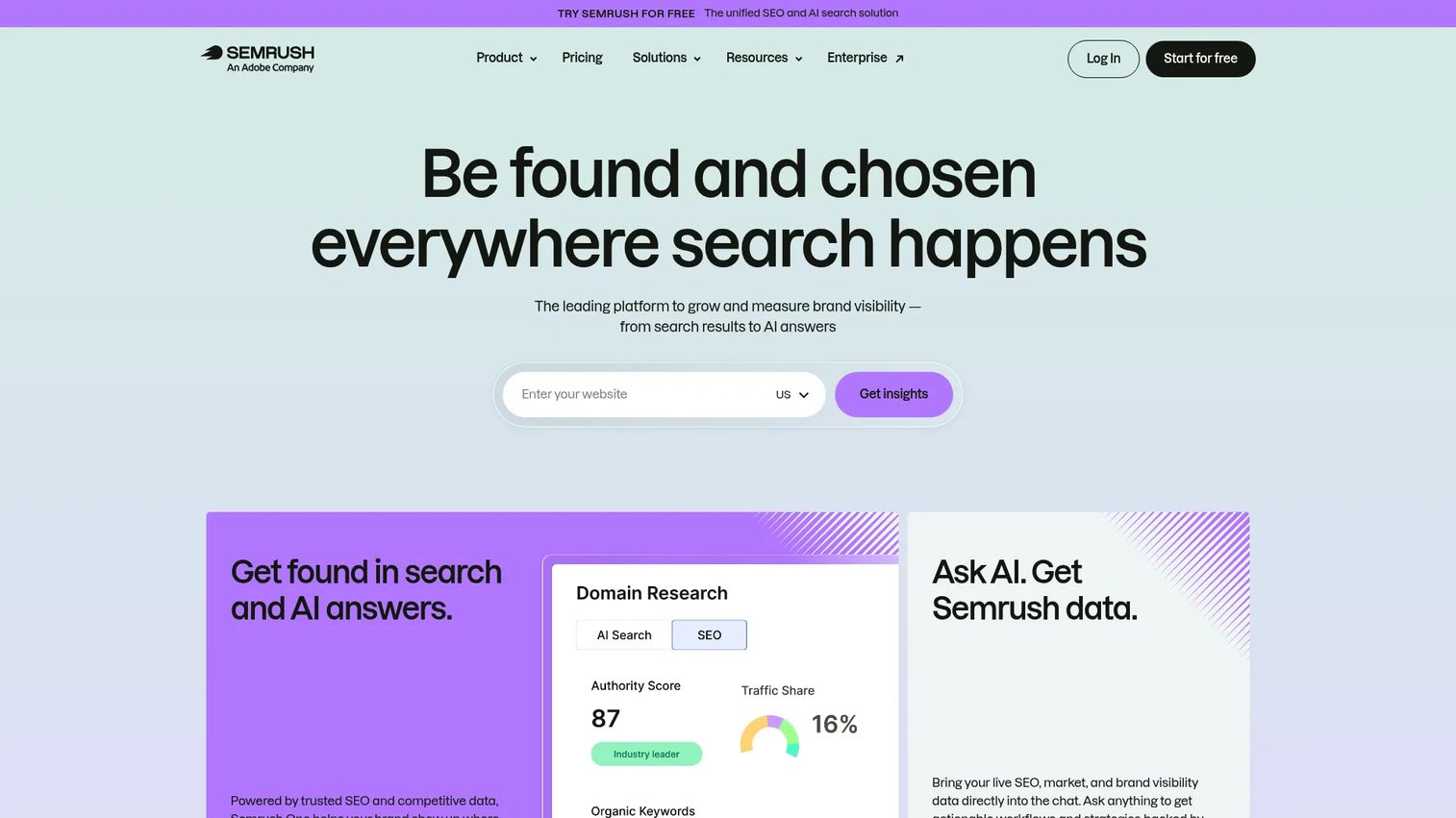
Semrush AI Visibility Toolkit sits inside the broader Semrush platform and extends it into AI search monitoring. It tracks how your brand appears across ChatGPT, Google AI Overviews, Gemini, and Perplexity, covering share of voice, sentiment, citation sources, and competitor positioning. Teams that already use Semrush for keyword research and rank tracking can add AI visibility to the same workflow without a separate login.
Best for: SEO and growth teams that want AI search data connected to their existing Semrush workflows.
Key features
- AI visibility and share-of-voice tracking across ChatGPT, Google AI, Gemini, and Perplexity
- Brand sentiment and narrative analysis inside AI answers
- Prompt research and daily prompt tracking
- Competitor share-of-voice benchmarking and prompt-gap analysis
- AI search health audits for content accessibility
Why choose Semrush AI Visibility Toolkit: The consolidation argument is real here. If you already pay for Semrush, adding AI visibility inside the same platform avoids a separate contract and keeps your reporting in one place.
Semrush AI Visibility Toolkit pricing: The Base plan starts at $99/month per domain, billed annually. Add-ons include Additional Users from $45/month and report exports from $10/month. Enterprise access is custom-priced.
G2 rating: 4.4/5
2. Peec AI
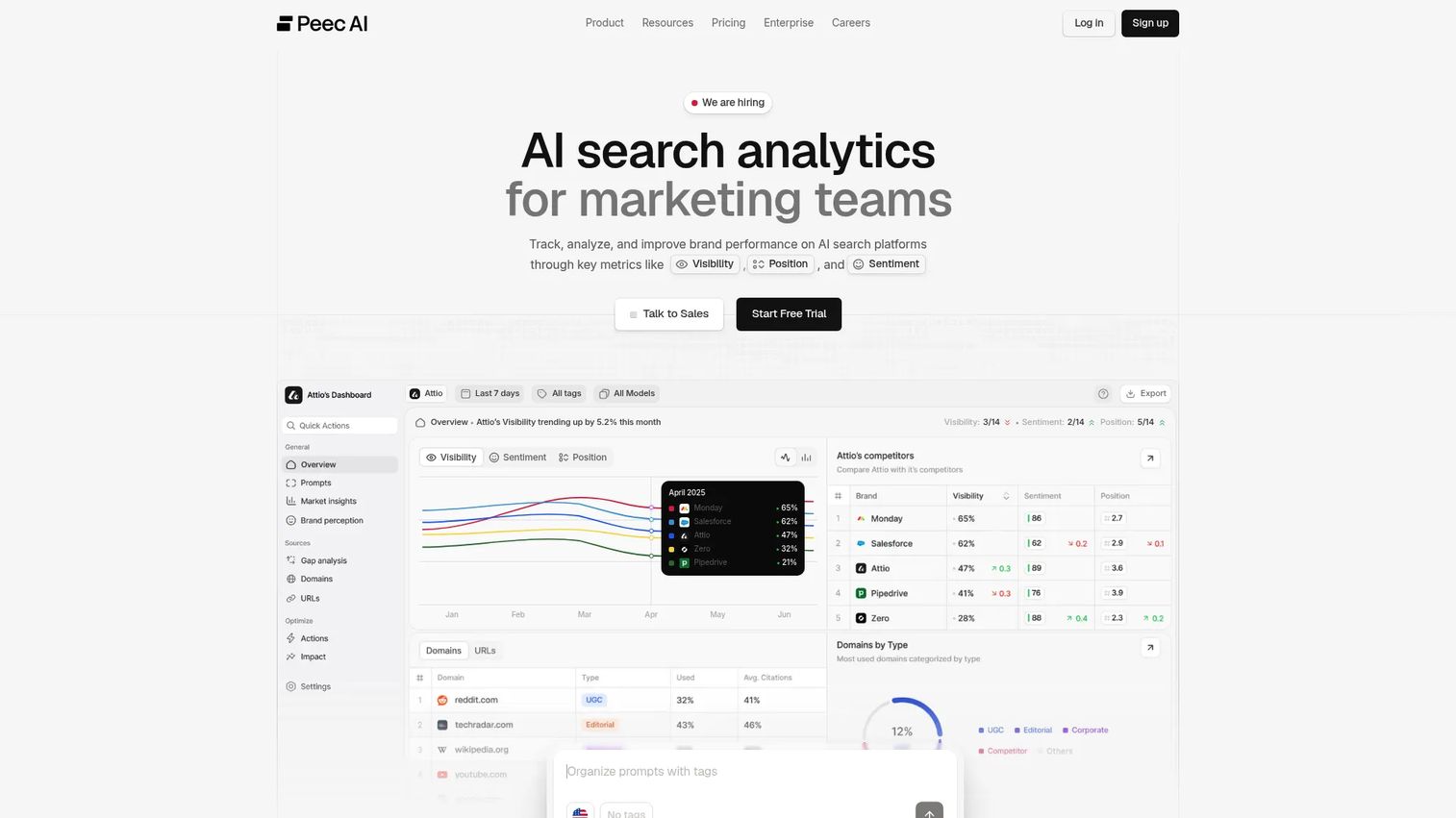
Peec AI is a dedicated AI search analytics platform built specifically for LLM visibility tracking. It covers six engines, including ChatGPT, Google AI Mode, Google AI Overviews, Microsoft Copilot, Gemini, and Naver AI, alongside AI Shopping and product-level visibility. Competitor benchmarking, source citation analysis, AI agent analytics, and crawlability audits make it one of the more complete dedicated platforms at this price point.
Best for: Marketing, SEO, and agency teams that want focused AI visibility tracking without the overhead of a full SEO suite.
Key features
- Six-engine AI visibility tracking including AI Shopping and Naver AI
- Prompt-level monitoring with share-of-voice and position analytics
- Citation analysis and competitor benchmarking
- AI agent analytics and crawlability audits
- API and MCP access on eligible plans
Why choose Peec AI: Teams building AI search reporting from scratch will find the depth here hard to match at the Starter price. The Starter plan covers 50 prompts and one project, which is enough to validate the channel before scaling up.
Peec AI pricing: Starter is $95/month, Pro is $245/month, and Advanced is $495/month, all billed monthly. Enterprise is custom-priced on annual terms.
G2 rating: 4.7/5
3. Profound
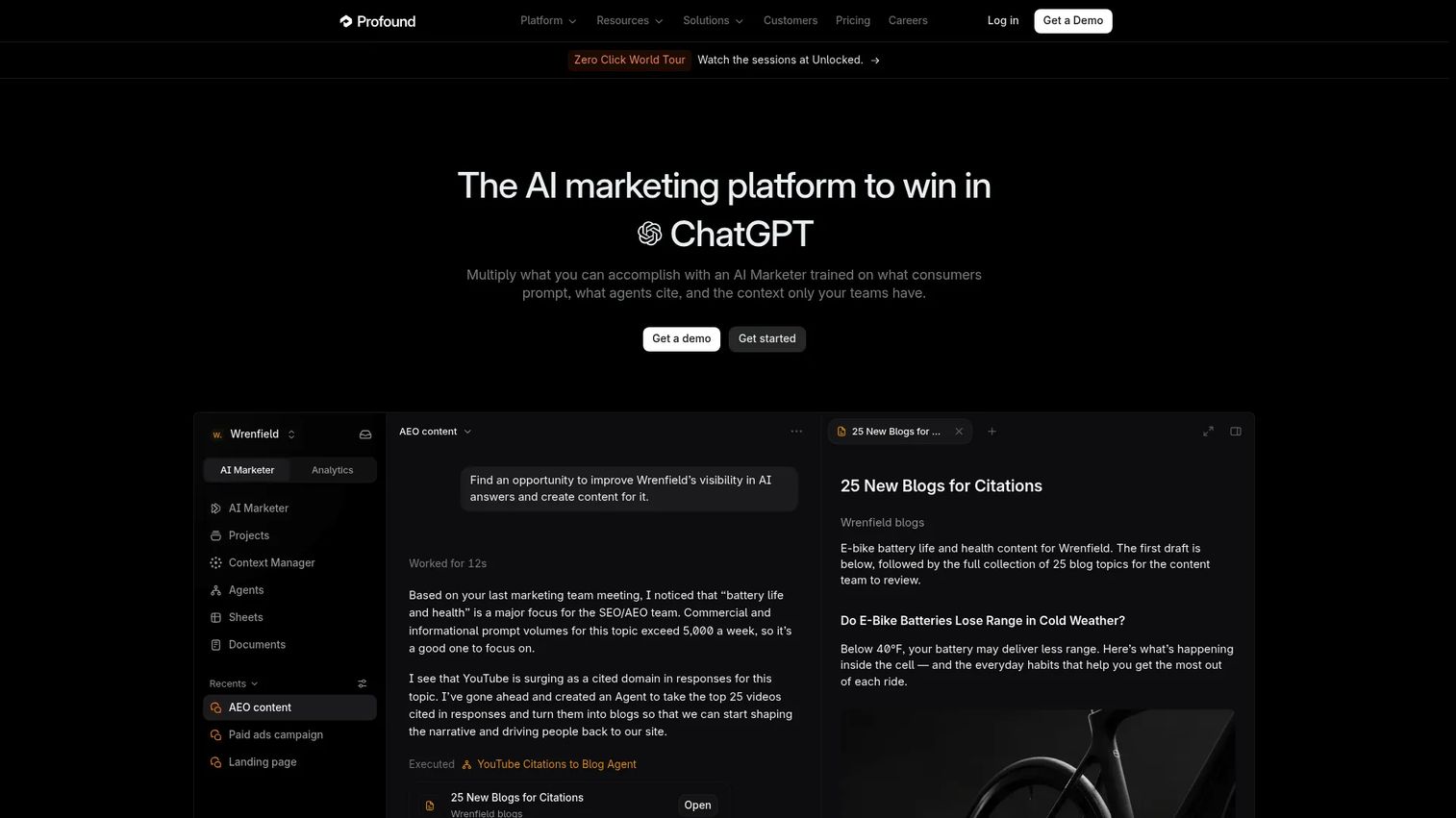
Profound is an AI marketing platform that combines answer engine insights with AI Marketer Agents for recurring marketing workflows. The core product covers visibility, sentiment, citations, accuracy, and competitive benchmarking across AI search and answer engines. AI Marketer Agents handle research, writing, reporting, and recurring workflows, which separates Profound from pure monitoring tools.
Best for: Enterprise marketing and agency teams that need ongoing AI visibility intelligence with built-in workflow automation.
Key features
- Answer Engine Insights covering visibility, sentiment, citations, and accuracy
- AI Marketer Agents for research, writing, and reporting workflows
- Prompt Volumes for analyzing real user prompts and AI search demand
- Competitive benchmarking and daily tracking
- Enterprise SSO/SAML and SOC 2 compliance on the Enterprise tier
Why choose Profound: The 7-day free trial lets you run real prompts and see actual coverage data before committing. Teams that need board-ready reporting alongside monitoring will find the agent layer useful for recurring tasks.
Profound pricing: A 7-day free trial is available with limited credits and 50 daily prompts. After the trial, pricing moves to a custom Enterprise package. Contact Profound's sales team for scope and volume details.
G2 rating: 4.5/5
4. AthenaHQ
AthenaHQ monitors how AI engines understand, mention, and recommend brands, then gives teams specific actions to improve. The platform tracks brand mention frequency, competitor share of voice, sentiment, and prompt-response analysis. Its content optimization agent surfaces on-page and off-page recommendations alongside the monitoring data.
Best for: Marketing and growth teams that want AI visibility monitoring paired with actionable content recommendations.
Key features
- Brand mention frequency, competitor share-of-voice, and sentiment monitoring
- Prompt and response analysis with source and competitor insights
- Content optimization agent with on-page and off-page recommendations
- Reporting dashboards and exports
- Integrations on paid plans
Why choose AthenaHQ: The free Essential tier includes 300 credits and core analysis, which is a rare genuine starting point for teams not ready to commit to a paid plan. The highest G2 rating in this list at 4.9/5 reflects strong early user satisfaction.
AthenaHQ pricing: Essential is free and includes 300 credits. Starter is $295/month and includes 3,600 credits, broader model coverage, integrations, and content optimization features. Enterprise pricing is custom.
G2 rating: 4.9/5
5. SE Ranking
SE Ranking is a combined SEO and generative engine optimization platform covering rank tracking, keyword research, website auditing, backlink monitoring, content tools, and AI visibility reporting. The GEO features sit alongside traditional SEO capabilities, which suits teams consolidating around a single mid-market platform rather than adding a separate AI tracking tool.
Best for: Small to mid-market SEO teams and agencies that want traditional SEO and AI search visibility in one affordable platform.
Key features
- Rank tracking across major search engines
- AI visibility and GEO reporting
- Keyword and competitor research
- Website and on-page audits
- Agency reporting features and MCP integrations
Why choose SE Ranking: The price-to-capability ratio is strong for teams that need both traditional SEO and AI visibility covered without an enterprise budget. A 14-day free trial is available before committing.
SE Ranking pricing: Core starts at $103.20/month billed annually ($129/month billed monthly). Growth is $223.20/month annually ($279/month monthly). Enterprise pricing is custom. A 14-day free trial is available.
G2 rating: 4.7/5
6. Writesonic
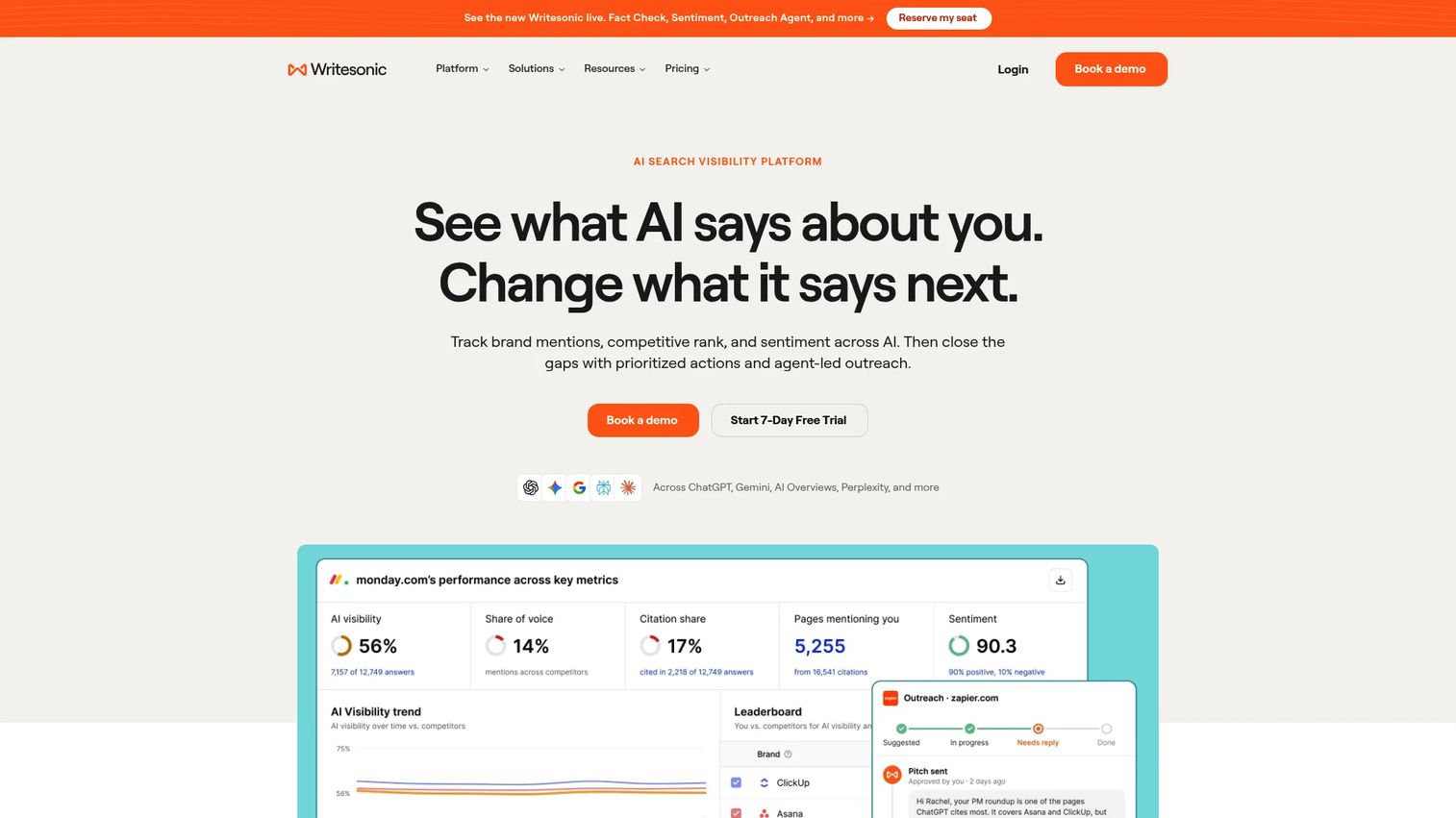
Writesonic combines AI visibility tracking with content generation, SEO optimization, site audits, and publishing workflows. It monitors brand performance across ChatGPT, Gemini, and Google AI Overviews, then connects those insights to AI-assisted content creation. Teams that want to move from "we have a gap" to "we published the fix" in a single platform will find this workflow appealing.
Best for: Content and growth teams that want AI visibility insights connected directly to content production.
Key features
- AI visibility tracking across ChatGPT, Gemini, and Google AI Overviews
- AI article generation and SEO content optimization
- Site audits and AI search action workflows
- Publishing workflows and integrations
- Outreach features on higher tiers
Why choose Writesonic: The monitor-to-create workflow reduces handoff time between visibility analysis and content execution. Worth noting: Reporting depth may not match dedicated AI visibility platforms on the monitoring side, so evaluate based on where your bigger gap is.
Writesonic pricing: Starter is $79/month billed annually ($99/month billed monthly). Basic is $199/month annually, Growth is $399/month annually. Enterprise pricing is custom.
7. Scrunch
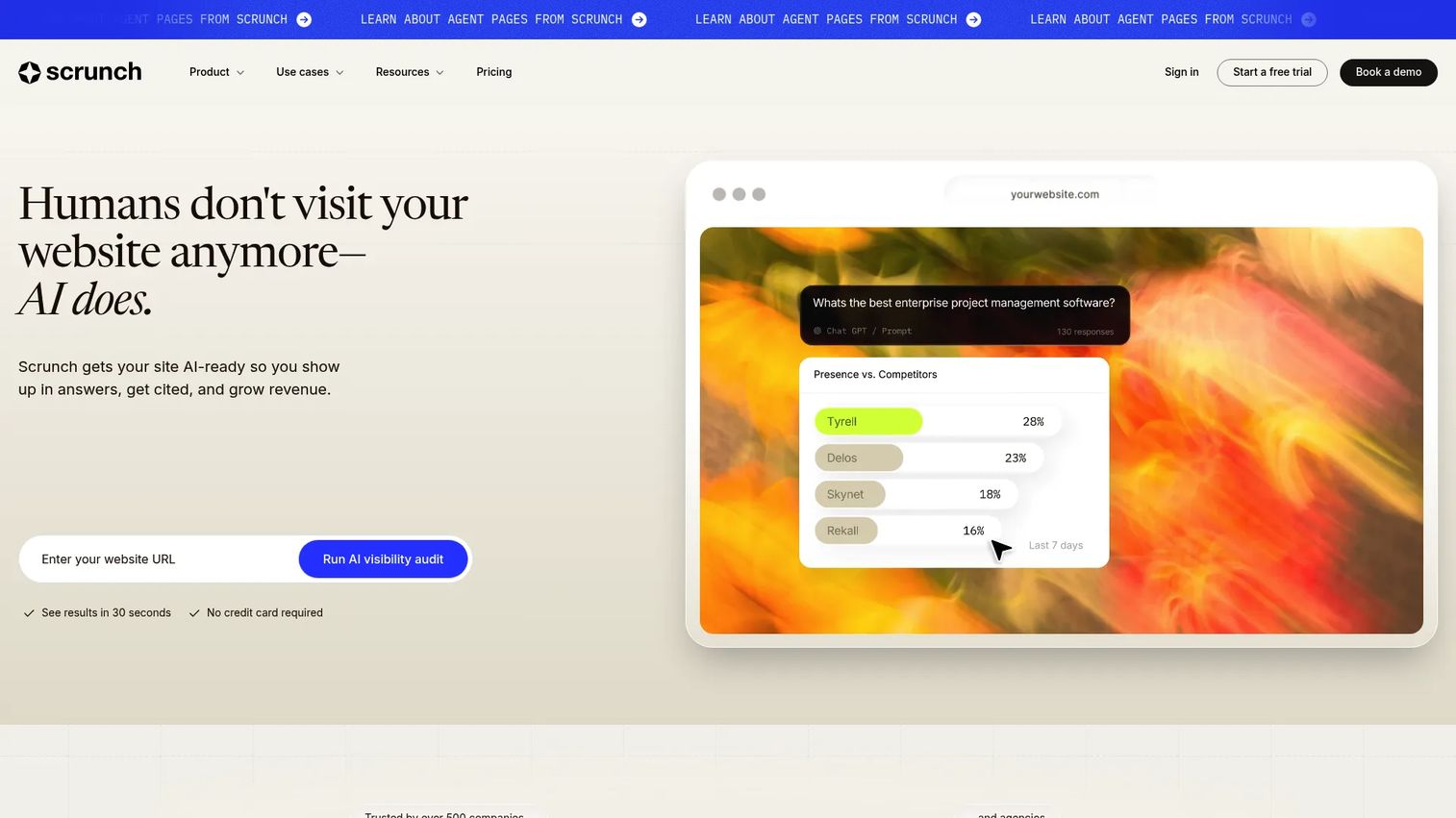
Scrunch monitors brand performance across AI platforms and delivers AI-optimized content through its Agent Experience Platform (AXP). The platform covers cross-platform AI visibility, citation analysis, AI bot traffic monitoring, page audits, and competitor tracking. The AXP layer means Scrunch operates on both the measurement side and the delivery side, serving optimized content to AI crawlers directly.
Best for: Brand and growth teams tracking AI answer presence and wanting to serve AI crawlers optimized content.
Key features
- Cross-platform AI visibility and prompt tracking
- Citation analysis and competitive benchmarking
- AI bot traffic monitoring and agent referral tracking
- Page audits and optimization guidance
- Agent Experience Platform for AI-optimized content delivery
Why choose Scrunch: The bot traffic monitoring and AXP layer differentiate it from pure reporting tools. Teams that want to influence what AI crawlers see, not only measure what they found, should evaluate this angle carefully.
Scrunch pricing: Starter is $250/month billed annually (or $300/month billed monthly). Growth is $417/month annually ($500/month monthly). Enterprise pricing is custom. A 7-day Starter trial requires no credit card.
G2 rating: 4.6/5
8. Ahrefs Brand Radar
Ahrefs Brand Radar tracks how brands appear across AI Overviews, AI Mode, ChatGPT, Perplexity, Gemini, Copilot, Grok, and Claude. Beyond AI surfaces, it monitors visibility across web pages, YouTube, Reddit, and TikTok, giving teams a broader picture of where their brand shows up in discovery channels. Custom prompt tracking and competitor benchmarking round out the feature set.
Best for: SEO teams that want AI brand visibility signals alongside Ahrefs' existing link and search intelligence.
Key features
- Brand visibility tracking across eight AI engines
- Competitor benchmarking and cited-page identification
- Visibility monitoring across web, YouTube, Reddit, and TikTok
- Custom prompt tracking on configurable schedules
- Brand mention, sentiment, and buyer-journey visibility reporting
Why choose Ahrefs Brand Radar: Teams already deep in Ahrefs' ecosystem get AI visibility without a separate contract. The eight-engine coverage is among the broadest in this list. Keep in mind that the G2 rating reflects Ahrefs overall rather than Brand Radar specifically.
Ahrefs Brand Radar pricing: AI Visibility Index starts at $199/month. All-platform access is $699/month and includes 2,500 custom prompt checks. Additional custom prompt packages start at $50/month.
G2 rating: 4.5/5
9. OtterlyAI
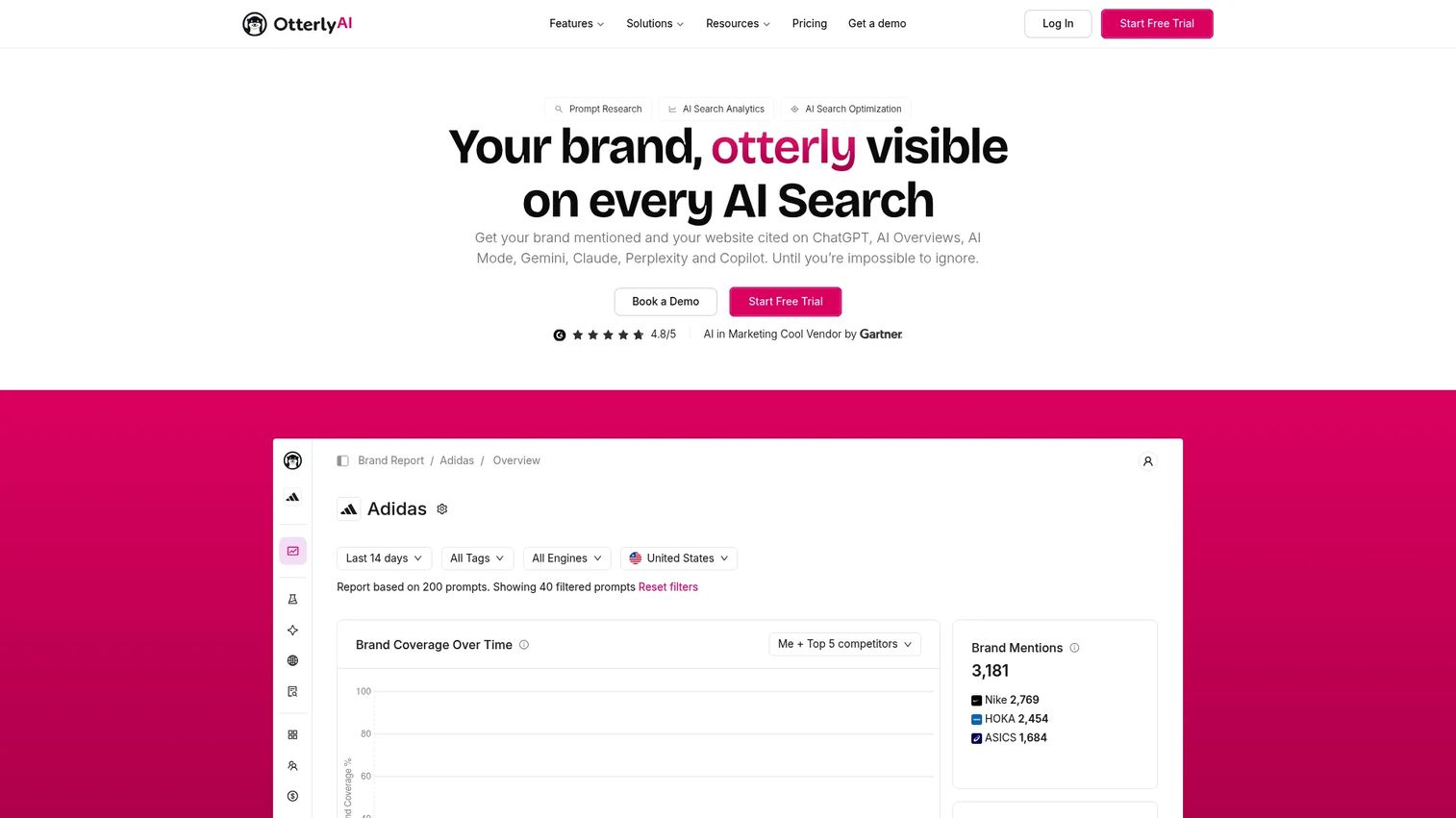
OtterlyAI monitors brand mentions, citations, sentiment, and share of voice across ChatGPT, Google AI Overviews, Google AI Mode, Perplexity, Gemini, Claude, and Microsoft Copilot. Its Lite plan covers 16 prompts for a small monthly fee, making it accessible for teams running a focused AI visibility pilot. Prompt research, GEO audits, and optimization recommendations are included across plans.
Best for: Marketers starting an AI visibility program who want broad engine coverage without a large upfront commitment.
Key features
- Seven-engine AI monitoring including Claude and Microsoft Copilot
- Brand mention, sentiment, share-of-voice, and citation tracking
- Prompt research and GEO audits
- Optimization recommendations and reports
- API and MCP access on Standard and above
Why choose OtterlyAI: The entry price (€29/month for 16 prompts) is the lowest paid tier in this list for multi-engine coverage. Note that the official pricing page displays EUR rather than USD, so the effective cost will vary by currency.
OtterlyAI pricing: Lite is €29/month. Standard is €189/month. Premium is €489/month. Enterprise is custom. A free tier is available with limited access.
10. Similarweb
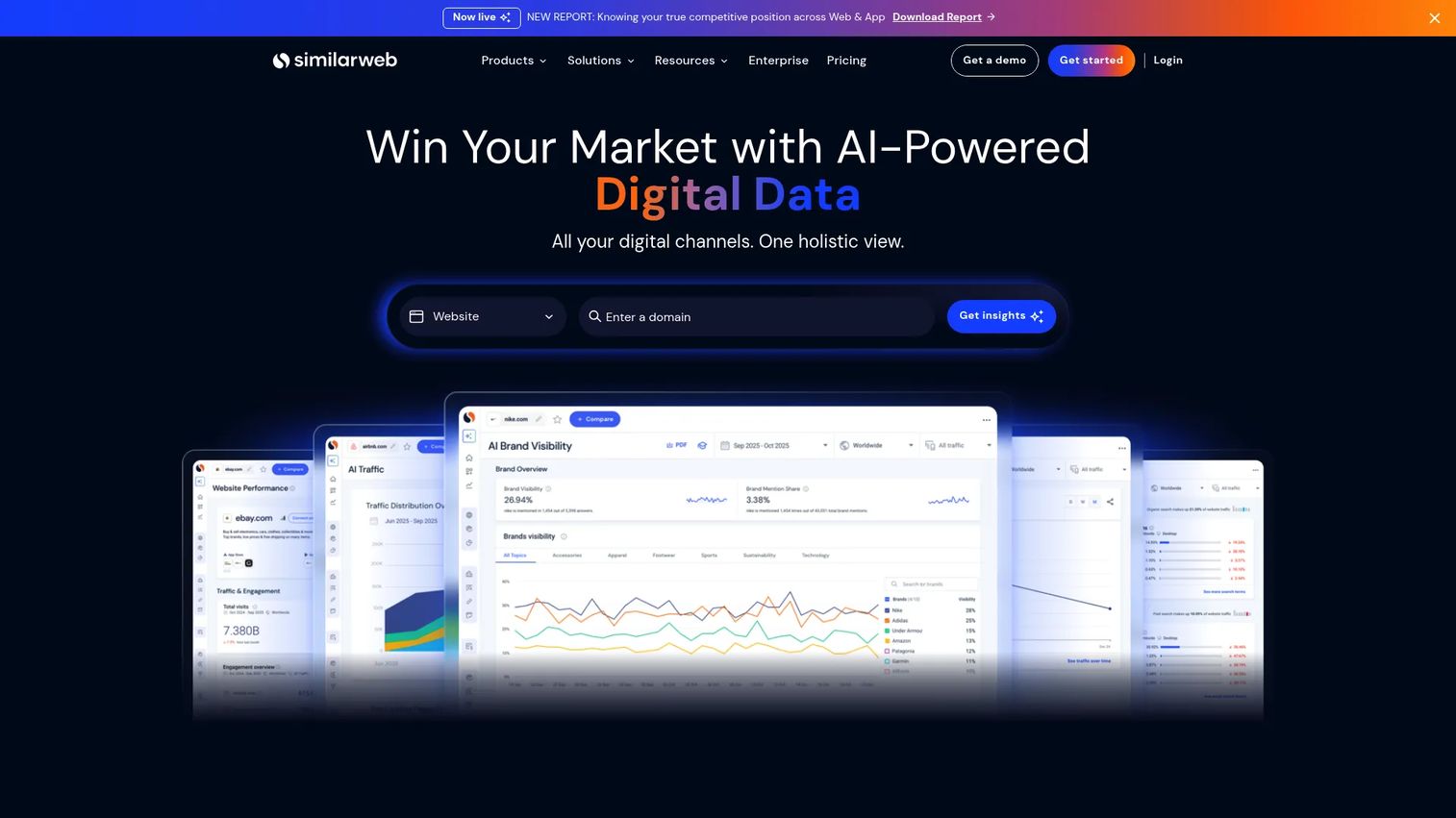
Similarweb is a digital intelligence platform that covers competitive traffic, keyword analysis, referral channels, app performance, and market benchmarking. It is broader than a dedicated AI visibility tracker, but it helps enterprise teams contextualize AI referral traffic within a full market picture. Teams that need to explain AI search impact to leadership alongside competitive traffic shifts will find the combination useful.
Best for: Enterprise marketing and strategy teams that need market intelligence and competitive context alongside AI traffic data.
Key features
- Competitive website traffic and engagement analysis
- Search and keyword intelligence
- Referral traffic insights across channels
- Market research and competitive benchmarking
- API access and enterprise integrations
Why choose Similarweb: The platform excels at market-level context. Teams that need to report on AI referral traffic as part of a broader competitive picture will get more here than from a dedicated prompt monitoring tool. For pure prompt tracking, pair it with a focused AI visibility platform.
Similarweb pricing: Starter is $199/month or $1,500/year. Team is $14,000/year. Business is $35,000/year. Enterprise pricing is custom. A free tier is available.
G2 rating: 4.4/5
11. Yext Scout
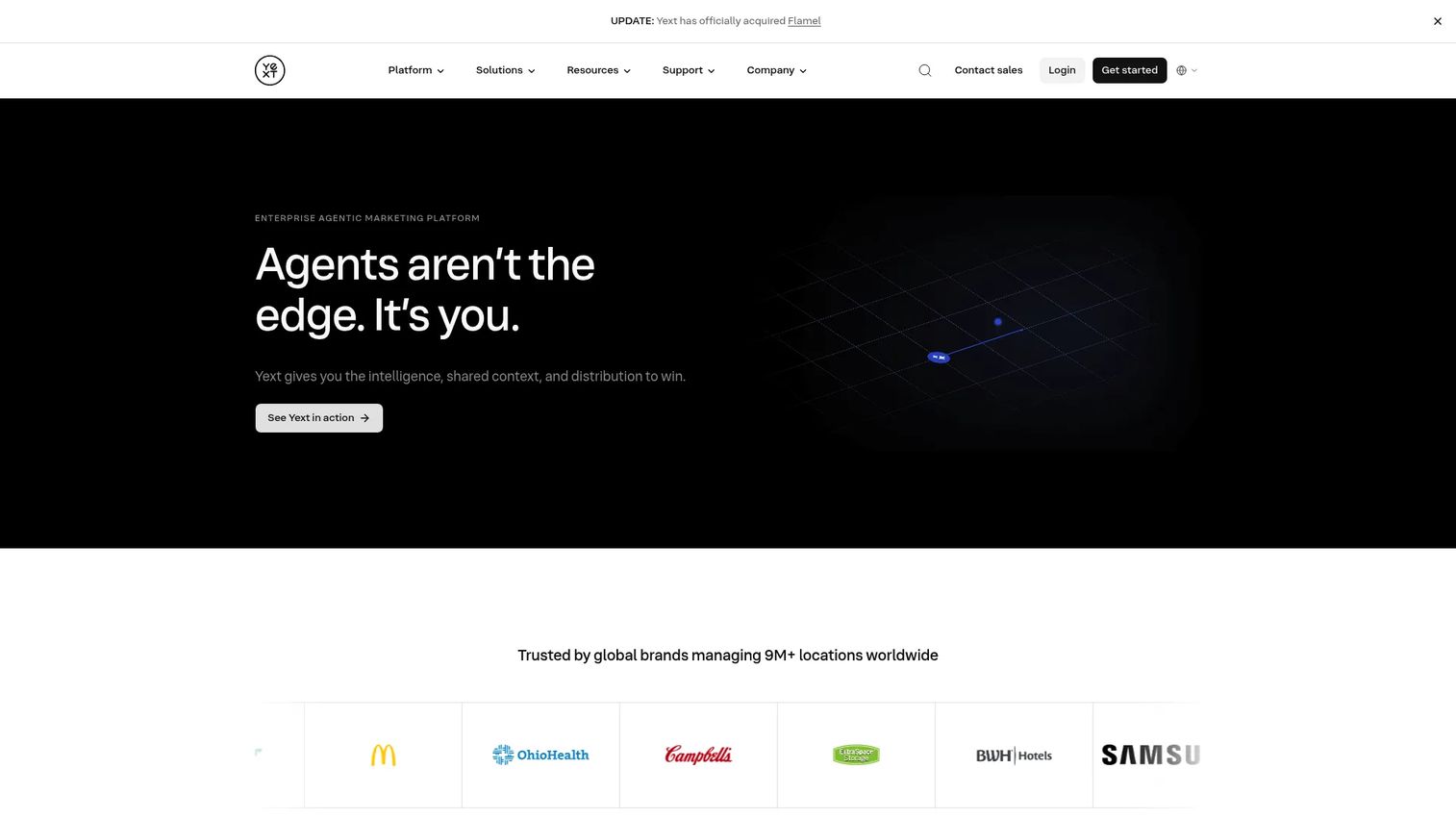
Yext Scout is an AI search visibility and competitive benchmarking agent designed for brands managing multiple locations or large volumes of entity data. It monitors visibility across Google Search, Google Maps, Google AI Overviews, ChatGPT, Gemini, Claude, and Perplexity, with location-level win rates, AI sentiment analysis, and prioritized recommendations through Yext Action Center.
Best for: Multi-location brands and enterprises managing entity accuracy across search and AI surfaces.
Key features
- Visibility monitoring across Google AI Overviews, ChatGPT, Gemini, Claude, and Perplexity
- Location-level competitive benchmarking and win-rate tracking
- AI sentiment analysis and citation-source tracking
- Prioritized recommendations through Yext Action Center
- Mobile app access and natural-language Talk to Scout interface
Why choose Yext Scout: Entity consistency is the core pitch. If AI engines pull wrong facts about your brand because your structured data is inconsistent across locations or listings, Scout surfaces and prioritizes those gaps. Basic Scout KPIs are available on a free tier.
Yext Scout pricing: Basic Scout KPIs are available on a free tier. Full drill-down capabilities and data exports require a paid Scout plan. Contact Yext sales for paid pricing details.
G2 rating: 4.4/5
12. Goodie AI
Goodie AI is an answer engine optimization platform that covers prompt research, brand monitoring, AI-optimized content generation, and revenue attribution. The Pro plan includes SKU-level agentic commerce visibility, which is relevant for teams selling through AI shopping surfaces. All plans include unlimited seats, which removes the per-seat pricing pressure common in this category.
Best for: Growth teams that want optimization actions and revenue attribution alongside AI visibility monitoring.
Key features
- Prompt research and visibility monitoring across up to 14 AI models
- AI-optimized content generation and prioritized optimization actions
- AI agent analytics, traffic analytics, and revenue attribution
- SKU-level agentic commerce visibility on Pro and above
- MCP access and strategist support
Why choose Goodie AI: The unlimited seats model and the revenue attribution layer separate it from most tools in this list. Teams that want to close the loop between AI visibility and actual revenue, not just impressions, should look closely at the Pro plan.
Goodie AI pricing: Core is $295/month. Pro is $999/month. Enterprise pricing requires a demo conversation. No free tier; a 7-day trial is available on Core.
G2 rating: 4.9/5
13. AirOps
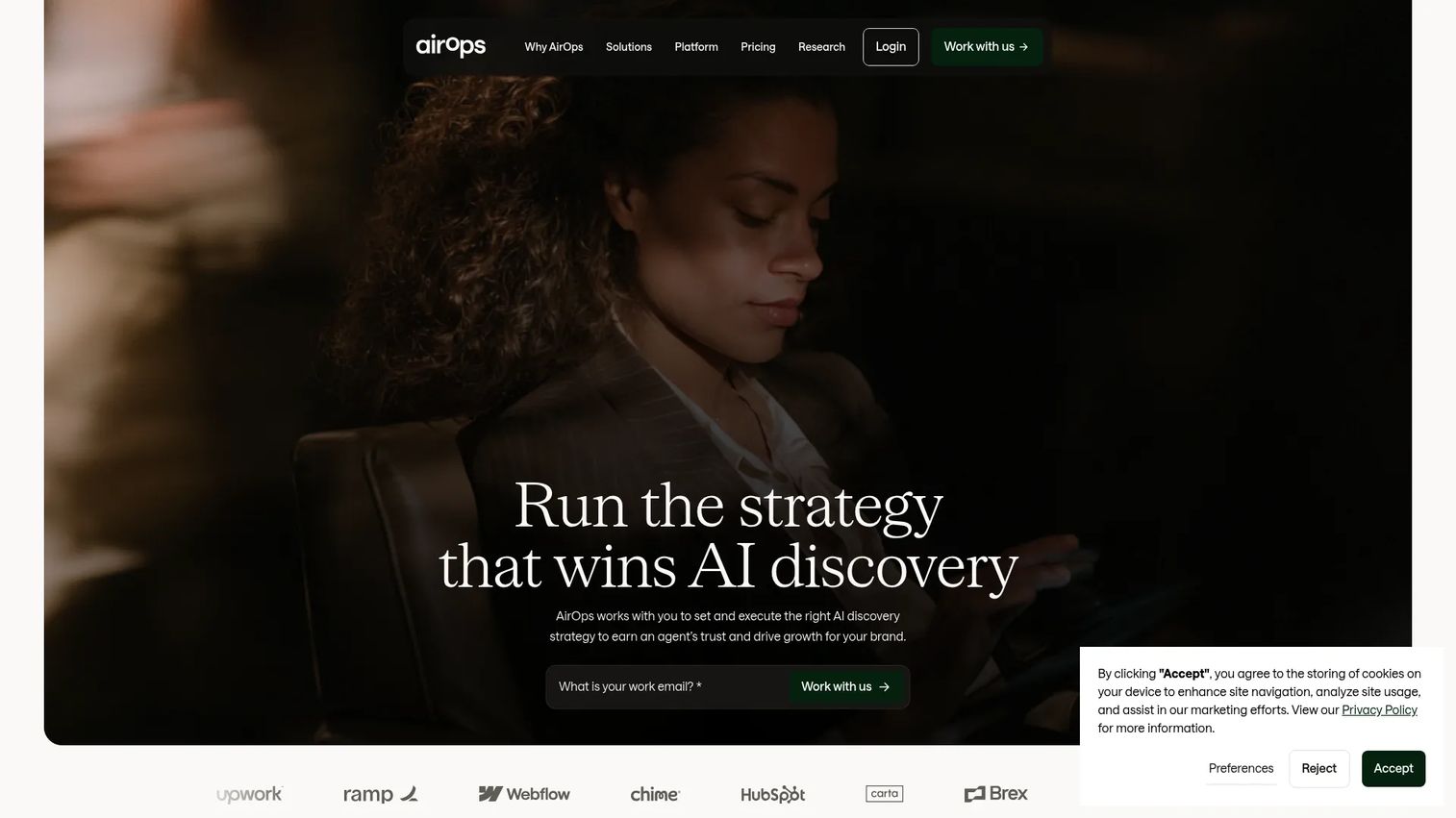
AirOps is an AI search platform that helps marketing teams measure brand visibility across answer engines and then execute content and growth programs at scale. It connects visibility gaps to AI agents, playbooks, content workflows, brief generation, review cycles, and CMS publishing. The free Solo tier covers 35,000 content production tasks, which makes it a low-risk starting point for content-heavy teams.
Best for: Content and growth teams that want to operationalize AI visibility recommendations into repeatable content workflows.
Key features
- AI search and answer-engine visibility insights
- AI agents, playbooks, workflows, and triggers for content execution
- Brand Kits and Knowledge Bases for consistent content production
- CMS publishing, MCP, and API integrations
- Content creation, review, and refresh workflows
Why choose AirOps: The execution layer is the differentiator. Teams focused solely on monitoring may find dedicated tracking tools more precise. AirOps earns its place for teams whose bottleneck is turning gap data into published content at scale.
AirOps pricing: Solo is free and includes 35,000 content production tasks. Pro pricing is not publicly listed and varies by task volume. Enterprise pricing is custom. Contact AirOps for Pro and Enterprise details.
G2 rating: 4.7/5
14. BrightEdge
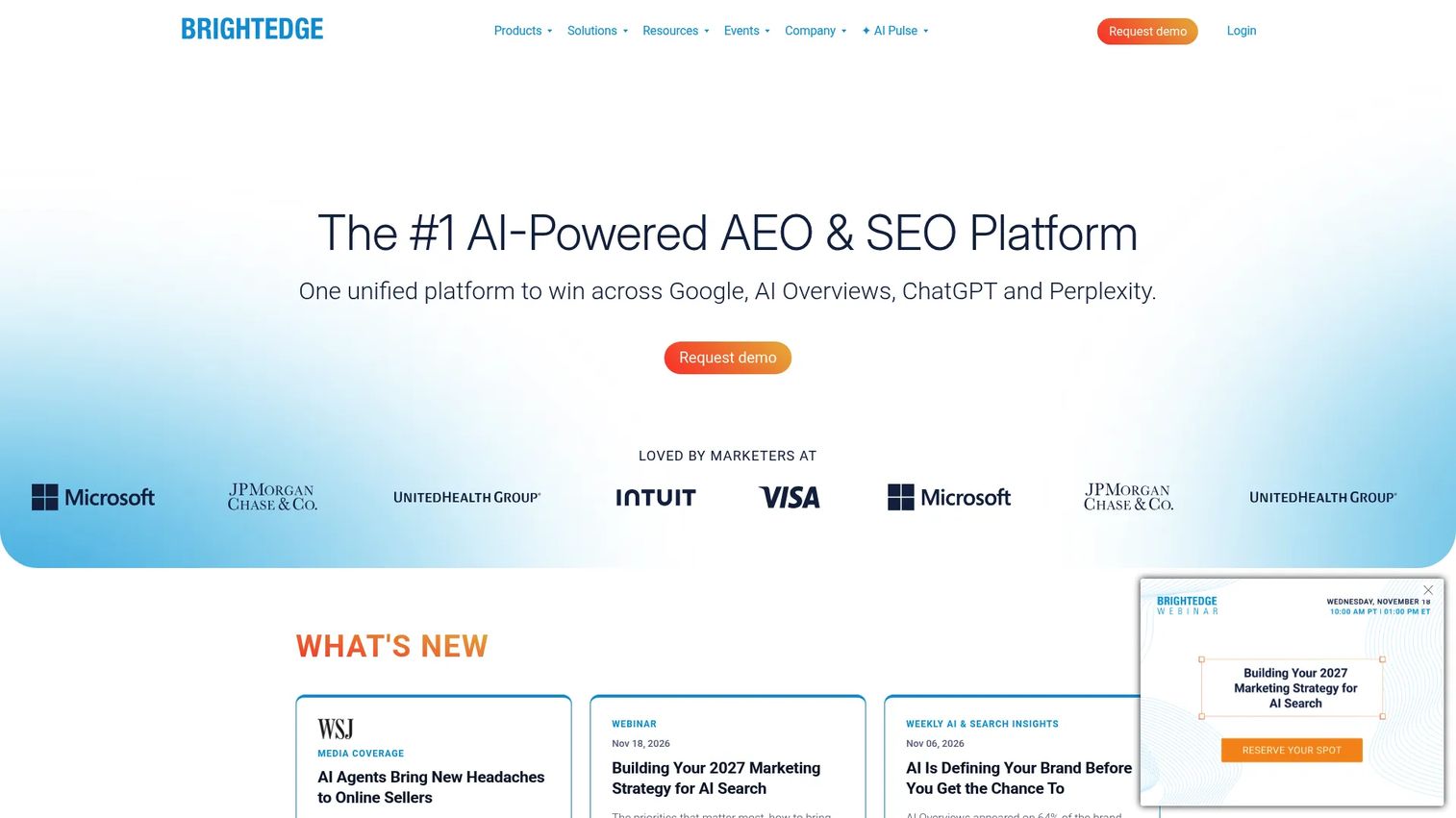
BrightEdge is an enterprise SEO and content performance platform with AI search visibility measurement built into its broader capability set. It covers keyword research, content intelligence, technical site audits with ContentIQ, competitive share-of-voice, custom dashboards, and AI search tracking. Teams with large content libraries, governance requirements, and executive reporting needs are the natural fit.
Best for: Enterprise SEO teams that need AI visibility tied to mature SEO governance, reporting, and content workflows.
Key features
- Enterprise SEO reporting and keyword intelligence
- AI search visibility measurement
- Content recommendations and optimization
- Technical site auditing with ContentIQ
- Competitive share-of-voice tracking and custom dashboards
Why choose BrightEdge: For enterprise teams already running structured SEO programs, adding AI search visibility inside BrightEdge avoids a parallel reporting stack. The platform suits organizations where procurement, compliance, and executive visibility requirements drive tool decisions.
BrightEdge pricing: BrightEdge prices by custom quote. Contact sales for scope and volume details.
G2 rating: 4.4/5
15. Google Search Console
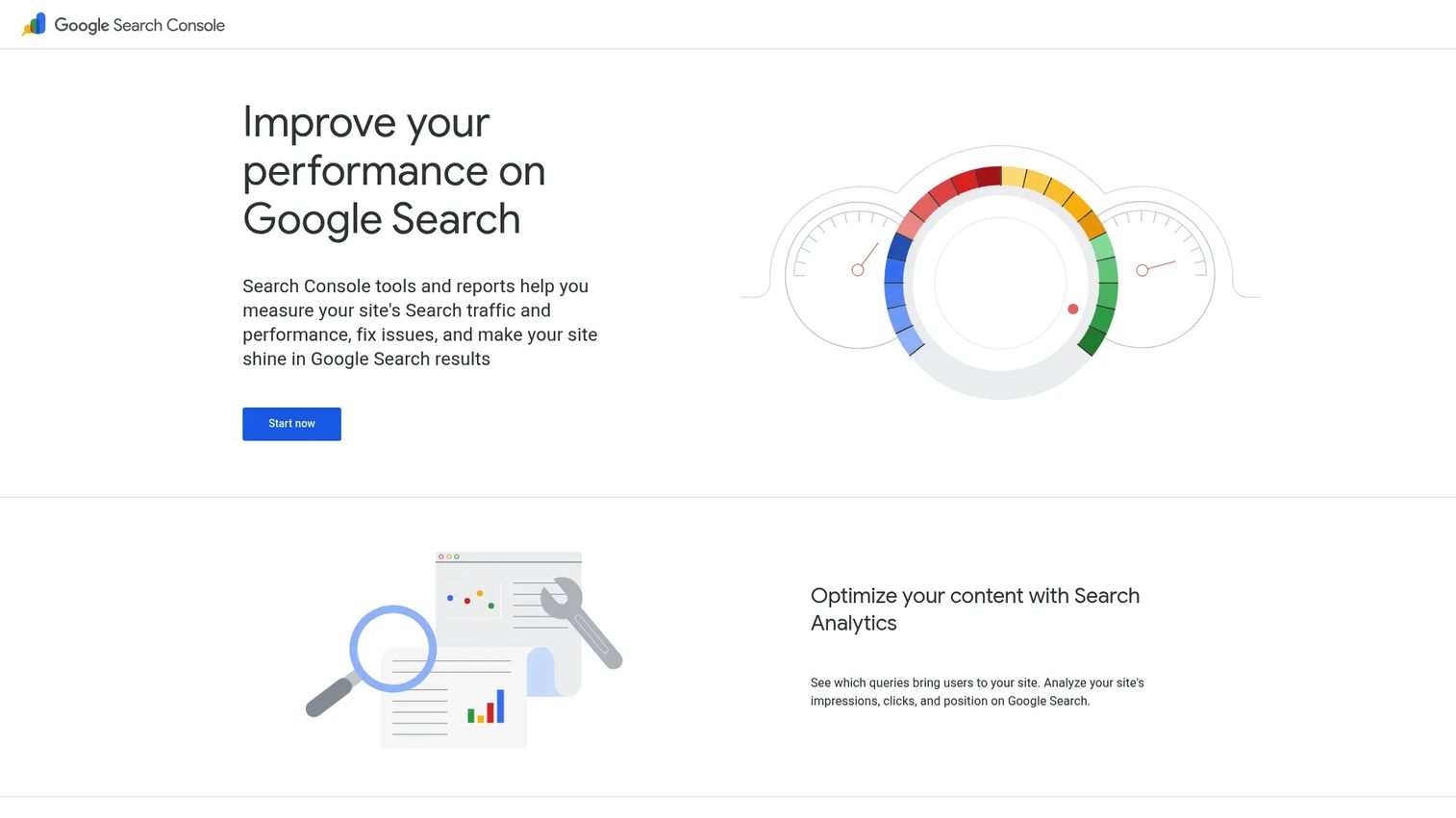
Google Search Console is the free, official tool for understanding how your site performs in Google Search. It covers query data, impressions, clicks, page indexing, Core Web Vitals, sitemaps, and security issues. It is not an AI visibility platform in the prompt-tracking sense. Its value here is as the free baseline every team should have before evaluating paid AI visibility tools.
Best for: Marketers who need a free, authoritative baseline for Google search data before adding a dedicated AI visibility layer.
Key features
- Query performance data: Clicks, impressions, CTR, and average position
- Index coverage and URL inspection
- Core Web Vitals and page experience signals
- Rich results and search appearance reporting
- Sitemaps submission and monitoring
Why choose Google Search Console: Every team should run this. It is free, authoritative for Google data, and essential context for any AI visibility program. It will not tell you whether Perplexity cites you, but it will tell you whether Google can crawl the pages you want cited.
Google Search Console pricing: Free. No paid tiers.
G2 rating: 4.7/5
Considerations when choosing AI search visibility optimization tools
AI engine coverage
Check exactly which engines the tool tracks and how. Coverage of ChatGPT, Gemini, Perplexity, Claude, and Google AI surfaces varies meaningfully between platforms. Some tools track only a subset, and collection methods (real UI queries versus API access) affect result reliability.
Prompt depth and discovery
Tracking 20 branded prompts is not an AI visibility program. A useful platform surfaces category prompts, comparison prompts, and problem-aware prompts where buyers ask questions without mentioning your brand. Prompt discovery is where most of the competitive gap analysis lives.
Citation and source reporting
Knowing you are not mentioned is only half the picture. The more actionable data is which URLs AI engines do cite: Competitor blog posts, review sites, documentation pages, or third-party comparison articles. That list becomes your digital PR and content refresh backlog.
Reporting reliability
LLM nondeterminism is a real measurement challenge. AI visibility scores change because tools run different prompts, sample at different frequencies, query different model versions, and apply different scoring formulas. Treat visibility scores as directional trends rather than precise rankings, and compare tools using the same prompt set before drawing conclusions.
Workflow fit
The most common objection from digital marketers is "what does this replace?" Before buying, map the tool against your existing SEO platform, content workflow, and reporting stack. A platform that consolidates AI visibility with existing SEO reporting reduces tool sprawl. A standalone monitoring tool is worth it only if your current stack has no overlap.
Conclusion
The right choice depends on where your biggest gap is.
For teams already in Semrush, the AI Visibility Toolkit is the consolidation play. For teams building a dedicated AI analytics program from scratch, Peec AI or AthenaHQ offer strong depth without requiring an enterprise budget. Profound suits enterprise marketing teams that need ongoing workflow automation alongside monitoring. For content execution at scale, AirOps connects the gap between visibility data and published fixes. Writesonic covers similar ground with more emphasis on content generation.
Similarweb and BrightEdge are worth evaluating when market intelligence or enterprise SEO governance is the primary need and AI visibility is one layer of a broader program. Yext Scout is the clearest answer for multi-location brands where entity accuracy drives AI answer quality.
Google Search Console is the floor. Set it up first, understand your Google baseline, and build an AI visibility layer on top.
The AI SEO tools landscape is moving fast. Start with the tool that solves your most immediate measurement gap, run it for a quarter, and expand from there.
Start your journey with Guideflow today!
FAQs
AI search visibility optimization tools help brands monitor and improve how they appear in AI-generated answers across platforms like ChatGPT, Gemini, Perplexity, and Google AI experiences. They track brand mentions, citations, share of voice, sentiment, and prompt-level performance. The best tools also surface which content gaps and citation sources to address.
SEO tools track rankings, clicks, backlinks, impressions, and technical page health in traditional search results. AI visibility tools track whether AI engines recommend, cite, or mention your brand inside generated answers. The measurement object is different: A rank position versus a presence inside a generated response. Most teams will need both.
The answer varies by team size and primary need. Semrush AI Visibility Toolkit fits teams consolidating AI visibility with existing SEO workflows. Peec AI fits teams that want dedicated multi-engine analytics from $95/month. AthenaHQ fits teams that want a free starting point with an optimization layer. Google Search Console fits teams that need a free Google baseline before buying anything else.
Many tools track some or all of these engines, but coverage varies by platform. Peec AI covers six engines including Naver AI. Ahrefs Brand Radar covers eight. OtterlyAI covers seven including Claude and Microsoft Copilot. Verify engine coverage, regions, prompt volume, and collection method before buying, since the specifics affect what the data actually tells you.
Different tools run different prompts, sample at different frequencies, query different model versions, and apply proprietary scoring formulas. LLM outputs also vary by geography, session context, and when the query runs. Treat AI visibility scores as directional trend data rather than precise rankings, and use the same prompt set across tools when comparing results.
No. These tools identify gaps, citation sources, and content opportunities. Improvement requires content updates, technical SEO fixes, entity consistency work, and authority building. Platforms like AthenaHQ, Goodie AI, and AirOps include recommendations and workflow tools to help you act on the data, but the execution still requires your team.
Track citation URLs (which pages AI engines actually pull from), sentiment (how your brand is described), competitor share of voice, prompt categories (branded versus category versus comparison), answer position, and AI referral traffic. For best generative AI tools comparisons specifically, citation tracking often reveals which third-party review pages and comparison articles carry the most influence.
Google Search Console is valuable as a free baseline for Google search performance data. It does not replace multi-engine prompt tracking, citation monitoring across ChatGPT or Perplexity, or competitor share-of-voice analysis. Use it alongside a dedicated AI visibility tool, not instead of one.