Your AI feature is only as good as the retrieval layer behind it. If the system pulls stale documents, misses a permission boundary, or returns the wrong entity, users do not blame the infrastructure. They blame the product.
That gap between AI ambition and retrieval reality is widening fast. According to the Capgemini Research Institute (2025), 93% of organizations are already exploring, piloting, or deploying generative AI. Yet most of those initiatives hit the same wall: Choosing the wrong retrieval infrastructure early in the build creates technical debt that compounds with every sprint. For product managers, this is not an engineering abstraction. It is a question of activation rates, support ticket volume, and whether your AI feature earns trust or erodes it.
This guide exists to help you shortlist the right platform before that decision hardens. It compares 15 AI search and retrieval infrastructure software options across vector databases, enterprise search platforms, managed RAG infrastructure, and open-source foundations.
What's inside
This guide covers 15 AI search and retrieval infrastructure software tools evaluated for 2026. It is written for product managers and product leaders at SaaS companies choosing infrastructure for AI-powered features, semantic product search, knowledge discovery, or agent workflows.
Selection criteria:
- Retrieval fit: Vector, keyword, hybrid, semantic, or multimodal search capability
- Deployment model: Managed cloud, self-hosted open source, enterprise platform, or database-native
- Product and engineering fit: APIs, SDKs, indexing pipelines, relevance tuning
- Production readiness: Security controls, permission handling, pricing clarity, analytics
TL;DR
- Best for vector-native AI retrieval: Pinecone handles managed vector search at production scale without cluster operations
- Best for hybrid enterprise search: Elastic combines keyword, vector, and semantic retrieval with mature analytics and deployment flexibility
- Best for product discovery and site search: Algolia delivers API-first search with relevance tooling built for conversion
- Best for managed Solr infrastructure: SearchStax removes cluster operations while keeping Solr's depth
- Best open-source starting point: Chroma for fast developer prototyping; OpenSearch for teams ready to operate infrastructure
- Best for enterprise knowledge search: IBM Watson Discovery and Mindbreeze fit regulated organizations with document-heavy workflows
- Best for automatic RAG on Cloudflare's platform: Cloudflare AI Search suits teams already building on Workers and edge infrastructure
What is AI search and retrieval infrastructure software?
AI search and retrieval infrastructure software is the backend layer that indexes, retrieves, ranks, and serves relevant information to AI applications, agents, search interfaces, and knowledge discovery workflows. It is the system that decides what your AI feature actually knows when a user asks a question.
The category spans several distinct layers:
- Retrieval layer: Finds candidate documents, records, chunks, entities, or media based on a query
- Indexing layer: Keeps product data, support content, files, or embeddings current and searchable
- Ranking and relevance layer: Decides which results surface first, using keyword signals, vector similarity, or hybrid scoring
- Generation support: Feeds grounded context into AI answers or agent reasoning steps
- Governance layer: Handles permissions, tenant isolation, audit logs, and secure connector behavior
Key capabilities to evaluate across platforms:
- Vector search
- Keyword and hybrid retrieval
- Semantic ranking and reranking
- Embedding management
- Continuous indexing
- Permission-aware access control
- APIs and SDKs
- Search analytics and query logs
- Relevance tuning
- Multimodal retrieval
One important boundary: A vector database is one type of retrieval infrastructure. It stores embeddings and returns similarity matches, but it does not automatically handle keyword search, connectors, permissions, or analytics dashboards. Enterprise search platforms add those layers on top. Model providers alone are not retrieval infrastructure unless they include indexing and search capabilities. A generic chatbot without retrieval, indexing, and permission controls produces hallucinations the moment your data grows beyond its training window. That distinction matters when you are picking architecture for a production AI feature.
Explore related guides on agentic AI platforms and best AI agents if your use case involves autonomous workflows that also need retrieval.
When to use AI search and retrieval infrastructure software
Build AI features that need grounded answers
Product teams need retrieval infrastructure when AI answers must cite internal docs, product data, support content, or knowledge bases rather than relying on model memory alone. Without a retrieval layer, language models hallucinate on company-specific questions. With one, every answer can be traced to a source. For PMs, the outcome is fewer hallucinations, better user trust, and lower CS load from confused users.
Modernize keyword search with semantic and hybrid retrieval
Existing keyword search fails when users do not know the exact term your system indexed. A user searching "how do I export my data" should find the same result as someone who typed "download CSV." Natural-language queries, synonyms, intent matching, and hybrid ranking close that gap across help centers, admin search, internal tools, and product discovery surfaces.
Support agents, copilots, and self-serve workflows
AI agents need current information to act reliably. That means continuous re-indexing as your product data changes, per-tenant boundaries so one user cannot surface another's records, and low enough latency that the agent does not stall mid-task. PMs evaluating retrieval for AI copilot software or agent workflows should model freshness requirements carefully before choosing a platform.
AI search and retrieval infrastructure software comparison
Pricing and G2 ratings in this table reflect figures verified against each vendor's pricing page and G2 listing during article preparation. Prices change, so confirm current figures before committing to a shortlist.
| # | Product | Best for | Key differentiator | Pricing | G2 rating |
|---|---|---|---|---|---|
| 1 | Pinecone | Vector-native retrieval for AI apps | Managed vector database built for production retrieval | Free tier; paid from $20/mo | 4.4/5 |
| 2 | Elastic | Enterprise hybrid search and observability | Keyword, vector, semantic, and analytics stack with cloud and self-managed options | Usage-based; 14-day free trial | 4.4/5 |
| 3 | Algolia | Product discovery and site search | API-first search with relevance tooling and merchandising controls | Free tier; Grow and Grow Plus usage-based | 4.5/5 |
| 4 | Lucidworks | Enterprise search and commerce discovery | AI-powered search with relevance workflows and no-code studio tooling | Custom pricing | 4.5/5 |
| 5 | SearchStax | Managed Solr infrastructure and site search | Managed Solr hosting with operational tooling and AI-powered site search | From $53/node/mo (billed annually) | 4.5/5 |
| 6 | Chroma | Developer-first embedding search | Open-source vector database with full-text, vector, and metadata search | Free Starter; Team at $250/mo | 4.2/5 |
| 7 | Jina AI | Neural and multimodal retrieval components | Embedding models, rerankers, and reader APIs for retrieval pipelines | Free API tokens; usage-based beyond that | N/A |
| 8 | Cloudflare AI Search | Automatic RAG on Cloudflare's platform | Continuous indexing with hybrid search, multimodal support, and built-in MCP endpoints | Usage-based from included free allowances | N/A |
| 9 | IBM Watson Discovery | Enterprise knowledge and document search | Document understanding with permission-aware discovery and enterprise connectors | From $500/mo (Plus plan) | 4.5/5 |
| 10 | Google Vertex AI Search | Enterprise and app search on Google Cloud | Managed AI search with RAG and grounded answers across structured and unstructured data | From $1.50/1,000 queries | 4.2/5 |
| 11 | Oracle AI Vector Search | Database-native vector search in Oracle | Vector search inside Oracle Database without data movement | From $0.0807/ECPU hour; Always Free tier | N/A |
| 12 | OpenSearch | Open-source search with hybrid retrieval | Community-driven search with k-NN, full-text, and analytics capabilities | Free open source; hosted costs vary by provider | 4.4/5 |
| 13 | Apache Solr | Self-hosted enterprise search | Mature open-source Lucene-based search with SolrCloud and faceting | Free open source | 4.1/5 |
| 14 | Mindbreeze | Enterprise knowledge discovery | 500+ connectors, semantic search, and permission-aware retrieval for large organizations | From EUR 83,000/year (1M documents plan) | 4.4/5 |
| 15 | Diffbot | Knowledge graph and web-scale data retrieval | Structured web knowledge graph with entity extraction and natural-language query | Free tier; Startup from $299/mo | 4.9/5 |
Best 15 AI search and retrieval infrastructure software
1. Pinecone
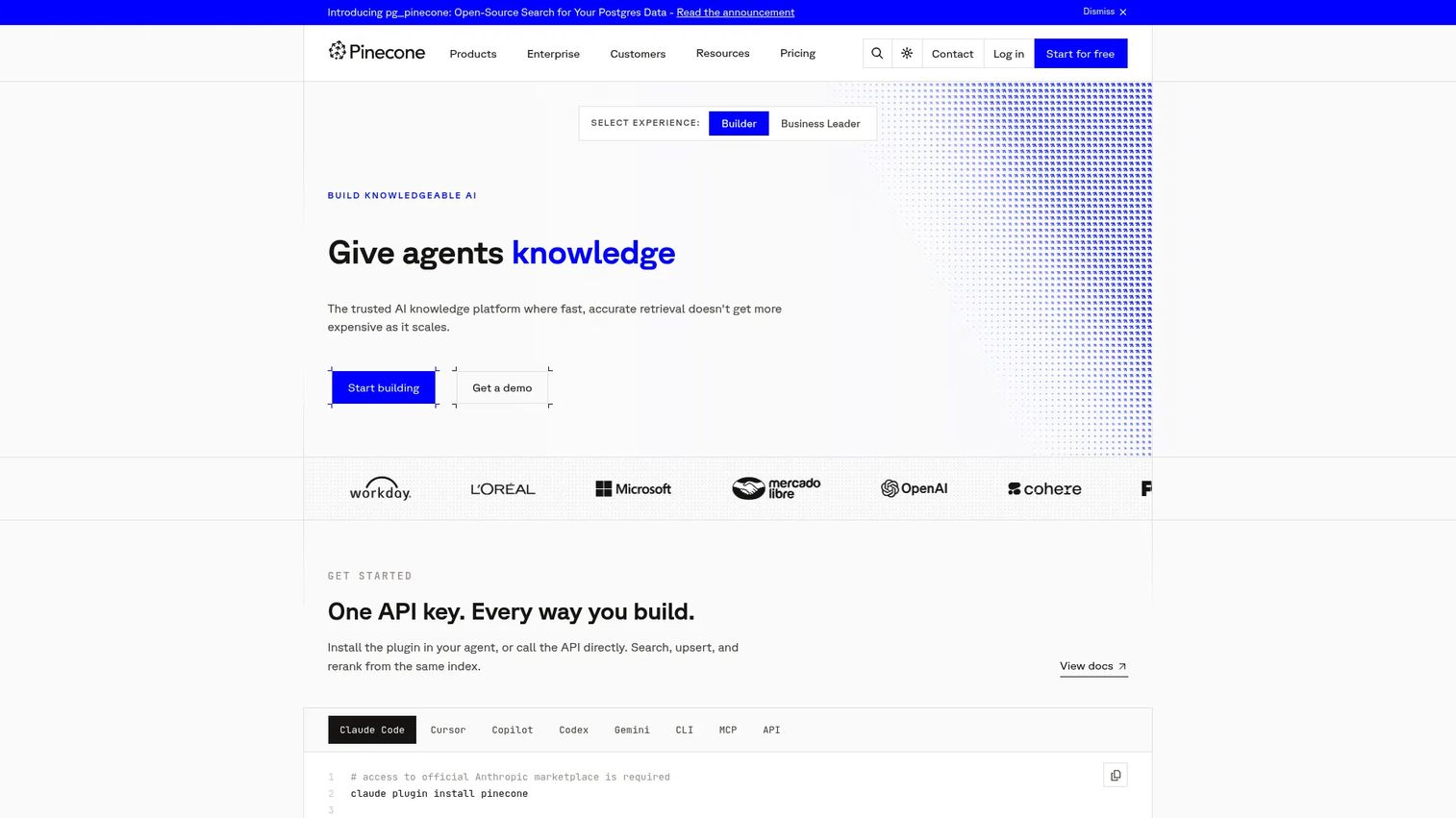
Pinecone is a fully managed vector database and AI knowledge infrastructure platform built for production retrieval workloads. It handles embedding storage, similarity search, and index scaling without requiring you to operate a cluster. For PMs, that means fewer engineering quarters spent on infrastructure and more focus on retrieval quality and product behavior.
Best for: Engineering teams building semantic search, RAG pipelines, and AI-agent memory at production scale.
Key features
- Dense, sparse, hybrid, and native full-text search
- Metadata filtering with real-time index updates
- Serverless scaling with backup and restore capabilities
- Integrated embedding and reranking model support
- Enterprise security: RBAC, SSO, private endpoints, and BYOC options
Why choose Pinecone: Pinecone is the right call when the retrieval layer is central to your AI product and your engineering team does not want to operate vector infrastructure. Teams that also need enterprise search connectors, document processing, or multi-system permissioning will likely pair Pinecone with another layer.
Pinecone pricing: The Starter plan is free. Builder costs $20/month flat. Standard has a $50/month minimum usage charge, and Enterprise starts at a $500/month minimum. Higher tiers add production features, security controls, and support capacity.
G2 rating: 4.4/5
2. Elastic
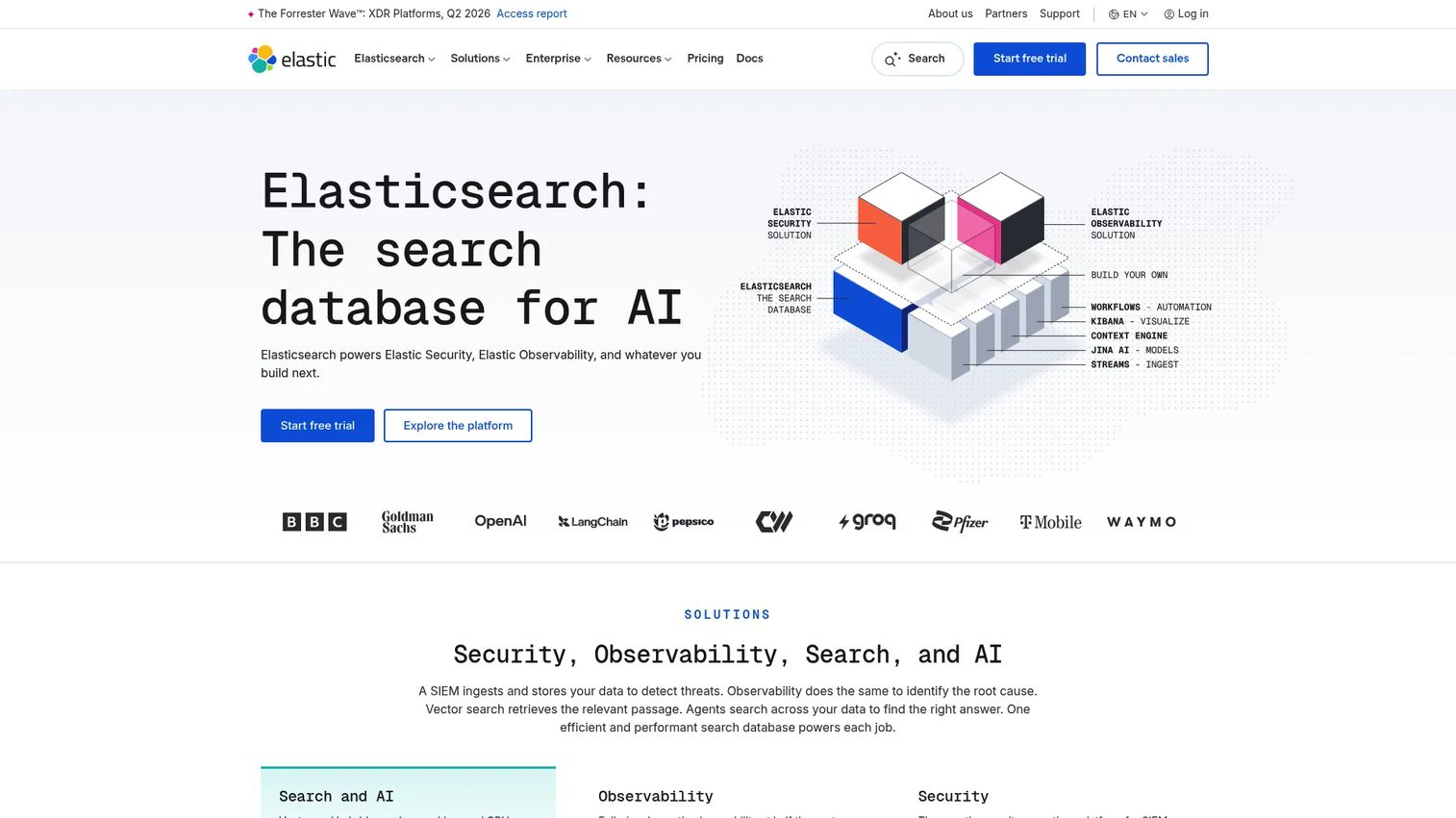
Elastic is the company behind Elasticsearch and the broader Elastic Stack, used for full-text search, vector search, observability, and security analytics. For teams already running Elasticsearch, Elastic offers a natural path to AI-powered hybrid retrieval without replacing the existing stack. It supports deployment on Elastic Cloud or self-managed environments.
Best for: Teams modernizing existing Elasticsearch deployments or building search across complex operational data with analytics and observability requirements.
Key features
- Full-text and vector search with hybrid retrieval
- Observability across logs, metrics, and application traces
- Machine learning and anomaly detection
- Role-based, field-level, and document-level security
- Cloud and self-managed deployment options
Why choose Elastic: Elastic performs well when search is part of a broader data and observability strategy. PMs should consider it when engineering already knows Elasticsearch, or when ranking, operational logging, and visibility into retrieval behavior are requirements alongside the AI feature itself.
Elastic pricing: Elastic Cloud runs on usage-based or resource-based pricing across Standard, Gold, Platinum, and Enterprise tiers. A 14-day free trial is available. Self-managed deployments use license-based pricing. Contact Elastic for a plan-specific quote.
G2 rating: 4.4/5
3. Algolia
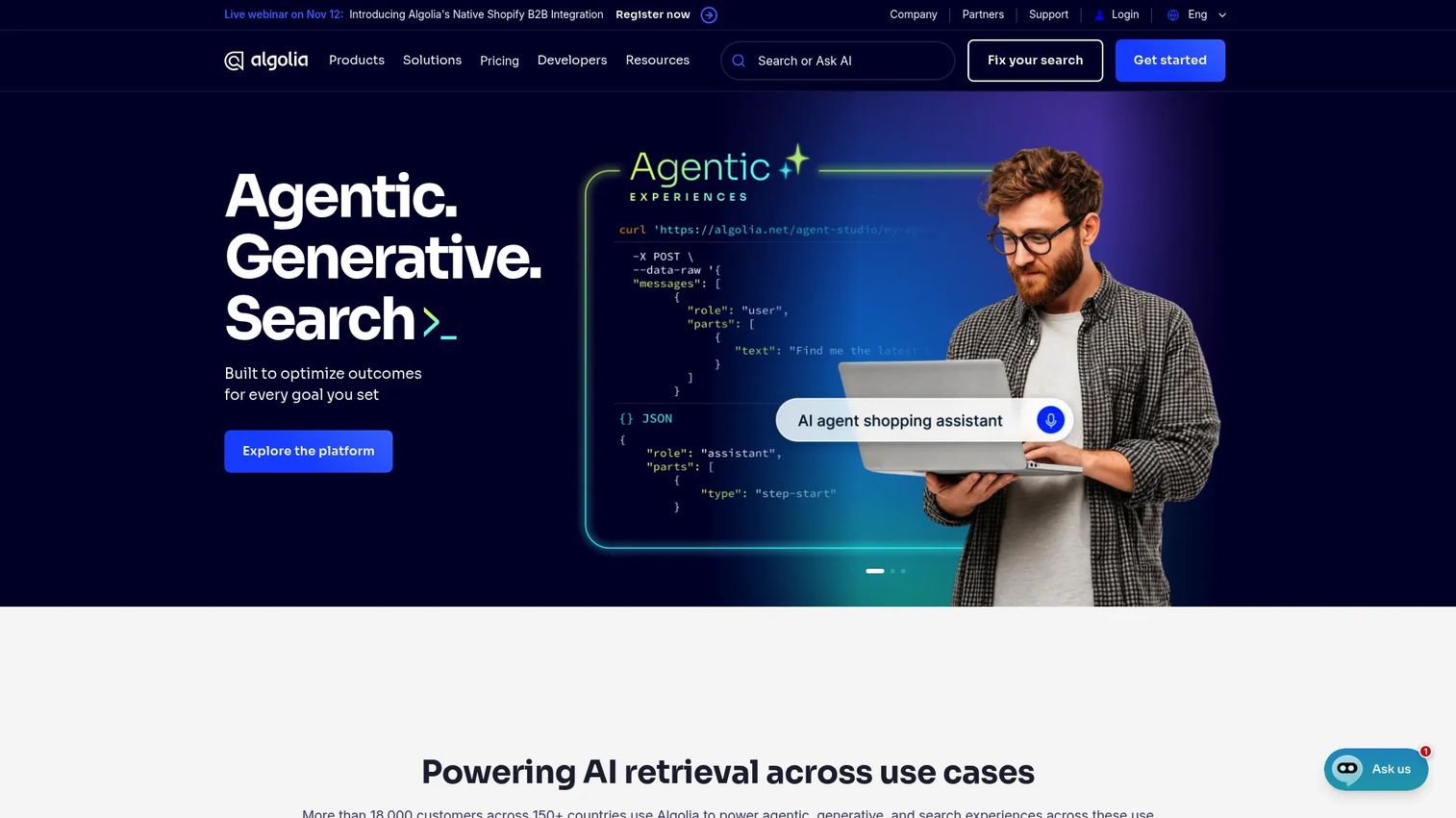
Algolia is an API-first search and discovery platform built for product search, content discovery, and app search experiences. It includes NeuralSearch for semantic retrieval, merchandising rules for search curation, and relevance controls designed to improve conversion rather than just recall. Teams implement it without deep search engineering expertise.
Best for: Product and growth teams where search quality ties directly to conversion rates, activation, and user engagement.
Key features
- Keyword and semantic search with NeuralSearch
- Query suggestions, faceted filtering, and merchandising rules
- AI ranking, personalization, and recommendation capabilities
- Search analytics with query and click data
- Usage-based API with SDKs for major languages and frameworks
Why choose Algolia: Algolia excels when the business impact is tied to user-facing discovery and relevance tuning. It is less a pure vector database and more a product-search platform. If you need deep enterprise connectors, document-level permissions, or on-premise deployment, another option will serve better. See also the best enterprise search software guide for platforms better suited to those requirements.
Algolia pricing: Free includes 10,000 search requests and 50,000 records per month. Grow and Grow Plus plans both start at $0/month with usage-based charges beyond included allowances. Elevate is an annual contract with custom volume-based pricing.
G2 rating: 4.5/5
4. Lucidworks
Lucidworks provides an AI-powered search and discovery platform used across enterprise and commerce contexts. Its Fusion platform combines neural hybrid search, LLM orchestration, behavioral signal analysis, and no-code studio tooling for search governance. PMs managing search quality across product catalogs, internal knowledge bases, or multi-source discovery will find its relevance workflow depth useful.
Best for: Enterprise teams with complex relevance tuning, search governance, and multi-source discovery requirements across commerce or workplace environments.
Key features
- AI-powered enterprise search and product discovery
- Neural hybrid search combining keyword and semantic signals
- Generative AI and LLM orchestration capabilities
- No-code Agent, Commerce, Analytics, and UI Studios
- Behavioral signals and relevance analytics with SaaS or self-hosted options
Why choose Lucidworks: Choose Lucidworks when business stakeholders need explicit control over ranking, merchandising, and enterprise knowledge retrieval. Implementation typically requires cross-functional coordination between product, engineering, and search specialists.
Lucidworks pricing: Lucidworks does not display prices on its website. Pricing is defined in customer Order Forms. Contact Lucidworks sales for a quote based on your index volume, connector needs, and deployment model.
G2 rating: 4.5/5
5. SearchStax

SearchStax provides fully managed Apache Solr infrastructure alongside an AI-powered site search product. Teams committed to Solr get production-grade hosting with scaling, monitoring, backups, and uptime SLAs, without owning cluster operations. The site search product adds features like Smart Match Assist, Smart Ranking, and Smart Answers on top of the Solr foundation.
Best for: Teams already committed to Solr, or organizations running CMS-based sites that need customizable, analytics-driven search without managing clusters.
Key features
- Managed Apache Solr hosting with scaling, backups, and SLAs
- AI-powered site search with Smart Match Assist and Smart Ranking
- Facets, filters, auto-suggest, spell check, and customizable result snippets
- Operational monitoring and security controls
- 14-day free trial for Managed Search
Why choose SearchStax: SearchStax makes sense when Solr is the right foundation but engineering cost and cluster maintenance are the main blockers. It is especially relevant for Drupal and Sitecore deployments where Solr integration is already established. For teams open to a different foundation, OpenSearch or Elastic may offer a broader AI retrieval feature set.
SearchStax pricing: Managed Search development clusters start at $53/node/month (billed annually). Core plans start at $2,499/month and Enterprise at $6,250/month, both billed annually. Site Search Advanced and Premium plans require contacting sales.
G2 rating: 4.5/5
6. Chroma
Chroma is an open-source embedding database built for AI application development. It supports vector search, full-text search, sparse vector search, and metadata filtering in a single system. Developers use it locally or through Chroma's hosted service to validate RAG pipelines and embedding workflows before infrastructure choices harden.
Best for: Developer teams validating retrieval features, RAG pipelines, or prototype AI experiences with minimal infrastructure overhead.
Key features
- Vector and sparse vector similarity search
- Full-text, lexical, and regex search alongside embeddings
- Metadata filtering and faceted search
- Collection forking and dataset versioning
- Python and JavaScript SDK support with CLI tooling
Why choose Chroma: Chroma is the fastest path from idea to working retrieval prototype. For enterprise production deployments that need governance, multi-tenant isolation, and operational SLAs, teams should evaluate whether the hosted service or a managed alternative better fits their maturity requirements.
Chroma pricing: The Starter plan includes $5 in free credits per month with usage-based pricing beyond that. The Team plan is $250/month and includes $100 in credits plus usage-based charges. Enterprise pricing is custom.
G2 rating: 4.2/5
7. Jina AI
Jina AI provides search foundation models and retrieval APIs including multilingual and multimodal embeddings, a reranking API, a web reader API for converting pages and PDFs to LLM-ready text, and DeepSearch for iterative research workflows. Teams use Jina AI components as building blocks inside their own retrieval pipelines rather than as a fully hosted search product.
Best for: Developer teams assembling high-quality retrieval across text, images, PDFs, and complex content who want modular, API-first components.
Key features
- Multilingual and multimodal embedding models for semantic search and RAG
- Reranking API for improving result relevance after initial retrieval
- Reader API converting web pages and PDFs into LLM-friendly text
- DeepSearch for iterative web search, reading, and reasoning
- Document OCR for structured text and Markdown extraction
Why choose Jina AI: Jina AI suits technical teams that want retrieval building blocks rather than a complete hosted search box. It is a strong fit when embedding quality and reranking step are the primary performance levers. Teams looking for end-to-end managed search with connectors and dashboards will need to combine Jina AI with other infrastructure.
Jina AI pricing: New API keys include free tokens to get started. Usage-based pricing applies beyond the included allowance.
8. Cloudflare AI Search
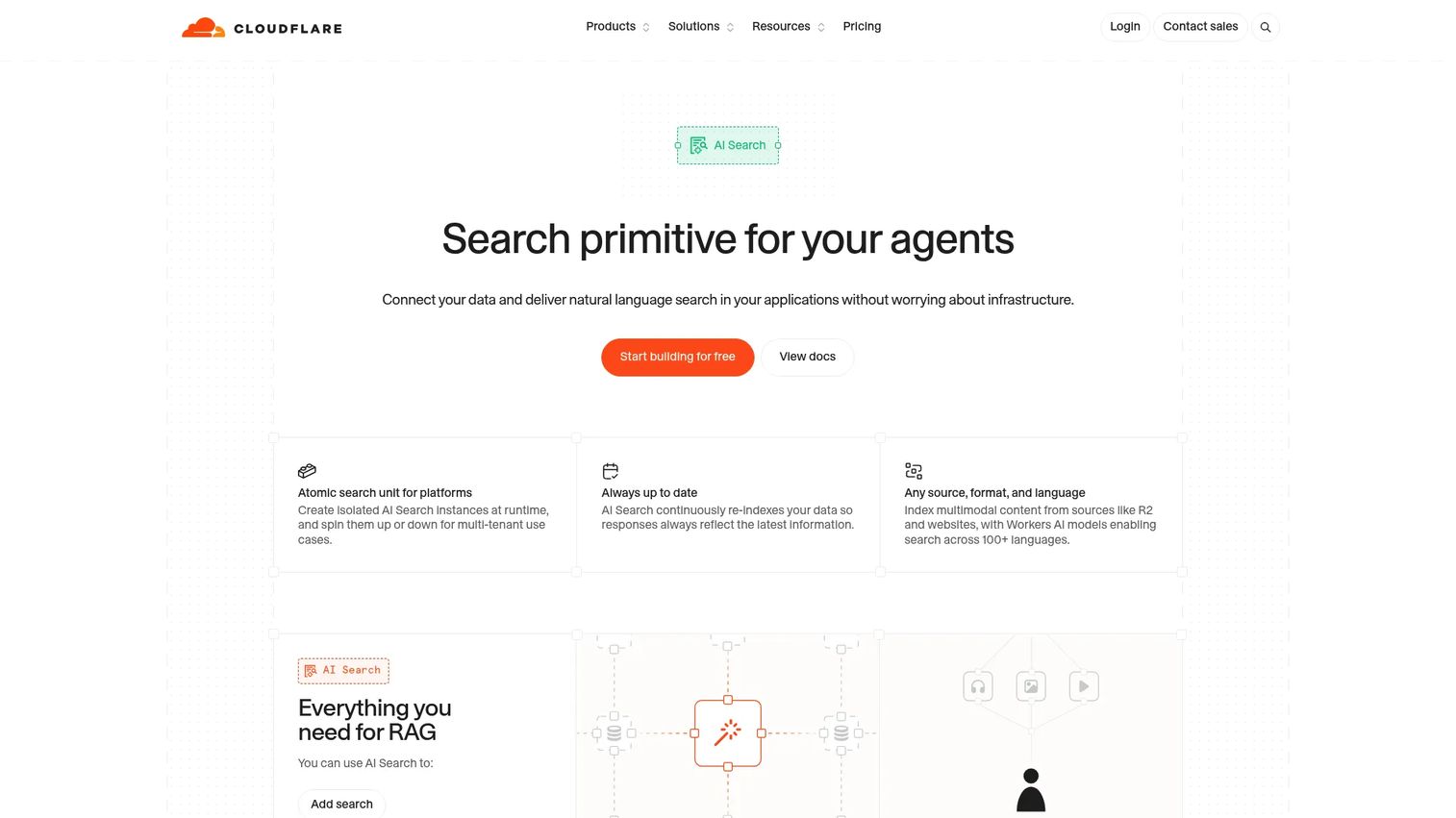
Cloudflare AI Search is a managed search and RAG infrastructure primitive designed to run close to Cloudflare's compute, storage, and edge services. It continuously indexes data, supports hybrid semantic and keyword retrieval, handles multimodal content including images and scanned PDFs via OCR, and exposes built-in MCP endpoints for agent workflows.
Best for: Engineering teams building documentation search, knowledge-base retrieval, or per-tenant agent search within Cloudflare's Workers and storage platform.
Key features
- Automated continuous indexing across connected data sources
- Hybrid semantic and keyword search in a single query
- Multimodal indexing covering text, images, and PDFs
- OCR for scanned PDFs and image content
- Built-in MCP endpoints and embeddable UI snippets
Why choose Cloudflare AI Search: Cloudflare AI Search performs well when retrieval belongs close to Cloudflare's compute and storage stack. PMs should evaluate how much of the team's existing infrastructure already lives on Cloudflare before prioritizing this option. For teams without that existing footprint, billing begins in December 2026, making now a reasonable time to run a pilot.
Cloudflare AI Search pricing: Monthly allowances include 5 million ingestion tokens, 10 GB-month storage, 1,000 semantic queries, and 1,000 full-text queries. Additional usage costs $0.75 per million base-ingestion tokens and $0.75 per 1,000 semantic queries, among other rates. Each AI Search instance beyond the included allowance costs $0.10/month.
9. IBM Watson Discovery
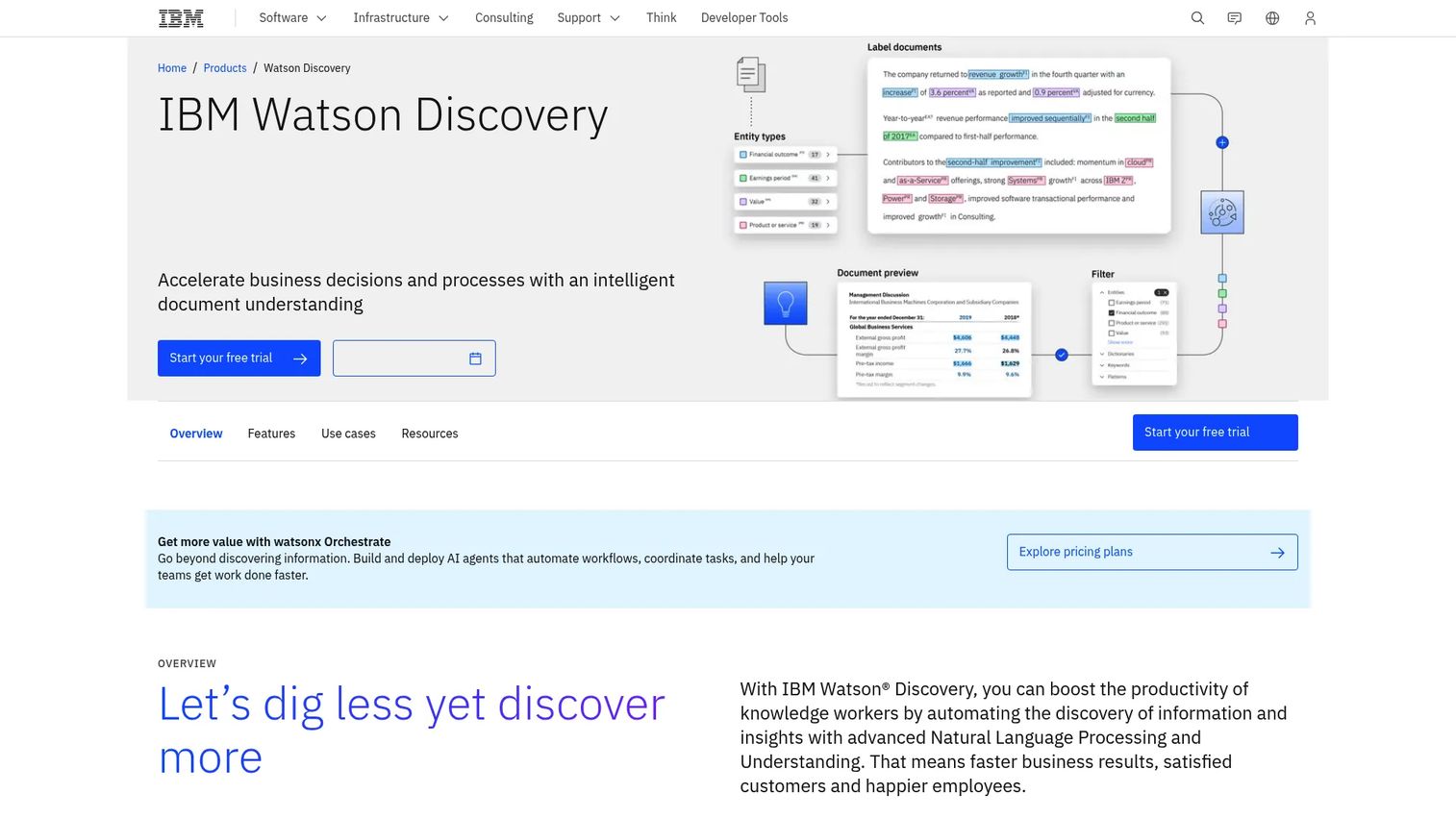
IBM Watson Discovery is an enterprise AI search platform for documents and business knowledge. It applies natural-language processing, table understanding, passage retrieval, and custom model training to extract structured insight from large volumes of unstructured content. It includes enterprise connectors, content enrichment pipelines, and governance controls suited to regulated organizations.
Best for: Enterprises that need AI search across document repositories, policies, contracts, and internal knowledge bases with security and document-intelligence requirements.
Key features
- Natural-language and structured query search
- Table and passage retrieval with document understanding
- Enterprise connectors and document ingestion pipelines
- Content mining and contract understanding capabilities
- Governance controls and role-based access
Why choose IBM Watson Discovery: Choose Watson Discovery when security, document intelligence, and enterprise procurement requirements outweigh startup-style speed. PMs should factor in implementation process length and internal stakeholder alignment, particularly in regulated industries.
IBM Watson Discovery pricing: The Plus plan starts at $500/month and includes 10,000 documents and 10,000 monthly queries. Enterprise starts at $5,000/month and covers 100,000 documents and query calls. Premium and Cloud Pak for Data cartridge pricing require contacting IBM.
G2 rating: 4.5/5
10. Google Vertex AI Search
Google Vertex AI Search, now also identified as Agent Search on current Google Cloud pages, is managed AI search for applications, websites, and enterprise data. It provides semantic and hybrid search, generative answers with citations, out-of-the-box RAG capabilities, and integration with Google Cloud's data and AI services. Teams on Google Cloud can connect structured data, unstructured documents, and website content through a managed indexing pipeline.
Best for: Organizations building enterprise search or RAG applications on Google Cloud that want managed infrastructure with grounded answer capabilities.
Key features
- Semantic and hybrid search across structured, unstructured, and website data
- Generative answers, summaries, citations, and follow-up interaction support
- Out-of-the-box RAG including ETL, OCR, chunking, embeddings, and indexing
- Enterprise data connectors and Google Cloud integration
- App search and website search configurations
Why choose Google Vertex AI Search: This platform suits teams already building on Google Cloud where managed AI search and grounded answers are the core requirement. PMs should evaluate data residency requirements, connector fit with existing data sources, and query-based pricing at their expected usage volume before committing.
Google Vertex AI Search pricing: Search Standard Edition costs $1.50 per 1,000 queries. Search Enterprise Edition costs $4.00 per 1,000 queries. Advanced Generative Answers adds $4.00 per 1,000 user input queries as an add-on. Per-GB indexing charges also apply.
G2 rating: 4.2/5
11. Oracle AI Vector Search
Oracle AI Vector Search adds semantic similarity search and RAG capabilities directly inside Oracle Database, without moving data to a separate vector store. It uses a native VECTOR data type, supports SQL-based vector queries, and allows hybrid searches that combine vector similarity with relational, text, JSON, graph, and spatial conditions in the same query.
Best for: Enterprises already using Oracle Database for critical application data that want to add vector retrieval without a separate system.
Key features
- Unified hybrid search across vector, relational, text, JSON, graph, and spatial data
- Native VECTOR data type with flexible embedding generation
- Hybrid vector indexes for combined similarity and non-vector searches
- SQL-based vector queries with configurable search accuracy
- Native document loading, chunking, embedding, and RAG capabilities
Why choose Oracle AI Vector Search: The compelling argument is data proximity. If your critical application data already lives in Oracle, adding vector retrieval in the same database removes data movement risk and simplifies governance. For teams without an Oracle footprint, a standalone vector database or managed AI search service will be a faster path.
Oracle AI Vector Search pricing: Available through Oracle AI Database services. Autonomous AI Vector Database is priced at $0.0807/ECPU hour. Oracle Cloud Free Tier includes Always Free Autonomous AI Database instances.
12. OpenSearch
OpenSearch is a community-driven, fully open-source search and analytics platform originally forked from Elasticsearch. It supports full-text search, vector search, k-NN retrieval, and hybrid search, alongside observability and security analytics capabilities. Teams self-host it or run it through managed providers.
Best for: Technical teams that need open-source search infrastructure with control over deployment, plugins, and hybrid retrieval behavior.
Key features
- Full-text, vector, hybrid, and AI-powered search
- k-NN approximate nearest-neighbor vector retrieval
- OpenSearch Dashboards for analytics and visualization
- Observability across logs, metrics, and traces
- Self-managed or provider-hosted deployment options
Why choose OpenSearch: Choose OpenSearch when control, extensibility, and open-source licensing matter to your organization. PMs should account for engineering ownership over upgrades, scaling decisions, relevance tuning, and incident response. That operational burden is real, but the community and plugin ecosystem are substantial. For enterprise search software requirements with minimal ops overhead, a managed option may fit better.
OpenSearch pricing: The OpenSearch software is free under the Apache License 2.0. Hosted managed service pricing is usage-based and set separately by providers such as Amazon OpenSearch Service.
G2 rating: 4.4/5
13. Apache Solr
Apache Solr is a mature open-source enterprise search engine built on Apache Lucene. It offers advanced full-text search, faceted navigation, distributed search through SolrCloud, and highly customizable relevance configurations. Teams with deep search requirements and engineering expertise use Solr when they need fine-grained control over every aspect of indexing and ranking.
Best for: Teams with search engineering expertise that need high control over indexing pipelines, relevance configurations, and self-managed infrastructure.
Key features
- Advanced full-text search built on Lucene
- Faceted search and filtering with rich configuration options
- SolrCloud distributed search with replication and fault tolerance
- Custom relevance scoring and query parsing
- Mature plugin ecosystem and community support
Why choose Apache Solr: Solr makes sense when your engineering team has search expertise and needs deep control. PMs should factor in the ongoing maintenance cost: Solr requires specialist knowledge for tuning, scaling, and upgrades. For teams that want Solr's depth without the operations burden, SearchStax provides managed hosting on the same foundation.
Apache Solr pricing: Apache Solr is free open-source software. For managed hosting, see SearchStax or other third-party providers.
G2 rating: 4.1/5
14. Mindbreeze
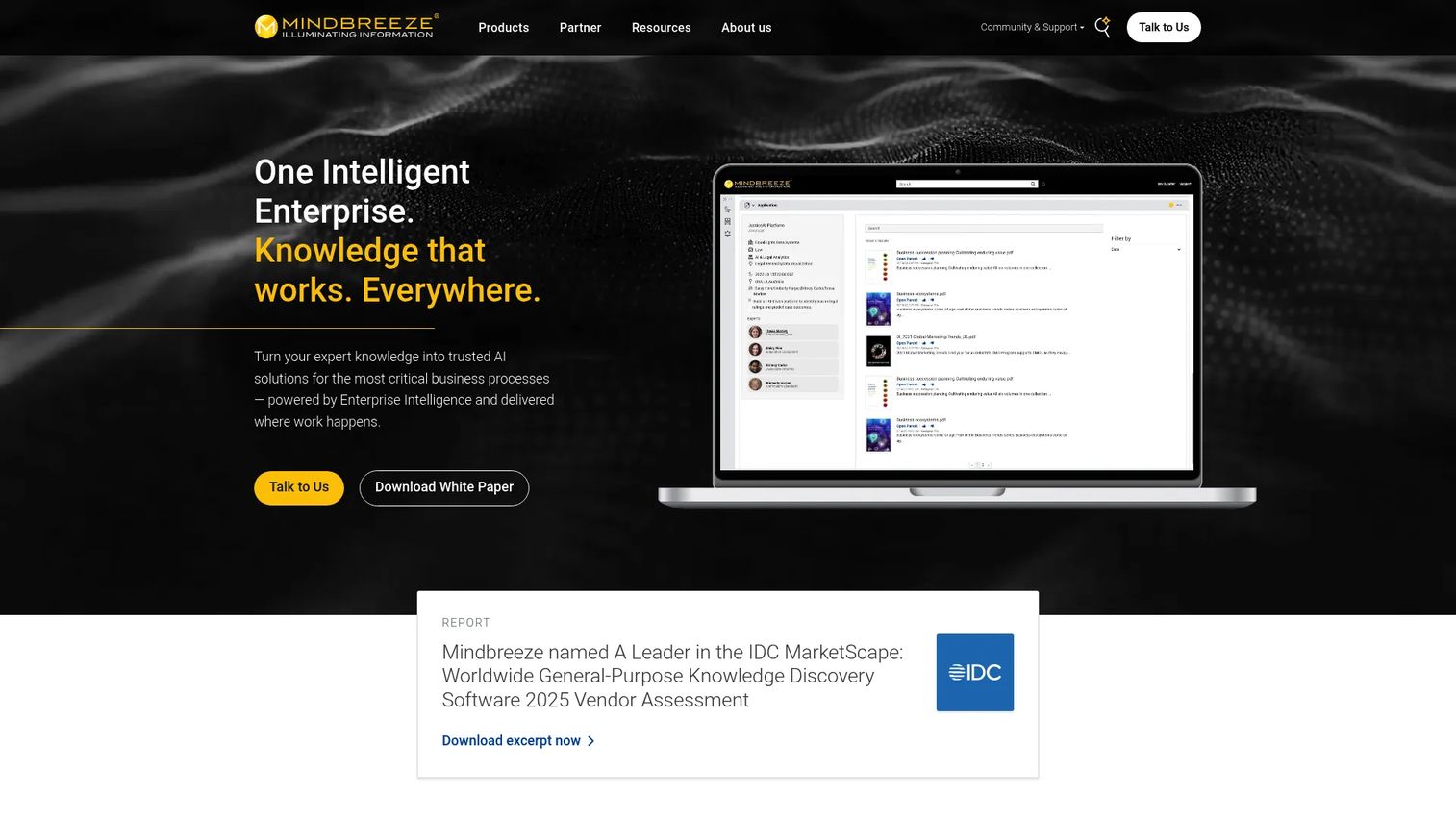
Mindbreeze is an enterprise intelligence and knowledge discovery platform that connects, analyzes, and searches structured and unstructured business information across more than 500 data sources. It delivers permission-aware semantic search, natural-language question answering, knowledge graph discovery, and RAG and LLM-agent capabilities through its InSpire platform.
Best for: Large organizations that need permission-aware search and knowledge discovery across many enterprise systems with security and governance requirements.
Key features
- Enterprise search across 500+ data source connectors
- Natural-language processing and question-answering
- Knowledge graph and expert discovery capabilities
- RAG, LLM, and AI-agent integration support
- Personalized results with role-based access permissions
Why choose Mindbreeze: Mindbreeze is a better fit for large organizations where enterprise knowledge access is the primary use case and governance is non-negotiable. It is less suited to small product teams or early-stage companies where cost and procurement cycle length are constraints. If your PM context is an enterprise with many source systems and strict access controls, the connector breadth and permission handling are genuinely differentiating.
Mindbreeze pricing: The 1M plan (up to 1,000,000 indexed documents) starts at EUR 83,000 per year (approximately USD 103,700). Higher tiers for 5M documents, 10M+, and unlimited documents require contacting Mindbreeze. No free tier is available.
G2 rating: 4.4/5
15. Diffbot
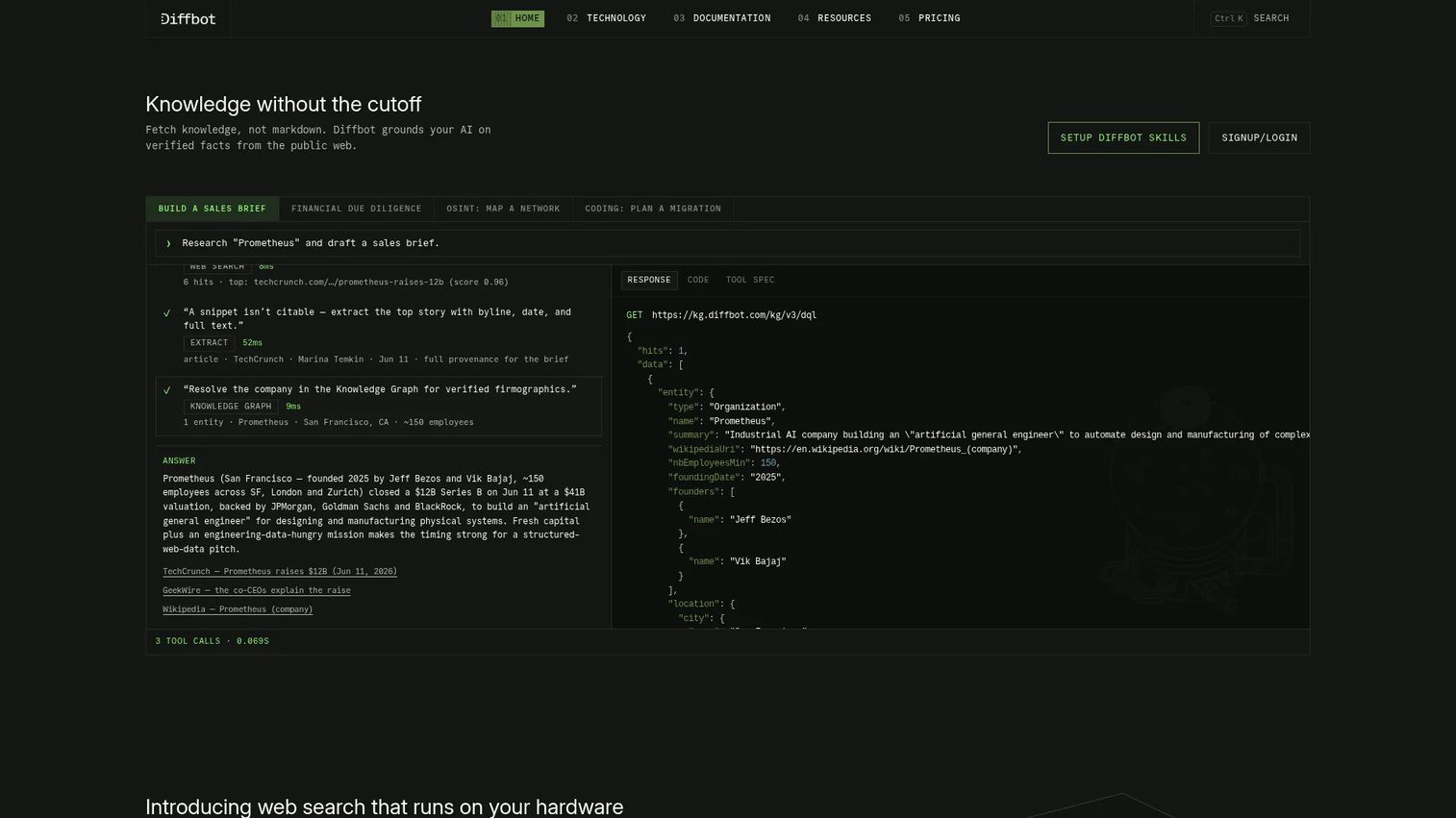
Diffbot builds AI models and APIs that read, structure, search, and transform unstructured public-web data into knowledge. Its Knowledge Graph converts web-scale information into structured entities and relationships, queryable via natural language. Teams use it when their AI features need grounding in current external knowledge rather than only internal documents.
Best for: Teams building AI products that require structured external web data, entity extraction, market intelligence, or knowledge-graph retrieval alongside internal sources.
Key features
- Automatic web-page extraction into structured JSON
- Website crawling and bulk content extraction
- Knowledge Graph search with entity resolution
- Natural-language entity, relationship, fact, and sentiment extraction
- Public-web search API access
Why choose Diffbot: Choose Diffbot when retrieval depends on current structured knowledge from the public web, not only your own internal documents. It is a specialized fit for data-rich AI applications where grounding against external entities, company facts, or relationship graphs matters. For purely internal document retrieval, another platform will cover the job without the web-extraction complexity.
Diffbot pricing: The Free plan includes 10,000 credits per month. Startup costs $299/month and includes 250,000 credits. The Plus plan is $899/month with 1,000,000 credits. Enterprise pricing is custom.
G2 rating: 4.9/5
Considerations when choosing AI search and retrieval infrastructure software
Retrieval quality and relevance controls
Retrieval quality is the product experience. A system that returns the wrong document 20% of the time creates user distrust faster than a slow load time. Before choosing a platform, ask engineering to demonstrate failure cases on your actual query distribution, not cherry-picked demo queries. Evaluate whether the platform supports reranking, hybrid retrieval, synonyms, and manual relevance tuning after launch. Query logs and evaluation sets are essential instrumentation for iterating on retrieval after the AI feature ships.
Data freshness and indexing ownership
Stale retrieval is the most common silent failure in production AI features. Define freshness expectations by use case: Operational workflows may need indexing in seconds, support documentation in hours, and archived content on a slower cadence. Ask vendors how they handle event-driven updates, batch indexing pipelines, and re-indexing when your product data schema changes. The best product analytics software tools can help you instrument freshness-related drop-off once the feature is live.
Permissioning and tenant isolation
Retrieval systems can become accidental data-exposure risks. A user searching your internal knowledge base should never surface a document they do not have access to in the source system. Evaluate role-based access controls, document-level permissions, tenant isolation boundaries, audit log availability, and how connectors handle access tokens from source systems. This is not just a security concern: A permissions failure in a production AI feature is a trust incident.
Deployment model and engineering cost
Managed cloud, self-hosted open source, enterprise platform, and database-native options carry fundamentally different engineering cost profiles. Managed platforms reduce operational burden but add vendor dependency. Self-hosted options give control but require ongoing specialist capacity for upgrades, scaling, and incident response. Model the opportunity cost honestly: Engineering hours spent operating retrieval infrastructure are hours not spent on the product features that drive activation and retention.
Pricing predictability at scale
Retrieval pricing models vary widely. Some charge per vector stored, others per query, some per indexed record, some by compute consumption, and some by document count. Run a high-usage scenario before committing. For a product feature that will serve 100,000 monthly active users, model both average usage and peak spikes. Unexpected cost at scale is a roadmap disruption.
Conclusion
The right retrieval infrastructure does not win on AI branding. It wins because it surfaces the right content, respects permission boundaries, stays current as your product changes, fits your engineering team's operational capacity, and gives you enough query-log and analytics signal to improve retrieval quality after launch.
For vector-native AI retrieval and agent memory, Pinecone is the strongest managed option. Elastic covers hybrid enterprise search with deployment flexibility. Algolia is the clearest choice for conversion-focused product discovery. Chroma is fast for prototyping and validation. Cloudflare AI Search is worth a pilot if your team already lives on that platform. For enterprise knowledge use cases with document complexity and governance requirements, IBM Watson Discovery, Google Vertex AI Search, and Mindbreeze each serve different organizational contexts. OpenSearch and Apache Solr fit teams that want open-source control and can staff the operational work.
Shortlist two managed platforms and one open-source option. Then run the same 50 queries across each system, including your worst support tickets, stale doc examples, misspelled product terms, and permission-sensitive content. What fails there is what will fail in production.
Once your users find the right information, they still need to understand what to do with it. If your team also needs to explain complex product workflows after retrieval surfaces the answer, interactive product experiences help you show the next step clearly.
Start your journey with Guideflow today!
FAQs
AI search and retrieval infrastructure software is the backend layer that indexes, retrieves, ranks, and serves relevant information to AI applications, agents, search interfaces, and knowledge discovery workflows. It includes vector databases, enterprise search platforms, managed RAG infrastructure, and open-source search engines. What they share is the job of deciding what your AI feature actually knows and returns in response to a query.
A vector database stores embeddings and returns similarity matches based on distance in embedding space. AI search is broader: It can include keyword search, vector search, hybrid retrieval, result ranking, permission controls, connectors, analytics dashboards, and UI or API layers. A vector database is one component; a search platform is the full retrieval system around it. Many production AI features combine both.
Vector search performs well for semantic similarity tasks where the user's intent matters more than exact term matching. Hybrid search helps when both precise terminology and semantic meaning matter simultaneously, common in support search and internal tooling. Enterprise search adds the full layer of permissioning, multi-source connectors, governance, and relevance workflows that regulated or multi-system organizations require. Most production AI features eventually need at least hybrid retrieval; enterprise search is warranted when permissions and connector breadth are non-negotiable.
For vector-native RAG where the team controls the embedding pipeline, a managed vector database handles retrieval without infrastructure burden. For app or website RAG where grounded answers need to surface over public or structured content, a managed AI search service with built-in chunking and indexing reduces build time significantly. For enterprise knowledge RAG with documents across many internal systems, a platform with connectors, document processing, and permission-aware access is the right foundation. The choice flows from where your data lives and what permissions it carries.
Build a query test set before choosing a platform. Include your highest-volume support queries, your most common search failure cases, permission-sensitive examples, and product vocabulary your users actually use. Run those queries against each shortlisted system and score results on precision, recall, answer groundedness where relevant, latency, and whether users could complete the task they started. Avoid evaluating only on queries you know the system handles well.
The most common risks are stale data reaching users when indexing pipelines fall behind, permission errors exposing content to the wrong user, hallucinated answers when retrieval fails to return grounded content, poor recall on domain-specific vocabulary, latency spikes during peak usage, and pricing surprises at scale. These are product risks, not just engineering risks. Each one has a user-facing symptom: Distrust, confusion, or abandonment. Building measurement into the retrieval layer before launch gives you the query logs and engagement signals needed to catch failures early.
Open source can be a strong production foundation when the team has search expertise and operational capacity. OpenSearch and Apache Solr are mature platforms with large communities. The honest constraint is maintenance burden: Upgrades, relevance tuning, scaling, and incident response require sustained specialist attention. Managed platforms shift that burden to the vendor at the cost of less control and predictable per-usage pricing. For small product teams without dedicated search infrastructure resources, a managed option often delivers faster time-to-production and lower total maintenance overhead.
Cost drivers vary by platform and architecture. Vector databases typically charge on stored vectors and query volume. Managed search services charge per query, per record indexed, or per compute unit. Enterprise search platforms often price on document count with annual contracts. Open-source software is free to run but carries real operational engineering cost. Before committing, model a realistic high-usage scenario including index size, query volume, number of tenants or users, connector count, and support tier. The platforms in this guide range from free open-source deployments to EUR 83,000 per year at the enterprise end, so right-sizing the choice early saves meaningful budget.