Your activation dashboard says 42%. Your data analyst's says 38%. Your VP of Product is asking which number to trust, and nobody has a confident answer.
That gap is not a dashboard problem. It's a metadata problem. When metric definitions drift, ownership is unclear, and lineage is undocumented, every roadmap decision sits on a foundation nobody fully trusts. Only 11% of organizations reported high metadata management maturity in 2025, according to DATAVERSITY, and 71% said they had a governance program, up from 60% in 2023, per Precisely and Drexel University. The gap between having a program and trusting your data remains wide.
Passive catalogs document what exists. Active metadata management goes further: It collects context, analyzes usage, surfaces quality signals, and pushes that intelligence into the tools where your team already works. For product managers who care about instrumentation, segment accuracy, and release cadence risk, that difference matters.
This guide shortlists 15 active metadata management software options for 2026, with verified pricing, G2 ratings, and practical guidance on where each fits.
What's inside
This guide compares 15 active metadata management tools for 2026, selected for data, product, analytics, governance, and platform teams. Items were chosen based on:
- Metadata discovery, cataloging, and classification capabilities
- Lineage, provenance, and impact analysis depth
- Governance workflows, business glossary, and stewardship support
- Automation, orchestration, and integration coverage
- AI or knowledge graph capabilities where verified
Pricing and G2 ratings were checked against vendor pages and live G2 listings.
TL;DR
- Best overall active metadata platform: Alation, for enterprise data teams that need behavioral signals, search, and governance in one place
- Best for knowledge graph-driven discovery: data.world, for teams that need semantic relationships between data assets
- Best for enterprise data governance: Collibra Platform, for regulated organizations with mature stewardship needs
- Best for Microsoft-heavy stacks: Microsoft Purview Data Governance, for Azure and Microsoft 365 estates
- Best for smaller teams documenting databases: Dataedo, with transparent annual pricing and a 14-day free trial
- Best for lineage and regulatory change analysis: Solidatus or Precisely Data360, for teams where lineage is a decision tool, not just a report
What is active metadata management software?
Active metadata management software collects, enriches, analyzes, and operationalizes metadata across the data stack so teams can act on data context inside the tools where work already happens.
The distinction between active and passive metadata is practical. Passive metadata sits in a catalog: Documented, stored, and mostly static. Someone has to go find it. Active metadata moves: It triggers recommendations, fires governance workflows, surfaces quality alerts, updates lineage automatically, and feeds usage signals back into search rankings and certification decisions.
For product managers, this means metric definitions stay consistent across dashboards and teams. Data owners become discoverable before a Slack thread turns into a detective hunt. Schema and event changes are traceable before a pipeline break surfaces two sprints later. The opportunity cost of reactive data debugging drops.
Active vs passive metadata
| Dimension | Passive metadata | Active metadata |
|---|---|---|
| Update model | Manual or scheduled | Automated and event-driven |
| User workflow | Pull: Users go find context | Push: Context comes to users |
| Automation | Low | High |
| Governance action | Static documentation | Triggered workflows and alerts |
| Best fit | Smaller teams, early programs | Modern data stacks at scale |
Key capabilities to look for
- Metadata harvesting from warehouses, lakes, and BI tools
- Automated data discovery and classification
- Business glossary and term stewardship
- Data lineage and provenance tracking
- Impact analysis for schema or pipeline changes
- Data quality signals and alerts
- Usage analytics and popularity scoring
- Workflow integrations and collaboration
- AI-assisted search and recommendations
- Governance policy management
For more context on adjacent business glossary software and big data analytics software, those guides cover overlapping tool categories worth reviewing during evaluation.
When to use active metadata management software
Improve trust in product and analytics metrics
Activation, retention, and funnel numbers mean nothing when different dashboards show different figures. Active metadata management surfaces metric definitions, ownership, and lineage so teams can trace disagreements back to their source: A renamed field, a changed event schema, a modified dbt model. PMs get a faster path from "which number is right" to "here's why they differ."
Govern data without slowing product teams
Governance that lives in a separate portal nobody opens is not governance. Active metadata integrates stewardship into existing workflows: Glossary approvals route through the right owners, policy alerts appear where the data is used, and certification badges signal trust without requiring a meeting. Release cadence stays intact.
Trace data changes before they break decisions
Schema updates and pipeline changes create downstream risk. Impact analysis in active metadata platforms shows which reports, segments, and models a field change will touch before the change ships. For PMs managing instrumentation across a release, that visibility reduces the cost of a wrong call and shortens post-release debugging.
Active metadata management software comparison
The table below is a shortlist, not a universal ranking. Verify pricing, plan packaging, and G2 ratings directly on vendor pages before shortlisting. Tools are ordered by relevance to the keyword.
| # | Product | Best for | Key differentiator | Pricing | G2 rating |
|---|---|---|---|---|---|
| 1 | Alation | Enterprise active metadata and catalog adoption | Behavioral metadata, stewardship, and governance context | Contact sales (ACU-based) | 4.4/5 |
| 2 | data.world | Knowledge graph-driven discovery | Knowledge graph catalog with collaborative governance | Contact sales | 4.2/5 |
| 3 | DataGalaxy Value Governance Platform | Business glossary and value-driven governance | Governance organized around business value and ownership | Contact sales | 4.8/5 |
| 4 | ALEX | Enterprise metadata management and AI readiness | Unlimited-user subscription with governed context and MCP server | Contact sales | 4.9/5 |
| 5 | Atlan | Modern data teams and collaborative analytics | Collaboration layer across catalogs, lineage, and data tools | Contact sales | 4.5/5 |
| 6 | Ab Initio | Complex enterprise data processing | Metadata and governance tied to large-scale data engineering | Contact sales | 4.3/5 |
| 7 | ServiceNow Data Catalog | Enterprises on ServiceNow | Data catalog workflows connected to service management | Contact sales | N/A |
| 8 | Rocket Data Intelligence | Legacy and mainframe data estates | Metadata visibility across hybrid and mainframe systems | Contact sales | 4.6/5 |
| 9 | Collibra Platform | Enterprise governance and compliance | Mature governance workflows and policy management | Contact sales | 4.2/5 |
| 10 | Informatica Intelligent Data Management Cloud | Broad cloud data management | Catalog, quality, integration, and governance in one platform | Contact sales (IPU-based) | 4.2/5 |
| 11 | Microsoft Purview Data Governance | Microsoft Azure and Microsoft 365 estates | Native Microsoft ecosystem governance and cataloging | Pay-as-you-go (Azure) | N/A |
| 12 | Oracle Enterprise Metadata Management | Oracle-centered environments | Metadata harvesting and lineage across Oracle stacks | Contact sales | 3.7/5 |
| 13 | Dataedo | Smaller teams documenting databases | Practical database cataloging with transparent pricing | From $18,000/year | N/A (Capterra 4.7/5) |
| 14 | Solidatus | Lineage and regulatory change management | Visual lineage modeling and what-if impact analysis | Contact sales | 4.2/5 |
| 15 | Precisely Data360 | Governance connected to data quality | Metadata governance tied to trust and data quality | Contact sales | 4.3/5 |
Best 15 active metadata management software tools
1. Alation

Alation is an agentic data intelligence platform built for enterprise data teams that need active metadata across discovery, governance, and quality workflows. Its behavioral metadata engine tracks how data assets are actually used: Which tables analysts query most, which dashboards get certified, and which definitions are most searched. That usage signal feeds recommendations, surfacing relevant assets before a user asks.
Best for: Enterprise data teams that need active metadata, governance, and catalog adoption at scale.
Key features
- Behavioral metadata and usage signals
- Intelligent catalog search and recommendations
- Business glossary and stewardship workflows
- Automated data lineage and impact analysis
- AI-powered data quality monitoring
- Workflow automation and AI agents
Why choose Alation: Alation fits enterprises where metadata needs to do more than sit in a catalog. The behavioral signals and governance context make it practical for product teams that want trusted metrics without engineering every clarification.
Alation pricing: Alation uses a consumption-based model centered on Alation Consumption Units (ACUs).
G2 rating: 4.4/5
2. data.world
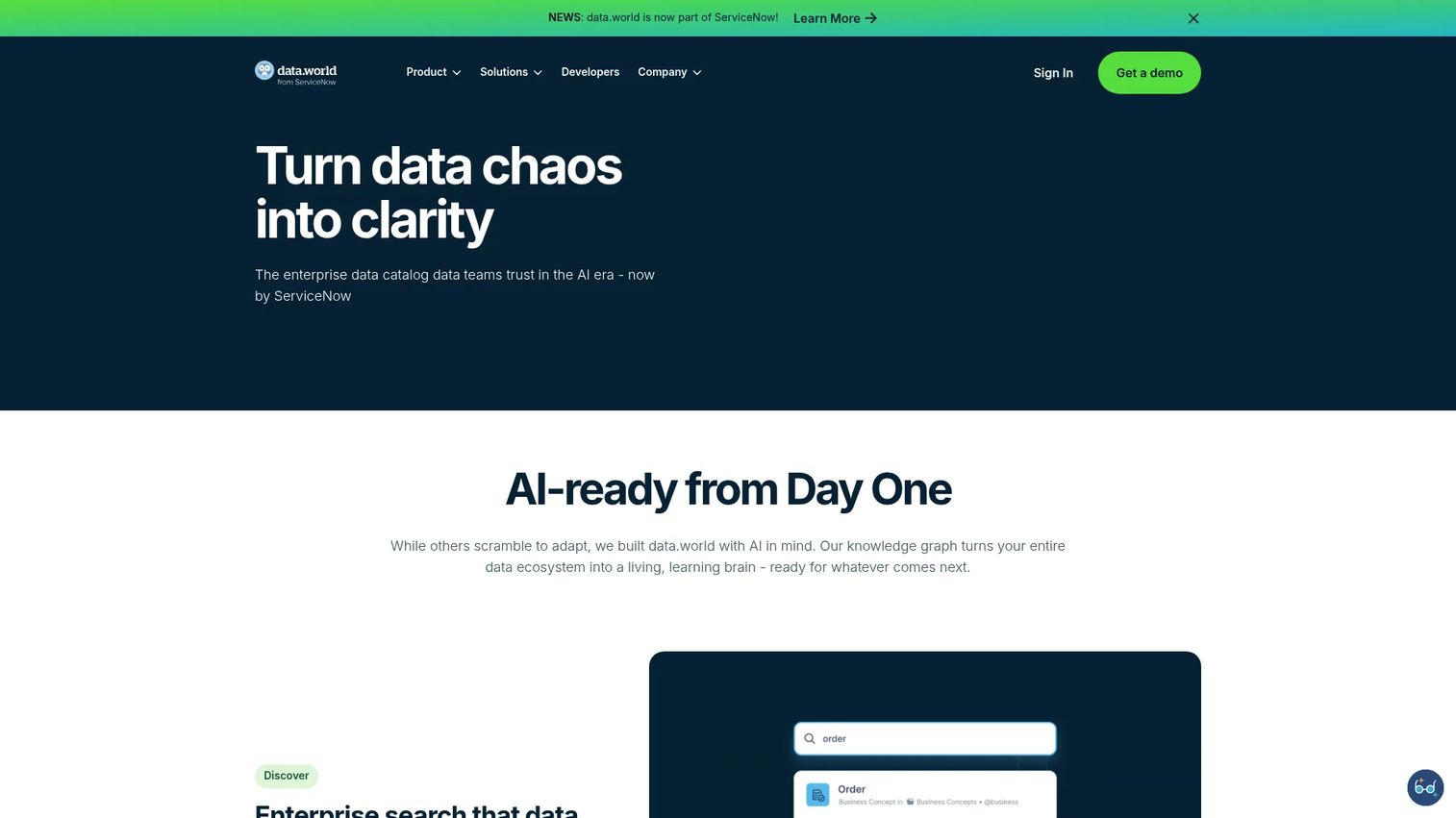
data.world positions itself as an enterprise data catalog built on a knowledge graph, which means it stores relationships between data assets, not just the assets themselves. That structure makes it easier to understand how a metric connects to its upstream source, which team owns a dataset, and what happens downstream when a schema changes. The platform also includes AI-assisted search and collaborative governance workflows.
Best for: Teams that want a knowledge graph-driven approach to metadata, semantic data discovery, and self-service analytics governance.
Key features
- Knowledge graph-based data catalog
- AI-assisted data discovery and search
- Agile governance and automation-driven workflows
- Data lineage and impact analysis
- Federated querying and hybrid architecture support
Why choose data.world: The knowledge graph foundation is the right choice when relationships between data assets carry as much weight as the assets themselves. Product and analytics teams dealing with messy definitions across functions benefit from the semantic layer.
data.world pricing: Plans span Essentials, Standard, Enterprise, and Enterprise+, each including 10 users. Additional users and add-ons price separately. Buyers contact sales for all tier costs.
G2 rating: 4.2/5
3. DataGalaxy Value Governance Platform
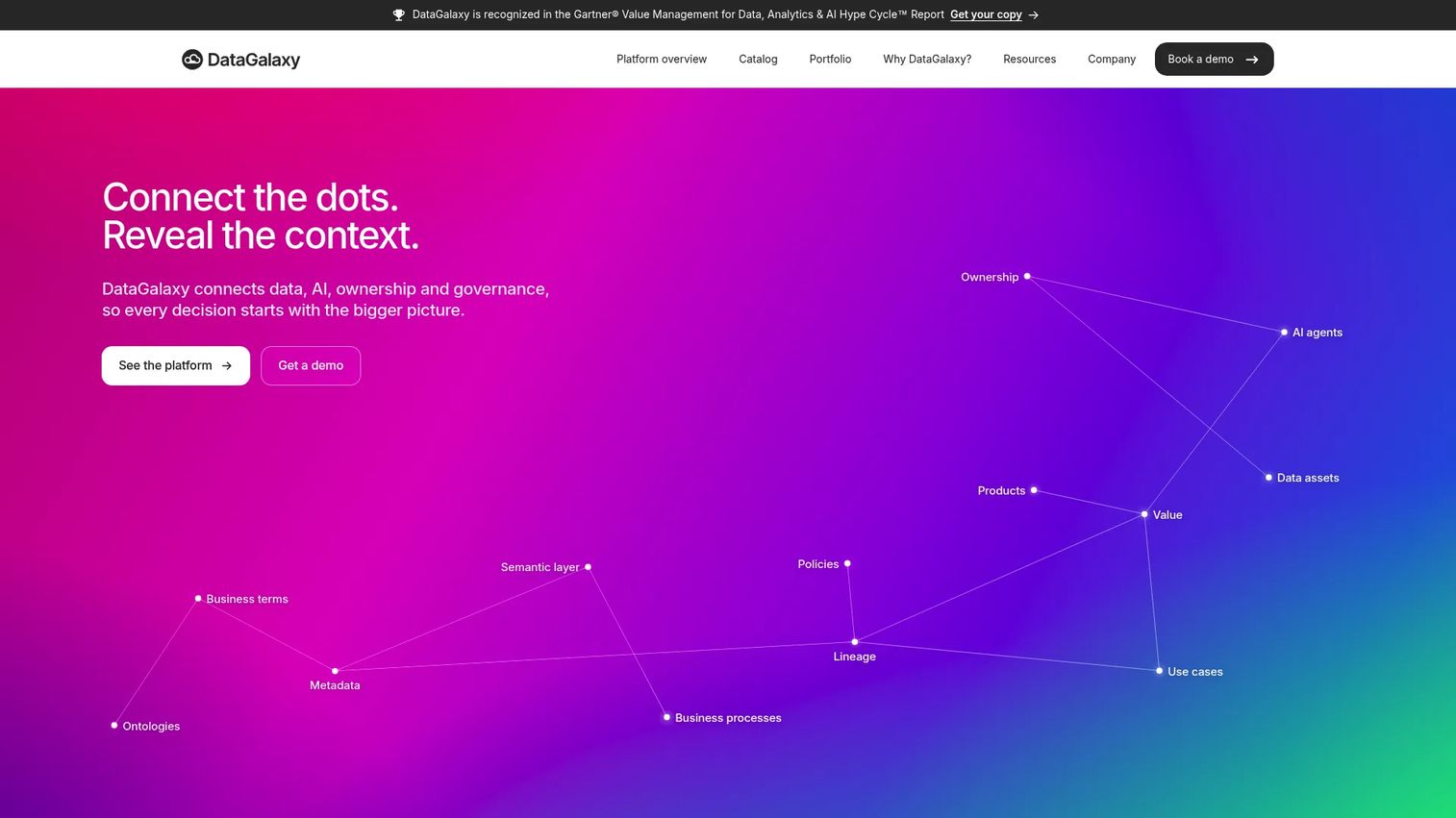
DataGalaxy Value Governance Platform is a governance-focused metadata platform that organizes data work around business value, not just technical documentation. It combines a business glossary, data catalog, ownership workflows, lineage visualization, and collaborative governance in one place. The platform also covers data and AI initiative portfolio management, so governance connects to strategic delivery.
Best for: Organizations that need business users involved in glossary ownership, governance collaboration, and value tracking for data and AI programs.
Key features
- Unified business glossary and data catalog
- End-to-end lineage visualization
- Collaborative and policy-driven governance
- AI curation and compliance
- Data and AI initiative portfolio management
Why choose DataGalaxy Value Governance Platform: It fits companies where metadata work has to connect to business outcomes, not just technical cataloging. For PMs, the shared glossary and stakeholder ownership model reduces the drift between how engineering and business define the same metric.
DataGalaxy Value Governance Platform pricing: The official pricing page directs visitors to schedule a demo. Buyers should confirm modules, seat count, and governance scope directly with the team.
G2 rating: 4.8/5
4. ALEX
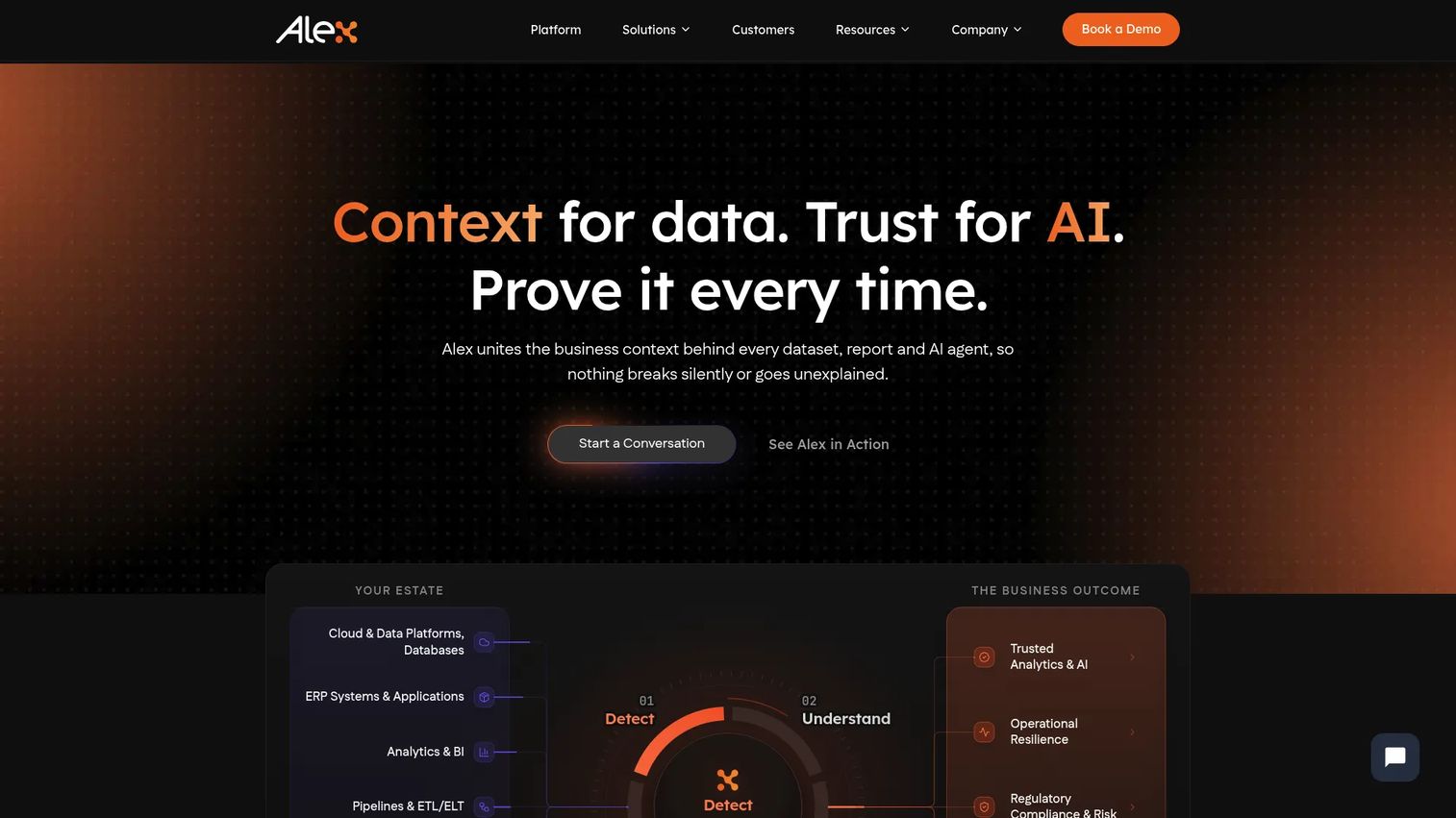
ALEX is an enterprise metadata management platform built around governed context: It connects metadata, business definitions, policy, lineage, and AI readiness across heterogeneous data environments. The platform covers metadata ingestion from prebuilt connectors, event-based scanning, profiling, tagging, and APIs, alongside a data catalog, business glossary, ontology, policy management, and data quality observability. An MCP server exposes governed context to AI agents.
Best for: Large or complex enterprises seeking governed metadata, lineage, compliance, and AI readiness across multi-system environments.
Key features
- Metadata ingestion with prebuilt connectors and event-based scanning
- Data catalog, business glossary, and ontology management
- End-to-end lineage and dependency mapping
- Impact analysis and policy enforcement
- Data marketplace, APIs, and MCP server for AI context
Why choose ALEX: The unlimited-user subscription model removes the seat-count friction that slows adoption in large organizations. For product teams that need governed context available to AI tools alongside human analysts, the MCP server integration makes ALEX practical beyond the catalog itself.
ALEX pricing: ALEX uses a single platform subscription with unlimited users and no separate connector licensing. Business Journeys are subscribed separately; implementation is agreed through a statement of work. Buyers contact sales for pricing.
G2 rating: 4.9/5
5. Atlan
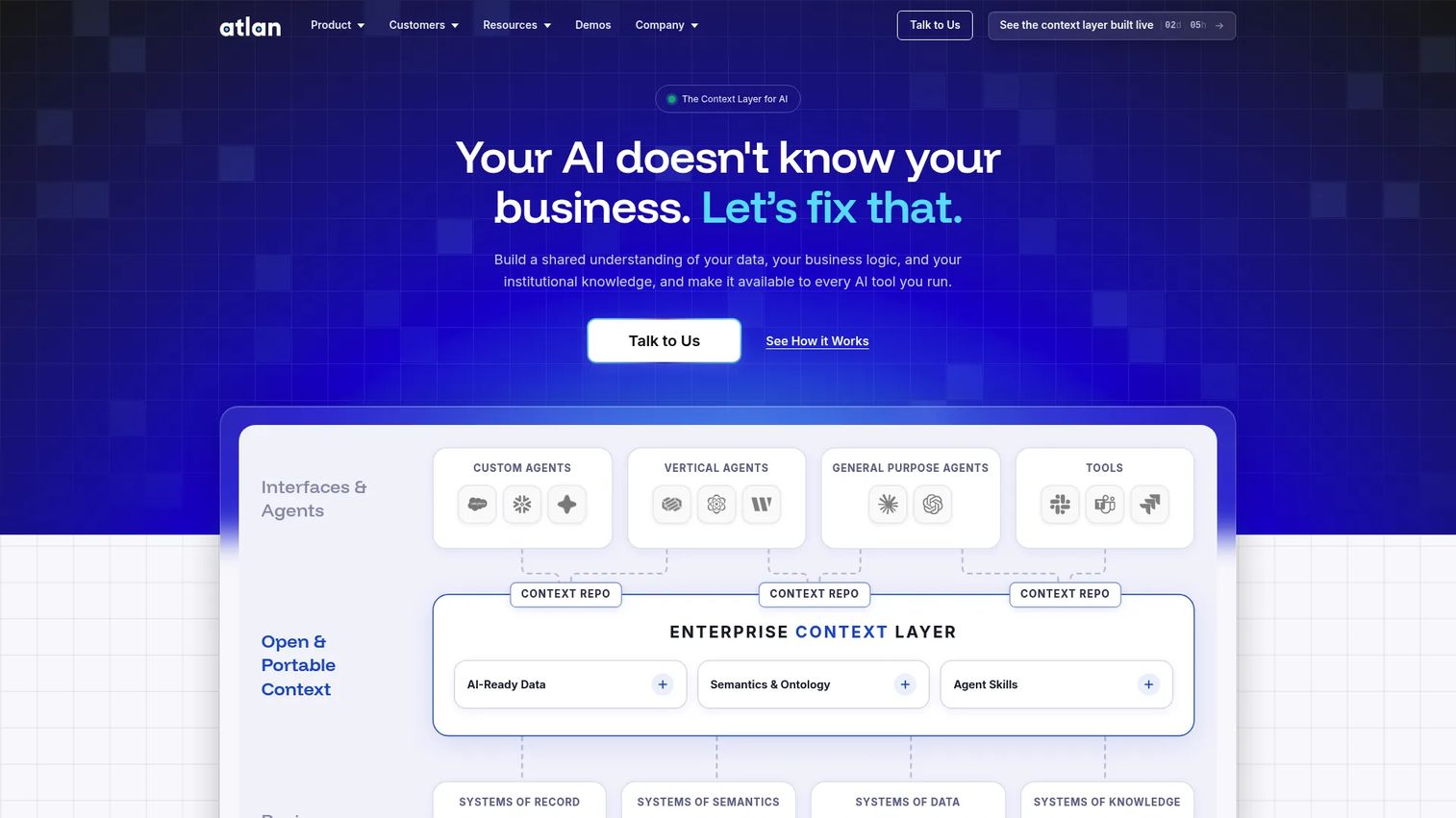
Atlan describes itself as an enterprise context layer and agentic data catalog. The core idea is that metadata should live inside the tools where data work happens, not locked in a separate portal. Atlan connects to data stacks through native integrations, captures lineage automatically, and provides AI-powered context agents that enrich metadata across the catalog.
Best for: Modern data teams that need collaborative cataloging, active lineage, and metadata that surfaces inside existing analytics workflows.
Key features
- Enterprise data graph and metadata catalog
- Data discovery and conversational search
- Data lineage and governance workflows
- AI-powered context agents for metadata enrichment
- Context Lakehouse with MCP, SQL, REST, and Graph API access
Why choose Atlan: The collaboration layer works well when data, analytics, product, and engineering teams need shared context rather than a tool owned by a single governance function. The workflow integrations reduce the gap between where metadata lives and where decisions get made.
Atlan pricing: Pricing is customized by edition, cataloged assets, seats, and optional add-ons. Buyers contact sales for a quote and confirm connector and enterprise security costs.
G2 rating: 4.5/5
6. Ab Initio
Ab Initio is an enterprise data platform for building, deploying, and managing scalable data processing, integration, governance, and automation applications. Metadata management sits inside a broader data engineering environment rather than as a standalone catalog. Its graphical development approach and rules-based processing tools make it suited for organizations where metadata connects tightly to operational data pipelines.
Best for: Enterprises with complex data engineering environments that need metadata and governance connected to large-scale processing.
Key features
- Graphical data pipeline development
- Batch and real-time processing at scale
- Metadata management and governance
- Data quality, cataloging, and lineage
- Rules-based matching and entity profiling
Why choose Ab Initio: Ab Initio fits large organizations where the metadata problem is inseparable from the data engineering stack. Product managers in those environments encounter it most often when data dependencies are deep and pipeline changes carry downstream risk.
Ab Initio pricing: Ab Initio offers licensing options ranging from usage-based models to enterprise agreements. Buyers contact the company directly for details.
G2 rating: 4.3/5
7. ServiceNow Data Catalog
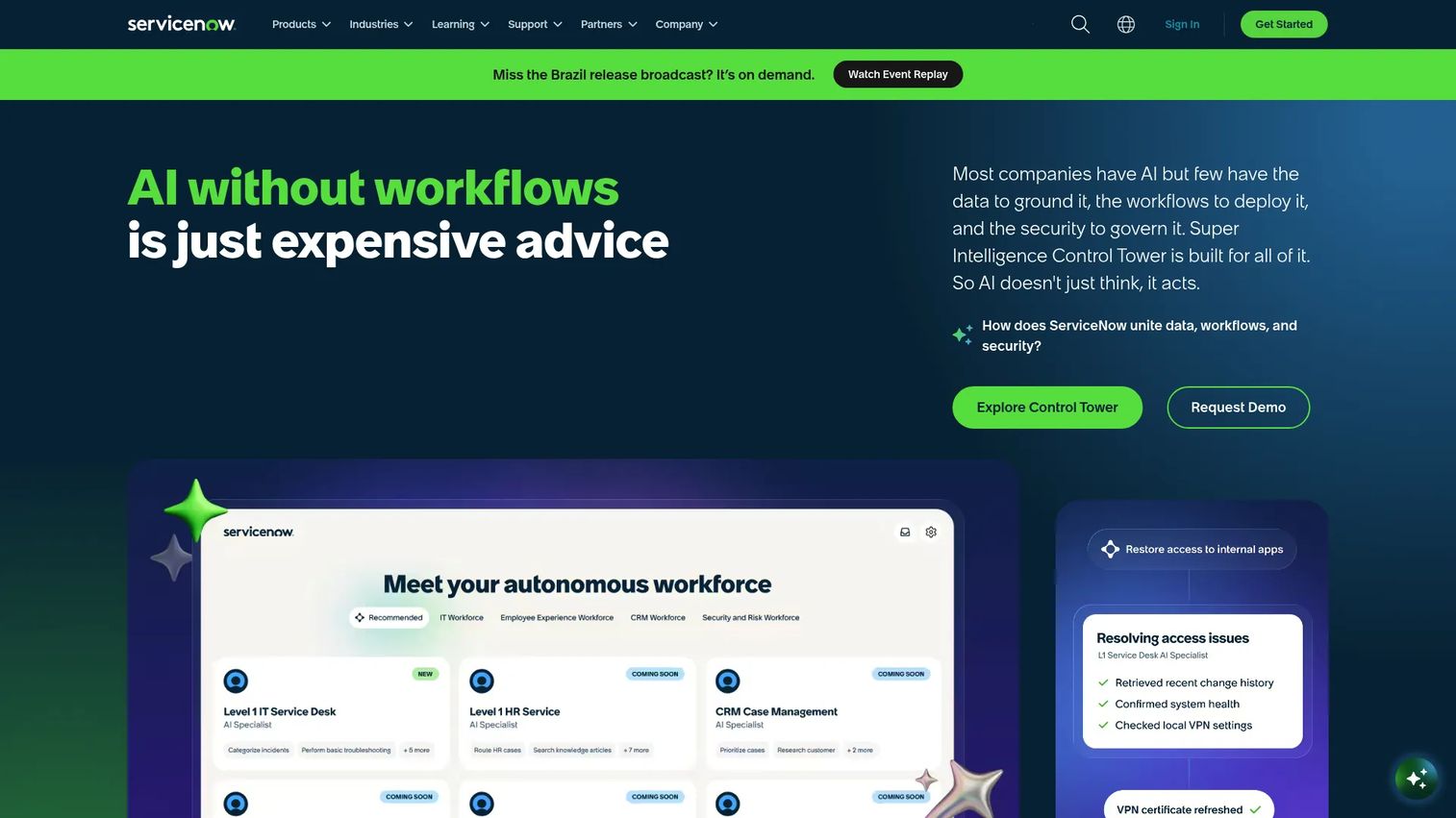
ServiceNow Data Catalog is an enterprise data catalog and governance platform built as part of the ServiceNow AI Platform and Workflow Data Fabric. Its differentiation is operational: Data catalog workflows connect directly to IT service management, risk governance, and enterprise process management. The platform includes AI-powered discovery, a knowledge graph for metadata relationships, an automated governance workflow engine, and a business glossary.
Best for: Enterprises already invested in ServiceNow that want data catalog workflows embedded inside existing operational and governance processes.
Key features
- AI-powered data discovery and search
- Knowledge graph with metadata relationships and lineage
- Automated data governance workflows
- Business glossary
- Data quality indicators and trust scores
Why choose ServiceNow Data Catalog: The fit is strongest when metadata governance needs to connect with IT, risk, and service management workflows that already run on ServiceNow. Organizations outside that ecosystem may find purpose-built catalog tools more practical.
ServiceNow Data Catalog pricing: ServiceNow Data Catalog is offered through the ServiceNow AI Platform. Buyers should confirm package, workflow, and platform requirements with ServiceNow directly.
8. Rocket Data Intelligence
Rocket Data Intelligence is a self-service data intelligence platform built for organizations managing metadata across hybrid, mainframe, and cloud environments. Its key strength is visibility into legacy systems that most modern catalog tools do not reach: Mainframe data, complex ETL pipelines, and inherited enterprise architectures.
Best for: Large enterprises with legacy data estates, mainframe environments, and active data modernization programs.
Key features
- End-to-end data lineage across hybrid environments
- Metadata-driven data discovery and mapping
- Impact analysis and auditability
- Governance context for legacy systems
- Support for mainframe and cloud data sources
Why choose Rocket Data Intelligence: Teams modernizing inherited data estates need visibility into where data originates, how it moves, and what depends on it. Product managers in large enterprise organizations benefit when downstream risk from infrastructure changes becomes traceable before a sprint ends.
Rocket Data Intelligence pricing: Buyers should confirm modules, data source coverage, and deployment scope.
G2 rating: 4.6/5
9. Collibra Platform
Collibra Platform is a mature enterprise data governance and catalog platform. It covers data governance, catalog, lineage, data quality, data privacy, AI governance, and a data marketplace across more than 100 native integrations. The platform is designed for organizations where governance is a formal program with stewardship roles, approval workflows, and policy accountability.
Best for: Large and regulated enterprises that need structured governance, stewardship workflows, and policy enforcement across complex data environments.
Key features
- Data governance workflows and policy management
- Business glossary and term stewardship
- Data catalog and lineage
- Data quality and observability
- Data privacy and AI governance
Why choose Collibra Platform: Collibra fits when metadata management ties directly to compliance, audit readiness, and business accountability. For product managers operating in regulated industries, the structured stewardship model reduces the gap between data policy and day-to-day data decisions.
Collibra Platform pricing: Collibra directs prospects to request a demo or contact sales. Buyers should confirm modules, user tiers, and implementation support requirements.
G2 rating: 4.2/5
10. Informatica Intelligent Data Management Cloud
Informatica Intelligent Data Management Cloud is a cloud-native platform combining data integration, data quality, data governance, catalog, lineage, master data management, and API integration. Its CLAIRE metadata intelligence engine uses AI to automate metadata enrichment, suggest governance actions, and surface data quality signals across the lifecycle.
Best for: Enterprises that want metadata management as part of a broader cloud data management program covering integration, quality, and governance.
Key features
- Data catalog, lineage, and governance workflows
- Data quality and observability
- Data integration and engineering pipelines
- Master data management and 360 applications
- AI-powered CLAIRE metadata intelligence
Why choose Informatica Intelligent Data Management Cloud: The platform makes sense when active metadata is one layer inside a wider data management investment. Product teams benefit when quality signals, metric definitions, and lineage connect across the full data lifecycle rather than sitting in separate tools.
Informatica Intelligent Data Management Cloud pricing: Pricing uses Informatica Processing Units (IPUs) in a consumption-based model. Buyers request a quote and confirm cloud services, modules, and support costs.
G2 rating: 4.2/5
11. Microsoft Purview Data Governance
Microsoft Purview Data Governance is a governance solution for discovering, curating, and managing the health of enterprise data across multicloud and Microsoft-native estates. It includes natural-language data discovery, data curation by business domain, built-in data quality management, and health reports that surface actionable insights. The platform sits inside the Microsoft security and compliance ecosystem.
Best for: Organizations already standardizing on Microsoft data infrastructure, Azure, or Microsoft 365 who need native governance without adding a separate vendor.
Key features
- Natural-language data discovery across the data estate
- Data curation using business concepts and governance domains
- Built-in data quality management
- Data health reports and actionable insights
- Microsoft ecosystem integration
Why choose Microsoft Purview Data Governance: The fit is strongest for teams whose data already lives in Azure, Microsoft Fabric, or Microsoft 365. For product managers in Microsoft-heavy organizations, governance context arrives closer to where data work already happens.
Microsoft Purview Data Governance pricing: Microsoft uses a pay-as-you-go model billing by governed assets and Data Governance Processing Units, requiring an Azure subscription. Buyers should confirm current capacity and consumption rates on the Azure pricing page, as Microsoft packaging changes regularly.
12. Oracle Enterprise Metadata Management
Oracle Enterprise Metadata Management is a metadata management platform for harvesting, cataloging, governing, and analyzing metadata across Oracle and third-party data technologies. Its metadata harvesting covers Oracle data management, integration, warehouse, and business intelligence products, alongside third-party sources. Data-flow lineage, impact analysis, semantic lineage, and business glossary capabilities round out the core set.
Best for: Enterprises with significant Oracle data infrastructure that need lineage and impact analysis across Oracle-centered estates.
Key features
- Metadata harvesting from Oracle and third-party technologies
- Data-flow lineage and impact analysis
- Metadata exploration, search, and model diagram visualization
- Model versioning and comparison
- Business glossary, semantic lineage, and annotations
Why choose Oracle Enterprise Metadata Management: The platform fits organizations where the data estate is primarily Oracle-based and lineage across Oracle products is a first-order requirement. Product managers benefit when change risk in Oracle-centered data environments needs to be traceable before decisions depend on it.
Oracle Enterprise Metadata Management pricing: Oracle sells through enterprise licensing; buyers should confirm current product status and commercial terms directly with Oracle before making a shortlisting decision.
G2 rating: 3.7/5
13. Dataedo
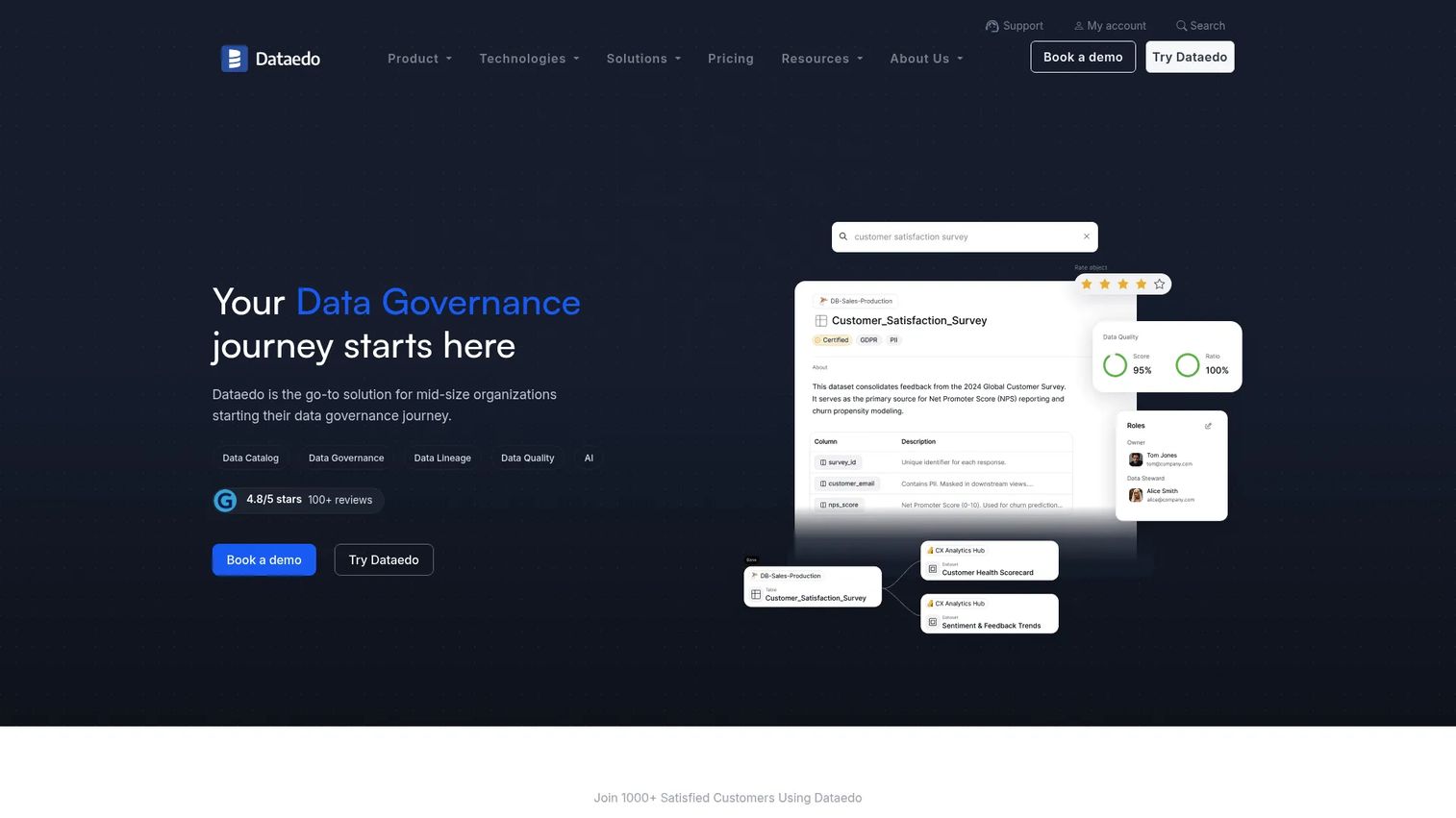
Dataedo is a data governance platform focused on practical database documentation and cataloging. It covers data catalog, lineage, data quality and profiling, business glossary, reference data management, and schema change tracking. The platform includes AI autodocumentation and publishes transparent annual pricing, which stands out in a category where most vendors require a sales conversation for any number.
Best for: Mid-sized data teams building a centralized catalog, lineage, and data quality program without enterprise-scale governance overhead.
Key features
- Data catalog and AI autodocumentation
- Data lineage and schema change tracking
- Data quality and profiling
- Business glossary and reference data
- ER diagrams and data dictionaries
Why choose Dataedo: Dataedo is the most accessible entry point in this list for product managers or analytics leads who need to understand tables, fields, and ownership without waiting on a data engineering queue. The transparent pricing makes the buying decision faster.
Dataedo pricing: Plans start at $18,000 per year (Essentials), with Data Lineage at $24,000 per year and Data Quality at $32,000 per year. All plans require a minimum of 3 editors; a 14-day free trial is available.
14. Solidatus
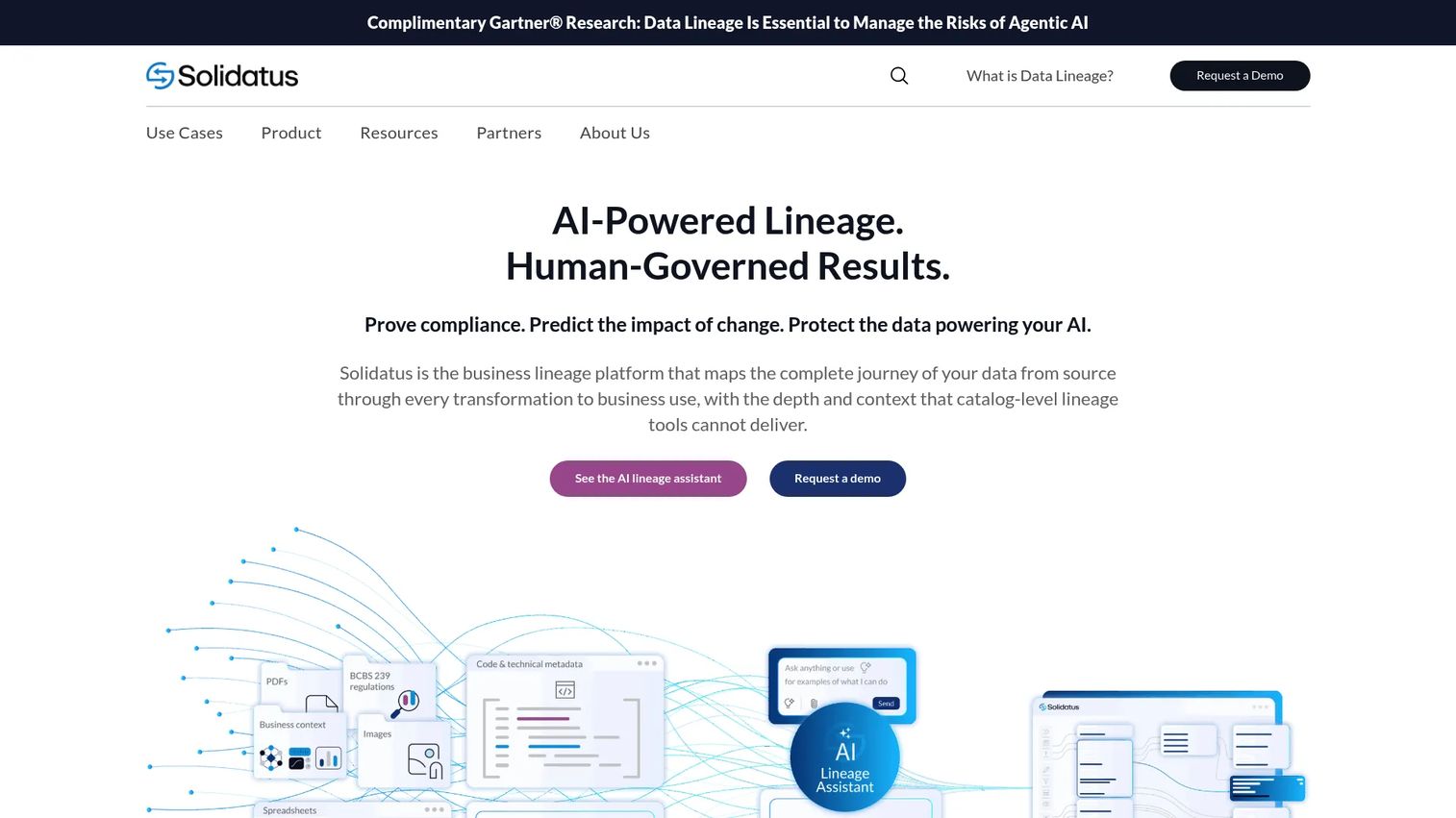
Solidatus is an AI-powered data lineage platform built for regulated enterprises. Its core strength is column-level lineage visualization combined with what-if impact analysis and bi-temporal version control. Teams can model how data moves, run scenario analysis before making changes, and maintain full audit trails for regulatory review.
Best for: Regulated enterprises and teams where lineage is a decision tool for change management, regulatory compliance, and impact analysis.
Key features
- End-to-end column-level data lineage visualization
- Rules-based impact analysis and what-if scenario modeling
- Bi-temporal version control and audit trails
- AI-assisted lineage mapping and metadata enrichment
- Business context, ownership, policy, and regulatory overlays
Why choose Solidatus: Solidatus fits teams where lineage is not a reporting feature but an active input to change decisions. For product managers managing events, schemas, or reporting layers that touch regulated data, the what-if modeling reduces the cost of a schema change that ripples unexpectedly.
Solidatus pricing: Solidatus directs buyers to contact sales. Confirm users, environments, lineage scope, and implementation support requirements before committing.
G2 rating: 4.2/5
15. Precisely Data360
Precisely Data360 is an enterprise data platform combining governance, cataloging, data quality, self-service data preparation, and analytics. The platform connects governance metadata directly to data quality monitoring, reconciliation, scoring, and dashboards, so teams can see whether a metric is safe to use before it drives a decision.
Best for: Enterprises connecting metadata governance to data quality programs where trust scores need to reach operational teams.
Key features
- Data catalog and metadata management
- Data quality monitoring, reconciliation, and scoring
- Self-service data preparation and integration
- Data governance workflows, business glossary, and lineage
- Statistical and predictive analytics
Why choose Precisely Data360: The governance-to-quality connection makes Precisely Data360 worth evaluating when the metadata problem is inseparable from data quality. Product managers who need to know whether a metric can be trusted before a roadmap review lands in the right spot with this platform.
Precisely Data360 pricing: Precisely directs buyers to request a demo. Confirm modules, governance scope, and services requirements before shortlisting.
G2 rating: 4.3/5
Considerations when choosing active metadata management software
Start with the workflow, not the catalog
Map where metadata should act before selecting a tool. Identify the BI tools, notebooks, incident workflows, governance approvals, and dashboards where your team makes decisions. A catalog that nobody opens will not change how data is trusted. Ask vendors to demonstrate how metadata surfaces inside tools already in use, not only inside their own interface.
Check lineage depth before buying
Lineage depth varies significantly. Table-level lineage shows which sources feed which outputs. Column-level lineage traces specific fields through transformations. Business-process lineage maps data to the workflows it supports. Ask vendors to show impact analysis on a real schema or event change from your environment, not a demo dataset.
Verify connector coverage
Metadata management fails when core systems are missing. List your data warehouses, lakes, BI platforms, reverse ETL tools, orchestration systems, and collaboration tools before comparing vendors. A platform with 100 connectors that skips your primary warehouse is not a fit.
Look at stewardship adoption
Governance requires owners, workflows, approvals, and reminders to function. Product managers should verify who maintains definitions once the catalog is live and how changes become visible to data consumers. A tool with strong features but no adoption path produces the same documentation rot as a spreadsheet.
Measure trust, not catalog volume
Avoid measuring success by assets indexed. Better signals include search success rate, certified metric usage, fewer repeated data questions, faster impact analysis turnaround, and reduced dashboard disputes. Build the measurement plan before purchase so the vendor's analytics support what you actually care about.
Conclusion
Active metadata management is most useful when metadata drives action: Routing ownership questions to the right person, alerting a team before a schema change breaks a report, surfacing why two dashboards disagree.
For enterprise teams with mature governance needs, Alation and Collibra Platform are the strongest starting points. data.world fits when semantic relationships between data assets matter as much as the assets themselves. Microsoft Purview Data Governance is the natural choice for organizations already committed to the Microsoft data ecosystem. Dataedo is the most practical option for mid-sized teams that need database documentation and clear pricing without an enterprise procurement cycle. Solidatus and Precisely Data360 are worth serious evaluation when lineage and data quality trust are first-order requirements.
Shortlist three to five tools based on stack fit, lineage depth, governance maturity, and adoption requirements. Run a proof of concept on a real use case from your environment, not a vendor-provided scenario.
For related reading on adjacent governance and analytics software, the AI governance tools guide and the best business intelligence software guide cover overlapping categories that often appear in the same evaluation.
FAQs
Active metadata management software collects, enriches, analyzes, and activates metadata across the data stack so teams can act on data context inside the tools where work happens. It goes beyond storage and documentation to include automated lineage, governance workflows, quality alerts, and usage signals that push relevant context to analysts, engineers, and product managers.
Passive metadata is documented and stored: It sits in a catalog and waits for someone to find it. Active metadata triggers actions based on what it knows. A lineage alert fires when an upstream table changes, a stewardship workflow routes when a definition needs an owner, or a search recommendation surfaces based on usage frequency. The practical difference is whether metadata changes decisions before or after something breaks.
Data governance teams, analytics engineers, data engineers, compliance officers, and business analysts are the primary users. Product managers use active metadata management to validate metric definitions, trace instrumentation changes, understand segment accuracy, and reduce dependency on data engineering for every data question. The tools are most valuable in organizations where multiple teams depend on shared data definitions.
A data catalog is often a component of active metadata management, but active metadata goes further. A catalog documents and organizes data assets. Active metadata uses that documentation to power recommendations, route governance workflows, fire quality alerts, and update lineage automatically. Many of the platforms in this list include a catalog as one layer of a broader active metadata program.
Enterprise governance buyers most commonly evaluate Alation, Collibra Platform, Informatica Intelligent Data Management Cloud, Microsoft Purview Data Governance, and Precisely Data360. The right choice depends on stewardship workflow depth, policy support, lineage capability, connector coverage, and whether the platform integrates with existing compliance and risk processes. Run a structured evaluation against those criteria rather than rating or brand recognition alone.
Product managers should prioritize tools that clarify metric definitions, expose ownership, trace instrumentation or schema changes, and reduce dependency on data engineering for routine data questions. Alation and Atlan fit teams with modern data stacks and collaborative workflows. data.world fits when semantic relationships between metrics matter. Dataedo fits smaller or earlier-stage teams that need practical database documentation fast. Microsoft Purview fits PMs already operating inside a Microsoft data estate.
Pricing varies by platform, data sources, connectors, users, governance modules, and deployment model. Most enterprise platforms including Alation, Collibra, Atlan, and Informatica use consumption-based or quote-only pricing and require a sales conversation. Dataedo is an exception, with published annual plans starting at $18,000. Always verify pricing on vendor pages before shortlisting; costs move frequently in this category.
Ask which systems the platform connects to and what the connector update cadence is. Ask what lineage depth is supported: Table, column, or business process. Ask how glossary approvals and stewardship workflows operate and who maintains definitions after launch. Ask whether metadata syncs bidirectionally with source systems or only harvests on schedule. Ask how stale assets, ownership gaps, and quality issues surface to data consumers, not just catalog administrators.