You booked the same 9am kayak slot twice. One guest shows up on the wrong day. A reseller sold three seats you already filled through your website. And the OTA calendar still says you have availability that no longer exists.
None of this is a scheduling problem. It's a systems problem. When bookings live in one place, availability in another, and supplier updates in a third, errors are not an accident. They are the default outcome of fragmented tools. The tour operator software market reflects how urgent this has become: it is projected to reach USD 1.33B by 2030 at a 10.3% CAGR, according to Research and Markets (2026).
For a growing operator, this maps to a familiar tension. You want a booking motion that runs without you personally reconciling calendars every night. That means one system that holds reservations, inventory, availability, supplier coordination, and reporting together instead of stitching five dashboards. The right tour booking software turns manual admin into a repeatable process. The wrong patchwork keeps every mistake routed back through you.
If you are evaluating adjacent operational categories at the same time, it helps to compare how other platforms handle scale. Guides on event management software and loyalty management tools cover overlapping concerns around bookings, guest data, and repeat demand. And any operator serious about growth eventually leans on analytics platforms to read what's actually driving revenue.
This guide ranks 10 platforms by how they handle the operational core: reservations, inventory, supplier connectivity, channel distribution, payments, and reporting.
What's inside
This is a shortlist of 10 tour operator software platforms for teams that need control over bookings, reservations, inventory, and distribution in one place. It's written for operators past the spreadsheet stage who want a system that scales without adding chaos.
We selected and ranked platforms on five criteria that matter operationally:
- Booking and reservation management: how cleanly it handles day-to-day workflows
- Supplier connectivity and channel distribution: OTA, reseller, and marketplace reach without double booking
- Inventory and availability control: live syncing across every channel
- Payments and reporting: payment gateway support plus analytics and reporting depth
- Pricing transparency and operator fit: whether it suits small, mid-size, or enterprise operators
TL;DR
- Best for broad all-in-one distribution: Bókun pairs booking management with marketplace and channel reach.
- Best for reseller and B2B distribution: Rezdy is built around channel manager and agent networks.
- Best for direct booking flow: FareHarbor focuses on conversion and operational management.
- Best for flexible reservation workflows: Checkfront handles inventory and availability across activity types.
- Best for online conversion and marketing: Xola aligns booking engine and marketing automation.
- Best for omnichannel and POS: TrekkSoft and Ventrata suit multi-channel and attractions-heavy operations.
- Best for lean teams: Rezgo and Bookeo keep booking workflows simple and low-overhead.
What is tour operator software?
Tour operator software is a platform that centralizes bookings, reservations, availability, inventory, supplier coordination, distribution, payments, and reporting for tour and activity businesses in one system.
The core job is to replace manual admin and disconnected calendars with a single source of truth. Instead of updating availability across your website, OTAs, and reseller agreements by hand, the software syncs it live. When a booking comes in from any channel, inventory updates everywhere at once, which is what prevents the overbooking that fragmented systems create.
Common related terms describe overlapping slices of the same category: tour booking software, tour reservation software, and broader travel booking software all point to the same operational core. A booking engine powers the online checkout on your site. A channel manager pushes availability out to distribution channels and pulls bookings back in without conflicts.
Core capabilities most operators should expect:
- Booking engine and reservation management: online and offline bookings in one calendar
- Inventory management and availability management: live syncing so no channel oversells
- Channel manager and OTA distribution: connect to OTAs, resellers, and marketplaces
- Supplier connectivity: coordinate suppliers and shared inventory
- Payment gateway support: take deposits and full payments at checkout
- Analytics and reporting: revenue, occupancy, and channel performance
- Back office management: staff, manifests, waivers, and CRM integration
The strongest platforms treat these as one connected system, not separate modules you glue together. That's the difference between software that scales your operation and tooling that just moves the manual work somewhere else.
When to use tour operator software
Replace spreadsheets and manual booking admin
Spreadsheets work until they don't. Once you're running multiple daily departures, taking bookings from more than one source, and coordinating staff manually, every handoff is a chance to lose data. Centralized reservation management gives you one calendar, one guest record, and one place where availability is true. That's the point where an operator stops reconciling and starts operating.
Manage live availability across channels
The moment you sell through more than your own website, availability has to sync in real time. If a reseller books a seat and your OTA calendar doesn't know, you oversell. Live syncing through a channel manager keeps every distribution channel looking at the same inventory. Strong supplier connectivity extends this to shared inventory across partners, so a sale anywhere updates the count everywhere.
Scale sales across B2B, B2C, resellers, and marketplaces
Growth rarely comes from direct website bookings alone. It comes from adding channels: OTA distribution, reseller portals, affiliate tracking, and marketplace listings. The operators who scale cleanly are the ones whose software handles multi-channel sales without multiplying admin. When each new channel plugs into the same booking engine and inventory, you add revenue without adding reconciliation work.
Comparison table
The table below maps each platform to its primary intent, differentiation, pricing entry point, and G2 rating. Use it to shortlist two or three, then read the sections for operational fit.
| # | Product | Intent | Key differentiation | Pricing | G2 rating |
|---|---|---|---|---|---|
| 1 | Bókun | All-in-one booking and distribution | Marketplace and channel reach | From $49/mo + booking fee | 4.5/5 |
| 2 | Rezdy | B2B and reseller distribution | Channel manager and agent networks | From $49/mo + 3% per booking | 3.9/5 |
| 3 | FareHarbor | Direct booking and operations | Conversion-focused booking flow | From $499/mo | Not listed |
| 4 | Checkfront | Flexible reservation workflows | Inventory and availability control | Free plan; from $107/mo | 4.4/5 |
| 5 | Xola | Online conversion and marketing | Booking engine plus marketing tools | 2.39% + $0.30 per transaction | 4.5/5 |
| 6 | TrekkSoft | Omnichannel booking and POS | Booking, POS, and OTA distribution | From €49/mo | 4.4/5 |
| 7 | Rezgo | Lean, subscription-free booking | No monthly fee, per-booking model | 4.9% online booking fee | 4.5/5 |
| 8 | Bookeo | Simple booking workflows | Low-overhead scheduling | From $14.95/mo | 3.8/5 |
| 9 | Peek Pro | Booking plus operations automation | Dynamic pricing and mobile ops | From $26/agent/mo | 4.2/5 |
| 10 | Ventrata | Enterprise and attractions | POS, kiosks, and distribution | From $575/mo | 5.0/5 |
1. Bókun
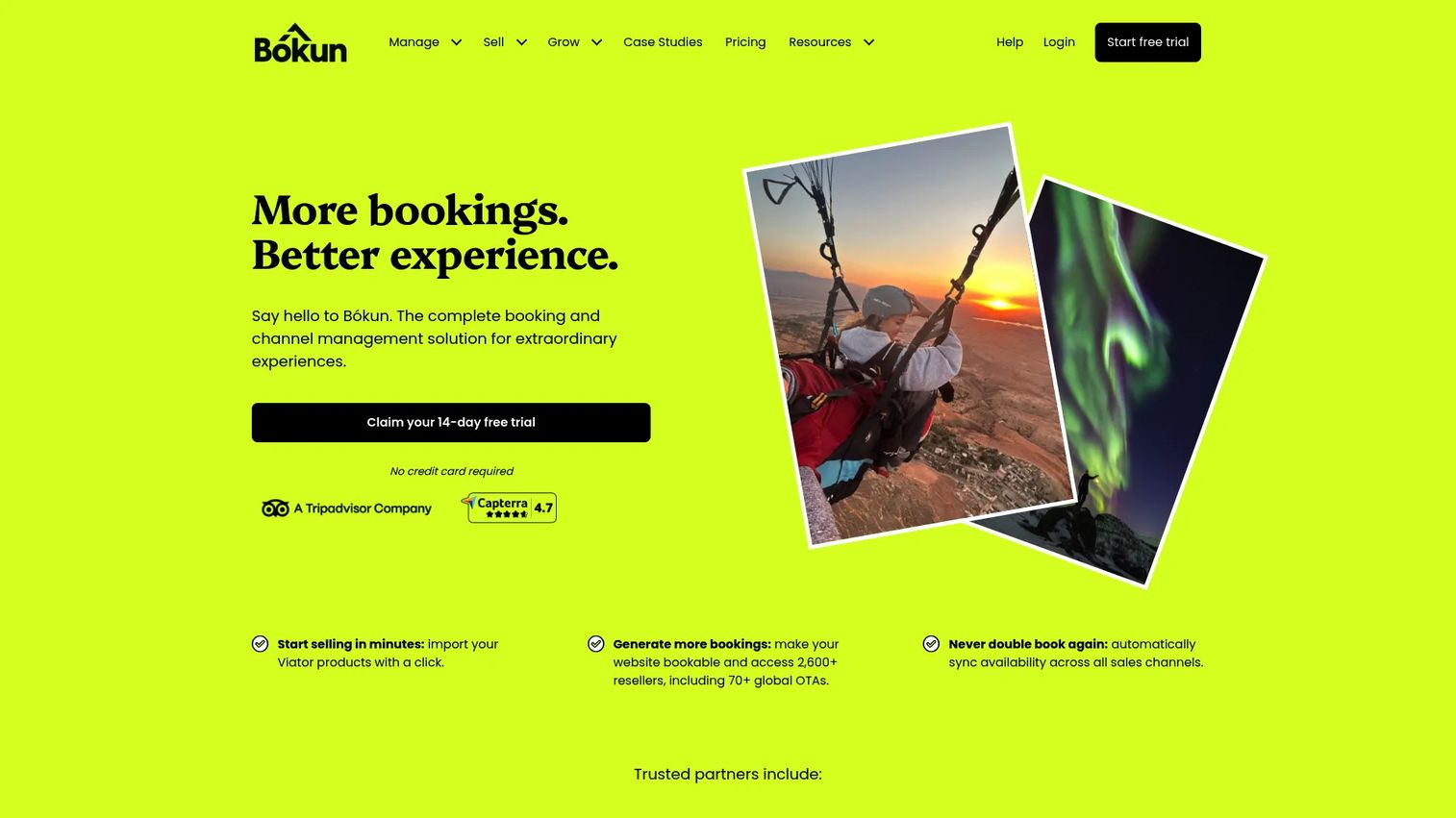
Bókun is booking and channel management software for tours, activities, and experience operators. It combines reservation management, a website booking widget, and marketplace access into one platform, and its Viator connection gives operators broad OTA distribution reach out of the box. For operators who want to grow distribution without wiring together separate tools, it's a strong all-in-one starting point.
Best for: Tour and activity operators who want booking, distribution, and operations management in a single platform.
Key strengths
- Booking management: Handle online and offline reservations from one calendar.
- Channel manager and marketplace access: Push availability to OTAs and connected marketplaces without double booking.
- Website builder and booking widgets: Launch a direct booking engine on your own site fast.
Why choose Bókun: The platform leans into distribution. If a meaningful share of your growth will come from OTAs, resellers, and marketplace exposure rather than direct traffic alone, Bókun's channel reach does the heavy lifting. It suits operators who want to expand where they sell without expanding how much they reconcile.
Bókun pricing: Bókun offers a 14-day free trial with no credit card required. Paid plans run from START at $49 per month with a 1.5% booking fee, to PLUS at $149 per month with a 1.25% fee, up to PREMIUM at $499 per month with a 1% fee. Viator and offline bookings are not charged fees on paid plans.
2. Rezdy
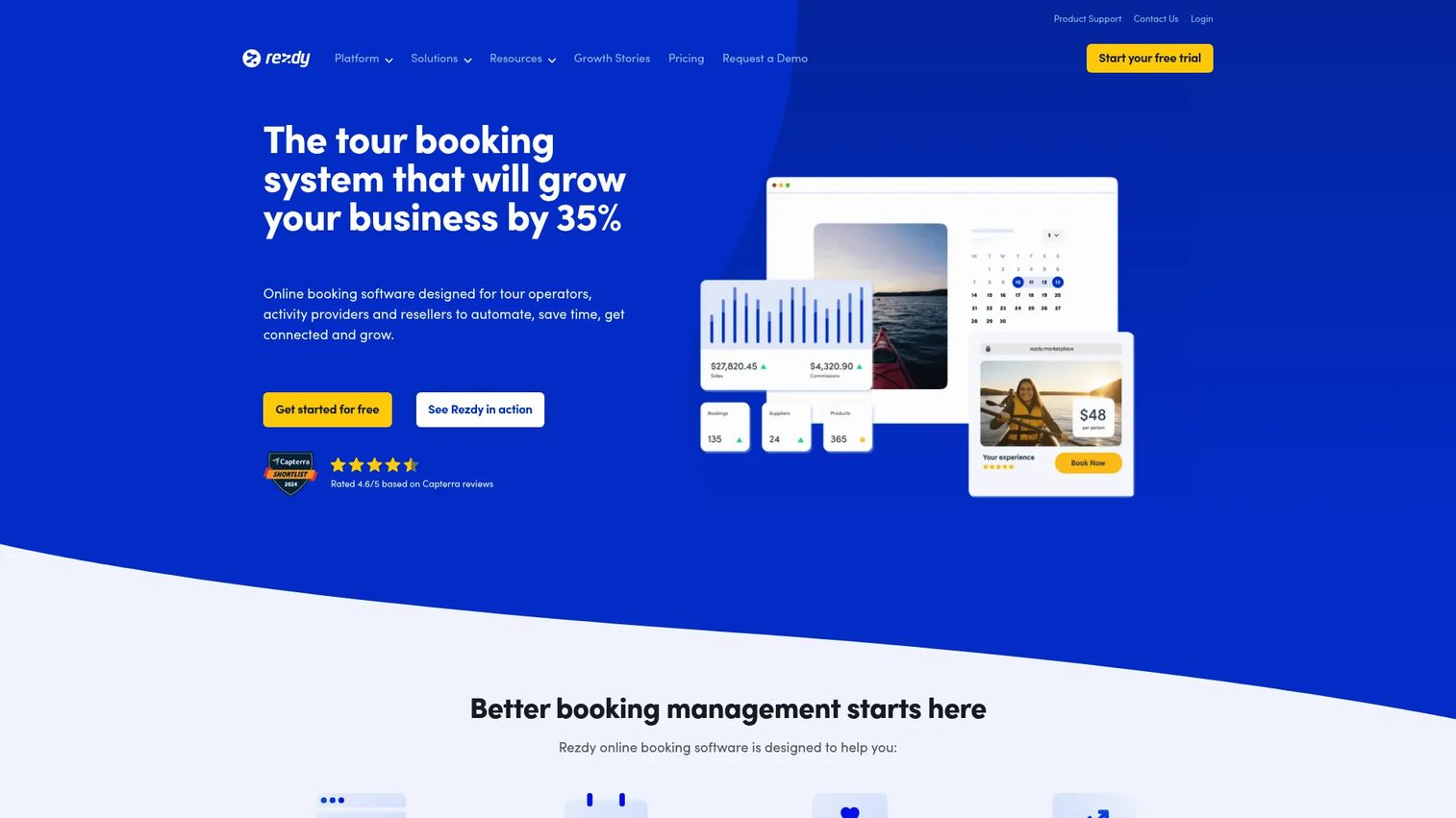
Rezdy is a B2B booking and distribution platform for tours, activities, and attractions. Its strength is the channel manager and reseller network: Rezdy is built to help operators sell through agents, resellers, and OTAs at scale while keeping availability in sync. Payment processing, reporting tools, and integrations round out the day-to-day workflow.
Best for: Operators that need clean booking software plus serious reseller and channel distribution.
Key strengths
- Online booking engine: Take direct bookings with real-time availability.
- Channel manager and reseller distribution: Connect to a large agent network and manage OTA distribution centrally.
- Payment processing and reporting: Handle payments and read channel performance in one place.
Why choose Rezdy: If your growth model depends on distribution partners more than direct traffic, Rezdy's reseller focus is the differentiator. It's built for operators who treat agents and OTAs as a primary sales channel, not an afterthought, and want live syncing to prevent conflicts across all of them.
Rezdy pricing: Rezdy has three public plans, each with a 21-day free trial: Foundation at $49 per month, Accelerate at $99 per month, and Expansion at $249 per month. All plans add 3% per online booking, plus a separate fee for offline or agent bookings. Prices are exclusive of GST in Australia.
3. FareHarbor
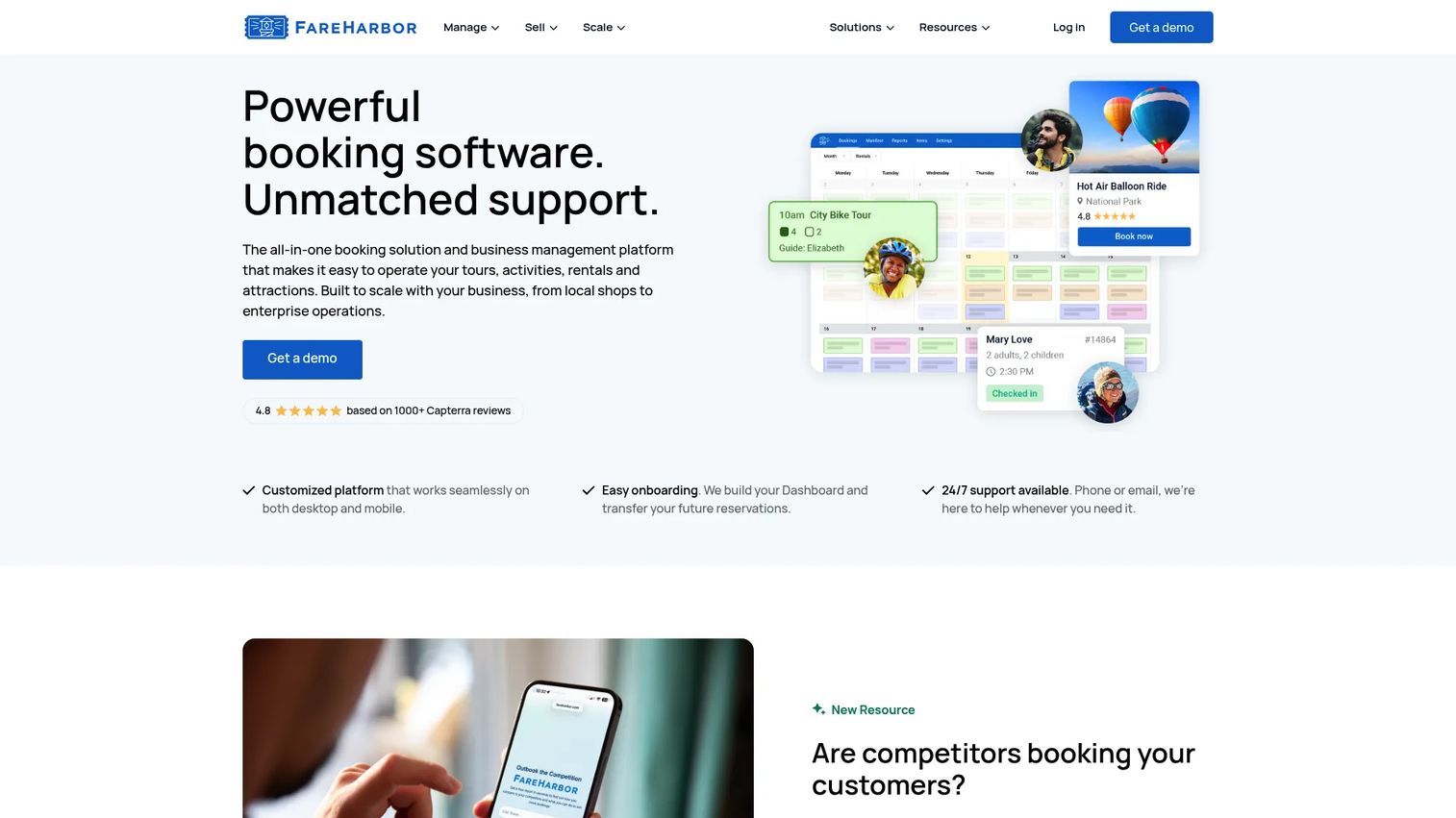
FareHarbor is booking and business management software for tour, activity, attraction, and rental operators. It focuses on a conversion-oriented direct booking flow paired with operational management: inventory, reporting, staff scheduling, and private events all live in the platform. The emphasis is on turning website traffic into completed bookings efficiently.
Best for: Tour and activity operators who want an all-in-one booking platform with a strong direct-booking experience.
Key strengths
- Online booking and payments: A checkout flow built to convert direct traffic.
- Inventory, reporting, and staff management: Run availability, manifests, and staffing from one system.
- Private events management: Handle group and custom bookings alongside standard departures.
Why choose FareHarbor: FareHarbor fits operators whose direct website is a core revenue driver and who want the booking experience optimized for conversion. The combination of booking flow and back office management in one place reduces the number of systems your team touches per booking.
FareHarbor pricing: FareHarbor's core booking software pricing is handled through direct conversation rather than a public price page. Its published website and SEO packages start at $499 per month or $5,000 per year for a Web Core first website, with additional SEO tiers available. Confirm booking-software terms directly with FareHarbor.
4. Checkfront
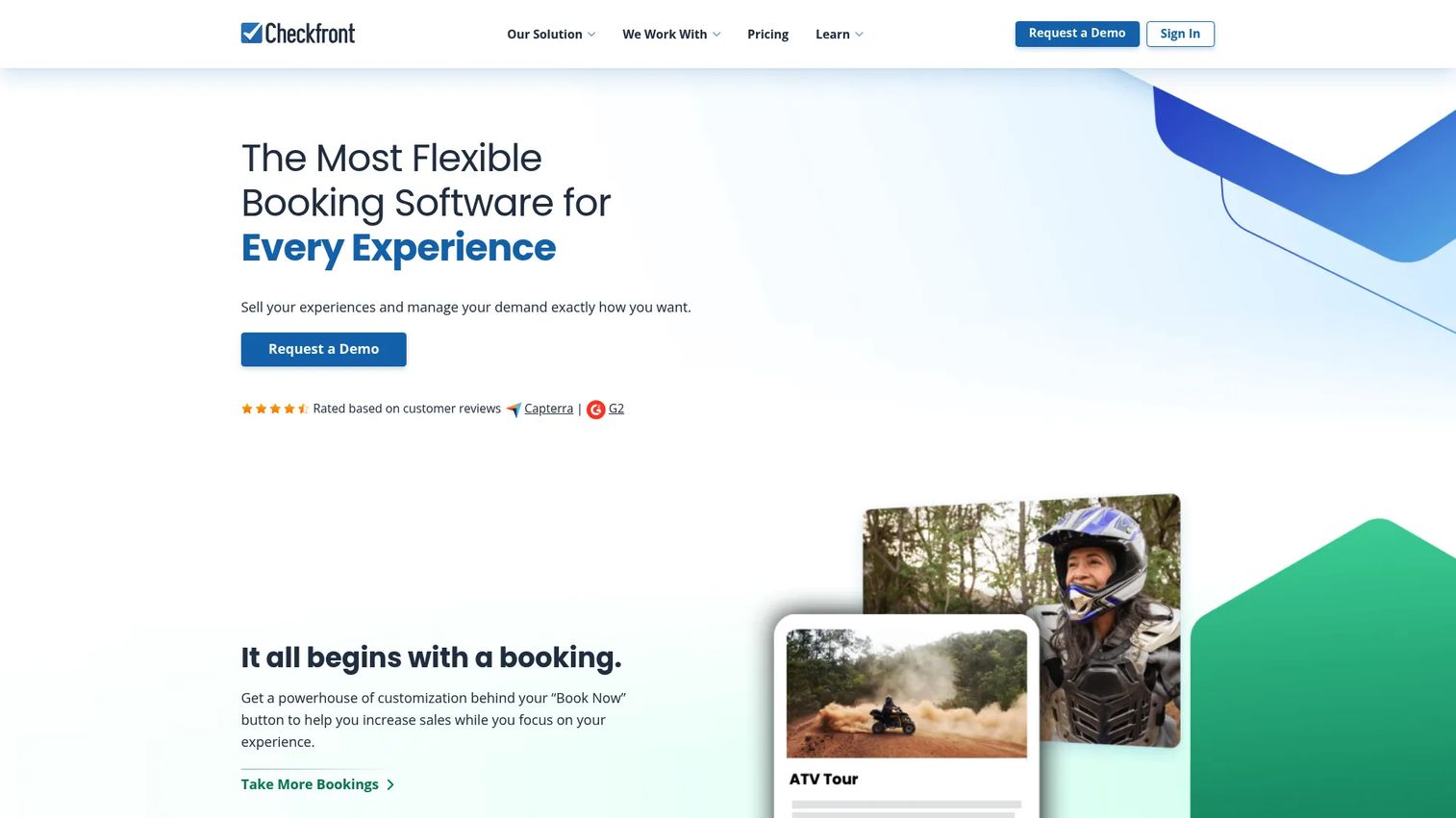
Checkfront is booking management software for tours, rentals, activities, and accommodations. Its strength is flexible reservation management: calendar and availability management, an online booking widget, waivers, notifications, and integrations that adapt to different activity types. Operators who run mixed inventory, from timed tours to multi-day rentals, get workflows that flex to match.
Best for: Tour, activity, rental, and accommodation businesses that need flexible online booking and scheduling.
Key strengths
- Online booking widget: Add a booking engine to your site with real-time availability.
- Calendar and availability management: Control inventory across varied booking types.
- Waivers, notifications, and integrations: Automate guest communication and connect your stack.
Why choose Checkfront: Checkfront suits operators whose inventory doesn't fit a single template. If you sell timed activities, equipment rentals, and accommodations from one business, its availability management adapts without forcing everything into the same mold. That flexibility is the operational win.
Checkfront pricing: Checkfront offers a free Starter plan. Paid plans include Growth at $107 per month billed annually, a Growth option on a 3.5% booking-fee model, and a Managed plan starting at $595 per month with custom terms. Monthly payment options are available.
5. Xola
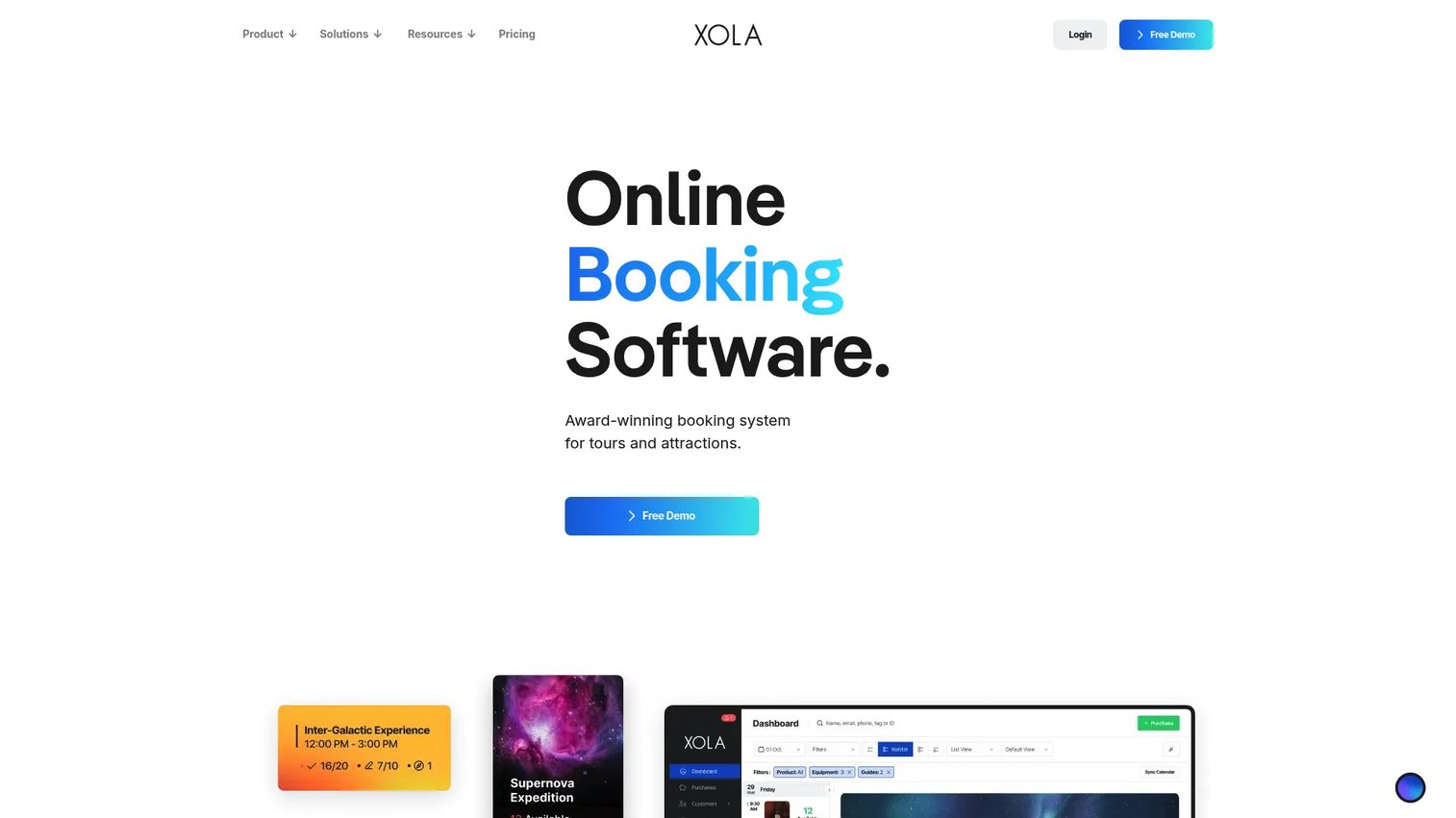
Xola is booking and marketing software for tours and attractions. What sets it apart is the tie between the booking engine and marketing: online booking, marketing automation, and point-of-sale and check-in tools work together so that acquisition and conversion stay aligned. For operators who think about bookings as a marketing funnel, that alignment matters.
Best for: Tour and activity businesses that prioritize online bookings and marketing alignment.
Key strengths
- Online booking: A conversion-focused booking engine for your website.
- Marketing automation: Connect booking behavior to follow-up and remarketing.
- Point-of-sale and check-in tools: Handle on-site sales and guest arrivals in one flow.
Why choose Xola: Xola fits operators who treat marketing and booking as one motion rather than separate jobs. If improving website conversion and running data-driven follow-up is central to your growth, the built-in marketing tools reduce the need for a separate layer bolted onto your booking system.
Xola pricing: Xola's public pricing lists a per-transaction partner fee of 2.39% plus $0.30, with no listed subscription tier. Full platform pricing is handled through a direct conversation, so contact Xola to confirm terms for your volume.
6. TrekkSoft
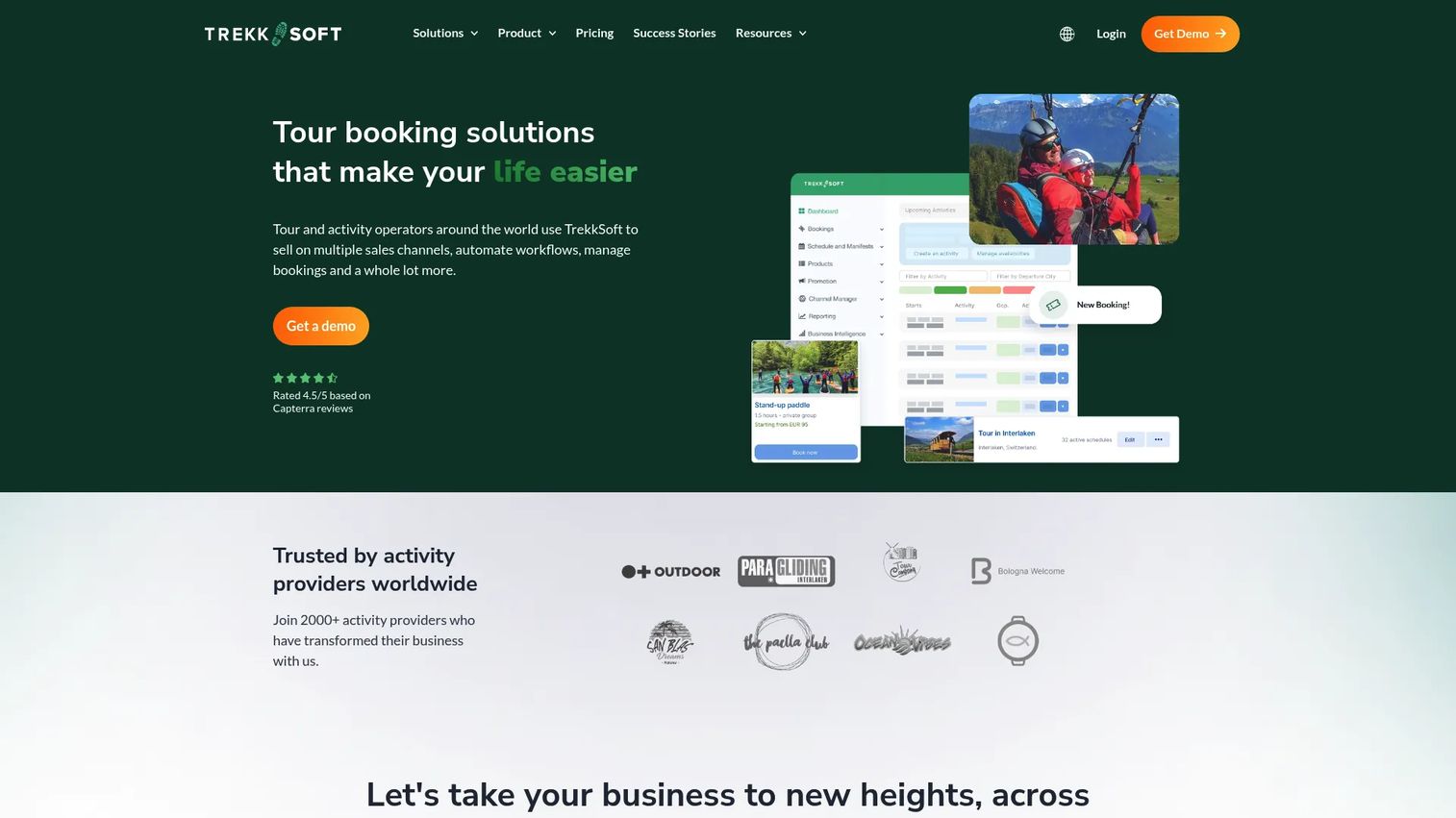
TrekkSoft is booking and management software for tour and activity operators with a strong omnichannel angle. It combines an online booking widget, booking management, POS and mPOS sales tools, OTA distribution, API connections, and payment gateway support. The result is a platform built for operators selling across web, on-site, and reseller channels at once.
Best for: Tour and activity operators coordinating sales across multiple channels who need booking, POS, and distribution together.
Key strengths
- Online booking widget and website integration: Take direct bookings from your own site.
- Booking management and POS tools: Run web and on-site sales through one system.
- OTA distribution and payment gateway support: Connect distribution channels and process payments natively.
Why choose TrekkSoft: TrekkSoft suits operators whose sales are genuinely omnichannel. If you're selling at a kiosk, on your website, and through OTAs in the same day, its combined POS and channel manager keep those channels working from shared inventory. That's what prevents the double-selling that omnichannel operations invite.
TrekkSoft pricing: TrekkSoft lists three plans, each with a 14-day free trial: Starter at €49 per month, Accelerate at €149 per month, and Ultimate at €249 per month. Booking fees are disclosed during a demo call, so confirm those terms before committing.
7. Rezgo
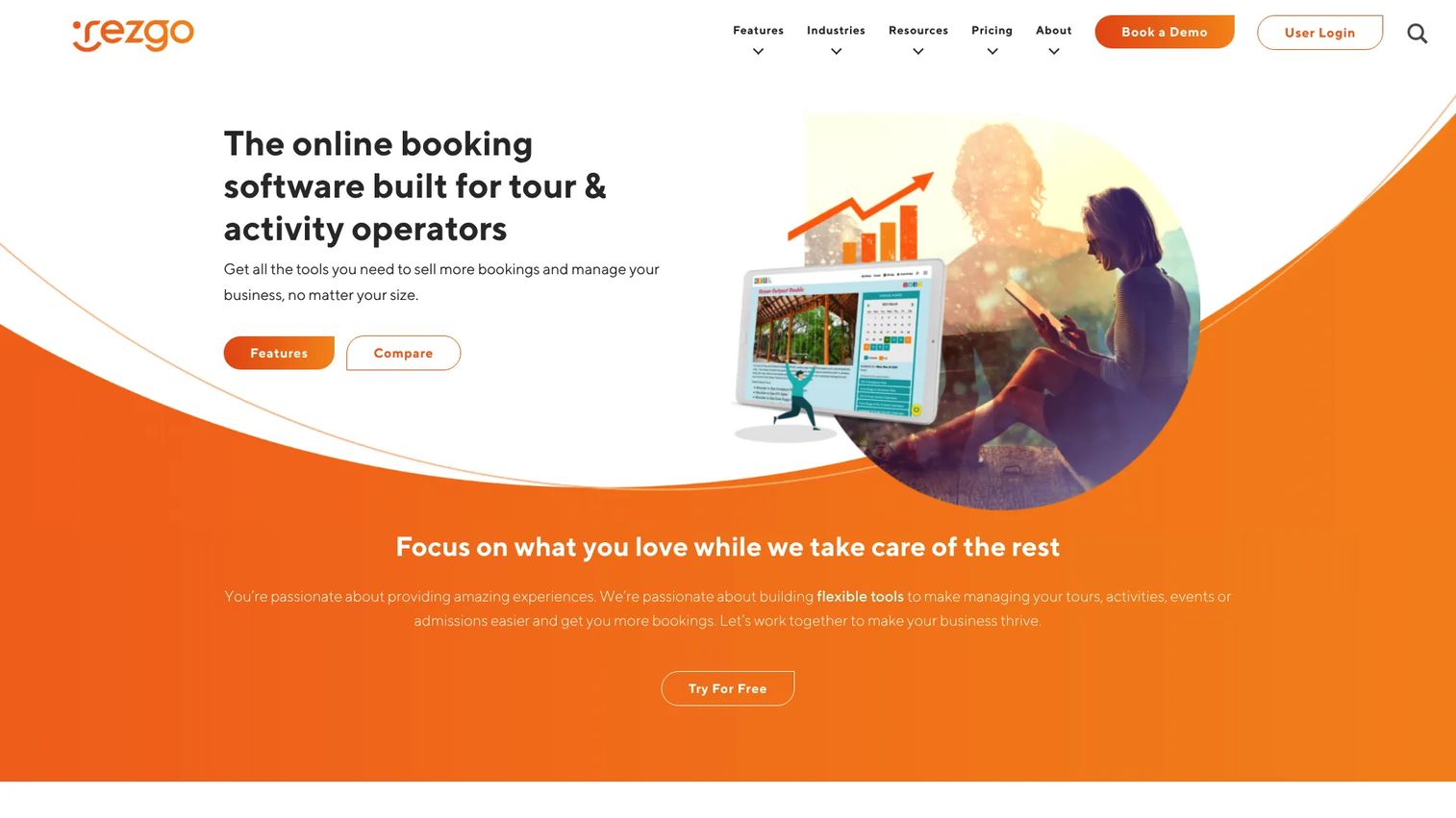
Rezgo is booking software for tour and activity operators built around a subscription-free model. Instead of a monthly fee, it charges per booking, which keeps overhead low for leaner teams. Online bookings, inventory management, and OTA and reseller distribution are all included, so smaller operators get real distribution without a heavy fixed cost.
Best for: Tour and activity operators who want subscription-free booking management with distribution built in.
Key strengths
- Online bookings everywhere: Take reservations across web and connected channels.
- Inventory management: Keep availability accurate across every sales point.
- OTAs and reseller distribution: Reach distribution channels without a monthly platform fee.
Why choose Rezgo: Rezgo fits operators who want to keep fixed costs down and pay in proportion to booking volume. For a lean team early in its growth, the per-booking model aligns cost with revenue while still offering the OTA and reseller reach larger platforms provide.
Rezgo pricing: Rezgo's Pro plan has no monthly fee and charges a 4.9% online booking fee plus a 0.9% POS booking fee. A Custom plan offers tailored rates for high-volume businesses. Rezgo is free to try.
8. Bookeo
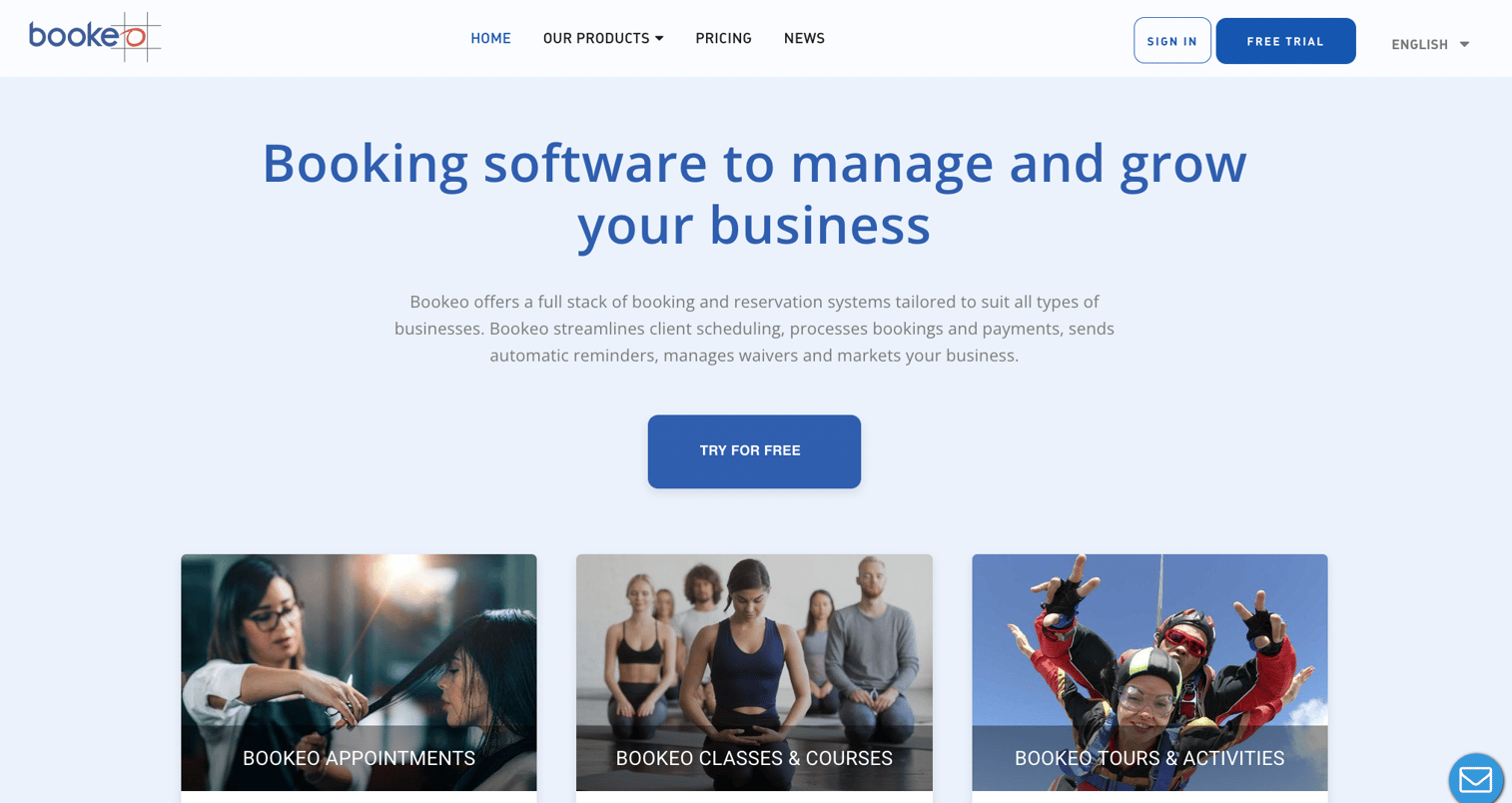
Bookeo is booking and reservation software for appointments, classes, and tours. It's built for straightforward booking workflows: online booking and scheduling, calendar sync and availability management, plus online payments, reminders, and marketing features. For operators who want a clean, low-friction setup, Bookeo gets a booking flow live quickly.
Best for: Operators that want simple, reliable online booking without heavy configuration.
Key strengths
- Online booking and scheduling: Accept reservations and manage the calendar in one view.
- Calendar sync and availability management: Keep availability accurate across bookings.
- Online payments, reminders, and marketing: Take deposits and reduce no-shows automatically.
Why choose Bookeo: Bookeo fits operators who want booking workflows that just work without a long implementation. If your operation is more about reliable scheduling than complex multi-channel distribution, its transparent per-plan pricing and quick setup make it an easy entry point.
Bookeo pricing: Bookeo lists monthly plans by product line, starting at Solo for $14.95 per month, then Small at $29.95, Standard at $39.95, Large at $79.95, and X-large at $119.95. A 30-day free trial is available with no credit card required. Add-ons include digital waivers and SMS credits.
9. Peek Pro
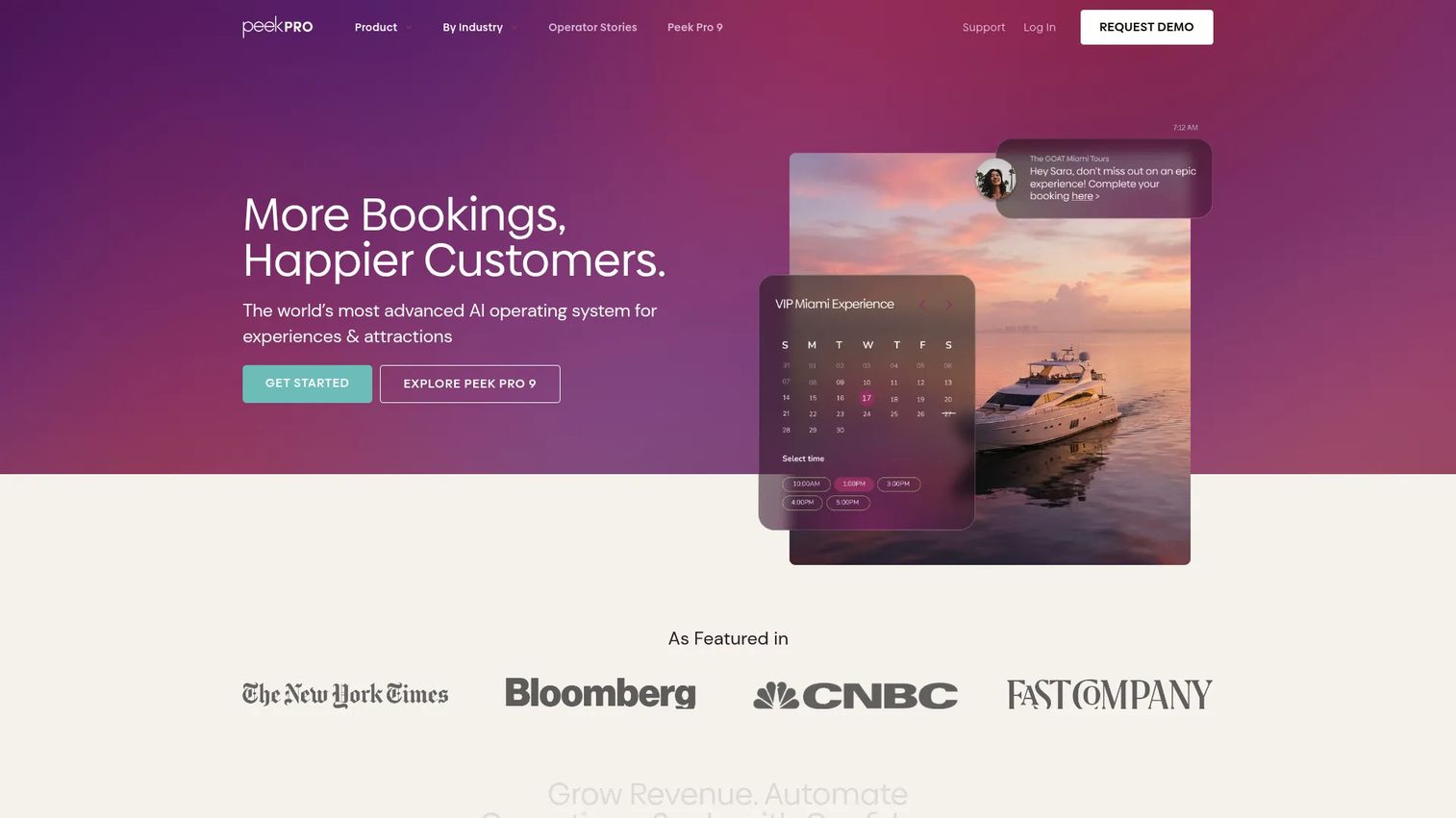
Peek Pro is booking and operations software for tour and activity operators. It pairs a mobile-friendly booking flow with operations automation: dynamic pricing, abandoned booking recovery, POS, guest messaging, and mobile operations tools. The angle is commercial as much as operational, focused on capturing more revenue from the same traffic.
Best for: Tour, rental, and attraction operators who want booking plus revenue-focused operations automation.
Key strengths
- Mobile-friendly booking flow: Convert bookings on any device.
- Dynamic pricing and abandoned booking recovery: Capture revenue that would otherwise leak.
- POS, guest messaging, and mobile ops: Run on-site operations from a phone or tablet.
Why choose Peek Pro: Peek Pro fits operators focused on squeezing more revenue from existing demand. Dynamic pricing and abandoned-booking recovery target the commercial edges most platforms leave alone, while the mobile operations tools keep field teams coordinated during live departures.
Peek Pro pricing: Peek Pro shows tiered per-agent monthly pricing, with plans reported at $26, $49, $99, and $215 per agent per month. No free tier is listed on the pricing page, so confirm which tier matches your team size and feature needs.
10. Ventrata
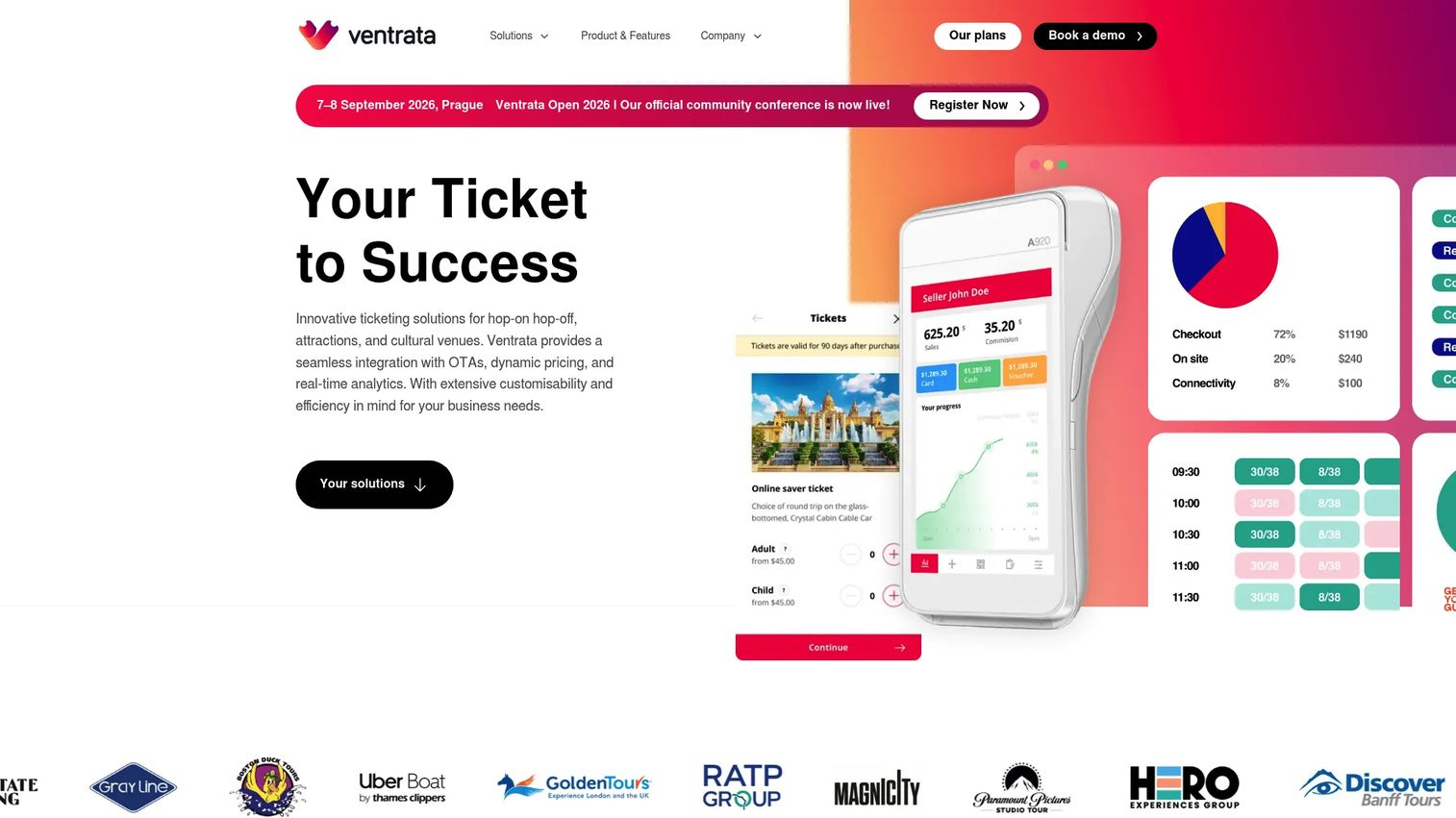
Ventrata is booking and ticketing software for larger tour operators and attractions. It's built for complexity: web checkout with real-time availability, POS options including handheld, desktop, and kiosk hardware, and API connectivity with OTA and operator integrations. For high-volume attractions with physical entry points, that hardware and distribution depth is the point.
Best for: Tour operators and attractions needing an all-in-one ticketing, POS, and distribution platform at scale.
Key strengths
- Web checkout with real-time availability: Sell online with live inventory.
- POS across handheld, desktop, and kiosk: Handle on-site ticketing at every entry point.
- API connectivity and OTA integrations: Connect distribution channels and partner systems.
Why choose Ventrata: Ventrata fits enterprise operators and attractions that manage turnstiles, kiosks, and multiple entry points alongside online sales. If your operation runs at a scale where physical POS hardware and deep OTA distribution both matter, Ventrata is built for that level of complexity.
Ventrata pricing: Ventrata lists three plans: Standard at $575 per month, Premium at $2,300 per month, and Elite at $5,750 per month. All prices are in USD and include additional transaction fees. Confirm the fee structure for your booking volume before committing.
Considerations before you choose
Feature lists blur together. What separates a platform that scales your operation from one that just relocates the manual work is how it handles a few specific things. Run each shortlisted tool against these.
Distribution and channel reach
Map where your growth actually comes from. If OTAs, resellers, and marketplaces drive a meaningful share, prioritize a channel manager and OTA distribution depth over a slick direct-booking widget. The right answer depends on your model, not the vendor's marketing.
Inventory and availability syncing
Ask exactly how live syncing works across channels. The whole point is preventing overbooking, so confirm that a sale anywhere updates inventory everywhere in real time. Weak availability management is where multi-channel operators get burned.
Payments and back office fit
Check payment gateway support against how you actually take money: deposits, full payments, on-site POS. Then look at back office management, manifests, waivers, staff scheduling, and CRM integration, so the system covers the whole booking lifecycle, not just checkout.
Reporting and total cost
Strong analytics and reporting is what turns bookings into decisions about which channels and products to push. And read the full cost: monthly fee plus per-booking percentages plus implementation. A low headline price with high transaction fees can cost more than a flat subscription at volume.
Conclusion
The right pick comes down to your operating model, not a feature count. For broad distribution across OTAs and marketplaces, Bókun and Rezdy lead. For a conversion-focused direct booking experience, FareHarbor and Xola fit best. For flexible reservation workflows across mixed inventory, Checkfront adapts. For omnichannel operations with POS, TrekkSoft and Ventrata cover web, on-site, and reseller sales, with Ventrata built for enterprise-scale attractions. And for lean teams that want low overhead, Rezgo and Bookeo keep booking simple.
Start by mapping where your bookings come from and where you want them to come from next. Then shortlist two or three platforms whose distribution, inventory syncing, and reporting match that model, and run a trial on each. The goal is a system that holds reservations, availability, and channels together so growth stops routing every mistake back through you.
Start your journey with Guideflow today!
FAQs
Prioritize the operational core: booking and reservation management, inventory and live availability, supplier syncing, payment gateway support, and analytics and reporting. These are what replace manual admin and prevent overbooking. Distribution and channel management matter more as you add sales channels beyond your own website.
Booking is one part of it. Pure tour booking software handles the checkout and calendar, while full tour operator software adds inventory management, OTA and reseller distribution, supplier connectivity, and back office management. If you sell through multiple channels or coordinate suppliers, you need the broader operator platform, not just a booking widget.
Start with ease of setup, calendar and availability management, payment handling, and simple booking workflows. Platforms like Bookeo and Rezgo keep overhead low and get a booking flow live quickly. You can add distribution depth later as you grow into more channels.
Focus on channel management, supplier connectivity, multi-location and multi-channel operations, deep reporting, and automation. Platforms like Ventrata and TrekkSoft handle POS hardware and OTA distribution at scale. The priority shifts from getting bookings live to coordinating high volume across many channels without conflicts.
A channel manager distributes your availability to OTAs, resellers, affiliates, and your direct site, then pulls bookings back into one calendar. Because inventory syncs live, a sale on any channel updates the count everywhere, which is what prevents double booking. It's how operators scale multi-channel sales without multiplying reconciliation work.
Most do. Payment gateway support lets you take deposits and full payments at checkout, while CRM integration keeps guest data connected to your marketing and follow-up. Together they matter for revenue operations: clean payment handling plus unified customer records make repeat bookings and reporting far easier.
Look past the headline number. Some platforms charge a flat monthly subscription, others a per-booking percentage, and many combine both. Factor in transaction fees, seat-based costs, and implementation. At high volume, a per-booking model can cost more than a flat plan, so run your actual booking numbers against each pricing structure before deciding.