Every acquired clinic adds more than patients and staff. It adds another imaging history, another PACS contract, and another archive that must stay accessible for years. Multiply that across a health system growing through acquisition, and the imaging data problem compounds faster than the IT team can keep up.
This is precisely where vendor-neutral archive software earns its place. The global VNA market reached $2.9 billion in 2024, according to Grand View Research, and cloud-based deployments now account for nearly 46% of that market. Adoption grew 10% in 2024 alone, per the CHIME National Trends Report. Those numbers reflect a real shift: Health systems are moving archive decisions out of departmental PACS procurement and into enterprise infrastructure strategy.
The right VNA choice reduces vendor dependence, preserves data access during migrations, and builds a foundation for decades of retention. The wrong one recreates the lock-in you were trying to escape.
This guide gives you a shortlist of nine platforms, the vocabulary to evaluate them, and a practical checklist for the decision.
What's inside
This guide covers nine VNA and enterprise imaging platform options for 2026. Tools were selected based on four criteria:
- Interoperability depth: DICOM support, HL7 and EHR connectivity, image exchange standards
- Archive scope: Ability to manage multi-site, multi-specialty, and long-term retention requirements
- Migration fit: Tools, APIs, and migration services that reduce data portability risk
- Deployment flexibility: Cloud, hybrid, and on-premises options depending on the organization's operating model
All nine tools are enterprise-grade and require a vendor quote. G2 ratings are noted where available.
TL;DR
- Best for cloud-led imaging archive consolidation: Intelerad Cloud VNA, built for health systems centralizing imaging across sites and legacy environments
- Best for large health systems standardizing enterprise imaging: Agfa HealthCare Enterprise Imaging, with broad multi-specialty workflow coverage
- Best for interoperability and cross-system archive access: iConnect Enterprise Archive from Merative, focused on DICOM standards and cross-system connectivity
- Best for clinical content and archive independence: Hyland Acuo, purpose-built as a standalone VNA with usage-based pricing
- Best for modular enterprise imaging modernization: Mach7 Enterprise Imaging Platform, supporting phased deployment without replacing everything at once
- Buying warning: Choose your VNA based on a data inventory and migration plan, not a PACS contract renewal date. The archive decision shapes access for decades.
What is vendor-neutral archives software?
Vendor-neutral archives software, often called VNA software, stores, normalizes, manages, and retrieves medical images and related clinical content across multiple imaging systems without tying access to a single PACS vendor.
What a VNA stores
A VNA archive holds DICOM images and associated metadata from radiology, cardiology, pathology, and other imaging departments. Most platforms also support non-DICOM clinical content such as documents, video, audio, and wound care photographs. Historical imaging records from legacy PACS environments form a large share of initial migration volume. Long-term retention, often mandated for decades, is a primary design requirement.
How VNA software differs from PACS
Many buyers arrive at a VNA evaluation thinking they need to choose between PACS and VNA. Most health systems use both.
| Capability | PACS | Vendor-neutral archive |
|---|---|---|
| Primary role | Departmental imaging workflow and viewing | Enterprise archive, access, and lifecycle management |
| Vendor dependence | Often tied to one ecosystem | Built to support multiple systems |
| Scope | Commonly departmental | Cross-facility and enterprise-wide |
| Migration role | May require export during replacement | Designed to preserve data continuity |
| Standards focus | DICOM-centric workflow | DICOM, metadata normalization, broader interoperability |
A PACS manages the radiologist's workflow. A VNA manages the organization's imaging data. Organizations often retain PACS for diagnostic viewing and worklists while using the VNA as the enterprise archive layer.
Core capabilities to evaluate
- DICOM ingestion and normalization across specialties
- Connectivity with PACS, RIS, EHR, and HL7 workflows
- Metadata management and tag morphing
- Enterprise search and retrieval across sites
- Information lifecycle management with tiered storage
- Disaster recovery, backup architecture, and retention controls
- Access controls, audit logs, and regional hosting options
- Cloud, hybrid, or on-premises deployment
When to use vendor-neutral archive software
Consolidate imaging data after acquisitions
Mergers and multi-site growth create duplicate PACS contracts, fragmented archives, inconsistent patient identifiers, and overlapping retention obligations. A VNA acts as the consolidation layer, ingesting studies from multiple source systems and presenting a unified patient record. Evaluate ingestion tooling, patient identity reconciliation capabilities, and migration validation before committing.
Reduce dependence on a single PACS vendor
A VNA can preserve data access when a health system changes PACS vendors or modernizes its enterprise imaging program. Vendor neutrality must be validated through actual standards support, export terms, and contractual data-access rights. Ask vendors to demonstrate data portability using sample studies and metadata from your own environment.
Build an enterprise imaging layer across specialties
Radiology is rarely the only imaging department. Cardiology, pathology, point-of-care imaging, and wound care all generate data that must be retained and accessible. The VNA must support your current specialty mix and the imaging roadmap you expect to run over the next five to ten years.
Vendor-neutral archives software comparison
Platforms in this category vary significantly in emphasis. Some center on enterprise imaging workflow. Others prioritize archive interoperability, cloud deployment, or content management. Before shortlisting, clarify which problem you are solving first: Fragmented archives, PACS migration, specialty expansion, or a cloud transition.
No vendor in this category displays pricing. All nine require a direct sales conversation and a formal proposal. G2 ratings are not available for any of these platforms at this time, as most have zero reviews or are listed under parent company pages.
| # | Product | Best for | Key differentiator | Pricing | G2 rating |
|---|---|---|---|---|---|
| 1 | Intelerad Cloud VNA | Cloud-led archive consolidation | Cloud VNA with EHR integration and image lifecycle management | Contact sales | Not listed |
| 2 | Agfa HealthCare Enterprise Imaging | Large health systems, multi-specialty | Broad enterprise imaging platform with AI orchestration | Contact sales | Not listed |
| 3 | iConnect Enterprise Archive | Interoperability and cross-system access | DICOM and IHE standards-based archive and connectivity | Contact sales | Not listed |
| 4 | Philips HealthSuite Digital Platform | Cloud health data program integration | HL7/FHIR cloud platform connecting devices and data | Contact sales | Not listed |
| 5 | Hyland Acuo | Clinical content archive independence | Usage-based standalone VNA with multi-standard interoperability | Contact sales | Not listed |
| 6 | Mach7 Enterprise Imaging Platform | Modular, phased imaging modernization | Open vendor-neutral platform with zero proprietary storage format | Contact sales | Not listed |
| 7 | Sectra VNA | Centralized multimedia archive across departments | Storage-agnostic archive with non-DICOM and mobile capture support | Contact sales | Not listed |
| 8 | Synapse VNA | Enterprise archive and imaging ecosystem alignment | Patient-centric VNA for multi-site and multi-department consolidation | Contact sales | Not listed |
| 9 | VioArchive VNA | Focused DICOM archive and retrieval | Standards-based HL7 and DICOM archive for diagnostic imaging | Contact sales | Not listed |
Best 9 vendor-neutral archives software for 2026
1. Intelerad Cloud VNA

Intelerad Cloud VNA is a cloud-based vendor-neutral archive platform designed to centralize medical imaging across systems and provide secure, scalable access for clinicians and patients. The platform covers image lifecycle management and connects with major EHR systems including Epic MyChart, Cerner, and Athena Patient Portal.
Best for: Hospitals and health systems seeking a cloud-led archive strategy while preserving access across distributed imaging environments.
Key features
- Image lifecycle management across multi-site environments
- Image object change management
- Universal data access across connected systems
- EHR integration with Epic MyChart, Cerner, and Athena Patient Portal
- Role-based access controls with cloud-based security
Why choose Intelerad Cloud VNA: This platform fits organizations that want cloud-led archive operations rather than on-premises infrastructure investment. Before committing, confirm current data residency options, specialty coverage, and migration tooling availability for your source systems.
Intelerad Cloud VNA pricing: Intelerad directs prospective customers to contact sales for a proposal. Request a cost model that separates platform licensing, storage, EHR integration, and migration services.
2. Agfa HealthCare Enterprise Imaging
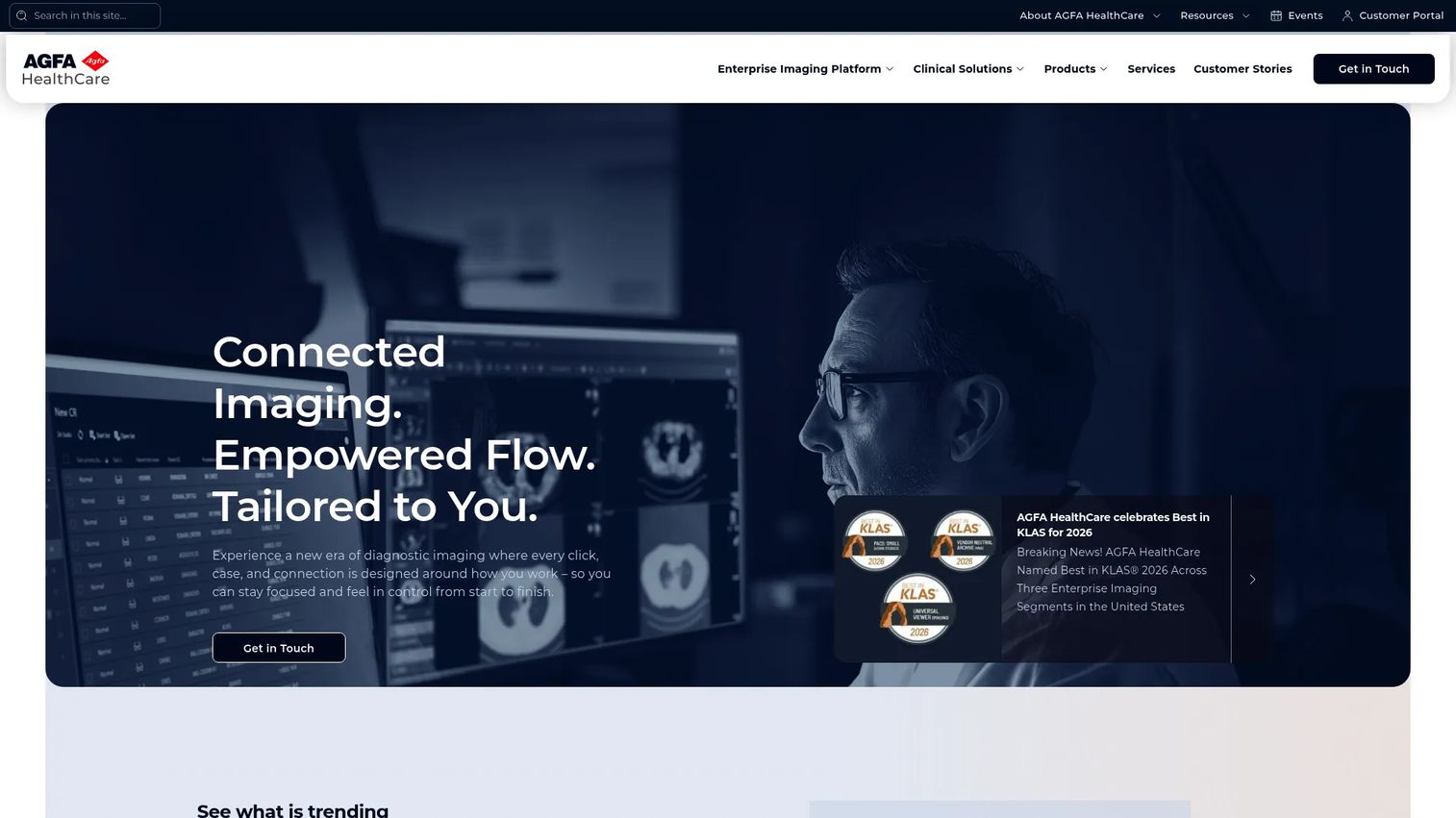
Agfa HealthCare Enterprise Imaging is a unified enterprise imaging platform that connects imaging specialties, orchestrates diagnostic workflows, and provides rapid access to patient imaging data. The platform includes a Vendor Neutral Archive, a Universal Viewer, the RUBEE Orchestrator for automated case assignment, and RUBEE AI for embedded clinical decision support. More than 1,000 healthcare sites rely on the platform, including over 170 VNA installations.
Best for: Large provider organizations that need enterprise imaging governance across multiple facilities and clinical specialties.
Key features
- Enterprise Vendor Neutral Archive with DICOM, HL7, FHIR, and FHIRcast interoperability
- RUBEE Orchestrator for automated case assignment and workload balancing
- Browser-based streaming access to diagnostic images
- Cloud, hybrid, and on-premises deployment options
- Structured reporting, hanging protocols, and advanced visualization
Why choose Agfa HealthCare Enterprise Imaging: Choose this platform when the decision is a strategic enterprise imaging program, not a narrow storage project. Buyers should clarify which archive functions are included versus which require additional workflow or viewing modules.
Agfa HealthCare Enterprise Imaging pricing: Pricing uses a tailored service model with subscription-based SaaS options. Contact Agfa HealthCare directly to get a proposal covering platform scope, site count, and implementation services.
3. iConnect Enterprise Archive
iConnect Enterprise Archive is part of Merative's Merge imaging portfolio, providing centralized enterprise-wide storage, management, and sharing of medical images. The platform supports vendor-neutral archiving across disparate storage systems, specialties, service lines, and multiple sites, using DICOM and IHE interoperability standards.
Best for: Healthcare IT teams prioritizing archive interoperability, image exchange, and cross-system access when operating more than one PACS or inheriting legacy repositories.
Key features
- Enterprise-wide DICOM image storage, management, and sharing
- Vendor-neutral archiving across multiple storage systems and specialties
- DICOM and IHE interoperability standards support
- Cross-system image access and exchange
- Multi-site and service-line coverage
Why choose iConnect Enterprise Archive: This platform fits buyers whose primary problem is integration and data continuity rather than workflow modernization. Validate compatibility with your PACS, EHR, RIS, and image-sharing environments before scoping a migration.
iConnect Enterprise Archive pricing: Contact Merative for a proposal. Ask the vendor to separate archive licensing from migration services and integration work in the cost model.
4. Philips HealthSuite Digital Platform

Philips HealthSuite Digital Platform is a healthcare cloud platform for connecting devices, collecting and managing health data, and enabling interoperability through APIs and healthcare standards including HL7 and FHIR. It supports cloud-based application hosting, containerization, analytics, and digital health solution development across healthcare and life science organizations.
Best for: Organizations running an enterprise cloud modernization program where imaging data must connect to a broader health data platform rather than a standalone archive.
Key features
- Secure health data collection, aggregation, and sharing
- HL7 and FHIR interoperability via APIs
- Cloud-based application hosting and containerization
- Analytics and digital health solution development
- Scalable deployment for healthcare and life science organizations
Why choose Philips HealthSuite Digital Platform: This is a stronger fit when the archive decision sits inside a broader digital transformation program. Buyers should identify what VNA-specific archive functions the platform provides versus adjacent platform capabilities, and map those against the organization's actual imaging workflow requirements.
Philips HealthSuite Digital Platform pricing: Contact Philips via the cloud solutions page for a proposal. Pricing is not displayed and requires a direct sales conversation covering platform scope, data services, and integration requirements.
5. Hyland Acuo
Hyland Acuo is a vendor-neutral archive purpose-built for consolidating, managing, and sharing enterprise medical imaging data. It provides a centralized repository for DICOM and multimedia imaging content and supports interoperability through HL7, DICOM, DICOMweb, FHIR, XDS, and XCA. The platform includes image migration tools, metadata normalization, and centralized backup and disaster recovery.
Best for: Health systems consolidating imaging and clinical content independently from a single departmental system, particularly those planning for long retention periods or complex data migration.
Key features
- Centralized DICOM and multimedia imaging content repository
- Interoperability via HL7, DICOM, DICOMweb, FHIR, XDS, and XCA
- Image migration and metadata normalization tools
- Centralized backup, disaster recovery, and upgrade management
- Image exchange and archive lifecycle management
Why choose Hyland Acuo: Acuo's independent clinical archive positioning means it does not require displacing a diagnostic PACS to add value. Buyers should distinguish archival functions from viewer and enterprise content management capabilities to scope the engagement accurately.
Hyland Acuo pricing: Pricing is usage-based, calculated on the annual number of Studies and Non-DICOM Objects. Contact Hyland for a proposal that models your expected study volume and migration scope.
6. Mach7 Enterprise Imaging Platform
Mach7 Enterprise Imaging Platform is an open, vendor-neutral enterprise imaging platform that combines imaging archiving, workflow orchestration, worklists, lifecycle management, migration tooling, and zero-footprint viewing. The platform operates across on-premises, cloud, and hybrid deployments without locking data in a proprietary internal format. Mach7 is deployed at more than 230 customer sites across more than 13 countries.
Best for: Organizations that want to modernize enterprise imaging in phases rather than replace every imaging system at once.
Key features
- Vendor-neutral archive with a single index of record for DICOM and non-DICOM data
- Rules-based imaging routing and workflow orchestration across systems and sites
- Browser-based zero-footprint viewing via Mach7 eUnity
- On-premises, cloud, or hybrid deployment with configurable image lifecycle management
- Migration tooling with standards-native storage and no proprietary format
Why choose Mach7 Enterprise Imaging Platform: Mach7's modular design lets buyers address archive, viewing, workflow, and integration requirements in phases. Map which components solve which problems before comparing proposals, since the commercial scope can vary significantly.
Mach7 Enterprise Imaging Platform pricing: Pricing is flexible and environment-specific. Contact Mach7 for a proposal that reflects your deployment model, module selection, and migration requirements.
7. Sectra VNA
Sectra VNA is a vendor-neutral, centralized multimedia archive for enterprise healthcare imaging and related clinical information. It supports storage-agnostic archiving with information lifecycle management and handles DICOM and non-DICOM content including video, audio, documents, ECG, and digital pathology files. The platform includes full-text patient search, EMR integration, mobile camera capture, federated authentication, and audit trails. Optional workflow modules support radiology, breast imaging, cardiology, and pathology.
Best for: Health systems standardizing imaging workflows and archive strategy across radiology and adjacent specialties.
Key features
- Storage-agnostic archive with information lifecycle management
- DICOM and non-DICOM support: Video, audio, documents, ECG, digital pathology
- Zero-footprint enterprise viewer with EMR integration
- XDS-based information overview and full-text patient search
- Standards-based interoperability via DICOM, HL7, WADO, and XDS
Why choose Sectra VNA: Sectra fits buyers where archive selection connects directly to diagnostic workflow consistency across multiple departments. Validate data migration paths, external PACS connectivity, and non-DICOM content coverage before scoping.
Sectra VNA pricing: Contact Sectra for a proposal. Pricing is not displayed on the official site.
8. Synapse VNA
Synapse VNA is a patient-centric vendor-neutral archive for enterprise management of medical images and information across multiple sites, facilities, departments, and business units. The platform manages DICOM and native non-DICOM medical objects from departmental systems using an open, secure, standards-based, and hardware-agnostic storage architecture. Enterprise data lifecycle management includes purge, tiering, compression, and storage policies.
Best for: Healthcare organizations evaluating archive modernization alongside broader imaging operations and clinical viewing needs.
Key features
- DICOM and native non-DICOM medical object management from departmental systems
- Open, hardware-agnostic, standards-based storage platform
- Enterprise data lifecycle management: Purge, tiering, compression, and storage policies
- Interoperability with EMR, EHR, enterprise, and departmental information systems
- Centralized patient imaging records with data mining and outcomes research support
Why choose Synapse VNA: Test the depth of vendor neutrality directly. Confirm third-party PACS integration scope, export processes, metadata handling, and contractual data-access rights before committing. Platform-aligned approaches work well when workflow continuity is a priority.
Synapse VNA pricing: Pricing is not publicly available. Contact Fujifilm for a proposal covering archive scope, site count, workflow modules, and implementation services.
9. VioArchive VNA
VioArchive VNA is Canon Medical's networked healthcare information system for querying and retrieving diagnostic medical images and reports. The platform supports HL7 Version 2.5 interoperability and DICOM and IHE integration, providing standards-based access to diagnostic imaging data across connected systems.
Best for: Organizations starting with archive consolidation and interoperability before pursuing a full enterprise imaging platform replacement.
Key features
- Querying and retrieval of diagnostic medical images and reports
- HL7 Version 2.5 interoperability
- DICOM and IHE integration and standards-based access
- Long-term diagnostic imaging data retention
- Enterprise imaging data management and archival
Why choose VioArchive VNA: A focused VNA makes sense when the immediate problem is fragmented archives rather than a full viewer or workflow replacement. Assess support coverage, scale, high availability configuration, and integration depth before scoping the engagement.
VioArchive VNA pricing: Contact Canon Medical for a proposal. Pricing is not displayed and is available through the vendor's sales team.
Considerations when choosing vendor-neutral archives software
Validate interoperability before signing
Require proof of DICOM support, HL7 and EHR connectivity, API access, image exchange patterns, and interfaces for legacy systems. Ask each vendor to demonstrate compatibility using your sample studies and metadata, not a generic reference environment.
Treat migration as a dedicated workstream
Inventory your source archives before shortlisting vendors. Document data volumes, historical patient identifiers, image quality variation, metadata inconsistencies, and retention rules. Require a staged migration plan with rollback criteria and validation checkpoints at each phase. Poor metadata quality is the most common cause of migration delays, and it cannot be solved by choosing a different platform.
Separate archive scope from workflow scope
Clarify whether you need long-term storage, diagnostic viewing, enterprise worklists, image sharing, or a broader enterprise imaging platform before evaluating tools. A VNA can become the central archive layer without replacing every adjacent system. Conflating the two scopes leads to over-buying on workflow and under-investing in migration.
Model the full cost of ownership
Include implementation, data migration, archive storage, integration work, disaster recovery, support, and internal staffing in every commercial proposal. The lowest license cost can still produce the highest total cost if migration and operations are under-scoped. Ask vendors to provide a line-item cost model rather than a bundled figure.
Test governance and resilience
Evaluate audit logs, encryption, access controls, retention policies, backup architecture, recovery objectives, regional hosting, and operational support before signing. Involve legal, security, and clinical governance stakeholders in the evaluation. Do not make compliance claims on behalf of any vendor. That assessment belongs to your organization's own teams. For guidance on building a structured evaluation process, reviewing contract lifecycle management software frameworks can offer useful parallels on due diligence structure.
Conclusion
A VNA decision is a data ownership decision that will shape clinical operations for years. The global VNA market is growing fast, cloud deployments are becoming the default model for new programs, and health systems managing imaging data at exabyte scale cannot afford to recreate vendor dependence through the archive layer.
Start with the architecture and migration problem, not the feature list. Identify whether the priority is cloud archive consolidation, enterprise imaging standardization, cross-system interoperability, or phased migration. Then shortlist platforms by the operating model each one supports.
For cloud-led consolidation, Intelerad Cloud VNA and Agfa HealthCare Enterprise Imaging are the strongest starting points. For archive independence and interoperability depth, iConnect Enterprise Archive and Hyland Acuo deserve close evaluation. For phased modernization without proprietary lock-in, Mach7 stands out. Sectra, Synapse, and VioArchive each serve specific contexts where their archive depth and standards coverage match the organization's workflow and data requirements.
Run a pilot with real studies, real metadata, and real user access before committing. Make pricing, contractual data-access rights, and migration scope part of the same conversation as platform capabilities.
Start your journey with Guideflow today!
FAQs
Vendor-neutral archives software centralizes medical images and clinical content from multiple imaging systems while keeping long-term access independent from any single PACS vendor. It normalizes DICOM data, manages metadata, enforces retention policies, and provides enterprise-wide retrieval across facilities and specialties.
PACS manages departmental imaging workflows and diagnostic viewing, while a VNA focuses on enterprise-wide archive, normalization, retention, and cross-system access. Most health systems use both: PACS handles radiologist workflow; the VNA manages the underlying data. The two systems are complementary, not interchangeable.
A VNA can replace some archive functions that a PACS provides, but it does not automatically replace diagnostic workflow, worklists, reporting integration, or specialty-specific viewing. Whether a VNA can serve as the primary system depends on the specific platform and the organization's operational model. Confirm each function explicitly with the vendor rather than assuming it is included.
VNAs store DICOM images, associated metadata, and historical studies from legacy PACS environments. Depending on the platform, they may also store non-DICOM clinical content such as documents, video, audio, ECG files, and digital pathology. Validate file type support and retention requirements during evaluation.
A VNA can act as a stable archive layer while an organization changes PACS vendors, preserving data access throughout the transition. Migration success still depends on metadata quality, patient identity reconciliation, data validation protocols, and phased cutover planning. The VNA does not eliminate migration risk; it provides the infrastructure to manage it.
Cloud VNAs can meet healthcare security requirements, but the evaluation belongs to your organization's security and legal teams. Assess access controls, encryption in transit and at rest, audit logs, backup architecture, hosting geography, incident response procedures, and contractual responsibilities. Do not accept a vendor's security summary as a substitute for your own review.
DICOM is the baseline. Beyond that, look for connectivity with your specific PACS, RIS, EHR, HL7 workflows, image exchange tools, and identity systems. The exact integration requirements depend on the health system's clinical workflow and legacy environment. Ask vendors to demonstrate live integration with your systems during evaluation, not a reference site visit.
Enterprise VNA pricing reflects deployment model, migration scope, storage volume, specialty coverage, integration complexity, support tier, and contract duration. No vendor in this category publishes a price list. Request a cost model that separates platform licensing, storage, migration services, integration work, and ongoing support so you can compare proposals on an equivalent basis. The gap between license cost and total cost of ownership is where most budget surprises occur.