You do not need another dashboard. You need a stack that tells you what to fix, what to publish, what changed, and how to explain it to a client without spending Friday in slides.
Organic search drives 53.3% of trackable website traffic, according to BrightEdge (2026). That number lands on marketing teams as a mandate to prove SEO impact in attribution models that leadership will actually trust. The problem is the stack that most agencies and growth teams run today was not built for that mandate. Rankings live in one tool, technical audits in another, behavior data somewhere else, and client reports get assembled by hand every month.
This guide cuts through that. It compares 17 SEO agency software options by the specific workflow bottleneck each one removes, so you can build a stack around what your agency actually needs rather than what a vendor says you should buy.
What's inside
This guide compares 17 SEO agency tools for 2026, chosen for agency and growth-team workflows rather than generic SEO popularity.
Tools were evaluated on:
- Multi-client workflow fit and reporting quality
- Technical SEO and crawl capability
- Pricing structure relative to agency margins
- Integration depth with analytics, CRM, and BI tools
- Support for AI-search visibility and content workflows
Pricing and G2 ratings reflect verified sources as of November 2026.
TL;DR
- Best all-around SEO agency software: Ahrefs for backlink intelligence and competitive research; Semrush for broader campaign management across SEO and paid channels
- Best free foundation: Google Search Console plus Google Analytics 4, together they anchor first-party measurement for every client
- Best technical SEO crawler: Screaming Frog SEO Spider for hands-on audits and deep export flexibility
- Best client reporting: AgencyAnalytics for white-label dashboards and automated delivery
- Best enterprise technical SEO: Lumar, Siteimprove, or Botify for complex, high-change websites
- Best for AI-search and content workflow: Rankability for structured content scoring; LowFruits for quick-win keyword discovery on lower-authority sites
What is SEO agency software?
SEO agency software is a set of platforms and tools that help agencies research keywords, audit websites, track rankings, optimize content, manage backlinks, and report SEO performance across multiple clients.
Core jobs SEO agency software handles
- Keyword research and competitor analysis
- Technical crawling and site health monitoring
- Rank tracking and SERP visibility
- Content optimization and brief creation
- Backlink analysis and link-building research
- Client reporting and dashboard delivery
- AI-search visibility and citation tracking
- Multi-client workflow management
What makes agency SEO software different from general SEO tools
Agencies need capabilities that individual site owners rarely do. Multi-client views let one team manage dozens of domains without data bleed. White-label reporting removes the friction of reformatting data for clients. Repeatable workflows reduce the time it takes to onboard a new client account. Permissions and team collaboration controls matter when analysts, strategists, and account managers all touch the same project. Pricing that scales by client count or usage directly affects whether the tool fits a retainer model.
What it is not
No single tool replaces judgment, strategy, or client communication. The best stack reduces manual work and improves signal quality. The decisions about what to prioritize, what to pitch, and what to report still belong to the people on your team.
When to use SEO agency software
Manage SEO across multiple clients
Spreadsheets and one-off exports stop working the moment you're managing more than a handful of accounts. When retainer volume grows and stakeholders multiply, you need platforms that segment data cleanly by domain, automate recurring reports, and let analysts work in parallel without stepping on each other's data.
Prove SEO performance beyond rankings
Growth marketers are accountable for pipeline impact, not page positions. Connecting organic traffic to conversions, revenue events, and channel attribution requires tools like Google Analytics 4, Google Search Console, and Looker Studio working together. Rankings tell you where you stand; analytics tell you whether it matters.
Find technical and content opportunities faster
Speed matters when the same team services many accounts. Technical crawlers surface issues that would take days to find manually. Content optimization tools help writers produce briefs that have a real shot at ranking, rather than guessing at keyword density. The faster you can identify and prioritize work, the more accounts you can run profitably.
SEO agency software comparison
The table below gives you a quick scan of all 17 tools by primary use case, key differentiator, pricing entry point, and G2 rating. Use it to shortlist. The full item sections below carry the detail you need to decide.
| # | Product | Best for | Key differentiator | Pricing | G2 rating |
|---|---|---|---|---|---|
| 1 | Ahrefs | Backlink intelligence and competitive research | Deep link data and keyword discovery | From €27/mo | 4.5/5 |
| 2 | Semrush | Full-funnel SEO and digital marketing campaigns | Broad SEO, PPC, content, and competitive suite | Free; paid from $117.33/mo (annual) | 4.4/5 |
| 3 | Google Search Console | First-party search performance data | Direct query and indexing data from Google | Free | 4.7/5 |
| 4 | Screaming Frog SEO Spider | Technical SEO crawling and audits | Desktop crawler with deep export flexibility | Free (500 URL limit); $279/licence/year | 4.7/5 |
| 5 | Rankability | Content optimization and AI-search workflow | Traditional and AI-search visibility tracking | From $99/mo | N/A |
| 6 | Google Analytics 4 | SEO conversion and behavior measurement | Event-based analytics tied to site outcomes | Free | 4.5/5 |
| 7 | AgencyAnalytics | Client reporting and dashboards | White-label reporting built for agencies | From $20/client/mo (annual) | 4.7/5 |
| 8 | SE Ranking | Affordable all-in-one agency SEO platform | Rank tracking, audits, and white-label reports | From $103.20/mo (annual) | 4.7/5 |
| 9 | Lumar | Enterprise technical SEO | Large-scale crawling and site health intelligence | From $25/mo (GEO Studio); enterprise custom | 4.6/5 |
| 10 | Majestic | Backlink and link intelligence | Trust Flow, Citation Flow, and link index depth | From $49.99/mo | 4.3/5 |
| 11 | SpyFu | Competitor PPC and SEO research | Competitor keyword and ad history | From $29/mo (annual) | 4.6/5 |
| 12 | LowFruits | Low-competition keyword discovery | Quick-win SERP weak-spot analysis | Contact LowFruits for current pricing | N/A |
| 13 | All In One SEO | WordPress SEO execution | On-page and technical controls for WordPress | From $49.50/year | 4.8/5 |
| 14 | Microsoft Clarity | Behavior analytics for landing pages | Free heatmaps and session recordings | Free | 4.5/5 |
| 15 | Looker Studio | Custom SEO reporting | Flexible dashboards from multiple data sources | Free | 4.4/5 |
| 16 | Siteimprove | Enterprise SEO and site governance | SEO, accessibility, and content quality combined | Custom pricing | 4.6/5 |
| 17 | Botify | Enterprise SEO automation at scale | Crawl, log analysis, and organic search intelligence | Custom pricing | 4.4/5 |
Best 17 SEO agency software tools for 2026
1. Ahrefs
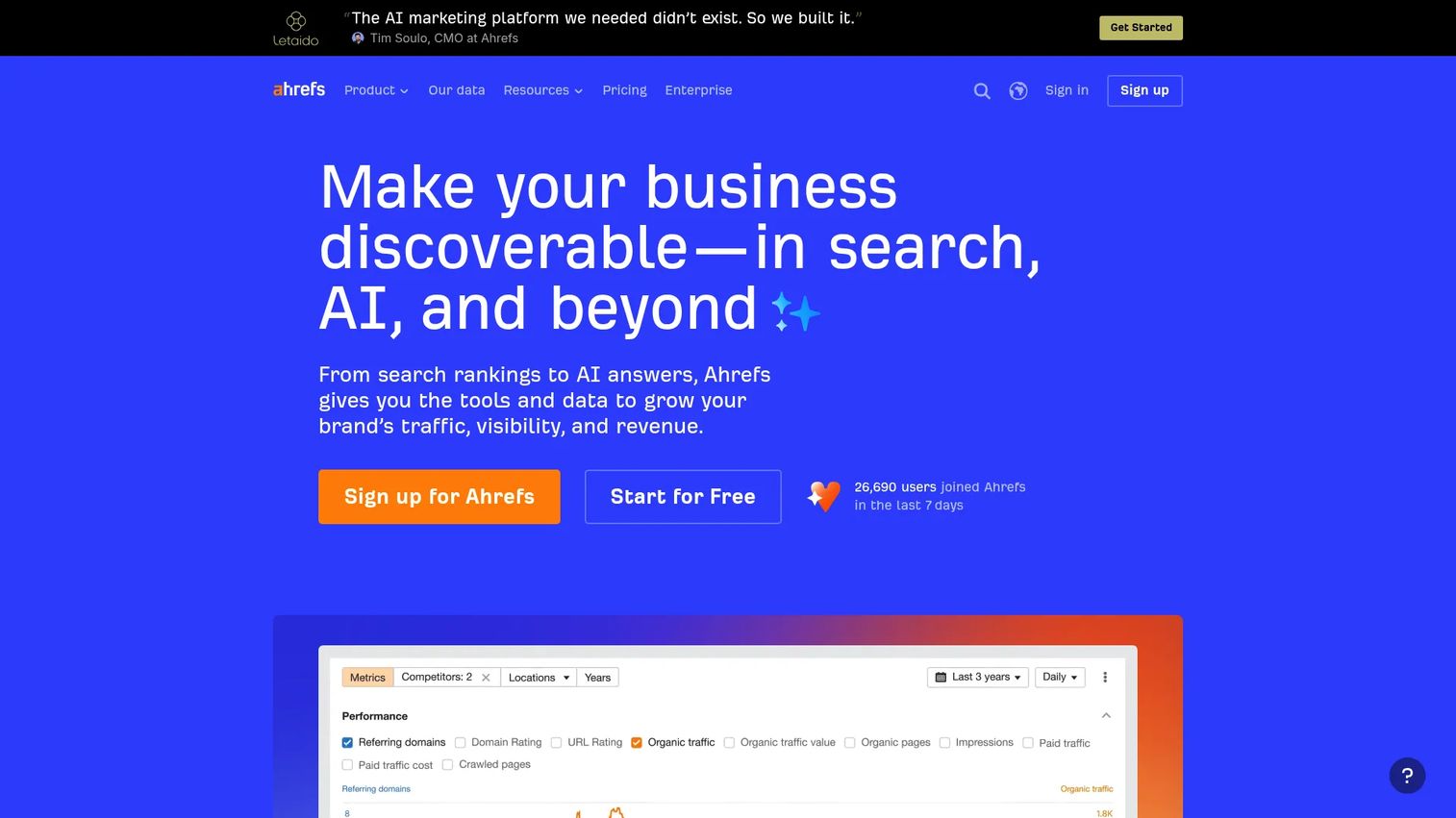
Ahrefs is the platform most agencies reach for first when a client asks why a competitor is outranking them. Its backlink index, keyword discovery tools, and competitive gap analysis sit in one interface and cover the research questions that come up in almost every account. Beyond links, Ahrefs includes site auditing, rank tracking, and a web analytics layer.
Best for: Agencies that run competitive research, link audits, and content gap analysis as core service deliverables.
Key features
- Site Explorer for domain-level link and traffic analysis
- Keywords Explorer with keyword difficulty and traffic potential
- Content gap analysis across competing domains
- Rank Tracker for multi-domain position monitoring
- Site Audit with crawl-based issue detection
Why choose Ahrefs: If backlink quality and competitive SERP positioning are central to your agency's work, Ahrefs carries the deepest link data of any tool on this list. It is not the broadest marketing suite, but for agencies where link intelligence drives strategy, it is hard to displace.
Ahrefs pricing: Plans start at €27 per month for Starter, with Lite at €119/mo, Standard at €229/mo, and Advanced at €419/mo. Annual billing saves up to 17%. Enterprise pricing is custom. A free-forever tier (Ahrefs Free) is available with limited access.
G2 rating: 4.5/5
2. Semrush
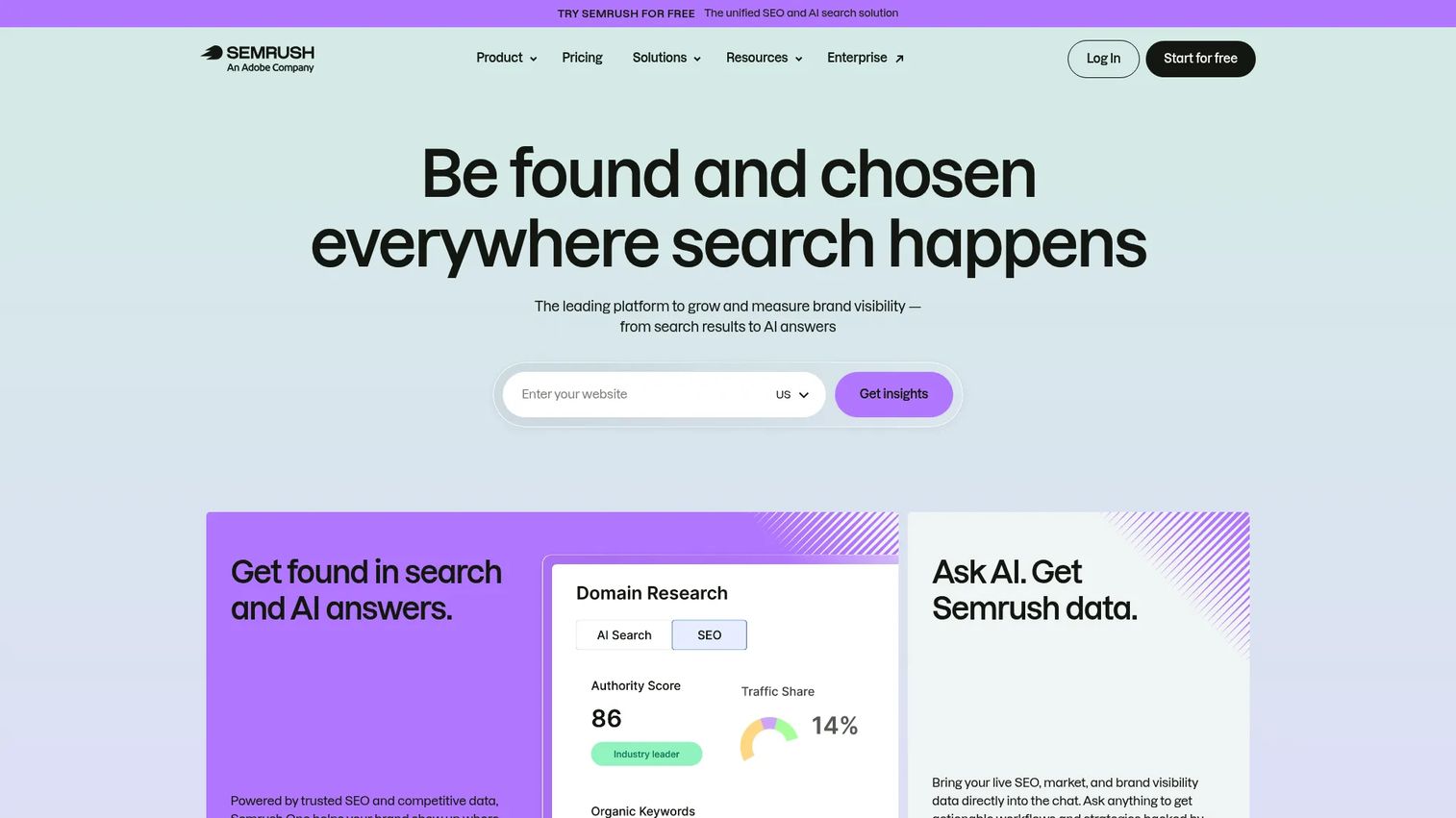
Semrush positions itself as a brand-visibility platform that covers SEO, AI-search visibility, PPC research, content marketing, and competitive intelligence in one suite. For growth marketers who want fewer tools and broader campaign coverage, Semrush reduces the number of subscriptions needed to run a full-service account.
Best for: Agencies that manage SEO alongside paid search, content production, and competitive monitoring for the same clients.
Key features
- Keyword Magic Tool with intent and difficulty filtering
- Site Audit with technical health scoring
- Position Tracking across search engines and locations
- Backlink Analytics and link-building outreach tools
- Content marketing tools including topic research and SEO writing assistance
Why choose Semrush: Its breadth is the main case for it. When one team handles SEO, PPC analysis, and content for the same account, Semrush reduces context-switching and tool sprawl. Attribution-focused growth marketers appreciate having campaign and organic data in a shared environment.
Semrush pricing: A free tier is available. Paid SEO plans start at $117.33/mo billed annually (Starter at $165.17/mo, Pro+ at $248.17/mo). Advanced uses custom pricing. A free trial is available on paid plans.
G2 rating: 4.4/5
3. Google Search Console
Google Search Console is the non-negotiable free foundation for any agency doing SEO. It delivers first-party data straight from Google: Which queries drive impressions and clicks, which pages are indexed, where coverage errors exist, and how Core Web Vitals perform. No paid tool replicates this source.
Best for: Every agency that needs direct search performance and indexing data from Google, regardless of what paid tools sit alongside it.
Key features
- Search performance reports by query, page, country, and device
- Index coverage monitoring and sitemap submission
- URL Inspection for page-level indexing diagnostics
- Core Web Vitals monitoring
- Manual action and security issue alerts
Why choose Google Search Console: It is the source of record for organic search data. Rank trackers and third-party crawlers estimate; Search Console measures what Google actually shows and indexes. Build your reporting foundation here before layering paid tools on top.
Google Search Console pricing: Free, with no paid tiers.
G2 rating: 4.7/5
4. Screaming Frog SEO Spider
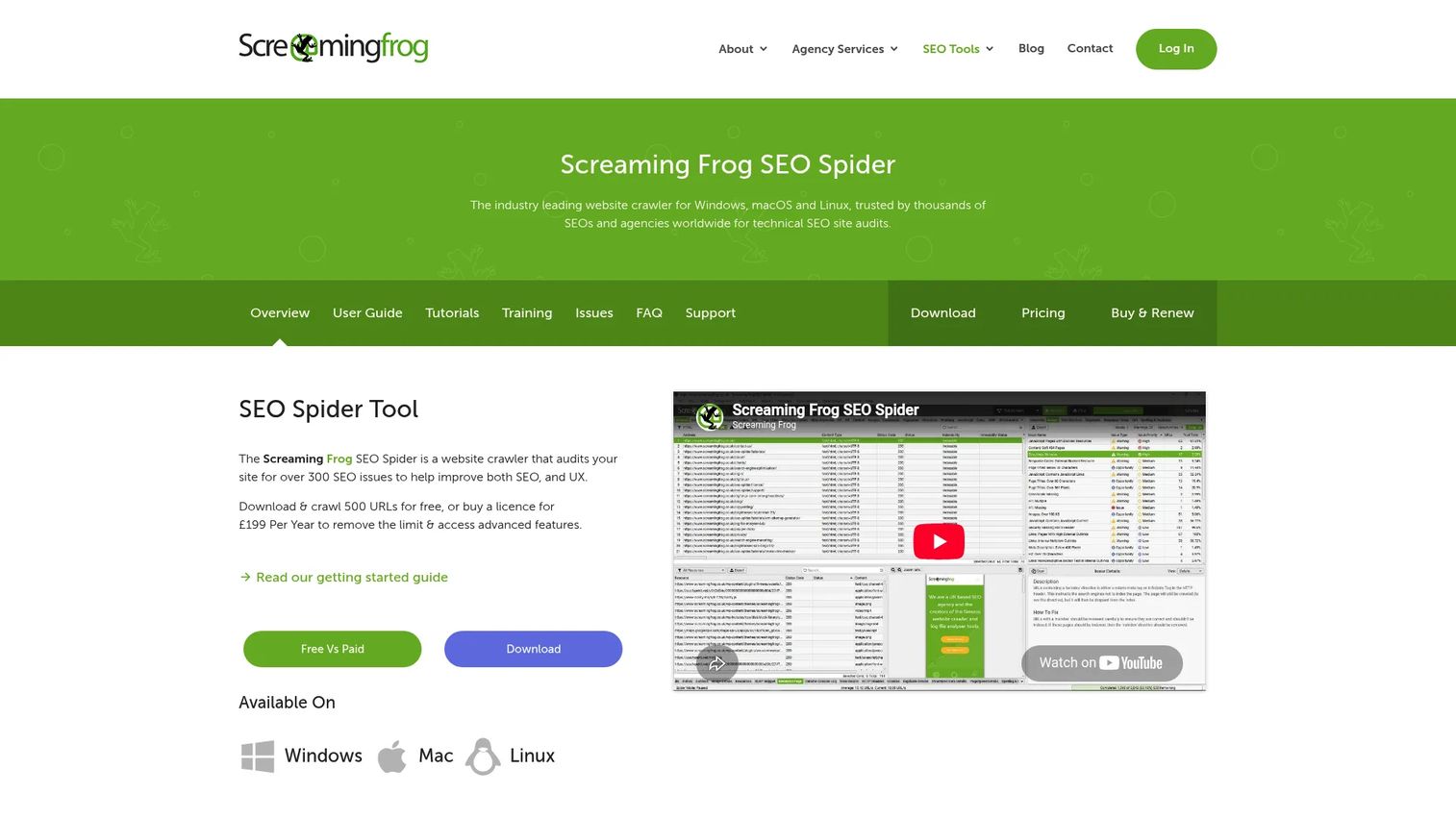
Screaming Frog SEO Spider is the technical SEO workhorse that most practitioners keep in their stack regardless of what cloud-based platform they use. The desktop crawler exports status codes, metadata, redirects, canonical tags, structured data, and custom extraction fields in formats that plug directly into audit deliverables.
Best for: Agencies running technical audits, site migrations, crawl diagnostics, and large-scale site checks where raw data matters.
Key features
- Full website crawling with status code and redirect analysis
- Metadata extraction across titles, descriptions, and headings
- JavaScript rendering via integrated Chromium
- Custom XPath, CSS Path, and regex data extraction
- Integrations with Google Analytics, Search Console, and PageSpeed Insights
Why choose Screaming Frog SEO Spider: Technical SEO specialists who need raw, exportable crawl data at the page level will find cloud-based tools limiting by comparison. The free version crawls up to 500 URLs, which is enough for small site spot-checks. The paid licence removes that limit entirely.
Screaming Frog SEO Spider pricing: The free version is limited to 500 URLs per crawl. A paid licence costs $279 per user per year, dropping to $265 for 5 to 9 licences and $249 for 10 to 19 licences.
G2 rating: 4.7/5
5. Rankability
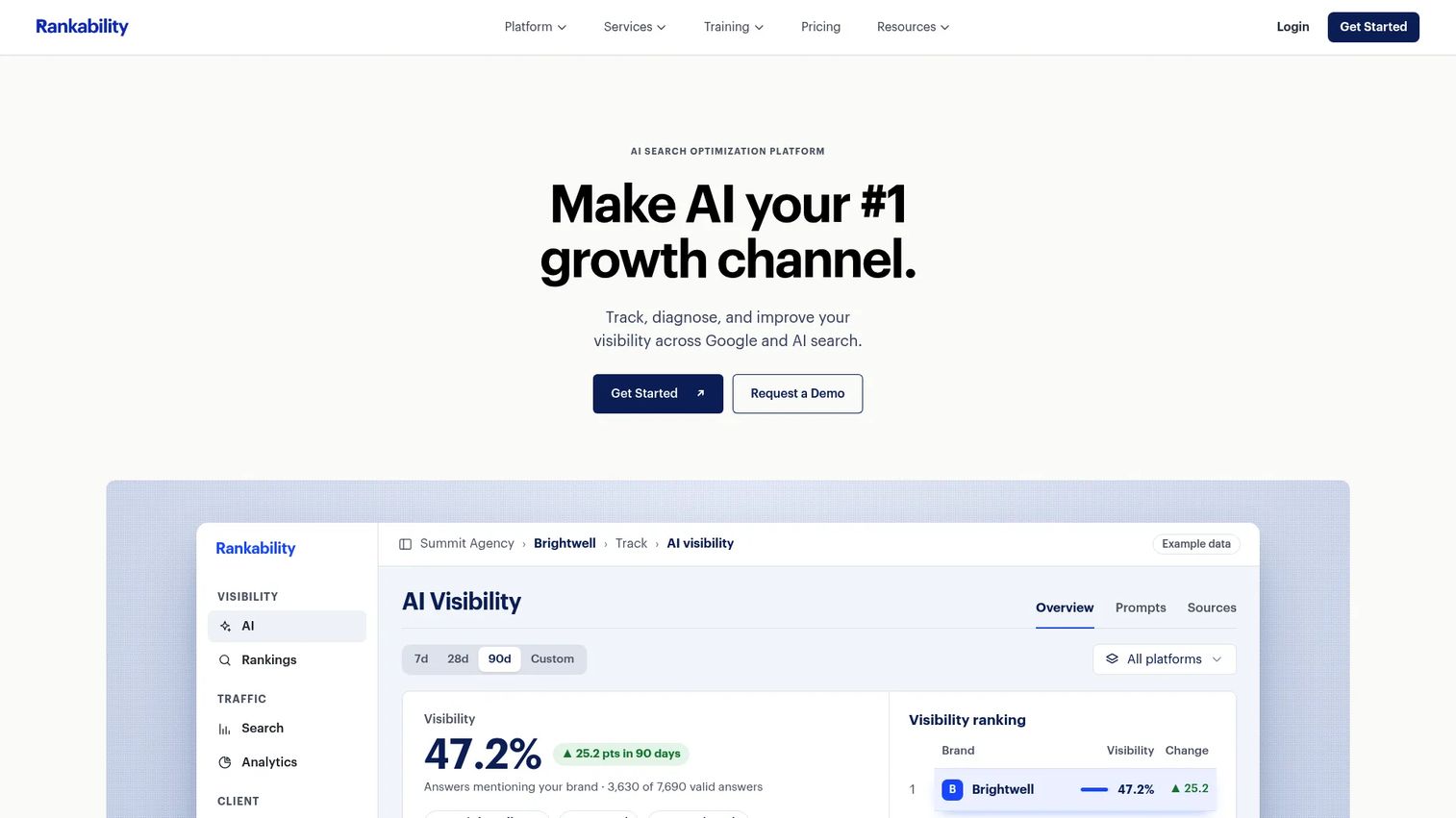
Rankability covers both traditional and AI-search visibility in one platform, including keyword and competitor research, content optimization, site and page auditing, backlink analysis, and client portals. For agencies building repeatable content workflows that need to perform in both organic search and AI-generated answers, Rankability addresses that dual requirement directly.
Best for: Agencies building structured content workflows for clients competing in both traditional search and AI-driven answer surfaces.
Key features
- Traditional and AI search visibility tracking with Search Performance Index
- AI-assisted content creation and optimization
- Keyword and competitor research with topic coverage
- Site, page, and URL-set auditing
- Client portals and shareable reports with API and MCP access
Why choose Rankability: The combination of content scoring and AI-search tracking makes it useful for agencies whose clients are starting to ask about visibility in AI-generated answers alongside traditional rankings. It is a focused operational tool rather than an all-in-one suite.
Rankability pricing: Starter is $99/mo, Core is $199/mo, and Team is $399/mo, all billed monthly. Annual pricing is $990, $1,990, and $3,990 respectively. All plans include unlimited seats.
6. Google Analytics 4
Google Analytics 4 is the measurement layer that turns SEO traffic into business outcomes. Event-based tracking covers conversions, landing page engagement, acquisition channels, and funnel behavior. For growth marketers who need to connect organic traffic to pipeline, GA4 is where that connection gets built.
Best for: Agencies that need to tie organic channel performance to conversions, revenue events, and cross-channel attribution for client reporting.
Key features
- Event-based tracking with custom conversion definitions
- Traffic acquisition and landing page reports
- Funnel analysis and Explorations
- Cross-platform attribution including Google Ads integration
- BigQuery export for custom analysis
Why choose Google Analytics 4: SEO reporting without conversion behavior tells only half the story. GA4 is free and connects directly to Search Console and Google Ads, making it the backbone of defensible attribution for most agency stacks. Setup discipline matters: Poorly configured GA4 produces noisy data that undermines the reporting it is supposed to support.
Google Analytics 4 pricing: Standard GA4 is free. Analytics 360 is a contract-based enterprise tier with higher limits; exact pricing requires contacting Google.
G2 rating: 4.5/5
7. AgencyAnalytics
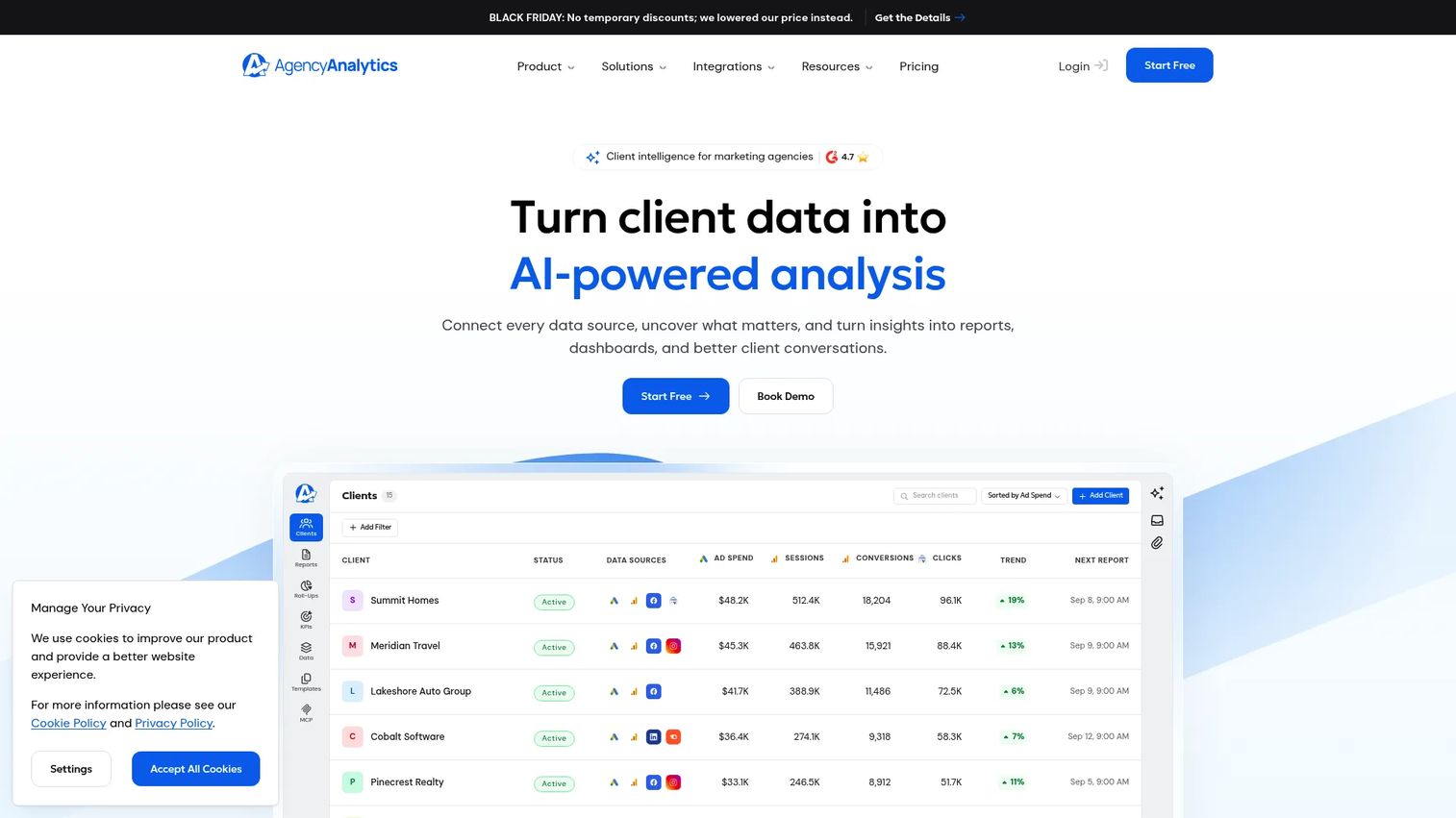
AgencyAnalytics is built specifically for the client reporting problem that agencies hit at scale: Producing branded, accurate dashboards across many clients without spending hours each month assembling data manually. It connects 90-plus marketing integrations and delivers white-label reports through client portals.
Best for: Agencies that need automated, client-ready SEO dashboards and scheduled reports delivered under their own brand.
Key features
- White-label dashboards and client portals
- Automated scheduled reports
- Rank tracking and SEO monitoring
- 90-plus marketing data integrations
- Goals, alerts, anomaly detection, and AgencyAI insights
Why choose AgencyAnalytics: Reporting is where agencies lose time every single month. AgencyAnalytics is strongest when your team already collects data from several SEO and analytics platforms and needs one place to present it cleanly to clients. It does not replace research tools; it surfaces and packages their outputs.
AgencyAnalytics pricing: Core plan starts at $20 per client per month billed annually. Volume pricing applies for 25-plus clients. A 14-day free trial is available; no permanent free tier.
G2 rating: 4.7/5
8. SE Ranking
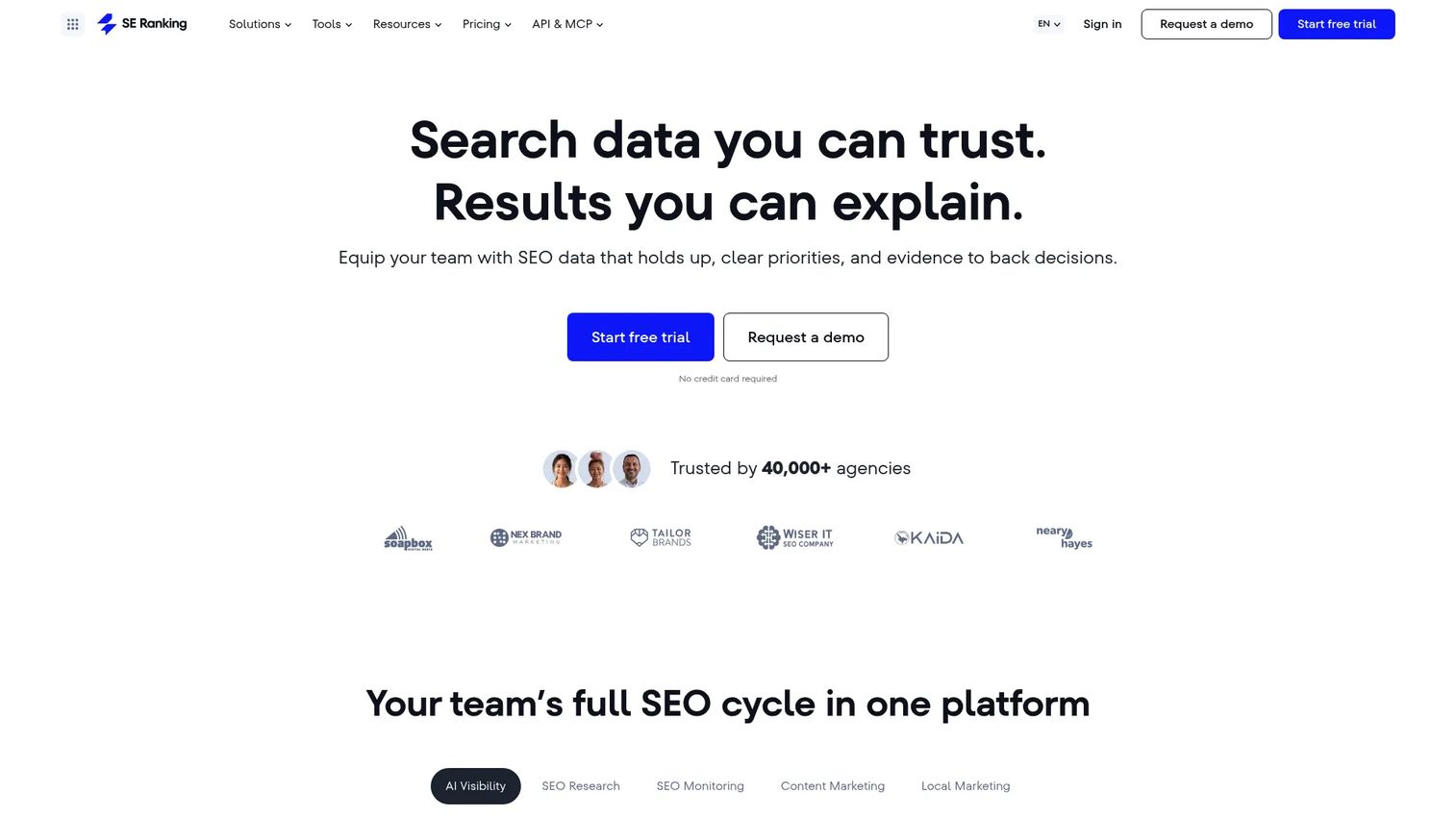
SE Ranking is an all-in-one SEO platform built with agency pricing and workflows in mind. It covers rank tracking, keyword research, website audits, backlink monitoring, content tools, local SEO, and reporting in one subscription at a price point that works for small to mid-sized agencies managing recurring accounts.
Best for: Small and mid-sized agencies that need broad SEO coverage across rank tracking, audits, and white-label reporting without enterprise pricing.
Key features
- Rank tracking across major search engines and locations
- Website and on-page audit tools
- Competitor keyword and backlink research
- Backlink monitoring and analysis
- White-label report builder with integrations
Why choose SE Ranking: Value and breadth are the story here. If your agency needs one platform to handle everyday SEO delivery, from rank monitoring to competitor snapshots to client reports, SE Ranking covers those jobs at a price that fits a retainer model. It also includes AI visibility tracking for agencies monitoring emerging search channels.
SE Ranking pricing: Core plan is $103.20/mo billed annually (regular $129/mo). Growth plan is $223.20/mo billed annually (regular $279/mo). Enterprise uses custom pricing. A 14-day free trial is available.
G2 rating: 4.7/5
9. Lumar
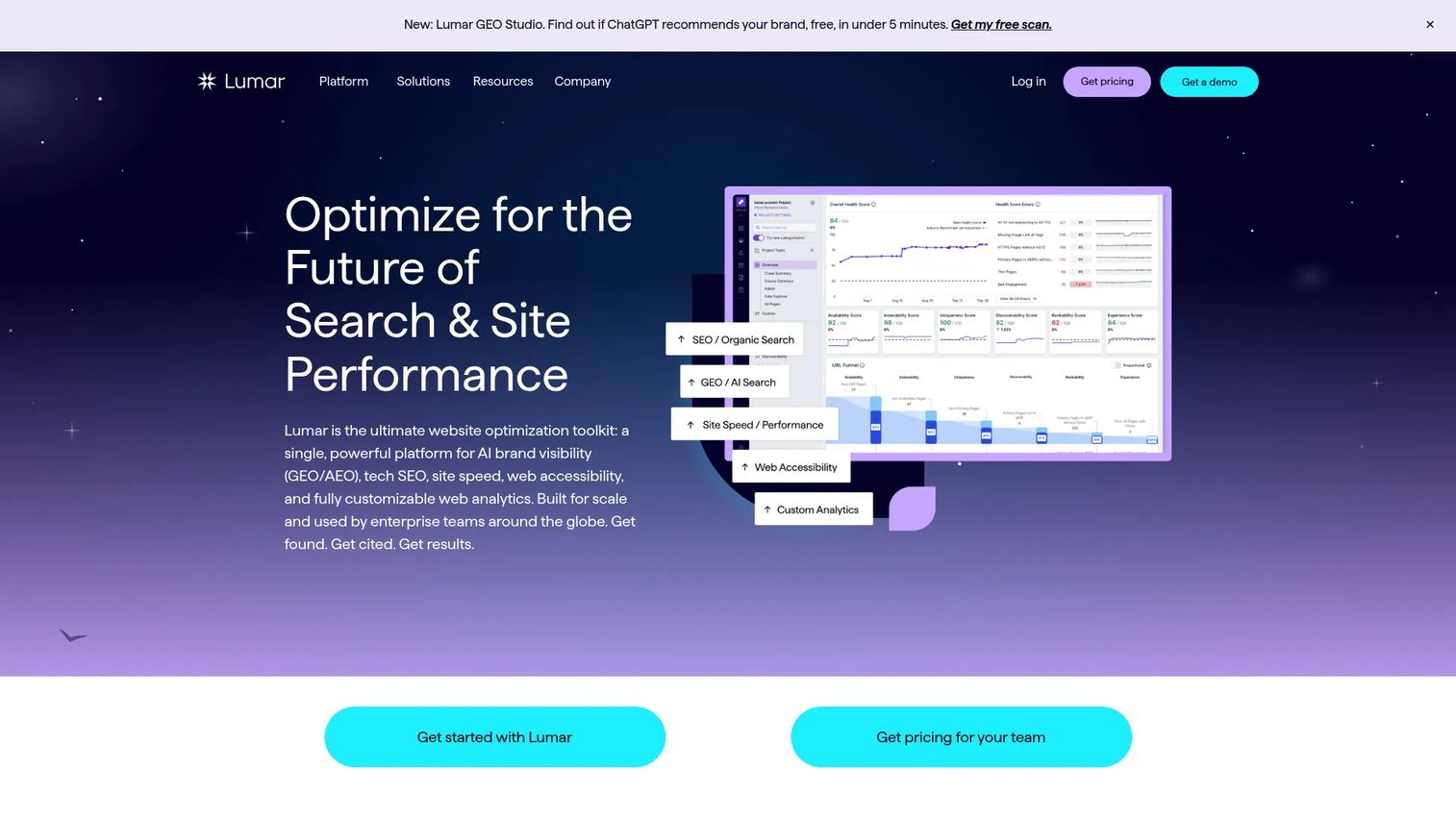
Lumar is an enterprise website optimization platform that covers technical SEO, AI-search visibility, site speed, accessibility monitoring, and automated website QA. For large, complex sites where lightweight crawlers hit scale limits, Lumar provides the depth of crawl and monitoring infrastructure that enterprise teams need.
Best for: Enterprise agencies and in-house teams managing large, high-change websites where technical complexity makes simpler crawlers insufficient.
Key features
- Deep website audits covering technical SEO, GEO/AI-search, site speed, and accessibility
- Customizable monitoring dashboards and alerts across domains and site sections
- Automated website QA with CI/CD pipeline integrations
- Health scores, industry benchmarking, and stakeholder reporting
- GraphQL API for custom integrations
Why choose Lumar: Scale and technical governance are what differentiate it. When a site has hundreds of thousands of pages, complex JavaScript rendering requirements, or needs continuous technical monitoring rather than point-in-time audits, Lumar's infrastructure fits where desktop crawlers stop.
Lumar pricing: Lumar GEO Studio has public pricing starting at $25/mo (Starter), $179/mo (Growth), and custom Enterprise. The broader Lumar platform directs buyers to request pricing directly.
G2 rating: 4.6/5
10. Majestic
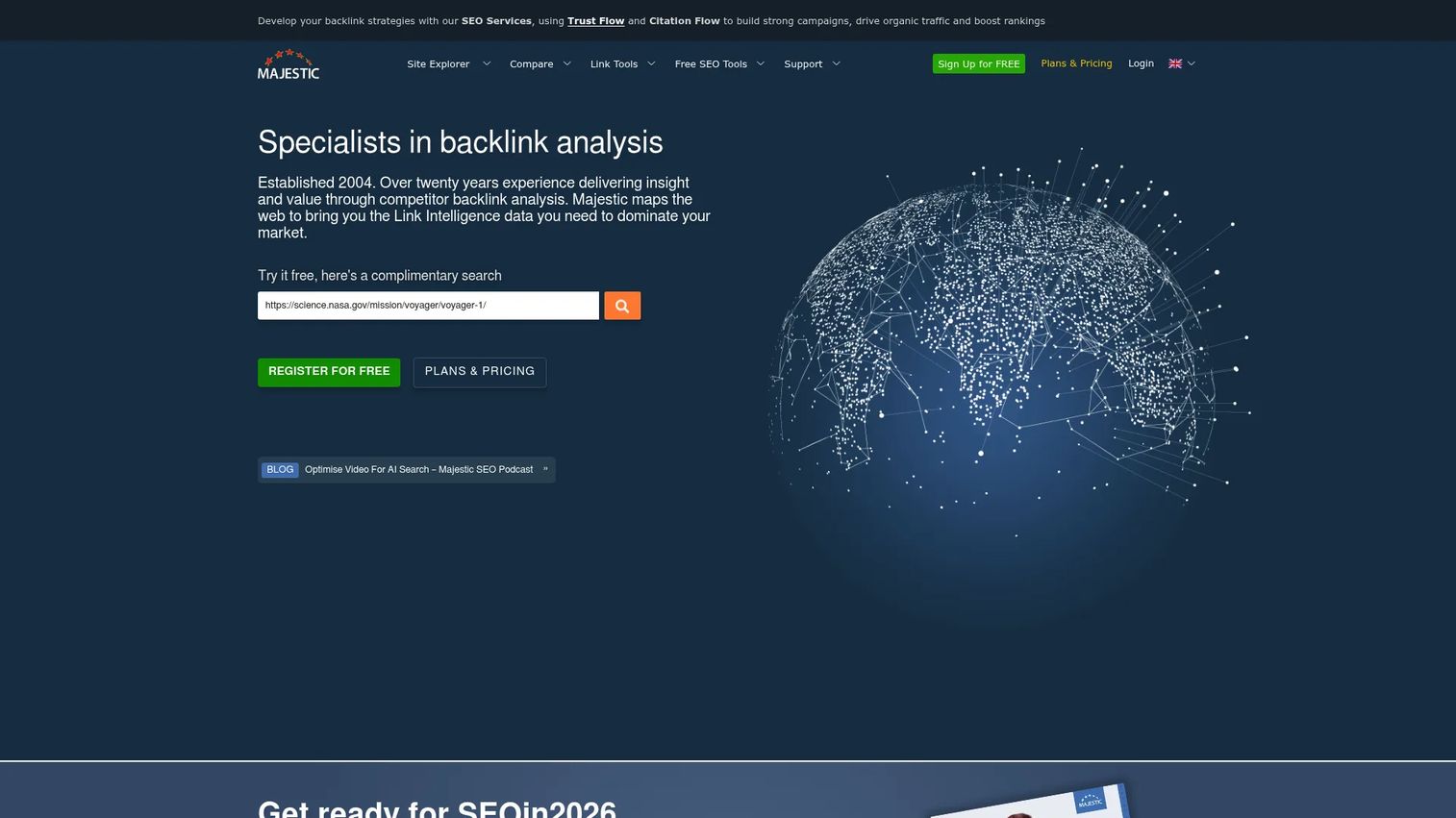
Majestic is a specialist backlink and link intelligence platform. Its Trust Flow and Citation Flow metrics give agencies a way to assess link quality beyond raw counts. Fresh and Historic Index access lets you trace how a domain's link profile has changed over time, which matters for audits and penalty recovery work.
Best for: Agencies focused on backlink analysis, link-building prospecting, and link-quality auditing as dedicated service lines.
Key features
- Site Explorer with Fresh and Historic Index access
- Trust Flow and Citation Flow quality metrics
- Bulk Backlink Checker
- Clique Hunter for competitor link pattern discovery
- Backlink history and topical trust analysis
Why choose Majestic: Its specialization is the reason to add it. When link strategy drives client outcomes and you need deeper link-quality signals than an all-in-one platform provides, Majestic fills that gap. Many agencies pair it with a broader platform rather than using it as their primary tool.
Majestic pricing: Lite is $49.99/mo, Pro is $99.99/mo, and API is $399.99/mo. Annual billing drops those to $41.67, $83.33, and $333.33 per month respectively. Free registration provides limited access.
G2 rating: 4.3/5
11. SpyFu
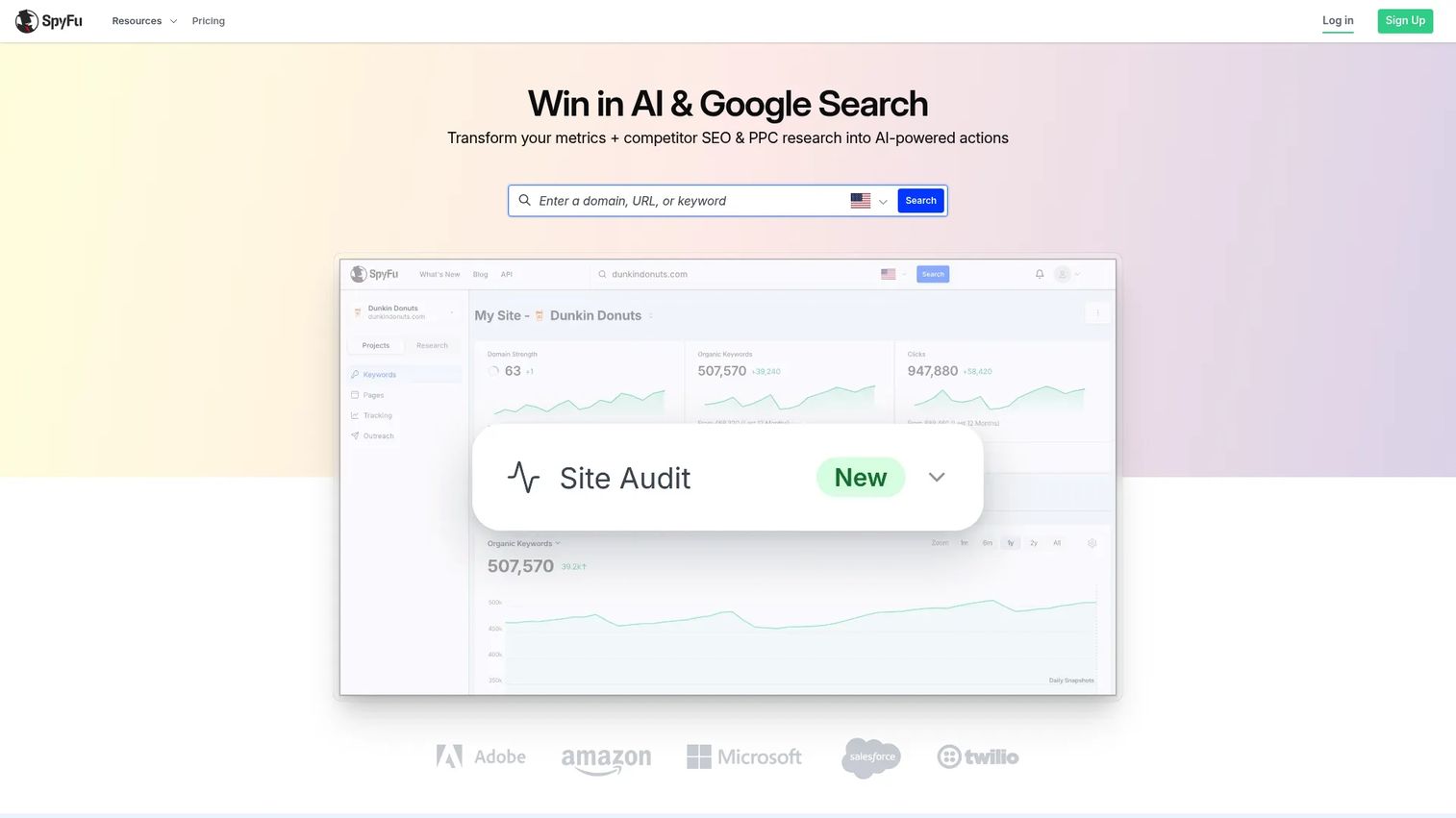
SpyFu surfaces the keyword and advertising history of any domain. For agencies that pitch competitive strategy, it shows what a competitor has ranked for over time, which paid keywords they've tested, and where their SEO and PPC overlap. That historical context is hard to replicate from current rankings alone.
Best for: Agencies that use competitive intelligence as a core pitch and planning input, covering both SEO and paid search strategy.
Key features
- Competitor keyword research and domain analysis
- PPC ad history and Google Ads spend estimates
- SEO ranking history across years
- Domain comparison and keyword gap analysis
- Site Audit with AI-suggested fixes
Why choose SpyFu: The historical lens on competitor data is what sets it apart. For prospect audits, new client onboarding, and competitive strategy decks, SpyFu answers questions that current-state tools cannot. A free version is available for initial exploration.
SpyFu pricing: Basic is $39/mo (or $29/mo billed annually). Pro + AI is $59 for the first month then $119/mo (or $89/mo annually). Team/Agency is $249/mo (or $187/mo annually).
G2 rating: 4.6/5
12. LowFruits
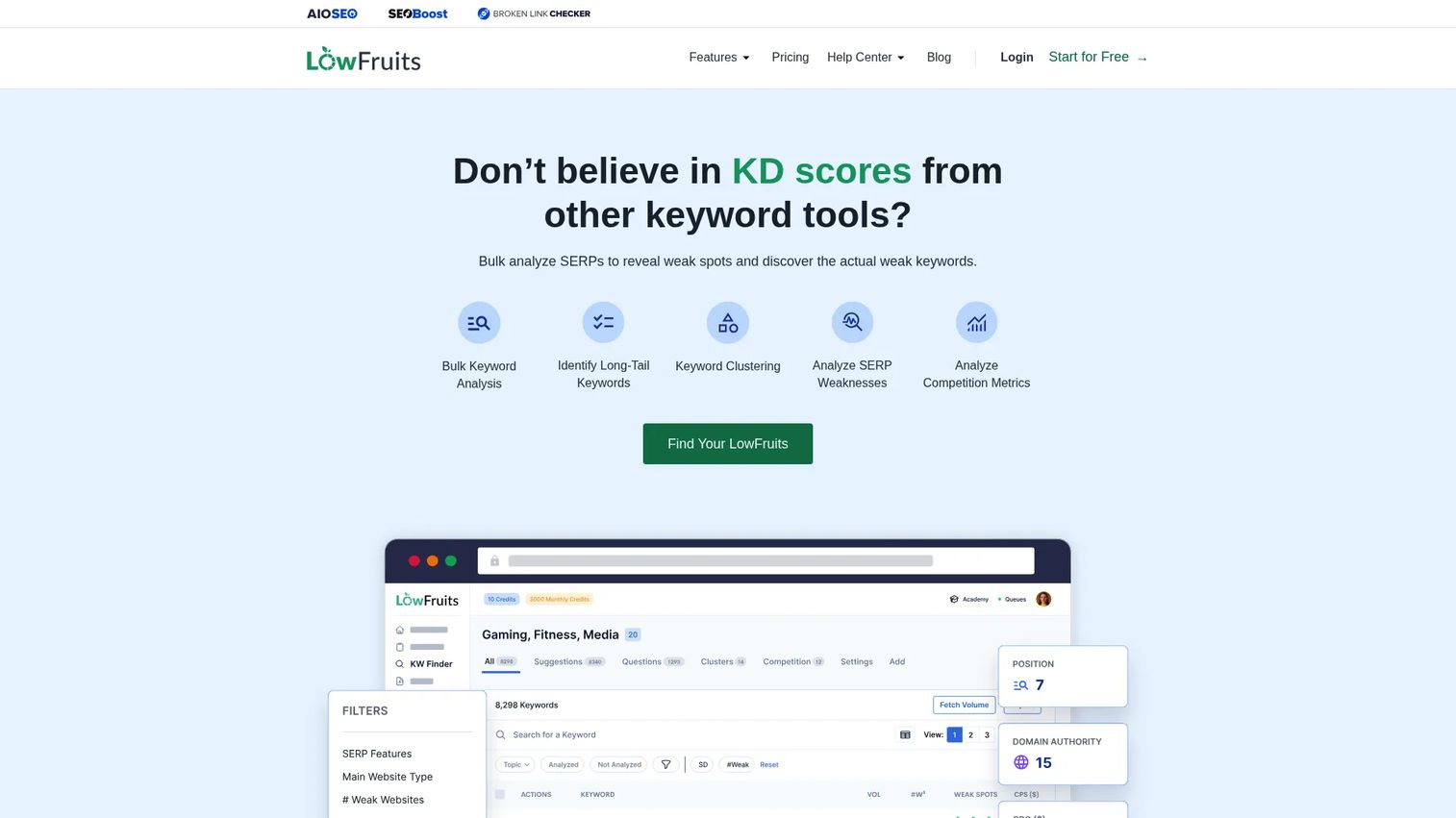
LowFruits focuses on a specific and practical problem: Finding keywords where the SERP is populated with weak results that a newer or lower-authority site can realistically target. It analyzes SERPs for weak spots, clusters related keywords, and helps content teams identify quick-win opportunities rather than chasing competitive head terms.
Best for: Agencies working with newer sites or clients with limited domain authority who need realistic content targets within a 90-day planning window.
Key features
- Long-tail keyword finder with weak-spot SERP analysis
- Keyword clustering and topic grouping
- Domain Explorer for competitor keyword extraction
- Sitemap extraction for existing site analysis
- Keyword rank tracker
Why choose LowFruits: The weak-spot methodology makes it useful for accounts where chasing high-difficulty terms is unrealistic. For small agencies and freelancers managing content budgets carefully, it narrows the keyword list to what can actually win rather than what looks impressive in a brief.
LowFruits pricing: Pricing was not accessible from verified sources at the time of writing. Contact LowFruits directly at lowfruits.io for current plan and credit pricing.
13. All In One SEO
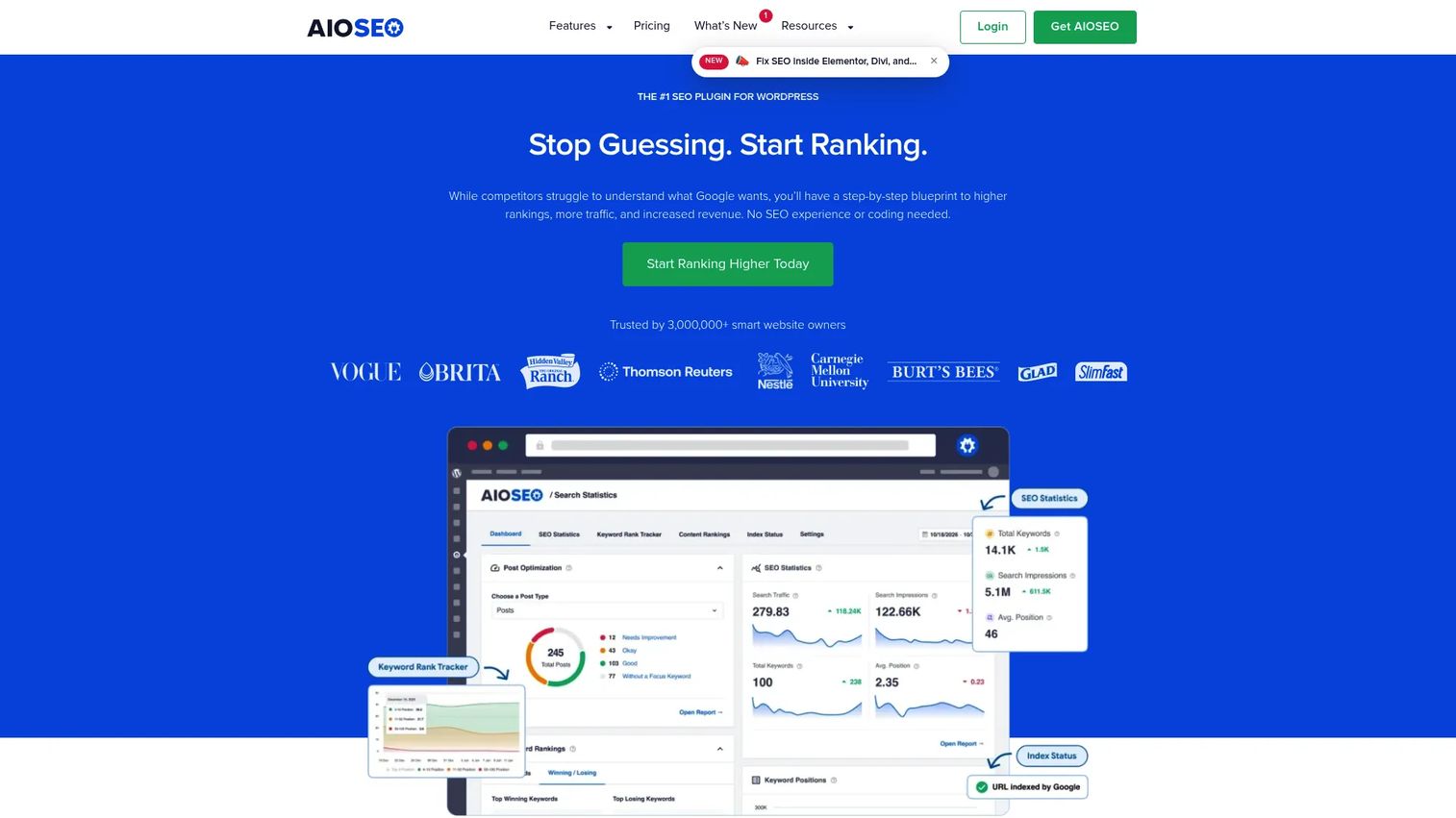
All In One SEO is a WordPress SEO plugin and toolkit that handles on-page optimization, schema markup, XML sitemaps, redirects, local SEO, and WooCommerce SEO from within the WordPress admin. For agencies managing SEO implementation across multiple WordPress client sites, it removes the gap between research recommendations and on-site execution.
Best for: Agencies managing SEO implementation across WordPress client sites, particularly where WooCommerce or local SEO is in scope.
Key features
- On-page SEO controls and Search Statistics integration
- XML sitemaps and schema markup generation
- Redirection Manager and Link Assistant
- Local SEO and WooCommerce SEO support
- AI content and image generation tools
Why choose All In One SEO: It bridges the distance between audit findings and actual implementation. When agencies need to push SEO changes directly into WordPress without engineering dependencies, All In One SEO handles that execution layer. It is not a research platform but pairs well with any research tool on this list.
All In One SEO pricing: Basic is $49.50/year (1 site), Plus is $99.50/year (3 sites), Pro is $199.50/year (10 sites), and Elite is $299.50/year (100 sites). These are introductory first-year prices. A free Lite version is available.
G2 rating: 4.8/5
14. Microsoft Clarity
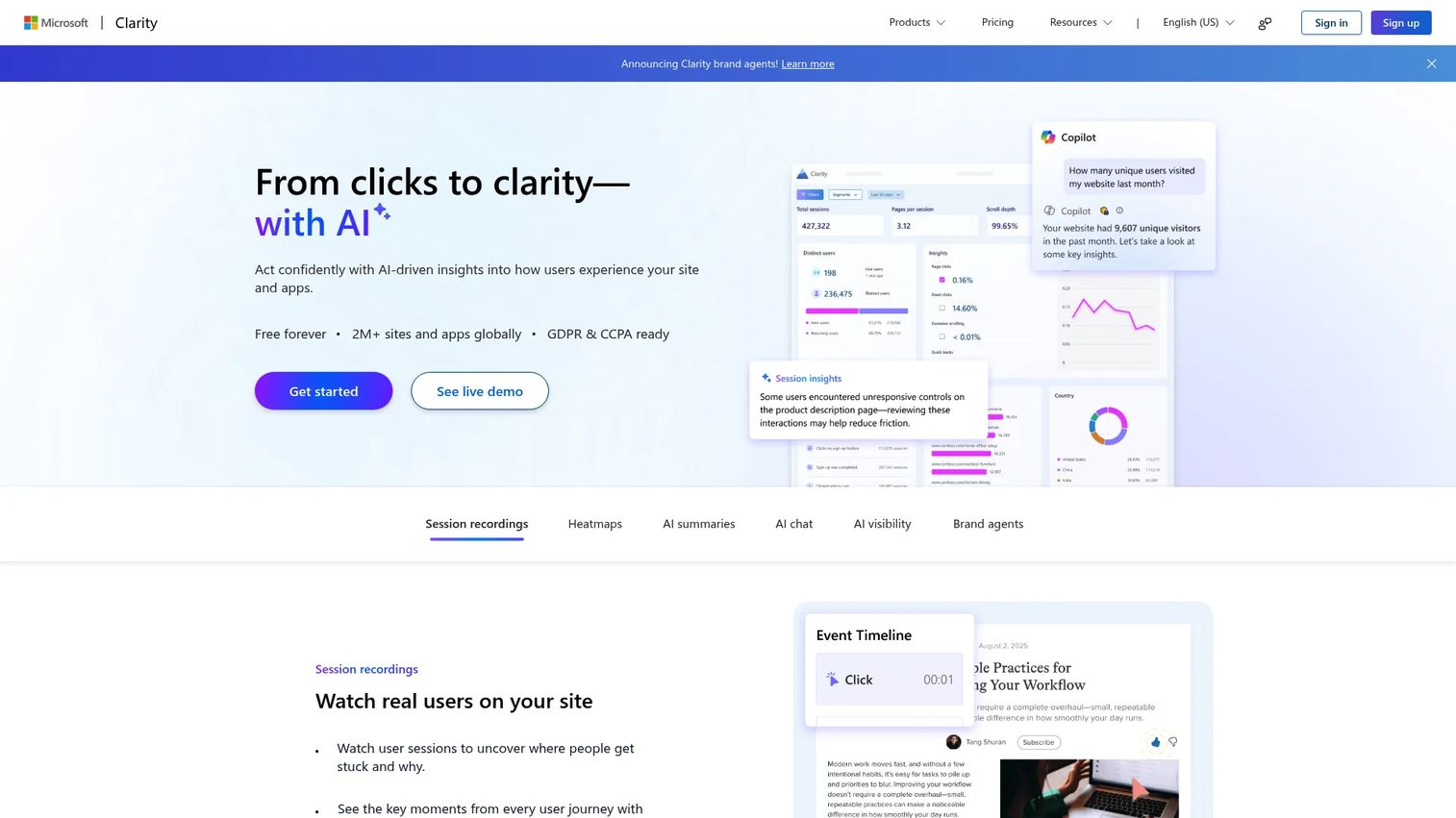
Microsoft Clarity provides free heatmaps, session recordings, and behavior analytics that show what users do after organic search traffic lands on a page. For agencies troubleshooting conversion rates on SEO landing pages, it answers the question that ranking data cannot: Why traffic is not converting.
Best for: Agencies that want free behavior analytics to diagnose conversion problems on SEO landing pages.
Key features
- Click, scroll, area, and conversion heatmaps
- Session recordings with segmentation filters
- Rage-click and dead-click insights
- AI summaries and Copilot chat analysis
- Google Analytics integration
Why choose Microsoft Clarity: It is completely free, with no traffic limits, unlimited heatmaps, and unlimited team members. The behavior layer it adds to SEO reporting helps agencies move from "rankings improved" to "here's why conversions followed," which is a more defensible client conversation.
Microsoft Clarity pricing: Free forever, with all features included at no cost.
G2 rating: 4.5/5
15. Looker Studio
Looker Studio (formerly Data Studio, renamed in April 2026) is a free dashboard and reporting tool that connects to Google products, databases, files, and social media platforms. For agencies that need fully custom SEO dashboards built from blended data sources, it offers more flexibility than purpose-built reporting tools at zero software cost.
Best for: Agencies that need custom SEO reporting dashboards from multiple data sources and have the technical capacity to build and maintain report logic.
Key features
- Custom dashboards with charts, pivot tables, and geo maps
- Data connectors to Google products, databases, and third-party sources
- Data blending from related sources in one view
- Report templates and scheduled email delivery
- Real-time collaboration and embedding
Why choose Looker Studio: The flexibility and cost combination is hard to beat. The trade-off is maintenance: Someone on your team needs to manage data source connections and report logic. For teams comfortable with that overhead, Looker Studio produces cleaner, more customized outputs than most subscription reporting tools.
Looker Studio pricing: Standard use is free. Data Studio Pro is a paid subscription for enterprise collaboration and administration features; exact pricing was not publicly displayed.
G2 rating: 4.4/5
16. Siteimprove
Siteimprove is an enterprise content intelligence platform that combines SEO monitoring, accessibility compliance analysis, content quality assurance, policy governance, and analytics in one system. For enterprise marketing teams where SEO sits alongside accessibility mandates and content governance requirements, it covers ground that standalone SEO platforms do not.
Best for: Enterprise agencies and marketing teams where SEO, accessibility compliance, and site governance are managed together.
Key features
- SEO auditing, keyword tracking, and content optimization
- Accessibility monitoring and compliance analysis
- Quality assurance for broken links, misspellings, and readability
- Policy and governance monitoring with custom rules
- Analytics and traffic-based issue prioritization
Why choose Siteimprove: Organizations with legal or regulatory accessibility requirements often cannot separate SEO from broader site quality governance. Siteimprove addresses that reality. It is not the right fit for agencies that only need SEO tooling, but for enterprise clients with multi-discipline compliance needs, it covers jobs that specialist SEO tools leave unaddressed.
Siteimprove pricing: Custom pricing. Contact Siteimprove directly for a quote.
G2 rating: 4.6/5
17. Botify
Botify is an enterprise SEO and AI discoverability platform that combines crawl analysis, server log analysis, organic search intelligence, and automation capabilities. For large websites where crawl budget, indexation, and technical prioritization have direct revenue impact, Botify provides the infrastructure to identify and act on those issues at scale.
Best for: Enterprise SEO teams and agencies managing large websites where crawlability, indexation, and log-based technical insights drive organic performance.
Key features
- Enterprise crawling and technical SEO analysis
- Server log analysis for crawl and indexation insights
- AI visibility monitoring and organic search intelligence
- PageWorkers for SEO optimization and deployment
- SmartIndex for optimized sitemap generation and indexing notifications
Why choose Botify: Its differentiation is the combination of crawl data and log file analysis. When technical SEO decisions require understanding how search engines actually access a site, not just what the site looks like to a crawler, the log analysis layer is what separates Botify from standard enterprise crawlers.
Botify pricing: Botify offers five subscription plans (Essential, Accelerate, Growth, Pro, and Enterprise). Custom pricing applies across all tiers. Contact Botify for a quote.
G2 rating: 4.4/5
Considerations when choosing SEO agency software
Match the tool to the workflow bottleneck
Keyword research, content optimization, technical auditing, client reporting, and enterprise governance are genuinely different jobs. A platform that excels at competitive keyword research often lacks the crawl depth a technical specialist needs. Identify the workflow that is slowing your agency down most, then start there.
Check reporting before you check features
A tool that creates manual reporting work every month costs more than its subscription fee. Before committing to any platform, test whether its reports can go to clients with minimal post-processing. White-label quality, scheduling reliability, and integration depth with the tools you already use should all be evaluated during trial.
Calculate cost per client, not cost per month
Seat-based pricing, client-based pricing, credit consumption, and crawl volume all compound differently at agency scale. Run your current client count against each pricing model to understand what the tool actually costs when it is fully deployed. A $100/mo tool that requires five seats for your team at $20/seat each is a $200/mo tool.
Prioritize integrations with your existing stack
Data lock-in matters more at the reporting stage than at the research stage. Confirm that each tool exports cleanly to GA4, Google Search Console, Looker Studio, your CRM, or whatever BI layer your clients use. Platforms that do not connect to your reporting infrastructure create work rather than eliminating it.
Plan for AI-search visibility as a reporting requirement
Clients are starting to ask where their brand appears in AI-generated answers. The reporting standards for this are still developing, so avoid overpromising. That said, tools like Rankability and SE Ranking already track AI-search visibility alongside traditional rankings, and that capability will become a standard expectation rather than a differentiator.
Conclusion
The right SEO agency software stack does not start with features. It starts with the bottleneck your team hits most often.
For core research, Ahrefs and Semrush anchor most agency stacks. Google Search Console and GA4 anchor first-party measurement for free. Screaming Frog SEO Spider handles the technical audits that cloud platforms often approximate rather than complete. AgencyAnalytics and Looker Studio address the client reporting problem from different angles: Speed versus customization. For content workflow, Rankability and LowFruits serve different site authority levels. At enterprise scale, Lumar, Siteimprove, and Botify each address distinct technical and governance requirements.
Build your stack around the job that is costing you the most time or margin right now. That is the tool to trial first. Add the adjacent pieces once the core workflow is running cleanly.
Start your journey with Guideflow today!
FAQs
The right answer depends on your agency's primary workflow. Ahrefs and Semrush are the strongest all-around picks for research and competitive intelligence. Google Search Console and GA4 should be in nearly every stack regardless of budget. Technical SEO teams managing large or complex sites often prioritize Screaming Frog SEO Spider, Lumar, or Botify.
Most agencies build a stack across several categories: Keyword research, rank tracking, technical crawling, analytics, client reporting, content optimization, and backlink analysis. Common combinations include Ahrefs or Semrush for research, Screaming Frog SEO Spider for technical audits, GA4 and Google Search Console for analytics, and AgencyAnalytics or Looker Studio for reporting.
Google Search Console, GA4, Microsoft Clarity, and Looker Studio form a genuinely strong free foundation. That combination covers search performance data, conversion behavior, user behavior, and custom dashboards. Paid tools become necessary when you need competitive research, white-label reporting, backlink analysis, or enterprise-grade crawling at scale.
AgencyAnalytics is the strongest option when speed and white-label quality matter: It automates report delivery across clients with minimal setup. Looker Studio is the stronger option when full customization is worth the maintenance cost. Choose AgencyAnalytics for teams that want reporting to run itself; choose Looker Studio for teams comfortable maintaining data connectors.
Screaming Frog SEO Spider fits hands-on technical audits and site migrations, particularly when raw crawl exports are needed. Lumar, Siteimprove, and Botify are purpose-built for enterprise websites where scale, continuous monitoring, JavaScript rendering, and log file analysis go beyond what a desktop crawler handles.
A lean stack of SE Ranking, Google Search Console, GA4, Microsoft Clarity, and Looker Studio covers keyword tracking, analytics, behavior data, and reporting at low or no cost. Ahrefs or Semrush can be added when competitive research becomes a weekly deliverable rather than an occasional input.
Ahrefs is typically stronger for backlink intelligence, competitive link research, and deep keyword discovery. Semrush is broader across SEO, PPC analysis, content, and AI-search visibility, making it a better fit when one team handles multiple channel types for the same client. The most practical test: Run the same research task in both on a live client account and compare the output.
Clients are increasingly asking about visibility in AI-generated answers alongside traditional rankings. Agencies should track both. Tools including Rankability, SE Ranking, Semrush, and Botify now include AI-search visibility features alongside traditional rank tracking. Reporting standards are still evolving, so set client expectations accordingly rather than overpromising on what AI-search measurement can confirm.