Online ordering should give restaurants more margin, not more maintenance. In practice, most implementations create exactly the kind of operational debt a founder spends months cleaning up: Menu edits in one system, orders landing in another, payment data sitting in a third. According to Restaurant Dive (2024), online ordering platforms now account for an average of 23% of a restaurant's business. That share is meaningful enough to run on purpose, not by accident.
The difference between a system that compounds and one that creates reconciliation work every shift comes down to one question: Does the order reach the right kitchen, with the right data, without someone retyping it? The platforms below are evaluated on that standard, not on which has the prettiest menu page.
What's inside
This guide compares 14 restaurant online ordering software options for 2026. It is for restaurant operators, multi-location brands, and operators building repeatable digital ordering infrastructure. Tools were selected based on:
- Ordering experience, menu control, and branded storefront quality
- POS and kitchen integration depth
- Pricing structure, including subscription, commission, processing fees, and add-ons
- Customer data ownership and direct-ordering capabilities
- Multi-location support and operational scalability
TL;DR
- Best POS-native option: Square Online fits restaurants already using Square that want ordering, payments, loyalty, and POS sync in one workflow
- Best for Toast restaurants: Toast Online Ordering keeps direct orders tied to POS and kitchen operations without adding a disconnected tool
- Best for multi-channel consolidation: Chowly Platform suits operators managing marketplace channels alongside direct ordering
- Best for independent direct ordering: Owner.com and ChowNow both emphasize first-party customer relationships and reduce marketplace dependence
- Best free starting point: GloriaFood gives small restaurants a low-cost path into online ordering before committing to a heavier stack
- Best for enterprise and delivery-heavy operations: Oracle, HungerRush, and Deliverect deserve evaluation when scale, routing, and integration depth matter more than setup speed
What is restaurant online ordering software?
Restaurant online ordering software lets restaurants accept, manage, and fulfill digital orders from owned channels such as websites, mobile pages, QR codes, and social profiles. It is the operational layer behind a first-party online food ordering system: The difference between owning the customer relationship and renting it from a marketplace.
Where third-party platforms bring discovery traffic but own the customer, a restaurant online ordering system routes that same transaction through branded channels the restaurant controls. The result is direct access to order history, contact information, and repeat purchasing behavior, the kind of data that drives loyalty campaigns, upsell timing, and lifetime value modeling.
Key capabilities to evaluate in any restaurant online ordering platform:
- Branded ordering storefront (website, mobile page, app)
- Menu management with modifiers, combos, and multi-location variants
- Pickup, delivery, curbside, and scheduled order support
- Online payment processing with card, digital wallet, and stored payment options
- POS and kitchen display system order routing
- QR-code table ordering and dine-in support
- Customer profiles, email capture, loyalty, and remarketing tools
- Multi-location menu and geolocation management
- Order analytics and reporting
Category distinctions worth knowing:
- POS-native ordering: Built on top of an existing POS (Square, Toast, Clover). Tight integration, but the ordering tool follows the POS decision.
- Website-first ordering: Prioritizes branded web presence and direct ordering. Best when the restaurant website is a revenue channel.
- Aggregator and marketplace management: Centralizes orders from third-party platforms into the POS. Reduces tablet sprawl; does not replace direct ordering.
- Enterprise restaurant commerce: End-to-end platforms for chains, hotel groups, and large operators. Requires more implementation time but handles scale.
When to use restaurant online ordering software
Grow direct orders without giving up customer data
Marketplace orders create volume but rarely create loyalty data you own. First-party ordering through your own website or app gives you the email address, order history, and behavioral signal to market directly to repeat customers. Operators who rely entirely on third-party platforms for delivery are building someone else's customer database.
Add pickup, delivery, and ordering ahead
Timing accuracy matters more than menu design when a kitchen is under load. The right restaurant ordering system handles prep time windows, scheduled orders, delivery zone management, and curbside instructions without requiring staff to track it in a separate spreadsheet.
Connect online orders to POS and kitchen operations
Manual re-entry breaks at any meaningful order volume. Order injection routes incoming orders directly to the POS and kitchen display, eliminating transcription errors and the extra labor they produce. If the integration requires a middleware step or manual staff action, that step is where the system fails.
Restaurant online ordering software comparison
The table below compares all 14 platforms by best-fit use case, key differentiator, pricing, and G2 rating. Pricing reflects figures verified against vendor pricing pages at time of writing. G2 ratings are sourced from live G2 listings. Verify both before committing, as restaurant software pricing changes frequently.
| # | Product | Best for | Key differentiator | Pricing | G2 rating |
|---|---|---|---|---|---|
| 1 | Square Online | Square POS users | Free tier with full POS sync | From $0/mo | N/A |
| 2 | Toast Online Ordering | Toast POS restaurants | Commission-free, kitchen-native ordering | Custom pricing | N/A |
| 3 | Chowly Platform | Multi-channel operators | 150+ delivery app integrations plus direct ordering | Custom pricing | 5.0/5 |
| 4 | Owner.com | Independent restaurants | AI-driven website, ordering, and marketing in one stack | From $249/mo | 4.8/5 |
| 5 | ChowNow | Commission-free direct ordering | Four-tier plan with built-in marketing tools | From $229/mo | 4.6/5 |
| 6 | Popmenu | Website-first restaurants | Interactive SEO menus plus marketing automation | From $159/mo | 4.7/5 |
| 7 | GloriaFood | Small restaurants | Free online ordering with paid add-ons | Free (add-ons from $19/mo) | 4.7/5 |
| 8 | Menufy | Independent restaurants | Flat monthly fee, no commissions | From $149/mo | N/A |
| 9 | Restolabs | Multi-location chains | Commission-free ordering with delivery zones and loyalty | From $69/mo | 4.2/5 |
| 10 | BentoBox | Clover POS customers | Restaurant website, ordering, and ecommerce combined | Custom pricing | 4.6/5 |
| 11 | Clover POS | Hardware-first operators | POS, payments, and ordering in one hardware stack | From $16/mo (hardware) | 3.8/5 |
| 12 | Oracle | Enterprise restaurant groups | Full MICROS ecosystem with ordering, analytics, and compliance | Custom pricing | 3.6/5 |
| 13 | HungerRush | Pizza and delivery restaurants | Integrated POS, dispatch, and AI phone ordering | From $149/mo | 4.4/5 |
| 14 | Deliverect | Multi-channel enterprise | Direct ordering plus third-party aggregation and dispatch | From $119/mo | 2.3/5 |
Best 14 restaurant online ordering software tools for 2026
1. Square Online
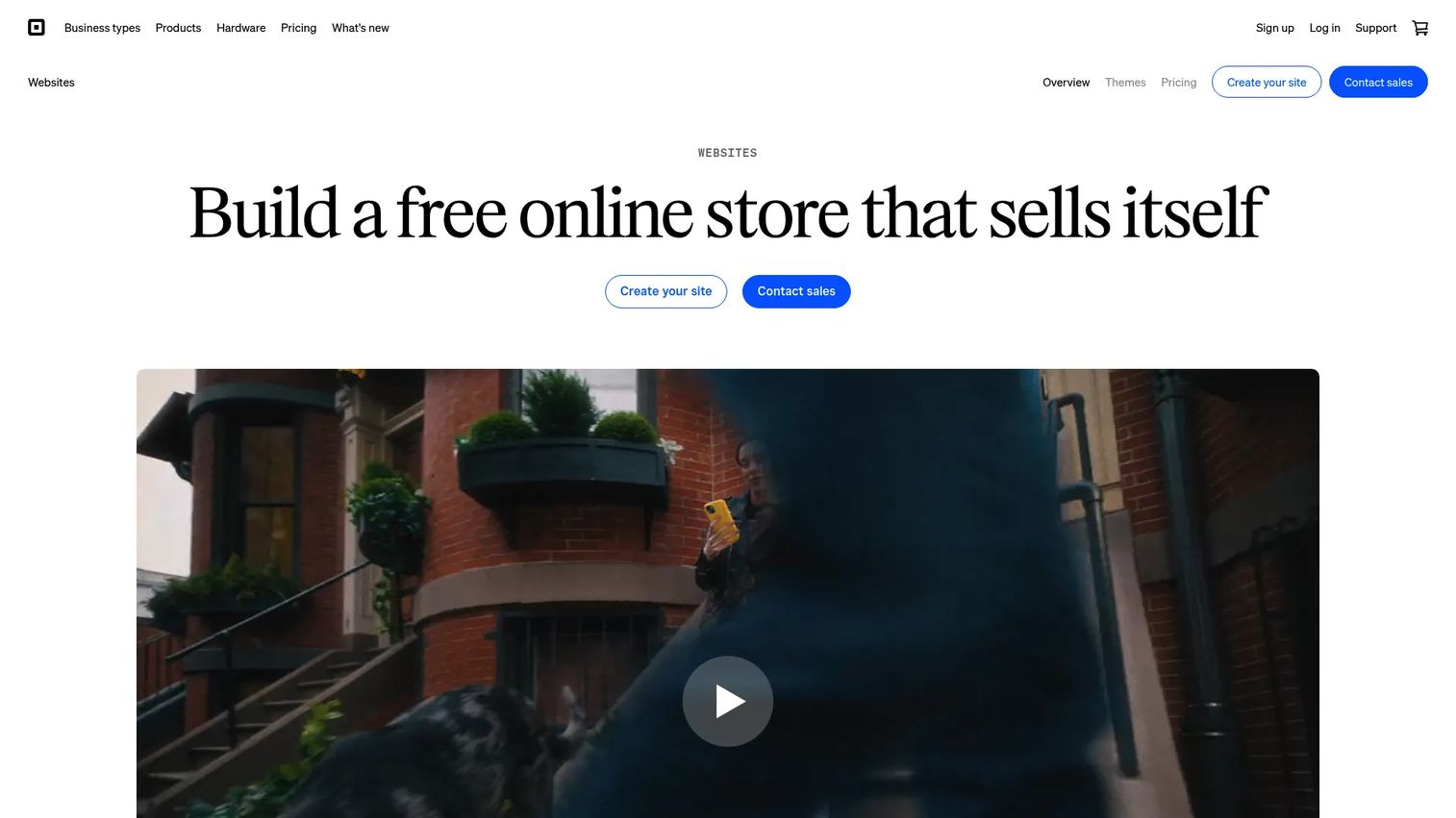
Square Online is an ecommerce and online ordering platform for restaurants and retail businesses that runs on top of Square's POS and payments infrastructure. It lets restaurants build a branded ordering page, accept pickup and local delivery orders, and sync inventory and order data with Square POS without any additional middleware. The platform also connects to Square Loyalty, Square Marketing, and gift cards, which makes it a coherent operating stack for restaurants already inside the Square ecosystem.
Best for: Restaurants already using Square POS that want to add direct online ordering without introducing a disconnected tool.
Key features
- Free branded online ordering page included
- Square POS sync for inventory, orders, and payments
- Pickup, local delivery, and QR code ordering
- Loyalty, gift cards, and email marketing integrations
- Google and Meta integrations for order-link distribution
Why choose Square Online: Square Online earns its place when Square already runs the register. The integration is native, not bolted on, and the free tier removes the barrier for restaurants testing direct ordering for the first time. Restaurants on a different POS should model the switching cost before moving.
Square Online pricing: The Free plan has no monthly fee. The Plus plan runs $29/month (billed annually at $348/year), and the Premium plan is $79/month ($948/year). Payment processing adds 2.9% + $0.30 per transaction on Free and Plus, dropping to 2.6% + $0.30 on Premium.
2. Toast Online Ordering
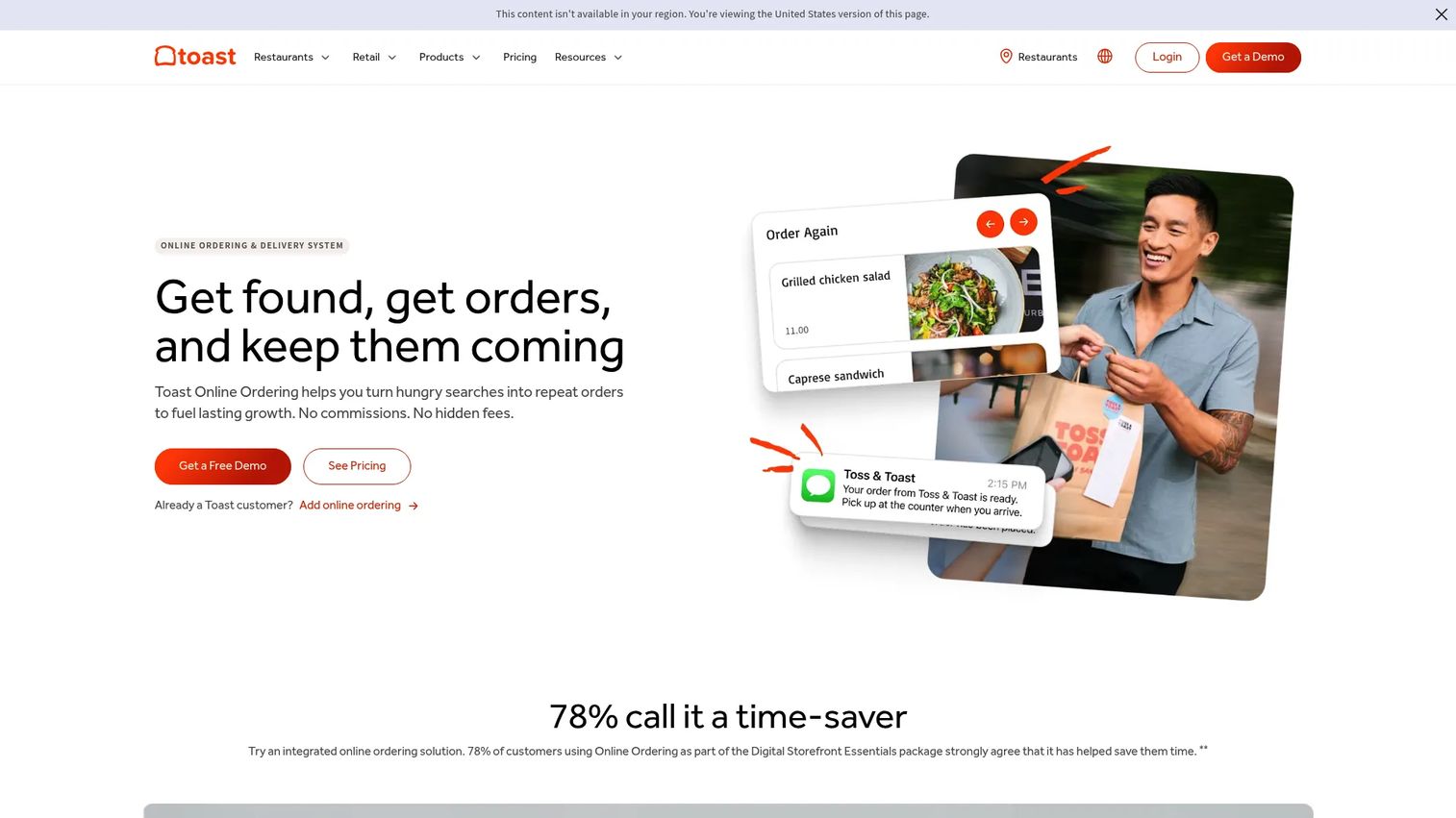
Toast Online Ordering is the direct ordering product built into the Toast restaurant platform. Orders placed through the branded ordering page flow directly into Toast POS and kitchen workflows, with no separate routing step. Toast markets the product as commission-free, with flat delivery fees rather than percentage-based marketplace commissions. The platform includes multi-location picker support, SEO-optimized menus, and Order with Google integration for discovery-to-checkout without leaving search.
Best for: Restaurants already standardized on Toast POS that want commission-free direct ordering without adding a third-party ordering layer.
Key features
- Native Toast POS and kitchen display integration
- Commission-free ordering with flat delivery fees
- Custom branding with fonts, colors, and images
- Order volume management and guest communications
- Multi-location picker and Order with Google
Why choose Toast Online Ordering: For Toast restaurants, this is the lowest-friction path to direct ordering. The kitchen routing is native, menu updates sync automatically, and there is no additional integration to maintain. Restaurants not on Toast POS need to evaluate the broader platform commitment alongside the ordering feature.
Toast Online Ordering pricing: Both plans are quote-based. Contact Toast sales for current plan pricing and what is included at each tier.
3. Chowly Platform
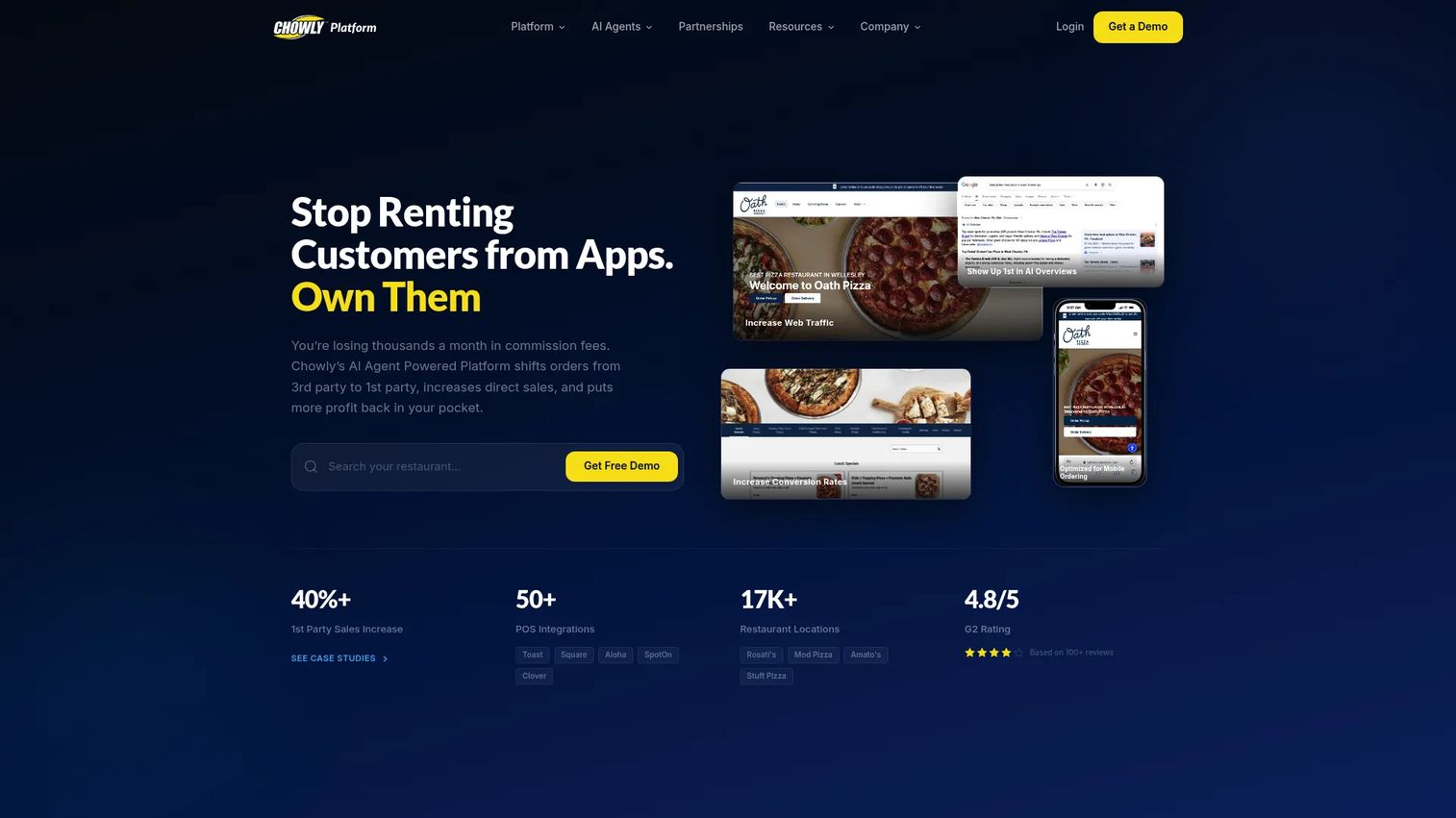
Chowly is an AI-powered restaurant platform that handles first-party online ordering, third-party delivery platform management, marketing, and guest engagement from a single control center. The platform integrates with more than 150 delivery apps and injects orders directly into the restaurant's POS, eliminating the tablet stack that many multi-channel operators manage manually. Beyond order routing, Chowly includes an AI-optimized marketing website, automated email campaigns, a branded mobile app, and a loyalty program with POS redemption.
Best for: Independent restaurants managing direct orders alongside multiple marketplace channels, particularly those losing staff time to manual tablet reentry.
Key features
- Commission-free first-party ordering on the restaurant's domain
- 150+ delivery app integrations with POS order injection
- Branded iOS and Android mobile app
- Automated email marketing and Google Ads management
- Loyalty program with in-store POS redemption and post-order survey routing
Why choose Chowly Platform: Chowly addresses a specific operational problem: Too many order channels, too many tablets, and no clean view of what's driving revenue. If the primary pain is channel fragmentation, Chowly's consolidation layer solves it more directly than a pure direct-ordering tool.
Chowly Platform pricing: Custom pricing. The official terms note a one-time setup fee and a monthly per-location fee with a $35/month minimum per location. Request a demo for current plan details.
G2 rating: 5.0/5 based on 6 reviews (G2).
4. Owner.com
Owner.com is an AI-powered growth platform for independent restaurants that combines an AI-optimized website, direct online ordering, a branded mobile app, loyalty and rewards, automated marketing, and chargeback protection under one subscription. The positioning centers on reducing marketplace dependence: Everything is built to increase the share of orders that come through the restaurant's own channels, with customer data flowing back to the operator rather than to a third-party platform.
Best for: Independent restaurants that want a direct-ordering and marketing engine, not just a checkout page, and are willing to pay a monthly subscription to own the customer relationship.
Key features
- AI-optimized website with automated SEO pages
- Direct online ordering with branded mobile app
- Loyalty, rewards, and automated marketing
- Direct catering orders and chargeback protection
- 24/7 support with setup and migration included
Why choose Owner.com: Owner.com makes the most sense for operators who want owned customer data, repeat-order automation, and marketing capability without stitching together separate tools. Restaurants that only need basic pickup ordering should compare the total monthly cost against a simpler ordering widget before committing.
Owner.com pricing: The Flexible plan runs $249/month plus a 5% restaurant fee per order. The Flat Rate plan is $499/month with no additional restaurant fees. Both plans charge guests a 5% order support fee. Billing is month-to-month on both.
G2 rating: 4.8/5 (G2, with 465 reviews verified at time of research).
5. ChowNow
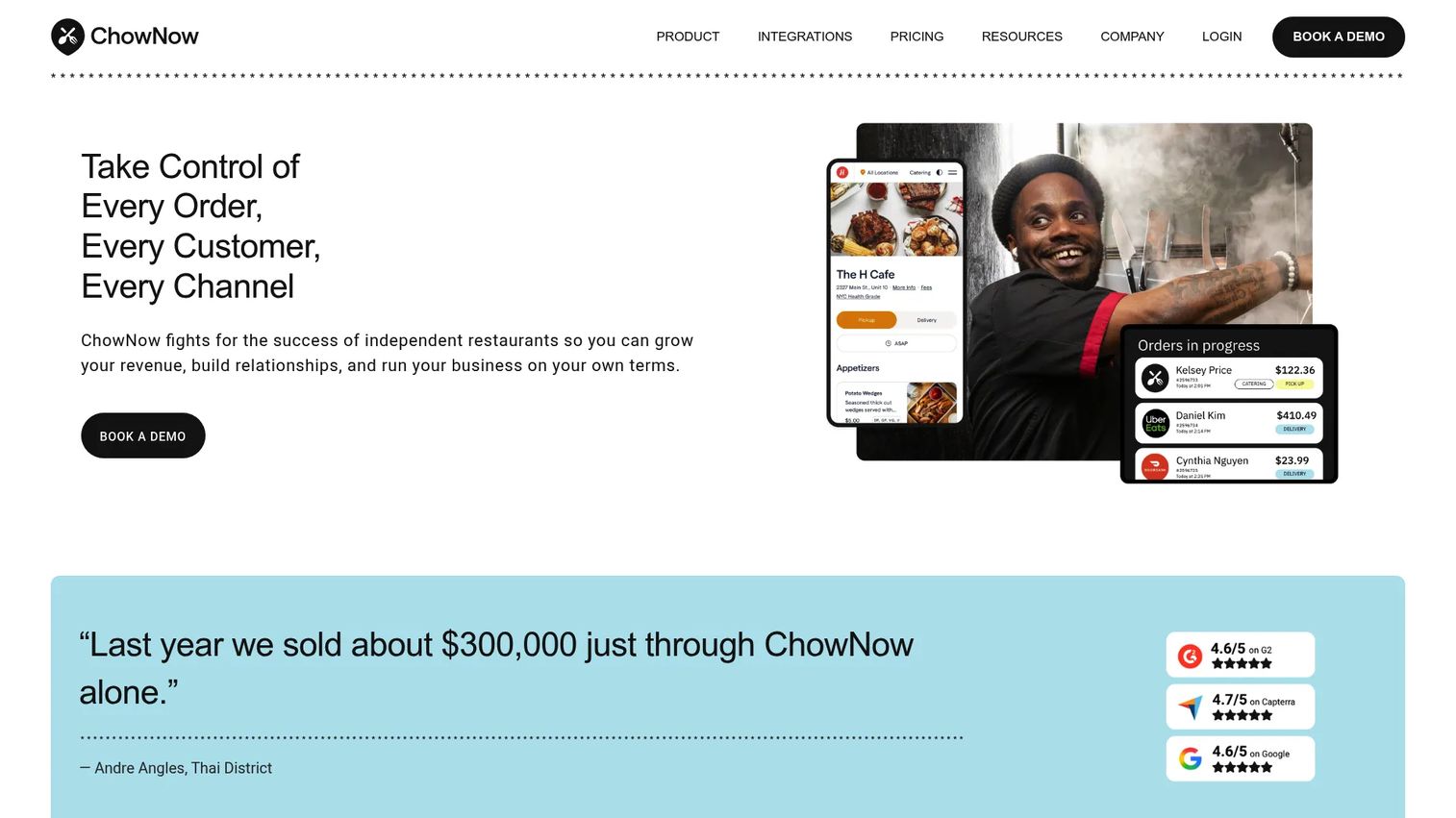
ChowNow is an online ordering, marketing, and operations platform for restaurants that positions direct ordering as commission-free. The platform covers branded ordering channels, pickup and delivery, customer data access, email and SMS marketing, loyalty and rewards, POS integrations, and order aggregation. ChowNow also operates a Reach plan with no monthly subscription fee that charges on qualifying orders, giving small restaurants a low-commitment entry point before moving to a paid plan.
Best for: Independent restaurants seeking commission-free direct ordering with integrated marketing tools and genuine customer data ownership.
Key features
- Branded ordering website and mobile app
- Commission-free ordering on paid plans
- Email, SMS, automated campaigns, and loyalty rewards
- POS integrations with centralized menu management
- Marketplace ordering, QR codes, and catering support
Why choose ChowNow: ChowNow fits restaurants where the goal is building a direct customer database, not just processing digital orders. The four-tier plan structure means you can start with Reach and scale into marketing and operations features as direct order volume grows. Total cost depends on plan tier, processing fees, delivery fees, and optional add-ons, so model it at your expected order volume.
ChowNow pricing: The Reach plan is $0/month. Launch starts at $229/month (annual) or $249/month (month-to-month). Grow runs $319/month (annual) or $349/month (month-to-month). Elevate is $409/month (annual) or $449/month (month-to-month). Setup, processing, and delivery fees apply separately.
G2 rating: 4.6/5 (G2).
6. Popmenu
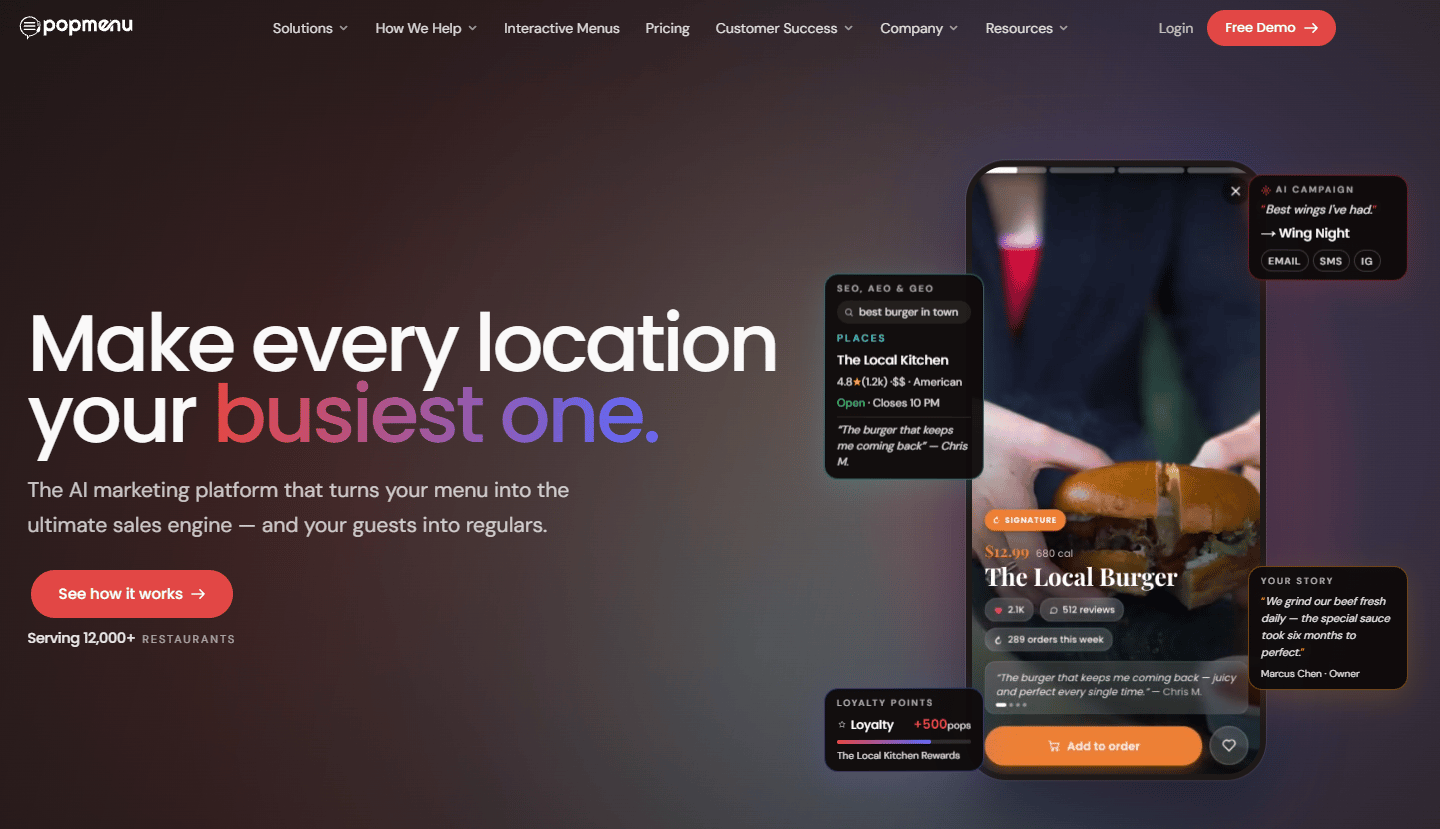
Popmenu is a restaurant technology platform that combines an SEO-focused website, interactive menus, online ordering, email and SMS marketing, digital reservations, loyalty, and reputation management. The interactive menu format converts static menu pages into indexed, linkable content, which Popmenu positions as a way to capture search intent from people looking for specific dishes or cuisines. Online ordering, catering, and POS integrations layer onto the website foundation.
Best for: Independent restaurants and hospitality groups that view their website as a primary revenue channel and want ordering tied to guest marketing and search visibility.
Key features
- SEO-driven websites with interactive, indexed menu pages
- Online ordering, pickup, delivery, and catering
- Email, SMS, AI-generated content, and marketing calendar
- Digital waitlist, reservations, and guest feedback
- Reputation management with AI review replies
Why choose Popmenu: Popmenu pays off when the restaurant is actively investing in its own web presence. The SEO menu structure drives organic discovery, and the marketing tools create automated retention campaigns from guest data collected through ordering. Restaurants whose primary need is order injection into an existing POS may find Popmenu more than they need.
Popmenu pricing: Starter starts at $159/month (prepaid annually). Essentials is $269/month (prepaid annually). Premier is $449/month (prepaid annually). A Build Your Own option is available through sales. Annual pricing reflects a 10% discount versus month-to-month.
G2 rating: 4.7/5 (G2).
7. GloriaFood
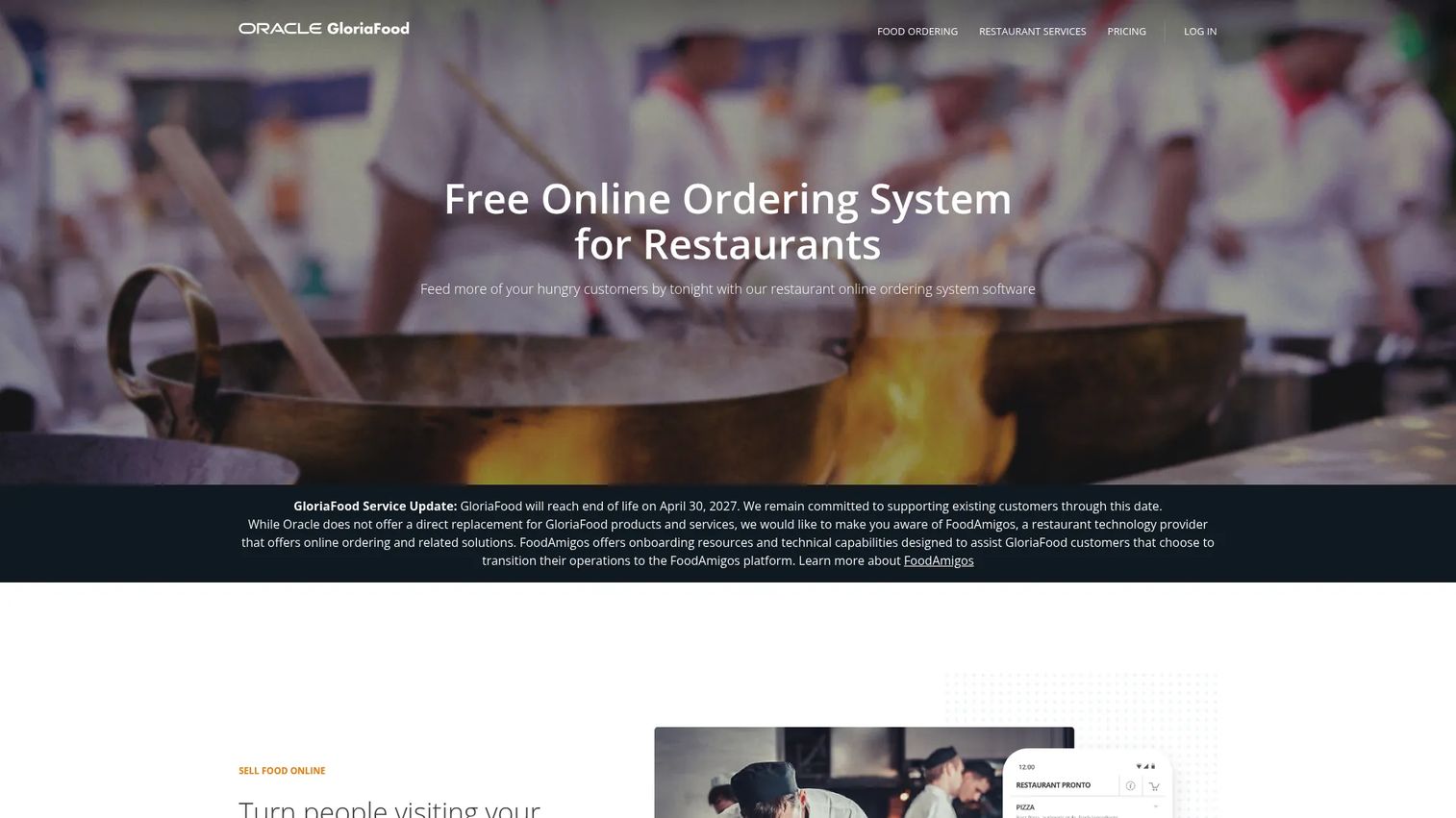
GloriaFood is a free online ordering and reservation platform for restaurants that covers delivery, pickup, dine-in, and scheduled orders. Restaurants add an ordering widget to their existing website, manage orders through an Android or iOS app, and accept table reservations without paying a monthly fee for core functionality. QR code dine-in ordering and multi-location support are included. Paid add-ons cover online payment processing, a POS system, table reservation deposits, and advanced promotional marketing.
Important note: GloriaFood has announced end-of-life on April 30, 2027. Factor that timeline into any long-term platform decision.
Best for: Small restaurants that need a low-cost way to start accepting online orders immediately, before committing to a paid platform.
Key features
- Free online ordering for delivery, pickup, and dine-in
- Table reservations and order-ahead functionality
- QR code table ordering
- Android and iOS order management app
- Promotions, coupons, and analytics
Why choose GloriaFood: The free core plan removes the financial barrier for restaurants testing direct ordering. Online payment processing, POS functionality, and advanced promotions each require paid add-ons, so the total cost scales with the features you activate. Given the 2027 end-of-life date, treat GloriaFood as a short-term option or migration stepping stone.
GloriaFood pricing: The core service plan is free. The POS system add-on is $49/month per location (2-year commitment). Online payment processing is $29/month. Table reservation deposits cost $0.50 per accepted booking. Advanced promo marketing is $19/month.
G2 rating: 4.7/5 (G2).
8. Menufy
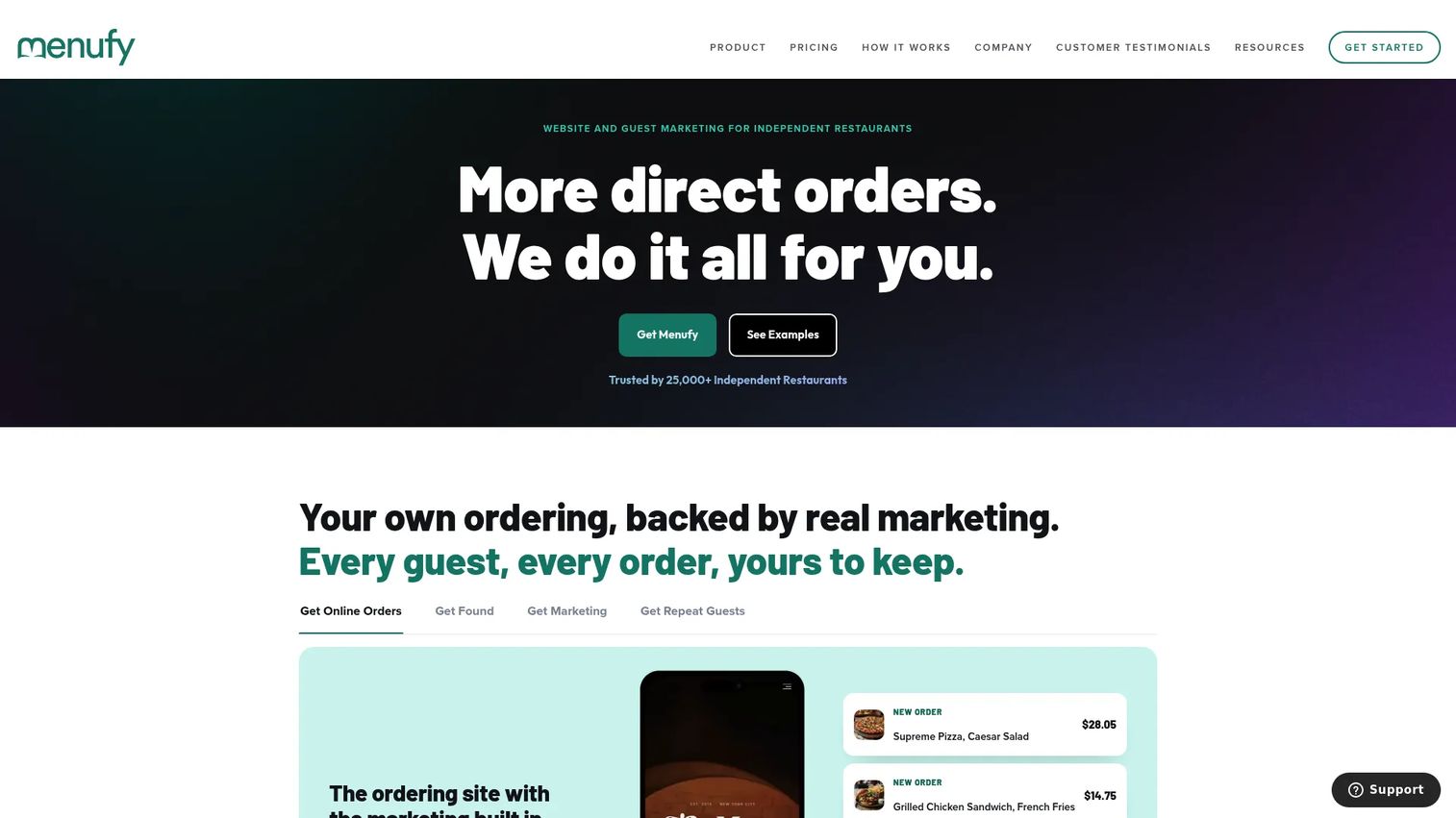
Menufy provides branded online ordering websites and managed marketing for independent restaurants. The platform covers direct ordering, Google ordering, automated email and text marketing, loyalty programs, and AI-powered Google review tools. Pricing is a flat monthly fee with no per-order commissions, which simplifies total cost modeling compared with percentage-based alternatives. The annual plan includes free equipment, adding hardware value to the subscription.
Best for: Independent restaurants that want managed direct ordering without building their own ordering flow, and prefer predictable flat-rate pricing over commission structures.
Key features
- Direct online ordering with branded page
- Google ordering and SEO integration
- Automated email and text marketing
- Loyalty programs and coupons
- AI-powered Google review tools and cloud reporting
Why choose Menufy: Menufy fits restaurants that want to hand off the ordering and marketing infrastructure and pay a flat rate. The absence of per-order commissions makes it easier to project monthly cost as order volume grows. Restaurants needing deep POS-native workflows should compare Menufy's integration options against their current POS before switching.
Menufy pricing: The Annual plan is $149/month over a 12-month agreement, with free equipment included. The Month-to-Month plan is $179/month with no contract. No per-order commissions apply on either plan.
9. Restolabs
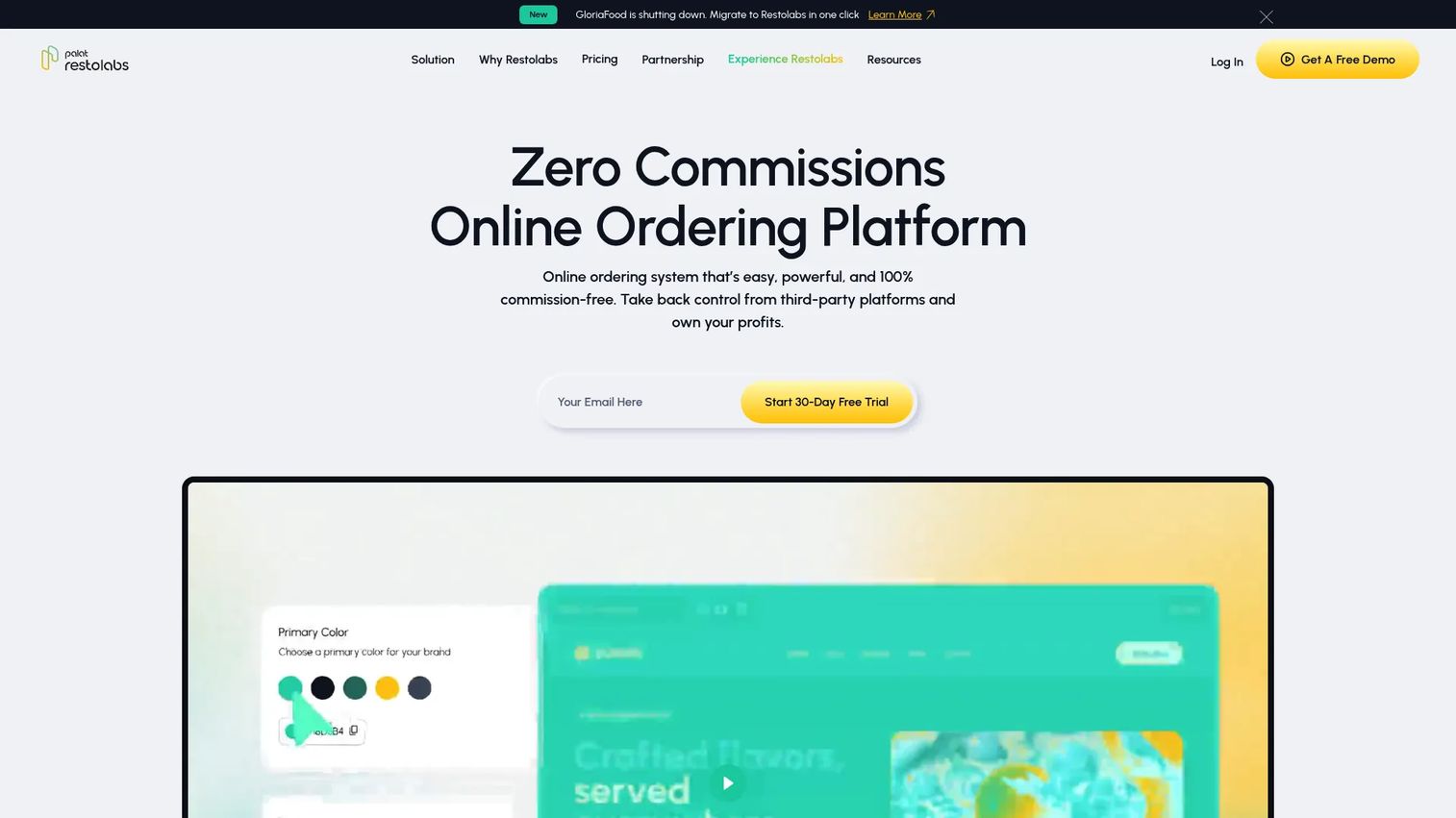
Restolabs is a commission-free online ordering and restaurant growth platform for independent restaurants and small chains. It covers pickup, delivery, curbside, dine-in, and catering orders through a branded website and native iOS and Android apps. Delivery zone management, live order tracking, and third-party delivery integrations are built in, as are loyalty programs, coupons, QR code dine-in ordering, and an SEO-optimized website. The platform serves multi-location operators with location-level controls and consolidated reporting.
Best for: Restaurants and small chains that want configurable direct ordering, delivery management, and loyalty without paying per-order commissions.
Key features
- Commission-free ordering for pickup, delivery, curbside, dine-in, and catering
- Delivery zone management, live tracking, and third-party delivery integrations
- Loyalty with points, coupons, gift cards, and push notifications
- Branded website and iOS/Android mobile apps
- QR dine-in ordering and real-time analytics
Why choose Restolabs: Restolabs gives multi-location operators configurability that simpler tools lack, specifically location-specific menus, delivery zones, and reporting. The tiered plan structure lets operators start at $69/month and add features as the operation grows. Verify integration requirements against your current POS before committing.
Restolabs pricing: Basic runs $69/month. Growth is $99/month. Pro is $199/month. All plans include a 30-day free trial. Add-ons include a custom website for $29/month, a branded mobile app for $49/month, and Google Business Profile setup for $19/month.
G2 rating: 4.2/5 (G2).
10. BentoBox
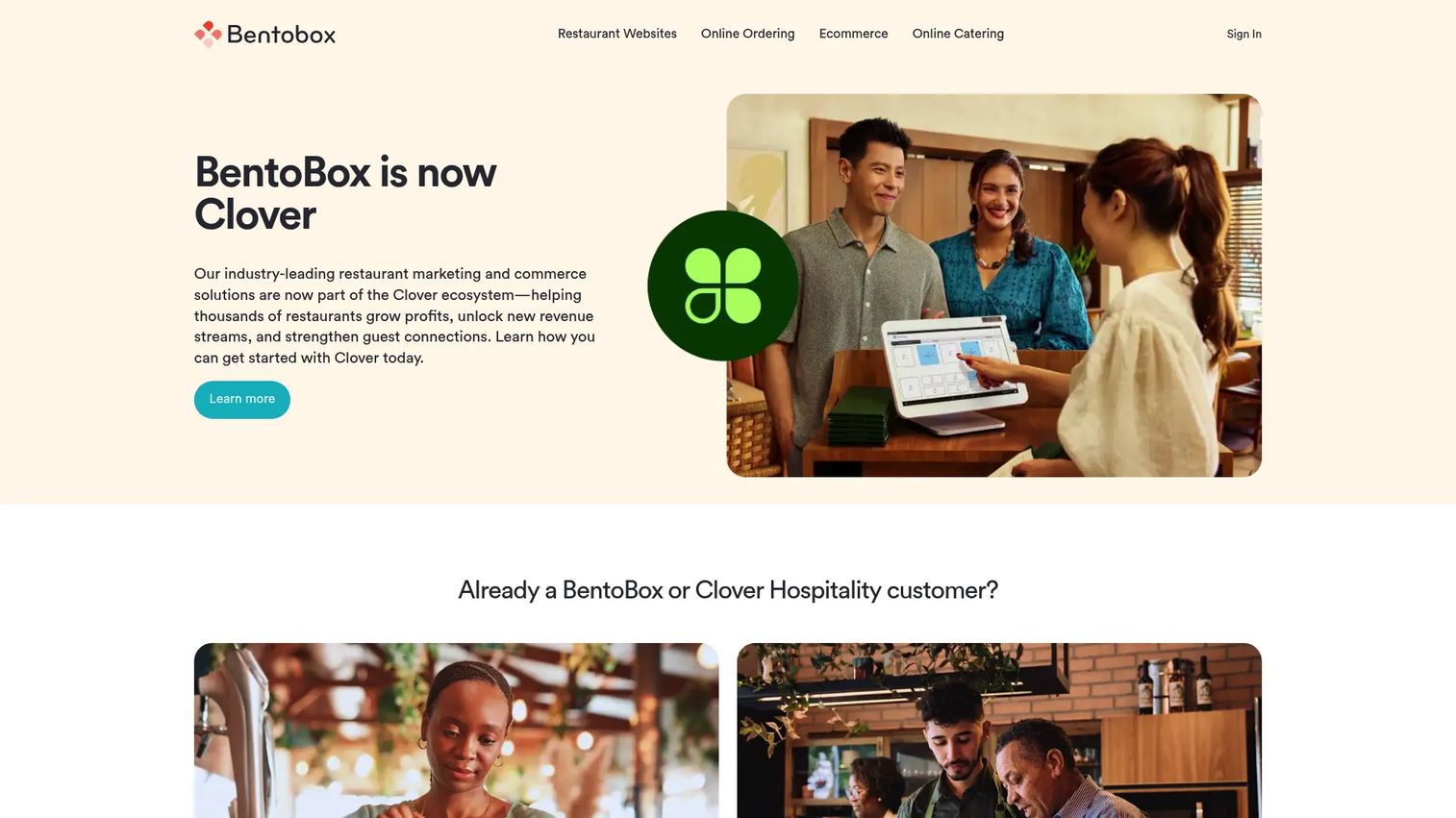
BentoBox is a restaurant marketing and commerce platform that combines website design, online ordering, ecommerce, catering, and reservations. It is currently available only to Clover POS customers, which makes it a direct extension of the Clover ecosystem rather than a standalone ordering tool. BentoBox is well-suited for restaurants that want a polished branded web presence tied to their existing Clover POS and payment infrastructure.
Best for: Restaurants using Clover POS that want an integrated website, ordering, and guest-engagement platform without connecting a third-party ordering system.
Key features
- Restaurant website with brand-focused templates
- Online ordering and ecommerce
- Online catering and event pages
- Reservations and marketing tools
- Clover POS integration
Why choose BentoBox: BentoBox earns its place when the restaurant is already on Clover and needs a branded website and ordering experience that connects natively to POS. Restaurants not on Clover should evaluate other options, as BentoBox is not available outside the Clover ecosystem.
BentoBox pricing: BentoBox does not publish pricing on its current website. Contact sales for plan details and packaging.
G2 rating: 4.6/5 (G2).
11. Clover POS
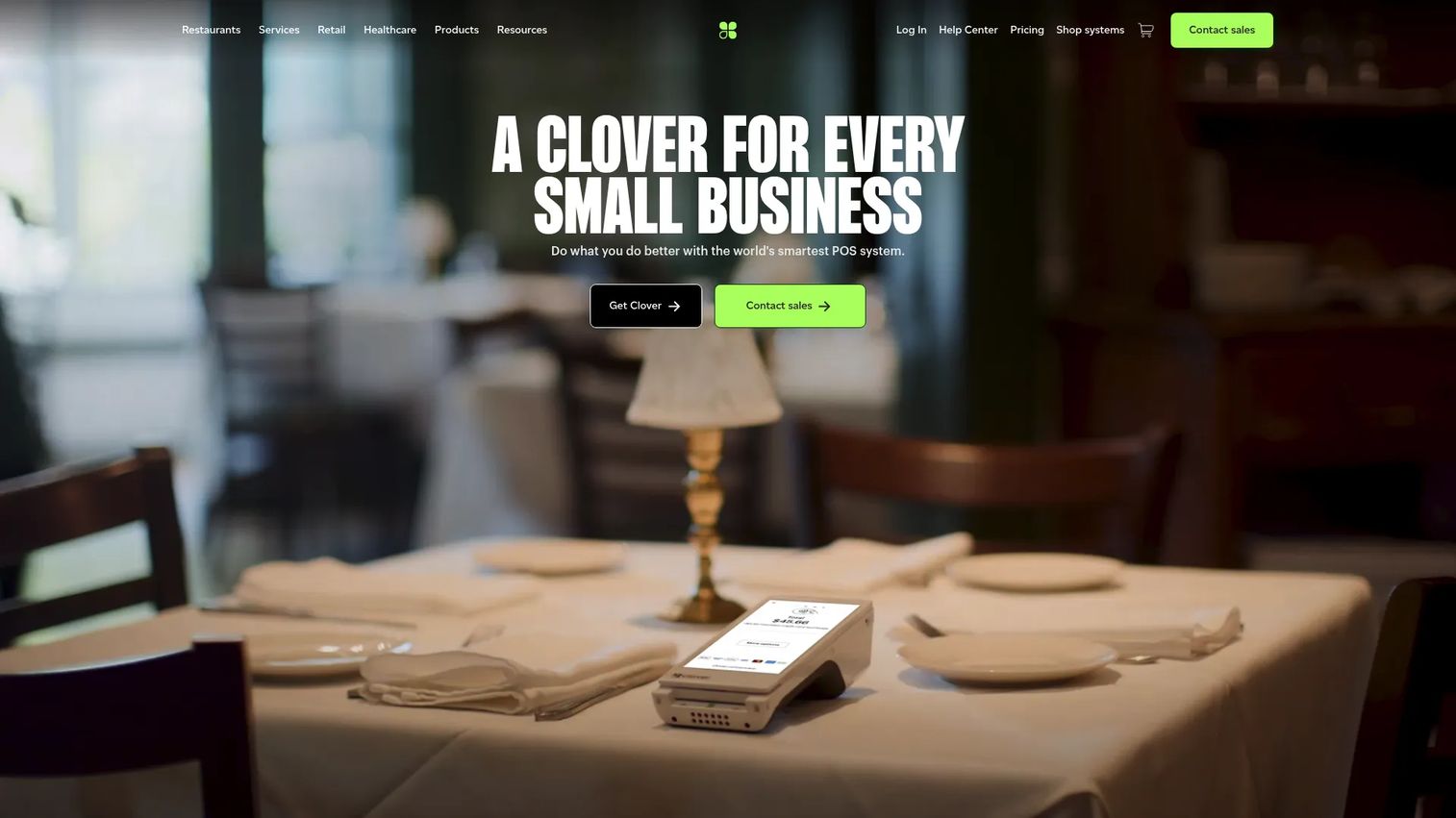
Clover is a cloud-based point-of-sale and payments system for restaurants and retail businesses. Its product line covers hardware from handheld readers to full kitchen display systems, with software for order management, employee shifts, inventory, customer engagement, and reporting. Online ordering capability is available through the Clover app marketplace, and BentoBox provides website and ordering integration for Clover customers. For restaurants evaluating the best POS software alongside ordering tools, Clover bundles hardware, payment processing, and software into one merchant relationship.
Best for: Restaurants that want online ordering tied to POS hardware and payment processing under one provider, particularly those building a new location from scratch.
Key features
- POS hardware from compact readers to full counter stations
- Payment acceptance including cards, mobile wallets, and stored payments
- Employee management, inventory, and performance reporting
- Customer engagement with rewards, promotions, and gift cards
- App Market integrations including online ordering and delivery tools
Why choose Clover POS: Clover suits restaurants that want hardware, software, and payment processing from one vendor rather than assembling a stack. Evaluate the total cost across hardware, software plan, and processing rates together, as these vary by business type and agreement terms.
Clover POS pricing: Hardware starts at $16/month for 36 months (or $349 one-time) for the Compact reader. The Station Duo runs $180/month for 36 months (or $1,899). KDS units run $799 to $899 plus $25/month per device. Software and processing rates vary by plan and business type.
G2 rating: 3.8/5 (G2).
12. Oracle
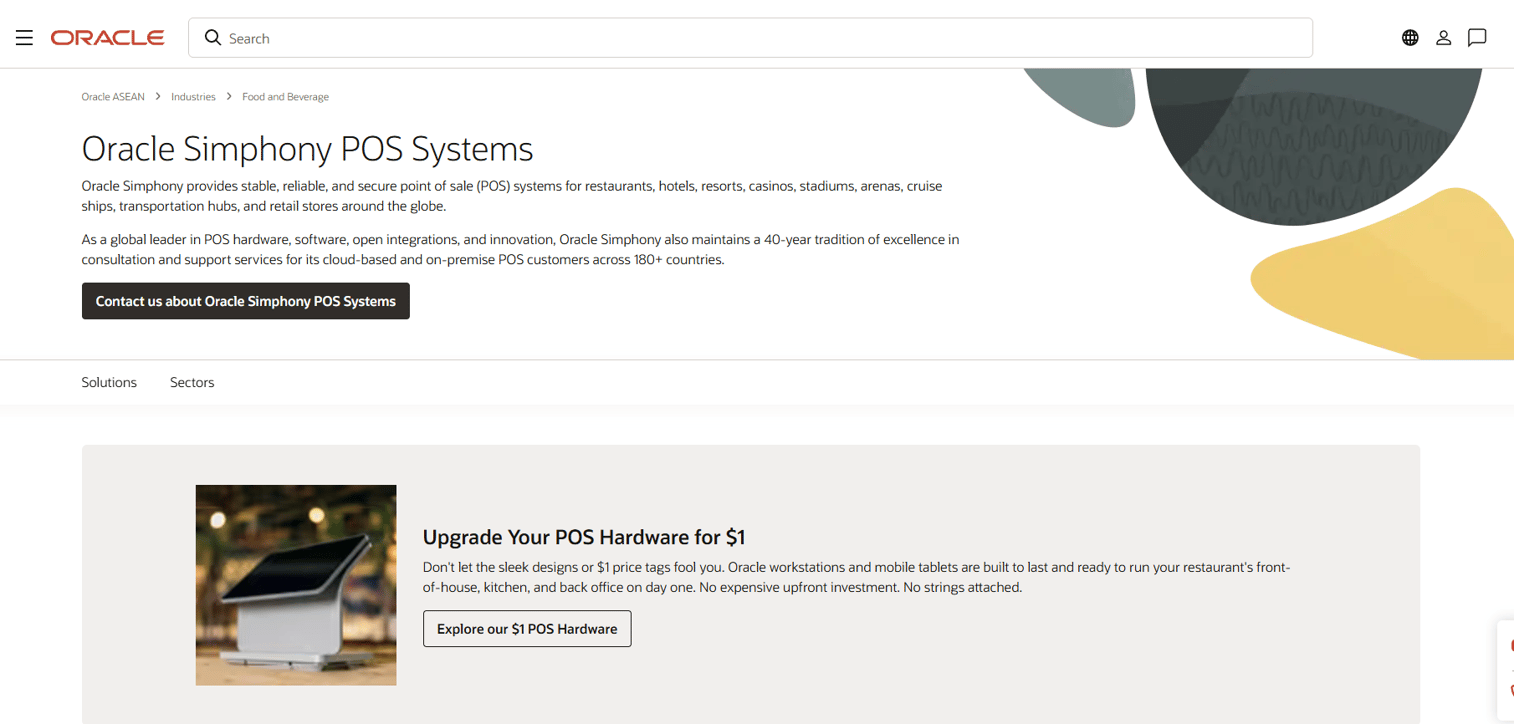
Oracle provides enterprise restaurant technology through the Oracle MICROS Simphony POS ecosystem, which includes online ordering, delivery, analytics, and operational management for restaurant groups, hotel food-and-beverage operations, and large chains. The platform handles multi-location controls, complex menu management, real-time operational reporting, and integrated payments. For operators building a bar POS software stack alongside full-service restaurant operations, Oracle's ecosystem covers both. It is an enterprise decision requiring IT, procurement, and operational governance involvement.
Best for: Large restaurant groups, hotel food-and-beverage operators, and enterprise chains that need connected POS, ordering, analytics, and compliance infrastructure at scale.
Key features
- Enterprise POS through Oracle MICROS Simphony
- Integrated online ordering and delivery management
- Multi-location controls and menu management
- Real-time restaurant analytics and operational reporting
- Payment processing with published per-transaction fees
Why choose Oracle: Oracle fits operations where scale, governance, and integration complexity are the primary buying criteria. A single-location restaurant looking for fast setup should look elsewhere. The buying process involves scoping by location count, POS modules, integrations, support tiers, and services.
Oracle pricing: Oracle publishes payment processing fees: Card-present transactions at 2.45% plus $0.15, card-not-present at 2.99% plus $0.18.
G2 rating: 3.6/5 for Oracle MICROS Simphony (G2).
13. HungerRush
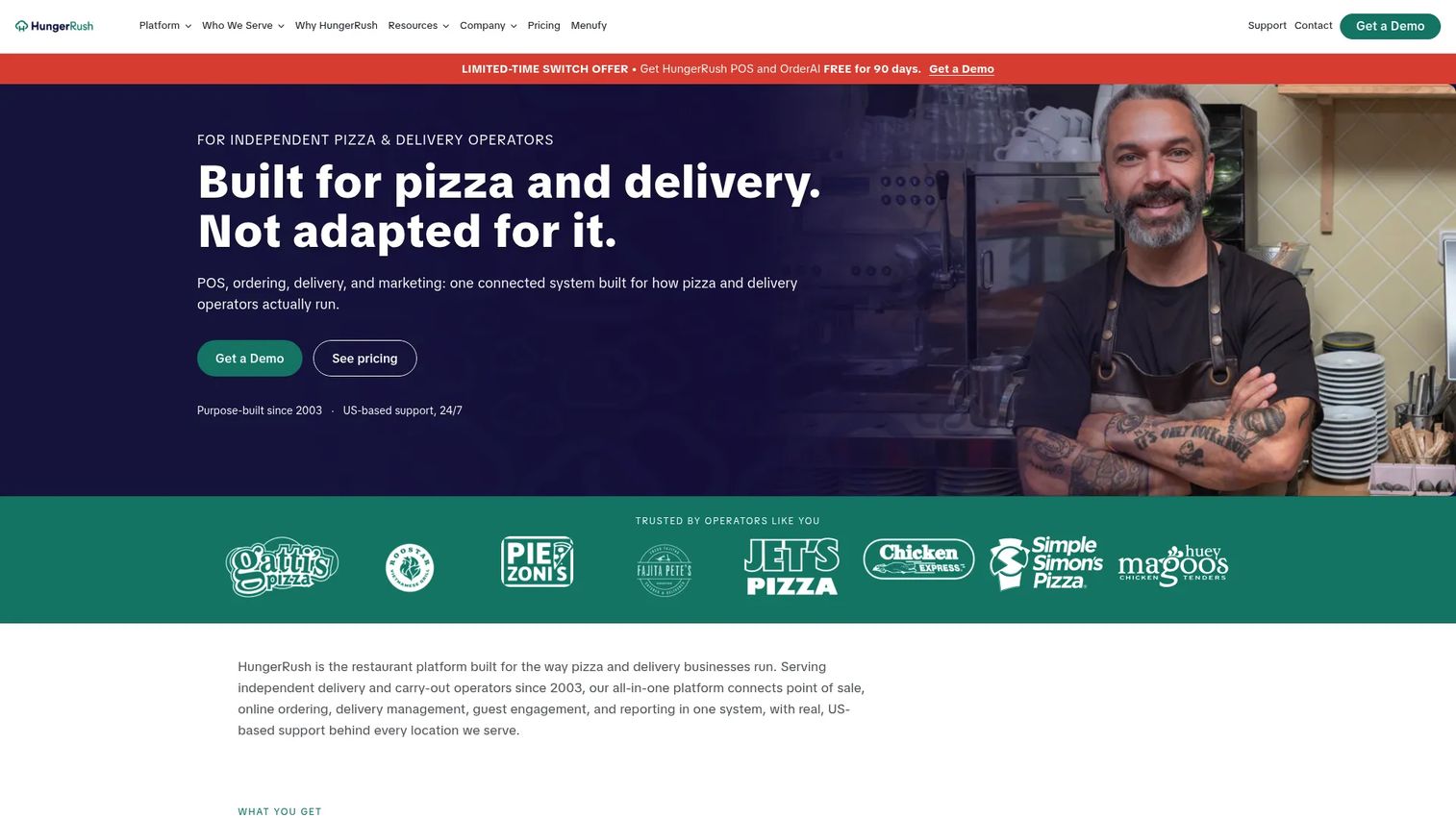
HungerRush is an all-in-one restaurant platform for POS, online ordering, delivery dispatch, driver tracking, guest engagement, and business management. The platform includes pizza-specific features such as half-and-half pricing logic and modifier handling, along with an AI phone ordering system (OrderAI) that handles incoming calls and routes orders directly to the POS. Loyalty, marketing, gift cards, and a kitchen display system are available as additional modules.
Best for: Independent pizza and delivery-focused restaurants needing integrated POS, online ordering, delivery dispatch, and guest engagement in one platform.
Key features
- POS with pizza-specific modifier and half-and-half pricing logic
- Online ordering with direct POS integration and delivery dispatch
- OrderAI phone ordering system
- Kitchen display system with real-time order sync
- Loyalty, marketing, gift cards, and multi-location management
Why choose HungerRush: HungerRush is purpose-built for restaurants where delivery is the primary revenue channel, not an add-on. The delivery dispatch and driver tracking are native, not integrated from a third party, which matters when order volume is high and routing errors are expensive. Restaurants with primarily dine-in operations should compare the module structure carefully before committing.
HungerRush pricing: The Base Package starts at $149/month on a 36-month agreement and includes hardware, core POS software, online ordering, and delivery management. Additional modules (marketing, loyalty, gift cards, OrderAI) are available through a custom Build Your Own package.
G2 rating: 4.4/5 (G2).
14. Deliverect
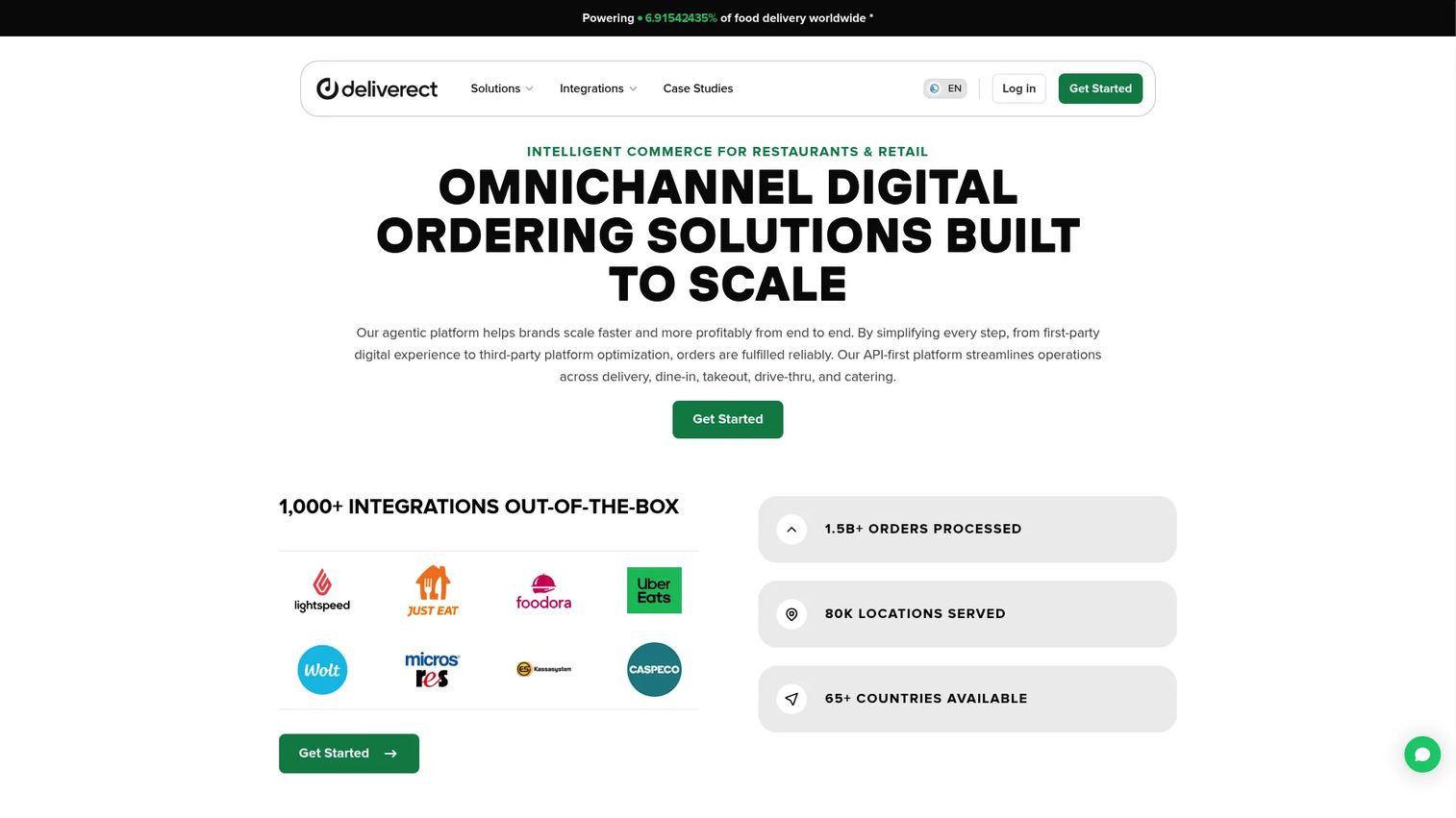
Deliverect provides enterprise digital ordering and marketplace management for restaurant businesses. It covers first-party web, app, QR code, and kiosk ordering alongside third-party order aggregation with POS injection, menu synchronization, and dispatch. The platform includes in-house fleet management, delivery-partner integrations, live order tracking, and a catering module. Deliverect is built for operators running high order volumes across both owned channels and delivery marketplaces, where operational control and channel visibility matter more than setup speed.
Best for: Multi-channel restaurant groups that want direct ordering alongside centralized marketplace management, delivery dispatch, and POS-level order control.
Key features
- First-party ordering via web, app, QR code, and kiosk
- Third-party order aggregation with POS injection and menu sync
- Delivery dispatch, in-house fleet management, and live tracking
- Order analytics and revenue reporting across channels
- Catering and large-order management
Why choose Deliverect: Deliverect addresses the complexity of running direct and marketplace channels at scale. If the operational problem is fragmented order management across channels, Deliverect's aggregation and routing layer solves it. Smaller operators with simple direct-ordering needs may find the platform more than the operation requires.
Deliverect pricing: The US price list shows $119/month for 0 to 350 orders per month, $199/month for 351 to 750 orders, and $249/month for 751 to 1,500 orders. Many Deliverect solutions are currently priced on a custom-quote basis on the main website. Volume thresholds and channel add-ons drive total cost.
G2 rating: 2.3/5 (G2).
Considerations when choosing restaurant online ordering software
Start with your POS reality
The first buying question is not which ordering page looks best. It is where orders land when they come in. If the order does not reach the POS or kitchen cleanly, the workaround becomes a nightly staff task. Map your POS first, then shortlist ordering tools with confirmed integration depth for that specific system.
Model total cost, not only the subscription price
A platform marketed as commission-free may still carry payment processing fees, delivery fees, setup fees, hardware costs, and paid add-ons for features listed in the marketing. At 500 orders per month, a $0.30 processing fee adds $150/month before anything else. Build a simple model using your expected order volume, average ticket size, and all applicable fees. Then compare tools on that number, not the headline subscription.
Decide who owns customer data
First-party ordering gives you the customer's email address, order history, and behavioral data. Third-party marketplaces usually keep that data for themselves. If retention, loyalty, and lifetime value matter to the operation, choose a platform that captures and returns customer data to you. This is the distinction between the best customer data platform logic applied to restaurant operations, and it compounds over time.
Check menu and modifier complexity
Restaurants with combos, modifiers, substitutions, and location-specific menus need stronger menu management than a simple cafe with five items. Test the menu builder against your most complex item before committing. A platform that handles simple orders cleanly but fails on a half-and-half pizza or a burger with 12 modifier options creates kitchen confusion at peak hours.
Plan for multi-location operations from day one
Multi-location support varies significantly across platforms. Evaluate whether the tool handles location routing, geolocation, location-specific menus and hours, consolidated reporting across locations, and role-based access for location-level managers. Adding locations to a tool not built for it often means rebuilding menus and workflows from scratch.
Conclusion
The right restaurant online ordering software is the one that sends orders to the right kitchen, gives you customer data, and survives scrutiny on total cost once processing fees and add-ons are included.
For restaurants already on Square, Square Online adds direct ordering with no switching friction. Toast restaurants get the same native integration through Toast Online Ordering. Operators running multiple marketplace channels benefit most from Chowly Platform or Deliverect, which centralize order management rather than replacing it.
Owner.com and ChowNow both make a strong case for independent restaurants focused on building direct customer relationships and reducing marketplace dependence. Popmenu fits when the restaurant website is a primary acquisition channel. GloriaFood is the fastest zero-cost starting point, though its 2027 end-of-life date limits the planning horizon.
For delivery-heavy operations, HungerRush's native dispatch and AI phone ordering give it a real operational advantage. Oracle and Deliverect serve enterprise groups where scale, governance, and multi-location control outweigh setup speed. Restolabs and Menufy offer a middle path: Flat-rate pricing, commission-free ordering, and enough feature depth for small chains without enterprise complexity.
If your team also needs to show software experiences to buyers, Start your journey with Guideflow today!
FAQs
Restaurant online ordering software lets restaurants accept, manage, and fulfill digital orders from owned channels such as websites, mobile pages, QR codes, and social profiles. It differs from third-party marketplace apps in that the restaurant controls the branded storefront, owns the customer data, and typically pays a subscription or processing fee rather than a per-order marketplace commission. Most platforms also handle menu management, POS routing, and payment processing.
Costs vary by pricing model. Free plans exist (GloriaFood, ChowNow Reach) but typically require paid add-ons for payments and advanced features. Paid plans range from $69/month (Restolabs Basic) to $499/month (Owner.com Flat Rate). Payment processing fees, delivery fees, setup costs, hardware, and add-ons all affect total monthly spend. The clearest way to compare is to model total monthly cost at your expected order volume and average ticket size across all applicable fees.
GloriaFood offers a free core plan that covers online ordering, reservations, and basic promotions. ChowNow's Reach plan also starts at $0/month. Both platforms charge separately for online payment processing and additional features. Free entry points work best for restaurants testing direct ordering before committing to a paid subscription. Keep in mind GloriaFood reaches end-of-life in April 2027.
Some do and some do not. Third-party marketplaces like delivery apps typically charge restaurants a commission per order (often 15% to 30%). Most direct-ordering platforms reviewed here market themselves as commission-free on paid plans, meaning the restaurant pays a subscription fee instead of a cut of each order. Payment processing fees, however, still apply on virtually all platforms regardless of commission structure.
In most cases, yes. Many platforms inject orders directly into an existing POS through integrations, middleware, or the POS's own app marketplace. Integration depth varies: Some tools offer native two-way sync, while others use a middleware step or manual export. Confirm that your current POS is on the vendor's supported integration list before signing a contract, and ask specifically about how menu updates sync between the two systems.
First-party ordering happens through channels owned or controlled by the restaurant: A branded website, a restaurant-specific app, or a QR code at the table. The restaurant collects the customer's contact information, order history, and behavioral data. Third-party marketplaces (delivery aggregators) handle discovery and logistics, but the customer relationship belongs to the platform, not the restaurant. First-party ordering builds a direct customer database; third-party platforms rent you access to demand without giving you the underlying customer data.
Most platforms on this list support multiple fulfillment types, but availability depends on the specific vendor and plan tier. Pickup and curbside are widely available. Delivery typically requires a delivery zone configuration and either an in-house driver fleet, a delivery integration, or a third-party courier. Scheduled or ordered-ahead functionality is common on mid-tier and higher plans. Verify which fulfillment types are included at the plan tier you are evaluating.
Evaluate whether the platform handles location-level routing (directing orders to the correct kitchen), geolocation (showing the nearest location to a customer automatically), location-specific menus and hours, and consolidated cross-location reporting. Role-based access matters for giving location managers the ability to update their own menus and hours without touching other locations. Tools like Restolabs, HungerRush, Deliverect, and Oracle are built with multi-location operators in mind. Single-location tools may technically support multiple locations but can require manual workarounds as the operation scales.