You can launch a search campaign in an afternoon. Proving which clicks turned into pipeline takes considerably longer. U.S. search ad revenue reached $114.2 billion in 2025, up 11% year over year according to IAB/PwC (2026), which means more teams are competing for the same search real estate with tighter scrutiny on every dollar spent.
Paid search software exists because the native ad account is only one piece of the workflow. Keyword research, budget pacing, conversion tracking, landing page quality, reporting, and stakeholder explanations all sit around it. Some tools buy the media. Others optimize the account. Still others explain performance. The right choice depends on which layer is breaking for your team.
This guide cuts through 14 options across native platforms, optimization tools, enterprise bid management, and competitive research, so you can match the tool to the actual problem.
What's inside
This guide is for growth marketers, paid media managers, demand gen teams, and agencies evaluating paid search software in 2026.
- What's covered: Native ad platforms, PPC management software, enterprise bid platforms, and competitive intelligence tools
- Selection criteria: Workflow fit for paid search, depth of campaign automation, reporting and attribution capabilities, and pricing transparency
- Verification: Pricing and G2 ratings checked against live vendor pages and G2 listings
- Who this is not for: Teams looking for display-only, programmatic, or paid social tools without any search component
TL;DR
- Best native platform for most search advertisers: Google Ads handles the majority of search intent and is the required starting point for most teams
- Best for Microsoft search inventory: Microsoft Advertising extends reach beyond Google with a separate bidding environment
- Best for app install campaigns: Apple Search Ads covers high-intent App Store search for mobile-first teams
- Best for enterprise paid search teams: Search Ads 360 fits Google Marketing Platform-aligned organizations; Skai suits large cross-channel programs with retail media needs
- Best for agencies managing multiple PPC accounts: Optmyzr combines automation, audits, and reporting in one PPC management workflow
- Best for competitive research before launch: Semrush and SpyFu surface competitor keywords and ad history before you commit budget
- Best for accessible optimization: Adzooma and Opteo give lean teams structured improvement workflows without enterprise overhead
What is paid search advertising software?
Paid search advertising software helps marketers create, manage, optimize, and measure ads that appear on search engines, app stores, shopping surfaces, and related search-driven placements. The category is not one tool. It is a stack layer, and understanding the layers helps you buy the right thing.
Native ad platforms
These are where ads are actually bought and served. Google Ads, Microsoft Advertising, and Apple Search Ads fall here. You cannot run search campaigns without access to at least one of these. Every other tool in this category wraps around them.
PPC management and optimization tools
These sit above native platforms and automate checks, bidding recommendations, budget pacing, keyword cleanup, and reporting. They are relevant once account complexity makes manual QA slow or when you manage more than a handful of campaigns.
Enterprise bid and portfolio platforms
Cross-account and cross-channel platforms built for large teams that need portfolio bidding, governance workflows, and advanced attribution. Search Ads 360, Skai, and Marin Software operate at this layer. They are not starter tools.
Research and intelligence tools
Competitor keyword research, ad copy history, PPC keyword discovery, and market visibility. Semrush and SpyFu live here. They feed your strategy rather than execute it.
Key capabilities to evaluate across this category:
- Campaign creation and ad group management
- Keyword research and match type control
- Negative keyword discovery
- Bid automation and bid management workflows
- Conversion tracking and attribution
- Search term analysis
- Ad copy testing
- ROAS, CPA, CTR, and conversion reporting
- Cross-account governance
When to use paid search advertising software
Scale campaigns beyond one account
Native dashboards handle a single account cleanly. Once you are managing multiple products, markets, clients, or regions, pacing, reporting, and QA become manual and error-prone. A campaign management software layer reduces the coordination cost as accounts multiply.
Reduce wasted spend before it compounds
Search term analysis surfaces queries you should not be bidding on. Negative keyword management stops them from eating budget. Budget alerts catch overspend before the end of the month. These checks are possible manually, but optimization tools run them continuously and flag what needs attention, which directly affects CPA.
Prove performance across the funnel
Conversion tracking connects clicks to revenue. ROAS and CPA reporting tell the CMO whether search is pulling its weight. Attribution gaps are where most teams struggle most. Paid search software should make that reporting faster, not just prettier. If it cannot connect ad activity to pipeline contribution, it is solving the wrong problem for a growth marketer accountable to CAC targets.
Paid search advertising software comparison
The table below is a starting point for evaluation. Native platforms serve ads. Third-party tools optimize, report on, or add workflow control on top of them. Most teams need at least one native platform plus one additional layer depending on their scale and workflow gaps.
| # | Product | Best for | Key differentiator | Pricing | G2 rating |
|---|---|---|---|---|---|
| 1 | Google Ads | Most paid search advertisers | Largest search ad inventory with native buying controls | Pay per click/impression | 4.3/5 |
| 2 | Microsoft Advertising | Bing and Microsoft network campaigns | Lower-competition search inventory with LinkedIn profile targeting | Pay per click/impression | N/A |
| 3 | Apple Search Ads | App growth teams | Paid search inside the App Store | Pay per tap or install | 4.2/5 |
| 4 | Google Ads Editor | Bulk Google Ads edits | Free offline bulk editing for large accounts | Free | N/A |
| 5 | Search Ads 360 | Enterprise Google-centric teams | Cross-engine management inside Google Marketing Platform | Contract-based | N/A |
| 6 | Optmyzr | Agencies and advanced PPC teams | Rule-based automation and PPC audit workflows | From $299/month | 4.7/5 |
| 7 | Skai | Enterprise cross-channel advertisers | Portfolio management across search, retail media, and app | From $114k/year | 4.0/5 |
| 8 | Marin Software | Enterprise search and social teams | Budget pacing and cross-channel paid media management | From $500/month | 3.8/5 |
| 9 | Semrush | PPC and SEO research teams | Competitor keyword and ad research alongside organic tools | From $117.33/month | 4.5/5 |
| 10 | SpyFu | Competitive PPC intelligence | Competitor keyword history and domain-level search insights | From $29/month | 4.6/5 |
| 11 | Adalysis | Search ad testing and audits | 100+ audit checks and automated PPC monitoring | Spend-based pricing | N/A |
| 12 | Opteo | Google Ads optimization | Clear recommendations and one-click account improvements | From $129/month | 4.5/5 |
| 13 | Adzooma | Small businesses and lean teams | Multi-platform PPC management with a free starting tier | Free; paid from $69/month | 4.3/5 |
| 14 | WordStream | SMB PPC education and guidance | Free PPC grader and beginner-friendly keyword tools | Free tools available | N/A |
Best 14 paid search advertising software tools for 2026
1. Google Ads
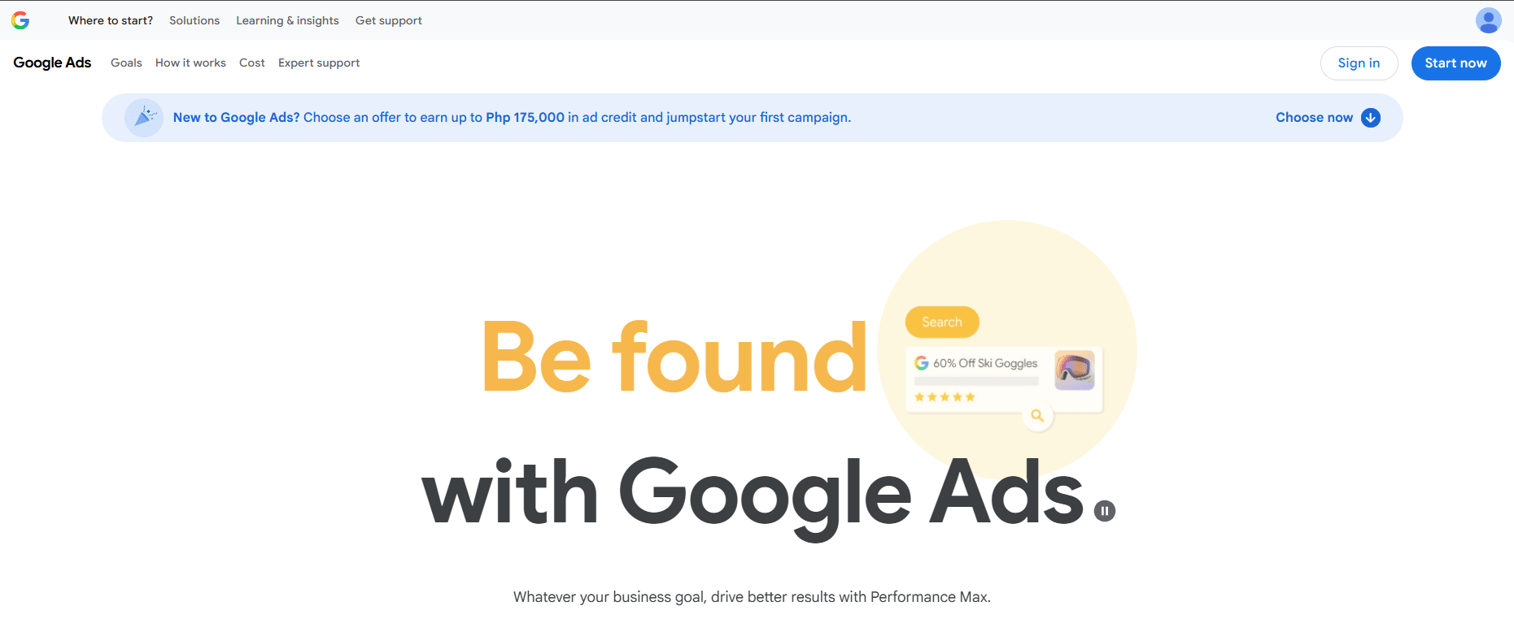
Google Ads is the primary native platform for buying search ads across Google Search, Shopping, Performance Max, and partner inventory. For most paid search teams, this is not optional. It is where search intent lives and where campaigns start. You control keywords, match types, bidding strategies, audience layers, ad assets, conversion actions, and experiments directly inside the platform.
Best for: Growth marketers and paid media teams whose acquisition model depends on Google search demand.
Key features
- Search, Shopping, and Performance Max campaigns
- Smart Bidding strategies including Target CPA and Target ROAS
- Keyword Planner for search volume and forecast data
- Conversion tracking and audience insights
- Adjustable average daily budgets with no minimum spend requirement
Why choose Google Ads: Even teams using third-party PPC management software still need to understand the native Google Ads account. Every optimization layer wraps around this platform, so it is the required foundation before any other tool in this list matters.
Google Ads pricing: Account access is free. You pay only for campaign spend based on your chosen bidding model and daily budget. There are no platform subscription fees.
G2 rating: 4.3/5
2. Microsoft Advertising
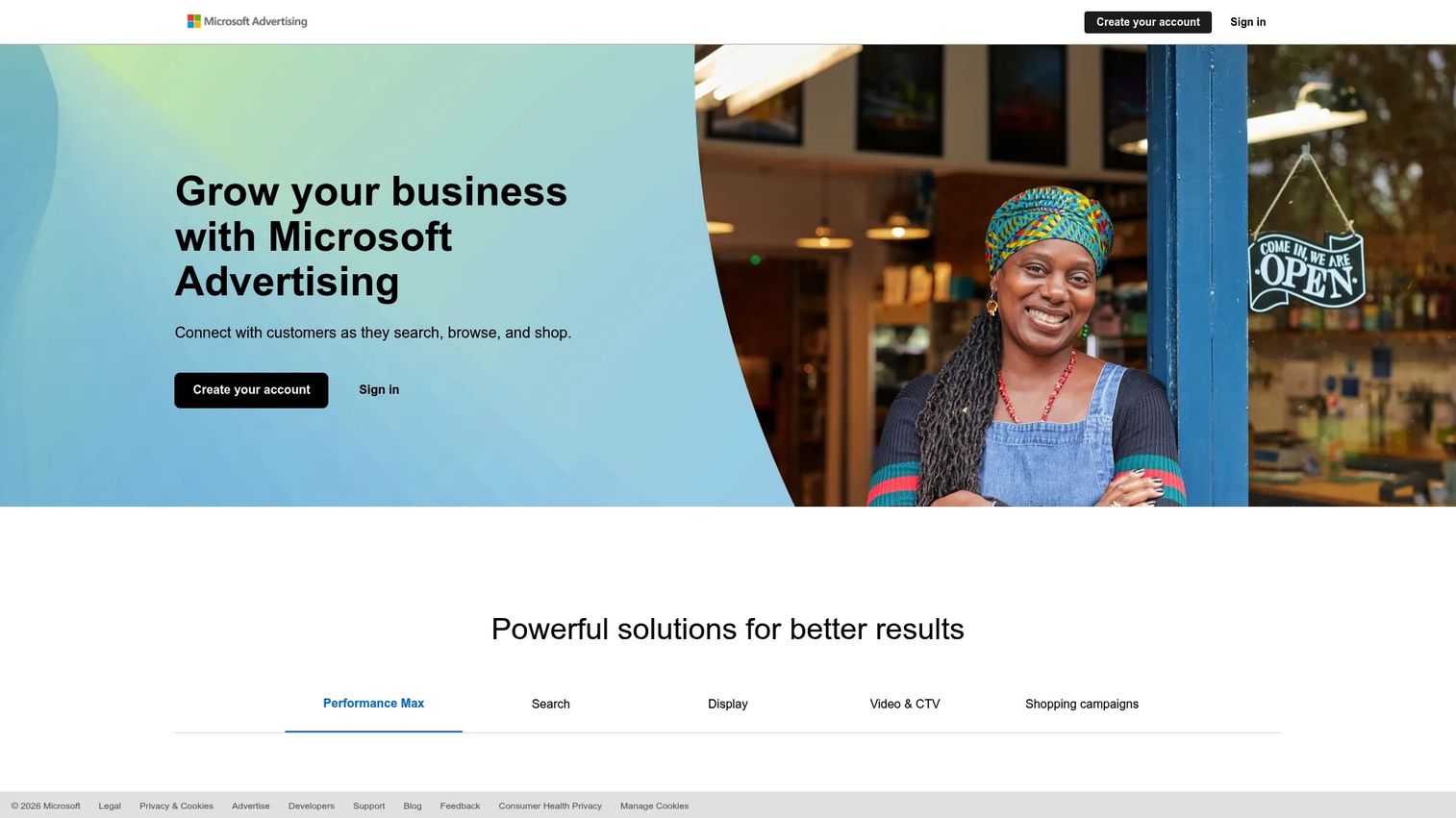
Microsoft Advertising is the native platform for search and omnichannel advertising across the Microsoft Search Network, including Bing, MSN, and partner properties. B2B marketers and teams targeting desktop-heavy or older audiences often find CPCs here run lower than equivalent Google keywords. The import tool makes it straightforward to bring existing Google Ads campaigns into Microsoft without rebuilding them manually.
Best for: Paid search teams that want incremental search volume and audience reach beyond Google.
Key features
- Google Ads import for fast account replication
- Audience targeting with LinkedIn profile data options
- Search, Shopping, and Performance Max campaigns
- Universal Event Tracking for conversion measurement
- AI-powered Copilot campaign optimization
Why choose Microsoft Advertising: Use it as a second search channel once your Google Ads foundations are solid. It is not a replacement, but it often returns incremental volume at lower cost in B2B categories.
Microsoft Advertising pricing: Account access is free. You pay for clicks or impressions based on your campaign type and bidding settings.
3. Apple Search Ads
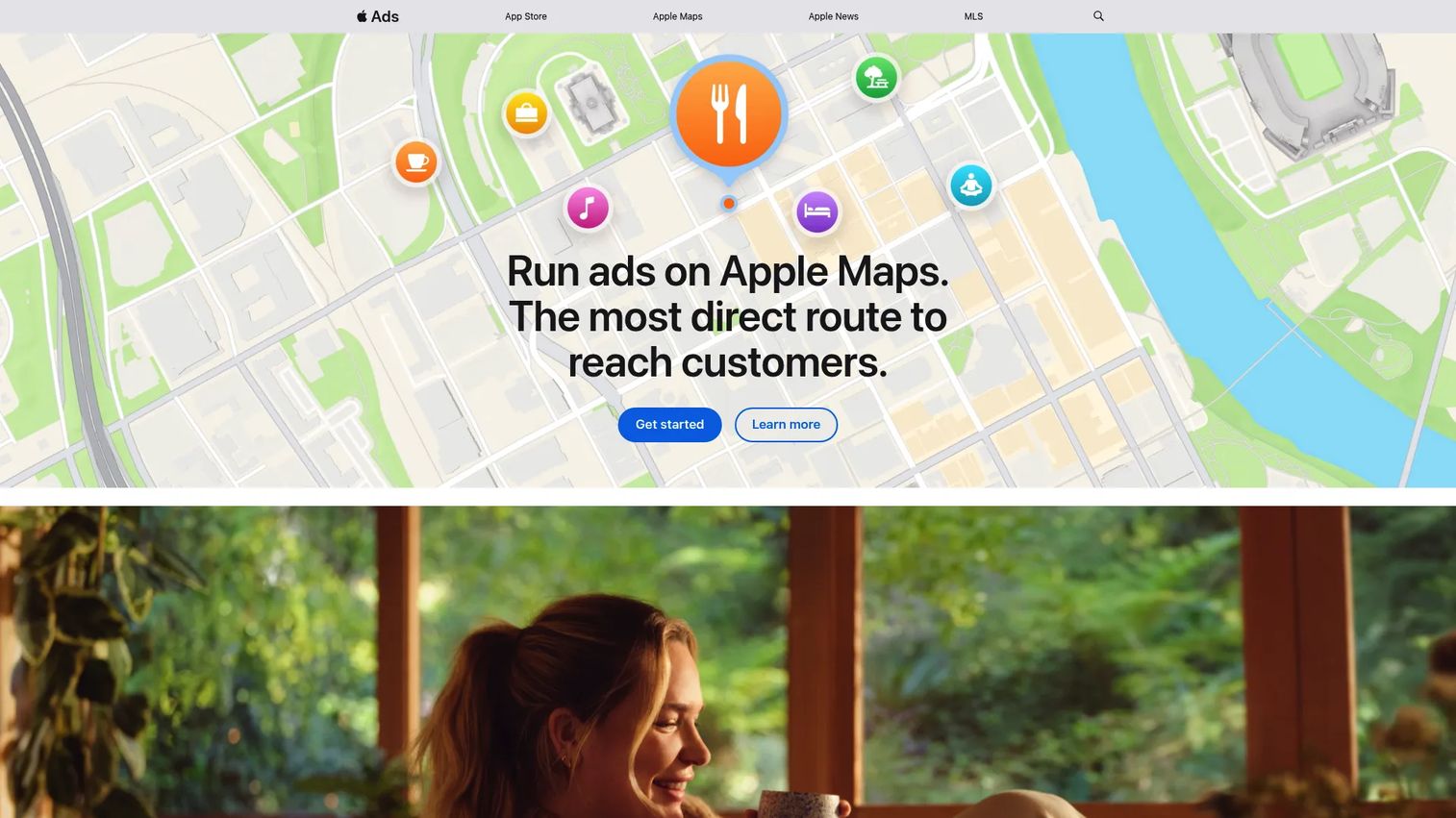
Apple Search Ads lets app marketers place ads inside App Store search results, the Today tab, the Search tab, and app product pages. This is paid search for mobile app discovery rather than web search. Users searching the App Store for apps matching your keywords see your ad before organic results. Custom product pages allow advertisers to connect ad clicks to tailored App Store experiences.
Best for: App growth teams trying to acquire high-intent App Store users at scale.
Key features
- App Store search results, Today tab, and Search tab placements
- Keyword targeting with broad, exact, and Search Match options
- Custom product pages for tailored post-click experiences
- Cost-per-tap (Apple Ads Advanced) and cost-per-install (Apple Ads Basic) billing
- Campaign groups and install performance reporting
Why choose Apple Search Ads: Choose it when your conversion event is an app install or an in-app action. It is not a general PPC tool, but it is the primary paid search channel for app-first acquisition.
Apple Search Ads pricing: Apple Ads Advanced charges per tap at a maximum price you choose. Apple Ads Basic charges per install at a cost you set, with a maximum of $10,000 per app per month. Actual auction clearing prices depend on competition.
G2 rating: 4.2/5
4. Google Ads Editor
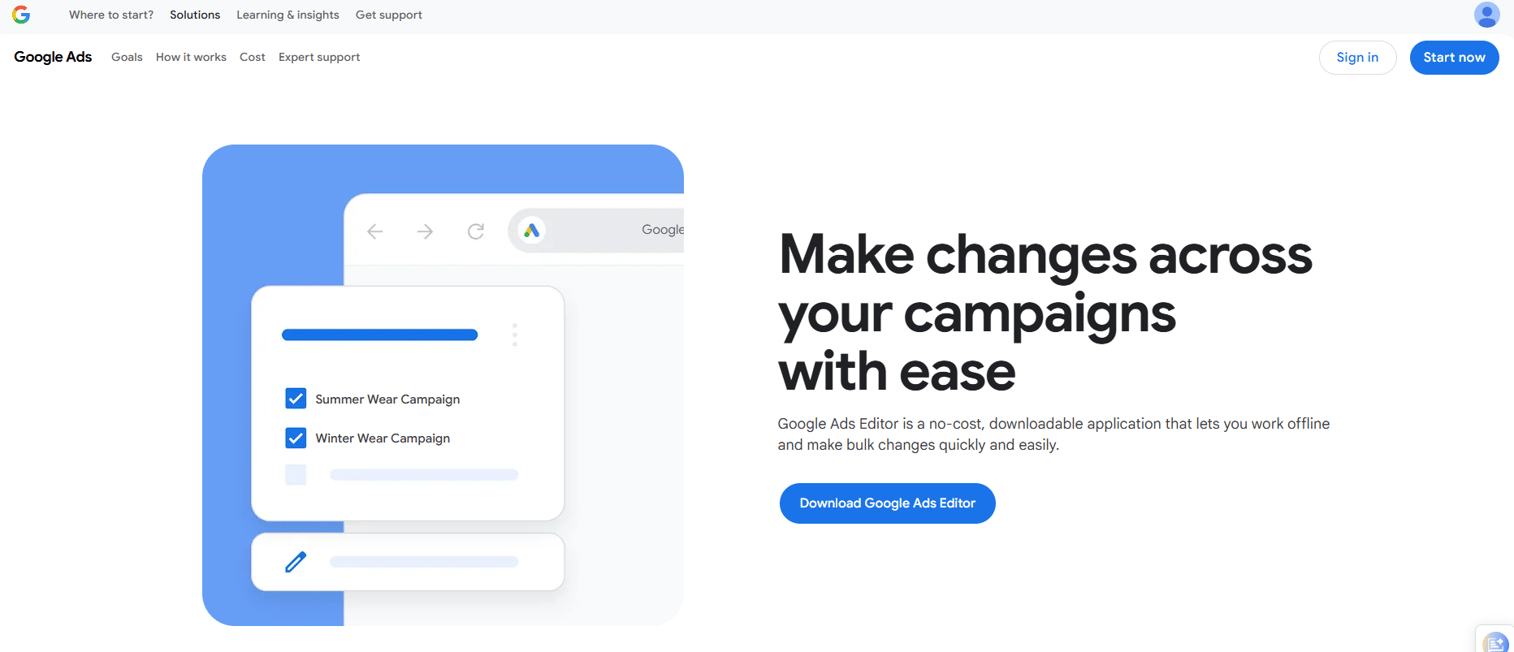
Google Ads Editor is a free desktop application for making bulk changes to Google Ads accounts without working inside the browser interface. You download the account, edit offline using search-and-replace, CSV import, and bulk operations, then upload your changes for review before posting. It is a utility, not a reporting or optimization platform.
Best for: PPC specialists and agency teams making large-scale edits across Google Ads campaigns, ad groups, or keywords.
Key features
- Offline account download and editing
- Bulk changes with search-and-replace and undo/redo
- CSV import and export for collaborative workflows
- Change review before posting
- Multi-account management in a single application
Why choose Google Ads Editor: It pairs with Google Ads rather than replacing it. When spreadsheet-heavy edits slow down launch timelines or campaign QA, this removes the browser interface bottleneck.
Google Ads Editor pricing: Free. No subscription, no spend minimum.
5. Search Ads 360
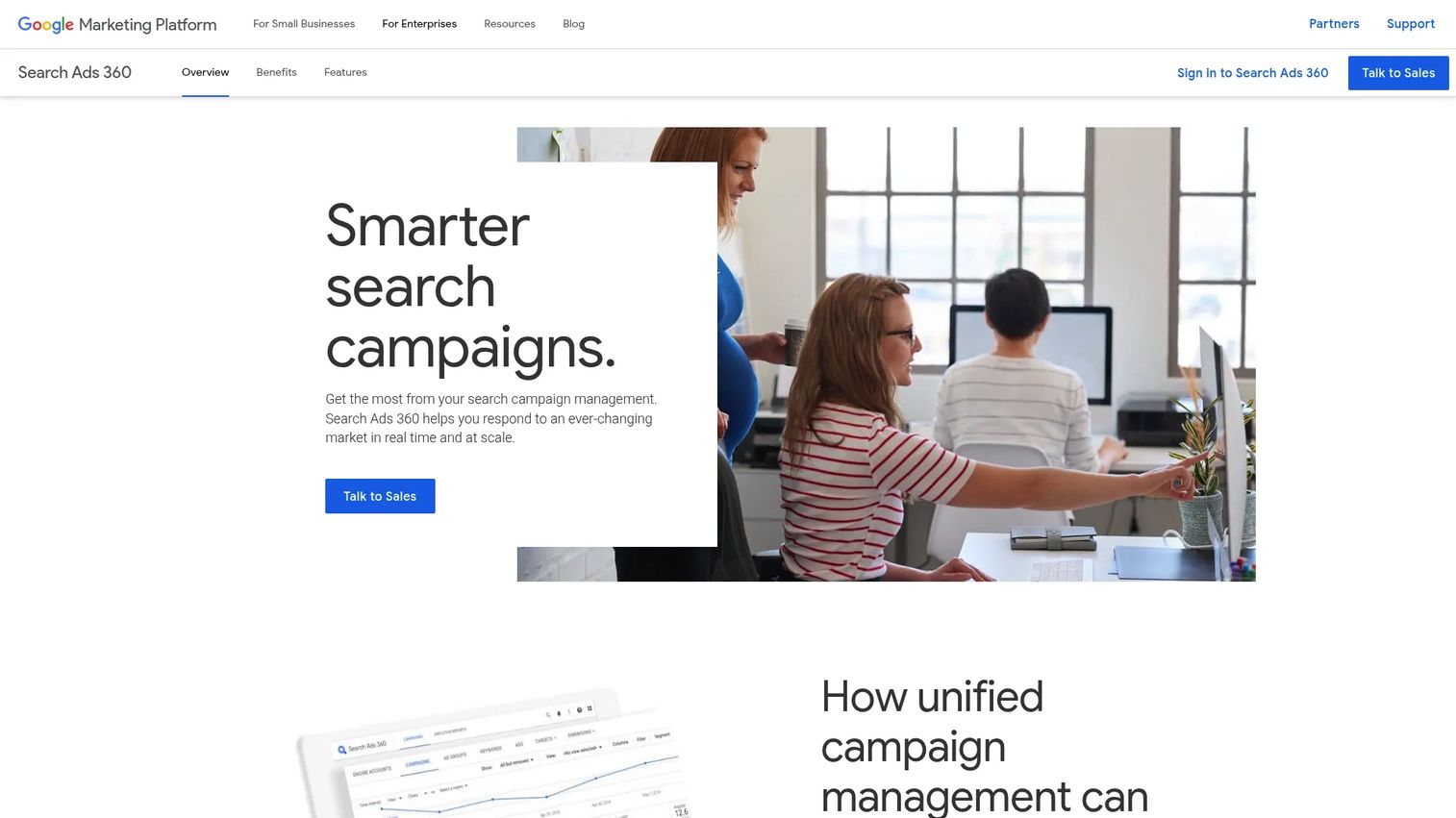
Search Ads 360 is Google's enterprise search management product inside Google Marketing Platform. It handles cross-engine campaign management, machine-learning-powered bid strategies, Floodlight measurement integration, and executive-level reporting. Large teams with complex governance needs, multiple accounts, and high spend use it when tight alignment with Google's broader measurement stack matters.
Best for: Enterprise teams that need Google Marketing Platform alignment for reporting, attribution, and cross-engine search management.
Key features
- Unified campaign management across search engines
- Machine-learning-powered automated bidding
- Floodlight tagging and cross-channel measurement
- Budget management and enterprise reporting workflows
- Attribution integration with the Google Marketing Platform stack
Why choose Search Ads 360: Choose it when paid search is tightly connected to Google's measurement infrastructure and your organization already runs broader advertising through that platform. Teams without that context will pay for capabilities they cannot fully use.
Search Ads 360 pricing: Pricing is contract-based, negotiated with Google, and calculated as a percentage of eligible ad spend. Some contracts include a fixed minimum monthly or annual service fee. Contact Google or a certified partner for current terms.
6. Optmyzr
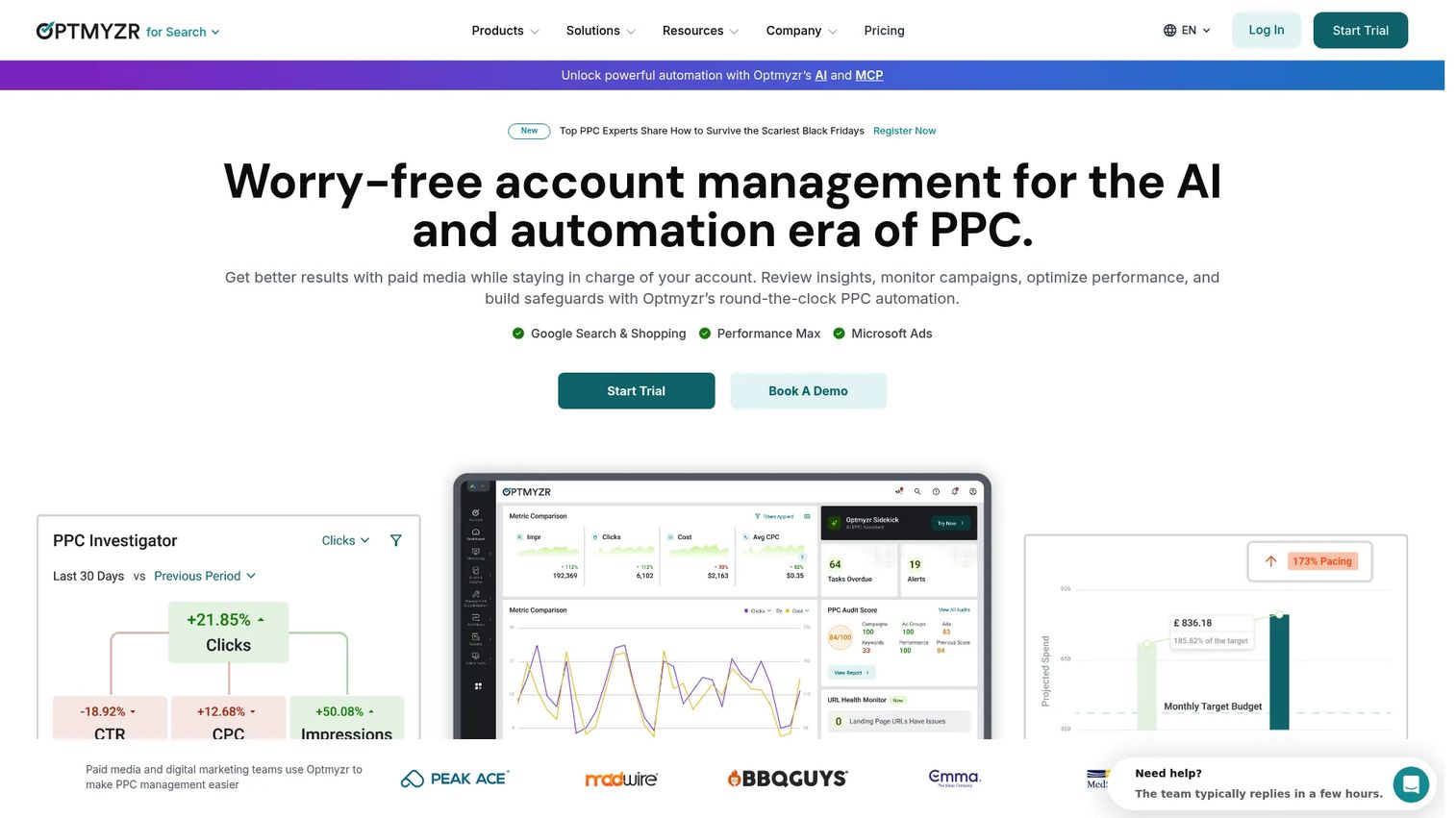
Optmyzr is PPC management software built for teams and agencies that need repeatable optimization workflows across Google Ads, Microsoft Advertising, and Shopping campaigns. The Rule Engine lets you automate account checks without writing scripts from scratch. PPC audits surface issues across multiple accounts simultaneously. Reporting templates cut time spent building stakeholder decks each week.
Best for: Agencies and advanced PPC teams managing multiple paid search accounts who need a layer above native platforms for structured optimization.
Key features
- Rule Engine automation for custom account checks
- PPC audits across multiple accounts
- Shopping and product feed optimization
- Budget pacing and spend monitoring
- Automated reporting with templates
Why choose Optmyzr: It suits marketers who already know PPC and want faster execution. If you are still learning the basics, start in Google Ads natively before adding this layer. A 14-day free trial is available to test fit.
Optmyzr pricing: Plans start at $299/month (Essentials) and $389/month (Premium), priced by monthly ad spend. Enterprise pricing is custom. Annual billing carries a 30% discount.
G2 rating: 4.7/5
7. Skai
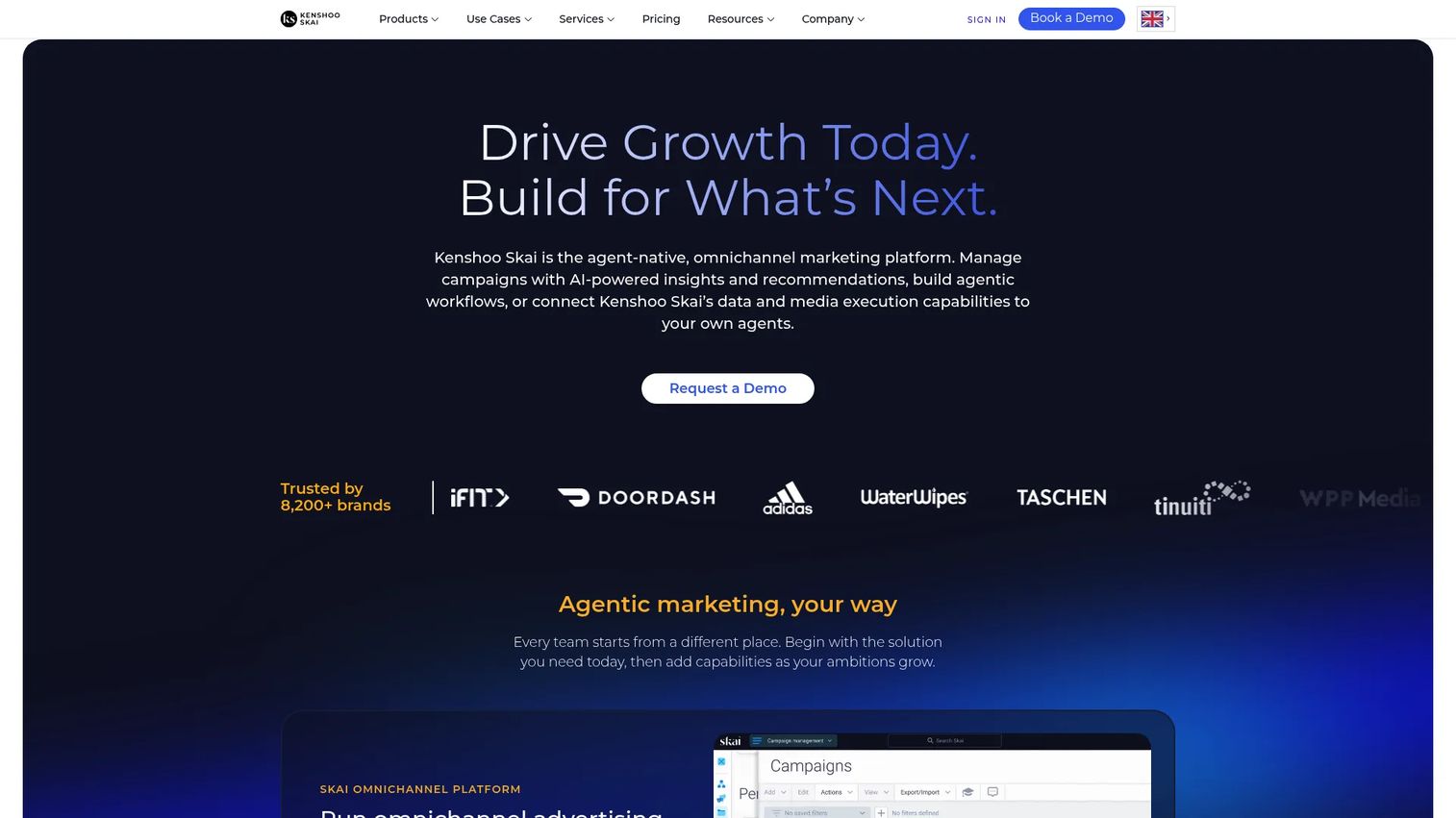
Skai is an enterprise advertising platform for teams managing paid search alongside retail media, paid social, and app campaigns at significant scale. Portfolio-level optimization, budget forecasting, competitive insights, and full-funnel attribution run across channels from a single interface. This is not a tool for teams launching their first campaigns.
Best for: Enterprise brands and agencies managing paid search as part of a broader performance media program that includes retail media or paid social.
Key features
- AI-powered portfolio bidding and budget optimization
- Cross-channel campaign management and reporting
- Competitive insights and search term analysis
- Digital shelf intelligence for retail media
- Full-funnel attribution and audience management
Why choose Skai: Choose it when paid search needs active management alongside retail media and social at scale. The cost reflects enterprise positioning. Standard plans start at $114k per year and scale based on media spend.
Skai pricing: Annual plans are tiered by ad spend. Standard starts at $114,000/year (up to $4M annual spend), Advanced at $276,000/year (up to $10M), Enterprise at $504,000/year (up to $20M), and Enterprise Premier at $756,000/year (up to $35M). Larger programs use custom pricing.
G2 rating: 4.0/5
8. Marin Software
Marin Software is a unified performance marketing platform for managing, measuring, and optimizing advertising across search, social, ecommerce, and display. It handles budget pacing, cross-channel reporting, bid optimization, and forecasting for large paid media programs. The Connect plan covers five data sources with a 90-day backfill, making it an accessible entry point relative to the broader enterprise tier.
Best for: Large advertisers and agencies that need enterprise budget pacing and cross-channel paid media reporting in one place.
Key features
- Cross-channel data unification and reporting
- Budget pacing, forecasting, and dynamic spend allocation
- AI-powered insights and anomaly detection
- Bid optimization workflows
- Revenue integrations and BI connectivity
Why choose Marin Software: Choose it when enterprise reporting and budget pacing matter more than beginner-friendly recommendations. Verify current product status and packaging directly with Marin before purchase, as enterprise software offerings in this category evolve.
Marin Software pricing: Connect starts at $500/month (month-to-month) with five data sources. Ascend and One plans are custom-priced on 12-month contracts and include unlimited data sources.
G2 rating: 3.8/5
9. Semrush
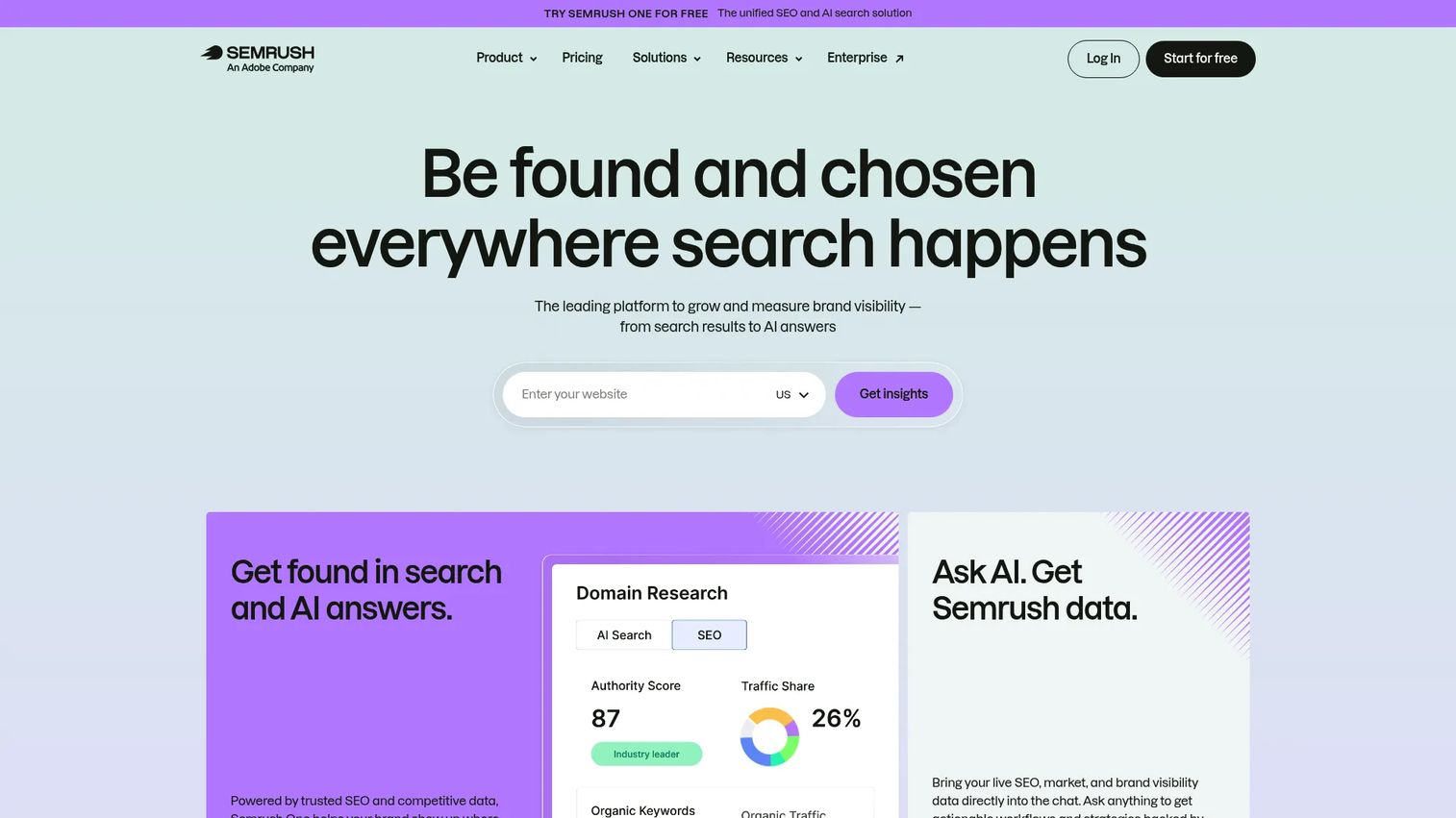
Semrush is a search visibility platform with strong PPC research capabilities alongside its organic tools. Advertising Research shows competitor ads and keywords. Keyword Gap surfaces terms competitors rank for that you do not. PLA Research covers product listing ad intelligence. It works best as a pre-launch and ongoing competitive intelligence layer, not as a campaign execution platform.
Best for: Growth teams that want PPC keyword and competitor research alongside SEO and content intelligence in a single subscription.
Key features
- Advertising Research for competitor ad and keyword data
- Keyword Gap analysis across domains
- PLA research for Shopping campaign intelligence
- CPC estimates and historical keyword data
- Competitor ad copy and landing page history
Why choose Semrush: Choose it when paid search planning requires competitive context and you also want organic search coverage. It works around campaigns rather than inside them.
Semrush pricing: A free tier is available with limited queries. Paid SEO plans start at $117.33/month (billed annually). Advertising research features are included across paid plans. Advanced and enterprise tiers are custom-priced.
G2 rating: 4.5/5
10. SpyFu
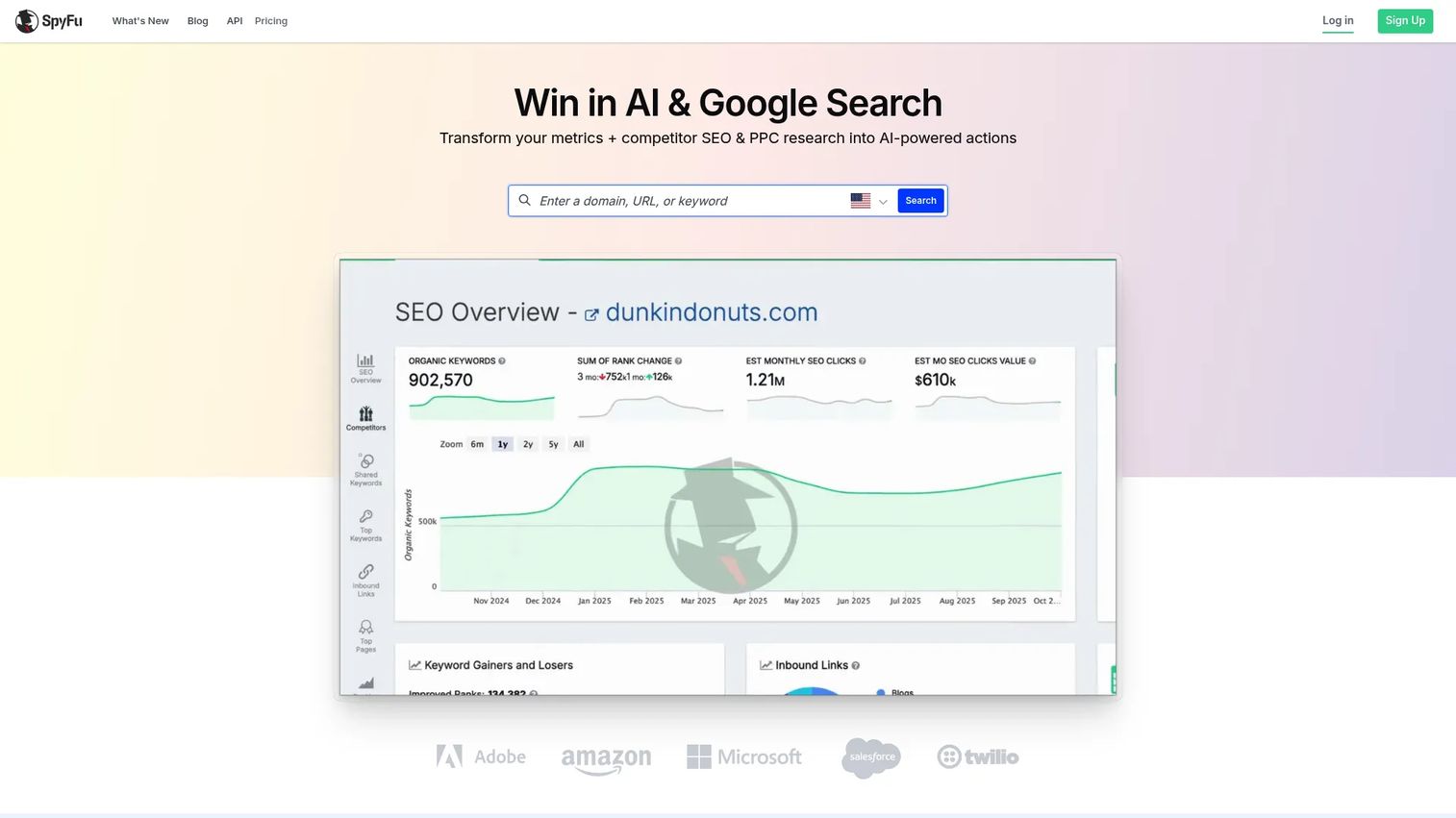
SpyFu is a competitive search intelligence tool for PPC and SEO research. You enter a competitor domain and see their paid keywords, ad history, estimated spend, and the ads they have run over time. For lean teams that need quick competitive context before building campaigns, it delivers at a lower price point than broader enterprise research suites.
Best for: Marketers researching competitor paid search strategy before building or adjusting campaigns.
Key features
- Competitor PPC keyword research by domain
- Google Ads copy history and ad variation tracking
- Estimated competitor spend and keyword overlap
- Keyword rank tracking with historical data
- Bulk export and API access on higher plans
Why choose SpyFu: Choose it when you need competitive intelligence at an accessible price. It should feed your PPC strategy rather than replace campaign management or execution.
SpyFu pricing: Basic starts at $29/month (billed annually) or $39/month billed monthly. Pro + AI is $89/month annually or $59 for the first month then $119/month. Team/Agency is $187/month annually.
G2 rating: 4.6/5
11. Adalysis
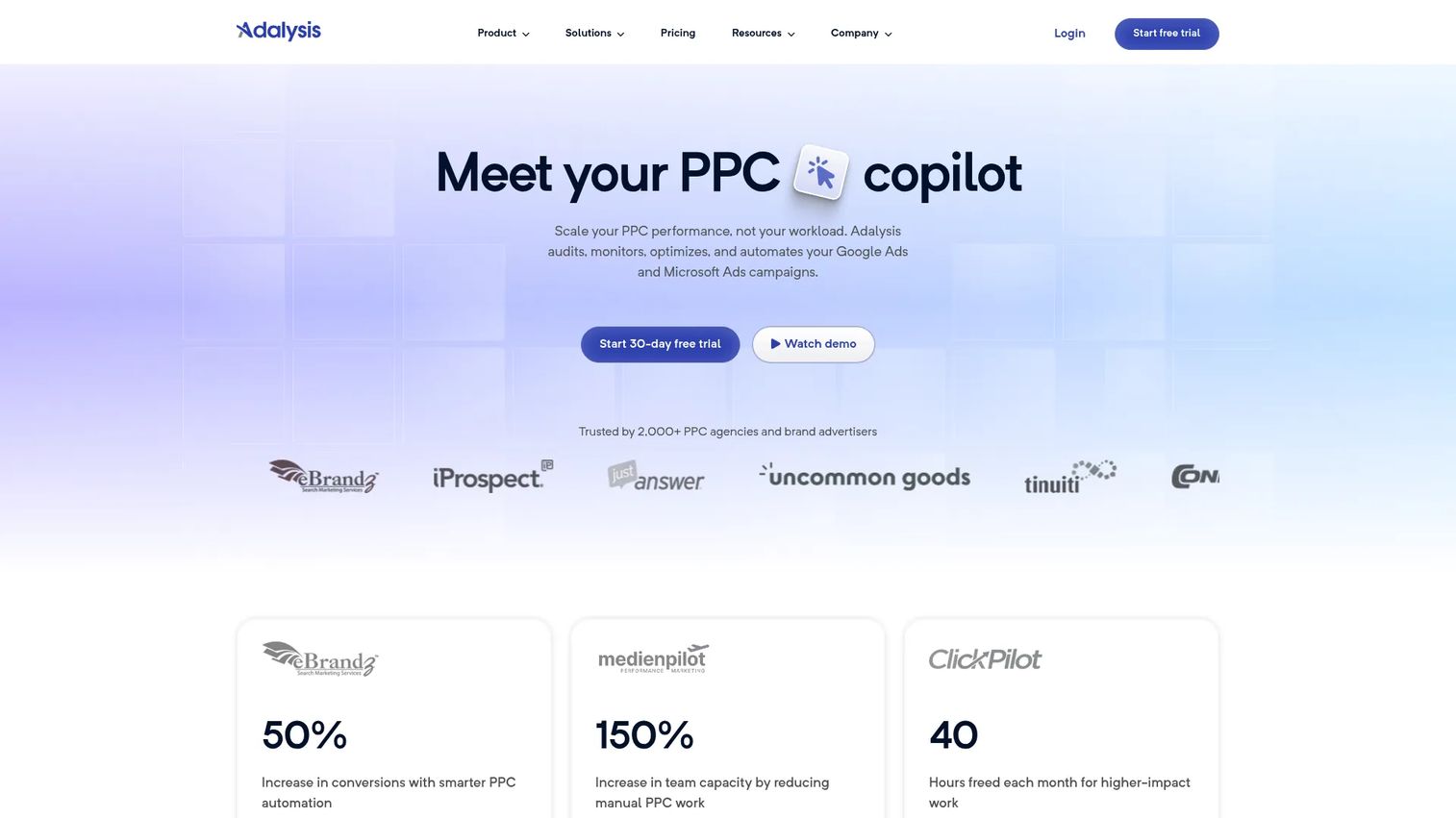
Adalysis is PPC management software focused on audits, automated monitoring, ad testing, and account optimization for Google Ads and Microsoft Advertising. It runs more than 100 customizable audit checks and delivers alerts via email or Slack when something breaks or goes out of range. Teams managing many search campaigns use it to maintain systematic QA without manually checking every account weekly.
Best for: Search marketers and PPC agencies who need automated account auditing and ad testing workflows across multiple accounts.
Key features
- 100+ customizable audit checks and automated alerts
- Budget tracking, projections, and automation rules
- Quality Score, keyword, and search term analysis
- Performance Max tools and RSA asset management
- White-label reporting with email and Slack delivery
Why choose Adalysis: Missed account issues cost more than the software. It is especially useful for teams managing several search campaigns simultaneously, where manual review misses problems that accumulate quietly.
Adalysis pricing: Pricing is based on maximum monthly ad spend and billed monthly, every six months, or annually. Six-month billing carries a 10% discount; annual billing carries a 15% discount. A 30-day free trial is available.
12. Opteo
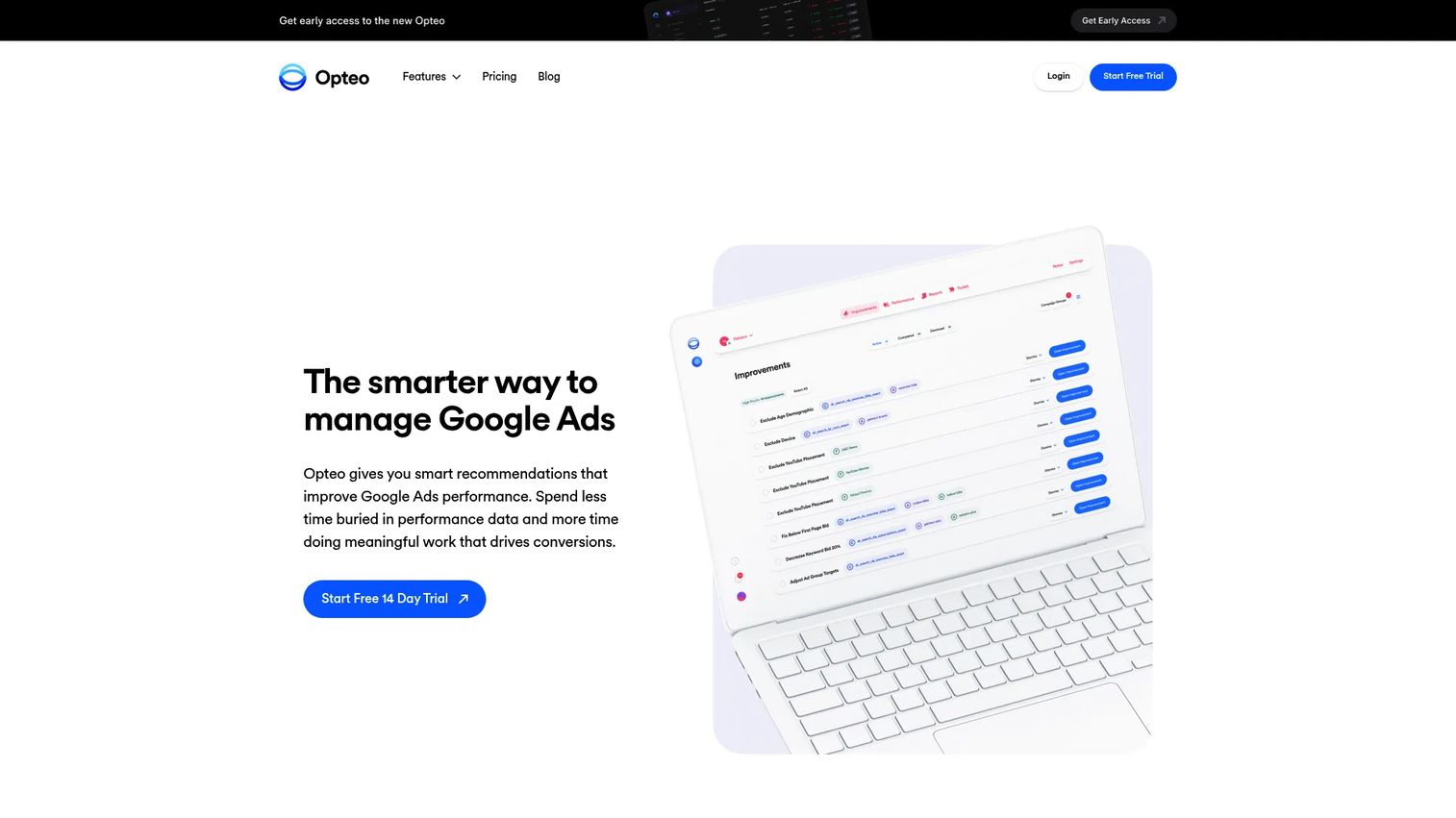
Opteo is a marketing-efficiency platform that surfaces clear optimization recommendations for Google Ads accounts and supports Microsoft, Meta, LinkedIn, and TikTok Ads on higher plans. Recommendations are prioritized by impact. You apply them in one click or dismiss them with a reason. The N-gram Finder helps identify high-performing and wasted search terms without building manual pivot tables.
Best for: Lean paid search teams optimizing Google Ads accounts who want structured recommendations without an enterprise platform rollout.
Key features
- AI-assisted optimization recommendations and alerts
- Account performance trends and scorecards
- N-gram Finder for search term analysis
- Budget monitoring and overspend alerts
- One-click improvements across campaigns
Why choose Opteo: Choose it when you want a clear priority list of account improvements without heavy implementation. It fits teams that need PPC hygiene and optimization support at a predictable monthly cost. A 14-day free trial is available.
Opteo pricing: Basic is $129/month, Professional is $249/month, and Agency is $499/month. Enterprise pricing is custom. Annual billing includes a two-month discount.
G2 rating: 4.5/5
13. Adzooma
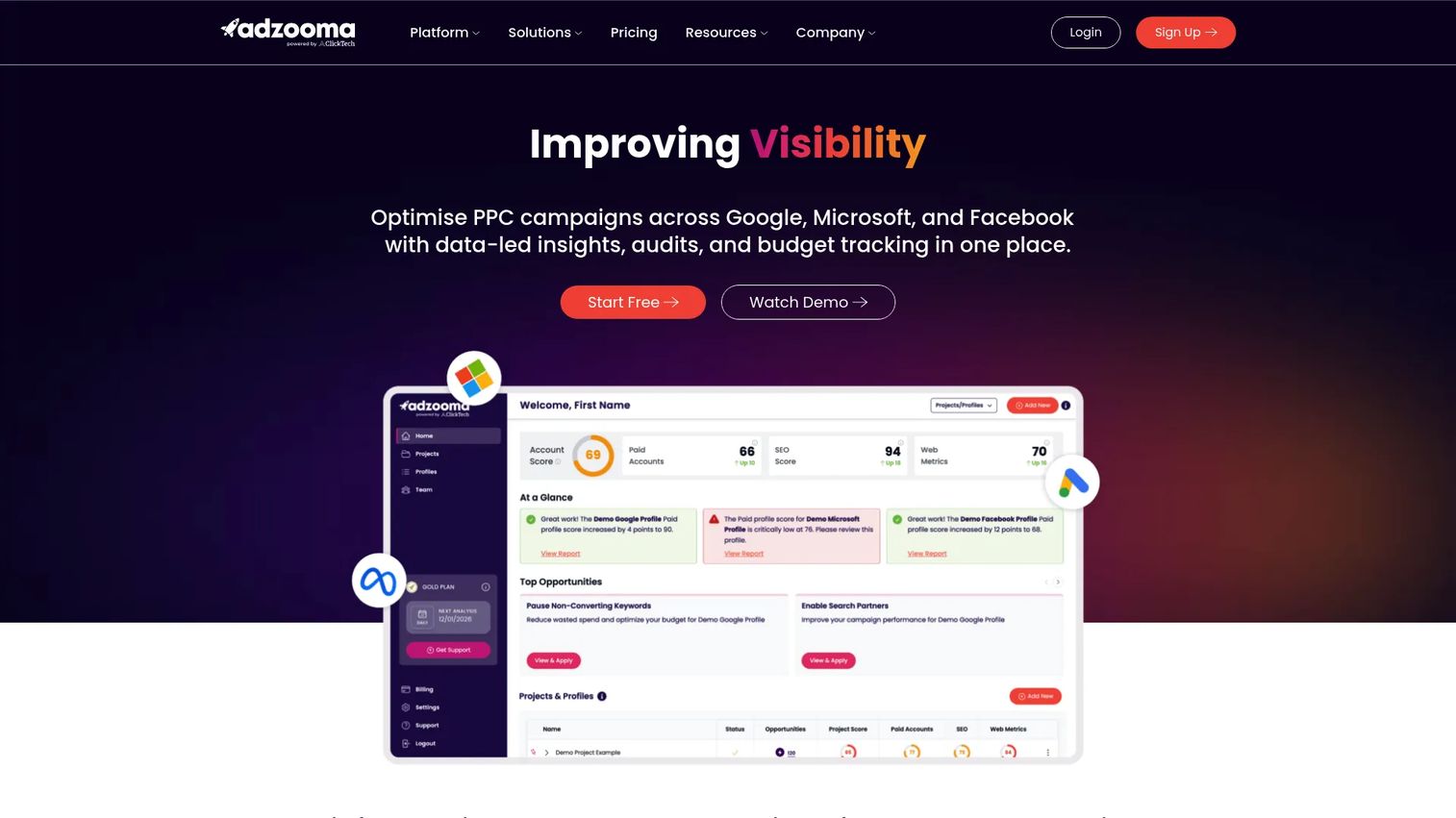
Adzooma is PPC management and optimization software for small businesses and lean marketing teams. It audits accounts for wasted spend, disapproved ads, and broken tracking, then surfaces prioritized opportunities. Multi-platform management covers Google, Microsoft, and Meta Ads from one interface. The free plan makes it an accessible entry point for teams that want structure without upfront cost.
Best for: Small businesses and lean teams that need guided PPC management and multi-platform campaign monitoring.
Key features
- Multi-platform management across Google, Microsoft, and Meta
- PPC audit for wasted spend and disapprovals
- Optimization opportunities with priority scoring
- Automation rules for budget and bid adjustments
- Performance reports and account alerts
Why choose Adzooma: Choose it when budget is tight and you need a guided workflow across ad platforms without hiring a PPC specialist. It is strongest for smaller accounts that need structure more than enterprise-level controls.
Adzooma pricing: A free plan is available. Silver costs $69/month billed monthly ($700/year billed annually). Gold costs $179/month billed monthly ($1,800/year billed annually). Enterprise pricing requires a quote.
G2 rating: 4.3/5
14. WordStream
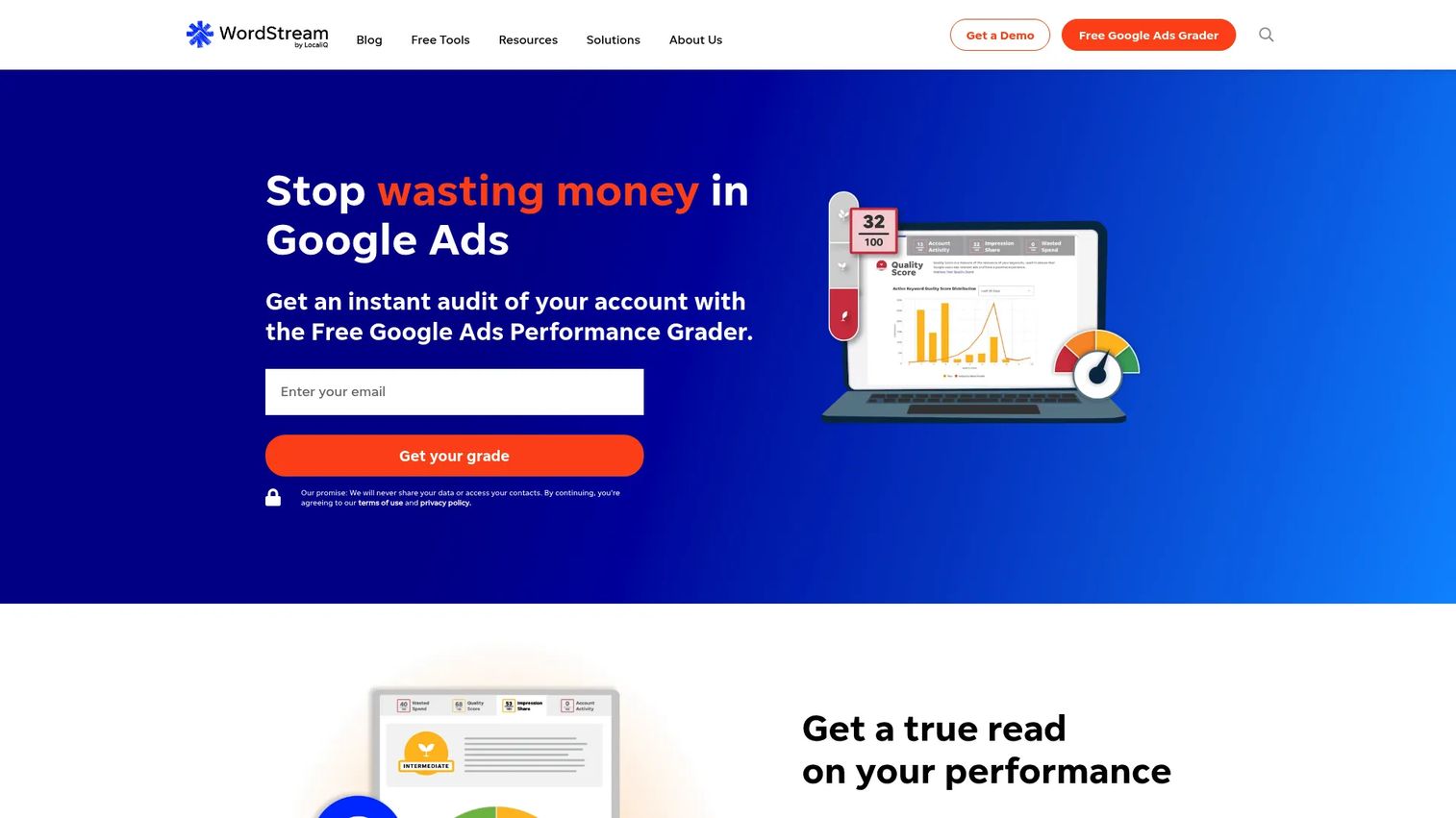
WordStream, now WordStream by LocaliQ, offers free marketing tools including a Google Ads Performance Grader, a Facebook Ads Grader, and keyword research tools with CPC and competition data. The Performance Grader benchmarks your account against similar advertisers and flags specific improvement areas. It functions primarily as a diagnostic and educational resource rather than a full PPC management platform.
Best for: SMBs and newer paid search advertisers who need account diagnostics, keyword guidance, and beginner-friendly PPC education.
Key features
- Google Ads Performance Grader with account benchmarking
- Free keyword research with search volume and CPC data
- Facebook Ads Grader for cross-channel visibility
- PPC resource library and campaign guidance
- Managed advertising services through LocaliQ
Why choose WordStream: Choose it when the team needs help understanding what is underperforming in an account before committing to deeper optimization tools. It is an educational and diagnostic entry point, not an enterprise workflow platform.
WordStream pricing: Free tools are available with no subscription required. Managed advertising services through LocaliQ carry separate pricing not displayed publicly. Contact WordStream directly for service package details.
Considerations when choosing paid search advertising software
Start with the workflow gap, not the feature list
Identify whether your team needs native campaign buying, optimization automation, cross-account reporting, competitive research, or enterprise governance. The wrong choice adds another login instead of removing work. A cheap Google-only tool may be enough for a single account. It becomes a gap when you also need Microsoft Advertising or Apple Search Ads coverage.
Check platform coverage before pricing
Platform breadth matters more than headline price. A tool that covers only Google Ads creates a separate workflow for Microsoft or App Store campaigns. If your program spans multiple search channels, choose a tool that handles them together or budget for separate platforms.
Map automation to account maturity
Automation should match where your account is. Budget pacing alerts and negative keyword suggestions are low-risk starting points. Automated bidding, bulk changes, and portfolio optimization need tighter review workflows and historical data to perform reliably. Giving automation full control in an account without conversion history tends to produce worse results, not better ones.
Verify conversion tracking and revenue reporting
A paid search platform that cannot connect clicks to conversions will not solve the attribution problem your leadership cares about. Ask how the tool handles offline conversions, CRM data, attribution windows, and reporting exports before you commit. This is where most tools reveal their real limitations.
Model total cost against measurable impact
Some tools price by seats. Others price by ad spend, account count, or enterprise contract terms. Compare software cost against time saved, wasted spend reduced, and reporting hours returned. A $299/month optimization tool that finds $2,000 in monthly wasted spend justifies itself on the first audit.
Conclusion
Paid search software is not one category. Native platforms buy the media. Optimization tools catch what native platforms miss. Enterprise platforms handle governance at scale. Research tools feed the strategy before spend starts.
Google Ads is the required foundation for most teams. Microsoft Advertising and Apple Search Ads extend reach when those audiences matter. Search Ads 360 and Skai fit large programs with complex governance and cross-channel needs. Optmyzr, Adalysis, Opteo, Adzooma, and WordStream each address specific optimization gaps at different price points and account sizes. Semrush and SpyFu help most before a campaign launches by surfacing what competitors are already doing.
The practical next step: Shortlist three tools based on the workflow gap you need to close, not the longest feature list. Run each against one live account for two to four weeks and measure whether it reduced time spent, wasted spend, or reporting friction. That evidence is what makes the case to your CMO or CFO.
Paid search spend keeps growing. The teams that defend CAC targets while scaling spend are the ones who know exactly which tool is doing which job.
Start your journey with Guideflow today!
FAQs
Google Ads is the required starting point because it provides direct access to Google search inventory. The definition of "best" shifts once your team needs optimization, competitive research, or enterprise governance. For most growth marketers running a single program, Google Ads plus one optimization tool covers the primary workflow.
Paid search software can refer to native platforms that serve ads directly. PPC management software typically refers to third-party tools that optimize, audit, automate, or report on campaigns across one or more ad platforms without serving the ads themselves.
Not always. Native Google Ads handles everything a small account needs. Third-party tools become worthwhile when you manage many campaigns, need automated audits, spend significant time on manual reporting, or want optimization checks running continuously without manual review.
Optmyzr and Adalysis are strong fits for agencies managing multiple client accounts. Optmyzr's Rule Engine and reporting templates reduce per-account time. Adalysis covers automated audits and white-label reporting at scale. Search Ads 360 suits larger agency operations already inside Google Marketing Platform.
Search Ads 360, Skai, and Marin Software are the main enterprise options in this list. Search Ads 360 fits teams aligned to Google Marketing Platform. Skai fits programs spanning retail media and paid social alongside search. Marin Software suits teams that need cross-channel budget pacing and unified reporting.
At minimum: CTR, CPC, CPA, conversion rate, ROAS, and impression share. Quality Score and Ad Rank diagnostics matter for optimization. Search term analysis helps identify wasted spend. Revenue-accountable teams need to connect these metrics to pipeline contribution or customer acquisition cost.
Native platforms charge for media spend rather than software access. Optimization tools like Opteo start at $129/month and Optmyzr at $299/month. Enterprise platforms like Skai start at $114,000/year. Adzooma offers a free starting tier. Cost also depends on ad spend volume, account count, and support level.
It can help by identifying wasted spend, surfacing better negative keywords, improving bid decisions, and clarifying which conversions are actually attributable to search. It cannot fix weak positioning, poor landing page performance, broken conversion tracking, or low-intent keywords. Software amplifies what is already working and makes problems visible faster. The fixes still require judgment.