A new hire starts Monday. By Wednesday, they still can't access the project management tool. A senior engineer spends forty minutes on a Slack thread trying to help. You get pulled in because no one else owns the problem.
That is the moment most founders recognize they've outgrown ad hoc IT support. Not when headcount crosses fifty. Not when the board mentions it. The moment a recurring, fixable operational failure costs a leadership-level hour.
The managed workplace services market reached $56.18 billion in 2025 and is projected to grow to $76.47 billion by 2030, according to Mordor Intelligence (2026). That growth reflects a straightforward reality: Employee IT operations are becoming too complex for a single generalist, and too important to leave unresolved.
Outsourcing to a managed workplace services provider can move onboarding from inconsistent to documented, reduce support escalations, and give your next IT or operations hire a stable base to build from. The right choice depends on where workplace operations break today: Employee support, device logistics, security controls, or vendor sprawl.
What's inside
This guide is for founders and operating leaders at Series B SaaS companies evaluating whether to outsource employee IT operations. The 12 providers were selected based on:
- Service breadth: Coverage across service desk, asset lifecycle management, endpoint management, and licensing
- Geographic coverage: Ability to support distributed and international teams
- Company-size fit: Range from growing SaaS companies to global enterprises
- Operating model clarity: Clear scope, defined escalation paths, and transparent reporting
TL;DR
- Best for broad workplace operations: Insight, for service desk, lifecycle, and hybrid support under one provider
- Best for Microsoft-heavy environments: Softchoice, for licensing, workplace support, and cloud governance in a connected program
- Best for global enterprise coverage: Computacenter, for multi-country end-user computing programs
- Best for device lifecycle and employee support: CompuCom, for hands-on workplace support and endpoint operations
- Best for complex transformation programs: Accenture or Cognizant, for large-scale workplace modernization tied to wider business change
The right choice depends on where your workplace operations break today: Employee support, device logistics, security controls, or vendor sprawl.
What is managed workplace services?
Managed workplace services are outsourced IT services that run the day-to-day technology experience for employees, including service desk support, device lifecycle management, endpoint operations, software and cloud licensing, identity controls, and workplace security.
What managed workplace services usually include
- Service desk and end-user support (remote and onsite)
- Device procurement, provisioning, replacement, and recovery
- Endpoint configuration, patching, and compliance
- Identity, access, and collaboration-tool administration
- SaaS, Microsoft 365, and cloud-license management
- Reporting, service-level tracking, and continuous improvement
- Hybrid workforce support across time zones and locations
How managed workplace services differ from managed IT services
Managed IT services can cover infrastructure, networks, servers, cloud, and security broadly. Managed workplace services focus specifically on the employee-facing technology experience: The support, devices, software access, and endpoint controls that determine whether employees can do their jobs on day one.
How managed workplace services differ from Device as a Service
Device as a Service primarily packages hardware procurement, financing, deployment, and replacement. Managed workplace services extend beyond the device layer to include service desk delivery, endpoint management, license operations, security processes, and workplace reporting.
Why founders consider this category
The operational case is straightforward:
- Onboarding becomes documented instead of improvised
- Support escalations stop consuming senior team members
- Spend becomes visible and predictable as headcount grows
- Security and access controls mature without requiring an engineering investment
- Founders and operations leaders stop being the fallback for every IT issue
When to use managed workplace services
Standardize onboarding and offboarding
New-hire provisioning breaks when it relies on Slack messages, manual app invites, and an informal device inventory. A managed workplace provider should own a documented process covering hardware, identity, SaaS access, and recovery. This is particularly urgent when hiring is accelerating and inconsistency creates real risk.
Support hybrid teams without a full internal IT department
Remote employees across multiple time zones create support gaps that a single internal generalist cannot fill. The provider needs a clear remote-first support model with defined escalation paths for hands-on work. Before signing, confirm what happens when remote troubleshooting cannot resolve the issue.
Consolidate devices, licenses, support, and endpoint controls
The warning sign: Finance, operations, and IT each own part of the employee technology picture, but nobody owns it end to end. Consolidating these into one managed workplace program gives leadership a single accountability point and a cleaner view of spend and risk.
Managed workplace services comparison
These providers differ more by operating model than by feature checklists. Compare delivery scale, geographic coverage, device lifecycle depth, service desk model, and Microsoft or cloud alignment.
| # | Product | Best for | Key use case | Pricing | G2 rating |
|---|---|---|---|---|---|
| 1 | Insight | Broad workplace operations | Service desk, lifecycle, and hybrid support | Custom quote | 3.6/5 |
| 2 | Softchoice | Microsoft-focused workplace programs | Licensing, workplace support, and cloud governance | Custom quote | 4.6/5 |
| 3 | Computacenter | Global end-user computing | Multi-country workplace support and governance | Custom quote | Not listed |
| 4 | CompuCom | Device lifecycle and employee support | Endpoint support and field services | Custom quote | 3.4/5 |
| 5 | Dell Technologies Services | Dell device environments | Device lifecycle and enterprise support | Custom quote | 4.3/5 |
| 6 | HCLTech | Automation-led end-user support | Service desk and workplace automation | Custom quote | 4.0/5 |
| 7 | NTT DATA | Global digital workplace programs | Managed workplace transformation | Custom quote | 4.2/5 |
| 8 | DXC Technology | Large workplace modernization | Virtual desktop and workplace device services | Custom quote | 4.2/5 |
| 9 | Accenture | Enterprise transformation programs | Workplace strategy and operating-model change | Custom quote | 4.2/5 |
| 10 | Cognizant | Digital employee experience | Integrated digital workplace delivery | Custom quote | 4.2/5 |
| 11 | Fujitsu | Regional support and technical services | End-user support and workplace operations | Custom quote | 4.2/5 |
| 12 | Getronics | International service desk coverage | Global workplace support and managed services | Custom quote | Not listed |
Pricing requires a sales engagement for all providers listed. G2 ratings verified October 2026 from each provider's live G2 listing.
Best managed workplace services for 2026
1. Insight
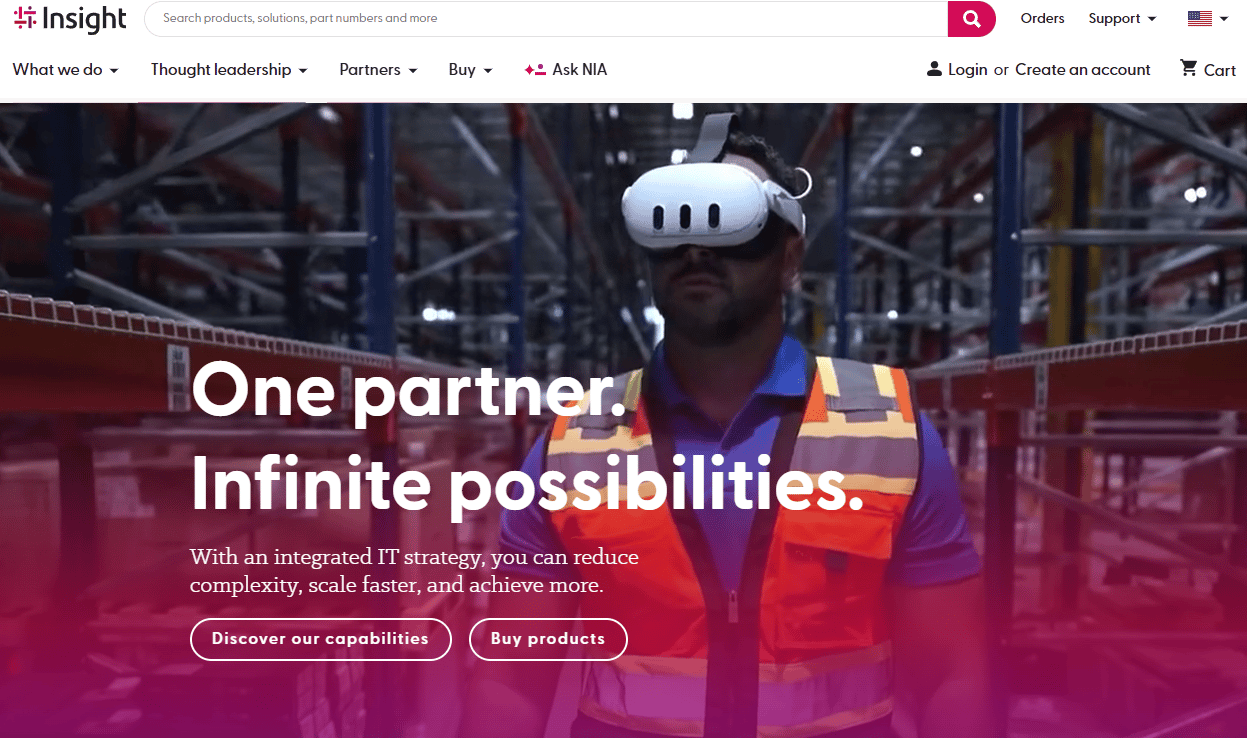
Insight is a solutions integrator covering IT procurement, cloud, cybersecurity, data and AI, and digital workplace services. For companies moving from ad hoc IT support toward a managed operating model, Insight offers a broad service footprint that covers both day-to-day employee support and the strategic design behind it. Its Tech Hub model connects onsite, remote, and device-exchange support into a single program.
Best for: SaaS companies that want one partner for workplace support, lifecycle services, hybrid employee experience, and IT operations.
Key features
- 24/7 service desk support across remote and onsite channels
- Device lifecycle management from procurement through recovery
- Tech Hub support model for flexible employee assistance
- Endpoint management and patching services
- Automation and self-service tooling for common requests
Why choose Insight: Insight works well for companies that need operational breadth rather than depth in one area. If your immediate problem spans service desk gaps, inconsistent device handling, and unclear ownership, this provider can cover multiple surfaces at once.
Insight pricing: Insight prices through custom quotes that account for employee count, device fleet size, coverage hours, and geography. Contact Insight directly for scope-based pricing.
Insight holds a 3.6/5 rating on G2.
2. Softchoice
Softchoice is a software- and cloud-focused IT solutions provider with particular depth in Microsoft ecosystems. Its workplace services connect cloud licensing, software asset management, digital workplace operations, and cybersecurity under a coordinated program. For SaaS founders dealing with Microsoft 365 sprawl alongside growing endpoint complexity, Softchoice brings both visibility and management into the same relationship.
Best for: SaaS companies with a Microsoft-heavy stack that need workplace support tied to license optimization and cloud governance.
Key features
- Microsoft 365 and Azure support and administration
- Workplace lifecycle services across device and software layers
- Software asset management and license optimization
- Cybersecurity assessments and managed security services
- Workplace reporting and periodic operational reviews
Why choose Softchoice: The value is in connecting software licensing, employee support, and workplace operations into a more coherent program. This is particularly useful when Microsoft licensing complexity is growing alongside the team.
Softchoice pricing: Costs reflect managed seat volume, Microsoft support level, license-management scope, and device operations requirements. Contact Softchoice for a scoped quote.
Softchoice holds a 4.6/5 rating on G2.
3. Computacenter
Computacenter is an independent technology and services provider with an established delivery model for enterprise-scale workplace programs. Its services span technology sourcing, logistics and configuration, professional services, and managed operations including remote user support, service desk, and digital operations. For companies with multi-country offices that need consistent end-user computing standards, Computacenter brings geographic reach and formal governance structures.
Best for: Multi-country SaaS companies that need consistent service levels across offices and a provider with mature global delivery processes.
Key features
- Global service desk delivery with remote user support
- Technology sourcing, procurement, logistics, and configuration
- Device lifecycle programs including circular services
- Managed workplace operations with formal SLA structures
- Professional services for IT strategy and transformation
Why choose Computacenter: This provider fits companies that have outgrown a regional IT partner and now need delivery consistency across multiple countries, with formal governance to satisfy procurement and security requirements.
Computacenter pricing: Contract terms reflect geographic footprint, device volume, service desk coverage requirements, and onsite support needs. Contact Computacenter for an assessed quote.
Computacenter does not currently have a rated G2 listing.
4. CompuCom
CompuCom provides enterprise technology sourcing, managed IT support, digital workplace services, and infrastructure and cloud capabilities. Its roots in device lifecycle and field services make it a practical choice when the core operational problem is about physical devices: Shipping, setup, break-fix, replacement, and recovery. CompuCom's service desk runs 24x7 with Level 1 support and Level 2 remote resolution backed by AIOps tooling.
Best for: Organizations where device fulfillment, endpoint consistency, and employee experience are the primary sources of operational drag.
Key features
- 24x7 Level 1 service desk and Level 2 remote resolution
- Device lifecycle services from procurement through asset recovery
- Endpoint support and managed infrastructure with AIOps
- Field and onsite services for break-fix and installation
- Technology sourcing and workplace experience programs
Why choose CompuCom: Strong fit when the company's problem is operational execution around devices and employee support rather than strategic workplace transformation.
CompuCom pricing: Costs are driven by device count, service desk coverage tier, onsite support demand, and endpoint management requirements. Contact CompuCom for a quote.
CompuCom holds a 3.4/5 rating on G2 from 6 reviews.
5. Dell Technologies Services
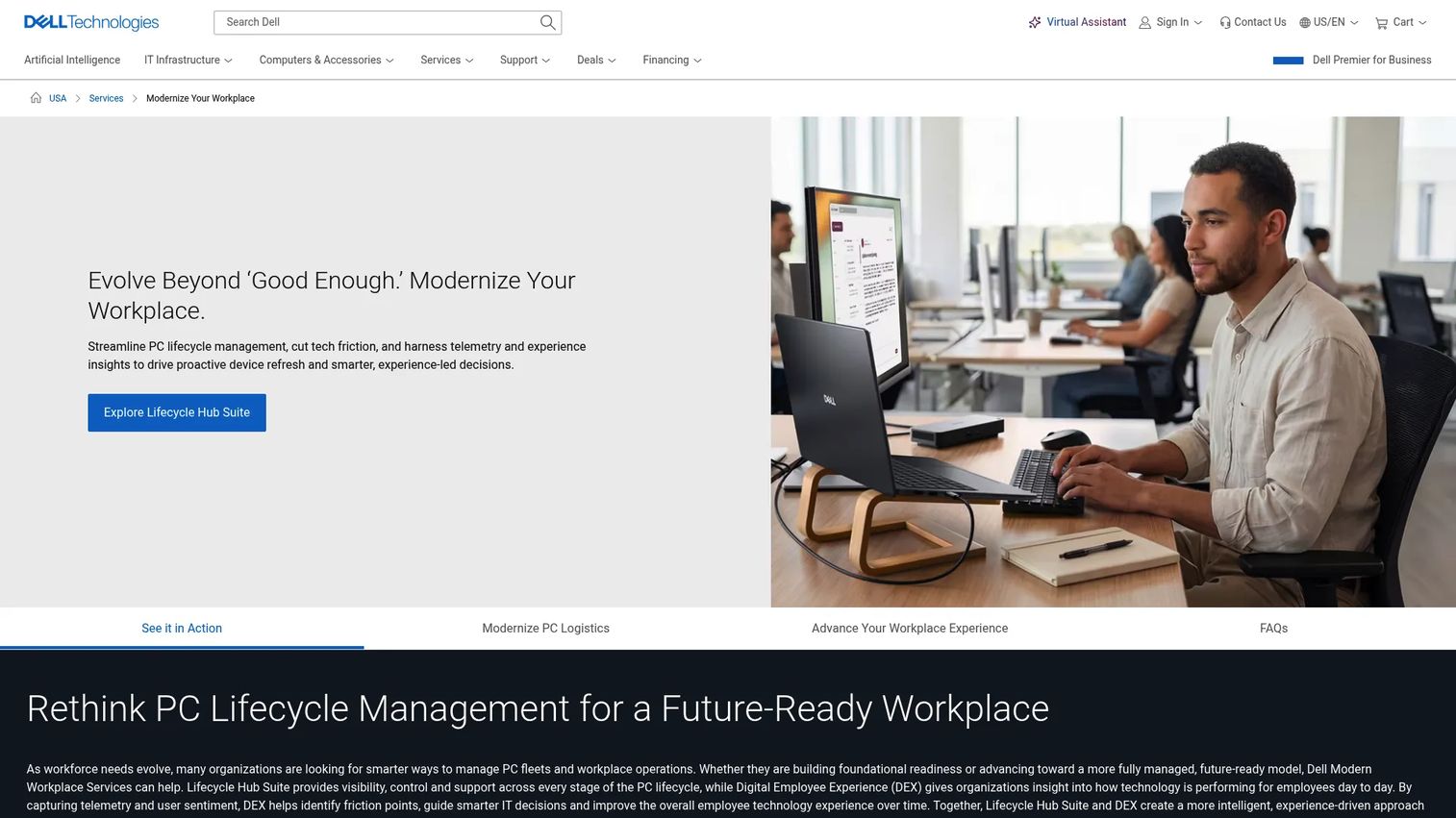
Dell Technologies Services covers the full lifecycle of employee devices, including PC refresh planning, Windows 11 transition services, deployment, support, asset recovery, and Device as a Service subscriptions through APEX PC as a Service. For companies standardizing their device fleet on Dell hardware, this creates a coherent lifecycle program from procurement through secure retirement.
Best for: Companies standardizing employee hardware around Dell devices and looking for lifecycle support from procurement through retirement.
Key features
- ProDeploy Client Suite for device deployment and configuration
- Lifecycle Hub Suite for PC lifecycle management
- ProSupport Suite with AI-driven diagnostics and self-healing automation
- APEX PC as a Service with customizable monthly subscriptions
- Asset Recovery Services for secure device retirement
Why choose Dell Technologies Services: The fit is clearest when hardware standardization around Dell is central to the workplace strategy. It makes less sense when the device fleet is mixed or when workplace needs extend heavily into service desk and licensing management.
Dell Technologies Services pricing: Costs vary by device model, support tier, deployment requirements, coverage period, and asset-recovery scope. Dell does not display service pricing publicly; contact the sales team for a quote.
Dell Technologies holds a 4.3/5 rating on G2.
6. HCLTech
HCLTech is a global technology company providing engineering, IT and business services, and enterprise software. Its end-user computing and managed service desk capabilities are built for high-volume environments, with workplace automation designed to reduce repetitive support requests and improve employee experience analytics. This is an enterprise-capable provider suited for complex operating environments, not a lightweight IT support subscription.
Best for: Organizations with high support volumes, broad end-user computing requirements, or a need to automate repetitive workplace support workflows.
Key features
- Managed service desk with IT enablement services
- Workplace automation for recurring support request types
- Employee experience analytics and reporting
- End-user computing operations across desktop and collaboration tools
- Cybersecurity and cloud services within the broader portfolio
Why choose HCLTech: HCLTech is strongest when the business needs operational scale and formal service management. For a 40-person company with straightforward needs, this level of provider may introduce more process than the stage requires.
HCLTech pricing: Commercial terms reflect service scope, employee population, support hours, automation requirements, and geographic delivery region. Contact HCLTech for a detailed proposal.
HCLTech holds a 4.0/5 rating on G2.
7. NTT DATA
NTT DATA provides consulting, cloud, cybersecurity, data and AI, and infrastructure services to large organizations. Its dynamic workplace services connect end-user computing support, digital employee experience, and transformation planning within a global delivery structure. For SaaS businesses with international operations that need workplace management connected to broader cloud or data programs, NTT DATA can bridge those workstreams under one engagement.
Best for: SaaS businesses with international operations that need workplace management linked to broader technology transformation programs.
Key features
- Dynamic workplace services including end-user computing support
- Global service delivery across multiple countries and time zones
- Digital employee experience design and operations
- Workplace transformation planning and advisory
- Cloud, connectivity, and cybersecurity services within the broader portfolio
Why choose NTT DATA: Emphasize the global delivery scale and the ability to connect workplace operations to larger technology programs. A growing company with straightforward workplace needs may find this provider's scope exceeds what the stage requires.
NTT DATA pricing: Commercial terms reflect geography, employee count, delivery model, and the scope of any transformation work attached to the engagement. Contact NTT DATA for an assessed quote.
NTT DATA holds a 4.2/5 rating on G2.
8. DXC Technology
DXC Technology provides enterprise technology services including modern workplace services, application development, cloud and infrastructure, and cybersecurity. Its workplace offering covers device services, virtual desktop support, application delivery, and service desk operations. For larger SaaS companies with complex endpoint environments or virtual desktop requirements, DXC brings enterprise-scale service management and a broad technology services portfolio.
Best for: Larger SaaS companies with complex endpoint, virtual desktop, or application-delivery requirements tied to enterprise-scale service management.
Key features
- Workplace device services and endpoint management
- Virtual desktop support and application delivery
- Service desk operations with enterprise SLA management
- Cloud and infrastructure services within the broader portfolio
- Enterprise IT transformation and modernization programs
Why choose DXC Technology: This provider fits complex environments where end-user services need to integrate with virtual desktops, distributed enterprise operations, or legacy systems. It is less suited to a straightforward employee support and device management need.
DXC Technology pricing: Contracts are built around service lines, endpoint volumes, virtual desktop scope, and transition work. Contact DXC for a quote reflecting the specific service configuration.
DXC Technology holds a 4.2/5 rating on G2.
9. Accenture
Accenture is a global professional services company providing strategy, consulting, technology, operations, AI, cloud, and cybersecurity services. Its workplace services are most relevant when managed operations are part of a broader transformation effort, covering operating-model design, employee experience programs, and global delivery governance. A 50-person company that only needs laptop support should look elsewhere. Accenture is the right conversation when change is happening at a system level.
Best for: Businesses undertaking major operating-model change that spans workplace technology, cloud, employee experience, and global service delivery.
Key features
- Workplace strategy services and operating-model design
- Global delivery teams across multiple regions
- Employee experience programs tied to broader transformation goals
- AI and data services within the technology transformation portfolio
- Managed services, cloud, and cybersecurity capabilities
Why choose Accenture: This provider fits high-complexity transformations involving multiple systems, global stakeholders, and executive-level change management. The engagement model is built for ambition at scale.
Accenture pricing: Engagement cost reflects transformation scope, global delivery requirements, and advisory work alongside managed operations. Accenture does not publish a general services price list; prospective buyers are directed to contact Accenture directly.
Accenture holds a 4.2/5 rating on G2.
10. Cognizant
Cognizant is a professional services company providing technology, consulting, cloud, AI, and digital transformation services. Its digital workplace delivery connects end-user support with broader systems and process modernization rather than treating employee IT as an isolated help desk contract. For growing companies that want workplace operations to align with digital transformation initiatives, Cognizant can tie both workstreams together.
Best for: Growing companies that want to modernize end-user support while connecting workplace services to broader digital systems and process improvements.
Key features
- Digital workplace services with experience-focused operations
- End-user support across managed IT delivery
- Automation and business operations services
- Application services and digital engineering
- Cloud migration and management within the broader portfolio
Why choose Cognizant: Best suited for companies where workplace modernization is part of a wider initiative rather than a standalone outsourcing decision. Its account management depth is stronger when tied to transformation scope.
Cognizant pricing: Costs reflect support scope, countries served, service levels, and transformation work attached to the engagement. Contact Cognizant for a scoped quote.
Cognizant holds a 4.2/5 rating on G2.
11. Fujitsu
Fujitsu provides digital services, cloud services, IT infrastructure, computing platforms, and industry-specific technology programs. Its workplace support capabilities include technical support, end-user operations, field services, and managed infrastructure, delivered through an established service model. For organizations that need a large, mature technology-services partner with regional delivery strength, Fujitsu is worth evaluating alongside the global providers on this list.
Best for: Organizations that need a mature technology-services partner for end-user support, field services, and workplace operations across established regions.
Key features
- Technical support services and end-user operations
- Field service capabilities for onsite and break-fix needs
- Managed infrastructure support alongside workplace services
- Cloud services and digital transformation programs
- Computing platforms and industry-specific technology programs
Why choose Fujitsu: Fujitsu suits companies seeking an established provider with broad technology-services capabilities, particularly where regional delivery strength matters more than a provider built specifically around modern SaaS workplace needs.
Fujitsu pricing: Assessments cover employee volume, device estate, support geography, SLA requirements, and transition complexity. Contact Fujitsu for a quote.
Fujitsu holds a 4.2/5 rating on G2.
12. Getronics
Getronics is a global IT services provider delivering digital workplace services, business applications, cybersecurity, cloud and infrastructure, networking, and field services. Its digital workplace capabilities span service desk, device management, collaboration support, and onsite operations across multiple countries and languages. For international SaaS companies that need consistent employee IT support across regions without building local IT teams everywhere, Getronics offers a coordinated global delivery model.
Best for: International SaaS companies that need consistent employee support across regions without building local IT teams in each market.
Key features
- Global service desk with multi-language delivery
- Digital workplace services including device and collaboration support
- End-user computing support across hybrid and remote environments
- Cybersecurity services including 24/7 SOC monitoring and incident response
- Managed network services with SD-WAN and enterprise connectivity
Why choose Getronics: Worth evaluating specifically when international coverage and cross-border support consistency matter more than a region-specific provider relationship. Its asset lifecycle management depth extends to field services across its international footprint.
Getronics pricing: Pricing depends on coverage countries, language requirements, support-hours model, device fleet size, and service-level commitments. Contact Getronics for a quote.
Considerations when choosing managed workplace services
Define the operating problem first
Do not start with a broad outsourcing mandate. Identify whether the core constraint is service desk coverage, device logistics, endpoint security, licensing visibility, or lack of internal ownership. A provider built for global transformation can be excessive when the immediate issue is onboarding consistency and device management.
Check the handoff between remote and onsite support
Ask explicitly what happens when a remote agent cannot resolve the issue. Confirm the escalation path, onsite availability, device-exchange options, and expected response time for each scenario. This is where service descriptions often stay vague; push for specifics before signing.
Map the provider to your existing stack
Workplace services should work with the systems already in use: Identity provider, endpoint management platform, ticketing tool, HRIS, and collaboration suite. Ask which tools the provider manages directly versus which they only support. Gaps here create operational friction from day one. A quick review of your contract lifecycle management process will also help you evaluate what governance the engagement requires.
Price the transition, not only the recurring fee
The ongoing contract is only part of the cost. Evaluate onboarding effort, asset inventory cleanup, endpoint standardization work, migration requirements, and minimum contract terms. The right provider should explain the transition plan in operational detail before the commercial discussion concludes.
Require executive-ready reporting
A useful quarterly review covers ticket trends, device health, onboarding time, recurring request types, software utilization, security exceptions, and next-quarter actions. Avoid any provider whose reporting only restates aggregate ticket volume.
Conclusion
Managed workplace services split cleanly along operating model. Insight fits companies that need broad workplace support with practical hybrid operations. Softchoice is the strongest candidate for Microsoft-heavy teams that need license visibility alongside workplace services.
Computacenter, NTT DATA, DXC Technology, Accenture, and Cognizant fit larger or more complex global environments where managed workplace operations connect to transformation programs. CompuCom and Dell Technologies Services deserve attention when devices and employee support are the core operational problem.
HCLTech, Fujitsu, and Getronics offer established service-delivery models for organizations that need scale, technical depth, or international coverage.
The practical next step: Document the last 30 days of employee IT friction, note where leadership time was pulled in, and bring that evidence into provider conversations. That record will make scope discussions faster and help you evaluate whether a provider's proposal actually addresses what breaks.
Start your journey with Guideflow today!
FAQs
Managed workplace services are outsourced IT programs that run the employee technology experience, covering service desk support, device lifecycle management, endpoint management, access administration, workplace security, and software and cloud-license operations. The exact scope differs by provider and contract. Most programs combine some set of these components rather than covering every area equally.
The most common components are service desk coverage, device procurement and lifecycle management, endpoint patching and compliance, identity and access administration, collaboration-tool support, license management, regular operational reporting, and onsite support where required. Confirm which components are included in the base contract versus billed separately, as providers bundle these differently.
Managed IT services can cover infrastructure, networks, cloud platforms, and security broadly. Managed workplace services focus specifically on the employee technology experience: The support, devices, software access, and endpoint controls that affect whether employees can do their jobs. Some providers offer both under one engagement; others specialize in the workplace layer.
No. Device as a Service concentrates on hardware procurement, financing, deployment, support, and replacement, typically as a monthly per-device subscription. Managed workplace services can include that layer but extend further into service desk delivery, endpoint management, licensing, governance, and employee support. A company may use both together or choose a provider whose managed workplace program incorporates device lifecycle within a broader service.
Clear triggers include rapid hiring that makes onboarding inconsistent, employees in multiple locations creating support gaps, repeated escalations reaching senior staff, poor device inventory visibility, weak endpoint controls, and internal engineering time being diverted into employee IT requests. Documenting the frequency and cost of these situations before outsourcing makes it easier to evaluate whether a provider's scope actually addresses the problem.
Most providers price through custom contracts. The cost drivers are employee and device counts, geographic coverage, support hours and SLA tiers, service desk scope, onsite support requirements, endpoint tooling, and migration effort. None of the 12 providers on this list publish standard pricing. A realistic evaluation requires a scoped proposal from each shortlisted provider.
Yes, and remote support is a standard component of most managed workplace programs. Confirm the specific details: Device shipping and replacement workflows, time-zone coverage, remote troubleshooting depth, and the escalation path when remote resolution is not possible. The quality of remote support varies significantly across providers, so this area deserves direct questions during the evaluation rather than assumptions based on marketing materials.
Bring these questions into every provider conversation:
- Who owns onboarding and offboarding workflows end to end?
- What support hours and escalation paths are included in the base contract?
- How are devices shipped, replaced, recovered, and retired?
- Which endpoint, identity, and ticketing tools does the provider manage directly?
- What reporting will leadership receive, and at what frequency?
- What does implementation require from internal teams in the first 90 days?