Trial signups look fine in the dashboard. Activation is weak. Sales says the trial users aren't qualified. Finance wants cleaner conversion data. Sound familiar?
The problem usually isn't the volume of trials. It's the moment between interest and activation where prospects stall, disengage, or enter your product without understanding it. According to First Page Sage (2025), opt-in SaaS trials convert at just 18.2% compared to 48.8% for opt-out trials. That gap isn't random. It reflects the difference between a buyer who self-qualified before starting and one who signed up out of curiosity.
Free trial management software covers a wide range of tools: Subscription billing, onboarding flows, product analytics, pre-trial product evaluation, proof-of-concept platforms, and clinical research systems. The right category for you depends on where your trial funnel actually breaks.
Which system helps you manage the trial moment that is breaking your funnel?
What's inside
This guide compares 11 tools across SaaS trial billing, in-app onboarding, product analytics, demo automation, proof-of-concept workflows, and clinical research operations. Items were selected for direct relevance to trial setup, activation, conversion, or trial governance.
Selection criteria:
- Trial configuration, automation, or evaluation capability
- Trial-to-paid conversion visibility or measurement
- Integration fit with CRM, billing, or analytics stack
- Relevance to marketer, RevOps, product, customer success, legal, or clinical teams
Pricing and G2 ratings were verified against live sources as of November 2026.
TL;DR
- Best for pre-trial product evaluation: Guideflow lets prospects experience your product before requesting access, tracking completion rate, leads collected, and conversion signals. Guideflow does not provision trial accounts, meter usage, or handle billing.
- Best for subscription trial operations: Recurly handles cardless trials, trial-ending emails, dunning, and renewal dates.
- Best for SaaS billing and trial monetization: Chargebee ties trial conversion to subscription billing, revenue recognition, and finance reporting.
- Best for developer-led billing workflows: Stripe Billing gives engineering teams API-first subscription trial infrastructure.
- Best for trial onboarding: Appcues and Userpilot guide users to their first activation moment without engineering tickets.
- Best for regulated clinical trial management: OpenClinica and Viedoc cover electronic data capture, audit trails, and study governance.
What is free trial management software?
Free trial management software helps teams configure, operate, measure, and improve product trial experiences, from trial access and billing rules to onboarding, reminders, conversion tracking, and post-trial handoff.
The category is broader than most buyers expect. Here are the key capabilities it covers:
- Trial duration setup: Configure trials in days or months at the plan level
- Cardless trial support: Let users start without entering payment details
- Billing information collection: Capture payment method before or at trial end
- Trial expiration emails: Automated reminders before and at trial end
- Dunning and failed payment handling: Recover revenue when conversion payments fail
- Trial onboarding flows: In-app guides, checklists, and tooltips that activate users
- Product usage analytics: Track feature adoption and behavior during the trial period
- Lead capture and qualification: Identify who is evaluating before they request access
- CRM and billing integrations: Connect trial behavior to pipeline and revenue data
- Compliance and audit trails: Governance for regulated evaluation and research workflows
- Post-trial migration: Convert trial users to paid plans or archive study data
Understanding the category boundary. The keyword "free trial management" means different things to different buyers:
- SaaS free trial management covers subscription trial setup, billing handoffs, activation, and paid conversion
- Pre-trial product evaluation covers interactive demo experiences a buyer has before account provisioning
- Proof-of-concept trials cover enterprise evaluation workflows for legal, procurement, or finance teams
- Clinical trial management covers regulated research operations, patient data, compliance, and study workflows
This guide covers all four. Each section below names which category a tool belongs to, so you can skip to what your problem actually is.
When to use free trial management software
Manage trial-to-paid conversion
Use subscription trial software when you have signups but weak paid conversion. Lifecycle emails, trial reminders, and dunning workflows reduce drop-off after the trial ends. CRM integrations connect trial behavior to pipeline so marketing and sales share the same conversion data.
Let buyers evaluate before they start a trial
An interactive demo fits when unqualified trials consume support resources, or when prospects need to understand the product before creating an account. Giving buyers a guided product experience before provisioning reduces support load and helps sales enter follow-up conversations with real context.
Support regulated or high-governance trials
Choose a proof-of-concept or clinical trial platform when "trial" means a formal evaluation with audit trails, approval workflows, or regulated data handling. Contract software evaluations, enterprise proof-of-concept processes, and clinical research operations all require documentation and permissions that standard SaaS billing tools don't provide.
Free trial management software comparison
The 11 tools below serve different definitions of "trial management." Choose by the problem you need to solve: Billing handoff, in-app activation, pre-trial evaluation, enterprise proof-of-concept, or clinical research operations.
Pricing and G2 ratings were verified against vendor pricing pages and G2 listings in November 2026.
| # | Product | Best for | Key differentiator | Pricing | G2 rating |
|---|---|---|---|---|---|
| 1 | Guideflow | Pre-trial product evaluation | Interactive demos and sandboxes before account provisioning | Free plan available; paid from $40/mo | 5.0/5 |
| 2 | Recurly | Subscription trial operations | Cardless trials, dunning, and renewal lifecycle management | From $249/mo | 4.1/5 |
| 3 | Chargebee | SaaS billing and trial monetization | Trial billing tied to revenue recognition and finance reporting | Free Starter plan; usage-based paid plans | 4.4/5 |
| 4 | Stripe Billing | Developer-led billing workflows | API-first subscription trials with flexible pricing models | 0.7% of billing volume or from $620/mo | N/A verified |
| 5 | ChurnZero | Customer success trial engagement | Health scores and automated journeys for trial accounts | Contact for pricing | 4.7/5 |
| 6 | Appcues | In-app trial onboarding | No-code in-app guides and checklists without engineering | From $9,000/year | 4.6/5 |
| 7 | Userpilot | Product-led trial activation | Onboarding, analytics, and surveys in one product adoption tool | From $299/mo | 4.6/5 |
| 8 | Pendo | Product analytics for trial behavior | Feature adoption tracking and account-level product analytics | Free plan up to 500 MAUs; paid custom | 4.4/5 |
| 9 | CobbleStone Contract Insight | Contract software proof-of-concept | AI-powered CLM with structured proof-of-concept evaluation | Contact for pricing | 4.7/5 |
| 10 | OpenClinica | Open-source clinical trial data capture | EDC with eConsent and audit trails for research teams | From $750/mo | N/A verified |
| 11 | Viedoc | Regulated clinical trial workflows | Full eClinical suite for CROs and sponsors | Contact for pricing | 4.5/5 |
Best 11 free trial management software tools for 2026
1. Guideflow
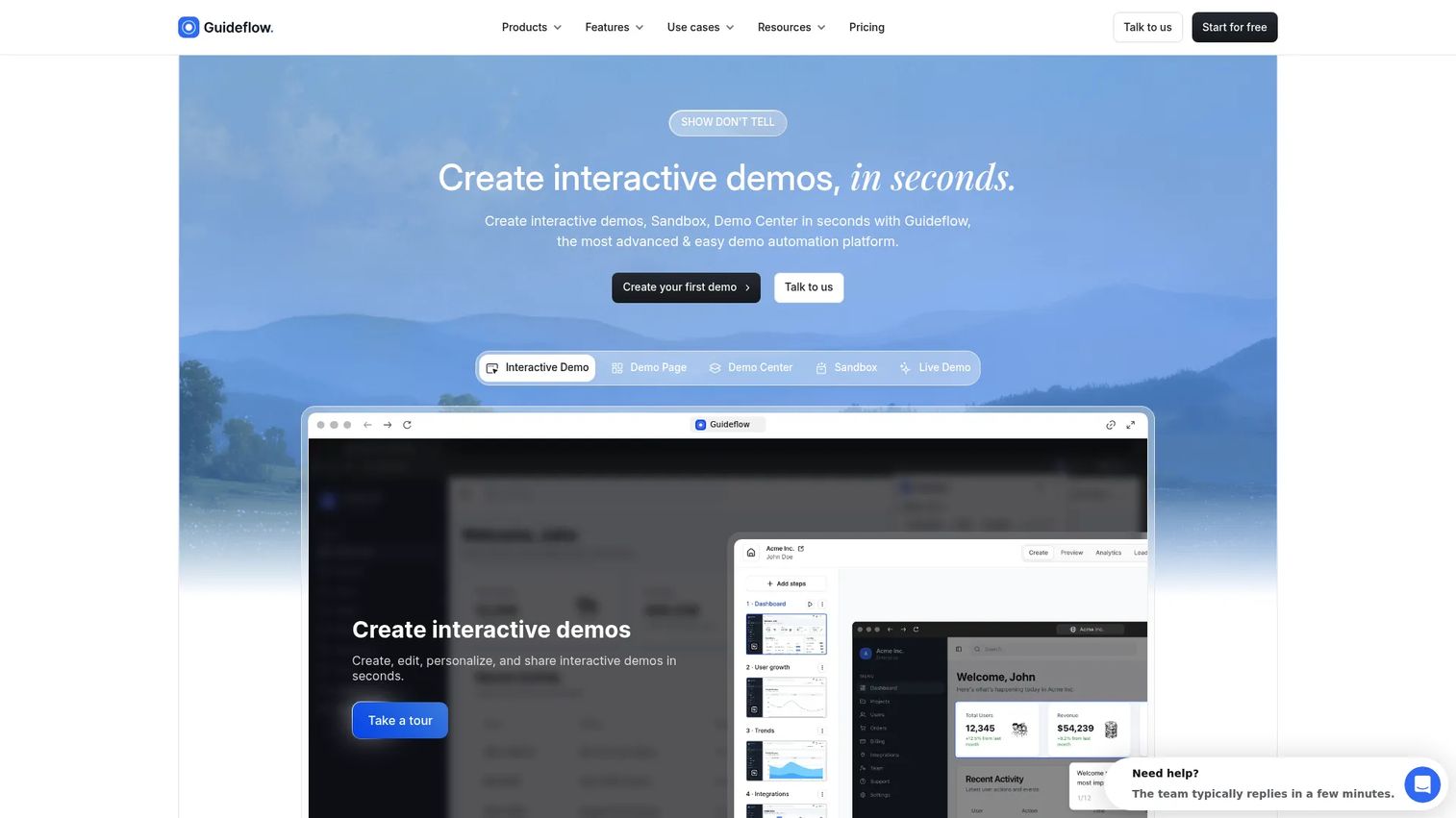
Guideflow is a demo automation platform that lets prospects experience your product before they request a free trial or book a call. It supports interactive demos, sandboxes, demo centers, live demos, and mobile demos, giving growth teams multiple formats to match the evaluation moment. Guideflow tracks impressions, completion rate, leads collected, and conversion signals in real time, so marketing and sales enter follow-up conversations with actual behavioral data.
Guideflow does not provision trial accounts, meter product usage, or handle billing. It sits before the trial, not inside it.
Best for: Growth and product marketing teams that want prospects to understand the product before starting a trial or booking a live call.
Key features
- Interactive demos, sandboxes, and demo centers in one platform
- Lead capture with completion and conversion analytics
- AI-generated steps, voiceovers, and translations
- No-code editor with CRM and Slack integrations
- Public links, website embeds, and social sharing
Why choose Guideflow: Choose Guideflow when the problem happens before the trial starts. If prospects need to see value before creating an account, Guideflow gives them a guided product experience and gives your team the completion, lead, and conversion signals to follow up with context.
Guideflow pricing: Free plan available. Monthly plans start at $40 per user (Solo), with the Startup plan at $599 per month. Annual billing brings Solo to $35 per month and the equivalent Growth plan to $499 per month.
G2 rating: 5.0/5 (158 reviews, verified November 2026).
Start your journey with Guideflow today!
2. Recurly
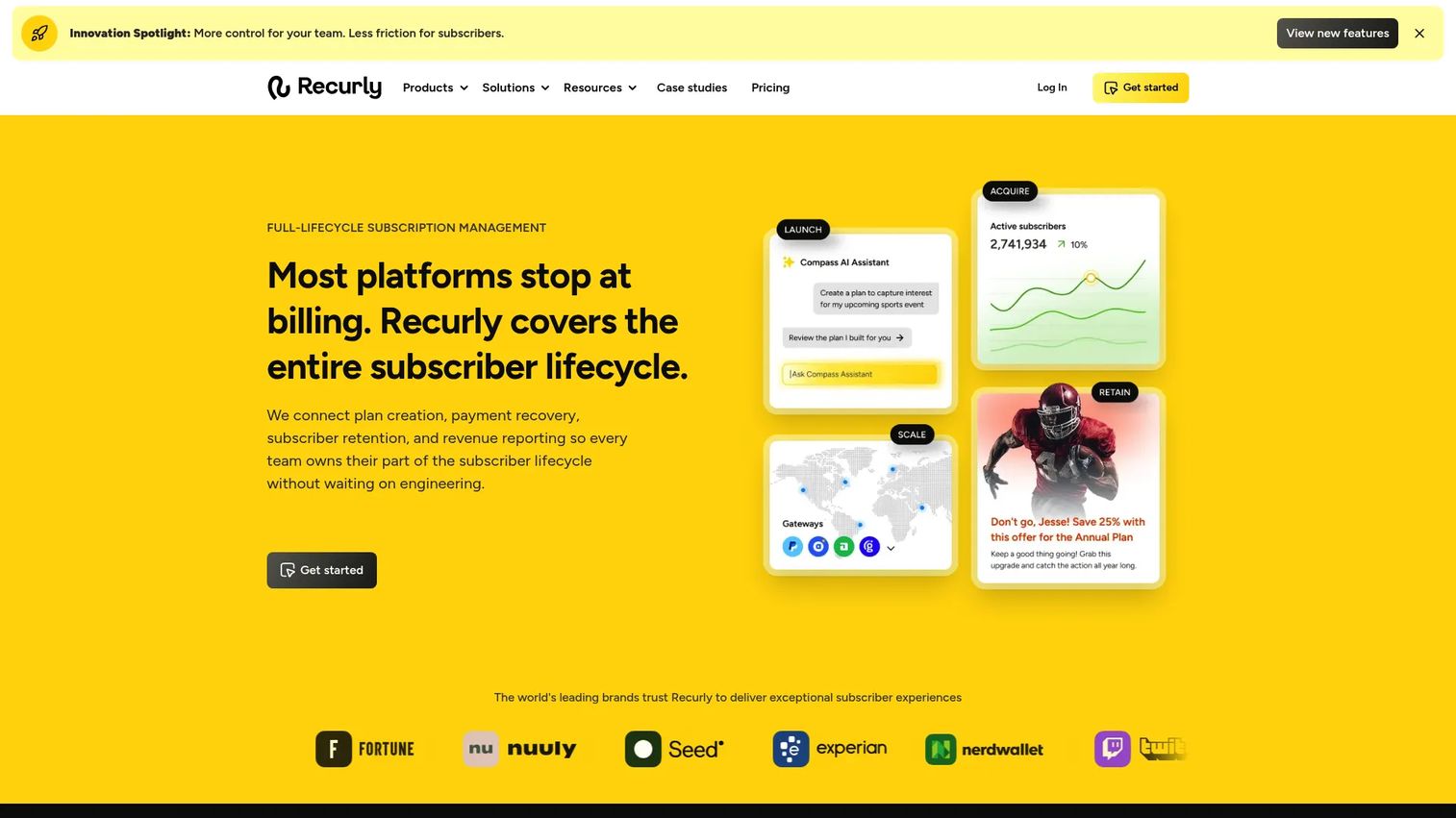
Recurly is a subscription revenue management platform built for recurring billing, churn prevention, and payment orchestration. It handles the operational side of SaaS free trials: Plan-level trial configuration, cardless free trials, trial-ending notifications, dunning workflows, and subscription renewal date management. Teams use it to control exactly when billing starts, how payment methods are collected, and what happens when a renewal fails.
Best for: SaaS teams that need precise control over trial billing state, payment authorization, and paid conversion.
Key features
- Cardless free trial configuration at the plan level
- Trial-ending notification emails
- Dunning and failed payment retry workflows
- Hosted payment pages and checkout support
- Subscription lifecycle and renewal date rules
Why choose Recurly: Use Recurly when your trial problem is fundamentally a subscription and billing problem. It fits RevOps and finance teams that need a single system for trial configuration, payment collection, and revenue reporting.
Recurly pricing: Starter plan is $249 per month plus 0.9% of billing volume, with the first $40,000 of monthly billings at no additional charge. Higher-volume All-Access plans are priced annually starting below 1% of billing volume; a $1M billing volume minimum applies. Recurly offers a 90-day free trial and free sandbox access.
G2 rating: 4.1/5
3. Chargebee
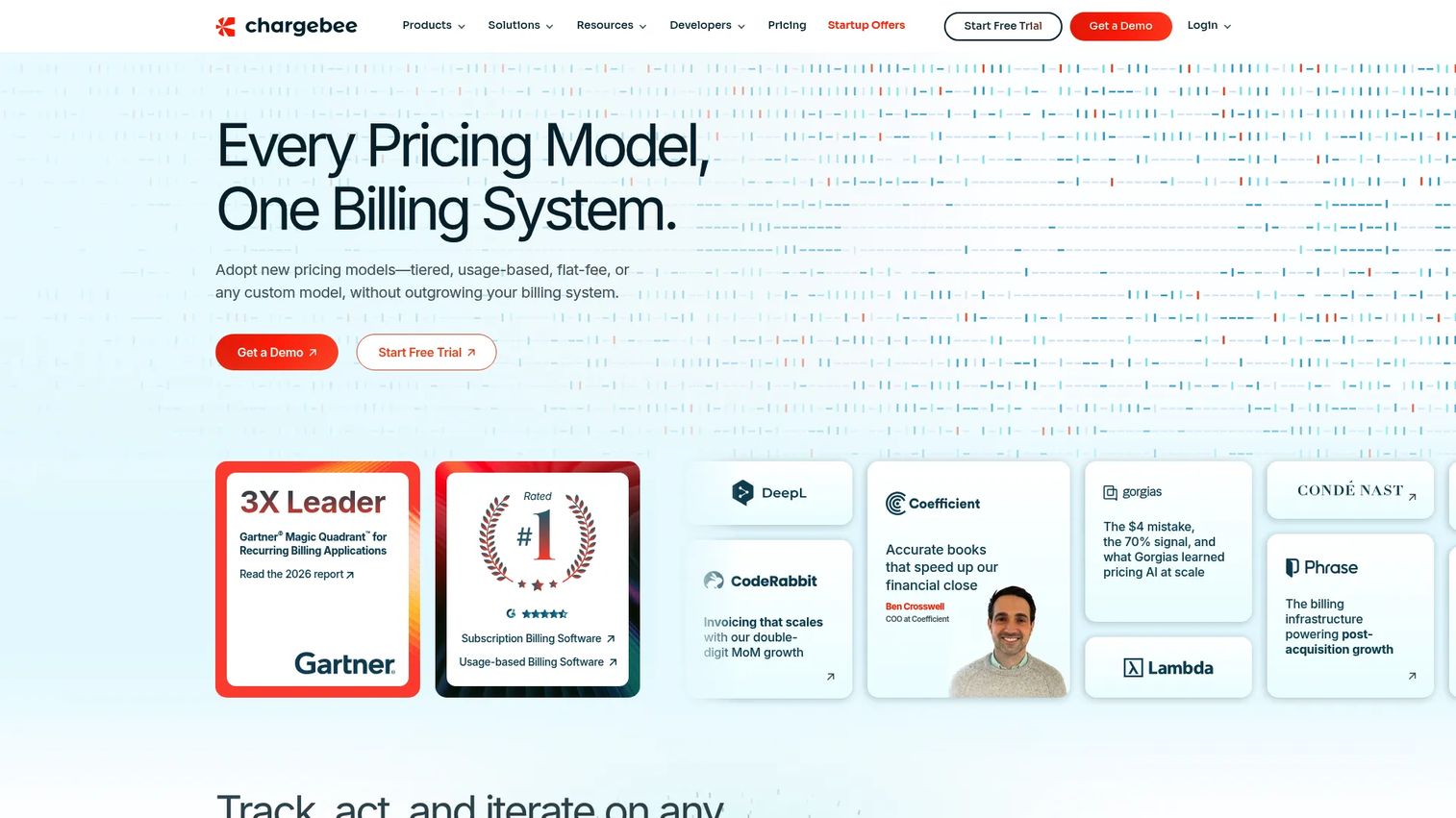
Chargebee is a billing and monetization platform for subscription, usage-based, and hybrid revenue models. It covers trial plan setup, subscription billing, coupons, revenue recognition, and dunning automation. Where Recurly focuses on subscription lifecycle operations, Chargebee adds a heavier layer of monetization complexity: Entitlement management, plan-change workflows, and native integrations with CRM and finance systems.
Best for: SaaS teams where trial conversion is tied to monetization complexity, and where marketing, RevOps, and finance all need a consistent view of paid conversion data.
Key features
- Trial plan setup and subscription billing
- Usage-based billing with a public pricing calculator
- Revenue recognition across plans
- Dunning automation and revenue recovery
- Integrations with Salesforce, HubSpot, and finance tools
Why choose Chargebee: Choose Chargebee when your trial-to-paid conversion question is also a revenue operations question. It's strong when billing, finance, and marketing need to report on conversion from the same data source.
Chargebee pricing: Starter plan is free. The Flow (usage-based) plan shows options at $0 + 0.80% or $99 + 0.65% of billing volume via the pricing calculator. Enterprise and Growth plans require contacting sales. CPQ Lite is free for the first 50 quotes.
G2 rating: 4.4/5
4. Stripe Billing
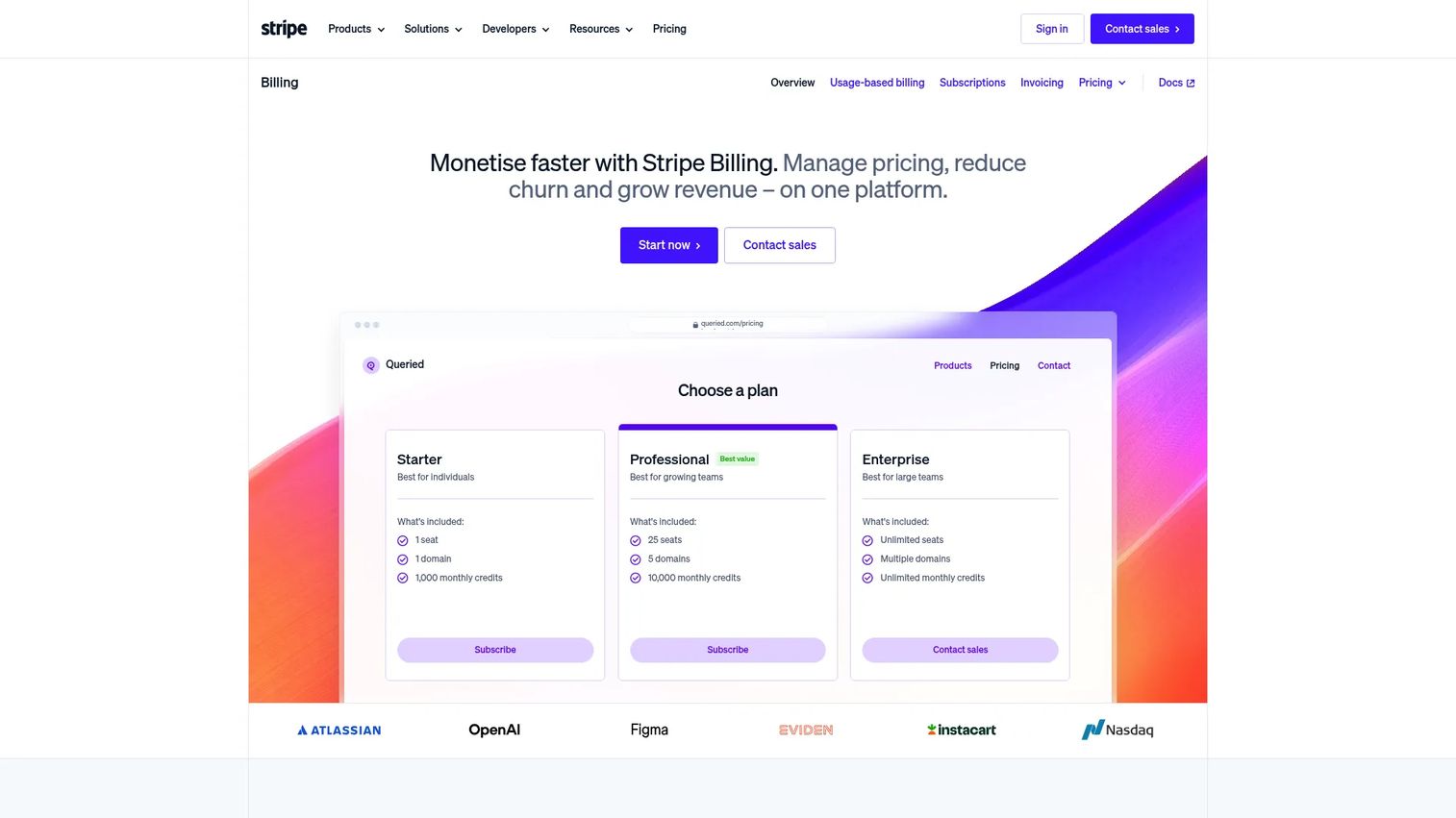
Stripe Billing is an API-first subscription management and billing platform built for teams that want flexible trial infrastructure close to their payments data. It supports subscription trials, subscription schedules, usage-based billing, hosted checkout pages, a customer portal, invoice automation, and automatic tax calculation. Teams already using Stripe for payments can add trial logic without switching billing systems.
Best for: Product and engineering teams that own the trial infrastructure and need flexible billing APIs rather than a configured SaaS UI.
Key features
- API-first subscription trial configuration
- Usage-based billing and rate cards
- Hosted checkout and customer portal
- Smart Retries for revenue recovery
- Billing analytics and accounting integrations
Why choose Stripe Billing: Pick Stripe Billing when engineering owns the trial setup and wants maximum flexibility. It suits teams that already run Stripe for payments and want trial state management inside the same infrastructure.
Stripe Billing pricing: Pay-as-you-go pricing is 0.7% of billing volume with no recurring fees. Monthly subscription plans start at $620 per month (annual contract), with higher volume tiers at $1,500, $2,950, and $5,750 per month. Custom pricing is available for large volumes.
5. ChurnZero
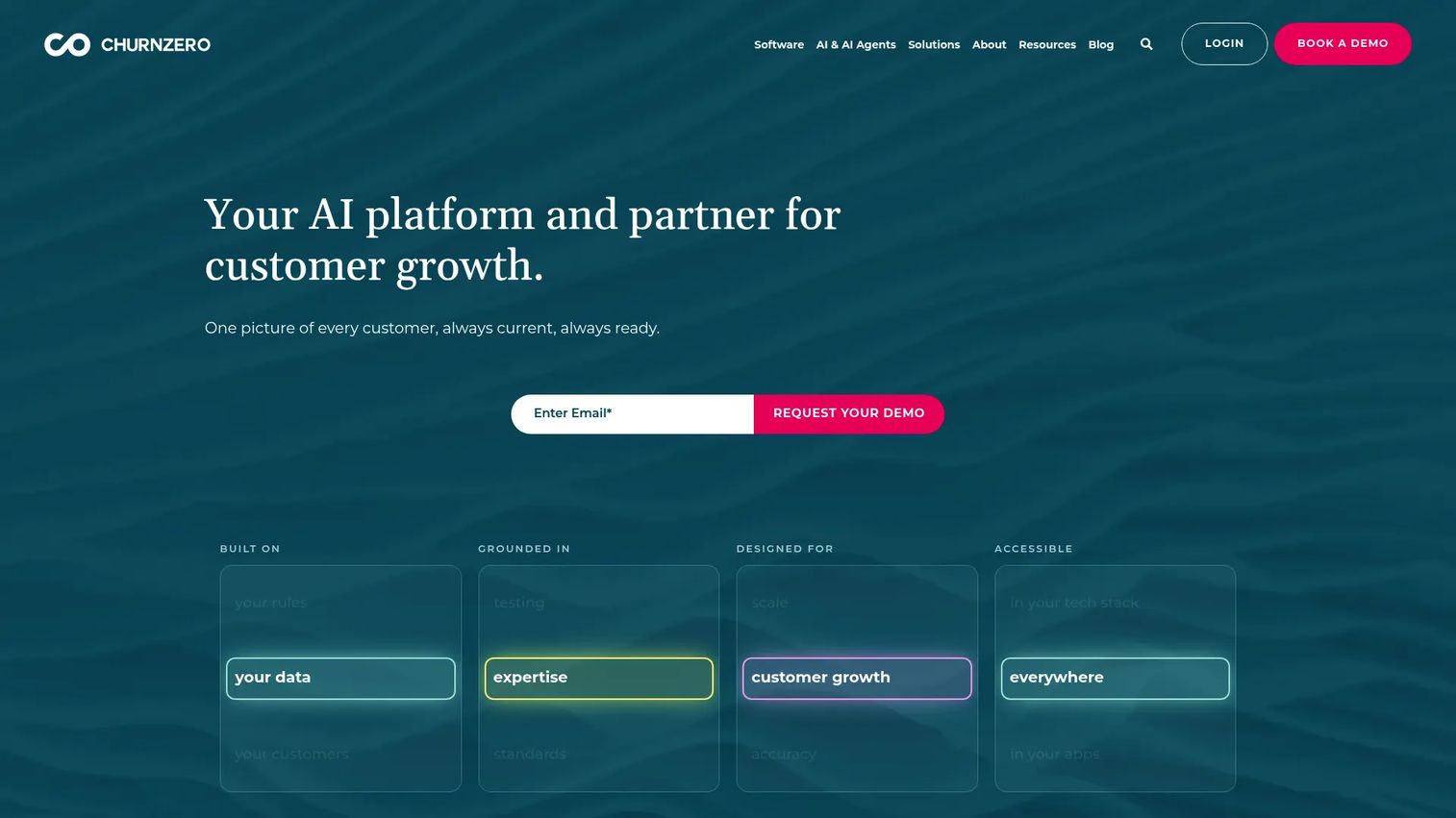
ChurnZero is an AI-powered customer success platform that tracks health scores, automates customer journeys, and surfaces retention signals. For trial management, it fits teams where the trial period overlaps with customer success: Tracking whether trial accounts reach activation milestones, triggering automated outreach when health scores drop, and segmenting accounts by engagement before the conversion conversation.
Best for: Customer success and growth teams managing high-touch trials where activation, onboarding, and retention share the same operational view.
Key features
- Customer health scoring (ChurnScores) for trial accounts
- Automated customer journeys and playbooks
- In-app communications and usage alerts
- Account segmentation and renewal forecasting
- 70+ native integrations including Salesforce and HubSpot
Why choose ChurnZero: Use ChurnZero when trial management and customer success are the same function. It works well for companies with longer, higher-touch trials where a CS team actively manages engagement before the conversion point.
ChurnZero pricing: ChurnZero prices by quote. Contact their team directly for current plan details. G2 reviewers report enterprise-level pricing typical for mid-market and above.
G2 rating: 4.7/5
6. Appcues
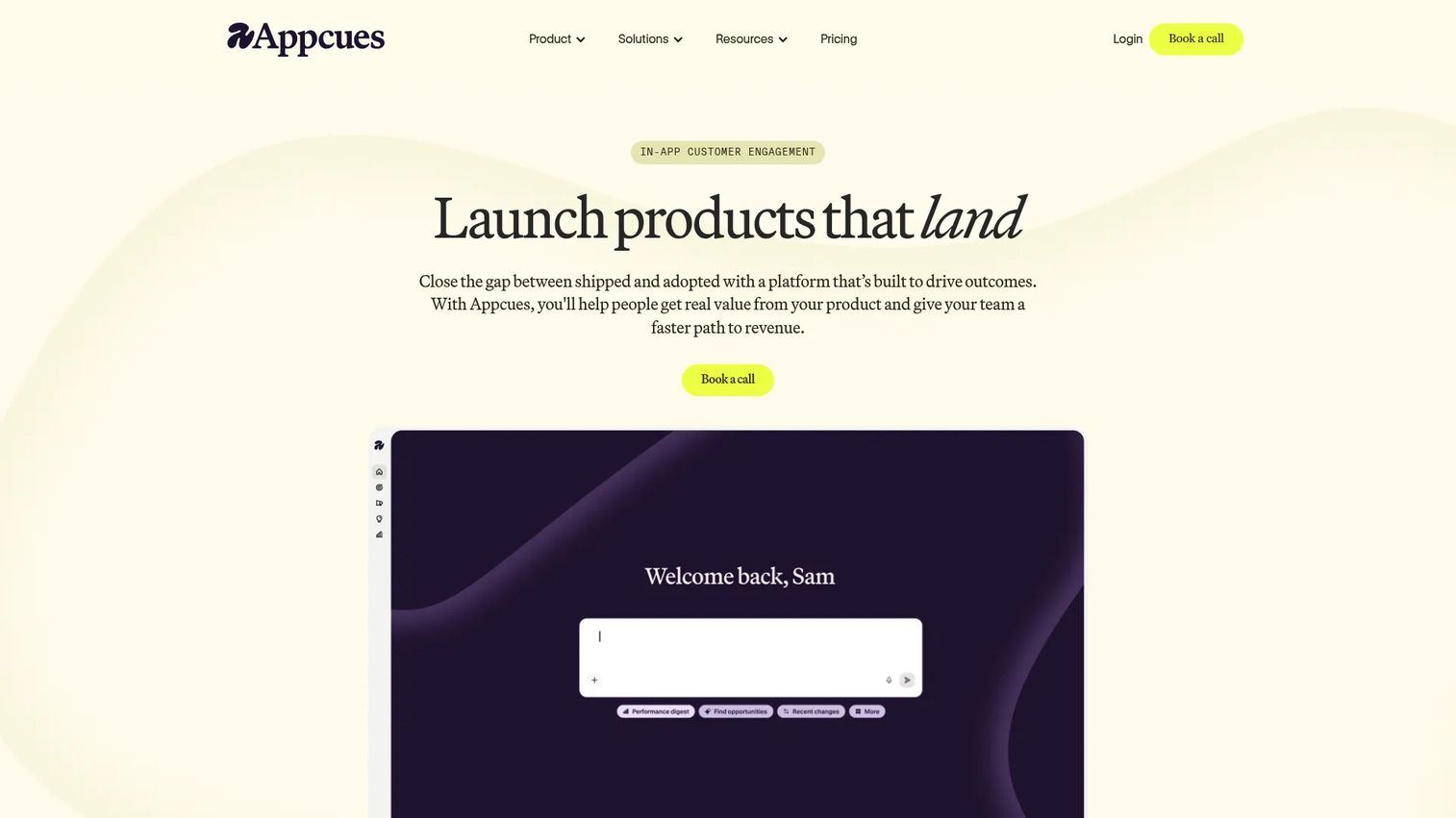
Appcues is an AI-powered customer engagement platform for building in-product experiences without engineering. It covers modals, checklists, tooltips, banners, NPS surveys, and in-app flows targeted by user behavior, attributes, or page. For trial management, the core use case is guiding trial users to their first meaningful action before they disengage.
Best for: Growth and product teams that need to activate trial users inside the product without filing engineering tickets for every onboarding change.
Key features
- In-app flows, checklists, and launchpads
- Audience targeting by behavior, page, and user attributes
- A/B testing and goal tracking
- AI-assisted experience building and analysis
- Email and push notification workflows
Why choose Appcues: Choose Appcues when users enter the trial but fail to reach the activation moment. It gives marketers and product teams control over in-product nudges and measures which onboarding sequences actually change conversion behavior.
Appcues pricing: The Grow plan starts at $9,000 per year (scales with monthly active users up to 50,000). An Enterprise plan is available at custom pricing.
G2 rating: 4.6/5
7. Userpilot
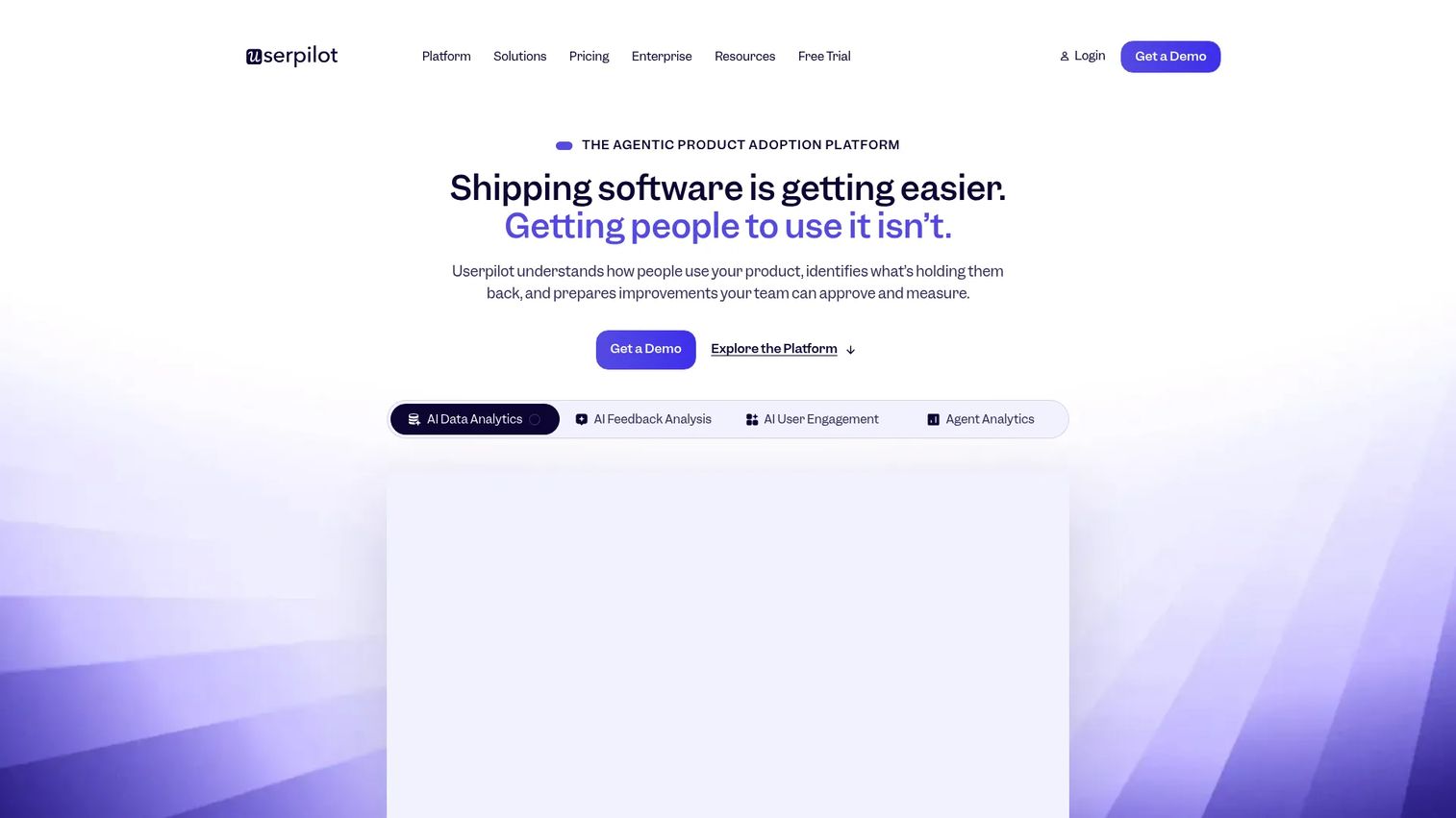
Userpilot is a product growth and analytics platform for understanding user behavior, running in-app onboarding flows, collecting feedback, and driving feature adoption. It combines onboarding, product analytics, session replay, and user surveys without requiring code changes. For product-led growth teams, it connects what users do during a trial to what actually converts them.
Best for: PLG teams that need onboarding, behavioral analytics, and in-app feedback in one product adoption tool, without splitting those functions across separate platforms.
Key features
- In-app onboarding and product adoption flows
- Product analytics and funnel analysis
- User segmentation and behavior-triggered targeting
- NPS surveys and in-app feedback collection
- Session replay and AI agent (Lia) for analysis
Why choose Userpilot: Use Userpilot when you need to run onboarding experiments and immediately see which segments convert. Its analytics sit inside the same platform as its onboarding flows, so you're not exporting data between tools to understand what's working.
Userpilot pricing: Starter plan is $299 per month (up to 2,000 monthly active users). Growth plan starts at $849 per month. Enterprise uses custom pricing.
G2 rating: 4.6/5
8. Pendo
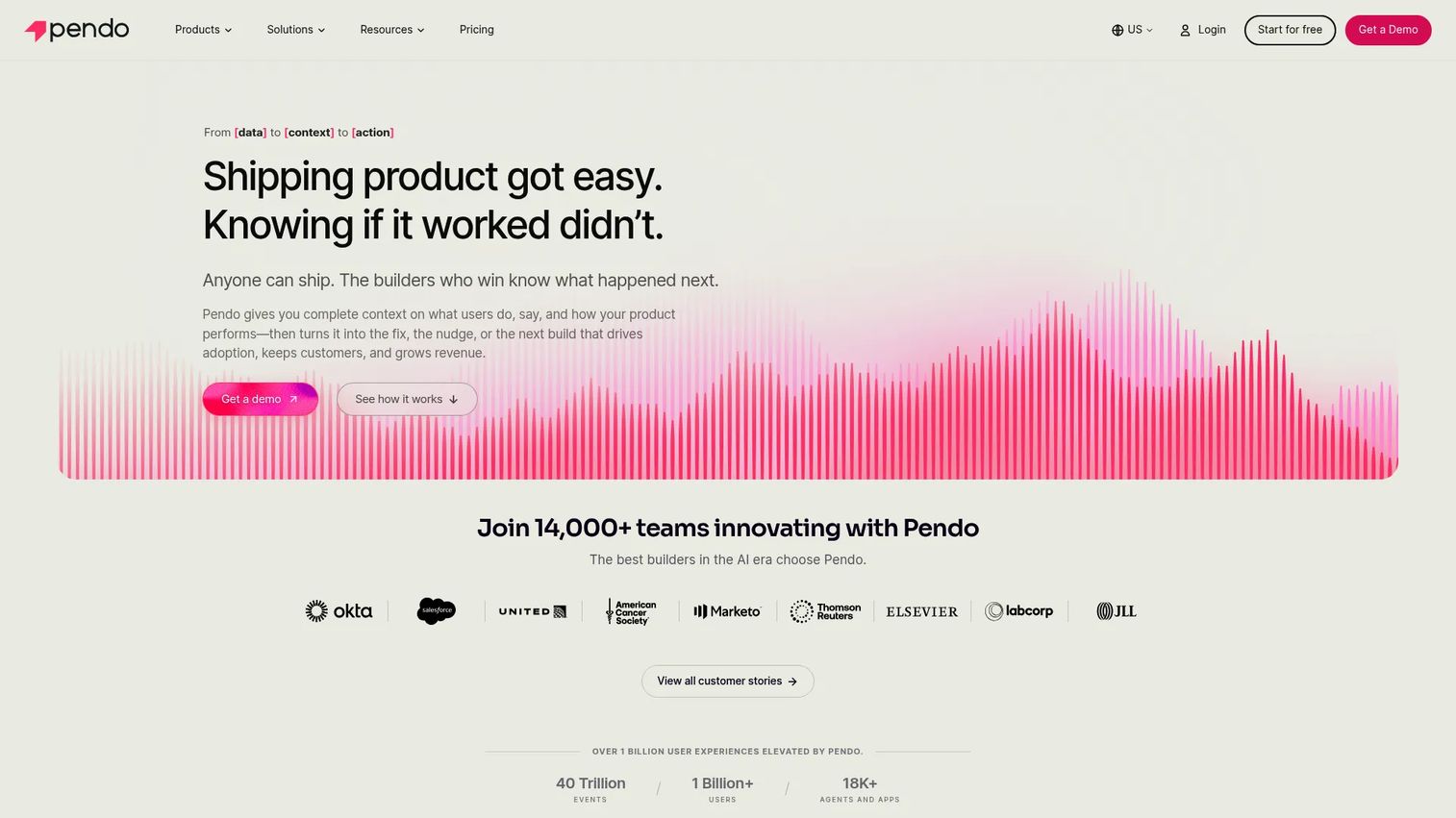
Pendo is a product experience platform combining usage analytics, in-app guidance, session replay, NPS surveys, and feedback management. For trial management, it answers the question "what are users doing before they convert?" It surfaces which features trial users touch, where they stall, and how account-level behavior maps to paid conversion.
Best for: Mid-market and enterprise teams that need product usage data and in-app engagement in one platform, particularly where account-level reporting is a priority.
Key features
- Product analytics and feature adoption tracking
- In-app guides and resource center
- Session Replay and cross-channel journey orchestration
- NPS, CSAT, and product-market fit surveys
- Account segmentation and AI-powered insights (Leo)
Why choose Pendo: Choose Pendo when understanding trial behavior is the primary gap. It works well for teams that need to report on feature adoption by account and correlate product usage to revenue outcomes.
Pendo pricing: A free plan is available for up to 500 monthly active users. Paid plans (Base, Core, Ultimate) use custom pricing tied to monthly active users and selected functionality. Novus is currently in free open beta. Contact Pendo for a quote on paid tiers.
G2 rating: 4.4/5 (verified November 2026).
9. CobbleStone Contract Insight
CobbleStone Contract Insight is an AI-powered contract lifecycle management platform for legal, procurement, and finance teams. It manages contract intake, drafting, approval workflows, e-signatures, obligation tracking, and renewal alerts. The "trial" context here is a proof-of-concept evaluation: A structured 30-day or longer assessment where an enterprise team validates the platform against their actual contract workflows before purchase.
Best for: Legal, procurement, and finance teams evaluating contract lifecycle management through a structured proof-of-concept, not SaaS subscription trials.
Key features
- Centralized contract repository with version control
- Automated approval workflows and renewal tracking
- VISDOM AI for contract data extraction and risk analysis
- Obligation and alert management
- Integrations with business systems across legal and finance
Why choose [CobbleStone Contract Insight](https://www.cobblestone ช.com): Choose CobbleStone when "trial management" means validating a complex enterprise workflow before purchase. It fits organizations where legal and procurement need to prove fit before committing to a multi-year contract.
CobbleStone Contract Insight pricing: Three editions are available: Enterprise, Express, and WorkGroup. Pricing requires contacting the CobbleStone sales team directly. G2 reviewers indicate enterprise-level contract value typical for CLM platforms.
G2 rating: 4.7/5
10. OpenClinica
OpenClinica is an eClinical platform for electronic data capture, eConsent, outcome assessments, analytics, and patient recruitment in clinical trials. It is not a SaaS product free trial tool. It manages clinical studies: Form building, data validation, role-based permissions, audit trails, and regulatory compliance. It sits in this list because "clinical trial management software" is a real intent branch of this keyword and belongs in a complete comparison.
Best for: Small to midsize sponsors, CROs, and academic research teams running clinical studies that require regulated data capture and consent workflows.
Key features
- Drag-and-drop EDC with real-time edit checks
- eConsent with electronic signatures and multilingual support
- Reporting and analytics with role-based dashboards
- Audit trails and regulatory-grade permissions
- 30-day free trial on the Launch plan
Why choose OpenClinica: Choose OpenClinica when "trial" means a clinical research study, not a SaaS product evaluation. It is a separate category from subscription trial management, and comparing the two would be a category error in your buying process.
OpenClinica pricing: Launch plan is $750 per month (billed monthly, no annual contract). Core plan is $3,000 per month per study on a 12-month contract. Advanced plan is $3,750 per month per study. Enterprise and academic pricing is custom.
11. Viedoc
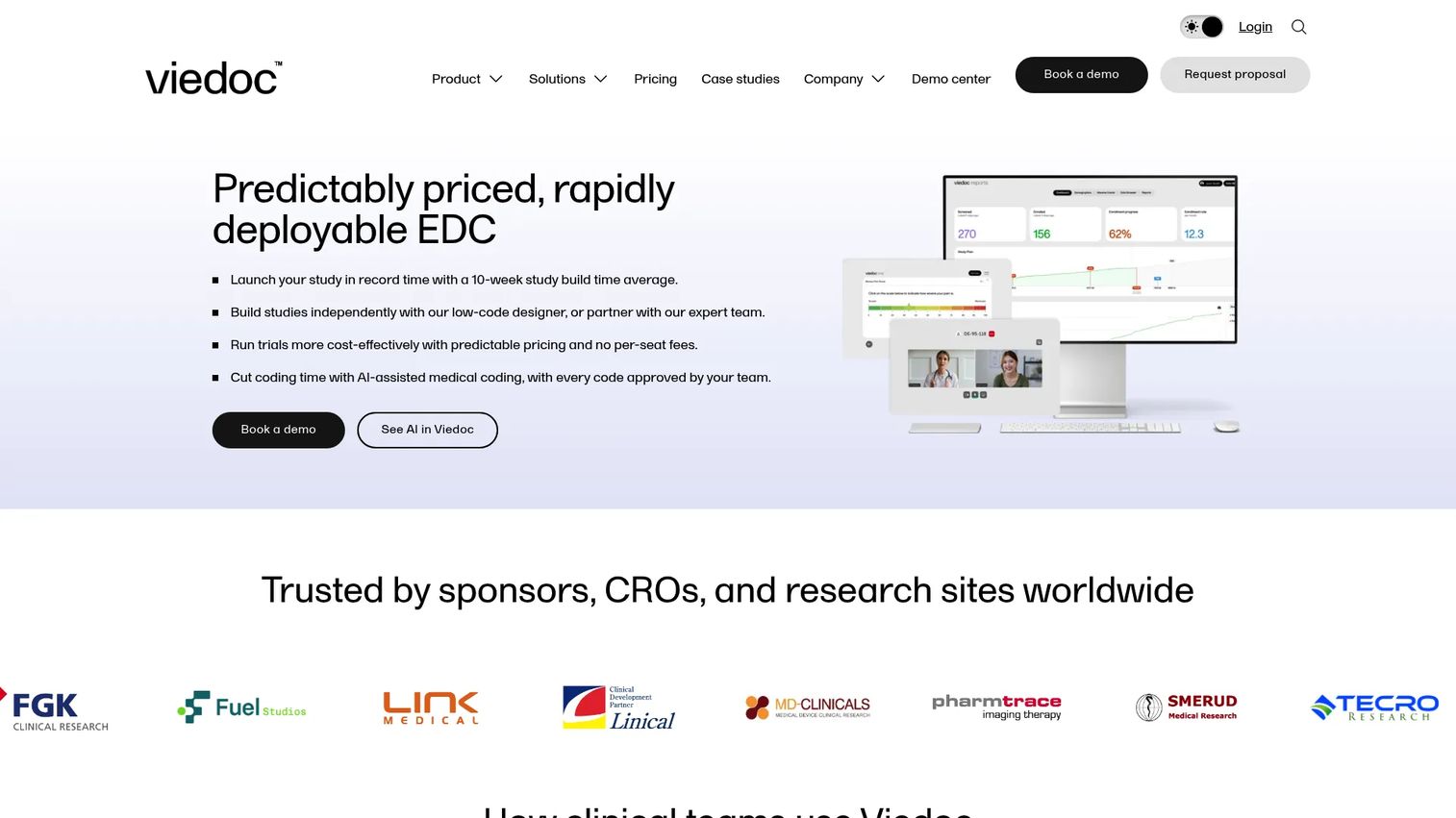
Viedoc is a web-based eClinical suite for managing regulated clinical trial data and workflows. It covers electronic data capture, electronic patient-reported outcomes, televisits, randomization, medical coding, trial supply management, and an electronic trial master file. Like OpenClinica, it appears here because clinical research teams searching this keyword need a complete answer, not just the SaaS billing tools.
Best for: CROs, sponsors, and medical-device organizations running regulated clinical trials that require a full eClinical workflow from study design to data closeout.
Key features
- EDC with drag-and-drop study design and real-time validation
- Electronic patient-reported outcomes (ePRO)
- Randomization and trial supply management
- eTMF, record sharing, and eSignatures
- Medical coding and reporting with audit-ready records
Why choose Viedoc: Use Viedoc when your trial management challenge is clinical governance, not SaaS conversion. It suits teams that need unlimited users, included hosting, maintenance, and compliance documentation built into the licensing model.
Viedoc pricing: Pricing uses a Single Study Model or Multiple License Model, both priced by study complexity, duration, number of sites, and included modules. Contact Viedoc sales for a quote. All licenses include unlimited users, hosting, maintenance, and updates.
G2 rating: 4.5/5
Considerations when choosing free trial management software
Start with the trial problem you actually have
Billing, onboarding, analytics, pre-trial evaluation, proof-of-concept, and clinical research are different problems requiring different tools. Pick the category first, then compare vendors within it. Adding a subscription billing platform won't fix weak in-app activation. Adding an onboarding tool won't fix unqualified trial signups.
Check how the tool handles conversion data
Growth marketers need visibility into activation events, trial stage, lead source, CRM ownership, and revenue outcome. If you're using a pre-trial interactive demo, confirm the platform reports on completion rate and leads collected, not just impressions. Attribution gaps between trial activity and pipeline are one of the most common reasons growth teams lose confidence in their tools.
Evaluate billing and cancellation rules
For SaaS trials, clarify whether the platform supports cardless trials, when it collects payment information, how it handles renewal timing, cancellation, dunning, and trial-ending emails. These rules determine your conversion curve and your revenue recovery rate after trial expiration.
Look for onboarding control without engineering bottlenecks
Trial onboarding tools should let marketers and product teams update in-app guides, checklists, and lifecycle nudges without filing tickets. If every onboarding experiment requires an engineering sprint, your iteration speed will cap out well below what your conversion rate requires.
Confirm compliance and governance fit
For contract workflow evaluations and clinical research, audit trails, permissions, approval workflows, data controls, and regulatory documentation are non-negotiable. Confirm the platform's compliance posture before evaluation, not after.
Conclusion
The right free trial management tool depends entirely on where your funnel breaks.
Recurly, Chargebee, and Stripe Billing handle the subscription and billing layer: Trial configuration, cardless access, dunning, and paid conversion workflows. Guideflow handles the evaluation moment before the trial starts, giving prospects an interactive product experience and giving your team completion and conversion signals. Appcues, Userpilot, and Pendo each address in-app activation and product behavior visibility in slightly different ways, with Appcues leaning no-code and Pendo leaning analytics depth.
CobbleStone Contract Insight serves a different buyer: Legal and procurement teams running structured proof-of-concept evaluations for enterprise software. OpenClinica and Viedoc serve clinical research teams entirely.
Before buying, map your trial funnel from first interest to paid conversion. Identify where the drop-off actually happens. Then match the tool category to that specific gap rather than adding another dashboard to a stack that's already crowded.
Start your journey with Guideflow today!
FAQs
Free trial management software helps teams configure, measure, and improve product trial experiences. The term covers subscription billing and trial configuration tools (like Recurly and Chargebee), in-app onboarding platforms (like Appcues and Userpilot), product analytics tools (like Pendo), and clinical trial management systems (like OpenClinica and Viedoc). The right category depends on whether your challenge is billing, activation, pre-trial evaluation, or regulated research.
For SaaS billing and subscription trials, Recurly and Chargebee are strong choices. For in-app activation and onboarding, Appcues and Userpilot are purpose-built for getting trial users to their first meaningful action. For pre-trial product evaluation, Guideflow lets prospects experience the product before account creation and tracks who engaged and how far they got.
Cardless free trials let users start evaluating a product without entering payment information. This reduces signup friction and typically increases trial volume, but conversion to paid requires a follow-up mechanism: Trial-ending emails, in-app prompts, or sales outreach before expiration. Platforms like Recurly and Chargebee support cardless trial configuration alongside the reminder and dunning workflows that convert trial users into paying customers.
Start by identifying whether the problem is at activation (users don't reach a valuable moment), at the billing handoff (payment collection or dunning fails), or before the trial begins (users sign up without understanding the product). Activation gaps respond to in-app onboarding tools. Billing gaps respond to subscription trial configuration. Pre-qualification gaps respond to giving prospects an interactive product experience before account creation, which surfaces intent signals before trial provisioning.
They solve different jobs. An interactive demo helps a prospect understand product value before they commit to creating an account. A free trial gives hands-on access to the live product after the buyer is ready to evaluate. Teams with high unqualified trial rates often find that adding a demo experience before the trial improves the quality of signups and gives sales richer context for follow-up.
Track signup source, the first activation event the user completes, feature-level usage, trial age, in-app engagement, email engagement, and MQL-to-SQL movement. If you're running a pre-trial interactive demo, also track completion rate, lead capture, and which demo steps drove the most engagement. All of these connect trial behavior to pipeline and help you identify which cohorts convert at higher rates.
Free trial software (SaaS context) refers to tools for managing subscription product evaluations: Billing configuration, in-app onboarding, product analytics, and paid conversion workflows. Clinical trial software manages regulated research studies, including electronic data capture, patient consent, audit trails, randomization, and compliance documentation. The two categories share a keyword but serve entirely different buyers with different regulatory and operational requirements.
For most B2B teams, yes. CRM integration lets sales follow up on trial accounts with behavioral context, allows marketers to attribute pipeline to trial activity, and gives RevOps a connected view of trial behavior and revenue outcome. Without CRM integration, trial data lives in a separate system and attribution gaps make it hard to prove which trial motion is actually driving conversion.