A procedure gets updated. Legal approves it. Operations signs off. Then you discover that pilots on two fleets are still flying with last month's version - because someone forwarded a PDF six weeks ago and nobody tracked who has what.
This is the operational reality that flight operations manual authoring software exists to prevent. The problem is not writing documents. The problem is controlling them: Who has the current version, who approved it, who can prove it was distributed to the right people at the right time.
IATA's 2023 global survey found that 60% of airlines carry flight plans in electronic format on at least one fleet, and 80% of surveyed organizations said they consulted cybersecurity teams when implementing electronic document systems. The move to digital is accelerating, and the governance gap between "we have digital documents" and "we have controlled documents" is where operational risk lives.
G2 tracks 11 products in the flight operations manual category and reports an average rating of 4.81 out of 5 as of October 2026. That high average reflects a specialized market where buyers know exactly what they need and vendors have built accordingly.
What's inside
This guide is for aviation operators, compliance leaders, and founders evaluating operational documentation infrastructure. Seven tools are covered, selected against four criteria:
- Aviation authoring depth: Does the tool understand operational manual structure, revision bars, and Lists of Effective Pages?
- Revision control and audit history: Can you prove who approved what, and when?
- Controlled distribution: Can you deliver current content to pilots, crews, and ground teams and confirm access?
- Implementation realism: Can a lean operations team own this without engineering support?
Pricing and G2 ratings reflect verified data from vendor pricing pages and live G2 listings as of October 2026.
TL;DR
- Best for aviation native manual workflows: Web Manuals, for operators who need authoring, compliance libraries, controlled revisions, and distribution in one aviation-focused platform
- Best for integrated safety and compliance governance: Centrik, for organizations connecting document control to safety management, quality, and risk workflows
- Best for airline-scale content delivery: Comply365 Productivity Suite, for larger operators managing controlled content across frontline teams and electronic flight bag workflows
- Best for controlled aviation documentation programs: eDocs-Aero and IDMR InForm, for regulated document management and controlled manual distribution
- Best for complex structured technical publications: MadCap Flare and MadCap IXIA CCMS, for aerospace teams managing reusable XML-based content across large technical documentation sets
What is flight operation manual authoring software?
Flight operation manual authoring software is aviation-specific software used to create, review, approve, revise, store, publish, and control access to operational manuals used by airline and aviation teams.
This is distinct from general document editing. The category exists because aviation documentation operates under regulatory obligations, and the evidence of compliance is not just the document itself but the complete history of who authored it, who reviewed it, who approved it, and who received the current version.
Core capabilities in this category:
- Aviation manual templates, structured sections, and aviation-specific formatting
- Collaborative authoring with review comments and formal approval routing
- Revision bars, change logs, Lists of Effective Pages, and full document history
- Role-based access controls and controlled distribution to operational teams
- Central document storage with current-version visibility for all users
- Audit trails covering authors, reviewers, approvers, and published versions
- Publishing to PDF, HTML5, mobile, or electronic flight bag environments
- Support for FAA, EASA, and operator-specific governance processes
Understanding the adjacent categories:
| Category | Primary job | Typical users | Best fit |
|---|---|---|---|
| Flight operations manual authoring software | Control airline operating manuals | Flight ops, compliance, safety, quality | Manuals, MELs, procedures, controlled distribution |
| Aviation document distribution software | Publish and deliver approved content | Pilots, cabin crew, ground operations | Access to current documents in the field |
| Technical documentation authoring software | Create reusable structured content | Technical publications, engineering | S1000D, DITA, maintenance manuals |
| General document editing software | Draft individual documents | Individual contributors | Early drafting, not controlled aviation operations |
Aviation native platforms are built around the workflow that follows authoring: Review, approval, publication, access control, and the audit trail that proves the whole chain happened. Structured technical authoring platforms solve a different problem: Managing reusable content components across large, complex documentation sets.
Choose based on where your operational risk actually sits today.
When to use flight operation manual authoring software
Replace uncontrolled Word and PDF workflows
Your operations team is managing versions through file names and inboxes. There is no clear source of truth, no record of who approved a revision, and no way to confirm that distributed copies match the current standard. The platform gives you a single controlled environment where a document cannot be published without completing the approval chain.
Manage frequent revisions across distributed teams
Regulatory changes, fleet additions, route expansions, and safety findings create revisions that require sign-off from multiple functions. Without a system, revision ownership falls to whoever is most organized, not whoever is most accountable. An approval workflow software layer inside an aviation platform makes status visible and keeps reviewers from becoming bottlenecks.
Distribute controlled manuals to operational teams
Pilots, dispatchers, cabin crews, and maintenance staff need access to current content. Getting approved content into the right hands, and proving it got there, is the second half of the job. Systems that handle authoring but fail at distribution leave the operational risk intact.
Flight operation manual authoring software comparison
The seven tools below cover a spectrum: Aviation native platforms built around operational manual control, and structured authoring platforms built for complex technical publications. Neither category is universally better. The right choice follows from where your documentation risk is concentrated.
| # | Product | Best for | Key differentiator | Pricing | G2 rating |
|---|---|---|---|---|---|
| 1 | Web Manuals | Aviation native manual authoring | Aviation-specific authoring, compliance libraries, revision workflows, and controlled distribution | Essentials from €4,000/year; Professional from €170/editor/month | 4.4/5 |
| 2 | Centrik | Integrated safety and compliance governance | Document control connected to safety management, quality, and risk workflows | Custom pricing | N/A |
| 3 | Comply365 Productivity Suite | Airline-scale content delivery | Controlled documentation and operational content delivery for mobile and frontline teams | Custom pricing | 4.7/5 (Comply365 overall) |
| 4 | eDocs-Aero | Controlled aviation documentation | Branded digital access, organized document storage, and automated revision status | Custom pricing | N/A |
| 5 | IDMR InForm | Regulated manual publishing | Controlled authoring, OEM integrations, and full revision control for aviation documentation | Custom pricing | N/A |
| 6 | MadCap Flare | Structured technical authoring | Single-source publishing, XML and DITA support, multi-format output | Flare Desktop from $3,150/author/year | 4.4/5 |
| 7 | MadCap IXIA CCMS | Enterprise component content management | DITA-based reusable content governance and large-scale technical publication programs | Custom pricing | N/A |
Best 7 flight operation manual authoring software tools for 2026
1. Web Manuals
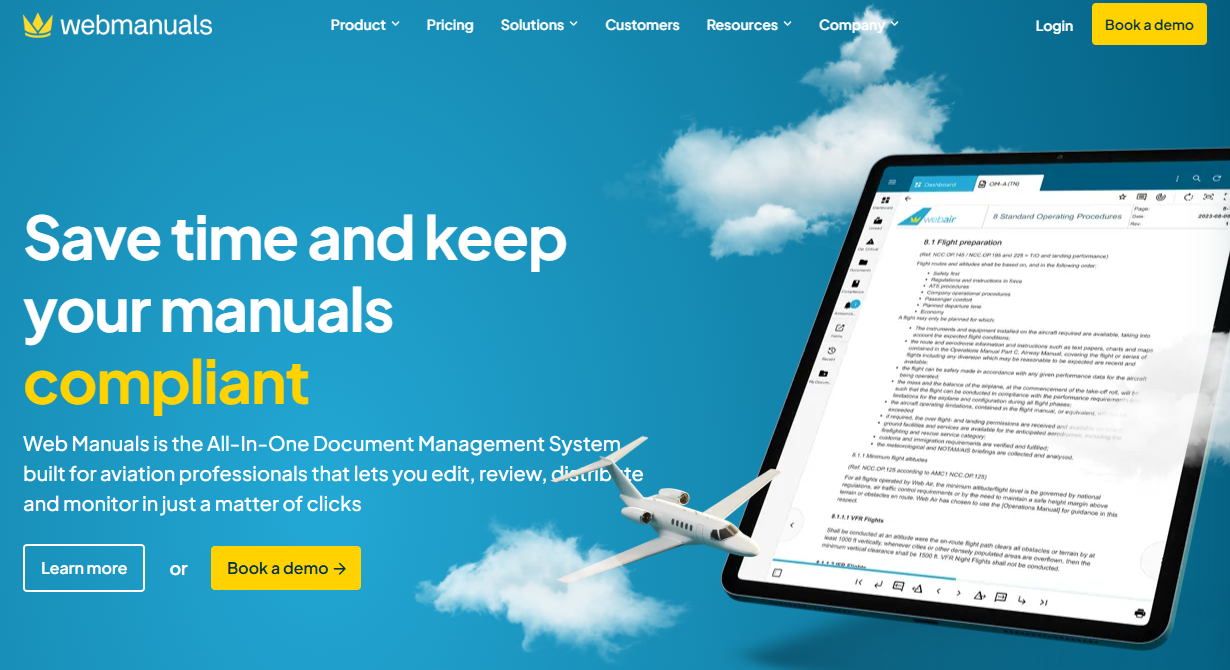
Web Manuals is an aviation document management platform built specifically for authoring, reviewing, and distributing operational manuals. It covers the full manual lifecycle: Drafting, reviewer comments, compliance monitoring, controlled publication, and access through web and mobile reader apps. The platform includes regulatory compliance libraries and an AI-powered document search feature called Amelia.
Best for: Airlines, charter operators, MRO organizations, and other regulated aviation teams that need a purpose-built system for operational manuals and compliance workflows.
Key features
- Aviation manual authoring and editing with structured revision workflows
- Compliance monitoring with regulatory content libraries
- Reviewer comments, approval routing, and audit trails
- List of Effective Pages automation
- Web, iOS, and Android reader apps for distributed teams
- Amelia AI natural-language document search
Why choose Web Manuals: This is the closest direct match for an operator managing flight operations manuals who wants aviation terminology, revision tracking, and controlled distribution in one environment. It reduces the need to adapt generic document tools to aviation-specific requirements.
Web Manuals pricing: The Essentials Package starts at €4,000 per year (billed annually) and includes 5 readers and 2 editors. The Professional plan is €170 per editor per month, billed annually, with expanded capacity and features. Enterprise pricing requires a sales conversation. Pricing is published in EUR on the vendor's pricing page.
Web Manuals G2 rating: 4.4/5
2. Centrik
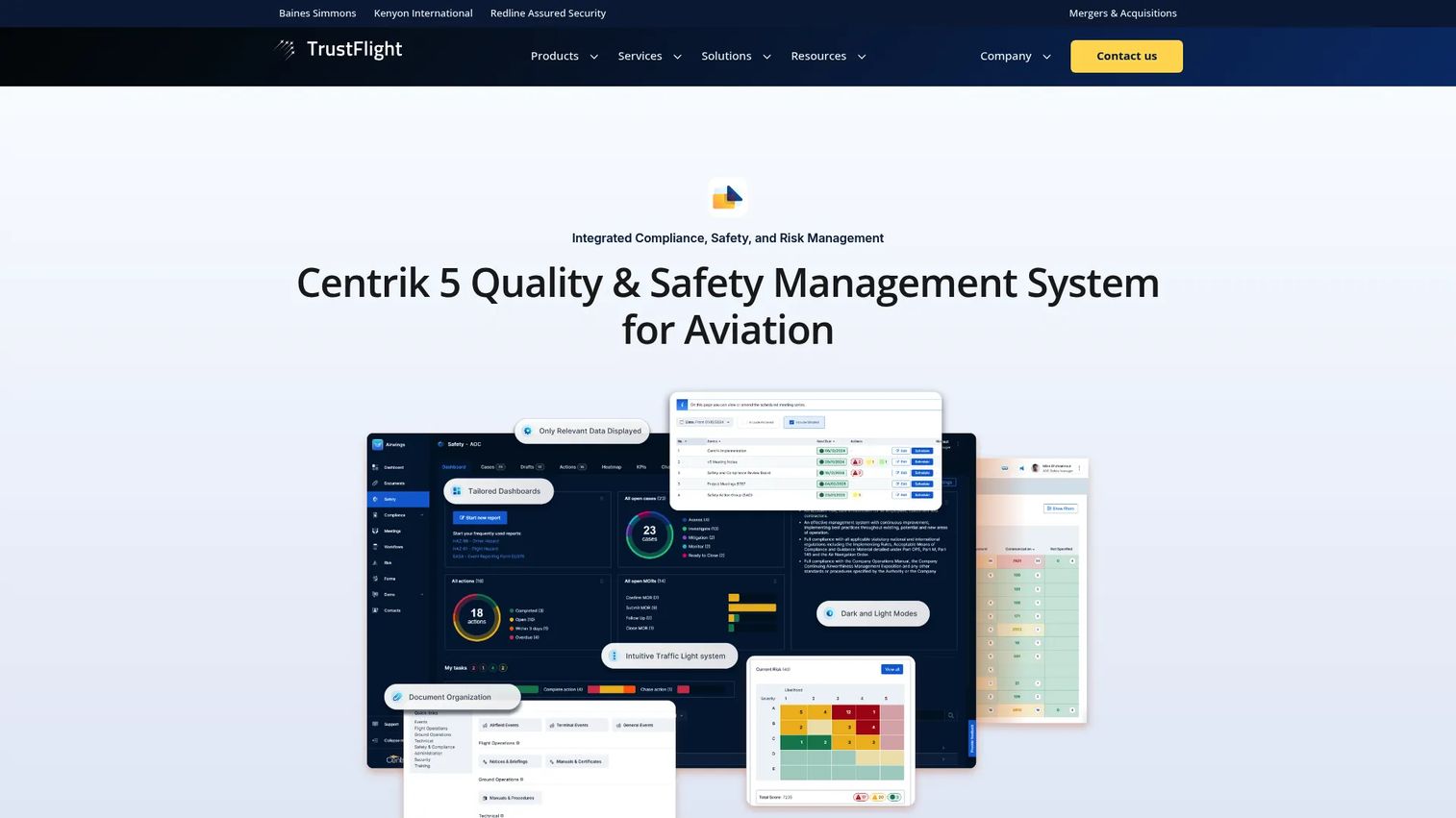
Centrik, now operating as Centrik 5 under TrustFlight, is an integrated platform connecting quality management, safety, compliance, risk, training, and document control for aviation and aerospace organizations. Document management sits alongside incident management, audit records, and risk assessments in one configurable environment. The platform includes AI-powered tools for duplicate event detection and categorization.
Best for: Aviation organizations that want manual governance connected to safety management system activity, audit programs, and operational risk processes.
Key features
- Document management, distribution, and tracking with configurable workflows
- Safety incident and hazard management
- Multi-hazard risk assessments
- Training qualification and records management
- Internal and external compliance management
- AI-powered duplicate event suggestions and categorization
Why choose Centrik: The value is greatest when operational documents need to connect to safety findings, quality audits, or risk assessments rather than sit in isolation. For organizations already running a safety management system, consolidating into one platform removes the gap between a document change and the compliance record that supports it.
Centrik pricing: Centrik directs prospective customers to request a demo for pricing. Commercial inputs that typically drive cost include modules selected, number of users, business units, and implementation services.
3. Comply365 Productivity Suite
Comply365 is an enterprise operational platform connecting content management, safety and risk management, training, and AI-powered operational intelligence for regulated industries including aviation, defense, and rail. The Productivity Suite covers operational content authoring, publishing, distribution, and online/offline access. It is designed for organizations where content must reach frontline teams reliably and where revision acknowledgment matters as much as the revision itself.
Best for: Airlines and larger aviation operators managing controlled content across pilots, cabin crews, maintenance teams, and other frontline users, particularly where electronic flight bag integration is a requirement.
Key features
- Operational content management with authoring, publishing, distribution, and search
- Online and offline document access for frontline teams
- Revision and acknowledgment workflows
- Safety and risk reporting with corrective action tracking
- Training and qualification management
- Integration with wider operational processes
Why choose Comply365 Productivity Suite: The bottleneck this platform solves is distribution, not authoring. If your team produces solid operational content but cannot confirm that frontline staff can access and acknowledge current versions, Comply365's delivery model addresses that gap directly.
Comply365 Productivity Suite pricing: Comply365 does not display pricing; contact sales for current package structure. The Productivity Suite is an enterprise product, and pricing reflects deployment scale, modules, and user population.
Comply365 G2 rating: 4.7/5
4. eDocs-Aero
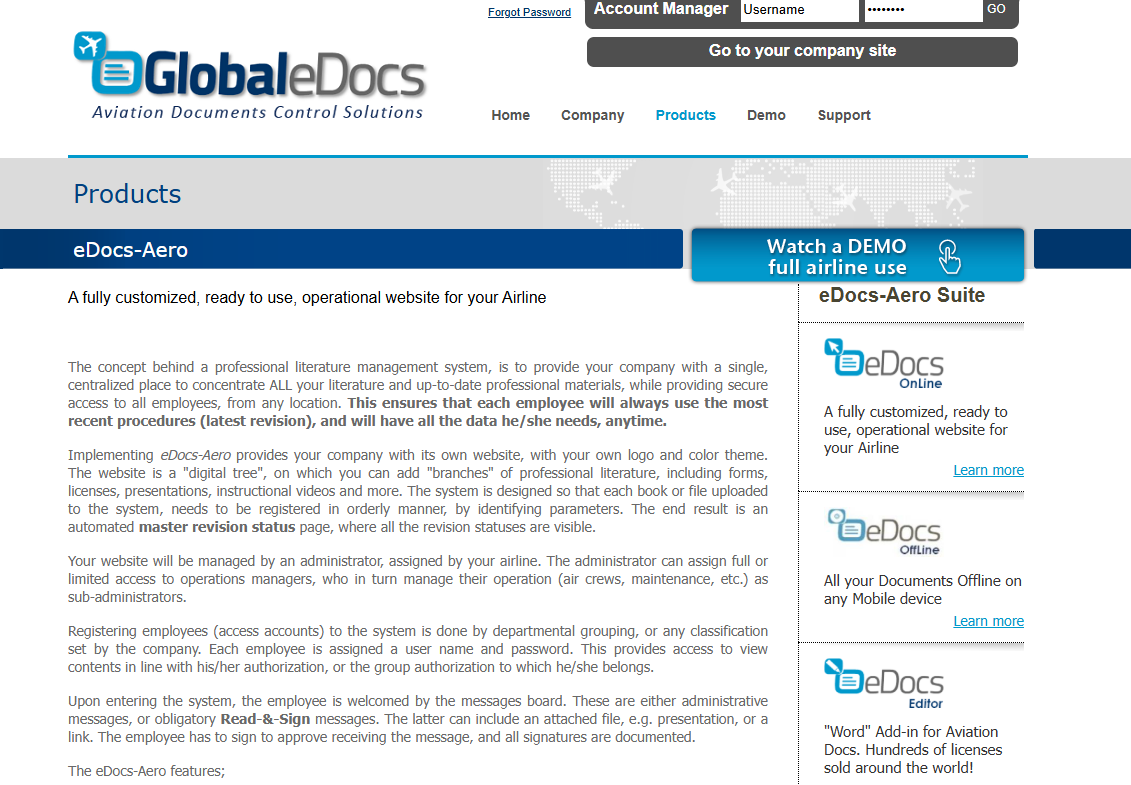
eDocs-Aero is an aviation document management platform that gives organizations a branded digital website for organizing and distributing controlled professional literature. It provides a digital-tree structure for forms, licenses, presentations, and instructional content, along with automated master revision-status visibility. The platform focuses on controlled access and current-version clarity for aviation documentation programs.
Best for: Aviation teams that need a dedicated document management environment for operational manuals, controlled access, and automated revision status tracking.
Key features
- Branded company website with custom logo and color theme
- Digital-tree organization for controlled aviation documents
- Automated master revision-status visibility
- Controlled document distribution and access management
- Structured organization for forms, licenses, and instructional content
Why choose eDocs-Aero: It belongs on the shortlist when aviation specificity matters more than broad enterprise content management features. For a lean operations team that needs clear version control and controlled access without a large implementation program, the focused scope can be an asset.
5. IDMR InForm
IDMR InForm is a web-based aviation document management system for authoring, maintaining, integrating, and distributing regulated airline documents. It covers document authoring, OEM and maintenance system integrations, task-card management, engineering-order workflows, full revision control, and electronic signatures. The system supports mobile and web-based access for distributed teams.
Best for: Airlines, MROs, and aviation organizations managing regulated maintenance and technical documentation alongside operational manuals.
Key features
- Document authoring, maintenance, and full revision control
- OEM and M&E system integration
- Task-card and engineering-order management
- Automated workflows with electronic signatures
- Mobile and web-based access for field teams
Why choose IDMR InForm: It fits organizations with mature documentation programs that need formal controlled publishing combined with maintenance system integration. The OEM integration capability makes it relevant for operators where technical and operational documentation need to connect rather than sit in separate environments.
IDMR InForm pricing: IDMR does not display pricing. Contact the vendor for a quote; pricing typically reflects deployment scope and governance requirements, including user population and the number of integrated systems.
6. MadCap Flare
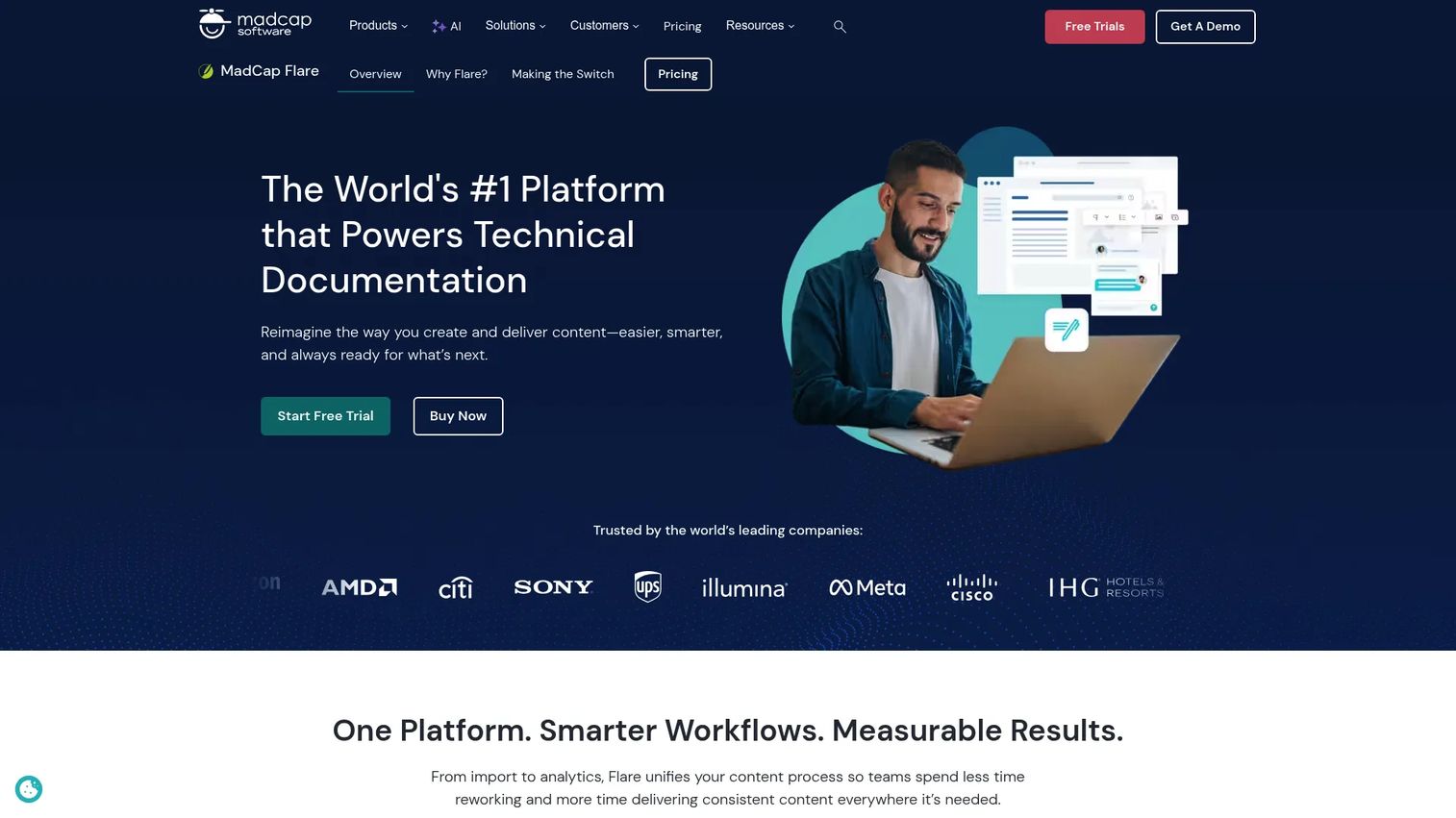
MadCap Flare is a structured technical authoring platform for creating, reusing, translating, and publishing content across multiple channels and formats. It is not an aviation native manual platform by default, but it is widely used across aerospace, defense, and technical publications teams managing complex documentation programs. Flare supports single-source publishing, XML and DITA authoring, conditional text for variant management, and output to HTML5, PDF, Word, and SCORM. Version control integrations connect it to engineering workflows. Teams evaluating aviation technical documentation software often encounter Flare when the documentation challenge extends beyond operational manuals into maintenance publications, training content, or multi-aircraft variant management.
Best for: Aerospace, defense, and technical publications teams managing structured content across manuals, maintenance documentation, or standards-driven publications with high reuse and variant requirements.
Key features
- Topic-based and micro-content authoring with single-source reuse
- XML and DITA support with conditional text and variables
- Multi-channel output: HTML5, PDF, Word, PowerPoint, SCORM
- Version control integrations for engineering workflows
- S1000D and DITA aviation documentation support
Why choose MadCap Flare: The right fit is when the core challenge is reusable technical content at scale across many aircraft types, configurations, or product lines. For organizations producing variant-heavy documentation where a change in one place must propagate correctly across dozens of downstream documents, Flare's structured authoring model creates real operational leverage.
MadCap Flare pricing: The Flare Desktop plan starts at $3,150 per author per year, billed annually. Flare Online plans (Individual, Team, Business) are contact-sales; a separate trial page lists Individual subscriptions from $537 per user per month billed annually. A 30-day free trial is available. No free tier exists.
MadCap Flare G2 rating: 4.4/5.
7. MadCap IXIA CCMS
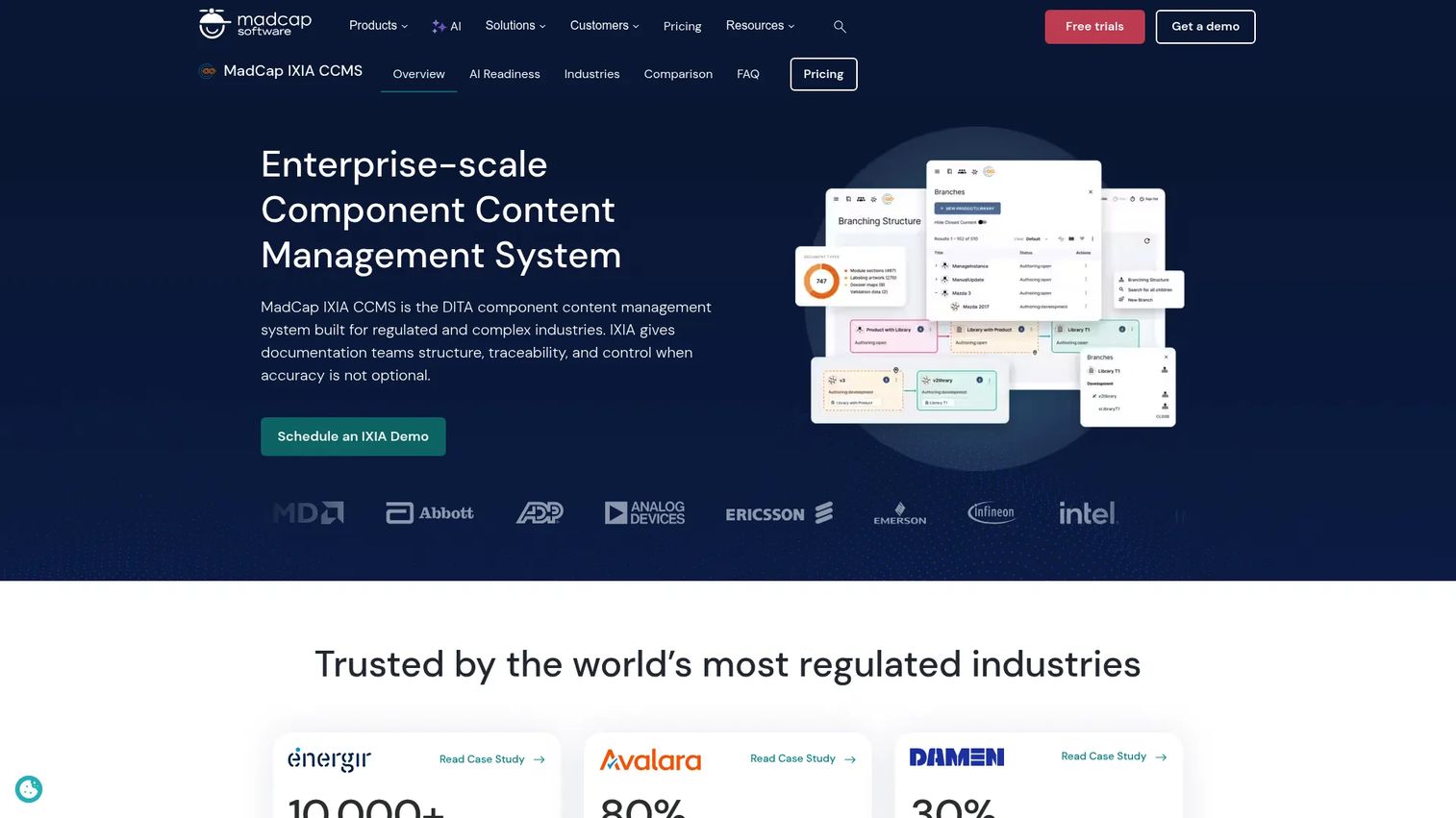
MadCap IXIA CCMS is an enterprise-grade DITA component content management system for regulated and complex industries. It extends structured documentation governance to large teams managing reusable content components, formal review and approval workflows, parallel release management, multilingual localization, and multi-format publishing. Aerospace and defense organizations use it to govern technical publications at scale. For teams evaluating best component content management systems, IXIA CCMS is the reference-level platform for DITA-based programs.
Best for: Large aerospace documentation organizations that need component content management across many manuals, product variants, contributors, and publication outputs.
Key features
- DITA-based component content management with component-level reuse
- Configurable workflows and approval governance
- Dynamic Release Management for parallel release programs
- Multilingual localization management
- Multi-format publishing: PDF, HTML5, WebHelp, and other outputs
Why choose MadCap IXIA CCMS: This is an operating model investment for enterprise technical publications programs. It creates repeatability and consistency across large documentation sets, but it needs ownership: A clear content governance plan, taxonomy discipline, and a team capable of administering the platform. For a small airline or charter operator with a defined set of operational manuals, it is likely more infrastructure than the task requires.
MadCap IXIA CCMS pricing: The official pricing page directs prospects to contact sales for enterprise pricing. Cost drivers typically include repository scale, contributor roles, deployment model, and implementation scope.
Considerations when choosing flight operation manual authoring software
Aviation specificity versus technical authoring flexibility
Aviation native platforms reduce the modeling work required for manual revisions, approvals, aviation-specific document formats, and operational distribution. Structured authoring platforms offer more flexibility for large technical documentation programs with high reuse requirements. The right choice follows from which workflow creates the most risk today: Operational manual control or complex content governance across publications. Choosing a platform that solves the wrong problem wastes implementation capacity and creates a second project.
Revision control and evidence of approval
Ask every vendor to demonstrate a complete revision lifecycle using one of your own manuals as the scenario. The demonstration should include drafting, comments, role-based approval, revision history, publication, and reader access confirmation. Do not accept a generic feature slide. An audit management software review found that organizations often conflate document storage with audit trail capability; these are different features and not every platform provides both.
Distribution and frontline access
Authoring is only half the job. Confirm how pilots, cabin crews, ground operations, maintenance teams, and contractors access current documents. Ask specifically about offline access, mobile delivery, controlled access for external contractors, acknowledgment requirements, and the process for withdrawing superseded versions. A platform that controls authoring but fails at distribution leaves the operational risk intact.
Integration with your existing stack
Map the systems that create or consume manual content before shortlisting. Safety management systems, quality platforms, electronic flight bags, training systems, maintenance platforms, and identity providers all potentially intersect with manual workflows. Integration requirements should narrow the shortlist before any team invests time in demos. Two platforms that appear equivalent on features can diverge significantly on integration depth.
Implementation ownership and migration risk
A better platform cannot fix uncontrolled source content automatically. Before committing, identify who will clean up templates, map approval chains, migrate historical files, define permissions, and maintain future workflows. This is the practical cost that never appears on a vendor demo. For a founder evaluating this category, the question is whether your operations and compliance team can own the platform without ongoing founder involvement. If the answer is no at implementation, it will still be no six months later.
Conclusion
Flight operation manual authoring software is a control system for operational knowledge. The right platform ensures a manual can be authored, reviewed, approved, published, accessed, and audited without relying on file naming conventions or one person's memory.
The routing here is straightforward. Web Manuals fits operators that need aviation native manual workflows and do not want to adapt generic tools to aviation requirements. Centrik fits organizations connecting document control to broader safety and quality governance. Comply365 Productivity Suite fits larger operators whose bottleneck is frontline content delivery. eDocs-Aero and IDMR InForm suit regulated documentation programs that need controlled access and revision management. MadCap Flare and MadCap IXIA CCMS suit aerospace technical publications teams managing complex reusable content at scale.
Validate pricing and current feature sets directly with each vendor before shortlisting. The category moves, and the implementation conversation matters as much as the product demonstration.
For founders evaluating this as an infrastructure decision: The right system moves revision ownership out of spreadsheets and inboxes and into a repeatable workflow your compliance team can own. That is what scales.
Start your journey with Guideflow today!
FAQs
Flight operation manual authoring software is aviation-specific software for creating, revising, approving, storing, publishing, and controlling access to flight operations manuals. It goes beyond ordinary document editing by adding governance capabilities: Formal approval chains, revision history, audit trails, and controlled distribution to operational teams. The category exists because aviation regulators require evidence of documentation control, not just the documents themselves.
Flight operations manual authoring software focuses on creating and maintaining the content of operational manuals, including structured authoring, reviewer workflows, revision bars, and Lists of Effective Pages. Aviation document management software covers the broader layer of storage, approval routing, distribution, and access control across many document types. In practice, many aviation platforms combine both functions, but the distinction matters when evaluating whether a tool is built primarily for authoring or primarily for document governance.
Yes, it can replace unmanaged drafting, review, and publishing workflows. Teams may still use Word or PDF as import or export formats, but the system of record should control approvals, revisions, and distributed versions. The key difference is that a controlled platform maintains a single authoritative version and a complete history of changes, approvals, and distribution. An unmanaged folder of PDFs cannot provide that evidence.
Evaluate aviation-specific templates, formal approval routing, full revision history, role-based access controls, controlled distribution with acknowledgment tracking, List of Effective Pages support, and integration with existing safety and quality systems. Beyond features, assess whether the vendor provides implementation support for migrating from unstructured workflows and whether your operations team can maintain the system without engineering involvement.
These platforms can support documentation processes aligned with an operator's regulatory obligations under FAA, EASA, and other authorities. They provide the authoring structure, approval records, revision history, and distribution controls that regulators look for during audits. Final compliance responsibility remains with the operator and the relevant authority. No software tool makes an organization compliant; it creates and maintains the evidence that supports an operator's compliance posture.
A List of Effective Pages identifies the current approved pages and their revision status within a controlled manual set. It tells users which pages are current, which have been revised, and which have been removed. Without it, a manual reader cannot confirm they are working from a complete and current document. Aviation native platforms typically automate this list as part of the revision and publication workflow, reducing the administrative work required to keep it accurate.
Some aviation native platforms support MEL-related authoring and formatting workflows, including table structures, revision references, approvals, and controlled distribution. Web Manuals, for example, includes MEL formatting support. Buyers should request a demonstration of the specific MEL workflow they need, including how the platform handles revision references, dual-column formatting, and the approval chain for MEL amendments.
Structured authoring is the right choice when the organization must manage reusable content across extensive technical publications: Multiple aircraft configurations, maintenance manuals in multiple languages, or large technical orders with shared components. MadCap Flare and MadCap IXIA CCMS excel in these scenarios because their content model is built for reuse and variant management. An aviation native platform is typically the closer fit for operational manual control and distribution where the documentation set is defined and the primary risk is revision governance rather than content reuse at scale.