Your production plan says one thing. Inventory says another. Finance finds out two weeks later.
That gap isn't a people problem. It's a systems problem. When sales orders, production schedules, component availability, and customer commitments live in separate tools, every exception turns into a founder or COO escalation. Discrete ERP software exists to give manufacturers a single operational record across all of those functions, so decisions happen faster and blind spots shrink.
According to Mordor Intelligence (2025), discrete operations accounted for 60% of manufacturing ERP implementations last year, within a market estimated at $5.91 billion. The category is not niche. And the pressure to get it right compounds at every stage of company growth.
A bad ERP choice burns quarters of leadership time, not just implementation budget. The guide below gives you a curated shortlist of 15 discrete manufacturing ERP systems, evaluated by manufacturing fit, operational depth, pricing transparency, and deployment practicality. No feature-list padding. Just the information you need before you book your first vendor demo.
What's inside
This guide compares 15 discrete ERP systems for founders, COOs, CFOs, and operations leaders who need a shortlist before entering RFP or demo cycles. Items were selected based on:
- Manufacturing fit: BOM, MRP, routing, scheduling, and production control depth
- Operational visibility: Inventory, quality, traceability, and financial reporting
- Deployment options: Cloud, SaaS, hybrid, and on-premises availability
- Buying practicality: Pricing transparency, implementation scope, and market presence by company size
You'll find a comparison table, per-vendor breakdowns, a buyer's checklist, and FAQ answers that address the questions most evaluation teams hit in the first week.
TL;DR
- Best overall for complex discrete manufacturing: Epicor Kinetic, with deep production planning, MRP, scheduling, and shop-floor visibility
- Best for Microsoft-centered teams: Microsoft Dynamics 365 Business Central, starting at $80/user/month (Essentials tier)
- Best for scaling multi-entity operations: NetSuite, with strong financial consolidation and cloud-native architecture
- Best for cloud-first mid-market manufacturers: Acumatica, with Manufacturing Edition starting under $2,185/month
- Best for enterprise industrial complexity: Infor CloudSuite Industrial Enterprise (Infor LN), covering engineer-to-order and global multi-site operations
- Best for job shops and smaller make-to-order manufacturers: JobBOSS² and Global Shop Solutions, both purpose-built for quoting, job costing, and shop-floor control
- Most flexible modular option: Odoo ERP, with a free one-app tier and paid plans from $24.90/user/month
What is discrete ERP software?
Discrete ERP software is enterprise resource planning software built for manufacturers that produce distinct, countable items, such as machines, electronics, aerospace parts, medical devices, fabricated metal components, or industrial equipment.
The defining characteristic is item discreteness. Where process manufacturing tracks formulas, batches, and yields, discrete manufacturing tracks individual units, assemblies, serial numbers, revision levels, and bills of materials. An ERP built for discrete manufacturers connects those items across the full production lifecycle.
Core capabilities in discrete manufacturing ERP systems include:
- Multi-level BOM management
- MRP (material requirements planning) and demand-driven replenishment
- Production scheduling and routing
- Shop floor execution and reporting
- Inventory control and warehouse management
- Purchasing and supplier coordination
- Quality management and inspection workflows
- Lot and serial traceability
- Cost accounting and job costing
- Sales order management and CRM integration
- Financial consolidation and reporting
- CAD, PLM, MES, and BI integrations
The distinction from process ERP matters during vendor selection. A system built primarily for batch or formula-based manufacturers will force workarounds on part revisions, BOM structures, and serial tracking. Confirm your vendor's discrete manufacturing depth before entering a detailed demo, not after.
For companies scaling into aerospace, medical devices, or multi-site industrial production, traceability and advanced planning and scheduling software integrations often determine which ERP wins the internal evaluation.
When to use discrete ERP software
Coordinate production across parts, suppliers, and customer orders
Discrete ERP becomes essential when your team needs one operational record linking sales orders, production plans, material availability, and delivery commitments. If your COO or ops lead is still reconciling exceptions manually across three spreadsheets, the company has outgrown lightweight accounting software. A manufacturing-specific ERP replaces that manual coordination with automated MRP runs, real-time inventory signals, and production order status visible to everyone who needs it.
Manage BOM, MRP, and engineering changes without spreadsheet drift
Stale BOMs, duplicate SKUs, and late engineering change orders create margin leakage that is hard to trace and expensive to fix. When a part revision updates in engineering but not in production, the wrong components get pulled and rework follows. Discrete ERP enforces a single BOM record, routes change orders through approval workflows, and updates MRP automatically. For companies with engineered products, bill of materials software integration with CAD and PLM systems is a primary evaluation criterion.
Improve quality, traceability, and board-ready reporting
Scaling manufacturers need clean traceability, quality inspection workflows, and accurate operational metrics. The value is not compliance alone. It's faster decision-making. When a board asks about gross margin by product line or customer delivery performance, the answer should come from the ERP, not from a weekend data pull. Discrete ERP gives finance, operations, and leadership a shared data model so those questions get answered in minutes, not days.
Discrete ERP software comparison
The table below is a shortlist, not a universal ranking. A job shop evaluating quoting and scheduling depth needs a different system than a multi-site industrial manufacturer evaluating global supply chain coordination. Use the "Best for" column to self-select into the right segment, then read the full vendor entry for implementation and pricing context.
| # | Product | Best for | Key differentiator | Pricing | G2 rating |
|---|---|---|---|---|---|
| 1 | Epicor Kinetic | Complex discrete manufacturers | Deep production planning, MRP, and shop-floor control | Quote-based | 3.9/5 |
| 2 | Microsoft Dynamics 365 Business Central | Microsoft-centered SMB and mid-market teams | ERP within the Microsoft stack with Power BI and Copilot | From $80/user/month | 4.0/5 |
| 3 | NetSuite | Multi-entity scaling manufacturers | Cloud ERP with strong financial consolidation | Quote-based | N/A (Capterra 4.2/5) |
| 4 | Acumatica | Cloud-first mid-market manufacturers | Manufacturing Edition with consumption-based licensing | From $2,185/month | 4.4/5 |
| 5 | Infor CloudSuite Industrial Enterprise (Infor LN) | Industrial enterprises with global operations | Engineer-to-order, multi-site, and supply chain depth | Quote-based | N/A |
| 6 | SAP S/4HANA Cloud | Large manufacturers standardizing global processes | Enterprise ERP with embedded AI and global compliance | From $295/user/month | 4.4/5 |
| 7 | Oracle Fusion Cloud ERP | Enterprise manufacturers needing finance-led ERP | Finance, procurement, and enterprise governance depth | From $625/user/month | N/A |
| 8 | IFS Cloud | Asset-heavy and project-based manufacturers | ERP, asset management, and field service in one platform | Quote-based | 4.3/5 |
| 9 | Plex ERP | Manufacturers needing shop-floor-connected cloud ERP | Integrated MES and ERP with real-time plant visibility | Quote-based | 3.9/5 |
| 10 | Rootstock Cloud ERP | Salesforce-native manufacturers | Manufacturing ERP built on the Salesforce platform | Quote-based | 4.0/5 |
| 11 | DELMIAWorks | Mid-market discrete manufacturers | Integrated ERP and MES for shop-floor execution | Quote-based | 4.1/5 |
| 12 | Global Shop Solutions | Job shops and custom manufacturers | Quote-to-cash shop management with scheduling depth | Quote-based | 3.9/5 |
| 13 | Cetec ERP | Small and mid-sized manufacturers | Transparent per-user pricing with full ERP and MES coverage | From $50/user/month | 4.1/5 |
| 14 | JobBOSS² | Small job shops and make-to-order manufacturers | Quoting, job costing, scheduling, and shop-floor tracking | Quote-based | 3.8/5 |
| 15 | Odoo ERP | Cost-sensitive teams wanting modular ERP | Open modular apps with a free one-app tier | Free / from $24.90/user/month | 4.2/5 |
Best 15 discrete ERP software for manufacturers
1. Epicor Kinetic
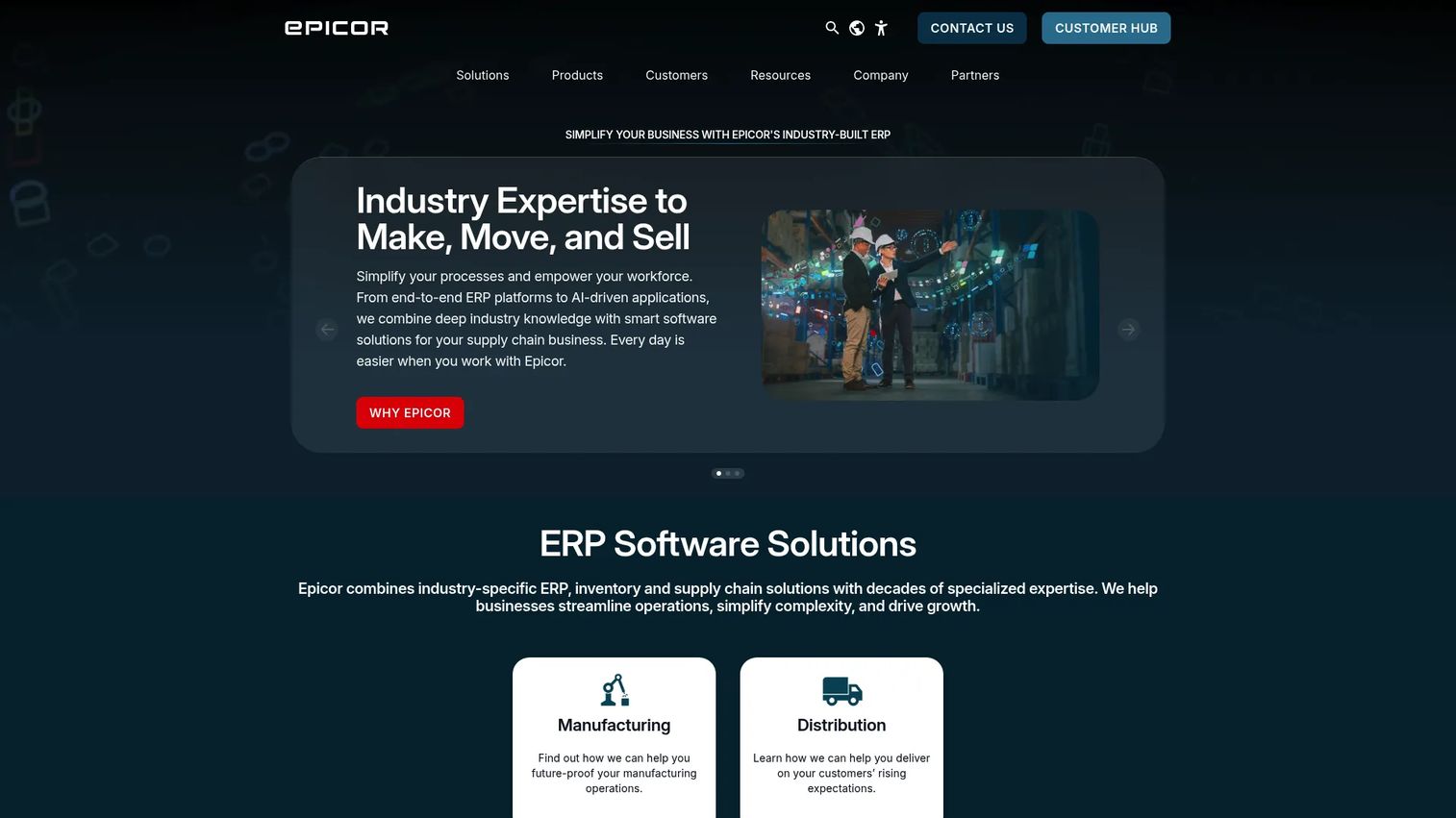
Epicor Kinetic is a cloud-focused ERP designed for discrete, process, and make-to-order manufacturers. It covers production management, MRP, scheduling, quality, supply chain, and financials in a configurable platform suited to mid-market and enterprise operations. Epicor has historically been a go-to system for manufacturers with complex production workflows, and Kinetic represents the cloud-native version of that legacy.
Best for: Mid-market and enterprise discrete manufacturers where production depth matters more than a lightweight financial suite.
Key features
- Production management and advanced scheduling
- MRP and multi-level BOM management
- Quality management and inspection workflows
- Shop floor visibility and data collection
- IoT integration and business intelligence
Why choose Epicor Kinetic: Choose Kinetic when manufacturing operations drive the ERP decision and your team needs serious configuration depth for routing, work centers, and engineering change orders. Budget for implementation; the manufacturing depth adds configuration work.
Epicor Kinetic pricing: Epicor uses a modular, concurrent-user licensing model. Ask sales to price the platform core, your required industry bundle, and the cloud package separately. Implementation and ongoing support are additional costs.
G2 rating: 3.9/5
2. Microsoft Dynamics 365 Business Central
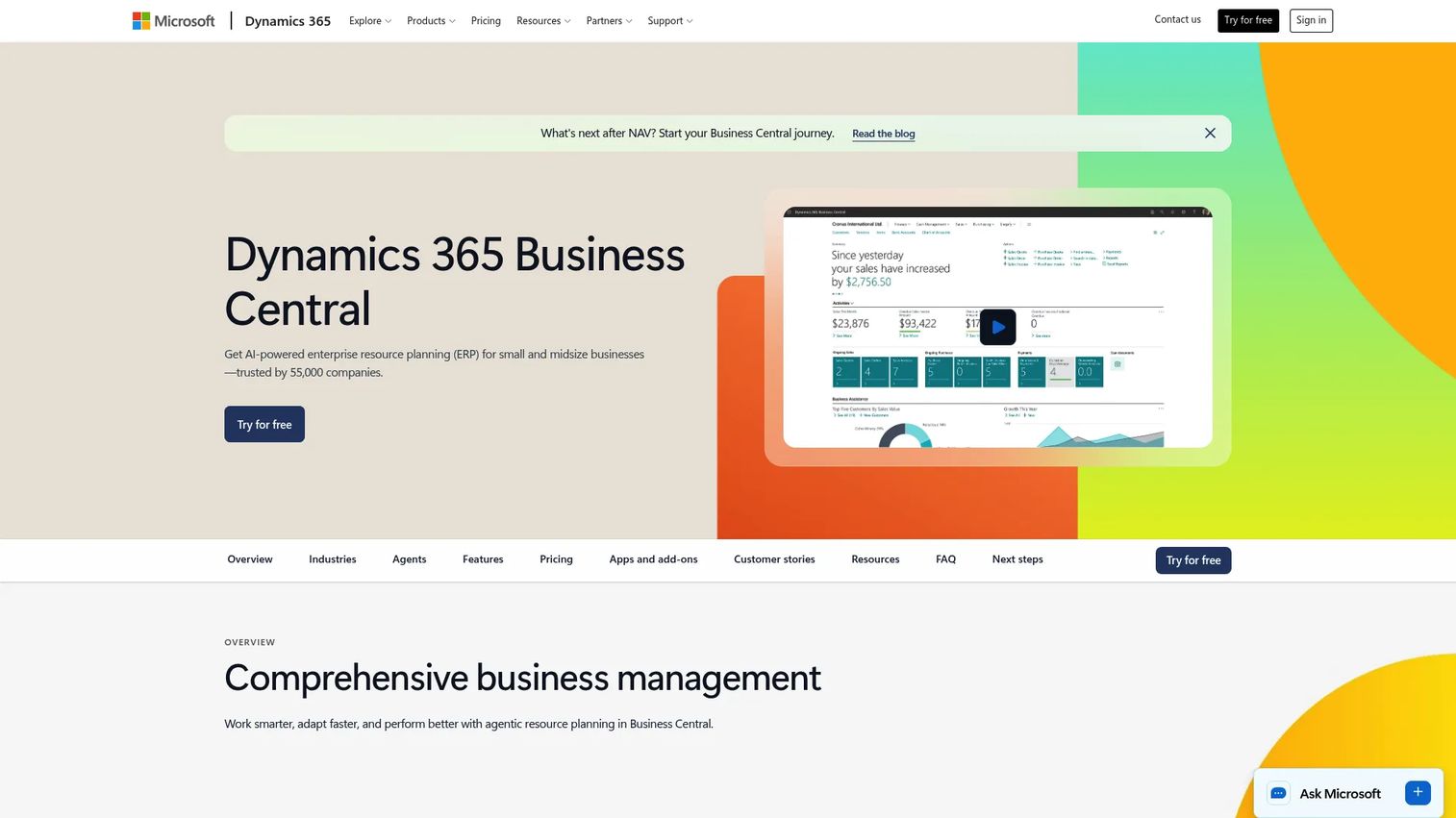
Microsoft Dynamics 365 Business Central is a cloud ERP for small and midsize businesses covering finance, sales, purchasing, inventory, and manufacturing. It sits natively inside the Microsoft ecosystem, connecting to Power BI, Power Automate, Teams, Outlook, and Excel. For teams already operating on Microsoft 365, the familiarity reduces adoption friction compared to a wholly new platform.
Best for: SMB and mid-market manufacturers that want ERP inside the Microsoft operating model and need strong financial reporting alongside basic manufacturing capability.
Key features
- Financial management and Microsoft 365 integration
- Inventory and warehouse management
- Manufacturing orders and production planning
- Copilot AI assistance and automated workflows
- Power BI reporting and embedded analytics
Why choose Microsoft Dynamics 365 Business Central: Choose Business Central when Microsoft familiarity and partner availability matter to adoption. Advanced manufacturing requirements, such as complex multi-level BOMs or detailed shop-floor execution, may need add-ons or implementation partner configuration beyond the base product.
Microsoft Dynamics 365 Business Central pricing: Essentials plan is $80/user/month (billed annually), covering finance, sales, and core operations. Premium adds service management and manufacturing at $110/user/month (billed annually). Team Members access is $8/user/month. A 30-day free trial is available.
G2 rating: 4.0/5
3. NetSuite
NetSuite is a cloud ERP suite combining financial management, inventory, order management, procurement, CRM, and manufacturing modules. Its strength is multi-entity operations: Subsidiaries, currencies, and consolidation across locations all handled in one system. Scaling manufacturers that have outgrown accounting software often land on NetSuite as the first true ERP choice.
Best for: Scaling manufacturers that need clean financial reporting across entities and want cloud-native ERP without on-premises infrastructure.
Key features
- Financial consolidation and multi-entity management
- Inventory, order, and warehouse management
- Manufacturing and work order management
- Real-time dashboards and embedded analytics
- Embedded AI and workflow automation
Why choose NetSuite: NetSuite fits companies where the CFO's reporting requirements drive the ERP decision as much as the COO's operational ones. Scope your manufacturing requirements carefully before implementation; the manufacturing module depth varies by configuration and may need partner expertise.
NetSuite pricing: NetSuite charges an annual license fee covering the platform, selected modules, and users, plus a one-time implementation fee. Ask sales to quote the base license, manufacturing module, user count, and implementation scope separately.
4. Acumatica
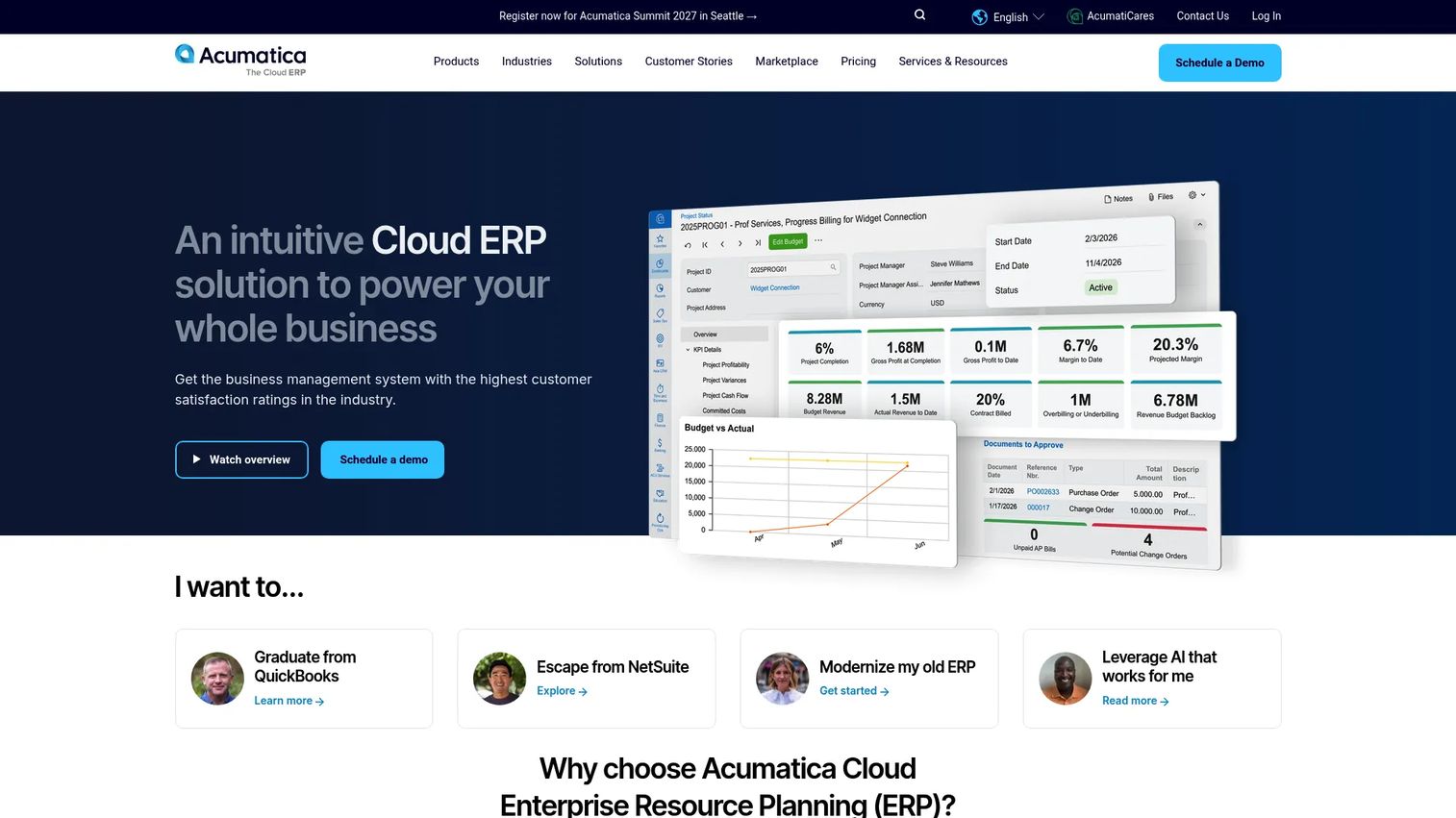
Acumatica is a cloud ERP with industry-specific editions for manufacturing, distribution, construction, and retail. The Manufacturing Edition covers production management, MRP, BOM, inventory, financials, and project accounting. Its licensing model is consumption-based rather than strict per-seat, which can reduce total cost as headcount grows.
Best for: Cloud-first mid-market manufacturers that want growth-friendly ERP licensing and a manufacturing-specific product edition.
Key features
- Manufacturing Edition with MRP and BOM management
- Cloud ERP with iOS and Android mobile apps
- Inventory control and distribution management
- Project accounting and financial reporting
- Configurable workflows and document management
Why choose Acumatica: Choose Acumatica when you want cloud ERP with a licensing structure that doesn't penalize you for adding users. Validate implementation partner expertise in the Manufacturing Edition before signing; partner quality varies.
Acumatica pricing: APEX for Manufacturing starts under $2,185/month. APEX for Distribution starts under $1,495/month. Core pricing is customized by application, resource usage, and deployment model, so get a full quote covering modules and partner implementation.
G2 rating: 4.4/5
5. Infor CloudSuite Industrial Enterprise (Infor LN)
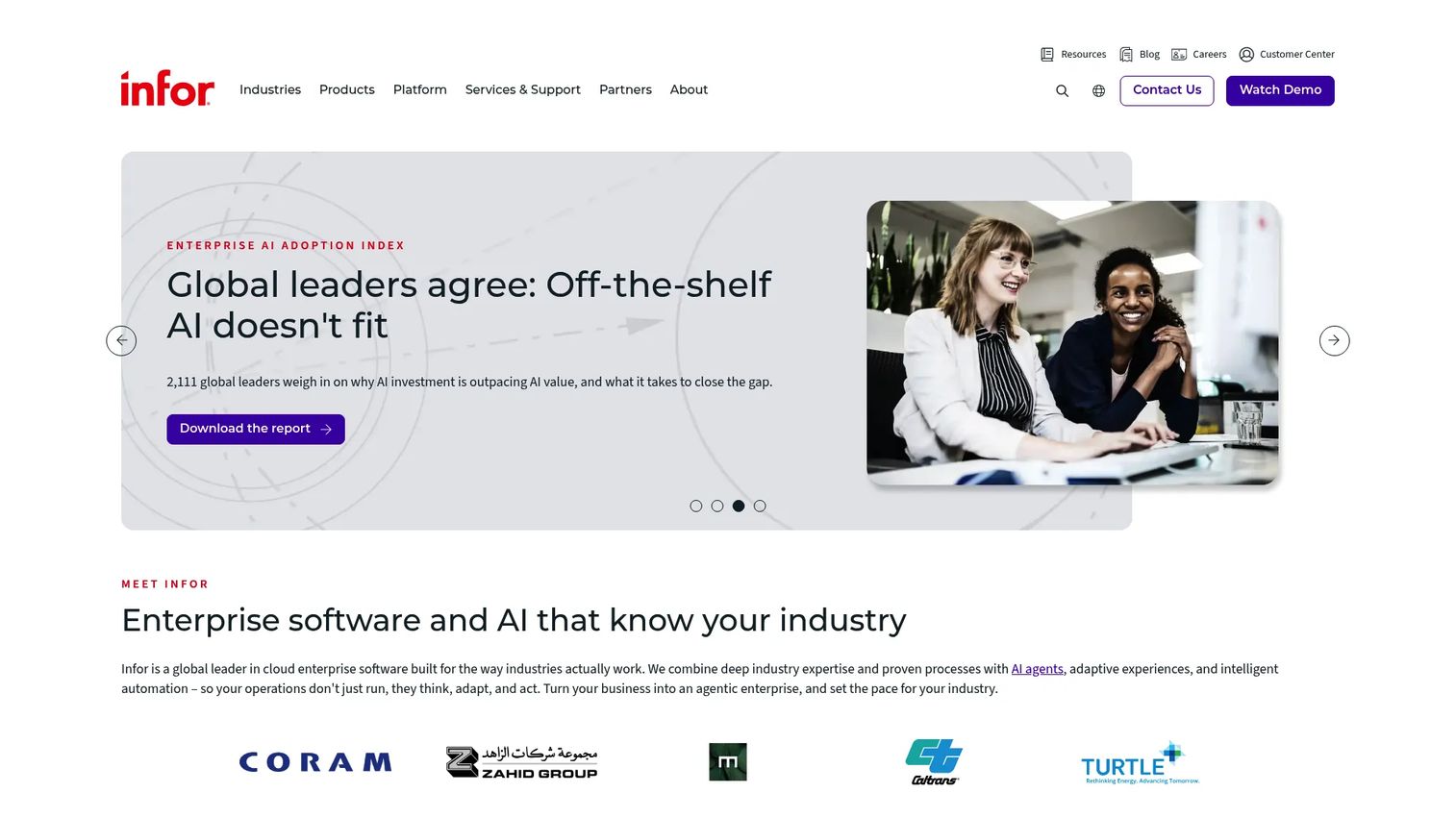
Infor CloudSuite Industrial Enterprise, also known as Infor LN, is an AI-powered cloud ERP for large industrial manufacturers with complex multi-site, multi-company, and multi-country operations. It covers engineer-to-order production, global supply chain, service lifecycle management, and enterprise finance. This is not a lightweight system; it is built for manufacturers whose operational complexity has outgrown mid-market ERP.
Best for: Industrial enterprises managing complex global manufacturing, engineer-to-order workflows, and multi-site supply chain coordination.
Key features
- Engineer-to-order and project lifecycle management
- Multi-site, multi-currency, and multi-company support
- Demand-driven supply chain planning
- Quality management and service lifecycle management
- Real-time analytics and factory-floor automation
Why choose Infor CloudSuite Industrial Enterprise (Infor LN): Infor LN fits companies where operational complexity has genuinely outgrown mid-market systems. Plan for significant process alignment work and change management before go-live; the depth that makes it powerful also requires careful configuration.
Infor CloudSuite Industrial Enterprise (Infor LN) pricing: Contact Infor directly to get a quote covering subscription, implementation services, integrations, and multi-site rollout costs.
6. SAP S/4HANA Cloud
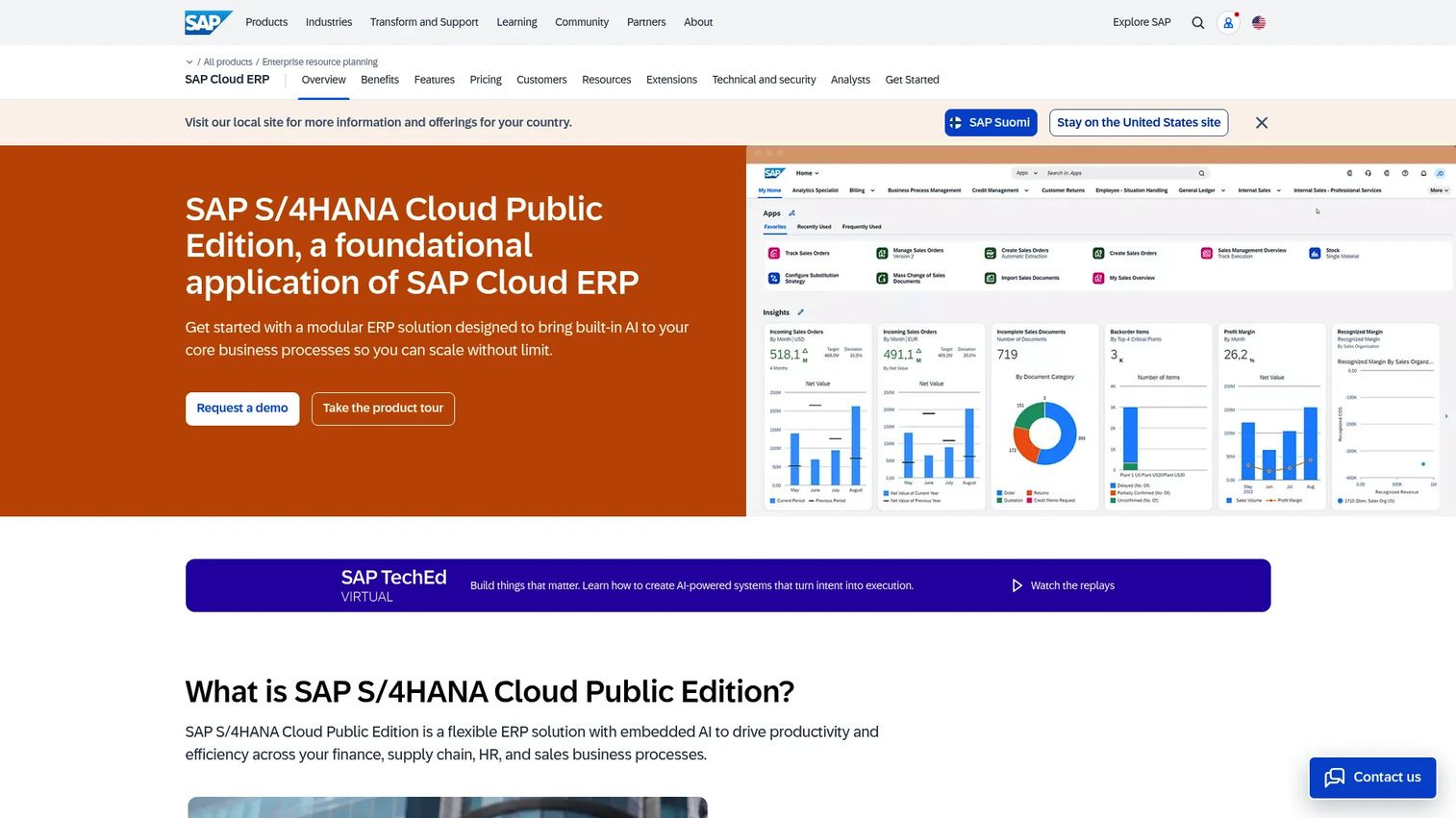
SAP S/4HANA Cloud is enterprise ERP for companies standardizing finance, procurement, manufacturing, supply chain, and analytics across global operations. It delivers embedded AI, preconfigured industry best practices, and automatic quarterly updates. The platform suits large manufacturers that need standardized, governed processes across plants, entities, and regions.
Best for: Large manufacturers and industrial companies standardizing business processes globally and needing embedded compliance, analytics, and enterprise governance.
Key features
- Enterprise finance with multi-GAAP support
- Manufacturing planning and supply chain management
- Procurement and embedded analytics
- AI-enabled automation and embedded AI insights
- Preconfigured industry best practices with continual updates
Why choose SAP S/4HANA Cloud: SAP fits companies where global process standardization and enterprise governance are non-negotiable. Smaller teams often find the implementation effort heavier than their scale requires; evaluate fit honestly against implementation capacity before committing.
SAP S/4HANA Cloud pricing: SAP Finance Base starts at $295/user/month, billed monthly with a minimum of 15 users. Project and resource management is priced at $403/user/month. Full manufacturing configuration will require additional component pricing; contact SAP to build a complete cost model.
G2 rating: 4.4/5
7. Oracle Fusion Cloud ERP
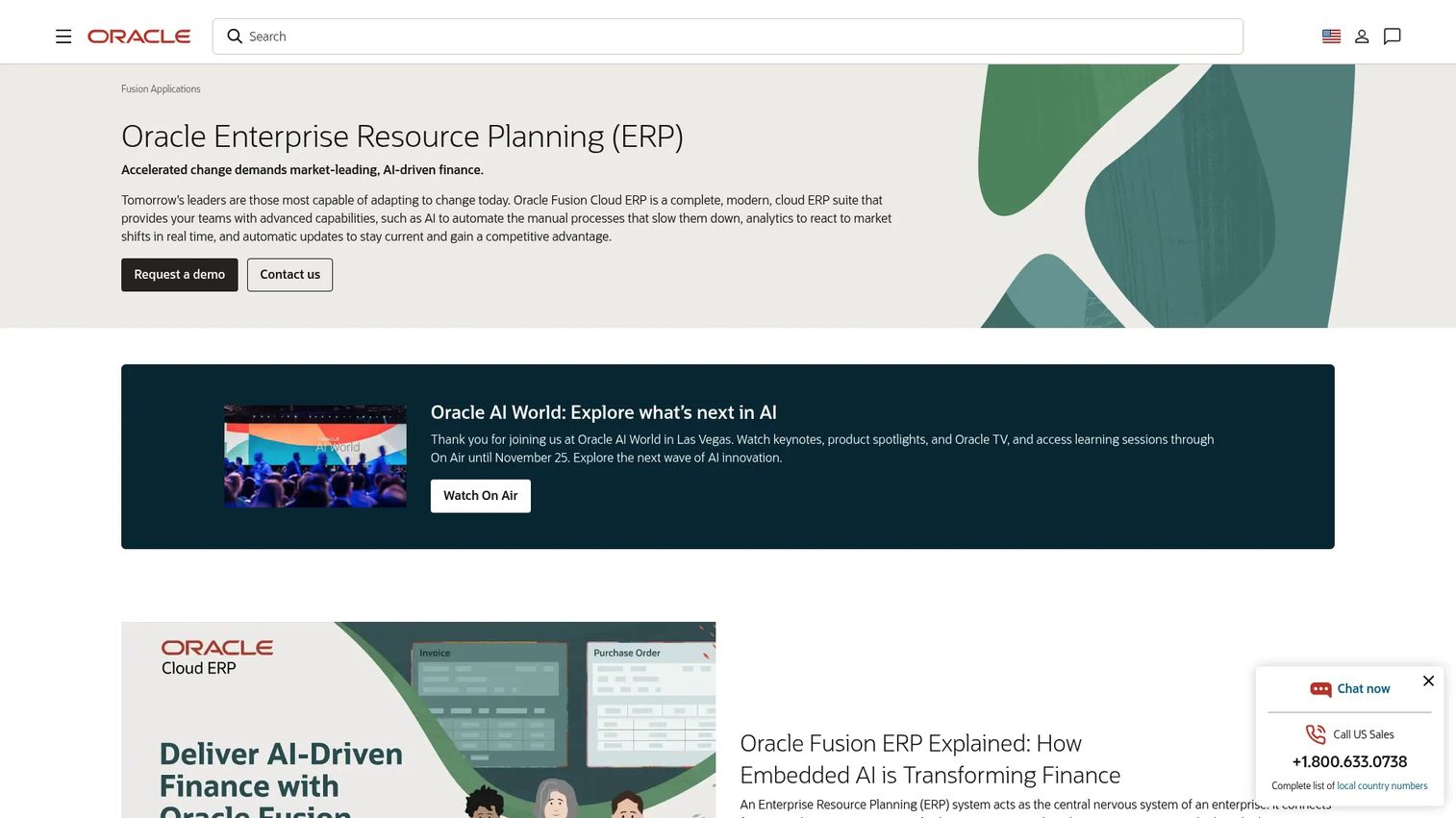
Oracle Fusion Cloud ERP is a comprehensive cloud ERP for large enterprises covering financial management, procurement, project management, risk management, and enterprise performance management. It suits manufacturers where CFO-level control, procurement structure, and global financial reporting are the primary drivers of the ERP decision.
Best for: Large manufacturers needing enterprise finance, procurement governance, and globally scalable cloud ERP with strong risk management.
Key features
- Financial management with multi-entity and multi-currency support
- Procurement and supply chain controls
- Project management and budgeting
- Risk management and enterprise performance management
- Real-time analytics and AI-driven automation
Why choose Oracle Fusion Cloud ERP: Oracle Fusion fits manufacturers where finance and procurement complexity drive the ERP evaluation. Manufacturing execution depth may require adjacent Oracle supply chain applications or integrations. Minimum user counts and standard 3-year subscription terms affect total cost modeling.
Oracle Fusion Cloud ERP pricing: The standard ERP subscription starts at $625/user/month for hosted named users, with a minimum of 10 users. Self-service access is $20/user/month with a minimum of 100 users. Contact Oracle for a full component and manufacturing scope quote.
8. IFS Cloud
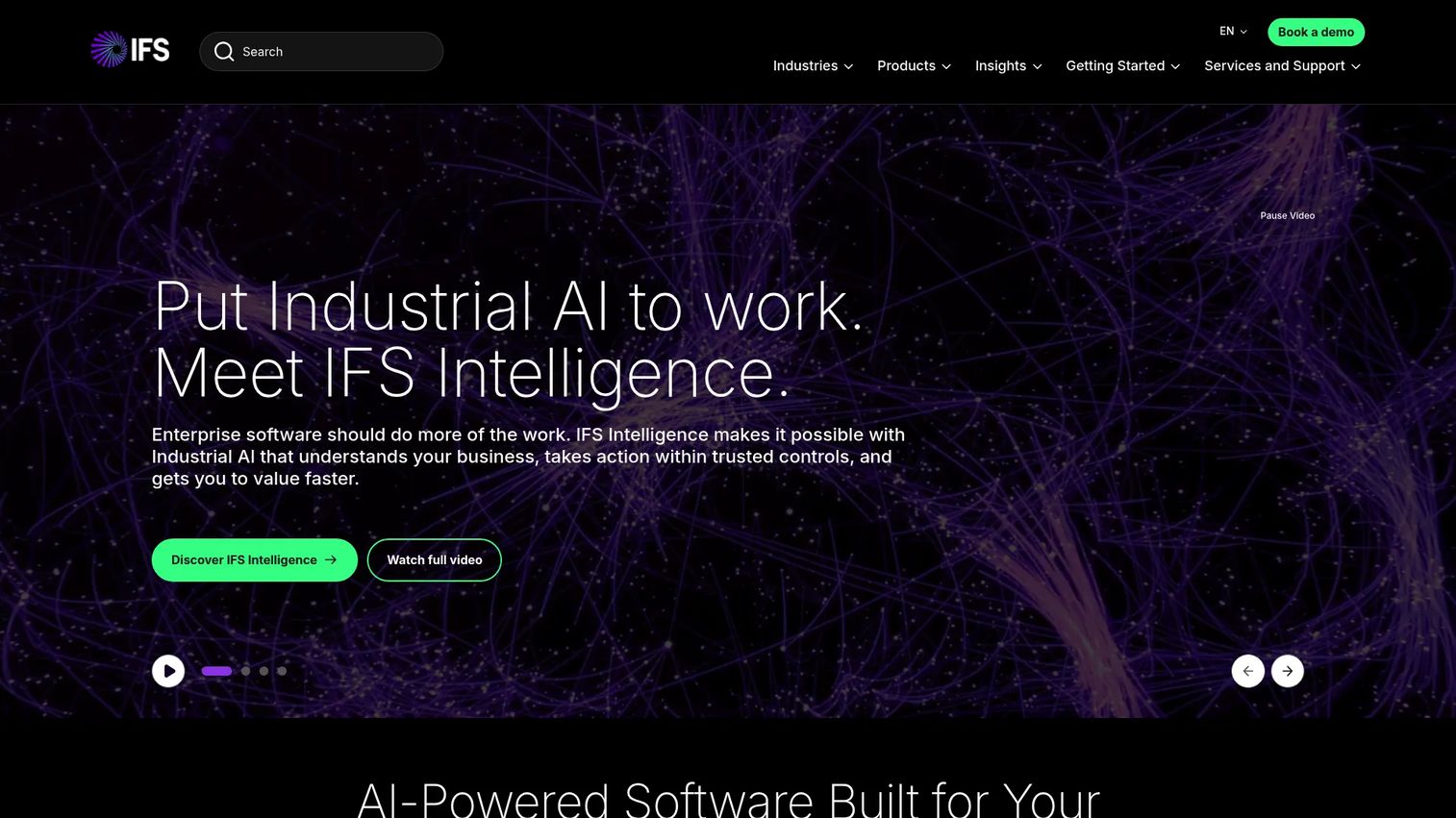
IFS Cloud is an AI-powered enterprise platform combining ERP, enterprise asset management, field service management, and supply chain management. It is built for companies where production, assets, service contracts, and project delivery all intersect in one operating model, such as aerospace, defense, energy, and industrial equipment manufacturers.
Best for: Manufacturers that combine production with asset-intensive operations, field service, and complex project delivery.
Key features
- Manufacturing ERP and production planning
- Enterprise asset management (EAM)
- Field service management (FSM)
- Supply chain and procurement planning
- Composable architecture with embedded Industrial AI
Why choose IFS Cloud: IFS Cloud fits companies where the ERP must cover not just production but also asset lifecycle and service contracts within a single platform. Map your full operating model before selecting modules; the breadth is a strength only when the deployment scope matches it.
IFS Cloud pricing: Pricing requires direct contact with IFS. Ask for quotes covering the specific modules, user count, implementation services, and ongoing support your operation requires.
G2 rating: 4.3/5
9. Plex ERP
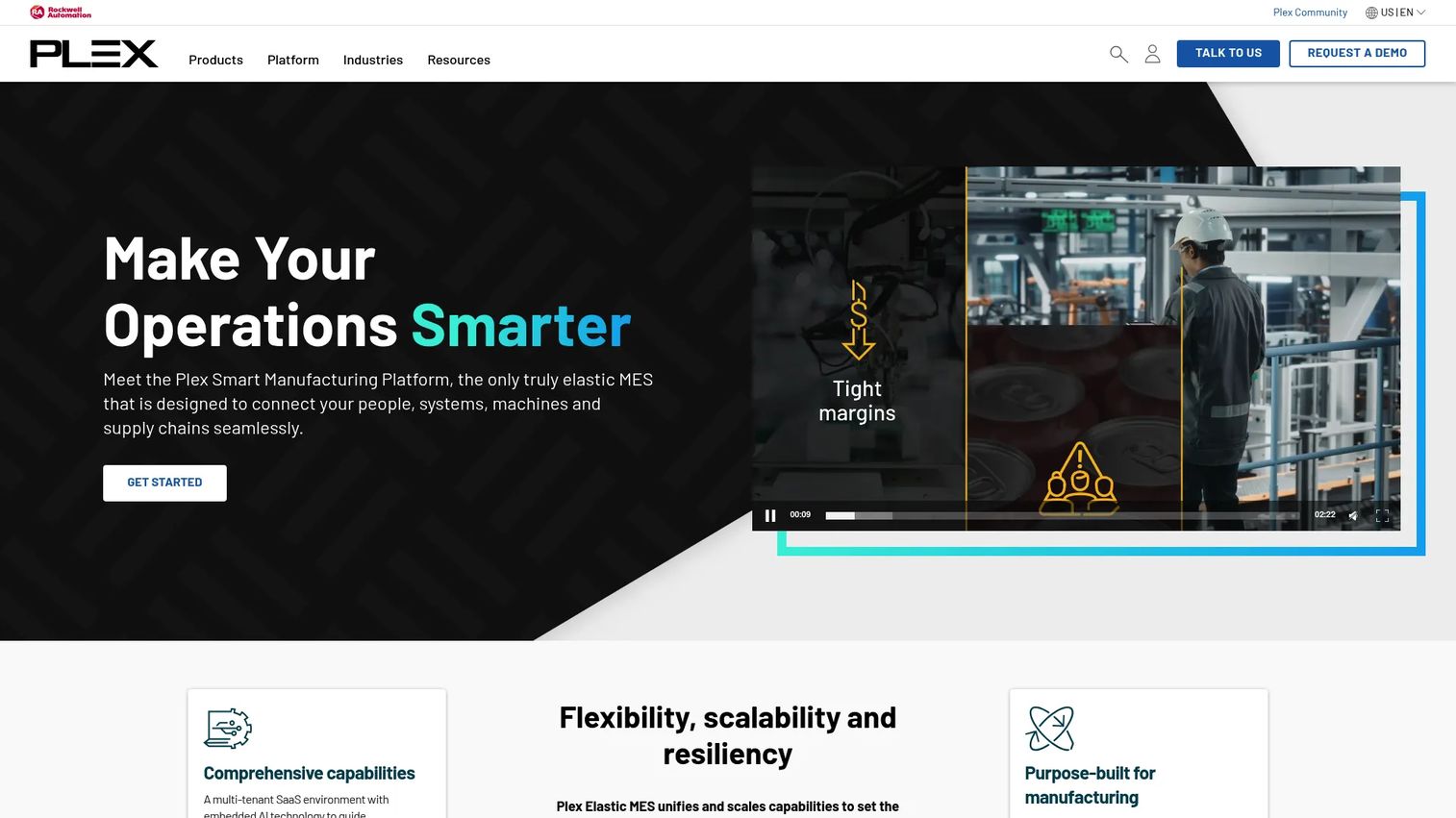
Plex ERP is a cloud manufacturing platform that integrates ERP and manufacturing execution system (MES) capabilities in one product. It connects the shop floor to enterprise financials through real-time production tracking, quality management, inventory control, and human capital management. Manufacturers that need tight shop-floor visibility alongside financial reporting often evaluate Plex as a unified alternative to separate ERP and MES tools.
Best for: Manufacturers where the factory floor drives the ERP decision and real-time plant visibility is a primary requirement.
Key features
- Integrated MES and production tracking
- Quality management and traceability
- Inventory control and supplier management
- Enterprise accounting and financial management
- Human capital management with time and attendance
Why choose Plex ERP: Choose Plex when plant-floor operations are central and you want the ERP and MES to share a single data layer. Evaluate corporate reporting and multi-entity financial consolidation requirements separately; Plex's strength is operational depth, so confirm it meets your finance team's reporting needs too.
Plex ERP pricing: Plex offers flexible subscription packages described as all-inclusive annual subscriptions. Contact Plex to get a quote covering plant count, user scope, and implementation.
G2 rating: 3.9/5
10. Rootstock Cloud ERP
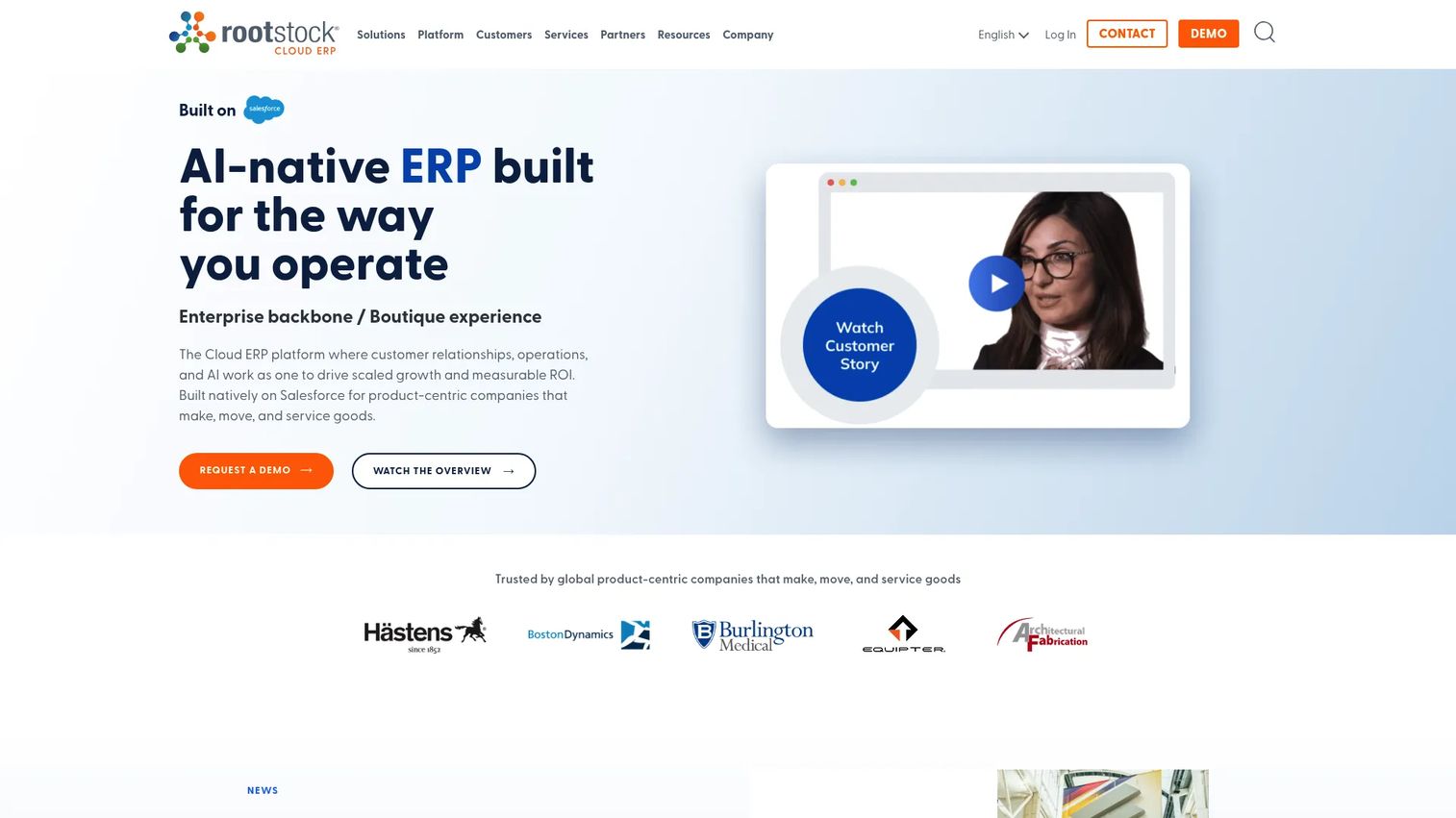
Rootstock Cloud ERP is an AI-native manufacturing ERP built directly on the Salesforce platform. Because it runs on Salesforce infrastructure, it connects CRM data, customer records, sales orders, and manufacturing operations natively, without middleware or custom integrations. Manufacturers that have committed to Salesforce as their core business platform often evaluate Rootstock to unify customer and operational data in one environment.
Best for: Manufacturers already committed to Salesforce that want manufacturing operations, inventory, and financials connected natively to CRM and customer workflows.
Key features
- Salesforce-native manufacturing ERP
- Production planning and supply chain management
- Financial management and ERP analytics
- Sales order management and configurable pricing
- AI agents and configurable workflows
Why choose Rootstock Cloud ERP: Rootstock's primary strategic reason for consideration is Salesforce alignment. If your team is deeply invested in Salesforce for customer management and you want manufacturing closer to CRM data, Rootstock reduces integration overhead compared to running separate systems.
Rootstock Cloud ERP pricing: Rootstock offers Growth, Advanced, and Enterprise packages, all quote-based. Pricing covers the Rootstock subscription, your existing Salesforce platform costs, implementation, and integration requirements. Contact Rootstock for a full scope quote.
G2 rating: 4.0/5
11. DELMIAWorks
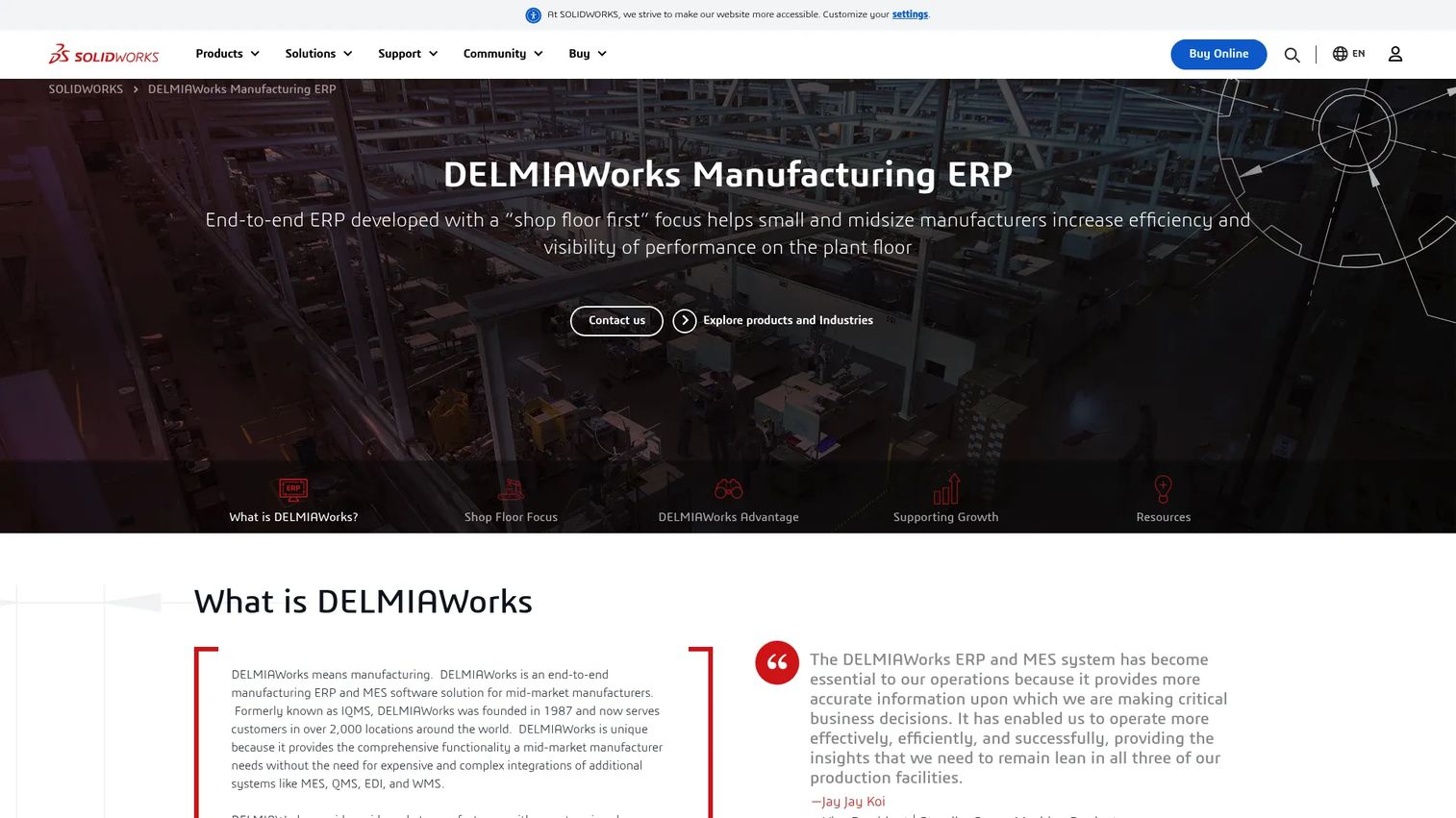
DELMIAWorks is an end-to-end manufacturing ERP and MES for mid-market discrete, repetitive, and batch manufacturers. It integrates production monitoring, scheduling, quality management, supply chain, and costing in one system. For mid-market manufacturers that need ERP tightly coupled with shop-floor execution, DELMIAWorks is a focused alternative to separating those two systems.
Best for: Mid-market manufacturers that need ERP and manufacturing execution tightly integrated without running separate MES and ERP products.
Key features
- Real-time production monitoring and shop-floor control
- Scheduling and production planning
- Integrated quality management
- Supply chain and inventory control
- Costing and financial controls
Why choose DELMIAWorks: Choose DELMIAWorks when shop-floor execution and operational control matter more than broad corporate ERP standardization. It fits mid-market teams with specific manufacturing depth requirements that generic ERP platforms don't address out of the box.
DELMIAWorks pricing: DELMIAWorks does not post pricing. Contact the team directly to scope subscription, implementation, and manufacturing configuration costs for your production environment.
G2 rating: 4.1/5
12. Global Shop Solutions
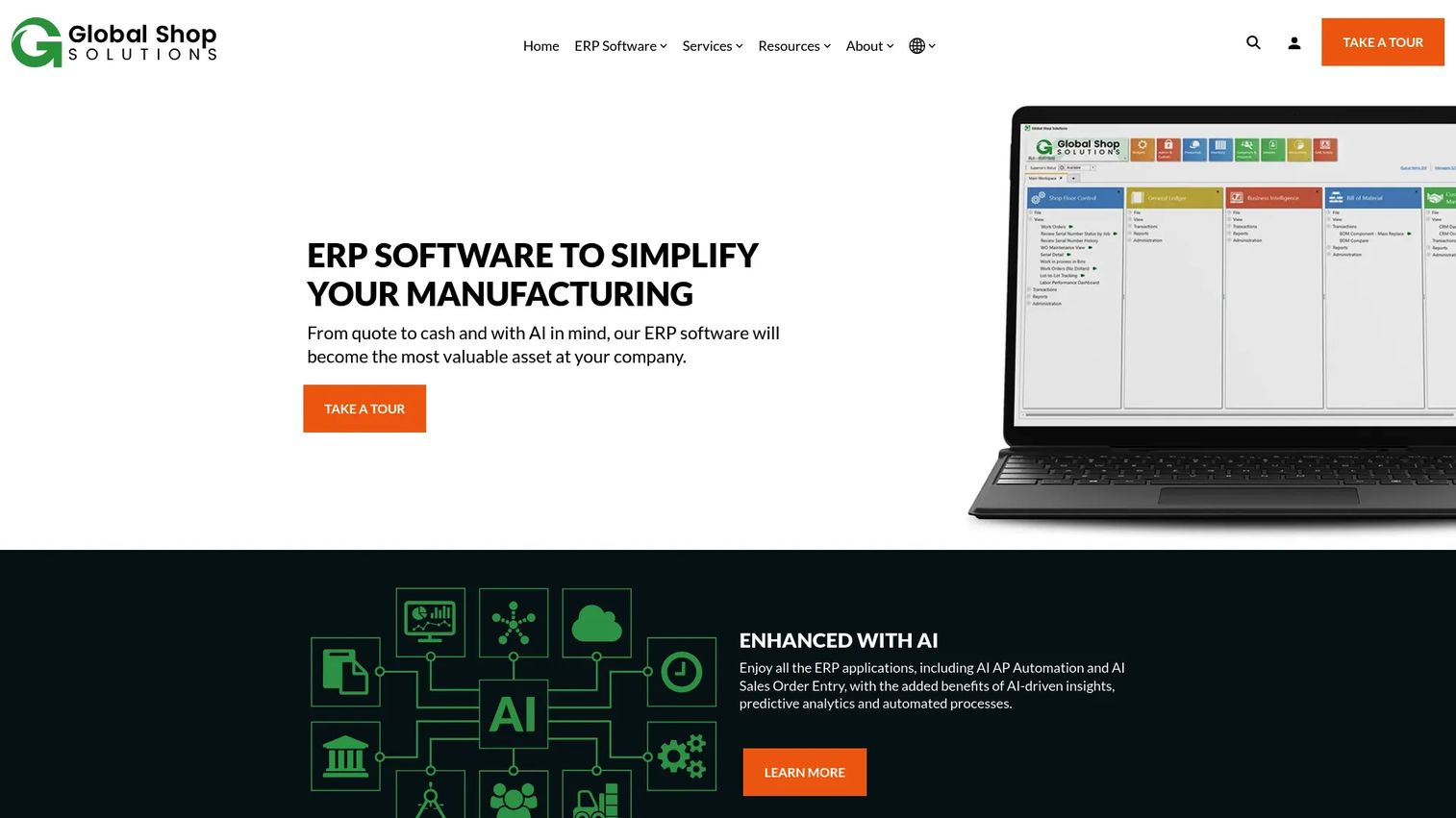
Global Shop Solutions is an AI-enabled ERP for manufacturing businesses, designed specifically for job shops, custom manufacturers, and make-to-order environments. It covers the full quote-to-cash workflow including quoting, scheduling, job costing, inventory, purchasing, quality, accounting, CRM, and shop-floor data collection. Cloud, on-premise, and SaaS deployment options are available.
Best for: Job shops and custom manufacturers that need strong scheduling, shop-floor visibility, job costing, and delivery performance management.
Key features
- Shop floor data collection and job management
- Planning, scheduling, and capacity management
- Inventory management and automated purchasing
- Job costing, accounting, AR, and AP
- CRM, order management, and quality control
Why choose Global Shop Solutions: Global Shop Solutions fits companies that live and die by quote accuracy, job visibility, and on-time delivery. Test the scheduling module and shop-floor data entry during demos with real production scenarios, not clean demo scripts.
Global Shop Solutions pricing: Pricing is based on a concurrent-user model with upfront and ongoing quarterly costs. Deployment options include on-premise, cloud, and SaaS. Contact Global Shop Solutions for a quote covering user count, modules, and implementation.
G2 rating: 3.9/5
13. Cetec ERP
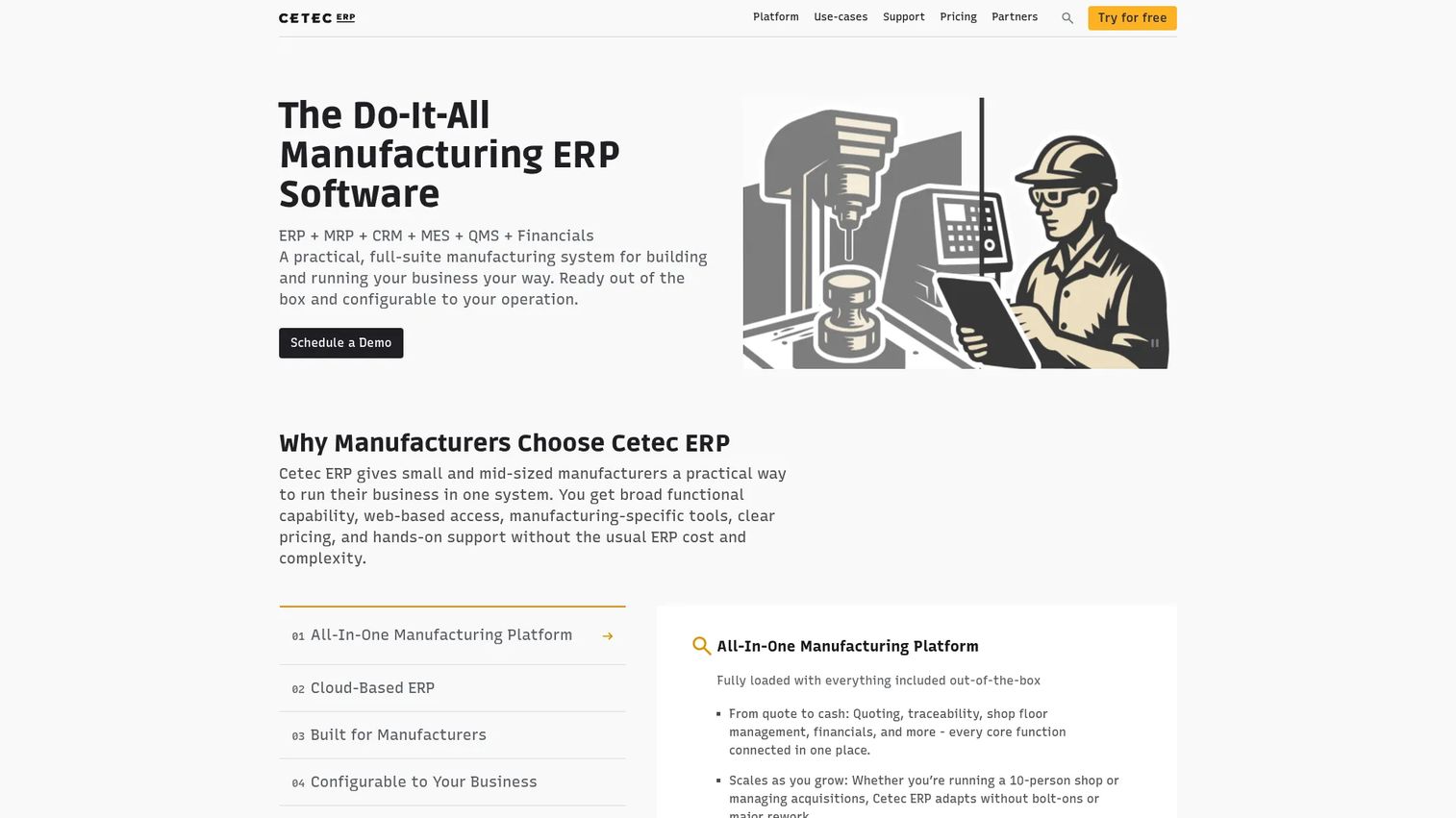
Cetec ERP is a cloud-based, full-suite ERP for small and mid-sized manufacturers. It combines ERP, MRP, CRM, MES, QMS, and financials in one product at a price point that is significantly more transparent than most competitors in this category. Cetec covers quoting, job costing, inventory, purchasing, production, quality, traceability, accounting, and document management.
Best for: Small and mid-sized manufacturers that want practical ERP and MES coverage without enterprise implementation overhead or opaque quote-only pricing.
Key features
- MRP and multi-level BOM management
- Job costing, quoting, and production control
- Quality management (QMS) and compliance workflows
- Lot and serial traceability
- Integrated accounting and financial management
Why choose Cetec ERP: Cetec's pricing transparency is itself a differentiator in a category where most vendors require a sales call just to get a ballpark. For manufacturers with straightforward operations, it offers broad coverage at a predictable cost. Validate fit for highly complex enterprise requirements before committing.
Cetec ERP pricing: Core subscription is $50/user/month with a 5-user minimum. Support plans are optional: Standard support is $650/month, Enterprise support is $3,200/month. Every instance starts with a free trial.
G2 rating: 4.1/5
14. JobBOSS²
JobBOSS² is a cloud-based job-shop ERP for small and mid-sized make-to-order and custom manufacturers. It covers the core job shop workflow: Quoting, scheduling, job tracking, job costing, purchasing, inventory, quality management, and shop-floor control. Its AI BOM Builder and QuickBooks integration are practical features for smaller shops that need ERP without an enterprise implementation.
Best for: Small job shops and make-to-order manufacturers that need control over quoting, job costs, scheduling, and delivery dates without committing to a full enterprise ERP.
Key features
- AI BOM Builder and quoting
- Job management and scheduling
- Inventory forecasting and automated purchasing
- Quality management and shop-floor tracking
- Real-time profitability reporting and QuickBooks integration
Why choose JobBOSS²: JobBOSS² is sized for smaller shops where full enterprise ERP would add more complexity than value. Check accounting depth, financial reporting capabilities, and integration requirements carefully before committing; this is a focused job shop tool, not a broad enterprise platform.
JobBOSS² pricing: Pricing is tailored to operational scale and required functionality. Contact JobBOSS² to get a quote covering subscription, implementation, and support.
G2 rating: 3.8/5
15. Odoo ERP
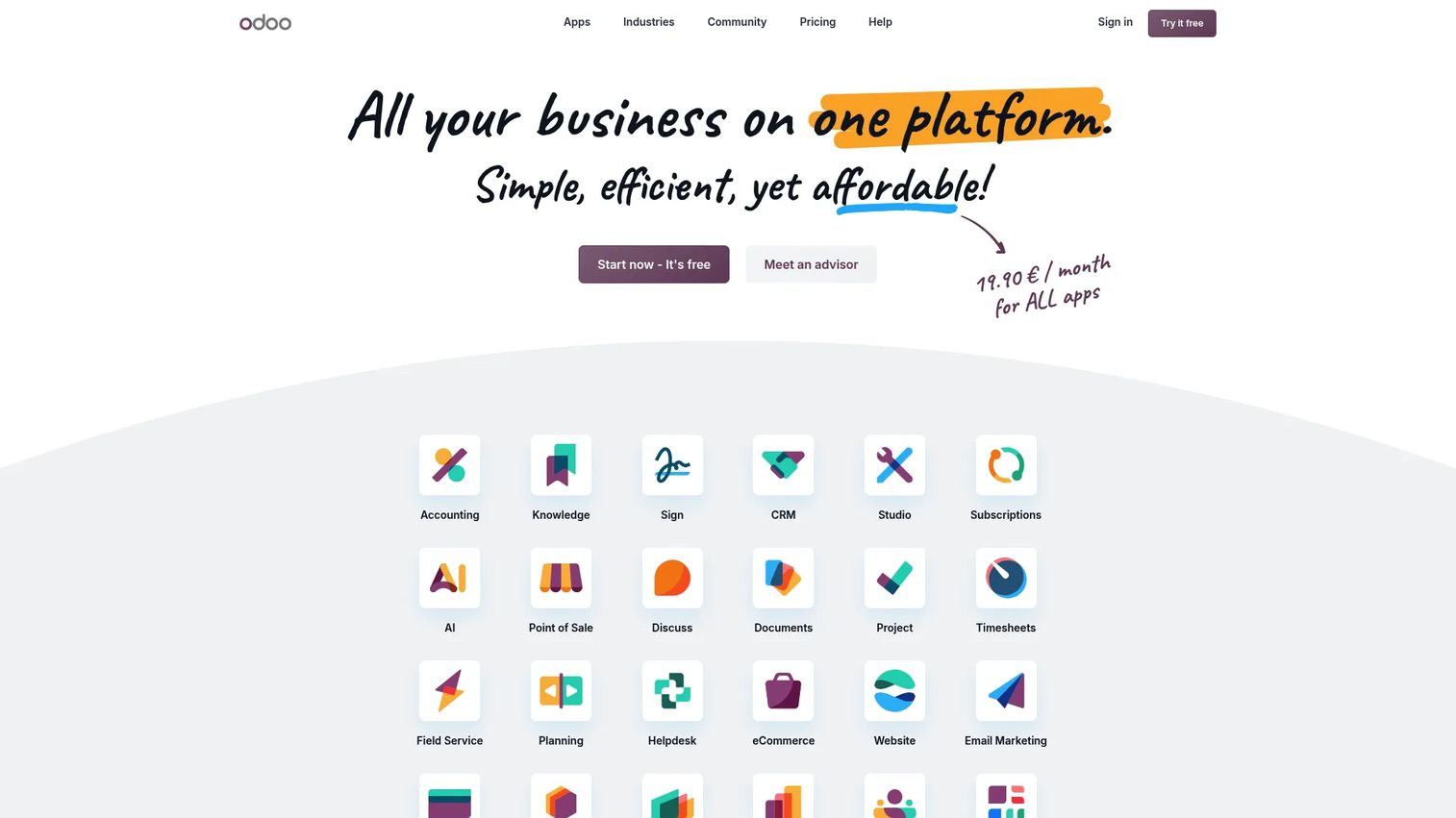
Odoo ERP is an open-source, modular business management platform with applications covering manufacturing, inventory, accounting, sales, purchasing, quality, maintenance, PLM, and CRM. Its modularity means teams can start with one or two apps and expand over time. A free one-app tier makes it accessible as an entry point for cost-sensitive manufacturers evaluating ERP for the first time.
Best for: Cost-sensitive manufacturers that want modular ERP with broad coverage and are willing to invest in careful configuration and implementation partner selection.
Key features
- Manufacturing orders, MRP, and work center management
- Inventory management and quality checks
- PLM app and maintenance management
- Integrated accounting, sales, and purchasing
- Multi-company support and on-premise deployment option
Why choose Odoo ERP: Odoo's cost structure and modularity make it appealing for smaller or early-stage manufacturers. The key variable is implementation partner quality; Odoo requires careful configuration to work well for discrete manufacturing, and that work varies significantly by partner. Evaluate partners as closely as the product itself.
Odoo ERP pricing: One App Free is $0 for unlimited users on a single Odoo application. Standard plan is $24.90/user/month (billed yearly), covering all apps. Custom plan is $49/user/month (billed yearly), adding Odoo Studio, Agentic AI, multi-company features, and external API access, plus on-premise deployment.
G2 rating: 4.2/5
Considerations when choosing discrete ERP software
Match the ERP to your manufacturing model
Make-to-stock, make-to-order, engineer-to-order, configure-to-order, job shop, and repetitive manufacturing all have different system requirements. The wrong fit creates workarounds before go-live. Map your predominant production model first, then filter vendors by that model, not by name recognition.
Validate BOM, MRP, and engineering change workflows
Ask vendors to walk through a real product: A multi-level BOM with alternates, a part revision, a routing change, and a scrap transaction. Demo scripts are designed to look clean. What matters is how the system handles messy production reality. Bring your operations lead into every demo to run that scenario.
Test production scheduling and shop-floor usability
Scheduling demos often show optimal conditions. Ask to see a rush order, a machine constraint, a labor shortage, a rework order, and a partial shipment. Shop-floor data entry needs to be fast enough for operators to use it. If it takes three screens to log a job completion, adoption will fail regardless of the platform's capabilities.
Look beyond license pricing
Implementation, data migration, integrations, partner services, training, and post-launch support can equal or exceed the first-year license cost. Leadership time spent on an ERP implementation is also a cost. Get a full first-year cost model from each vendor, including partner estimates, before comparing options on price.
Choose the deployment model your team can operate
Cloud ERP reduces infrastructure burden and simplifies updates. On-premises or hybrid deployment may fit plants with strict data control, low-latency shop-floor requirements, specific regulatory constraints, or existing IT infrastructure the organization wants to preserve. Tie the deployment decision to IT capacity, not just vendor preference.
Conclusion
No single ERP wins across every manufacturing context. The right choice comes down to production model, operational complexity, company size, and the team that will own the implementation.
For complex discrete manufacturing, Epicor Kinetic and Infor CloudSuite Industrial Enterprise offer the deepest production depth. For Microsoft-centered teams, Business Central integrates cleanly with existing tools starting at $80/user/month. NetSuite fits multi-entity scaling companies where financial consolidation drives the decision. Acumatica suits cloud-first mid-market manufacturers looking for manufacturing-specific editions. SAP S/4HANA Cloud and Oracle Fusion Cloud ERP serve large enterprises with global standardization requirements. IFS Cloud fits companies combining production with asset management and field service.
For smaller or more focused operations, Cetec ERP offers the most pricing transparency at $50/user/month. JobBOSS² and Global Shop Solutions fit job shops and make-to-order manufacturers. Odoo provides a modular entry point with a free tier and paid plans from $24.90/user/month.
The practical next step: Shortlist three vendors, give each the same manufacturing scenario, and ask them to show the full workflow from quote to cash, including a BOM change, a material shortage, a quality hold, and final shipment. How they handle that scenario is more predictive than any demo script.
FAQs
Discrete ERP software is enterprise resource planning software built for manufacturers that produce distinct, countable items such as machines, electronics, vehicles, aerospace components, or medical devices. It manages production, materials, inventory, quality, purchasing, finance, and sales orders across the full manufacturing lifecycle, using item-level tracking through BOMs, serial numbers, and lot numbers.
Discrete ERP supports products assembled from individual parts and components, where the output is a countable finished good with a defined BOM and routing. Process ERP supports formulas, recipes, batches, and continuous production where the output is measured in quantity, volume, or weight rather than discrete units. Using a process ERP for discrete manufacturing typically forces significant workarounds on part revisions, serial tracking, and job costing.
Core features include multi-level BOM management, MRP and demand planning, production routing and scheduling, inventory control, purchasing and supplier coordination, quality management, lot and serial traceability, cost accounting, sales order management, and financial reporting. For many manufacturers, integrations with CAD, PLM, MES, and BI tools are equally important and should be evaluated during demos, not assumed from the vendor's integration list.
Pricing varies significantly by vendor, company size, user count, modules, deployment model, implementation partner, data migration complexity, and support tier. Transparent per-user pricing like Cetec ERP ($50/user/month) and Odoo Standard ($24.90/user/month) is the exception. Most enterprise and mid-market ERP vendors price by quote. Compare total first-year cost across license, implementation, integrations, and training, not subscription price alone.
Small job shops using focused tools like JobBOSS² or Cetec ERP can implement in weeks. Mid-market ERP implementations on platforms like Acumatica or Business Central typically run three to six months. Enterprise rollouts on SAP S/4HANA Cloud, Oracle Fusion, or Infor LN often span several quarters, particularly for multi-site configurations. Ask every vendor for a phase-by-phase implementation plan with milestone dates before signing.
There is no single best system across all manufacturers. Epicor Kinetic and Infor LN fit complex discrete manufacturers needing deep production control. Business Central fits Microsoft-centered SMB and mid-market teams. NetSuite fits multi-entity scaling companies. Acumatica fits cloud-first mid-market manufacturers. For job shops, JobBOSS² and Global Shop Solutions are purpose-built. For cost-sensitive smaller manufacturers, Cetec ERP and Odoo offer accessible entry points. Match the system to your manufacturing model and operational complexity first.
Cloud ERP reduces infrastructure management, supports automatic updates, and scales without hardware upgrades, which suits most growing manufacturers. On-premises or hybrid deployment fits plants with strict data control requirements, low-latency shop-floor system dependencies, specific regulatory environments, or existing IT infrastructure that the organization wants to maintain. According to Aptean and B2B International (2025), 66% of surveyed manufacturers had already moved their ERP to the cloud or were actively doing so.
Build a controlled demo scenario around a real product your team makes. Run the same scenario with every vendor: Quote, BOM, MRP run, production order, material shortage, quality hold, and shipment. Ask for a phase-by-phase implementation plan and reference calls with manufacturers at a similar size and production model. Build a full first-year cost model, including partner services and internal team time. Assign an internal owner before you sign anything. The implementation succeeds or fails based on internal ownership, not just vendor quality.