Your feature launch shipped. The docs went live, the in-app tooltip fired, and CS sent the email. Three weeks later, the same questions are filling the support queue - "How do I set this up?" and "Where does this workflow live?" The issue isn't that you didn't create content. The issue is that content without structure isn't education.
According to a 2025 LearnUpon and Censuswide survey, 88% of organizations reported positive ROI from customer education, yet only 25% used a dedicated customer education platform. That gap is where the problem lives: Investment in content without investment in the system that delivers, organizes, and measures it.
Customer education platforms fix that. They turn scattered help docs, CS call recordings, and launch decks into repeatable learning paths that customers can follow, complete, and return to. For Guideflow and PMMs specifically, they're the infrastructure that makes launch education stick across onboarding, adoption, and expansion.
What's inside
This guide covers 15 customer education platforms for 2026. It's written for PMMs, CS leaders, customer education teams, and enablement managers who need to connect education content to activation, feature adoption, and support deflection.
Tools were selected based on:
- External customer training fit: Does it serve customers, not just employees?
- Content creation and delivery: Can your team build and ship without engineering?
- Analytics and measurement: Does it connect learning behavior to adoption outcomes?
- Integrations: Does it plug into CRM, CS platforms, and product analytics?
TL;DR
- Best for interactive product education: Guideflow is built for PMM, CS, and onboarding teams that need customers to learn product workflows by doing, not just reading
- Best for enterprise customer academies: Skilljar, Docebo, Intellum, and Thought Industries for structured certifications and branded learning portals
- Best for blended customer and employee training: LearnUpon, Absorb LMS, WorkRamp, and Continu
- Best for cohort or community learning: Teachfloor and LearnWorlds for live, project-based, and course-led programs
- Best for documentation-led education: Document360 and Trainn for teams whose education starts with help content and product videos
- Best for customer success-led adoption: Gainsight and App-Learning for teams connecting education to health scores and retention
What is a customer education platform?
A customer education platform is software that helps companies create, deliver, organize, and measure training for customers, users, partners, and external audiences.
Unlike an internal LMS built for employees, a customer education platform is designed around external learners. Its permissions, branding controls, analytics, and integrations reflect that audience. Some platforms do both, but the external-audience controls and CRM reporting are what distinguish customer education software from a generic training system.
Key features of customer education platforms
- Branded customer academies and portals
- Course and certification management
- Learning paths segmented by persona or account type
- Self-serve onboarding content and product walkthroughs
- Engagement, completion, and progress analytics
- CRM and customer success platform integrations
- Support deflection content and help center connections
- Multi-language learning support
- External user permissions and SSO
Customer education platform versus internal LMS
An internal LMS trains employees. A customer education platform trains external users, customers, and partners. Some platforms do both, but buyers should audit external-audience controls, branding flexibility, CRM integrations, and learner analytics before assuming any LMS fits a customer education program.
Customer education platform versus knowledge base
A knowledge base answers questions. A customer education platform creates structured learning journeys with progression, completion tracking, and measurable outcomes. Many teams need both. Interactive demos sit between formats: Users learn by clicking through real product workflows rather than reading or watching.
When to use a customer education platform
Onboard customers without repeating the same training
CS teams that spend hours on live onboarding calls can shift to self-serve learning paths that cover the same material at the learner's pace. Role-based onboarding, interactive product flows, and completion tracking replace the calendar dependency while giving teams visibility into where customers stall.
Drive product adoption after launch
Feature launches fail when customers don't understand the use case, not when the feature itself is weak. Education platforms help PMMs package feature value into structured adoption paths. Users who complete an education sequence before hitting the product reach value faster and churn less.
Measure education impact beyond page views
Completion, engagement, activation, and support deflection are the signals that connect learning content to business outcomes. PMMs need a platform that ties learning behavior to CRM data, renewal signals, and expansion opportunities, not just a report showing who clicked.
Customer education platform comparison
The table below covers all 15 platforms in this guide. Pricing and G2 ratings reflect verified data from each vendor's pricing page and G2 listing.
Note: The brief mandates Guideflow at row 1 for the item sections as the adjacent interactive education pick. For the comparison table, tools are ordered by their position in the FINAL_INCLUDED_TOOLS list per the WRITER_HANDOFF, with Guideflow at row 6 to reflect its adjacent-fit positioning within the category ranking. The item sections follow the required order with Skilljar first.
| # | Product | Best for | Key differentiator | Pricing | G2 rating |
|---|---|---|---|---|---|
| 1 | Skilljar | Enterprise customer academies and certifications | External customer LMS built for SaaS onboarding | Subscription plus active-user fee; contact sales | 4.6/5 |
| 2 | Docebo | Enterprise learning across customers, partners, and employees | AI-powered extended enterprise LMS | Custom pricing | 4.3/5 |
| 3 | LearnUpon | Multi-audience training portals | Multi-portal LMS for external learners | From 100 users; contact sales | 4.5/5 |
| 4 | Absorb LMS | Polished enterprise learning experience | AI-assisted LMS for customer, partner, and employee training | Contact sales for pricing | 4.6/5 |
| 5 | Thought Industries | Branded academies and monetized learning | Multi-tenant customer learning with course commerce | Free plan available; Lens Pro from $499/month | 4.1/5 |
| 6 | Guideflow | Interactive product education | Clickable demos, demo centers, sandboxes, and engagement analytics | Free plan available; Solo from $35/month (annual) | 5.0/5 |
| 7 | Intellum | Enterprise customer education programs | Multi-tenant LMS with AI agents and branded academies | Custom pricing | 4.3/5 |
| 8 | Gainsight | Customer success-led education | Education data connected to CS health scores and lifecycle | Contact sales for pricing | 4.5/5 |
| 9 | Teachfloor | Cohort and community education | Live, collaborative, and AI-enhanced learning | Startup from $89/month | 5.0/5 |
| 10 | WorkRamp | Revenue team and customer training | Learning for customers, partners, sales, and employees | Contact sales for pricing | 4.4/5 |
| 11 | Continu | Modern enablement and customer learning | Clean learning hub for internal and external programs | Growth, Professional, Enterprise; contact sales | 4.6/5 |
| 12 | Trainn | Video-led customer education | AI-powered product videos, guides, and training content | Creator from $19/month; Launch from $2,400/year | 4.7/5 |
| 13 | Document360 | Knowledge base-led customer education | AI-powered documentation and help center platform | Custom pricing | 4.7/5 |
| 14 | LearnWorlds | Course-based customer academies | Course creation, community, and e-commerce learning | Starter from $24/month (annual) | 4.7/5 |
| 15 | App-Learning | Complex or regulated customer education | Branded microlearning academies with gamified mechanics | Contact sales for pricing | N/A |
Best 15 customer education platforms for 2026
1. Skilljar
Skilljar is an external learning management system built specifically for customer education, partner training, and SaaS onboarding. It powers branded academies, certification programs, and structured learning paths for mid-market and enterprise organizations. Skilljar is now part of the Gainsight customer platform, which creates a tighter connection between education activity and customer success workflows.
Best for: Enterprise SaaS teams building structured customer academies with certifications and lifecycle-connected analytics.
Key features
- Customizable branded academies with custom domains
- Certificate and certification management
- Single sign-on for learner access
- Virtual instructor-led training support
- Content syndication across channels
- CRM integrations and scheduled reporting
Why choose Skilljar: Skilljar fits teams that need enterprise controls around external education, with learning data that connects to customer health and renewal signals. PMMs who coordinate launches across CS and product will find the certification and analytics layer useful for proving education impact on adoption.
Skilljar pricing: Skilljar sells on an annual subscription plus an active-user fee. Plans (Essentials, Professional, Enterprise) are priced by sales.
G2 rating: 4.6/5
2. Docebo
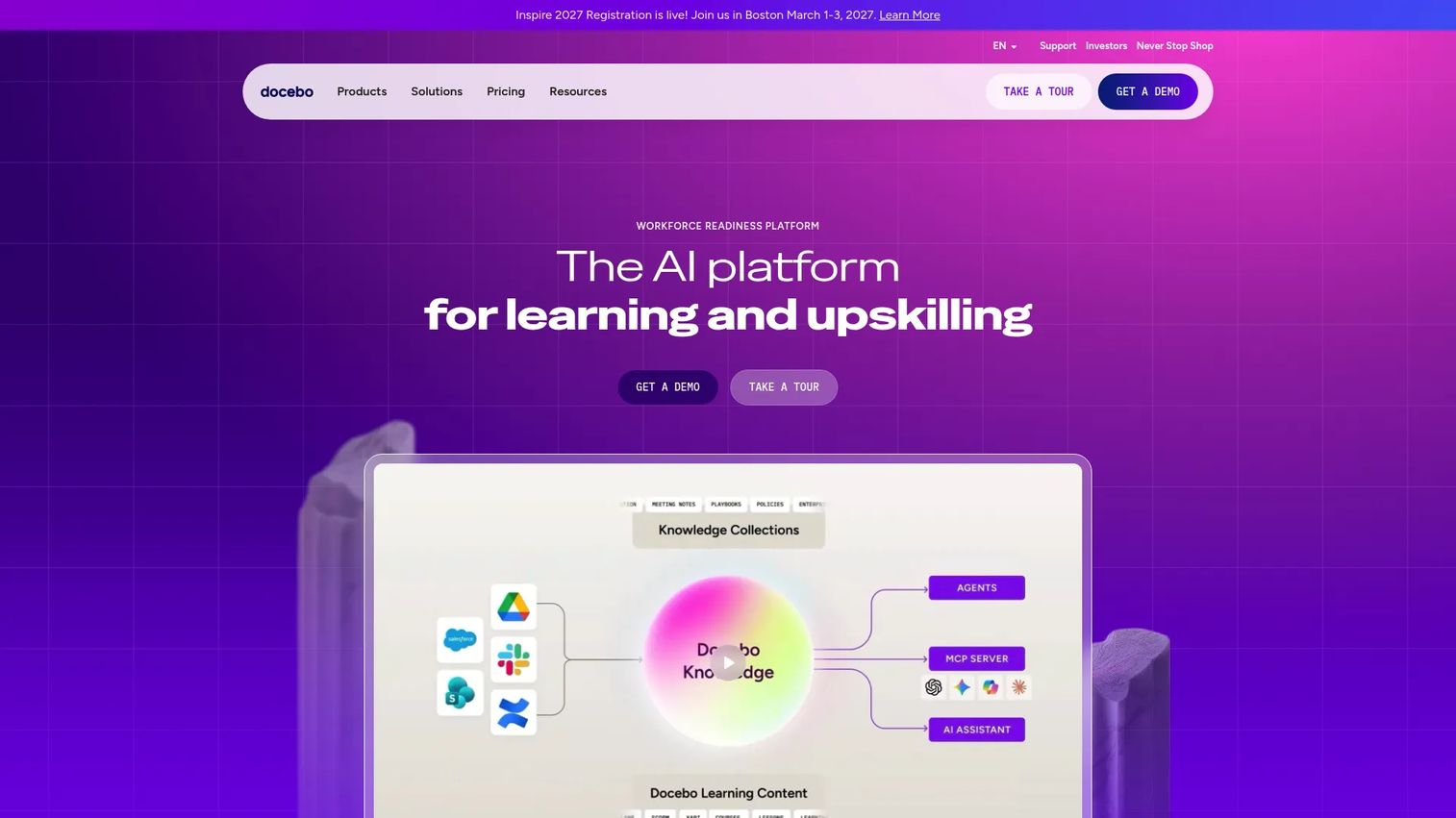
Docebo is an AI-powered learning platform serving enterprise organizations that need to train customers, partners, and employees from a single system. Its extended enterprise capabilities let teams set up separate portals and content libraries for each audience while managing them centrally. AI features span content recommendations, search, and an AI learning assistant.
Best for: Enterprises that need one learning platform spanning customer, partner, and internal training programs.
Key features
- AI-powered content creation and recommendations
- Extended enterprise multi-audience portals
- Live, on-demand, mobile, and social learning delivery
- Certification and compliance tracking
- Skills management and learning analytics
Why choose Docebo: Choose Docebo when customer education is one part of a broader organizational learning program and you need a single system to manage all three audiences. PMMs evaluating Docebo should confirm whether the customer education modules align with external-audience controls and CRM reporting expectations.
Docebo pricing: Docebo offers Elevate and Enterprise plans, both on custom pricing. Talk to sales directly to get a quote based on active learner volume and add-on requirements.
G2 rating: 4.3/5
3. LearnUpon
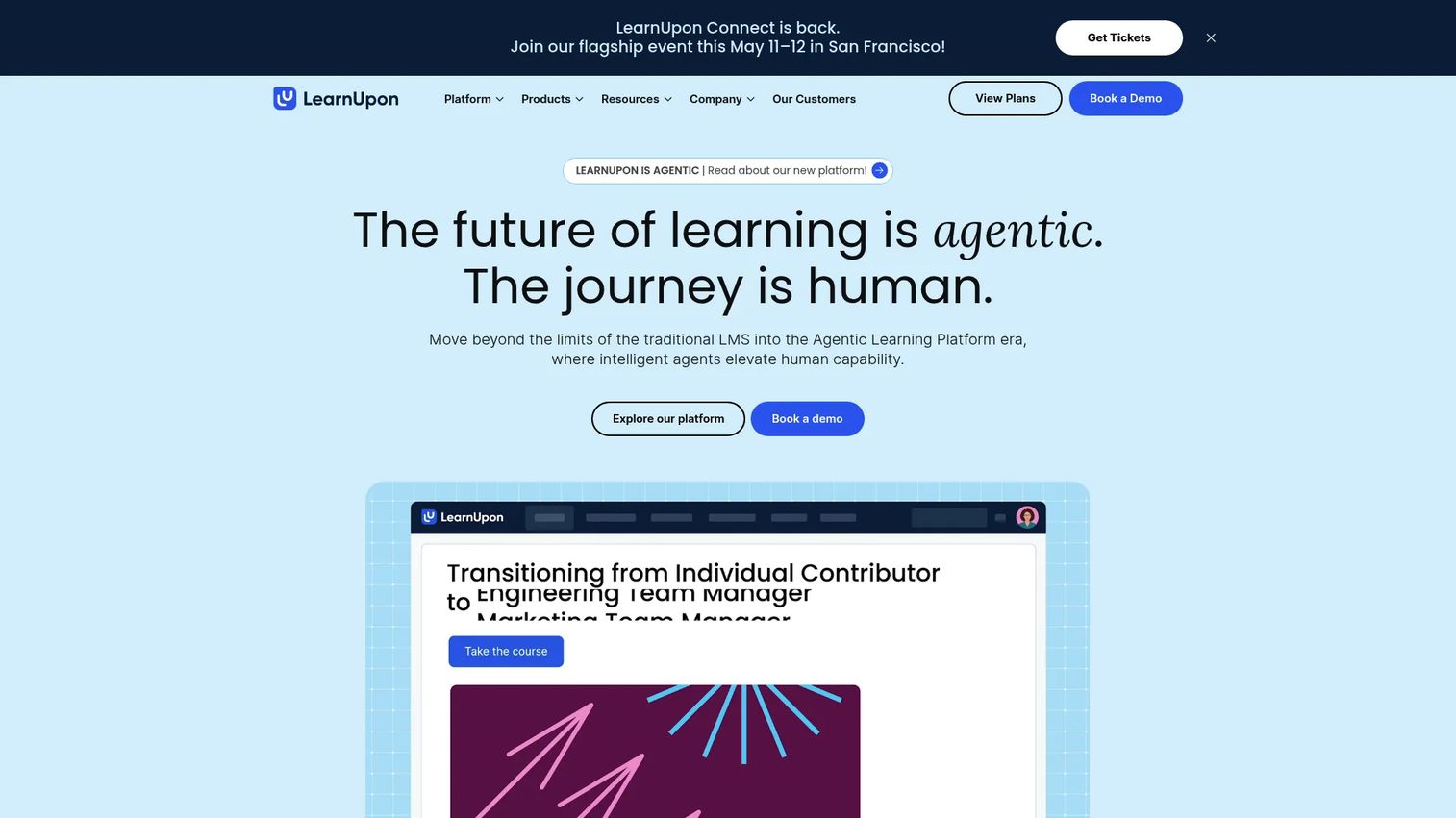
LearnUpon is an agentic LMS for employee, customer, and association training, with a strong emphasis on multi-portal delivery. Teams can run separate portals for each audience from a central admin. Its AI-assisted course authoring tool (Create+) and branching logic support structured learning paths without heavy implementation effort.
Best for: Teams that need multiple branded learning portals running in parallel without building separate systems for each audience.
Key features
- AI-assisted course authoring with Create+
- Personalized learning journeys with branching logic
- Skills management and proficiency tracking
- eCommerce support and learner reporting
- Live learning and 24/7/365 technical support
Why choose LearnUpon: LearnUpon works well when customer education is one part of a training function that also covers employee and partner programs. PMMs can use it to package onboarding and feature adoption content into structured paths without engineering involvement.
LearnUpon pricing: LearnUpon sets minimum user counts by audience: 100 users for employee training, 300 users for customer education, and 150 users for associations. All plans are priced by sales. Request pricing and ask about portal count, SSO, and analytics access.
G2 rating: 4.5/5
4. Absorb LMS
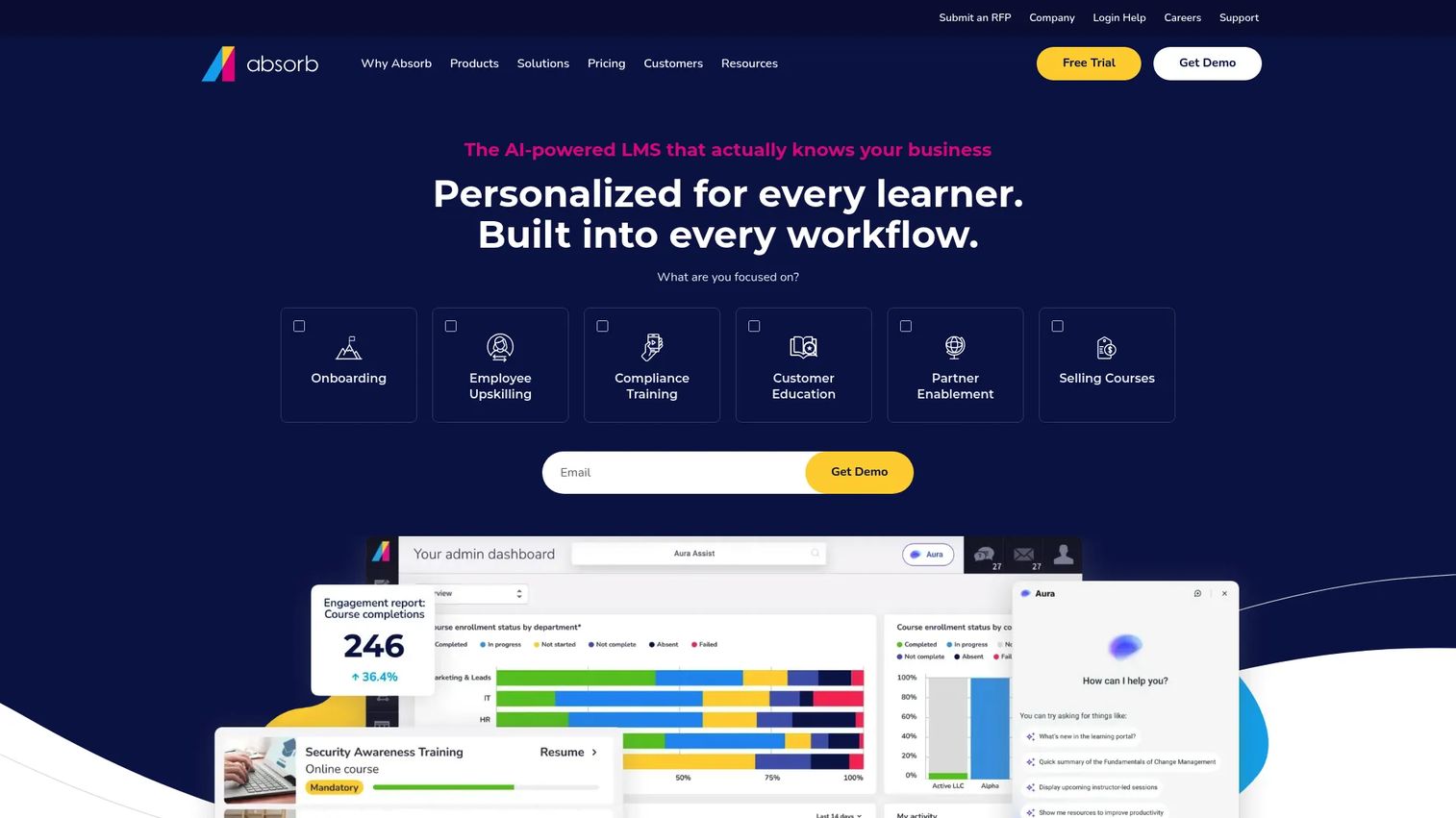
Absorb LMS is an AI-powered learning platform for enterprise training across customer, partner, employee, and compliance audiences. Its Absorb Create tool streamlines AI-assisted course authoring, while reporting and analytics dashboards surface engagement and ROI data for stakeholders. The platform now operates under the Absorb AI brand.
Best for: Organizations that want a polished, enterprise-grade LMS covering customer and partner education alongside internal compliance and skills training.
Key features
- Personalized upskilling and skills-based learning paths
- AI-assisted course creation with Absorb Create
- Learning portals for multiple audiences
- Reporting and analytics for compliance, engagement, and ROI
- E-commerce learning and course monetization
Why choose Absorb LMS: Absorb fits teams that care about learner experience quality and need a mature platform that handles formal training paths alongside customer-facing education. PMMs should ask about external-audience controls and CRM integration depth during the evaluation.
Absorb LMS pricing: Absorb prices on a custom quote basis tied to learner count and configuration. Contact sales and ask about portal count, AI feature access, and integration requirements before comparing against other enterprise LMS platforms.
G2 rating: 4.6/5
5. Thought Industries
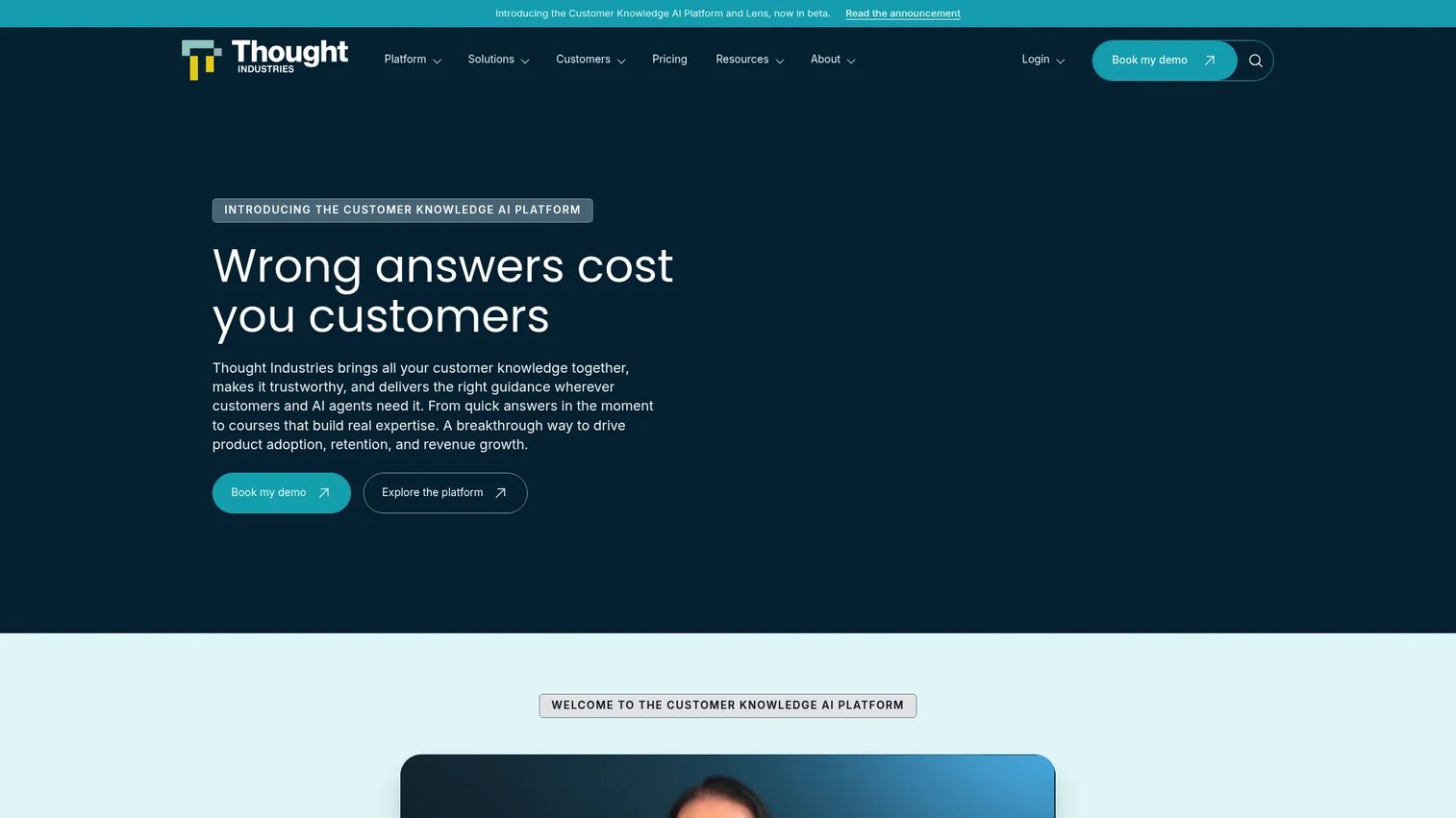
Thought Industries provides customer learning and knowledge AI platforms for creating, delivering, monetizing, and distributing training. Its multi-tenant academy architecture suits organizations running multiple branded learning portals for different customer segments, partners, or geographies. Course commerce, subscriptions, and certifications are built in.
Best for: Organizations building multiple branded customer academies or packaging learning into monetized certification programs.
Key features
- Branded learning sites with multi-tenant academy support
- AI-assisted course authoring
- Course storefront and subscription billing
- Learning paths and certifications
- Conversational AI learning and enterprise reporting
Why choose Thought Industries: Thought Industries is a strong fit when customer education is a productized experience with its own revenue model. For PMMs, it matters when training supports partner programs, enterprise onboarding, and paid certification pathways that need independent branding per portal.
Thought Industries pricing: The Lens product offers a Free plan with no time limit, a Pro plan at $499/month, and a Pro+ plan at $999/month. Academy plans (Starter, Professional, Enterprise) are priced by sales. Contact Thought Industries for Academy pricing based on program scope.
G2 rating: 4.1/5
6. Guideflow
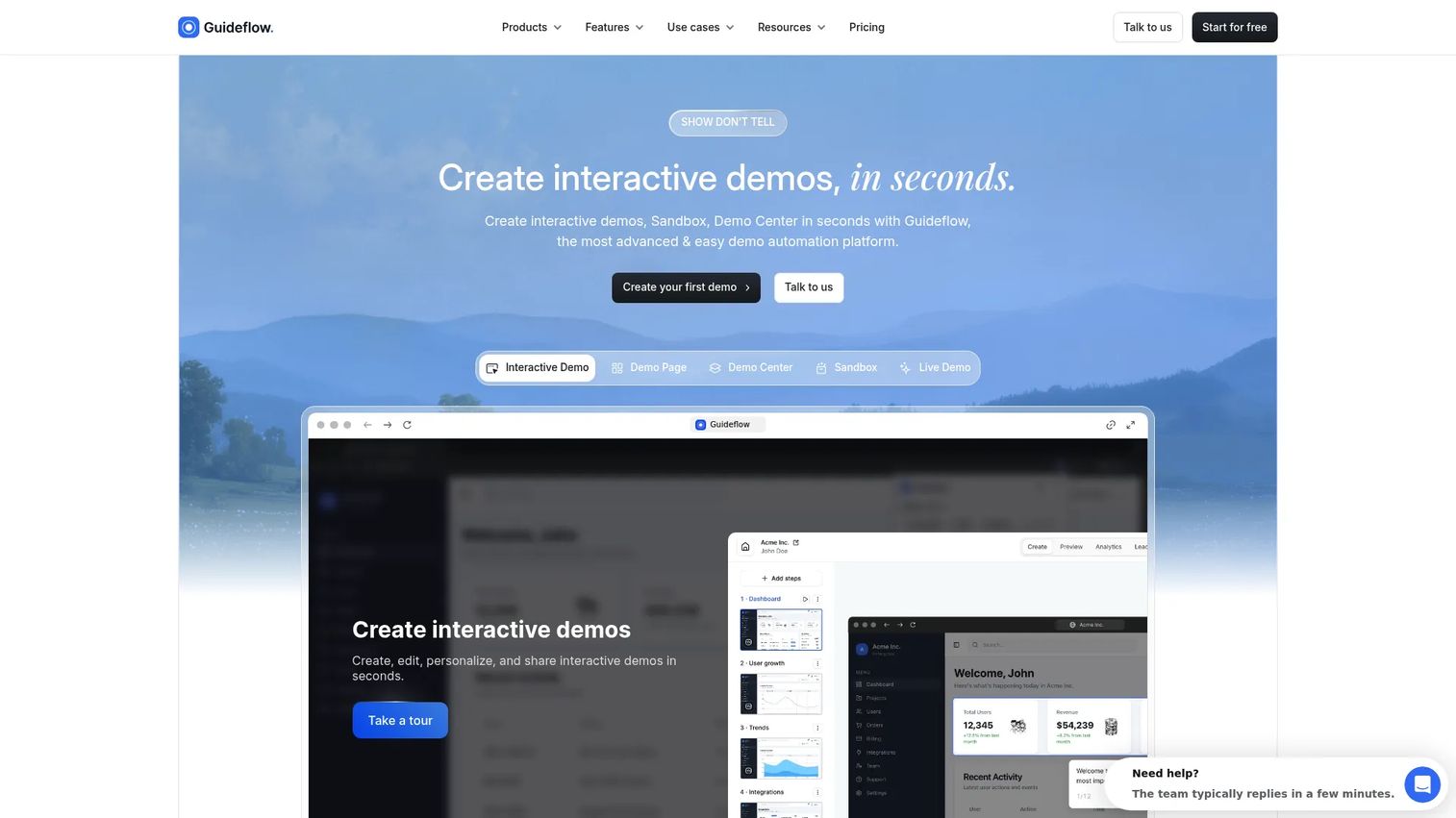
Guideflow is a demo automation platform for creating interactive product demos, Demo Centers, sandboxes, mobile demos, and live demos that customers can explore at their own pace. It's not an LMS and doesn't manage courses or certifications. What it does instead is put customers inside the product workflow from the moment they hit a help article, an onboarding email, or a launch announcement.
PMMs use Guideflow to capture product flows in minutes, personalize demos by persona, account, or use case, and analyze engagement at the step level. Demo Centers organize interactive demos into branded hubs that customers can browse by feature or workflow. Sandboxes give users full freedom to explore the product on their own terms, without a live environment or CS involvement.
Best for: PMM, CS, onboarding, and support teams that need customers to learn product workflows by doing, not by reading a doc or watching a video.
Key features
- Interactive demos with guided, clickable product walkthroughs
- Demo Centers: Branded hubs organizing demos by use case or persona
- Sandboxes for open product exploration
- No-code personalization by account, role, or lifecycle stage
- Engagement analytics on impressions, completion, and lead capture
Why choose Guideflow: Choose Guideflow when education happens inside the product experience itself. It's especially strong for feature launches, self-serve onboarding, help center embeds, and support guides where a traditional course adds too much distance from the actual workflow. For PMMs who care about consistent messaging across every customer touchpoint, Guideflow's integrations with CRM and CS platforms surface engagement data where it's already being tracked.
Guideflow pricing: Free plan available for up to 5 guideflows with unlimited viewers. Solo plan is $35/month billed annually ($40/month billed monthly). Growth, Advanced, and Enterprise plans add unlimited demos, analytics, AI features, HTML capture, and advanced personalization.
G2 rating: 5.0/5
Start your journey with Guideflow today!
7. Intellum
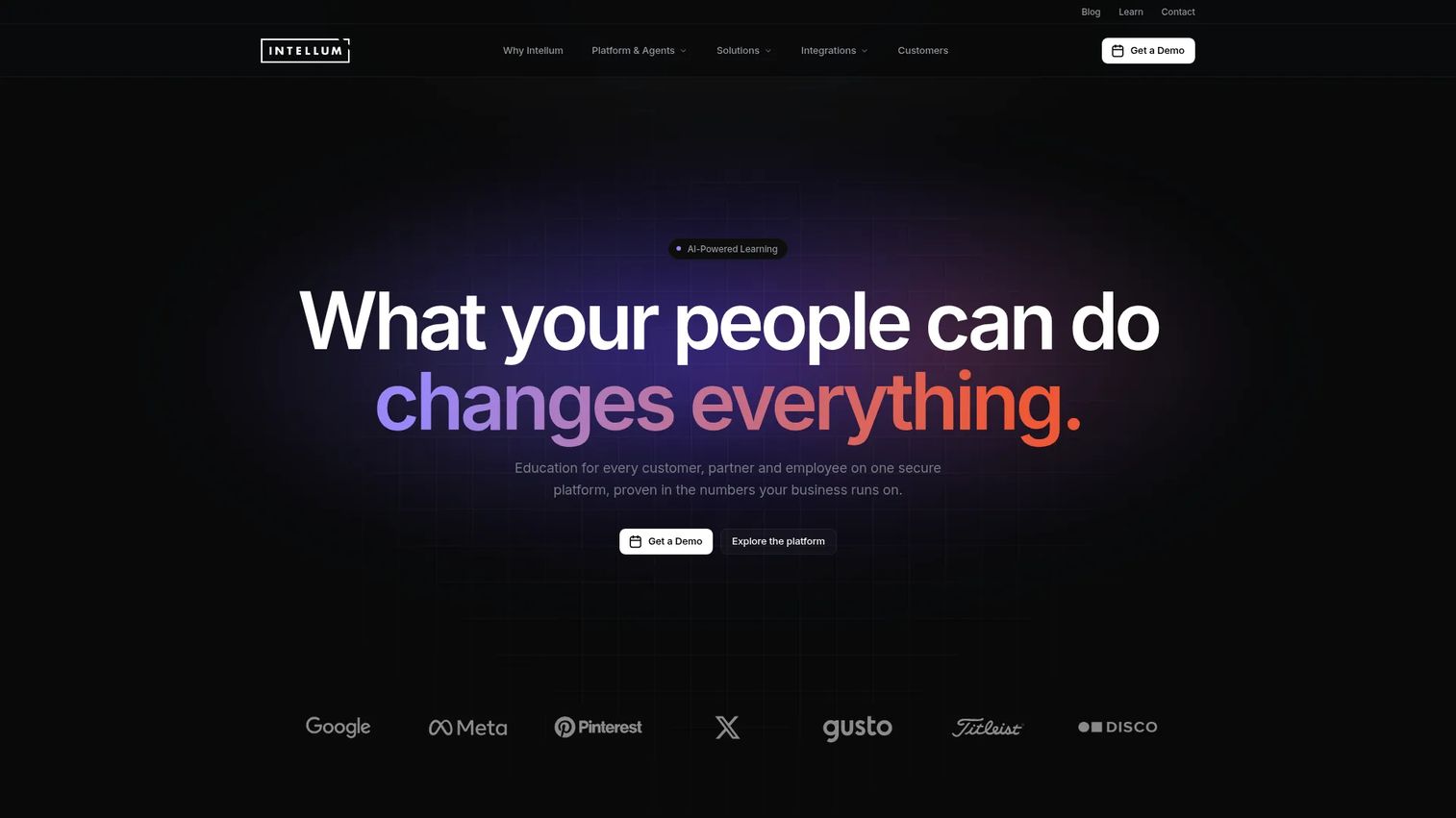
Intellum is an enterprise customer education platform built for large organizations running branded academies, certifications, and AI-assisted learning programs across customers, partners, and employees. Its multi-tenant architecture supports separate catalogs, sign-ins, and reporting for each audience. AI agents serve learners, course creators, and program managers with distinct workflows.
Best for: Large enterprises running mature customer education programs that need to connect learning data to retention, expansion, and support deflection outcomes.
Key features
- Multi-tenant LMS with separate audience catalogs and reporting
- AI agents for learners, creators, and managers
- Evolve interactive course authoring
- Certifications, virtual training, and social learning
- Data warehouse connectivity and analytics integrations
Why choose Intellum: Intellum fits organizations where customer education is a strategic business function, not a support cost. PMMs evaluating Intellum should focus on whether the learning data model connects to their existing CRM and CS platform, and whether the certification layer supports expansion and partner programs.
Intellum pricing: Pricing is individually quoted based on the products and audiences required. Contact sales and ask about admin seat costs, learner volume, multi-tenant configuration, and analytics connectivity.
G2 rating: 4.3/5
8. Gainsight
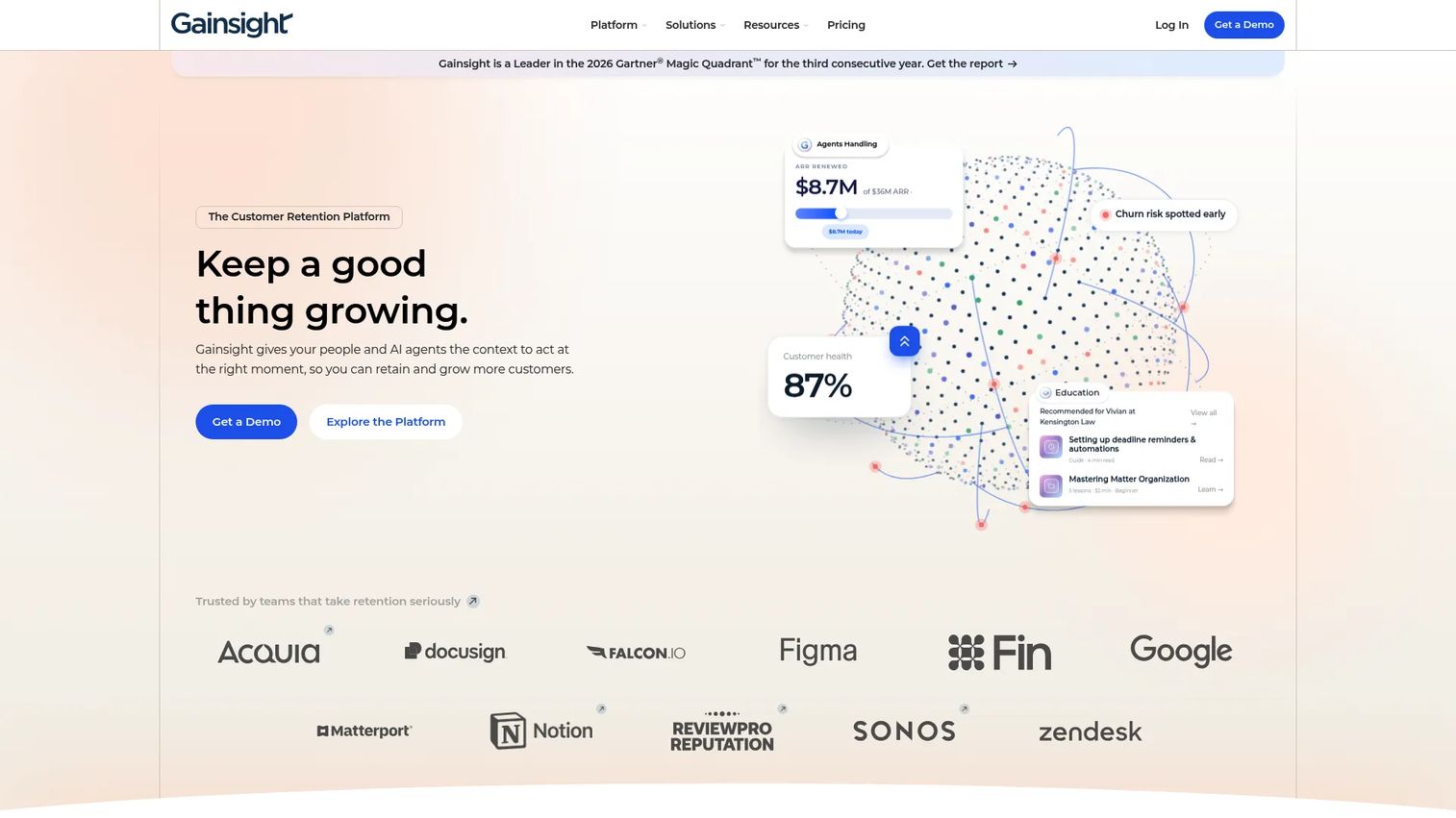
Gainsight provides a customer platform for customer success, product experience, community, and education. With the acquisition of Skilljar, Gainsight connects learning activity directly to health scores, renewal signals, and customer lifecycle workflows. Teams running CS-led education programs can surface education engagement inside the same platform they use for playbooks and QBRs.
Best for: Customer success teams connecting education completion and engagement to account health scores, renewal workflows, and expansion signals.
Key features
- Customer health scores and customer intelligence
- Playbooks and success plans
- Digital journeys and workflow automation
- Product analytics and in-app engagement
- Customer communities and self-service learning
Why choose Gainsight: Gainsight fits when the education program lives inside customer success operations and needs to influence CS workflows directly. PMMs should care about Gainsight when launch education and onboarding content need to show up in account health data, not just LMS reports.
Gainsight pricing: Gainsight lists Essentials and Enterprise tiers for Customer Success, plus Professional, Business, and Enterprise for Customer Communities. No numeric prices are shown. Contact sales and ask about CS seat costs, education module access, and health score configuration.
G2 rating: 4.5/5
9. Teachfloor
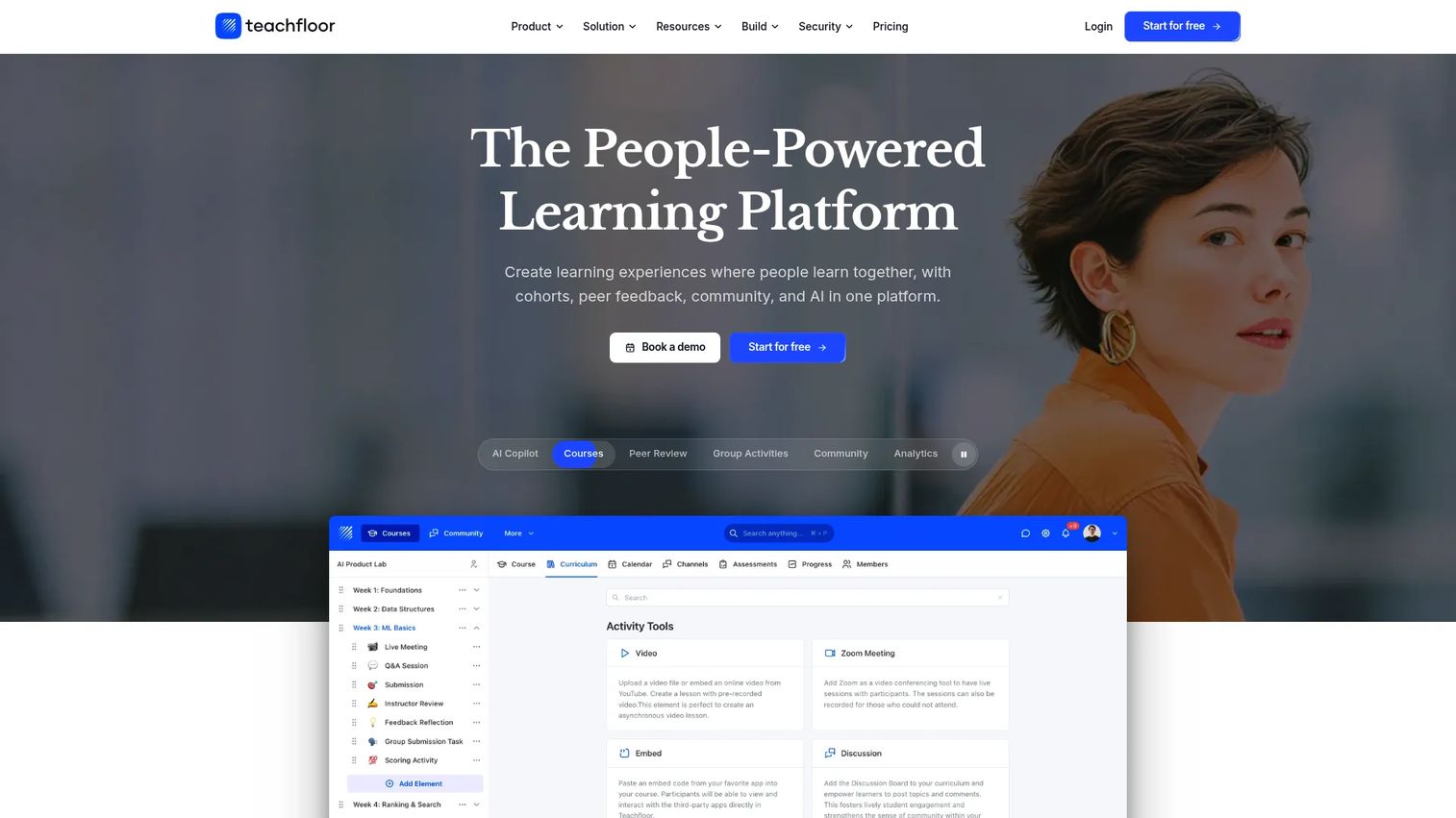
Teachfloor is a people-powered learning platform for cohort-based, collaborative, and AI-enhanced education. It supports live training sessions, peer review, group activities, and community learning alongside standard courses and certifications. Teams use it for programs where learner interaction and discussion improve outcomes, not just content consumption.
Best for: Teams running live cohorts, community-based training, or project-based customer education programs.
Key features
- AI-powered course generation and assignment grading
- Cohort-based courses with live sessions
- Peer review, group activities, and communities
- Assessments, certificates, and learning paths
- Stripe payments, REST API, webhooks, and LTI integrations
Why choose Teachfloor: Teachfloor fits education programs where engagement between learners is part of the value. PMMs can use it when product education benefits from community participation, live Q&A, or customer advisory-style learning cohorts that build advocacy alongside knowledge.
Teachfloor pricing: The Startup plan starts at $89/month. Full Features pricing is custom. A free trial is available.
G2 rating: 5.0/5
10. WorkRamp
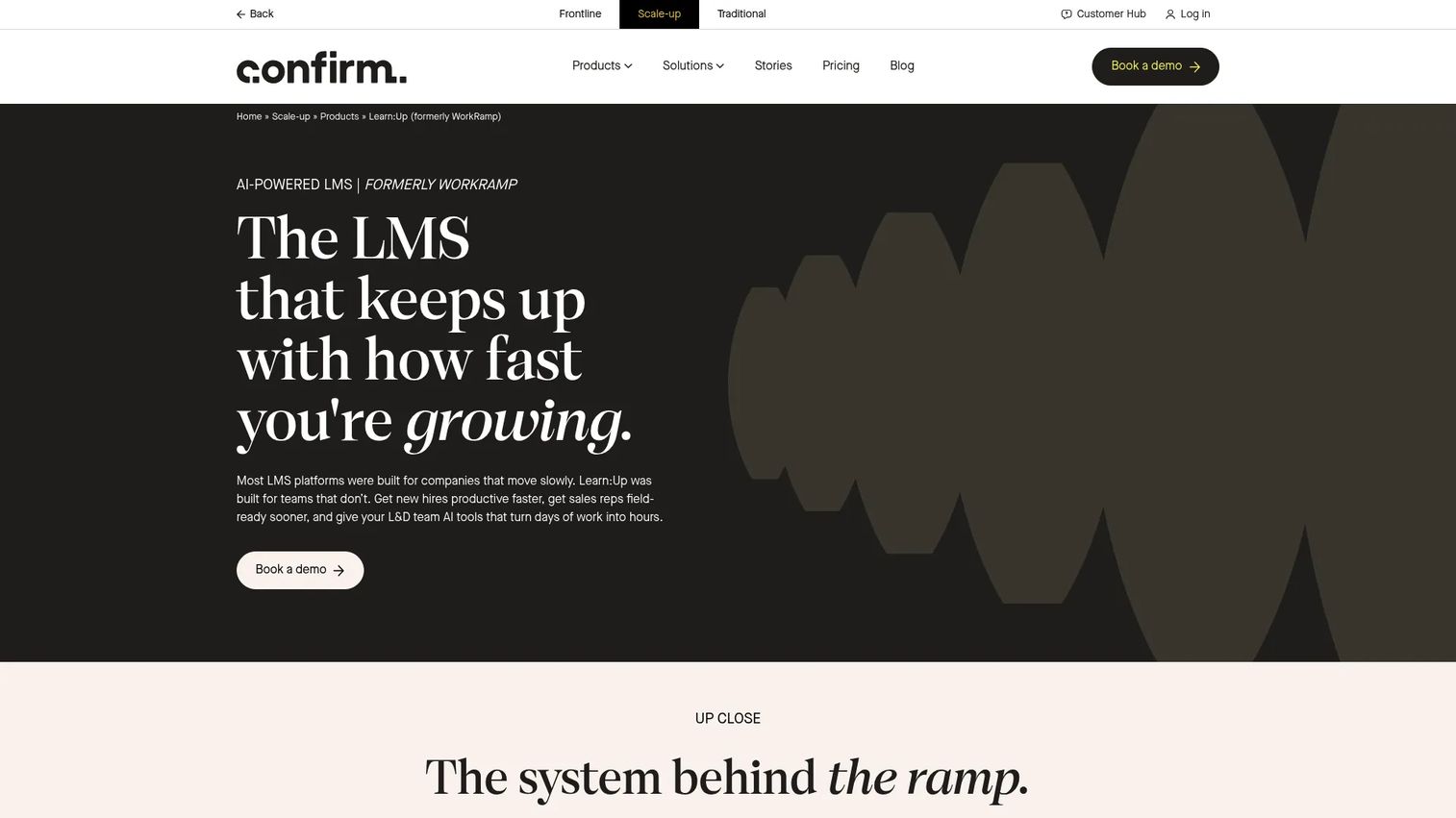
WorkRamp (now also listed as Learn:Up on G2) is an AI-powered learning platform for customer training, partner enablement, sales learning, and employee development. Teams use it when customer education shares operational resources with sales onboarding or partner certification, reducing the number of separate systems to maintain.
Best for: Revenue organizations that need customer education and internal enablement running from the same learning infrastructure.
Key features
- AI-assisted content authoring
- AI-powered practice simulations
- Branded learning academies
- Learning paths, assessments, and certifications
- Analytics and progress tracking
Why choose WorkRamp: WorkRamp is useful when launch education needs to reach customers and field teams from the same platform. PMMs evaluating it should confirm external-audience permissions, CRM integration depth, and whether the customer-facing academy experience meets branding requirements.
WorkRamp pricing: Contact sales and ask about customer-facing academy seats, integration requirements, and AI feature access.
G2 rating: 4.4/5
11. Continu
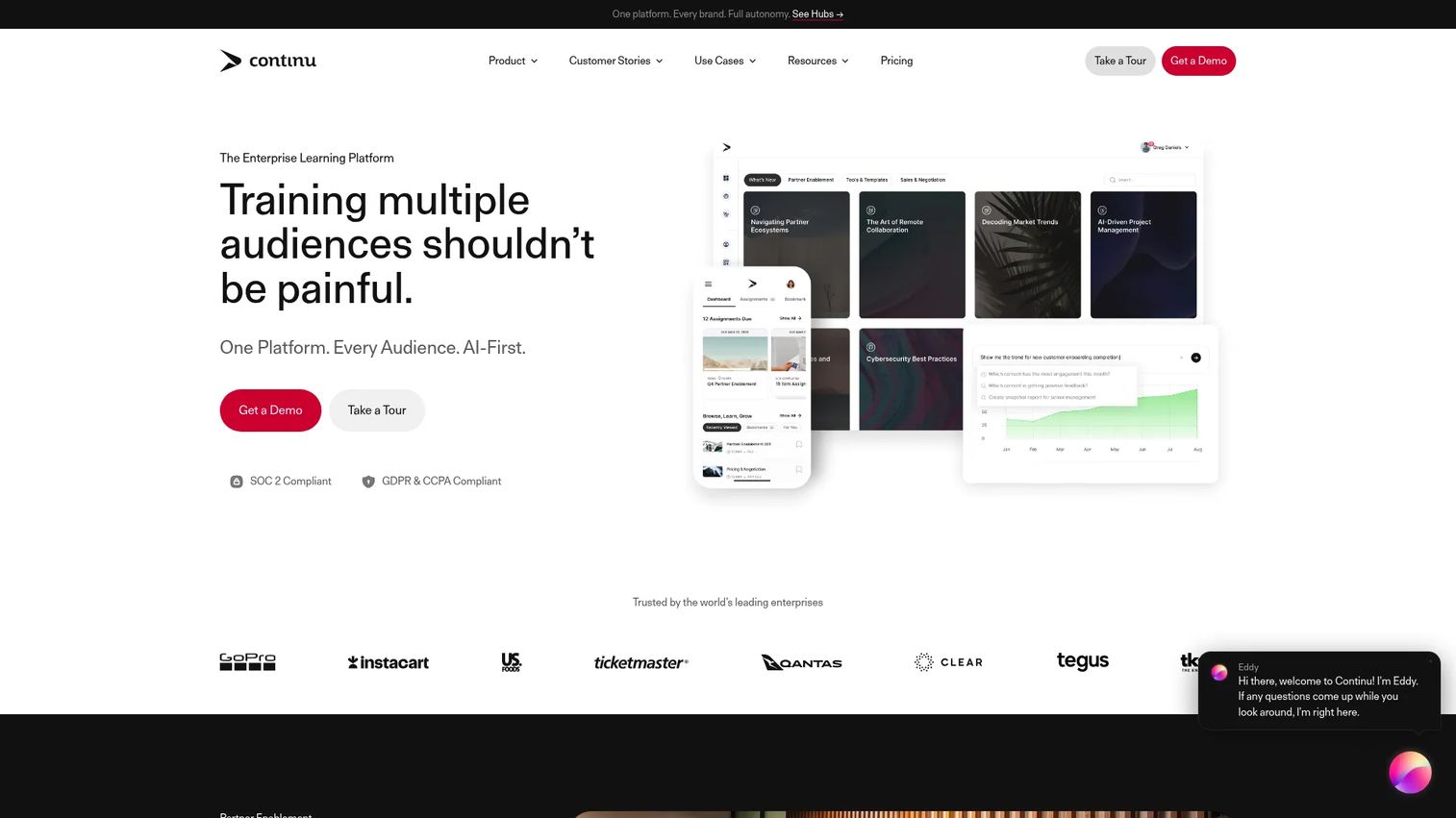
Continu is an enterprise learning and enablement platform for internal teams, partners, and customers. It supports learning tracks, SCORM content, workshops, automation workflows, and a conversational AI learning agent. External audiences and e-commerce features extend it beyond internal training.
Best for: Mid-market and enterprise teams that need an organized learning hub for enablement and customer training without a heavyweight academy buildout.
Key features
- Learning tracks and journeys
- Content authoring with SCORM support
- Automation workflows and training automation
- Custom reporting and analytics dashboard
- External audiences and e-commerce support
- Continu AI and conversational learning agent
Why choose Continu: Continu works when teams need consistent, governed content delivery across internal and external audiences without managing separate systems. PMMs can use it to keep launch content and training paths aligned across customer-facing and internal channels.
Continu pricing: Plans are structured by monthly active users: Growth (under 1,000), Professional (1,000 to 5,000), and Enterprise (5,000+). Contact sales with your learner volume and integration requirements.
G2 rating: 4.6/5
12. Trainn
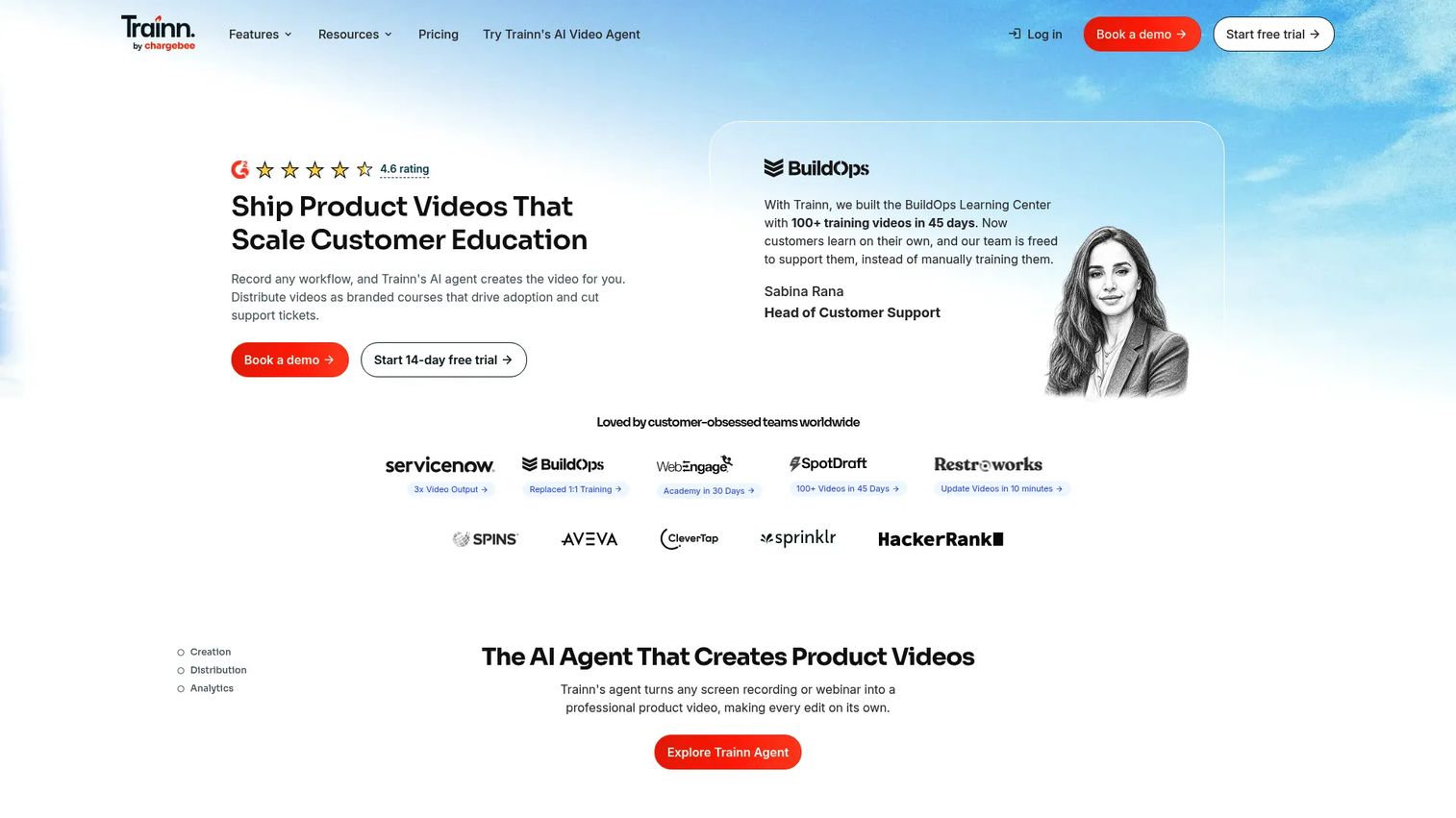
Trainn is an AI-powered customer education platform for SaaS teams creating product videos, guides, in-app tutorials, knowledge hubs, and LMS content. Teams capture product workflows and Trainn turns them into polished video with AI voiceovers, captions, zoom effects, and multilingual translation. Distribution spans shareable links, embeds, branded knowledge hubs, and in-app experiences.
Best for: SaaS teams that need to create customer-facing onboarding and adoption content quickly from product workflows, without a full course program buildout.
Key features
- AI-powered screen-recording-to-video creation with voiceovers and captions
- Multilingual translation and sensitive-information blurring
- Clip-based video editing with annotations and chapters
- Distribution through knowledge hubs, LMS courses, and in-app tutorials
- Shareable links, embeds, and PDF/image exports
Why choose Trainn: Trainn fits teams that need to ship customer education content faster than a full LMS workflow allows. PMMs who want to build onboarding and adoption videos from product recordings, without hiring video production, should evaluate Trainn alongside course-based platforms to see which content format fits the customer learning pattern.
Trainn pricing: The Creator plan starts at $19/month for one user and 15 videos. Launch is $2,400/year for three users and 120 videos. Scale is $10,000/year for five users, 250 videos, in-app tutorials, LMS with 100 monthly active users, and a branded knowledge hub. Enterprise is $39,900/year. No free plan; a free trial is available.
G2 rating: 4.7/5
13. Document360
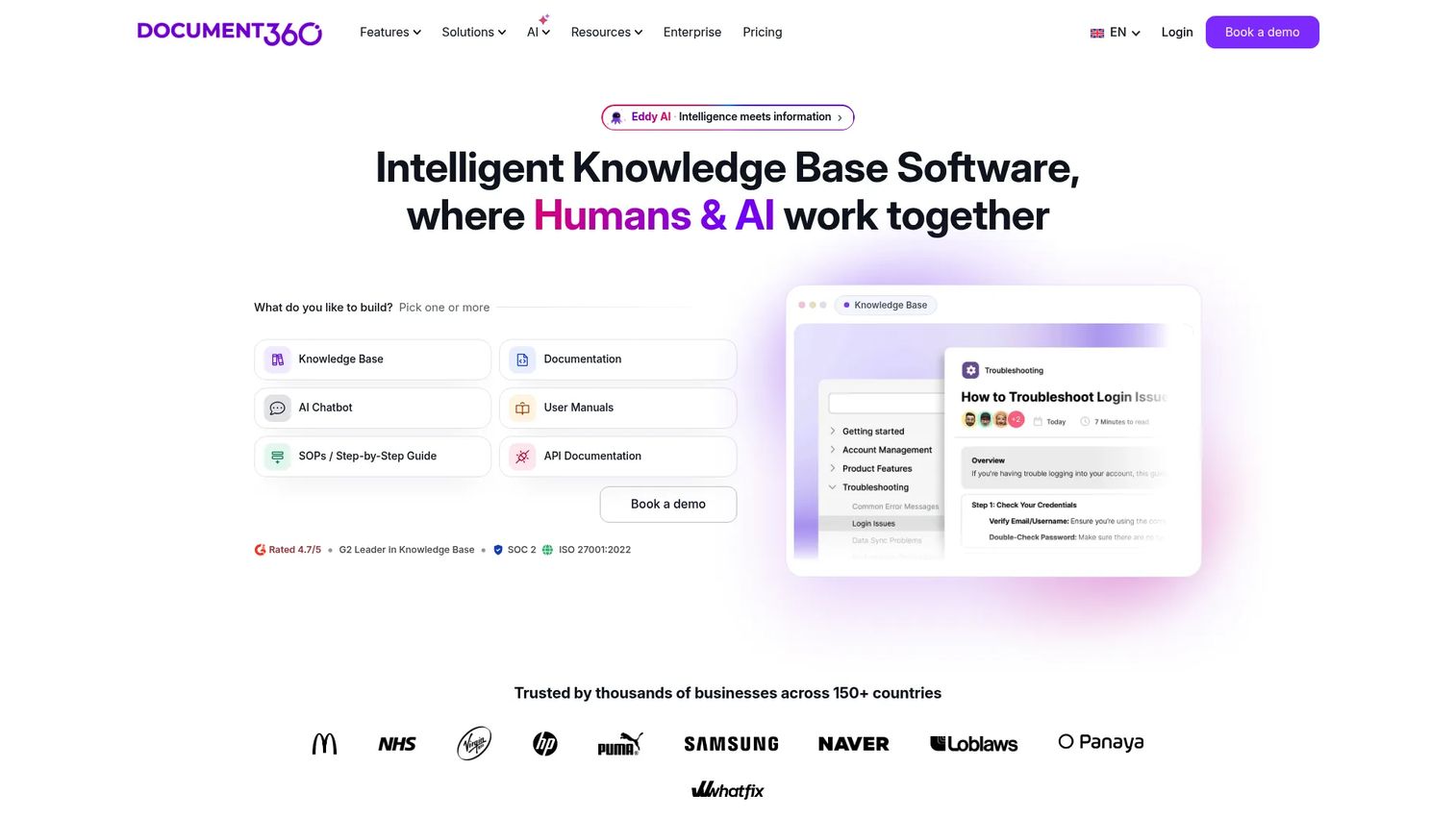
Document360 is an AI knowledge base platform for software documentation, SOPs, user manuals, and API documentation. It's not a customer education LMS, but it supports customer education programs where learning is primarily article-led. AI search, an AI writing agent, and custom workflows help teams create and maintain documentation at scale.
Best for: Teams whose customer education program starts with documentation and self-service help content, or organizations that need a governed knowledge base alongside a full LMS.
Key features
- AI Search and AI Chatbot
- AI Writing Agent for content creation
- Custom workflow builder and version control
- Analytics including search analytics and engagement data
- SSO and SCIM with integrations and PDF export
Why choose Document360: Document360 is the right fit when customers need reliable, searchable answers more than structured course programs. PMMs can use it to maintain launch documentation, feature explainers, and support education with governance and version control across product releases.
Document360 pricing: Pricing is customized based on workspaces, languages, team accounts, security requirements, and AI usage. Contact sales and confirm workspace count, analytics depth, and SSO requirements before comparing costs.
G2 rating: 4.7/5
14. LearnWorlds
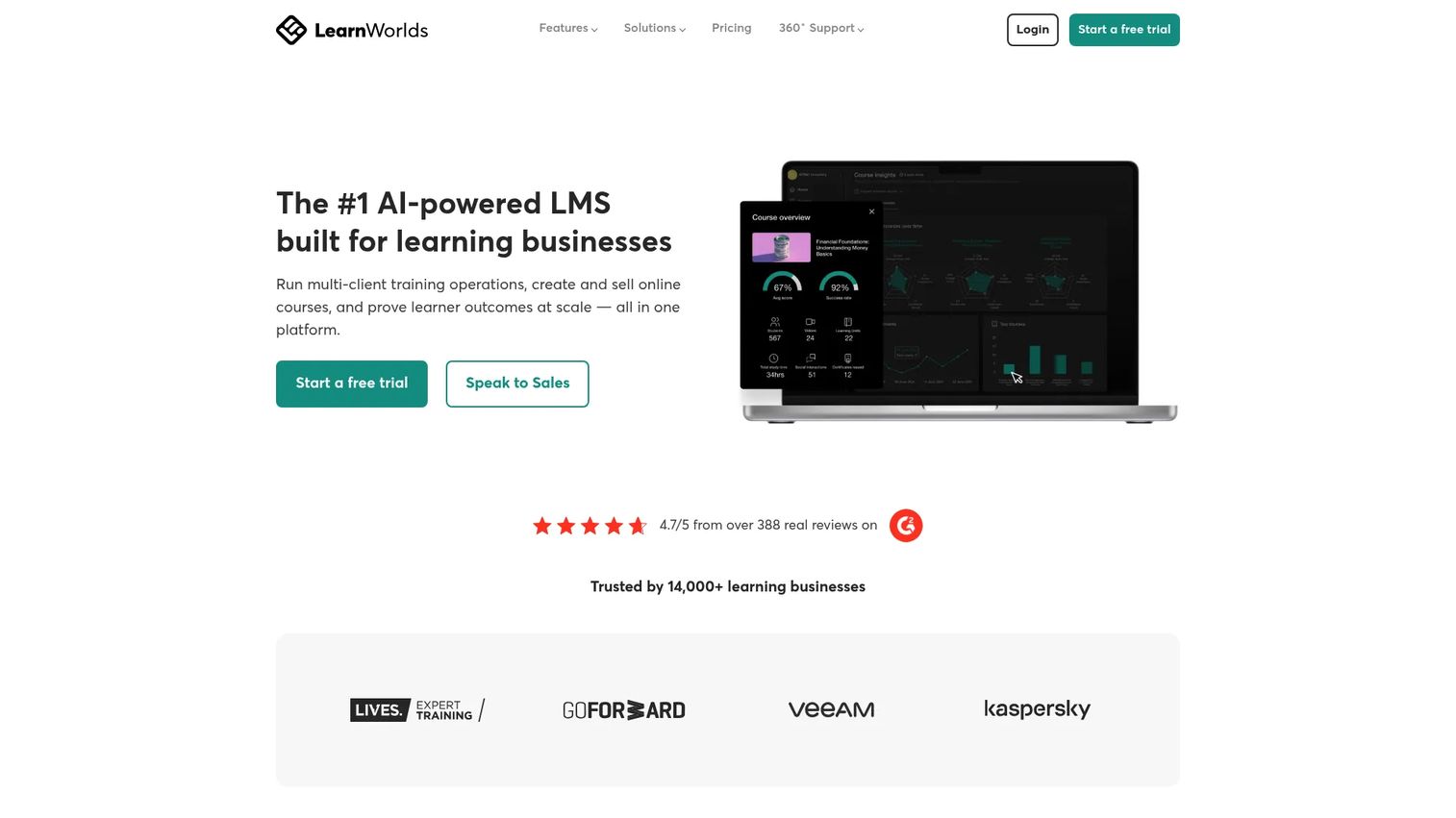
LearnWorlds is an all-in-one platform for creating, selling, and delivering online courses and learning programs. Its interactive video tool, SCORM support, community features, and payment gateway integrations make it well suited for customer education programs packaged as a branded academy experience.
Best for: Teams building course-based customer academies with community features, interactive video, and e-commerce capability.
Key features
- AI-assisted course and academy creation
- Interactive video with clickable elements
- Assessment builder and SCORM support
- Learning paths and payment gateways
- Community tools and e-commerce learning
Why choose LearnWorlds: LearnWorlds works when customer education looks like an online academy or school. PMMs should consider it for packaged training programs, customer certification content, or education programs that generate revenue alongside product adoption.
LearnWorlds pricing: The Starter plan is $24/month billed annually ($29/month billed monthly) but includes a $5 fee per paid enrollment. Pro Trainer is $79/month annually ($99/month monthly) with no enrollment fees. Learning Center is $249/month annually ($299/month monthly). Corporate pricing requires a sales conversation. A free trial is available.
G2 rating: 4.7/5
15. App-Learning
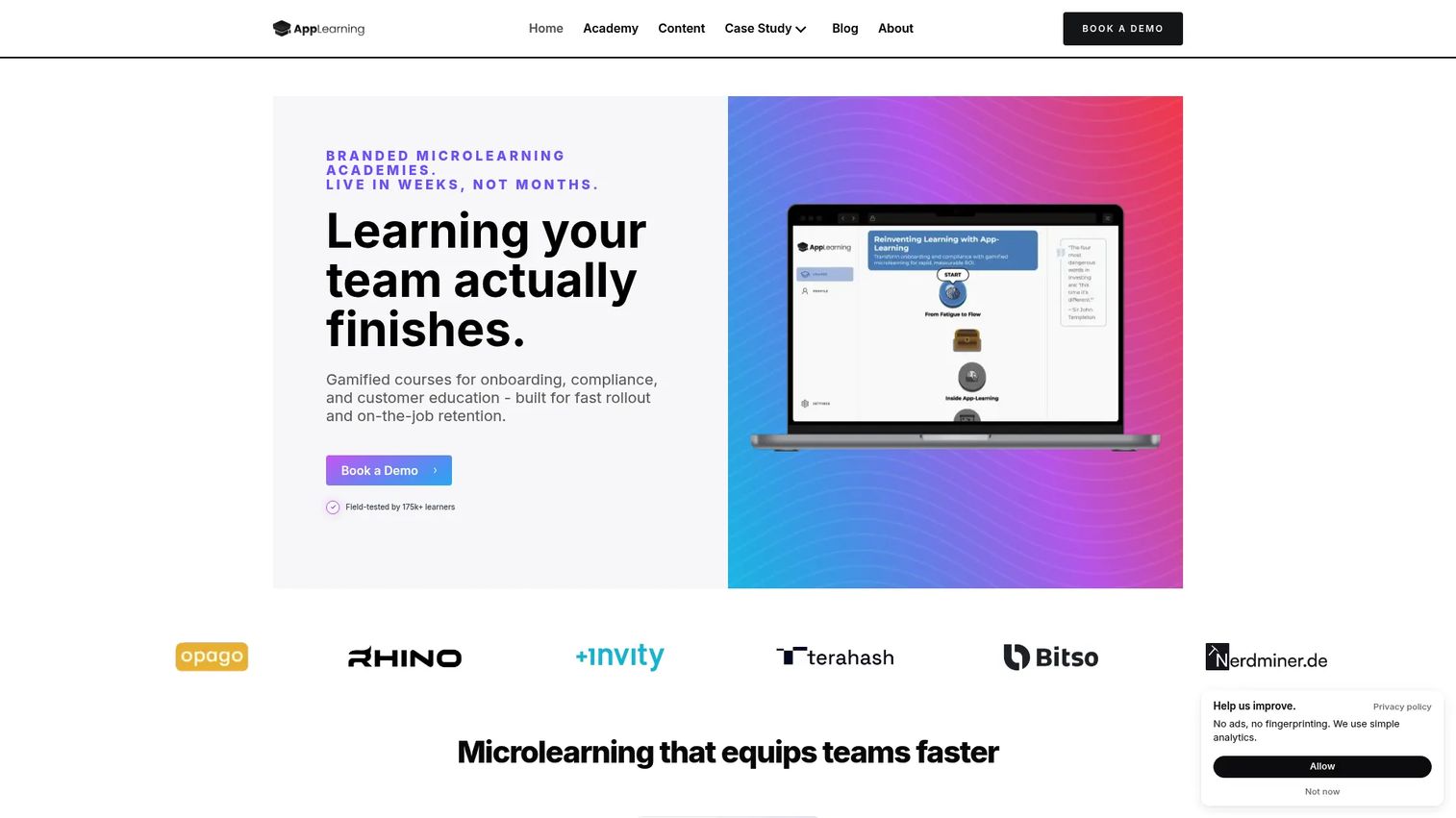
App-Learning provides branded microlearning academies for customer and employee education, covering authoring, learning management, analytics, and gamified learning experiences. Its focus on micro-lessons, quizzes, and certificates fits products where complex workflows or high-stakes decisions require clear, staged education.
Best for: Teams educating customers on complex, multi-step product workflows or high-consideration use cases where staged microlearning improves comprehension.
Key features
- Branded academies with role-based learning paths
- Micro-lessons, videos, quizzes, and certificates
- Gamified mechanics for engagement
- Analytics for progress, completions, and quiz results
- Customer and employee learning from one platform
Why choose App-Learning: App-Learning fits companies where product understanding is central to adoption, not just a nice-to-have. PMMs should consider it when customer education needs to build trust and competence through short, structured learning steps before users commit to complex product workflows.
App-Learning pricing: Ask sales for pricing.
Considerations when choosing a customer education platform
Match the format to the learning job
Courses, knowledge base articles, videos, interactive demos, live cohorts, and certifications solve different education jobs. A customer who needs to complete a compliance workflow needs a different format than one trying to explore an unfamiliar dashboard. Map the platform to the learner behavior you need, not to the longest feature list.
Check how fast your team can publish and update content
Customer education breaks when content goes stale after a launch. Evaluate how quickly PMMs and CS teams can capture, edit, and update content without engineering. If your release cadence is high, a platform with no-code editing and fast capture will save significant time across the year.
Tie analytics to adoption and retention
Completion rates are the starting point. Look for reporting that connects learning engagement to activation events, feature usage, support ticket volume, renewal rates, or expansion signals. Without that connection, it's hard to prove that education is working as a PMM or CS leader.
Validate integrations before buying
Prioritize your CRM, CS platform, help center, product analytics tool, and identity provider. Education data that lives in a separate reporting silo doesn't influence GTM decisions. The best product analytics software tools and CS platforms need to receive learning signals to act on them.
Plan ownership and governance before launch
Customer education sits at the intersection of PMM, CS, support, and product. Define who owns content quality, launch updates, and analytics reviews before buying a platform. Without governance, content drifts and education programs lose the consistency that makes them effective. See also our guide on best interactive demo tools for product marketing for the asset layer that sits alongside education platforms.
Conclusion
Customer education is not a support cost. It's how activation happens at scale, how launch adoption compounds, and how CS teams move from repeating the same calls to managing accounts at a higher level.
For enterprise academies and certifications, Skilljar, Docebo, Intellum, and Thought Industries cover structured learning at scale. LearnUpon, Absorb LMS, WorkRamp, and Continu work well for teams that need customer and internal training under one system. Teachfloor and LearnWorlds suit cohort and course-based programs with community or e-commerce layers. Document360 and Trainn fit teams whose education starts with documentation or product video. Gainsight and App-Learning connect education to customer success workflows and complex product onboarding.
Guideflow sits between all of these as the interactive product education layer. It's where customers click through real workflows instead of reading about them, and where PMMs can see engagement at the step level, not just the page view.
Start by identifying your biggest gap: Structured learning paths, self-service documentation, or interactive product education. Shortlist two or three platforms, verify integration fit with your CRM and CS stack, and confirm pricing based on your learner volume.
Start your journey with Guideflow today!
FAQs
A customer education platform is software that helps companies create, deliver, organize, and measure training for external users, customers, and partners. It differs from an internal LMS in its focus on external learners, with controls for branding, permissions, CRM integration, and learning analytics tied to customer lifecycle outcomes.
An LMS can serve any audience, including employees. A customer education platform is built specifically around external learners, customer onboarding, product adoption, and customer success workflows. Some platforms do both, but the external-audience controls, branded portals, and CRM reporting are what distinguish customer education software from a generic training system.
Look for branded portals, learning paths segmented by persona or account type, certification management, engagement and completion analytics, CRM and CS platform integrations, and content creation tools your team can operate without engineering support. Teams whose customers need to learn product workflows by doing should also evaluate interactive product education formats alongside traditional course-based delivery.
They turn onboarding and feature education into repeatable, self-serve learning paths that customers complete at their own pace. Users who finish an education sequence before hitting a product feature reach value faster, generate fewer support tickets, and show higher activation and retention rates than those who rely on static documentation alone.
Most need both. A knowledge base answers specific questions when customers are already in the product. A customer education platform creates structured journeys that build competence before or during the customer lifecycle. Some teams also add interactive product demos to let customers learn by clicking through real workflows. The right combination depends on how complex the product is and where customers typically stall.
PMMs should prioritize platforms that support fast content publishing, analytics connecting education to adoption metrics, and governance controls for launch and onboarding content. Guideflow is a strong fit when customers need to experience product workflows rather than read about them. For structured academies and certifications, Skilljar and Intellum are built for that program type. The right answer depends on whether the biggest education gap is interactive learning, structured courses, or documentation.
Start with a baseline before any rollout. Then track course or demo completion rates, feature activation after education touchpoints, support ticket volume for topics your education covers, time-to-value for new users, renewal and expansion rates for educated versus uneducated accounts, and account-level engagement in your demo centers or learning portals. No single metric tells the full story; the combination of completion and downstream behavior is what matters.
Yes, when the content addresses the specific questions driving ticket volume and when it's easy for customers to find. Interactive guides embedded in help centers, structured onboarding paths, and self-serve product demos address the "how do I" questions before they become tickets. For teams evaluating this angle, consider our guides on best onboarding flow software and best knowledge base software alongside the platforms covered here.