Container adoption has outpaced most teams' ability to govern what happens between services. According to the CNCF Annual Cloud Native Survey (2025), 82% of container users now run Kubernetes in production, up from 66% in 2023. That momentum is real, but it creates a quiet problem: Every new service you ship adds surface area across network policy, traffic routing, service identity, and observability. Most teams don't discover the gap until a reliability incident, a security review, or a launch delay surfaces it.
The wrong choice here doesn't show up as a failed deployment. It shows up as recurring platform interruptions, undefined policy ownership, and engineering capacity diverted from product work to infrastructure firefighting. Picking a tool from the right layer matters as much as picking the right tool.
This guide cuts through the category confusion and gives you a clear shortlist across orchestration, CNI, service mesh, ingress, and managed platforms.
What's inside
This guide is for product managers and technical leaders evaluating container networking options for production environments. Tools were selected based on:
- Production relevance: Widely used in real containerized workloads
- Layer served: CNI, service mesh, ingress, or managed platform
- Security and policy controls: Network policy, workload isolation, identity
- Operational fit: Observability, upgrade management, and pricing model
These tools serve different layers. The comparison helps you build a shortlist, not replace an architecture review.
TL;DR
- Best for Kubernetes orchestration foundations: Kubernetes provides the standard control plane for scheduling and service networking at scale
- Best for eBPF-based networking and observability: Cilium gives platform teams deep traffic visibility and policy control
- Best for mature network policy and segmentation: Calico suits production clusters with granular isolation requirements
- Best for service-to-service traffic management: Istio or HashiCorp Consul when distributed microservices need consistent identity and traffic control
- Best for managed container operations: Google Kubernetes Engine for Google Cloud commitments, Red Hat OpenShift for governed hybrid environments, Amazon ECS for AWS-native teams that don't need Kubernetes APIs
What is container networking software?
Container networking software connects containerized workloads, controls how they discover services, enforces traffic and security rules, and routes application traffic inside and outside container platforms.
The category covers several distinct layers that buyers frequently treat as interchangeable. They aren't.
The layers that matter
- Container runtime: Runs containers on hosts (Docker, containerd)
- Orchestration platform: Schedules, scales, and manages workloads across nodes
- CNI plugin: Gives pods network connectivity and enforces network policy at the cluster level
- Service mesh: Controls service-to-service traffic, encrypts connections, enforces service identity, and surfaces telemetry
- Ingress and gateway layer: Routes external traffic from users and APIs into cluster services
- Managed platform: Bundles operations, upgrades, security patching, and infrastructure support
Many production stacks combine several of these. A team might run Kubernetes as the orchestrator, Cilium as the CNI, Traefik as the ingress controller, and GKE as the managed platform underneath all of it.
Key capabilities to evaluate
- Pod and service connectivity with stable addressing
- Service discovery and DNS resolution
- Network policy enforcement and workload isolation
- Ingress, load balancing, and traffic routing
- Flow visibility, latency tracking, and policy violation alerts
- Multi-cluster or hybrid-cloud connectivity
- Integration with identity providers and security tooling
- Upgrade cadence and maintenance overhead
When to use container networking software
Run microservices in production
Once a product ships more than a handful of independent services, service-to-service communication becomes a platform concern. Ad hoc networking creates unpredictable failure modes. A CNI with policy enforcement and a clear ingress strategy reduces the surface area your engineering team has to debug.
Enforce isolation around sensitive workloads
Policy tools matter when teams handle customer data, shared clusters, or regulated workflows. Workload isolation is a release-cadence concern: Without it, a misconfiguration in one service can affect neighbors. The right tool makes policy ownership explicit and auditable, not an afterthought.
Scale clusters across teams or environments
Multi-cluster operations, hybrid cloud, or frequent releases across dev and production environments justify more mature traffic management. When multiple product teams share a platform, consistent observability and policy governance reduce the coordination cost of every incident.
Container networking software comparison
These products serve different infrastructure layers. Many production environments use more than one. Treat this table as a starting point for shortlisting by layer, not as a direct feature-to-feature replacement comparison.
| # | Product | Best for | Key differentiator | Pricing | G2 rating |
|---|---|---|---|---|---|
| 1 | Kubernetes | Core orchestration for container platforms | Standard control plane for scheduling and service networking | Open source | N/A |
| 2 | Cilium | Kubernetes networking and observability | eBPF-based networking, security, and observability | Open source | 4.5/5 |
| 3 | Calico | Network policy and workload isolation | Mature Kubernetes networking with granular policy controls | Open source; Calico Cloud from $0.025/vCPU hour | 4.5/5 |
| 4 | Istio | Service mesh traffic management | Fine-grained service routing, mTLS, and telemetry | Open source | 4.2/5 |
| 5 | HashiCorp Consul | Cross-platform service networking | Service discovery and mesh across Kubernetes and VMs | Community edition free; enterprise custom pricing | 4.3/5 |
| 6 | Traefik | Kubernetes ingress and edge routing | Dynamic ingress and application proxying | Open source; Hub plans contact sales | 4.6/5 |
| 7 | F5 NGINX | Enterprise ingress and traffic management | Reverse proxy, load balancing, and ingress with commercial support | Annual enterprise subscription; contact F5 for pricing | 4.6/5 |
| 8 | Google Kubernetes Engine | Managed Kubernetes on Google Cloud | Managed control plane with Google Cloud integration | From $0.0645/vCPU hour (Autopilot); free tier available | 4.5/5 |
| 9 | Red Hat OpenShift | Enterprise Kubernetes platform | Opinionated platform with developer and governance tooling | OpenShift Dedicated from $0.076/4vCPU hour (3-year); self-managed pricing varies | 4.5/5 |
| 10 | Amazon ECS | AWS-native container operations | Managed orchestration integrated with AWS services | No orchestration fee; pay for underlying compute | 4.3/5 |
Best 10 container networking software tools for 2026
1. Kubernetes
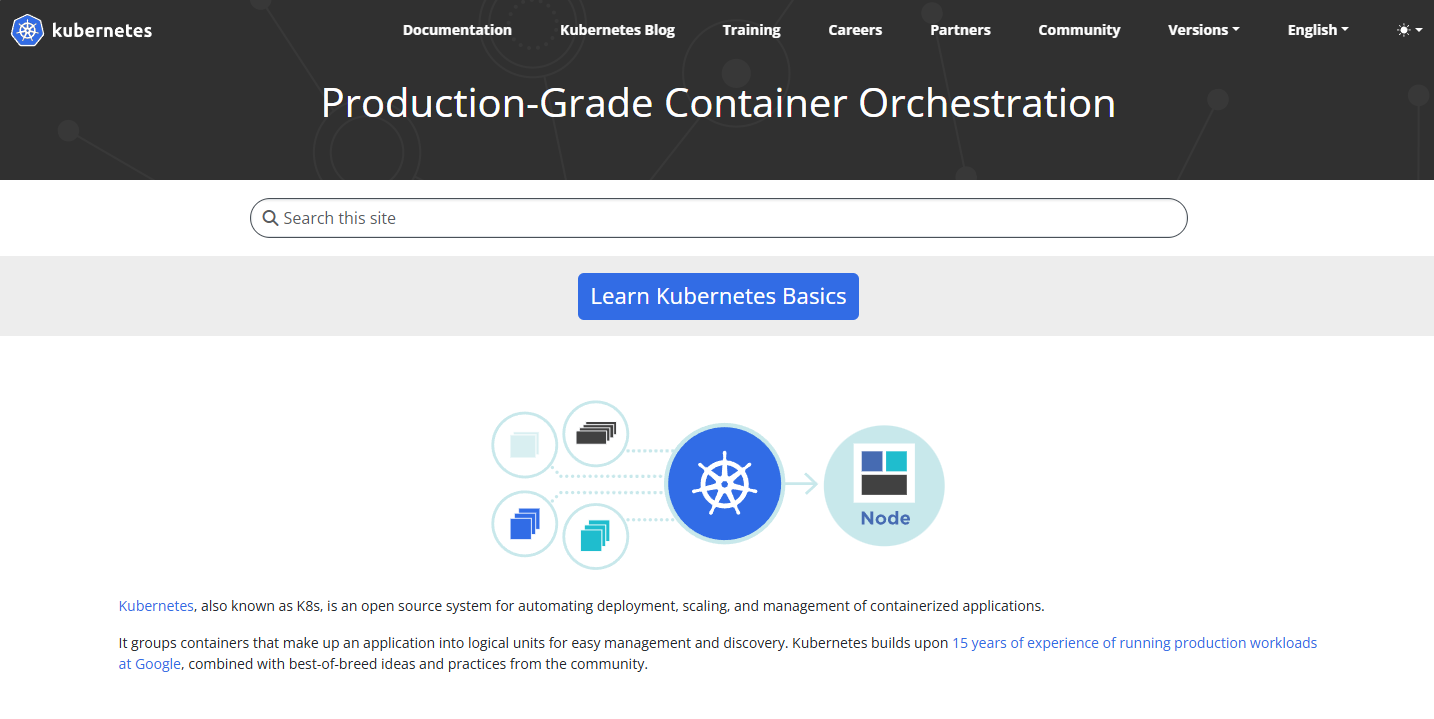
Kubernetes is an open-source, portable, extensible platform for managing containerized workloads and services. It defines the networking baseline for everything above it: Services get stable DNS names, pods get addresses through the CNI layer, and ingress controllers integrate at its edge. Kubernetes is not itself a complete CNI, service mesh, or ingress solution. It creates the foundation those tools build on.
Best for: Product organizations standardizing deployment and scaling across many containerized services.
Key features
- Automated rollouts and rollbacks with declarative configuration
- Service discovery through cluster DNS
- CNI-compatible networking model for pod connectivity
- Horizontal scaling and self-healing
- Storage orchestration across providers
Why choose Kubernetes: Choose it when the product needs a broadly supported orchestration foundation. Kubernetes still requires a CNI choice, an ingress strategy, and possibly service mesh tooling to be production-ready.
Kubernetes pricing: Kubernetes is open source with no license cost. Real costs come from infrastructure, platform engineering time, observability tooling, and support contracts.
2. Cilium
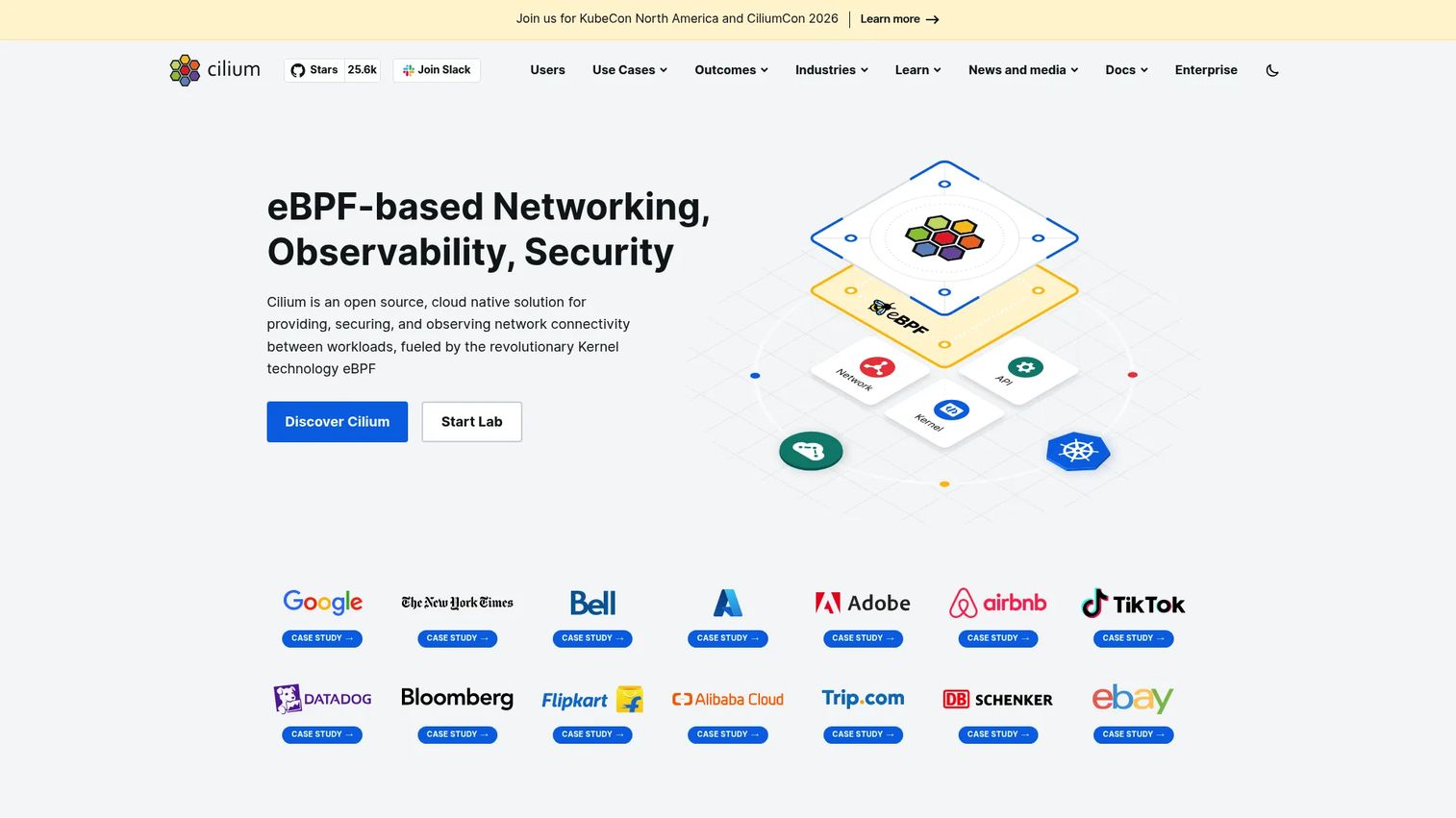
Cilium is an open-source, eBPF-based solution for Kubernetes networking, observability, and security. eBPF runs programs directly in the Linux kernel, which means Cilium can enforce network policy and capture traffic telemetry without relying on traditional proxy sidecars. The practical result: Detailed flow visibility and policy enforcement with lower per-node overhead than proxy-based approaches.
Best for: Kubernetes platform teams that need high-fidelity networking visibility, policy control, and cloud-native operational depth.
Key features
- eBPF-based Kubernetes networking and CNI
- Identity-aware network policy and runtime security enforcement
- Hubble-based service and network observability
- Service load balancing across pods
- Cluster mesh for multi-cluster connectivity
Why choose Cilium: Strong fit when platform teams need to connect networking decisions directly to observability and security workflows. It deserves careful evaluation when the organization operates multi-cluster environments or has complex policy requirements that proxy-based tools struggle to enforce efficiently.
Cilium pricing: The core project is open source. Enterprise support and managed offerings are available, though pricing was not publicly listed during research. Contact the vendor directly for commercial options.
G2 rating: 4.5/5
3. Calico
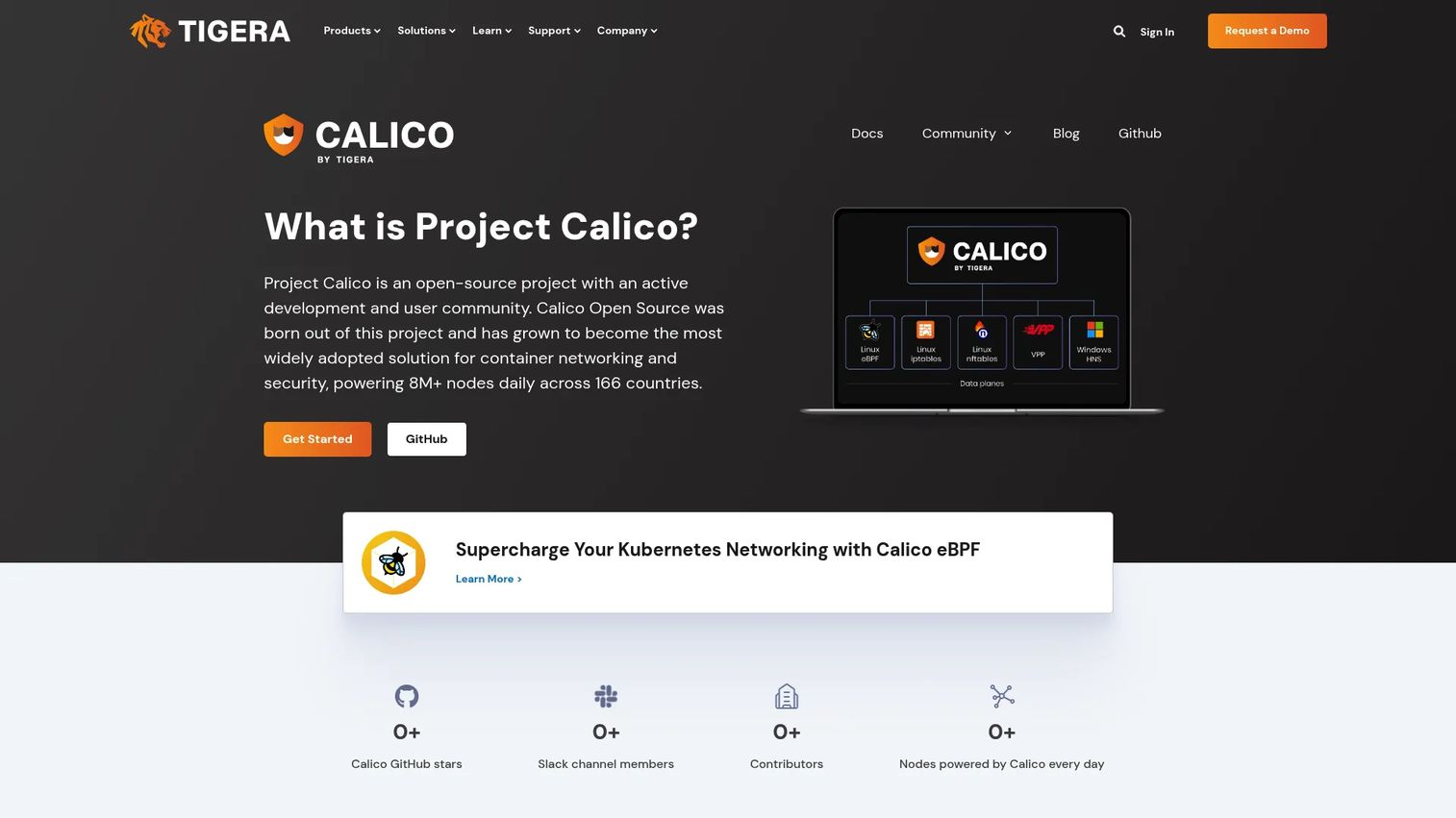
Calico, maintained by Tigera, is a Kubernetes platform for networking, network security, and observability across cloud, on-premises, and edge environments. Its policy model supports pods, VMs, and host interfaces. A practical example of why this matters: A payments service should not automatically reach every analytics or internal data service in the cluster. Calico makes that rule explicit and auditable.
Best for: Teams that want mature Kubernetes networking with granular network policy controls and workload segmentation.
Key features
- Kubernetes and extended NetworkPolicy enforcement for pods, VMs, and host interfaces
- Scalable pod networking with BGP and eBPF dataplane options
- Network observability with flow logs, dashboards, and packet capture
- Workload isolation controls across namespaces
- Multi-cluster security support
Why choose Calico: Choose Calico when policy maturity is the central concern. It fits teams that need least-privilege network rules across namespaces and want those rules to survive product growth and team expansion.
Calico pricing: The open source project carries no software cost. Calico Cloud, the managed SaaS platform, starts at $0.025 per vCPU hour with a free single-cluster tier. Calico Enterprise is self-managed with custom pricing through Tigera's sales team.
G2 rating: 4.5/5
4. Istio
Istio is an open-source service mesh that provides traffic management, telemetry, security, and reliability for Kubernetes workloads. It operates as a layer above your CNI, not a replacement for it. Istio handles service-to-service concerns: Which service can call which, how traffic shifts during a canary release, whether connections are mutually authenticated, and what telemetry surfaces in your observability stack.
Best for: Microservice environments where teams need consistent service-to-service traffic policy, progressive delivery controls, and distributed telemetry.
Key features
- Service-to-service security with mTLS, authorization, and encryption
- Traffic management including routing, canary deployments, retries, and load balancing
- Observability through metrics, logs, and distributed tracing
- Canary release traffic splitting with fine-grained weight controls
- Workload identity enforcement across services
Why choose Istio: Choose Istio when application reliability depends on consistent traffic controls across many services. Do not introduce a service mesh for a small application without a defined traffic-management or service-identity problem. The operational overhead is real.
Istio pricing: Istio is open source at no cost. Budget separately for the infrastructure, observability stack, and engineering time required to run it well in production.
G2 rating: 4.2/5
5. HashiCorp Consul
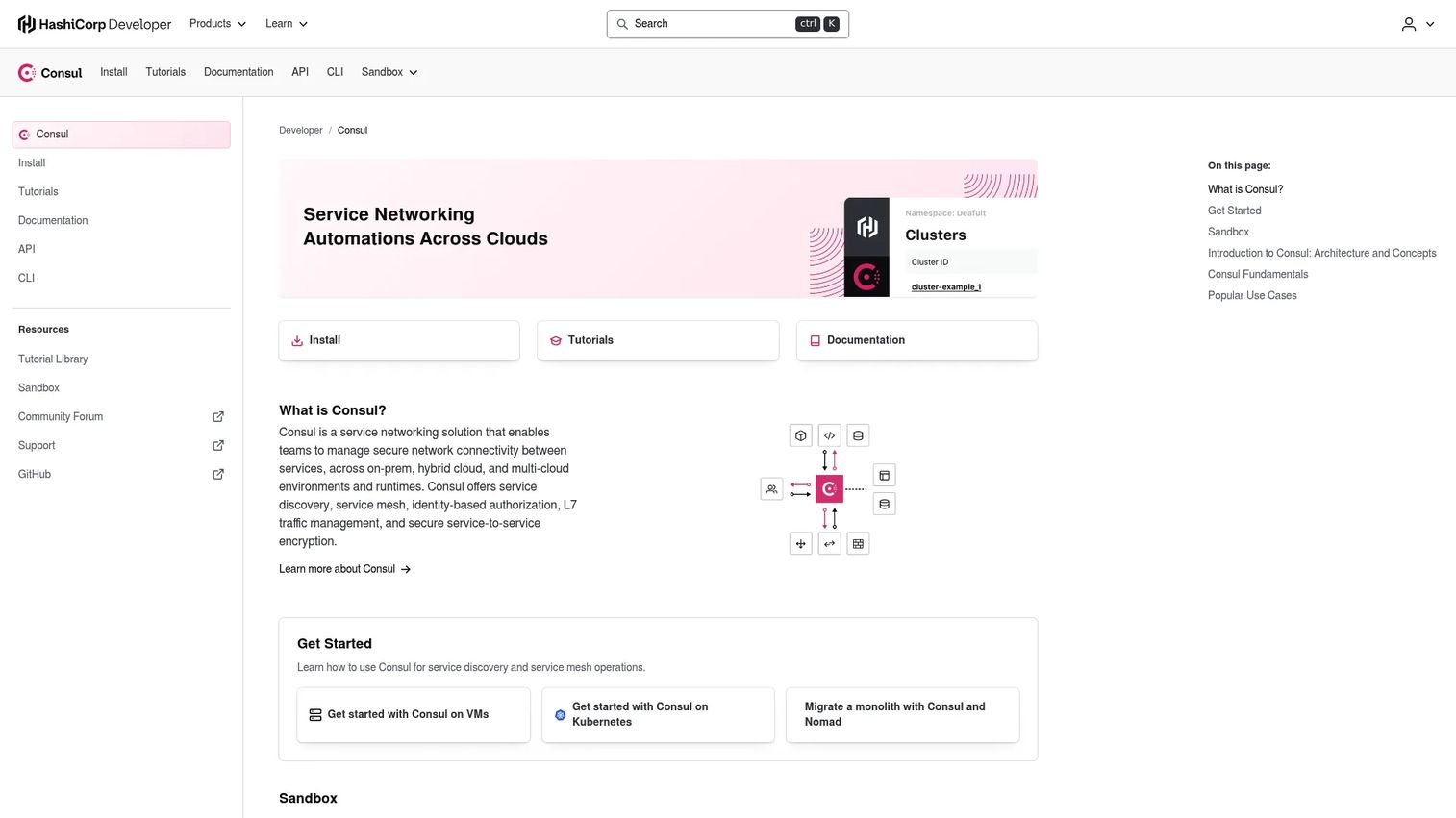
HashiCorp Consul is a service networking platform for secure connectivity, service discovery, service mesh, and network automation across on-premises and multi-cloud environments. Its differentiation is breadth: Consul works across Kubernetes clusters, virtual machines, and data centers, making it useful during cloud migrations or hybrid deployments where Kubernetes-native-only tools fall short.
Best for: Organizations connecting services across Kubernetes clusters, virtual machines, or multiple environments and cloud providers.
Key features
- Service discovery and health checks across environments
- Service mesh with authenticated, authorized, and encrypted service-to-service communication
- L7 traffic management and API gateway capabilities
- Identity-based authorization and mTLS
- Multi-cluster federation and DNS-based discovery
Why choose HashiCorp Consul: Consider Consul when the product architecture extends beyond one Kubernetes cluster or when the team is mid-migration from VMs to containers. Operational complexity rises with environment count, so the value comes from standardizing service networking across a mixed estate rather than using it for a single-cluster Kubernetes setup.
HashiCorp Consul pricing: The Community Edition is free and open source. Enterprise editions (Standard and Premium) require a sales conversation for pricing details.
G2 rating: 4.3/5
6. Traefik
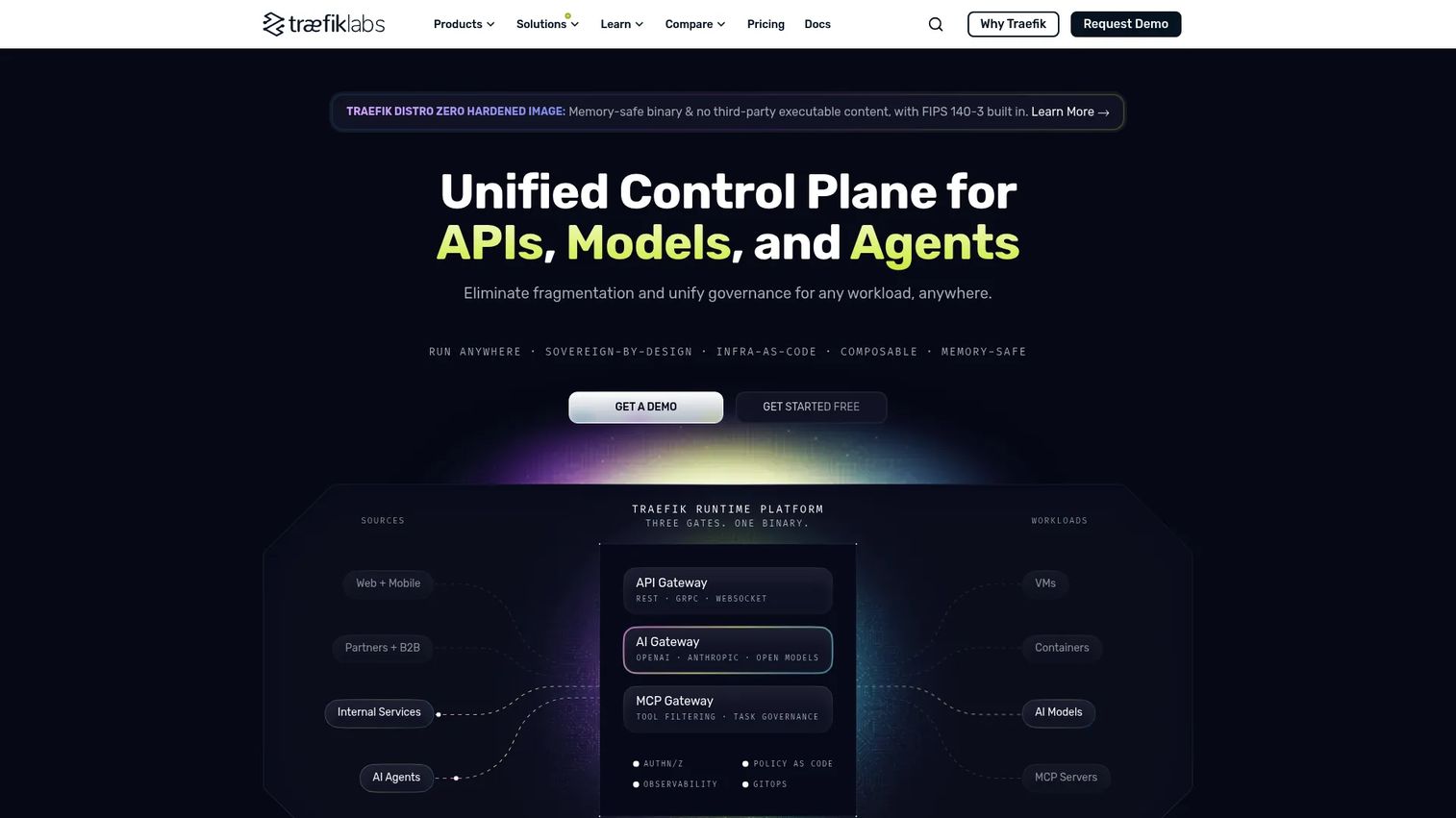
Traefik is an open-source cloud-native application proxy, reverse proxy, and ingress controller. It handles north-south traffic: Requests arriving from customers, browsers, and external APIs that need to reach services inside the cluster. Traefik's dynamic configuration model means it discovers services automatically as they start and stop, without requiring manual routing rule updates.
Best for: Cloud-native teams that need Kubernetes ingress and edge routing with flexible, application-aware configuration.
Key features
- Automatic service discovery and dynamic routing
- Layer 4 and Layer 7 routing with load balancing
- Kubernetes Ingress and Gateway API support
- Automatic HTTPS with Let's Encrypt integration
- Middleware for authentication, rate limiting, and circuit breaking
Why choose Traefik: Good fit when the immediate decision is how outside traffic reaches services. Traefik works well as a practical ingress layer without requiring a full service mesh adoption. Note that ingress handles a different layer than internal pod networking. Comparing Traefik directly against Cilium or Calico without understanding that distinction will produce a flawed architecture decision.
Traefik pricing: Traefik Proxy is open source. Traefik Hub API Gateway and Hub API Management require a sales conversation for commercial pricing.
G2 rating: 4.6/5
7. F5 NGINX
F5 NGINX provides software for delivering, securing, scaling, and managing applications, APIs, Kubernetes services, and AI workloads. It spans reverse proxy, load balancer, web server, API gateway, and Kubernetes ingress controller roles. For organizations already running NGINX in traditional infrastructure, adding it as a Kubernetes ingress controller keeps the operational model consistent across container and legacy environments.
Best for: Enterprises standardizing application delivery and ingress across Kubernetes and traditional infrastructure with commercial support requirements.
Key features
- L4 to L7 load balancing and advanced traffic control
- Reverse proxy, API gateway, and content caching
- Real-time observability with extensive metrics support
- Dynamic API-driven configuration without service restarts
- Integrated TLS termination, authentication, and rate limiting
Why choose F5 NGINX: Choose it when the organization already relies on NGINX for application delivery, or when enterprise traffic management needs to span containers and legacy systems under a single support agreement. It's compelling where infrastructure teams have existing NGINX expertise and governance processes that extend naturally to Kubernetes ingress.
F5 NGINX pricing: All NGINX products are sold through annual enterprise subscriptions. A free trial is available; contact F5 directly for subscription pricing.
G2 rating: 4.6/5
8. Google Kubernetes Engine
Google Kubernetes Engine (GKE) is Google Cloud's managed Kubernetes service. It belongs in this comparison because it packages cluster management, networking decisions, and cloud-native integrations into a single operating model. GKE handles control-plane operations, automated upgrades, and native integration with Google Cloud networking, IAM, and observability services. The platform choice shapes every downstream networking, security, and release decision.
Best for: Teams building containerized products on Google Cloud that want managed Kubernetes operations without operating the control plane themselves.
Key features
- Autopilot mode with Google-managed node infrastructure and scaling
- Managed Kubernetes control plane with automated upgrades
- Native Google Cloud networking and IAM integration
- Support for GPU, TPU, and AI workloads
- Cluster autoscaling and multi-cluster management
Why choose GKE: Choose GKE when the product is already committed to Google Cloud and the team wants to reduce control-plane operations. Cloud concentration is a deliberate trade-off: Managed convenience comes at the cost of portability. Evaluate that trade-off against your roadmap's multi-cloud requirements before committing.
GKE pricing: GKE Autopilot starts at $0.0645 per vCPU hour for compute. A free tier provides $74.40 in monthly credits per billing account, equivalent to one free Autopilot or zonal Standard cluster per month. Total costs combine compute, storage, networking, and optional platform services.
G2 rating: 4.5/5
9. Red Hat OpenShift
Red Hat OpenShift is a hybrid cloud application platform built on Kubernetes. It takes stronger opinions than upstream Kubernetes about the platform stack, developer workflows, security controls, and governance tooling. The trade-off is real: A more opinionated platform can reduce local variation across many product teams while requiring those teams to align with its conventions rather than choosing their own.
Best for: Enterprises that need a governed Kubernetes platform across cloud, on-premises, and hybrid environments with a single Red Hat support agreement.
Key features
- Kubernetes-based hybrid cloud platform across cloud and on-premises
- Integrated CI/CD, GitOps, Helm, and service mesh capabilities
- Built-in monitoring, logging, and security policy controls
- Multicluster management and edge architecture support
- Container and virtualization workloads on shared infrastructure
Why choose Red Hat OpenShift: Consider OpenShift when organizational consistency and enterprise support matter as much as Kubernetes flexibility. It fits teams that need repeatable controls across many product teams shipping into a shared platform. For organizations with on-premises requirements or regulated environments, the hybrid-cloud operating model is a meaningful differentiator.
OpenShift pricing: OpenShift Dedicated starts at $0.076 per 4 vCPU per hour on a 3-year commitment, or $0.171 per hour without a term commitment. Self-managed editions (OpenShift Platform Plus, OpenShift Container Platform) use subscription pricing that varies by sizing and commitment level.
G2 rating: 4.5/5
10. Amazon ECS
Amazon ECS is a fully managed AWS container orchestration service. It is not a Kubernetes distribution. ECS gives AWS-first teams managed container orchestration integrated with IAM, load balancers, CloudWatch, and CloudTrail without requiring Kubernetes APIs or ecosystem tooling. Teams can run containers on AWS Fargate (serverless) or on EC2 instances, with ECS handling scheduling and service management either way.
Best for: AWS-first teams that want managed container orchestration without operating Kubernetes infrastructure.
Key features
- AWS Fargate serverless container support
- Hybrid deployments with ECS Anywhere and AWS Outposts
- Automated container recovery and service scaling
- Task scheduling, networking, and load balancer integration
- CloudWatch monitoring and CloudTrail logging
Why choose Amazon ECS: ECS is the cleaner fit for AWS-native operations when the team values an AWS-integrated operating model over Kubernetes portability and ecosystem standardization. It reduces platform surface area for teams that don't need Kubernetes APIs. The portability trade-off is worth naming explicitly: Moving workloads off ECS to another environment requires more rework than moving off managed Kubernetes.
Amazon ECS pricing: There is no additional charge for ECS orchestration. Costs come from the underlying compute: AWS Fargate, Amazon EC2, or applicable ECS Anywhere instance fees. Total spend depends on workload size and the selected compute model.
G2 rating: 4.3/5
Considerations when choosing container networking software
Identify the layer you are actually buying
Do not compare CNI tools, service meshes, ingress controllers, and managed platforms as if they perform the same job. Map your current architecture and identify whether the immediate problem is cluster connectivity, service identity, public routing, or platform operations. Conflating layers leads to evaluating the wrong tools against each other.
Measure operational cost, not only license cost
Open source reduces license spend while potentially increasing platform engineering, observability tooling, support, and incident-response work. Ask your engineering team to estimate full ownership cost across a year, including upgrade cycles and on-call burden, before counting anything as "free."
Make network policy ownership explicit
Network policies fail when nobody owns their lifecycle. Clarify who can create rules, review exceptions, investigate violations, and update policy when services change. A tool with excellent policy controls creates no value if the organizational process for governing those controls doesn't exist.
Check observability before the first incident
Traffic maps, flow logs, service-level telemetry, and policy visibility shape how fast your team resolves customer-facing issues. Understand what signals will exist when a critical workflow slows down. Discovering that gap during an outage is the worst time to discover it.
Plan for release cadence and product growth
Choose a stack that can support the next 12 to 24 months of roadmap. New services, geographic expansion, tenant isolation requirements, partner integrations, and more teams shipping to shared infrastructure all affect the selection. A tool that fits today's five-service deployment may create a maintenance ceiling at fifty.
How to choose the right container networking software for your team
If you are standardizing a growing Kubernetes platform
Start with Kubernetes as the orchestration layer. Evaluate Cilium or Calico for cluster networking and network policy based on your observability requirements (Cilium's eBPF-based flow visibility) versus your policy maturity needs (Calico's extensive NetworkPolicy support). Add an ingress layer, Traefik for dynamic configuration or F5 NGINX for enterprise traffic management, only after deciding how external traffic should reach services.
If security and workload isolation are blocking launch plans
Prioritize a CNI with mature policy controls and clear observability. Calico and Cilium deserve the deepest review. The critical question is whether platform and security teams can govern policies without slowing release cadence. A tool that requires manual policy updates for every new service will create a bottleneck.
If microservices create traffic-management problems
Evaluate Istio or HashiCorp Consul when teams need consistent service identity, encryption, traffic shifting, and cross-service telemetry. Consul earns extra consideration when services span Kubernetes and virtual machines. Do not introduce a service mesh for basic cluster connectivity alone.
If platform engineering capacity is limited
A managed platform often produces the best outcome. GKE fits Google Cloud commitments and reduces control-plane work. OpenShift fits governed hybrid environments with enterprise support requirements. Amazon ECS suits AWS-first organizations that don't require Kubernetes portability. Each reduces operational ownership in exchange for less control over the platform's upgrade schedule and configuration surface.
Conclusion
Container networking isn't one decision. It's a set of layered choices, each affecting release reliability, security posture, engineering overhead, and long-term platform flexibility.
Kubernetes provides the orchestration foundation. Cilium and Calico address core networking and policy. Istio and HashiCorp Consul manage service-to-service behavior in complex distributed environments. Traefik and F5 NGINX manage application ingress. GKE, OpenShift, and Amazon ECS define different managed platform paths with different portability trade-offs.
The right next step is a structured selection workshop that includes platform engineering, security, and product leadership in the same room. Map the current architecture against the layer categories in this guide, identify the immediate constraint (policy gaps, observability blind spots, operational overhead), and evaluate tools against that constraint rather than against a generic feature checklist. For further reading on related platform decisions, the guides on application security testing software and AI security posture management tools cover adjacent security evaluation criteria worth reviewing alongside your networking stack decisions.
FAQs
Container networking software connects containerized workloads, enables service discovery, controls traffic routing, and enforces policy across containerized applications. It spans multiple infrastructure layers, including CNI plugins for pod connectivity, service meshes for service-to-service communication, ingress controllers for external traffic, and managed platforms that bundle several of these concerns into a single operating model.
Kubernetes defines the networking model: Every pod gets a routable IP address, services get stable DNS names, and network policy objects describe allowed traffic. A CNI plugin (Container Network Interface) implements that model by providing the actual pod connectivity and, in many cases, enforcing the policy rules. Without a CNI, pods in a Kubernetes cluster cannot communicate. Cilium and Calico are both CNI implementations with additional capabilities on top of the baseline specification.
Not automatically. Kubernetes provides baseline service discovery and routing through its service abstraction and cluster DNS. A service mesh becomes useful when teams need consistent service identity across many services, mutual TLS encryption between workloads, traffic shaping for canary releases, or distributed telemetry that doesn't require per-service instrumentation. For a small number of services with straightforward communication patterns, the operational cost of a service mesh outweighs the benefit.
Ingress focuses specifically on traffic entering the cluster from outside: Customer requests, browser traffic, and external API calls routing to internal services. Container networking also covers internal pod-to-pod communication, service discovery, and security policy enforcement between workloads inside the cluster. An ingress controller like Traefik handles the edge. A CNI like Cilium handles internal connectivity and policy. Both are necessary for a complete production setup.
Neither is universally better. Cilium is often the stronger choice when platform teams need detailed flow visibility through eBPF-based observability and efficient policy enforcement without proxy overhead. Calico is often the stronger choice when policy maturity is the priority, particularly for teams that need granular NetworkPolicy across namespaces and VM workloads alongside Kubernetes. The right choice depends on platform engineering skills, security requirements, and whether observability depth or policy breadth is the primary concern.
No. Containers can run with other platforms, including Amazon ECS and Docker Compose for local development. Kubernetes becomes relevant when organizations need standardized orchestration, self-healing, horizontal scaling, and a common API across many services and teams. For AWS-native workloads without multi-cloud portability requirements, Amazon ECS is a viable alternative that removes the Kubernetes API and ecosystem entirely.
Managed services handle control-plane operations and often include default networking configurations tied to the underlying cloud provider. GKE integrates with Google Cloud VPC networking. OpenShift ships with its own network plugin defaults. These choices reduce some operational work, but they don't remove decisions around network policy, ingress configuration, service mesh adoption, observability setup, or cloud networking costs. Teams often discover that managed Kubernetes reduces infrastructure work while the application-level networking decisions remain fully theirs to own.
PMs should define the product constraints that engineering must accommodate: Reliability expectations tied to activation and retention metrics, launch timelines, security requirements from compliance or customer contracts, the multi-tenant model, expected service growth over the next year, and who owns platform operations long-term. Engineering validates technical implementation against those constraints. A PM who can articulate "we need tenant isolation enforced before Q2 launch" gives the platform team a concrete requirement to evaluate tools against, which is more useful than deferring the entire decision to infrastructure.