You have a spreadsheet that decides what to reorder. It's held together by three VLOOKUPs, one planner who understands it, and a lot of hope.
Then a supplier lead time slips. A promotion sells three times faster than forecast. A slow-moving SKU quietly eats a warehouse bay for six months. By the time the spreadsheet catches up, you have stockouts on your best sellers and overstock on the stuff nobody wants.
This is the core problem replenishment planning software exists to solve: deciding what to buy, when to buy it, and how much, without a person manually reconciling demand against supply every week. The market reflects the pressure. The global inventory replenishment software market was valued at USD 1.95 billion in 2024 and is projected to reach USD 3.28 billion by 2034 at a 7.7% CAGR, according to Intel Market Research (2026). Demand for automated replenishment, better demand forecasting, and tighter inventory optimization is the reason.
ERP-only workflows and manual min/max methods stop short here. An ERP records what happened. Replenishment planning decides what should happen next. This guide breaks down where that line sits and which tools fit your operating model.
What's inside
This guide is for operations leaders, supply chain managers, inventory planners, and product managers evaluating planning systems for retail, e-commerce, and wholesale.
We selected these 8 tools based on four criteria that matter in a real buying decision:
- Planning depth: how the tool handles demand forecasting, safety stock, reorder points, and lead times
- Integration fit: ERP integration, WMS integration, and e-commerce connectivity
- Operating model: single warehouse, multi-location inventory, or enterprise network
- Pricing and packaging: what's public, what's quote-based, and what you'd actually pay
You'll get a comparison table, per-tool breakdowns with pricing and ratings, buyer considerations, and FAQs.
TL;DR
- Best for SMB retail and distribution: Netstock pairs ERP-connected inventory optimization with forecasting and ordering in one place.
- Best for teams leaving spreadsheets: EazyStock recalculates reorder points daily and drives exception-based ordering off your ERP data.
- Best for planning depth without an enterprise suite: GMDH Streamline delivers deep demand forecasting and inventory optimization, plus a free edition.
- Best for enterprise networks: o9 Solutions handles network-wide allocation, constraint-aware planning, and integrated demand-supply-finance.
- Best for e-commerce and online sellers: Optiply automates purchasing decisions with public, transparent pricing starting at €79/month.
- Best for multi-channel retail: Inventory Planner by Sage forecasts demand and automates purchasing across Shopify-style catalogs.
Every option here moves you from reactive ordering to automated replenishment that balances service levels against holding costs.
What replenishment planning software is
Replenishment planning software is a system that decides what to reorder, when to reorder it, and how much to buy by combining demand forecasting, inventory levels, lead times, and supplier constraints into automated order recommendations.
That's the part worth slowing down on. A reorder point rule fires when stock hits a fixed threshold. Replenishment planning software recalculates that decision continuously, factoring in changing demand, seasonality, promotions, and supply variability. It's the difference between a static tripwire and a decision engine.
Here's how it separates from what most teams already run:
- Manual stock ordering: a planner eyeballs quantities and places orders. Works until SKU count and locations grow.
- Reorder point rules: fixed min/max thresholds. Simple, but blind to demand shifts and lead time changes.
- ERP-only planning: the ERP tracks stock and generates basic suggestions, but rarely models safety stock, demand sensing, or multi-echelon service levels well.
The core capabilities that define the category:
- Suggested order quantities that balance service level against inventory cash
- Demand forecasting using history, seasonality, and promotions
- Safety stock logic tuned to demand and supply variability
- Lead times handling, including supplier variability
- Supplier constraints like MOQs, order multiples, and batching
- Multi-location inventory planning across warehouses and channels
Here's how the three approaches compare on the decisions that actually cost money:
| Capability | Manual replenishment | ERP-only workflow | Replenishment planning software |
|---|---|---|---|
| Demand forecasting | Manual, gut-based | Basic or add-on | Statistical, seasonality-aware |
| Safety stock | Fixed or none | Simple buffer | Dynamic, variability-based |
| Reorder recalculation | Periodic | Rule-based | Daily or continuous |
| Multi-location planning | Spreadsheet-heavy | Limited | Native |
| Order quantities | Manual entry | Threshold-based | Optimized suggestions |
When to use replenishment planning software
Retail replenishment
Retail replenishment means planning at both the store level and the network level. You're allocating stock across locations, absorbing seasonal demand swings, and stocking up for promotions that can triple velocity for two weeks. The operational trigger: when your store network grows past the point where a regional buyer can hold every SKU's demand pattern in their head. Software that models store-level demand and network flow keeps shelves full without dumping inventory into the wrong locations.
E-commerce replenishment
E-commerce replenishment is a cash-preservation game. Fast-moving SKU catalogs, unpredictable supplier lead times, and thin margins mean overstock ties up cash you need elsewhere, while stockouts hand sales to a competitor one tab over. The trigger: when your catalog and order volume outgrow manual reordering and you need automated replenishment tied to real sales velocity. Tools built for online sellers connect to your store, forecast demand, and generate purchase orders that protect working capital.
Wholesale and distribution
Wholesale and distribution planning is about service levels across multi-location supply. You're managing supplier constraints, order batching, and target fill rates across warehouses that feed different customer regions. The trigger: when service-level penalties or lost accounts start showing up because a warehouse ran dry. Distribution-focused tools handle multi-echelon inventory, supplier planning, and the batching economics that keep freight and MOQs sane.
Comparison table
Use this to narrow your shortlist fast. Sorting is by relevance to replenishment planning, not alphabetical. Pricing is drawn from public vendor pages where available; several vendors scope pricing per customer.
| # | Product | Best for | Key differentiator | Pricing | G2 rating |
|---|---|---|---|---|---|
| 1 | Netstock | SMB retail and distribution | ERP-connected forecasting, ordering, and optimization | Quote-based | 4.6/5 |
| 2 | EazyStock | Teams leaving spreadsheets | Daily reorder recalculation and exception ordering | Quote-based | 4.4/5 |
| 3 | GMDH Streamline | Distributors and manufacturers | Deep forecasting with a free edition | Quote-based, free edition | 4.4/5 |
| 4 | o9 Solutions | Enterprise networks | Integrated demand, supply, and finance planning | Custom | 4.2/5 |
| 5 | Blue Ridge | Mid-market to large supply chains | Explainable, AI-native replenishment optimization | Quote-based | 4.6/5 |
| 6 | Optiply | E-commerce and online sellers | Automated purchasing with public pricing | From €79/month | Not listed |
| 7 | Inventory Planner by Sage | Multi-channel retail | Forecasting and purchasing for Shopify-style stores | Quote-based | Not listed |
| 8 | StockIQ | Distribution and manufacturing | Replenishment plus promotion and S&OP planning | Custom | 4.6/5 |
Best replenishment planning software for 2026
1. Netstock
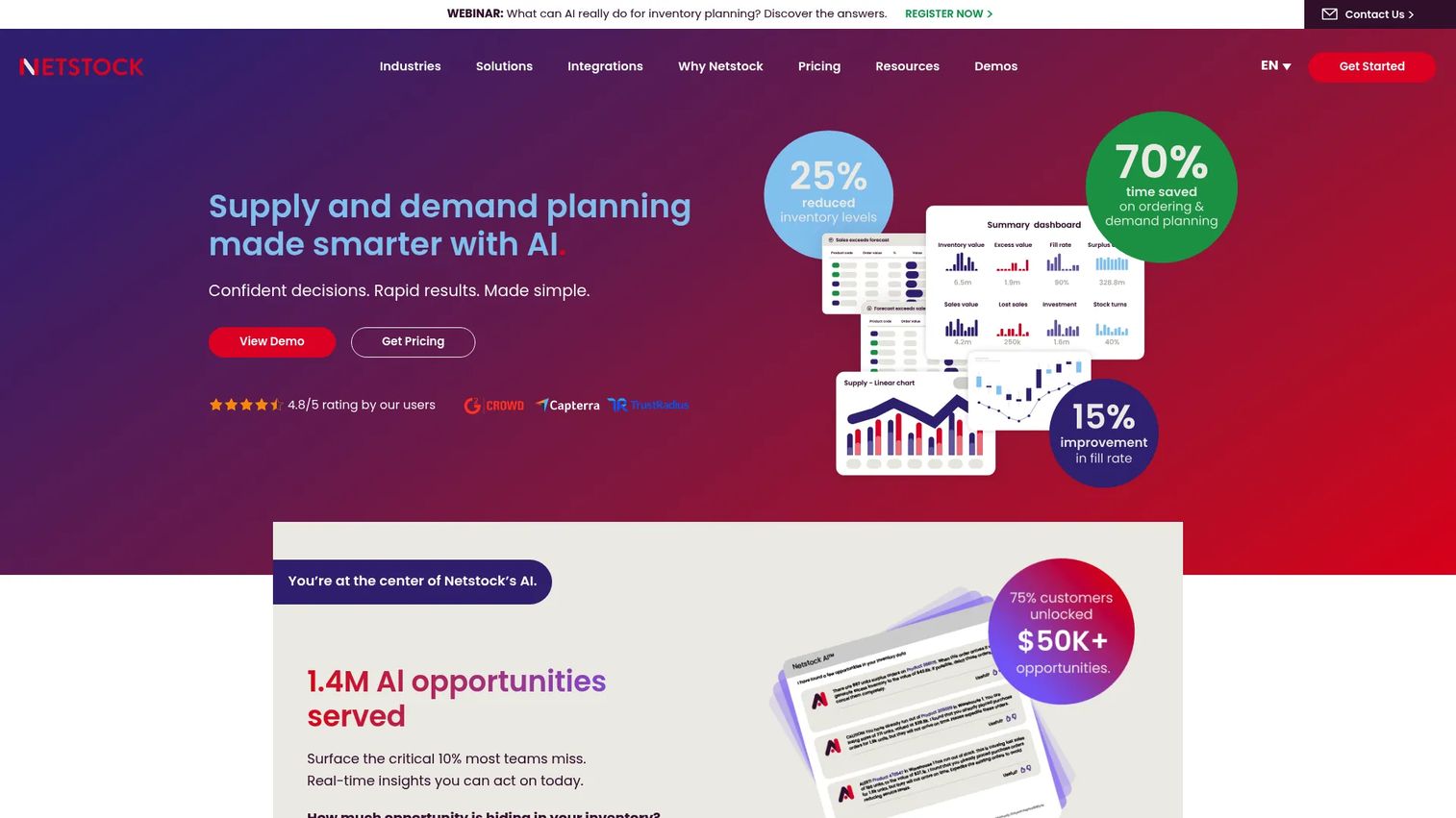
Netstock is AI-powered supply and demand planning software focused on inventory optimization, forecasting, ordering, and supplier performance. It connects directly to your ERP and turns raw stock data into ranked order recommendations, so planners spend time on exceptions instead of rebuilding a spreadsheet every Monday. It's a strong fit for retail and distribution teams that already run an ERP but need real planning logic on top of it.
The reason it lands with SMBs is the combination: forecasting, safety stock, and ordering in one connected workflow, without the weight of an enterprise suite. Multi-location inventory support means you can plan across warehouses rather than treating each as an island.
Best for: SMBs needing ERP-connected inventory and demand planning.
Key strengths
- Inventory optimization across locations
- Inventory forecasting with seasonality
- Suggested ordering tied to ERP data
Why choose Netstock: If you run a mid-sized retail or distribution operation on an ERP and want planning depth without a long enterprise implementation, Netstock fits the gap. It's built for teams graduating from manual methods.
Netstock pricing: Public pricing is not listed. The site directs you to request pricing or book a demo, so packaging is scoped to your ERP and SKU count.
2. EazyStock
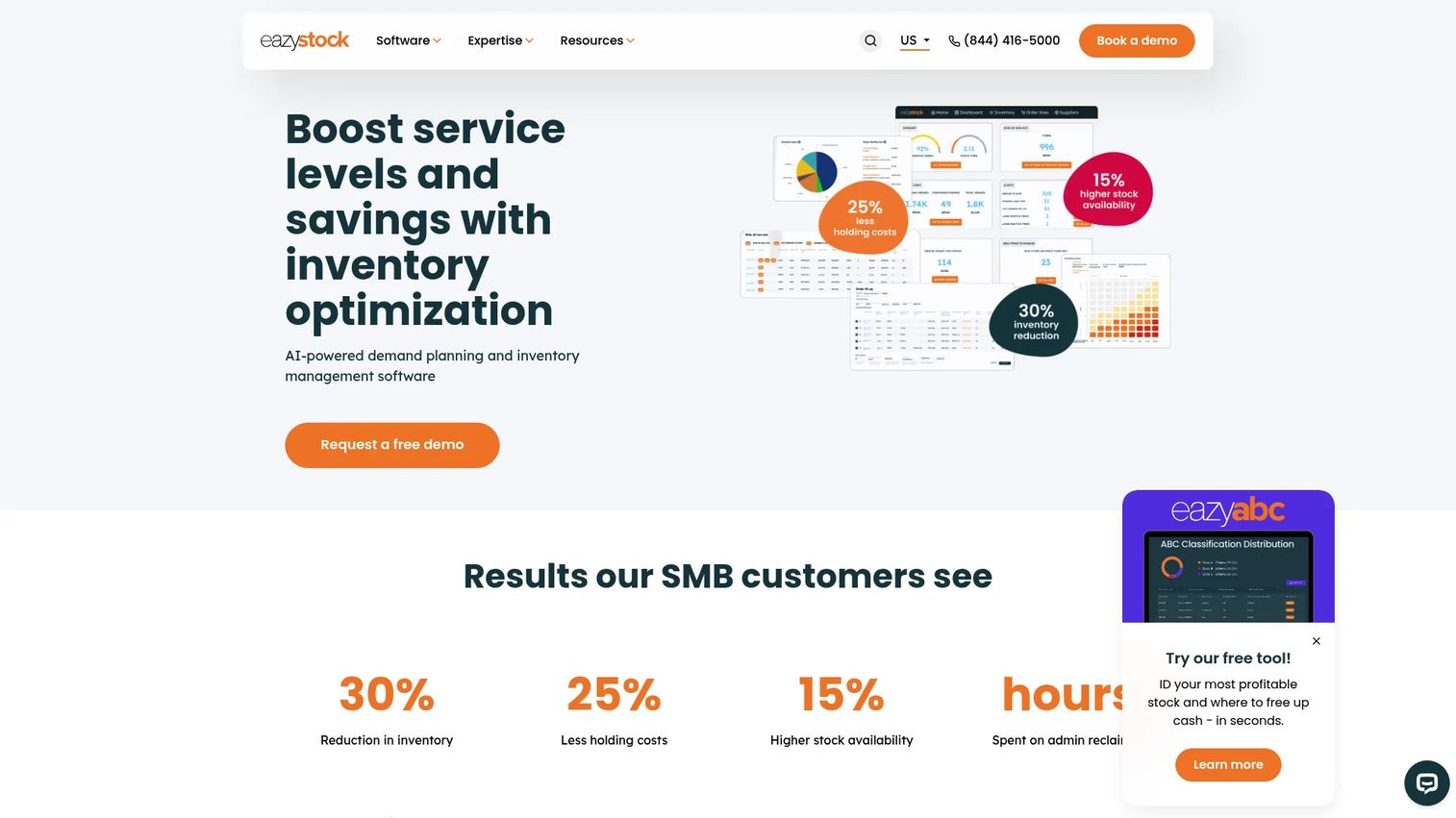
EazyStock is cloud inventory optimization software that layers AI-driven forecasting and reorder logic on top of your ERP. It recalculates reorder points, order quantities, and safety stock, then surfaces exception-based order proposals so planners act on what changed rather than reviewing every SKU. That daily recalculation is the point: demand and lead times move, and so should your reorder decisions.
It's aimed squarely at businesses moving beyond spreadsheets. If your team still exports data, applies manual rules, and hopes the numbers hold, EazyStock automates that loop while keeping your ERP as the system of record.
Best for: SMBs that need inventory optimization tied to an ERP.
Key strengths
- AI and machine-learning demand forecasting
- Reorder point, order quantity, and safety stock calculations
- Multi-location inventory management and order proposals
Why choose EazyStock: Choose it when you want automated replenishment that plugs into your existing ERP integration without ripping anything out. The exception-based workflow keeps planner attention where it matters.
EazyStock pricing: Pricing is quote-based off a standard price list rather than a fixed public number. Billing is annual, with an optional monthly billing arrangement carrying a 10% increase.
3. GMDH Streamline
GMDH Streamline is supply chain planning software built for demand forecasting and replenishment planning. It generates ordering plans, projects future inventory positions, and exports purchase plans your buyers can act on. The forecasting depth is the draw: it's aimed at teams that want serious planning without committing to a giant enterprise platform.
Distributors and manufacturers tend to like it because it handles the planning problems they actually have, forecasting demand, timing reorders, and projecting inventory, in a package that a lean team can run. A documented free edition with usage limits lets you test the workflow before committing.
Best for: Mid-market and enterprise teams needing demand forecasting and inventory planning.
Key strengths
- Demand forecasting across SKUs
- Inventory replenishment and ordering plans
- Purchase plan and projected inventory exports
Why choose GMDH Streamline: Pick it when you want forecasting and inventory optimization depth without an enterprise price tag or timeline. The free edition makes it easy to validate fit first.
GMDH Streamline pricing: Pricing is customized and not publicly listed; the site invites you to request pricing. A free edition is documented with usage limits.
4. o9 Solutions
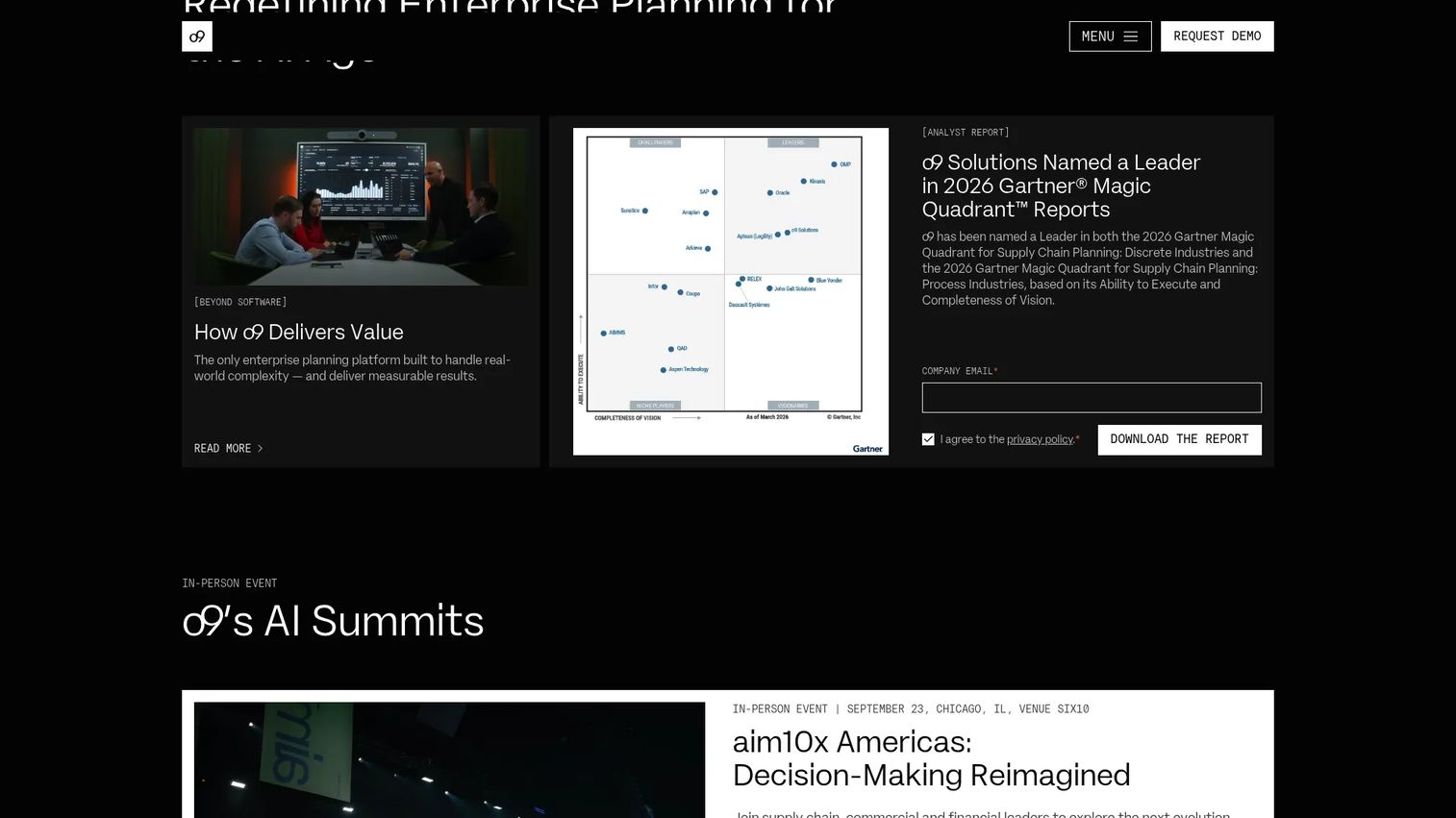
o9 Solutions is an enterprise AI platform for integrated planning across supply chain, commercial, and financial functions. Its positioning centers on a "Single Digital Brain," an enterprise knowledge graph that connects demand, supply, and finance data so planning decisions account for network-wide constraints. For large organizations, that means allocation and replenishment that respect real capacity, cost, and service targets across the whole network.
This is enterprise territory. o9 fits companies running complex, multi-node networks where a change in one region ripples across supply, revenue, and cash. Expect a scoped implementation and a cross-functional rollout rather than a plug-in setup.
Best for: Large enterprises needing integrated planning across supply chain, commercial, and finance.
Key strengths
- Single Digital Brain enterprise knowledge graph
- Revenue growth management with price planning
- AI-driven demand, supply, and finance integration with scenario simulation
Why choose o9 Solutions: Choose o9 when your planning problem spans supply chain, commercial, and finance, and no single-function tool can model the tradeoffs. Scenario simulation is built for the "what if" questions enterprises live on.
o9 Solutions pricing: Pricing is not published and is scoped per customer. Prospects are directed to a demo and pricing discussion.
5. Blue Ridge
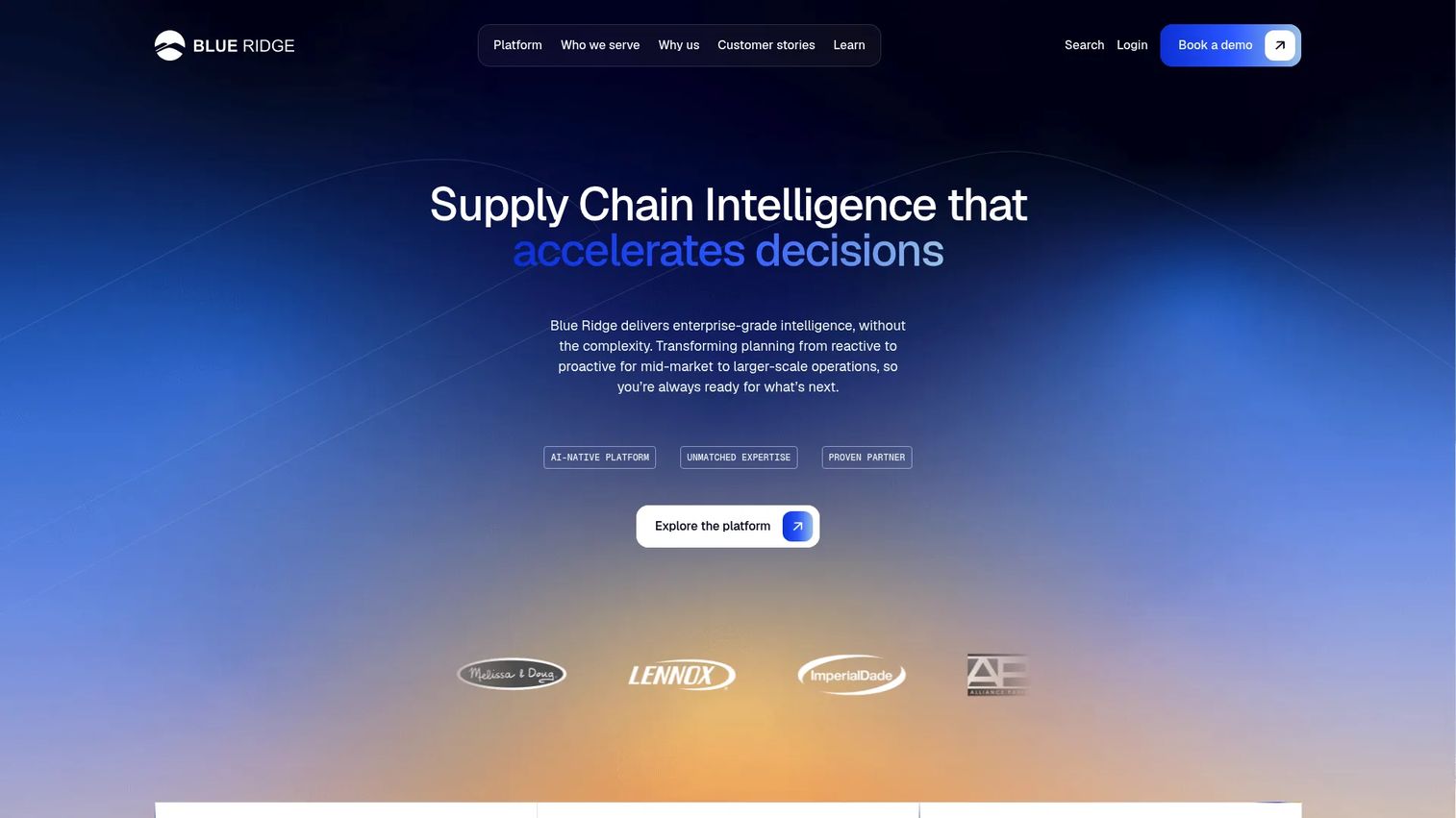
Blue Ridge is AI-native supply chain planning software covering demand, replenishment, inventory, supply, and business planning. Its differentiator is explainability: suggested order quantities and inventory recommendations come with the reasoning behind them, which matters when a buyer needs to trust and defend a plan. This is the planning-versus-transaction distinction in practice. Your ERP records the order; Blue Ridge decides what the order should be.
Multi-echelon inventory optimization means it plans across tiers of a network rather than one location at a time, balancing supplier economics against service levels. Mid-market to large teams that want optimization they can actually reason about tend to gravitate here.
Best for: Mid-market to large supply chain teams needing explainable planning and inventory optimization.
Key strengths
- Demand planning with clear rationale
- Replenishment optimization
- Multi-echelon inventory optimization
Why choose Blue Ridge: Pick it when buyers need to understand and defend why the system recommends a given order quantity, not just accept a black-box number. Explainable planning drives adoption.
Blue Ridge pricing: Pricing is not publicly displayed. The official site uses a request-a-demo flow, so packaging is scoped per engagement.
6. Optiply
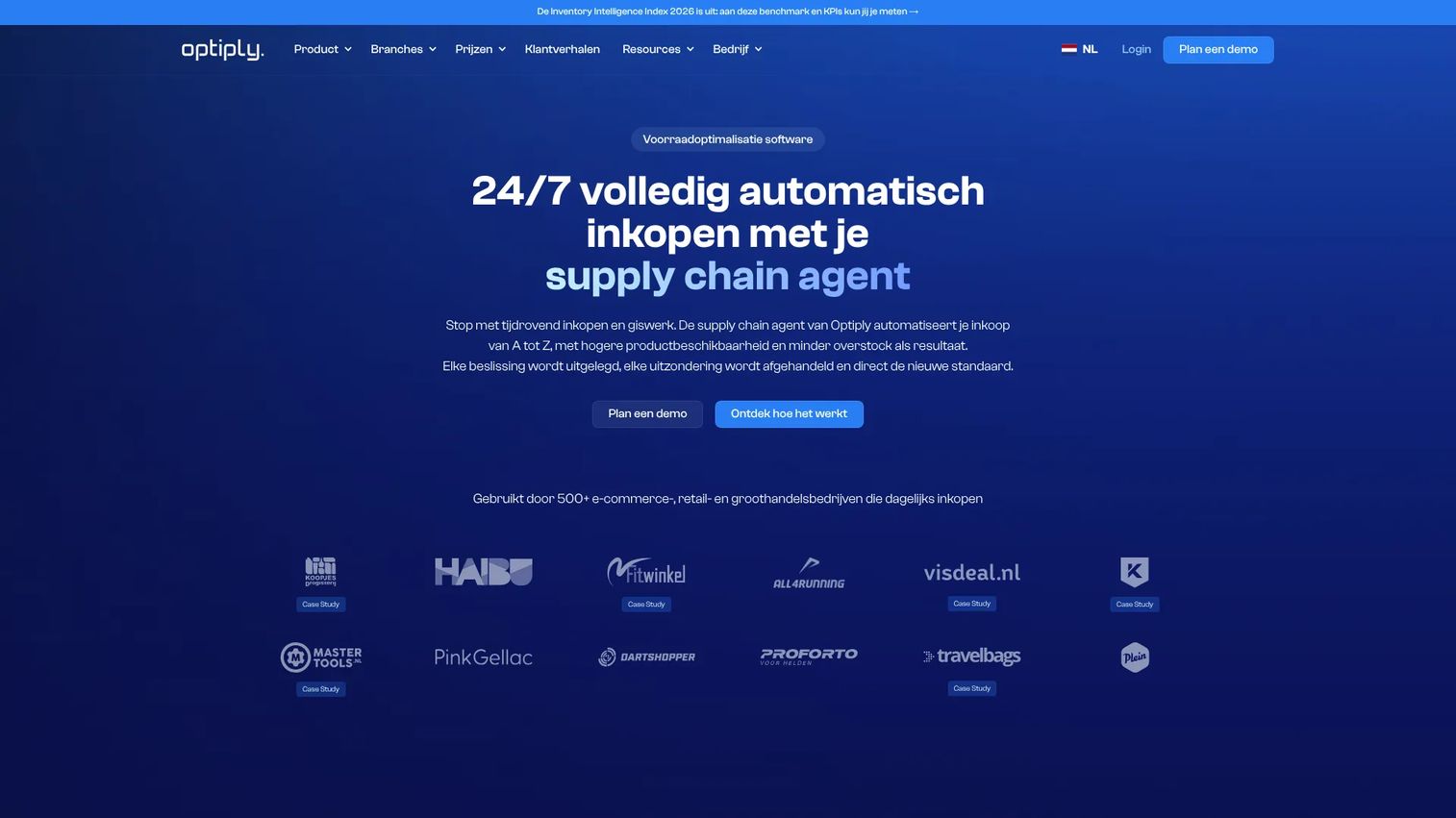
Optiply is inventory optimization and automated purchasing software built for e-commerce, wholesalers, and retailers. It forecasts demand, generates automated reorder proposals, and connects to your ERP, WMS, and e-commerce platforms, so purchasing decisions happen fast against live sales data. For online sellers who need to decide what to buy today, that speed is the value.
It's a good fit for retail and e-commerce operators who want automated replenishment without a heavy planning project. It's also one of the few tools here with transparent public pricing, which makes budgeting straightforward for growing teams.
Best for: Teams that want to automate inventory replenishment and purchasing decisions.
Key strengths
- Automated purchasing decisions
- Demand forecasting and replenishment
- Integrations with ERP, WMS, and e-commerce systems
Why choose Optiply: Choose Optiply when you want fast, automated purchasing tuned for e-commerce replenishment and public pricing you can plan a budget around. The self-serve entry tier lowers the barrier to start.
Optiply pricing: Public pricing is listed in EUR. Optiply Lite is €79/month with a 14-day free trial and no credit card required. Starter is €490/month, Professional is €1,310/month, and Enterprise is €1,960/month, with a mix of self-serve and quote-based options on higher tiers.
7. Inventory Planner by Sage
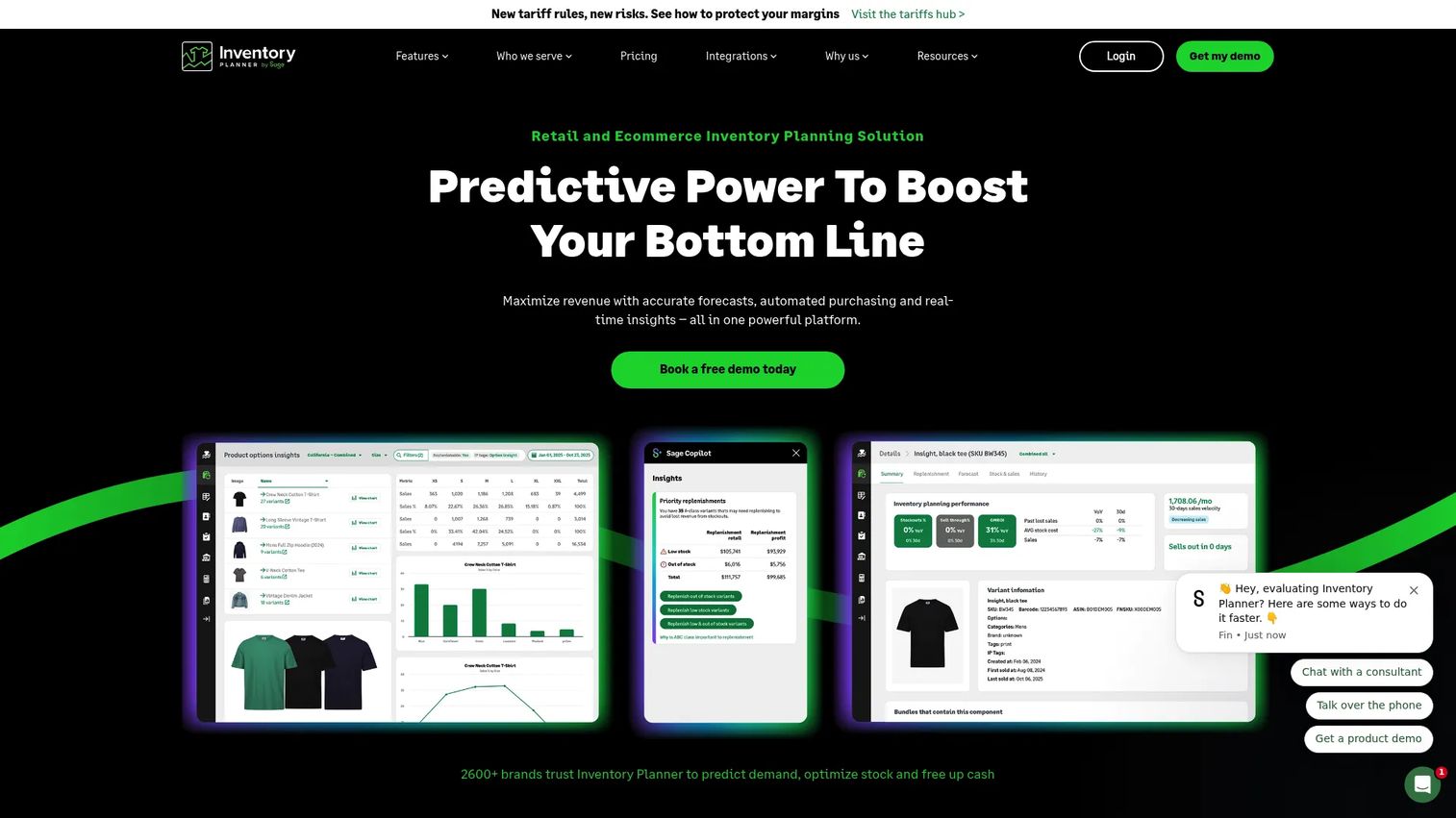
Inventory Planner by Sage is inventory forecasting and planning software built for retailers. It predicts demand, automates purchasing and replenishment, and plans across locations and channels, which makes it a natural fit for multi-channel and Shopify-style operations. If you sell across a store, a marketplace, and a couple of sales channels, it consolidates the demand picture and turns it into purchase recommendations.
The pull for e-commerce teams is the ecosystem fit. It's designed around the way online retailers actually operate, forecasting at the channel level and generating replenishment that keeps best sellers in stock without overbuying the long tail.
Best for: Multi-channel retailers needing demand forecasting and inventory replenishment planning.
Key strengths
- Predictive demand forecasting
- Automated purchasing and replenishment
- Multi-location planning and reporting
Why choose Inventory Planner by Sage: Pick it when you run multi-channel retail or a Shopify-centric operation and want forecasting plus automated purchasing built for that model. Channel-level planning is the differentiator.
Inventory Planner by Sage pricing: Pricing is quote-based and scaled to inventory volume. The pricing page asks you to request pricing rather than listing a public number.
8. StockIQ
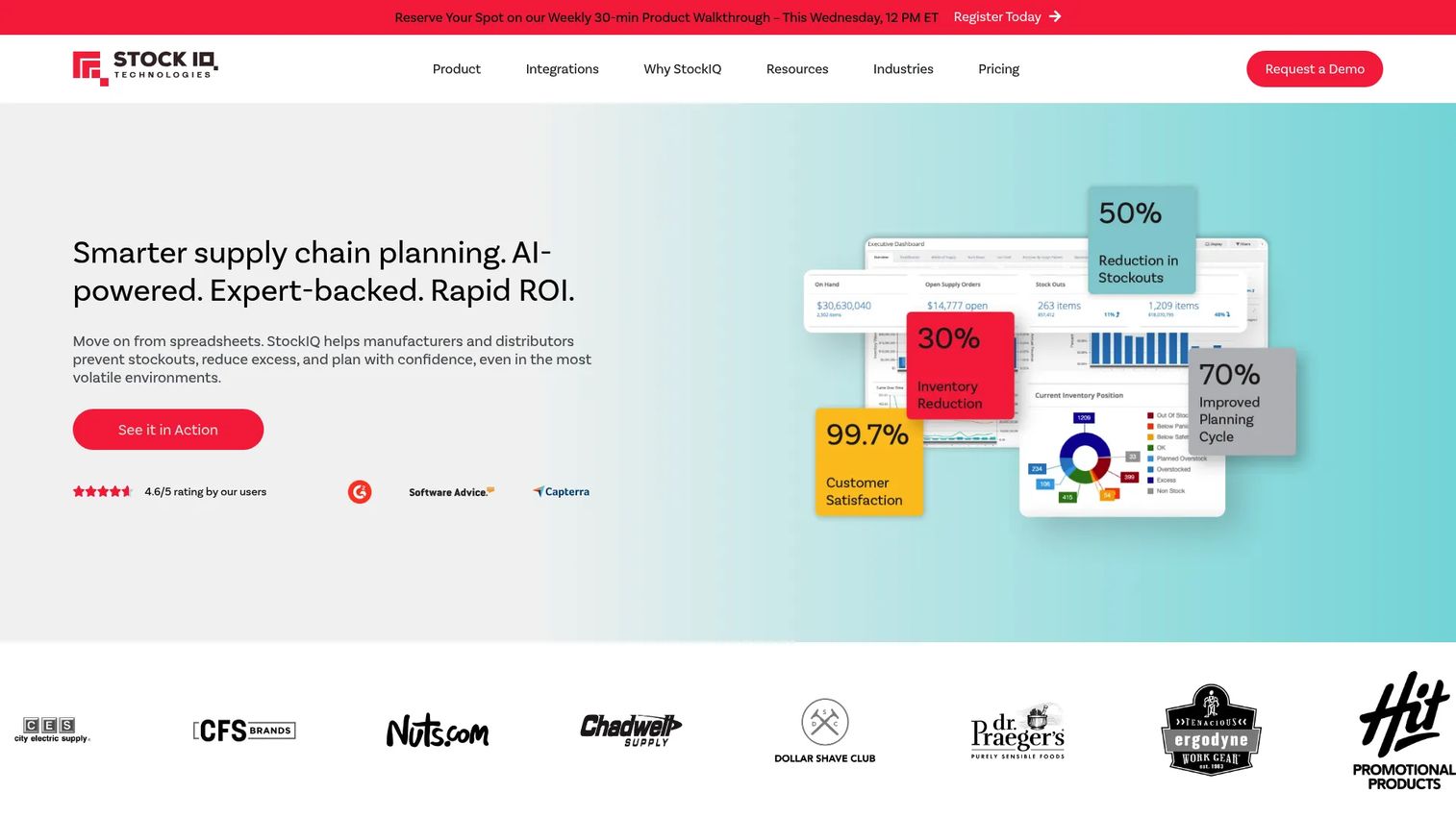
StockIQ is supply chain planning software for manufacturers and distributors. It covers replenishment planning and PO automation, supplier planning, promotion planning, and inventory and capacity planning under one roof. That breadth is the appeal: distribution and manufacturing teams often need forecasting, replenishment, and S&OP working together, and StockIQ handles multi-site planning across those needs.
Supplier performance tracking and promotion planning matter here because distributors live and die on lead time reliability and event-driven demand spikes. If your operation runs multiple sites and needs planning that connects supply, demand, and promotions, it's built for that reality.
Best for: Mid-market to enterprise manufacturers and distributors needing demand and inventory planning.
Key strengths
- AI-powered demand forecasting
- Replenishment planning and PO automation
- Supplier performance tracking, promotion planning, and S&OP
Why choose StockIQ: Choose it when you're a distributor or manufacturer that needs replenishment, supplier, and promotion planning connected across multiple sites rather than bought as separate tools.
StockIQ pricing: Pricing is custom and quote-based, depending on ERP, SKU count, locations, and planning complexity. StockIQ offers Core and Enterprise tiers.
Considerations
Integration depth
The value of any planning tool depends on the data feeding it. Confirm ERP integration first, then WMS integration, e-commerce connectors, supplier feeds, and EDI where you need them. A tool that can't cleanly pull live inventory and sales data will produce recommendations you can't trust, no matter how good the math is.
Forecasting quality
Ask exactly how the tool builds a forecast. Does it use sales history, seasonality, and promotions? Does it support demand sensing for near-term shifts? Generic "AI-powered" claims mean nothing without specifics. The forecast is the foundation for every reorder decision downstream, so pressure-test it against your messiest SKUs.
Planning logic
Look at how the tool handles reorder points, safety stock, lead times, MOQs, and service-level targets. The better tools let you set service levels by SKU or category and translate them into dynamic safety stock, rather than forcing one fixed buffer across everything.
Operational fit
Match the tool to your structure. A single-warehouse operation has different needs than a multi-location retailer or an enterprise network. Buying enterprise-grade software for a two-warehouse operation adds complexity you won't use; underbuying leaves a growing network without the multi-echelon logic it needs.
ROI model
Build a simple business case before you buy. Estimate stockout reduction (recovered sales), excess inventory reduction (freed cash and lower holding costs), and labor savings (planner hours moved from spreadsheets to exceptions). Even rough numbers tell you whether the pricing makes sense for your scale.
Conclusion
The category comes down to one idea: replenishment planning software decides what to buy, when, and how much, so your team stops reconciling demand against supply by hand. That decision engine is what separates it from ERP-only workflows and manual min/max rules.
Match the tool to your operating model. Netstock and EazyStock fit SMB retail and distribution teams building on an ERP. GMDH Streamline and Blue Ridge give you forecasting and inventory optimization depth for distributors and manufacturers. o9 Solutions is enterprise territory for network-wide integrated planning. Optiply and Inventory Planner by Sage are built for e-commerce and multi-channel retail. StockIQ connects replenishment, supplier, and promotion planning for distribution and manufacturing.
Your next step: shortlist two or three tools based on your operating model and integration needs, then run each against your hardest SKUs and lead times. The right choice is the one that reduces stockouts and overstock while freeing the cash and planner time you're spending today.
If your team also needs to communicate product value through self-serve, interactive demos, you can build, personalize, share, and analyze those experiences with Guideflow. Start your journey with Guideflow today!
FAQs
It decides what to reorder, when to reorder it, and how much to buy. The software combines demand forecasting, current inventory, lead times, and supplier constraints into order recommendations, so planners manage exceptions instead of calculating every order by hand. The goal is fewer stockouts and less overstock at the same time.
An ERP records transactions and tracks stock levels. Replenishment planning software decides what should happen next, forecasting demand, setting dynamic safety stock, and generating optimized order quantities. Most teams run both: the planning tool feeds recommendations into the ERP, which handles the purchase order and the record of truth. ERP integration is what connects them.
Reorder point planning fires an order when stock hits a fixed threshold. It's simple but blind to changing demand and lead times. Replenishment planning recalculates that decision continuously using demand forecasting, seasonality, and supply variability, so the reorder trigger and quantity adjust as conditions change rather than staying static.
Any operation where SKU count, location count, or order volume has outgrown spreadsheets and manual rules. That's typically retail chains managing store-level and network stock, e-commerce sellers protecting cash across fast-moving catalogs, and wholesale distributors holding service levels across multiple warehouses with supplier constraints.
Yes, and it's often where the ROI is clearest. E-commerce replenishment tools connect to your store and ERP, forecast demand off real sales velocity, and generate reorder proposals that protect working capital. That keeps best sellers in stock without tying up cash in slow-moving inventory. Tools like Optiply and Inventory Planner by Sage are built for this model.
That's the core promise. By forecasting demand more accurately and setting dynamic safety stock based on real variability, the software raises service levels while trimming excess inventory. The result is fewer stockouts on high-velocity SKUs and lower holding costs on the long tail, which frees cash for the rest of the business.
Start with ERP integration, since your ERP holds inventory and transaction data. Then check for WMS integration, e-commerce platform connectors, supplier feeds, and EDI if your suppliers use it. Clean, live data is what makes the planning recommendations trustworthy, so integration depth should weigh heavily in your evaluation.
Often, yes. Smaller teams feel spreadsheet limits sooner because one planner can't hold every SKU's demand pattern in their head. Tools aimed at SMBs, like Netstock and EazyStock, connect to your existing ERP and automate the reorder loop without a heavy implementation. A quick ROI check on recovered sales, freed cash, and saved planner hours usually settles it.