Most coaching businesses start the same way: A calendar link, a video call, and a shared Google Doc. That works for five clients. It stops working when you hit twenty.
The operational cost of a fragmented coaching stack shows up slowly, then all at once. Client history lives in email threads. Billing requires manual follow-up. Each coach keeps their own version of session notes. Onboarding a new program lead means handing over a folder and hoping they figure it out.
According to the International Coaching Federation (2025), the global coaching profession generated $5.34 billion over the past year, up 17% from 2023, and 54% of coaches identify improved platforms as a priority for meeting future client demands. The market is growing fast, but the operational infrastructure often hasn't kept pace.
The right client management software connects scheduling, billing, client records, and program delivery in one place, so your team runs it, not you. This guide compares nine coaching software platforms across those dimensions to help you pick one that fits your delivery model now.
What's inside
This guide is for coaches, program operators, and founders evaluating coaching platforms in 2026. Each tool was selected based on four criteria:
- Client operations coverage: Scheduling, payments, contracts, forms, and session records in one system
- Program delivery fit: Support for one-to-one, group cohort, or enterprise coaching models
- Reporting and visibility: Coach capacity, client engagement, and program completion data
- Operational handoff: Can a new program lead or VP run this without founder involvement on day one?
TL;DR
- Best for solo and small coaching businesses: Paperbell combines offers, scheduling, payments, and client delivery in one compact system
- Best for structured accountability: CoachAccountable centers the entire platform on goals, actions, and measurable client progress
- Best for enterprise coaching programs: Coaching.com handles multi-coach administration, program oversight, and reporting at scale
- Best for group programs and cohorts: UpCoach is purpose-built for cohort delivery with shared resources and community engagement
- Best for configurable practice management: Simply.Coach gives coaching firms structured client workflows and operational controls across multiple coaches
What is coaching software?
Coaching software is a platform that helps coaches and coaching organizations manage clients, appointments, packages, payments, session records, goals, resources, and program delivery from a shared system.
Unlike stitching together a calendar tool, a payment processor, and a shared document folder, a dedicated coaching platform keeps client context connected across every touchpoint, from the first intake form through to package renewal.
Core functions of coaching software
Most platforms in this category cover the following:
- Client profiles: Relationship history, session logs, notes, and goal tracking in one record
- Scheduling: Calendar sync, automated reminders, time-zone conversion, and video meeting integrations
- Billing: Package sales, invoices, payment plans, recurring billing, and e-contract signing
- Program delivery: Goals, milestones, assignments, reflection prompts, and client progress tracking
- Client portal: A destination where clients access resources, session materials, and program content
- Group coaching: Cohort spaces, shared content, community channels, and multi-client administration
- Reporting: Coach utilization, engagement rates, program completion, and revenue visibility
Standalone stack versus dedicated coaching software
| Factor | Standalone stack | Dedicated coaching software |
|---|---|---|
| Client context | Scattered across tools | Connected in one record |
| Billing | Manual or separate tool | Integrated with packages and sessions |
| Program delivery | Ad hoc | Structured with templates and tracking |
| Operational handoff | Hard, founder dependent | Documented, assignable to a program lead |
| Reporting | Manual exports | Dashboard or built-in analytics |
A modular stack works at low client volume. A dedicated client portal software layer becomes essential when client data, session workflows, and billing need to stay connected as volume grows.
When to use coaching software
Standardize a growing coaching practice
Once you have more than a handful of active clients, or more than one coach, manual coordination creates gaps. Session notes live in different places, billing follows up late, and the client experience varies by who happens to be available. A coaching platform removes those gaps by giving every coach the same system to work from, so client context survives handoffs.
Run group coaching or cohort programs
Group programs need more than a shared meeting link. Cohort delivery requires shared content, recurring session schedules, participant assignments, and visibility into who is engaging and who has dropped off. Platforms built for group coaching let you manage a dozen clients in a cohort the same way you'd manage one, without rebuilding the workflow from scratch each time.
Manage leadership or executive coaching at scale
Organizations running coaching programs across multiple coaches, departments, or external clients face reporting requirements that spreadsheets can't meet. You need visibility into coach capacity, client engagement, and program completion, all in a form that a program manager or VP can read without requesting a manual export. This is the use case where business scheduling software alone falls short and a full coaching management layer becomes necessary.
Coaching software comparison
These nine platforms differ primarily by coaching model. Some center on selling and managing packages. Others prioritize accountability frameworks, cohort delivery, enterprise reporting, or configurable workflows. The right choice follows your delivery model, not the feature count.
| # | Product | Best for | Key differentiator | Pricing | G2 rating |
|---|---|---|---|---|---|
| 1 | Paperbell | Solo and small coaching businesses | All-in-one offer pages, scheduling, payments, and client delivery | From $97/month | 4.7/5 |
| 2 | Simply.Coach | Configurable coaching practice management | Client workflows, goal tracking, forms, and multi-coach reporting | From $9/month (annual) | 4.8/5 |
| 3 | CoachAccountable | Goal-driven and accountability-focused programs | Actions, metrics, client progress tracking, and automated prompts | From $20/month | 4.8/5 |
| 4 | UpCoach | Group coaching and cohort programs | Cohort spaces, program templates, community, and engagement tracking | From $49/month (annual) | N/A on G2 |
| 5 | CoachVantage | Independent coaches building a digital practice | Scheduling, packages, client portal, invoicing, and automation | From $35/month (annual) | 4.5/5 |
| 6 | Satori | Coaches selling structured service packages | Client onboarding workflows, contracts, recurring billing, and coaching programs | From $33/month | N/A on G2 |
| 7 | Delenta | Guided practice management and multi-coach operations | Client records, goals, courses, and multi-coach administration | From $29/month | 4.9/5 |
| 8 | Quenza | Activity-based coaching between sessions | Custom activities, structured pathways, and client engagement tracking | From $25/month | 4.9/5 |
| 9 | Coaching.com | Enterprise and multi-coach programs | Coaching management, program oversight, and reporting at scale | Contact for pricing | N/A on G2 |
Best 9 coaching software tools for 2026
1. Paperbell
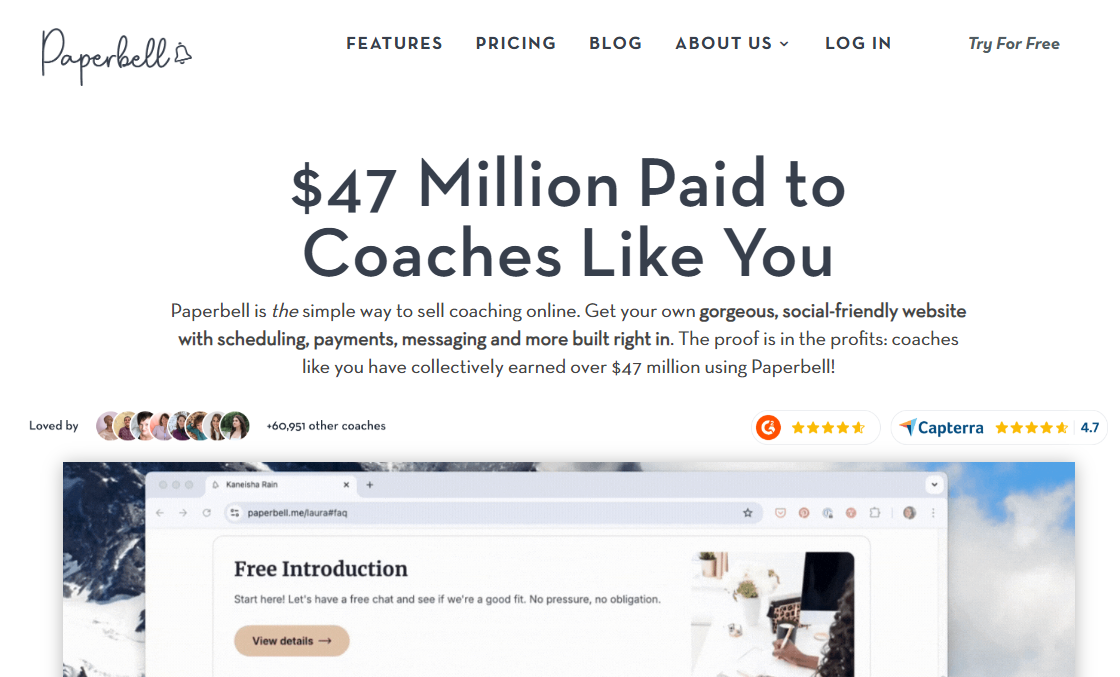
Paperbell is an all-in-one coaching platform combining a coaching website, package sales, scheduling, payment processing, contracts, intake forms, and a client portal. It's built for solo coaches and small practices who want to stop managing clients across separate tools.
Best for: Solo coaches and small firms replacing a fragmented scheduling, billing, and client delivery stack.
Key features
- Coaching package and offer pages with checkout
- Client self-scheduling with calendar integrations
- Payment plans, subscriptions, and Stripe or PayPal processing
- Contract signing via Dropbox Sign and intake forms
- Client portal with resource and digital download delivery
- Group coaching support
Why choose Paperbell: Paperbell is the most direct path from "I have clients" to "I have a repeatable commercial and delivery system." It won't match the reporting depth of enterprise platforms, but for a founder running a small practice or a new coaching offer alongside a core product, the setup time is low and the operational lift is immediate.
Paperbell pricing: A free account is available. Paid plans start at $97/month (billed monthly) or $970/year, covering unlimited clients, packages, appointments, and earnings with no per-client fees.
G2 rating: 4.7/5
2. Simply.Coach
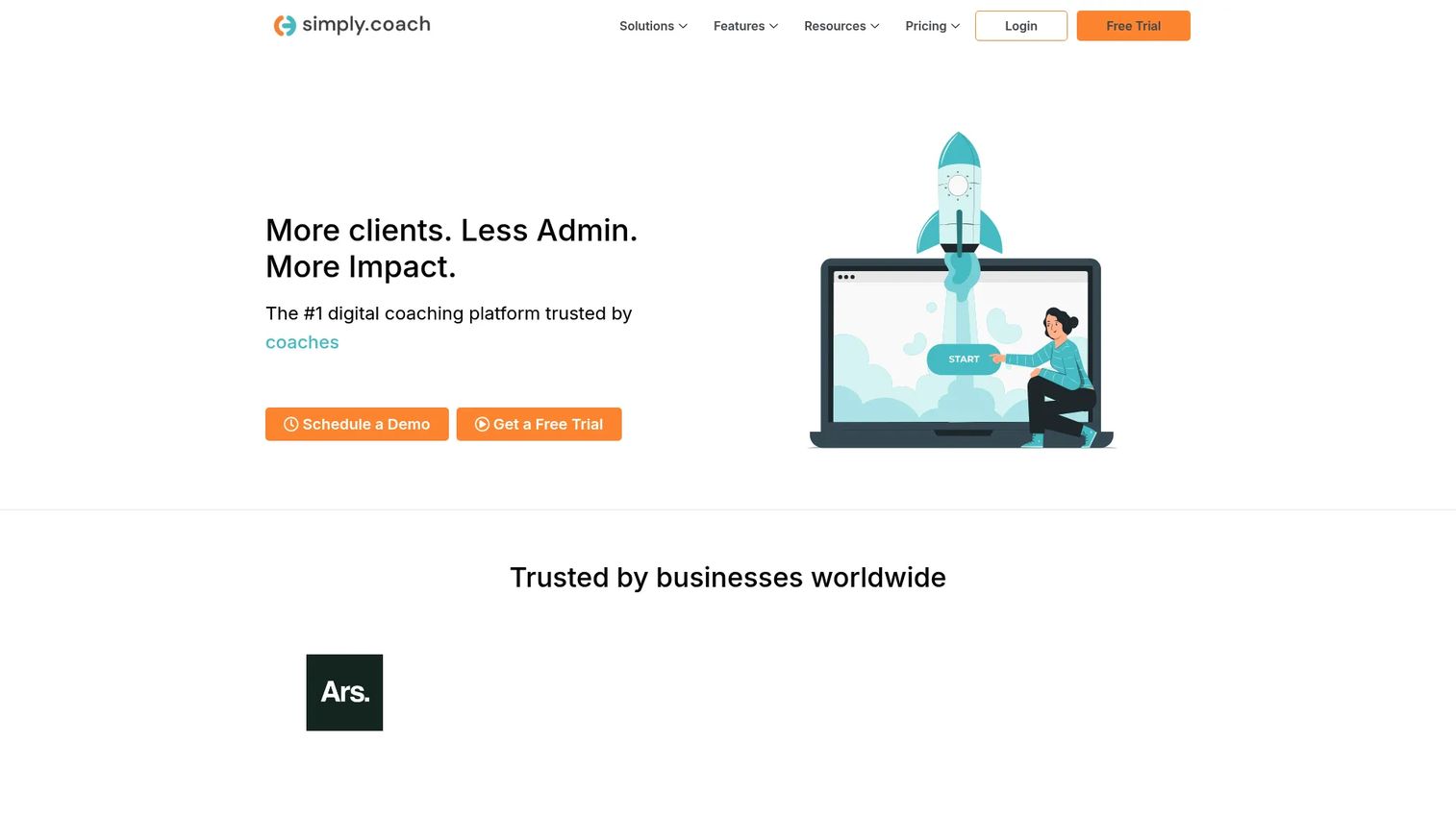
Simply.Coach is a digital coaching platform built for individual coaches, consulting firms, L&D teams, and universities. It covers client management, goal and development planning, scheduling, invoicing, contracts, and multi-coach administration in a configurable workspace.
Best for: Coaching practices with repeatable processes across several coaches, client types, or program types that need structured operations.
Key features
- Client and coach profiles with relationship history
- Goal and development planning with action tracking
- Forms, assessments, and digital coaching tools
- Scheduling and calendar integrations
- Invoicing, contracts, and payment management
- Coaching program reporting across coach and client activity
Why choose Simply.Coach: This platform suits founders who want to hand the coaching operation to a program manager or operations lead without rebuilding the system first. The configurable workflows and reporting layer support operational handoff in a way that simpler scheduling-and-billing tools don't.
Simply.Coach pricing: Solopreneur plans start at $9/month (billed annually), with tiers up to $69/month for the Leap plan. Business plans start at $79/month (annual) and scale to $289/month for the Optima tier. Enterprise pricing is available on request. A 14-day free trial is available.
G2 rating: 4.8/5
3. CoachAccountable
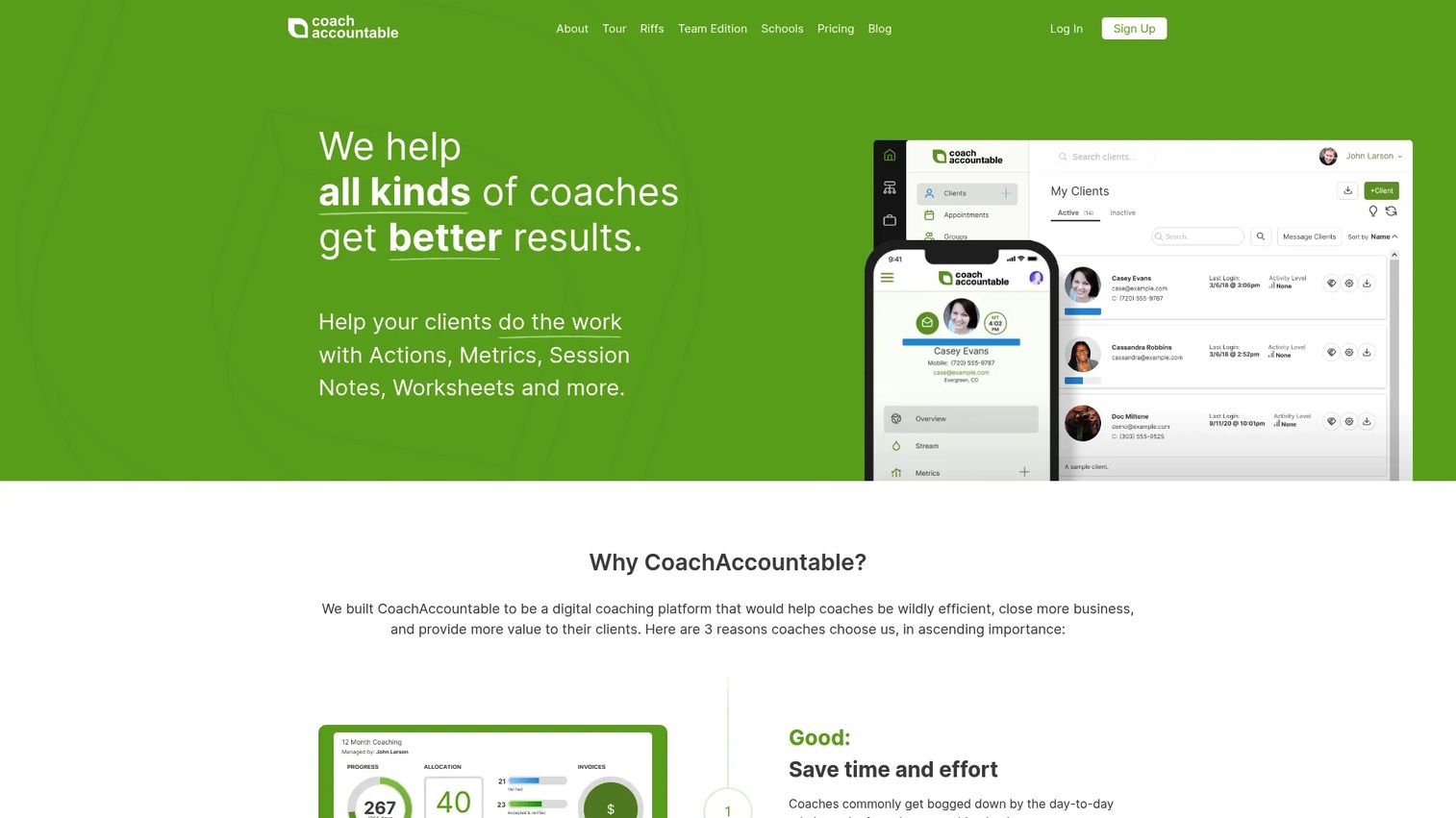
CoachAccountable is a web-based coaching platform built around client accountability, measurable progress, and coaching structure. It covers action plans, habit tracking, custom metrics, session notes, worksheets, automated reminders, and group delivery, all organized around the client's coaching journey.
Best for: Executive, business, health, or performance coaches whose method depends on visible progress, client-reported metrics, and follow-through tracking.
Key features
- Action plans, habit tracking, and client follow-through
- Custom goals and metrics with progress dashboards
- Automated reminders and client prompts
- Session notes and coaching agendas
- Worksheets, forms, and agreements
- Group coaching, courses, and scheduling with calendar integrations
Why choose CoachAccountable: If measurable accountability is the core of your coaching method, this platform is built around that outcome rather than treating it as a sidebar. The pricing model scales by active client count, which suits practices that grow incrementally rather than buying excess capacity upfront.
CoachAccountable pricing: Plans start at $20/month for up to 2 active clients. Pricing scales by client volume: $40/month for 5 clients, $70/month for 10, $120/month for 20, and up to $4,000/month for 1,000 clients. All plans include the full feature set. A 30-day free trial is available with no credit card required.
G2 rating: 4.8/5
4. UpCoach
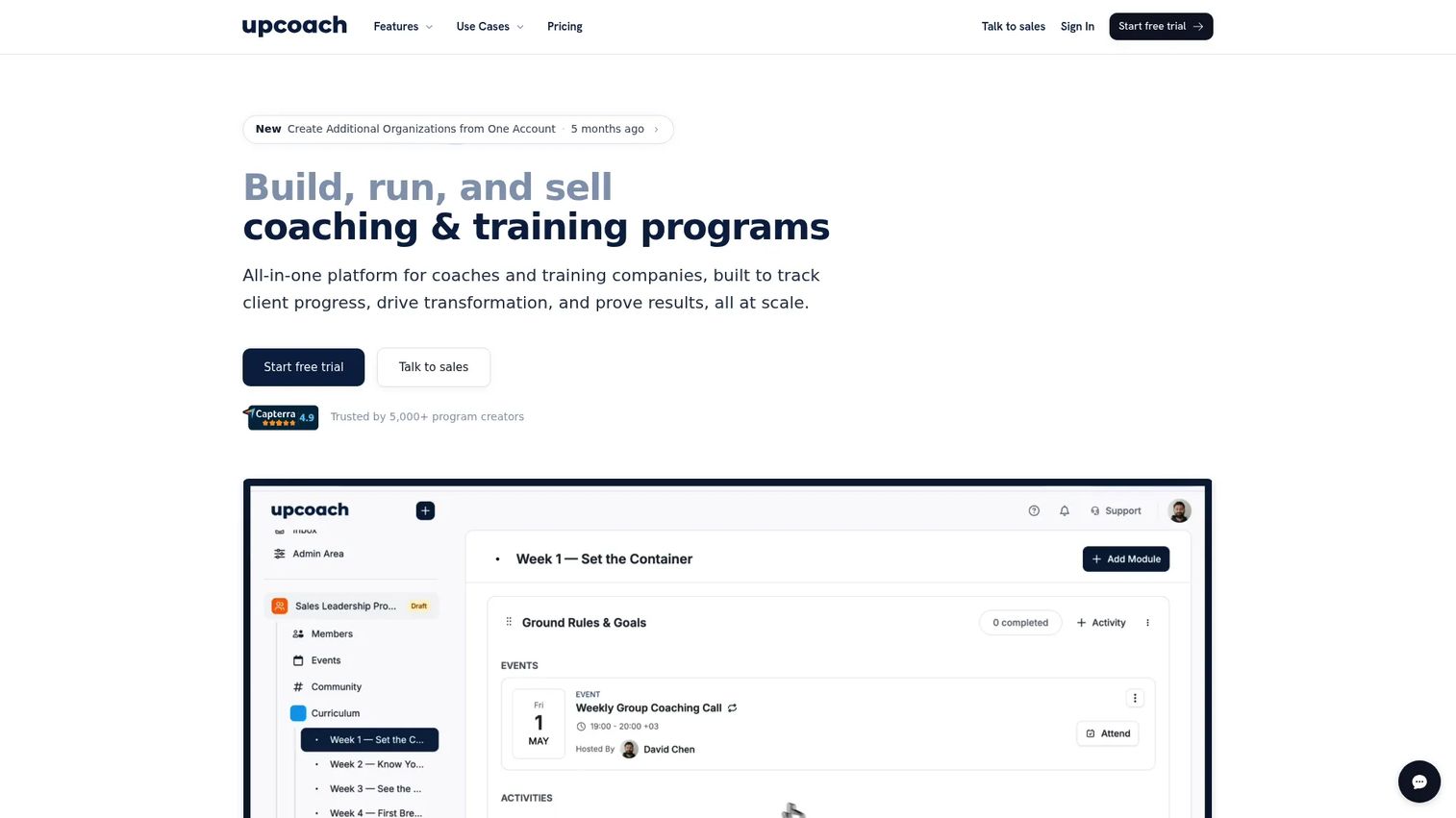
UpCoach is a platform for building, selling, and running structured coaching and training programs. It supports cohorts, masterminds, bootcamps, challenges, one-to-one programs, self-paced courses, and memberships, with tools for worksheets, check-ins, live events, community channels, and AI-assisted insights.
Best for: Coaches running paid cohort programs, mastermind groups, or structured group transformation programs who need more than a shared meeting calendar.
Key features
- Cohort and group program spaces with shared resources
- Program templates for cohorts, masterminds, and challenges
- Worksheets, check-ins, tasks, and lessons
- Community channels and client communication
- Live events, bookable sessions, and calendar integrations
- Payments, offers, bundles, and progress dashboards
Why choose UpCoach: Group program delivery is a different operational job than managing individual clients, and UpCoach is purpose-built for it. The platform gives participants a shared structured environment rather than asking a coach to coordinate content, sessions, and accountability across separate tools. Evaluate whether your model is primarily group-oriented before committing, since the platform's individual coaching depth is narrower.
UpCoach pricing: The Starter plan runs $49/month (billed annually). Pro is $99/month, Business+ is $199/month, and Scale is $399/month (all annual billing). Enterprise pricing requires a sales conversation. A 14-day free trial is available. No permanently free tier.
5. CoachVantage
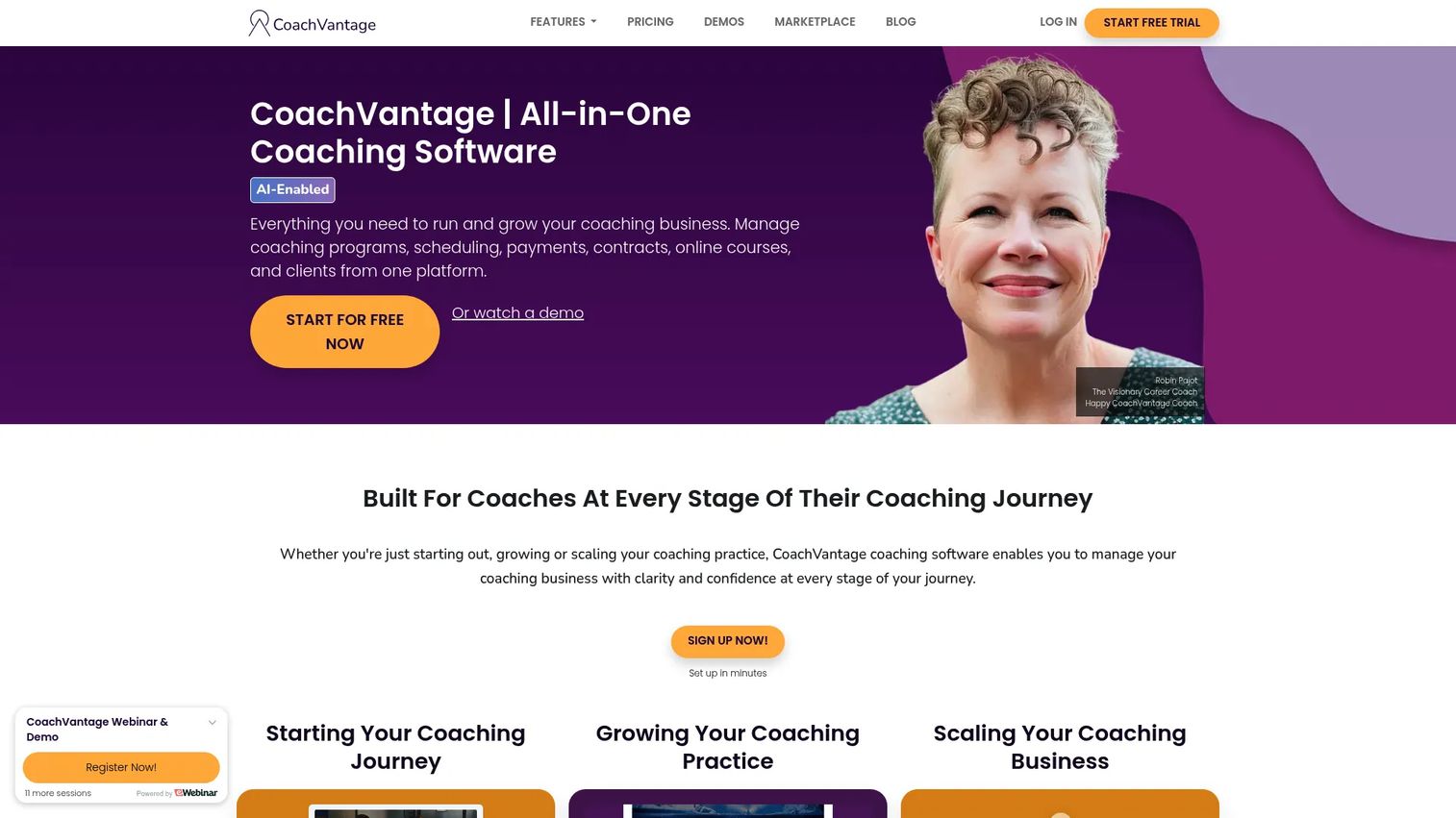
CoachVantage is an all-in-one coaching management platform covering client management, coaching programs, online courses, scheduling, e-contract signing, invoicing, payments, and a branded client portal. It targets independent coaches moving off manual coordination tools.
Best for: Solo coaches who want a dedicated client operating system without enterprise-level implementation complexity.
Key features
- Branded client portal with program access
- Appointment scheduling with calendar sync and Zoom integration
- Coaching package and group program management
- E-contract templates and signing
- Invoicing, payment collection, and coaching logs
- Workflow automations for reminders and follow-ups
Why choose CoachVantage: CoachVantage suits founders running a coaching offer alongside another product, or independent coaches who want a clean operational system without over-investing in platform setup. Firms with multiple coaches or complex custom reporting requirements should test governance depth before committing.
CoachVantage pricing: The Clarity plan starts at $35/month (billed annually) or $39/month on a monthly basis. The Aha! plan is $53/month (annual) or $59/month. Both plans include a 14-day free trial. No permanently free tier.
G2 rating: 4.5/5
6. Satori
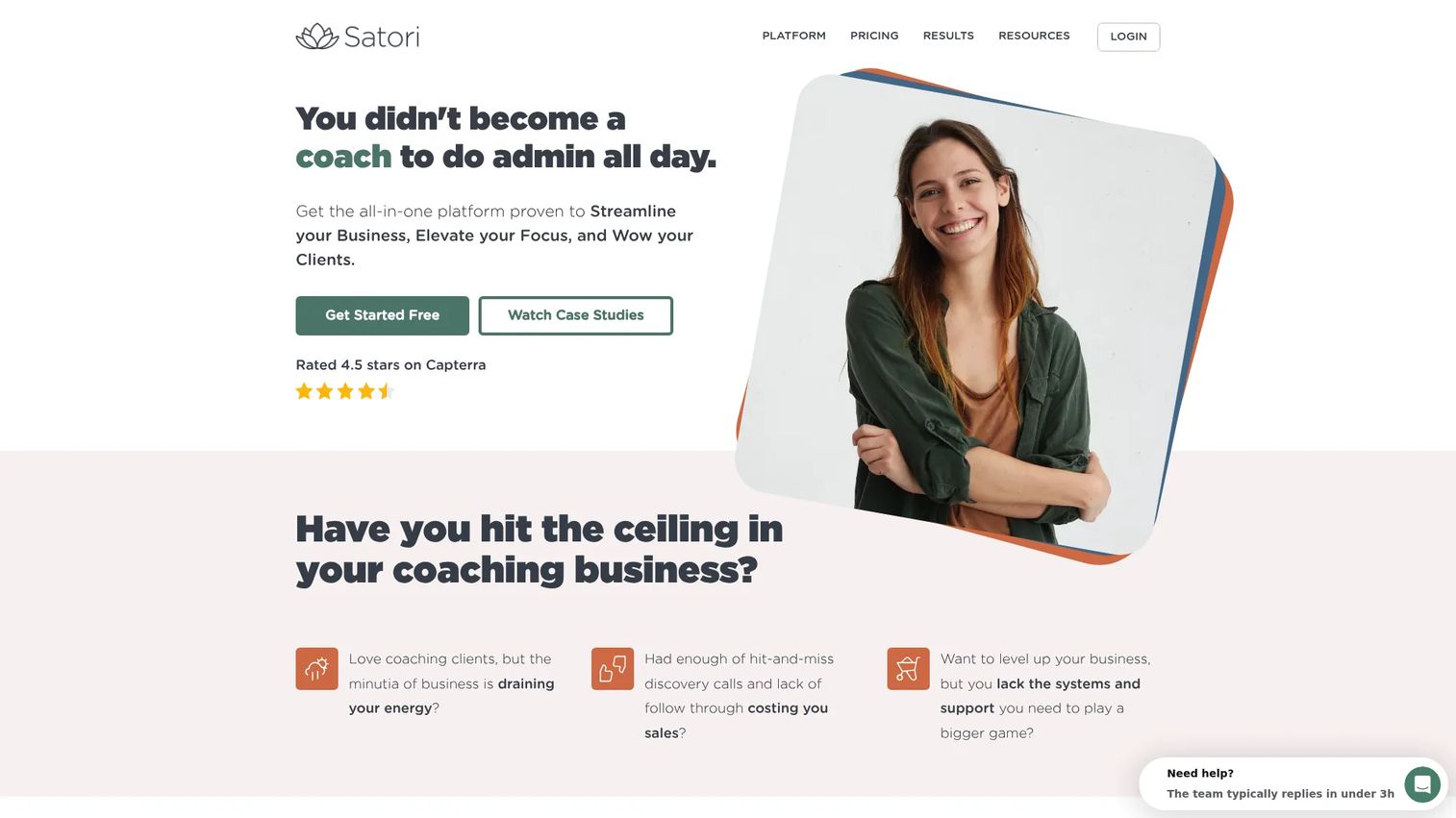
Satori is an all-in-one coaching platform focused on moving a prospective client from initial contact through onboarding, agreement, payment, scheduling, and ongoing delivery. It covers appointment scheduling, coaching programs with intake and progress tracking, proposals, contracts, recurring billing, and a business dashboard.
Best for: Coaches selling structured packaged engagements who want a cleaner, more consistent client journey from sales conversation to active engagement.
Key features
- Appointment scheduling with calendar integrations
- Coaching programs with intake forms, check-ins, and progress tracking
- Proposals, client agreements, and custom branding
- Online payments and recurring billing
- Business dashboard and client review collection
- Coaching log and session history
Why choose Satori: Satori's strength is in the handoff from selling a package to delivering it. The onboarding workflow is designed to reduce the manual coordination between contract, payment, and first session scheduling. If your coaching method centers on deep accountability structures or you need robust group cohort management, test those specific workflows before committing.
Satori pricing: The Essentials plan is $33/month, supporting up to 10 active clients. Pro is $49/month for up to 50 clients, and Leader is $124/month for up to 150. Annual billing includes two months free. A 15-day free trial is available without a credit card. A Scholar plan is free for coaching certification students.
7. Delenta
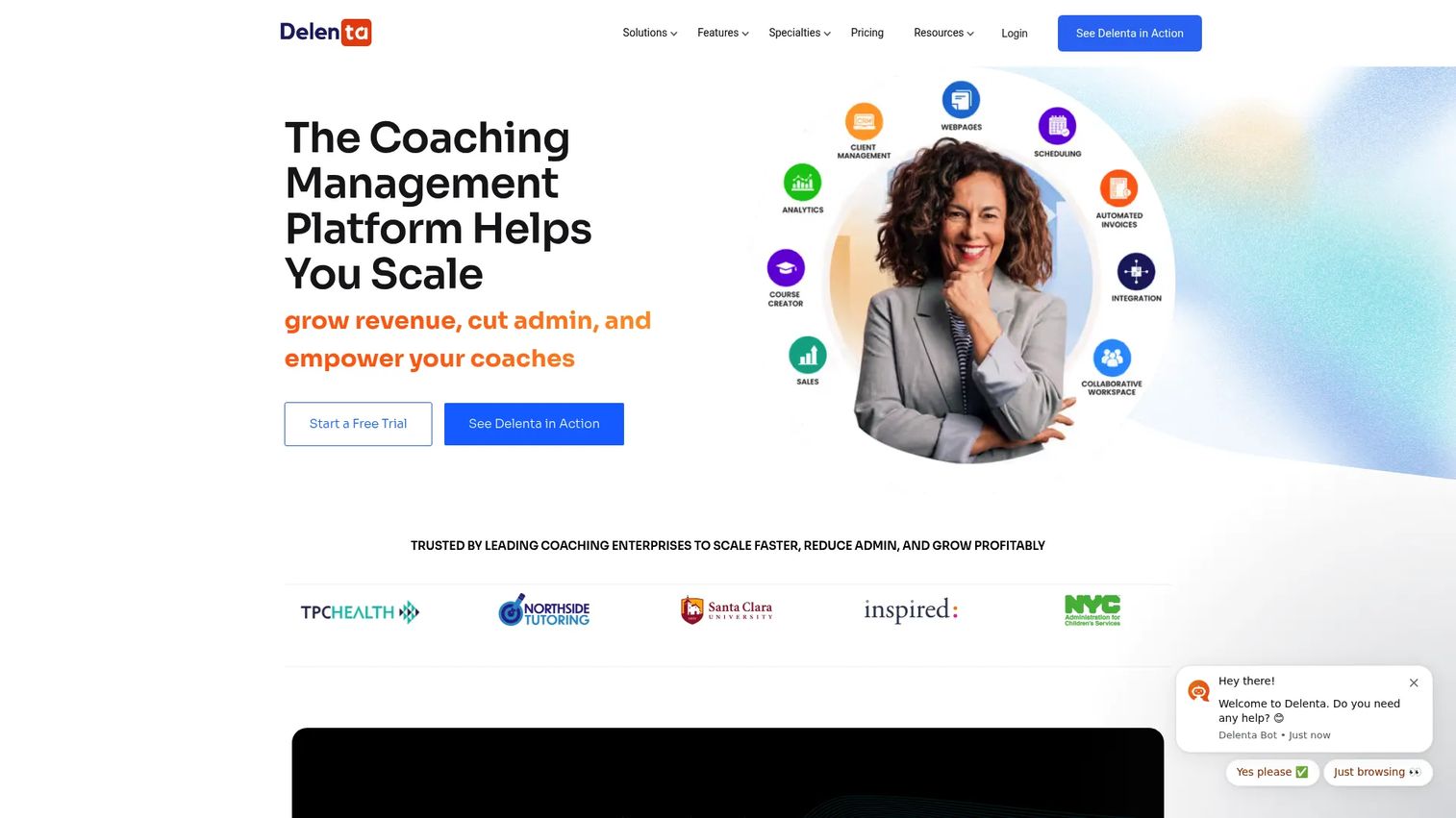
Delenta is an all-in-one coaching management platform covering client relationship management, scheduling, group coaching, digital course creation, client portals, contracts, invoicing, payments, and multi-coach administration with roles, permissions, reporting, and payroll tools.
Best for: Coaching businesses that want structured client development tools and multi-coach operations in one place, without assembling separate systems.
Key features
- Client records with session tracking, notes, tasks, and goals
- Scheduling with Google and Outlook calendar sync
- Group coaching management and group video sessions
- Digital course creation and delivery
- Client portals, automated forms, contracts, and invoicing
- Multi-coach roles, permissions, reporting, and payroll
Why choose Delenta: Delenta centralizes coaching delivery data in a way that supports growth without the founder holding the system together. The multi-coach administration layer makes it viable for practices adding headcount, and the course creation tools add content delivery without a separate platform. Confirm integration depth against your existing stack before signing.
Delenta pricing: The Starter plan is $29/month. Pro is $49/month and Premium is $79/month. Annual plans are $229, $469, and $699 respectively. Teams and Enterprise pricing requires a conversation with Delenta's team. A trial period is available.
G2 rating: 4.9/5
8. Quenza
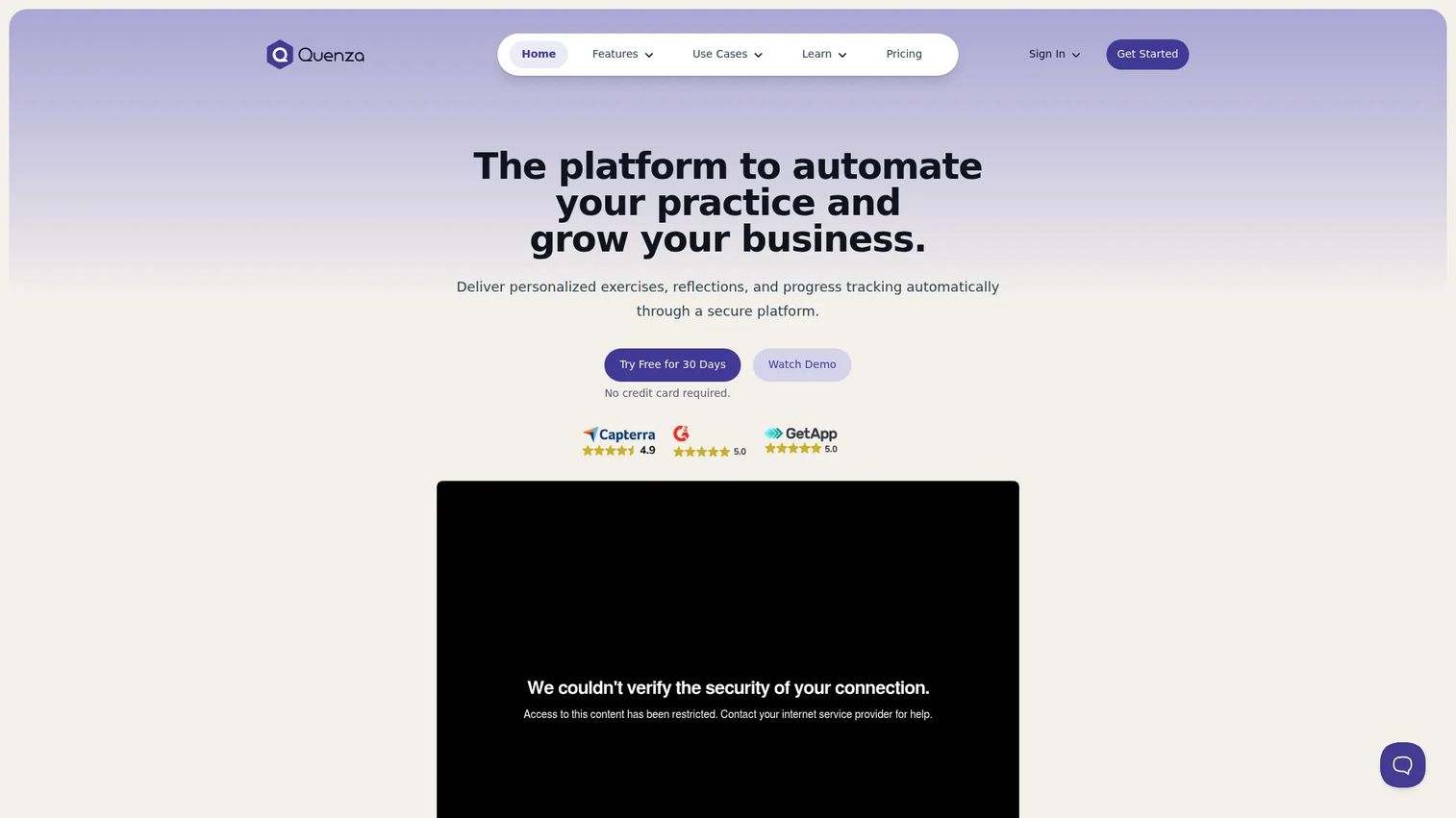
Quenza is a client engagement platform for coaches and mental health practitioners, built around delivering structured activities, exercises, reflections, and care pathways between sessions. It includes activity and program builders, a client portal with mobile apps, team and client chat, notes, file sharing, and landing page tools.
Best for: Coaches whose value proposition centers on structured exercises, guided reflection, and consistent between-session client practice.
Key features
- Custom interactive activities and assessments
- Structured multi-step client pathways and programs
- Client portal and iOS or Android mobile apps
- Client and team chat with notes and file sharing
- Landing pages and custom branding
- Calendar integrations and webhook or API access
Why choose Quenza: Quenza turns the coaching method itself into repeatable intellectual property rather than keeping it locked in each coach's notes. If your differentiation is in exercises and between-session work, this platform makes that repeatable across clients and coaches. Buyers who need full commerce management, multi-coach billing, or comprehensive scheduling should expect to run Quenza alongside other tools for those functions.
Quenza pricing: The Spark plan starts at $25/month or $20/month billed annually. Growth is $50/month or $40/month (annual). Impact is $125/month or $100/month (annual). The Collective plan for teams is $160/month or $128/month (annual). A Beyond plan uses custom pricing. A 30-day free trial is available with no credit card required.
G2 rating: 4.9/5
9. Coaching.com
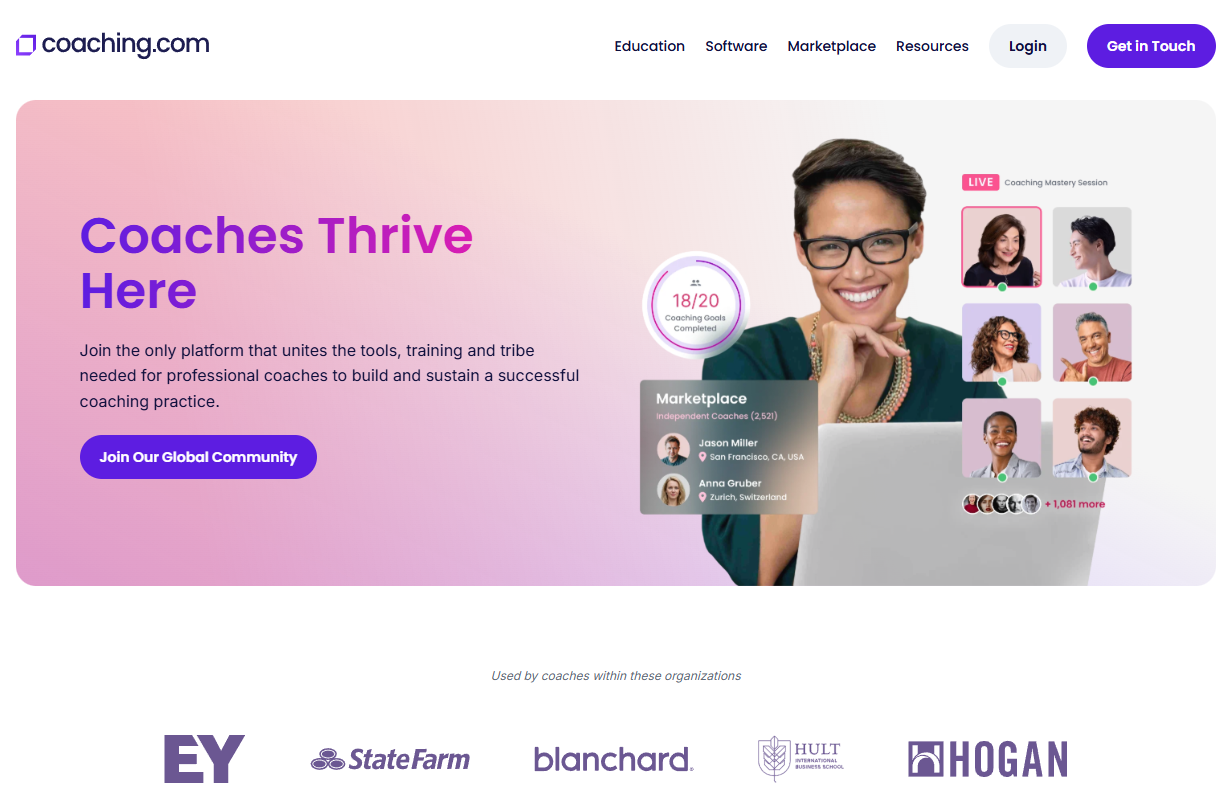
Coaching.com provides coaching management software for individual coaches, coaching firms, and enterprises, alongside education resources and a coach marketplace. The platform covers scheduling, session notes, goal planning, group coaching, client portals, billing, coach matching, reporting, and custom forms.
Best for: Organizations managing executive, leadership, or employee coaching programs across multiple coaches, with reporting requirements that go beyond individual session tracking.
Key features
- Centralized coaching program management dashboard
- Scheduling and calendar integrations
- Session notes, resource sharing, and goal tracking
- Group coaching and custom forms
- Reporting and analytics across coach and client activity
- Billing and invoicing with coach matching support
Why choose Coaching.com: This platform suits founders who have turned coaching into a strategic organizational program with multiple coaches, broader governance requirements, and stakeholders who need program health reporting. Smaller practices should compare the implementation requirements and contract scale against simpler tools before committing.
Coaching.com pricing: Business pricing is calculated dynamically based on active coaches or administrators. The pricing page does not display a fixed subscription amount without input. Optional implementation plans are available at $1,000 (Essentials) and $500 (Quick Start). Contact Coaching.com directly for a quote.
Considerations when choosing coaching software
Match the platform to your delivery model
A one-to-one executive coaching practice and a 12-week group cohort program have fundamentally different operational needs. Before comparing features, document the client journey you sell today: Package design, session cadence, between-session work, and renewal workflow. The platform should support that journey, not require you to redesign it.
Audit what the platform replaces
List every tool in your current coaching workflow: Scheduling, payment collection, agreements, forms, resource delivery, notes, and client communication. The platform earns its cost by removing coordination work, not by adding another system to update. Look specifically at which manual steps each tool eliminates, not which features it lists.
Test the client experience end to end
Run a real intake, booking, payment, and portal access sequence before signing. The admin view often looks clean while the client journey creates friction at the checkout or portal login step. A new client's first experience with your coaching operation is a direct reflection of how the platform performs, not how it's configured on your side.
Confirm ownership and reporting after launch
Decide who owns platform setup, billing rules, content workflows, and client support once you're live. For multi-coach or enterprise programs, validate that reporting covers coach utilization, client engagement by cohort, package renewal rates, and program completion, all accessible to a program manager without a manual export.
Check data portability and vendor stability
Ask each vendor how client records, session notes, resources, and payment history can be exported. Review contract terms and implementation support timelines. Confirm vendor stability and roadmap commitments before migrating your full client base to any platform.
Choose the platform that fits your coaching operating model
The nine tools above cover four distinct operating models. Matching the platform to the model is the decision.
Choose Paperbell when you want a compact all-in-one system for selling and delivering coaching packages with minimal setup. Choose Simply.Coach or Delenta when operational configuration and multi-coach client management are the priority. CoachAccountable suits programs where accountability, actions, and measurable progress form the core coaching method. UpCoach fits cohort and group delivery as the primary business model. Coaching.com is the right call when coaching has become an enterprise program with multi-stakeholder reporting and coach network administration. Quenza is purpose-built for coaches whose differentiation lives in repeatable exercises and structured between-session client work.
The practical next step: Document your current client journey from intake to renewal, then test the top two platforms against one active coaching package before migrating your full operation.
Start your journey with Guideflow today!
FAQs
For solo coaches, platforms like Paperbell, CoachVantage, and Satori cover the core weekly workflow: Package sales, scheduling, billing, contracts, and a client portal in one place. Prioritize the tool that matches your existing client journey rather than one that requires you to rebuild your offer structure to fit the platform.
A modular stack works at low client volume, typically under ten active clients with a simple offer. An all-in-one coaching management software platform becomes more valuable when client records, billing, session notes, and program delivery are creating duplicated work or when handing off to a team member requires explaining five separate tools.
Core features include client profiles, appointment scheduling, billing and package management, contracts and intake forms, session notes, goal tracking, a client portal for resources and communication, and basic reporting. Practices running group programs also need cohort spaces, shared content delivery, and participant engagement visibility.
Coaching software manages the ongoing service relationship: Sessions, goals, accountability, notes, forms, packages, and recurring billing. Course platforms focus on self-paced learning content, modules, assessments, and student access at scale. Some coaching platforms include course delivery as a feature, but the core design philosophy differs. Look at where the relationship tracking and session history live before choosing.
Most platforms support payment collection through integrations with Stripe or PayPal, along with package pricing, installment plans, and e-contract signing. Test your specific payment flow before committing: Deposits, installments, refunds, tax handling, and e-signature requirements vary by platform. Some handle all of these natively; others require workarounds for complex billing structures.
Group coaching needs dedicated program spaces for cohort communication, shared resources, recurring session management, participant assignments, and engagement visibility. UpCoach is purpose-built for this model. CoachAccountable and Delenta also support group delivery with varying levels of community and content tooling.
Entry-level plans for solo coaches range from roughly $20 to $97/month depending on client volume and feature scope. Mid-tier platforms for growing practices typically run $50 to $200/month. Enterprise platforms like Coaching.com price dynamically based on active coaches and program scale. Cost drivers include client count, coach seat count, payment and branding features, and reporting depth.
Start with one active offer or cohort rather than migrating everything at once. Import core client data, map your intake-to-delivery workflow in the new platform, test booking and payment with a real client, and confirm the portal experience works before adding historical materials. Running one program through the new system first surfaces friction points before they affect your entire client base. See also our guide to client portal software for additional context on client-facing delivery setup.
Yes, particularly platforms with multi-coach administration, engagement reporting, and program oversight. Coaching.com is the most purpose-built option for enterprise leadership programs. Simply.Coach and Delenta also serve organizational coaching use cases with configurable workflows and reporting across coach and client activity. Evaluate reporting depth and governance controls based on whether your stakeholders need program-level metrics or only individual session records.