Cloud workloads now span AWS, Azure, Google Cloud, Kubernetes clusters, containers, serverless functions, and hybrid environments. Traditional perimeter controls see none of what happens inside short-lived workloads. A container spins up, runs a workload, and disappears before a manual review ever starts.
The pressure is real: 55% of respondents say cloud environments are harder to secure than on-premises infrastructure, according to Thales (2025). Meanwhile, the cloud workload protection market is forecast to grow from $7.84 billion in 2025 to $26.84 billion by 2031 (Mordor Intelligence, 2026). Security teams, presales engineers, and technical buyers need tools that detect risky workloads before they become incidents.
This guide compares 16 cloud workload protection platforms across runtime detection, vulnerability management, agentless versus agent-based models, compliance support, and pricing. Whether you're scoping a POC, preparing for a security review call, or building a vendor shortlist, this is the practical evaluation brief you need before that call.
What's inside
This guide is for security evaluators, presales teams, solutions engineers, and technical buyers comparing CWPP options for 2026.
- Who it's for: Cloud security architects, presales and sales engineers, DevSecOps leads, and platform engineering teams
- How tools were chosen: Workload coverage depth, runtime protection model, vulnerability management, compliance reporting, integration breadth, and current market relevance
- What you'll find: A 16-platform comparison table, tool-by-tool entries with pricing and G2 ratings, and a buying checklist
- Important note: Many CWPP tools now ship as part of broader CNAPP platforms, so some entries cover wider cloud security capabilities alongside core workload protection
TL;DR
- Best for Microsoft-centric teams: Microsoft Defender for Cloud, for organizations standardized on Azure, Defender XDR, and Microsoft security workflows
- Best for agentless visibility: Wiz, for teams that want fast multicloud inventory and graph-based risk prioritization without starting with agent rollout
- Best for enterprise CNAPP programs: Palo Alto Networks Prisma Cloud, for organizations consolidating code-to-cloud security under one platform
- Best for detection-led security teams: CrowdStrike Falcon Cloud Security, for teams that want cloud workload findings connected to threat intelligence workflows
- Best for Kubernetes and container depth: Sysdig Secure or Aqua Security, depending on whether runtime behavior or container lifecycle coverage is the priority
- Best for vulnerability-led programs: Tenable Cloud Security or Qualys TotalCloud, for teams building cloud coverage around existing exposure management workflows
What are cloud workload protection platforms?
Cloud workload protection platforms (CWPP) are security tools that protect workloads running in cloud and hybrid environments, including virtual machines, containers, Kubernetes clusters, serverless functions, and sometimes bare metal or on-premises hosts. CWPP security fills the gap that network perimeter controls leave open: What happens inside the workload itself, at runtime.
The CWPP market emerged because cloud environments introduced a new problem. Workloads are ephemeral, autoscaling, and distributed across multiple cloud providers. Static configuration checks don't catch what a workload does after it starts. A cloud workload protection platform CWPP addresses this by combining runtime visibility, vulnerability management, and behavioral analysis into a single control plane.
Most CWPP tools today appear inside broader cloud native application protection platform (CNAPP) offerings. CNAPP combines CWPP with cloud security posture management (CSPM), cloud infrastructure entitlement management (CIEM), and often code security and IaC scanning.
Core CWPP capabilities
- Workload discovery across cloud accounts, clusters, and hybrid environments
- Vulnerability assessment and prioritization by exploitability and exposure
- Runtime threat detection for process anomalies, file changes, and lateral movement
- File integrity monitoring
- Malware and exploit detection
- Behavioral analysis and anomaly scoring
- Policy enforcement and microsegmentation controls
- Compliance reporting against CIS Benchmarks, PCI DSS, HIPAA, GDPR, and internal frameworks
- CI/CD pipeline and container image scanning
- Agentless scanning for fast inventory
- Agent-based protection for deeper runtime telemetry
- Integration with SIEM, SOAR, EDR, XDR, and ticketing systems
Workload types covered
- Virtual machines
- Containers and container images
- Kubernetes clusters
- Serverless functions
- Cloud hosts and ephemeral workloads
- Hybrid cloud and on-premises workloads
When to use cloud workload protection platforms
Protect workloads that change faster than manual reviews
Autoscaling groups, ephemeral containers, and serverless functions can appear and disappear in minutes. Manual review processes simply cannot keep up. A CWPP gives you continuous visibility across this dynamic surface, so new workloads enter your security inventory automatically rather than waiting for the next scan cycle. For presales teams, this is often the first validation point buyers need to see in a POC.
Prioritize vulnerabilities by runtime exposure
A long vulnerability list without context is noise. A useful CWPP shows which workloads are internet-facing, privileged, actively running sensitive processes, or connected to data that matters. That context turns a CVE spreadsheet into an actionable queue. Buyers often get stuck here during evaluations, so prepare to demo risk prioritization specifically against their environment.
Standardize runtime security across cloud providers
Multicloud environments create policy inconsistency. Security rules that work in one cloud don't automatically apply in another. A cloud workload protection platform gives security and platform teams a single policy layer across AWS, Azure, Google Cloud, Kubernetes, and hybrid workloads, with shared reporting that makes compliance evidence collection practical rather than painful.
Cloud workload protection platforms comparison
The table below covers all 16 platforms in the order they appear in this guide. Pricing reflects what each vendor publicly discloses. Where pricing is sales-led, the table notes that directly. G2 ratings are sourced from live listings; N/A indicates no verifiable rating at time of publication.
| # | Product | Best for | Key differentiator | Pricing | G2 rating |
|---|---|---|---|---|---|
| 1 | Microsoft Defender for Cloud | Microsoft-centric security teams | Native CWPP across Azure, hybrid, and multicloud with Microsoft Defender XDR integration | Free CSPM tier; paid plans by workload type | N/A |
| 2 | Wiz | Agentless multicloud visibility | Security Graph risk prioritization across workloads, identities, and data | Custom quote | 4.7/5 |
| 3 | Palo Alto Networks Prisma Cloud | Enterprise CNAPP programs | Code-to-cloud coverage with runtime workload defense | Custom quote | N/A |
| 4 | FortiCNAPP | Fortinet-aligned security teams | CNAPP with vCPU-based licensing across Standard, Professional, and Enterprise tiers | Custom quote; per-vCPU billing | 4.4/5 |
| 5 | CrowdStrike Falcon Cloud Security | Threat-led security teams | Cloud workload protection tied to Falcon detection and threat intelligence | Custom quote | 4.5/5 |
| 6 | Trend Vision One Cloud Security | Hybrid security operations | Credit-based cloud security connected to broader Trend Vision One XDR workflows | Custom quote; credit-based | 4.7/5 |
| 7 | Lacework FortiCNAPP | Cloud-native risk detection | Behavioral anomaly detection and workload risk prioritization | Custom quote | 4.4/5 |
| 8 | Check Point CloudGuard | Multicloud policy enforcement | Prevention-first cloud security with CNAPP, posture, and network controls | Custom quote | 4.4/5 |
| 9 | SentinelOne Singularity Cloud Security | Runtime defense and response | AI-powered CWPP with autonomous threat detection and containment | Custom quote | 4.9/5 |
| 10 | Orca Security | Agentless cloud risk visibility | SideScanning agentless architecture covering workloads, data, and identities | Custom quote | 4.7/5 |
| 11 | Sysdig Secure | Kubernetes and container security | Runtime threat detection built from container and Kubernetes activity | Custom quote; host-based billing | 4.8/5 |
| 12 | Aqua Security | Container-first workload protection | Deep container lifecycle security from image through runtime | Custom quote; workload-based billing | 4.2/5 |
| 13 | Tenable Cloud Security | Exposure management teams | Cloud risk connected to Tenable's vulnerability and exposure management platform | Custom quote; billable-resource pricing | 4.6/5 |
| 14 | Qualys TotalCloud | Vulnerability-led programs | TruRisk prioritization and FlexScan coverage in Qualys QLU workflows | Custom quote; QLU-based billing | N/A |
| 15 | Snyk Cloud | DevSecOps teams | Developer-first IaC and cloud misconfiguration detection in CI/CD workflows | Free; Team from $25/month | 4.5/5 |
| 16 | Rapid7 InsightCloudSec | Cloud governance teams | Resource-based cloud risk and compliance automation starting at $66,000/year | From $66,000/year | N/A |
Best 16 cloud workload protection platforms for 2026
1. Microsoft Defender for Cloud
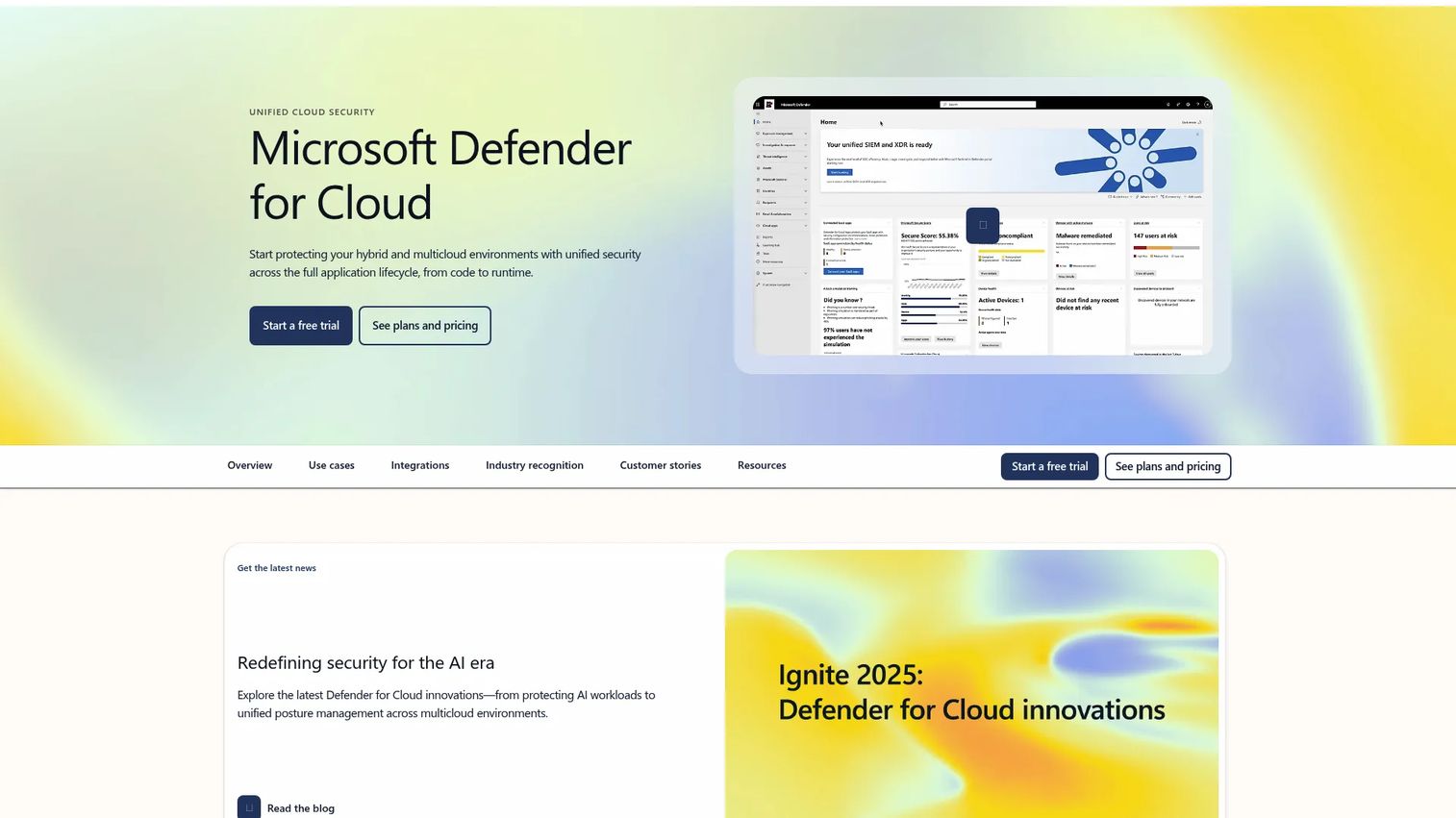
Microsoft Defender for Cloud is a cloud-native application protection platform covering workload protection, posture management, DevOps security, and threat detection across Azure, hybrid, and multicloud environments. It integrates natively with the Microsoft Defender portal, connecting cloud workload findings to the same investigation workflows your SOC already uses. For presales engineers supporting Microsoft-heavy enterprise accounts, this is often the first platform on the evaluation list because it reduces vendor sprawl without requiring a separate security stack.
Best for: Security teams already operating inside the Microsoft security stack, including Azure, Defender XDR, and Microsoft Sentinel.
Key features
- Cloud security posture management with Secure Score and security recommendations
- Workload protection for VMs, containers, Kubernetes, databases, and AI workloads
- Defender XDR integration for cross-domain investigation and response
- DevOps security across multi-pipeline environments
- Regulatory compliance dashboard with continuous monitoring
Why choose Microsoft Defender for Cloud: Choose it when the buyer's security operations already center on Microsoft tooling. Connecting cloud workload findings to Defender XDR reduces the number of consoles an analyst has to work across.
Microsoft Defender for Cloud pricing: The foundational CSPM tier is free. Paid plans cover workload-specific protection across servers, containers, databases, storage, App Service, Key Vault, and AI services, with a 30-day trial available for eligible plans. Specific per-resource pricing is usage-based and requires checking Microsoft's pricing calculator for exact figures.
2. Wiz
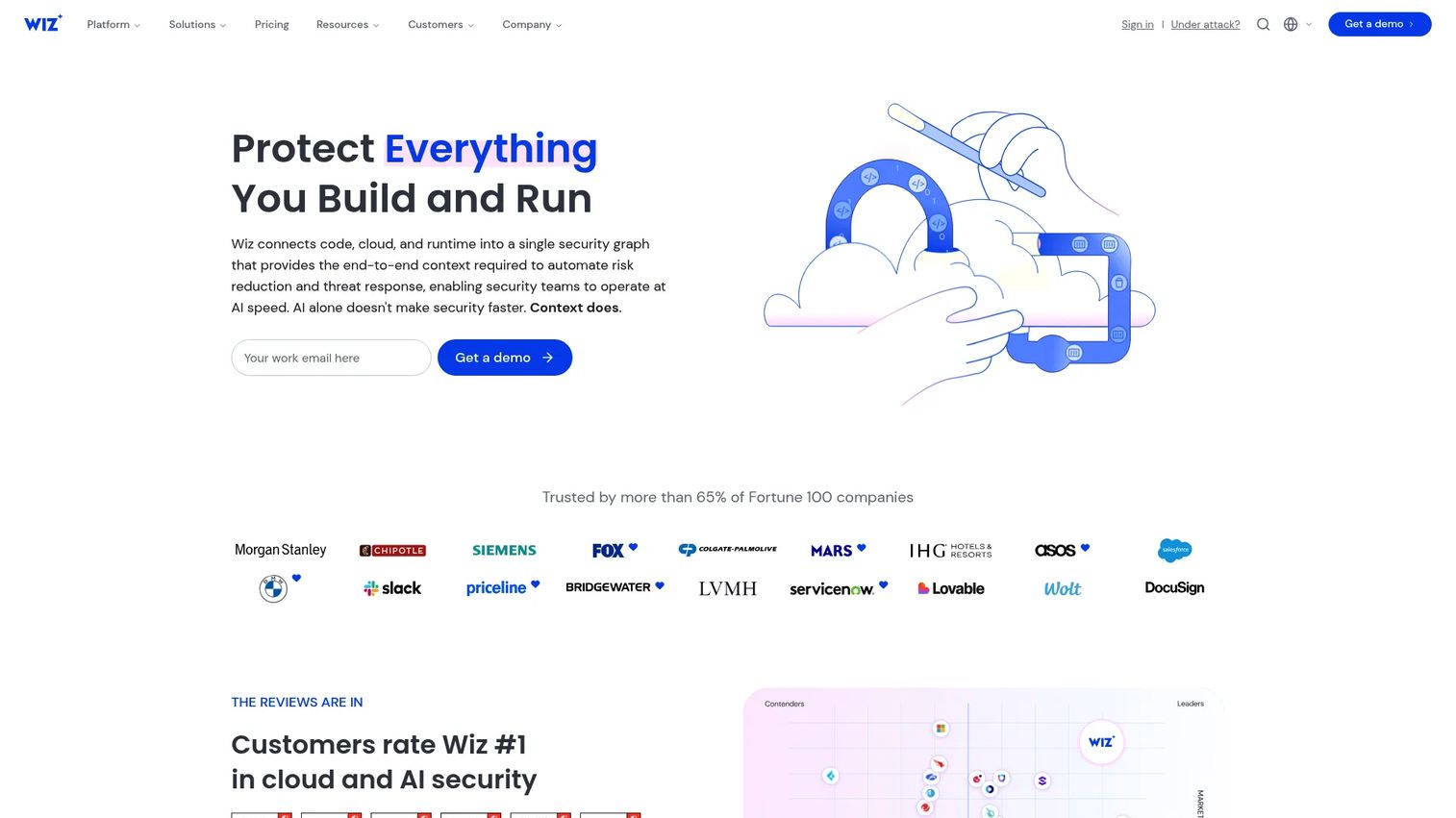
Wiz is an agentless cloud and AI security platform that connects workload vulnerabilities, identity risks, misconfigurations, and sensitive data exposure into a single Security Graph. Instead of presenting a flat list of findings, Wiz shows attack paths across your environment so teams can prioritize by what an attacker could actually reach. It supports CSPM, vulnerability management, CIEM, container and Kubernetes security, data security posture management (DSPM), and runtime protection through the optional Wiz Sensor.
Best for: Teams that need fast agentless visibility across multicloud workloads without committing to an agent deployment before they understand their exposure.
Key features
- Agentless workload scanning via SideScanning architecture
- Security Graph with attack-path analysis across workloads, identities, and data
- Vulnerability prioritization contextualized by internet exposure and lateral movement risk
- Kubernetes and container security posture
- Runtime protection through the optional Wiz Sensor agent
Why choose Wiz: Choose it when speed of initial inventory matters more than deep runtime telemetry on day one. The agentless model gives a complete workload picture quickly, and the Security Graph helps presales teams show buyers which risks actually matter.
Wiz pricing: Pricing uses modular licensing with separate products for Wiz Cloud, Wiz Code, Wiz Defend, and Wiz Sensor. Rates scale with workload count, active developers, or log ingestion. Contact Wiz for a quote specific to your environment size.
G2 rating: 4.7/5
3. Palo Alto Networks Prisma Cloud
Palo Alto Networks Prisma Cloud is a broad CNAPP platform that covers workload protection from code through runtime across hybrid and multicloud environments. It combines IaC scanning, CI/CD security, software composition analysis, CSPM, CIEM, DSPM, host and container workload protection, and web application and API security (WAAS) into a single platform. Enterprise security teams use it to standardize cloud security governance from the development pipeline through production workloads.
Best for: Large organizations consolidating cloud security under one enterprise CNAPP program with policy consistency from build to runtime.
Key features
- Runtime workload protection for hosts, containers, Kubernetes, and serverless
- Container image scanning and CI/CD pipeline integration
- IaC scanning with SAST, secrets detection, and software composition analysis
- CSPM with continuous compliance and attack-path analysis
- Web application and API security (WAAS)
Why choose Palo Alto Networks Prisma Cloud: Choose it when the buyer wants workload protection tied to code-level governance. Enterprise security programs that need to enforce policy from the developer's first commit through production runtime will find the coverage breadth valuable.
Palo Alto Networks Prisma Cloud pricing: Pricing is not publicly listed. Palo Alto Networks directs prospects to request a demo or contact sales. The platform uses Enterprise and Compute edition licensing models; contact the vendor for a quote based on workload and feature scope.
4. FortiCNAPP
FortiCNAPP is Fortinet's cloud-native application protection platform combining CSPM, CWPP, CIEM, Kubernetes security, SAST, SCA, SBOM, IaC scanning, and cloud detection and response into a unified offering. It uses behavioral anomaly detection and machine learning for cloud threat analysis, and connects into existing Fortinet security operations for teams already invested in the Fortinet stack. Lacework's behavioral analytics engine powers the cloud detection and response component.
Best for: Security teams standardizing cloud security around Fortinet controls and wanting CNAPP capabilities with vCPU-based licensing.
Key features
- CSPM with continuous compliance and policy enforcement
- CWPP and Kubernetes workload protection
- CIEM with identity and entitlement risk analysis
- SAST, SCA, SBOM, and IaC code security
- Cloud detection and response with behavioral anomaly detection
Why choose FortiCNAPP: Choose it when the buyer wants cloud workload and code security connected to existing Fortinet security operations. The vCPU-based licensing model makes it predictable for teams that know their compute footprint.
FortiCNAPP pricing: Licensing is per vCPU across Standard, Professional, and Enterprise tiers, with 1, 3, or 5-year terms. The Code Security add-on is licensed per code-contributing developer. Contact Fortinet for pricing specific to your vCPU count and selected tier.
G2 rating: 4.4/5
5. CrowdStrike Falcon Cloud Security
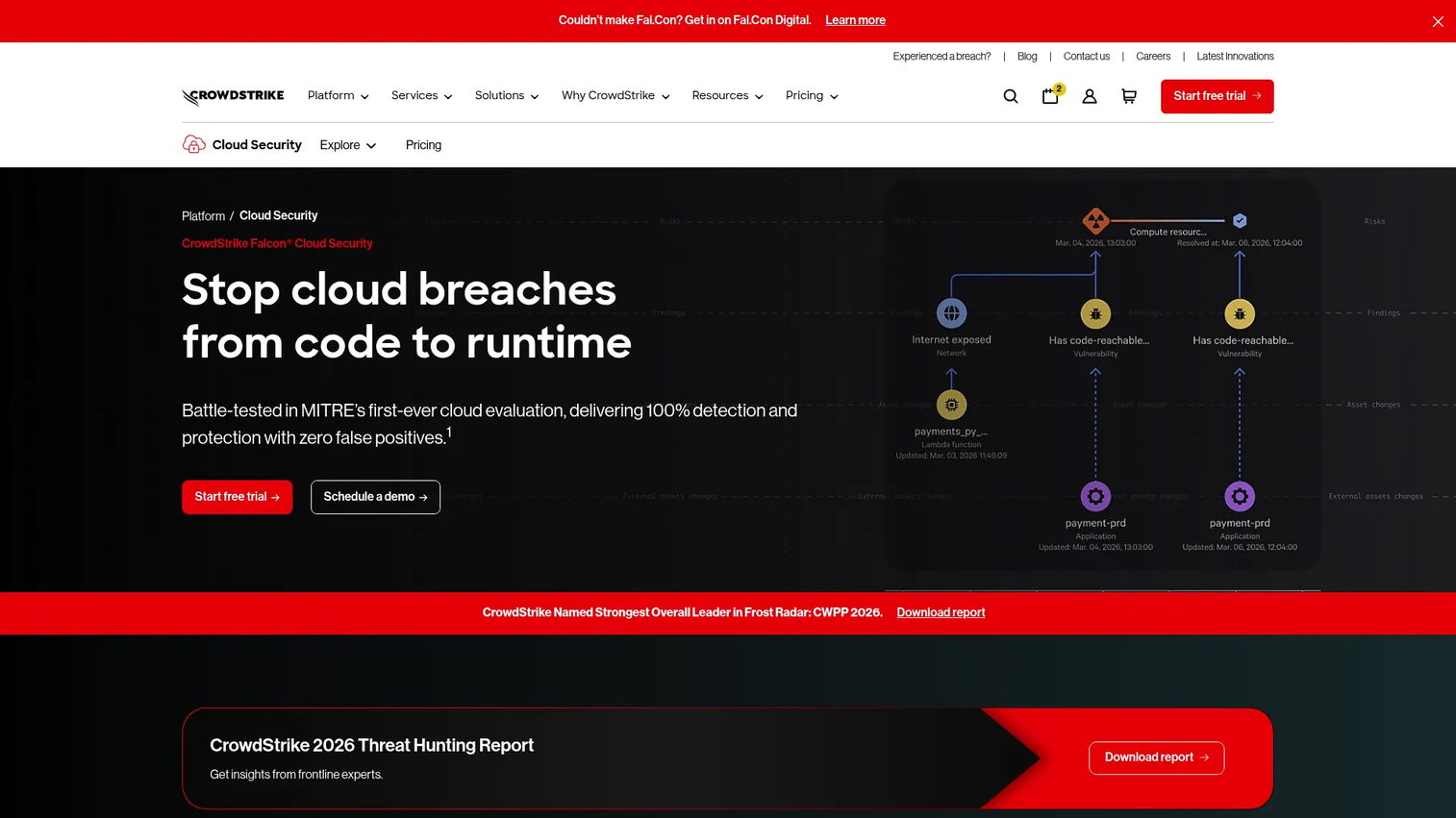
CrowdStrike Falcon Cloud Security delivers cloud workload protection, posture management, and cloud detection and response connected to the broader Falcon platform. It combines agentless asset visibility with real-time cloud threat detection, cross-domain investigation, and automated response. For security teams that already operate in Falcon for endpoint and identity, this brings cloud workload findings into the same investigation and response workflow.
Best for: Security teams that want cloud workload protection, runtime detection, and threat intelligence connected through the Falcon platform.
Key features
- CSPM with agentless asset discovery and misconfiguration detection
- Cloud detection and response with real-time threat detection
- Container and Kubernetes workload protection
- Cloud identity, AI, IaC, and application security
- Falcon platform integration connecting cloud and endpoint telemetry
Why choose CrowdStrike Falcon Cloud Security: Choose it when detection and response workflows matter as much as workload inventory. Teams already running Falcon for endpoints get cloud workload findings in the same investigation surface, which reduces context switching during an incident.
CrowdStrike Falcon Cloud Security pricing: Pricing is custom-quoted across plan tiers including Proactive Security, Cloud Detection and Response, and CNAPP options with and without container coverage. Contact CrowdStrike for a quote based on your cloud environment and required capabilities.
G2 rating: 4.5/5
6. Trend Vision One Cloud Security
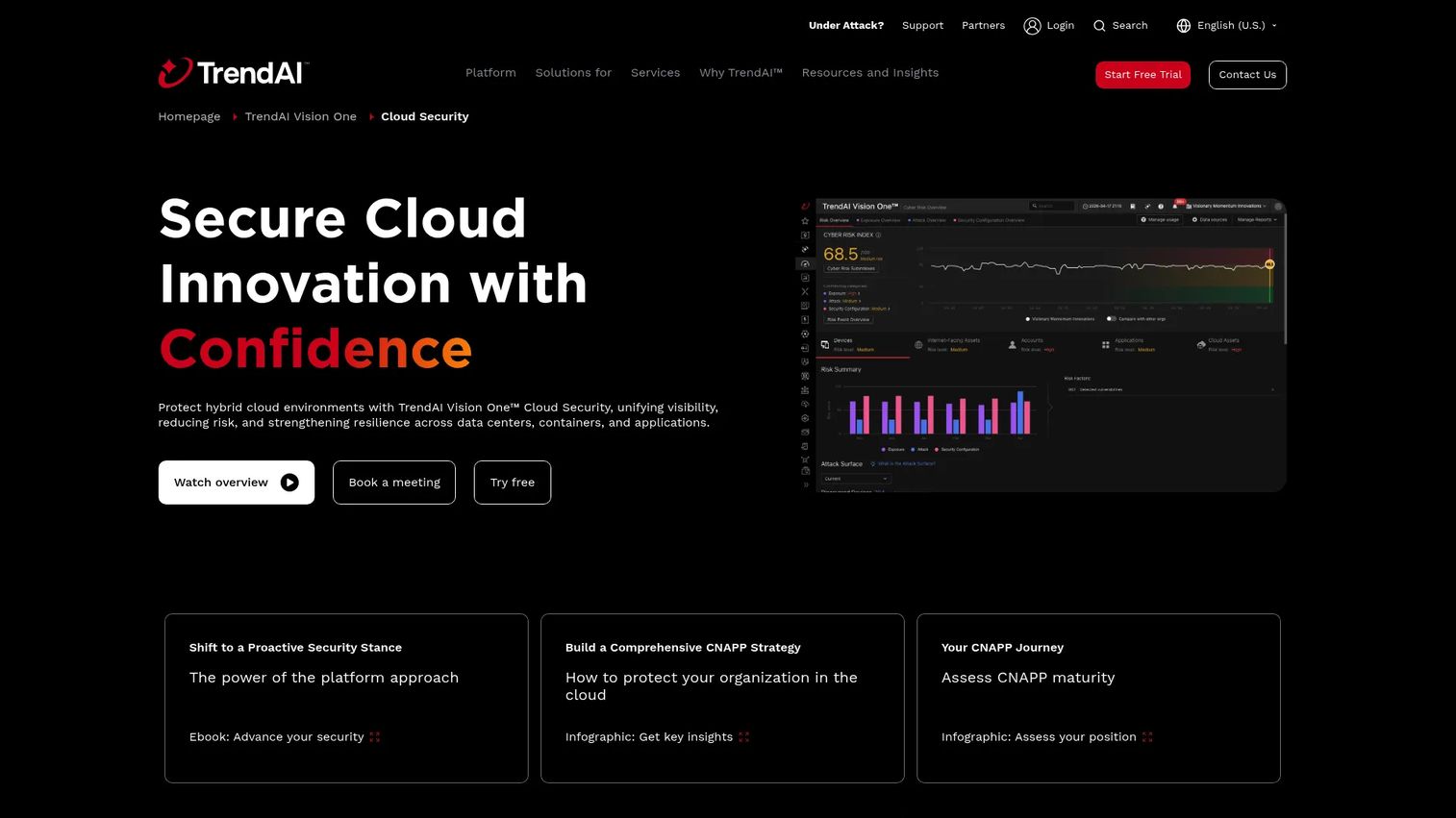
Trend Vision One Cloud Security is Trend Micro's cloud security platform providing risk management, code security, and container security across hybrid and multicloud environments. It connects cloud workload risk signals into the broader Trend Vision One XDR platform, giving security teams visibility across cloud, endpoint, email, and network in a unified risk view. The platform uses a credit-based TrendAI Flex licensing model.
Best for: Hybrid security operations teams that want cloud workload risk in the same operational view as broader XDR signals.
Key features
- Cloud risk management covering CSPM, CIEM, DSPM, AI-SPM, and attack-path analysis
- Container security with image scanning, admission control, and runtime protection
- Code and software supply chain security with OSS scanning, SBOM, and IaC analysis
- API risk visibility and cloud runtime threat detection
- XDR workflow connection across cloud, endpoint, and network
Why choose Trend Vision One Cloud Security: Choose it when the buyer wants cloud workload risk connected to SOC workflows without managing a separate cloud security console. It suits teams trying to consolidate their security operations view rather than adding another standalone tool.
Trend Vision One Cloud Security pricing: Licensing uses Trend's TrendAI Flex credit-based model. Contact Trend Micro for a quote specifying your cloud environment size and required capabilities.
G2 rating: 4.7/5
7. Lacework FortiCNAPP
Lacework FortiCNAPP is Fortinet's AI-powered CNAPP platform, incorporating Lacework's behavioral analytics engine for cloud workload risk detection. The platform provides CSPM, CWPP, CIEM, code security, vulnerability assessment, and cloud detection and response across multicloud and hybrid environments. Behavioral anomaly detection distinguishes it from posture-only tools: It learns normal workload behavior and surfaces deviations that signature-based tools miss.
Best for: Cloud-native security teams that want behavioral risk detection across dynamic workloads, not just static configuration checks.
Key features
- Behavioral anomaly detection across cloud workloads and accounts
- Cloud workload and Kubernetes vulnerability scanning
- CSPM and continuous compliance monitoring
- CIEM with identity and entitlement risk analysis
- Code security with SCA, SAST, secrets detection, and IaC scanning
Why choose Lacework FortiCNAPP: Choose it when teams want workload risk signals from behavioral patterns in fast-changing environments. The anomaly-based approach catches runtime threats that rule-based detection misses, especially in environments with frequent workload changes.
Lacework FortiCNAPP pricing: Pricing is custom-quoted. Contact Fortinet for details on licensing model and rates for your environment.
G2 rating: 4.4/5
8. Check Point CloudGuard
Check Point CloudGuard provides prevention-first cloud security across applications, workloads, and networks in public, private, and hybrid-cloud environments. It combines CNAPP capabilities with cloud network security, including firewall, IPS, DLP, VPN, threat extraction, and threat emulation. CloudGuard uses contextual AI for web application and API security, and supports CI/CD and IaC integrations for DevSecOps teams.
Best for: Enterprise security teams that need cloud workload security and network-layer controls in a single Check Point management framework.
Key features
- Cloud-native application protection and posture management
- Cloud network security including firewall, IPS, DLP, and VPN controls
- AI-powered web application and API security
- IaC, CI/CD, and automated deployment integrations
- Unified security management across public, private, hybrid-cloud, and on-premises
Why choose Check Point CloudGuard: Choose it when workload security must sit alongside network-layer cloud controls and the buyer already operates within the Check Point architecture. It reduces operational handoffs for teams that manage both cloud workload risks and cloud network policies.
Check Point CloudGuard pricing: Pricing uses PAYG and BYOL models for network security components. CNAPP pricing is based on utilized capabilities and protected cloud assets. Contact Check Point for a quote.
G2 rating: 4.4/5
9. SentinelOne Singularity Cloud Security
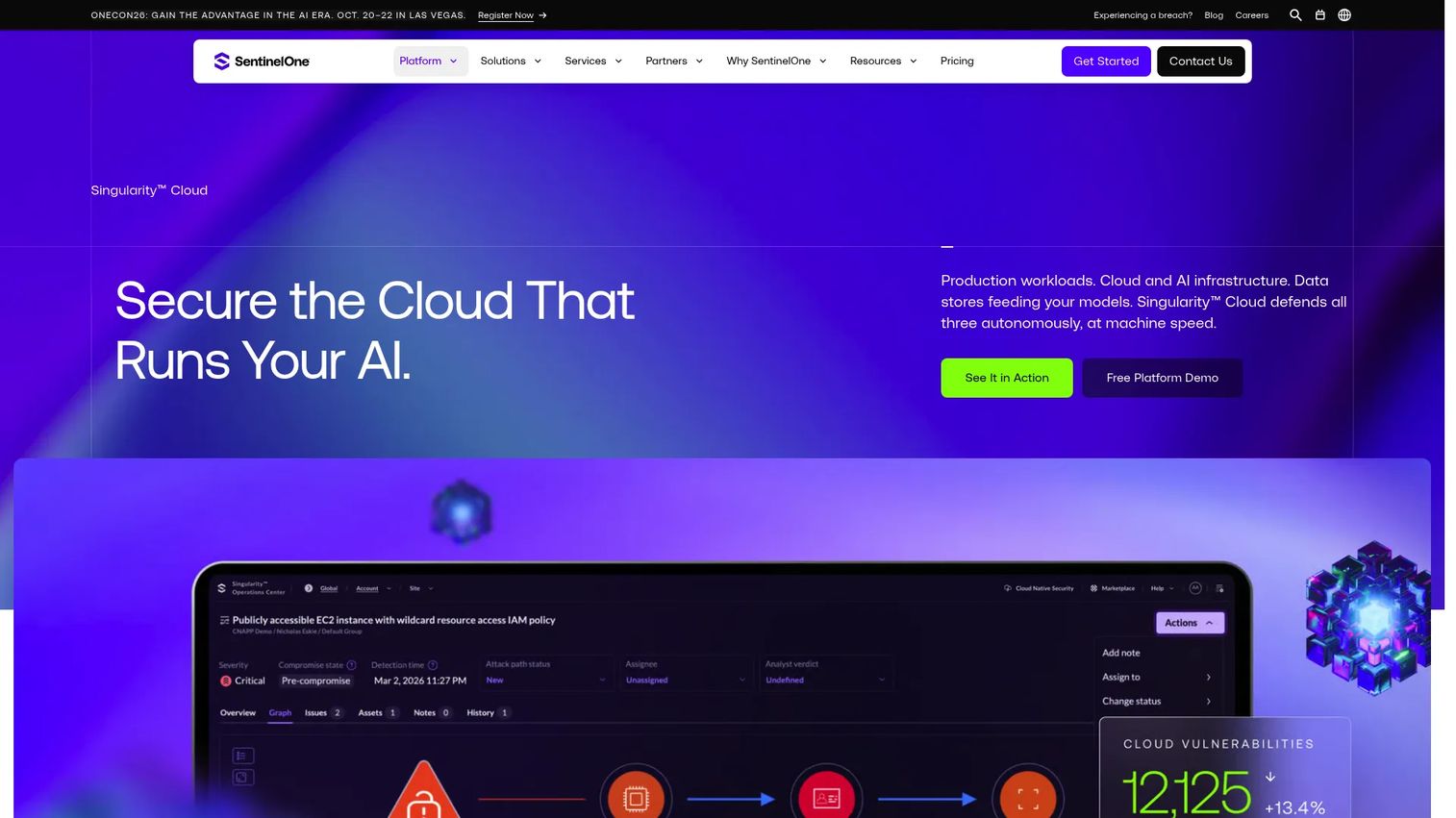
SentinelOne Singularity Cloud Security is an AI-powered CNAPP combining cloud workload protection, posture management, data security, and autonomous threat response. It uses AI to detect and contain workload threats in real time, and connects cloud security findings into the broader Singularity platform alongside endpoint and identity signals. The platform earns a 4.9/5 rating on G2, making it one of the highest-rated tools in this comparison.
Best for: SOC-led security teams that want cloud runtime defense connected to autonomous threat containment and cross-domain response.
Key features
- Cloud workload security with real-time threat detection and automated containment
- CSPM, CIEM, DSPM, and AI security posture management
- Cloud data security with AI-powered malware detection and automated quarantine
- Attack-path analysis across cloud assets and identities
- Purple AI assistant for unified investigation and security automation
Why choose SentinelOne Singularity Cloud Security: Choose it when cloud runtime defense must connect to endpoint and identity signals with minimal analyst intervention. The AI-driven containment approach reduces the time between detection and response, which matters for SOC teams managing fast-moving cloud incidents.
SentinelOne Singularity Cloud Security pricing: Dedicated cloud security pricing is custom-quoted. Contact SentinelOne for a quote covering your cloud workload scope and required capabilities.
G2 rating: 4.9/5
10. Orca Security
Orca Security uses its patented SideScanning technology to deliver agentless workload visibility across cloud environments without touching production systems or deploying agents. It discovers workloads, vulnerabilities, sensitive data, identities, misconfigurations, and attack paths from a single agentless connection. The Orca Sensor adds optional runtime protection for teams that need deeper workload telemetry after the agentless inventory phase.
Best for: Teams that need comprehensive agentless cloud workload and data risk visibility across multicloud environments.
Key features
- Agentless workload and container security via SideScanning
- Sensitive data discovery and classification across cloud storage and workloads
- Attack-path analysis connecting vulnerabilities, identities, and data exposure
- Vulnerability prioritization with contextual risk scoring
- AI asset discovery and runtime AI threat detection
Why choose Orca Security: Choose it when the first priority is a complete risk inventory before committing to agent deployment. The SideScanning approach gives a full picture of workload exposure without operational overhead, and the optional Sensor adds runtime depth when needed.
Orca Security pricing: Orca offers a single-SKU all-inclusive pricing model. Specific rates are quote-based. Contact Orca for pricing scaled to your cloud asset count.
G2 rating: 4.7/5
11. Sysdig Secure
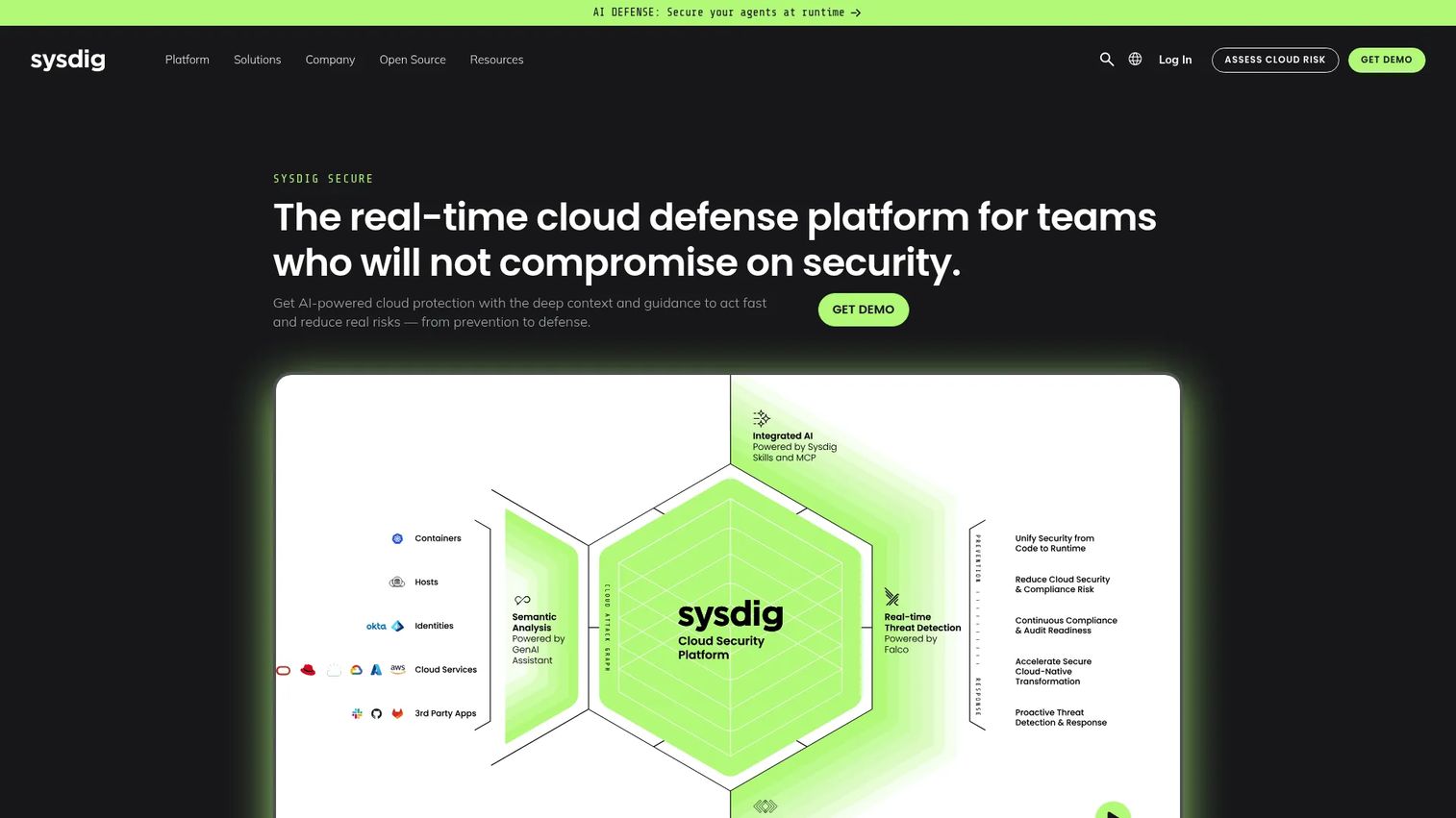
Sysdig Secure is a cloud-native application protection platform built around runtime visibility and container behavior. Its roots are in eBPF-based system call capture, giving it deep insight into what containers and Kubernetes workloads do during execution. Beyond runtime detection, Sysdig covers vulnerability management, cloud and Kubernetes posture management, CIEM, activity auditing, and an AI-powered Sage assistant for investigation.
Best for: Cloud-native teams where Kubernetes runtime security is the primary evaluation criterion, not just posture scanning.
Key features
- Kubernetes runtime detection and response using eBPF-based visibility
- Container vulnerability management and image scanning
- Cloud and Kubernetes security posture management
- CIEM with cloud identity and entitlement risk
- Cloud Attack Graph and AI-powered Sysdig Sage assistant
Why choose Sysdig Secure: Choose it when the buyer needs runtime context from actual container execution, not just pre-deployment scanning. Sysdig's detection is grounded in what workloads do at runtime, which is the layer most posture-focused tools miss.
Sysdig Secure pricing: Pricing is host-based; cloud detection and response is additionally priced by events processed. Contact Sysdig for a quote specific to your host count and log volume.
G2 rating: 4.8/5
12. Aqua Security
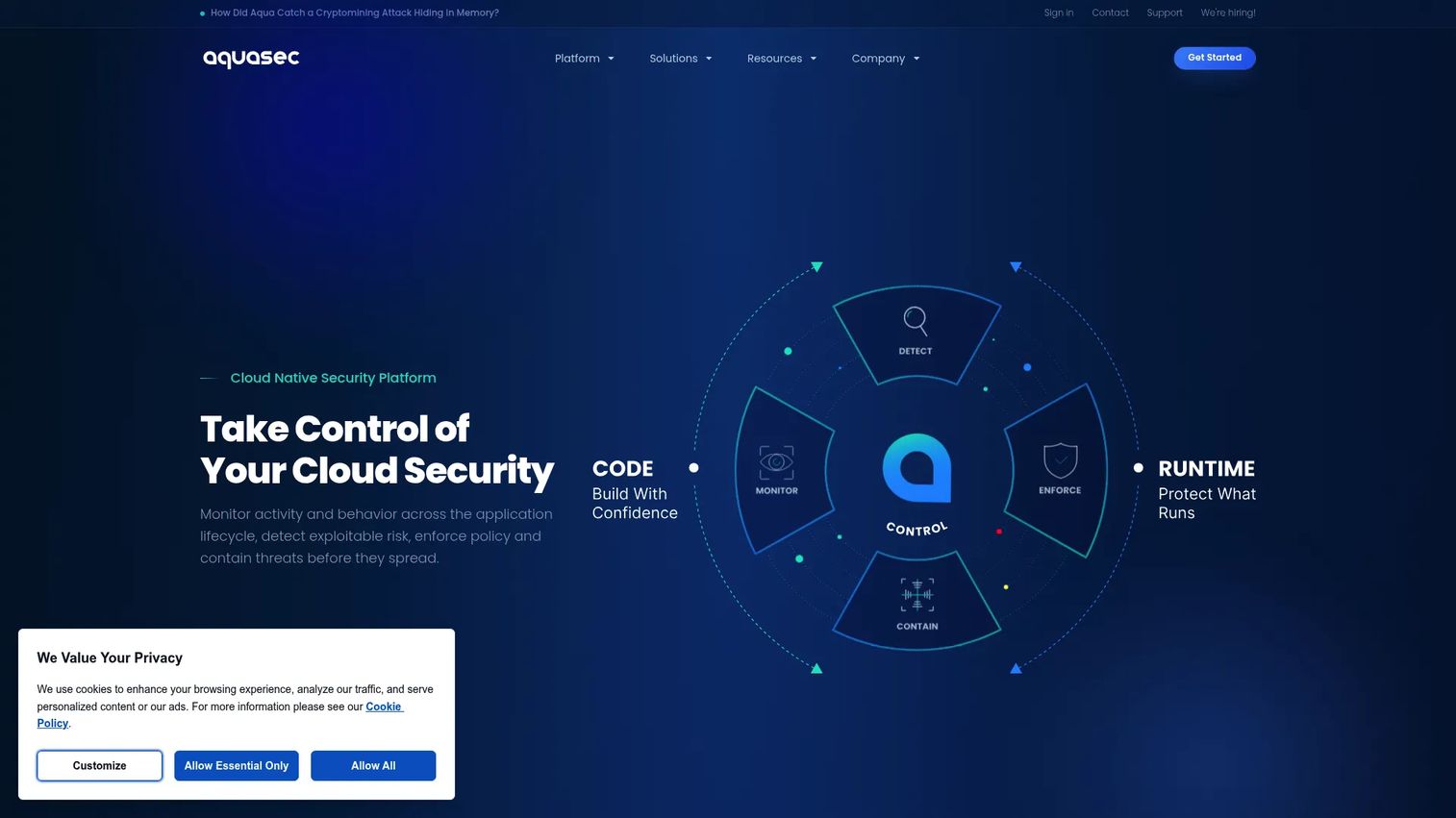
Aqua Security provides a cloud-native application protection platform with deep container lifecycle security from build through runtime. It covers image scanning, container runtime protection, Kubernetes security, CSPM, workload isolation, supply chain security, and attack-path reconstruction. Aqua is built for organizations running mature container programs that need comprehensive security controls at every stage of the container lifecycle.
Best for: Enterprise teams with complex containerized workloads and mature DevSecOps practices that need deep container lifecycle coverage.
Key features
- Container runtime protection with workload isolation and policy enforcement
- Kubernetes security with admission control and posture management
- Image vulnerability scanning and software supply chain security
- CSPM with real-time risk prioritization and compliance reporting
- Attack-path reconstruction and evidence preservation for forensic investigation
Why choose Aqua Security: Choose it when container and Kubernetes security depth matters more than a lightweight entry point. Aqua is particularly well-suited to organizations where DevSecOps teams need security controls embedded at every stage of container delivery, from the developer's local build through production runtime.
Aqua Security pricing: Pricing is workload-based. Contact Aqua for a quote reflecting your container and workload count.
G2 rating: 4.2/5
13. Tenable Cloud Security
Tenable Cloud Security is a CNAPP platform connected to Tenable's broader exposure management and vulnerability management strengths. It provides multicloud inventory, CSPM, CIEM with least-privilege enforcement, cloud workload protection covering VMs, containers, Kubernetes, and registries, cloud detection and response, IaC scanning, sensitive data discovery, and attack-path analysis. Teams already using Tenable One can add cloud coverage inside the same exposure management workflow.
Best for: Security teams building cloud workload protection around vulnerability-first and exposure management programs.
Key features
- Multicloud inventory and cloud workload protection across VMs, containers, Kubernetes, and registries
- CSPM with misconfiguration and compliance detection
- CIEM with least-privilege analysis and identity risk management
- IaC and CI/CD security scanning
- Sensitive data discovery and attack-path analysis with contextual risk prioritization
Why choose Tenable Cloud Security: Choose it when vulnerability management already drives the security program. Connecting cloud workload risk to Tenable's exposure management model means security teams don't have to maintain separate prioritization logic for cloud versus on-premises assets.
Tenable Cloud Security pricing: Pricing is based on billable resources with volume discounts. It can also be purchased through Tenable One. Contact Tenable for a quote.
G2 rating: 4.6/5
14. Qualys TotalCloud
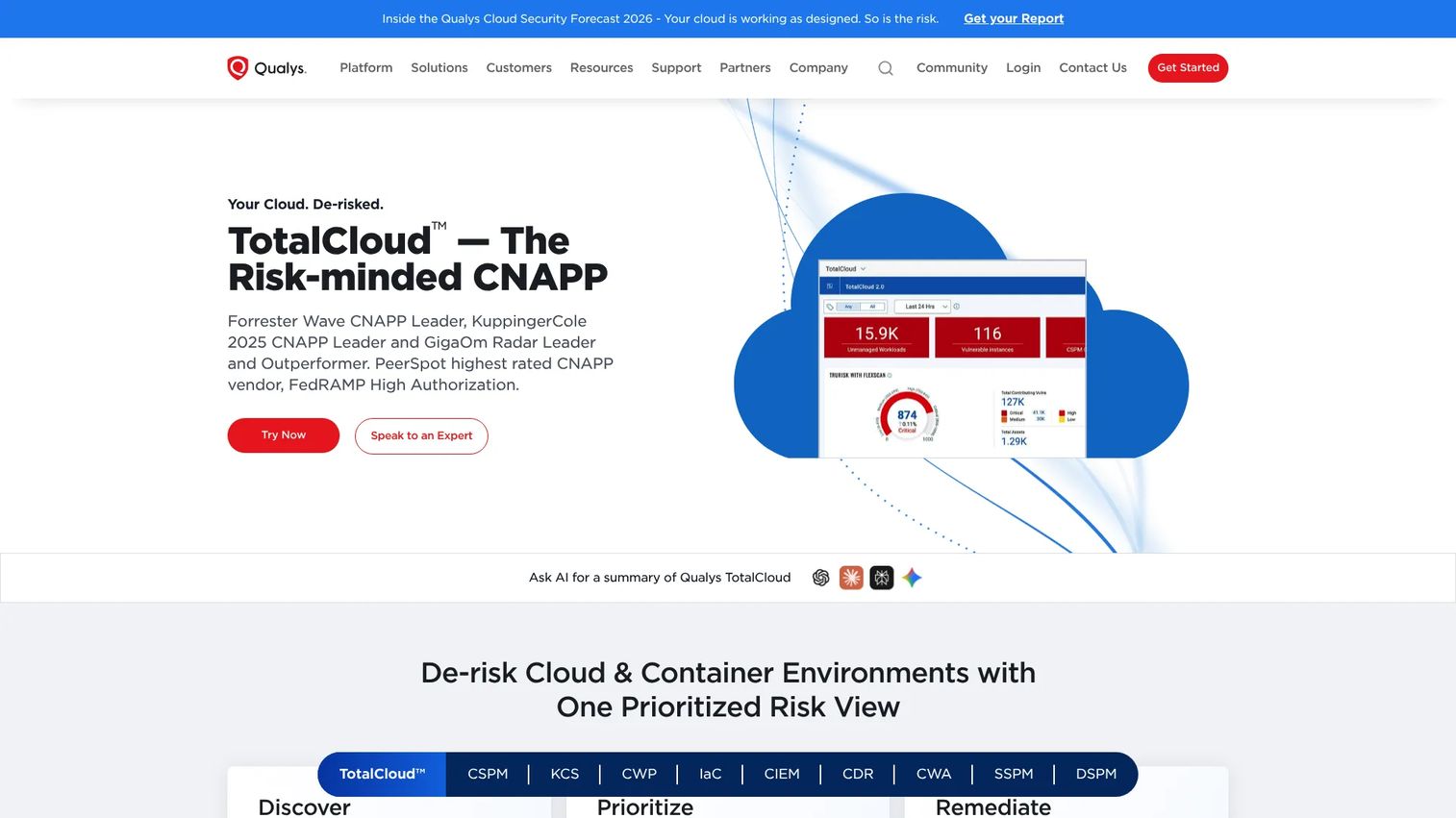
Qualys TotalCloud is a CNAPP platform within the Qualys Cloud Platform, providing unified cloud security posture management, workload protection, container security, CIEM, cloud detection and response, IaC security, SSPM, DSPM, and AI-SPM. It uses TruRisk scoring for contextual risk prioritization and FlexScan for flexible agentless, agent-based, network, and API-based assessment. Teams already using Qualys for vulnerability management can add cloud workload coverage inside the same QLU licensing model.
Best for: Teams already using Qualys for vulnerability and asset management who want cloud workload risk in the same platform and subscription.
Key features
- Unified multicloud asset visibility across AWS, Azure, GCP, and OCI
- TruRisk-based risk prioritization and attack-path analysis
- FlexScan agentless, agent-based, network, and API assessment options
- Cloud workload, container, CIEM, CDR, and AI-SPM coverage
- Automated remediation through no-code QFlow workflows
Why choose Qualys TotalCloud: Choose it when the buyer's vulnerability management program already runs on Qualys. Adding cloud workload risk inside the existing QLU model avoids introducing a separate licensing and reporting structure.
Qualys TotalCloud pricing: Pricing uses Qualys Unit (QLU) licensing and depends on selected Cloud Platform Apps, network addresses, web applications, and user licenses. Contact Qualys for a quote.
15. Snyk Cloud
Snyk Cloud is a developer-first cloud and infrastructure security product. Snyk's official documentation notes that cloud-related capabilities have been incorporated into Snyk IaC, which detects misconfigurations in Terraform, CloudFormation, Kubernetes, Helm, ARM, Kustomize, and Serverless files. It also surfaces infrastructure drift between deployed resources and their IaC definitions, and uses cloud context to prioritize or suppress findings. Snyk fits CWPP-adjacent evaluations for teams focused on shifting workload risk earlier into developer workflows.
Best for: DevSecOps teams that want to detect and fix cloud infrastructure misconfigurations before deployment, within developer-native tooling.
Key features
- IaC scanning across Terraform, CloudFormation, Kubernetes, Helm, ARM, and Serverless
- Infrastructure drift detection between live resources and IaC definitions
- Cloud-context analysis for finding prioritization and suppression
- Custom policies powered by Open Policy Agent
- IDE, CLI, source control, CI/CD, and Terraform Cloud integrations
Why choose Snyk Cloud: Choose it when developers own much of the cloud risk remediation workflow. Snyk's strength is shifting misconfiguration detection left into the tools developers already use, which reduces the remediation gap between security findings and engineering action.
Snyk Cloud pricing: A Free plan is available at no cost. The Team plan starts at $25/month. Enterprise pricing uses a credit-based model; contact Snyk for details.
G2 rating: 4.5/5
16. Rapid7 InsightCloudSec
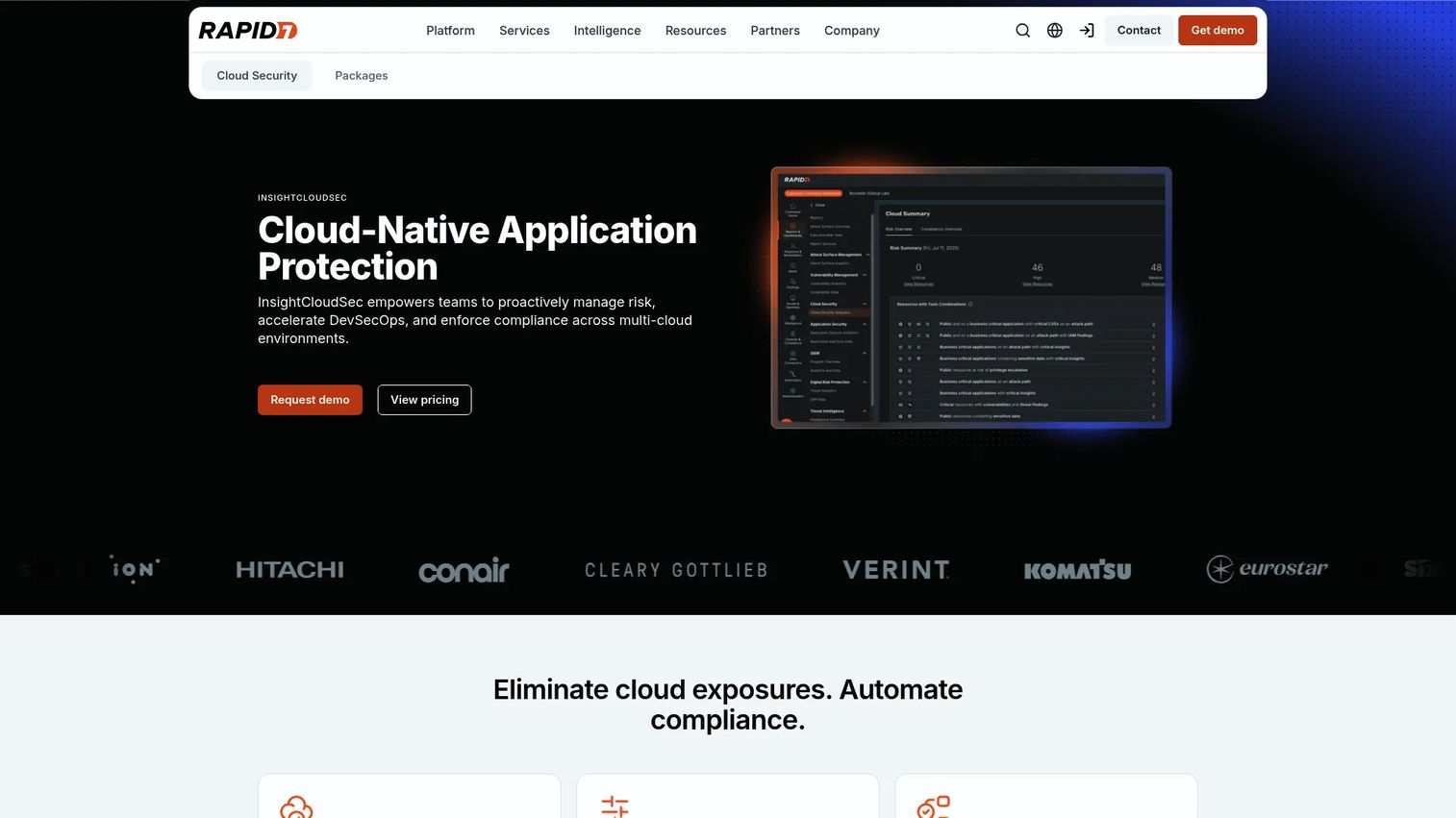
Rapid7 InsightCloudSec is a CNAPP platform providing multicloud visibility, risk-based prioritization, compliance management, CIEM, agentless vulnerability management, IaC security, and automated remediation. Its Kubernetes security posture management (KSPM) covers container environments, and no-code remediation workflows reduce the engineering overhead of fixing cloud misconfigurations at scale. Published pricing tiers make it one of the few platforms in this comparison with transparent cost information.
Best for: Cloud governance teams that need policy automation, compliance evidence collection, and workload risk visibility with a predictable pricing model.
Key features
- Real-time multicloud visibility and resource inventory
- Risk-based prioritization with sensitive data discovery
- Cloud compliance management across multiple frameworks
- CIEM with entitlement and identity risk analysis
- Kubernetes security posture management and IaC security
Why choose Rapid7 InsightCloudSec: Choose it when governance and compliance automation drive the buying decision. The published pricing model makes it easier to build an internal business case, and teams already using Rapid7 for security operations can connect cloud risk into existing workflows.
Rapid7 InsightCloudSec pricing: Pricing is consumption-based on the average number of billable resources monitored. Plans start at $66,000/year for 251 to 500 billable resources and scale to $438,000/year for 3,001 to 5,000 resources. Environments above 20,000 resources are negotiated. No free tier is listed.
Considerations when choosing cloud workload protection platforms
Workload coverage
Start by mapping what your organization runs today: Virtual machines, containers, Kubernetes clusters, serverless functions, or bare metal. Then check which workload types each platform covers and how it handles ephemeral workloads that autoscale and disappear quickly. A platform that covers your current environment but not your planned Kubernetes migration will create gaps within 12 months.
Agentless versus agent-based deployment
Agentless scanning provides fast inventory without touching workloads, making it ideal for initial visibility phases or environments where agent deployment is constrained. Agent-based protection gives deeper runtime telemetry, behavioral signals, and lower-latency detection, but requires a rollout plan and ongoing maintenance. Many platforms now offer both, so the practical question is which model you start with and how you phase in agents for high-risk workloads.
Runtime detection and response
Evaluate how each platform detects suspicious process behavior, file integrity changes, lateral movement, privilege escalation, and active exploitation. Confirm whether alerts flow into your existing SIEM, SOAR, EDR, XDR, or ticketing workflows. A CWPP that produces alerts without connecting to your response infrastructure creates a detection gap that analysts have to manually bridge.
Risk prioritization
A useful CWPP prioritizes vulnerabilities by exploitability, internet exposure, sensitive data access, identity privileges, and actual runtime activity. Ask vendors to show you how they rank findings against a real workload set during your POC. Platforms that surface only raw CVE counts without context force security teams to build their own prioritization logic, which most teams don't have capacity to maintain.
Compliance and governance
For teams managing compliance against PCI DSS, HIPAA, GDPR, or CIS Benchmarks, evaluate the quality of compliance mapping, evidence collection, and reporting. Confirm that the platform monitors continuously rather than producing point-in-time snapshots, and that it detects configuration drift between audit cycles. No tool makes an organization compliant by itself; the platform's role is to collect evidence, flag deviations, and support the controls the organization must demonstrate.
Conclusion
The right cloud workload protection platform depends on your workload mix, operating model, and whether CWPP is a standalone need or part of a broader CNAPP consolidation.
For Microsoft-centric enterprises, Defender for Cloud connects workload protection to the security stack already in place. Teams that need fast agentless visibility across multicloud environments should evaluate Wiz or Orca Security. CrowdStrike Falcon Cloud Security suits detection-led teams that want cloud and endpoint findings in the same workflow. Sysdig Secure and Aqua Security cover organizations where Kubernetes and container runtime depth is non-negotiable. Tenable Cloud Security and Qualys TotalCloud make sense when vulnerability management already anchors the program. Rapid7 InsightCloudSec offers transparent pricing for governance-led programs.
Pick 3 vendors and test each against the same workload set. Start with your highest-risk assets: Internet-facing virtual machines, privileged Kubernetes workloads, production containers, and serverless functions touching sensitive data. The best CWPP is the one your security team can deploy, understand, and act on before the next workload changes.
For presales and sales engineering teams supporting cloud security evaluations, our guide to application security testing software and the AI security posture management tools roundup cover adjacent categories that often appear in the same RFP. You can also explore our best presales software tools guide for building the broader presales stack around evaluations like this one.
FAQs
A cloud workload protection platform is a security tool that protects workloads running in cloud and hybrid environments, covering virtual machines, containers, Kubernetes clusters, serverless functions, and ephemeral workloads. CWPP tools provide runtime threat detection, vulnerability management, behavioral analysis, and policy enforcement for workloads that perimeter security cannot see. Most modern CWPP tools ship as part of broader CNAPP platforms.
CWPP stands for cloud workload protection platform. The term refers to tools designed to secure workloads running in cloud, hybrid, and multicloud environments, addressing the security gaps that emerge when workloads scale, move, and change faster than traditional security controls can track.
CWPP protects workloads themselves, focusing on runtime threats, vulnerabilities, and behavioral anomalies inside running workloads. Cloud security posture management (CSPM) focuses on cloud account configuration, policy compliance, and misconfiguration risk at the infrastructure level. Many CNAPP platforms include both, but the two capabilities address different attack surfaces: CSPM catches configuration drift, while CWPP catches what happens at runtime.
CWPP is one pillar inside CNAPP, not the full platform. A cloud native application protection platform (CNAPP) typically combines CWPP with CSPM, CIEM, code security, IaC scanning, and sometimes data security posture management. Buyers evaluating CWPP often end up comparing full CNAPP platforms because most vendors have moved to that broader packaging model.
Agent-based protection and agentless scanning serve different purposes. Agentless scanning provides fast inventory and vulnerability visibility without deployment overhead, making it practical for initial phases or restricted environments. Agents deliver deeper runtime telemetry, lower-latency detection, and behavioral signals that agentless tools miss. Many platforms now support both models, letting teams start agentless and add agents to high-risk workloads over time.
Priority workloads include internet-facing virtual machines, privileged Kubernetes pods, production containers handling customer data, serverless functions that process sensitive inputs, and container images in registries used by production pipelines. Beyond those, any workload with access to databases, secrets stores, or identity systems warrants coverage. Ephemeral and autoscaling workloads deserve particular attention because they appear and disappear before manual controls can respond.
CWPP tools support compliance programs by monitoring controls continuously, detecting configuration drift between audits, mapping findings to specific frameworks such as CIS Benchmarks, PCI DSS, HIPAA, or GDPR, and generating evidence for audit cycles. Compliance still depends on the organization's policies, architecture decisions, and operational procedures. A CWPP collects evidence and surfaces deviations; it does not substitute for the controls themselves.
Before scoping a POC, presales teams should confirm the buyer's workload mix (VMs, containers, Kubernetes, serverless), which cloud providers are in scope, runtime detection requirements, compliance frameworks they report against, deployment constraints around agents, and integration requirements with existing SIEM, EDR, XDR, or ticketing tools. Understanding whether the buyer wants a standalone CWPP or is evaluating a full CNAPP replacement shapes which platforms belong on the shortlist and which capabilities to demonstrate first. For buyers with hybrid environments, 82% of organizations operate hybrid setups according to a 2025 Tenable and Cloud Security Alliance report, so multicloud policy consistency is often a decisive evaluation factor.