Every finance meeting at a growing apparel brand eventually hits the same wall. Someone asks for margin by style. Someone else asks how much cash is tied up in inventory across the three warehouses. A third person wants to know why wholesale allocation and the Shopify storefront sold the same units last week.
Nobody trusts the number. And the founder ends up in the middle of it.
That is the operational reality for most apparel brands past the spreadsheet stage. The global apparel software market reached $4.8 billion in 2025 and is projected to grow to $9.2 billion by 2033, according to Dataintelo (2025). The growth reflects a simple pressure: Fashion businesses that scale past a handful of SKUs and one sales channel cannot run on manual reconciliation. Yet only 17% of fashion and retail survey respondents had ERP fully integrated across all departments, according to Rizing (2025).
This guide covers 12 apparel software tools selected for their operational fit across different business models: Wholesale-first brands, DTC operators, manufacturers, retailers, and ecommerce-led businesses.
What's inside
This guide is for apparel founders, operations leaders, finance leads, and supply chain managers evaluating software to replace disconnected spreadsheets, Shopify apps, and manual purchase order workflows. Tools were selected based on:
- Apparel-specific workflow coverage (style, color, size matrix; seasonal planning; BOMs; vendor management)
- Inventory and order management depth across wholesale, ecommerce, retail, and 3PL channels
- Pricing transparency and review signal quality from G2 and Capterra
- Operating model fit for brands at different stages: Startup, growth, and enterprise
TL;DR
- Best all-in-one apparel suite: ApparelMagic covers ERP, PLM, CRM, inventory, and order management for growing fashion brands
- Best for wholesale, DTC, and EDI depth: AIMS360 handles omnichannel complexity including 350+ retailer EDI connections
- Best for finance-led scale: NetSuite brings board-grade financial visibility and multi-entity operations
- Best for apparel manufacturing and PLM: PolyPM for production-first manufacturers; BlueCherry for established brands needing broader operations
- Best for focused inventory or forecasting needs: Fishbowl for inventory control; Inventory Planner for replenishment and demand signals
- Best for Magento retailers: Magestore is the obvious choice if Magento is your commerce backbone
What is apparel software?
Apparel software is business software built to manage fashion-specific workflows: Style, color, size inventory, seasonal collections, production, purchase orders, wholesale orders, ecommerce channels, PLM, and financial reporting.
Generic inventory or ERP systems can cover simple SKU businesses. Apparel brands multiply complexity fast. A brand with 200 styles, 8 sizes, 6 colors, three sales channels, and multiple warehouses creates a volume of SKU combinations and allocation decisions that breaks tools built for simpler product catalogs.
Core apparel software categories
- Apparel ERP: Integrates financials, inventory, order management, production, and reporting
- Apparel management software: Broader category covering operations and business workflows
- Inventory management: Tracks stock by style, color, size, location, and channel
- Order management: Handles wholesale, retail, ecommerce, and marketplace orders
- Fashion PLM software: Manages product lifecycle from concept through production
- Apparel production management software: BOMs, vendor purchase orders, WIP, and sampling
- Demand planning: Forecasting, replenishment, and open-to-buy planning
- POS and retail operations: Store sales, customer profiles, and multi-location inventory
- Ecommerce operations: Order routing, fulfillment, and channel sync
- Warehouse and 3PL management: Bin locations, picking, cycle counts, and fulfillment workflows
Key capabilities to look for
- Style, color, size matrix support with attribute-level inventory tracking
- Seasonal collection planning and open-to-buy budgets
- BOMs, tech packs, and costing at the style level
- Vendor purchase orders and WIP tracking across production stages
- Wholesale and B2B order portals
- Shopify, Amazon, and marketplace integrations
- EDI for apparel brands with retailer compliance workflows
- Multi-warehouse and 3PL inventory management
- Landed cost visibility and margin reporting by style
- Forecasting and automated replenishment
What apparel software is not
A generic inventory tool built for simple SKUs won't handle size runs, colorways, or wholesale allocations without significant workarounds. Apparel software is purpose-built for category complexity. Once a brand passes a few dozen active styles across multiple channels, fit-for-category workflows stop being a nice-to-have.
When to use apparel software
Replace spreadsheets before inventory becomes a board issue
Spreadsheets break when size runs, colorways, multiple warehouses, and DTC returns all hit at once. Wholesale allocations conflict with ecommerce picks. Return rates by size aren't trackable. When the board asks for working capital tied up in inventory and the answer requires a two-day reconciliation exercise, that's the signal. Software handles style-level inventory visibility automatically.
Coordinate production across vendors and seasons
BOMs, purchase orders, samples, approvals, and WIP tracking all live in email until they don't. Missed vendor deadlines are cash and revenue problems: A late seasonal delivery means markdowns or stockouts, not just a scheduling inconvenience. Production management software creates a visible workflow that an operations leader can own without daily founder escalation.
Connect wholesale, ecommerce, retail, and fulfillment
The real cost of disconnected systems isn't duplicate data entry. It's selling inventory on Shopify that's already committed to a wholesale order, or shipping from the wrong warehouse because the 3PL and the order management system don't agree. Integrated apparel ERP software prevents channel conflicts and removes the manual reconciliation step that currently sits inside finance and ops.
Apparel software comparison
The table below reflects pricing and G2 ratings from vendor pricing pages and live G2 listings. Use it as a starting point for shortlisting, not a final procurement decision. Several tools in this category price by quote or by user count, module selection, and implementation scope.
| # | Product | Best for | Key differentiator | Pricing | G2 rating |
|---|---|---|---|---|---|
| 1 | ApparelMagic | Growing fashion brands | All-in-one apparel ERP with PLM, CRM, and B2B ecommerce | From $337/mo (annual) | 4.9/5 |
| 2 | AIMS360 | Wholesale and omnichannel apparel brands | 350+ retailer EDI, Shopify, production, and accounting | $0/mo first year (Bronze offer) | N/A |
| 3 | NetSuite | Finance-led mid-market and enterprise | Cloud ERP with financials, demand planning, and multichannel operations | Custom pricing | 4.1/5 |
| 4 | PolyPM | Apparel manufacturers | Unified ERP and PLM on a single database for production | Custom pricing | 4.0/5 |
| 5 | Fishbowl | Inventory-first small and mid-market teams | Inventory, warehousing, manufacturing, and QuickBooks sync | From $229/mo (annual) | 4.0/5 |
| 6 | Lightspeed Retail | Apparel retailers with physical stores | POS-first retail with inventory and customer profiles | From $89/mo (monthly) | N/A |
| 7 | SAP S/4HANA Cloud | Large enterprises with global operations | Enterprise ERP depth for complex finance, manufacturing, and supply chain | Custom pricing | 4.4/5 |
| 8 | BlueCherry | Established fashion brands | End-to-end apparel suite: ERP, PLM, warehouse, EDI, and BI | Custom pricing | 4.0/5 |
| 9 | Techpacker | Design and product development teams | Tech packs, BOMs, supplier collaboration, and version control | From $35/user/mo (annual) | 4.5/5 |
| 10 | Inventory Planner | Forecasting and replenishment-focused teams | Demand forecasting, automated purchasing, and multi-location planning | Custom pricing | 4.5/5 |
| 11 | Xentral Software | Ecommerce-heavy apparel brands | ERP for order management, warehouse, and marketplace connectivity | From €99/mo | 4.8/5 |
| 12 | Magestore | Magento-centered apparel retailers | Native Magento POS with real-time inventory sync | From $69/mo | 5.0/5 |
Best 12 apparel software tools for 2026
1. ApparelMagic
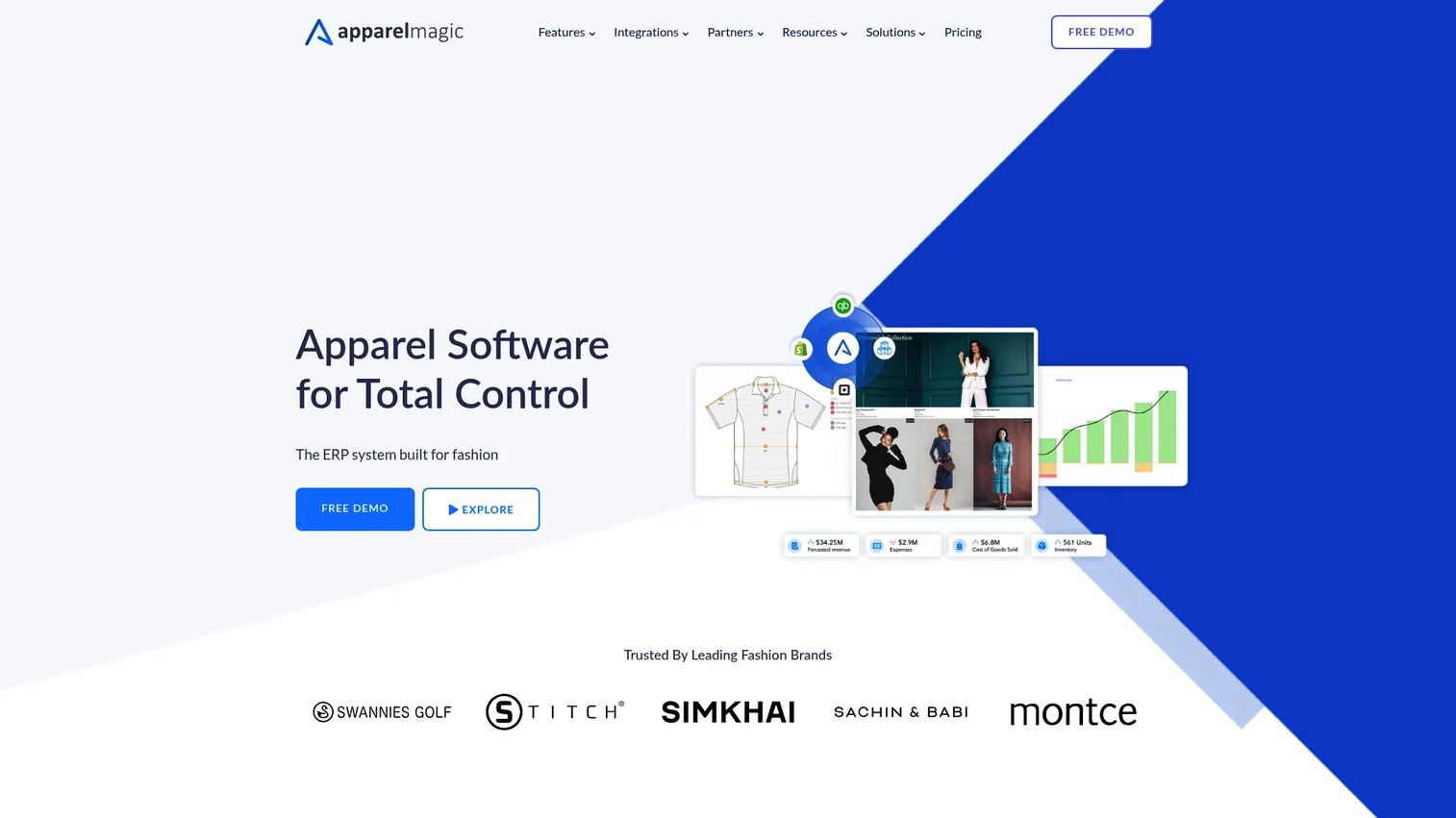
ApparelMagic is cloud-based ERP and business management software built specifically for fashion and apparel. It covers inventory management, PLM, order management, manufacturing, financials, and B2B ecommerce in a single system. The platform is built for brands that want an apparel-native operating system rather than a generic ERP customized to fit fashion workflows.
Best for: Growing apparel brands that need ERP, PLM, CRM, inventory, and order management without stitching together separate tools.
Key features
- Fashion ERP with inventory tracking by style, color, and size
- Product lifecycle management and product data management
- Order and sales management across wholesale and DTC channels
- B2B ecommerce portal for wholesale buyers
- Forecasting and multi-currency support
Why choose ApparelMagic: The breadth of coverage across product, sales, inventory, and operations means fewer integration dependencies. When operations leaders need to answer a board question about margin by style or working capital by season, the data lives in one place. It fits brands that have outgrown spreadsheets but aren't ready for enterprise ERP complexity.
ApparelMagic pricing: Plans start at $337 per month billed annually (Professional), with Enterprise at $655 per month annually. Monthly payment with annual commitment options are available at slightly higher rates. Ultimate tier pricing is custom. A 30-day money-back guarantee is advertised on the pricing page.
G2 rating: 4.9/5
2. AIMS360
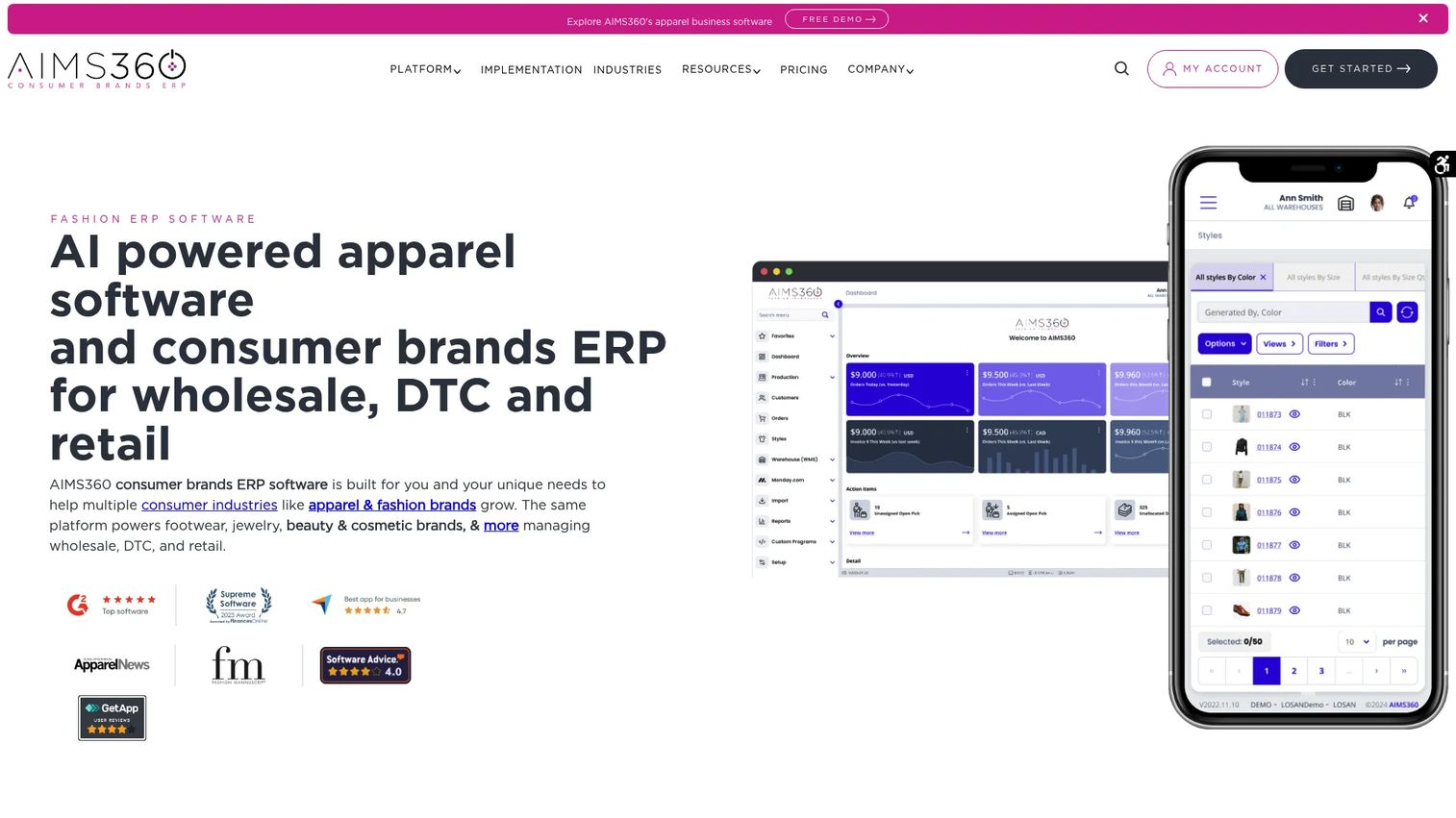
AIMS360 is a cloud ERP for apparel and consumer brands covering wholesale, DTC, retail, ecommerce, production, warehouse, fulfillment, payments, accounting, and retailer EDI. It supports AI-assisted ERP workflows alongside its core operations stack. The platform targets brands managing serious channel complexity rather than simple single-channel businesses.
Best for: Apparel brands with wholesale, Shopify, marketplace, and retailer EDI complexity that need a single system across production, inventory, and accounting.
Key features
- Built-in EDI for 350+ retailers
- Shopify and marketplace integrations
- Production and costing with vendor purchase orders and WIP tracking
- Warehouse management with bin locations, handheld scanning, and cycle counts
- Accounts receivable, invoicing, chargebacks, and payments
Why choose AIMS360: The EDI depth is the standout for wholesale-heavy brands. Brands managing dozens of retailer compliance requirements find that a system with 350+ native EDI connections removes a significant manual overhead. For founders trying to stop channel exceptions from routing through operations leadership, this is the option to evaluate first.
AIMS360 pricing: A promotional Bronze plan offers $0 per month for the first 12 months for new customers signing by December 31, 2026, under a 24-month agreement. Standard Bronze, Silver, and Gold pricing requires a quote. Plans differ by minimum user count: 3, 5, and 10 respectively. Billed quarterly for Silver and Gold.
3. NetSuite
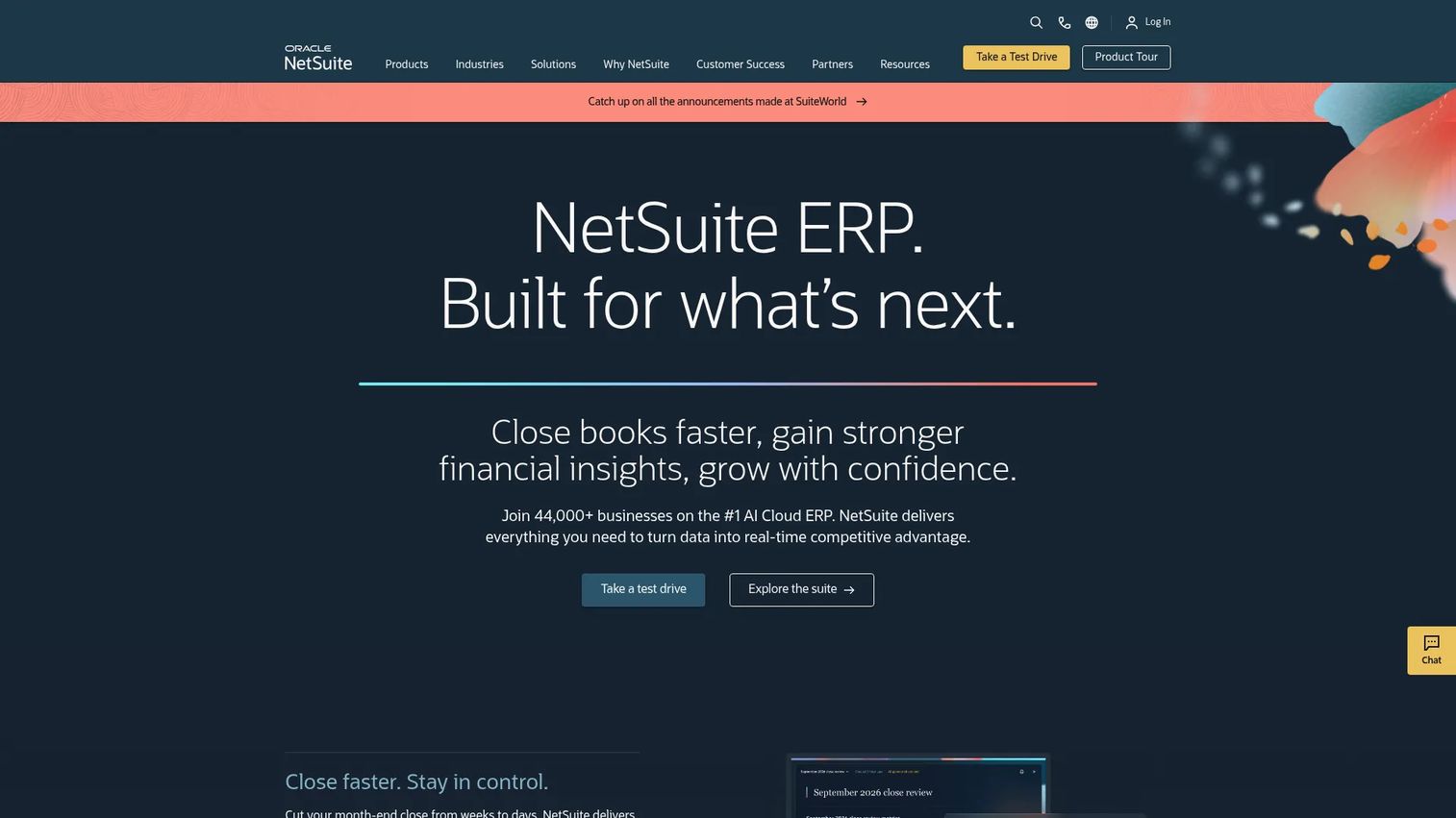
NetSuite is a cloud-based, AI-powered ERP covering financial management, inventory, order management, supply chain, CRM, commerce, and analytics. It serves mid-market and enterprise businesses across industries, including apparel and retail. For finance leaders who need board-grade reporting, multi-entity management, and tight operational controls, NetSuite is the most common path.
Best for: Finance-led apparel businesses that need strong reporting, entity-level controls, and operations inside a broader ERP rather than a fashion-native system.
Key features
- Financial management and accounting with multi-entity support
- Inventory, supply chain, and warehouse management
- Demand planning and order management
- Multichannel commerce and fulfillment
- Embedded AI across finance and operations workflows
Why choose NetSuite: The finance reporting depth is unmatched at this price tier. When a board or investor asks for margin by channel, landed cost trends, or working capital burn by product category, NetSuite answers those questions without a separate BI tool. Apparel-specific workflows like style-color-size matrices require configuration, so implementation planning matters.
NetSuite pricing: Standard pricing is customized by user count, modules, and implementation scope. NetSuite QuickStart is available free for eligible early-stage U.S. technology startups. For most apparel brands, expect a quoted annual license plus a one-time implementation fee.
G2 rating: 4.1/5
4. PolyPM
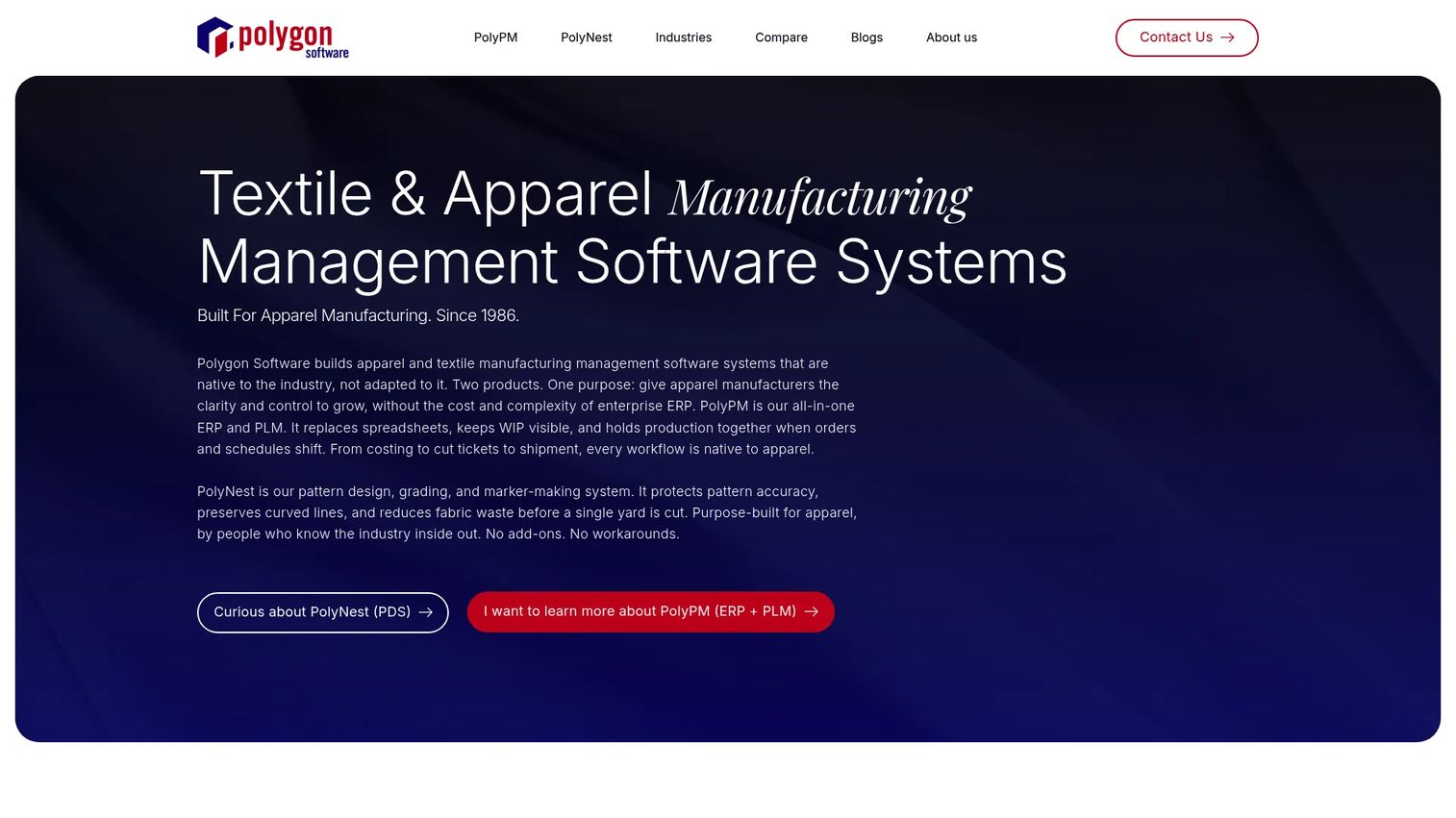
PolyPM is an apparel and textile manufacturing ERP and PLM platform combining product data, production, inventory, costing, and shipping workflows in a single database. It covers style and BOM management, colorway and artwork management, production and bundle-level WIP tracking, cut planning, and retailer compliance workflows. Screen-printing, embroidery, and sublimation production are supported natively.
Best for: Apparel manufacturers and textile teams where production workflows are the core business problem, not just an adjacent concern.
Key features
- Unified ERP and PLM on a single database
- Production and bundle-level WIP tracking
- Style, BOM, colorway, artwork, and tech-pack management
- Cut planning integration
- Order, packing, shipping, and retailer-compliance workflows
Why choose PolyPM: Production cannot live in email once delivery dates drive revenue. PolyPM is built for teams where the manufacturing floor, the purchasing department, and the product development team need to share one source of truth. It's a stronger fit for manufacturers than for wholesale or DTC operators whose primary problem is channel management.
PolyPM pricing: Contact PolyPM directly for a quote.
G2 rating: 4.0/5
5. Fishbowl
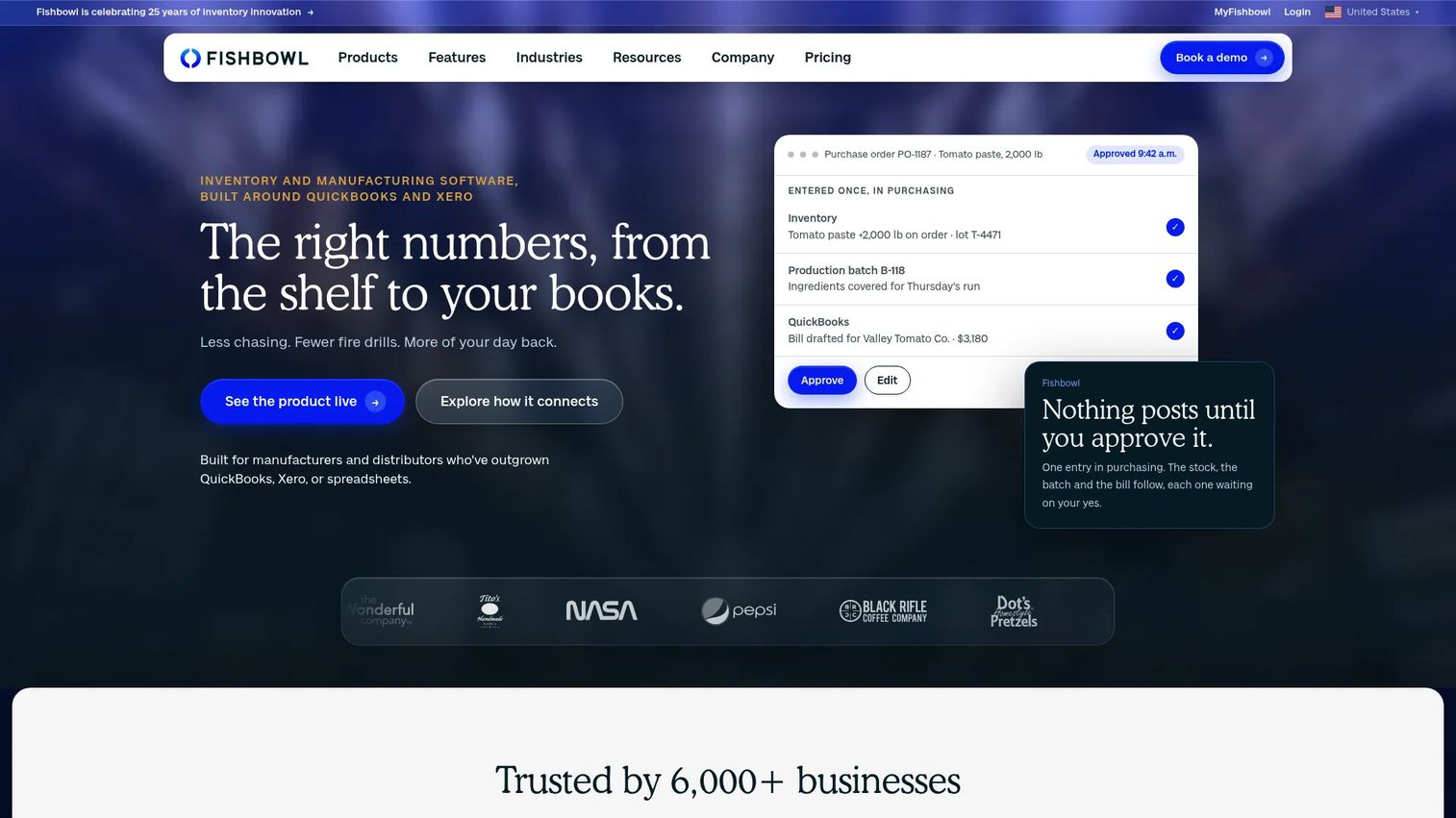
Fishbowl is cloud inventory, warehousing, manufacturing, and order management software for businesses that make, move, and sell physical products. It integrates directly with QuickBooks Online and Xero, making it a practical option for smaller apparel teams already running their accounting in those platforms. Multi-warehouse workflows, barcode scanning, bill of materials, and automated reorder points are all supported.
Best for: Smaller apparel teams that need inventory control before they're ready for a full apparel ERP.
Key features
- Real-time inventory and SKU tracking by location
- Mobile barcode scanning for pick, receive, and ship workflows
- QuickBooks Online and Xero synchronization
- Bill of materials, MRP, and work orders
- Lot traceability and reorder point automation
Why choose Fishbowl: When the immediate problem is inventory accuracy and the accounting is already in QuickBooks, Fishbowl closes the gap without a full ERP migration. Apparel-specific PLM and style-color-size matrix workflows will require configuration or additional tools, so treat this as an inventory-first solution rather than a complete apparel management software replacement.
Fishbowl pricing: The Essentials plan starts at $229 per month billed annually. Growth is $429 per month and Scale is $729 per month, both billed annually. Advanced Warehouse and Advanced Manufacturing plans start at $595 and $675 per month respectively, priced by user count and deployment configuration.
G2 rating: 4.0/5
6. Lightspeed Retail
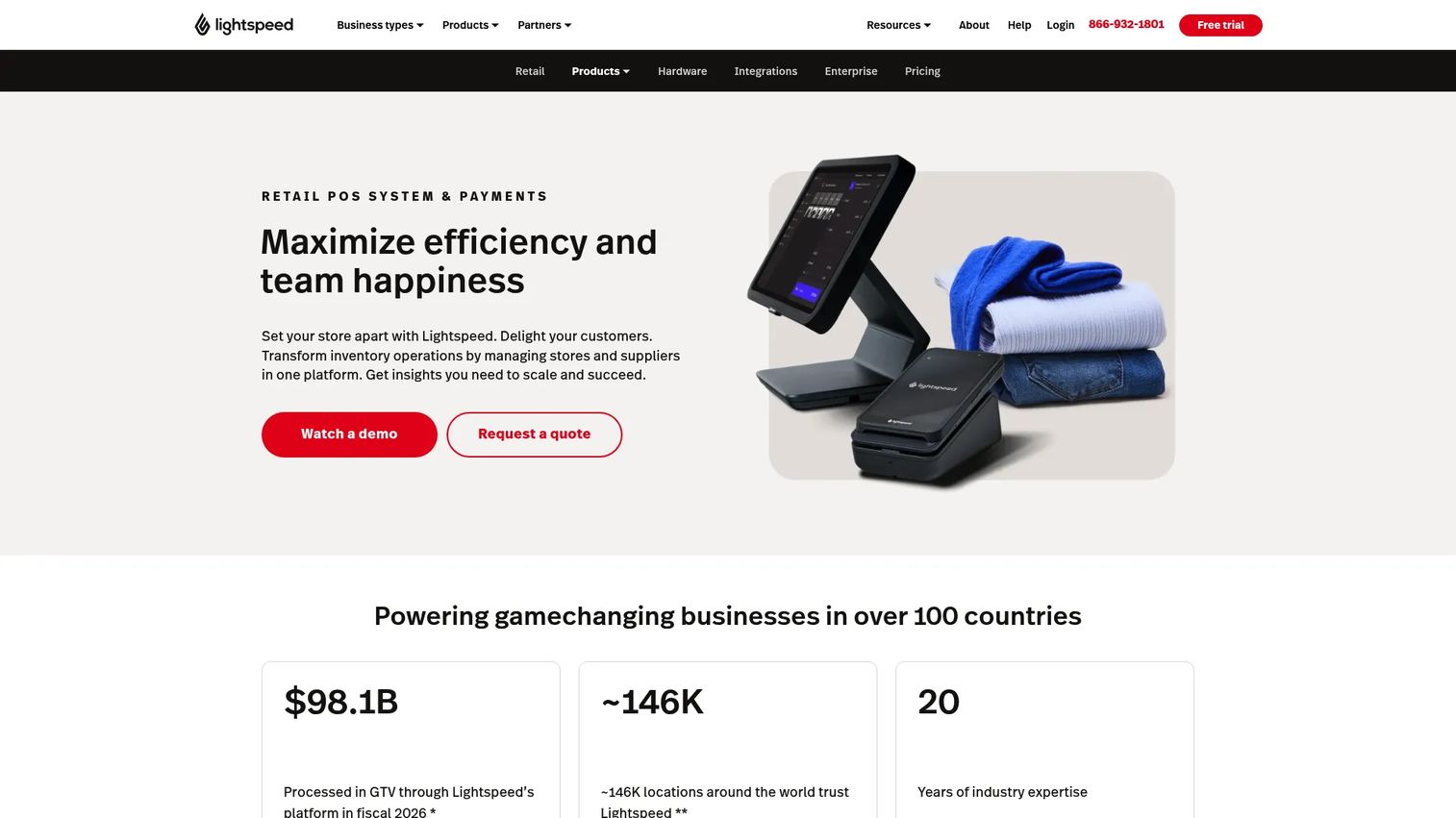
Lightspeed Retail is a cloud-based retail POS and commerce platform for managing sales, inventory, payments, customers, reporting, and online channels. It fits multi-location apparel retailers that need POS-first operations with solid inventory tracking and customer profiles. Ecommerce integration is supported alongside the core in-store workflow.
Best for: Apparel retailers with physical stores that need a POS system with multi-location inventory management as the primary workflow.
Key features
- Retail POS with multi-location inventory and stock transfers
- Integrated payments supporting multiple payment methods
- Customer profiles and loyalty program support
- Sales and product reporting by location, employee, and promotion
- Ecommerce channel support
Why choose Lightspeed Retail: The trade-off is clear: Lightspeed is excellent for store-led operations and weak for complex apparel production, wholesale, or PLM workflows. If your primary problem is running stores well and tracking inventory across locations, it fits. If you also need vendor management, production tracking, or wholesale order management, you'll need additional tools.
Lightspeed Retail pricing: Basic starts at $89 per month, Core at $149 per month, and Plus at $289 per month.
7. SAP S/4HANA Cloud
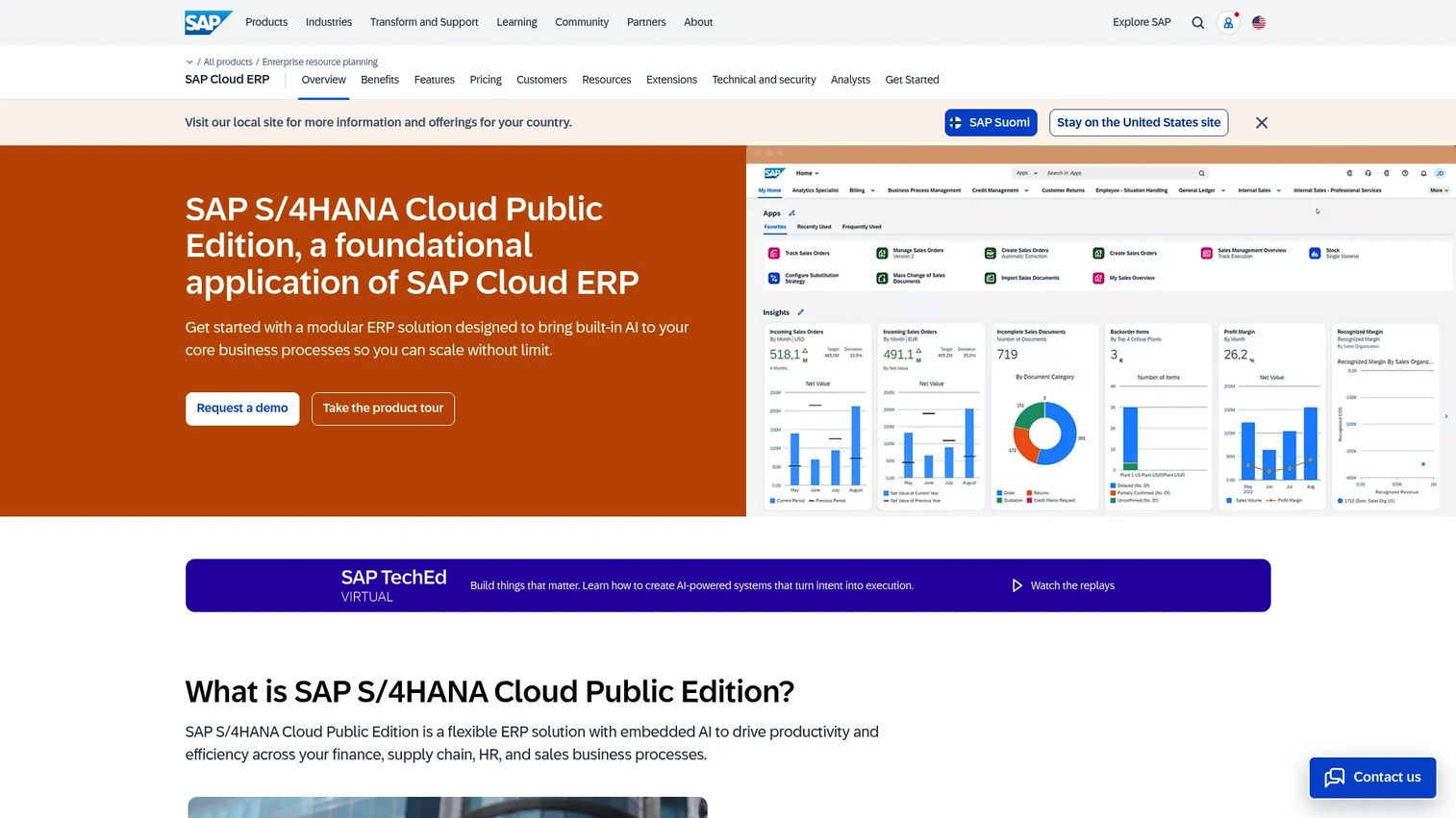
SAP S/4HANA Cloud is enterprise resource planning software with real-time processing, embedded AI, analytics, and integrated business processes across finance, supply chain, sales, HR, manufacturing, procurement, and service management. It serves large organizations with complex global operations, mature IT resources, and serious governance requirements.
Best for: Large apparel enterprises with global entities, complex procurement, and internal IT capacity to own implementation and ongoing configuration.
Key features
- Enterprise ERP with finance, supply chain, and manufacturing coverage
- Embedded AI and machine learning across business processes
- Real-time analytics and reporting
- Ready-to-go APIs and extensibility framework
- Data migration tooling from legacy systems
Why choose SAP S/4HANA Cloud: This is the serious enterprise transformation option, not a quick fix. Implementation demands executive sponsorship and strong internal ownership. For global apparel businesses running complex multi-entity finance, international procurement, and manufacturing across regions, SAP provides depth that mid-market tools cannot match. It's not the right evaluation for a brand under $50M in revenue without a dedicated IT leader.
SAP S/4HANA Cloud pricing: Contact SAP for a quote.
G2 rating: 4.4/5
8. BlueCherry
BlueCherry is an end-to-end supply chain and business management platform for fashion, apparel, footwear, retail, and consumer lifestyle companies. It covers ERP, PLM, manufacturing execution, AI-assisted planning, warehouse management, B2B wholesale, and EDI in a connected suite. BlueCherry fits established brands that need depth across product, supply chain, and channels and can support a larger implementation.
Best for: Established fashion brands needing integrated apparel ERP, PLM, warehouse, EDI, and business intelligence across a mature operation.
Key features
- Fashion ERP and PLM combined in one platform
- Manufacturing execution and shop-floor control
- AI-assisted demand forecasting and inventory optimization
- B2B wholesale portal and EDI workflows
- Supply chain and warehouse management with BI reporting
Why choose BlueCherry: The operational maturity required to get full value from BlueCherry is real. Brands with the staff and processes to run end-to-end apparel operations will find the coverage matches their complexity. For brands still building out their operations team, the implementation scope warrants careful planning.
BlueCherry pricing: Contact BlueCherry for a quote.
G2 rating: 4.0/5
9. Techpacker
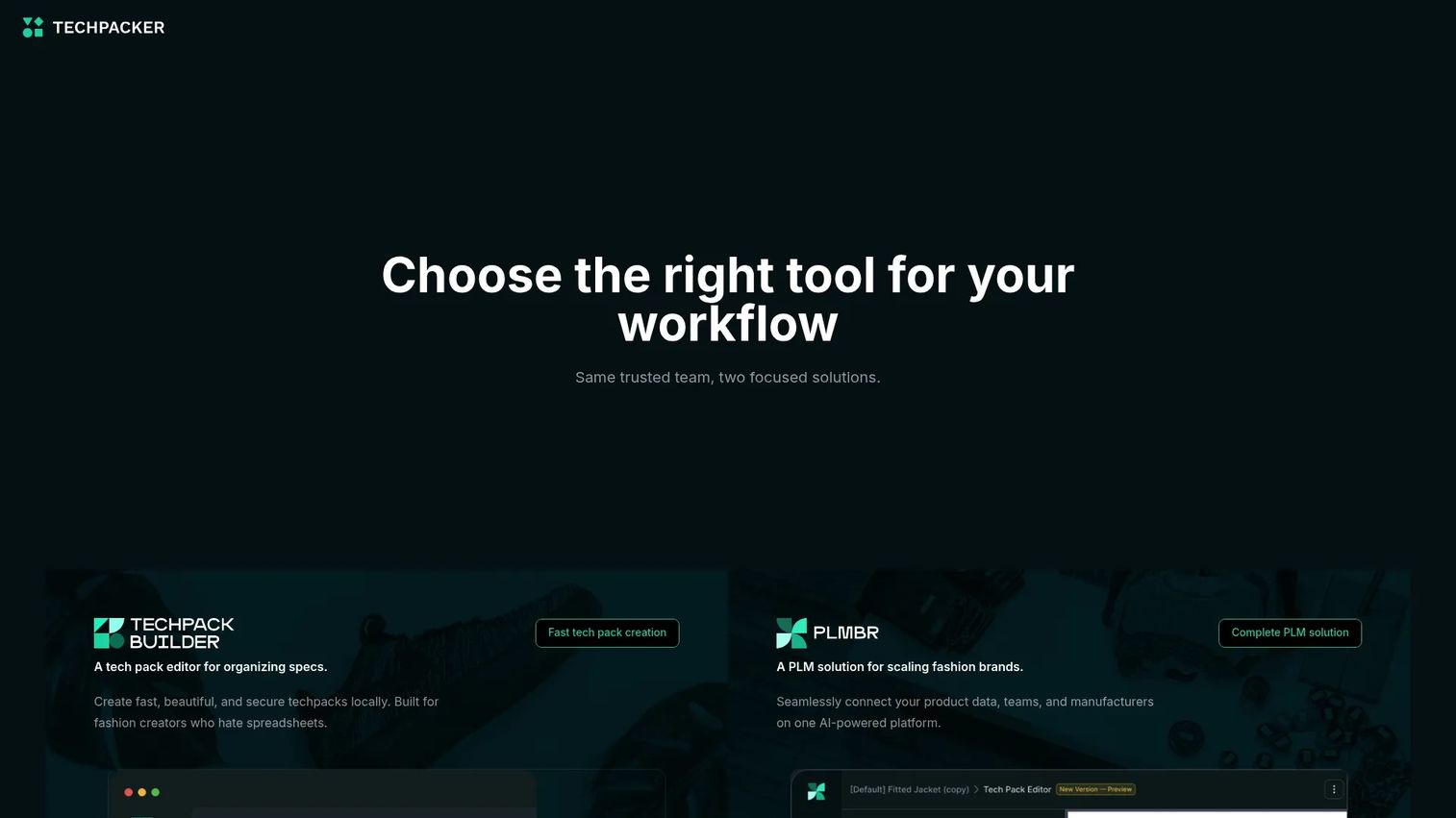
Techpacker is an online platform for creating, managing, and sharing fashion product tech packs and coordinating product development. It supports reusable smart-card libraries for sketches, materials, and measurements, automated grading, PDF and Excel export, and live collaboration with manufacturers through a supplier portal. Version control with automatic edit highlighting keeps development conversations accurate.
Best for: Design and product development teams where the bottleneck is tech pack quality and supplier handoff accuracy, not ERP or inventory management.
Key features
- Tech packs and BOM management with reusable smart-card libraries
- Automated grading based on measurement points
- Supplier collaboration portal with live access for manufacturers
- Version control with automatic highlighting of changes
- Stages and Gantt chart reporting for product development timelines
Why choose Techpacker: Bad specs create sample loops. A wrong measurement or unclear construction detail at the tech pack stage costs two to four weeks of back-and-forth with vendors. Techpacker reduces that friction by giving manufacturers a single, versioned source of truth. It's a focused tool for a specific part of the fashion PLM workflow, not a full ERP.
Techpacker pricing: Plans start at $35 per user per month billed annually (Techpack Builder, $420/year). PLM Professional is $95 per user per month annually and PLM Premium is $125 per user per month annually. A 7-day free trial is available.
G2 rating: 4.5/5
10. Inventory Planner
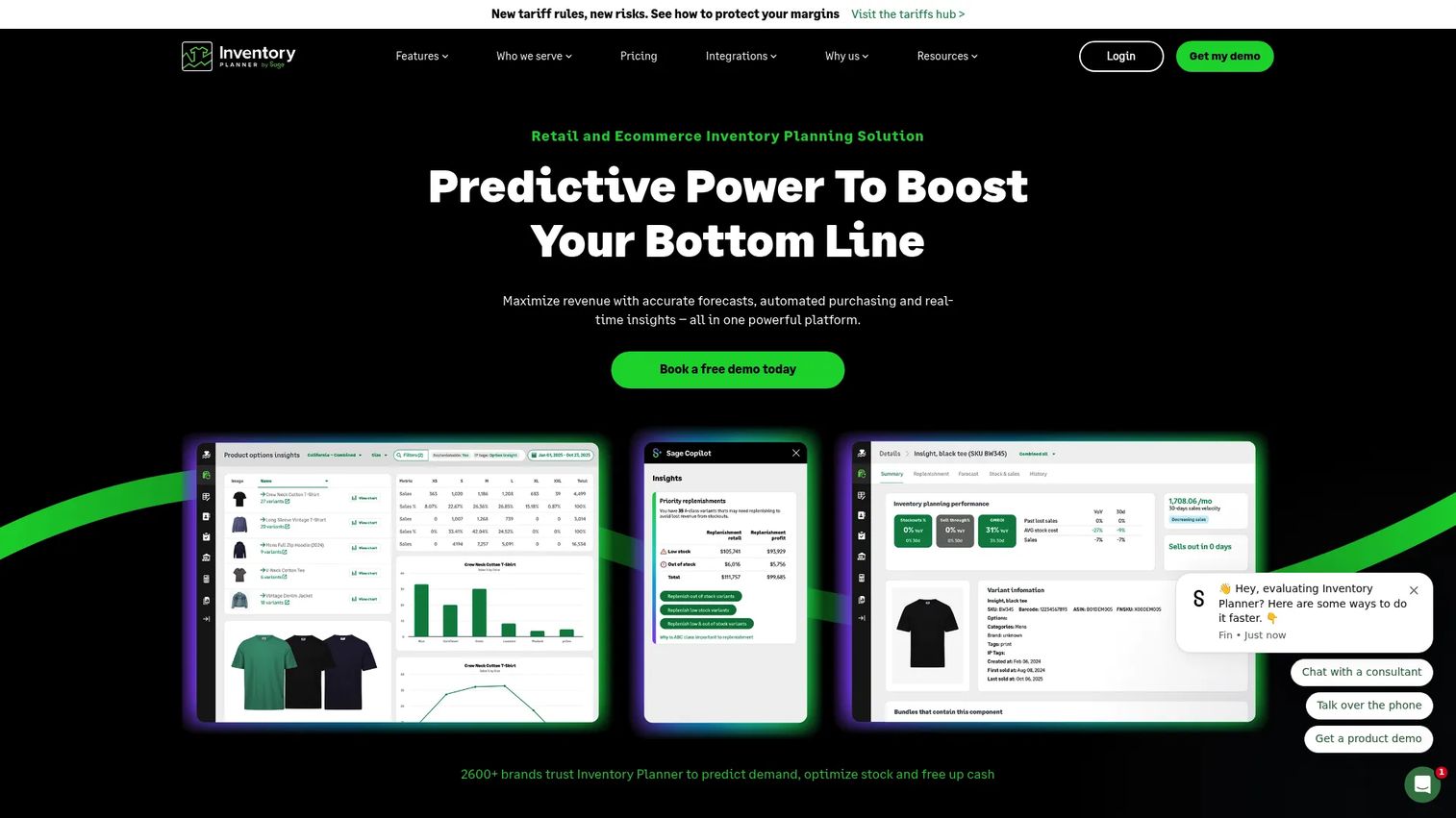
Inventory Planner is inventory planning software for retailers and ecommerce brands offering demand forecasting, automated purchasing, and inventory analytics. It connects to existing commerce and ERP systems rather than replacing them, making it a strong addition for brands that already have order management or accounting in place but need better buying and replenishment signals.
Best for: Apparel teams with existing commerce systems that need better demand forecasting, stockout prevention, and replenishment automation.
Key features
- Demand forecasting by product, location, and season
- Automated replenishment and purchase order generation
- Multi-location inventory planning
- Open-to-buy planning and budget tracking
- Retail analytics and inventory reporting with Shopify support
Why choose Inventory Planner: Cash trapped in overstock is one of the most common working capital problems in apparel. Inventory Planner addresses the buying side: When to reorder, how much to buy, and where to position stock across locations. It's not a production system or a full ERP, but for brands where purchasing decisions are creating margin and cash problems, it solves that specific job.
Inventory Planner pricing: Pricing is based on inventory volume and requires a quote. Unlimited users are included at no extra cost. Contact the vendor for a quote.
G2 rating: 4.5/5
11. Xentral Software
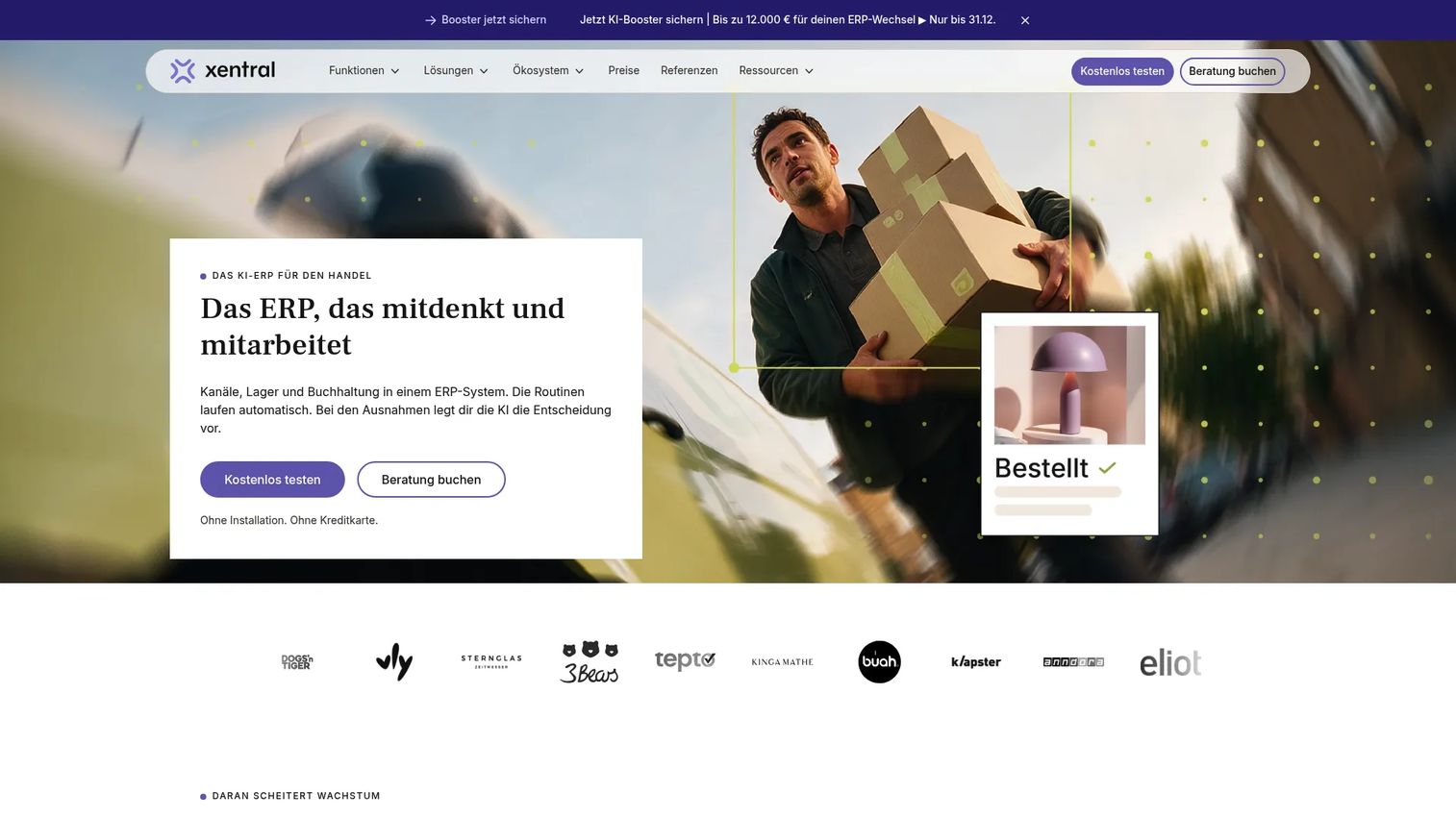
Xentral Software is a cloud-based ERP for growing retail and commerce businesses, combining order management, inventory, shipping, accounting, and automation. It connects to marketplaces and handles multi-channel order routing, warehouse workflows, and fulfillment without requiring heavy custom development. A 14-day free trial is available.
Best for: Ecommerce-heavy apparel brands scaling past Shopify admin and spreadsheets that need operational control across orders, warehouse, and sales channels.
Key features
- Order management with multichannel order processing
- Inventory and warehouse management
- Shipping and fulfillment automation
- Marketplace connections and inventory sync
- Accounting, invoicing, and procurement workflows
Why choose Xentral Software: Xentral fits brands that behave more like commerce operators than manufacturers. If your supply chain is relatively straightforward but your order volume across Shopify, Amazon, and other channels is creating fulfillment and accounting chaos, Xentral addresses that. It's less suited to brands with complex manufacturing or production management needs.
Xentral Software pricing: Plans are priced in EUR. Launch starts at €99 per month, Starter at €349 per month, Business at €649 per month, and Pro at €849 per month. A Scale tier is custom. A 14-day free trial is available.
G2 rating: 4.8/5
12. Magestore
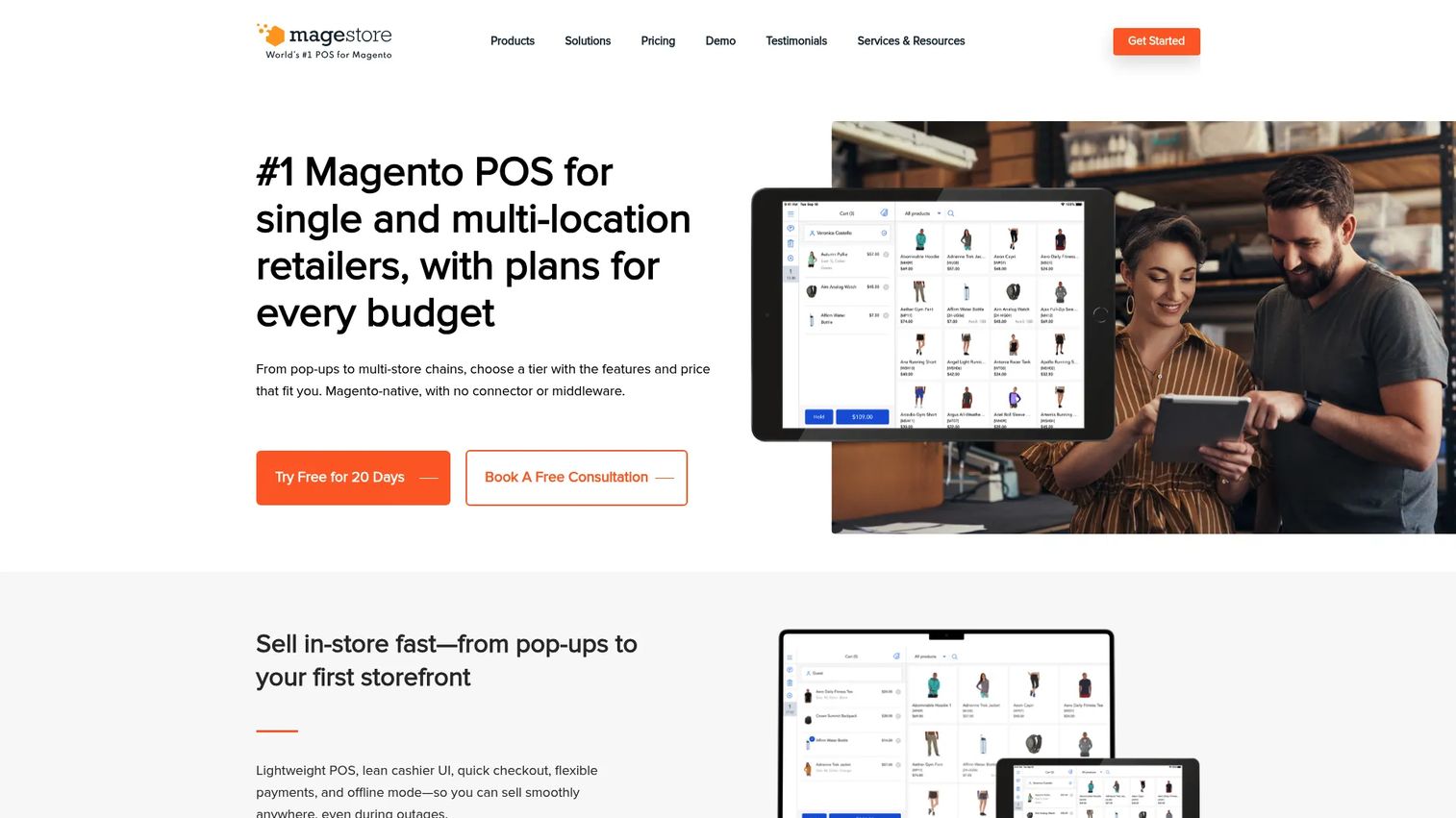
Magestore is Magento-native point-of-sale software for omnichannel retailers, synchronizing in-store and online sales, inventory, orders, and customer data in real time. It supports offline selling, multi-location inventory, loyalty programs, purchase orders, and order fulfillment including backorders, dropshipping, and click-and-collect.
Best for: Magento-centered apparel retailers that need POS and inventory tightly integrated with their existing Magento commerce stack.
Key features
- Real-time Magento-POS data synchronization
- Offline selling and checkout capability
- Multi-location inventory management
- Order fulfillment including backorders, dropshipping, and click-and-collect
- POS, inventory, and omnichannel sales reporting
Why choose Magestore: Platform dependency is the key self-selection filter. If Magento is your commerce backbone, Magestore is the obvious fit because of its native integration depth. For brands not running Magento, evaluating other tools on this list is a better use of time.
Magestore pricing: POS Lite starts at $69 per month. POS Simple is $89 per month with an additional $25 per month per extra store. POS Commerce pricing requires a custom quote.
G2 rating: 5.0/5
Considerations before choosing apparel software
Match the system to your operating model
Wholesale-first, DTC-first, retail-first, manufacturing-first, and finance-led apparel businesses have different primary problems. A wholesale brand's biggest pain is usually channel allocation and EDI compliance. A manufacturer's biggest pain is production visibility and vendor coordination. Don't let a demo checklist flatten those differences into a generic feature comparison.
Audit style, color, size complexity first
SKU count multiplies fast in apparel. A brand with 200 styles, 8 sizes, 6 colors, three channels, and two warehouses is managing a fundamentally different inventory problem than a business with 50 uniform SKUs. Before evaluating software, count your actual style-color-size combinations and confirm the platform handles attribute-level inventory tracking natively, not through workarounds.
Price the migration, not just the license
The subscription cost is often the smallest line item in a real software transition. Implementation, data cleanup, integration work, internal owner time, and process redesign add up. For founders, the honest cost question is: What does it take to get this running without pulling the ops leader out of normal work for six months?
Verify channel and integration depth
Ask what's native, what needs middleware, and what requires custom development. Shopify, Amazon, wholesale portals, 3PL connections, accounting systems, and EDI all need specific answers. A vendor that lists Shopify as an integration but routes it through a third-party connector adds a dependency you'll manage forever.
Decide who owns the system after go-live
Software only removes founder bottlenecks if a named leader owns data quality, workflows, and operating cadence after launch. Before signing, identify the internal owner. If that person doesn't exist yet, the software evaluation is premature.
Conclusion
The right apparel software pick comes down to operating model, not feature lists.
ApparelMagic and AIMS360 are the strongest apparel-native options for growing brands that need breadth across product, inventory, orders, and channels. NetSuite and SAP S/4HANA Cloud fit finance-led or enterprise businesses where board-grade reporting and entity-level controls are the primary requirement. PolyPM and BlueCherry serve manufacturing and deeper apparel operations where production visibility is the bottleneck.
Techpacker solves a specific product development problem. Inventory Planner solves a specific buying and replenishment problem. Fishbowl, Lightspeed Retail, Xentral Software, and Magestore each fit specific operational models: Inventory-first teams, retailers, ecommerce operators, and Magento merchants respectively.
The practical next step: Shortlist three tools based on your operating model. Then run the same workflow test across all three. Create a style, add sizes and colors, issue a purchase order, allocate inventory across channels, ship an order, process a return, and review margin. The tool that handles that sequence with the least friction is probably the right answer for your team.
For more context on ERP categories adjacent to apparel, see our guides on advanced planning and scheduling software, business process management software, and best product management tools.
Start your journey with Guideflow today!
FAQs
Apparel software is business software designed for fashion-specific operations including style, color, size inventory management, seasonal collections, production, wholesale and ecommerce order management, PLM, and financial reporting. It differs from generic business software by handling the dimensional complexity of fashion SKUs and multi-channel fashion selling natively.
Generic ERP manages business operations broadly: Finance, inventory, orders, and reporting. Apparel software adds fashion-specific workflows like style, color, size matrices, seasonal collection planning, tech packs, BOMs, retailer EDI, and channel allocation. A generic ERP can often be configured for apparel, but the configuration work is substantial and ongoing.
Smaller brands typically start with focused tools before committing to full ERP. Fishbowl addresses inventory control and QuickBooks integration. Lightspeed Retail covers retail store operations and POS. Techpacker handles tech pack and product development. Inventory Planner covers forecasting and replenishment. The choice depends on where the operational pain is concentrated.
ApparelMagic, AIMS360, NetSuite, PolyPM, and BlueCherry are the main candidates. The right choice depends on channel complexity (wholesale versus DTC versus retail), whether manufacturing is in-house or outsourced, and how strong the finance reporting requirements are. No single platform wins across every operating model.
Focused tools like Techpacker or Fishbowl start in the $35 to $300 per month range. Mid-market apparel ERP platforms like ApparelMagic start around $337 per month. Enterprise systems like NetSuite, SAP, and BlueCherry are quote-based with annual licenses plus implementation fees that often match or exceed the license cost. Budget for migration, data cleanup, integration work, and internal owner time regardless of tier.
The common triggers are: Inventory counts disagreeing across Shopify and wholesale allocations, production dates slipping because vendor status lives in email, finance needing two days to answer a margin question, return complexity creating reconciliation problems, and leadership spending meeting time correcting data instead of making decisions. Any one of these signals that the spreadsheet limit has been reached.
Style, color, and size support with attribute-level tracking is the baseline requirement. Beyond that: Multi-location inventory, channel allocation, reorder points, demand forecasting, barcode workflows for warehouse operations, returns handling, 3PL integration, and reporting by style and margin. The features that matter most depend on where inventory errors are currently costing the most time and money.
PLM manages the product before goods are sold: Design, specs, materials, samples, costing, and supplier approvals. ERP manages operations after products exist: Inventory, orders, finance, and fulfillment. Brands with complex product development often need both, either as separate tools or as one suite covering both functions. For brands with simple product development and complex operations, ERP alone may be enough.