Your rank-tracking dashboard still looks fine. But leadership is asking why pipeline is soft, and your buyers started their research by asking ChatGPT, not clicking a Google result. According to Attest (2025), 27% of consumers now use generative AI for at least half of their internet searches. Traditional keyword rankings tell you nothing about whether your brand appears in those answers, and nothing about how it's described when it does.
That gap is what AI visibility tools close. They track brand mentions, citations, share of voice, and sentiment across answer engines like ChatGPT, Gemini, and Perplexity, so you can see what AI systems say about your brand before your buyers do. The real question isn't whether you need this data. It's which tool helps your team act on it without adding another dashboard nobody checks.
What's inside
This guide covers 15 AI visibility tracking tools for digital marketers, SEO leads, growth teams, and agencies building an AI search reporting stack.
Selection criteria:
- AI engine coverage: Breadth of answer surfaces tracked (ChatGPT, Gemini, Perplexity, Google AI Overviews, and others)
- Prompt data quality: Whether the tool uses real-user prompts, modeled prompts, or keyword-derived prompts
- Citation and source analysis: Depth of insight into which domains AI systems reference
- Pricing and reporting fit: Whether the tool connects AI visibility to actionable reporting for growth teams
TL;DR
- Best overall for enterprise AI visibility: Profound, for teams that need deep answer-engine monitoring with agency-ready reporting
- Best for practical AI search monitoring: Peec AI, clean tracking across AI answer engines with straightforward pricing
- Best for SEO teams staying in one platform: Semrush AI Visibility Toolkit or Ahrefs Brand Radar, both fit teams that want AI visibility beside existing keyword and backlink data
- Best for citation and source intelligence: Scrunch or AthenaHQ, for understanding which sources AI systems trust and why
- Best budget entry point: Otterly (from $29/month) or HubSpot AI Search Grader (free, one-time diagnostic)
- Best for content teams moving from monitoring to action: Writesonic or Surfer, connecting AI visibility gaps directly to content workflows
What is an AI visibility tool?
An AI visibility tool tracks how often, where, and how a brand appears inside AI-generated answers across chat assistants, AI search engines, and AI-powered search results.
Unlike traditional SEO tools that track keyword rankings and backlinks, AI visibility tools monitor what happens inside the actual responses users receive from answer engines. The tool sends prompts, collects responses, and analyzes the output for brand mentions, source citations, competitor presence, and sentiment.
Core capabilities the category covers:
- Answer-engine coverage: Monitors visibility across AI surfaces including ChatGPT, Gemini, Perplexity, Google AI Overviews, and Microsoft Copilot
- Prompt tracking: Monitors repeatable prompts and query themes that reflect real buyer searches
- Citation analysis: Shows which source domains AI systems reference when answering category questions
- Share of voice: Compares how often your brand appears versus competitors across a prompt set
- Sentiment tracking: Flags whether AI systems describe your brand positively, neutrally, or negatively
- Action recommendations: Turns visibility gaps into specific content, PR, or technical tasks
- Reporting: Produces shareable dashboards that help marketers explain AI visibility to leadership
Category boundaries worth knowing:
AI visibility tools monitor how brands appear in AI answers. Generative engine optimization tools focus on improving that visibility through content strategy. LLM trackers monitor specific prompts and model outputs at a more granular level. Traditional SEO tools track rankings, crawl health, and organic traffic. All four categories remain relevant; none replaces the others entirely.
When to use AI visibility tools
Track brand presence across AI answer surfaces
If buyers in your category are searching AI tools before they visit websites, your brand's absence from those answers is a pipeline problem you won't see in rank tracking. AI visibility tools show whether your brand gets mentioned, how it's described, and which competitors appear alongside you in the same responses.
Find citation gaps before competitors own the answer
AI systems don't cite brands randomly. They cite trusted sources, review sites, comparison pages, and community discussions. An AI visibility tool surfaces which domains AI engines reference in your category, giving your content and PR teams a clear list of gaps to close.
Prove AI search impact to leadership
Share of voice trends, citation frequency, and AI referral traffic are metrics that mean something in a board presentation. When a growth marketer can show that AI visibility improvements correlate with traffic quality or lead volume, the category stops being a curiosity and becomes a reporting line. Tools in this list vary significantly on how well they close that attribution loop.
AI visibility tools comparison
Pricing and G2 ratings below reflect verified vendor sources. Check each vendor's pricing page before committing, as pricing in this category moves quickly.
| # | Product | Best for | Key differentiator | Pricing | G2 rating |
|---|---|---|---|---|---|
| 1 | Profound | Enterprise and agency AI visibility | Deep answer-engine visibility with AI marketing workflows | Free trial; Enterprise custom | 4.5/5 |
| 2 | Peec AI | Practical AI search monitoring | Clean multi-engine tracking with structured plan tiers | From $95/month | 4.7/5 |
| 3 | Semrush AI Visibility Toolkit | SEO teams already using Semrush | AI visibility inside a full SEO platform | From $99/month per domain | 4.5/5 |
| 4 | Ahrefs Brand Radar | SEO teams using Ahrefs | Multi-engine brand visibility tied to Ahrefs data | From $50/month | 4.5/5 |
| 5 | Scrunch | Citation and source analysis | AI search monitoring with agent traffic insights | From $250/month | 4.6/5 |
| 6 | AthenaHQ | Prompt intelligence and competitive monitoring | Free tier with prompt-level visibility across 11+ models | Free; Starter $295/month | 4.9/5 |
| 7 | Otterly | Budget-conscious AI search tracking | Lightweight monitoring with GEO and content audits | From $29/month | 4.7/5 |
| 8 | ZipTie | Broad AI engine coverage | Seven AI engines with configurable prompt monitoring | From $25.65/month | N/A |
| 9 | Writesonic | Content teams acting on AI insights | AI visibility combined with content generation workflows | From $79/month (annual) | 4.7/5 |
| 10 | Conductor | Enterprise organic visibility teams | AI visibility inside enterprise SEO and content operations | Custom pricing | 4.5/5 |
| 11 | Yext Scout | Multi-location and entity-driven brands | Location-level competitive benchmarking with free tier | Free tier available; Paid: Custom | 4.4/5 |
| 12 | Evertune | Brand perception and advertising | AI visibility with ChatGPT advertising and retargeting | From $60/month | N/A |
| 13 | Surfer | Content teams optimizing for AI search | AI visibility tied to content editor and optimization scoring | From $49/month (annual) | 4.6/5 |
| 14 | LLM Pulse | LLM response and prompt monitoring | Broad model coverage with AI crawler analytics | From €49/month | 5.0/5 (Capterra) |
| 15 | HubSpot AI Search Grader | Quick baseline diagnostic | Free one-time AI search presence analysis | Free | N/A |
Best 15 AI visibility tools for 2026
1. Profound
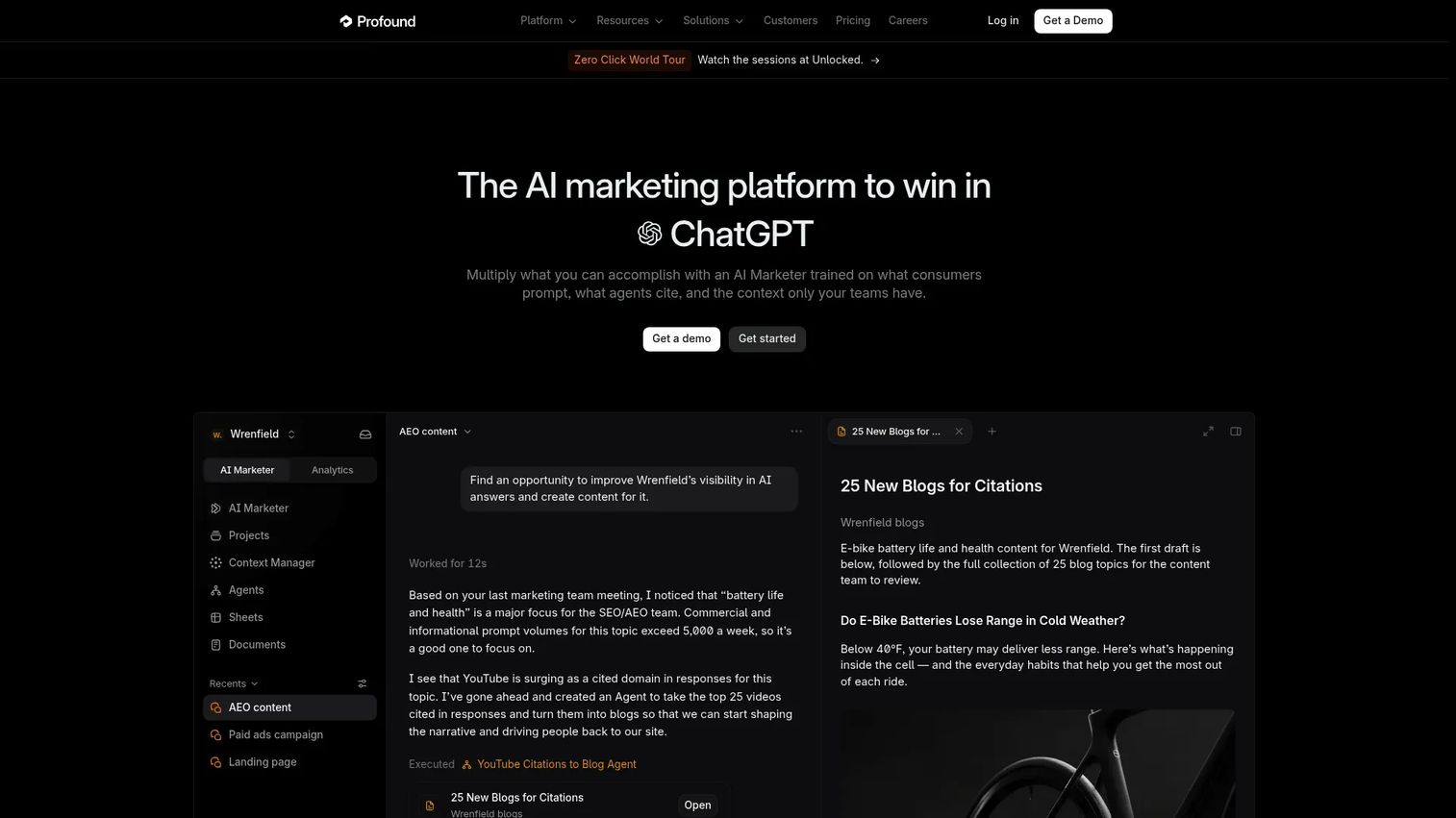
Profound is an AI marketing platform built for teams that need to research, analyze, and act on AI search visibility across answer engines. It combines answer-engine monitoring with an AI Marketer layer that assists with writing, reporting, and marketing workflows. Prompt Volume tracking shows what users actually ask AI engines in your category, which is useful when you need to build a prompt set without guessing.
Best for: Marketing teams and agencies that need deep AI-search visibility insights paired with AI-assisted workflow support.
Key features
- Multi-engine answer visibility and citation tracking
- Prompt Volumes for real-user query research
- Agent Analytics for AI-sourced traffic attribution
- Context Manager for reusable brand-informed tasks
- Agency-ready reporting and collaboration tools
Why choose Profound: Profound suits teams where AI visibility is a strategic reporting line, not a side experiment. The AI Marketer layer means analysts can go from monitoring to drafting a response strategy inside the same platform.
Profound pricing: A 7-day free trial is available with 50 daily prompts. Ongoing plans are Enterprise-only with custom packaging based on tracked topics and reporting depth. Contact sales for a quote.
G2 rating: 4.5/5
2. Peec AI
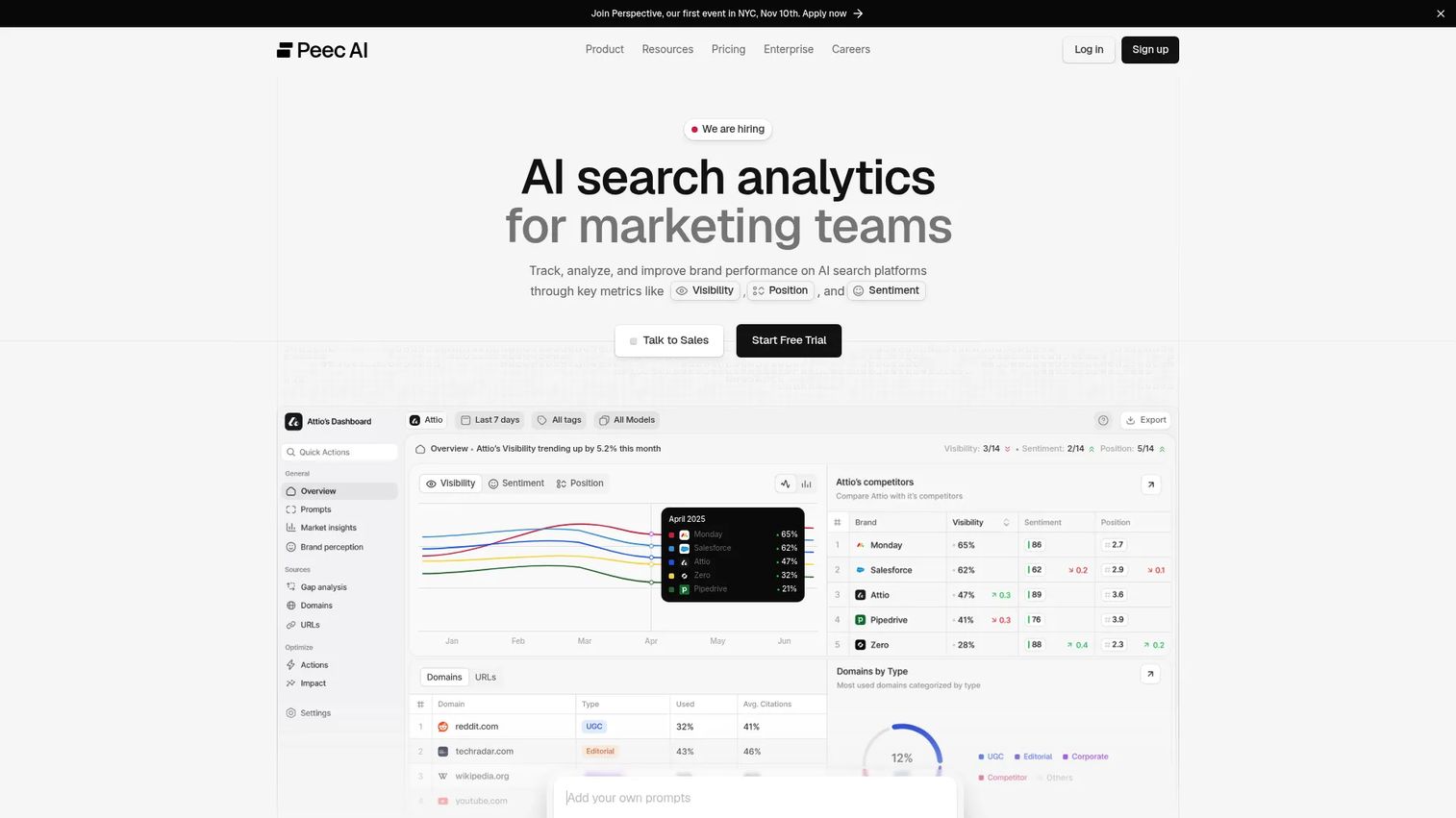
Peec AI is an AI search analytics platform that tracks brand visibility, position, and sentiment across AI-generated search results. It monitors prompts, compares competitor share of voice, and surfaces citation sources so marketing and SEO teams have a clear read on how their brand performs in AI answers without wading through enterprise-only tools.
Best for: Growth and SEO teams that need focused AI visibility tracking with structured pricing and prompt-level reporting.
Key features
- AI visibility, position, and sentiment tracking
- Prompt monitoring across multiple AI answer engines
- Competitor benchmarking and share-of-voice comparison
- Source citation analysis
- Performance reports and AI-assisted analysis
Why choose Peec AI: The structured plan tiers make it straightforward to match budget to prompt volume. Teams that want clear tracking without committing to an enterprise contract will find Peec AI easier to get started with than the larger platforms.
Peec AI pricing: Plans run Starter at $95/month, Pro at $245/month, and Advanced at $495/month, all billed monthly. Annual billing saves 15%. Enterprise pricing is custom.
G2 rating: 4.7/5
3. Semrush AI Visibility Toolkit
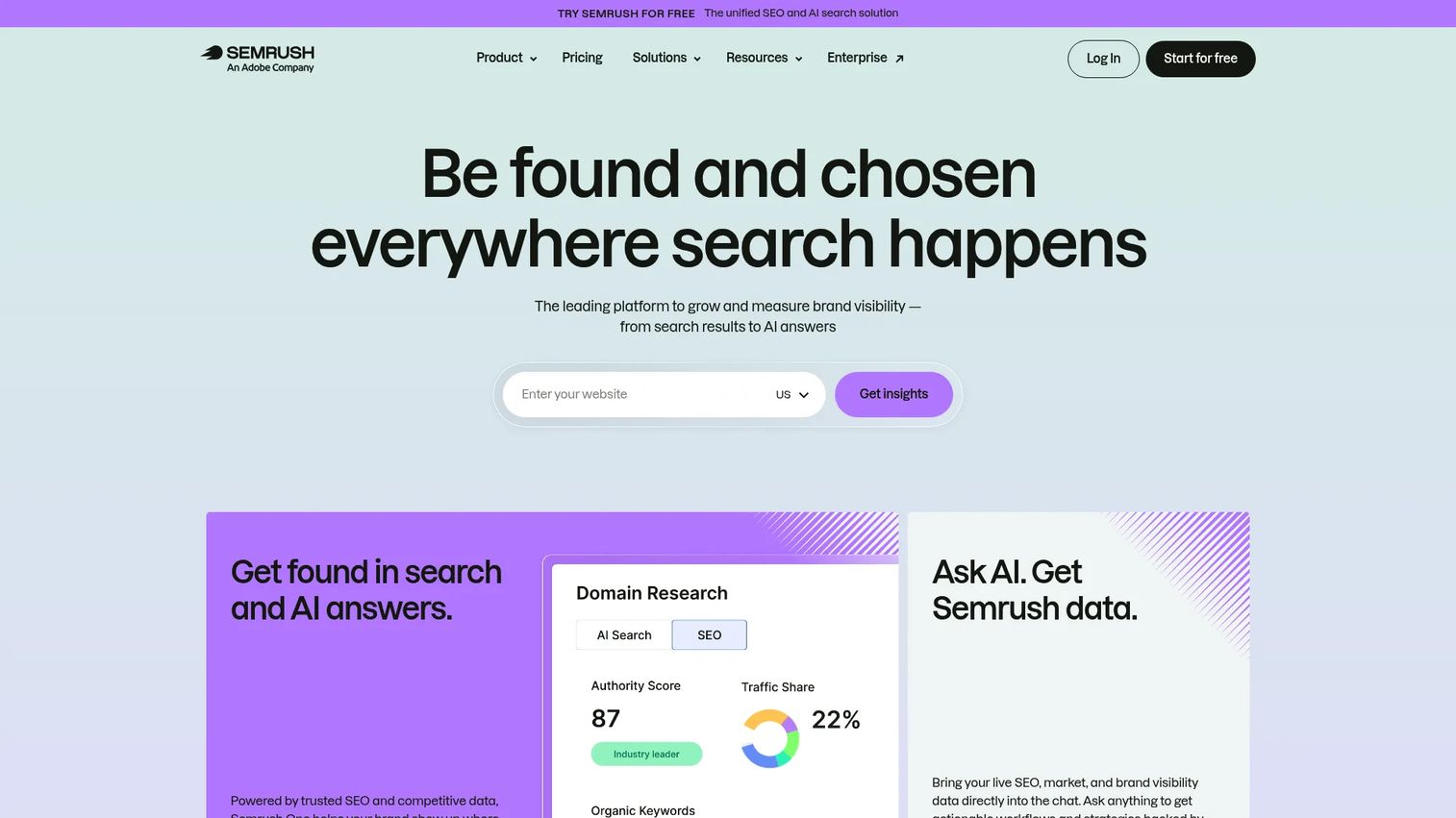
Semrush added its AI Visibility Toolkit for teams already running SEO workflows inside the platform. It measures brand mentions, citations, sentiment, and share of voice across AI answer engines, and layers that data alongside keyword rankings, backlinks, and site audits that Semrush users already rely on. The GEO audit checks whether AI crawlers can access your pages.
Best for: SEO and content teams already paying for Semrush who want AI visibility data without adding a separate tool to their stack.
Key features
- AI visibility, mentions, citations, and share-of-voice reporting
- Prompt research and tracking across AI platforms
- Competitor benchmarking and gap analysis
- AI crawler accessibility audit
- White-label and shareable reporting dashboards
Why choose Semrush AI Visibility Toolkit: If your SEO reporting already lives in Semrush, adding the AI Visibility Toolkit keeps everything in one place. The consolidation argument is real, and it matters for growth marketers who are already fighting tool sprawl.
Semrush AI Visibility Toolkit pricing: The Base plan starts at $99/month per domain (billed annually) and includes 25 tracked prompts, one domain, and daily, weekly, and monthly data updates. Enterprise pricing is custom.
G2 rating: 4.5/5 (Semrush overall)
4. Ahrefs Brand Radar
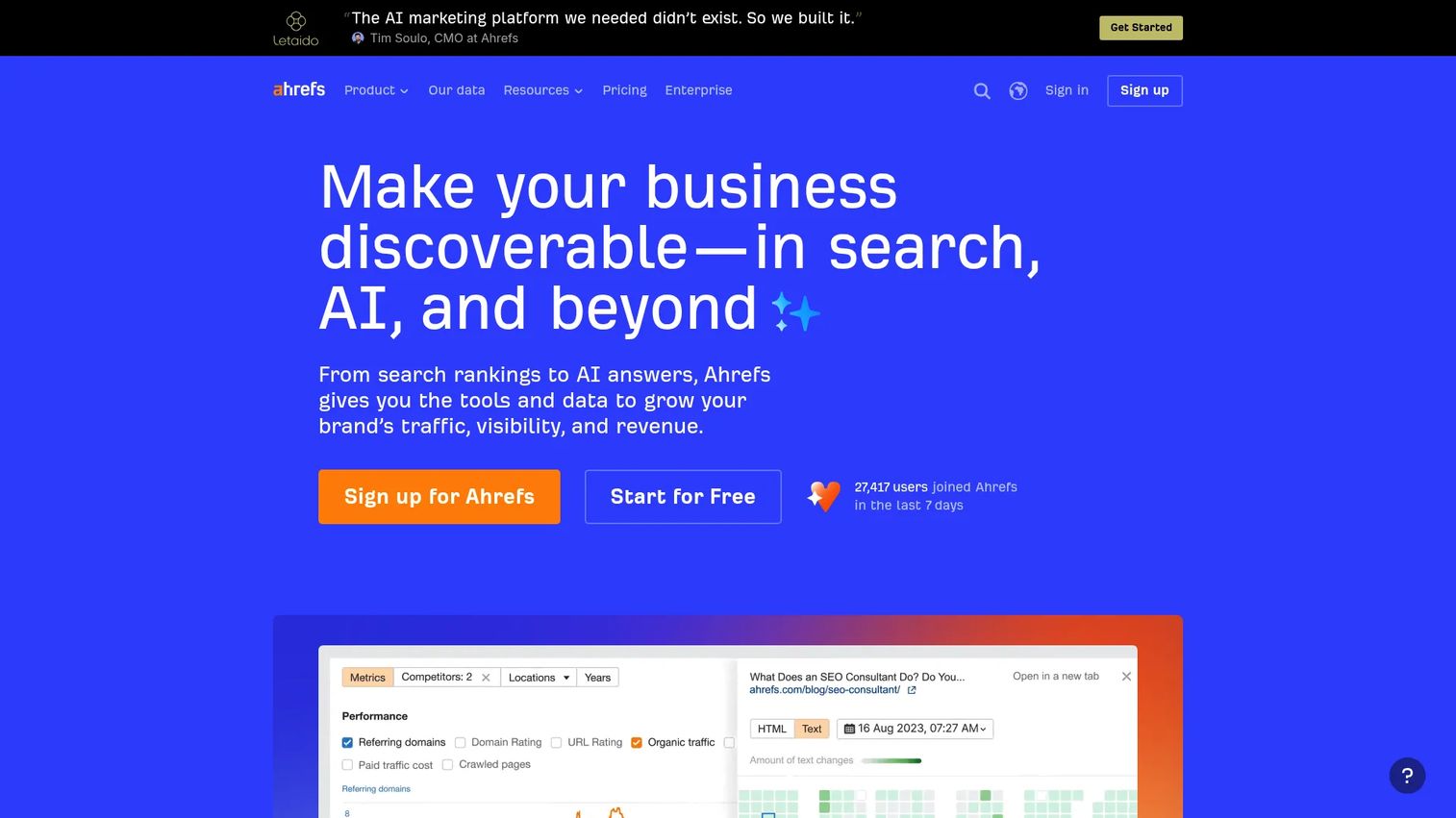
Ahrefs Brand Radar tracks brand mentions, citations, and AI Share of Voice across a broad set of answer engines including Google AI Overviews, Google AI Mode, ChatGPT, Perplexity, Gemini, Copilot, Grok, and Claude. For teams already using Ahrefs for keyword and backlink research, Brand Radar adds AI visibility data inside the same platform rather than requiring a new login.
Best for: SEO teams invested in Ahrefs who want brand visibility across AI surfaces added to their existing research workflow.
Key features
- AI Share of Voice across eight major AI engines
- Custom prompt tracking with configurable monitoring frequency
- Web mention tracking alongside AI visibility
- YouTube, Reddit, and TikTok visibility data
- Competitive comparison across brand and category terms
Why choose Ahrefs Brand Radar: The breadth of AI engine coverage is a genuine differentiator, and the connection to Ahrefs search and backlink data means teams can correlate citation gaps with link profiles. The configurable prompt frequency is useful for teams that want daily tracking on competitive terms.
Ahrefs Brand Radar pricing: Custom prompt packages start at $50/month. The AI Visibility Index adds $199/month, and the full All Platforms Brand Radar AI plan runs $699/month. A free tier is available for basic brand radar access.
G2 rating: 4.5/5 (Ahrefs overall)
5. Scrunch
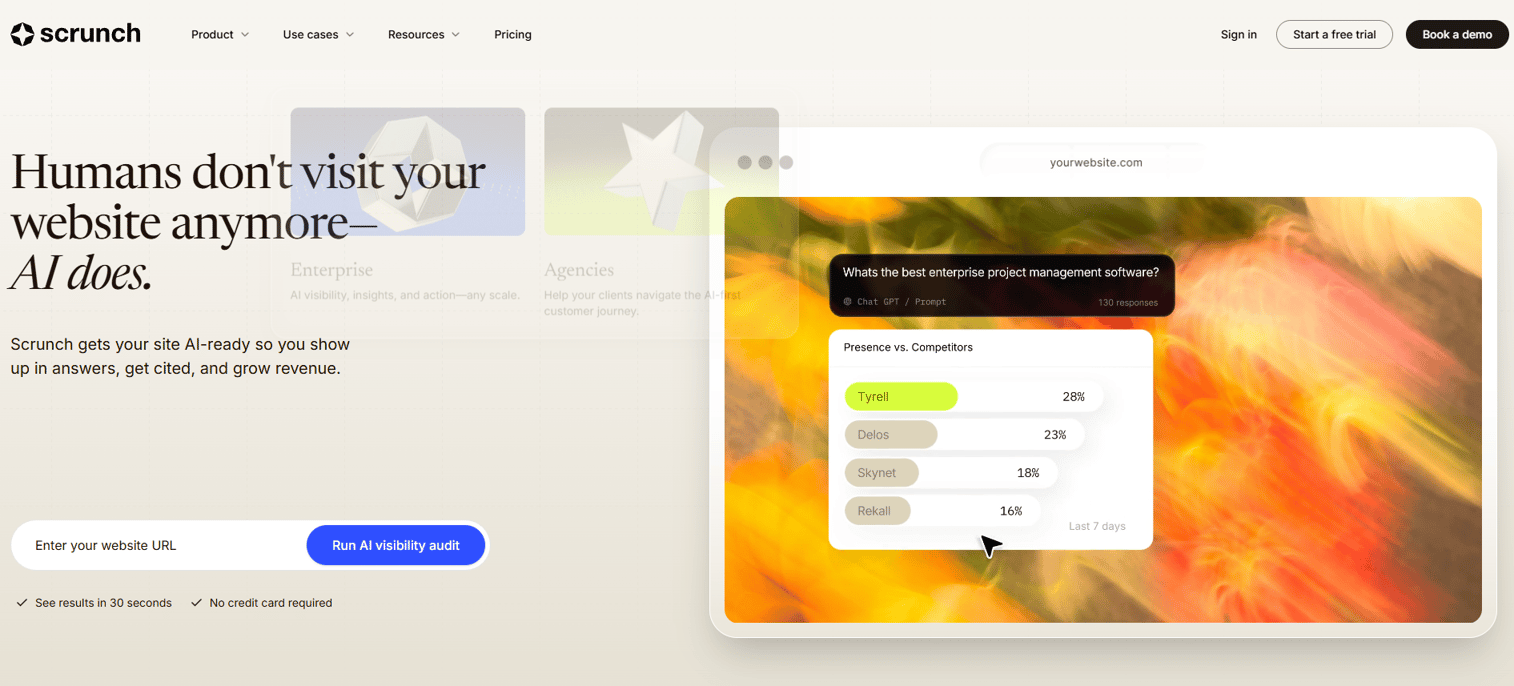
Scrunch focuses on how AI systems describe, cite, and compare brands across search platforms. It goes beyond mention counts to surface which source domains AI engines trust, where your brand appears relative to competitors, and how AI agents access your content. The Agent Experience Platform adds a layer for teams that want to deliver AI-optimized content directly to crawlers.
Best for: Brand and content teams that care about why their brand appears or doesn't appear in AI answers, not just whether it does.
Key features
- AI prompt monitoring across four supported LLMs
- Citation and brand visibility tracking
- Competitive benchmarking and AI search trends
- Site audits and AI bot traffic analysis
- Agent Experience Platform for AI-optimized content delivery
Why choose Scrunch: Citation quality is an underexplored metric, and Scrunch makes it a primary reporting line. Teams running content-heavy programs who want to understand source authority in AI engines will get more utility here than from share-of-voice dashboards alone.
Scrunch pricing: The Core plan is $250/month and includes 125 prompts, five site audits per month, and four supported LLMs. Enterprise pricing is custom and adds expanded model coverage, API access, and SSO.
G2 rating: 4.6/5
6. AthenaHQ
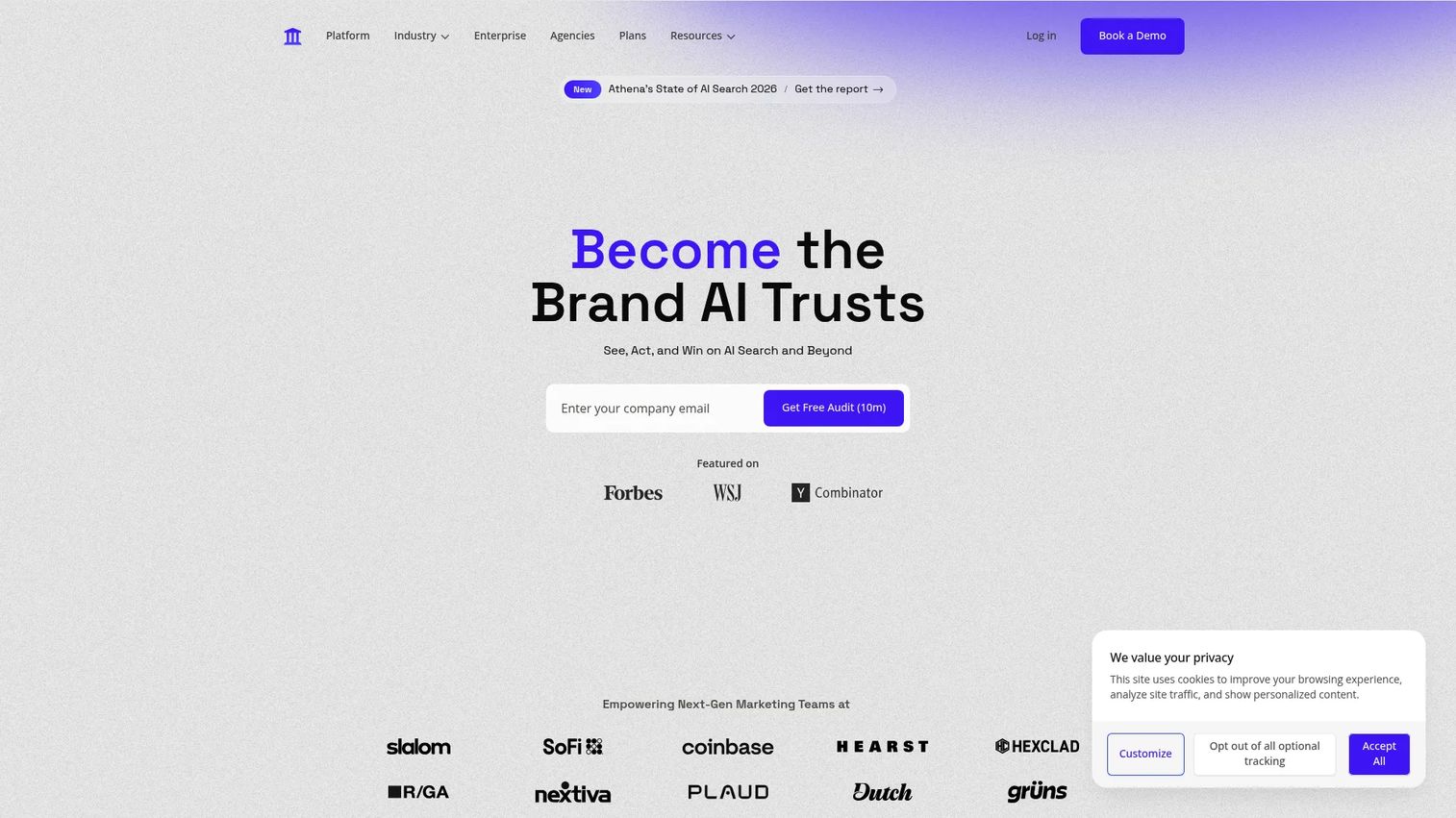
AthenaHQ is built as a command center for answer engine optimization and generative engine optimization. It tracks brand mention frequency, competitor share of voice, and brand sentiment across 11 models on its paid tier. The Oracle discrepancy detection flags when AI systems say something factually wrong about your brand, which is a capability most tools don't surface at all.
Best for: Marketing and brand teams that need prompt-level competitive intelligence and want to identify factual errors in AI-generated brand descriptions.
Key features
- Prompt and response analysis across 11 AI models (Starter)
- Competitor share-of-voice and brand sentiment tracking
- Content recommendations and optimization agent
- Self-learning content improvement
- Oracle discrepancy detection for factual accuracy
Why choose AthenaHQ: The free Essential tier lets teams run initial checks before committing budget, and the discrepancy detection is genuinely useful for brands where wrong AI-generated facts create sales friction. The 4.9/5 G2 rating reflects strong early user satisfaction.
AthenaHQ pricing: The Essential plan is free with 300 credits. The Starter plan runs $295/month with 3,600 credits and visibility across 11 models. Enterprise is custom pricing.
G2 rating: 4.9/5
7. Otterly
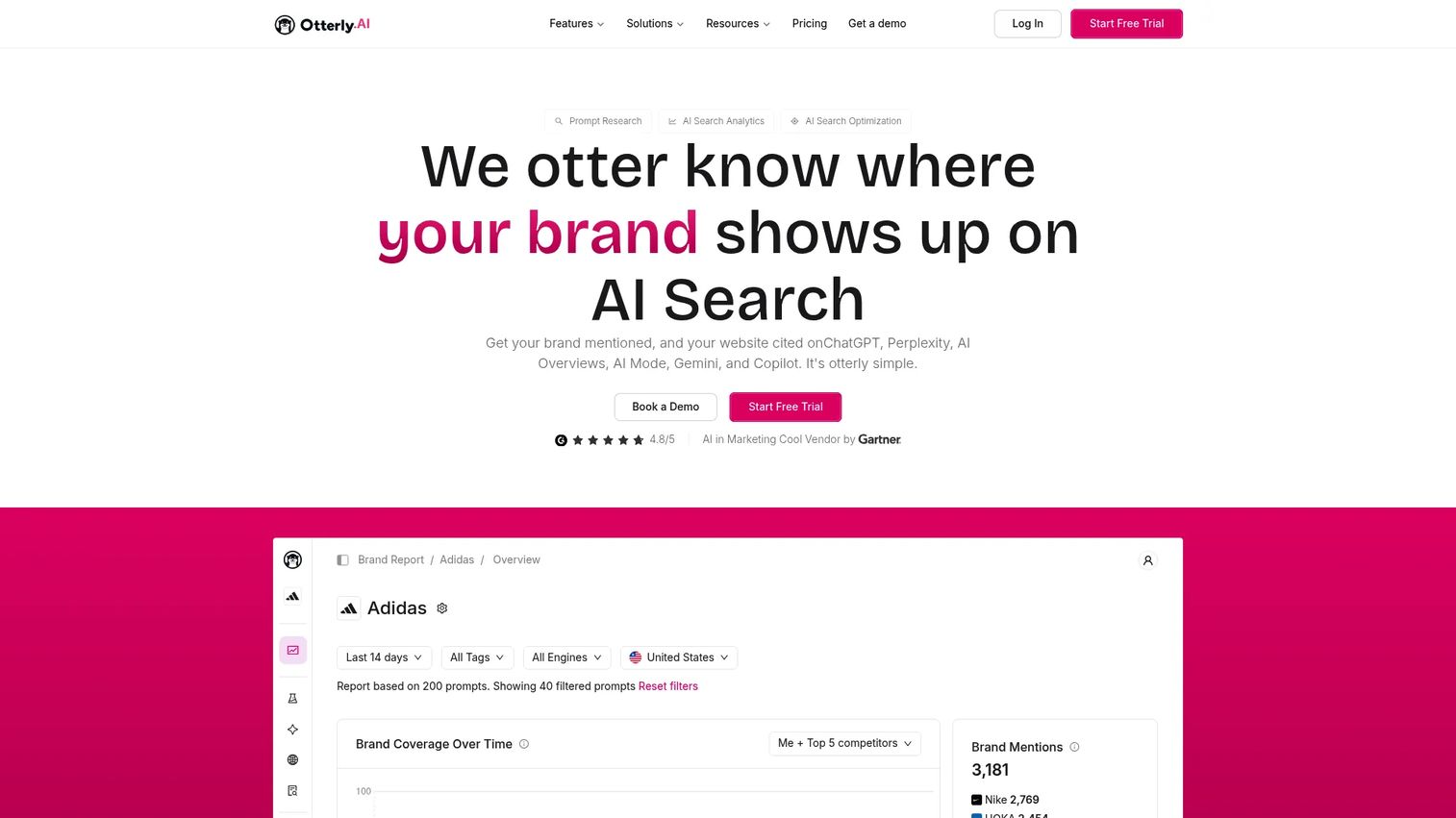
Otterly covers AI search monitoring, brand mention alerts, citation tracking, and competitive snapshots in a package that starts at $29/month. It also includes GEO content audits and optimization recommendations, which puts it in a broader use case than pure monitoring. Multi-country tracking makes it relevant for teams running regional campaigns.
Best for: Startups and small growth teams that want AI search monitoring, GEO audits, and content recommendations without committing to an enterprise platform budget.
Key features
- AI search analytics and brand visibility tracking
- Prompt research and competitive benchmarking
- Brand sentiment analysis
- Domain citation tracking
- GEO and content audit with optimization recommendations
Why choose Otterly: The entry price is the lowest among full-featured AI visibility platforms on this list. Teams testing whether AI visibility monitoring fits their reporting stack before scaling up will find Otterly a practical starting point.
Otterly pricing: The Lite plan is $29/month, Standard is $189/month, and Premium is $489/month, all billed monthly. Annual billing is available at a discount. Enterprise is custom. A free trial is confirmed; a permanent free tier is not.
G2 rating: 4.7/5
8. ZipTie
ZipTie.ai tracks brand mentions, citations, competitors, and sentiment across up to seven AI engines including ChatGPT, Google AI Overviews, Perplexity, Google AI Mode, Microsoft Copilot, Bing AI Overview, and Google Gemini. Pricing is configurable by prompt volume, refresh cadence, and engine selection, so teams pay for what they actually monitor. Add-ons include UGC impact analysis for Reddit and YouTube citations.
Best for: Marketing, SEO, and PR teams that want broad AI engine coverage with configurable prompt volume and optional UGC citation analysis.
Key features
- Brand monitoring across seven AI search engines
- Citation, mention, sentiment, and competitor analysis
- Action Center for identifying visibility gaps
- UGC Impact Analysis for Reddit and YouTube
- Google Search Console, Google Analytics 4, API, and MCP integrations
Why choose ZipTie: The configurable pricing means a small team can start with a narrow prompt set and expand as the program matures. Seven-engine coverage is among the broadest in this list.
ZipTie pricing: Starter plans begin at $25.65/month. Professional plans start at $340.20/month, and Enterprise from $1,647/month. A 7-day free trial includes 25 daily prompts across three engines.
9. Writesonic
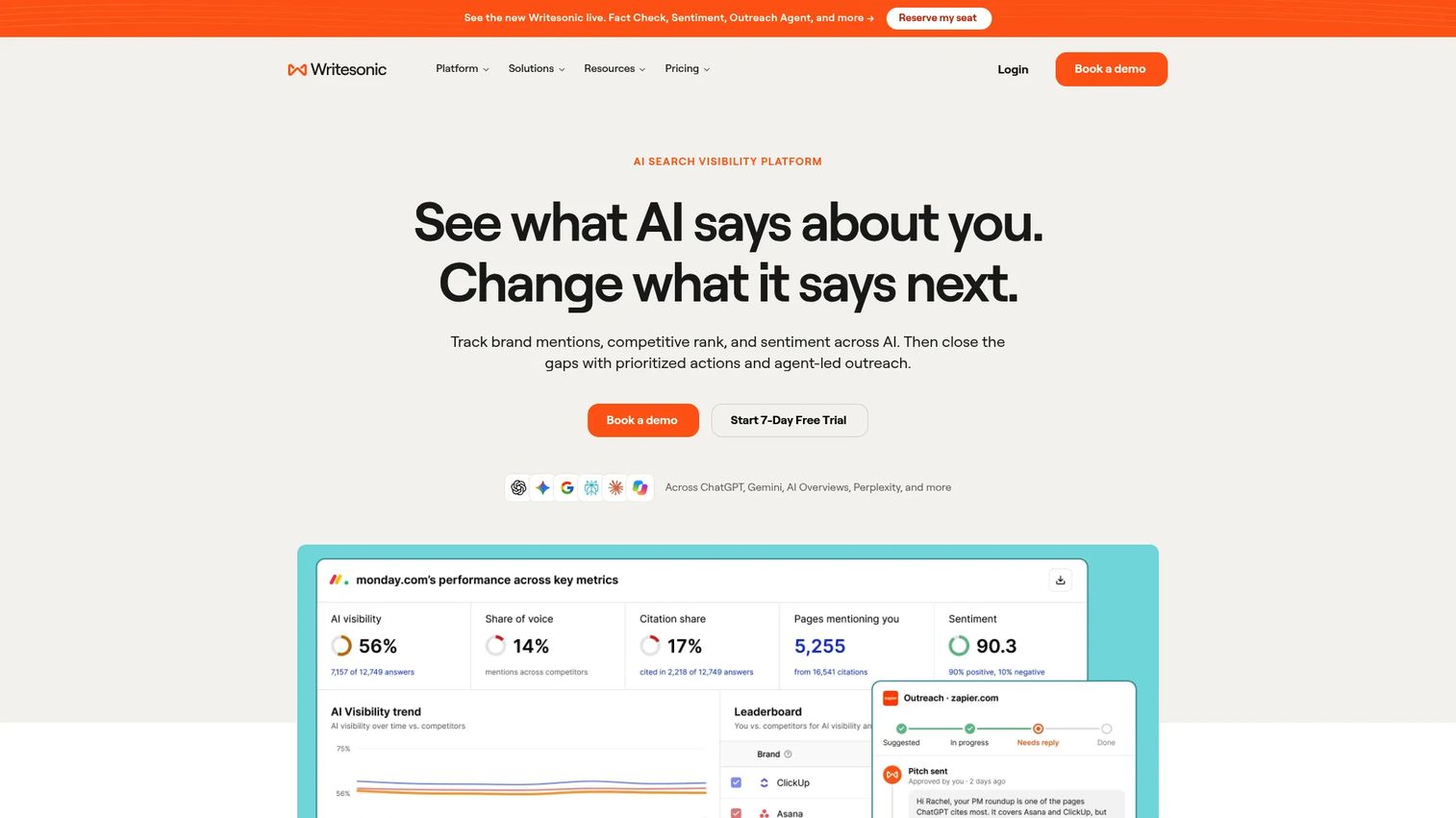
Writesonic combines AI visibility tracking with content generation inside the same platform. It monitors brand presence across ChatGPT, Gemini, and Google AI Overviews, runs sentiment analysis and competitive benchmarking, then connects those findings directly to an AI article writing and optimization workflow. Teams that spotted a citation gap no longer need to hand that finding to a separate content tool.
Best for: Content and growth marketing teams that want to close the loop between AI visibility gaps and published content without switching between platforms.
Key features
- AI visibility tracking across ChatGPT, Gemini, and Google AI Overviews
- Sentiment analysis and competitive benchmarking
- AI article writing and content optimization
- SEO site audits
- Google Search Console and WordPress integrations
Why choose Writesonic: The execution angle is the differentiator. Most AI visibility tools stop at the data. Writesonic lets teams move from "we're missing citations on this topic" to a draft piece inside one workflow. That matters for growth marketers who can't afford long handoffs between research and publishing.
Writesonic pricing: Plans start at $79/month (billed annually) for Starter, $199/month for Basic, and $399/month for Growth. Enterprise pricing is custom. A 7-day free trial is available.
G2 rating: 4.7/5
10. Conductor
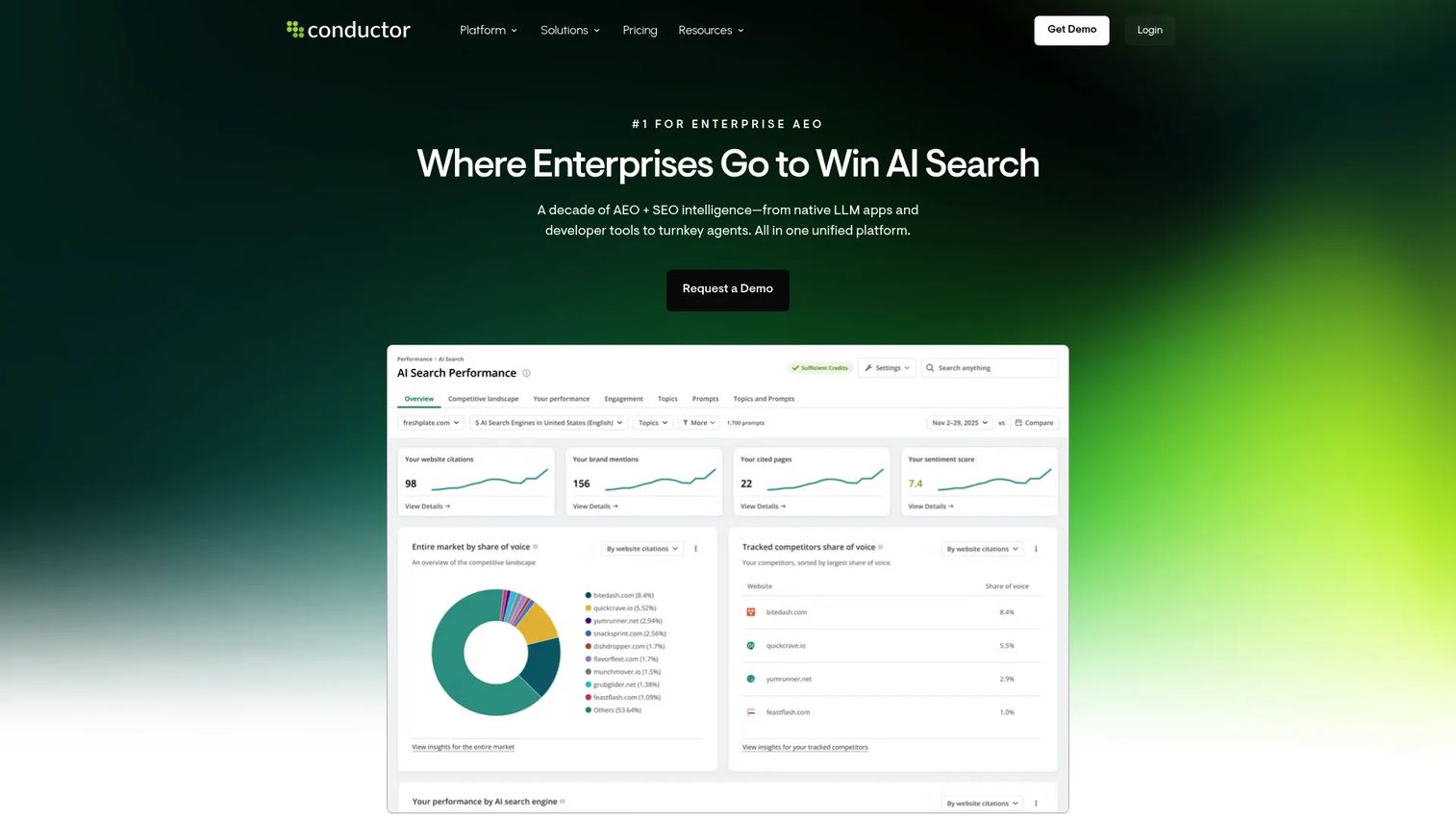
Conductor is an enterprise organic marketing platform with AI search visibility built into its broader SEO and content operations suite. It tracks AI mentions, citations, share of voice, and sentiment alongside keyword rankings and site health, with workflow governance designed for large teams running structured content programs.
Best for: Enterprise SEO and demand gen teams that need AI visibility embedded in a governed content operations workflow with executive reporting.
Key features
- AI search visibility: Mentions, citations, share of voice, sentiment
- Writing Assistant with content scoring and optimization
- Topic and keyword research with competitor analysis
- 24/7 website monitoring and technical health alerts
- Unified reporting across search and analytics data
Why choose Conductor: The governance layer is what separates Conductor from lighter tools. Large teams with multiple contributors, defined approval workflows, and leadership dashboards will find the structure useful. It's the right fit for organizations where organic marketing already runs on a platform, not a collection of tabs.
Conductor pricing: The platform offers Essentials, Growth, and Enterprise tiers, all priced through sales conversations. Contact Conductor for a quote.
G2 rating: 4.5/5
11. Yext Scout
Yext Scout tracks brand visibility across Google Search, Google Maps, Google AI Overviews, ChatGPT, Gemini, Claude, and Perplexity. It adds location-level competitive benchmarking and win rates, which makes it particularly useful for multi-location brands where "who appears when someone nearby asks an AI" is a real revenue question. A free tier is available.
Best for: Multi-location brands and entity-driven organizations where local AI search accuracy and competitive positioning vary by market.
Key features
- Visibility monitoring across seven AI and search surfaces
- Location-level competitive benchmarking and win rates
- AI sentiment analysis and citation-source tracking
- Prioritized recommendations through Yext's Action Center
- Knowledge graph support for structured brand data
Why choose Yext Scout: The location-level granularity is a capability most AI visibility tools don't offer. For brands where a wrong AI-generated answer about a store location, service area, or product availability creates lost revenue, Scout surfaces those gaps at the location level rather than averaging them out.
Yext Scout pricing: A free Scout tier is available. Paid Scout plans include expanded competitor and benchmarking access, with pricing by quote from Yext's sales team.
G2 rating: 4.4/5 (Yext overall)
12. Evertune
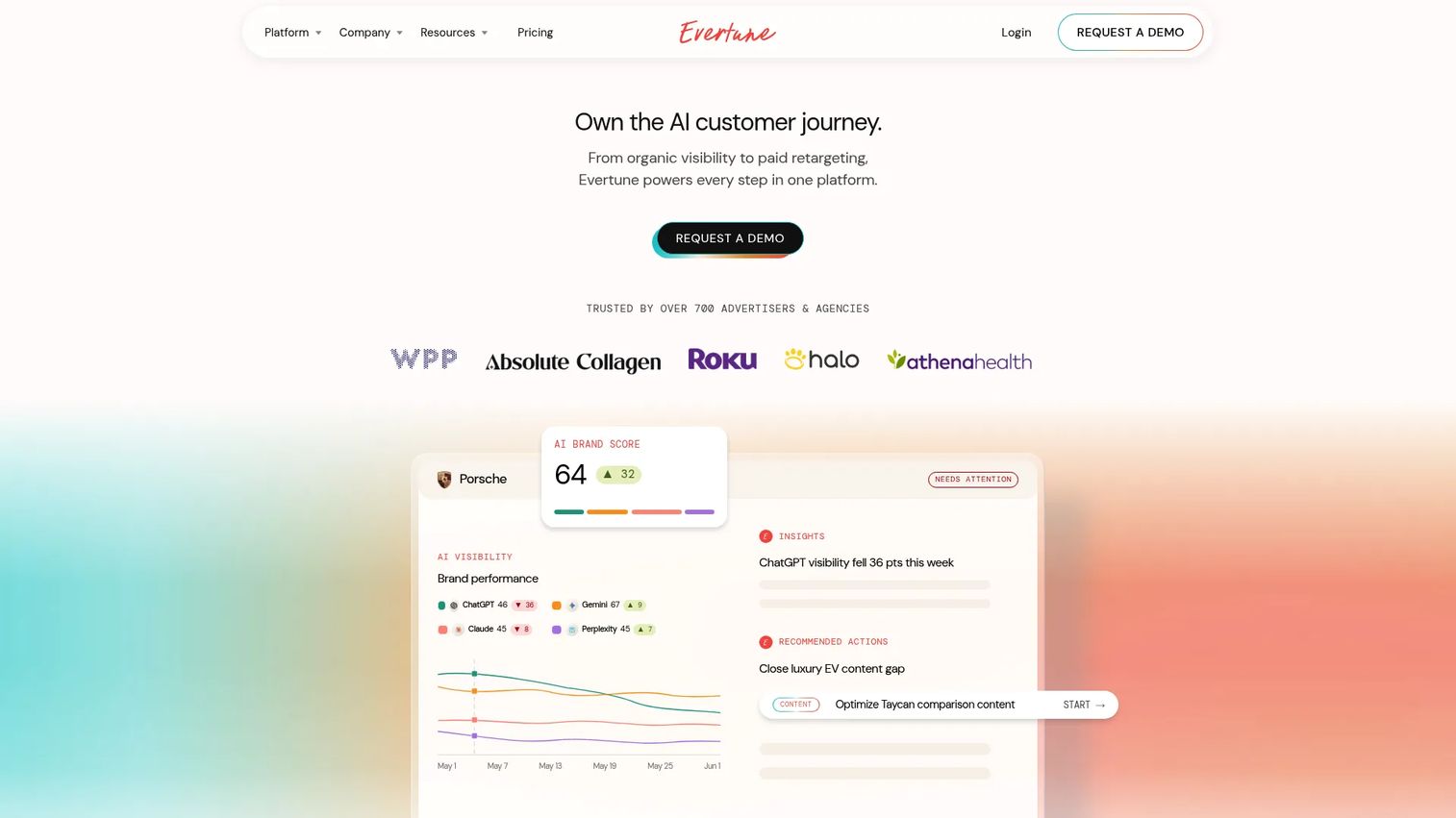
Evertune positions itself at the intersection of AI visibility and AI advertising. It tracks brand presence across major AI models, runs prompt research with statistically significant measurement, and adds an Ads Agent for running campaigns directly in ChatGPT. For brand teams that want to influence AI perception and test paid AI placements, Evertune covers both.
Best for: Marketing teams and agencies that want AI brand perception research combined with the ability to run and measure ChatGPT advertising campaigns.
Key features
- AI visibility tracking across major AI models
- Statistically significant prompt research
- Content Agent for visibility-gap content generation
- Ads Agent for ChatGPT advertising campaigns
- AI retargeting and site audit
Why choose Evertune: Few tools combine organic AI visibility with paid AI advertising in one platform. For teams exploring ChatGPT Sponsored answers or AI retargeting, Evertune removes the need to track organic and paid AI presence separately.
Evertune pricing: The Starter plan is $60/month. The Pro plan runs $800/month (billed annually) and includes 100,000 prompt credits, tracking across all major models, and content tools. Enterprise is custom pricing.
13. Surfer
Surfer is a content optimization platform that added AI visibility tracking to its core editor and audit suite. Teams use it to write and optimize content for both traditional search and AI search surfaces in the same workflow. The content scoring and internal linking tools are mature, and AI visibility sits alongside them rather than as a standalone module.
Best for: Content teams optimizing pages for organic search and AI search together, without splitting the workflow between multiple tools.
Key features
- AI visibility tracking
- Optimized content editor with real-time scoring
- Content audit
- AI SEO optimization recommendations
- One-click internal linking
Why choose Surfer: Surfer's strength is the writing environment. For content marketers who spend most of their time in a document editor, having AI visibility data visible during the writing process reduces handoffs between research and execution.
Surfer pricing: Plans start at $49/month (Discovery, billed annually), then $99/month (Standard), $182/month (Pro), and $299/month (Peace of Mind). Enterprise plans start at $999/month with custom limits and SSO. A 7-day Pro trial is available for new accounts.
G2 rating: 4.6/5
14. LLM Pulse
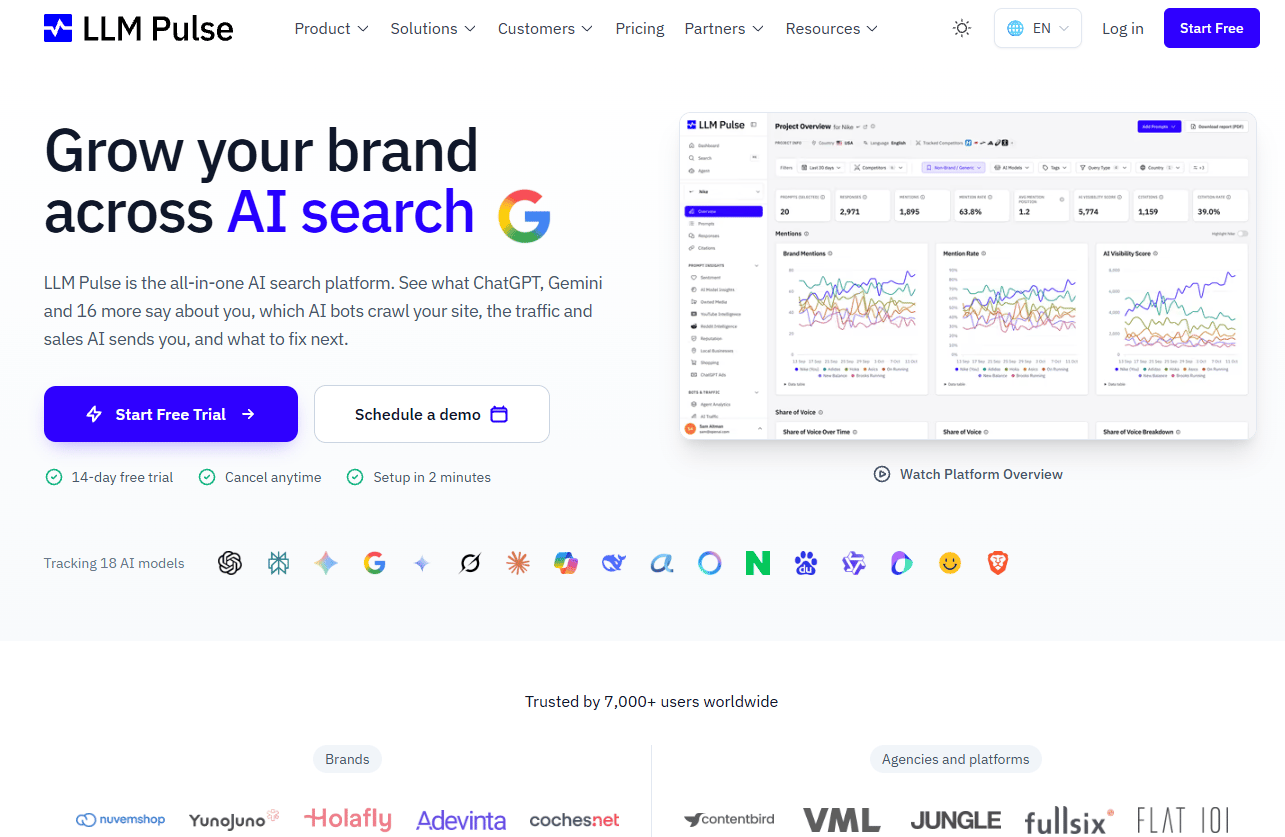
LLM Pulse tracks brand presence, citations, sentiment, and share of voice across AI models, with AI crawler and agent analytics that show how AI bots access your site. It also includes ChatGPT Shopping tracking, an GEO Writer for content creation, and an MCP server for teams that want API-level integration with their existing stack.
Best for: SEO, PR, and agency teams that want broad model coverage with AI crawler analytics and API access for custom integrations.
Key features
- AI prompt tracking across multiple models
- AI crawler and agent analytics
- AI traffic analytics and ChatGPT Shopping tracking
- Sentiment analysis and reputation monitoring
- GEO Writer, API, and MCP server
Why choose LLM Pulse: The crawler analytics angle is worth attention for technical SEO teams. Understanding how AI bots access your content, not just whether your brand gets mentioned, opens up a different category of optimization work.
LLM Pulse pricing: Plans are priced in euros. Starter runs €49/month, Growth is €99/month, and Scale is €299/month. Higher-volume tiers reach €3,799/month for the Partner++ plan. A 14-day free trial is available. Enterprise volume pricing is custom. Note pricing is in EUR, not USD.
G2 rating: 5.0/5
15. HubSpot AI Search Grader
HubSpot AI Search Grader is a free, one-time diagnostic that analyzes how ChatGPT, Perplexity, and Gemini currently represent your brand. It scores your brand out of 100 across sentiment, presence quality, brand recognition, share of voice, and market competition, and returns written recommendations for improvement. No account is required.
Best for: Marketers who want a quick baseline read on AI search presence before investing in a paid monitoring platform.
Key features
- Overall AI search score out of 100
- Sentiment analysis across ChatGPT, Perplexity, and Gemini
- Presence quality, brand recognition, and share-of-voice scoring
- Written interpretation and improvement recommendations
- No login or account required
Why choose HubSpot AI Search Grader: It's the right starting point for teams that haven't measured AI visibility yet. Run it, see your score, understand the gaps, then decide whether ongoing monitoring justifies a paid tool. It won't replace a monitoring platform, but it answers the initial question quickly.
HubSpot AI Search Grader pricing: Completely free.
Considerations when choosing an AI visibility tool
Answer-engine coverage
More engines tracked isn't always better. The tool must track the answer surfaces your buyers actually use. Start by confirming coverage of ChatGPT, Google AI Overviews, and Perplexity at minimum. If your buyers skew technical or international, check whether the platform covers Claude, Copilot, or region-specific AI surfaces before signing.
Prompt data quality
The difference between a useful AI visibility score and a misleading one often comes down to prompt data. Ask vendors whether their prompt sets come from real user queries, keyword-derived approximations, or manually entered prompts. Real-user prompts reflect actual buyer behavior. Modeled prompts are more controllable but may not match what buyers actually ask. Know which one you're buying.
Citation and source analysis
AI search visibility often depends on which domains answer engines trust, not how much content you've published. Before choosing a platform, check whether it shows you which sources AI systems cite in your category. That data drives your content and PR outreach strategy more directly than a share-of-voice score.
Reporting and attribution
A digital marketer with pipeline pressure needs more than a visibility score. Check whether the tool connects AI visibility to referral traffic, lead quality, or assisted conversions. The best tools in this list produce reports that can survive a leadership presentation; others stop at the monitoring layer.
Workflow fit and stack consolidation
Growth marketers already juggling too many tabs will rightly ask what this replaces. If you're already a Semrush or Ahrefs customer, the AI visibility add-ons within those platforms reduce stack sprawl. If your primary need is content optimization, Surfer or Writesonic may serve double duty. Standalone platforms like Profound, Peec AI, or Scrunch earn their place when AI visibility is a dedicated reporting function.
Conclusion
The tools on this list split across three practical use cases. For serious enterprise AI visibility programs with executive reporting requirements, Profound, Peec AI, and Conductor have the depth to match. For teams that want AI visibility data inside the SEO platform they already use, the Semrush AI Visibility Toolkit and Ahrefs Brand Radar are the consolidation plays. For citation intelligence and brand perception research, Scrunch, AthenaHQ, and Evertune go further than share-of-voice counts alone.
If you're starting from zero, run the HubSpot AI Search Grader first to get a baseline, then pick 20 to 50 prompts that reflect your highest-value buyer journeys. Test two or three tools against that same prompt set, compare the source citations they surface and how they report competitor positioning, and choose the platform whose data you'd actually put in a dashboard.
The goal isn't another visibility score. It's understanding what AI systems say about your brand before your buyers do, and having a clear path from that data to content, PR, or paid action.
Once visibility gaps point to high-intent topics, the downstream work is converting that traffic. Guideflow helps GTM teams build interactive demos that let prospects experience the product immediately, turning AI-driven discovery into qualified pipeline through sales enablement, landing pages, demo centers, and more.
Start your journey with Guideflow today!
FAQs
An AI visibility tool tracks how often and how a brand appears in AI-generated answers across platforms like ChatGPT, Gemini, Perplexity, and Google AI Overviews. It monitors brand mentions, source citations, sentiment, and share of voice in those responses, which are metrics that traditional rank-tracking tools don't capture. The goal is to understand and improve what AI systems say about your brand when buyers ask category questions.
The answer depends on your team size and primary use case. Profound and Peec AI are strong choices for teams building a dedicated AI visibility reporting function. The Semrush AI Visibility Toolkit and Ahrefs Brand Radar fit teams that want AI data inside their existing SEO platform. HubSpot AI Search Grader is the right starting point for a quick baseline with no cost. The practical approach is to run the same 20 to 30 prompts through two tools and compare which source citations and competitive data feel more actionable.
SEO tools track keyword rankings, backlinks, crawl health, and organic traffic from traditional search engines. AI visibility tools track what happens inside AI-generated answers, including which brands get mentioned, which sources get cited, and how brands are described relative to competitors. Both data sets matter. AI visibility tools don't replace SEO; they add a layer that SEO tools currently can't see. For more context on how these tools connect, see our guide to AI search and retrieval platforms.
Yes, with limitations. HubSpot AI Search Grader offers a free, one-time brand analysis across three AI engines with no account required. AthenaHQ has a free Essential tier with 300 credits. Ahrefs Brand Radar offers basic free access, and Yext Scout has a free tier for limited visibility monitoring. Free tools give you a snapshot. Ongoing monitoring that tracks share-of-voice trends and prompt coverage over time generally requires a paid plan.
Different tools query different AI engines, use different prompt sets, run queries at different times, and may send queries through APIs rather than live interfaces. AI models also vary outputs based on user context, geography, and model version. When two tools disagree on your visibility score, the prompt set is usually the first place to check. Tools using real-user prompts will reflect actual buyer searches; tools using keyword-derived prompts may miss how buyers actually phrase questions to AI assistants.
Start with the surfaces your buyers are most likely to use: ChatGPT, Google AI Overviews, and Perplexity cover the majority of AI search activity for most B2B categories. If your buyers are more technical, add Claude and Copilot. For teams exploring generative engine optimization or running regional campaigns, check whether the tool covers region-specific AI surfaces or international model variants.
The metrics worth tracking depend on where you are in building the program. Early stage: Brand mention rate across your core prompt set, and which competitor appears in answers where you don't. Intermediate: Share of voice trends over time, citation domain list and gaps, and sentiment breakdown. Advanced: AI referral traffic, correlation between citation gain and lead quality, and prompt coverage across different buyer journey stages. Start with share of voice and citation domains; they drive the most immediate action.
Weekly tracking makes sense for active campaigns, competitive categories, or immediately after publishing new content targeting AI search. Monthly reporting gives leadership enough data to see trends without noise. Categories with rapid competitive movement, such as software buying, may need more frequent checks during product launches or when a competitor makes a major content push. Most paid platforms in this list support daily or weekly automated monitoring with alert thresholds.