Aerospace manufacturers can’t afford disconnected production, quality, and traceability records. One outdated revision can trigger rework. A missing material certificate can delay shipment or turn audit preparation into a fire drill.
Generic manufacturing systems often struggle with this operating model. Aerospace manufacturing software must connect engineering changes, controlled work instructions, inspection evidence, supplier records, and material history.
The pressure is growing. Capgemini Research Institute reported in 2025 that 86% of aerospace and defense executives consider digital continuity important for increasing production.
For founders and operators, the buying question goes beyond features. Which system removes operational risk without creating years of implementation drag? The answer depends on whether your bottleneck sits in ERP, manufacturing execution, quality, engineering control, or inventory.
What's inside
This guide compares software for aerospace manufacturers, defense suppliers, precision machine shops, and other regulated producers.
We selected products using four criteria:
- Aerospace relevance: Support for regulated or complex manufacturing workflows
- Operational coverage: ERP, MES, PLM, quality, inventory, or additive production
- Traceability depth: Material history, revision records, production evidence, and quality data
- Stack fit: The operating maturity and system ownership each product requires
Choose by operating bottleneck. The product with the longest feature list isn’t automatically the right system.
TL;DR
- Best for aerospace ERP and quality: ProShop ERP combines ERP, MES, and QMS workflows for precision manufacturers
- Best for enterprise MOM and MES: DELMIA connects planning with complex manufacturing execution
- Best for additive manufacturing: Oqton Manufacturing OS manages production, traceability, machine connectivity, and digital spare parts
- Best for PLM and configuration control: Teamcenter governs engineering data, product structures, revisions, and changes
- Best for complex industrial operations: IFS Cloud ERP connects manufacturing with assets, service, supply chain, and finance
- Best for smaller operations: MRPeasy, Fishbowl, Cetec ERP, and Katana offer narrower entry points
What is aerospace manufacturing software?
Aerospace manufacturing software helps aerospace and defense manufacturers plan, execute, document, trace, and improve production under strict quality and configuration requirements.
The category includes several system types. Each controls a different part of the operating model.
- Enterprise resource planning (ERP): Manages purchasing, inventory, work orders, costing, financials, and supply planning
- Manufacturing execution systems (MES): Controls shop floor activity, work instructions, work in progress, and production records
- Manufacturing operations management (MOM): Coordinates execution, quality, labor, maintenance, and plant performance
- Quality management systems (QMS): Documents inspections, nonconformance reports, corrective actions, audits, and supplier quality
- Product lifecycle management (PLM): Governs engineering data, bills of materials, revisions, requirements, and configuration control
- Advanced planning and scheduling (APS): Models capacity, material constraints, sequence dependencies, and finite schedules
- Additive manufacturing software: Manages build preparation, machine connectivity, qualification data, and production monitoring
The core requirement is connected evidence. Aerospace traceability software should help teams follow materials, processes, inspections, and revisions from receipt through shipment.
Important capabilities include:
- Material, lot, and serial traceability
- AS9100 aligned quality workflows
- Access and document controls
- First article inspection records
- Nonconformance and corrective action management
- Revision and configuration control
- Digital work instructions
- Supplier quality records
- Shop floor visibility
- Production scheduling and WIP tracking
These platforms can support AS9100, ITAR, DFARS, NIST SP 800 171, and CMMC related workflows. They don’t make an organization compliant. Process ownership, staff training, cybersecurity controls, and documented execution remain the manufacturer’s responsibility.
When to use aerospace manufacturing software
Replace spreadsheet controlled production
Use dedicated software when job travelers, inspection results, material certificates, and schedules sit across spreadsheets or paper folders.
The trigger is simple. Your team can’t quickly answer where a part is, who handled it, or which revision governed production. Aerospace manufacturing ERP and MES platforms connect those records to the work.
Prepare for aerospace audits without a scramble
AS9100 and customer audits require evidence. Rebuilding that evidence during audit week wastes leadership time and exposes missing records.
Aerospace quality management software keeps inspections, nonconformance reports, corrective actions, calibration records, and approvals attached to production. This supports continuous readiness instead of last minute document collection.
Connect engineering changes to the shop floor
Aircraft manufacturing software becomes essential when revision changes affect materials, tooling, approved processes, or work instructions.
Aerospace PLM controls the engineering definition. MES guides execution, while ERP coordinates demand and inventory. Integrating these layers reduces the chance of building from an outdated configuration.
Aerospace manufacturing software comparison
The table compares 15 tools by operating fit, primary use case, pricing model, and current G2 rating. Prices come from vendor pricing pages where available.
Several enterprise vendors price by quote because deployments vary by users, sites, modules, and implementation services. An unavailable G2 rating means no current product rating was confirmed during research.
| # | Product | Best for | Key use case | Pricing | G2 rating |
|---|---|---|---|---|---|
| 1 | ProShop ERP | Aerospace machine shops and regulated suppliers | Integrated ERP, MES, and QMS | Custom pricing | 4.6/5 |
| 2 | DELMIA | Enterprise aerospace manufacturing operations | MOM, MES, planning, and execution | Custom pricing | 4.0/5 |
| 3 | Oqton Manufacturing OS | Additive aerospace manufacturing | Production control and machine traceability | Custom pricing | N/A |
| 4 | Kinetic | Midmarket industrial manufacturers | Manufacturing ERP and multi site operations | Custom pricing | 3.9/5 |
| 5 | Teamcenter | Engineering heavy aerospace organizations | PLM and configuration control | Custom pricing, 30 day trial | 4.3/5 |
| 6 | IFS Cloud ERP | Asset intensive aerospace operations | ERP, assets, service, and supply chain | Custom pricing | 4.0/5 |
| 7 | Solumina MES | Complex aerospace production | Digital execution and product genealogy | Custom pricing | N/A |
| 8 | TrakSYS | Factory visibility across complex operations | MES, quality, OEE, and analytics | From $1,999/month annually | N/A |
| 9 | Infor CloudSuite Industrial | Small and midsize industrial manufacturers | Manufacturing ERP and planning | Custom pricing | N/A |
| 10 | Global Shop Solutions | Job shops and mixed mode manufacturers | ERP, scheduling, costing, and quality | Custom pricing | 3.9/5 |
| 11 | SYSPRO | Manufacturing and distribution businesses | Production and supply chain control | Custom pricing | 4.1/5 |
| 12 | MRPeasy | Smaller manufacturers | MRP, scheduling, and inventory | From $49/user/month | 4.6/5 |
| 13 | Fishbowl | Inventory led manufacturing teams | Inventory and light manufacturing control | From $229/month annually | 4.0/5 |
| 14 | Cetec ERP | Small and midsize manufacturers | Cloud ERP, MRP, and quality | From $50/user/month | 4.1/5 |
| 15 | Katana Cloud Inventory | Small manufacturers needing cloud inventory | Inventory and production coordination | Free plan, paid from $299/month | 4.4/5 |
Best 15 tools for aerospace manufacturing software
1. ProShop ERP
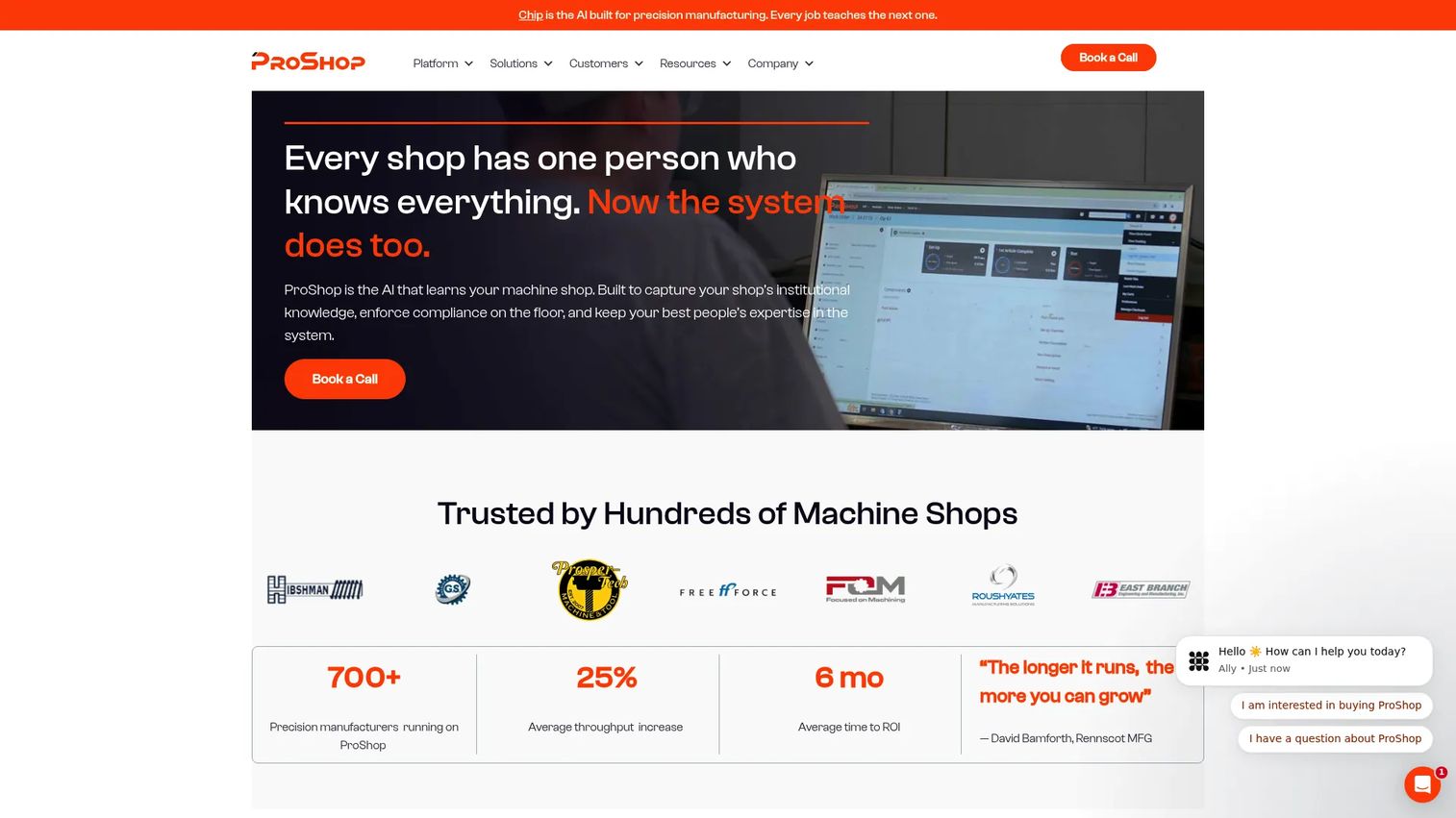
ProShop ERP is a web based, paperless ERP, MES, and QMS platform for precision manufacturers. It brings estimating, work orders, scheduling, quality records, tooling, and job costing into the same operational system.
Its integrated model fits aerospace machine shops that want fewer handoffs between production and quality. Visual work instructions and inspection records give operators controlled information while preserving evidence for later review.
Best for: Aerospace machine shops, defense suppliers, and precision manufacturers that want integrated operational control
Key features
- Integrated ERP, MES, and QMS
- Estimating and quoting
- Visual work instructions
- Quality inspection records
- Calibration and maintenance management
Why choose ProShop ERP: It suits manufacturers whose production and quality processes are tightly linked. The combined platform can reduce dependence on separate ERP, MES, and QMS products.
This fit matters when audit readiness and shop discipline carry more weight than broad corporate functionality. Buyers should still test how its financial workflows connect with existing accounting processes.
ProShop ERP pricing: Custom pricing reflects user count and the selected standard or government option.
G2 rating: 4.6/5.
2. DELMIA
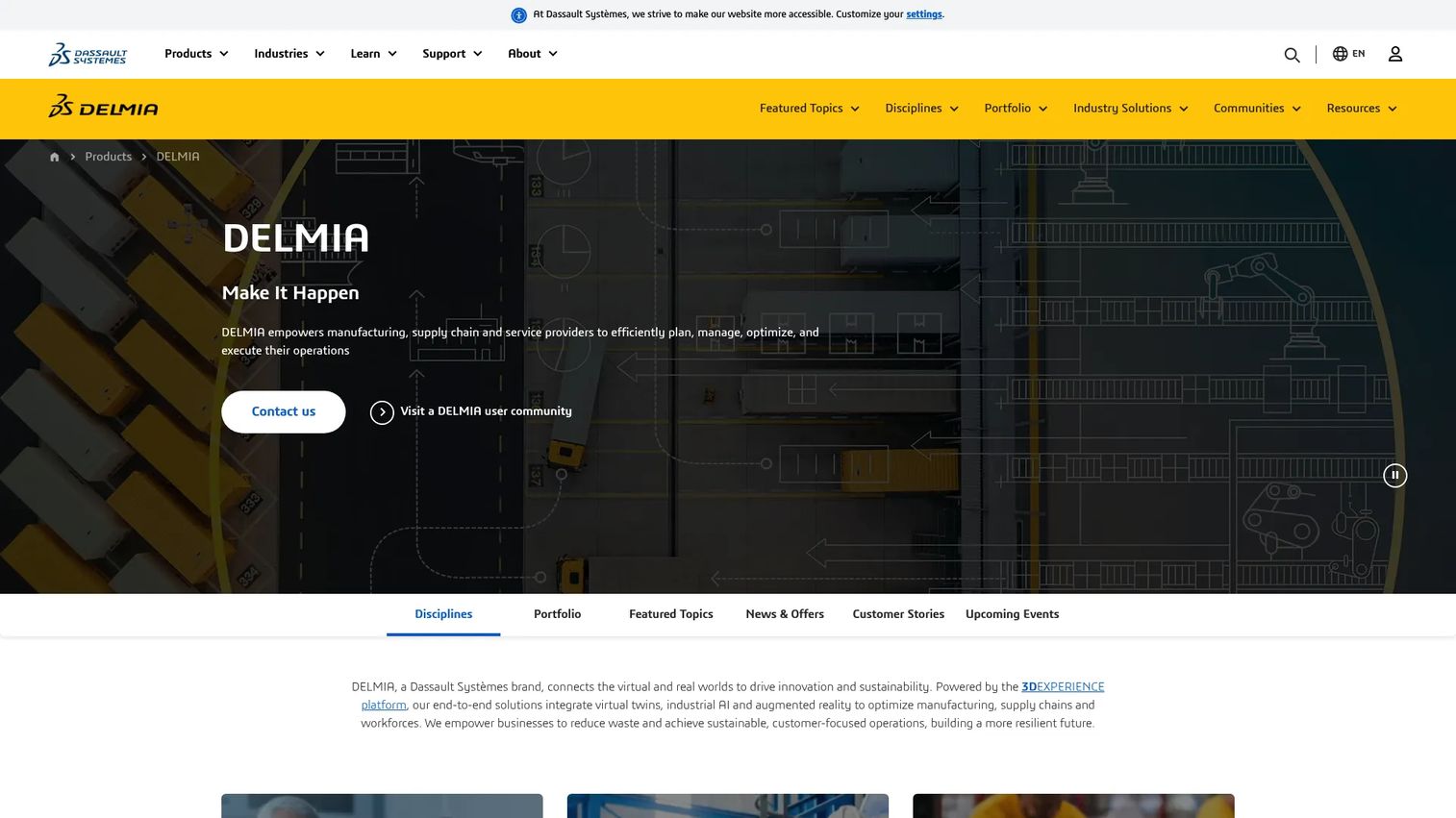
DELMIA supports manufacturing planning, operations execution, workforce processes, and supply chain optimization. Its scope spans digital manufacturing and enterprise production environments.
The platform fits aerospace organizations where operations cross plants, product lines, and complex planning constraints. Virtual twin technology helps teams model manufacturing processes before changing physical execution.
Best for: Enterprise aerospace manufacturers requiring advanced MOM, production planning, and execution control
Key features
- Manufacturing operations management
- Virtual twin technology
- Industrial AI optimization
- Augmented reality instructions
- Supply chain planning
Why choose DELMIA: Consider it when manufacturing execution must connect with engineering context and enterprise planning. Its breadth makes the strongest case in complex operating environments.
A deployment at this level requires defined process ownership. Leadership should budget for implementation resources, integration work, governance, and user adoption across affected plants.
DELMIA pricing: Custom pricing.
G2 rating: 4.0/5.
3. Oqton Manufacturing OS
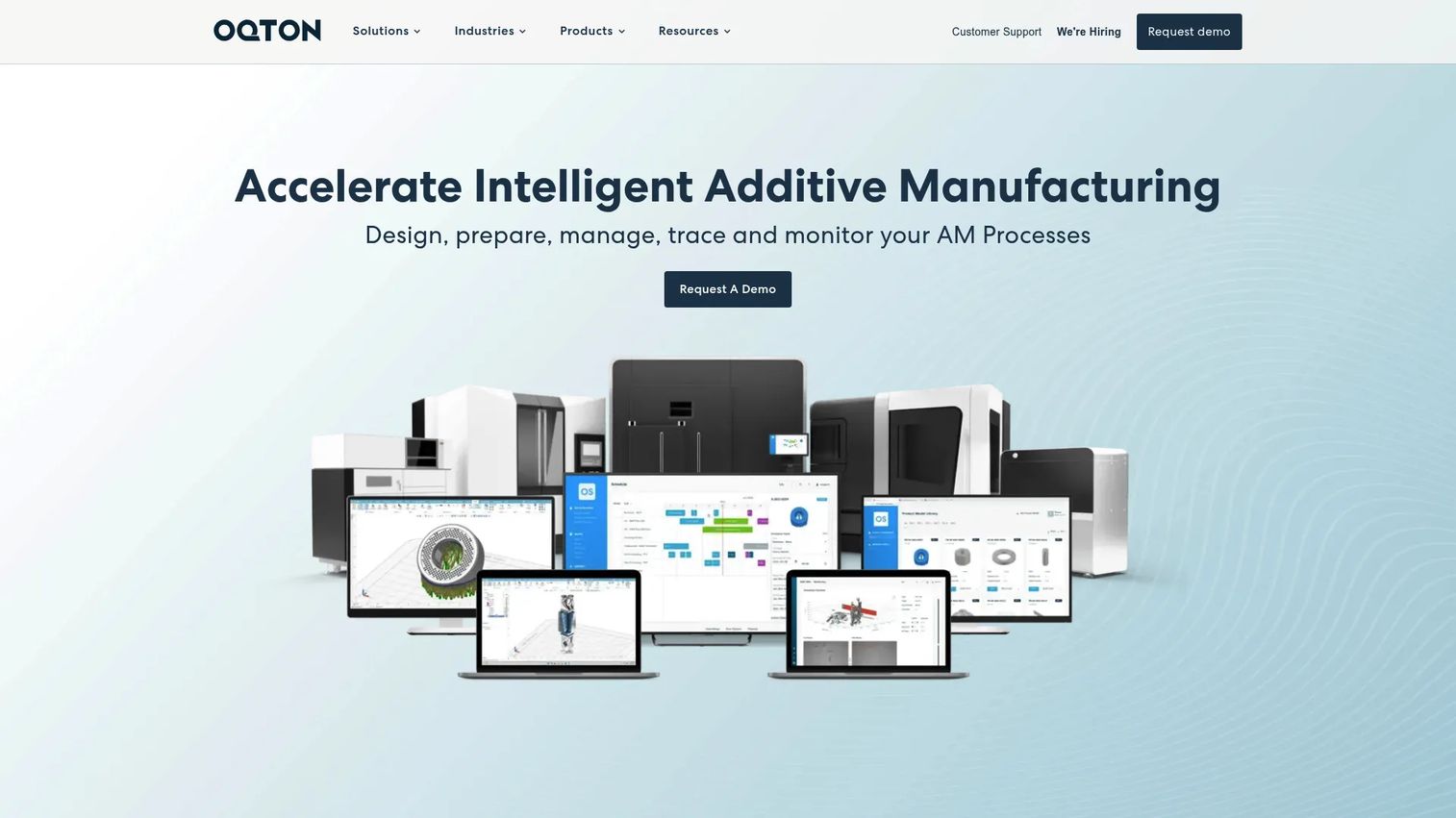
Oqton Manufacturing OS manages additive production workflows, orders, scheduling, quality data, and digital spare parts. Its traceability covers machines, parts, materials, and production orders.
This is a specialized choice for aerospace manufacturers moving additive manufacturing beyond prototyping. The Royal Aeronautical Society and Protolabs reported in 2025 that 69.14% of aerospace survey respondents used 3D printing for prototyping or manufacturing.
Best for: Aerospace teams producing qualified additive parts or managing distributed digital inventories
Key features
- Additive production management
- Machine and material traceability
- Production planning and scheduling
- Quality monitoring and alerts
- Digital spare parts warehouse
Why choose Oqton Manufacturing OS: Choose it when additive manufacturing is a production discipline rather than an isolated engineering experiment. Open APIs connect its workflow with ERP, CRM, PLM, and CAD or CAM systems.
It doesn’t replace the broader financial and purchasing role of aerospace ERP. Its value comes from managing additive operations with stronger production context.
Oqton Manufacturing OS pricing: Custom pricing. Perpetual and subscription licensing are available.
4. Kinetic
Kinetic is a cloud ERP system for discrete and make to order manufacturers. It connects production with supply chain operations, financial reporting, sourcing, and multi site management.
Forecasting, material requirements planning, and advanced scheduling make it relevant when production problems start with weak demand or capacity planning. IoT enabled data collection also brings execution signals into the ERP environment.
Best for: Midmarket and larger manufacturers that need a mature aerospace manufacturing ERP backbone
Key features
- Manufacturing planning and forecasting
- Material requirements planning
- Advanced planning and scheduling
- Financial reporting and analytics
- Multi site operations
Why choose Kinetic: It fits teams that need broad ERP control rather than a specialized point product. The platform gives operations and finance a shared system for planning production economics.
Implementation deserves board level scrutiny. Data migration, chart of accounts design, planning rules, integrations, and plant adoption will shape the return more than the software contract alone.
Kinetic pricing: Custom pricing.
G2 rating: 3.9/5.
5. Teamcenter
Teamcenter is PLM software for managing product data across design, development, manufacturing, and service. It governs documents, bills of materials, requirements, configurations, and engineering changes.
Teamcenter belongs on the shortlist when production risk begins with engineering data. It gives aerospace organizations a controlled product definition that downstream systems can reference.
Best for: Engineering heavy aerospace organizations where configuration control drives manufacturing risk
Key features
- Product data management
- Bill of materials control
- Engineering change management
- Requirements and configuration management
- Cross functional product collaboration
Why choose Teamcenter: Select it when revision discipline and approved product structures are the primary problem. It can anchor an aerospace defense product engineering software stack.
Teamcenter complements ERP and aerospace MES in many architectures. PLM controls what should be built, while execution and resource systems manage how production occurs.
Teamcenter pricing: Custom pricing across Essentials, Standard, Advanced, and Premium tiers. A 30 day trial is available.
G2 rating: 4.3/5.
6. IFS Cloud ERP
IFS Cloud ERP connects finance, supply chain, manufacturing, enterprise assets, and service operations. Its scope suits industrial companies whose products continue into maintenance or field service after production.
That breadth matters in aerospace and defense. Manufacturing may represent only one part of the lifecycle, alongside asset management, aftermarket service, and MRO handoff.
Best for: Asset intensive aerospace organizations connecting manufacturing with service and maintenance operations
Key features
- Connected enterprise resource planning
- Manufacturing and supply chain operations
- Enterprise asset management
- Field service management
- Sustainability tracking and reporting
Why choose IFS Cloud ERP: It fits companies where production, installed assets, and service delivery share operational data. This makes it relevant for manufacturers with long product lifecycles.
The platform can consolidate several enterprise processes, but consolidation increases implementation scope. Define which operating model takes priority before letting every department add requirements.
IFS Cloud ERP pricing: Custom pricing.
G2 rating: 4.0/5.
7. Solumina MES
Solumina MES is a manufacturing execution system for complex discrete production. It has direct relevance to aerospace and defense environments that require controlled processes and detailed product genealogy.
The platform manages production definitions, dispatch, data collection, quality, and change execution. Paperless operations give technicians current work instructions while capturing production evidence.
Best for: Aerospace manufacturers needing execution level control and end to end production traceability
Key features
- Digital work instructions
- Product tracking and genealogy
- Process execution management
- Quality data collection
- Change management
Why choose Solumina MES: Use it when ERP lacks enough control over operator activity and production records. It supports the manufacturing execution system aerospace buyers need for regulated shop floors.
Its focus is execution rather than general financial management. Buyers should map how orders, materials, engineering changes, and completed records move between MES, ERP, and PLM.
Solumina MES pricing: Custom pricing.
8. TrakSYS
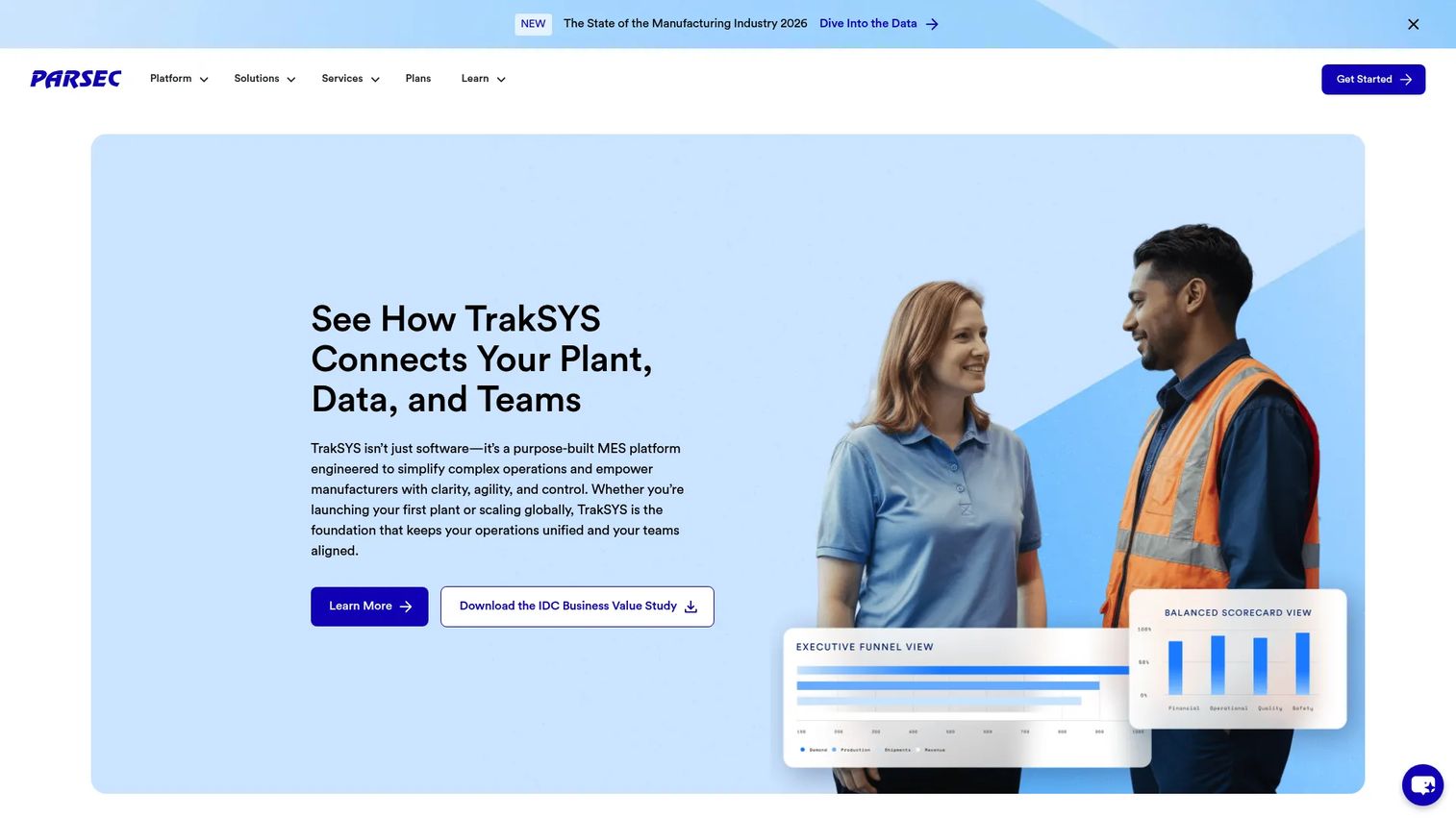
TrakSYS is a modular MES for monitoring and controlling complex manufacturing operations. It connects production data with digital workflows, quality checkpoints, traceability, dashboards, and alerts.
Its integration options include PLCs, HMIs, ERP, SCADA, cloud applications, OPC UA, MQTT, REST, and SQL. That connectivity makes it useful where visibility depends on consolidating signals from existing factory systems.
Best for: Manufacturers improving shop floor visibility without immediately replacing their broader ERP stack
Key features
- Real time production monitoring
- OEE and KPI tracking
- Electronic work instructions
- Quality checkpoints and traceability
- Multi site manufacturing orchestration
Why choose TrakSYS: It fits operations teams focused on throughput, downtime, and factory performance. Modular deployment also supports a phased manufacturing operations program.
Aerospace buyers should test genealogy, revision handling, inspection evidence, and access controls against their operating requirements. Generic performance monitoring alone won’t satisfy regulated production needs.
TrakSYS pricing: Essentials starts at $1,999 per month with an annual subscription. Higher plans range from $4,999 to $15,999 per month.
9. Infor CloudSuite Industrial
Infor CloudSuite Industrial is a cloud ERP system for small and midsize industrial manufacturers. It supports discrete, process, and project based manufacturing models.
The platform combines planning, inventory, warehousing, supply chain visibility, and inline quality controls. Modular connections with MES, WMS, PLM, and CPQ can extend the core ERP.
Best for: Industrial manufacturers scaling production and supply chain control through cloud ERP
Key features
- Industry specific cloud ERP
- Advanced planning and scheduling
- Multi site operations
- Inventory and warehousing
- Inline quality control
Why choose Infor CloudSuite Industrial: It suits manufacturers seeking a broad aerospace ERP software foundation with production depth. Project based workflows also matter where contracts span long delivery cycles.
Before committing, determine which quality and traceability capabilities live inside the core deployment. External modules and integrations can materially change cost and implementation time.
Infor CloudSuite Industrial pricing: Custom pricing.
10. Global Shop Solutions
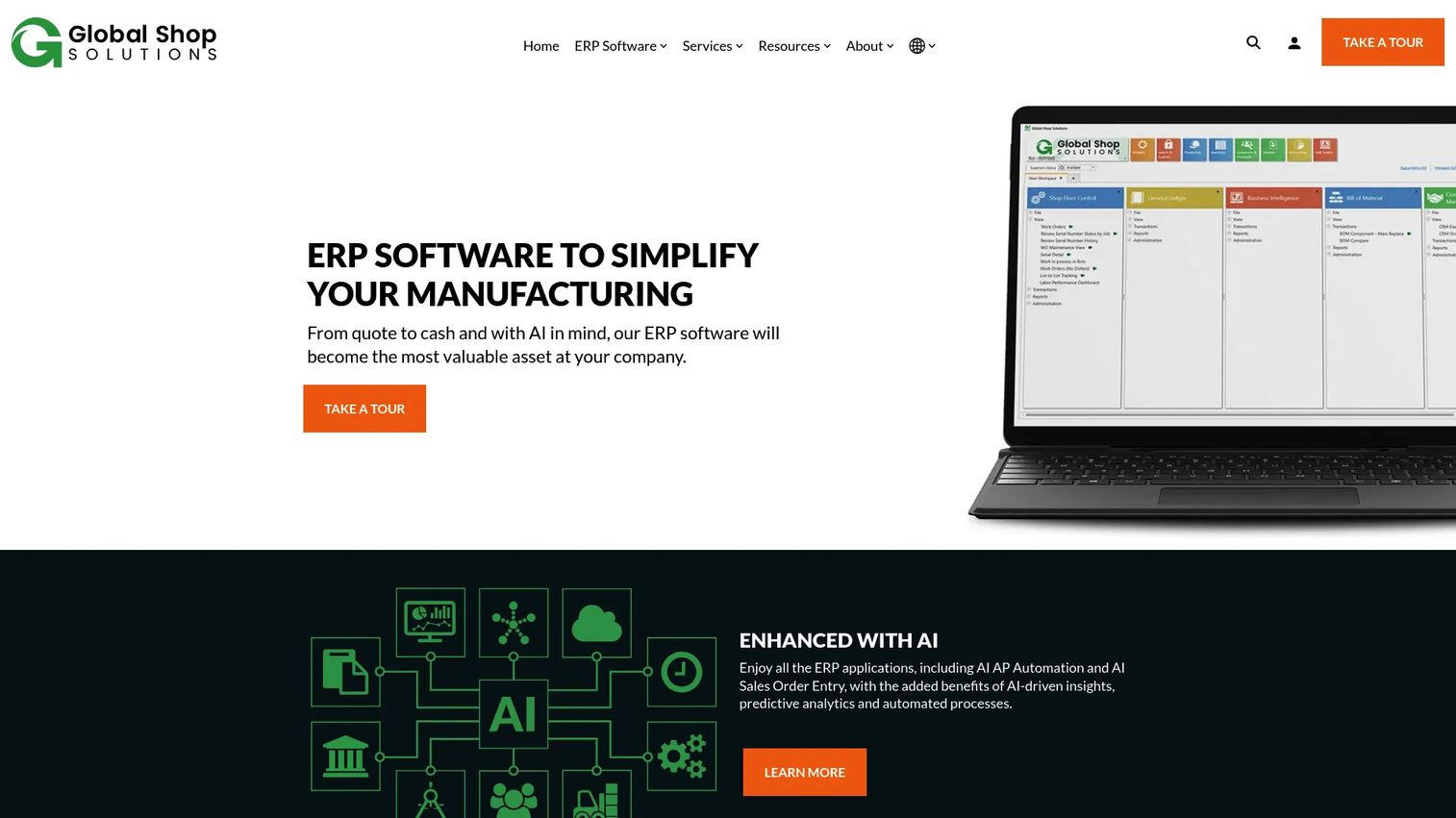
Global Shop Solutions provides manufacturing ERP from quote through cash. Its functional coverage includes scheduling, shop floor data collection, inventory, quality, purchasing, job costing, and financial management.
That range fits job shops that want production control without maintaining a collection of disconnected applications. Dashboard and KPI features give leaders a shared view of operational performance.
Best for: Job shops and mixed mode manufacturers needing broad control over production economics
Key features
- Production scheduling
- Shop floor data collection
- Inventory and purchasing
- Quality management
- Job costing and financials
Why choose Global Shop Solutions: It fits manufacturers that want one ERP covering commercial and production processes. The concurrent user model may also suit companies with rotating shop floor usage.
Aerospace buyers should test controlled documents, inspection history, material certificates, and configuration records during evaluation. General manufacturing breadth doesn’t automatically provide aerospace depth.
Global Shop Solutions pricing: Custom pricing uses a concurrent user model. Deployment options include cloud, SaaS, and on premises installations.
G2 rating: 3.9/5.
11. SYSPRO
SYSPRO is ERP software for manufacturing and distribution companies. It covers production, inventory, warehouse operations, financial controls, and supply chain workflows.
Manufacturing capabilities include bills of materials, material requirements planning, quality management, and traceability. Distribution features extend its fit for companies managing complex inbound and outbound material flows.
Best for: Mid sized manufacturers balancing production needs with supply chain and distribution complexity
Key features
- Manufacturing operations management
- Material requirements planning
- Quality and traceability
- Warehouse management
- Financial controls
Why choose SYSPRO: Consider it when inventory and supply chain discipline are as important as production planning. Its breadth can give finance and operations a shared source of data.
Keep aerospace relevance grounded in tested workflows. Ask the vendor to demonstrate lot history, quality evidence, revision handling, and controlled access with your sample data.
SYSPRO pricing: Custom pricing reflects users, modules, deployment, implementation, training, and support.
G2 rating: 4.1/5.
12. MRPeasy
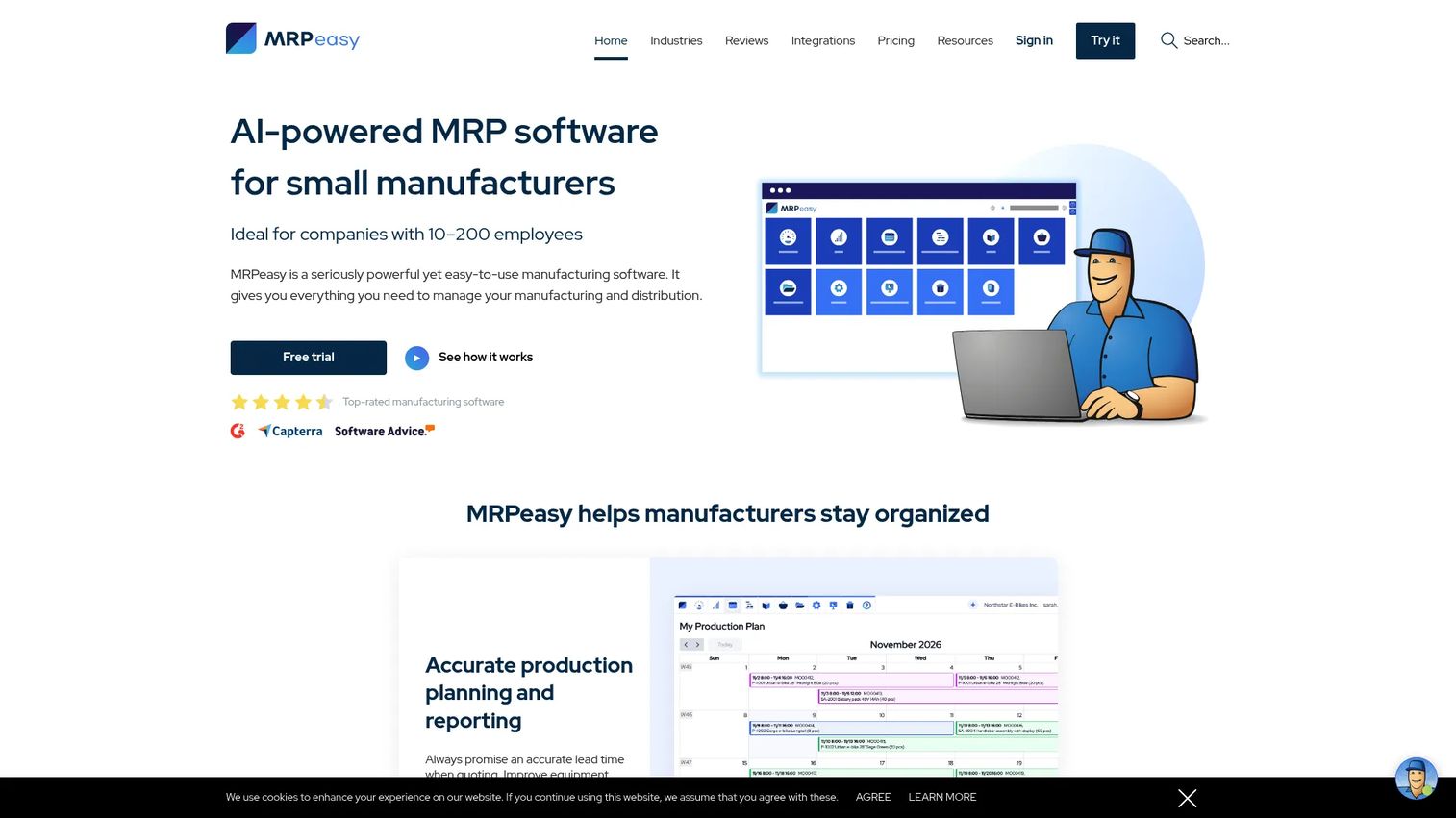
MRPeasy is cloud manufacturing resource planning software for small and midsize manufacturers. It combines production scheduling with bills of materials, purchasing, inventory, sales management, and shop floor reporting.
Lot and serial number traceability make it more capable than a basic inventory application. Its published pricing also gives smaller teams clearer cost visibility before evaluation.
Best for: Smaller manufacturers that need structured production planning without a large ERP program
Key features
- Production planning and scheduling
- Bill of materials management
- Lot and serial traceability
- Inventory and procurement
- Shop floor reporting
Why choose MRPeasy: It fits teams replacing spreadsheets with an accessible MRP system. The product can establish planning discipline before an enterprise platform becomes economically sensible.
Regulated aerospace manufacturers should test quality workflows, document control, FAI records, and audit trails closely. A low subscription cost won’t offset missing operating controls.
MRPeasy pricing: Starter costs $49 per user monthly. Other plans cost $69, $99, or $149 per user monthly, with a 15 day trial.
G2 rating: 4.6/5.
13. Fishbowl
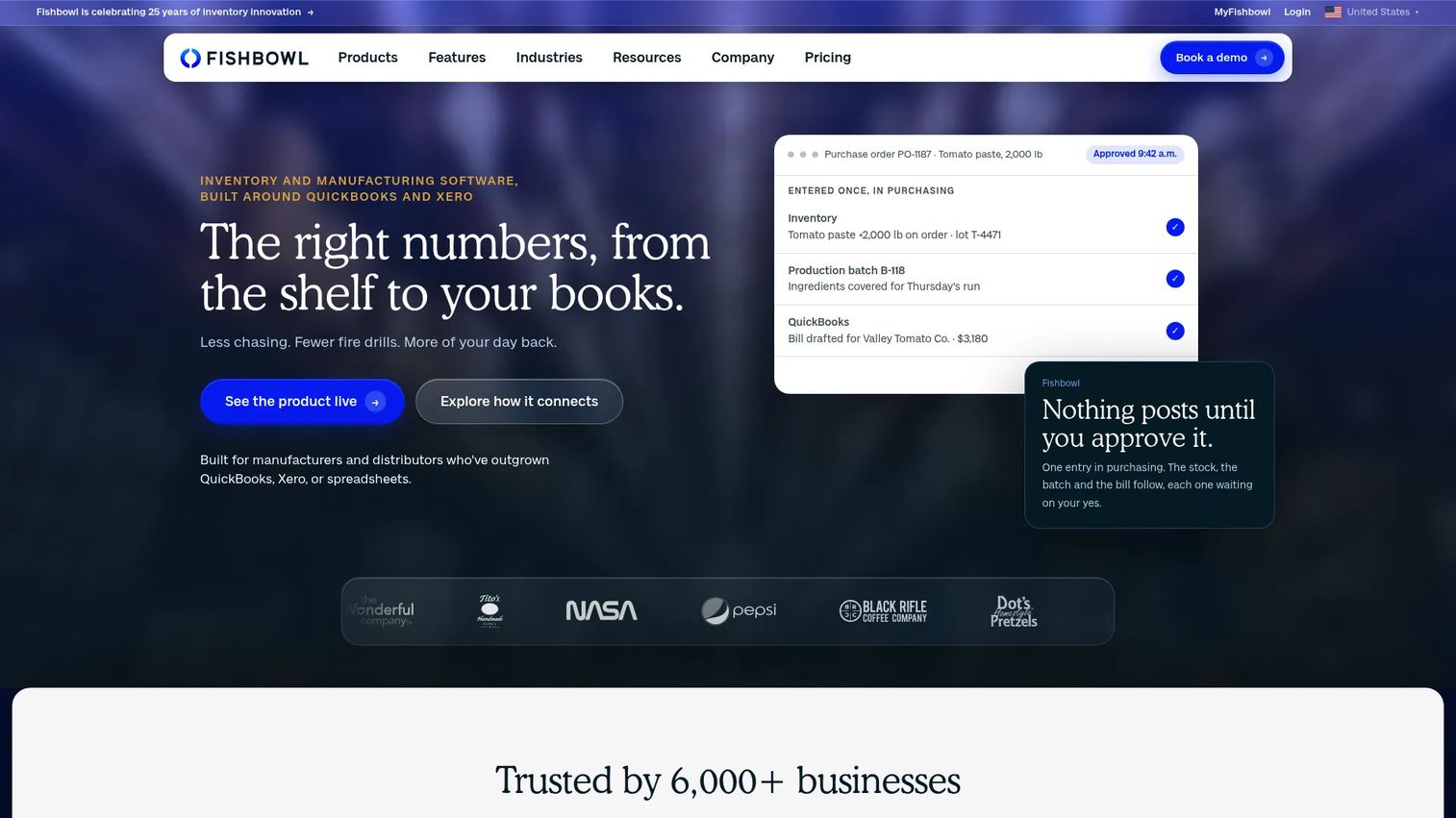
Fishbowl combines inventory, warehouse management, and light manufacturing control. It tracks stock across locations and supports bills of materials, work orders, purchasing, and barcode operations.
Lot level forward and backward traceability helps teams investigate material movement. Connections with QuickBooks Online and Xero also appeal to businesses that aren’t ready for a full financial ERP.
Best for: Inventory led manufacturers that need stronger stock control and basic production management
Key features
- Real time inventory tracking
- Lot and serial traceability
- Bills of materials
- Mobile barcode scanning
- Work orders and purchasing
Why choose Fishbowl: It earns consideration when inventory accuracy creates the largest operational risk. Advanced Manufacturing adds more production control than the core inventory plans.
Complex aerospace operations should validate inspection management, configuration control, supplier quality, and audit evidence. Fishbowl’s center of gravity remains inventory and warehouse execution.
Fishbowl pricing: Essentials starts at $229 per month billed annually. Advanced Manufacturing starts at $675 per month.
G2 rating: 4.0/5.
14. Cetec ERP
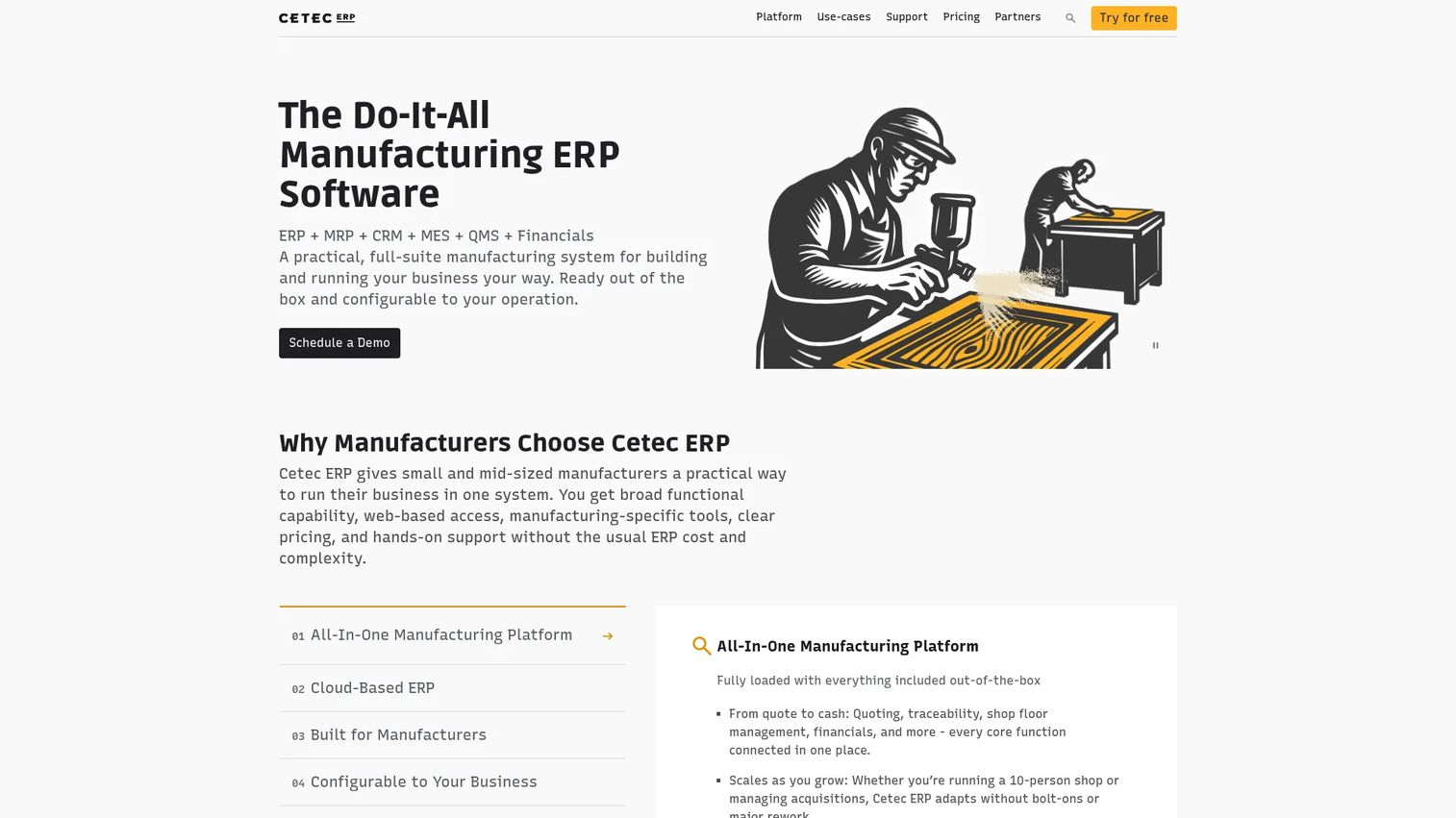
Cetec ERP is a cloud ERP platform for small and midsize manufacturers. It combines CRM, quoting, production, inventory, quality, financials, and document management.
Quality tracking and traceability extend its usefulness for regulated suppliers. The web based delivery model also avoids the infrastructure burden associated with traditional on premises ERP deployments.
Best for: Smaller manufacturers wanting integrated ERP, MRP, quality, and accounting workflows
Key features
- Manufacturing quoting and costing
- Material requirements planning
- Quality and traceability
- Inventory and barcode scanning
- Integrated financial management
Why choose Cetec ERP: It offers broad manufacturing coverage with transparent user pricing. This can help an operator estimate first year software costs before implementation planning begins.
Support plans are separate from user subscriptions. Buyers should model total cost across licenses, support, migration, training, and integration work.
Cetec ERP pricing: Standard users cost $50 per month with a five user minimum. A free trial is available.
G2 rating: 4.1/5.
15. Katana Cloud Inventory

Katana Cloud Inventory centralizes inventory, production, purchasing, and sales operations for small manufacturers. It tracks materials across multiple warehouses while coordinating production orders.
Batch, expiry date, and serial number tracking support product history. Barcode based receiving and stock counting help improve inventory accuracy during daily operations.
Best for: Small manufacturers needing cloud inventory and production coordination before a full ERP rollout
Key features
- Multi location inventory tracking
- Batch and serial traceability
- Production order management
- Purchasing coordination
- Barcode receiving and counting
Why choose Katana Cloud Inventory: It fits companies seeking inventory clarity without adopting a large aerospace ERP. The free plan also provides a low commitment starting point for limited SKU counts.
Its lighter scope won’t cover every aerospace quality or engineering workflow. Treat it as an inventory and production system, then validate external controls for regulated work.
Katana Cloud Inventory pricing: A free plan supports up to 30 SKUs. Core starts at $299 per month, while Advantage uses custom pricing.
G2 rating: 4.4/5.
Considerations when choosing aerospace manufacturing software
Match the system to the bottleneck
ERP, MES, QMS, PLM, and inventory products solve different operating problems. Start with the failure your leadership team can observe and measure.
Choose ERP for broken purchasing, costing, and planning. Prioritize MES for weak execution records, while PLM addresses engineering revision drift.
Verify traceability depth before the sales call
Ask vendors to demonstrate one complete material journey. Start with the purchase order and material certificate, then follow the lot through production and shipment.
Include inspection results, operator history, revision status, and nonconformance records. Generic claims about cradle to grave traceability aren’t enough.
Test AS9100 and ITAR workflows as processes
Evaluate access controls, document approvals, training records, corrective actions, and audit evidence. For defense work, include export controlled data handling in the review.
Software can support these processes. Your organization remains responsible for policy design, execution, cybersecurity, and legal interpretation.
Check integration points early
Map ERP, aerospace MES, PLM, QMS, CAD, purchasing, and inspection systems before selecting a platform. Identify which application owns each record.
This prevents duplicate master data and unclear accountability. It also exposes integration costs before contract signature.
Price the implementation
Subscription price represents one part of the investment. Include migration, process redesign, validation, training, integrations, and shop floor adoption.
For a founder, leadership distraction is also a cost. Assign an executive owner and establish measurable operational outcomes before implementation starts.
Conclusion
The right aerospace industry software depends on where operational control breaks first.
ProShop ERP fits precision manufacturers seeking integrated ERP and quality workflows. DELMIA and Solumina MES suit complex production execution, while Teamcenter addresses aerospace PLM and configuration control.
Oqton Manufacturing OS serves additive manufacturing environments. IFS Cloud ERP covers broader asset, service, and manufacturing operations.
Smaller producers can start with MRPeasy, Fishbowl, Cetec ERP, or Katana. Those products provide narrower operating coverage with clearer entry costs.
Pick the bottleneck before selecting vendors. Then shortlist three to five products from the relevant category.
Ask each vendor to demonstrate one connected aerospace workflow. Include quoting, revision controlled instructions, material certificates, inspection, nonconformance, shipment, and audit evidence.
A polished dashboard proves little. The system earns its place when your operations lead can trace a part without chasing spreadsheets, emails, or paper travelers.
FAQs
Aerospace manufacturing software manages production, quality, engineering information, inventory, and traceability for aerospace and defense manufacturers.
The category includes ERP, MES, QMS, PLM, APS, inventory, and additive manufacturing platforms. These systems support scheduling, material history, inspection evidence, revision control, and regulated workflows.
The right AS9100 software depends on the operating gap. ProShop ERP fits manufacturers seeking integrated ERP, MES, and quality workflows.
DELMIA and Solumina MES support complex production execution. Teamcenter addresses engineering control and product configuration. Evaluate each product against your documented quality processes.
Aerospace ERP manages purchasing, inventory, costing, work orders, supply planning, and financial operations. It provides the commercial and resource backbone.
Aerospace MES manages shop floor execution. It controls work instructions, operator activity, work in progress, production records, and process evidence.
Software can support ITAR related processes through access restrictions, document controls, user permissions, and audit records. These capabilities help organizations govern sensitive technical information.
A product doesn’t guarantee compliance. Companies still need appropriate policies, training, cybersecurity controls, and qualified legal guidance.
Oqton Manufacturing OS is the most specialized additive manufacturing option in this list. It covers production workflows, machine connectivity, traceability, quality monitoring, and digital spare parts.
DELMIA also supports digital manufacturing within a broader enterprise operations environment. Choose according to whether additive production or enterprise coordination is the main requirement.
Look for material certificates, lot and serial tracking, revision history, operator records, inspection results, and controlled work instructions.
Supplier records, shipment evidence, and audit trails should connect to the same production history. Test traceability with a completed part, not a presentation.
Pricing varies by category, user count, sites, modules, deployment, and implementation services. Enterprise ERP, MES, and PLM products commonly use custom pricing.
Published entry prices in this list range from $49 per user monthly to several thousand dollars per month. Migration, integrations, training, and validation can exceed first year subscription costs.
Choose ERP when purchasing, inventory, costing, or financial control is the main problem. Select MES when shop floor execution and production records need stronger control.
QMS addresses inspections, nonconformance, corrective actions, and audit processes. PLM governs engineering data, revisions, requirements, and product configurations. Many aerospace manufacturers integrate several categories.