Your SOC has more telemetry than any human team can triage. Endpoint alerts, cloud logs, identity events, email flags, network flows: every tool generates its own stream, in its own console, with its own severity scale. Analysts spend their day stitching that context together by hand, and the real attack hides in the gaps between tools.
That fragmentation is expensive. The global XDR platform market is projected to grow from USD 7.92 billion in 2025 to USD 30.86 billion by 2030, a 31.2% CAGR, according to MarketsandMarkets (2025). Over 66% of enterprises are prioritizing centralized security operations and automated incident response, per Global Growth Insights (2025). The reason is simple: nobody wins by adding a tenth dashboard. They win by correlating telemetry across domains into one control plane where triage, containment, and remediation actually happen.
An XDR platform is that control plane. It ingests signals from endpoint, cloud, identity, email, and network, correlates them into unified incidents, and gives analysts a single place to investigate and respond. The hard part is choosing one. Vendors split between native XDR (one vendor's stack, deep integration) and open XDR (bring-your-own telemetry, broader coverage). Some lead with endpoint. Some lead with network. Some wrap the whole thing in a managed service.
This guide compares eight XDR platforms on the criteria that decide fit: telemetry coverage, correlation depth, response automation, integration model, and analyst productivity.
What's inside
This is a buyer's guide for teams comparing XDR solutions across native, open, and hybrid architectures. It's written for the people who actually run technical validation: SOC leads, security engineers, and presales teams evaluating fit before a purchase.
We chose vendors based on four things: breadth of cross-domain telemetry, depth of detection and response workflows, integration model with an existing security stack, and impact on analyst productivity. Pricing transparency and public documentation influenced ordering where it was verifiable. Where a vendor keeps pricing behind a sales conversation, we say so instead of guessing.
TL;DR
- Best for platform breadth: SentinelOne unifies endpoint, cloud, identity, and data on one AI-native data layer.
- Best for Microsoft-centric environments: Microsoft Defender XDR correlates email, identity, endpoint, and cloud apps natively across Microsoft 365.
- Best for network and stack integration: Cisco XDR takes a vendor-neutral approach with strong network and cross-domain visibility.
- Best for enterprise SOC standardization: Palo Alto Networks Cortex XDR pairs endpoint-led detection with deep analytics and response workflows.
- Best for endpoint-first teams: CrowdStrike Falcon Insight XDR unifies first-party modules and third-party data ingest in one console.
- Best for managed detection plus response: eSentire runs XDR inside a 24/7 MDR motion with human threat hunting.
What is an XDR platform?
An XDR platform is an integrated detection and response system that correlates telemetry across endpoints, identities, cloud workloads, email, network, and other sources into unified incidents, then supports investigation, containment, and remediation from a single console.
Extended detection and response evolved from EDR (endpoint detection and response) by widening the aperture beyond the endpoint. Where EDR watches one domain, XDR fuses many. The core capabilities that define the category:
- Cross-domain telemetry correlation: Signals from endpoint, cloud, identity, email, and network are normalized and linked so a single attack shows up as one incident, not five disconnected alerts.
- Unified investigation views: Analysts pivot across domains in one interface instead of logging into separate tools to trace an attack chain.
- Threat prioritization and triage: Incidents are scored and grouped so analysts work the highest-risk cases first, cutting duplicate-alert fatigue.
- Containment and remediation workflows: Response actions (isolate a host, disable an account, quarantine an email) run from the same console, often with automation.
- Integration with the existing security stack: Native connectors and open APIs pull data from tools already in place, so XDR augments rather than rips out.
Two architecture models matter for buyers. Native XDR uses one vendor's sensors end to end, giving the deepest correlation and the smoothest response automation. Open XDR ingests telemetry from third-party tools, prioritizing coverage breadth and stack flexibility. Most 2026 platforms sit somewhere on that spectrum, and where a vendor lands is the single biggest factor in whether it fits your environment.
When to use an XDR platform
Consolidating fragmented security tools
If your team runs separate consoles for endpoint, email, cloud, and identity, and analysts jump between them to piece together one incident, you have a correlation problem, not a coverage problem. An XDR platform collapses those streams into a single detection layer. This is the classic trigger: a security stack consolidation push, often after a budget review flags overlapping point products that each solve a slice of the problem.
Reducing analyst noise and triage time
SOC teams drown in duplicate and low-fidelity alerts. The same event surfaces in three tools, each firing its own ticket. XDR correlates related signals into one prioritized incident, so analysts spend less time deduplicating and more time investigating what matters. Teams reach for XDR when mean-time-to-triage is climbing and analyst burnout is showing up in staffing conversations.
Improving validation and response workflows
When containment depends on an analyst manually chasing an alert across tools, response is slow and inconsistent. XDR platforms attach context and automation to detections, so isolating a host or disabling an account happens in seconds from one console. This matters most for teams under pressure to shorten dwell time and prove faster, more repeatable incident response.
XDR platform comparison
The table below sorts by fit for a broad enterprise XDR evaluation. Pricing reflects publicly verifiable figures where available; several vendors quote XDR licensing through sales, which we note rather than approximate. G2 ratings come from each vendor's seller or product profile.
| # | Product | Intent | Key differentiation | Pricing | G2 rating |
|---|---|---|---|---|---|
| 1 | Cisco | Vendor-neutral cross-domain XDR | Strong network telemetry and open integration model | Quote-based via Cisco Commerce and partners | 4.3/5 |
| 2 | SentinelOne | AI-native unified platform | One data layer across endpoint, cloud, identity | Singularity Core from $69.99/endpoint/yr | 4.7/5 |
| 3 | Microsoft | Microsoft 365-centric native XDR | Native email, identity, endpoint, cloud app correlation | Suite/license-based; contact Microsoft | 4.4/5 |
| 4 | Palo Alto Networks | Enterprise SOC standardization | Endpoint-led detection with deep analytics | Quote-based; contact sales | 4.4/5 |
| 5 | CrowdStrike | Endpoint-first native XDR | Falcon module unification plus third-party ingest | Falcon Enterprise from $184.99/device/yr | 4.6/5 |
| 6 | eSentire | XDR inside managed MDR | 24/7 human threat hunting on Atlas platform | Quote-based (Atlas packages) | 4.6/5 |
| 7 | IBM | SOC-oriented enterprise operations | Correlation and investigation for IBM-invested teams | Product-level; watsonx from USD 0/mo | 4.4/5 |
| 8 | Trend Micro | Broad attack surface visibility | Multi-domain telemetry with manageable operations | Consumer plans from $19.99; business by quote | 4.0/5 |
1. Cisco
Cisco approaches XDR as a vendor-neutral control plane. Rather than assuming you run Cisco everywhere, Cisco XDR ingests telemetry from third-party endpoint, email, and cloud tools and correlates it against Cisco's own deep network visibility. For teams whose real strength sits in the network layer, that telemetry becomes a differentiator: east-west traffic and lateral-movement signals that endpoint-only platforms miss.
Best for: Enterprises that want vendor-neutral cross-domain visibility with strong network telemetry feeding the correlation engine.
Key strengths
- Network-native correlation: Cisco's networking heritage means flow and traffic telemetry feed detection, surfacing lateral movement other XDR solutions can miss.
- Open integration model: Broad third-party connectors let you keep existing endpoint and email tools while Cisco handles cross-domain correlation and response guidance.
- Guided investigation: Built-in response recommendations help analysts move from alert to containment with less manual pivoting between consoles.
Why choose Cisco: If your organization already runs Cisco networking and security infrastructure, XDR extends that footprint without forcing a full stack replacement. The open ingestion model also suits teams that want to correlate across mixed vendors rather than commit to one native ecosystem. It fits security operations that treat the network as a primary detection surface.
Cisco pricing: Cisco does not publish a universal list price for its XDR offering. Purchases are typically handled through Cisco Commerce, authorized partners, or a direct sales conversation, and licensing is quoted per environment. Contact Cisco or a partner for a scoped quote. Cisco holds a 4.3/5 rating on G2.
2. SentinelOne
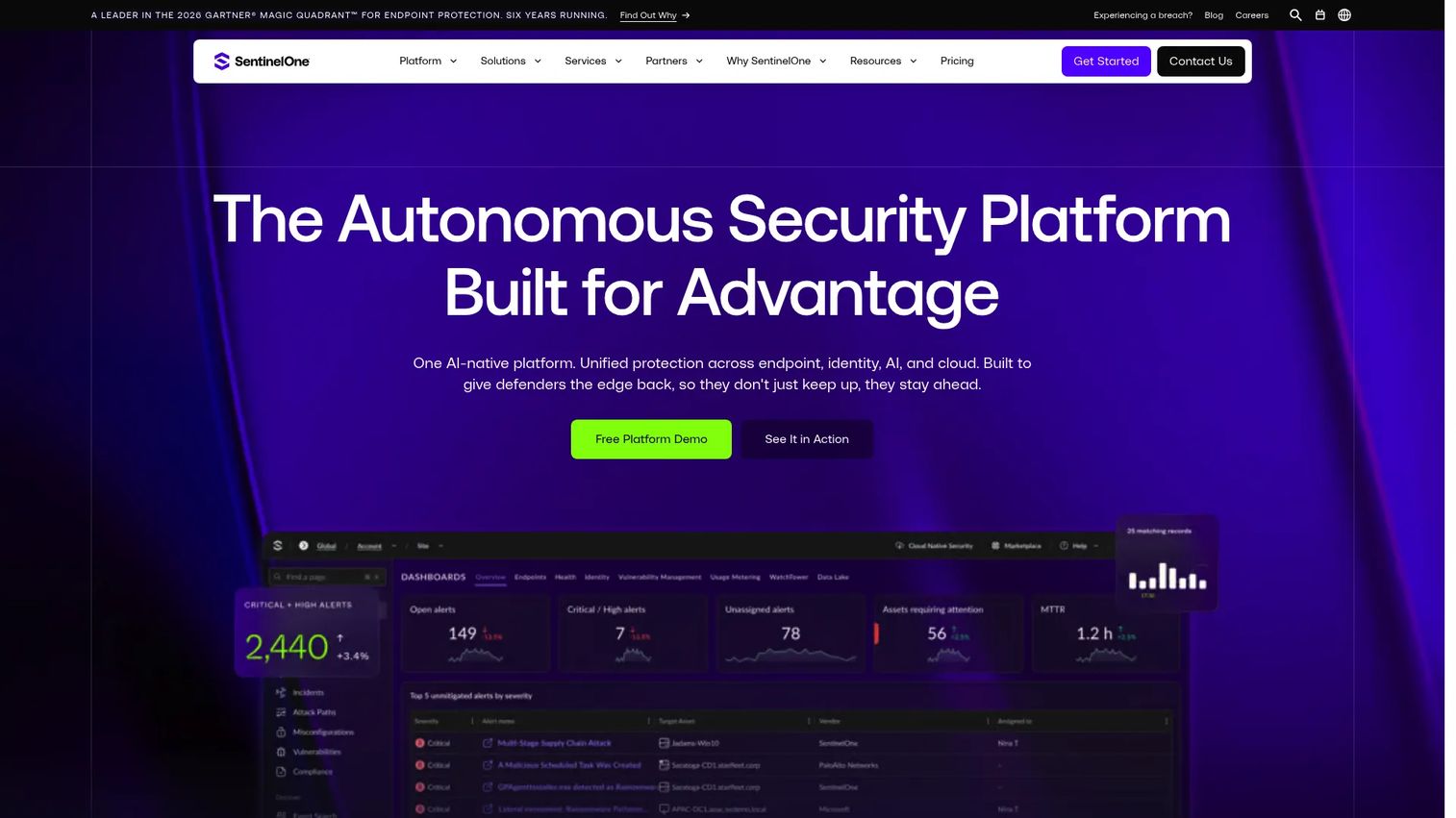
SentinelOne positions its Singularity Platform as AI-native security, with XDR as one layer of a broader architecture. The core idea is one foundation and one data layer spanning endpoint, cloud workloads, and identity, so cross-surface intelligence is built in rather than bolted on. For teams consolidating security operations onto a single vendor, that unified data model is the pitch.
Best for: Mid-market to enterprise teams that want autonomous endpoint detection and extended response on one AI-native platform.
Key strengths
- Unified data layer: Endpoint, cloud, and identity telemetry live in one place, so correlation happens without stitching separate products together.
- Autonomous detection and response: AI-driven analytics flag and act on threats in real time, reducing the manual triage load on analysts.
- Identity detection and response: Built-in identity threat coverage extends XDR beyond endpoint and cloud into credential-based attacks.
Why choose SentinelOne: SentinelOne suits teams that want native XDR breadth without assembling it from point tools. The AI-native architecture leans toward automation, which fits SOCs trying to do more with a lean analyst headcount. It's a strong fit when platform consolidation and detection speed both rank high on the requirement list.
SentinelOne pricing: Public pricing shows three packages. Singularity Core starts at $69.99 per endpoint annually, Singularity Commercial at $229.99 per endpoint annually, and Singularity Enterprise is quoted by sales. Pricing is displayed for 5 to 100 workstations, and final pricing may vary through authorized partners. SentinelOne holds a 4.7/5 rating on G2.
3. Microsoft

Microsoft Defender XDR is built for organizations that live inside Microsoft 365. It correlates signals across email and collaboration, endpoints, identity, SaaS, and cloud apps, all within the Microsoft ecosystem where much of that telemetry already originates. For a Microsoft-heavy environment, the native reach into Exchange, Entra ID, and cloud app data is hard for external platforms to match.
Best for: Organizations standardized on Microsoft 365 that want native XDR correlation across email, identity, endpoint, and cloud apps.
Key strengths
- Native Microsoft 365 correlation: Email, identity, endpoint, and SaaS signals link automatically because they originate inside the same ecosystem.
- Identity-aware detection: Deep Entra ID integration surfaces credential and identity-based attacks that span email and cloud.
- Copilot-assisted investigation: AI features across Microsoft security products help analysts summarize incidents and accelerate triage.
Why choose Microsoft: If your stack is already Microsoft 365, Defender XDR reduces integration overhead because the telemetry is native. The suite-based licensing can also fold into existing agreements. It fits SOC teams that want cross-domain correlation without wiring together separate vendor sensors.
Microsoft pricing: Defender XDR capabilities are packaged through Microsoft 365 security licensing rather than a standalone list price. Microsoft 365 plans are publicly listed (Business Premium at $22.00 per user per month, billed yearly), but XDR-tier security features depend on the specific suite and add-ons. Contact Microsoft for security-suite pricing scoped to your environment. Microsoft holds a 4.4/5 rating on G2.
4. Palo Alto Networks

Palo Alto Networks Cortex XDR is built for large enterprise SOCs that want endpoint-led detection paired with integrated analytics. Cortex correlates endpoint, network, and cloud telemetry, then layers behavioral analytics on top to surface stealthy attacks. For teams standardizing their security operations on Cortex, the depth of response workflow and investigation tooling is the draw.
Best for: Large enterprise SOC teams standardizing on Cortex and needing deep, repeatable response workflows.
Key strengths
- Behavioral analytics: Cortex profiles normal activity to flag anomalies across endpoint, network, and cloud, catching threats that signature-based tools miss.
- Deep response workflows: Rich investigation and containment tooling supports mature SOC processes and repeatable incident handling.
- Platform breadth: Cortex sits within a wider Palo Alto security portfolio spanning network security, SASE, and cloud, easing stack consolidation.
Why choose Palo Alto Networks: Cortex XDR fits enterprises that already run Palo Alto network security and want their SOC on the same platform. The analytics depth suits teams with dedicated analysts who can operationalize behavioral detection. It's a strong choice when SOC standardization and cross-domain telemetry both matter.
Palo Alto Networks pricing: Palo Alto Networks does not publish a public list price for Cortex XDR. Licensing is quoted per environment through sales, with packaging that scales by endpoint count and module selection. Contact sales for a scoped quote. Palo Alto Networks holds a 4.4/5 rating on G2.
5. CrowdStrike

CrowdStrike Falcon Insight XDR extends the Falcon platform's endpoint-first heritage into cross-domain detection. It unifies visibility across CrowdStrike's own modules and ingests third-party telemetry, all in a single lightweight console. For endpoint-first teams that value speed and console unification, Falcon's cloud-native architecture keeps detection fast and the analyst experience consolidated.
Best for: Endpoint-first organizations that want a unified, fast native XDR console with the option to ingest third-party data.
Key strengths
- Console unification: First-party modules and third-party data ingest surface in one Falcon console, cutting the tool-switching that slows triage.
- Cloud-native speed: A lightweight agent and cloud architecture keep detection and response fast at scale.
- Endpoint depth plus cloud and identity: Falcon's EDR foundation extends into cloud and identity security for broader cross-domain coverage.
Why choose CrowdStrike: CrowdStrike suits teams whose detection strategy centers on the endpoint and who want XDR breadth without leaving the Falcon console. The public pricing tiers also make it one of the more transparent XDR vendors to evaluate. It fits SOCs prioritizing speed and a unified analyst experience.
CrowdStrike pricing: CrowdStrike publishes tiered pricing. Falcon Go starts at $7.99 per device monthly ($59.99 annually), Falcon Pro at $14.99 monthly ($99.99 annually), and Falcon Enterprise at $19.99 monthly ($184.99 annually). A 15-day free trial is available, and Falcon Complete Next-Gen MDR is quoted by sales. CrowdStrike holds a 4.6/5 rating on G2.
6. eSentire
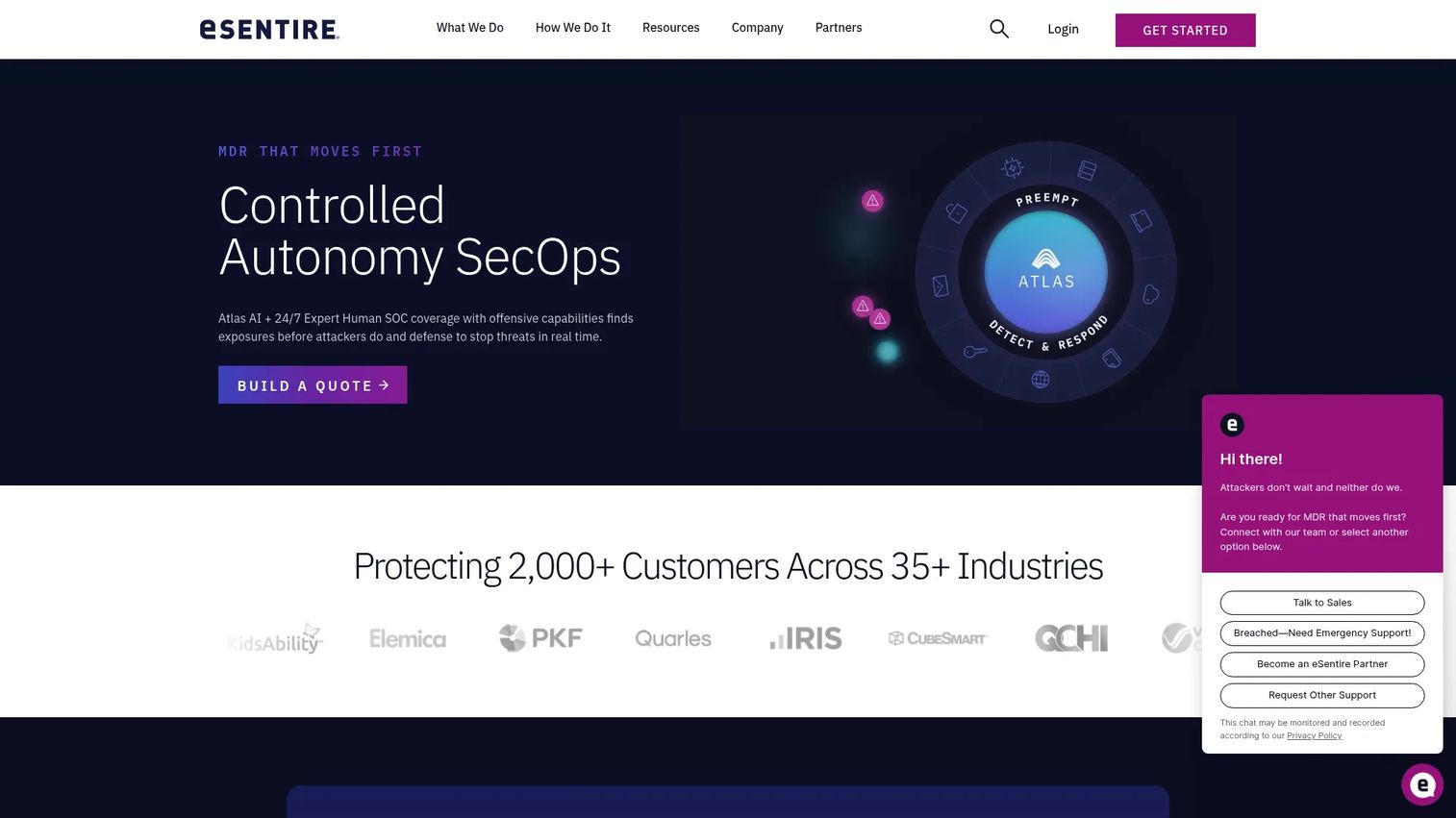
eSentire delivers XDR inside a managed detection and response motion. Its Atlas platform provides the correlation and detection layer, while eSentire's SOC runs 24/7 threat hunting, triage, and response on top of it. For teams that want XDR capability but lack the analyst headcount to staff a round-the-clock SOC, the command-center model pairs the platform with operational muscle.
Best for: Organizations that want XDR correlation backed by outsourced 24/7 SOC and threat hunting operations.
Key strengths
- 24/7 managed threat hunting: eSentire's SOC analysts run continuous hunting and triage, extending an in-house team's coverage around the clock.
- Atlas correlation platform: The Atlas security operations platform provides the cross-domain detection layer that MDR analysts act on.
- Digital forensics and incident response: Built-in DFIR capability means containment and post-incident investigation are part of the service, not an add-on.
Why choose eSentire: eSentire fits teams that need XDR outcomes without building a full internal SOC. The managed model suits organizations with lean security staffing or those wanting human threat hunting layered onto platform detection. It's a strong choice when operational response support ranks as high as the technology itself.
eSentire pricing: eSentire lists three MDR packages: Atlas Essentials, Atlas Advanced, and Atlas Complete. No public numeric price is shown; pricing is customized and quote-based per environment. Contact eSentire for a scoped quote. eSentire holds a 4.6/5 rating on G2.
7. IBM
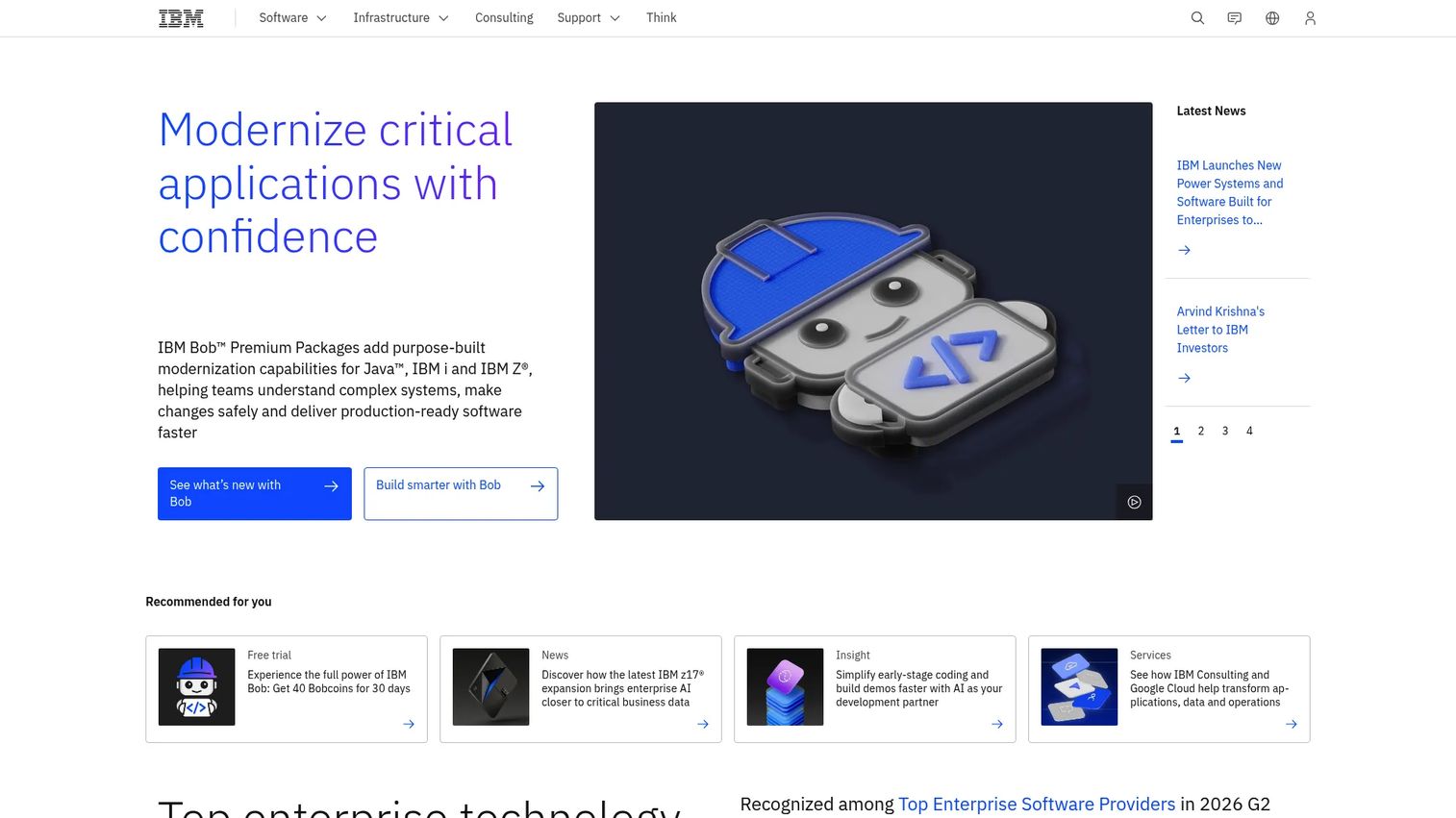
IBM offers SOC-oriented detection and response capabilities aimed at enterprises already invested in IBM security tooling. The QRadar-lineage approach emphasizes deep correlation, investigation workflows, and enterprise-scale operations. For large organizations running IBM security infrastructure, XDR-related capabilities extend correlation across domains while fitting into established SOC processes.
Best for: Large enterprises already invested in IBM security tooling that want correlation and investigation at enterprise scale.
Key strengths
- Enterprise correlation depth: IBM's SOC heritage brings mature correlation and analytics tuned for large, complex environments.
- Investigation workflows: Structured investigation tooling supports established analyst processes and enterprise governance requirements.
- AI-assisted operations: IBM's watsonx AI capabilities extend into security operations, helping analysts summarize and prioritize incidents.
Why choose IBM: IBM fits enterprises that already run IBM security products and want XDR-related capabilities inside that ecosystem. The correlation and governance depth suits regulated industries and large SOCs with formal process requirements. It's a fit when enterprise-scale operations and existing IBM investment both weigh heavily.
IBM pricing: IBM does not present a single public price for its corporate security portfolio. As a reference point for IBM's AI-adjacent products, watsonx.ai starts at USD 0 per month (Free), with Standard pay-as-you-go from USD 1110 per month; security-platform licensing is quoted separately. Contact IBM for security-specific pricing. IBM holds a 4.4/5 rating on G2.
8. Trend Micro

Trend Micro Vision One is an XDR platform oriented around attack surface visibility and threat detection across multiple domains. It correlates telemetry from endpoint, email, server, cloud, and network into a unified view, with an emphasis on manageable operations for teams that want broad coverage without a heavy operational burden.
Best for: Teams that want broad multi-domain telemetry and attack surface visibility with manageable day-to-day operations.
Key strengths
- Multi-domain telemetry: Vision One correlates endpoint, email, server, cloud, and network signals for a broad view of the attack surface.
- Attack surface management: Built-in visibility into exposed assets helps teams prioritize risk before it becomes an incident.
- Manageable operations: The platform is oriented toward teams that want broad XDR coverage without a heavy operational lift.
Why choose Trend Micro: Trend Micro suits teams that value broad attack surface visibility and want XDR that stays operationally manageable. Its long consumer and business security heritage means mature threat intelligence feeds detection. It fits organizations balancing coverage breadth with limited SOC staffing.
Trend Micro pricing: Trend Micro's public store lists consumer plans starting at $19.99 (ScamCheck) up to $109.95 for the Premium Security Suite. Business products including Vision One are quoted through sales rather than a public list price, and free offerings like HouseCall are available. Contact Trend Micro for business XDR pricing. Trend Micro holds a 4.0/5 rating on G2.
What to evaluate before you buy
Telemetry coverage and correlation depth
Start here, because it dictates everything downstream. List the domains you need covered (endpoint, cloud, identity, email, network) and check whether the platform correlates them natively or ingests them. A vendor with deep native coverage in three domains may beat one with shallow coverage in six. Map coverage to your actual attack surface, not a feature checklist.
Architecture: open XDR vs native XDR
Native XDR gives the deepest correlation and smoothest automation but assumes you standardize on the vendor's sensors. Open XDR prioritizes breadth and lets you keep existing tools. Neither is universally better. If you already run one vendor's stack, native fidelity wins. If you run a mixed environment, open ingestion protects your investment.
Response automation and workflow fit
Detection is half the job. Evaluate how the platform handles containment: can analysts isolate a host or disable an account from the incident view, and how much of that can be automated safely? Look at playbook flexibility and how response actions map to your existing runbooks.
Integration with your existing stack
Check connector coverage for your CRM of tools: SIEM, ticketing, identity provider, cloud platforms. A platform that integrates cleanly reduces analyst tool-switching and preserves data you already collect. Confirm API depth if you plan to build custom automation.
Analyst productivity and operations
The best platform is the one your analysts actually use well. Assess triage workflow, incident grouping, and how much noise the correlation engine removes. If you lack 24/7 staffing, weigh managed options like eSentire that pair the platform with a SOC.
Conclusion
The right XDR platform depends on your architecture and where your telemetry already lives. Cisco fits teams wanting broad, vendor-neutral visibility with network telemetry at the core. SentinelOne suits organizations consolidating onto an AI-native platform with a unified data layer. Microsoft is the natural choice for Microsoft 365-heavy environments. Palo Alto Networks fits large enterprise SOCs standardizing on Cortex. CrowdStrike serves endpoint-first teams wanting a fast, unified native console. eSentire is the pick when you want XDR backed by 24/7 managed operations, while IBM and Trend Micro serve enterprises invested in their respective ecosystems and those prioritizing broad attack surface coverage.
Compare architecture and telemetry coverage first, since that decision constrains everything else. Then weigh response automation and integration with your stack. Only after those fit checks should pricing become the deciding factor. Shortlist two or three, run a scoped proof of concept against your real telemetry, and let your analysts validate the triage experience before you commit.
FAQs
An XDR platform is a security operations tool that correlates telemetry across endpoints, identities, cloud, email, and network into unified incidents, then supports investigation and response from one console. Instead of chasing the same attack across separate tools, analysts see one prioritized incident with full context. The goal is faster, more accurate detection and response with less manual correlation.
EDR (endpoint detection and response) watches a single domain: the endpoint. XDR extends that visibility across multiple domains, including cloud, identity, email, and network, and correlates signals between them. Operationally, EDR tells you what happened on a device; XDR tells you how an attack moved across your whole environment, which changes how quickly analysts can scope and contain it.
Neither is universally better; it depends on your stack. Native XDR uses one vendor's sensors for the deepest correlation and smoothest automation, which fits teams already standardized on that vendor. Open XDR ingests third-party telemetry, prioritizing coverage breadth and protecting existing tool investments. Mixed environments usually favor open; single-vendor stacks usually favor native.
Prioritize correlation depth across the domains you actually run, response automation that maps to your runbooks, and integration with your existing SIEM, ticketing, and identity tools. Then assess analyst productivity: how well the platform groups incidents and removes duplicate-alert noise. A platform that reduces triage time and consolidates consoles is worth more than one with the longest feature list.
Not always, and often they coexist. SIEM aggregates and retains logs broadly, frequently for compliance and long-term storage, while XDR focuses on correlating security telemetry into actionable incidents with built-in response. Some teams run XDR alongside SIEM; others use XDR to reduce SIEM dependence. Evaluate whether your compliance and retention needs still require a dedicated SIEM.
The sources that map to your real attack surface. For most organizations that means endpoint, identity, cloud, email, and network correlation, because modern attacks cross those boundaries. Identity telemetry has become especially important as credential-based attacks rise. Prioritize the domains where you have the most exposure and the least current visibility.
XDR correlates related signals from different tools into a single prioritized incident instead of firing separate alerts for each. When one attack triggers events across endpoint, email, and identity, XDR links them into one case rather than three tickets. That deduplication and prioritization cuts the volume analysts triage and helps them work the highest-risk cases first.
Ask which telemetry sources are natively correlated versus ingested, and how deep that correlation goes. Confirm which response actions can run from the incident view and how much is safely automatable. Probe integration depth with your SIEM, identity provider, and ticketing tools, and request a scoped proof of concept against your real telemetry so analysts can validate the triage experience before purchase.