Your product just shipped a significant feature. Sales needs a training guide by end of week. The enablement deck from last quarter is already stale. And the enterprise digital adoption platform your IT team licensed six months ago still requires a ticket to publish anything new.
This is where most PMMs start searching for Whatfix alternatives. The global digital adoption platform market reached $1.24 billion in 2025, according to Fortune Business Insights, and the category now spans tools built for very different jobs. Some are full enterprise DAPs built for IT-led rollouts across dozens of internal applications. Others are purpose-built for SaaS product onboarding. And some, like Guideflow, are interactive guide and demo automation platforms that let marketing and enablement teams publish step-by-step training content without waiting on a technical rollout.
If your main job is internal training, SOPs, and employee onboarding, Guideflow is the top Whatfix alternative because it lets teams record software once and share interactive demos used for SOPs, launch enablement, and employee education without rebuilding assets every time something changes.
The 12 tools in this list span four distinct categories: Interactive guide platforms, enterprise digital adoption platforms, product adoption platforms for SaaS onboarding, and application training tools.
TL;DR
- Best overall for internal training and SOPs: Guideflow. Free plan available; paid plans from $35/user/month (annual).
- Best for large multi-app enterprise rollouts: WalkMe, at 4.6/5 on G2 and backed by SAP.
- Best for product analytics plus in-app guidance: Pendo, which combines usage analytics, NPS, and in-app guides on a free-to-paid model.
- Best for customer-facing SaaS onboarding: Userpilot or UserGuiding, both with public pricing starting under $500/month.
- Best for Oracle Cloud environments: Oracle Guided Learning, purpose-built for Oracle application adoption.
- The list spans two categories: Enterprise DAPs that sit inside every business application, and content-first guide platforms where PMMs and enablement teams own the workflow.
What's inside
- What Whatfix does well and why teams look elsewhere
- 12 tools grouped by category with pricing, G2 ratings, and free-plan notes
- A comparison table with a Category column so you can tell a DAP from a guide platform
- Per-tool cards with sourced limitations
- Use-case routing by job: Internal training, enterprise adoption, product analytics, SaaS onboarding, and budget
What is Whatfix?
Whatfix is an enterprise digital adoption platform used to create in-app guidance, self-help widgets, onboarding flows, training content, and adoption analytics across business applications.
Its in-app layer sits on top of your existing software stack, covering web, desktop, mobile, and virtual desktop environments including Citrix. Core capabilities include Flows, Smart Tips, Pop-Ups, Beacons, Task Lists, and a self-help widget that aggregates contextual content. Whatfix also offers Mirror, an application simulation for AI-assisted roleplay and practice.
The platform targets IT, digital transformation, enablement, and operations teams managing software adoption across CRM, ERP, HRIS, and other enterprise systems. It holds a 4.6/5 rating on G2 and supports Standard, Premium, and Enterprise plans, all priced through a sales conversation.
Whatfix is a credible, mature platform for organizations running structured digital adoption programs. The alternatives below exist because some buyers need a different balance of speed, ownership, pricing, or use-case focus.
Why teams look for Whatfix alternatives
Teams typically compare Whatfix alternatives when the platform feels heavier than the job, when pricing requires a sales process before evaluation, or when the core need is PMM-owned training content rather than a full enterprise DAP program.
Pricing requires a conversation before you can evaluate
Whatfix's Standard, Premium, and Enterprise plans carry no public pricing. The model is a flat fee plus user license fees, varying by product, plan, application type, and user count. For teams that need to build a quick business case or compare costs without a sales cycle, this creates friction before evaluation even starts.
Implementation timelines can outpace PMM needs
PMMs and enablement teams often need to publish training content in days. Enterprise DAPs typically require cross-functional implementation planning, IT involvement, and configuration work before anything ships. G2 reviewers of Whatfix note that the initial setup and customization process can take time, particularly for complex deployments across multiple enterprise applications.
The workflow favors IT and ops owners, not content owners
Whatfix is built for in-app overlay programs owned by IT and digital transformation teams. PMMs who need to create, update, and distribute training content on a launch calendar often find the content workflow slower than tools designed for self-serve publishing.
Some teams need SaaS product onboarding, not enterprise app training
Tools like Userpilot, UserGuiding, and Appcues are designed specifically for customer-facing SaaS onboarding and feature adoption. Whatfix's depth in enterprise application environments is an advantage for internal adoption programs but a mismatch for product-led SaaS teams.
Enterprise app coverage varies across alternatives
If your environment includes SAP, Oracle Cloud, Workday, or legacy desktop applications, your shortlist narrows significantly. Not every DAP covers all of these. This matters before any evaluation begins.
How we picked these Whatfix alternatives
Each tool was selected based on fit for internal training, employee onboarding, and SOP creation; fit for enterprise digital adoption programs; fit for customer-facing SaaS product adoption; pricing model and free-plan availability; G2 rating and review themes; and integration depth with common GTM and HR stacks.
The list spans interactive guide platforms, enterprise DAPs, product adoption platforms, and application training tools. The Category column in the table below labels each so you can tell a category upgrade from a like-for-like swap. Statistics in this article are cited to named third-party sources. Pricing and ratings are taken from each vendor's pricing page and G2 listing.
Whatfix alternatives at a glance
The best Whatfix alternative depends on the job: Replacing an enterprise DAP, creating internal training content, building customer-facing onboarding, or measuring product adoption. Guideflow leads for PMM-owned interactive training guides. WalkMe leads for full enterprise DAP programs. Pendo leads for analytics-first adoption.
| # | Tool | Category | Best for | G2 rating | Free plan | Starting price |
|---|---|---|---|---|---|---|
| 1 | Guideflow | Interactive guide platform | Internal training, SOPs, employee onboarding | 5.0 | Yes | $35/user/month (annual) |
| 2 | WalkMe | Enterprise digital adoption platform | Large multi-app employee rollouts | 4.6 | Contact sales | Contact sales |
| 3 | Pendo | Product analytics and adoption platform | Product analytics plus in-app guidance | 4.4 | Yes (up to 500 MAU) | Contact sales for paid |
| 4 | Userpilot | Product adoption platform | SaaS onboarding and feature adoption | 4.6 | No (14-day trial) | $299/month |
| 5 | UserGuiding | User onboarding platform | No-code SaaS onboarding | 4.7 | No (30-day guarantee) | $249/month |
| 6 | Appcues | Product adoption platform | Customer-facing onboarding flows | 4.6 | No (free trial) | $3,600/year |
| 7 | Apty | Digital adoption platform | Process compliance in enterprise apps | 4.7 | Contact sales | Contact sales |
| 8 | Userlane | Digital adoption platform | Employee training across business apps | 4.7 | Contact sales | Contact sales |
| 9 | Lemon Learning | Application training platform | Enterprise app training and localization | 4.8 | No | Contact sales |
| 10 | Oracle Guided Learning | Oracle application guidance platform | Oracle Cloud application adoption | 4.7 | Contact sales | Contact sales |
| 11 | Inline Manual | In-app guidance platform | Customer-facing in-app help and onboarding | 4.6 | No (14-day trial) | $158/month |
| 12 | Toonimo | Digital guidance platform | Voice-assisted guided digital journeys | 4.3 | Contact sales | Contact sales |
The best Whatfix alternatives in 2026
1. Guideflow
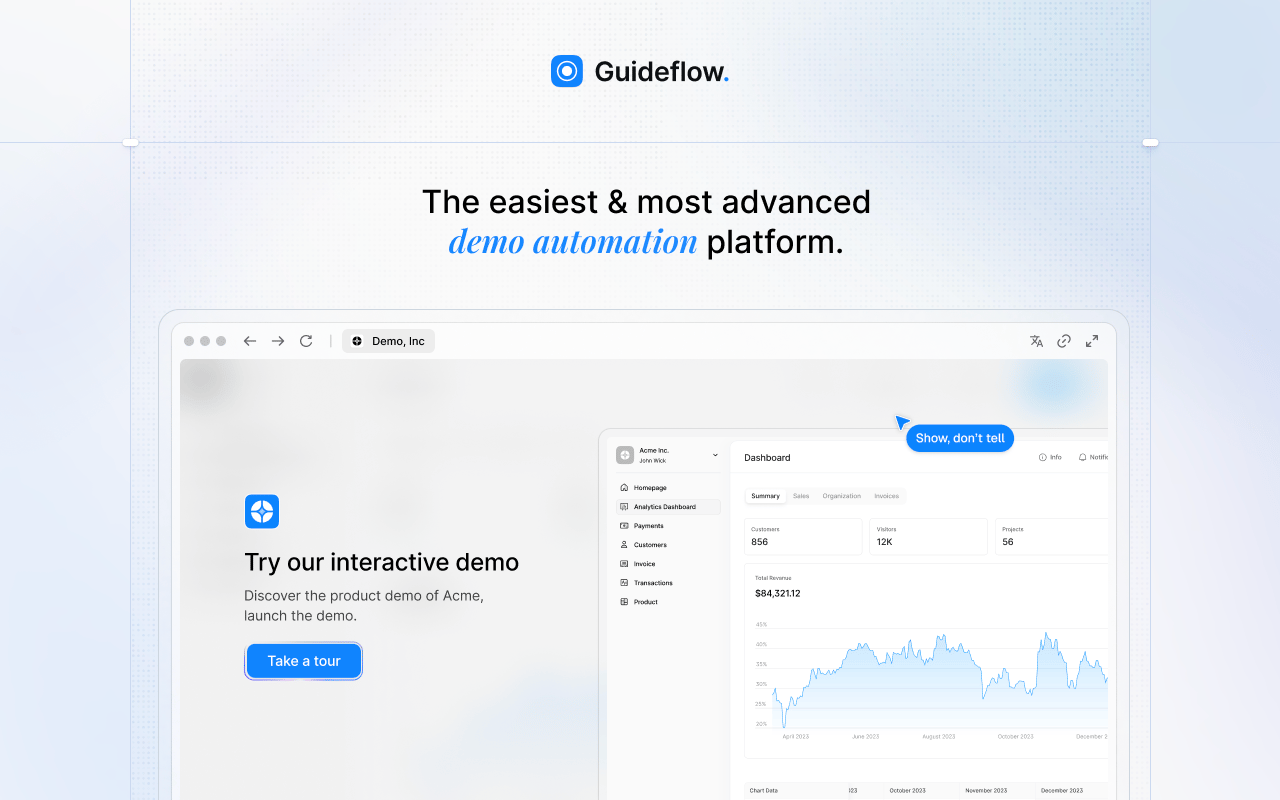
Guideflow is the top pick for PMMs and enablement teams whose main job is publishing interactive training guides, not managing an enterprise DAP. You record a software flow once through the Chrome extension or the native app, and the step content is written automatically. From there, the same capture can support launch training, internal SOPs, sales enablement, and employee onboarding, all shareable by link or embedded wherever your team works.
Best for: Product marketing, enablement, and operations teams creating internal training, SOPs, employee onboarding, launch enablement, and software education guides.
What it is: Guideflow is a demo automation platform that turns recorded product flows into clickable, step-by-step interactive demos. Guides are interactive demos used for internal audiences: SOPs, process documentation, and training content that employees click through rather than read. The platform covers six formats: Interactive demos, demo pages, demo centers, sandboxes, live demos, and mobile demos.
Key features:
- Capture via Chrome extension or native app, with screenshot, HTML, and video modes
- Step content and CTAs written automatically after capture
- Editable text, images, graphs, and branching in the no-code editor
- Translation into more than 30 languages
- Step-level completion, drop-off, and viewer flow analytics
- Integrations with HubSpot, Salesforce, Pipedrive, Zoho, and Marketo
Where Guideflow falls short:
- Look elsewhere if your primary need is an enterprise DAP that overlays in-app guidance directly inside every internal business application you operate.
- Look elsewhere if your environment is Oracle-heavy and you need native Oracle Cloud guidance out of the box.
- Guideflow performs best when the job is shareable interactive training content, SOPs, and enablement guides rather than IT-managed, multi-application overlay programs.
Pricing: Free plan available. Paid plans on annual billing: Solo at $35/user/month, Growth at $499/month, Advanced at $1,499/month, Enterprise from $2,999/month. Enterprise adds SSO, advanced governance, and enterprise security.
How it compares to Whatfix: Whatfix is built for IT-owned adoption programs across many enterprise applications. Guideflow is built for content-first training workflows that PMMs and enablement teams can own and ship without a technical rollout.
2. WalkMe (enterprise digital adoption platform)
WalkMe is the closest enterprise DAP comparison point to Whatfix and the strongest option for organizations running adoption programs across many internal systems. SAP acquired WalkMe in 2024, which is relevant for enterprise procurement decisions and long-term roadmap considerations.
Best for: Large organizations rolling out digital adoption programs across multiple internal applications, particularly those with complex workflows and high governance requirements.
What it is: WalkMe is a cloud-based enterprise digital adoption platform providing analytics, in-app guidance, workflow automation, and contextual AI across web, desktop, and mobile. It holds a 4.6/5 G2 rating and serves large enterprise environments with mature implementation and governance frameworks.
Key features:
- Real-time application and workflow analytics
- Interactive in-app guidance, tooltips, and notifications
- Workflow automation
- Behavioral segmentation and personalization
- Contextual AI assistance
- Cross-platform support: Web, desktop, mobile
Where WalkMe falls short:
- G2 reviewers frequently cite implementation complexity as a barrier; deploying WalkMe at enterprise scale typically requires dedicated admin expertise and cross-functional project work.
- Pricing is quote-based with no public figures, adding procurement overhead.
- PMMs looking for a content-first training workflow rather than a managed DAP program may find WalkMe more infrastructure than they need.
Pricing: Contact sales. WalkMe uses a request-a-quote model with no numeric pricing on its pricing page.
G2 rating: 4.6
How it compares to Whatfix: WalkMe and Whatfix are the two mature enterprise DAP options in this list. Choose WalkMe when SAP ecosystem alignment, automation depth, or cross-platform enterprise scale are the deciding factors.
3. Pendo (product analytics and adoption platform)
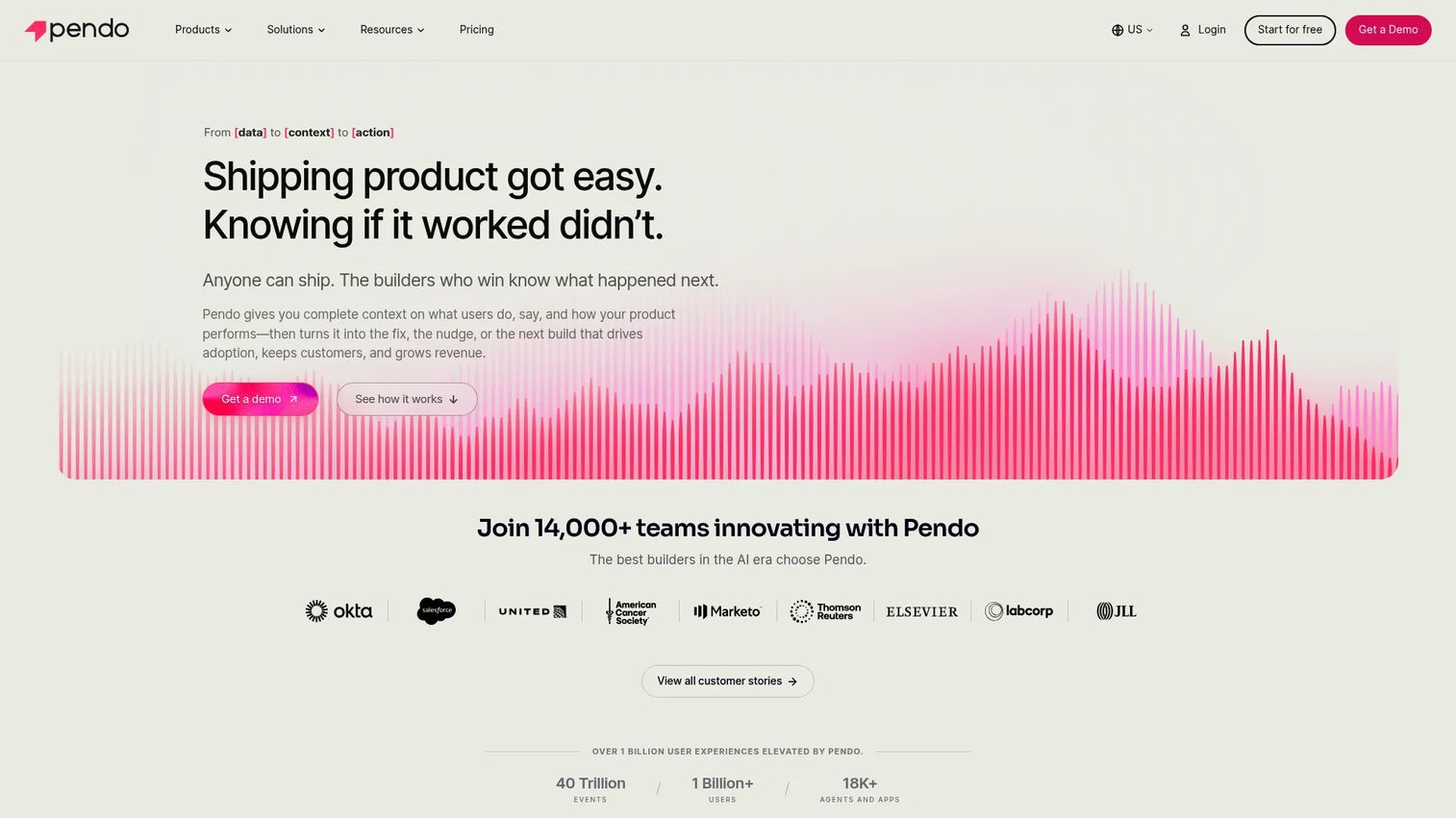
Pendo's core strength is product analytics, and its in-app guidance capabilities are built on top of a data foundation. For PMMs who need to understand usage patterns before deciding what to train on, Pendo offers a different entry point than a pure DAP.
Best for: Product and PMM teams that need product usage analytics, NPS, and in-app guidance together in one platform.
What it is: Pendo is a product experience platform combining product analytics, in-app guides, session replay, feedback, NPS surveys, and roadmapping. It is used across product, customer success, and operations teams to measure and improve software adoption. A free tier supports up to 500 monthly active users; paid plans are priced by MAU volume and require a sales conversation.
Key features:
- Product analytics with funnels, paths, retention, and dashboards
- In-app guides and announcements
- Session replay
- NPS surveys and in-app feedback
- Roadmapping and product discovery tools
Where Pendo falls short:
- Paid plan pricing is not publicly listed; buyers must contact sales once they exceed 500 MAUs, which complicates budget planning for growing teams.
- G2 reviewers note that setup and instrumentation require planning and ongoing maintenance, particularly for large or complex SaaS products.
- Teams focused purely on internal employee training rather than product analytics may find Pendo's breadth beyond their actual need.
Pricing: Free plan for up to 500 MAUs. Paid plans (Base, Core, Ultimate) are custom-priced by MAU volume; contact sales.
G2 : 4.4
How it compares to Whatfix: Pendo is the stronger choice when product analytics and behavioral data drive the buying decision. Whatfix focuses more directly on the guidance overlay for enterprise business applications.
4. Userpilot (product adoption platform)
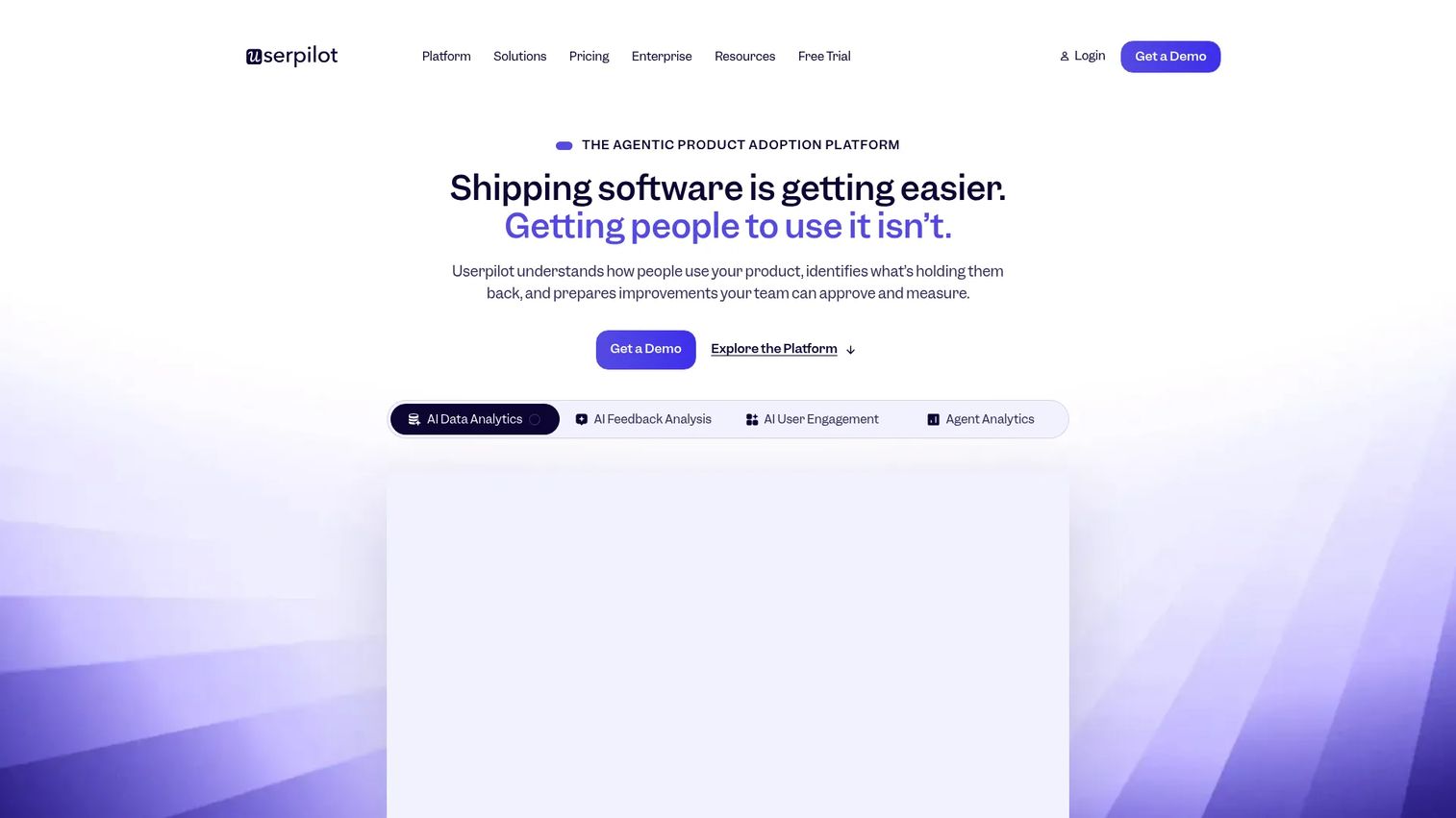
Userpilot is built for SaaS teams that want to improve customer onboarding, feature adoption, and activation without engineering involvement. Its public pricing and 14-day trial make early evaluation more accessible than most enterprise DAPs.
Best for: SaaS product, growth, and customer success teams building in-app onboarding flows, feature adoption campaigns, and feedback collection for external users.
What it is: Userpilot is a product growth and analytics platform for understanding user behavior and driving product adoption. It supports in-app onboarding, segmentation, NPS, session replay, feature adoption flows, and experimentation. Plans are priced by monthly active users, starting at $299/month for up to 2,000 MAUs. G2 rating: 4.6.
Key features:
- In-app onboarding flows and checklists
- Product analytics with funnels, cohorts, and dashboards
- NPS, in-app surveys, and feedback collection
- Session replay with frustration signals
- Feature adoption campaigns and A/B testing
Where Userpilot falls short:
- Userpilot is built for web-based SaaS products; enterprise internal training across desktop, Citrix, or legacy applications is outside its scope.
- G2 reviewers note that some advanced analytics features require the Growth tier, pushing initial costs higher for smaller teams.
- Internal employee training use cases on non-SaaS business applications are a mismatch for the platform.
Pricing: Starter at $299/month for up to 2,000 MAUs. Growth from $849/month. Enterprise is custom. No permanent free tier; 14-day trial available.
G2 rating: 4.6
How it compares to Whatfix: Userpilot is better matched to SaaS product-led onboarding for external customers. Whatfix is built for internal enterprise application adoption programs.
5. UserGuiding (user onboarding platform)
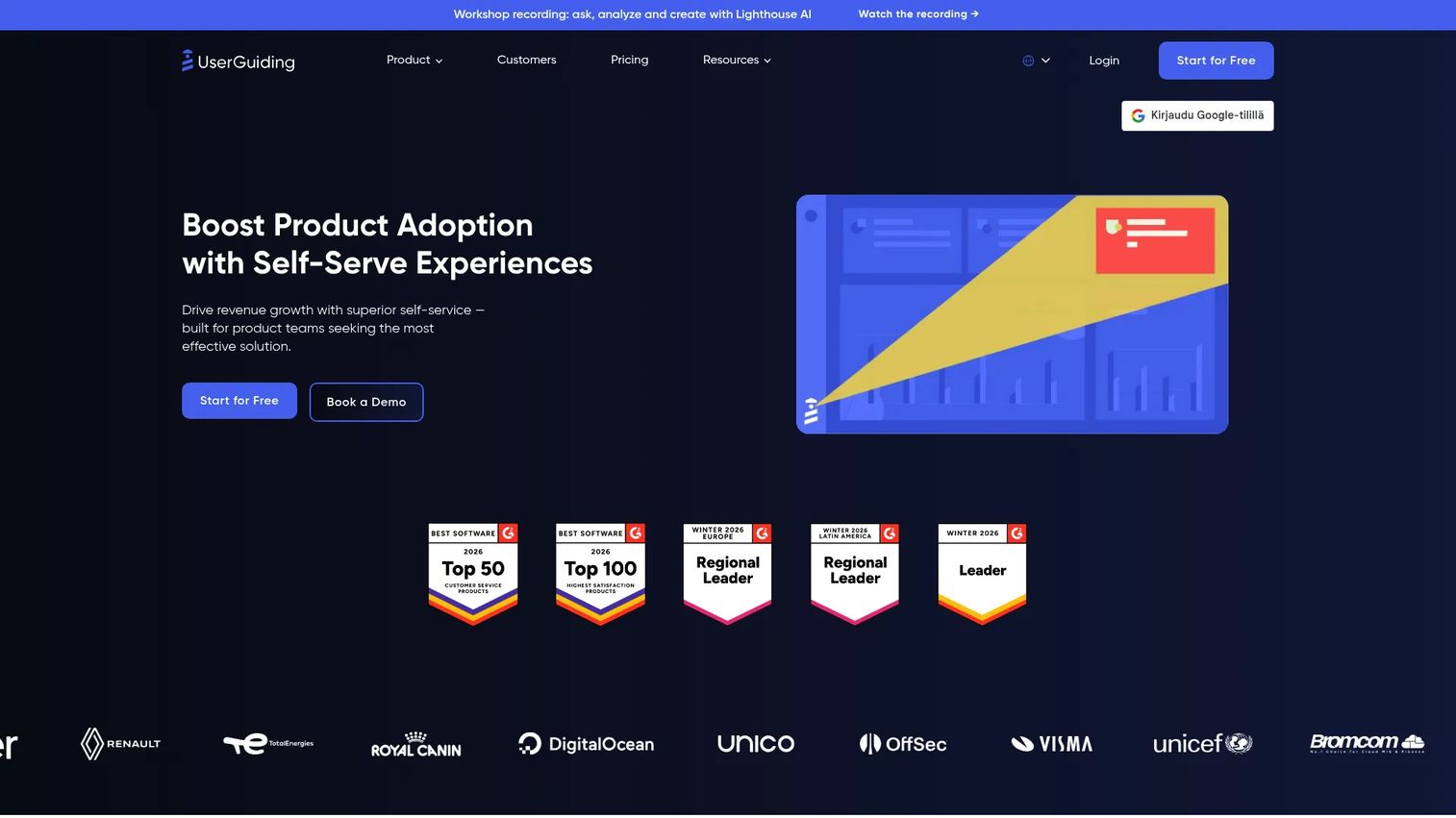
UserGuiding offers the most accessible no-code onboarding toolkit in this list for SaaS teams that want product tours, checklists, resource centers, and surveys without developer involvement.
Best for: Product teams at SaaS companies needing no-code onboarding flows, checklists, and resource centers for customer-facing products.
What it is: UserGuiding is a no-code product adoption platform for in-app onboarding experiences, hotspots, tooltips, checklists, surveys, and a Knowledge Base. Its Starter plan starts at $249/month for up to 2,000 MAUs. G2 rating: 4.7.
Key features:
- Product tours, tooltips, and hotspots
- Onboarding checklists and banners
- Resource Center and AI Assistant
- In-app surveys and NPS
- Analytics, segmentation, and session replay
Where UserGuiding falls short:
- Designed primarily for SaaS product onboarding; complex enterprise change management or multi-application internal training programs need a DAP instead.
- G2 reviewers report that advanced analytics capabilities and deeper integrations are gated to higher pricing tiers.
- Pricing is based on MAU count; teams with high monthly active user volumes should check whether costs scale predictably.
Pricing: Starter at $249/month. Growth at $499/month. Enterprise is a custom annual quote. Pricing covers up to 2,000 MAUs; higher usage requires a custom quote. 30-day money-back guarantee.
G2 rating: 4.7
How it compares to Whatfix: UserGuiding fits smaller SaaS teams or PMMs who need no-code customer onboarding without enterprise DAP scope or pricing.
6. Appcues (product adoption platform)
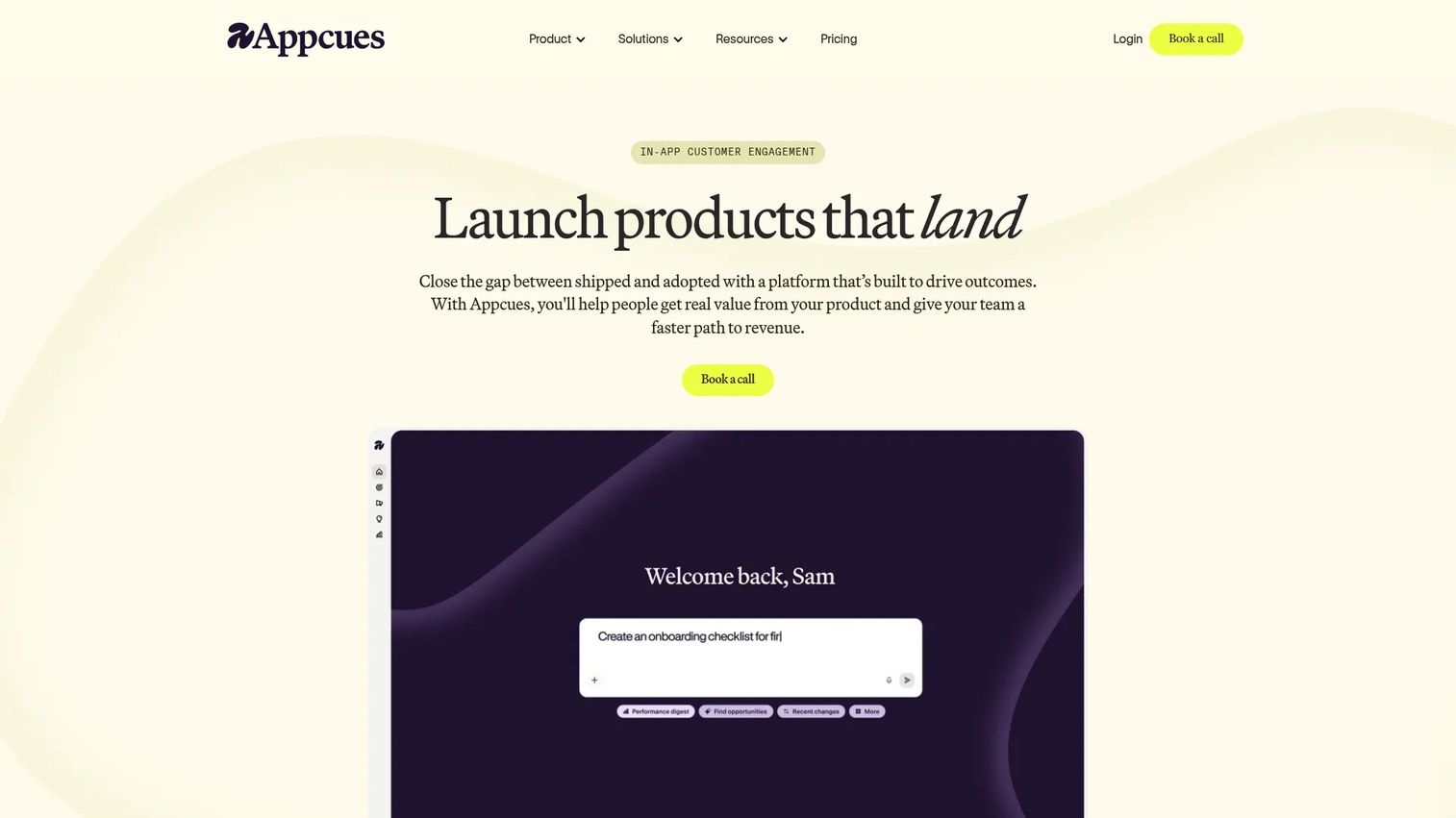
Appcues positions itself as an AI-powered customer engagement platform. It goes beyond basic onboarding to include in-product flows, email, push notifications, and behavioral analytics across a single system.
Best for: Product and growth teams driving customer onboarding, feature adoption, and retention through in-product and multi-channel experiences.
What it is: Appcues is an AI-powered product engagement platform for in-app flows, checklists, launchpads, pins, banners, NPS, surveys, analytics, and email and push workflows. The Spark plan starts at $3,600/year for teams of up to 25 with 1,000 MAUs. G2 rating: 4.6.
Key features:
- In-app flows, checklists, and launchpads
- Behavior and attribute-based audience targeting
- Product analytics with funnels, retention, and path analysis
- AI-assisted experience creation and targeting recommendations
- Email and push notification workflows
Where Appcues falls short:
- Appcues is designed for customer-facing SaaS adoption, not internal enterprise application training programs.
- Pricing is MAU-based and starts at $3,600/year for a small team, which is higher than other SaaS onboarding tools in this list for the entry tier.
- G2 reviewers note that the full value of AI and analytics features is better realized at higher MAU tiers.
Pricing: Spark at $3,600/year for up to 1,000 MAUs (teams of 25 or fewer). Grow from $9,000/year for up to 50,000 MAUs. Enterprise is custom. No free tier; free trial available.
G2 rating: 4.6
How it compares to Whatfix: Appcues is more product-led and customer-facing. Whatfix is stronger for internal enterprise employee adoption programs across business applications.
7. Apty (digital adoption platform)
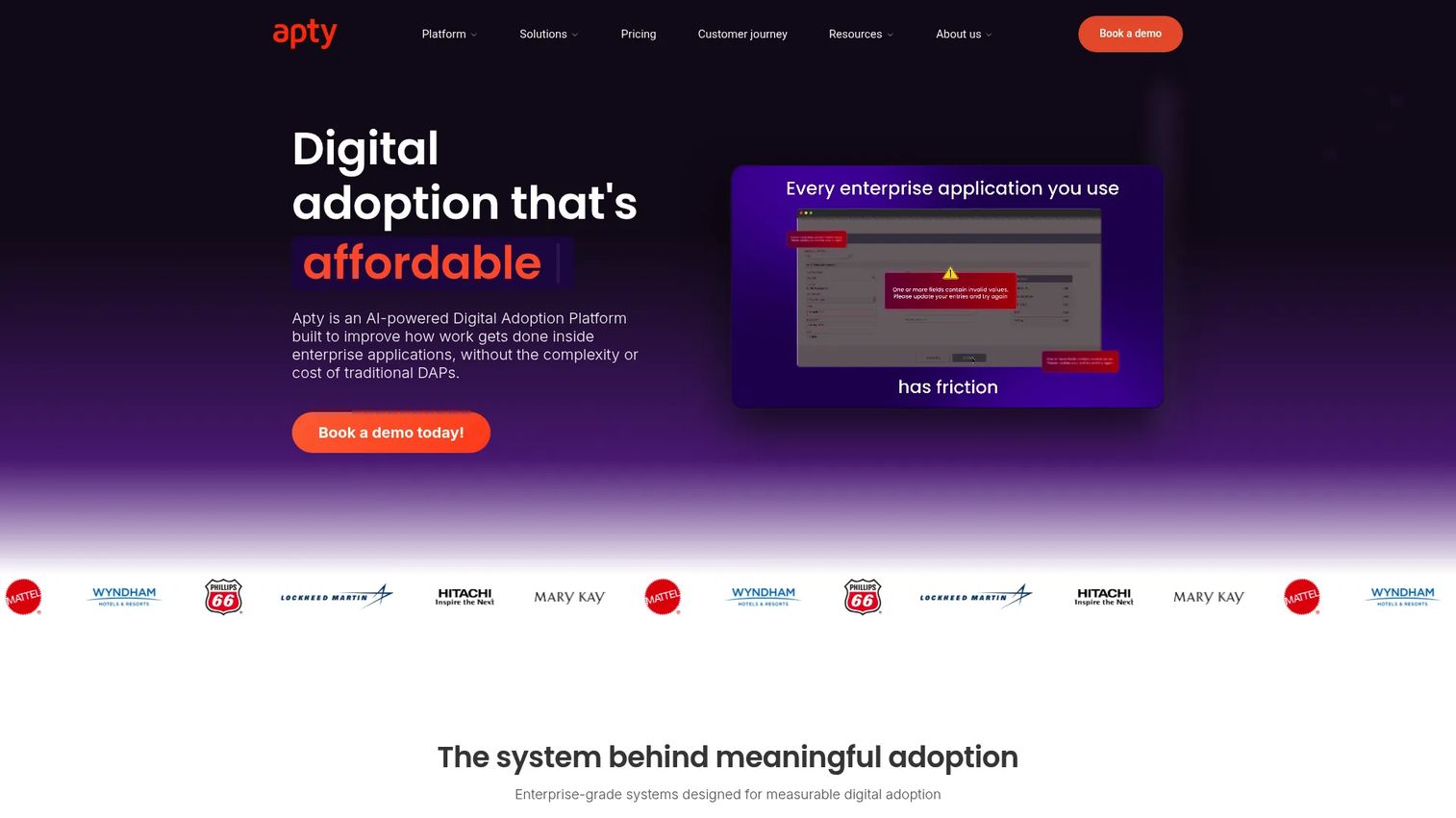
Apty is the strongest option in this list for enterprises where process compliance and operational productivity inside business applications are the primary drivers, beyond general software adoption.
Best for: Enterprise organizations needing measurable process compliance, guided workflows, and adoption analytics inside internal business applications.
What it is: Apty is an AI-powered digital adoption platform focused on in-app guidance, process tracking, validation, and live workflow monitoring. Its homepage is currently at apty.ai. G2 rating: 4.7.
Key features:
- In-app guidance and tooltips
- Process tracking and validation
- Live workflow monitoring
- Adoption analytics and usage tracking
- Early risk and compliance alerts
Where Apty falls short:
- Pricing is not publicly listed; every evaluation requires a sales conversation, which limits early-stage budget comparison.
- Apty is built for internal enterprise application programs; customer-facing SaaS onboarding is outside its scope.
- G2 reviewers note that the depth of configuration options can extend initial setup time.
Pricing: Contact sales.
G2 rating: 4.7
How it compares to Whatfix: Apty is a credible DAP alternative when process compliance, operational productivity, and workflow reinforcement are the primary evaluation criteria.
8. Userlane (digital adoption platform)
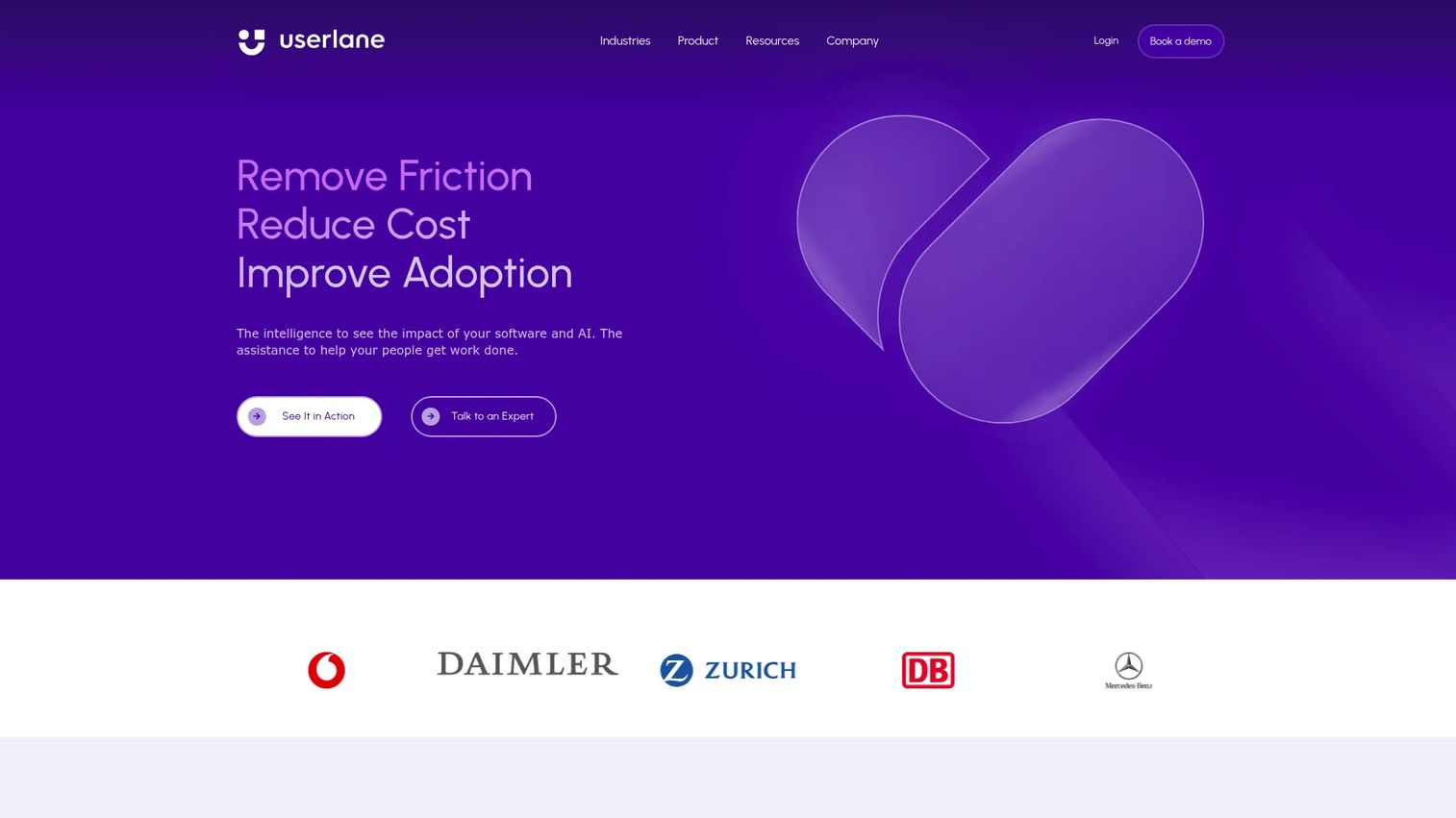
Userlane frames itself as an enterprise software performance platform, combining application intelligence with contextual in-app assistance. Its HEART Score and App Discovery features add a measurement layer that most lighter onboarding tools lack.
Best for: Enterprise organizations that want to measure software portfolio performance alongside in-app guidance for employee adoption.
What it is: Userlane is a digital adoption platform combining Application Intelligence (App Discovery, HEART Score, portfolio overview) with contextual in-app guidance, validators, and surveys. Plans are structured as Application, Department, and Organization tiers, priced by fixed annual fee; contact sales. G2 rating: 4.7.
Key features:
- App Discovery and HEART Score for software portfolio intelligence
- In-app guidance, Assistant, and validators
- Interactive guides, tooltips, announcements, and NPS content
- User segmentation and contextual actions
Where Userlane falls short:
- Pricing requires a sales process for all tiers; no public numeric figures are available on the pricing page.
- G2 reviewers note that the platform is best suited to employee-facing software adoption rather than customer-facing SaaS onboarding.
- PMMs looking for a self-serve content workflow for training guides may find Userlane's setup footprint larger than their need.
Pricing: Contact sales. Application, Department, and Organization tiers are priced as annual fees by application count or user count.
G2 rating: 4.7
How it compares to Whatfix: Userlane is a strong employee adoption alternative when application intelligence and software portfolio measurement matter alongside in-app guidance.
9. Lemon Learning (application training platform)
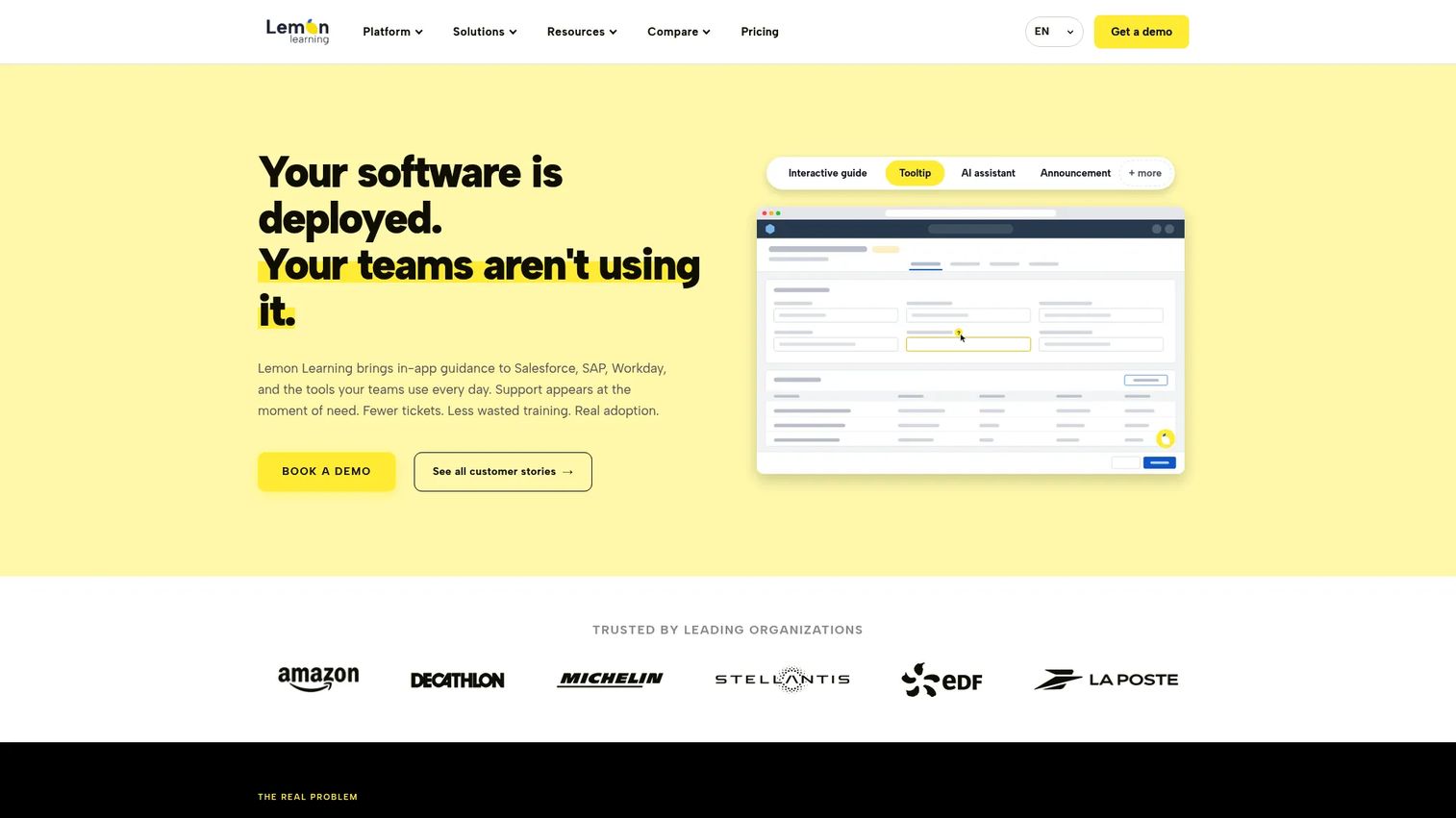
Lemon Learning holds the highest G2 rating in this list at 4.8/5 and is the strongest option for enterprises that need multilingual application training, desktop and legacy app support, and localization alongside in-app guidance.
Best for: Enterprise organizations needing in-app adoption guidance across complex web, desktop, and legacy software with multilingual content requirements.
What it is: Lemon Learning is a digital adoption platform providing step-by-step guides, an AI Guide Creator, tooltips, announcements, a Resource Center, interactive simulations, and guidance analytics. It supports both web and desktop environments, including legacy applications. No free plan. G2 rating: 4.8.
Key features:
- Interactive step-by-step guides with no-code editor
- AI Guide Creator and AI Assistant
- User segmentation and localization
- Interactive simulations
- Desktop and legacy application guidance
Where Lemon Learning falls short:
- Pricing is quote-based for both Application and Corporate licence models; no public figures are displayed.
- Implementation is a paid service and AI usage is consumption-based, which adds variable cost.
- Lemon Learning's focus is enterprise application training rather than customer-facing SaaS product growth.
Pricing: Contact sales for annual licence pricing. Two models: Application licence (one application) and Corporate licence (unlimited applications). Implementation is separately priced.
G2 rating: 4.8
How it compares to Whatfix: Lemon Learning is worth evaluating when application coverage, localization requirements, and a high G2 satisfaction score are the deciding factors over Whatfix.
10. Oracle Guided Learning (Oracle application guidance platform)
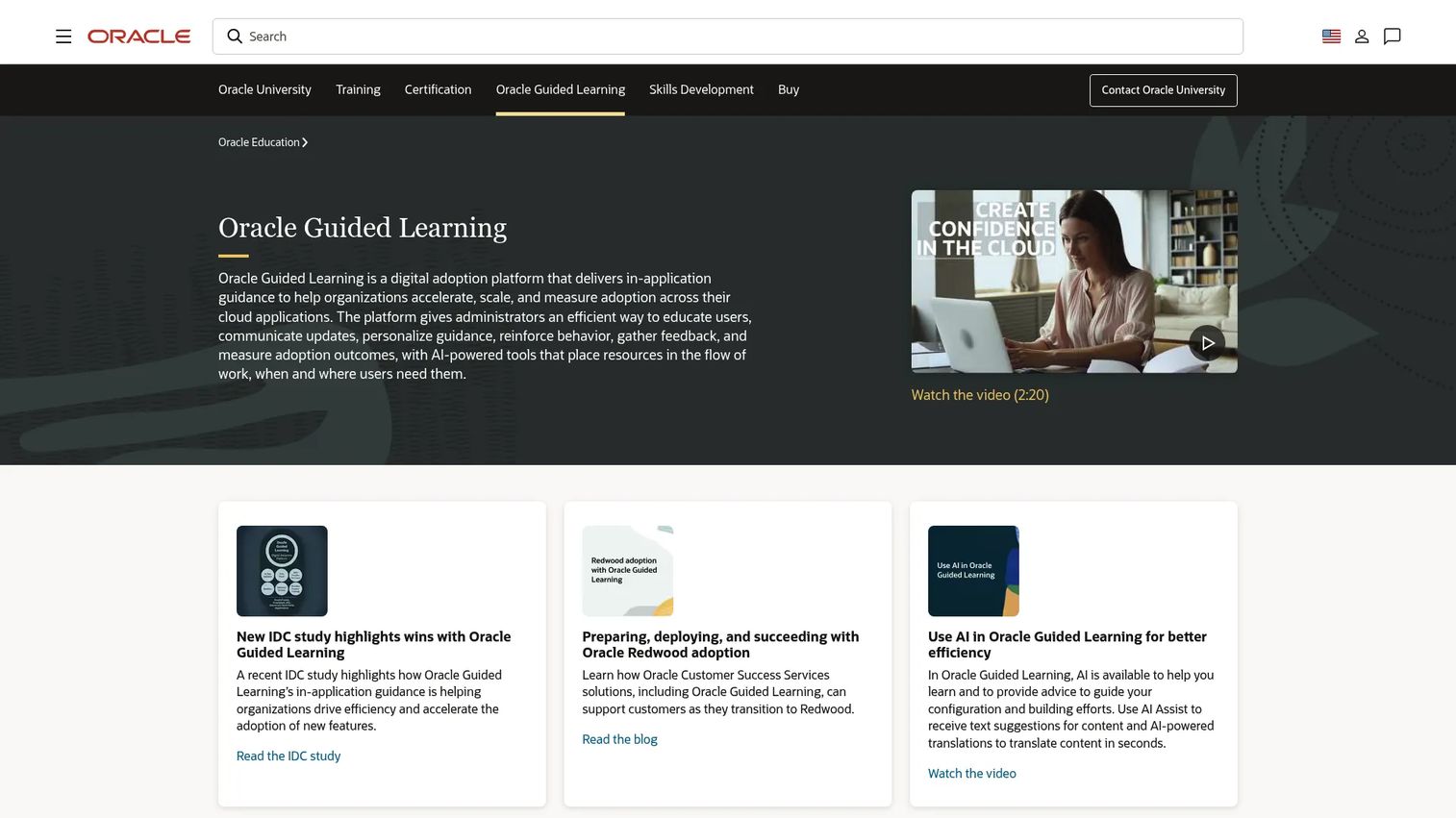
Oracle Guided Learning is the clearest specialist in this list. If your organization standardizes on Oracle Cloud applications, it offers the tightest integration with Oracle's ecosystem. Outside that context, broader tooling applies.
Best for: Organizations standardizing adoption, change communication, and training across Oracle Cloud applications.
What it is: Oracle Guided Learning is a digital adoption platform providing in-application process guides, contextual tooltips, smart tips, banners, in-app messaging, personalized guidance using branching and AI-powered translation, surveys, and adoption analytics. It also supports select non-Oracle web applications. G2 rating: 4.7.
Key features:
- In-app process guides, tours, simulations, and step-by-step content
- Contextual tooltips, smart tips, beacons, and banners
- Personalized guidance with conditions, branching, and AI-powered translation
- In-app surveys and feedback
- Adoption analytics
Where Oracle Guided Learning falls short:
- The platform is primarily designed for Oracle Cloud environments. Teams operating outside Oracle-heavy stacks will find limited coverage compared to broader DAPs.
- Pricing is not publicly listed; evaluation requires engagement with Oracle sales.
- G2 coverage is limited to a small number of reviews, so the rating should be treated as directional.
Pricing: Contact Oracle sales.
G2 rating: 4.7
How it compares to Whatfix: Oracle Guided Learning is the stronger choice when Oracle applications dominate the training environment. Whatfix covers a wider application footprint outside Oracle.
11. Inline Manual (in-app guidance platform)
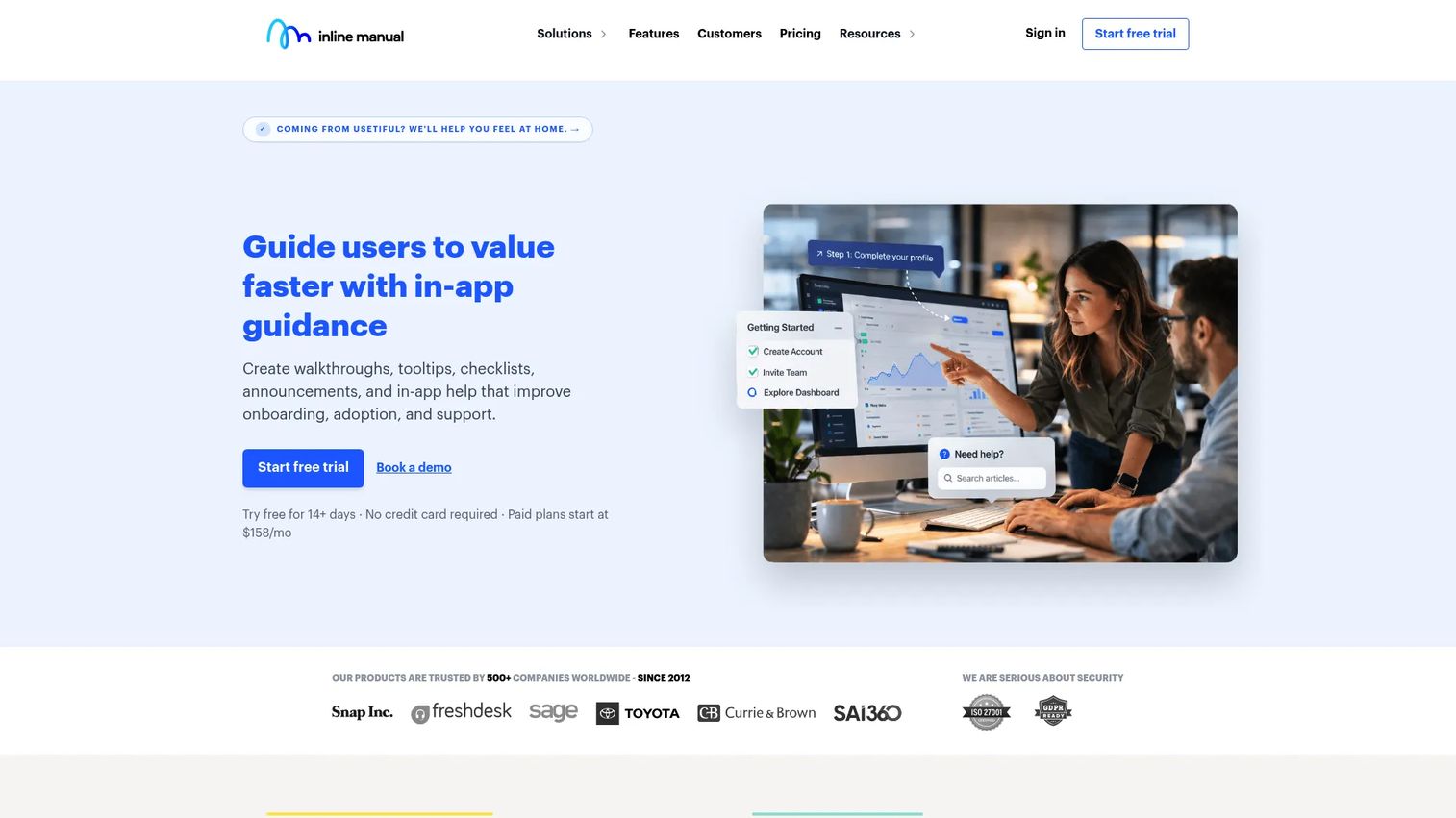
Inline Manual is the most accessible entry-priced option in this list with a publicly listed starting price. For teams that need in-app guidance and help content without enterprise DAP overhead, it offers a credible mid-weight option.
Best for: SaaS teams and organizations needing customizable in-app onboarding, help content, and customer support guidance without enterprise DAP pricing.
What it is: Inline Manual is a digital adoption platform for in-app guides, tooltips, checklists, announcements, NPS widgets, multilingual content, and version control. Standard Pro starts at $158/month for 250 monthly active users. G2 rating: 4.6.
Key features:
- Interactive step-by-step guides and tooltips
- Checklists, announcements, and banners
- In-app NPS and feedback widgets
- Multilingual content and localization
- Offline standalone deployment option
Where Inline Manual falls short:
- Enterprise multi-application internal training programs may need a heavier DAP with broader application coverage.
- Pricing scales by MAU count; teams with large user bases should request an enterprise quote early in the evaluation.
- G2 reviewers note that documentation and onboarding resources could be more extensive for new users.
Pricing: Standard Pro at $158/month for 250 MAUs. Enterprise is custom pricing. A one-time Product Adoption Audit is available at $399. Free trial of at least 14 days available, no credit card required.
G2 rating: 4.6
How it compares to Whatfix: Inline Manual is a lighter, more accessible alternative for product adoption and in-app help when a full enterprise DAP program is more than the team needs.
12. Toonimo (digital guidance platform)
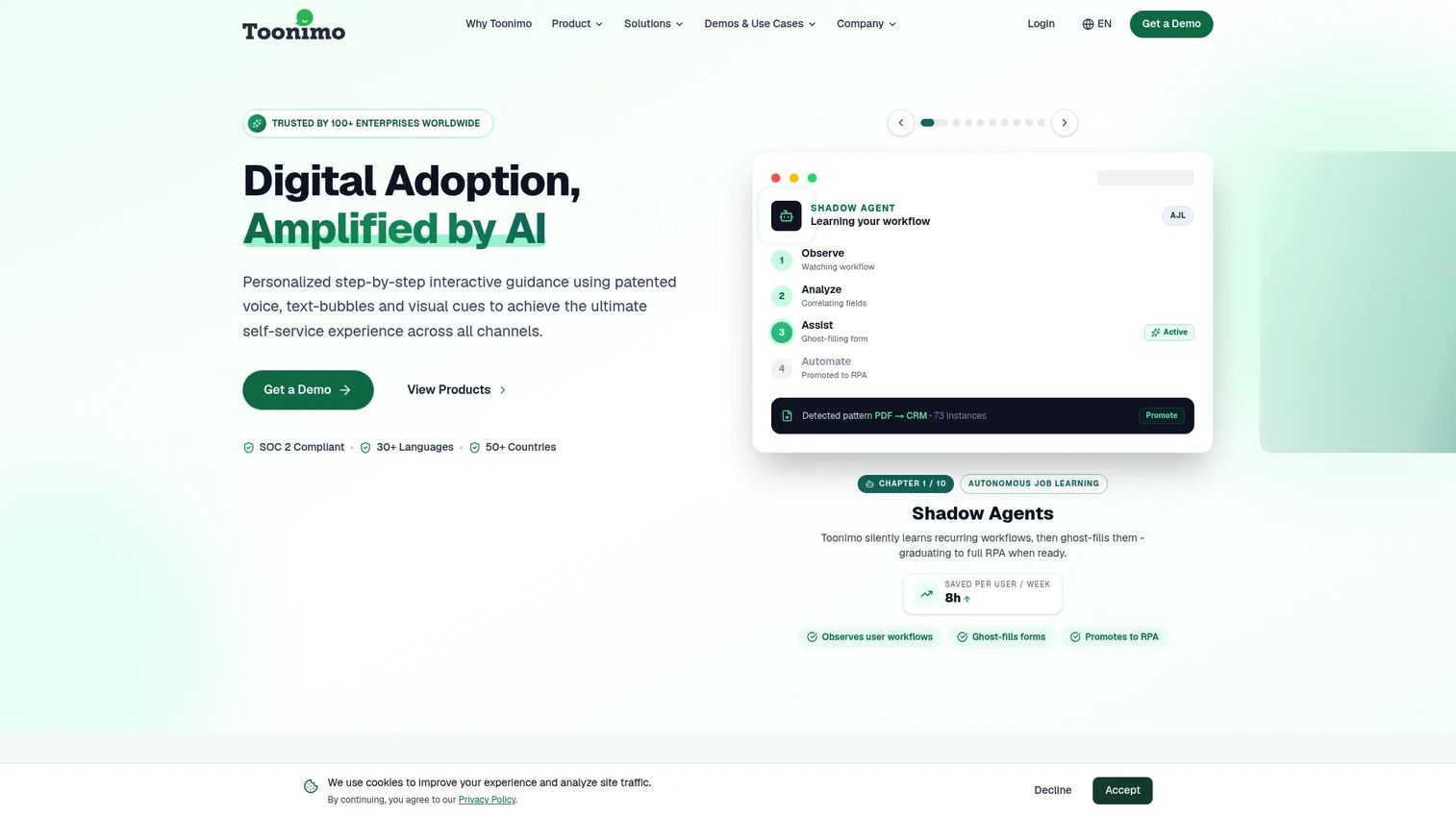
Toonimo is the most distinctive tool in this list. Its audio-visual walkthroughs and voice-assisted guidance set it apart for use cases where completion rates on guided digital journeys are the primary measure of success.
Best for: Enterprise organizations that want voice-assisted, audio-visual guided journeys for user completion, training, and onboarding.
What it is: Toonimo is an enterprise digital adoption platform with audio-visual step-by-step guides, a no-code WYSIWYG editor, rule-based personalization, A/B testing, goal-based analytics, robotic process automation, chatbots, voicebots, and native iOS and Android support. All plans are custom-priced. G2 rating: 4.3.
Key features:
- Audio-visual step-by-step guided journeys
- Voice-assisted guidance and form assistance
- Rule-based segmentation and A/B testing
- Robotic process automation
- Knowledge base and curriculums
Where Toonimo falls short:
- G2 reviewers note limited publicly available documentation and case studies compared to larger DAP platforms, which makes independent evaluation harder.
- Pricing is fully custom with no self-serve trial; Toonimo offers a guided proof-of-concept instead.
- Toonimo's narrower focus on guided digital journeys means teams needing broad enterprise application coverage should evaluate WalkMe instead.
Pricing: Contact sales. Professional, Enterprise, and Enterprise Plus plans are all custom-priced by guided user sessions per month.
G2 rating: 4.3
How it compares to Whatfix: Toonimo is a narrower alternative suited to guided digital journeys with voice and multimedia assistance. Whatfix covers a broader enterprise DAP footprint with more application types.
What is the best Whatfix alternative for internal training?
Guideflow is the top pick for internal training. PMMs and enablement teams can record a product flow once and distribute it as a clickable, step-by-step guide for SOPs, launch training, employee onboarding, and software education. The same capture supports multiple distribution channels: Shared by link, embedded in a wiki, or organized inside a Demo Center. For teams that need broader enterprise application overlay programs, WalkMe or Lemon Learning are the right comparison points.
Which Whatfix alternative is best for enterprise digital adoption?
WalkMe, Userlane, Apty, and Lemon Learning are the strongest options for enterprise DAP programs. The right choice comes down to application coverage, governance depth, analytics, data residency requirements, available implementation resources, and your required support model. For SAP ecosystem alignment, WalkMe warrants close evaluation. For Oracle Cloud environments specifically, Oracle Guided Learning is the most targeted fit. If you need a full enterprise DAP, compare WalkMe and Userlane directly before deciding.
Which tool leads on product analytics?
Pendo is the strongest choice when product analytics and adoption insights are the primary need. Pendo's free tier up to 500 MAUs makes early evaluation accessible. Paid plans add deeper funnels, paths, session replay, and behavioral segmentation. Guideflow's analytics focus on step-level completion, drop-off, and viewer flow inside published guides, not broad product usage instrumentation. If the buying decision is analytics-first, Pendo is the category leader in this list.
What is the best Whatfix alternative for SaaS onboarding?
Userpilot, UserGuiding, and Appcues are the most direct options for customer-facing SaaS onboarding. All three support in-app onboarding flows, checklists, segmentation, and feedback without IT involvement. Userpilot starts at $299/month; UserGuiding at $249/month; Appcues at $3,600/year. Choose Guideflow when the goal is interactive enablement guides that can be shared by link, embedded in a help center, or used in onboarding materials rather than live in-app overlays on your SaaS product.
What is the cheapest Whatfix alternative?
The cheapest entry point depends on the category. For interactive training guides, Guideflow has a free plan. For SaaS onboarding, UserGuiding starts at $249/month and Userpilot at $299/month. Inline Manual starts at $158/month for up to 250 MAUs. For enterprise DAPs including WalkMe, Userlane, Apty, Lemon Learning, and Toonimo, pricing requires a sales conversation and depends on application count, user volume, modules selected, and services required.
When should you stay with Whatfix?
Stay with Whatfix if you are running a structured digital adoption program across multiple enterprise applications and have IT or digital transformation ownership in place. Its mature governance, broad application coverage including Citrix and VDI, analytics depth, and enterprise support model are advantages that narrower tools in this list do not match.
Switching away from Whatfix makes sense when the content workflow needs to be faster than a managed DAP allows, or when the core job is PMM-owned interactive training content rather than overlay guidance across every business application. If the organization has already invested in Whatfix implementation and the program is producing results, the switching cost rarely justifies a change until the renewal cycle.
Why teams switch from Whatfix to Guideflow
Teams switch from a DAP evaluation to Guideflow when the job is not "overlay guidance across every application" but "create training content PMMs and enablement managers can ship and update today."
Four things make the switch work. First, the capture workflow. Recording a product flow through the Chrome extension or the native app takes about two and a half minutes. Step content and CTAs are written automatically. No IT ticket, no implementation project. Second, the content format. Guideflow produces interactive guides that employees click through rather than read. The same capture can feed internal SOPs, sales enablement, launch training, and onboarding, all from one recording session.
Third, distribution. Guides are shareable by link, embeddable in Notion, Confluence, help centers, or marketing pages, and organizable inside a Demo Center. Fourth, the analytics layer. Step-level completion, drop-off, and viewer flow data show which parts of a training guide employees actually complete and where they stop. CRM records are created when a viewer identifies through an in-demo form or a personalized link, feeding engagement data into HubSpot, Salesforce, Pipedrive, Zoho, or Marketo.
One thing to keep in mind: Guideflow is not an enterprise DAP. It does not overlay guidance directly inside every business application you operate. For teams whose job is content-first interactive training and enablement, that is the trade-off worth making.
Start your journey with Guideflow today!
Frequently asked questions: Whatfix alternatives
Guideflow is the top pick for PMMs and enablement teams creating internal training, SOPs, and employee onboarding guides. It records software flows once and distributes them as interactive, clickable step-by-step guides without requiring a DAP rollout. For teams that need broader enterprise application overlay programs, WalkMe, Userlane, or Lemon Learning are the relevant comparison points.
Whatfix is an enterprise digital adoption platform that overlays in-app guidance directly inside business applications, managed by IT or digital transformation teams. Guideflow is a demo automation platform that turns recorded product flows into shareable, clickable interactive guides used for internal training, SOPs, sales enablement, and employee onboarding. Whatfix sits inside the application; Guideflow produces distributable training content that lives outside it.
Both are enterprise digital adoption platforms competing for similar buyers and programs. WalkMe was acquired by SAP in 2024, which is relevant for enterprise procurement and long-term roadmap discussions. Both carry a 4.6/5 G2 rating. The key evaluation factors between them are application coverage, SAP ecosystem alignment, automation depth, governance models, and implementation requirements. Neither publishes pricing publicly.
Userpilot, UserGuiding, and Appcues are the most direct options for customer-facing SaaS onboarding. Userpilot starts at $299/month, UserGuiding at $249/month, and Appcues at $3,600/year. All three support no-code onboarding flows, checklists, in-app surveys, and segmentation for external product users.
Guideflow has a free plan. Pendo offers a free tier for up to 500 monthly active users. Other tools in this list offer free trials rather than permanent free tiers: Userpilot offers 14 days, Inline Manual offers at least 14 days, and UserGuiding provides a 30-day money-back guarantee. Enterprise DAPs including WalkMe, Apty, Userlane, Lemon Learning, and Toonimo do not offer public free tiers.
Whatfix does not publish numeric pricing on its pricing page. Plans are Standard, Premium, and Enterprise, priced as a flat fee plus user license fees. The variables are product, plan, application type, and user count. Pricing requires a sales conversation. For teams that need a budgetary range before engaging, G2 reviewer-reported ranges and Vendr benchmarks can provide context, but those figures should be treated as directional.
Pendo is the category leader for product analytics combined with in-app guidance. Its free tier covers up to 500 MAUs and includes product analytics, in-app guides, and Pendo-branded NPS. Paid plans add deeper behavioral analytics, session replay, and journey orchestration priced by MAU volume. Guideflow's analytics cover guide-level engagement: Step completion, drop-off, and viewer flow, which is a different scope than full product instrumentation.
Define the job first. If the job is interactive internal training guides, SOPs, and PMM-owned enablement content, Guideflow fits the workflow. If the job is product analytics and adoption data, Pendo is the right starting point. If the job is customer-facing SaaS onboarding and activation, Userpilot, UserGuiding, or Appcues match the use case. If the job is a full enterprise DAP program across multiple business applications, WalkMe, Userlane, Apty, or Lemon Learning are the relevant comparisons. Most evaluation mistakes in this category come from evaluating a DAP for a content workflow job, or a SaaS onboarding tool for an enterprise IT-led program.