Equity was manageable when you had 20 employees and a single cap table spreadsheet. At 80 employees across three states, the spreadsheet becomes a liability. Grants go unrecorded. Exercises happen without proper board approval. Tax documents miss deadlines. And when diligence arrives for your next financing, someone has to reconstruct the full ownership history from emails and Slack threads.
That reconstruction is expensive. According to a 2025 NASPP survey, 71% of companies already outsource at least some stock plan administration, which means your competitors aren't doing this manually. The right platform gives your CFO, legal team, and board clean equity data on demand, without routing every question through you.
This guide covers 12 stock plan administration software platforms chosen for plan administration depth, reporting, participant experience, and fit across company stages.
What's inside
- Who this is for: Founders, CFOs, people leaders, and legal teams at private and public SaaS companies
- How tools were selected: Category fit (stock plan administration, not just cap table management), reporting depth, integrations, and participant experience
- Scope: 12 platforms spanning startups, growth-stage companies, public companies, and global teams
- Pricing and ratings: Verified against vendor pricing pages and live G2 listings
TL;DR
- Best overall for high-growth private companies: Carta for cap table management, equity grants, 409A workflows, and investor-ready records
- Best for enterprise and public-company programs: Morgan Stanley at Work for scaled plan administration tied to participant brokerage and workplace benefits
- Best for global share plans: J.P. Morgan Workplace Solutions for multinational equity operations, multilingual participants, and BI reporting
- Best for startups with transparent pricing: Cake Equity for founder-friendly cap table workflows, option plans, and compliance reporting
- Best for finance-heavy reporting: Certent Equity Management for ASC 718, disclosure, and public-company reporting depth
- Best for lean private-company teams: Pulley for cap table cleanup, scenario modeling, and equity grants (note: Pulley is winding down operations on December 8, 2026, with an exclusive partnership moving to Carta)
What is stock plan administration software?
Stock plan administration software is a system companies use to manage equity compensation plans, covering grants, vesting, exercises, settlements, cap table records, participant communications, tax workflows, and financial reporting.
This is a different category from basic cap table management software. A cap table tool tracks ownership. A stock plan administration platform handles the operational life of that equity: Who gets granted what, when it vests, how it exercises, what tax documents employees receive, and how the finance team reports it all to auditors and the board.
Key capabilities to look for:
- Grant and award administration (stock options, RSUs, RSAs, ESPPs, warrants, SAFEs, convertible notes)
- Vesting schedule tracking and exercise management
- Cap table and ownership records
- Employee equity portals and participant self-service
- 409A valuation support or integrations
- ASC 718 and disclosure reporting
- ESPP administration and payroll withholding
- HRIS, payroll, broker, and accounting integrations
- Scenario modeling and dilution forecasting
- Global tax and compliance support
Why this matters at Series B:
More employees means more grants. More investors means more complex ownership. More jurisdictions create more tax exposure. And more diligence events, every fundraise, acquisition conversation, or audit, mean fewer shortcuts.
A Series B founder who can hand the CFO a clean equity system removes an entire category of board-meeting risk. The platforms below do that job at different price points and company stages.
When to use stock plan administration software
Prepare for financing or diligence
Investors and acquirers need clean cap table views, complete grant histories, vesting schedules, and stakeholder records. Producing those from spreadsheets requires manual reconstruction, which takes time and creates errors. A dedicated platform generates the required reports on demand, so your team isn't scrambling two weeks before a close.
Scale equity compensation past spreadsheets
New-hire grants, refresh grants, exercise requests, option expirations, board approvals, and employee questions all multiply as you grow. A founder can run equity admin manually until around 30 employees. After that, the process breaks. Platforms automate grant workflows, approval chains, and participant communications so the work doesn't sit on one person's desk.
Manage public-company or global complexity
RSUs, ESPPs, payroll withholding, broker connections, multilingual participant support, and ASC 718 reporting require stronger infrastructure than early-stage tools provide. If you're preparing for an IPO or managing employees across countries, the platform you choose needs to handle those requirements without forcing your finance team to patch gaps manually.
Stock plan administration software comparison
No single platform is the right fit for every company. The table below helps you shortlist by stage, primary use case, and verified data. Pricing and G2 ratings were checked against each vendor's pricing page and live G2 listing.
| # | Product | Best for | Key differentiator | Pricing | G2 rating |
|---|---|---|---|---|---|
| 1 | Carta | High-growth private companies | Cap table, 409A, grants, fundraising workflows | Free plan available; paid plans contact vendor | 4.3/5 |
| 2 | Morgan Stanley at Work | Enterprise and public-company plans | Broker-linked workplace equity and financial benefits | Custom pricing | 3.8/5 |
| 3 | J.P. Morgan Workplace Solutions | Global share plans | Multinational equity operations and BI reporting | Custom pricing | 4.8/5 |
| 4 | UBS | Large enterprise equity programs | Enterprise wealth and equity plan servicing | Custom pricing | Not listed |
| 5 | Cake Equity | Startups and scaleups | Transparent pricing with compliance and 409A support | Free; paid from $1,000/year | 4.8/5 |
| 6 | Pulley | Private companies (wind-down Dec 2026) | Cap table cleanup and scenario modeling | From $1,200/year | 4.7/5 |
| 7 | Ledgy | European and global companies | Equity plan workflows across jurisdictions | Free; paid from €5k/year | 4.7/5 |
| 8 | Certent Equity Management | Public-company reporting teams | ASC 718, disclosure, and financial reporting depth | Custom pricing | 4.4/5 |
| 9 | OptionTrax | Stock plan administrators | Flexible award tracking with ASC 718 support | From $449/month | 4.7/5 |
| 10 | Charles Schwab EquiView | Public companies using Schwab | Broker-connected equity administration | Custom pricing | Not listed |
| 11 | Fidelity Stock Plan Services | Large public companies | Brokerage, participant services, and plan administration | Custom pricing | Not listed |
| 12 | Bank of America Equity Plan Services | Enterprise equity programs | Integrated equity administration with financial-services support | Custom pricing | Not listed |
Best 12 stock plan administration software for 2026
Each platform below serves a different combination of company stage, award complexity, and reporting requirements. Read each section to find the fit for your current situation, not just the next 18 months.
1. Carta
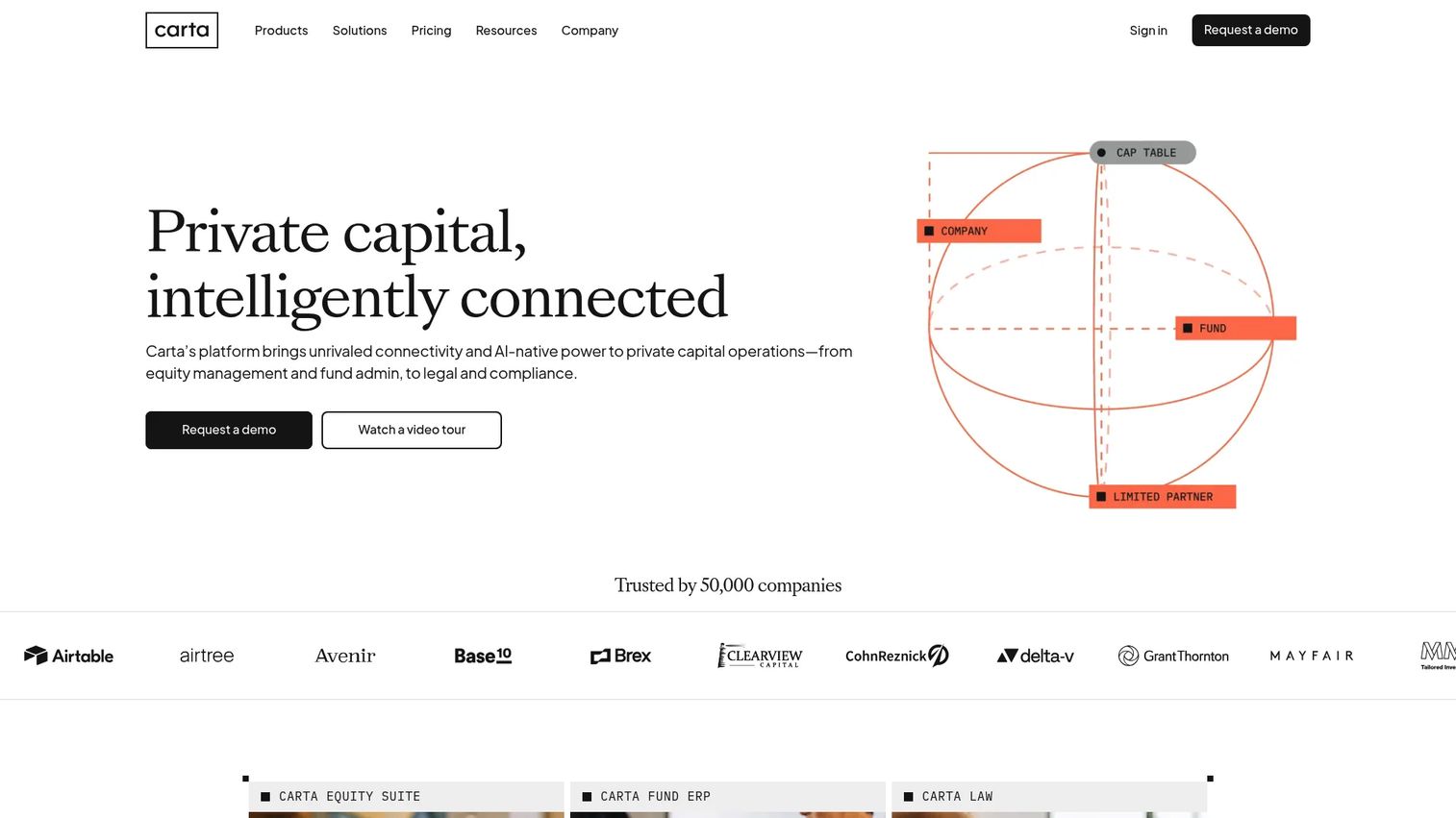
Carta is a private-capital platform covering equity management, fund administration, valuations, compliance, and financial workflows. It's the default starting point for most venture-backed companies, largely because it integrates cap table management, equity grants, 409A valuations, and investor reporting in one place. For a Series B founder, the buying case is straightforward: Hand the CFO a platform that produces audit-ready equity records without manual reconstruction before every board meeting.
Best for: High-growth private SaaS companies that need cap table accuracy, equity grants, 409A support, and investor reporting in one system.
Key features
- Cap table management and securities issuance
- 409A valuation support and financial reporting
- SAFE fundraising, round modeling, and deal closings
- Option grant workflows and vesting management
- Scenario modeling for dilution and fundraising
Why choose Carta: Carta is the most complete platform for venture-backed private companies. It covers the full equity lifecycle from a SAFE at seed through a Series B cap table and beyond, which means your legal, finance, and investor teams work from the same records.
Carta pricing: The Launch plan is free for companies with up to 25 stakeholders and $1M raised. Build, Grow, and Scale plans are available with no numeric prices shown on the pricing page; contact Carta for a quote based on company size and stakeholder count.
Carta G2 rating: 4.3/5
2. Morgan Stanley at Work
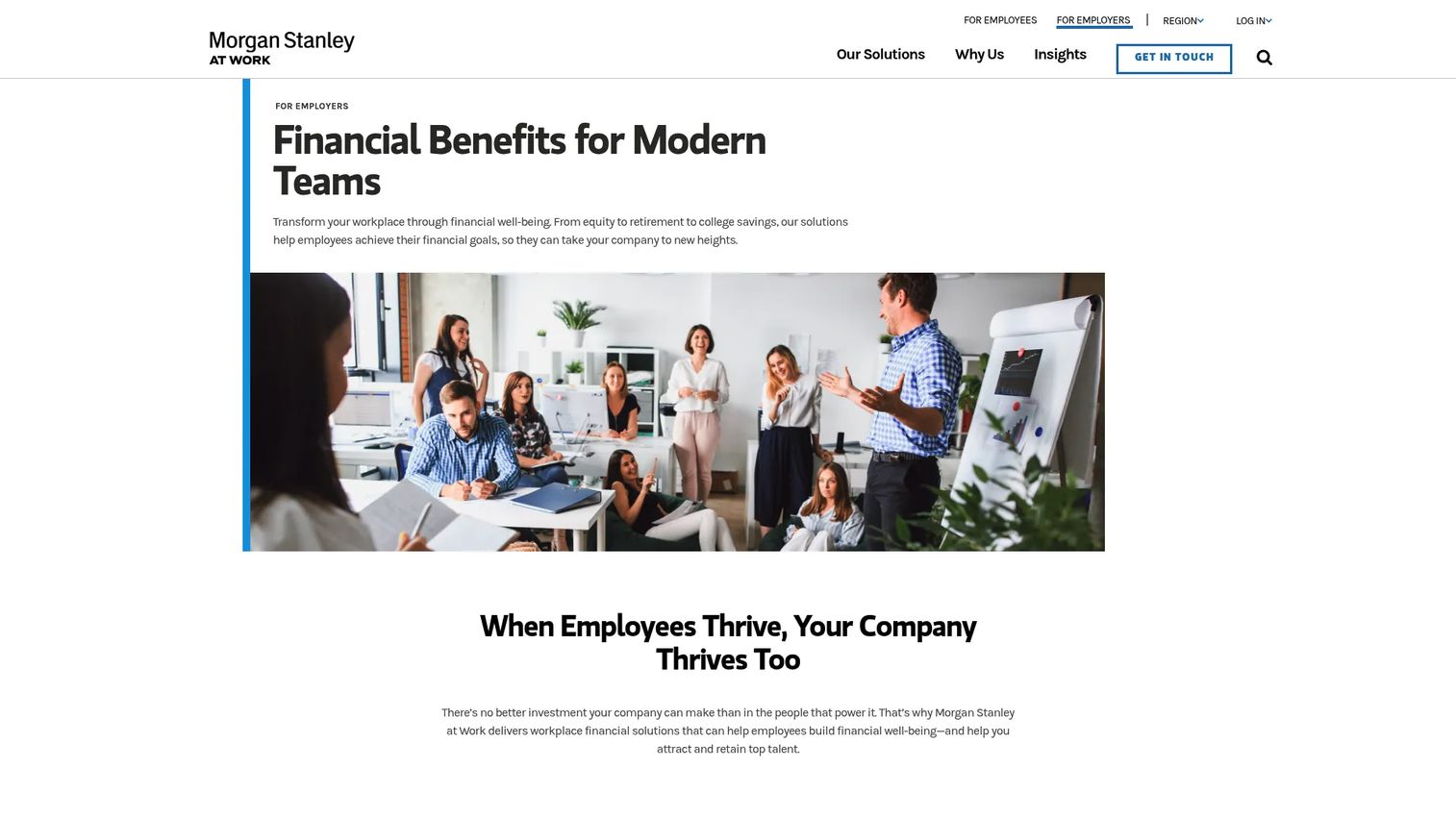
Morgan Stanley at Work provides workplace financial benefits covering equity compensation, retirement, deferred compensation, executive services, and financial wellness tools. It connects equity plan administration to participant brokerage, employee education, and financial advisor guidance. Companies typically evaluate it once equity becomes a scaled benefit, not just a cap table exercise.
Best for: Large private, pre-IPO, and public companies that need equity plan administration tied to participant brokerage and broader workplace financial benefits.
Key features
- Equity compensation plan administration
- Participant brokerage access and financial wellness tools
- Retirement and deferred compensation programs
- Executive services including equity planning
- Global participant support
Why choose Morgan Stanley at Work: The platform makes sense when stock plan administration and employee financial benefits need to live in one place. The buying process is enterprise-grade, which typically means longer implementation timelines and a procurement motion that doesn't fit lean Series B teams.
Morgan Stanley at Work pricing: Custom pricing; contact the vendor. No self-serve plan prices are available.
Morgan Stanley at Work G2 rating: 3.8/5 (rating reflects Shareworks by Morgan Stanley, the equity administration platform under the Morgan Stanley at Work brand)
3. J.P. Morgan Workplace Solutions
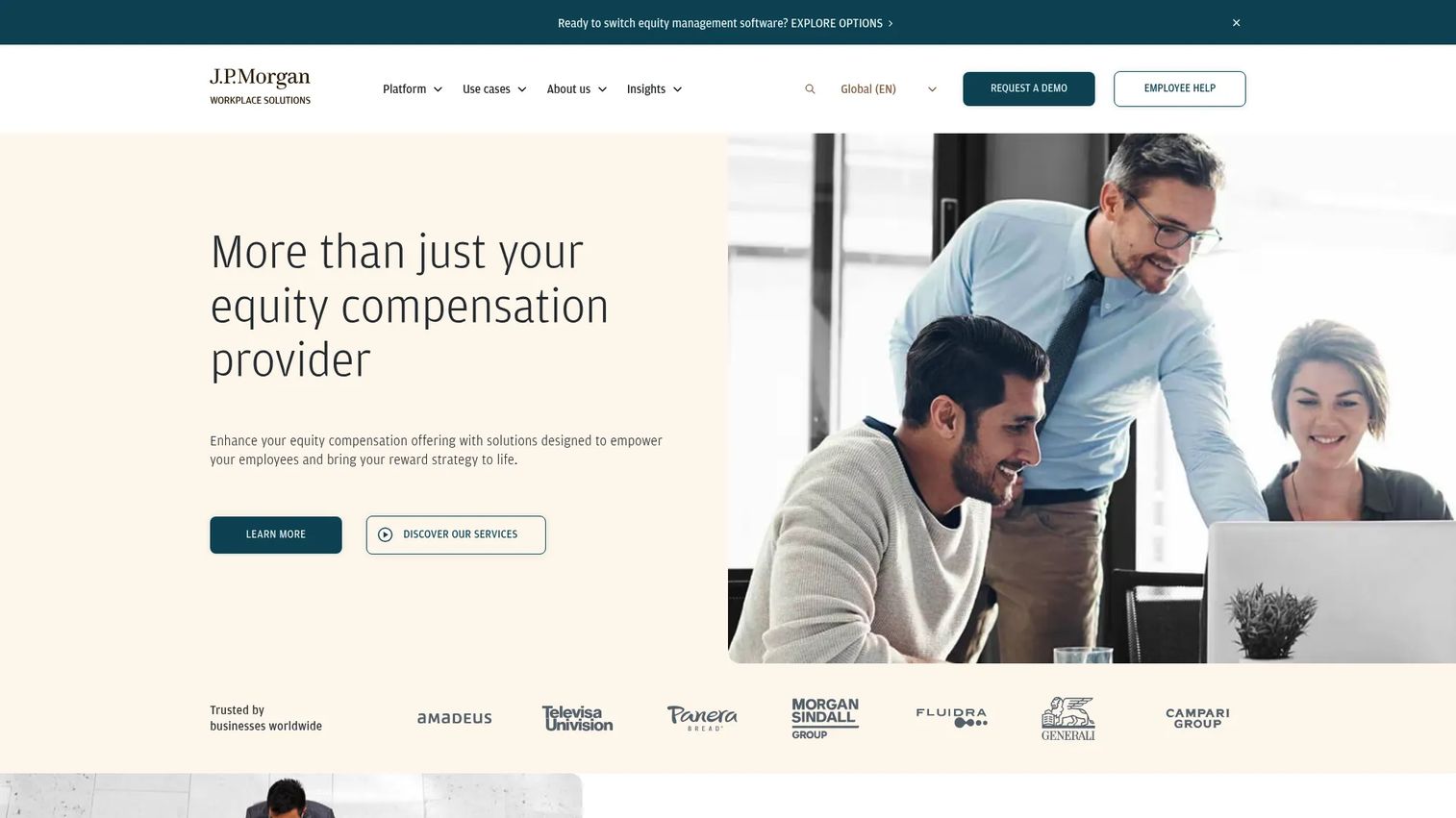
J.P. Morgan Workplace Solutions is an enterprise equity management and participant experience platform. It covers global share plan administration, cap table management, vesting and grant workflows, multilingual participant portals, and BI reporting. For SaaS companies expanding internationally, it handles the complexity of multiple currencies, tax jurisdictions, and local compliance requirements that simpler platforms don't cover.
Best for: Multinational companies managing stock plan administration across countries, currencies, and employee populations.
Key features
- Global equity compensation administration and reporting
- Cap table management, vesting, and grant acceptance workflows
- Participant portal with multilingual support and equity visibility
- Business intelligence dashboards, reports, and pivot tables
- HRIS, tax, payroll, and accounting integrations via API
Why choose J.P. Morgan Workplace Solutions: The platform earns consideration when international operations are operationally material. Local tax rules, multilingual employees, and cross-border reporting require depth that most startup-focused tools skip. For U.S.-only companies at Series B, it may be more infrastructure than needed.
J.P. Morgan Workplace Solutions pricing: Custom pricing; contact the vendor. No self-serve plan prices were found on the official site.
J.P. Morgan Workplace Solutions G2 rating: 4.8/5
4. UBS
UBS is a global financial services firm offering wealth management, investment banking, institutional services, and equity plan administration. Its workplace equity offering sits inside a broader financial-services relationship, covering enterprise plan servicing, participant support, broker connectivity, and access to wealth planning resources.
Best for: Enterprise organizations that want stock plan administration connected to executive wealth management and broader financial services.
Key features
- Enterprise equity plan servicing
- Participant support and brokerage connectivity
- Global equity operations support
- Wealth planning and investment management access
- Retirement and education planning
Why choose UBS: UBS belongs on the shortlist when equity administration is part of a larger executive services or wealth management strategy. For a Series B company without those requirements, the buying motion and service model will likely feel heavier than the problem warrants.
UBS pricing: Custom pricing; contact the vendor. UBS publishes a guide to fees at ubs.com/guidetofees, but no standardized plan pricing is displayed for equity plan services.
5. Cake Equity
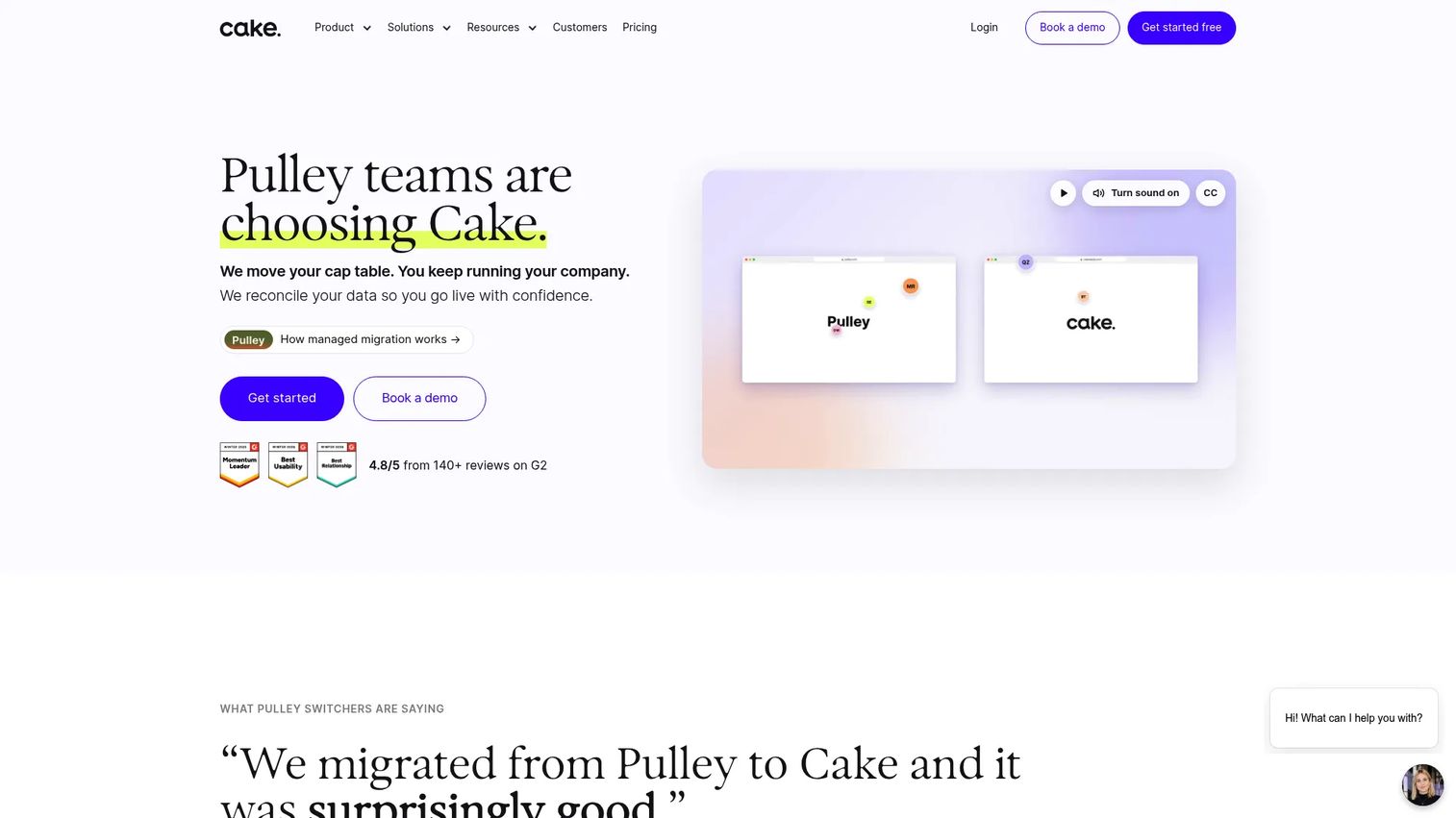
Cake Equity is an equity management platform for startups and growing companies. It covers cap tables, fundraising modeling, option grants, SAFEs, convertible notes, warrants, and compliance reporting including 409A, ASC 718, Form 3921, and Rule 701. The platform also includes an AI Access feature (MCP) that lets founders query cap table data directly. Pricing is transparent and published on the website, which makes it easy to evaluate cost before booking a demo.
Best for: Founders and finance leads who want a clear equity platform before public-company reporting complexity arrives.
Key features
- Cap table management and fundraising modeling
- Equity grants, vesting, SAFEs, convertible notes, and warrants
- 409A valuation, QSBS, ASC 718, Form 3921, and Rule 701 reporting
- Integrated equity document signing and approvals
- Employee and stakeholder portals with compliance reminders
Why choose Cake Equity: The transparent pricing model and startup-friendly workflows make it a natural choice for founders moving off spreadsheets. If your company already needs deep public-company reporting or high-volume ESPP administration, evaluate whether the current plan tier covers those requirements before signing.
Cake Equity pricing: Free plan covers up to 5 stakeholders. Build costs $1,000/year (25 stakeholders). Team costs $2,750/year (40 stakeholders). Pro is custom-priced for 100 or more stakeholders. A 409A valuation is available as an add-on for $1,500 on eligible plans.
Cake Equity G2 rating: 4.8/5
6. Pulley
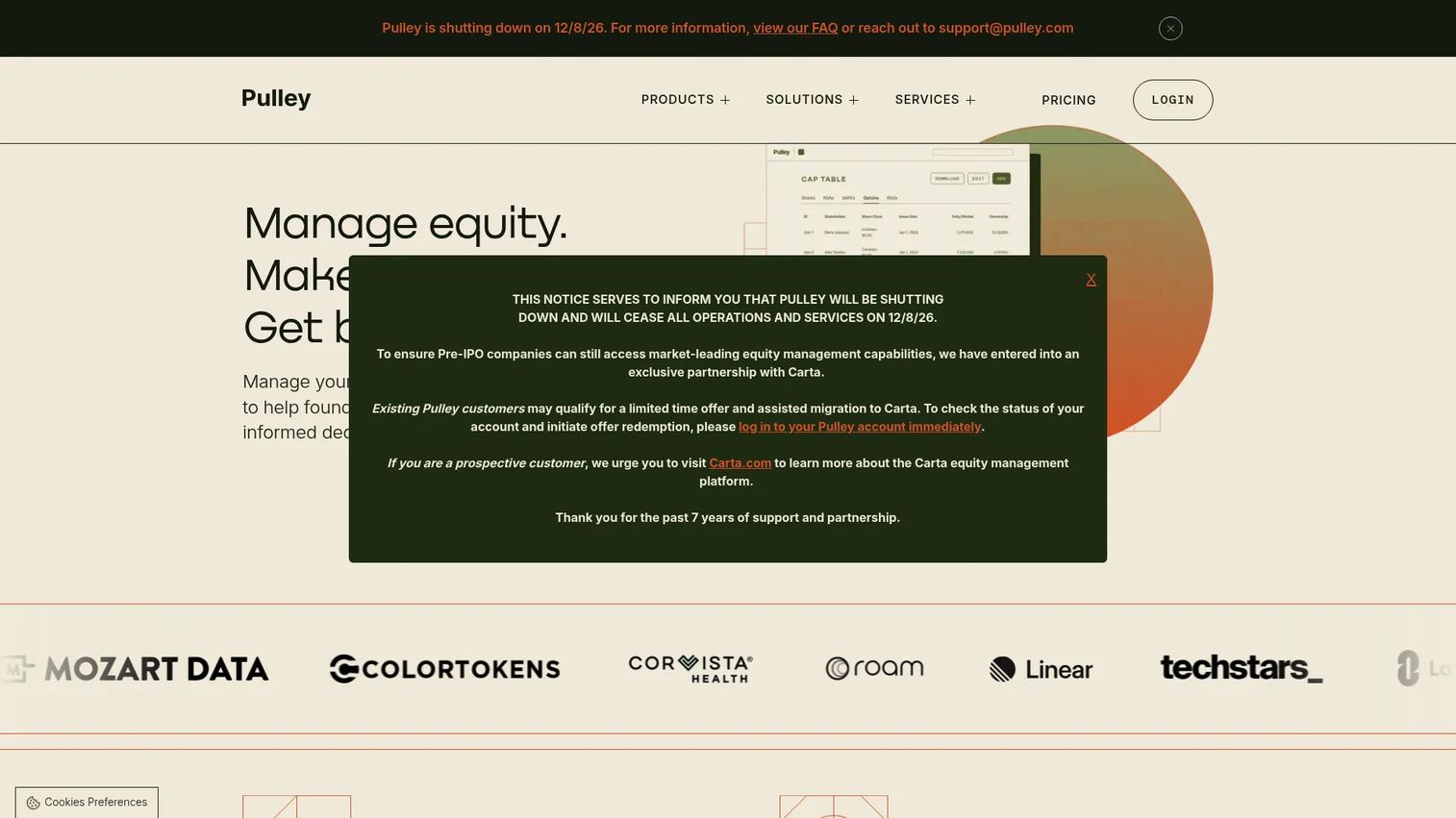
Pulley is an equity management platform for founders and finance teams, focused on cap tables, fundraising scenarios, employee equity, and compliance. Important context for 2026: Pulley has announced it will cease operations on December 8, 2026, with an exclusive partnership transferring customers to Carta. If you're evaluating Pulley today, factor the migration timeline into your decision.
Best for: Private companies that want cap table cleanup, equity workflows, and dilution modeling, and who plan to migrate to Carta before the December 2026 deadline.
Key features
- Cap table management and equity grant workflows
- Fundraising modeling and dilution scenarios
- 409A valuations and compliance reporting
- Employee equity views and stakeholder portals
- Rule 701 and Form 3921 compliance support
Why choose Pulley: Pulley fits teams that need clarity around dilution and employee equity before moving to a more complex system. Given the wind-down announcement, it's most relevant as a short-term option for companies already on the platform, not a new purchase for most buyers.
Pulley pricing: Startup plan starts at $1,200/year (first 25 stakeholders). Growth plan is $3,500/year (first 40 stakeholders, adds 409A, option exercises, and HRIS integrations). Enterprise pricing is contact-based.
Pulley G2 rating: 4.7/5
7. Ledgy
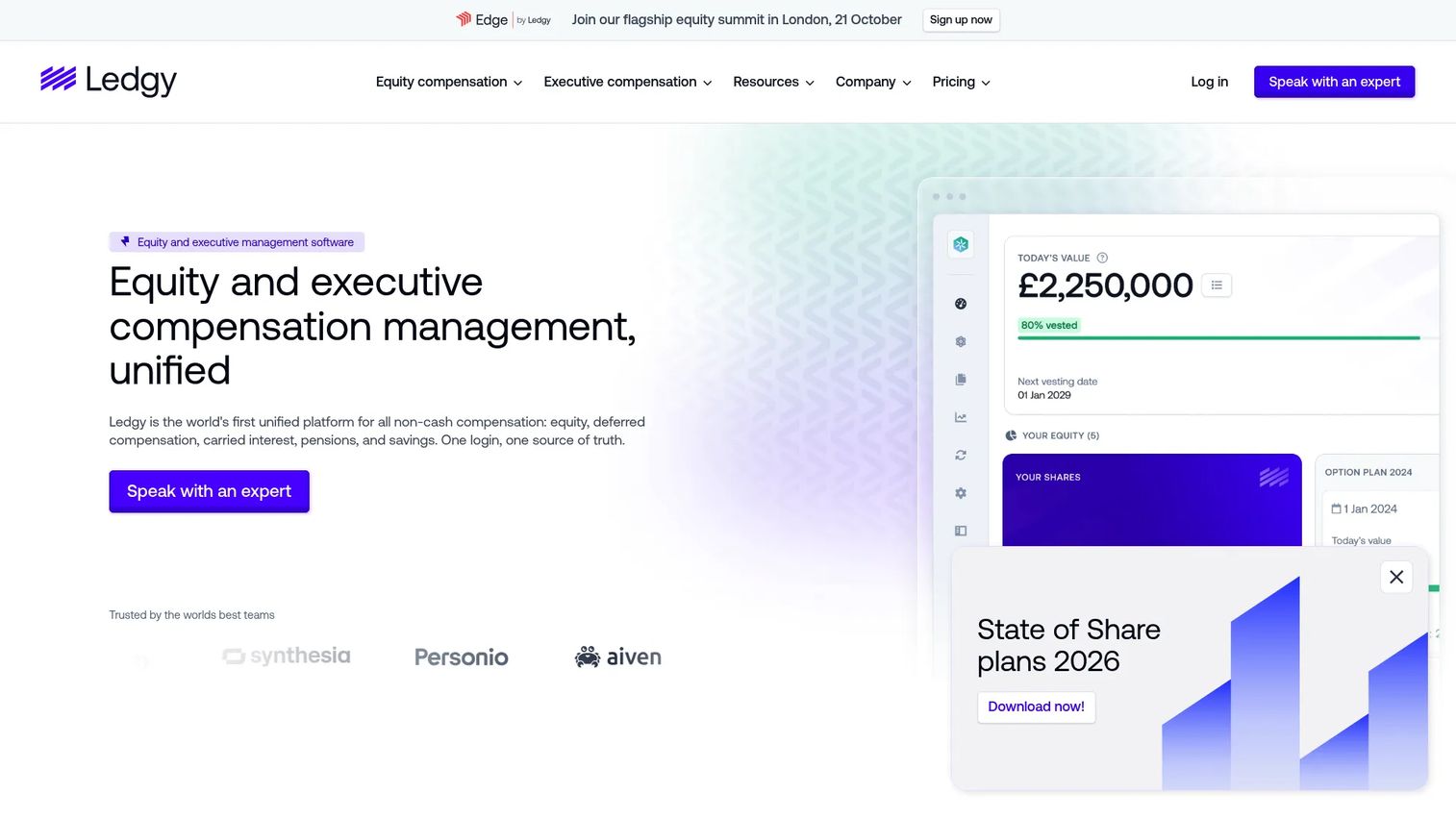
Ledgy is an equity and executive compensation management platform for private and public companies, with particular depth for European and international teams. It covers cap tables, share plan automation, employee equity dashboards, global mobility compliance, financial reporting, and trading and settlement. The platform serves companies from incorporation through post-IPO, including executive compensation management.
Best for: Companies with European or international equity operations that need compliance, investor relations, and employee equity support across jurisdictions.
Key features
- Cap table management and share plan automation
- Global equity compliance and mobility reporting
- Employee equity dashboards and stakeholder communications
- Financial reporting, trading, and settlement
- Executive compensation management
Why choose Ledgy: Ledgy fits teams that need international equity administration without the full complexity of a broker-connected enterprise platform. For U.S.-only SaaS companies, verify that local tax workflow depth and jurisdiction support meet your specific requirements before committing.
Ledgy pricing: Launch plan is free. Scale starts at €5,000/year. Enterprise starts at €18,000/year. Public uses custom pricing. Financial-reporting add-ons (Essentials and Advanced) start at €3,000 and €5,000/year respectively. Pricing is in EUR; USD pricing is not displayed on the site.
Ledgy G2 rating: 4.7/5
8. Certent Equity Management
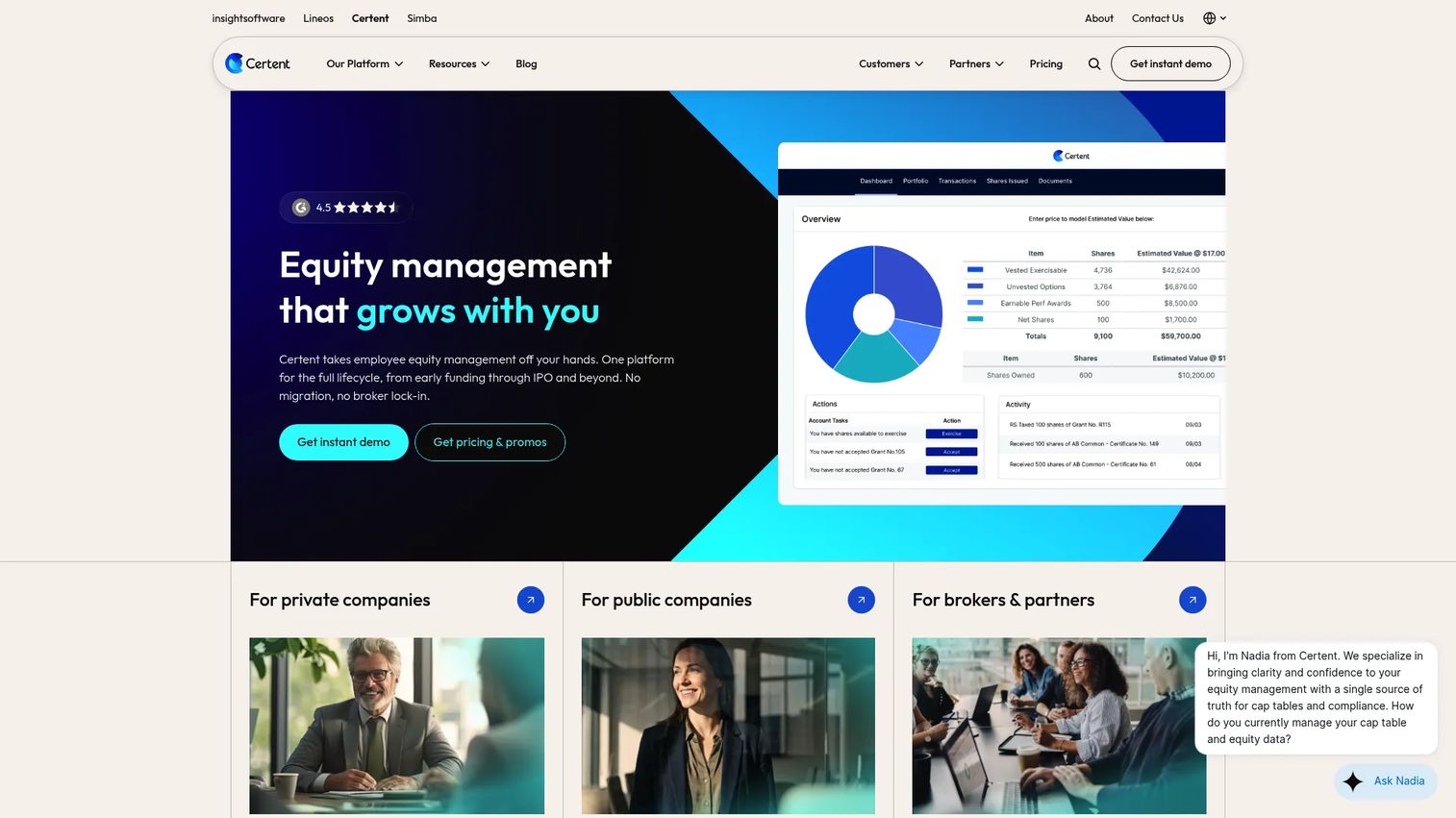
Certent Equity Management (now part of insightsoftware) is an equity administration platform covering cap tables, grant administration, ASC 718 reporting, disclosure reporting, SEC and IFRS compliance, and participant self-service. It's built for companies with complex reporting requirements, particularly those preparing for or operating as public companies.
Best for: Finance and stock administration teams that need deep ASC 718, disclosure, and public-company reporting support alongside grant administration.
Key features
- Cap table management with ownership, waterfall, and scenario modeling
- Grant administration with approvals, vesting, digital signing, and audit trails
- ASC 718 and IFRS 2 expense reporting
- SEC, FASB, and Section 16 compliance reporting
- Participant self-service portal
Why choose Certent Equity Management: Certent earns consideration once the finance team needs audit-ready reporting and the equity plan has moved past basic option grants. For a founder, it enters the shortlist when the CFO or auditor asks for ASC 718 output that a simpler platform can't produce.
Certent Equity Management pricing: Custom pricing; a request-for-pricing form is available on the insightsoftware site. No plan tiers or numeric prices are displayed.
Certent Equity Management G2 rating: 4.4/5
9. OptionTrax
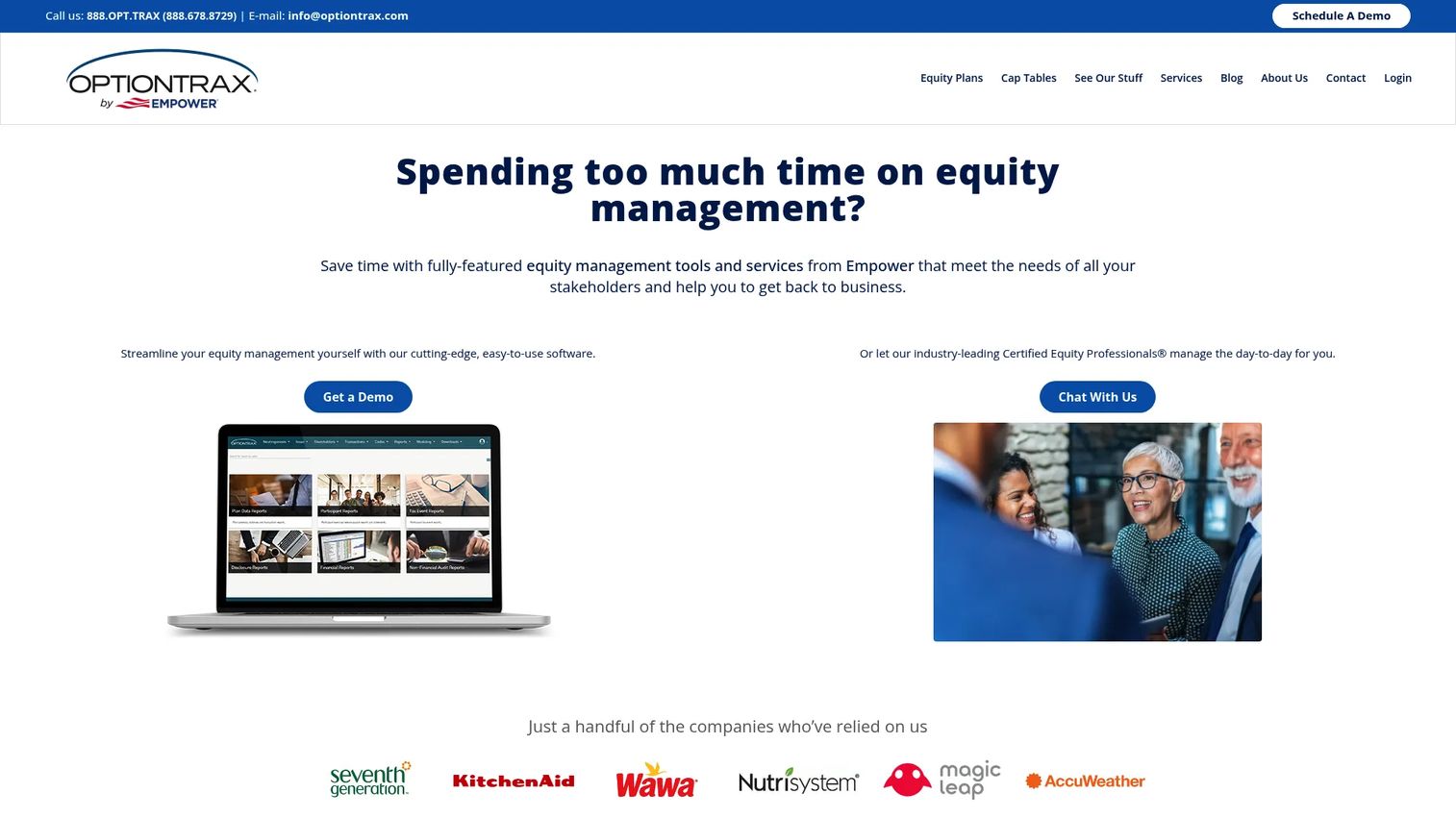
OptionTrax is an equity plan and cap table management platform serving public and private companies. It supports automated tracking across stock options, RSAs, RSUs, SARs, performance awards, phantom awards, warrants, and ESPPs. The platform includes Black-Scholes and intrinsic valuation, ASC 718 and ASC 260 expense reporting, and electronic grant agreements with participant document management.
Best for: Stock plan administrators at growing public or private companies who need flexible award tracking across multiple award types with built-in compliance reporting.
Key features
- Automated tracking for stock options, RSUs, SARs, ESPPs, and warrants
- Black-Scholes and intrinsic valuation with ASC 718 support
- Real-time filtered reporting with PDF, HTML, and Excel exports
- Cap table management covering securities, shareholders, and dilution
- Electronic grant agreements and online participant exercising
Why choose OptionTrax: OptionTrax suits stock plan administrators who need dedicated equity operations software with broad award-type coverage, rather than a financial institution platform with equity as one module among many. The flat monthly pricing makes cost predictable as participant count grows.
OptionTrax pricing: Private company plans start at $449/month. Public company plans start at $649/month. The dedicated pricing page notes that detailed pricing is customized; contact the vendor for your specific configuration.
OptionTrax G2 rating: 4.7/5
10. Charles Schwab EquiView
Charles Schwab EquiView is a web-based equity compensation plan administration and recordkeeping platform. It handles complex stock plans, global tax withholding, rules-based mobility tracking, foreign-currency reporting, ASC 718 and IFRS 2 integration, and Section 16 reporting. The EquiView Modeler provides a staging environment for scenario testing before changes go live.
Best for: Large or complex organizations that need enterprise stock plan administration connected to Schwab's brokerage and participant servicing environment.
Key features
- Customizable dashboards, reports, and automated delivery
- Rules-based global tax withholding and mobility tracking
- ASC 718, IFRS 2, disclosure, dilution, and Section 16 reporting
- EquiView Modeler staging environment for scenario testing
- Audit trails, SOX controls, and configurable access permissions
Why choose Charles Schwab EquiView: Schwab makes sense when brokerage connectivity and participant servicing matter as much as plan administration. It's typically an evaluation for later-stage or public companies, not the first tool a founder purchases after moving off spreadsheets.
Charles Schwab EquiView pricing: Custom pricing; no self-serve plan prices were found on Schwab's first-party pages. Contact Schwab for a quote.
11. Fidelity Stock Plan Services
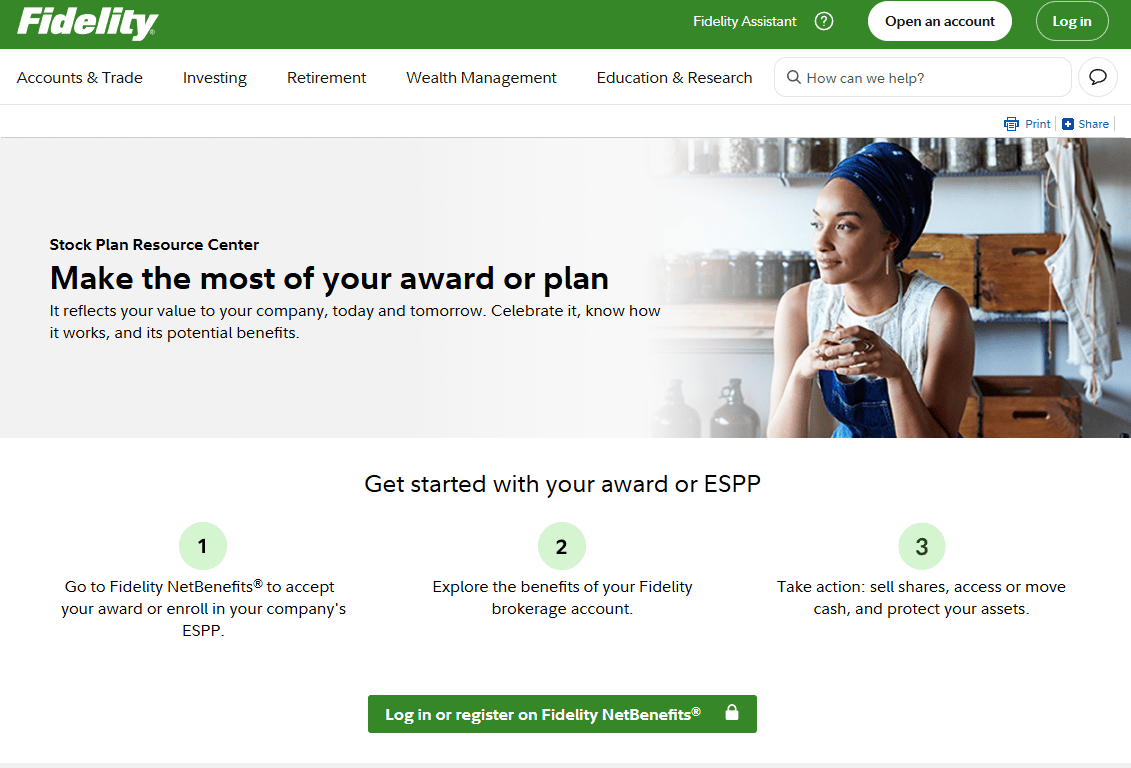
Fidelity Stock Plan Services is a stock plan administration and participant brokerage service for managing employee equity awards, ESPPs, shares, and related investments. Participants access awards, enroll in ESPPs, make tax elections, and manage plan details through Fidelity NetBenefits. A linked Fidelity brokerage account lets employees sell shares, transfer cash, and invest across stocks, ETFs, and mutual funds.
Best for: Large public companies and late-stage private companies that need broker-linked plan administration with integrated participant financial services.
Key features
- RSU, RSA, ESPP, stock option, performance award, and SAR administration
- Participant access via Fidelity NetBenefits for award acceptance and tax elections
- Brokerage account integration for share selling and investing
- Employee education and financial wellness tools
- Transaction processing with transaction fees that vary by plan
Why choose Fidelity Stock Plan Services: Fidelity is a serious option when employee equity is a scaled financial benefit, not just a grant-and-track workflow. For a Series B founder, it usually enters the conversation when the company is planning public-company readiness or managing a large global workforce.
Fidelity Stock Plan Services pricing: Custom pricing; no general self-serve plan prices are available. Transaction fees may apply and vary by plan and transaction type.
12. Bank of America Equity Plan Services
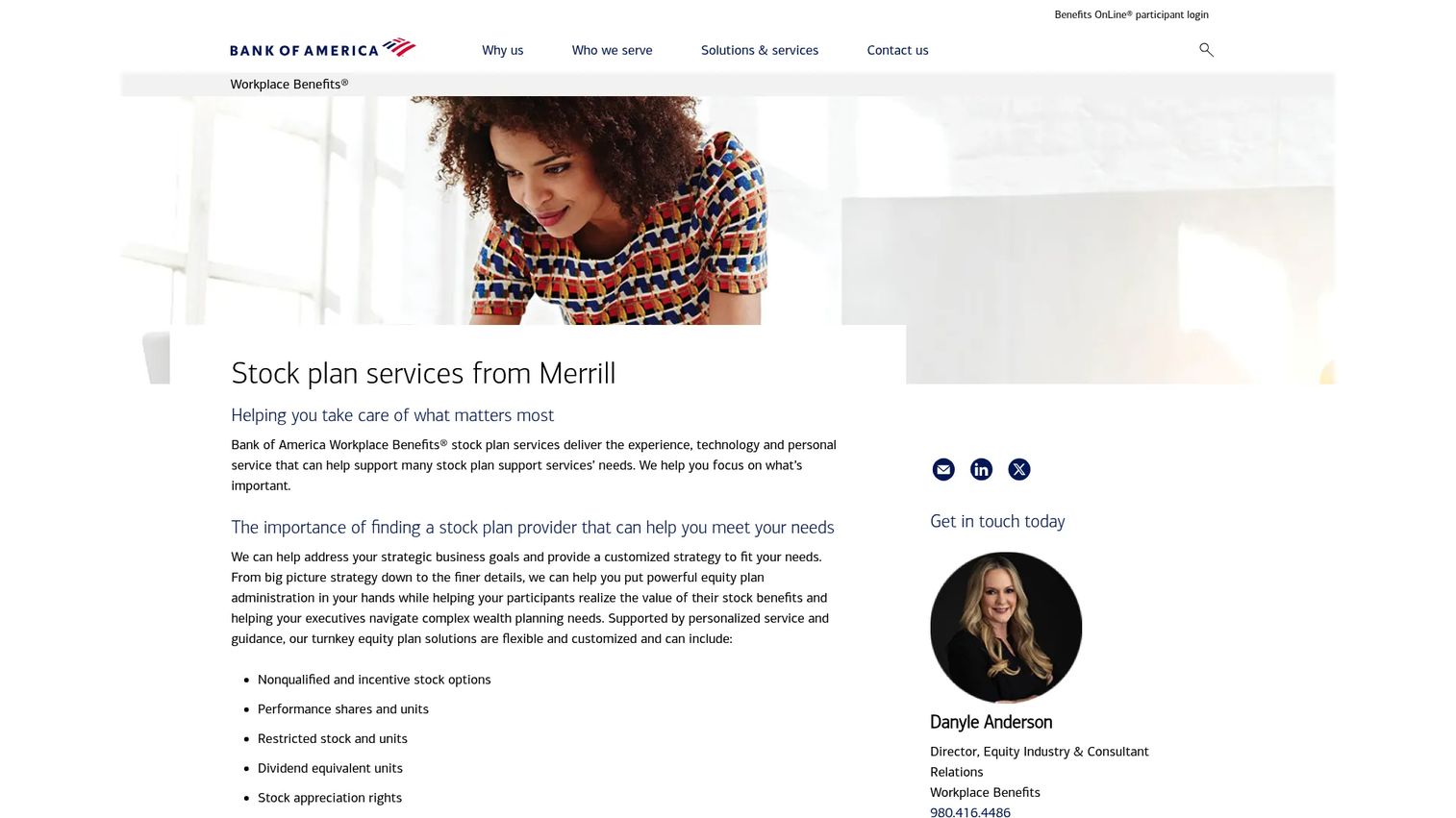
Bank of America Equity Plan Services provides customized equity plan administration, technology, recordkeeping, reporting, compliance support, and participant guidance. It supports nonqualified and incentive stock options, performance shares and units, restricted stock and units, SARs, ESPPs, and dividend equivalent units. The platform includes ASC 718 compliance support, international awards administration, and digital mobile access for participants.
Best for: Enterprise companies that want equity plan administration connected to a broader Bank of America financial-services relationship.
Key features
- Full award-type coverage: Stock options, RSUs, RSAs, SARs, ESPPs, and dividend equivalent units
- ASC 718 compliance support and equity financial reporting
- International awards administration
- Executive services and recordkeeping
- Digital and mobile participant access
Why choose Bank of America Equity Plan Services: This option fits companies that value an enterprise banking relationship around their equity program. For smaller private companies or early-stage SaaS teams, the buying process and service model will likely feel heavier than the stage requires.
Bank of America Equity Plan Services pricing: Custom pricing; solutions are customized and directed to contact the vendor. No plan tiers or prices are displayed.
Considerations when choosing stock plan administration software
Match the platform to your company stage
A seed-stage cap table has different needs than a Series B with 40 employees across four states. Buy for the next 18 to 36 months, not just the current state of your cap table. A platform that handles today's option grants but can't produce ASC 718 output for your next audit will require a costly migration at the worst possible time.
Verify award types and plan complexity
Support for stock options doesn't guarantee depth across RSUs, RSAs, ESPPs, warrants, or international grants. Ask each vendor which award types are included in your plan tier and which require add-ons or custom configuration. This matters more if your compensation team is planning to introduce new award structures in the next 12 months.
Audit reporting and tax workflows
Your CFO and auditors will need outputs before you do. Ask them what they require: ASC 718 expense reports, 409A documentation, Form 3921 delivery, payroll withholding records, and disclosure reporting all have different platform requirements. Collect that list before your vendor demos so you're evaluating against real requirements, not assumptions.
Check integrations before signing
HRIS, payroll, accounting, and broker integrations determine whether equity data flows automatically or requires manual exports. A founder should ask: Who owns integration maintenance after implementation? If the answer is your engineering team, factor that ongoing cost into the evaluation.
Evaluate the employee equity portal
A good participant portal cuts the volume of equity questions routed through HR and finance. Employees should be able to view their grants, track vesting, model exercise scenarios, and access tax documents without filing a ticket. Weak portals create repetitive support work and, more importantly, erode employee trust in the equity program.
Conclusion
Stock plan administration becomes infrastructure once you scale past the early-stage spreadsheet phase. The wrong system surfaces during the worst moments: Financing diligence, an IPO readiness project, or an employee's exercise window after a board-approved grant that never got formally recorded.
For most high-growth private SaaS companies, Carta covers the full equity lifecycle and integrates with the financing workflows your investors already use. Cake Equity is a practical, transparent-pricing option for founders who want to get out of spreadsheets without an enterprise buying process. Certent and OptionTrax serve companies with complex reporting requirements. J.P. Morgan Workplace Solutions leads for global equity operations.
The financial institution platforms, Morgan Stanley at Work, J.P. Morgan, UBS, Schwab, Fidelity, and Bank of America, fit companies where equity has become a large-scale employee benefit tied to participant brokerage and financial wellness services.
Audit your current equity workflows this week. Map what you need for the next fundraise or audit. Then shortlist two or three vendors based on your stage, award types, and reporting requirements. The cleaner your equity data, the stronger your position heading into any board-level conversation.
Start your journey with Guideflow today!
FAQs
Stock plan administration software manages the operational life of employee equity: Grants, vesting, exercises, settlements, tax documents, participant communications, and financial reporting. It's distinct from a basic cap table tool, which only tracks ownership. A full administration platform handles the workflows that make equity work as a day-to-day program, not just a record.
Cap table software tracks who owns what percentage of your company. Stock plan administration software handles everything that happens after a grant is issued: Vesting schedules, exercise windows, employee portal access, tax form delivery, payroll withholding, and compliance reporting. Many platforms cover both, but their depth differs significantly by use case.
The clearest triggers are institutional financing (investors want clean cap table records), repeated grants across a growing team, the need for a defensible 409A, employee exercise requests, an upcoming audit, or expansion into multiple tax jurisdictions. For Series B companies, spreadsheets are usually already a risk by the time the board asks for cleaner ownership data.
Most Series B companies evaluate platforms with strong private-company cap table management, 409A support, and grant workflows. Carta is the most common choice at this stage because it covers the full equity lifecycle and integrates with the financing workflows investors use. Cake Equity is worth considering for teams that want transparent pricing and a faster buying process.
The features that matter most depend on your award types, reporting requirements, and employee footprint. Grant workflows, vesting and exercise tracking, cap table records, and a participant portal cover the basics. Add ASC 718 reporting, payroll withholding support, and broker integrations once the program grows. International grants add jurisdiction-specific tax and compliance requirements on top of that.
Some platforms offer 409A support directly, others integrate with third-party valuation providers, and some require you to source it separately. Carta and Cake Equity both include 409A valuation options within their platforms (Cake charges $1,500 as an add-on on eligible plans). Verify timing, included documentation, and audit defensibility before relying on any platform's 409A service.
Pricing varies by participant count, company stage, award types, reporting modules, and whether global operations are involved. Startup-focused platforms like Cake Equity start at $1,000/year, while enterprise platforms from financial institutions require a custom quote based on service scope. OptionTrax publishes flat monthly pricing starting at $449 for private companies, which is useful if you want cost predictability without a negotiated contract.
Ask about migration timeline and what data cleanup they require upfront. Confirm which award types are included in the quoted plan. Ask what ASC 718, tax, and disclosure reports the system produces and in what format. Find out which HRIS, payroll, and broker integrations are available. Ask who owns integration maintenance after go-live. Get specifics on the participant portal and what employees can do self-serve versus what routes through your admin team.