You need to hit a permit deadline, model a plant upgrade before you spend seven figures on new equipment, and keep operations visible enough that nobody gets surprised by a process failure at 2 a.m. Those are three different jobs. Most teams try to solve them with the same tool, then wonder why the fit feels off.
That tension is the real problem with buying wastewater software. Modeling, compliance, monitoring, and operations look adjacent, but they reward completely different product designs. A treatment simulator that engineers love does nothing for your NetDMR filing. A compliance platform that keeps your permits clean will not tell you why the biological process is drifting.
The market reflects how serious the stakes have become. The global wastewater compliance software market was valued at $2.1 billion in 2025 and is forecast to reach $4.6 billion by 2034 at a 9.8% CAGR, according to MarketIntelo (2025). North America alone holds 42.3% of that revenue, worth roughly $888.3 million. Separately, the wastewater modeling software market sat at $1.60 billion in 2025 and is expected to reach $2.90 billion by 2032 at an 8.81% CAGR, per 360iResearch (2025). Two adjacent categories, both growing fast, both solving different problems.
So the smart move in 2026 is not finding the single best wastewater software. It is matching the tool to the job you actually need done first.
What's inside
This guide covers wastewater software for treatment plants, municipal utilities, and industrial operations. We pulled the shortlist from the vendors that dominate real buying conversations across modeling, compliance, monitoring, and operations, then organized them by the job each does best.
We selected tools on five criteria: modeling depth and process simulation accuracy, compliance and reporting workflow coverage, analytics and operational visibility, ecosystem breadth across water and wastewater use cases, and the credibility of adoption among consultants, utilities, and plant engineers. Every pricing figure and rating below comes from verified first-party or public sources at the time of writing.
TL;DR
- Best for modeling and simulation: EnviroSim (BioWin) and GPS-X, the two dominant treatment plant simulators used by engineers and consultants.
- Best for compliance and reporting: Locus Technologies, built around permit tracking, NetDMR filing, and environmental data management.
- Best for centralized operations and SCADA: GE Vernova and its Proficy suite, for utilities and industrial operators.
- Best all-in-one modeling suite: Hydromantis, whose portfolio spans GPS-X, Toxchem, WatPro, and more.
- Best for consultants and plant engineers: BioWin and GPS-X again, for scenario analysis and plant design.
- Best for broader environmental data management: Locus Technologies, for teams unifying EHS, ESG, and water compliance in one place.
What is wastewater software?
Wastewater software is any application that helps utilities, treatment plants, and industrial operators model treatment processes, meet regulatory compliance, monitor operations, and optimize plant performance. It is not one category. It is a family of tools that each solve a distinct operational job.
The confusion starts when buyers treat these as interchangeable. They are not. Here are the major capability buckets, and what each one is actually for.
- Modeling and simulation. Process simulation software that predicts how a treatment train behaves before you build or change it. Think biological reactor modeling, chemistry, mass transfer, and scenario analysis. This is wastewater modeling software, and it is where engineers and consultants live.
- Compliance and reporting. Wastewater compliance software that tracks permits, automates regulatory filings like EPA NetDMR, and keeps discharge reporting audit-ready. This category overlaps heavily with wastewater reporting software and broader wastewater data management.
- Monitoring and operational control. Wastewater monitoring software and SCADA systems that pull live signals from sensors and equipment so operators can see plant state in real time and respond to process issues fast.
- Analytics and optimization. Wastewater analytics software and wastewater optimization software that turn operational data into decisions, flagging inefficiencies in energy, chemical dosing, or aeration.
- Data management and workflow automation. The connective layer that centralizes plant data, standardizes reporting, and reduces the manual work of moving numbers between systems.
Most wastewater treatment plant software leans hard into one or two of these buckets. The vendors below are strongest where their design intent is clearest.
When to use wastewater software
The right tool depends on which decision is in front of you. Three common triggers cover most buying situations.
Model treatment changes before investing in equipment
You are considering a capital upgrade, a new process, or a load change, and you need to know how the plant will respond before spending money. This is the case for wastewater modeling software. A calibrated simulator lets you test scenarios, size equipment, and validate design assumptions in a model rather than in concrete. Engineers and consultants use process simulation software here to de-risk decisions that carry seven-figure consequences.
Centralize permit reporting and wastewater data
You are drowning in permit deadlines, discharge monitoring reports, and data scattered across spreadsheets and email. This is the case for wastewater compliance software and wastewater management software. A compliance-first platform tracks permit conditions, automates NetDMR submissions, and creates a single audit-ready record. The value is fewer missed deadlines and less manual reporting labor.
Monitor operations and spot process issues faster
You need live visibility into what the plant is doing right now, not what it did last month. This is the case for wastewater monitoring software and SCADA. Operations teams use it to watch sensor data, historian trends, and equipment status in real time, so a drifting process gets caught in minutes instead of showing up in next quarter's compliance report.
Comparison table
The table below orders vendors by relevance to the wastewater software keyword and shows where each fits. Pricing and ratings reflect verified first-party or public sources at the time of writing. Where a figure could not be confirmed, the cell is left open rather than estimated.
| # | Product | Intent | Key differentiation | Pricing | G2 rating |
|---|---|---|---|---|---|
| 1 | EnviroSim | Process modeling and simulation | BioWin simulator with proprietary biological model | From $2,500/yr | Not available |
| 2 | Locus Technologies | Compliance, reporting, data management | Cloud EHS, ESG, and water compliance in one platform | Custom | Not available |
| 3 | Hydromantis | Modeling suite | GPS-X plus Toxchem, WatPro, and more | From $3,700/yr (GPS-X) | Not available |
| 4 | GE Vernova | Operations, monitoring, SCADA | Proficy suite for utility and industrial scale | Custom | 4.3/5 |
| 5 | BioWin | Treatment plant simulation | Deep biological, chemical, physical process modeling | From $2,750/yr | Not available |
| 6 | GPS-X | Treatment plant simulation | Dynamic simulation with scenario and optimization tools | From $3,700/yr | Not available |
| 7 | Proficy Suite | Industrial operations software | HMI/SCADA, historian, MES, operations analytics | Custom | Not available |
1. EnviroSim
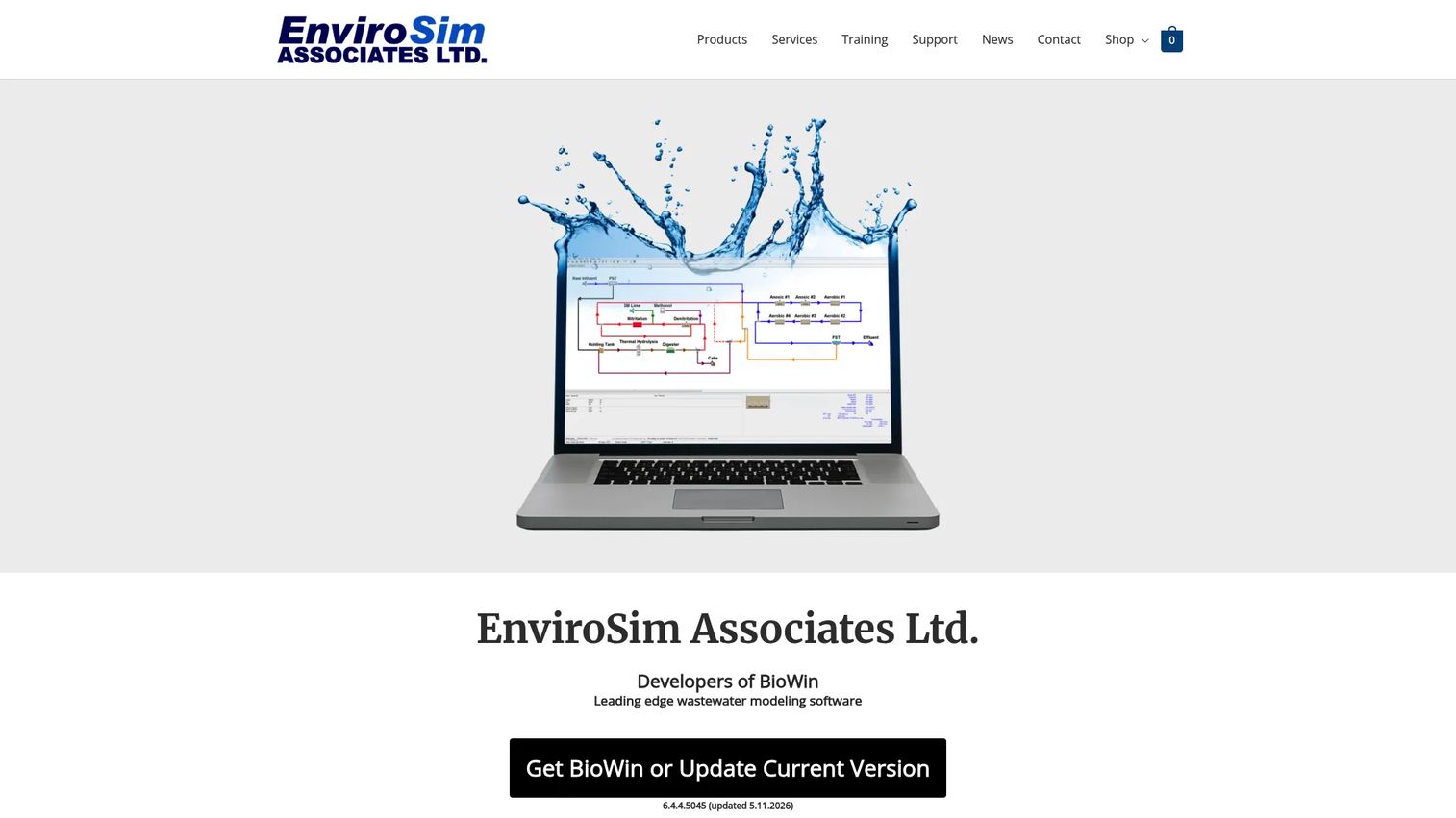
EnviroSim is the company behind BioWin, the wastewater treatment process simulator that engineers reach for when they need to model a plant with real biological accuracy. The product centers on a proprietary biological model paired with chemistry and mass transfer modules, so you can simulate an entire treatment train and predict how process changes will play out. It is process simulation software built by people who take the underlying science seriously, and it shows.
What sets EnviroSim apart is the service layer around the software. Training seminars, project-team involvement, and direct support mean buyers are not left alone with a complex model. That matters when your simulation results feed a design decision worth millions.
Best for: Consultants, municipalities, and educators who need rigorous wastewater modeling software for plant design and optimization.
Key strengths
- BioWin process simulator: Models biological, chemical, and physical treatment processes in one integrated environment.
- BW Controller add-on: Extends the model with process control simulation for testing control strategies before deployment.
- Excel and Word reporting: Exports results directly into the formats engineers already use to document and present findings.
Why choose EnviroSim: If your primary job is modeling treatment performance before you commit to equipment, EnviroSim earns its place. The proprietary biological model is trusted across the industry, and the training-led support model suits engineering-heavy teams who want to build internal modeling capability, not just buy a license.
EnviroSim pricing: BioWin is available as an annual license starting at $2,500 for the first-year starter kit, with renewals at a lower rate. A perpetual BioWin license is $8,000 one-time. The BW Controller add-on runs $500 annually or $2,000 as a perpetual license. Pricing is listed publicly on EnviroSim's site, with volume discounts available. There is no free tier.
2. Locus Technologies
Locus Technologies is where compliance-first teams go. It is cloud-based environmental, EHS, ESG, and water management software built to handle the regulatory side of wastewater that simulators ignore entirely. If your day revolves around permit conditions, discharge monitoring reports, and audit readiness, this is the category leader for wastewater compliance software.
The platform covers EPA NetDMR reporting, permit tracking, regulatory and ESG reporting, mobile data collection, and GIS mapping. It runs as a multi-tenant cloud SaaS with REST APIs, so it plugs into the broader environmental data management stack rather than sitting in a silo. For teams unifying water compliance with wider EHS and ESG obligations, that breadth is the whole point.
Best for: Regulated enterprises and environmental data managers who need compliance, reporting, and data management in one system.
Key strengths
- Regulatory and ESG reporting: Automates NetDMR filings and standardized regulatory reports, cutting manual submission work.
- Permit tracking: Keeps permit conditions and deadlines visible so nothing slips through the cracks.
- API connections and GIS mapping: Integrates with existing systems and layers spatial context onto compliance data.
Why choose Locus Technologies: Choose Locus when compliance is the primary job, not an afterthought. It is the strongest fit for teams that treat wastewater reporting software as part of a larger environmental data management practice, and who need workflow, visualization, and audit trails rather than process modeling.
Locus Technologies pricing: Locus does not publish numeric pricing on its site. The platform uses subscription SaaS and consumption-based pricing, so cost scales with your data volume and module needs. Teams evaluating it should request a quote based on their specific compliance footprint.
3. Hydromantis
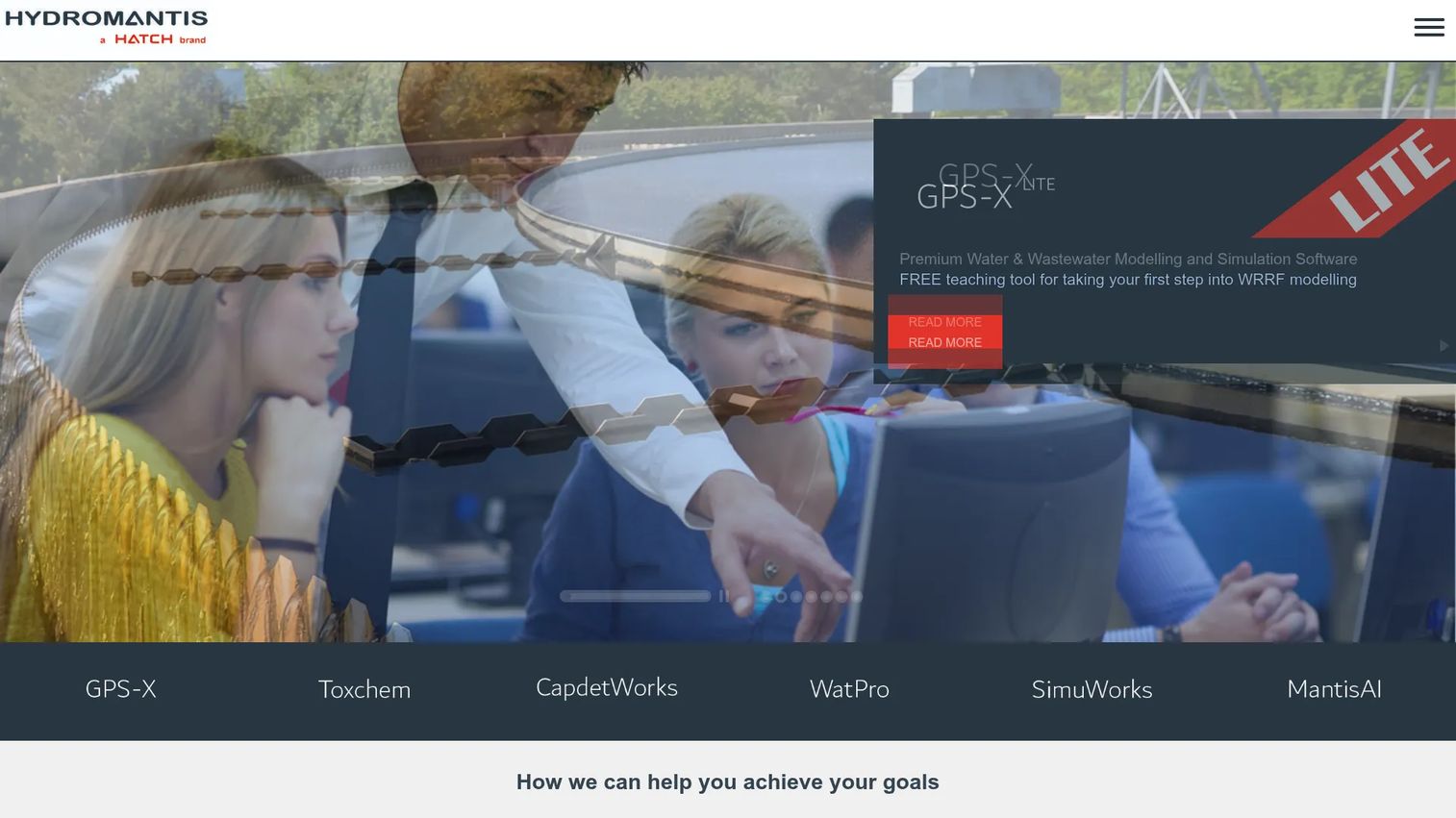
Hydromantis takes the suite approach to wastewater modeling software. Rather than one simulator, it offers a portfolio: GPS-X for treatment plant modeling, Toxchem for air emissions, WatPro for drinking water disinfection, plus CapdetWorks, SimuWorks, and Mantis.AI. For engineering teams that model across water and wastewater, the breadth means fewer separate tools to stitch together.
GPS-X anchors the suite as the dynamic simulation platform, but the value of Hydromantis is the ecosystem. You can model treatment processes, analyze air emissions, optimize disinfection, and run digital twin-style analysis without leaving the vendor. Training and support assets round it out for teams building operator competency.
Best for: Utilities and engineering teams that model both wastewater and drinking water treatment processes and want a single-vendor suite.
Key strengths
- GPS-X simulation: Dynamic wastewater treatment plant modeling with a full unit process library.
- Toxchem air emissions modeling: Predicts volatile emissions from treatment processes for compliance and design.
- WatPro disinfection optimization: Models drinking water disinfection to balance safety and cost.
Why choose Hydromantis: Pick Hydromantis when your modeling needs span more than one process domain. The suite is strong for plant modeling, digital twin analysis, and operator training, and the free GPS-X LITE learning version makes it easy to build familiarity before committing. It is the evaluation-friendly choice for training-led teams.
Hydromantis pricing: GPS-X is sold as an annual subscription across three tiers: Standard at US$3,700, Pro at US$4,700, and Pro + at US$10,400. A free simplified learning version, GPS-X LITE, is available for teaching and familiarization. Other suite products are priced separately.
4. GE Vernova
GE Vernova approaches wastewater from the operations and infrastructure side. As a global energy and industrial technology company, it brings grid modernization, power generation, and industrial software under one roof, with the Proficy suite anchoring its wastewater monitoring software and operations story. Utilities and industrial operators use it for real-time visibility, optimization, and integration across large infrastructure.
The strength here is centralized operations. SCADA, historian data, an operations hub, analytics, and sustainability insights combine so a utility team can see and control the plant from one place. This is wastewater operations software at utility scale, built for organizations that already run complex industrial environments and want a single vendor spanning power, grid, and operations.
Best for: Utilities and industrial operators needing grid, power, and operations software from one vendor with deep SCADA and monitoring capability.
Key strengths
- Grid and automation software: Modernizes and automates infrastructure control across large operations.
- Industrial monitoring and optimization: Surfaces operational state and performance in real time for faster response.
- Integrated portfolio: Spans power generation, grid, and operations so utilities consolidate vendors.
Why choose GE Vernova: Choose GE Vernova when operational visibility and infrastructure integration outweigh process modeling. For utilities running SCADA software and needing wastewater analytics software tied into broader operations, the single-vendor breadth is the draw. It fits organizations optimizing at scale, not consultants sizing a clarifier.
GE Vernova pricing: GE Vernova does not publish public pricing for its software. Product pages direct buyers to contact sales or request a private offer, reflecting the enterprise, project-based nature of its deals. It holds a 4.3/5 rating on G2. Expect a consultative sales process sized to your infrastructure.
5. BioWin
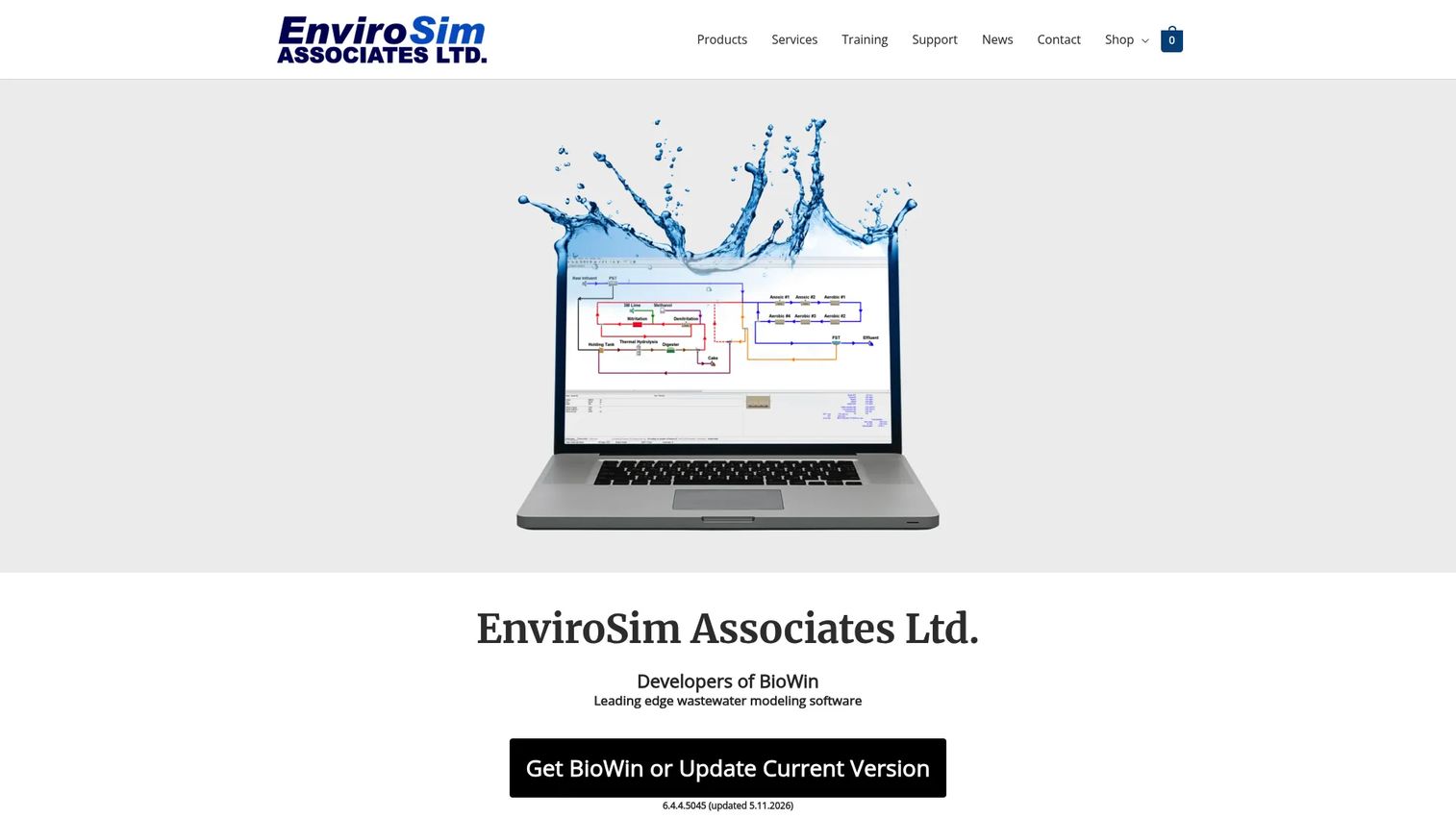
BioWin is EnviroSim's flagship simulator, and it deserves a dedicated look because it is the tool many plant engineers name first when asked about wastewater treatment plant software. It models biological, chemical, and physical processes together, letting you design, upgrade, and optimize a treatment plant inside a single environment. When a design team debates whether to add a reactor or change an aeration strategy, BioWin is often where that debate gets settled with data.
The modeling depth is the reason it sticks around on shortlists. You can represent complex treatment trains, run steady-state and dynamic simulations, and add the optional BW Controller module to test process control logic. It is trusted by consultants, utilities, and universities alike.
Best for: Engineering teams modeling and optimizing wastewater treatment plants who want proven biological process depth.
Key strengths
- Integrated process modeling: Handles biological, chemical, and physical processes in one coherent model.
- Design and optimization: Supports plant design, upgrades, and performance optimization end to end.
- BW Controller add-on: Simulates process control strategies before you deploy them on the plant floor.
Why choose BioWin: BioWin is the shortlist default when biological modeling accuracy matters most. If you are sizing or upgrading a treatment plant and need results you can defend to a client or a board, its proprietary model and long track record make it a safe, credible choice.
BioWin pricing: A new annual license (BioWin starter kit, first year) is US$2,750, with renewals at US$2,200 annually. A new perpetual license runs US$8,800 one-time, and a perpetual upgrade is US$3,630. The BW Controller add-on is priced separately. There is no free tier.
6. GPS-X
GPS-X is Hydromantis's dynamic simulation platform and the other name that dominates treatment plant modeling conversations. It gives engineers a full unit process library to build treatment trains, then layers on scenario analysis, controllers, an optimizer, and an Influent Advisor to characterize incoming loads. If BioWin is the modeling default for many teams, GPS-X is the equally serious alternative that plenty of engineers prefer.
Where GPS-X earns loyalty is scenario and optimization tooling. You can run sensitivity analyses, test control strategies, and optimize plant operation across conditions, all inside one platform. That makes it strong for both design work and ongoing wastewater optimization software use once a plant is running.
Best for: Wastewater engineers and utilities modeling and optimizing treatment plants who want deep scenario and optimization tools.
Key strengths
- Dynamic plant simulation: Models full treatment trains with a comprehensive unit process library.
- Scenario and sensitivity analysis: Tests how the plant responds to load, control, and design changes.
- Optimizer and Influent Advisor: Tunes plant operation and characterizes influent for accurate modeling.
Why choose GPS-X: Choose GPS-X when scenario analysis and optimization are central to your workflow, or when you want a simulator that plugs into the wider Hydromantis suite. The tiered subscription and free LITE version also make it approachable for teams building modeling skills before scaling up.
GPS-X pricing: GPS-X uses annual subscription tiers: Standard at US$3,700, Pro at US$4,700, and Pro + at US$10,400. GPS-X LITE, a simplified learning version, is free. Because it shares the Hydromantis ecosystem, it fits teams already using or considering other suite products.
How BioWin and GPS-X differ in buyer workflows
Both are dominant treatment plant simulators, and choosing between them is often about fit rather than capability. BioWin is prized for the depth and reputation of its proprietary biological model, and its training-led support suits teams building internal modeling expertise. GPS-X is prized for its scenario and optimization tooling and its place inside a broader modeling suite. Many consultants know both and pick based on the project, the client's existing standard, and whether the work leans toward design accuracy or operational optimization.
7. Proficy Suite
The Proficy Suite is GE Vernova's industrial software portfolio, and it is the operational backbone for wastewater utilities that run at industrial scale. It combines HMI/SCADA, historians, MES, and operations analytics into one environment for monitoring, controlling, analyzing, and optimizing plant operations. Where the modeling tools above predict plant behavior, Proficy runs and watches the plant in real time.
For a utility team, the value is having historian data, SCADA control, and analytics working together instead of as disconnected systems. Operators get live visibility, engineers get historical trends, and management gets sustainability and performance insight. It is wastewater operations software for organizations that need to manage complex, always-on infrastructure.
Best for: Large industrial operations and utilities needing an integrated suite for operations monitoring, control, and intelligence.
Key strengths
- HMI/SCADA: Provides real-time supervisory control and visualization of plant operations.
- Industrial historian: Captures and stores high-resolution operational data for trend analysis.
- MES and operations analytics: Turns operational data into performance and optimization decisions.
Why choose Proficy Suite: Proficy fits when your primary need is running and optimizing operations, not modeling them. Utilities and industrial operators that already standardize on SCADA software and want an integrated operations layer, backed by GE Vernova's infrastructure portfolio, are the natural buyers.
Proficy Suite pricing: GE Vernova does not publish a single public price for the Proficy Suite. Individual products, such as Proficy Smart Factory, use subscription licensing, but the overall suite is quoted through sales based on scope. Expect enterprise, project-based pricing shaped by the number of products and the scale of your operations.
Considerations before you buy
The vendors above win in different lanes, so the buying decision comes down to matching design intent to your primary job. Run through these criteria before you shortlist.
Primary job to be done
Decide whether your first need is modeling, compliance, or operations. A simulator will not file your permits, and a compliance platform will not size your reactor. Naming the primary job narrows the field faster than any feature comparison.
Stakeholder alignment
Wastewater software decisions rarely sit with one person. Engineering, compliance, operations, and data teams all have a stake. Confirm early which group owns the decision and whose workflow the tool must fit, or you will buy something that satisfies one team and frustrates the rest.
Data integration and maintainability
Check how the tool connects to your existing systems, whether that is SCADA, a historian, GIS, or a reporting stack. A platform with clean APIs and standardized data handling reduces the manual work of moving numbers between systems and stays maintainable as your operation changes.
Support and training model
Complex modeling and operations tools carry a learning curve. Vendors that offer training seminars, onboarding, and project-team involvement help your team build real capability rather than depending on a single power user. Weigh this heavily for wastewater modeling software.
Total cost and licensing model
Compare annual subscriptions, perpetual licenses, and consumption-based pricing against how you actually plan to use the tool. A perpetual license may cost less over years of steady use, while a subscription fits shorter projects or teams that want ongoing updates included.
Conclusion
There is no single best wastewater software, and any list that crowns one is solving the wrong problem. The right pick depends on the job in front of you.
For modeling-heavy buyers sizing plants and testing process changes, BioWin and GPS-X are the two dominant simulators, and the choice between them comes down to biological modeling depth versus scenario and optimization tooling. For compliance and reporting, Locus Technologies is the clear fit, especially for teams unifying water compliance with broader environmental data management. For operations and monitoring at utility scale, GE Vernova and its Proficy suite bring the SCADA, historian, and analytics depth that large infrastructure demands. And for teams that want a broad modeling suite with training-led evaluation, Hydromantis spans more process domains than any single tool.
So start with the decision, not the vendor. If your first need is simulation, go to the simulators. If it is compliance, go to the compliance platform. If it is operational control, go to the operations suite. Match the tool to the job, and the shortlist writes itself.
FAQs
Wastewater software helps utilities, treatment plants, and industrial operators model treatment processes, meet regulatory compliance, monitor operations, and optimize plant performance. In practice it splits into distinct categories: modeling and simulation, compliance and reporting, monitoring and control, and analytics. Most teams need more than one type because these jobs rarely overlap.
Wastewater modeling software, like BioWin or GPS-X, simulates how a treatment plant behaves so engineers can design, upgrade, or optimize it before making physical changes. Wastewater management software focuses on the operational and regulatory side, tracking permits, centralizing data, and automating reporting. One predicts plant behavior, the other manages compliance and data day to day.
For treatment plant design, BioWin from EnviroSim and GPS-X from Hydromantis are the two dominant process simulators. Both let engineers model treatment trains and test design scenarios with real biological accuracy. BioWin is known for the depth of its proprietary biological model, while GPS-X is favored for scenario and optimization tooling.
Locus Technologies is the strongest fit for compliance reporting. It handles EPA NetDMR filings, permit tracking, and regulatory and ESG reporting inside a cloud platform, and it integrates water compliance with broader environmental data management. Teams whose primary job is staying audit-ready and meeting permit deadlines should start there.
Yes. SCADA is central to wastewater operations, giving operators real-time supervisory control and visibility into sensors, equipment, and process state. Platforms like GE Vernova's Proficy suite combine SCADA software with historians and analytics so utilities can monitor, control, and optimize operations from one environment.
Start by naming the primary job: modeling, compliance, or operations. Then evaluate stakeholder alignment across engineering, compliance, and operations teams, data integration with existing SCADA or reporting systems, the vendor's support and training model, and the licensing structure. Matching design intent to your actual need matters more than any single feature.
Both are leading treatment plant simulators, and the difference is emphasis rather than capability. BioWin is prized for its proprietary biological model and training-led support, which suits teams building internal modeling expertise. GPS-X stands out for scenario analysis, optimization tools, and its place inside the wider Hydromantis suite. Many consultants use both and choose based on the project and client standard.
Yes. Compliance-focused platforms like Locus Technologies are built specifically for permit tracking and reporting. They keep permit conditions and deadlines visible, automate discharge monitoring reports and NetDMR submissions, and maintain audit-ready records, which removes much of the manual labor and risk from regulatory reporting.