Your recruiters can fill the job order. The operational strain often starts after that.
Workers need onboarding. Clients need approvals. Payroll needs accurate hours, while finance needs the correct pay and bill rates. When each step sits in a different system, mistakes surface after they have affected margin or cash flow.
Staffing company software must therefore cover more than candidate tracking. Temp and contract agencies need connected workflows from job order through paid invoice.
The category is growing alongside that demand. Fortune Business Insights valued the global staffing agency software market at $634 million in 2025, according to research published in 2026.
The practical buying question is simple: Does the platform remove handoffs across recruiting and worker operations, or does it create another system your team must reconcile?
What's inside
This guide compares software for staffing agencies across temp, contract, executive search, and multi vertical operating models.
We selected each platform using four criteria:
- Recruiting coverage: ATS, staffing CRM, sourcing, and job order management
- Worker operations: Scheduling, onboarding, portals, timesheets, and compliance
- Financial workflows: Pay rates, bill rates, payroll data, and invoicing
- Operational fit: Reporting, integrations, implementation demands, and pricing structure
Pricing comes from vendor sources. G2 ratings reflect the current research supplied for this comparison. The objective is a defensible shortlist, rather than a directory of loosely related HR tools.
TL;DR
- Best for large staffing agencies: Bullhorn combines ATS, CRM, automation, analytics, and staffing operations
- Best for temp and industrial staffing: Avionté connects recruitment with onboarding, payroll, billing, and worker engagement
- Best for recruitment to invoice operations: Isimio covers scheduling, portals, timesheets, rate cards, and invoicing
- Best for high volume staffing: JobDiva combines ATS, VMS synchronization, onboarding, and back office tools
- Best for CRM led recruiting: Tracker and Crelate connect client development with candidate pipelines
- Best for lean recruitment firms: Recruit CRM, Zoho Recruit, and Manatal offer clearer entry paths for smaller teams
What is staffing agency software?
Staffing agency software helps staffing firms manage candidates, clients, jobs, placements, workers, timesheets, payroll data, billing, compliance, and reporting across the staffing lifecycle.
A standard applicant tracking system focuses on applicants and hiring workflows. Staffing management software extends that record into client management and worker operations. Broader platforms may also handle scheduling, rate calculations, invoice preparation, and workforce reporting.
That distinction matters for temp and contract firms. A placement creates operational work that continues after acceptance. The worker may need documents, shift details, time approval, and pay information. Clients may require portal access or invoice review.
Professional recruitment firms often need a different balance. Their recruitment agency software may prioritize sourcing, relationship history, job orders, and placement management. Payroll depth matters less when clients hire candidates directly.
Common capabilities include:
- Applicant tracking and candidate records
- Recruitment CRM and job order management
- Resume parsing and candidate matching
- Shift scheduling and worker availability
- Worker portal and client portal access
- Onboarding and compliance documents
- Timesheet management and approvals
- Pay rate and bill rate handling
- Payroll data and invoicing workflows
- Reporting and margin visibility
- Job board and business system integrations
ATS versus staffing agency software
| Capability | Standard ATS | Staffing agency software |
|---|---|---|
| Candidate tracking | Core function | Core function |
| Client and job orders | Varies | Common |
| Shift scheduling | Usually outside scope | Common in temp staffing platforms |
| Worker portals | Varies | Common |
| Timesheets | Usually outside scope | Common in operational platforms |
| Pay and bill rates | Usually outside scope | Common in contract staffing |
| Invoicing | Usually outside scope | Available in broader platforms |
| Compliance | Candidate focused | Candidate and worker focused |
| Reporting | Hiring metrics | Recruiting, workforce, and financial metrics |
When to use staffing agency software
Fill shifts without rebuilding schedules in spreadsheets
Use temp staffing agency software when availability, open shifts, confirmations, and attendance must stay connected. Shift scheduling software for staffing agencies gives recruiters and coordinators a shared operating view.
This matters when a missed update can produce an uncovered shift or a payroll correction. Temporary staff management software also helps teams communicate changes without relying on scattered messages.
Manage timesheets and rates without finance cleanup
Timesheet management software connects submitted hours with client approval and payroll data. Broader platforms can also apply overtime rules, pay rates, or bill rates before invoicing.
This workflow gives founders and operators earlier margin visibility. It also reduces the month end work required to reconcile scheduling, finance, and payroll records.
Run recruiting and placement from one operating system
Use staffing software when candidate records must stay connected with job orders, onboarding, compliance, and assignments. This creates repeatable handoffs without requiring leaders to reconstruct each placement manually.
The result should be cleaner weekly reporting and faster ramp for new operators. Your team should see where work stalls without stitching together multiple dashboards.
Staffing agency software comparison
Use this table to narrow the market by operating model. It is a starting point, rather than a final buying decision.
A staffing firm software purchase affects recruiters, operations, finance, and leadership reporting. Verify implementation scope and contract terms before signing. Ask each vendor to show your placement workflow from open order through client invoice.
Pricing below reflects the supplied vendor research. Custom pricing means the vendor prices through a sales process. G2 ratings appear only where the research confirmed a current listing.
| # | Product | Best for | Key differentiator | Pricing | G2 rating |
|---|---|---|---|---|---|
| 1 | Bullhorn | Large staffing agencies | Enterprise ATS, CRM, automation, and analytics | From $99/user/month | 4.2/5 |
| 2 | Avionté | Temp and multi vertical staffing | Connected front office and back office workflows | Custom pricing | 4.3/5 |
| 3 | JobDiva | High volume enterprise staffing | ATS, VMS synchronization, onboarding, and financial tools | Custom pricing | 4.7/5 |
| 4 | TempWorks | Temp staffing operations | Payroll, billing, timekeeping, and recruiting | Custom pricing | 4.1/5 |
| 5 | Isimio | Recruitment to invoice workflows | Salesforce native staffing operations | From $33/recruiter/month | N/A |
| 6 | Tracker | CRM led staffing teams | Sales, recruiting, automation, and back office visibility | From $79/user/month | 4.5/5 |
| 7 | Vincere | Recruitment agencies scaling operations | Recruitment CRM, ATS, analytics, and workforce tools | From £150/month | 4.5/5 |
| 8 | Ceipal | High volume recruiting | AI matching, sourcing, and workforce management | Workforce from $85/month | 4.6/5 |
| 9 | Crelate | Relationship driven recruiting | Recruiting CRM with talent relationship management | From $85/user/month annually | 4.4/5 |
| 10 | Recruit CRM | Small and mid sized recruitment firms | ATS, CRM, outreach, and contractor billing | From $95/user/month | N/A |
| 11 | Zoho Recruit | Budget conscious agencies | ATS and recruitment CRM within the Zoho suite | Free plan available | 4.4/5 |
| 12 | Manatal | Lean sourcing teams | Candidate enrichment and AI recommendations | From $15/user/month annually | 4.8/5 |
| 13 | Loxo | Outbound talent pipelines | Talent intelligence and sourcing automation | From $149/user/month annually | 4.6/5 |
| 14 | SmartSearch | Compliance screening | AML, KYC, KYB, and ongoing monitoring | Custom pricing | 4.0/5 |
| 15 | Workstaff | Shift based workforce coordination | Scheduling, timesheets, and worker communication | From $99/month | 4.7/5 |
Best 15 tools for staffing agency software
1. Bullhorn
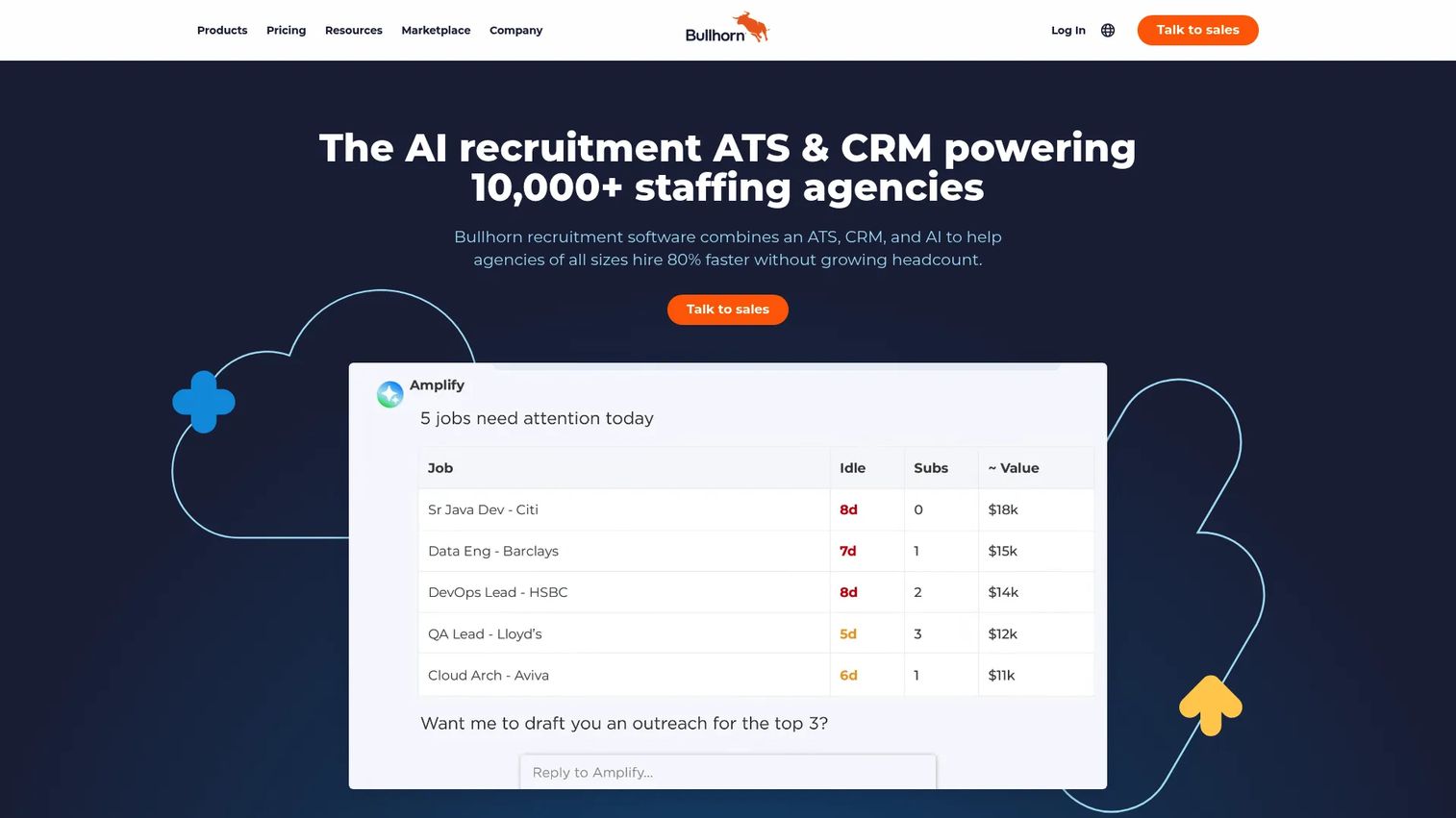
Bullhorn is cloud based staffing software covering recruiting, CRM, operations, and workforce management. Its scope suits firms with multiple teams or business lines that need a common data model.
The platform connects candidate activity with client pipelines and operational reporting. It also supports time capture, pay and bill processes, onboarding, and invoicing.
Best for: Large staffing firms that need an enterprise platform across sales, recruiting, staffing operations, and analytics.
Key features
- Applicant tracking and recruitment CRM
- AI search and candidate matching
- Staffing process automation
- Pay, bill, and invoicing workflows
- Reporting and pipeline forecasting
Why choose Bullhorn: Choose it when ecosystem depth and staffing specific workflows matter more than a lightweight rollout. Smaller agencies should model implementation ownership and total cost before committing.
Bullhorn pricing: Starter costs $99 per user monthly. Core costs $165 per user monthly, while Pro and Max use custom pricing.
G2 rating: 4.2/5.
2. Avionté
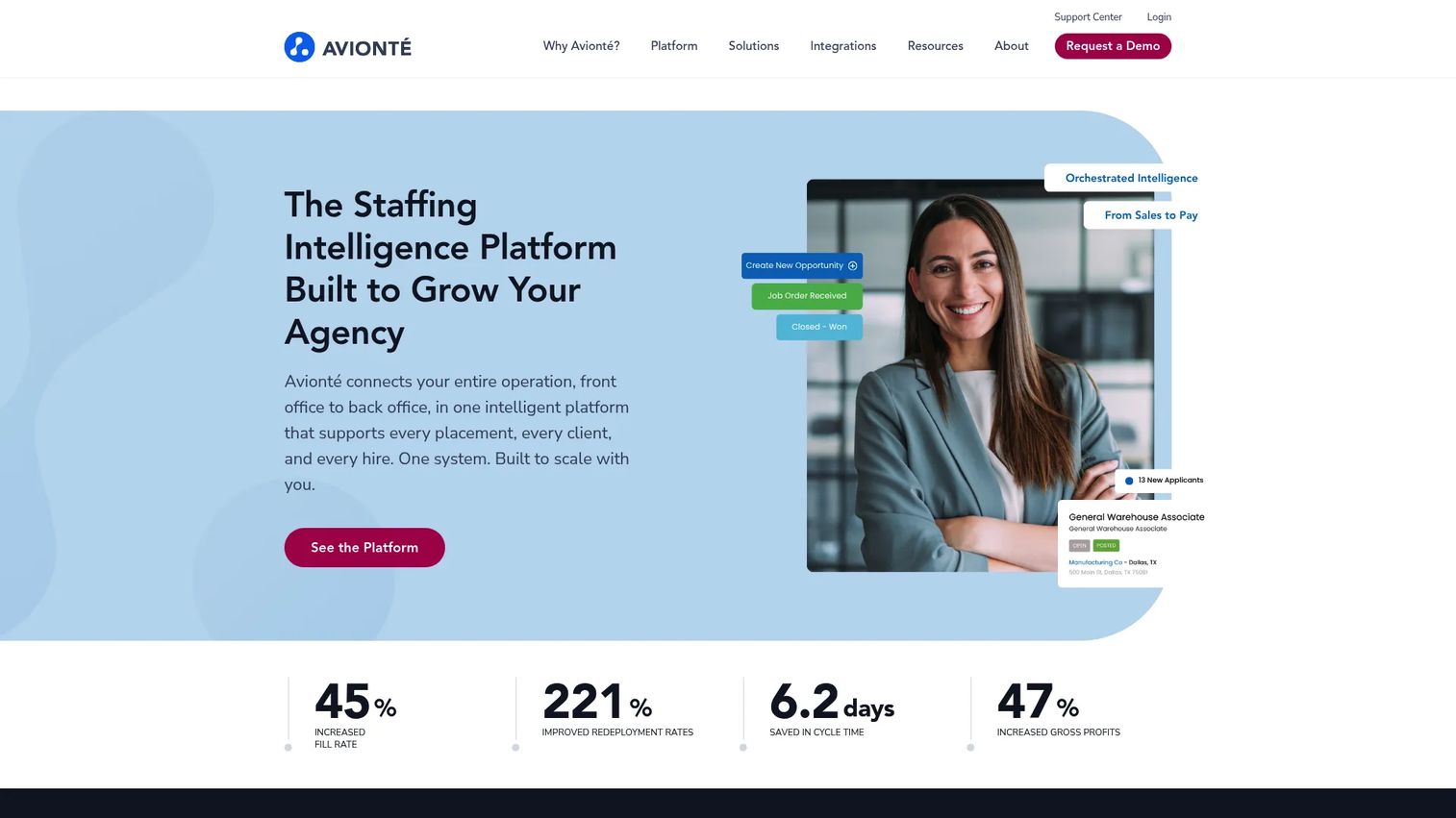
Avionté combines recruiting, CRM, workforce management, payroll, billing, analytics, and talent engagement. Its coverage fits high volume agencies where work continues well beyond candidate placement.
The mobile talent app supports job search, onboarding, scheduling, time tracking, and pay access. Integrated payroll and billing reduce handoffs between recruiters, operations, and finance.
Best for: Temp, industrial, clerical, and commercial staffing firms needing connected front office and back office workflows.
Key features
- Unified ATS and staffing CRM
- Mobile talent application
- Onboarding and compliance workflows
- Payroll, billing, and tax reporting
- Business intelligence dashboards
Why choose Avionté: It fits agencies where worker operations carry as much weight as recruiting. Evaluate it when your current stack splits onboarding, payroll, and billing across separate systems.
Avionté pricing: Custom pricing. Request a consultation for platform costs and implementation scope.
G2 rating: 4.3/5.
3. JobDiva
JobDiva combines ATS, CRM, automated onboarding, VMS synchronization, and reporting. Its DivaFinancials suite adds back office capabilities for staffing organizations.
Resume harvesting and parsing support data heavy recruitment operations. Mobile applications extend access for candidates and recruiters outside the desktop workflow.
Best for: Enterprise staffing agencies managing high requisition volumes, VMS driven clients, and mature recruiting operations.
Key features
- Applicant tracking and contact management
- Automated candidate onboarding
- VMS synchronization
- DivaFinancials back office suite
- Reports and recruiting analytics
Why choose JobDiva: Its breadth fits agencies that need enterprise recruiting infrastructure and operational depth. Assign clear ownership for configuration, administration, and reporting before implementation.
JobDiva pricing: Custom pricing is determined for each customer. Request a quote based on your required platform scope.
G2 rating: 4.7/5.
4. TempWorks
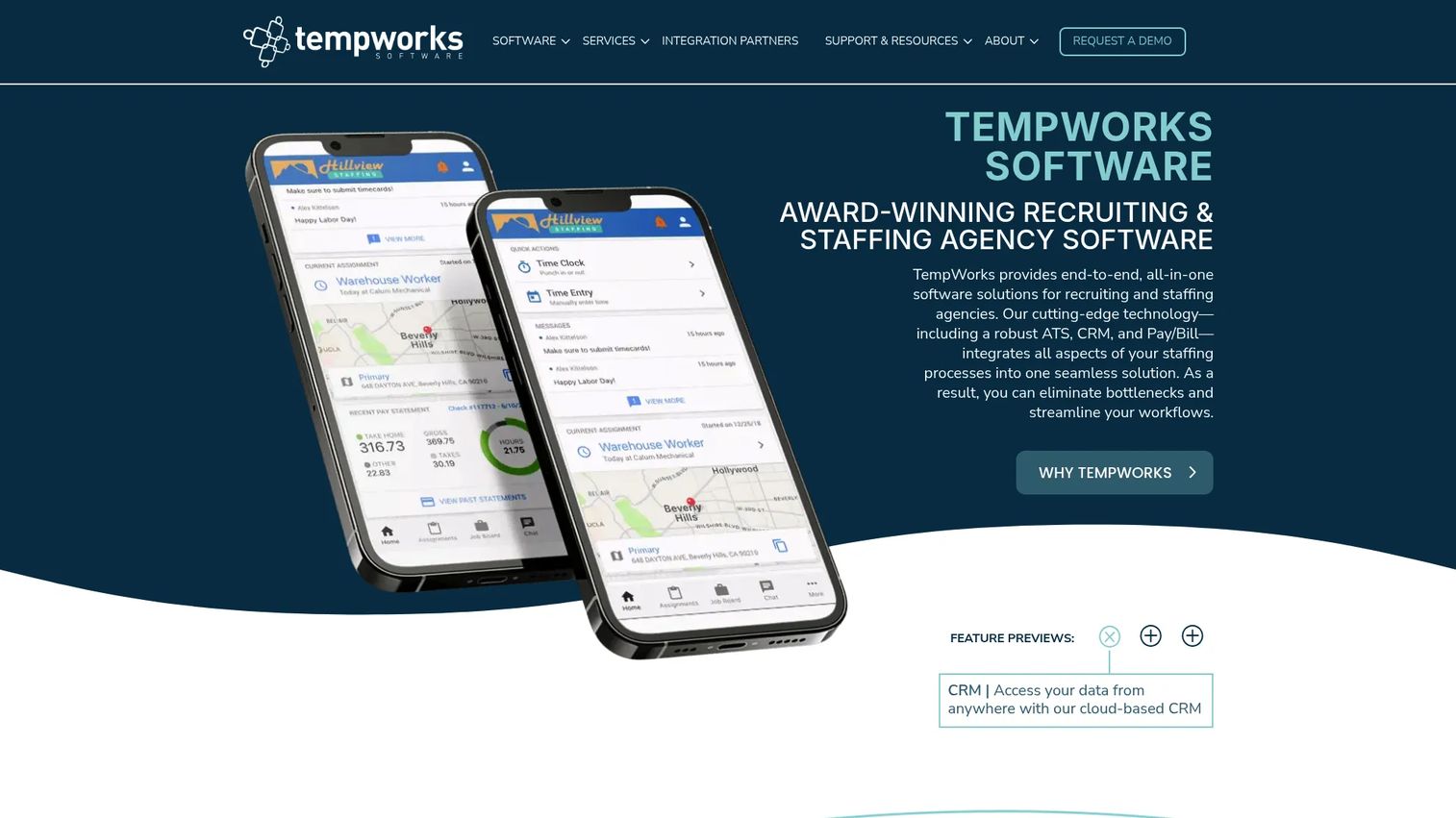
TempWorks provides staffing software for recruiting and back office operations. Its verified capabilities include applicant tracking, client management, timekeeping, payroll, and billing.
This makes the platform relevant to temp and contract agencies where staffing payroll software is central. Dashboards and reporting give managers visibility into operational records without separate spreadsheets.
Best for: Staffing firms that need payroll, billing, timekeeping, and recruitment workflows in the same platform.
Key features
- Applicant tracking and recruitment workflows
- Client relationship management
- Time and attendance management
- Payroll and billing
- Tax compliance support
Why choose TempWorks: Consider it when payroll accuracy and staffing invoicing software are core buying requirements. Map your rate cards and approval process before assessing the vendor workflow.
TempWorks pricing: Custom pricing. Request a quote covering users, payroll services, implementation, and required back office modules.
G2 rating: 4.1/5.
5. Isimio
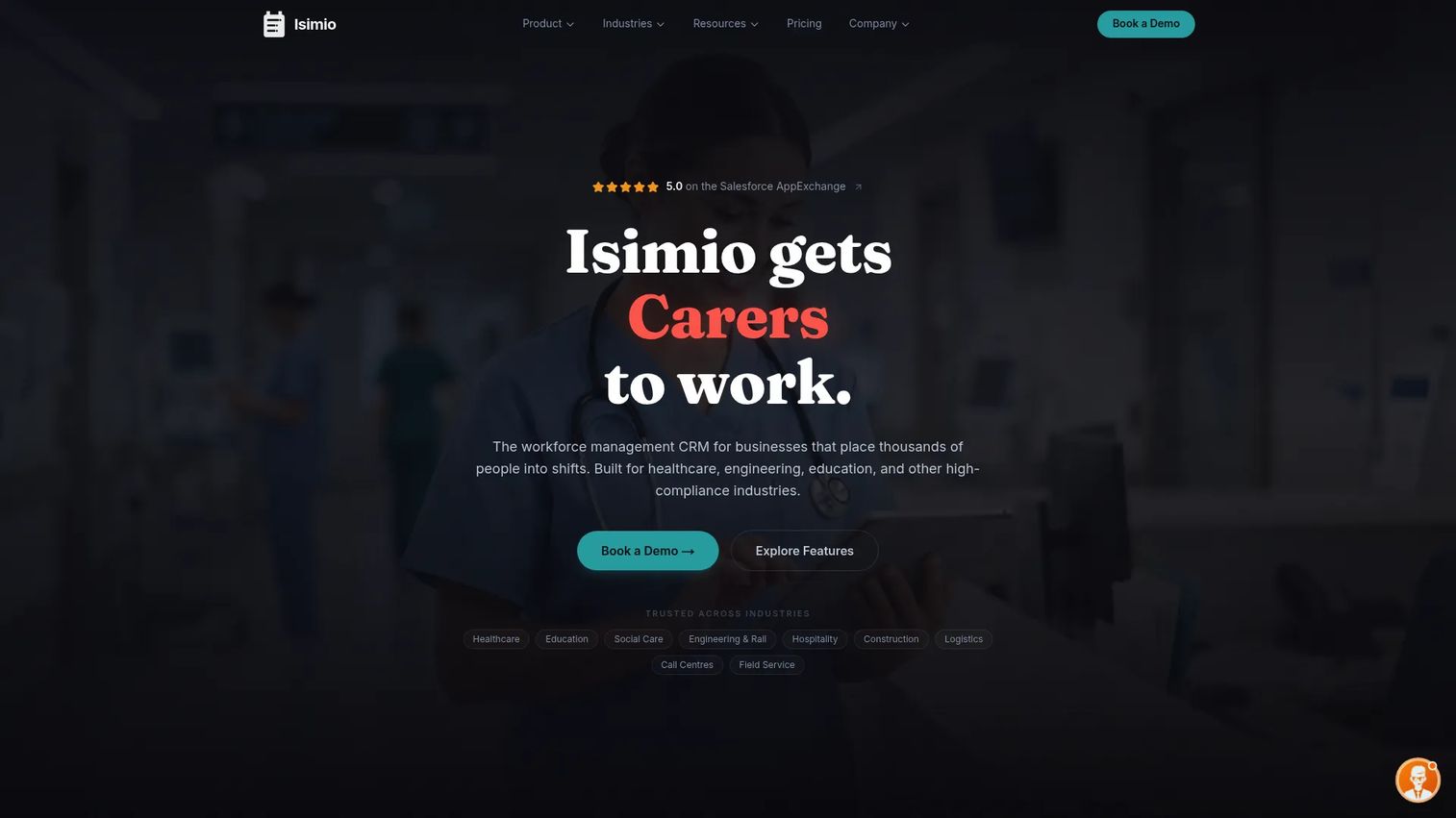
Isimio is Salesforce native staffing software designed around recruitment to invoice operations. It combines recruitment, scheduling, compliance, timesheets, finance workflows, and portals.
The platform supports digital timesheets and pay and bill rate cards. Worker and client portals provide access through web and mobile interfaces.
Best for: Agencies that want Salesforce based staffing operations with clear applicant to paid invoice workflows.
Key features
- Salesforce native staffing CRM
- Shift scheduling and matching
- Worker and client portals
- Digital timesheets and approvals
- Pay, bill, and invoice management
Why choose Isimio: It fits firms already committed to Salesforce or managing complex rate calculations. The connected workflow gives operators a direct view from recruitment through payment tracking.
Isimio pricing: Unmanaged access starts at $33 per recruiter monthly. Managed service starts at $105 or £80 per recruiter monthly.
6. Tracker
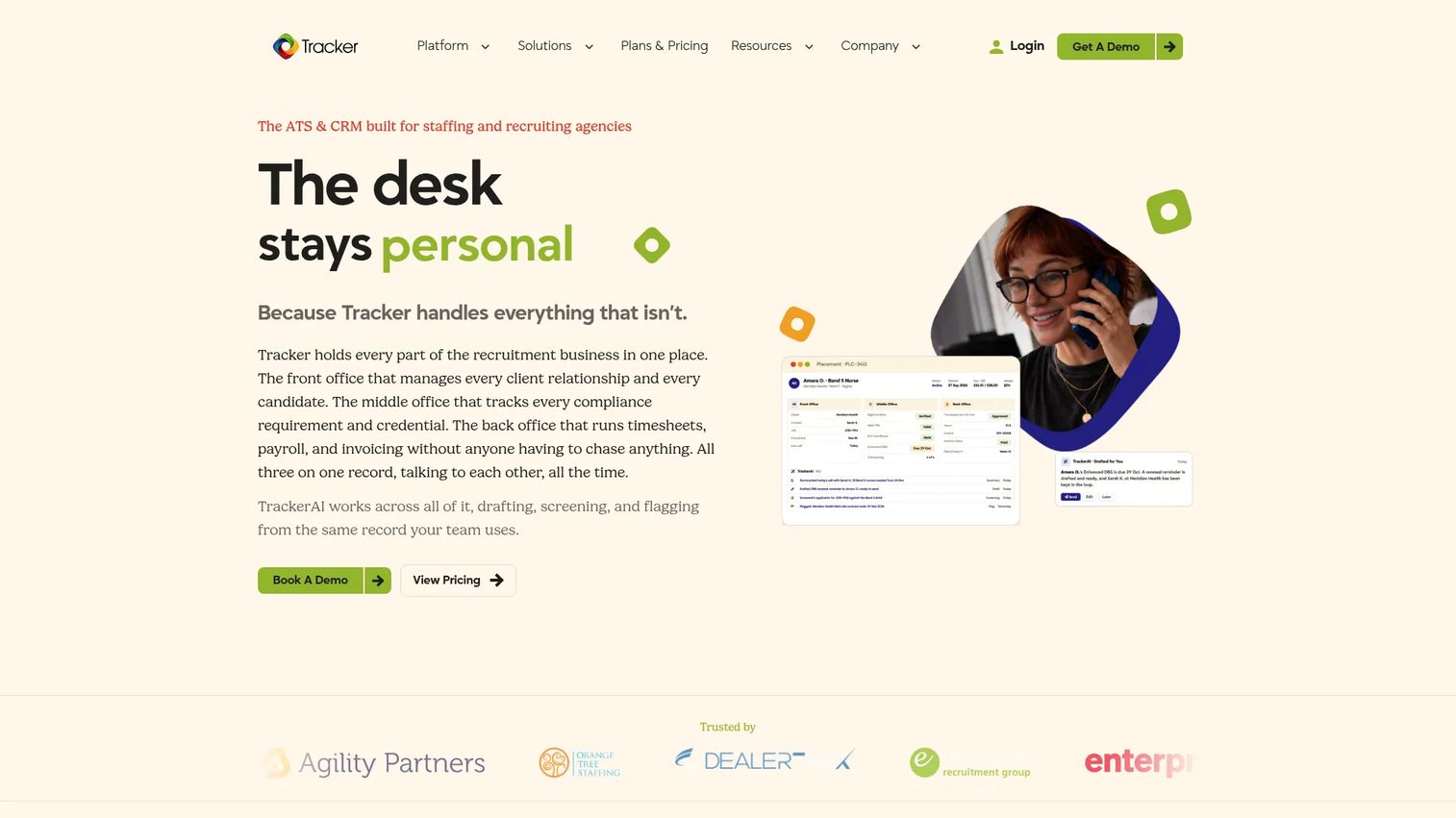
Tracker combines applicant tracking, recruitment CRM, automation, onboarding, and reporting. Higher plans extend into compliance, timesheets, portals, and payroll integrations.
Its shared sales and recruiting data helps agencies connect business development with delivery. AI search and matching support candidate discovery within existing records.
Best for: Staffing teams that want CRM led recruiting with automation, engagement tools, and operational visibility.
Key features
- Applicant tracking and recruitment CRM
- AI candidate search and matching
- Workflow automation
- Onboarding and electronic signatures
- Reporting and custom dashboards
Why choose Tracker: It suits agencies that need one source of truth across sales and recruiting. Compare higher plans when timesheets or workforce management affect the purchase.
Tracker pricing: Launch costs $79 per user monthly. Core costs $99 per user monthly, while Professional and Enterprise use custom pricing.
G2 rating: 4.5/5.
7. Vincere
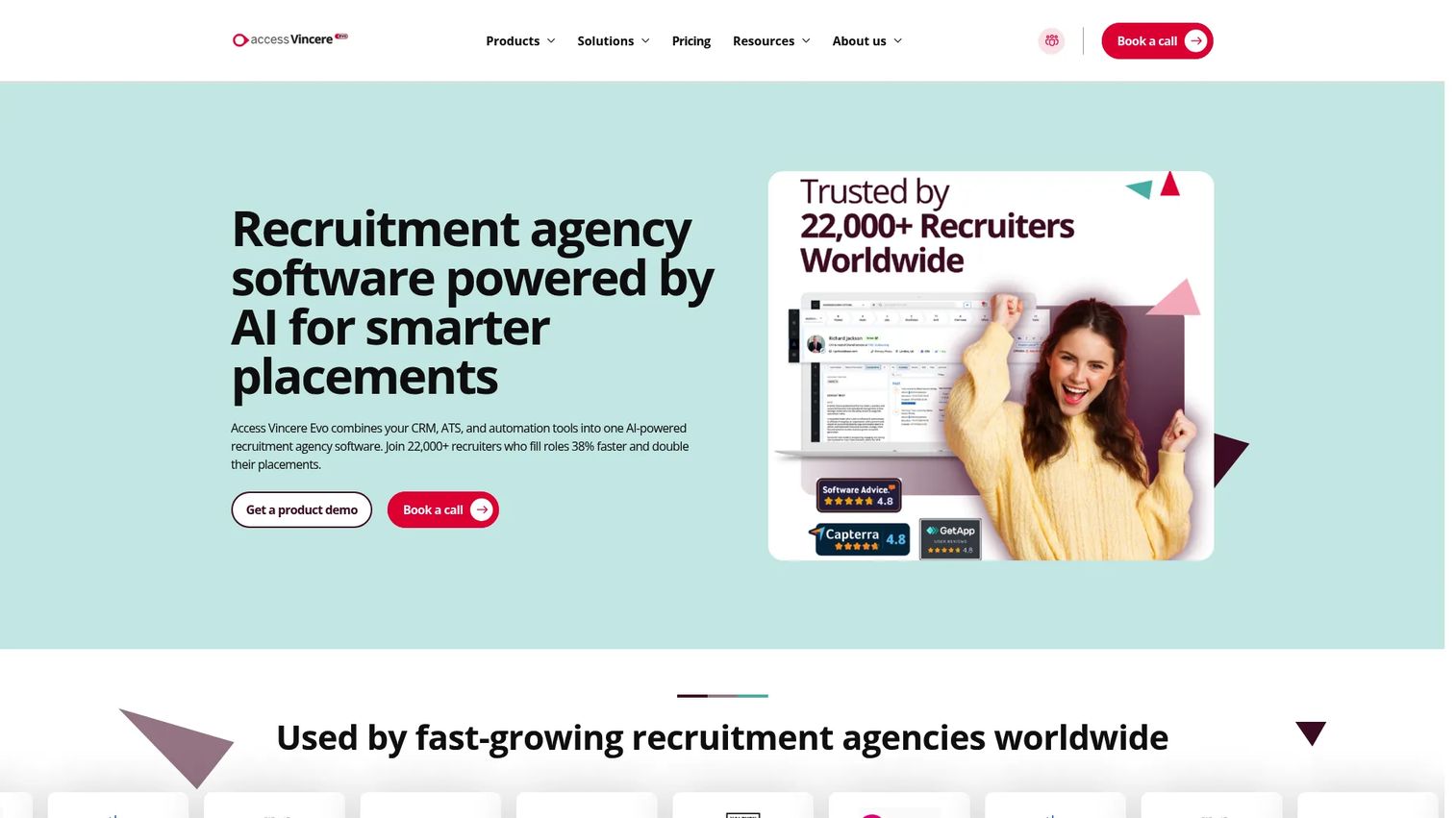
Vincere combines recruitment CRM, ATS, analytics, automation, and operational tools. It supports candidate management alongside client development and placement workflows.
Available capabilities include branded job portals, timesheets, billing, and workforce management. Reporting dashboards help leaders track agency performance and recruiter activity.
Best for: Recruitment and staffing agencies scaling sales, recruitment, placement, and performance reporting across growing teams.
Key features
- Candidate and contact management
- Job and pipeline management
- AI candidate scoring
- Recruitment analytics dashboards
- Timesheets and workforce management
Why choose Vincere: It fits agencies replacing disconnected recruitment tools with a broader operating system. Evaluate the plan that matches your contract staffing and reporting requirements.
Vincere pricing: Startup costs £150 monthly for one user. Core costs £95 per user monthly, while Pro uses custom pricing.
G2 rating: 4.5/5.
8. Ceipal
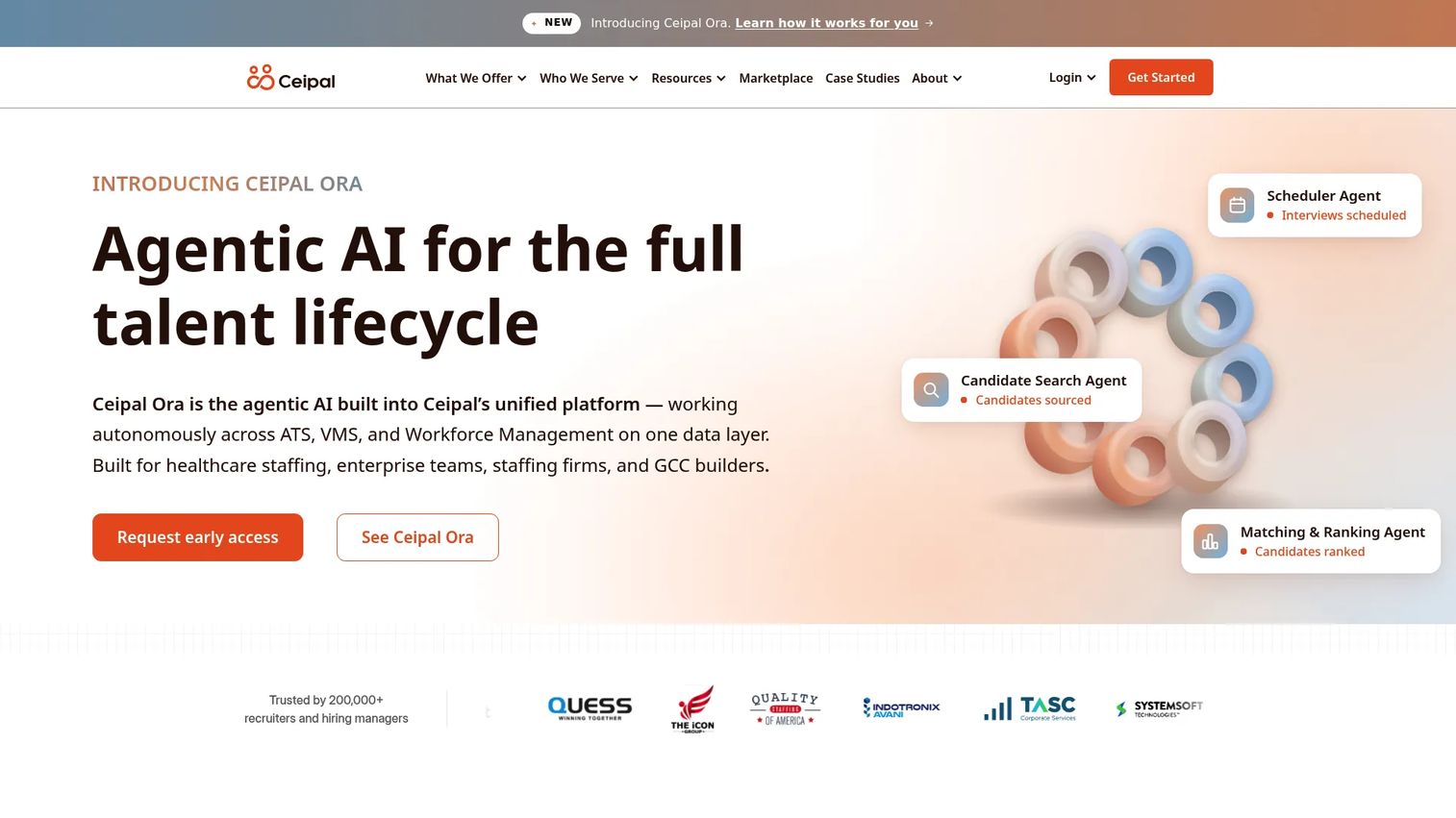
Ceipal combines ATS, workforce management, candidate matching, and recruiting automation. Its platform targets staffing firms and enterprise recruiting teams with high candidate volumes.
Automated resume parsing supports screening and database management. Workforce capabilities cover timesheets, expenses, onboarding, and work authorization tracking.
Best for: Staffing firms needing AI assisted sourcing, resume parsing, candidate matching, and workforce automation.
Key features
- AI candidate matching and ranking
- Automated resume parsing
- Centralized job posting
- Workforce management workflows
- Multichannel candidate communication
Why choose Ceipal: Consider it when candidate volume makes manual screening a bottleneck. Recruiter adoption and source data quality will determine how much value automation creates.
Ceipal pricing: Ceipal Workforce starts at $85 monthly for 1 to 25 employee logins. Core platform pricing is custom.
G2 rating: 4.6/5.
9. Crelate
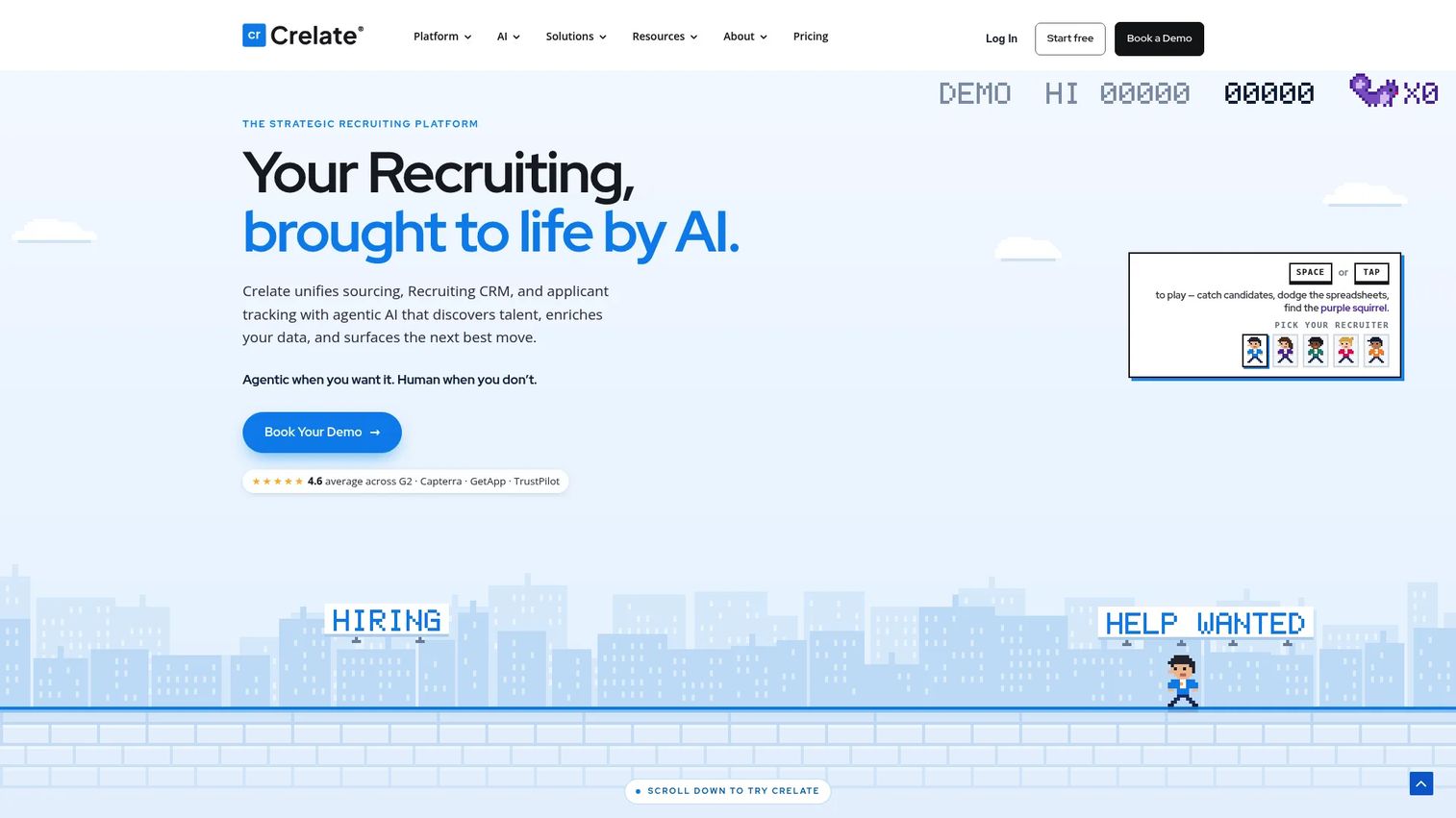
Crelate combines a recruiting CRM with applicant tracking, sourcing, job portals, and automation. The platform centers candidate and client relationships within a shared recruitment record.
Resume parsing and candidate discovery support sourcing work. Reporting gives managers visibility into pipelines and recruiter activity.
Best for: Staffing, search, and recruiting agencies that prioritize relationship history and CRM led candidate management.
Key features
- Applicant tracking system
- Recruiting CRM and analytics
- Resume parsing and sourcing
- Client and job portals
- Automation and sequencing
Why choose Crelate: It is a practical choice for teams replacing spreadsheets or generic CRM workflows. Temp agencies should separately validate their payroll and timesheet requirements.
Crelate pricing: Essentials starts at $85 per user monthly when paid annually. Business starts at $119 per user monthly, with a free trial available.
G2 rating: 4.4/5.
10. Recruit CRM
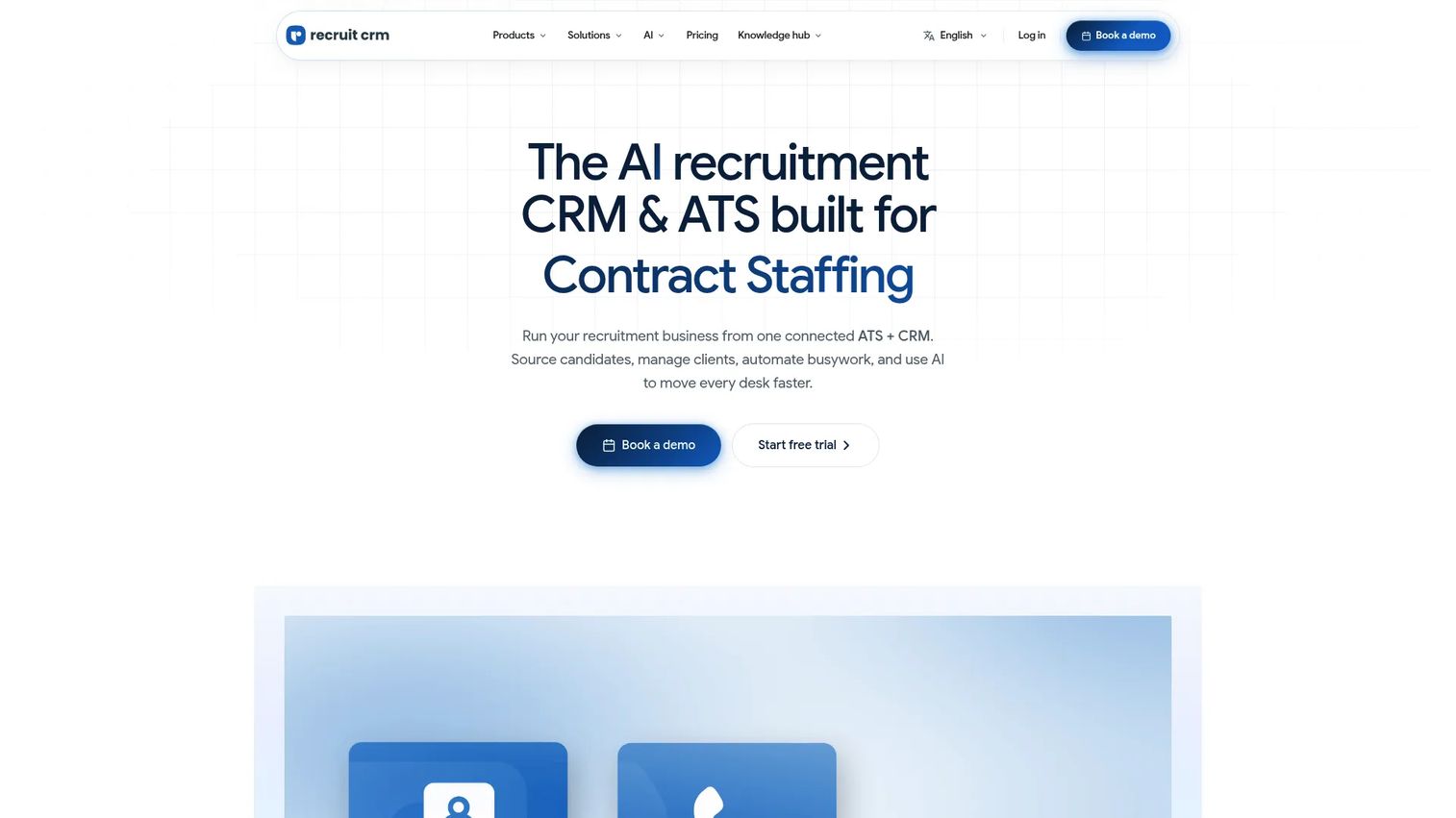
Recruit CRM provides ATS and CRM software for recruitment agencies, staffing firms, executive search, and RPO teams. It connects candidates, clients, jobs, deals, and placements.
The platform supports sourcing and multichannel outreach. Contractor billing, timesheets, invoicing, and placement tracking extend its usefulness beyond direct hire recruiting.
Best for: Small and mid sized recruitment firms wanting a unified ATS, CRM, outreach, and billing platform.
Key features
- ATS and recruitment CRM
- AI sourcing and matching
- Multichannel outreach
- Workflow automation
- Contractor billing and timesheets
Why choose Recruit CRM: Its public tiers give smaller teams a clear entry path. The 30 day trial supports evaluation before a broader rollout.
Recruit CRM pricing: Pro costs $95 per user monthly. Business costs $135, while Enterprise costs $215 per user monthly.
11. Zoho Recruit
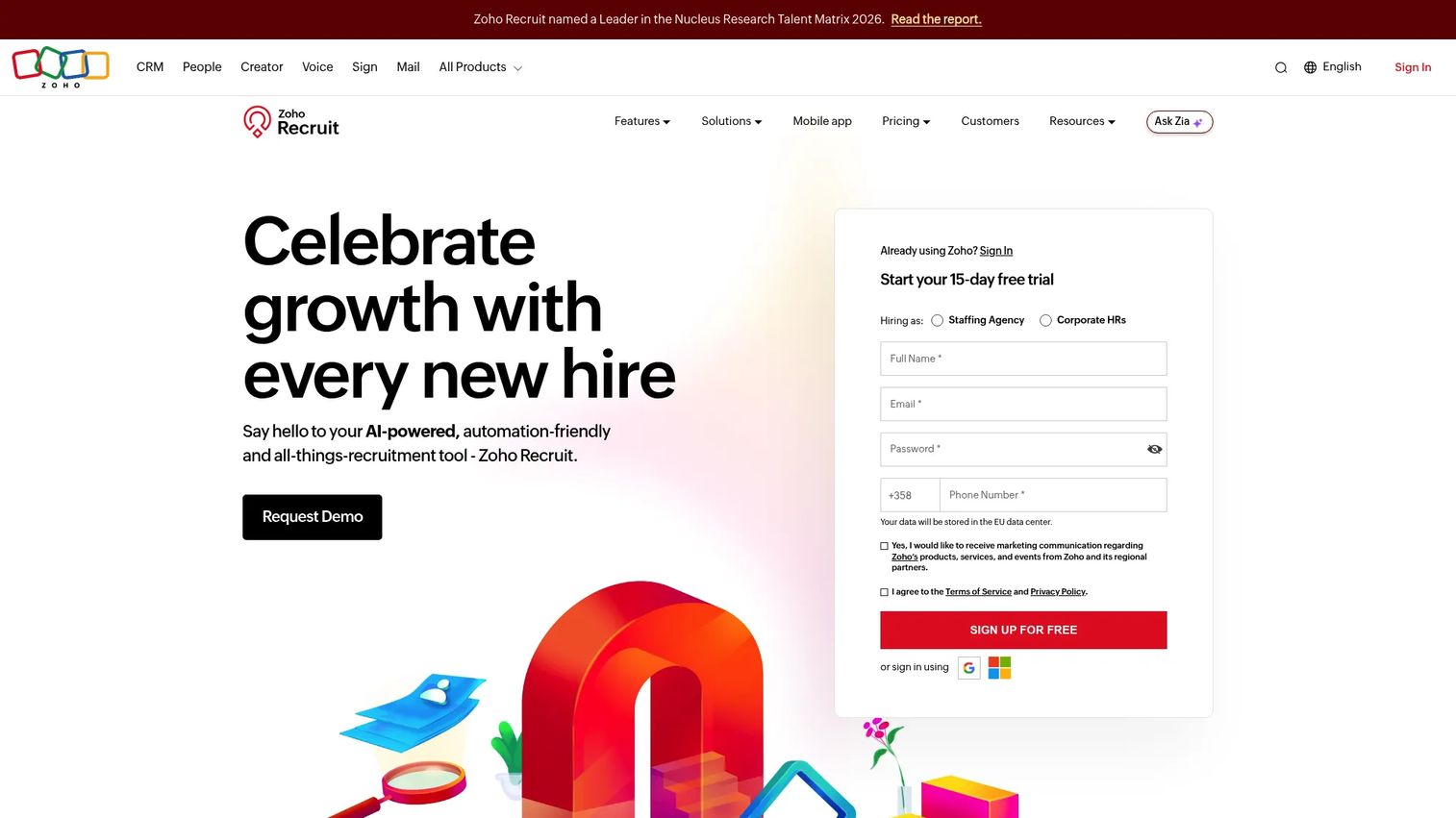
Zoho Recruit is a cloud based ATS and recruitment CRM for staffing agencies and internal HR teams. It connects candidate sourcing with job distribution and hiring workflows.
The platform includes portals, recruitment analytics, and automation tools. Its position within the broader Zoho suite makes it relevant for teams already using that software family.
Best for: Budget conscious recruitment teams that need structured applicant tracking and CRM adjacency.
Key features
- AI assisted candidate sourcing
- Job distribution tools
- Workflow automation
- Candidate and staffing portals
- Recruitment analytics
Why choose Zoho Recruit: It gives lean agencies a free entry point and a 15 day trial. Agencies with complex pay and bill processes should validate the broader operating workflow.
Zoho Recruit pricing: A free plan and 15 day trial are available. Standard and Enterprise are paid plans.
G2 rating: 4.4/5.
12. Manatal
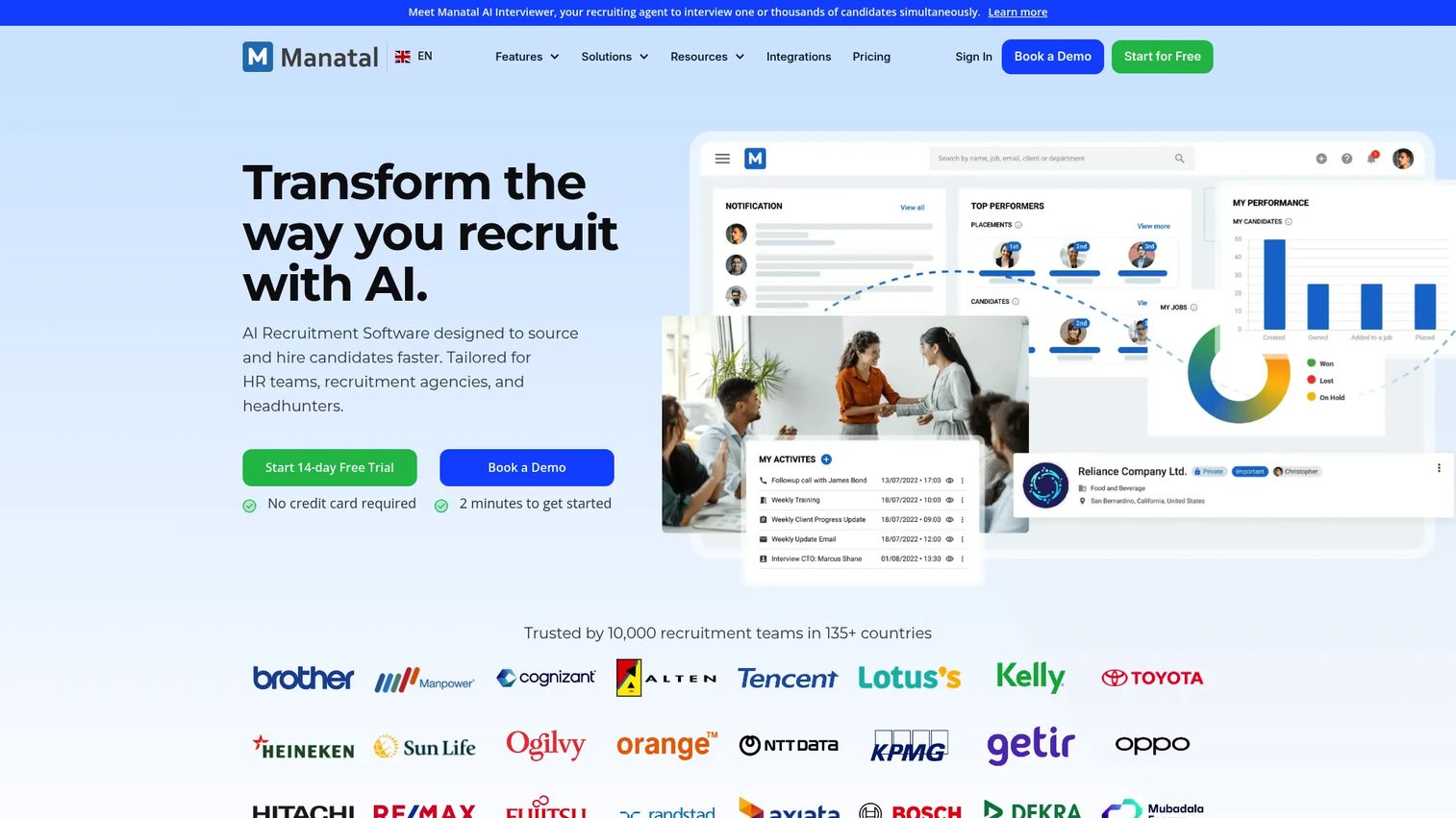
Manatal provides recruiting software for agencies and internal HR teams. Its capabilities cover candidate recommendations, resume parsing, job posting, pipeline management, and reporting.
Automated interviews and meeting transcription support recruiter workflows. Candidate portals provide another channel for managing communication and application progress.
Best for: Lean recruitment agencies prioritizing candidate sourcing and recruiter productivity over staffing back office depth.
Key features
- AI candidate recommendations
- Resume parsing and enrichment
- Automated interviews
- Recruitment pipeline management
- Job board multiposting
Why choose Manatal: Its low starting price fits teams that need candidate sourcing software without a large implementation. A 14 day trial supports workflow testing.
Manatal pricing: Professional starts at $15 per user monthly when billed annually. Monthly billing starts at $19 per user.
G2 rating: 4.8/5.
13. Loxo
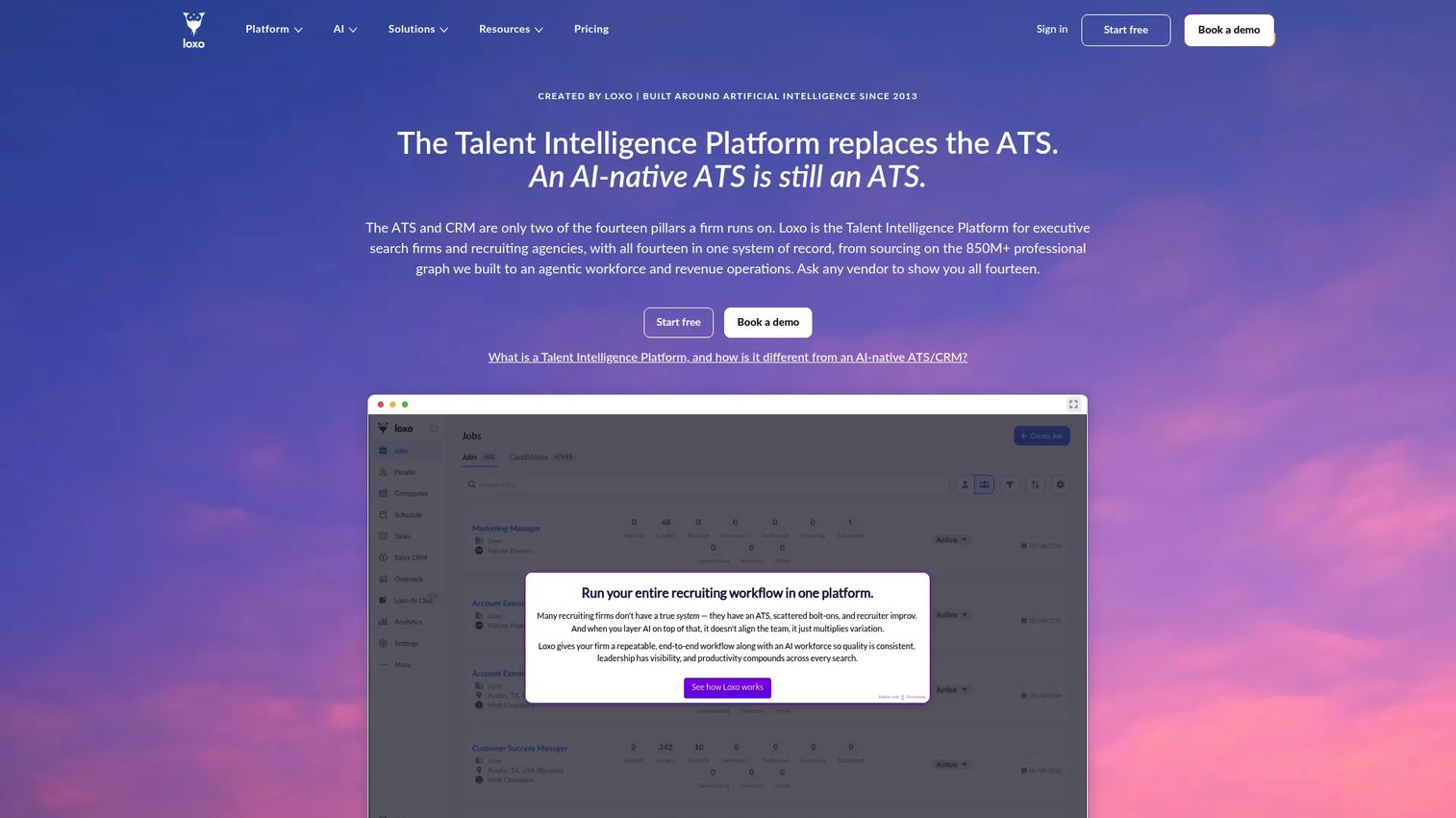
Loxo combines recruiting CRM, ATS, sourcing, outreach, contact data, and AI agents. It focuses on agencies building proactive talent pipelines instead of waiting for applications.
Natural language search supports candidate discovery across available records. Automated agents assist with intake, longlists, shortlists, outreach, and data hygiene.
Best for: Recruiting and executive search firms building outbound talent pipelines with sourcing automation.
Key features
- Full ATS and recruiting CRM
- Natural language candidate search
- AI sourcing agents
- Outreach automation
- Talent pipeline reporting
Why choose Loxo: It fits firms where sourcing and pipeline creation constrain growth. Temp agencies should separately map worker scheduling and payroll requirements.
Loxo pricing: Core costs $149 per user monthly when billed annually. Professional and Enterprise use custom pricing.
G2 rating: 4.6/5.
14. SmartSearch
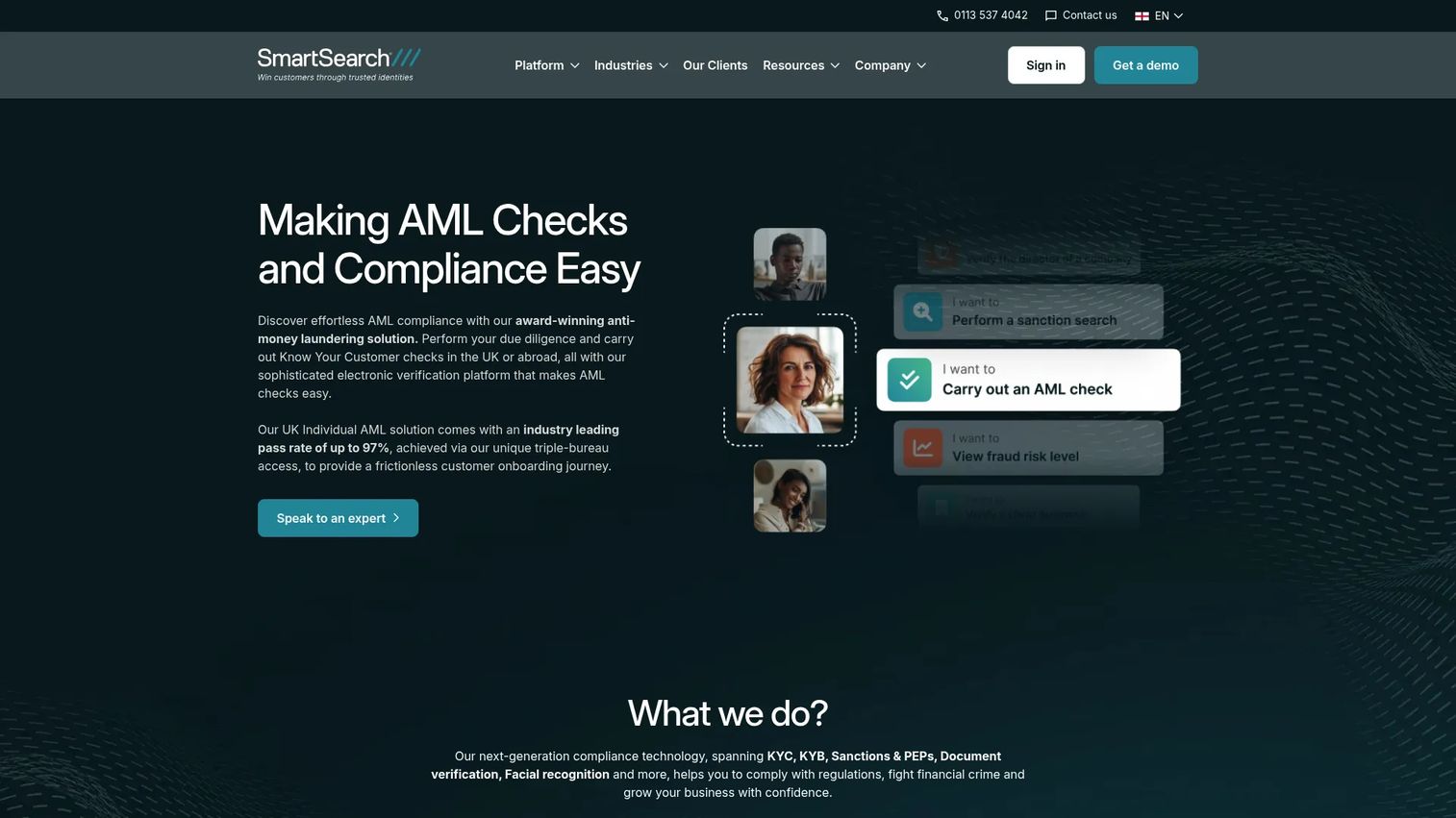
SmartSearch is an AML and compliance platform for identity verification, sanctions screening, KYC, and KYB. The verified product profile does not establish it as a staffing ATS or recruitment CRM.
Its relevance is therefore narrow. Agencies in regulated sectors may evaluate it as a compliance layer alongside their core staffing management software.
Best for: Regulated businesses needing identity checks, sanctions screening, and ongoing compliance monitoring.
Key features
- Identity and AML checks
- Sanctions and PEP screening
- Business KYB verification
- Enhanced due diligence
- Daily monitoring and alerts
Why choose SmartSearch: Consider it when compliance screening is the specific requirement. It should not replace the core system managing candidates, jobs, placements, and staffing operations.
SmartSearch pricing: Custom pricing across Starter Compliance, Growth Compliance, and Enterprise Compliance.
G2 rating: 4.0/5.
15. Workstaff
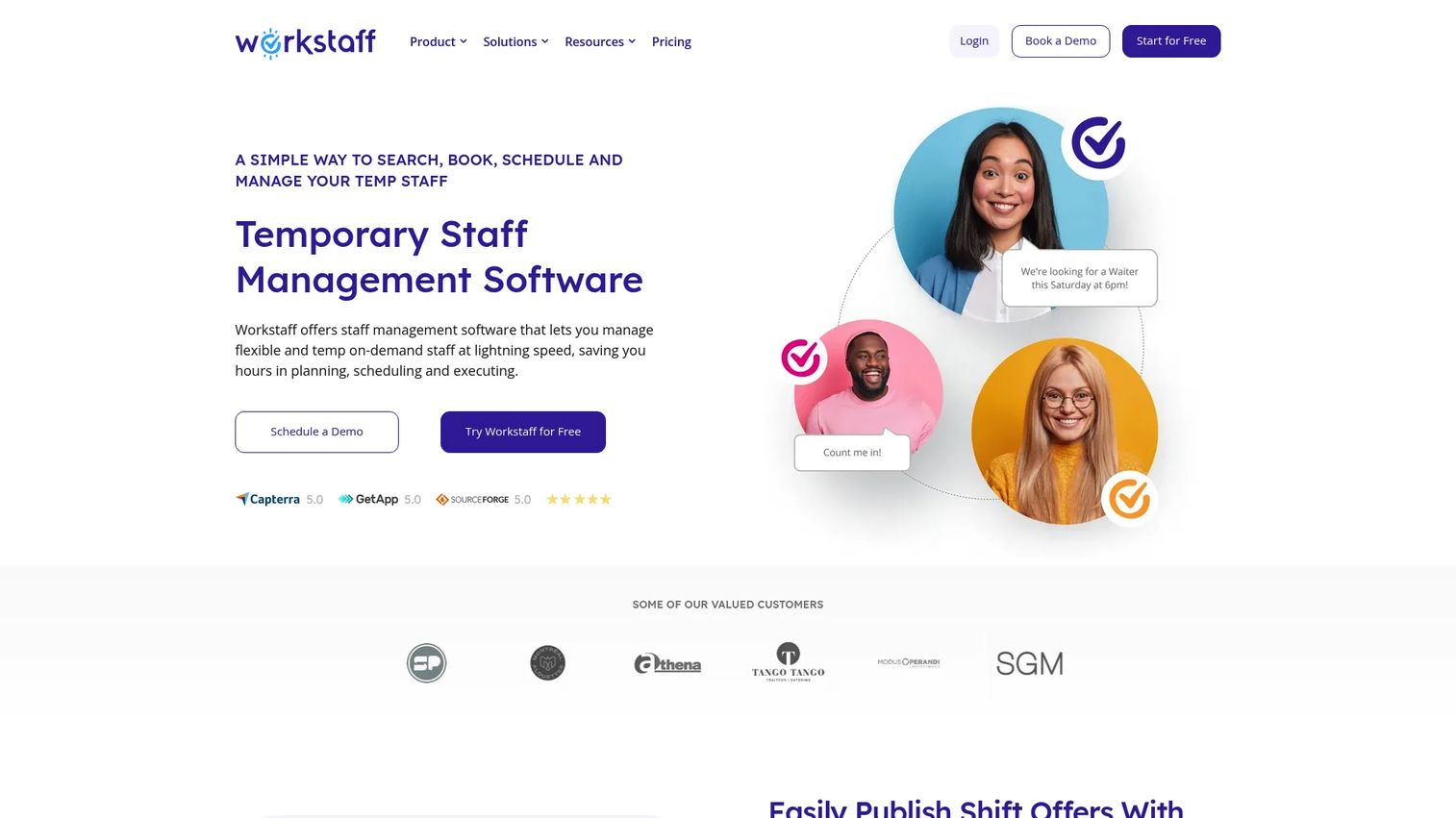
Workstaff is workforce management software for flexible and temporary staff. It centers project scheduling, open shifts, attendance, and worker communication.
Time and overtime tracking provide operational records for shift based teams. Mobile applications support staff and managers away from the office.
Best for: Shift based staffing agencies that need scheduling, availability, timesheets, and workforce communication.
Key features
- Project based staff scheduling
- Open shift management
- Time and overtime tracking
- Staff messaging and broadcasts
- Mobile applications
Why choose Workstaff: It fits agencies where coverage and coordination are the immediate problems. Buyers needing a full ATS or payroll workflow should assess how it connects with existing systems.
Workstaff pricing: Pro starts at $99 monthly. Max starts at $139 monthly, while Enterprise uses custom pricing.
G2 rating: 4.7/5.
Considerations when choosing staffing agency software
Match the platform to your staffing model
Temp, healthcare, industrial, clerical, and executive search firms run different workflows. A search firm may not need a payroll heavy platform.
Conversely, a recruiter focused ATS can leave a temp agency managing timesheets and rates elsewhere. Start with the operating model, then evaluate features.
Verify the post placement workflow
Map every step after acceptance. Include onboarding, compliance, scheduling, time approval, pay calculations, client billing, and reporting.
Ask vendors to show this process using your rate structure. A placement to invoice workflow reveals gaps that an ATS presentation can hide.
Check integrations before the sales call
Document required job boards, payroll providers, accounting systems, and VMS connections. Include communication tools and background checks where relevant.
Request a working demonstration of each critical integration. A marketplace logo does not prove data moves at the required depth.
Pressure test pricing against volume
Staffing agency software pricing can vary by users, active workers, modules, payroll services, and implementation. Data migration and integrations can also affect total cost.
Model your first month and second year. Growth should not turn a reasonable starting price into an unexpected operating tax.
Assign implementation ownership
Name who owns migration, data cleanup, recruiter training, rate cards, and reporting. Payroll configuration and compliance templates also need accountable owners.
Software scales the operating model it receives. It cannot replace unclear process ownership or inconsistent data.
Conclusion
The best staffing agency software depends on what happens after placement.
Bullhorn and JobDiva fit larger organizations with complex recruiting operations. Avionté provides broader front office and back office coverage for high volume staffing.
Isimio and TempWorks deserve attention when scheduling, payroll data, rate management, and invoicing drive the evaluation. Tracker and Crelate suit agencies prioritizing connected sales and recruiting workflows.
Lean recruitment firms can start with Recruit CRM, Zoho Recruit, or Manatal. Workstaff makes more sense when shift coordination is the immediate bottleneck.
Before booking vendor calls, document a 10 step workflow from open job to paid invoice. Include every approval, system handoff, and manual spreadsheet.
Then ask each vendor to run that workflow. The strongest staffing company software should reduce coordination and produce cleaner weekly metrics without founder intervention.
Start your journey with Guideflow today!
FAQs
Staffing agency software manages candidates, clients, job orders, placements, and worker records. Broader platforms add onboarding, timesheets, payroll data, billing, compliance, and reporting.
The exact scope varies by agency model. Temp firms usually need more post placement functionality than direct hire recruitment agencies.
An ATS for staffing agencies manages applicants and hiring workflows. Staffing software often adds client records, worker operations, shift scheduling, timesheets, pay rates, bill rates, and invoicing.
Some products combine both categories. Others focus primarily on recruiting and connect with separate operational systems.
Staffing agency software pricing can depend on user count, active workers, modules, and payroll services. Implementation, support, contract length, integrations, and data migration may also affect the total.
Compare the full operating cost against the work being replaced. A low subscription price offers little value if finance still reconciles every placement manually.
There is no universal winner for every temp agency. Prioritize worker availability, scheduling, mobile access, timesheets, compliance, pay and bill calculations, payroll data, and invoicing.
Evaluate the platform using one complete assignment. Follow it from initial order through approved time and client billing.
Core requirements include ATS, staffing CRM, candidate sourcing, and job order management. Temp agencies should also assess worker portals, client portals, scheduling, compliance, timesheets, payroll, invoicing, analytics, and integrations.
Choose features that remove existing handoffs. Avoid paying for broad functionality without a named owner or measurable workflow outcome.
Many platforms connect with payroll systems, accounting software, job boards, and e signature tools. Other common integrations cover background checks, calendars, email, SMS, and VMS platforms.
Verify the exact data flow during evaluation. A connector may synchronize records without supporting calculations or approval logic.
Implementation time varies with agency size, data quality, workflow count, and payroll complexity. Integrations and team training can extend the project.
Ask for a migration plan with named owners and acceptance criteria. Confirm which reports must work before the old system is retired.
It can be worthwhile once an agency has repeatable job orders, several recruiters, or growing candidate data. Manual compliance, timesheet, and billing work can also justify the investment.
A small direct hire firm may need only a lighter ATS or recruitment CRM. Buy for the current operating model and the next credible stage of growth.