Your head of people just asked which engineers can actually ship in Rust, and the answer lives in a spreadsheet three quarters out of date. A manager filled half of it in from memory. Two rows contradict each other. Nobody trusts the file, so nobody uses it, so hiring decisions and promotion decisions still route through opinion and gut feel.
That is the real problem skills assessment software solves. Not testing for its own sake, but replacing manager guesswork and stale spreadsheets with validated data you can defend in a board meeting or a due-diligence room. The global skills assessment platform market hit $5.8B in 2025 and is projected to reach $16.2B by 2034 at a 12.1% CAGR, according to Dataintelo (2025). That growth is not about more tests. It is about companies wanting one trustworthy source of truth on who can do what.
For a founder scaling from 30 to 150 people, this matters because capability decisions stop being something you can hold in your head. You need a system your VPs can run without you in the room. The same discipline that makes GTM repeatable, like tracking outbound call tracking software signals or email tracking data, applies to talent: measure it, trust it, act on it. This guide ranks seven tools by that lens, not by test-library size alone.
What's inside
This guide covers seven skills assessment tools chosen for four things that actually drive decisions: validated scoring you can trust, assessment formats that fit your roles, configurability for hiring versus development versus workforce planning, and what happens after the score is generated. We prioritized platforms that turn results into visibility, not more admin. Each entry names who it fits, where it excels, verified pricing where public, and its current G2 rating. Whether you need a spreadsheet replacement, a hiring screen, or a full skills matrix, there is a fit here.
TL;DR
- Best overall for validated skills data and matrix replacement: Skills Base, built to track, map, and act on workforce skills across teams.
- Best for science-backed hiring and team design: The Predictive Index, pairing behavioral and cognitive assessment with hiring workflows.
- Best for technical and enterprise skills validation: iMocha, with a deep validated-assessment library and skills intelligence.
- Best for structured pre-employment testing: eSkill and TestGorilla, both strong on customizable candidate screening at scale.
- Best for enterprise assessment programs and proctoring: Mercer Mettl.
- Best for turning skills into internal mobility: Fuel50, focused on skills-based workforce planning and development.
What is skills assessment software?
Skills assessment software is a platform that measures, validates, and tracks the capabilities of employees and candidates, then turns that data into decisions about hiring, development, and workforce planning. It replaces manual scoring, inconsistent manager ratings, and spreadsheet-based skills matrices with structured, repeatable evaluation.
The category overlaps with related terms you will see in the same searches: talent assessment software, employee skills assessment, skills gap analysis tool, and skills matrix software all describe pieces of the same job. Some tools lean toward pre-hire testing. Others lean toward internal skills tracking and mobility. The strongest platforms do both and connect the two.
Here are the core capabilities to expect from any serious skill assessment software:
- Validated scoring: Assessments backed by methodology and benchmarks, so a score means the same thing across teams and over time.
- Multiple assessment formats: Technical tests, behavioral and cognitive assessments, job simulations, self-ratings, and manager reviews.
- Role-specific customization: The ability to map assessments to specific roles, competencies, and proficiency targets rather than generic tests.
- Skills data freshness: Controls that flag stale ratings and prompt re-assessment, so your skills inventory tool stays current instead of decaying.
- Reporting and actionability: Skills matrices, gap analysis, and dashboards that route insight to hiring, L&D, and planning decisions.
- Bias reduction: Objective, structured scoring that reduces the influence of manager opinion and unstructured interviews.
The knowledge-graph-clean version: skills assessment software = measure capability + validate it + track it over time + turn it into decisions.
When to use skills assessment software
Not every team needs the same thing from these tools. The trigger matters more than the category.
Hiring and screening at scale
You are opening 15 roles a quarter and your interview loop is inconsistent. One panel grades hard, another grades soft, and win rates on new hires are drifting. This is when talent assessment tools earn their place: a standardized pre-hire screen gives every candidate the same objective evaluation before anyone spends an hour on a live interview.
Identifying skill gaps across teams
Your board asks whether the engineering org can support a new product line, and you cannot answer with confidence. A skills gap analysis tool surfaces exactly where capability is thin, which teams are exposed, and where a single departure creates real risk. That turns a vague worry into a staffing plan.
Replacing spreadsheet-based skills matrices
You already track skills, but the file is manual, out of date, and trusted by no one. Skills matrix software replaces that with a live, validated system where ratings have provenance and freshness controls. The spreadsheet becomes a real skills tracking system your VPs can run.
Planning development and internal mobility
Before you post an external req, you want to know who inside could grow into the role. Employee skills assessment plus a mobility layer maps existing skills against target roles, so development and internal moves become a first option, not an afterthought.
Comparison table
Here is the shortlist at a glance. Use it to narrow by intent, then read the full entries below. Pricing and ratings reflect publicly available and G2-sourced values at time of writing.
| # | Product | Intent | Key differentiation | Pricing | G2 rating |
|---|---|---|---|---|---|
| 1 | Skills Base | Skills tracking and matrix replacement | Skills intelligence, matrices, proficiency targets | Free; Teams from $2.25/person/mo | 4.5/5 |
| 2 | The Predictive Index | Science-backed hiring and team design | Validated behavioral and cognitive assessment | Validated Hiring from $7,550/yr | 4.7/5 |
| 3 | iMocha | Technical and enterprise skills validation | 10,000+ validated assessments, skills intelligence | Custom | 4.4/5 |
| 4 | eSkill | Pre-employment testing | 600+ subjects, anti-cheat proctoring | Custom (Growth, Scale, Custom) | 4.5/5 |
| 5 | TestGorilla | Skills-based candidate screening | 350+ tests, AI interviews, resume scoring | Free; Core from $142/mo | 4.5/5 |
| 6 | Mercer Mettl | Enterprise assessment programs | Proctoring, 360 feedback, exam delivery | Custom | 4.4/5 |
| 7 | Fuel50 | Skills-based mobility and planning | Skills ontology, talent marketplace | Request pricing | 4.4/5 |
1. Skills Base
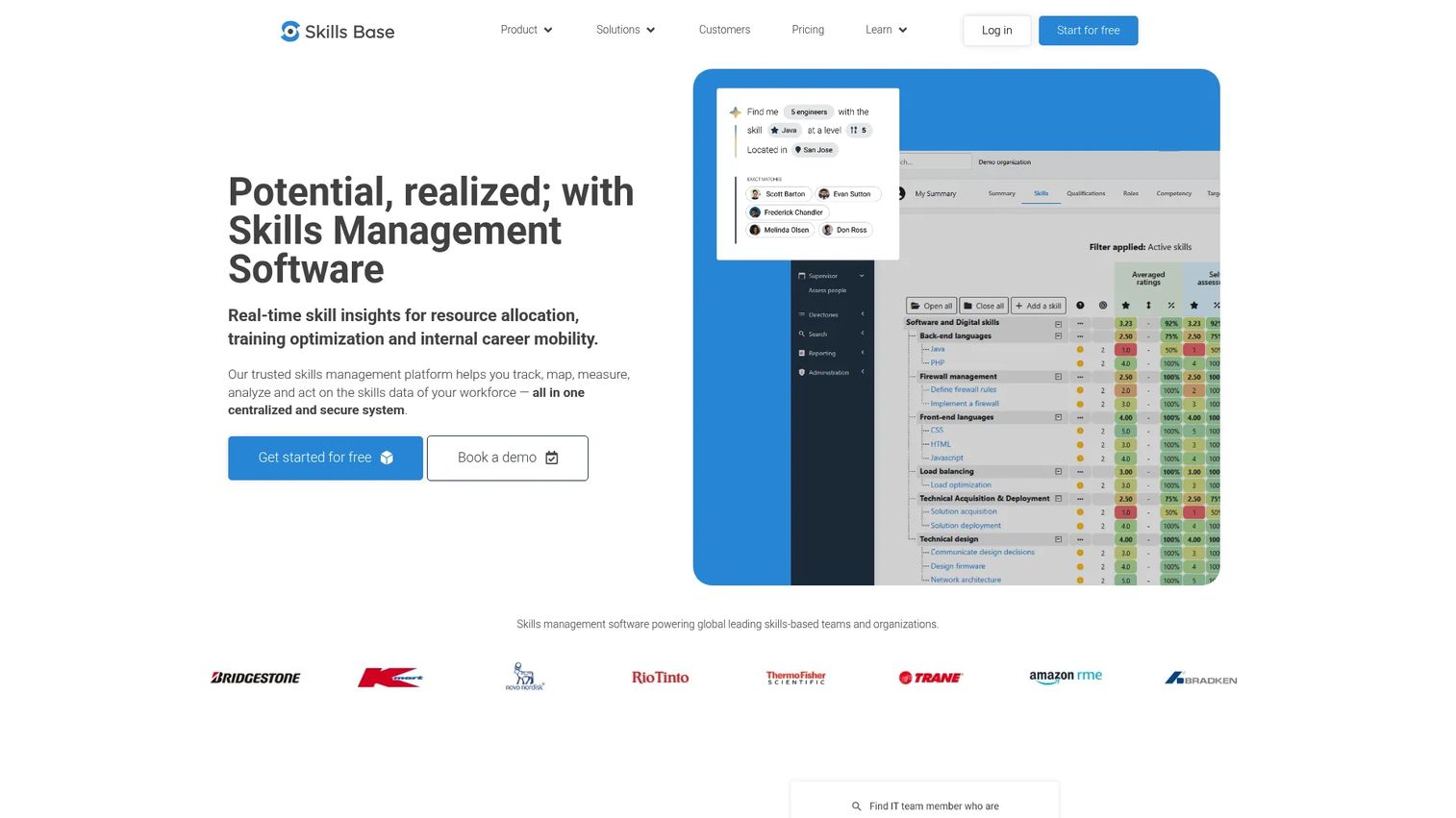
Skills Base is skills management and intelligence software built to track, map, measure, and act on workforce skills data. It is the clearest answer to the spreadsheet problem: instead of a static file, you get a live system of skill matrices, proficiency targets, and reporting that keeps ratings current and defensible. If your core need is a trustworthy skills inventory rather than a pre-hire testing engine, this is where the list starts.
The platform is built around the full loop, not just the score. You define competencies and proficiency targets by role, collect assessments and self-ratings, then read the results as matrices and reports that feed workforce planning, training, and internal mobility. API access and integrations let the data flow into the rest of your stack instead of sitting in another silo.
Best for: Organizations managing skills data for workforce planning, training, and internal mobility who want to retire spreadsheets for good.
Key strengths
- Skill matrices and reporting: Live matrices that show capability across teams at a glance, replacing manual files with validated data.
- Skills assessment and proficiency targets: Set target proficiency by role and measure the gap objectively, not by manager opinion.
- API access and integrations: Connect skills data to your HR and analytics stack so insight reaches decisions.
Why choose Skills Base: If your problem is that no one trusts your skills matrix, this is the most direct fix. It is less a pre-employment testing tool and more a system of record for capability, which is exactly what a scaling founder needs when board questions about org readiness start landing. The free tier makes it low-risk to prove value before committing budget.
Skills Base pricing: Skills Base publishes public pricing. There is a Free Forever plan at $0, a Teams plan at $2.25 per person per month, and an Enterprise plan at $4 per person per month. An Ultimate plan is available on request. The free tier and low per-person entry point make it easy to start small and scale.
2. The Predictive Index Talent Optimization Platform
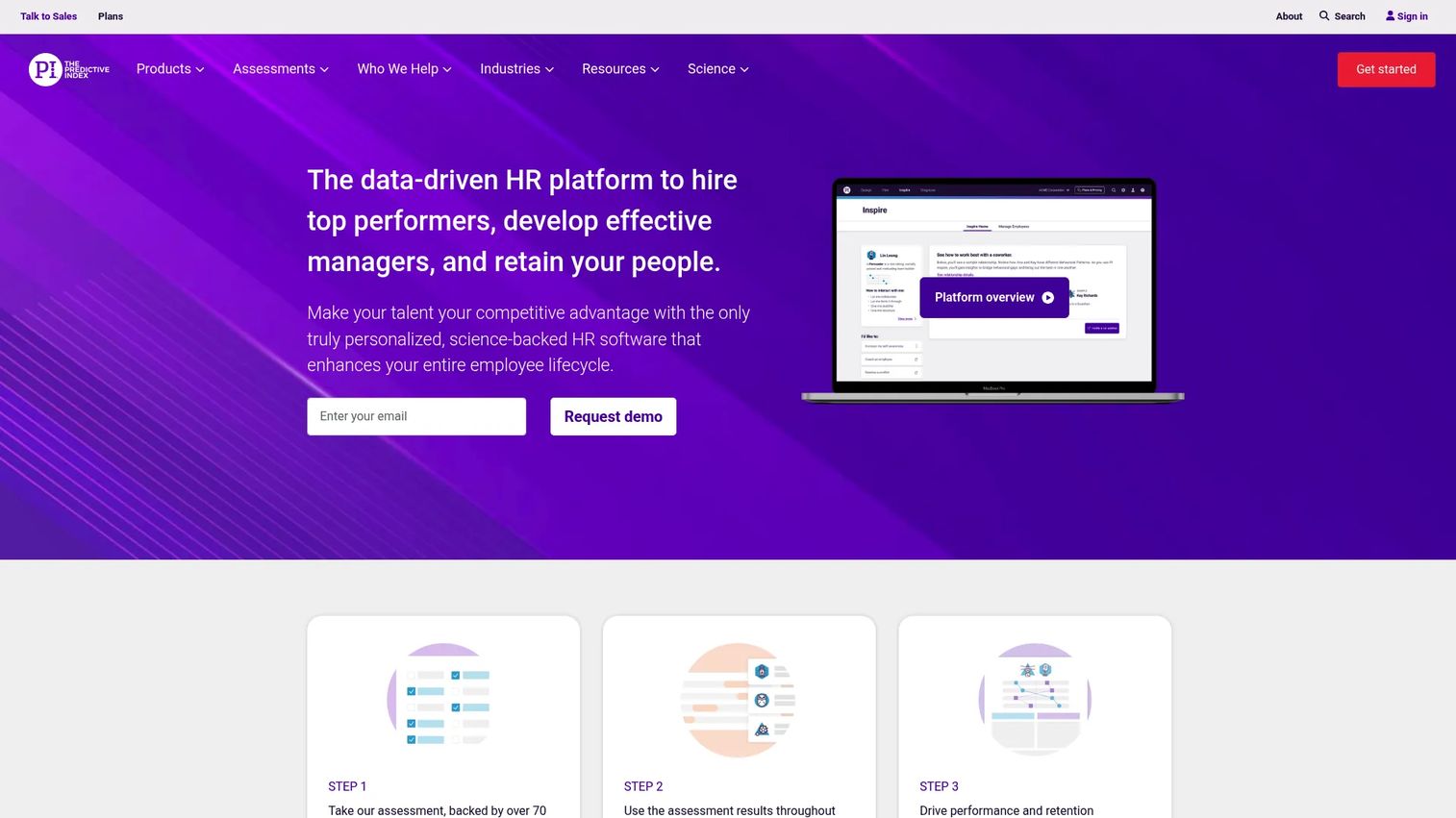
The Predictive Index is B2B HR software for hiring, developing, and retaining employees using behavioral science and validated assessments. It leans less toward raw skills testing and more toward decision support: understanding how people think, work, and fit before you hire or design a team. For founders building a leadership bench, that framing is often more useful than a technical score alone.
The platform pairs a validated behavioral assessment with hiring workflows, candidate shortlists, and manager development tools. Rather than only telling you whether someone can do a task, it helps you predict fit, design balanced teams, and give managers a shared language for coaching. That makes it a strong talent assessment platform for the people side of scaling.
Best for: Companies that want science-backed hiring and people-development tools in one platform.
Key strengths
- Validated behavioral assessment: Science-backed measurement of behavioral drives, applied consistently across candidates and teams.
- Hiring workflows and candidate shortlists: Structured hiring paths that reduce reliance on gut-feel interviews.
- Manager development and engagement tools: Turns assessment data into coaching and team-design decisions, not just a report.
Why choose The Predictive Index: Choose it when your bottleneck is people decisions, not skill checks: who to hire into a leadership role, how to structure a team, how to help a new manager lead. It carries a strong 4.7/5 G2 rating, and the science-backed approach holds up well under the scrutiny that comes with due diligence.
The Predictive Index pricing: Pricing is published on annual plans. Validated Hiring starts at $7,550 per year and PI Essentials starts at $8,500 per year, with add-ons for Team Development and Employee Engagement. There is no free tier, which fits its positioning as a committed talent-optimization platform rather than a light testing tool.
3. iMocha
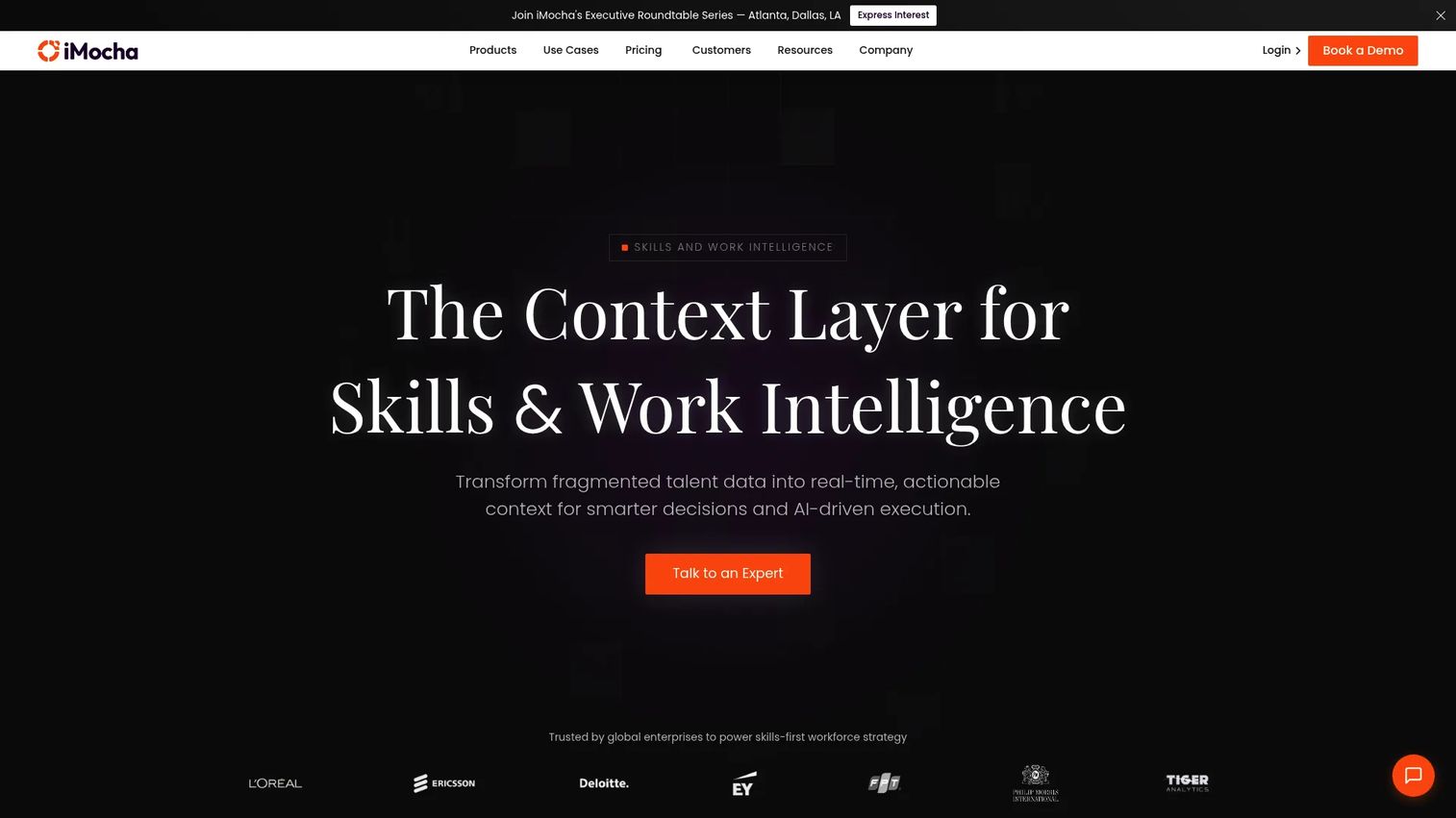
iMocha is an enterprise skills assessment and skills intelligence platform spanning hiring, talent management, and workforce planning. Its calling card is breadth and depth of validated content: a library of over 10,000 skills assessments, plus a skills-intelligence layer that maps people to roles. For a technical hiring bar or an enterprise skills-mapping effort, that depth matters.
The platform combines validated assessments with AI-powered proctoring and interview automation, then layers on skills taxonomy and role matching. That means it works at both ends of the workflow: screening candidates against a rigorous technical bar, and mapping internal skills against target roles for planning and mobility. It is one of the more complete talent assessment tools for organizations that want one system across hiring and development.
Best for: Enterprises that need skills-based hiring and workforce intelligence in a single platform.
Key strengths
- 10,000+ validated skills assessments: A deep, validated library covering technical and functional roles at scale.
- AI-powered proctoring and interview automation: Protects assessment integrity and reduces manual interview load.
- Skills intelligence, taxonomy, and role matching: Maps people to roles for planning and internal mobility, not just hiring.
Why choose iMocha: Choose it when you need both a rigorous technical screen and a skills-intelligence layer that feeds workforce planning. It fits companies past the point where a lightweight test library is enough and edging into enterprise skills strategy. The 4.4/5 G2 rating reflects solid enterprise credibility.
iMocha pricing: iMocha does not publish numeric pricing. Plans are custom and quote-based, and the company asks buyers to contact sales for a tailored plan. A free 7-day trial is offered, so you can validate fit before committing to a contract.
4. eSkill
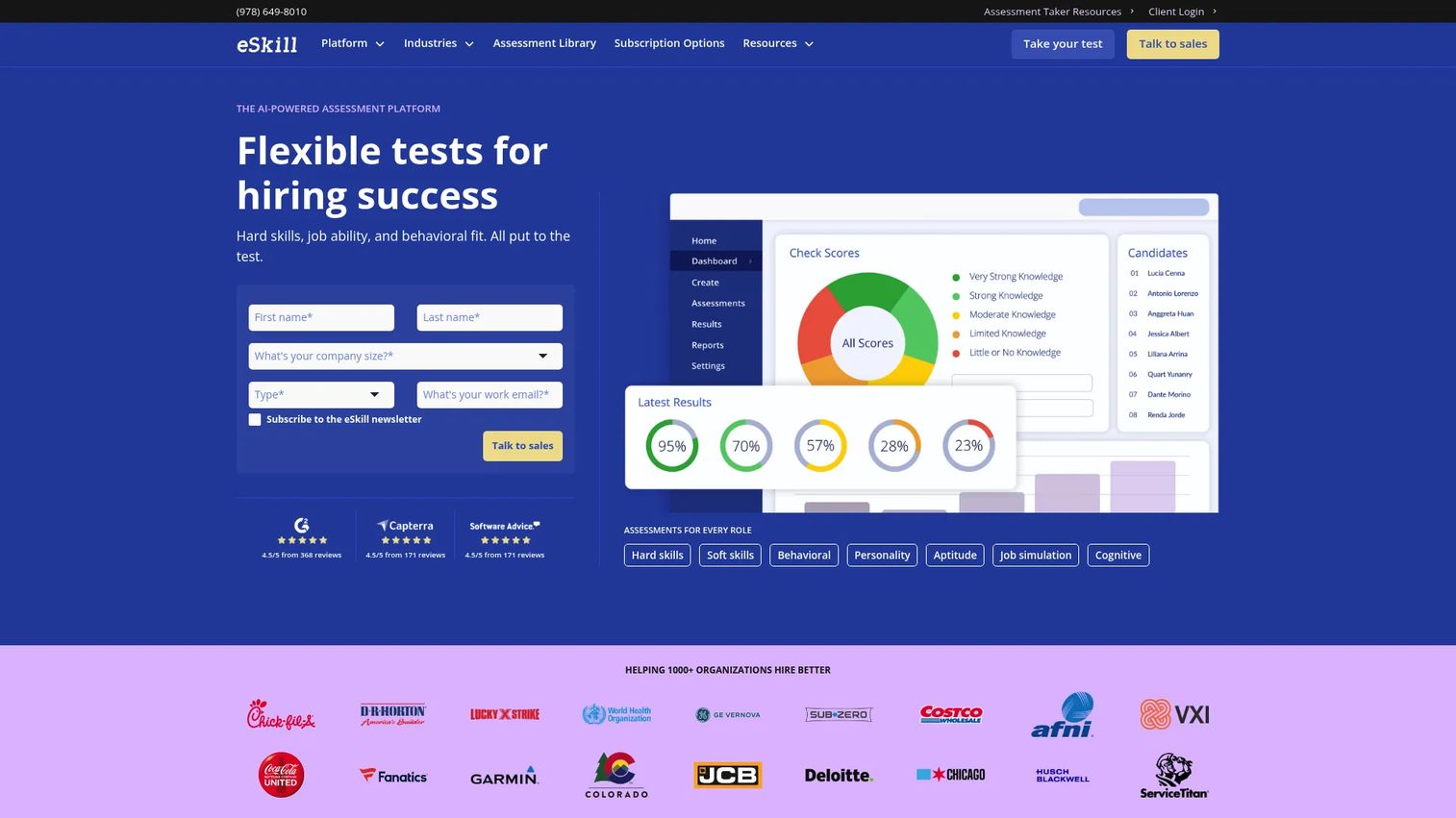
eSkill is a pre-employment assessment platform focused on hiring confidence and structured candidate evaluation. Where broader tools try to cover the full talent lifecycle, eSkill concentrates on the hiring end: customizable tests, job simulations, and anti-cheat controls that give you a defensible read on candidates before they reach a live round.
The assessment library is a genuine differentiator, spanning 600+ subjects and roughly 70,000 questions, which lets you build role-specific tests rather than settling for generic ones. Anti-cheat tools and AI-assisted proctoring protect result integrity, which matters when a score is going to influence a hiring call. For teams whose main problem is inconsistent screening, this is a focused skill assessment software.
Best for: Organizations that need customizable pre-employment skills assessments with strong result integrity.
Key strengths
- Customizable pre-hire assessments: Build role-specific tests from a large library instead of relying on off-the-shelf generics.
- Anti-cheat tools and AI-assisted proctoring: Protects score integrity so hiring decisions rest on trustworthy data.
- Assessment library with 600+ subjects and 70,000 questions: Deep content coverage across a wide range of roles and skills.
Why choose eSkill: Choose it when hiring confidence is the job to be done and you want structured, customizable candidate evaluation without a broader workforce-planning suite attached. Its 4.5/5 G2 rating reflects reliability in the pre-employment testing lane.
eSkill pricing: eSkill does not display public numeric pricing. The site lists Growth, Scale, and Custom subscription options and directs buyers to sales for higher plans. Pricing is tailored to volume and needs, so a scoping conversation is the way to get an exact figure.
5. TestGorilla
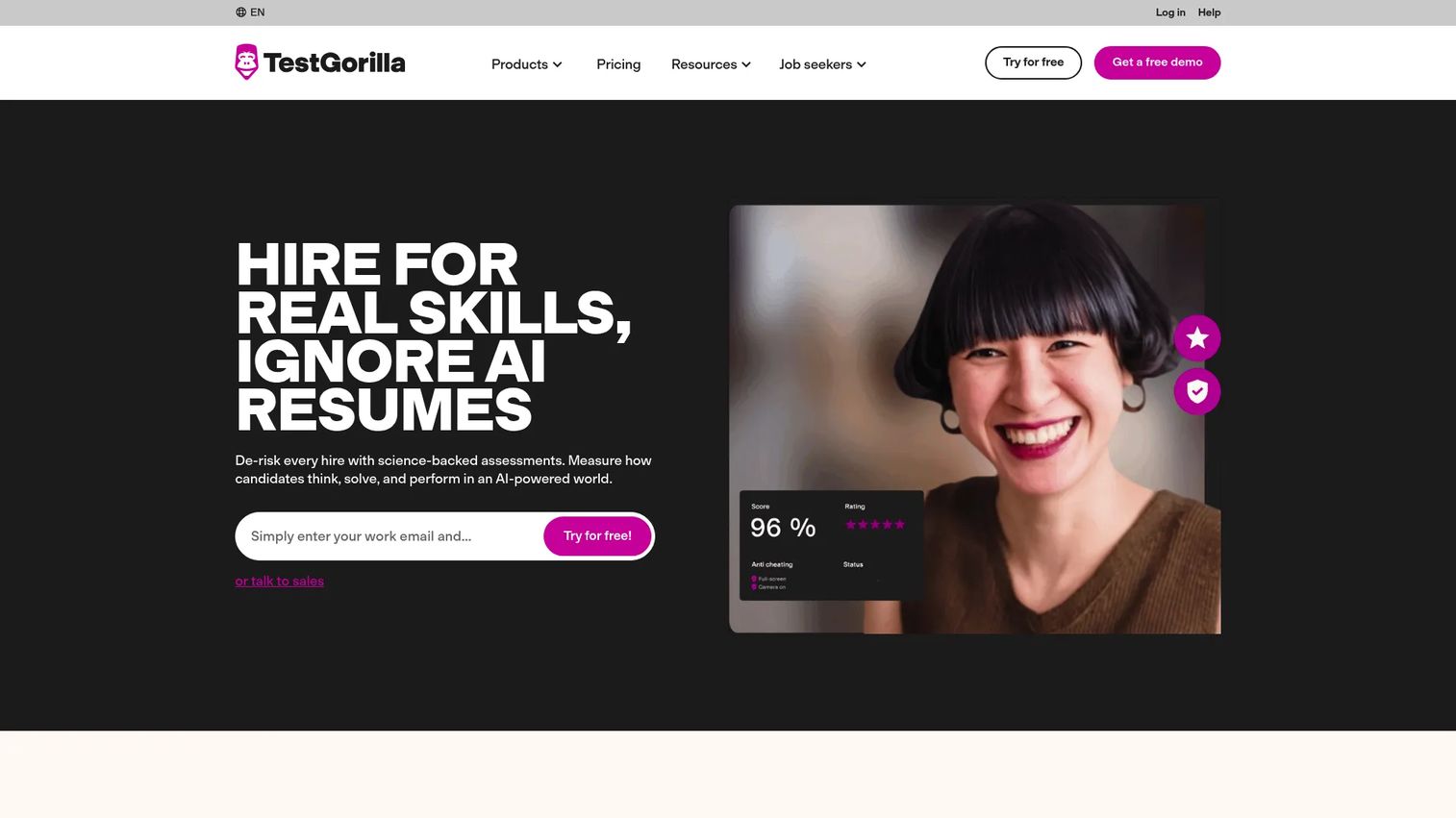
TestGorilla is a skills-based hiring platform combining assessments, AI interviews, resume scoring, and talent sourcing. It is the popular general-purpose pick for teams that want to standardize screening fast and cover a broad range of roles without heavy setup. If you need to move from ad-hoc interviews to structured evaluation this quarter, it is an easy on-ramp.
The library covers 350+ skills tests, and the platform layers on AI interviews and resume scoring so you can build a multi-measure screen rather than leaning on one signal. The free tier and self-serve setup make it fast to deploy, which suits smaller teams and fast-scaling companies that do not want a long implementation cycle before the first hire benefits.
Best for: Teams that want skills-based candidate screening and assessment at scale with quick deployment.
Key strengths
- 350+ skills tests: Broad role coverage so most positions can be screened from one library.
- AI interviews: Structured, consistent interview steps that reduce panel variance.
- Resume scoring: Faster top-of-funnel filtering so recruiters focus on real fits.
Why choose TestGorilla: Choose it when speed and breadth matter more than a deep workforce-planning layer. It is a strong first assessment tool for a company standardizing hiring for the first time, and the free plan lets you test the workflow before paying. The 4.5/5 G2 rating reflects broad, positive adoption.
TestGorilla pricing: TestGorilla offers a Free plan at $0/month, a Core plan at $142/month on an annual commitment ($1,704 billed annually), and a Plus plan starting from $400/month (annual commitment starting at $4,800). An Enterprise plan is available via sales. Pricing is credit-based, so match the plan to your hiring volume.
6. Mercer Mettl
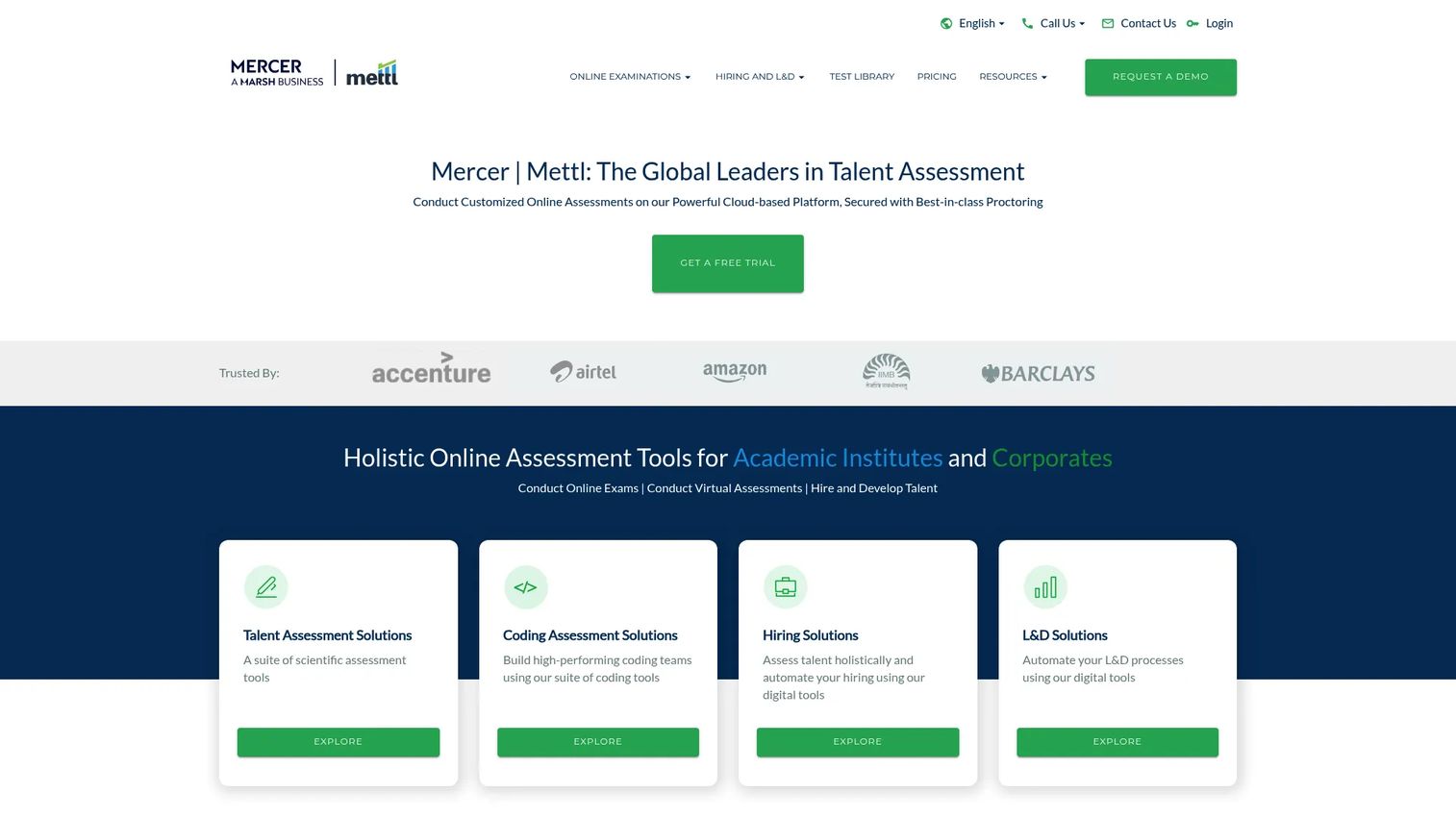
Mercer Mettl is an online assessment and talent evaluation platform covering hiring, development, exams, and proctoring. It is built for scale and governance, which makes it a strong fit for larger HR and talent workflows where assessment programs need structure, security, and breadth of content. When assessment becomes a program rather than a one-off, this is the kind of platform that supports it.
The platform spans online talent assessments, AI-powered remote proctoring, and 360-degree feedback plus performance appraisal. That range lets a single system support pre-hire testing, structured exams, and development feedback under consistent governance. For enterprises running assessment at volume across regions, that breadth and control is the point.
Best for: Organizations needing customizable assessment, proctoring, and talent evaluation software at enterprise scale.
Key strengths
- Online talent assessments: Broad, customizable assessment content across hiring and development use cases.
- AI-powered remote proctoring: Secures high-stakes assessments and exams delivered remotely.
- 360-degree feedback and performance appraisal: Extends assessment into structured development, not just hiring.
Why choose Mercer Mettl: Choose it when you are running assessment as an ongoing enterprise program that needs proctoring integrity, content breadth, and governance. It fits larger talent organizations more than a five-person team standardizing its first hiring loop. The 4.4/5 G2 rating reflects dependable enterprise performance.
Mercer Mettl pricing: Mercer Mettl uses customized, quote-based pricing. No public numeric price is displayed, and plans are scoped to your assessment volume and requirements. Reach out to sales for a tailored quote based on your program size.
7. Fuel50
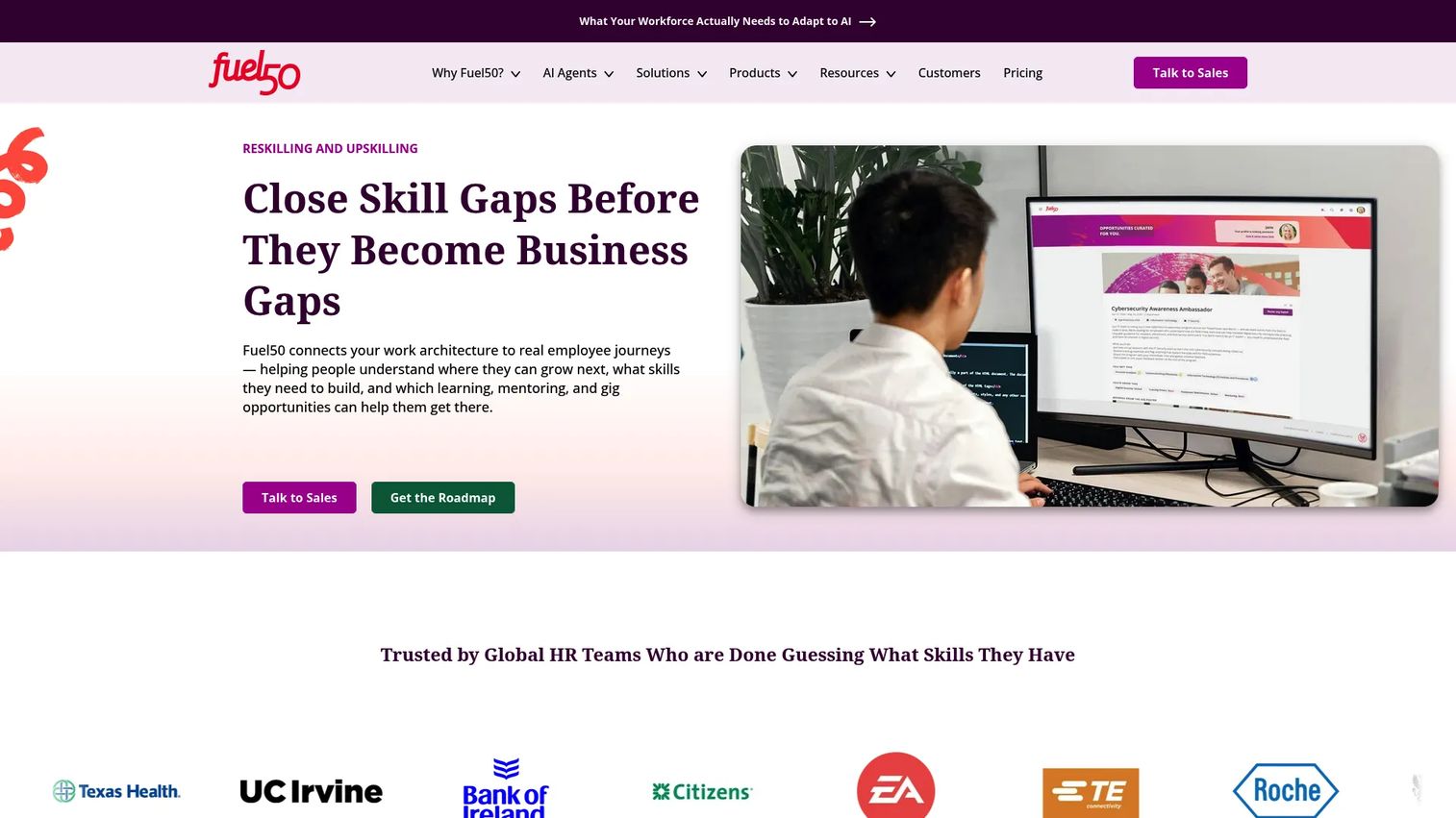
Fuel50 is a talent intelligence platform for skills-based workforce transformation, internal mobility, and development. It sits at the action end of the spectrum: less about generating a single score and more about turning skills data into movement, growth, and planning. If your question is "what do we do with skills data once we have it," this is the entry to study.
The platform is built around a governed skills ontology, an internal talent marketplace, and AI-assisted insights and career guidance. That combination maps existing skills against future roles, surfaces internal candidates before you post externally, and gives employees a path to grow. For broader talent strategy, it turns assessment into a workforce-planning engine rather than a filing cabinet of scores.
Best for: Mid-market and enterprise teams building skills-based talent mobility programs.
Key strengths
- Skills intelligence and governed skills ontology: A structured, consistent skills language across the organization for reliable planning.
- Internal mobility and talent marketplace: Surfaces internal candidates and moves before defaulting to external hiring.
- AI-assisted insights and career guidance: Turns skills data into development paths and planning decisions.
Why choose Fuel50: Choose it when the goal is workforce planning and internal mobility, not candidate screening. It complements a testing tool rather than replacing one: assessments generate the data, Fuel50 turns it into movement. The 4.4/5 G2 rating reflects solid mid-market and enterprise fit.
Fuel50 pricing: Fuel50 uses quote-based pricing. The pricing page presents modules and bundles, Skills Intelligence, Talent Marketplace, and Ultimate Fuel50, each on a request-pricing basis rather than public numbers. Contact sales to scope a plan to your mobility program.
Considerations before you buy
The tool matters less than whether it fits the decision you are trying to make. Run every option on this list through these criteria before committing.
Validated data you can defend
A score is only useful if it means the same thing across teams and holds up under scrutiny. Ask how each platform validates its assessments and benchmarks. When your board or an acquirer questions a capability claim, "our tool is validated and consistent" beats "a manager rated it a four."
Hiring versus development fit
Some tools are built for pre-hire screening, others for internal skills tracking and mobility. Be honest about your primary job. Buying a hiring-first tool to solve a workforce-planning problem, or vice versa, is the most common way teams end up disappointed with an otherwise good product.
Taxonomy and role mapping
Your skills data is only as useful as the structure behind it. Check whether the platform lets you map assessments to your specific roles, competencies, and proficiency targets. A governed taxonomy is what turns raw scores into a usable competency skill mapping system.
Actionability after the score
The score is the start, not the finish. Look at what the tool does next: does it produce a live skills matrix, gap analysis, mobility recommendations, and dashboards your VPs will actually open? A platform that generates data but not decisions just digitizes the spreadsheet problem.
Freshness and maintenance
Skills data decays. Ratings from a year ago may no longer be true. Favor tools with freshness controls that flag stale entries and prompt re-assessment, so your skills tracking software stays current without a manual clean-up project every quarter.
Conclusion
The best skills assessment software for your team depends on the decision you are trying to make, not the size of the test library. If your problem is a stale, untrusted skills matrix, Skills Base is the strongest overall fit for validated tracking and spreadsheet replacement. If people decisions are the bottleneck, The Predictive Index brings science-backed hiring and team design. For a rigorous technical bar plus skills intelligence, iMocha covers both ends. eSkill and TestGorilla are the picks for structured, scalable pre-employment testing, Mercer Mettl for enterprise assessment programs, and Fuel50 for turning skills data into internal mobility.
The decision lens stays constant: trust the data, fit the job, and choose the tool that helps you act on results rather than just digitize a spreadsheet. Start with the one that matches your most pressing decision this quarter, run it on real roles, and measure whether it shortens the path from question to answer.
Ready to bring the same show-don't-tell clarity to how you demo your own product? Start your journey with Guideflow today!
FAQs
Skills assessment software is a platform that measures, validates, and tracks the capabilities of employees and candidates, then turns that data into hiring, development, and workforce-planning decisions. It replaces manual scoring, inconsistent manager ratings, and spreadsheet-based skills matrices with structured, repeatable evaluation. The goal is one trustworthy source of truth on who can do what.
A performance review evaluates how someone did their job over a period, usually against goals and manager judgment. Skills assessment measures specific, discrete capabilities against objective benchmarks, independent of a review cycle. Reviews look backward at outcomes; assessments measure current capability so you can make forward-looking hiring and development decisions.
Yes, and that is one of its most common use cases. A skills matrix in a spreadsheet is manual, quickly outdated, and rarely trusted. Dedicated skills matrix software gives you validated ratings with provenance, freshness controls, and live reporting, so the data stays current and defensible. The key is choosing a tool that produces decisions, not just a nicer-looking file.
Enterprise buyers should prioritize validated scoring, a governed skills taxonomy that maps to their roles, proctoring and security for high-stakes assessments, and integrations with existing HR and analytics systems. Actionability matters most: the platform should feed gap analysis, workforce planning, and mobility decisions, not just generate scores. Governance and freshness controls keep the data reliable at scale.
Structured, objective assessments apply the same criteria to every candidate and employee, which reduces the influence of unstructured interviews and manager opinion. Instead of a gut-feel rating, a score reflects measured performance against a consistent benchmark. That consistency is what makes the data defensible and fairer across teams.
It depends on the tool. Some platforms specialize in pre-employment screening, others in internal skills tracking and mobility, and the strongest do both and connect them. Decide your primary job first: a hiring-first tool solves screening well but may not support workforce planning, while a development-first tool maps internal skills but is not a candidate testing engine.
The terms overlap heavily and are often used interchangeably. Skills assessment tools tend to emphasize measuring specific capabilities and competencies. Talent assessment software often takes a broader view, including behavioral and cognitive fit, hiring workflows, and development. In practice, buyers should focus on the job to be done rather than the label.
Start by mapping results to a governed taxonomy so scores tie to specific roles and proficiency targets. Then use the platform's matrices and gap analysis to see where capability is thin, and route that insight to hiring, L&D, and mobility decisions. The tools that add most value here surface internal candidates and development paths automatically, so results drive action instead of sitting in a report.