Showpad renewal conversations tend to surface the same question: Is this platform doing the right jobs, or just doing a lot of jobs? Showpad sits at the center of content libraries, seller training, coaching, buyer-facing shared spaces, and analytics. When teams reassess it, they usually are not asking which logo to swap in. They are asking which specific job broke down.
This list of 20 Showpad alternatives spans several distinct categories. Guideflow is the top pick for interactive internal training and buyer-facing product education. Seismic and Highspot cover enterprise sales enablement. Mindtickle, Allego, and SalesHood serve readiness and coaching. Showell, Pitcher, and Bigtincan address field selling. SharePoint, Google Drive, OneDrive, and Box provide document repositories. And Salesforce anchors CRM-native enablement.
The right answer depends on which Showpad job you need to replace. According to Gartner in 2026, 67% of B2B buyers prefer a rep-free buying experience. For enablement teams, that makes self-serve product education a job that deserves its own tool, not a checkbox inside a broad platform.
TL;DR
- Best overall for interactive internal training and product education: Guideflow, with more than 500,000 guideflows created and a free plan available
- Best traditional enterprise enablement alternative: Seismic (4.7/5 on G2) for revenue enablement breadth
- Best for content governance and rep adoption: Highspot (4.7/5 on G2)
- Best for readiness and coaching depth: Mindtickle (4.7/5 on G2) or Allego (4.6/5 on G2)
- Best for field and offline selling: Showell (4.6/5 on G2) or Pitcher (4.4/5 on G2)
- Pricing reality: Most full enablement suites use quote-based pricing. Document repositories (SharePoint, Google Drive, OneDrive, Box) may already be in your stack. Salesforce starts at $25/user/month for Sales Cloud Starter Suite
- This list spans two categories: purpose-built enablement platforms and specialist tools for training, field sales, or interactive product education
What's inside
- What Showpad is and what it does well
- Five reasons teams search for Showpad alternatives
- A 20-tool comparison table with categories, G2 ratings, and pricing
- Full tool cards for each of the 20 alternatives
- Use-case routing: Internal training, enterprise enablement, coaching, field sales, and lowest cost
- When staying with Showpad makes sense
- Why teams switch to Guideflow for interactive product education
What is Showpad?
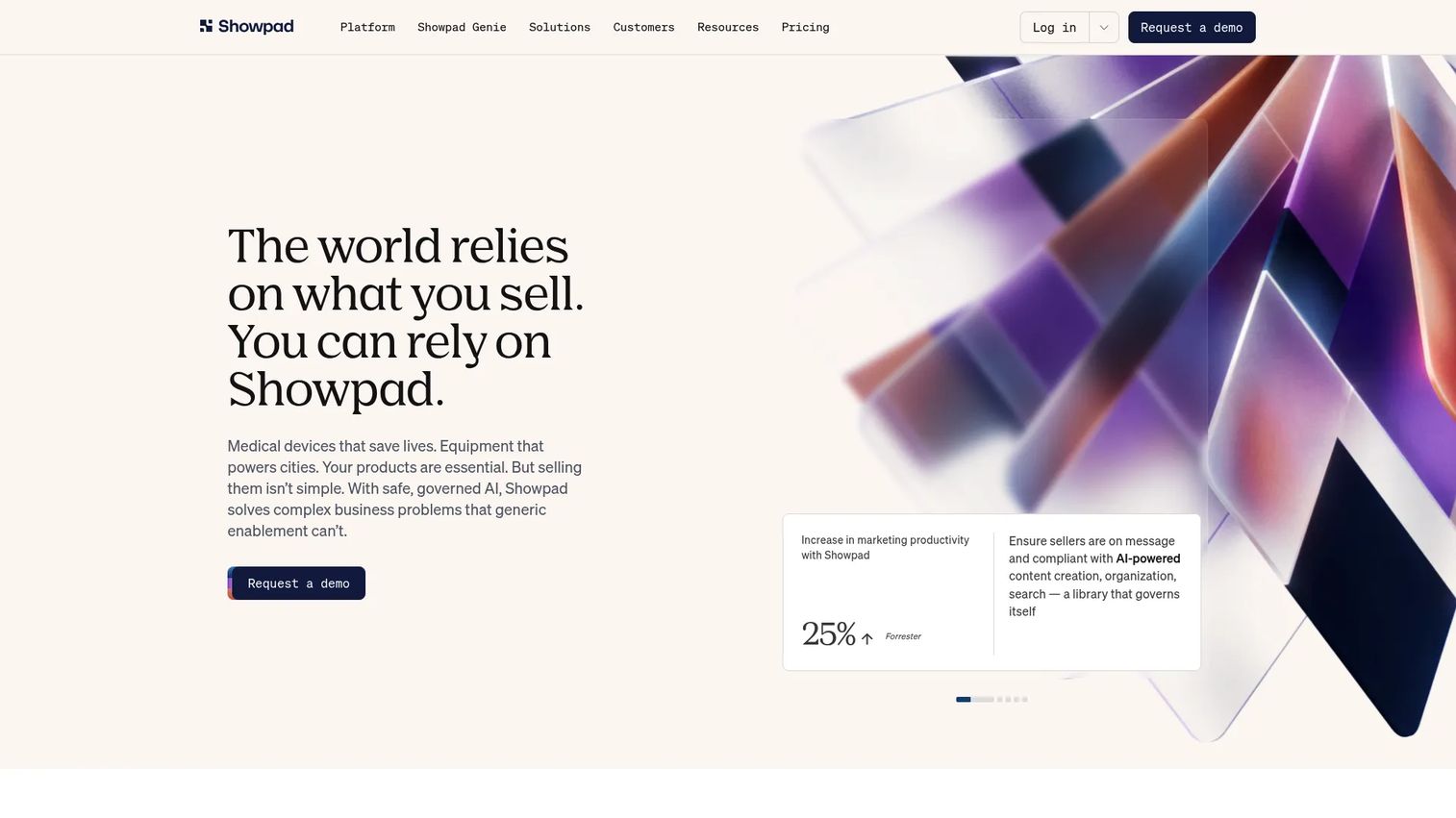
Showpad is an AI-native revenue effectiveness platform. It combines sales content management, seller training and coaching, buyer engagement through Shared Spaces, and analytics in one platform.
Mid-market and enterprise field-selling organizations are its primary audience. The platform is built for teams that want content, readiness, and buyer engagement to live together and share data. G2 rates it at 4.6/5.
Key strengths include a centralized content library with governance, seller training courses and certifications, AI-assisted roleplay, buyer-facing Shared Spaces for deal collaboration, and engagement analytics that show which assets move deals. Showpad offers three packages, Professional, Advanced, and Expert, all priced on request.
Why teams look for Showpad alternatives
Teams usually search for Showpad alternatives when the platform is doing too many jobs with uneven results, or when a renewal prompts a wider stack review.
Reps still cannot find the right asset
Enablement libraries built for coverage rather than findability create the same problem they were designed to solve. When content exists across multiple folders, old versions persist alongside new ones, and stage or persona tags are inconsistent, reps default to searching Slack or asking colleagues. G2 reviewers of Showpad note that content search and organization can require significant admin investment to work well at scale.
Training and execution are disconnected
Certifications and onboarding programs sit in one part of the platform while live deals happen in a CRM or sequencer. G2 reviewers mention that keeping training content fresh and tied to current messaging requires ongoing governance work. Launch enablement content risks going stale between releases.
Buyers want to self-educate before a call
72% of B2B purchases involve complex, multi-stakeholder buying groups, according to Demandbase in 2025. Static PDFs and passive slide decks do not give each stakeholder a way to explore the product at their own pace. Enablement teams increasingly need a format that lets a champion forward something a committee can click through, not just read.
Field teams need reliable offline access
Teams selling in showrooms, clinics, manufacturing facilities, and distribution networks need content that works without connectivity. G2 reviewers of Showpad note that the mobile and offline experience is an area where field-focused specialist tools sometimes outperform a broad platform.
Renewal cost prompts a stack review
Showpad's pricing is quote-based across all three tiers. When usage patterns shift, when headcount grows, or when leadership pushes for consolidation, the renewal conversation becomes an audit of which jobs the platform is performing and which are going unused.
How we picked these Showpad alternatives
Each tool was selected based on real capability overlap with Showpad's core jobs: Content management, seller readiness, coaching, buyer engagement, field selling, and interactive product education. Pricing was taken from each vendor's pricing page. G2 ratings come from G2 listings. The list includes both full platform replacements and specialists, labeled by category so readers can distinguish a direct swap from a category upgrade. The sales enablement market was valued at $4.21 billion in 2025, according to Mordor Intelligence. With that scope, any "best of" list reflects use-case fit, not universal ranking.
Showpad alternatives at a glance
Guideflow leads for interactive product education. The enterprise enablement platforms, Seismic, Highspot, Allego, and Mindtickle, are grouped by their primary strength. Field specialists like Showell and Pitcher occupy their own lane. Document repositories round out the list for teams that need governance without a full enablement build.
| # | Tool | Category | Best for | G2 rating | Free plan | Starting price |
|---|---|---|---|---|---|---|
| 1 | Guideflow | Interactive guide platform | Internal training, onboarding, SOPs, product education | 5.0/5 | Yes | Free; paid from $35/user/month (annual) |
| 2 | Seismic | Revenue enablement platform | Enterprise enablement, content, buyer engagement | 4.7/5 | No | Quote-based |
| 3 | Highspot | Sales enablement platform | Enterprise content governance and rep adoption | 4.7/5 | No | Quote-based |
| 4 | Mindtickle | Sales readiness platform | Training, certification, coaching, skill development | 4.7/5 | No | Quote-based |
| 5 | Allego | Revenue enablement platform | Coaching, learning, digital selling | 4.6/5 | No | Quote-based |
| 6 | Mediafly | Revenue enablement platform | Value selling, buyer engagement, content analytics | 4.4/5 | No | Quote-based |
| 7 | Bigtincan | Sales enablement platform | Field enablement, mobile selling, readiness | 4.3/5 | No | Quote-based |
| 8 | Showell | Sales enablement app | Field sales, offline access, branded content delivery | 4.6/5 | No | From €925/workspace/month |
| 9 | Crescendo | AI customer experience platform | AI-managed customer support operations | 4.4 | No | From $1.25/resolution + $2,900/month |
| 10 | Pitcher | Sales enablement platform | Regulated field sales, guided selling | 4.4/5 | No | Quote-based |
| 11 | GTM Buddy | Revenue activation platform | In-workflow enablement, contextual content delivery | 4.8/5 | No | Quote-based |
| 12 | SalesHood | Sales enablement and training platform | Onboarding programs, coaching, readiness | 4.6/5 | No | Quote-based |
| 13 | Accent | Revenue enablement platform | AI-guided selling, content governance, rep readiness | 4.4/5 | No | Quote-based |
| 14 | ClearSlide | Sales engagement platform | Presentations, screen sharing, engagement analytics | 4.3 | No | Quote-based |
| 15 | Veelo | Sales enablement platform | Lightweight content and seller support | 4.7 | No | Quote-based |
| 16 | SharePoint | Document management platform | Microsoft-based content libraries and permissions | 4.0/5 | No | From $5/user/month (annual) |
| 17 | Google Drive | Cloud storage platform | Simple asset storage for Google Workspace teams | 4.5 | Yes | Free; Google Workspace from $7/user/month |
| 18 | OneDrive | Cloud storage platform | Microsoft file storage and sharing | 4.3/5 | Yes (5 GB) | From $19.99/year |
| 19 | Box | Cloud content management platform | Secure enterprise content storage and governance | 4.3/5 | Yes | Business Starter from $5/user/month |
| 20 | Salesforce | CRM platform | CRM-native enablement, workflows, pipeline reporting | 4.4/5 | Yes (Free Suite) | Starter Suite from $25/user/month |
The best Showpad alternatives in 2026
1. Guideflow (interactive guide platform)
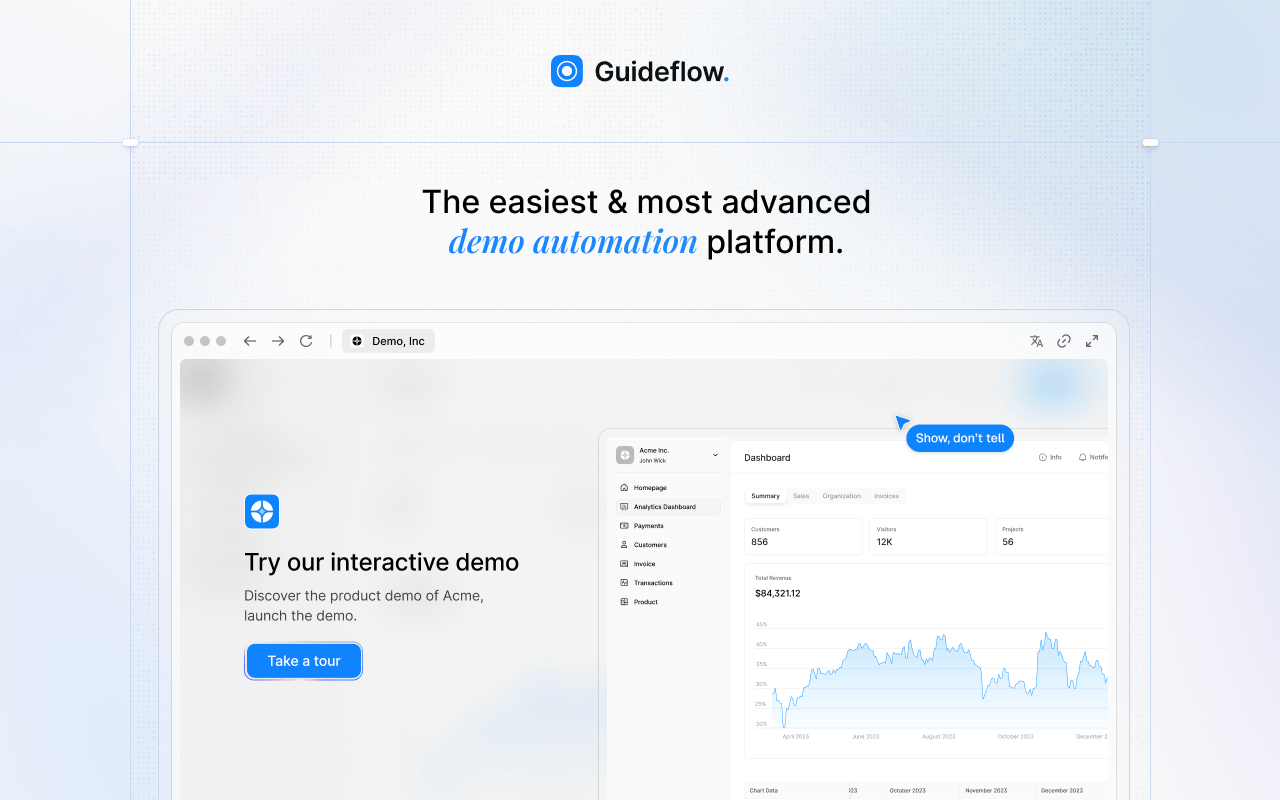
Guideflow is a demo automation platform built for enablement teams that need reps, new hires, and buyers to learn software by doing rather than reading static documents. Teams capture their product once through the Chrome extension or native app, then share step-by-step interactive demos for employee onboarding, process training, SOPs, launch enablement, and buyer-facing product education.
Best for: Sales enablement managers who need interactive internal training guides, process SOPs, rep onboarding, and self-serve product education for buyers.
What it is: Guideflow is a demo automation platform. Capture modes include screenshot, HTML, and video. Step content and CTAs are written automatically. The editor supports text, images, graphs, and branching. The platform covers six demo types: Interactive demos, demo pages, demo centers, sandboxes, live demos, and mobile demos.
Key features:
- Capture through the Chrome extension or native app
- Automated step content and CTAs
- Editor for text, images, graphs, and branching paths
- Analytics covering step-level completion, drop-off, and viewer flow
- Company-level visitor identification; CRM records created on viewer identification
- Translation into more than 30 languages; AI voiceover
- Integrations with HubSpot, Salesforce, Pipedrive, Zoho, and Marketo
Where Guideflow falls short: Teams that need a classic LMS with SCORM-based certification, a formal coaching scorecard system, or a broad sales content repository will want to pair Guideflow with a dedicated readiness or content platform. Guideflow excels at interactive product education and guided procedural learning; it is not a full Showpad replacement for teams whose primary job is managing a large sales content library across a field force.
Pricing: Free plan available. Solo is $35/user/month, billed annually. Growth is $499/month. Advanced is $1,499/month. Enterprise starts from $2,999/month and includes SSO, advanced governance, and enterprise security.
G2 rating: 5.0/5
How it compares to Showpad: Guideflow targets a different job than Showpad. Where Showpad manages content, coaching, and buyer spaces in one platform, Guideflow lets enablement teams create interactive experiences that reps and buyers click through at their own pace. Many teams run both.
Start your journey with Guideflow today!
2. Seismic (revenue enablement platform)
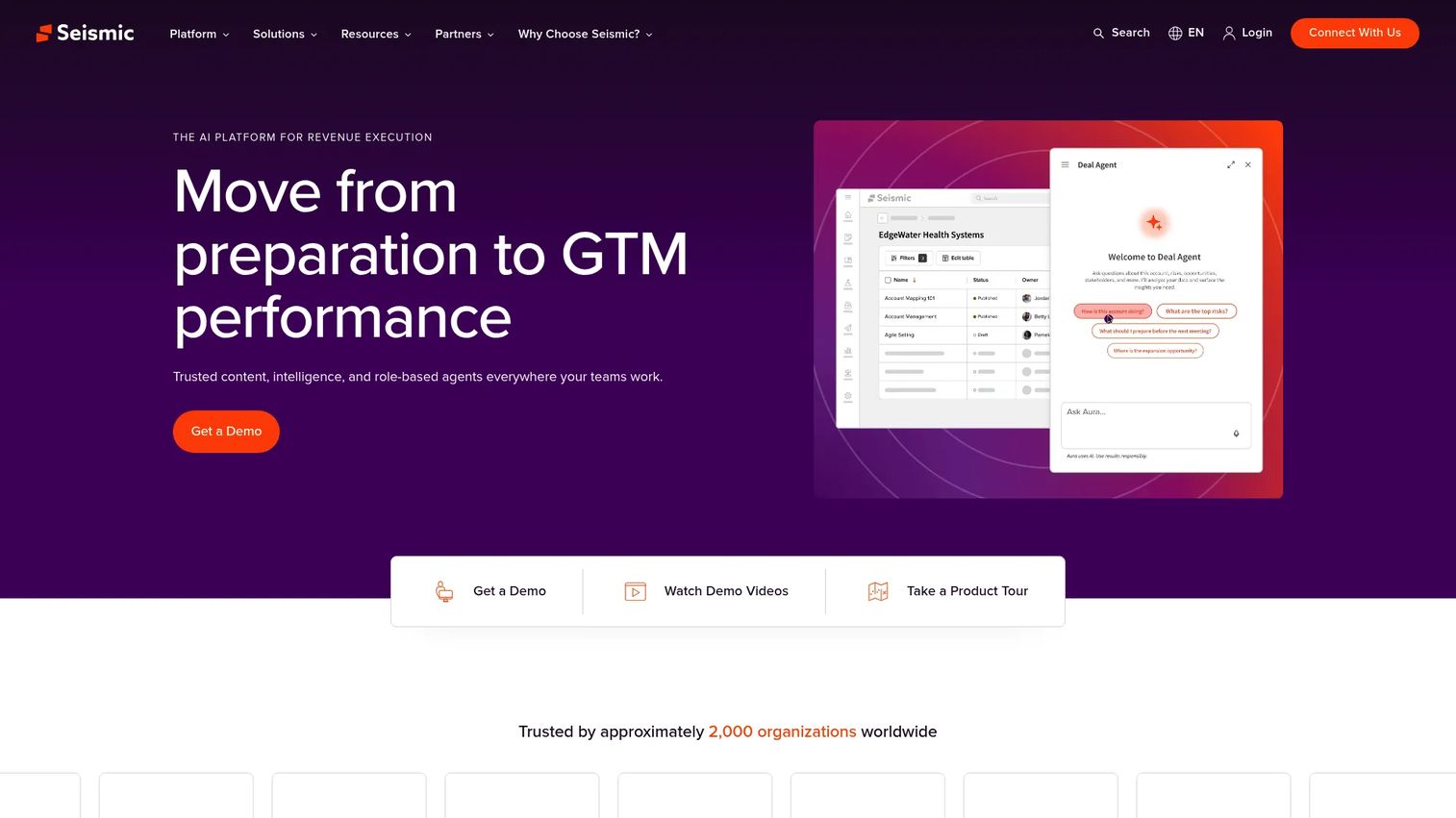
Seismic is the clearest like-for-like swap for enterprise teams that want another broad revenue enablement platform rather than a category specialist.
Best for: Large organizations that need a full revenue enablement platform spanning content, learning, coaching, buyer engagement, and analytics operations.
What it is: Seismic is an AI-powered sales enablement platform rated 4.7/5 on G2. It covers content management, digital sales rooms, content automation, learning and coaching, and CRM integrations across Professional Edition, Enterprise Premier Edition, and Seismic Learning packages.
Key features:
- Content management and governance
- Digital sales rooms and buyer engagement tracking
- Learning, coaching, and AI-powered role-play practice
- Enablement analytics and planning
- CRM integrations and open APIs
Where Seismic falls short: G2 reviewers note that implementation can be complex and time-consuming for teams without dedicated admin resources. Some reviewers mention a learning curve for configuring content automation and analytics to full depth. Admin complexity is a recurring theme for organizations without a dedicated enablement operations function.
Pricing: Custom pricing.
G2 rating: 4.7/5
How it compares to Showpad: Seismic and Showpad occupy the same enterprise revenue enablement category. Teams leaving Showpad for a full platform replacement should put Seismic directly on the evaluation shortlist alongside Highspot.
3. Highspot (sales enablement platform)
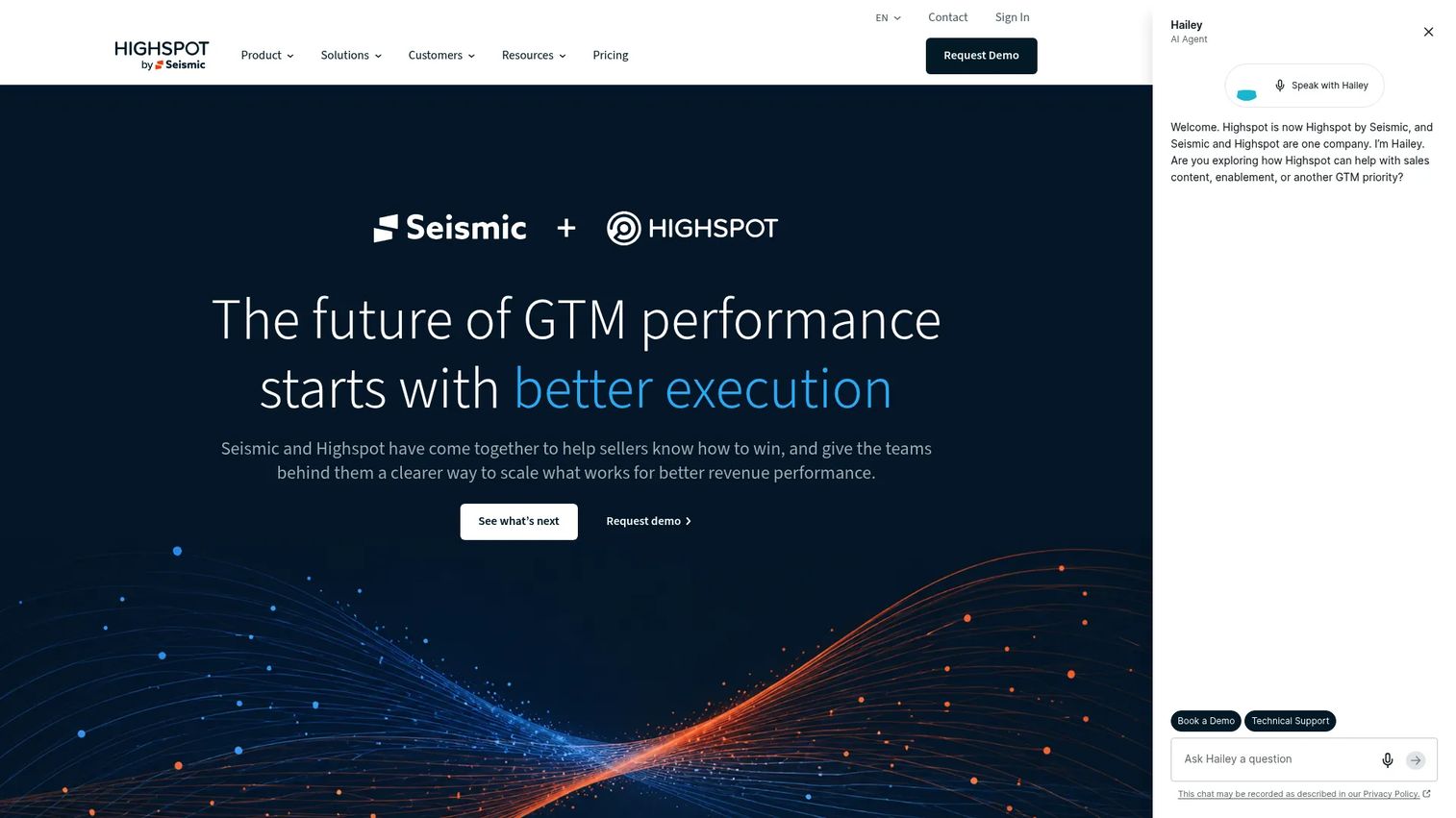
Highspot was acquired by Seismic, though it continues to operate as a distinct product. For teams focused on content governance and rep adoption, it deserves its own comparison.
Best for: Enterprise go-to-market teams prioritizing content governance, sales plays, and rep adoption measurement.
What it is: Highspot is an AI-powered go-to-market platform rated 4.7/5 on G2. It covers content organization, sales plays, digital sales rooms, AI-assisted training, adaptive learning, roleplay, meeting intelligence, and coaching. Three plans, Equip and engage, Train and practice, and Coach and reinforce, are available on request.
Key features:
- AI-powered content organization, search, and recommendations
- Sales Plays and Digital Sales Rooms
- AI Role Play and adaptive skills reinforcement
- Meeting Intelligence, deal guidance, and performance analytics
- Integrations with Salesforce, Microsoft Copilot for Sales, and Agentforce
Where Highspot falls short: G2 reviewers note that the reporting and analytics interface can require training to use effectively. Some reviewers flag that the admin configuration needed to build and maintain sales plays is non-trivial. Enterprise pricing scales with usage, which some reviewers flag when budgets are under review.
Pricing: Quote-based across all three plans.
G2 rating: 4.7/5
How it compares to Showpad: Highspot is a direct competitor in the enterprise enablement category. Teams that prioritize content governance, sales play execution, and rep adoption metrics will find the comparison between Highspot and Showpad worth running in depth.
4. Mindtickle (sales readiness platform)
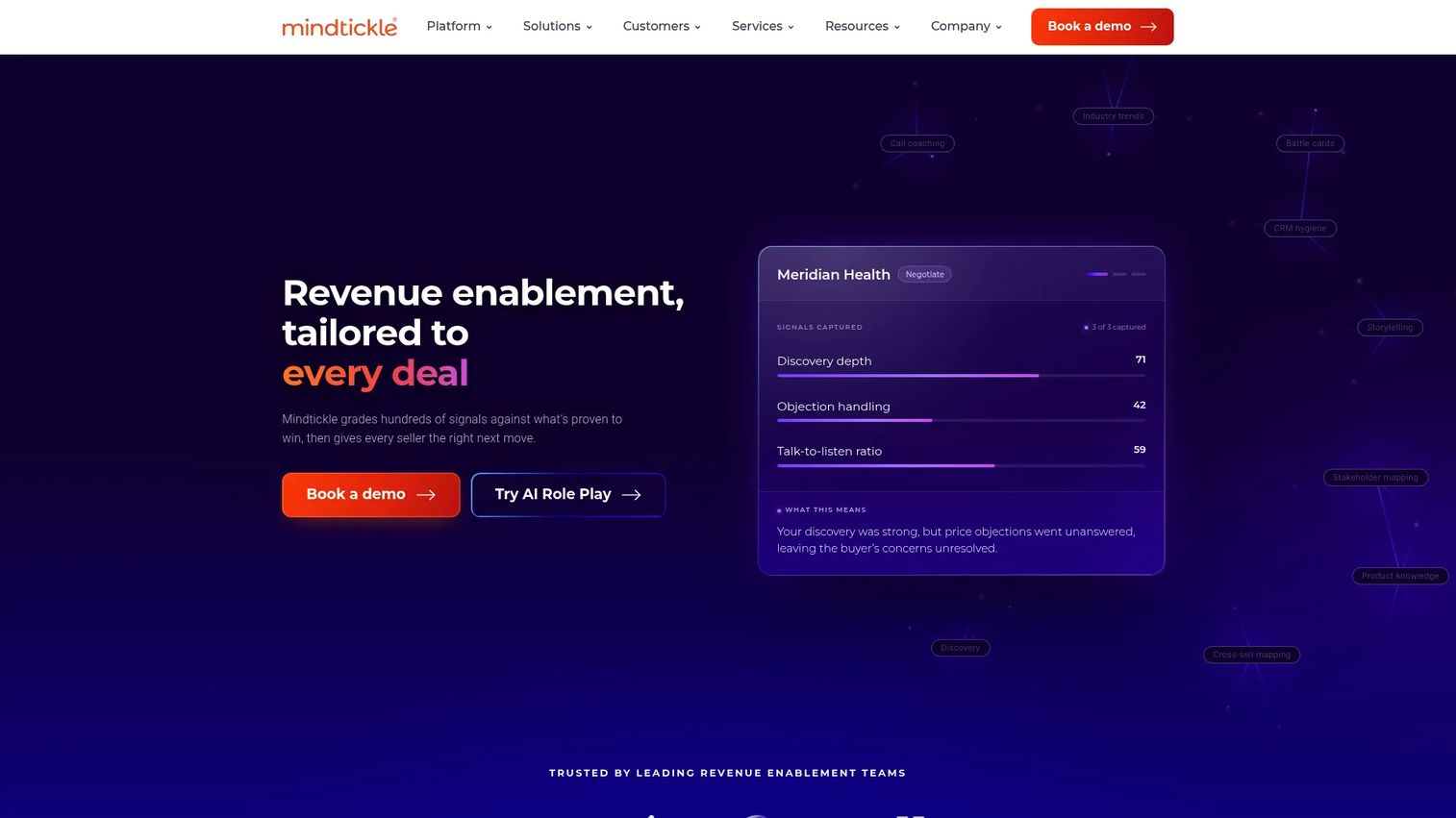
Mindtickle goes deeper on readiness than most broad enablement platforms. If formal certification, structured onboarding paths, and coaching dashboards are the core job, it earns a close look.
Best for: Enterprise revenue teams where rep readiness, skill development, and formal certification programs are the primary enablement investment.
What it is: Mindtickle is a revenue enablement platform rated 4.7/5 on G2. It covers AI roleplay, training and adaptive learning, coaching and Readiness Index, Asset Hub content management, digital sales rooms, and conversation intelligence. Packages, LMS, Readiness, Enable, and Transform, are priced on request.
Key features:
- AI Role Play with automated feedback
- Training paths, certifications, and adaptive learning
- Readiness Index and coaching dashboards
- Asset Hub for sales content management
- Conversation Intelligence and Call AI
Where Mindtickle falls short: G2 reviewers note that the content management module is secondary to readiness. Teams that need a full sales content repository with deep governance may find Mindtickle better positioned as a readiness complement than a Showpad replacement in full.
Pricing: Quote-based.
G2 rating: 4.7/5
How it compares to Showpad: Mindtickle replaces the readiness and coaching jobs more completely than Showpad's equivalents. It is the stronger pick when ramp time, certification completion, and skill development are the primary KPIs.
5. Allego (revenue enablement platform)
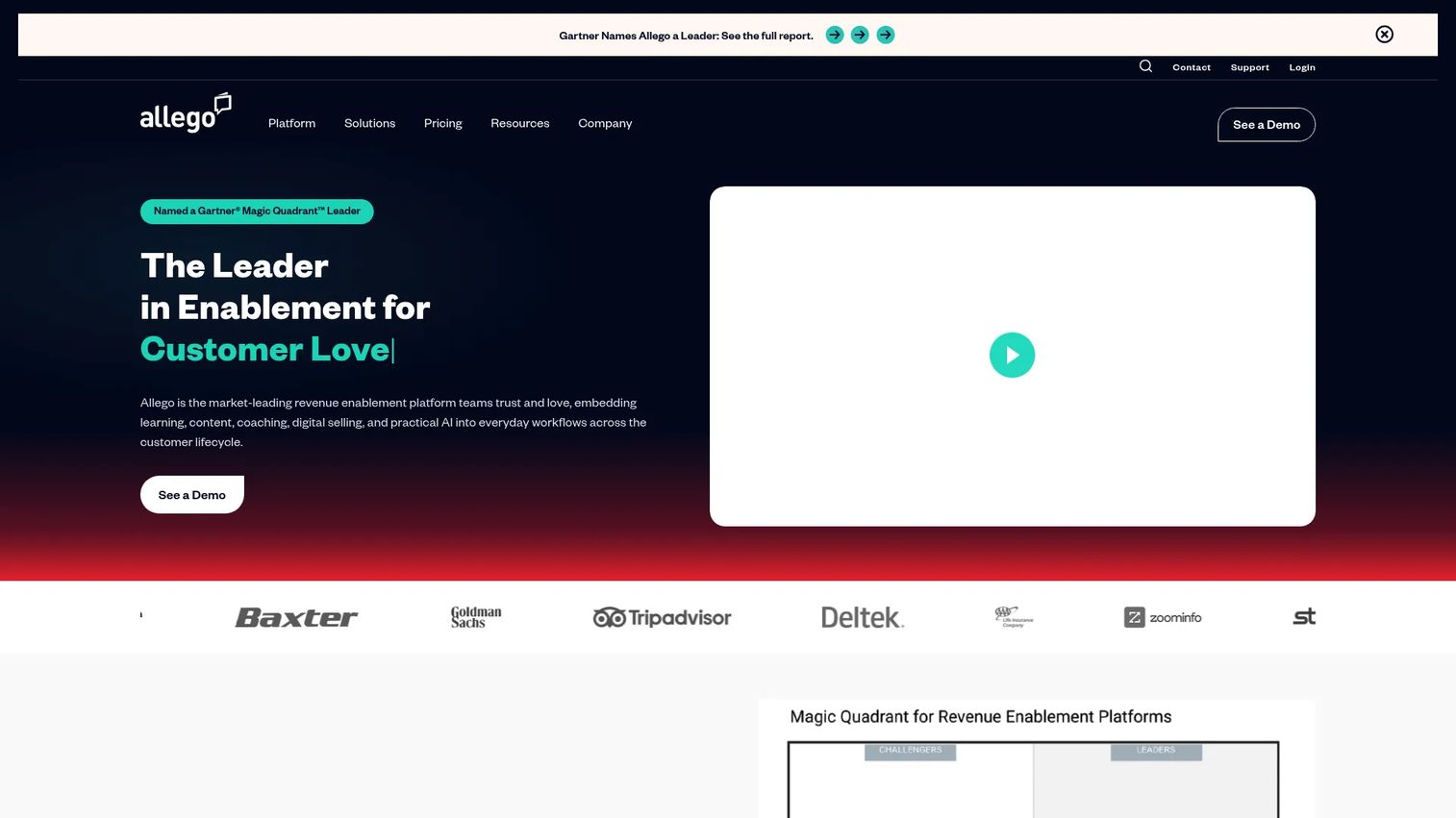
Allego combines learning, video-based coaching, content management, and digital deal execution in one platform, making it a credible full Showpad alternative for teams where video coaching is central.
Best for: Revenue teams that want learning, AI coaching, digital sales rooms, and conversation intelligence in one platform.
What it is: Allego is a revenue enablement platform rated 4.6/5 on G2. It covers modern learning and onboarding, AI role play and coaching, content management with AI-powered search, conversation intelligence, digital sales rooms, and mobile enablement. Pricing by seat, billed annually upfront, with typical contracts of three years.
Key features:
- Modern learning and onboarding programs
- AI role play and coaching
- Content management with AI-powered search
- Conversation intelligence and call analysis
- Digital Sales Rooms and Deal Navigator
Where Allego falls short: G2 reviewers note that the platform is extensive, and teams with narrower needs sometimes find the full setup scope more than their situation warrants. Some reviewers also flag that reporting customization can require admin expertise.
Pricing: Per-user pricing billed annually upfront. Contract lengths typically three years.
G2 rating: 4.6/5
How it compares to Showpad: Allego is positioned closer to Showpad's scope than most alternatives. Teams that want to replace content, learning, and digital selling in one move will find both worth evaluating side by side.
6. Mediafly (revenue enablement platform)
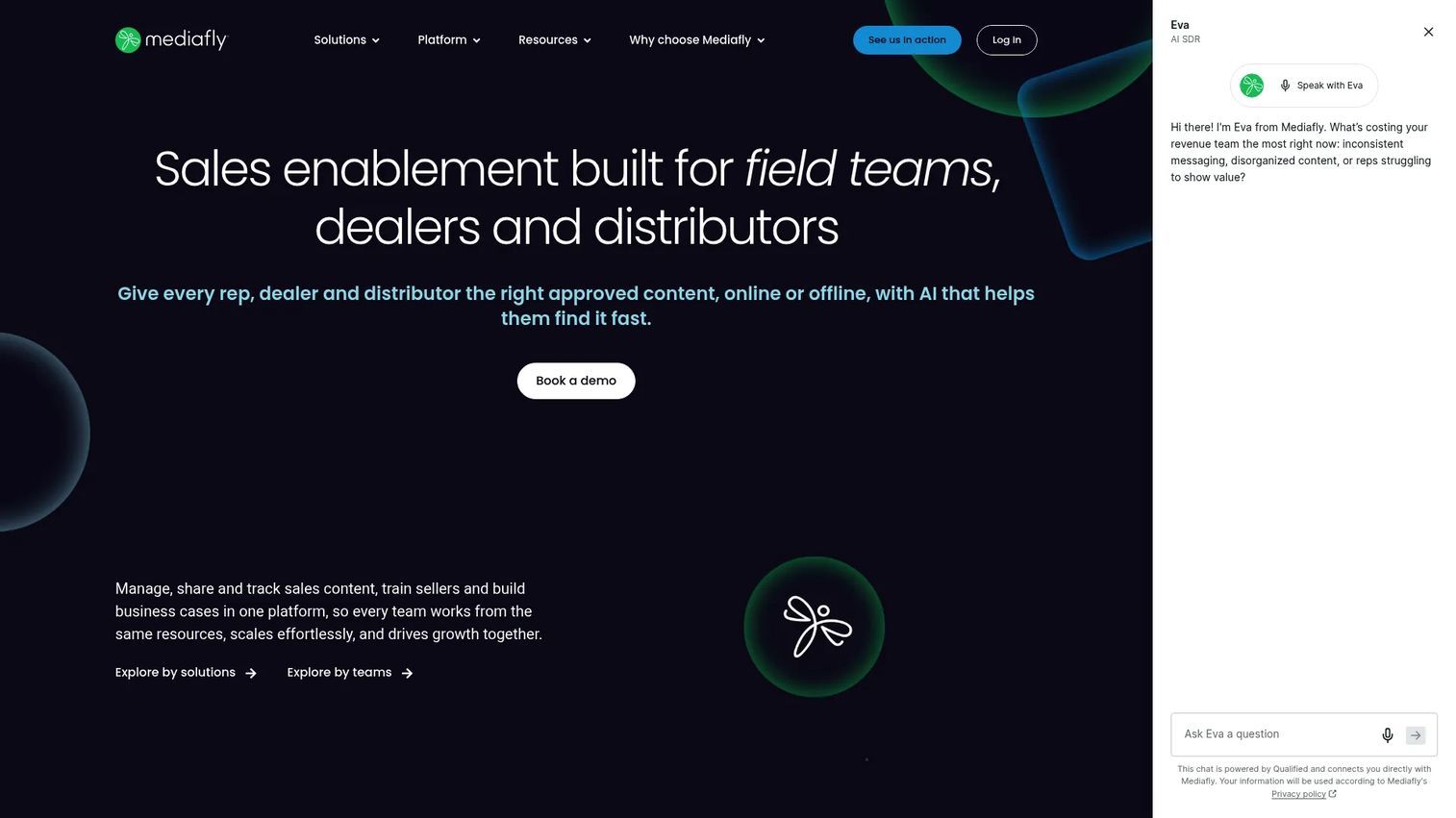
Mediafly's differentiation sits in value selling. ROI calculators, TCO estimators, and business case builders come standard, which separates it from content-and-coaching platforms.
Best for: Enterprise revenue teams with complex, consultative sales cycles that need value-selling tools alongside content and buyer engagement.
What it is: Mediafly is an enterprise revenue enablement platform rated 4.4/5 on G2. It unifies sales content management, digital sales rooms, value-selling tools, learning and coaching embedded in Salesforce, and AI-powered content recommendations. Pricing is modular and quote-based.
Key features:
- Sales content management and governance
- Value calculators, ROI estimators, and business case builders
- Digital sales rooms and buyer engagement analytics
- Learning and coaching inside Salesforce
- AI-powered content search, summaries, and recommendations
Where Mediafly falls short: G2 reviewers note that the configuration of value-selling tools and analytics dashboards can require significant setup. Some reviewers flag that the breadth of modules makes the platform more complex to administer than narrower alternatives.
Pricing: Quote-based. Pricing is modular by feature set, seat count, and integration requirements.
G2 rating: 4.4/5
How it compares to Showpad: Mediafly wins when value selling is a primary motion. If the team needs to build financial business cases inside the demo experience, Mediafly's toolset goes deeper than Showpad's.
7. Bigtincan (sales enablement platform)
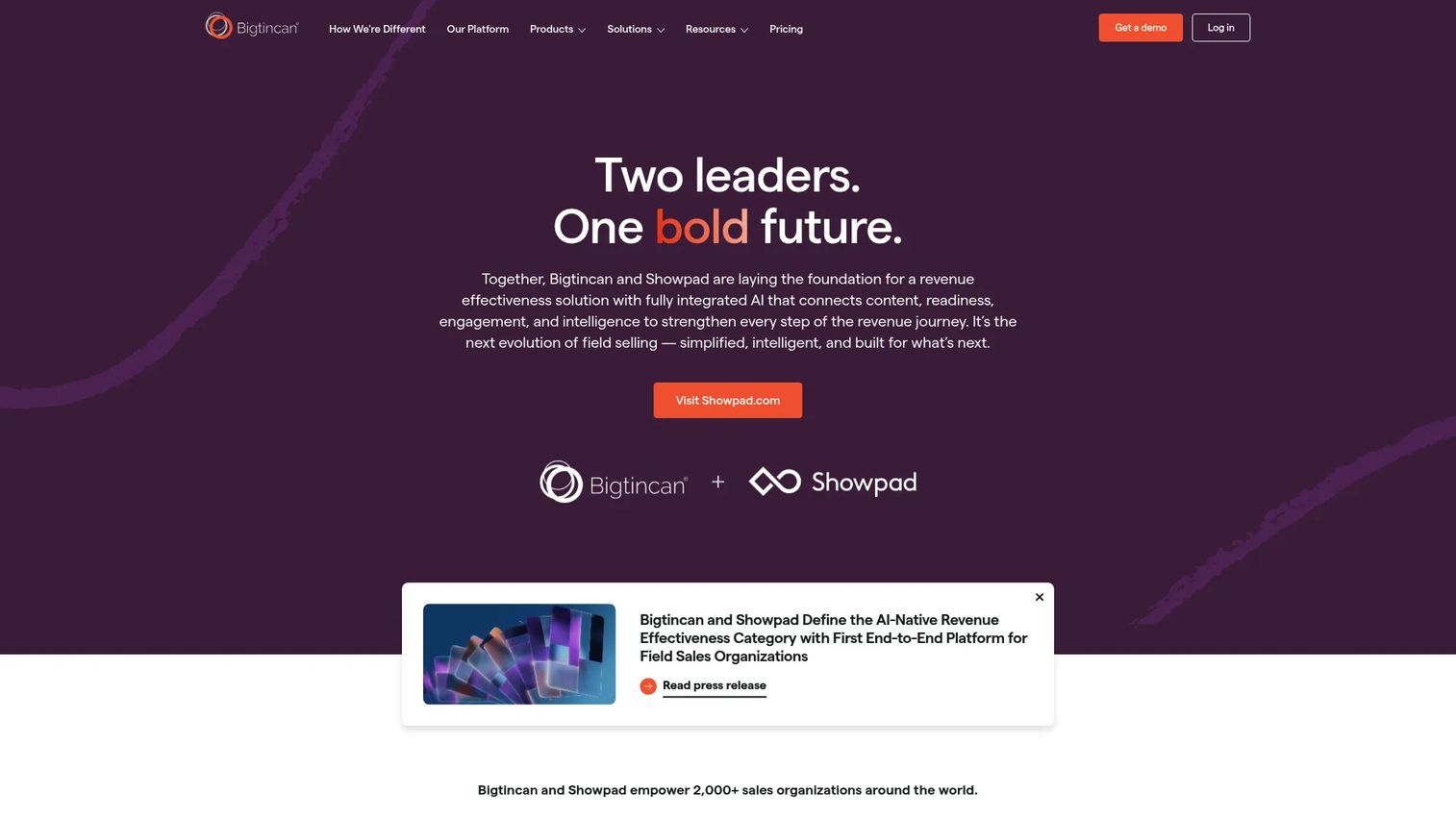
Bigtincan connects content, readiness, and buyer engagement with a mobile-first approach. It suits enterprise teams where field sales is the dominant motion.
Best for: Enterprise customer-facing organizations that need mobile sales enablement, offline content access, and AI-driven readiness.
What it is: Bigtincan is an AI-enabled revenue enablement platform rated 4.3/5 on G2. It covers content management with personalization and offline access, AI-powered readiness, coaching and role-play, digital sales rooms, and analytics. Essential and Elite editions are available on request.
Key features:
- Content management with offline access, version control, and personalization
- AI-powered readiness, coaching, and role-play
- Digital Sales Rooms and buyer engagement tracking
- Revenue analytics across content, readiness, and engagement
- Integrations with Salesforce, Outlook 365, Microsoft Teams, and Gmail
Where Bigtincan falls short: G2 reviewers mention that search and content discovery can require solid taxonomy setup. Some reviewers flag that implementation timelines for the full platform are substantial. Support response times also appear as a recurring G2 theme.
Pricing: Quote-based.
G2 rating: 4.3/5
How it compares to Showpad: Bigtincan and Showpad are close in scope. Bigtincan's mobile-first architecture gives it an edge for field-intensive organizations. Teams whose reps sell primarily from a laptop may find the distinction less meaningful.
8. Showell (sales enablement app)
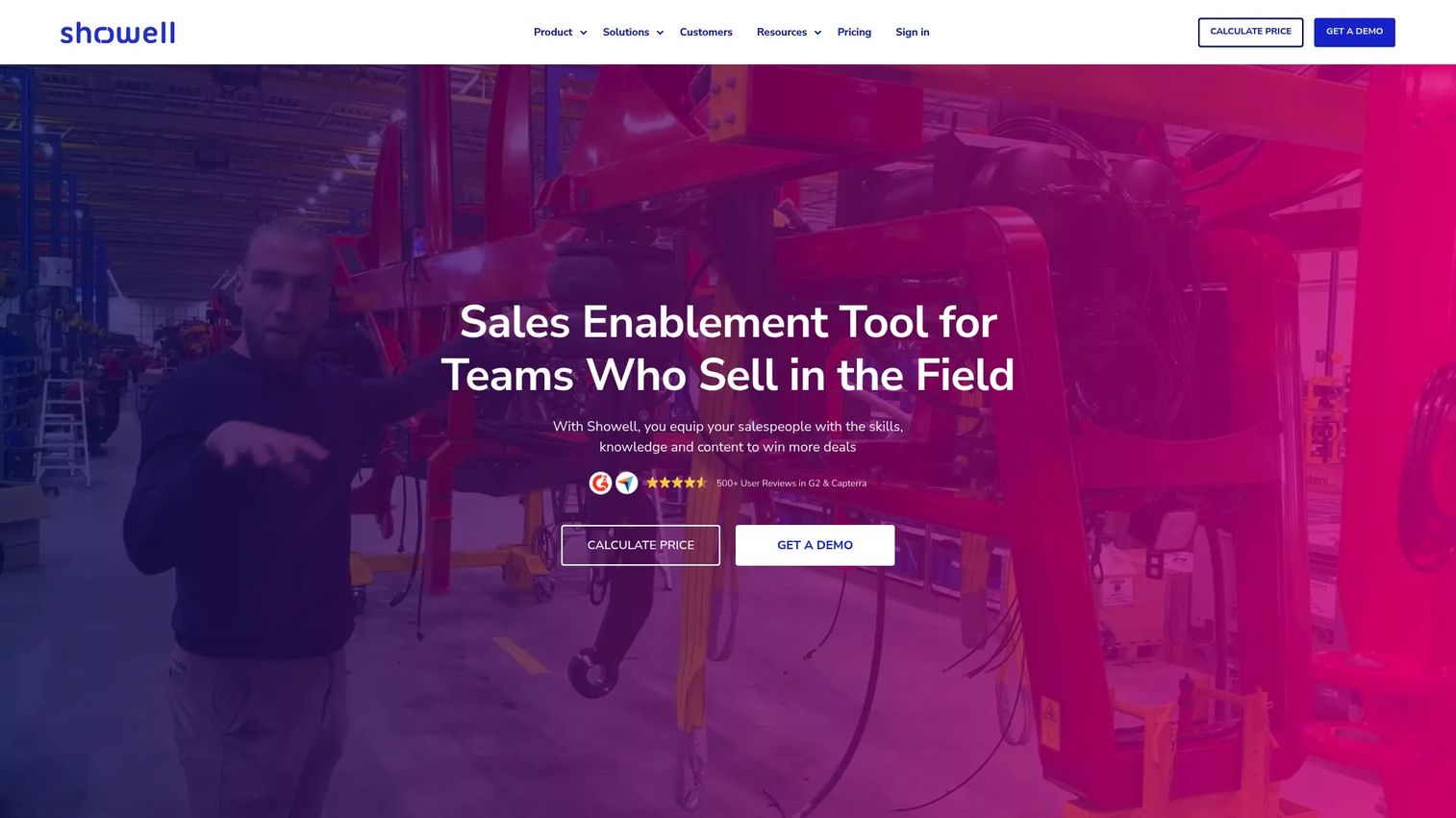
Showell is built for the moment a rep is standing in front of a customer with unreliable WiFi. It is narrower than a full platform but very focused on field content delivery.
Best for: Field sales teams and dealer networks that need offline access, branded content presentation, and engagement tracking.
What it is: Showell is a sales enablement app rated 4.6/5 on G2. It covers centralized content management, offline desktop and mobile access, branded sales presentations, digital sales rooms, learning management, and an AI assistant. The Professional Plan is designed for 10 to 200 users.
Key features:
- Offline content access on desktop and mobile
- Branded sales presentations and content sharing
- Digital Sales Rooms with controlled sharing and engagement tracking
- Sales training and onboarding modules
- AI Assistant for content recommendations
Where Showell falls short: Showell's strength is content delivery, not coaching depth. Teams that need formal certification programs, conversation intelligence, or deep buyer engagement analytics will find the platform lighter than a full enablement suite. Showell's pricing is in euros, which adds a currency consideration for US-based procurement.
Pricing: Professional Plan starts at €925/workspace/month, minimum 12-month commitment. Enterprise pricing is custom.
G2 rating: 4.6/5
How it compares to Showpad: Showell is narrower and field-focused. It is a strong choice when the job is field content delivery, not full platform replacement.
9. Crescendo (AI customer experience platform)
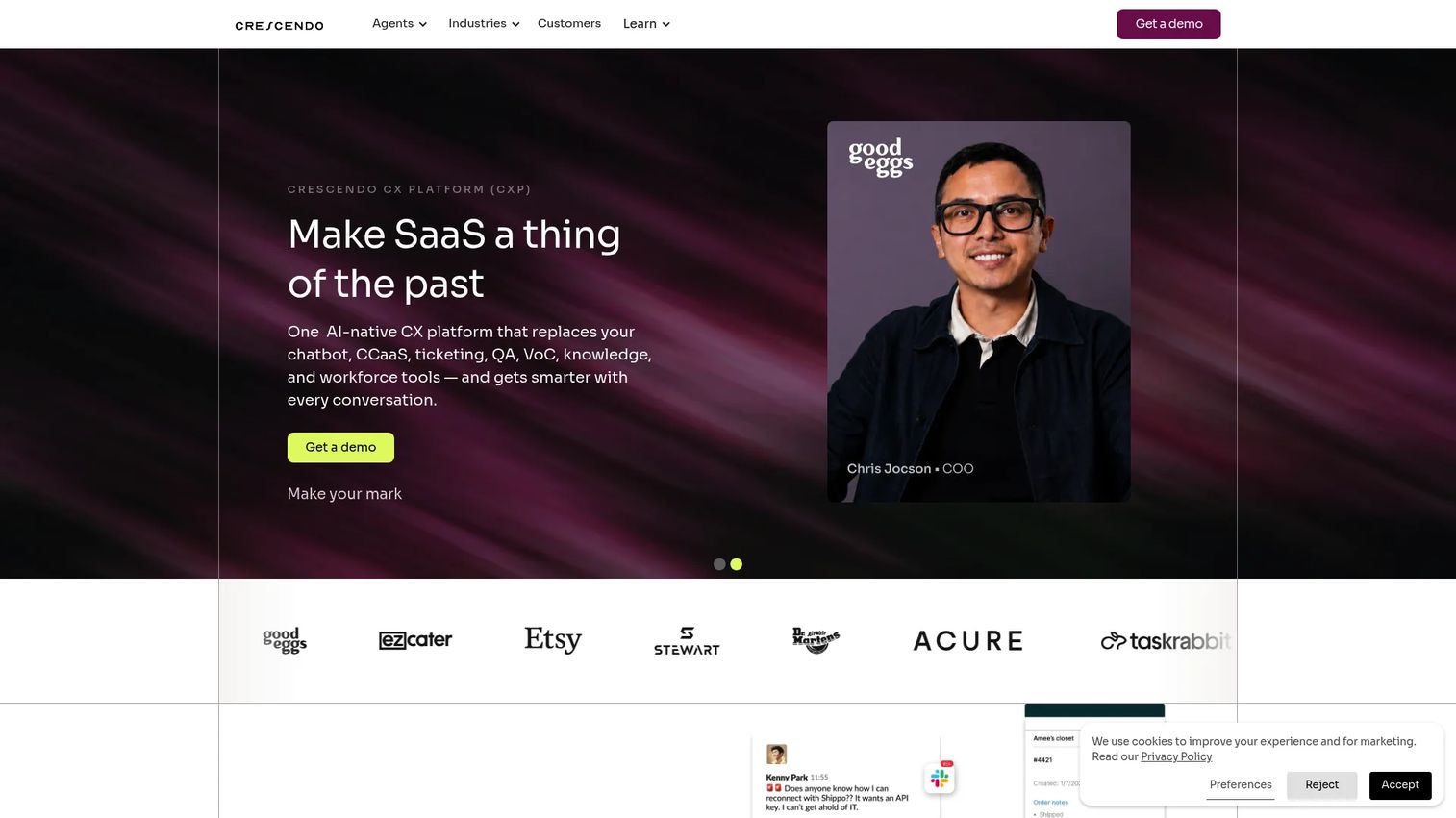
Crescendo is included here as a point of category clarity. Its product focuses on AI-managed customer support operations, not sales enablement.
Best for: Enterprise teams building AI-managed customer support operations with human oversight and outcome-based pricing.
What it is: Crescendo is an AI-native customer experience platform. It combines autonomous AI agents for voice, chat, email, and text with human escalation, quality scoring, agent assist, and operational insights. Pricing follows an outcome-based model.
Key features:
- Concierge Agent for multi-channel support with human handoff
- Quality Agent scoring every conversation
- Agent Assist real-time copilot for live specialists
- Applied Insights Agent for root-cause analysis
- Optimization and Knowledge Agents
Where Crescendo falls short: Crescendo does not cover sales content management, seller readiness, coaching, or buyer-facing deal collaboration. It is not a sales enablement platform by category and would not replace Showpad's sales-facing jobs.
Pricing: Outcome-based, starting at $1.25/resolution plus $2,900/month.
G2: 4.4
How it compares to Showpad: Crescendo is in a different category. Teams looking for Showpad replacement should evaluate other tools in this list.
10. Pitcher (sales enablement platform)
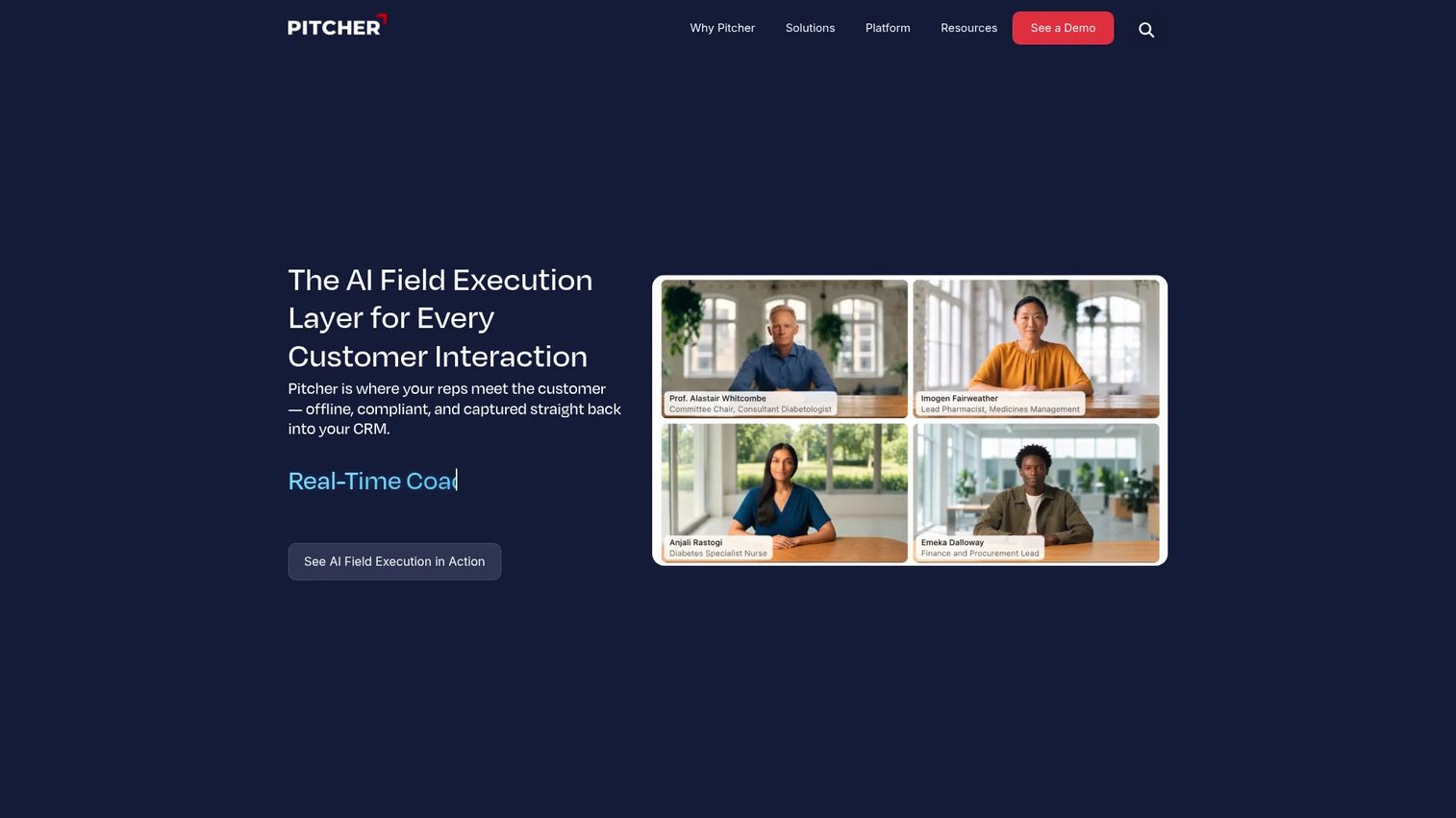
Pitcher's reputation comes from regulated industries. Life sciences, pharma, and financial services teams find it built for their content control and compliance requirements.
Best for: Commercial and field-sales teams in regulated industries that need guided selling, offline access, and CRM-integrated content control.
What it is: Pitcher is an AI-native sales enablement platform rated 4.4/5 on G2. It covers AI-guided selling with Next Best Action recommendations, offline field execution with CRM synchronization, dynamic content and presentation management, digital sales rooms, and AI-powered coaching.
Key features:
- AI-guided selling and Next Best Action recommendations
- Offline field execution with CRM synchronization
- Dynamic content and presentation management
- Digital Sales Rooms with automated follow-ups
- Closed-loop analytics across content, engagement, and performance
Where Pitcher falls short: G2 reviewers note that initial configuration and rollout in regulated environments can require significant IT and admin involvement. The platform's depth in compliance-driven industries adds setup complexity that general commercial teams may not need.
Pricing: Quote-based.
G2 rating: 4.4/5
How it compares to Showpad: Pitcher is the cleaner choice for regulated field-selling motions. Showpad covers similar ground, but Pitcher's compliance-oriented architecture makes it the stronger fit for life sciences and financial services teams.
11. GTM Buddy (revenue activation platform)
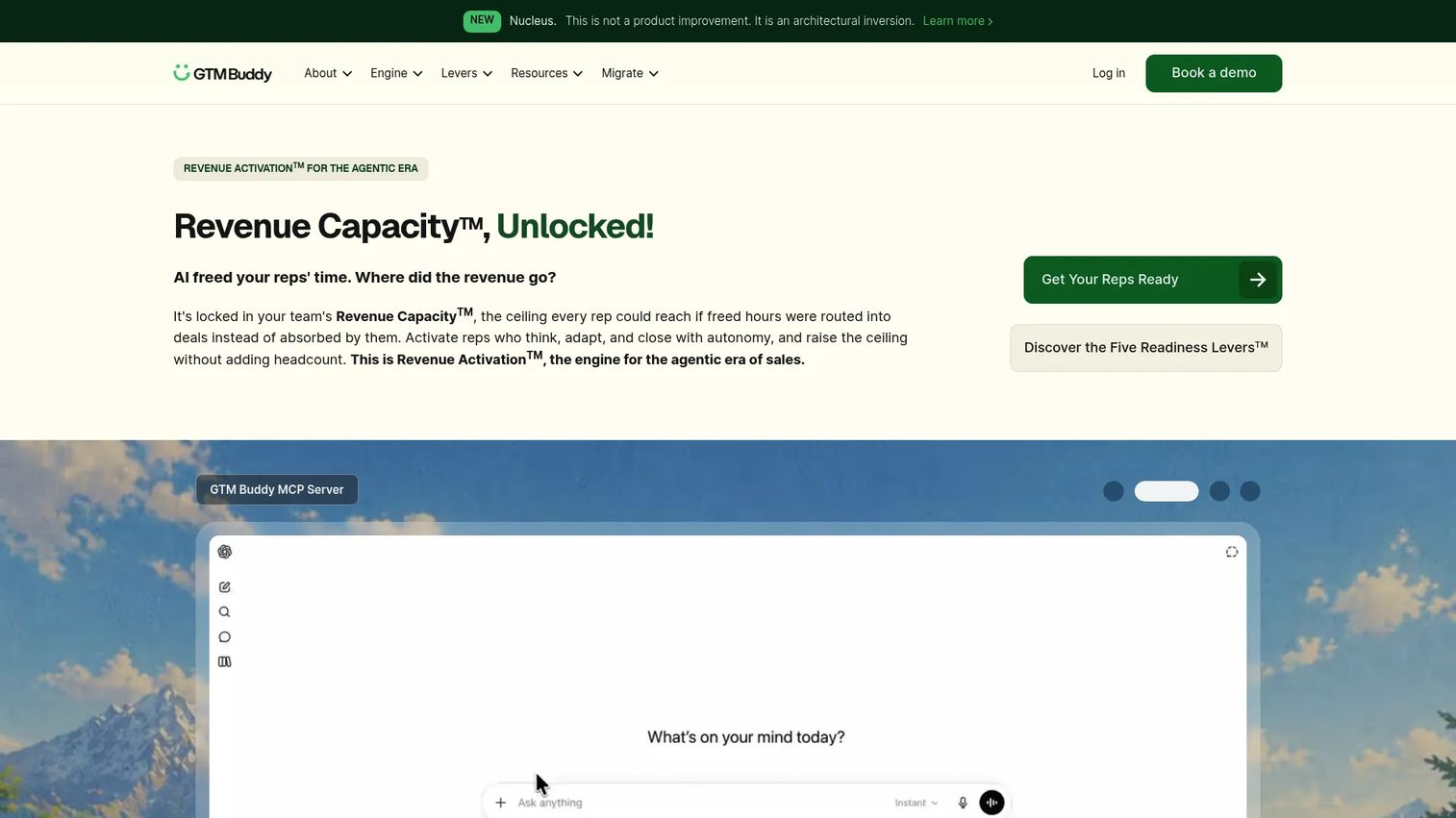
GTM Buddy solves the adoption problem from a different angle: Surface content and guidance inside the tools sellers are already in rather than asking them to open another portal.
Best for: B2B revenue teams where sellers ignore content portals and need enablement delivered inside CRM, email, and calendar workflows.
What it is: GTM Buddy is a revenue activation platform rated 4.8/5 on G2. It delivers AI-powered content and guidance through its Ask Buddy interface, digital sales rooms, AI roleplay, and in-flow support across CRM, email, Slack, and Microsoft Teams.
Key features:
- Ask Buddy AI for in-workflow content and guidance
- Digital sales rooms
- AI roleplay
- Content management with search, tagging, and version control
- Revenue performance insights and coaching dashboards
Where GTM Buddy falls short: G2 reviewers note that the platform's coverage of enterprise-scale content governance and formal learning programs is more limited than a full enablement suite. Teams running large-scale certification and onboarding programs may need to pair GTM Buddy with a dedicated readiness tool.
Pricing: Quote-based.
G2 rating: 4.8/5
How it compares to Showpad: GTM Buddy addresses a gap Showpad has not fully closed: In-workflow delivery. When rep adoption of content portals is the core problem, GTM Buddy's approach targets the root cause.
12. SalesHood (sales enablement and training platform)
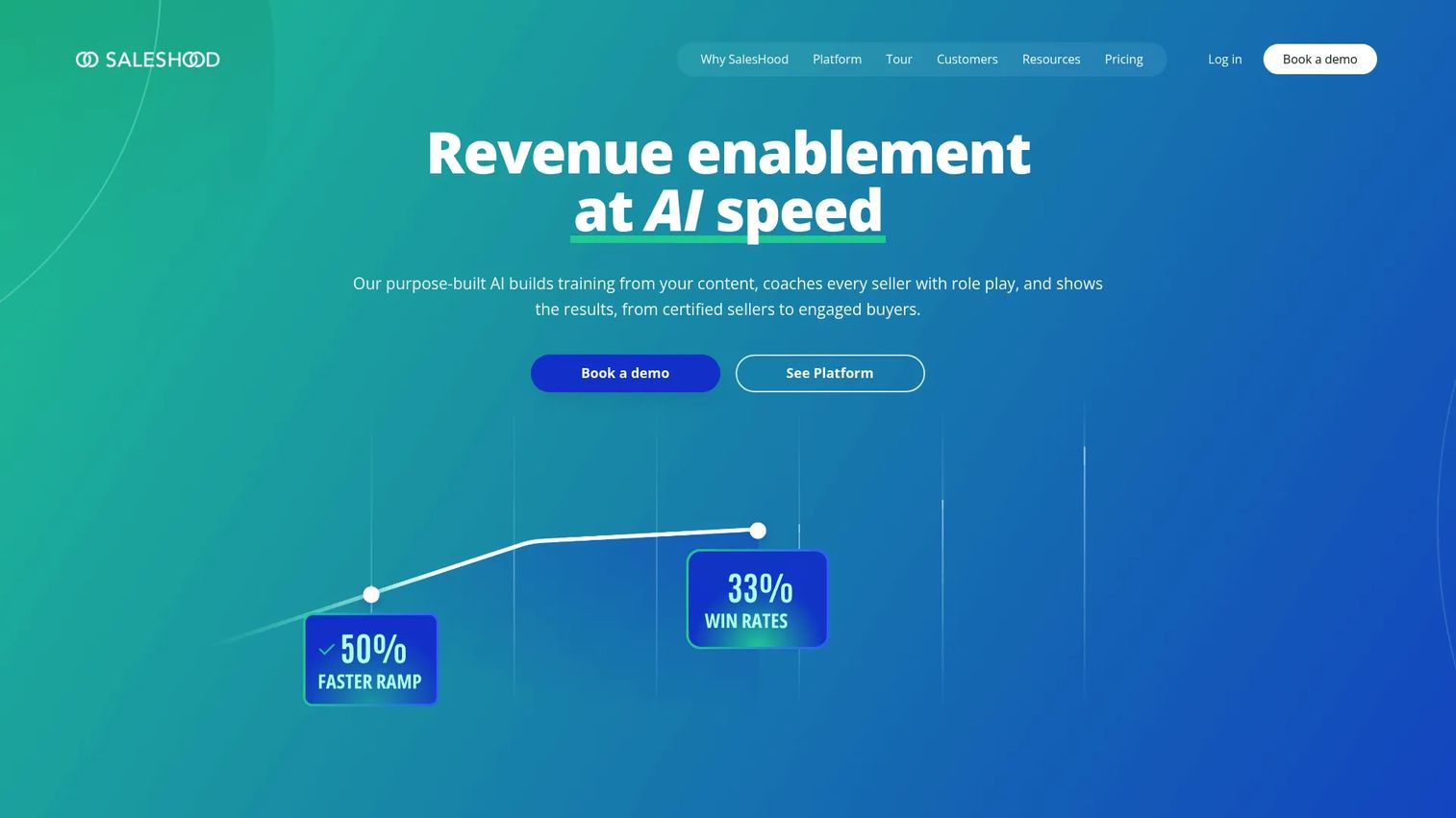
SalesHood is built for structured ramp programs. Teams that onboard cohorts of reps, run peer coaching, and track readiness by cohort find its structure maps well to those workflows.
Best for: Revenue teams that want structured onboarding programs, AI coaching, and readiness measurement as the primary enablement investment.
What it is: SalesHood is an agentic AI sales enablement platform rated 4.6/5 on G2. It covers centralized sales content management, training, onboarding, AI practice, digital sales rooms, and mutual action plans. Essential, Pro, and Unlimited editions are priced on request.
Key features:
- Structured onboarding and certification programs
- AI practice, coaching, and peer learning
- Centralized sales content management
- Digital sales rooms and mutual action plans
- Analytics across readiness, content, and revenue outcomes
Where SalesHood falls short: G2 reviewers note that the content management and content search experience is secondary to its readiness and coaching workflows. Teams that need a robust sales content repository as the primary job will find the balance different from Showpad's.
Pricing: Quote-based.
G2 rating: 4.6/5
How it compares to Showpad: SalesHood replaces Showpad's readiness job more fully than its content job. Teams running formal onboarding programs for growing sales teams will find SalesHood's structure a close fit.
13. Accent (revenue enablement platform)
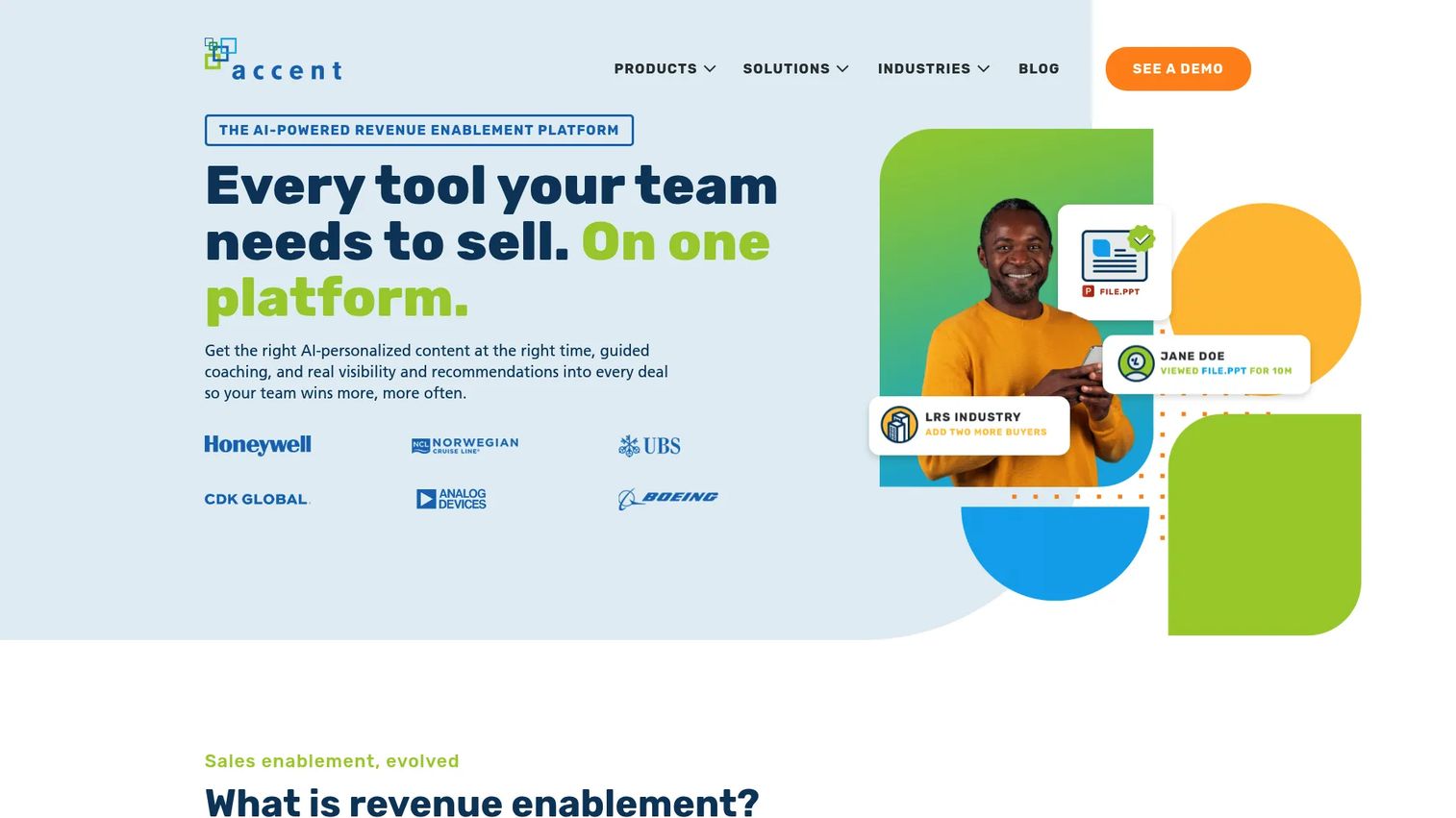
Accent combines AI-powered selling guidance with content governance and rep readiness in a tightly integrated platform. Its differentiator is deal-level intelligence surfaced alongside enablement content.
Best for: Enterprise revenue teams that want AI-guided selling, content governance, and pipeline intelligence in one place.
What it is: Accent is an AI-powered revenue enablement platform rated 4.4/5 on G2. It covers an AI knowledgebase, content management with automated asset retirement, guided selling with next-best-action recommendations, sales management with pipeline and forecasting insights, and learning paths with pitch practice.
Key features:
- AI knowledgebase for product, service, account, and pipeline questions
- Content management with governance and automated retirement of outdated assets
- Guided selling with deal prioritization and drafted follow-up emails
- Sales management with opportunity health and forecasting insights
- Learning paths, certifications, pitch practice, and coaching
Where Accent falls short: G2 reviewers note limited data points given the platform's review presence on G2. Teams evaluating Accent should request references from accounts comparable in size and sales motion.
Pricing: Quote-based.
G2 rating: 4.3/5
How it compares to Showpad: Accent spans similar jobs but adds deeper deal-guidance intelligence. Teams where sales management visibility and rep guidance need to live alongside content and training may find Accent's integration of those layers compelling.
14. ClearSlide (sales engagement platform)
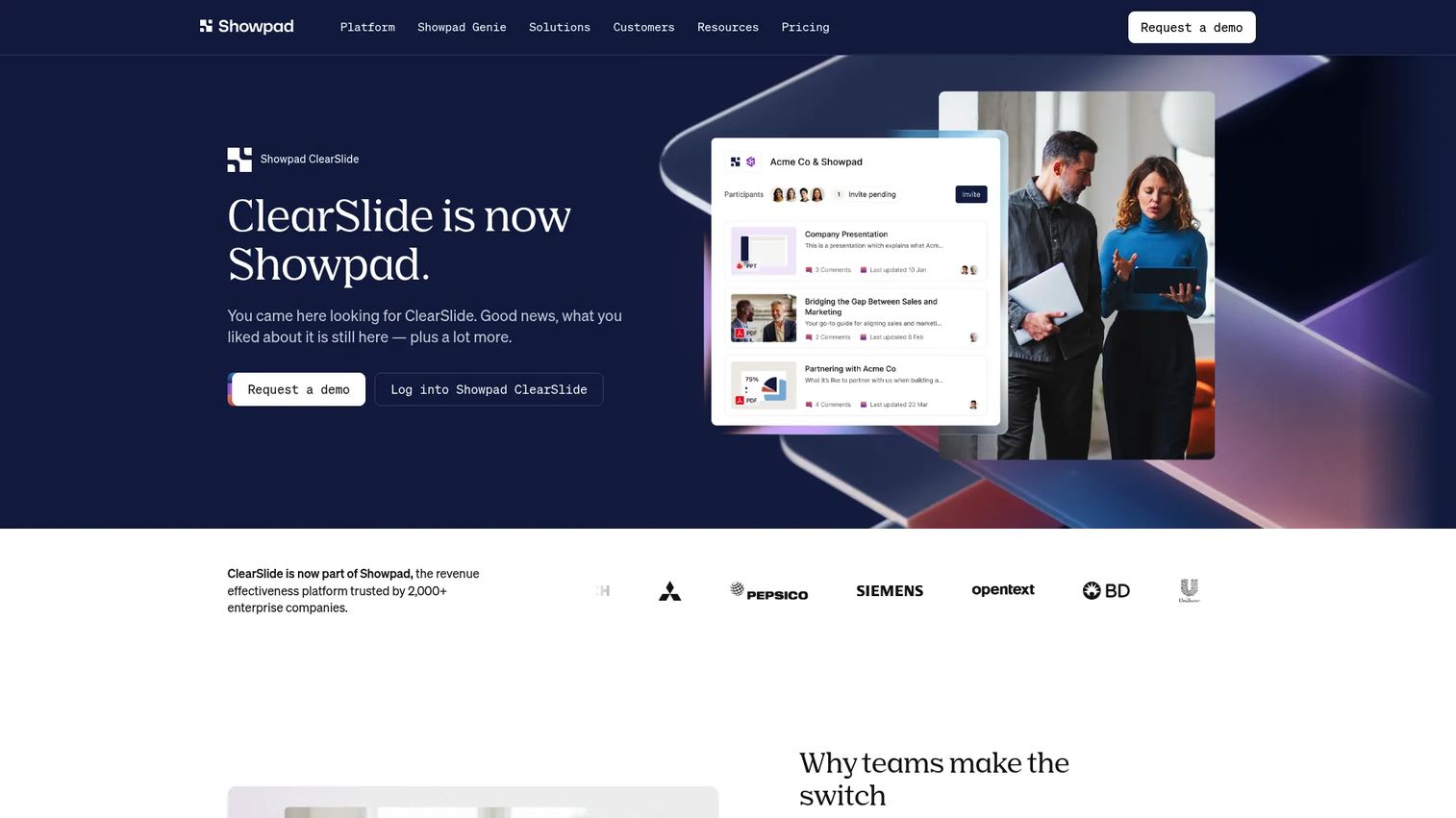
ClearSlide sits in the sales engagement space: Online presentations, screen sharing, and engagement analytics rather than a full enablement suite.
Best for: Enterprise sales teams that need centralized content, integrated communications for live presentations, and buyer engagement tracking.
What it is: ClearSlide is a sales engagement and presentation platform. It covers a sales and marketing content hub, integrated meeting and screen-sharing tools, real-time engagement analytics, rules-based guided selling, and performance replay for coaching.
Key features:
- Sales and marketing content hub
- Integrated communications: Online meetings, email, screen sharing
- Real-time engagement analytics
- Rules-based guided selling and content recommendations
- Replay recordings and performance dashboards
Where ClearSlide falls short: Teams should request current references and confirm the product's active development status before including it in a shortlist.
G2 rating: 4.4/5
How it compares to Showpad: ClearSlide covers sales presentation and engagement analytics rather than the full content, coaching, and readiness scope of Showpad. It addresses a narrower set of jobs.
15. Veelo (sales enablement platform)
Veelo's current public presence is limited. Teams considering it should request direct product demonstrations and confirm active development before evaluation.
Best for: Teams seeking a lightweight content enablement layer, pending confirmation of current product scope and availability.
What it is: Based on available public information, Veelo was positioned as a sales enablement platform for content access, guided selling, and training support. Current product status and feature set could not be confirmed from live sources.
Key features:
- Content access and delivery
- Guided selling support
- Training and analytics
Where Veelo falls short: Public product information is limited. Teams should treat Veelo as a research item requiring vendor engagement before formal evaluation.
G2: 4.7
How it compares to Showpad: Veelo is narrower in scope. Its placement on this list reflects search market positioning; teams should validate current capabilities directly with the vendor.
16. SharePoint (document management platform)
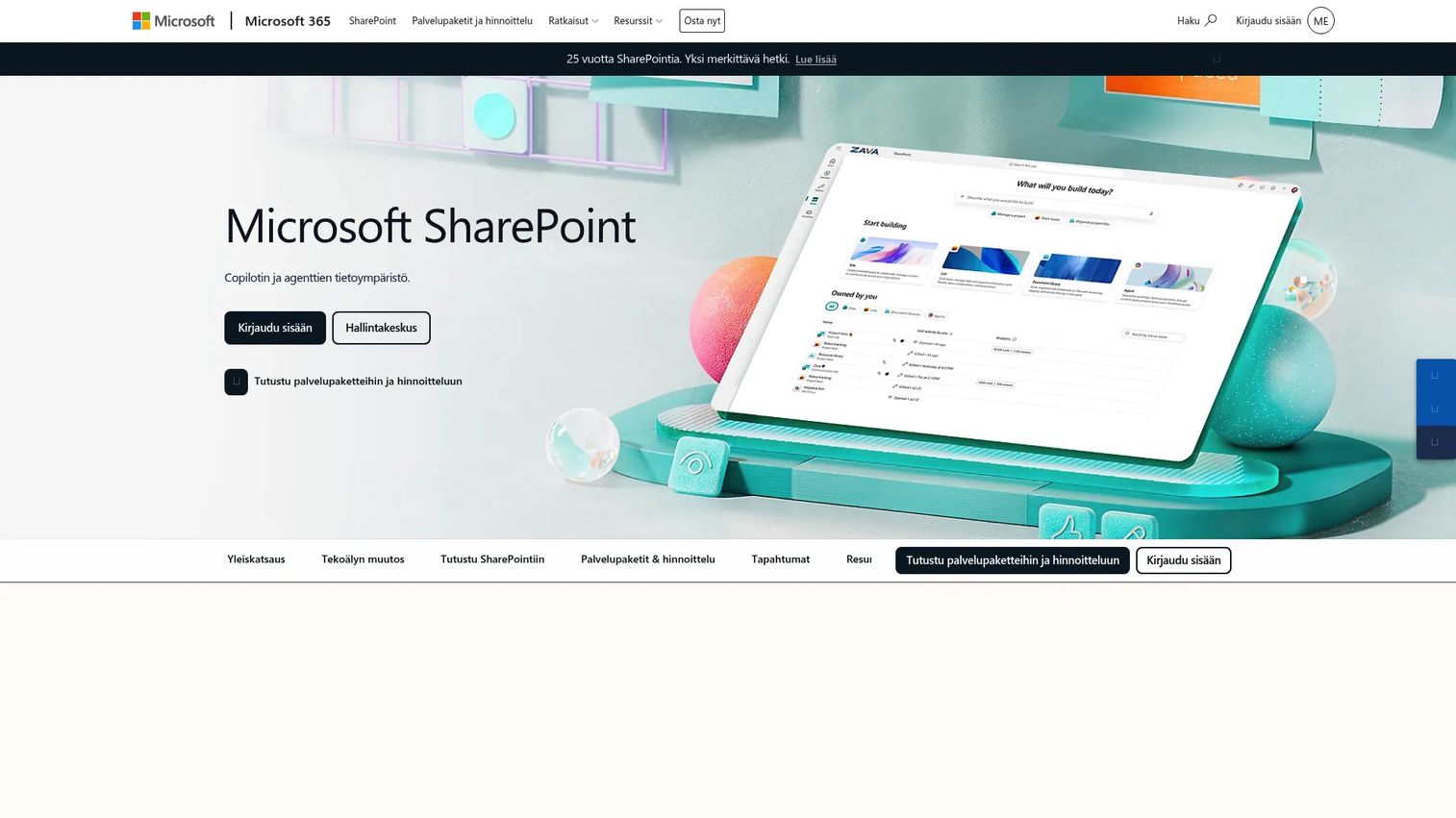
SharePoint may already be part of the Microsoft 365 stack for many teams. It handles document governance, not seller readiness or buyer engagement.
Best for: Microsoft-based organizations that need governed document storage, permissions, and content libraries without buying a purpose-built enablement platform.
What it is: Microsoft SharePoint is a collaboration and content management platform rated 4.0/5 on G2. It covers secure file sharing, document libraries with versioning and access control, communication and team sites, search, and Microsoft Lists.
Key features:
- Secure file sharing and real-time coauthoring
- Document libraries with versioning and access control
- Communication and team sites
- Search and discovery of organizational content
- Integration with Microsoft 365 apps
Where SharePoint falls short: SharePoint does not provide seller readiness programs, coaching scorecards, digital sales rooms, or buyer engagement analytics. Using it as a Showpad replacement means managing training, coaching, and buyer-facing content separately.
Pricing: SharePoint Plan 1 is $5/user/month, billed annually. Microsoft 365 Business Standard (which includes SharePoint) is $12.50/user/month. A no-Teams variant is $9.29/user/month.
G2 rating: 4.0/5
How it compares to Showpad: SharePoint is a document governance tool. It replaces the content storage layer but not the readiness, coaching, or buyer engagement layers of Showpad.
17. Google Drive (cloud storage platform)
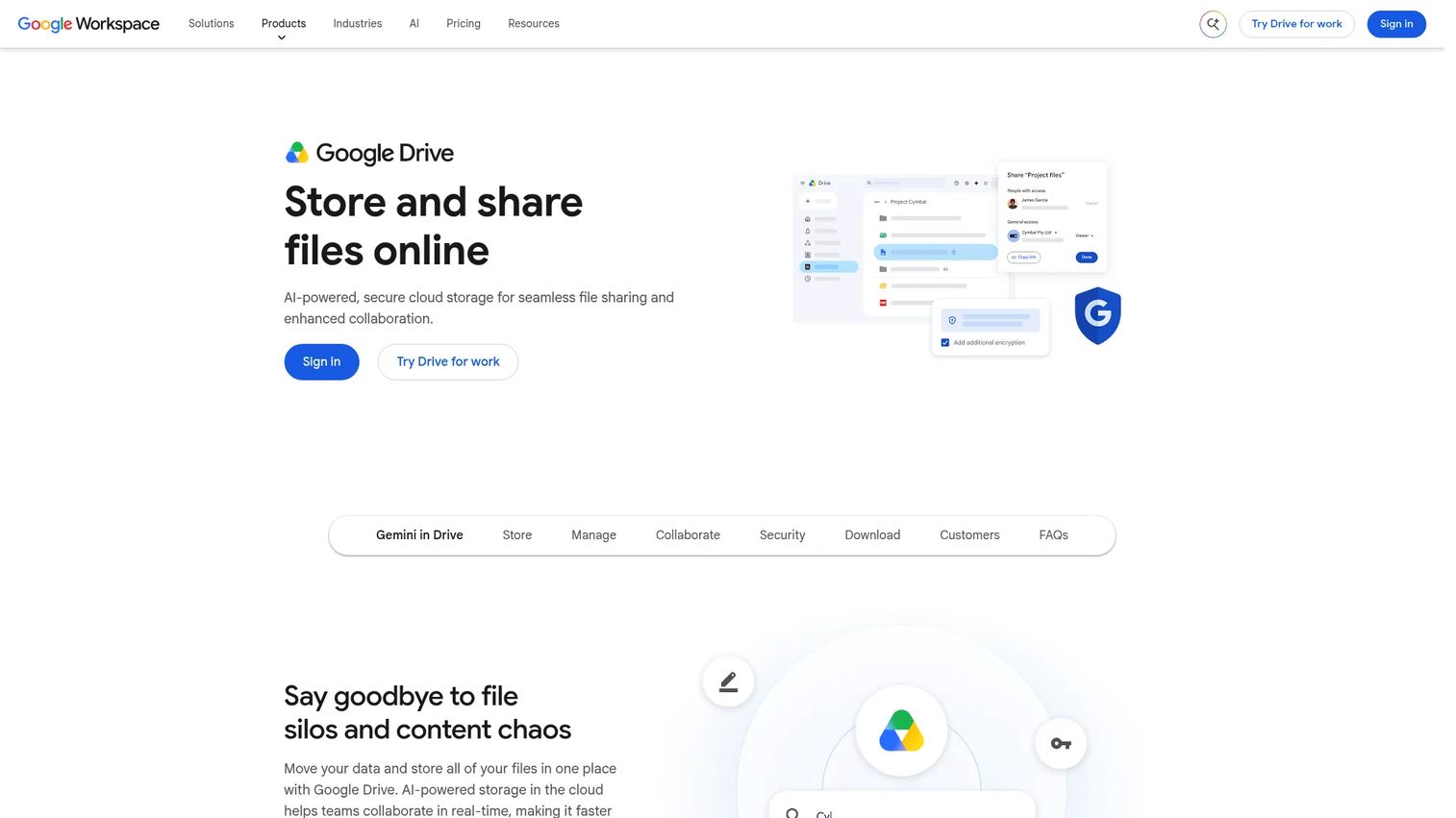
Google Drive is often the path-of-least-resistance storage layer for teams already using Google Workspace. It is not a sales enablement platform.
Best for: Google Workspace teams that need cloud file storage, real-time collaboration, and shared asset access without additional tooling.
What it is: Google Drive is an AI-powered cloud storage service. It supports cloud storage and file sharing, real-time editing of Docs, Sheets, Slides, and PDFs, AI-powered search with Gemini, shared drives with access controls, and desktop file synchronization.
Key features:
- Cloud storage and sharing
- Real-time collaborative editing
- Gemini AI search
- Shared drives and permission controls
- Drive for desktop sync
Where Google Drive falls short: Google Drive provides no seller onboarding, coaching, readiness measurement, or buyer engagement features. Teams that need enablement workflows will need to build or buy those layers separately.
Pricing: Free for personal accounts. Google Workspace Starter is $7/user/month. Standard is $14/user/month. Plus is $22/user/month.
G2: 4.5
How it compares to Showpad: Drive replaces only the file storage layer. Every other Showpad job, readiness, coaching, buyer engagement, and analytics, requires a separate tool or build.
18. OneDrive (cloud storage platform)
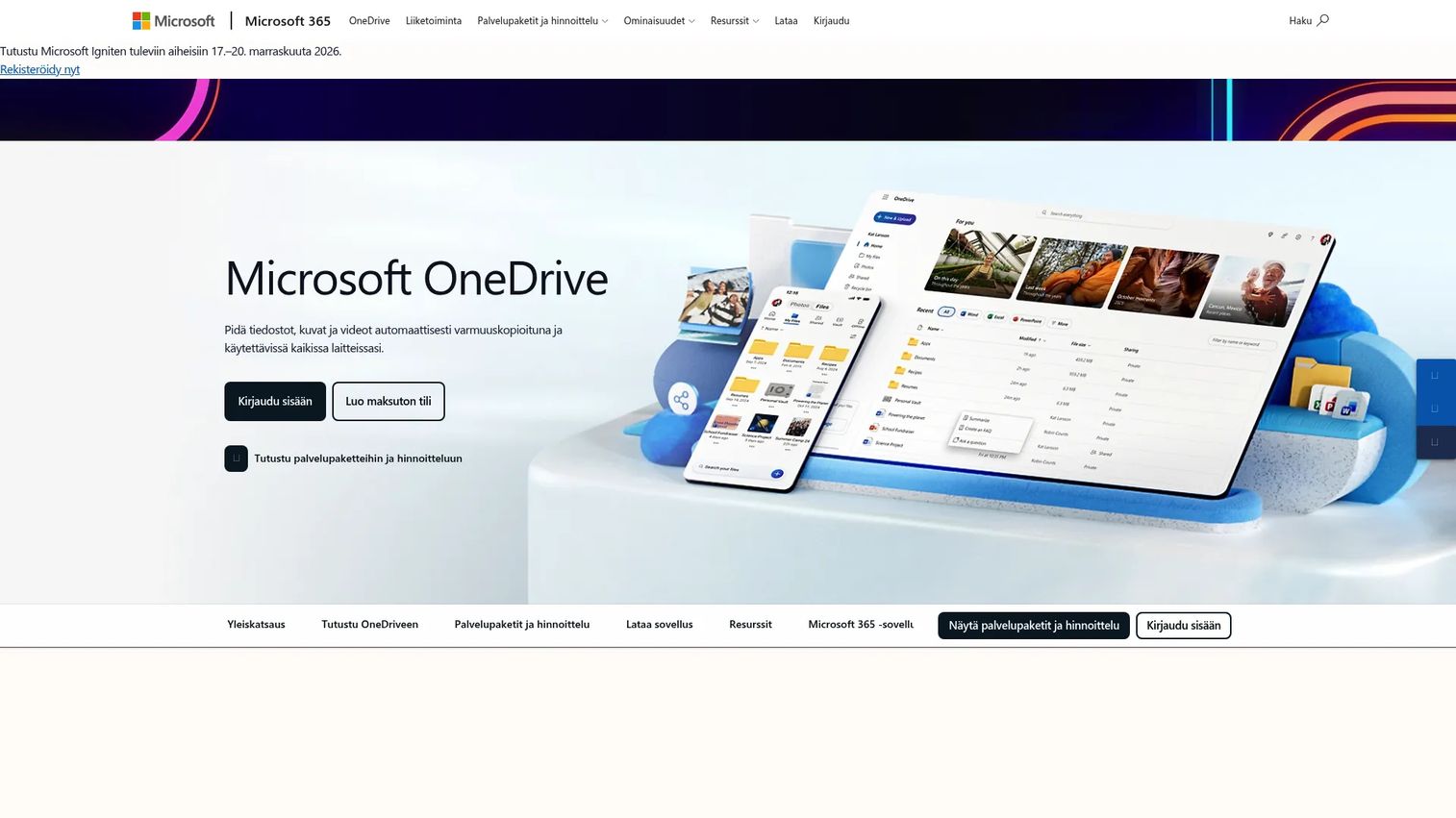
OneDrive is Microsoft's individual file storage product. Like SharePoint, it is infrastructure rather than an enablement platform.
Best for: Microsoft-based teams that need individual cloud storage, file sync, and mobile file access integrated with Microsoft 365.
What it is: OneDrive is Microsoft's cloud storage service rated 4.3/5 on G2. It covers file and photo backup, real-time collaboration, file sharing with access controls, ransomware protection, and Microsoft 365 integration.
Key features:
- Cloud file backup and sync
- Real-time collaborative editing
- Sharing controls and version history
- Personal Vault for sensitive content
- Mobile access and offline files
Where OneDrive falls short: OneDrive does not provide sales training, coaching, buyer engagement tools, or enablement analytics. It is personal storage with sharing capabilities, not a sales enablement platform.
Pricing: Free plan includes 5 GB. Microsoft 365 Basic is $19.99/year. Personal is $99.99/year. Family is $129.99/year.
G2 rating: 4.3/5
How it compares to Showpad: OneDrive handles individual file access. Teams looking to replace Showpad's enablement functions will need to combine OneDrive with dedicated tools for training, content governance, and buyer engagement.
19. Box (cloud content management platform)
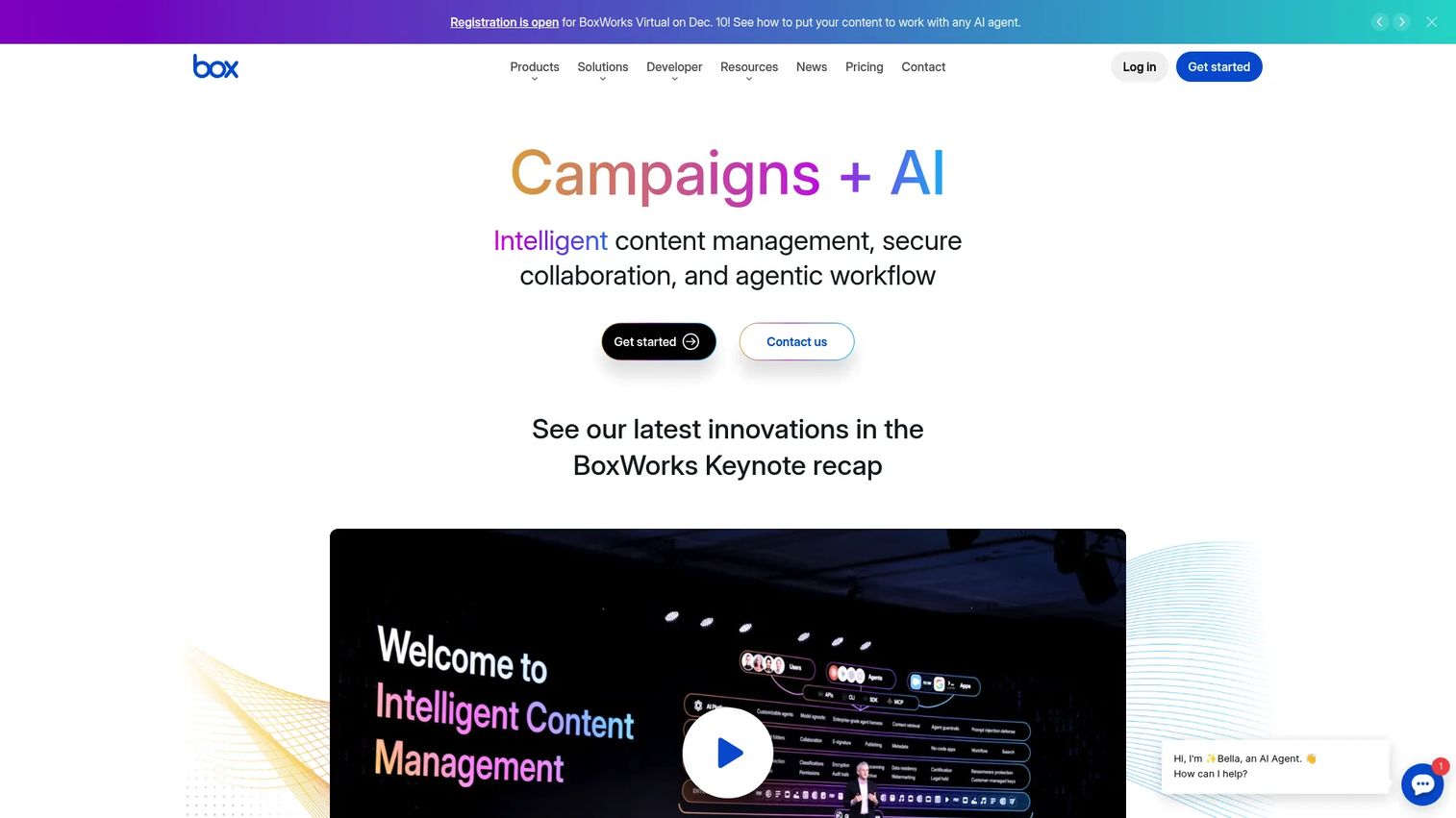
Box goes further than basic cloud storage. Its governance, security, and workflow automation features make it a credible enterprise content repository.
Best for: Enterprises that need secure content storage, compliance controls, workflow automation, and external sharing with strong governance.
What it is: Box is an AI-powered intelligent content management platform rated 4.3/5 on G2. It covers secure content management, Box AI for content insights and workflow automation, threat detection and compliance controls, native e-signatures with Box Sign, and integrations with more than 1,500 applications.
Key features:
- Secure content management and sharing
- Box AI for content insights and workflow automation
- Security, compliance, and threat detection
- Native e-signatures with Box Sign
- Extensive third-party integrations
Where Box falls short: Box does not cover seller readiness, coaching, or buyer engagement out of the box. Teams replacing Showpad's full scope would need to pair Box with dedicated enablement and readiness tooling.
Pricing: Free Individual plan available. Business Starter is $5/user/month (minimum 3 users). Business is $15/user/month. Business Plus is $25/user/month. Enterprise is $35/user/month. Enterprise Plus is $50/user/month on annual billing.
G2 rating: 4.3/5
How it compares to Showpad: Box is the strongest content governance option in the repository category. For teams replacing only Showpad's content storage and external sharing jobs, Box is worth evaluating. For teams replacing the full platform, it needs to be part of a wider stack.
20. Salesforce (CRM platform)
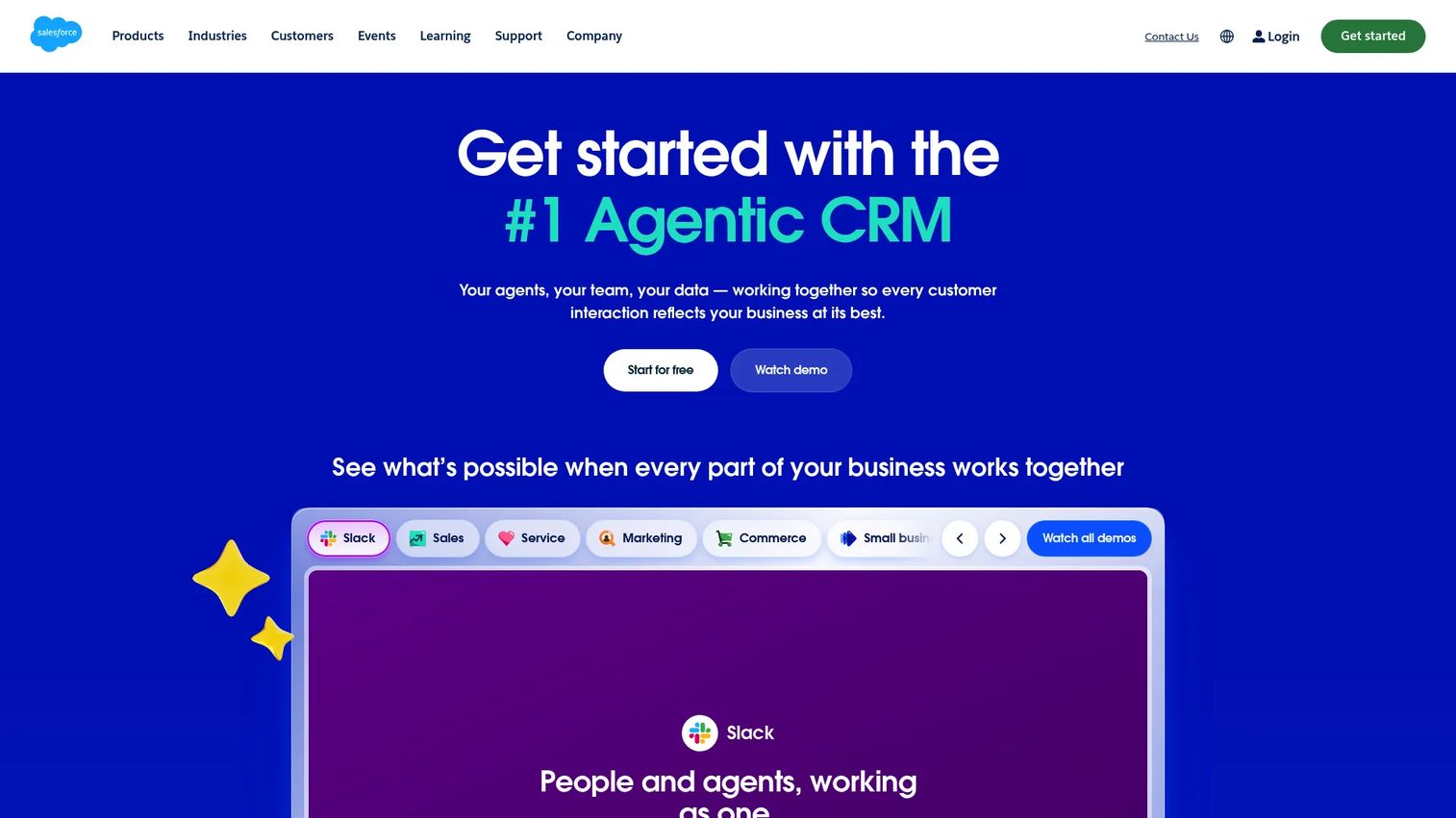
Salesforce is the system of record for most revenue teams. Its own Sales Cloud includes some enablement-adjacent features, but it is a CRM platform, not a sales enablement suite.
Best for: Organizations that want enablement activity tied directly to CRM workflows and pipeline reporting.
What it is: Salesforce is an AI-powered CRM platform rated 4.4/5 on G2 (Sales Cloud). It covers lead, account, contact, and opportunity management, quoting and forecasting, workflow automation, AI agents, and the AppExchange ecosystem.
Key features:
- Lead, account, contact, and opportunity management
- Sales quoting and forecasting
- Workflow automation and customization
- AI agents and automation
- AppExchange ecosystem for extensions and integrations
Where Salesforce falls short: Salesforce is not a standalone Showpad replacement. It does not natively cover a sales content library with governance, structured rep onboarding programs, coaching scorecards, or buyer-facing Shared Spaces. Teams build or buy those layers via AppExchange.
Pricing: Free Suite at $0/user/month. Starter Suite is $25/user/month, billed monthly or annually. Pro Suite is $100/user/month, billed annually. Core is $195/user/month. Advanced is $395/user/month. Max is $550/user/month.
G2 rating: 4.4/5
How it compares to Showpad: Salesforce works best as the system of record into which enablement signals flow, not as a Showpad replacement on its own. Teams that want CRM-native guidance can explore enablement-layer apps in AppExchange.
Which Showpad alternative is best for interactive internal training?
Guideflow is the top pick when the job is interactive software training, rep onboarding, process SOPs, and product education.
Static PDFs and slide decks require reps to read and remember. Interactive demos let them click through the actual workflow at their own pace. For new hire onboarding, CRM process training, product launch enablement, RevOps workflow documentation, or customer education, Guideflow's capture-once-and-share model means one created asset serves many sessions without rebuild. Teams running Guideflow alongside a full enablement platform use it to cover the procedural, software-specific training jobs that static assets handle poorly.
Which Showpad alternative is best for enterprise sales enablement?
Seismic and Highspot are the strongest fits when the job is a full enterprise platform replacement.
Seismic covers the widest revenue enablement scope: Content, learning, coaching, digital sales rooms, and analytics operations. Highspot narrows to content governance, sales plays, and rep adoption measurement, with strong Salesforce and Microsoft integrations. Teams migrating from Showpad at enterprise scale should run Seismic and Highspot in a parallel evaluation, paying particular attention to implementation requirements, admin resourcing, and CRM integration depth during discovery.
What is the best Showpad alternative for sales coaching and readiness?
Mindtickle, Allego, and SalesHood are the right shortlist when readiness and coaching are the primary jobs.
Mindtickle goes deepest on structured certification and skill development. Allego adds video-based coaching and conversation intelligence. SalesHood is designed around structured onboarding cohorts and peer learning. When teams want interactive software training alongside any of these platforms, Guideflow pairs well: It covers the procedural and product education layer those platforms do not specialize in.
Which Showpad alternative is best for field sales and offline access?
Showell, Pitcher, and Bigtincan are purpose-built for field-selling motions.
Showell focuses on branded content delivery and offline access for dealer networks and field teams. Pitcher is the choice for regulated industries like life sciences and financial services, where guided selling and content compliance controls are non-negotiable. Bigtincan adds mobile-first content, readiness, and digital sales rooms for enterprise field organizations. For these use cases, a broad platform like Showpad often carries capabilities the field team never uses.
What is the cheapest Showpad alternative?
The least expensive starting point is usually a tool already in the stack.
Google Drive has a free personal tier and Google Workspace starting at $7/user/month. OneDrive includes 5 GB free and Microsoft 365 Basic at $19.99/year. SharePoint Plan 1 is $5/user/month. Box Business Starter starts at $5/user/month. All four provide content storage but no enablement workflows.
For teams that need interactive product education alongside low-cost storage, Guideflow has a free plan. Paid plans start at $35/user/month on annual billing. That combination, a document repository for file governance plus Guideflow for interactive training and product education, can cover several of Showpad's jobs at a lower total cost than a full enterprise enablement suite.
When should you stay with Showpad?
Switching from Showpad is worth its cost and risk only when a specific job is genuinely broken.
If the team has adopted the platform deeply, content is current, coaching is running, and buyers engage with Shared Spaces, the case for switching rests on price or a job Showpad is not performing. Renewal pressure alone is not a reason to migrate.
Showpad's scope also works against switching when multiple jobs are involved. Replacing content, readiness, coaching, and buyer engagement in one platform requires either a like-for-like suite or a stack of specialists. The migration effort is real, particularly for content libraries built over several years.
If the primary problem is governance, findability, or admin complexity, those may be solvable within Showpad before switching.
Why teams switch from Showpad to Guideflow
Showpad manages content, coaching, and buyer spaces. Guideflow produces interactive demos that reps and buyers click through at their own pace. Those are complementary jobs, not competing ones, and many enablement teams run both.
The switch happens when the team recognizes that static assets, PDFs, decks, and recorded videos, are not covering the procedural and software-specific training jobs. New hires reading a document about how to log a deal in Salesforce is a different experience from clicking through the workflow step by step. Guideflow covers the gap between documentation and doing.
Sales enablement managers use Guideflow's interactive demo capabilities to build guides for rep onboarding, internal process rollouts, product launch enablement, and customer education. The same platform covers buyer-facing use cases: Sales follow-up, demo leave-behinds, and self-serve product exploration for multi-stakeholder buying committees. With more than 500,000 guideflows created and a demo ready in about two and a half minutes, the production cycle for new training material is short enough to keep pace with product releases.
One boundary to keep in view: Guideflow is not a sales content repository, an LMS with SCORM certification, or a coaching scorecard platform. Teams that need those jobs covered will pair Guideflow with a dedicated tool.
Start your journey with Guideflow today!
Frequently asked questions: Showpad alternatives
The best alternative depends on the job you are replacing. Guideflow is the top pick for interactive internal training, rep onboarding, SOPs, and self-serve product education. Seismic or Highspot are the right choice for a full enterprise platform replacement. Mindtickle or Allego serve teams where readiness and coaching are the primary investment.
Guideflow fits when the team needs interactive step-by-step guides for employee onboarding, software process training, and product education. Teams capture a workflow once and share it as a clickable interactive demo, which produces materially higher engagement than static documentation for procedural learning.
Seismic and Highspot are the strongest purpose-built content management options. For teams already in the Microsoft ecosystem, SharePoint and OneDrive handle document governance but require separate enablement tooling for training and buyer engagement. Showell and Crescendo.ai address content access in field selling contexts.
Google Drive has a free personal plan. Guideflow has a free plan. OneDrive includes 5 GB free with a Microsoft account. Box has a free Individual plan. Each covers file storage rather than the full Showpad scope. Guideflow's free plan covers interactive product education; it does not replace a full sales enablement suite.
A document repository already in your stack, SharePoint, Google Drive, or OneDrive, is the cheapest starting point for content storage. For interactive training and product education, Guideflow's paid plans start at $35/user/month on annual billing. Full enterprise enablement suites from Seismic, Highspot, Mindtickle, and similar vendors are quote-based and typically significantly higher.
Prioritize content migration scope, CRM integration depth, training and certification requirements, buyer engagement features, and analytics reporting. Also evaluate implementation time and the admin resources needed to run the new platform. Governance, particularly versioning, ownership, and expiration rules for content assets, is frequently underweighted in evaluations and becomes a friction point post-migration.
Interactive demos replace static SOPs, software training documentation, and buyer-facing product education assets. They do not replace a sales content repository, a formal LMS with certification, or a coaching scorecard system. For enablement managers, interactive demos are a production format for procedural and product knowledge, not a full platform replacement.
Choose a full platform when content, training, coaching, and buyer engagement must share data and live under one governance model. Choose a specialist when the pain is narrower: Internal software training, field content delivery, or cloud content governance each has purpose-built tools that outperform a broad platform on that specific job. A hybrid approach, combining a focused interactive guide tool with a lightweight content repository, often costs less and deploys faster than a second full suite.