You're not buying eDiscovery software because search is hard. You're buying it because one bad collection, one missed privilege call, or one production error changes the cost and risk profile of a matter permanently.
Global eDiscovery software spending reached $6.67 billion in 2025 and is projected to hit $10.95 billion by 2030, growing at a 10.41% CAGR according to ComplexDiscovery (2026). That growth reflects a straightforward reality: Legal teams are collecting more electronically stored information from more systems, while review timelines keep shrinking and buyer committees keep asking harder security questions.
For presales teams supporting legal tech evaluations, this matters directly. Buyers in this category need to see real workflow evidence, not feature lists. They want to watch data move from collection through production, understand how AI suggestions connect to source documents, and confirm that audit trails satisfy counsel. This guide gives you the shortlist to work from.
What's inside
This guide compares 15 eDiscovery software tools for 2026. Tools were selected based on lifecycle coverage, AI and analytics depth, security posture, integration breadth, review workflow quality, and pricing transparency. It is written for legal teams, litigation support professionals, compliance and IT stakeholders, and presales teams supporting technical validation.
- Tools for corporate legal teams, law firms, and public-sector organizations
- Platforms covering litigation, investigations, and regulatory response
- Evaluation criteria across collection, processing, review, security, and production
- Pricing and G2 ratings sourced from vendor pages and live G2 listings
TL;DR
- Best for cloud-first legal teams: Logikcull, for fast matter setup, approachable cloud review, and usage-based pricing at $40/GB/month
- Best for enterprise-scale review: RelativityOne (now rebranded as Relativity aiR), for large matters, AI-assisted review, and complex data handling
- Best for corporate legal collaboration: Everlaw, for cloud review, investigation support, and trial preparation
- Best for Microsoft 365 environments: Microsoft Purview eDiscovery, for teams already standardized on Microsoft data and compliance workflows
- Best for AI-led review: Reveal Enterprise, for analytics-heavy matters and investigation support
- Best for legal governance programs: Exterro Data Risk Management Platform, for teams connecting eDiscovery with data risk, privacy, and legal hold
What is eDiscovery software?
eDiscovery software helps legal and compliance teams identify, preserve, collect, process, review, analyze, and produce electronically stored information for litigation, investigations, and regulatory matters.
Electronic discovery software sits at the intersection of legal process and data management. It is purpose-built for defensibility, matter workflows, chain of custody, and production requirements. It is not general document storage, backup, or knowledge management.
Core capabilities to look for:
- Identification and preservation of potentially relevant data
- Legal hold management, custodian notifications, and tracking
- Data collection from custodians and enterprise systems
- Processing, deduplication, and de-NISTing
- Search, filtering, and analytics across document sets
- Document review, tagging, and quality control
- Privilege review and redaction
- Production and export in required formats
- Audit logs, chain of custody, and defensibility controls
Electronically stored information (ESI) includes:
- Email and calendar data
- Office documents and PDFs
- Chat and collaboration messages (Teams, Slack, WhatsApp)
- Cloud storage files
- Databases and structured data
- Audio and video files
- Mobile device data
- Data from enterprise platforms and SaaS applications
According to eDiscovery Today's 2025 State of the Industry Report, 37.5% of professionals encounter mobile-device data in most or all cases, and 39.2% do so for collaboration-app data. Any platform shortlist that ignores modern data sources will fail the collection stage.
The category boundary is important. Legal e-discovery software builds matter workflows with defensible chain of custody. General document management tools do not.
When to use eDiscovery software
Manage litigation document review
Litigation teams use electronic discovery platforms to collect, process, search, review, and produce evidence for active matters. The workflow runs from legal hold through production, and every step needs an audit trail. Presales teams validating these platforms should ask to see review batching, privilege tagging, redaction, and production export in a single test matter rather than evaluating features in isolation.
Support investigations and regulatory requests
Internal investigations, subpoenas, government audits, and regulatory responses all create urgent data-collection requirements with short timelines. eDiscovery legal software with strong legal hold, custodian tracking, and defensible collection workflows shortens the gap between a request and a defensible response. Ask vendors how they handle scope changes mid-matter.
Collect data from modern systems
Legal teams now regularly need data from Microsoft 365, Google Workspace, Slack, Teams, mobile devices, and cloud repositories. Native connectors matter: Services-led collection adds cost and introduces handoff risk. Before signing, list every data source your organization uses and confirm whether each connector is native or requires a third-party services engagement.
eDiscovery software comparison
The table below gives a quick orientation across 15 platforms. Buyers should validate deployment model, data source coverage, security documentation, and total matter cost during evaluation. Pricing and G2 ratings reflect verified sources as of November 2026.
| # | Product | Best for | Key differentiator | Pricing | G2 rating |
|---|---|---|---|---|---|
| 1 | Logikcull | Cloud-first legal teams | Fast matter setup, usage-based pricing | From $40/GB/month | 4.7/5 |
| 2 | RelativityOne | Enterprise review at scale | AI-assisted review, analytics, end-to-end workflow | Custom pricing | N/A |
| 3 | Everlaw | Corporate legal and law firms | Collaborative cloud review and trial preparation | Custom pricing | 4.7/5 |
| 4 | Microsoft Purview eDiscovery | Microsoft 365 organizations | Native Microsoft data coverage | From $20/GB/month (Premium) | 4.4/5 |
| 5 | Reveal Enterprise | AI-led review teams | Analytics, AI, and multi-deployment options | Custom pricing | 4.2/5 |
| 6 | DISCO | Law firms and litigation teams | Cloud review with AI and legal workflow tools | Custom pricing | 4.6/5 |
| 7 | Casepoint | Enterprise and government teams | FedRAMP High, end-to-end discovery with AI | Custom pricing | 4.7/5 |
| 8 | Exterro Data Risk Management Platform | Legal governance teams | Legal hold, data risk, 190+ connectors | Custom pricing | 4.4/5 |
| 9 | OpenText Axcelerate | Large enterprise matters | GenAI review, 45+ connectors, multi-deployment | Custom pricing | 4.5/5 |
| 10 | Nuix Discover | Investigation-heavy teams | Semantic search, AI clustering, continuous active learning | Custom pricing | 3.5/5 |
| 11 | CloudNine LAW | Litigation support teams | On-premise processing, 4,800+ file types | Custom pricing | 4.4/5 |
| 12 | Arctera eDiscovery Platform | Enterprise discovery operations | Searchable archive-based review, InsightAI assistant | Custom pricing | 4.5/5 |
| 13 | OpenText eDiscovery | Enterprise legal departments | GenAI Aviator, end-to-end lifecycle, visual analytics | Custom pricing | N/A |
| 14 | Veritas eDiscovery Platform | Archive-connected enterprise discovery | Legal hold through production, capacity-based licensing | Custom pricing | N/A |
| 15 | Nebula | Hosted review teams | AI analytics, predictive coding, RelativityOne promotion path | Custom pricing | 4.0/5 |
Best 15 eDiscovery software for 2026
1. Logikcull
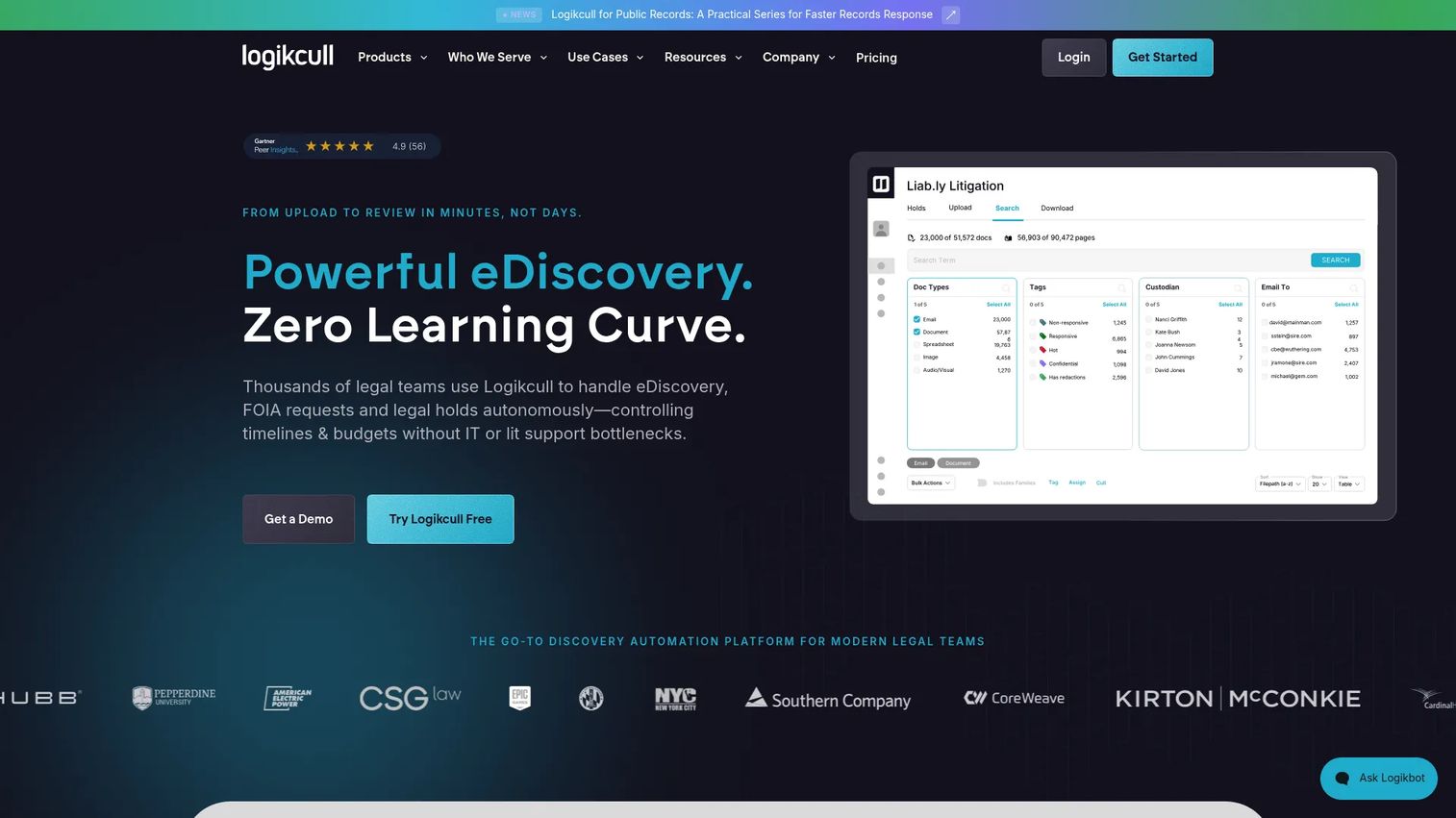
Logikcull is a cloud eDiscovery platform that covers automated data processing, search, review, redaction, and production. It positions itself as a self-service alternative to traditional vendor-heavy workflows. The Corporate Suite plan adds legal holds and collection from 31 or more sources, making it one of the more complete self-service options for corporate legal teams. Logikcull was acquired by Reveal in 2022, though it continues to operate as a distinct product.
Best for: Legal teams and law firms moving away from manual review and costly per-matter vendor engagements.
Key features
- Cloud upload, automated processing, and deduplication
- Search, culling, review tagging, and redaction
- PII detection with bulk redaction tools
- Legal holds and custodian tracking (Corporate Suite)
- GenAI fact-finding with source citations
Why choose Logikcull: The usage-based Pay As You Go plan removes fixed-seat costs, which works well for teams with variable matter volume. For teams that need legal hold and collection as part of a consistent program, the Corporate Suite adds that infrastructure without requiring a separate tool.
Logikcull pricing: Pay As You Go starts at $40/GB/month with unlimited users, projects, and downloads. The Logikcull Subscription and Corporate Suite plans are priced annually and require a quote from the sales team.
G2 rating: 4.7/5
2. RelativityOne
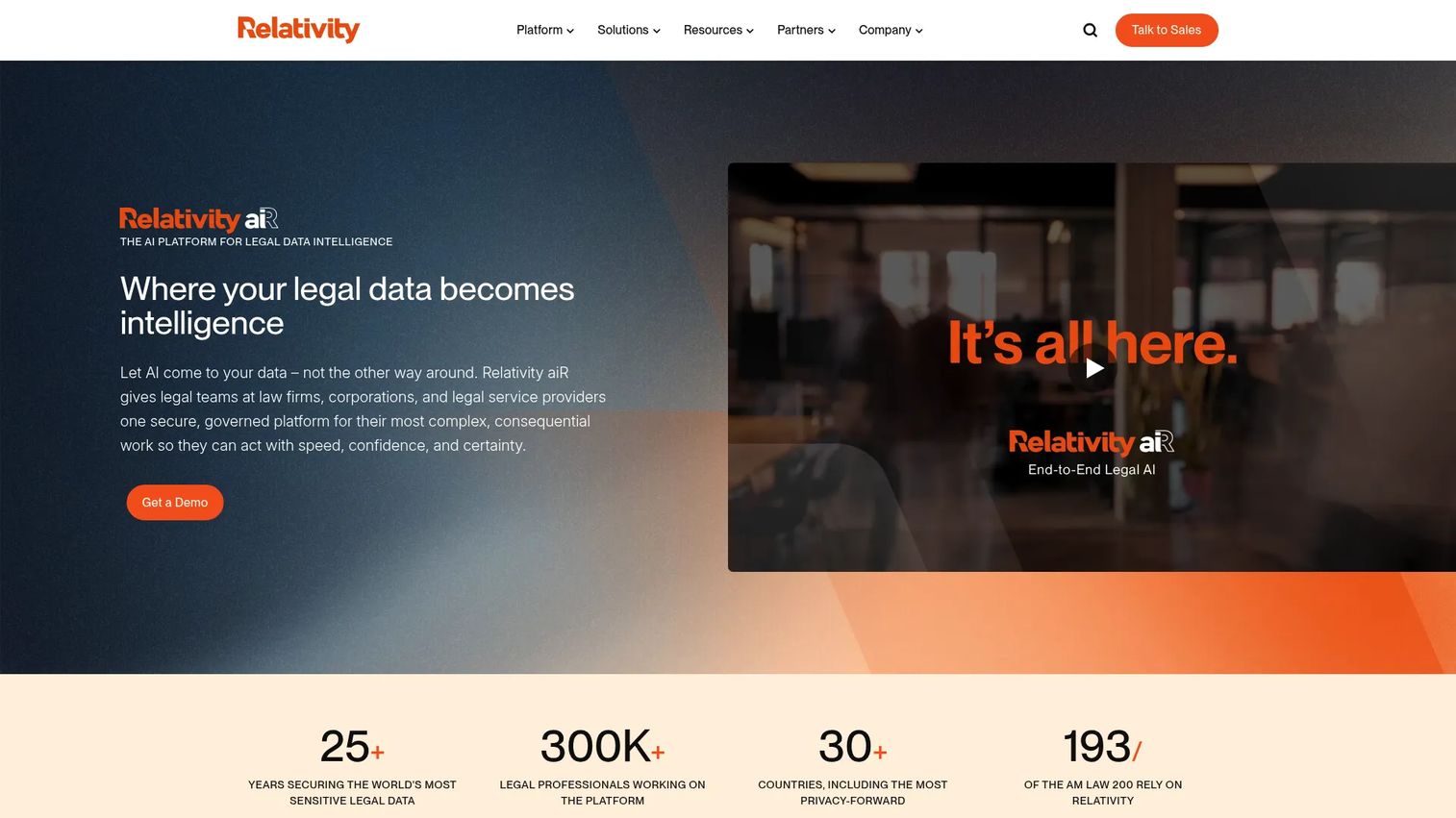
RelativityOne rebranded as Relativity aiR on September 16, 2026. The platform covers the full e-discovery lifecycle: Legal hold, collection, processing, review, analytics, AI-assisted review, and production. It supports AI for document review, privilege review, case strategy, and data breach response. Email threading, clustering, sentiment analysis, and language identification are all available within the platform.
Best for: Enterprise legal teams, litigation service providers, and law firms handling high-volume, complex matters.
Key features
- End-to-end discovery from collection through production
- AI-assisted document review, privilege review, and case strategy
- Analytics: Email threading, clustering, sentiment analysis
- Redaction, OCR, and document processing
- Cloud-based workflow automation and collaboration
Why choose RelativityOne: The platform is one of the most mature in the market for large review teams and complex data types. Buyers should confirm the level of implementation support and managed services required before comparing total cost.
RelativityOne pricing: Flexible pay-as-you-go or one- and three-year commitments. Contact Relativity's sales team for a quote. The pricing structure now includes integrated AI capabilities.
3. Everlaw
Everlaw is a cloud-based legal discovery software platform for litigation, investigations, and eDiscovery. Core capabilities include legal holds, data ingestion, processing, review, analytics, and production. It also includes Storybuilder, a tool for case building, deposition preparation, and fact development that distinguishes it from purely review-focused platforms.
Best for: Corporate legal teams and law firms that want cloud review combined with case preparation in a single environment.
Key features
- Legal holds and preservation workflows
- AI-assisted document summaries, coding suggestions, and Q&A
- Predictive coding and concept clustering
- Collaborative review workflows with team management
- Storybuilder for deposition prep and case strategy
Why choose Everlaw: The combination of review and case preparation tools reduces the number of handoffs between the review platform and trial support. Teams that run matters through to deposition or trial get the most out of the full feature set.
Everlaw pricing: Pricing is based on hosted data volume and usage. Core platform subscriptions include unlimited user licenses, processing, and productions. Contact Everlaw's sales team for a quote.
G2 rating: 4.7/5
4. Microsoft Purview eDiscovery
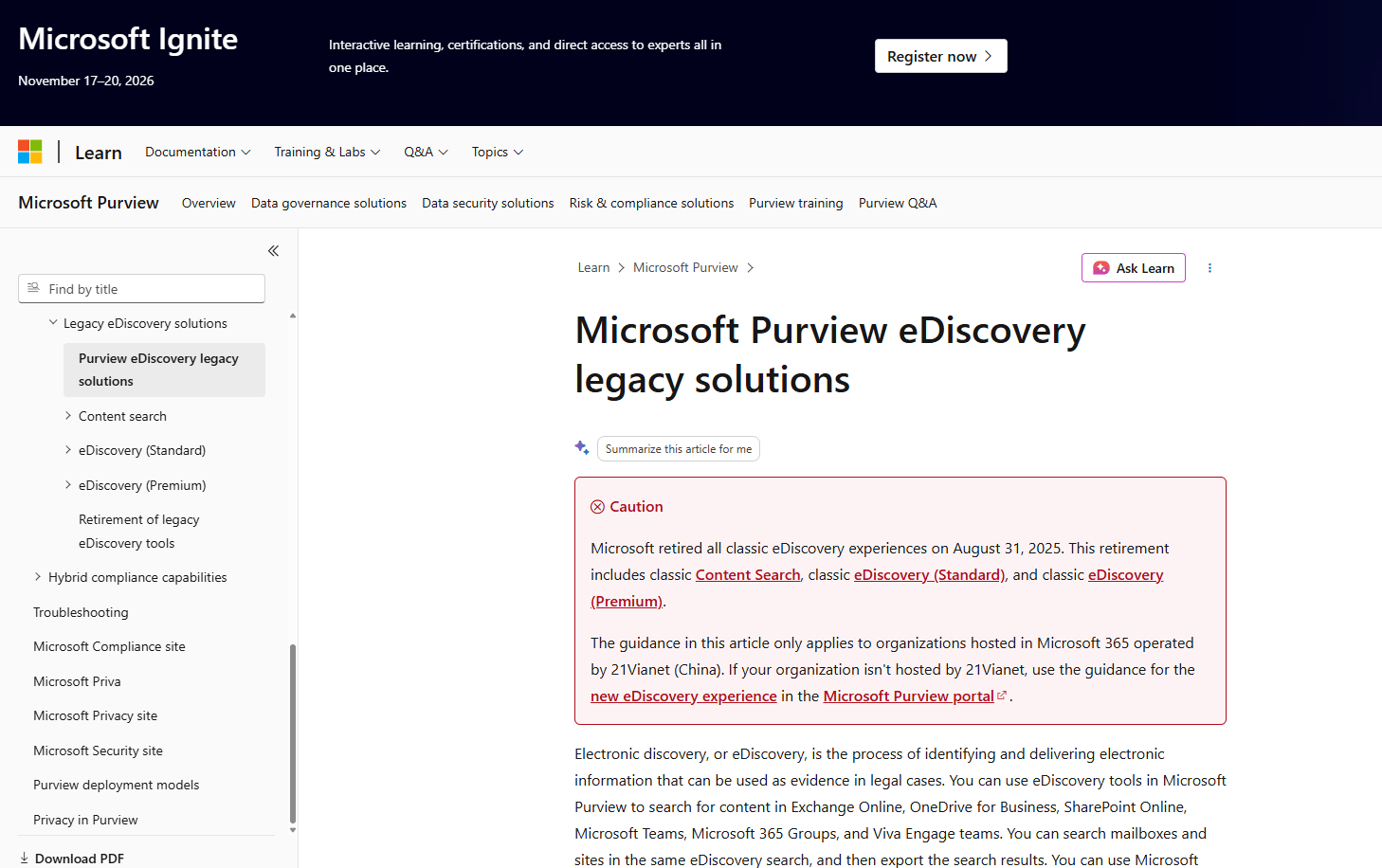
Microsoft Purview eDiscovery is the native e-discovery tool for organizations already running on Microsoft 365. It covers search and export across Exchange Online, Teams, OneDrive, SharePoint, Microsoft 365 Groups, and Viva Engage. The Premium tier adds advanced indexing, review sets, external data import, analytics, and predictive coding.
Best for: Organizations standardized on Microsoft 365 that need eDiscovery across Microsoft data without provisioning a separate platform.
Key features
- Search across Exchange Online, Teams, OneDrive, SharePoint, and Viva Engage
- Legal hold management, case management, and role-based permissions
- Advanced indexing, review sets, and analytics (Premium)
- Predictive coding and external data import (Premium)
- Integration with the Microsoft Purview compliance suite
Why choose Microsoft Purview eDiscovery: Native coverage of Microsoft data removes the collection friction that third-party connectors introduce for Microsoft-heavy environments. Buyers should validate whether complex review requirements need a dedicated review platform alongside Purview for large matters.
Microsoft Purview eDiscovery pricing: Standard eDiscovery requires qualifying Microsoft 365 licensing. The Premium tier is available through Microsoft 365 E5/A5/G5 or add-on licensing. eDiscovery Premium consumption is priced at approximately $20 per GB per month.
G2 rating: 4.4/5
5. Reveal Enterprise
Reveal Enterprise is a cloud-native eDiscovery platform built around analytics and AI. It covers processing, document review, redaction, searching, and production. The platform supports over 100 languages in processing and includes analytics tools such as email threading, near-duplicate detection, entity extraction, clustering, and classification. Deployment options include cloud, hybrid, on-premises, and private environments.
Best for: Law firms, corporate legal teams, and government agencies running analytics-intensive matters or requiring flexible deployment.
Key features
- AI and analytics: Email threading, near-duplicate detection, entity extraction, clustering
- Document review with advanced searching, assignments, and production
- Enterprise processing supporting 100+ languages
- ASK and aji AI analytics tools
- Cloud, hybrid, on-premises, and private deployment
Why choose Reveal Enterprise: The analytics depth suits matters where AI-assisted categorization reduces review load significantly. Flexible deployment also addresses organizations with data residency or security constraints that cloud-only platforms cannot meet.
Reveal Enterprise pricing: Contact Reveal's sales team for a quote.
G2 rating: 4.2/5
6. DISCO
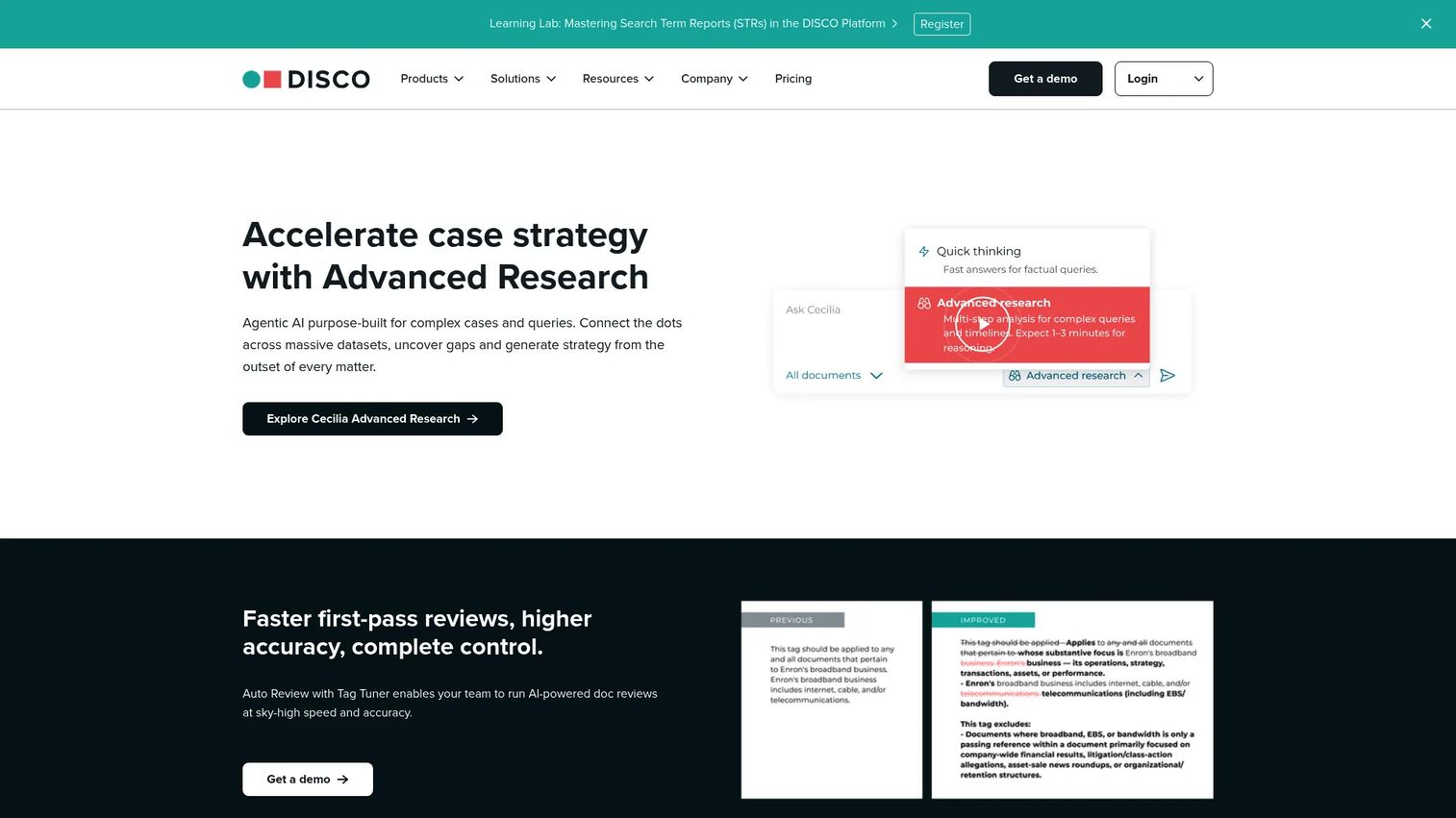
DISCO is cloud-native eDiscovery and litigation software for law firms and corporate legal teams. Beyond core review and production, it includes Cecilia, an AI tool covering Q&A, document summaries, deposition summaries, and auto timelines. DISCO also offers deposition management with transcript review, collaborative annotations, and synced video, which extends its value beyond standard document review platforms.
Best for: Litigation teams that want AI-assisted review and case management tools in a single cloud platform.
Key features
- AI Q&A, document summaries, deposition summaries, and auto timelines (Cecilia)
- Cloud review with search builder, filters, and visualization
- Deposition management with transcript review and synced video
- Legal hold, data collection, and production
- All-inclusive per-GB hosting with no separate ingest fees
Why choose DISCO: The all-inclusive pricing model removes per-feature billing friction during active matters. Litigation teams that handle depositions alongside document review benefit from having both workflows in one environment.
DISCO pricing: Per-GB hosting fee with no separate charges for ingest, processing, or users. Contact DISCO's sales team for a quote. The pricing page requires a sales conversation and does not display a numeric rate.
G2 rating: 4.6/5
7. Casepoint
Casepoint is an AI-powered eDiscovery platform for enterprise, government, and compliance teams. It covers legal hold, collection, processing, analysis, review, and production. Casepoint holds FedRAMP High, DOD IL5, and DOD IL6 authorizations, making it one of the few platforms in this category that can operate in US federal government environments. It also handles FOIA, public records, and investigation workflows.
Best for: Enterprise organizations, government agencies, and compliance teams requiring end-to-end discovery with federal security authorizations.
Key features
- AI Search, document summarization, and active learning
- Legal hold and data preservation workflows
- End-to-end collection, processing, analysis, review, and production
- FedRAMP High, DOD IL5, and DOD IL6 authorizations
- FOIA, public records, and compliance investigation support
Why choose Casepoint: The federal security authorizations are a practical differentiator for government buyers and government-adjacent contractors who cannot use platforms that lack those clearances. Enterprise teams with strict compliance requirements benefit from the end-to-end workflow without third-party dependencies.
Casepoint pricing: Tailored pricing based on applications and use cases. Contact Casepoint's sales team for a quote. Customers pay only for the products they use.
G2 rating: 4.7/5
8. Exterro Data Risk Management Platform
Exterro is an AI-powered platform that unifies eDiscovery, digital forensics, data privacy, security, and governance workflows. It covers legal hold, collection, processing, document review, and production alongside automated data mapping, classification, retention, and disposition. The platform connects to 190+ enterprise data sources, which matters when matters span multiple cloud and on-premise systems.
Best for: Enterprise legal operations teams that treat eDiscovery as part of a broader data risk, privacy, and governance program.
Key features
- Legal hold, collection, processing, document review, and production
- Automated data mapping, classification, and retention
- Data subject rights, consent, RoPA, and privacy assessments
- 190+ enterprise data connectors
- Embedded agentic AI with human oversight and audit trail
Why choose Exterro: Teams that manage eDiscovery alongside privacy response, compliance, and information governance reduce tool sprawl and get a single audit trail across workflows. The connector breadth addresses the modern data source challenge that narrower review platforms leave unsolved.
Exterro Data Risk Management Platform pricing: Enterprise subscription pricing. Contact Exterro's sales team for a quote.
G2 rating: 4.4/5
9. OpenText Axcelerate
OpenText Axcelerate is an enterprise eDiscovery and investigations platform with GenAI-powered technology-assisted review and document summarization. It covers 45 or more data-source connectors, predictive search, advanced data visualization, and automated personal-data detection with redaction. Deployment options include public cloud, private cloud, on-premises, and hybrid environments. Note that OpenText has been consolidating its product branding under the OpenText eDiscovery name.
Best for: Enterprise legal teams and law firms handling large review sets that need analytics depth and deployment flexibility.
Key features
- GenAI technology-assisted review and document summarization
- 45+ data-source connectors with automated deduplication
- Predictive search and advanced data visualization
- Automated personal-data detection and redaction
- Integrated audio and video review support
Why choose OpenText Axcelerate: Analytics depth suits large review sets where AI-assisted categorization meaningfully reduces review hours. Multi-deployment support handles organizations with data sovereignty requirements. Validate current product packaging with OpenText before committing, as the Axcelerate branding is being consolidated.
OpenText Axcelerate pricing: Contact OpenText's sales team for a quote.
G2 rating: 4.5/5
10. Nuix Discover
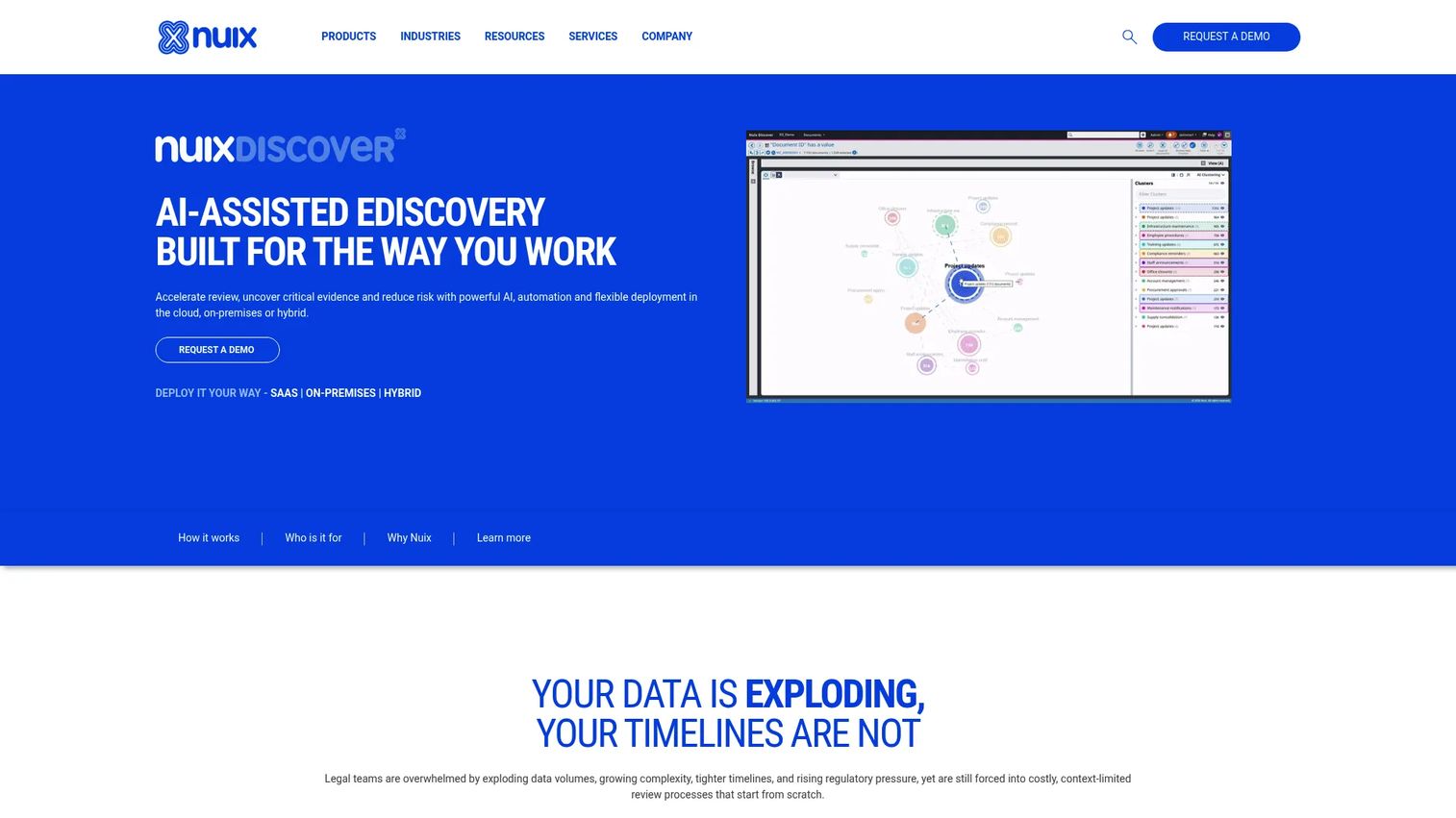
Nuix Discover is AI-assisted eDiscovery software covering data processing, review, analytics, and production. Its AI capabilities include semantic search, document summaries, AI clustering and visualization, predictive coding with continuous active learning, AI-assisted redaction, transcription, and first-pass review through Cog AI enrichment. Deployment options include SaaS, on-premises, and hybrid.
Best for: Legal departments, regulators, and service providers handling complex data sets with investigation-heavy workflows.
Key features
- Semantic search and AI-powered document summaries
- AI clustering, visualization, and continuous active learning
- AI-assisted redaction and transcription
- First-pass review with Cog AI enrichment
- SaaS, on-premises, and hybrid deployment
Why choose Nuix Discover: The combination of semantic search and continuous active learning suits matters where the document population is large and traditional keyword search underperforms. Buyers should note that the G2 rating sits below the category average, which warrants a reference check during evaluation.
Nuix Discover pricing: Contact Nuix's sales team for a quote.
G2 rating: 3.5/5
11. CloudNine LAW
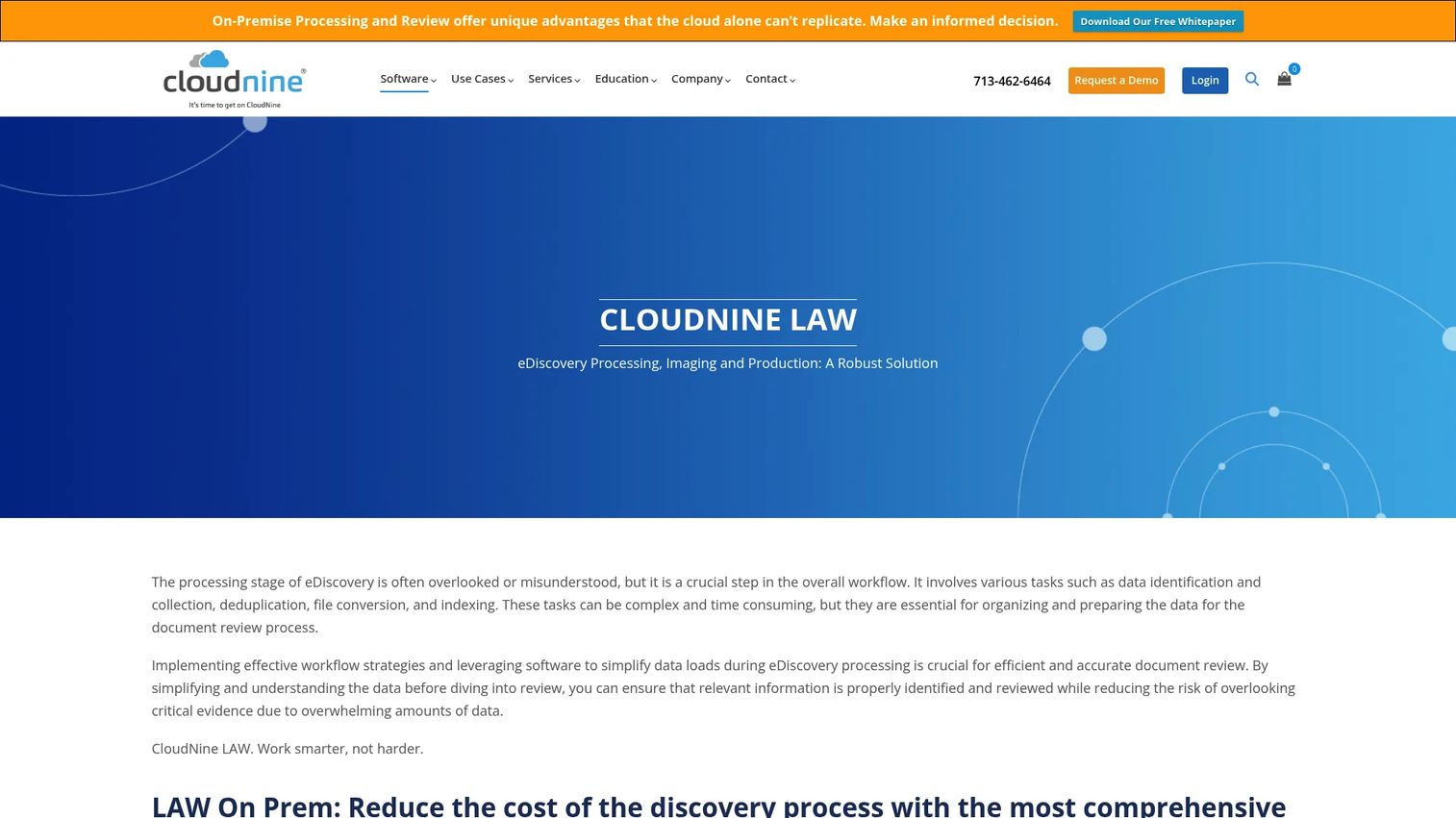
CloudNine LAW is an on-premise eDiscovery processing, imaging, and production solution. It supports over 4,800 native file types with automated OCR, content extraction, and language identification. The platform handles processing, imaging, production, printing, scanning, and scripting, and scales through vertical or horizontal expansion. It is designed for teams that need secure, behind-the-firewall processing rather than cloud-hosted review.
Best for: Litigation support teams and law firms that need on-premise processing and production with broad file-type coverage.
Key features
- Supports 4,800+ native file types with automated OCR
- Processing, imaging, and production workflows
- Vertical and horizontal scalability options
- Language identification and content extraction
- Scripting support for custom workflows
Why choose CloudNine LAW: On-premise deployment gives teams with strict data security or air-gap requirements a processing and production workflow that stays entirely within their own environment. Buyers should confirm cloud hosting and managed review options with CloudNine if hybrid deployment is needed.
CloudNine LAW pricing: Contact CloudNine's sales team for a quote.
G2 rating: 4.4/5
12. Arctera eDiscovery Platform
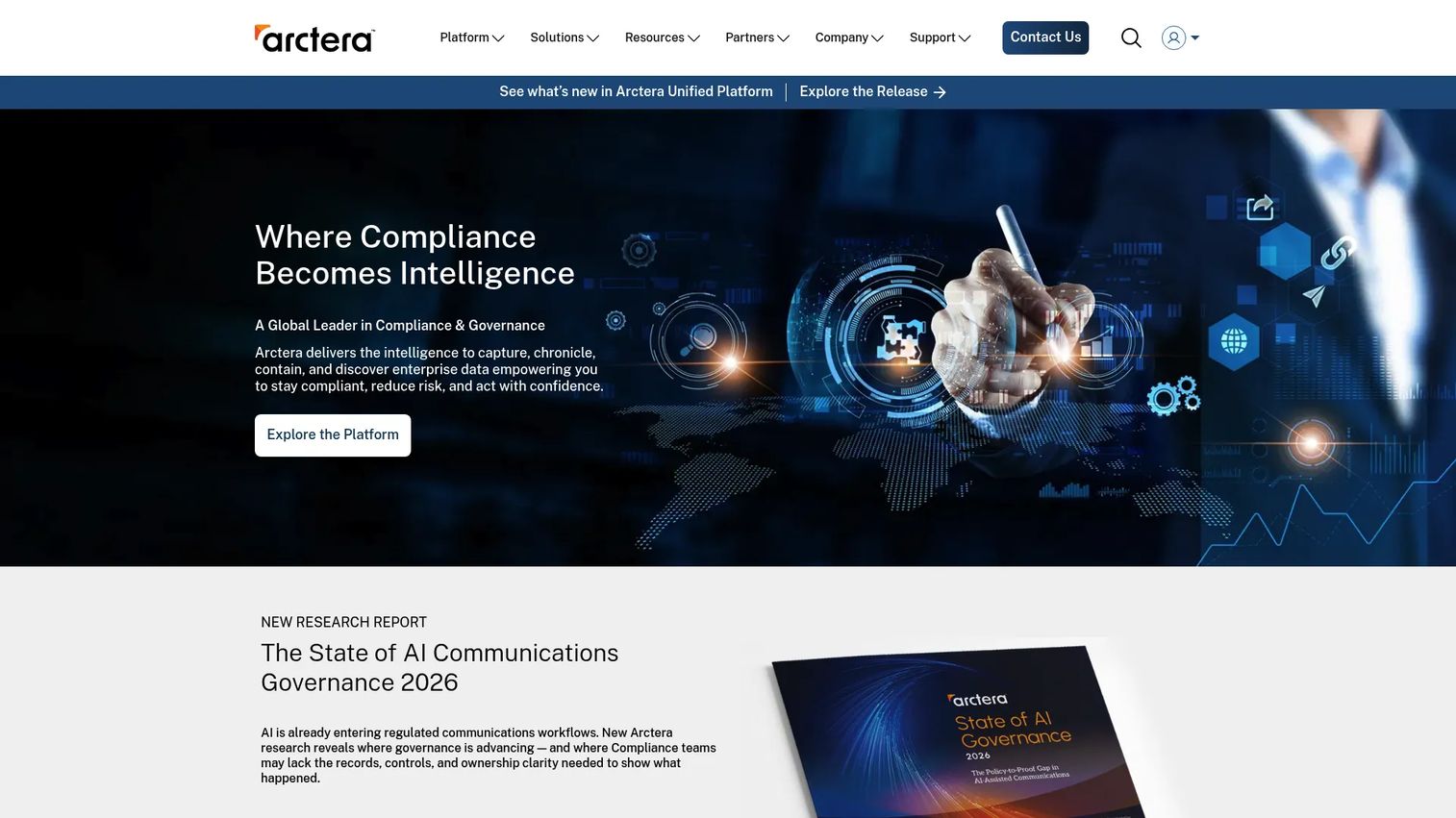
Arctera eDiscovery Platform is a web-based eDiscovery service for legal and compliance teams handling investigations, litigation requests, and regulatory requirements. It provides advanced iterative search across archived emails, collaboration messages, and files. Collaborative case workflows include role-based reviewer permissions, legal holds, tagging, labels, and notes. Export formats include EML, PST, and NSF with optional EDRM XML. The platform also includes InsightAI assistant and inline translation.
Best for: Legal, compliance, and investigation teams that need defensible discovery across enterprise communications archives.
Key features
- Advanced iterative search across email, collaboration, and file archives
- Collaborative case workflows with role-based permissions and legal holds
- Export to EML, PST, NSF, and EDRM XML
- Hit highlighting and case and audit reporting
- InsightAI assistant and inline translation
Why choose Arctera eDiscovery Platform: The archive-connected search model works well for organizations whose eDiscovery requirements center on email and collaboration data in an existing archive environment. Teams with large unstructured document review needs should evaluate whether the platform's review depth matches their matter requirements.
Arctera eDiscovery Platform pricing: Contact Arctera's sales team for a quote.
G2 rating: 4.5/5
13. OpenText eDiscovery
OpenText eDiscovery is an end-to-end eDiscovery platform covering litigation hold, collection, early case assessment, investigation, review, production, and trial preparation. It includes OpenText eDiscovery Aviator, a generative AI capability for the review and analysis stage. The platform also supports visual analytics, communications mapping, and audio, video, chat, and multilingual data. This is distinct from OpenText Axcelerate, which focuses specifically on analytics-driven review.
Best for: Enterprise legal departments that already use OpenText information management products and want eDiscovery within the same portfolio.
Key features
- Early case assessment with collection, processing, OCR, and deduplication
- OpenText eDiscovery Aviator (generative AI for review)
- Technology-assisted review and predictive search
- Visual analytics and communications mapping
- Audio, video, chat, and multilingual data support
Why choose OpenText eDiscovery: Buyers already invested in OpenText's information management portfolio can consolidate legal workflows under a single vendor relationship. Teams evaluating OpenText Axcelerate and OpenText eDiscovery together should ask the vendor to clarify the current roadmap and which product maps to their specific use case.
OpenText eDiscovery pricing: Contact OpenText's sales team for a quote.
14. Veritas eDiscovery Platform
Veritas eDiscovery Platform is an enterprise eDiscovery product for managing legal, regulatory, and investigative matters from legal hold through production. It covers hold notices, reminders, escalations, custodian surveys, identification and collection, processing with OCR and deduplication, multimedia processing, review, annotation, redaction, and production. Licensing documentation describes separate modules with capacity-based pricing meters. Buyers should confirm current ownership, product status, and support model directly with Veritas before beginning an evaluation.
Best for: Enterprises with existing Veritas archive infrastructure that need discovery connected to their information governance environment.
Key features
- Legal hold notices, reminders, escalations, and custodian tracking
- Identification, collection, and data mapping
- Processing with OCR, deduplication, and advanced search
- Review, annotation, redaction, and production
- Capacity-based licensing with modular structure
Why choose Veritas eDiscovery Platform: Organizations with Veritas archive environments get discovery that connects directly to their existing governance infrastructure, reducing re-collection overhead. Buyers evaluating this platform should confirm current product availability and roadmap before starting a formal POC.
Veritas eDiscovery Platform pricing: Pricing requires contacting Veritas. Licensing uses separate modules with capacity-based meters.
15. Nebula
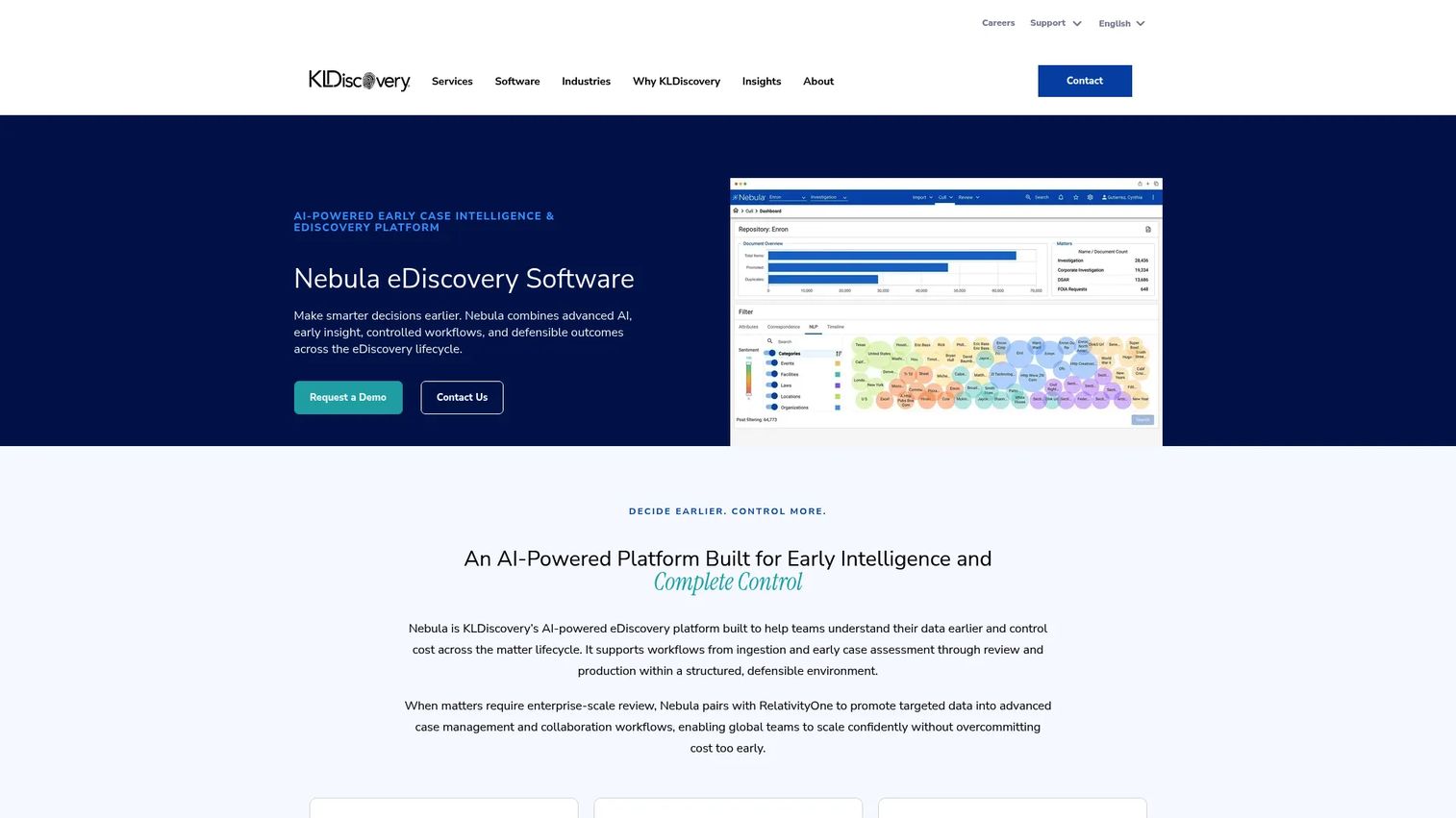
Nebula is KLDiscovery's AI-powered eDiscovery platform for early case assessment, analysis, review, collaboration, and production. Capabilities include predictive coding, machine learning, email threading, near-duplicate detection, AI-powered entity recognition, and sentiment analysis. The platform supports an interactive timeline and keyword navigation. Nebula also offers a flexible promotion path to RelativityOne for matters that outgrow its scope, which reduces risk for teams uncertain about platform scale requirements.
Best for: Law firms, corporate legal teams, and eDiscovery professionals managing litigation and investigations who want AI analytics with a clear scale-up path.
Key features
- Predictive coding and continuous machine learning
- Email threading and near-duplicate detection
- AI entity recognition and sentiment analysis
- Interactive timeline and keyword navigation
- Flexible promotion to RelativityOne
Why choose Nebula: The RelativityOne promotion path addresses a common presales objection: What happens when a matter grows beyond initial scope. Teams that want AI analytics without committing to a large enterprise platform from day one get a practical starting point. Annual subscriptions are priced monthly with multi-year discounts available.
Nebula pricing: Contact KLDiscovery's sales team for a quote. Annual subscriptions are priced monthly. Multi-year discounts are available.
G2 rating: 4.0/5
Considerations when choosing eDiscovery software
Data sources and collection coverage
Confirm which connectors are native and which require services-led collection before signing. For legal discovery software evaluations, list every data source your organization uses: Microsoft 365, Google Workspace, Slack, Teams, mobile data, and enterprise archives. According to the 2025 Ediscovery Innovation Report, 66% of legal professionals use cloud-based platforms, but collection gaps often surface during POC rather than during a demo.
Review speed and workflow control
High-volume review needs batching, privilege tagging, quality control checkpoints, and reviewer progress reporting. Ask vendors to show a live matter with batched review assignments, a privilege log export, and a production run. If they demonstrate features without running a test matter, that tells you something.
AI explainability and defensibility
37% of eDiscovery professionals are already using generative AI in their work, according to the 2025 Ediscovery Innovation Report. AI is useful only when legal teams can trace a suggestion back to source documents and defend review decisions in court. Ask vendors how AI coding suggestions connect to the original document, how decisions are logged, and what happens when a judge asks for the AI audit trail.
Security, privacy, and access controls
Confirm encryption at rest and in transit, role-based permissions, matter-level access controls, data residency options, and audit log completeness. For organizations with federal or regulated environments, verify specific authorizations such as FedRAMP from the vendor's own security documentation rather than accepting marketing claims.
Pricing model and services dependency
eDiscovery costs extend beyond license fees. Factor in hosting, processing, storage, export, support, and professional services when building a total matter cost model. Usage-based models like Logikcull's $40/GB structure are predictable for consistent matter volume. Custom quote models require a representative matter sample to produce a comparable number.
Conclusion
The right eDiscovery platform depends on your matter type, data sources, team size, and existing infrastructure.
Logikcull works for teams that want approachable cloud discovery with usage-based pricing and no fixed seat costs. RelativityOne (now Relativity aiR) handles enterprise-scale review with AI depth and mature workflow tooling. Everlaw suits corporate legal teams that run matters through to trial preparation. Microsoft Purview eDiscovery removes friction for organizations that live in Microsoft 365. Reveal Enterprise fits analytics-heavy matters with flexible deployment. Exterro connects eDiscovery to the broader data risk and governance program.
Your next step: Shortlist three platforms, build a test matter with real data from your most common custodian types, and validate collection, processing, search, review, redaction, and production end to end. Compare total matter cost at a representative data volume, not just license price.
If your team sells complex software and buyers need to understand the workflow before committing to a live call, interactive demos let technical stakeholders self-educate before the meeting. Start your journey with Guideflow today!
FAQs
eDiscovery software is used to identify, preserve, collect, process, review, analyze, and produce electronically stored information for litigation, investigations, and regulatory matters. Legal and compliance teams use it to manage matter workflows from legal hold through production while maintaining defensible chain of custody and audit trails.
The answer depends on team size, matter type, and infrastructure. Enterprise review teams with large document volumes typically prioritize AI-assisted review and analytics depth. Smaller legal teams or those with variable matter load often prioritize fast setup and predictable per-GB pricing. No single platform wins across every scenario, which is why presales teams should run a test matter before committing.
Document review software handles the review, tagging, redaction, and coding stage of the eDiscovery process. eDiscovery software covers the full lifecycle: Legal hold, collection, processing, analytics, review, and production. Some platforms focus on one stage; others cover the complete workflow. Buyers should clarify which stages they need to manage before narrowing the shortlist.
Yes, and the use cases vary significantly. Common applications include document clustering, predictive coding, continuous active learning, relevance review, privilege review, issue coding, document summarization, entity recognition, and sentiment analysis. Buyers should ask vendors how AI suggestions connect to source documents, what the audit trail looks like, and whether the output is explainable enough to defend in a regulatory or court setting.
Pricing depends on users, matters, data volume, hosting, processing, storage, export, and professional services. Logikcull's Pay As You Go plan starts at $40/GB/month. Microsoft Purview eDiscovery Premium starts at approximately $20/GB/month for consumption. Most enterprise platforms require a custom quote. Model cost against a representative matter volume, not just headline license price, to get a comparable number.
At minimum, evaluate coverage for email, Microsoft 365 (Exchange, Teams, SharePoint, OneDrive), cloud storage, chat platforms (Slack, WhatsApp, Teams), mobile data, and enterprise databases. According to eDiscovery Today's 2025 State of the Industry Report, mobile and collaboration data now appear in a significant share of matters. List your specific sources and confirm native versus services-led collection before signing.
Cloud platforms can support strong security controls, but buyers must verify specifics rather than accepting general claims. Check for encryption at rest and in transit, role-based access controls, matter-level permissions, data residency and sovereignty options, retention controls, and audit log completeness. For federal or regulated environments, verify specific authorizations such as FedRAMP High directly from the vendor's security documentation.
Run a realistic matter workflow rather than a feature tour. Show collection from at least one modern data source, processing with deduplication, search and keyword filtering, review batching with privilege tagging, redaction, production export, and the audit log. Ask the vendor to show how the platform handles a scope change mid-matter and how AI suggestions are explained when a reviewer challenges a coding decision. Technical buyers who will own the implementation need to see failure scenarios handled, not just the happy path.