

Your renewal warning arrived last week. The customer churned this morning.
The signals were there. Product usage dropped 40% in Q3. Two support escalations went unresolved. The executive sponsor left the account in August. But that data lived in five different tools, and nobody stitched it together until the QBR that never happened.
This is the core problem customer health score software solves. It pulls product usage, support history, survey feedback, relationship quality, and account data into one operational score you can act on before the churn conversation, not after it.
The market has caught up to the pain. The customer success platform market reached USD 2.4B in 2024, per Grand View Research, and the customer success software category is growing at a 22.7% CAGR through 2027, according to WorldMetrics. Roughly 38% of organizations already use software for customer health scoring, with another 29% planning to adopt it. The tools have matured past static dashboards into predictive systems, with 68% of vendors now embedding AI and machine learning into their scoring.
But a health score is only useful if it drives action. The wrong tool gives you a pretty number that reports on lagging signals. The right one segments by lifecycle, flags churn risk early, surfaces upsell readiness, and triggers the play that saves the account.
What's inside
This guide compares eight customer health score software platforms built for SaaS customer success, RevOps, and leadership teams. We picked tools that treat health scoring as an operating problem, not just a metric.
Selection criteria:
- Ability to combine quantitative signals (usage, tickets) with qualitative ones (sentiment, relationship strength)
- Scoring flexibility and lifecycle segmentation
- Automation, alerts, and playbooks that turn scores into action
- Integration depth with your CRM and CS stack
- Ease of adoption across CS, RevOps, and leadership
Every pricing and rating figure was verified against first-party pages and G2 at the time of writing.
TL;DR
- Best overall for mature CS ops: Vitally, for flexible scoring plus deep workflow automation
- Best for enterprise lifecycle orchestration: Gainsight, for scorecards, playbooks, and renewal forecasting at scale
- Best for dashboard-first teams: Custify, for straightforward account health visibility and automated signals
- Best for alert-driven workflows: ChurnZero, for structured plays around risk and renewal
- Best for flexible data modeling: Planhat, for a highly configurable customer data layer
- Best for health plus expansion signals: Totango and Catalyst, for broad CS platforms with growth workflows built in
What is customer health score software?
Customer health score software is a customer success tool that combines multiple account signals into a single, weighted score that predicts whether a customer will renew, churn, or expand.
The customer health score itself is a composite index. Instead of judging an account on one metric, it rolls several inputs into a number or a color-coded status that a CS team can prioritize against.
Most platforms combine some mix of these customer health score metrics:
- Product usage: login frequency, feature adoption, active seats, depth of use
- Support signals: ticket volume, escalations, resolution time, sentiment
- Survey feedback: NPS, CSAT, and qualitative comments
- Relationship quality: executive sponsor engagement, champion strength, stakeholder coverage
- Commercial data: contract value, payment history, renewal date, expansion history
Teams use the resulting customer health dashboard for three operating decisions. They flag churn risk before it becomes a fire drill. They prioritize which renewals need a human touch versus which run automatically. And they spot upsell readiness in accounts that show consistent, growing engagement.
One caveat worth stating early: a single score is rarely enough for every lifecycle stage. An onboarding account and a three-year customer are healthy for different reasons. The strongest platforms let you build multiple scorecards, apply a weighted scoring model per segment, and adjust the customer health scorecard as accounts move through the journey.
When to use customer health score software
Prioritize renewals before they become fire drills
If your renewal forecast is a spreadsheet updated the week before the contract date, you are managing blind. Health scoring lets you rank the renewal book by risk months out. High-value accounts trending down get an intervention. Healthy accounts renew with a light touch. Renewal prioritization stops being a guessing game.
Surface churn risk earlier than your QBR cadence
Quarterly check-ins catch problems on a 90-day delay. By then the sponsor has left and usage has cratered. Health monitoring tools watch the signals continuously and alert you the week a key metric drops, not the quarter after. You get time to act while the account is still savable.
Spot expansion-ready accounts with consistent behavior signals
Not every healthy account is an upsell. But accounts with rising seat counts, deep feature adoption, and strong sponsor engagement are showing you where the expansion revenue lives. A good customer health index makes those patterns visible so CS and sales can move on them together.
Customer health score software comparison
The comparison below focuses on the factors that decide real-world fit: score flexibility, automation depth, integration coverage, and how well each tool serves CS, RevOps, and leadership together. Pricing for this category is almost entirely quote-based, so we have noted that where it applies and paired it with current G2 ratings.
| # | Product | Intent | Key use case | Pricing | G2 rating |
|---|---|---|---|---|---|
| 1 | Vitally | Mature CS ops | Flexible scoring plus workflow automation | Quote-based | 4.5/5 |
| 2 | Gainsight | Enterprise orchestration | Scorecards, playbooks, renewal forecasting | Quote-based | 4.5/5 |
| 3 | Custify | Dashboard-first teams | Account health monitoring and alerts | Quote-based | 4.7/5 |
| 4 | ChurnZero | Alert-driven CS | Plays and alerts around churn risk | Quote-based | 4.7/5 |
| 5 | Totango | Broad CS platform | Health tracking plus segment workflows | Quote-based | 4.4/5 |
| 6 | Planhat | Custom data modeling | Configurable customer data layer | Quote-based | 4.5/5 |
| 7 | Catalyst | Customer growth | Health plus expansion workflows | Quote-based | 4.5/5 |
| 8 | ClientSuccess | SMB and mid-market | Health scoring plus renewal execution | Quote-based | 4.4/5 |
Best customer health score software for 2026
1. Vitally
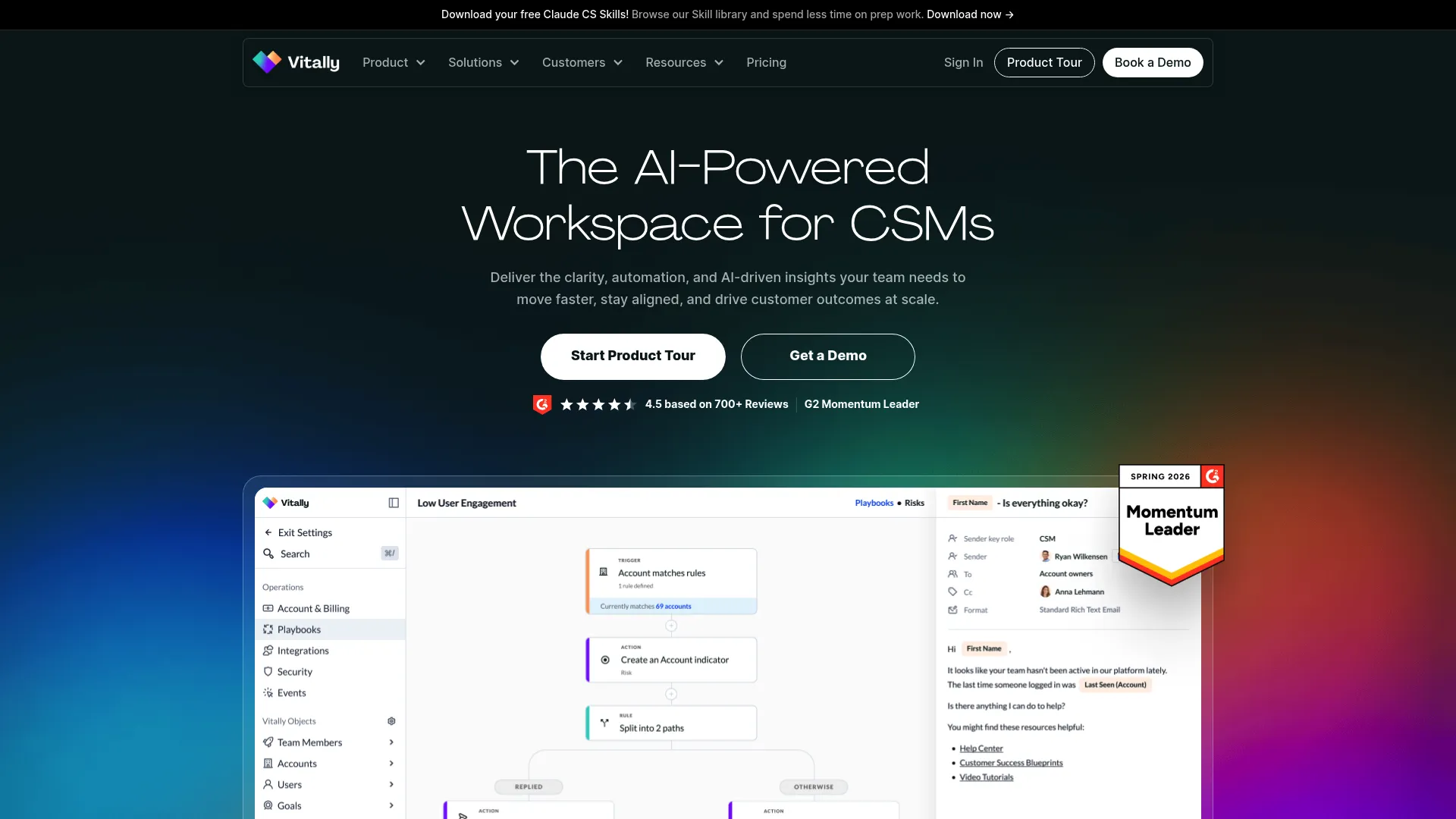
Vitally is an AI-powered customer success platform built for B2B CS teams that want a modern operating system around health signals. It ties flexible health scores to product usage data, customer 360 views, and workflow automation, so a change in an account's score can trigger a task, a playbook, or an alert without manual monitoring. The platform leans into automation and AI-assisted account management, which suits teams ready to run health scoring as a repeatable process rather than a manual review.
Best for: B2B customer success teams that need workflow automation, visibility, and AI-assisted account management.
Key strengths
- Flexible health scores across segments
- Automation tied to score changes and account signals
- Customer 360 with product usage data
- AI-powered note-taking, surveys, and NPS
- Segmentation, reporting, and open API
Why choose Vitally: If your CS team already understands health scoring and wants to operationalize it with automation and clean reporting, Vitally fits the mature-ops profile well. It rewards teams with decent data hygiene.
Vitally pricing: Vitally offers three plans, Tech-Touch, Hybrid-Touch, and High-Touch, all of which include the same core features. Pricing is quote-based; each plan lists "Request Pricing" rather than a public number.
2. Gainsight
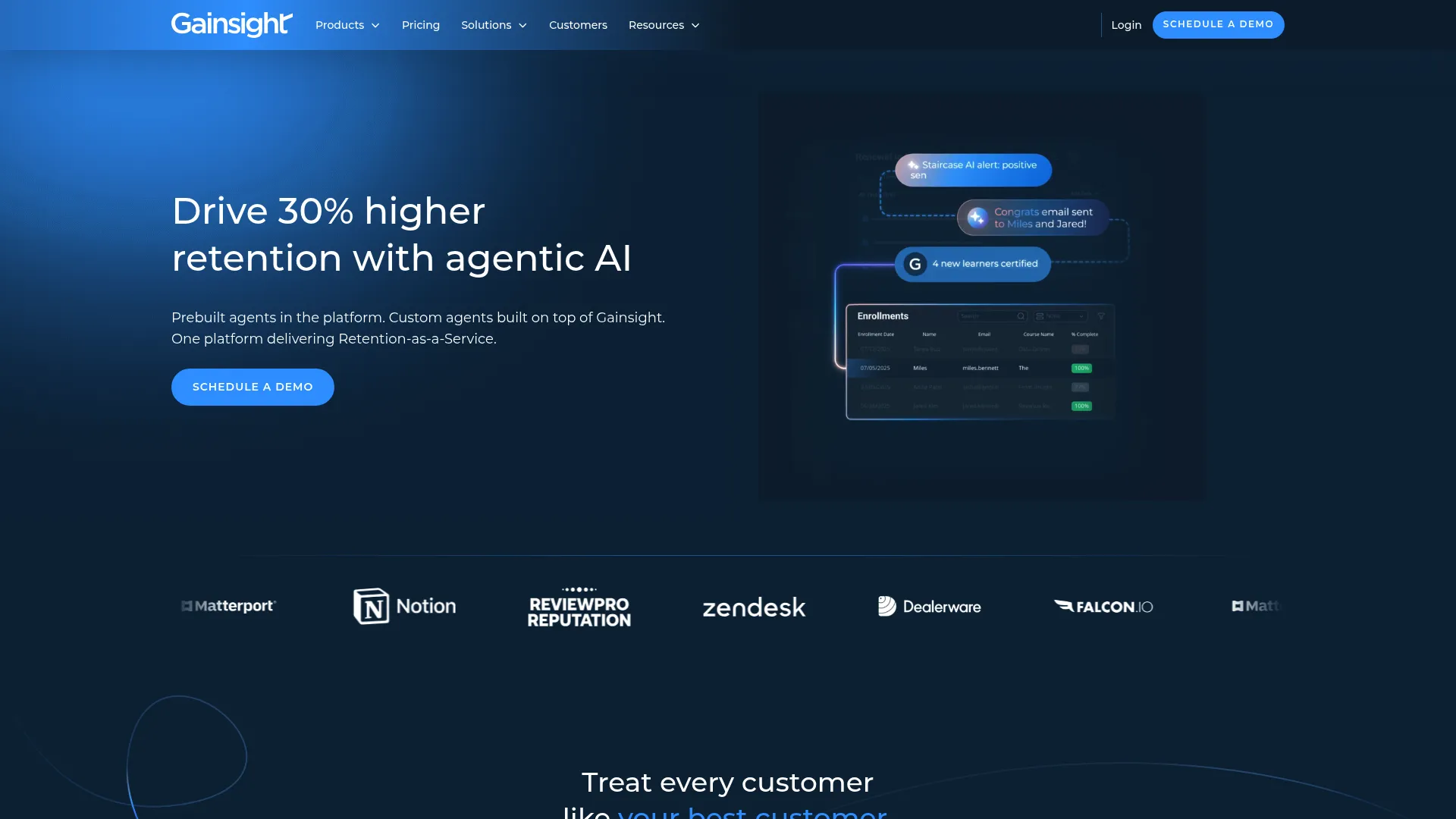
Gainsight is the enterprise standard for customer success and product experience, built for larger teams managing complex renewal and expansion workflows. Its customer success platform pairs health scores with playbooks, dashboards, surveys, and renewal forecasting, while adjacent products cover product analytics and customer education. For organizations running structured CS programs across thousands of accounts, Gainsight offers the orchestration depth to segment by lifecycle and drive coordinated action at scale.
Best for: Enterprise teams managing customer success, product adoption, and customer education.
Key strengths
- Health scores with playbooks and dashboards
- Renewal forecasting and survey tooling
- Product Experience (PX) analytics and in-app guides
- Skilljar for customer education and academies
- Lifecycle segmentation across large account bases
Why choose Gainsight: When your CS program spans many segments and stakeholders, Gainsight gives you the orchestration layer to run it. It is the heaviest platform here, which pays off for large teams with complex motions.
Gainsight pricing: Gainsight uses quote-based pricing across its Essentials and Enterprise tiers for Customer Success, as well as its Product Experience and Customer Communities products. A free trial is available on Product Experience; core pricing is available on request.
3. Custify

Custify is customer success software for SaaS teams that want straightforward visibility into account health without heavy configuration overhead. It centralizes customer data into a Customer 360, calculates health scores, and runs automation and playbooks off those signals. The dashboard-first approach makes it a strong fit for teams that want to see churn risk clearly and collaborate around it, rather than build a deeply custom scoring apparatus.
Best for: B2B SaaS customer success teams that want workflow automation and health monitoring.
Key strengths
- Customer 360 with consolidated account data
- Health scores surfaced on a clear dashboard
- Automation and playbooks off health signals
- Collaboration around at-risk accounts
- Practical setup for lean CS teams
Why choose Custify: If you want account health visibility your whole team can read at a glance, Custify keeps things approachable. It suits teams that value clarity over maximal customization.
Custify pricing: Custify describes its model as "Flexible Pricing" on its site, with no public numeric price listed. Contact Custify for a quote based on your team and account volume.
4. ChurnZero
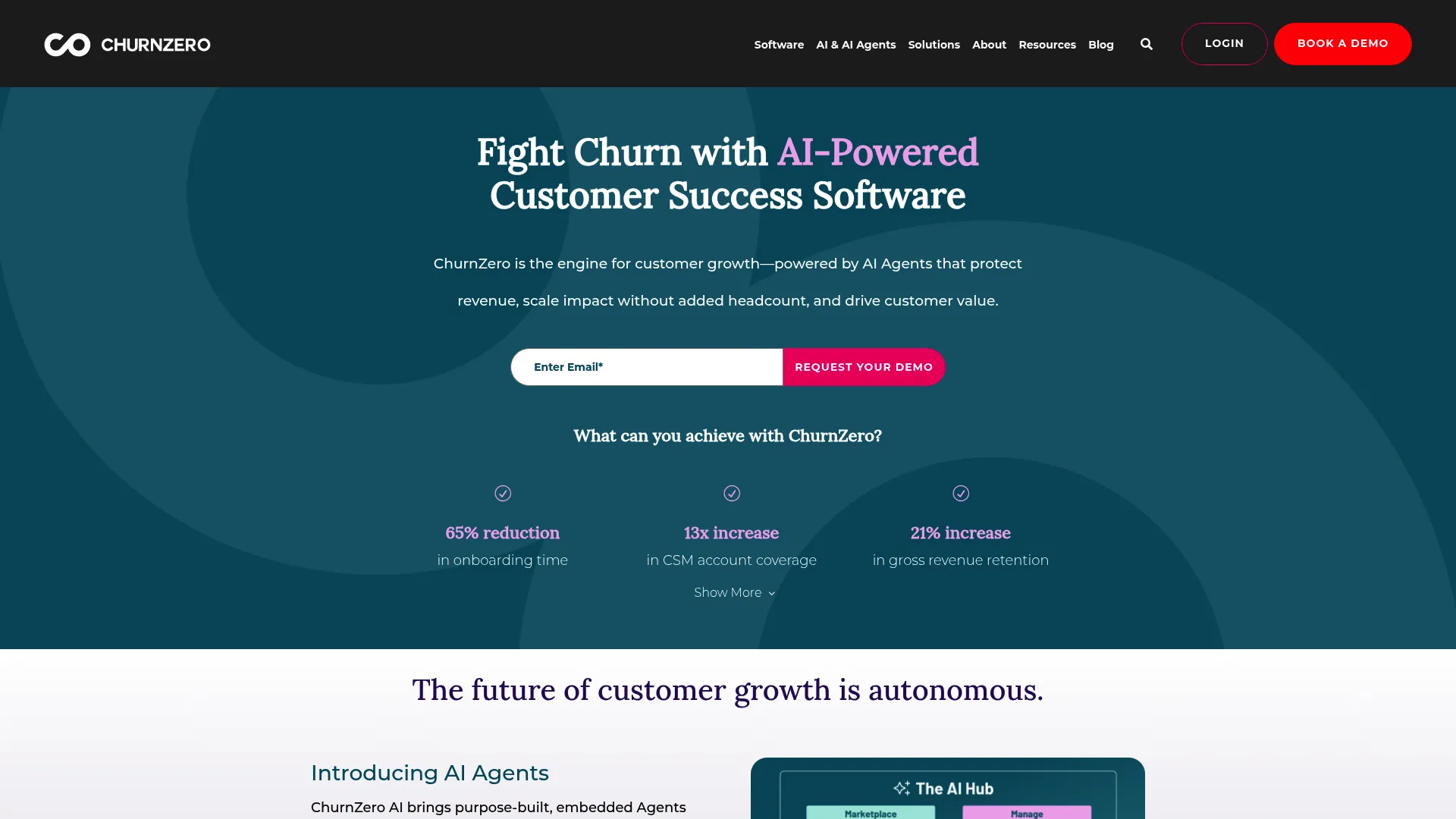
ChurnZero is an AI customer growth platform built for CS teams that want structured execution around risk and renewal. Its health scoring feeds plays, alerts, and success plans, so a declining score becomes a triggered workflow rather than a note someone forgets to follow up on. The platform also layers in AI agents and knowledge sources, positioning it for teams that want their customer success health score to drive automated, alert-driven action.
Best for: B2B SaaS teams that need customer success automation, health scoring, and retention workflows.
Key strengths
- Customer health scores tied to plays
- Alerts triggered by score and signal changes
- Success plans and playbook automation
- AI agents and AI knowledge sources
- Structured retention and renewal workflows
Why choose ChurnZero: If your team wants scores that automatically fire the next best action, ChurnZero's play-and-alert model is its core strength. It suits CS orgs that run on structured, repeatable execution.
ChurnZero pricing: ChurnZero does not publish public pricing; its plans are typically sold as annual subscriptions. Request a demo and quote directly from ChurnZero for figures specific to your account base.
5. Totango
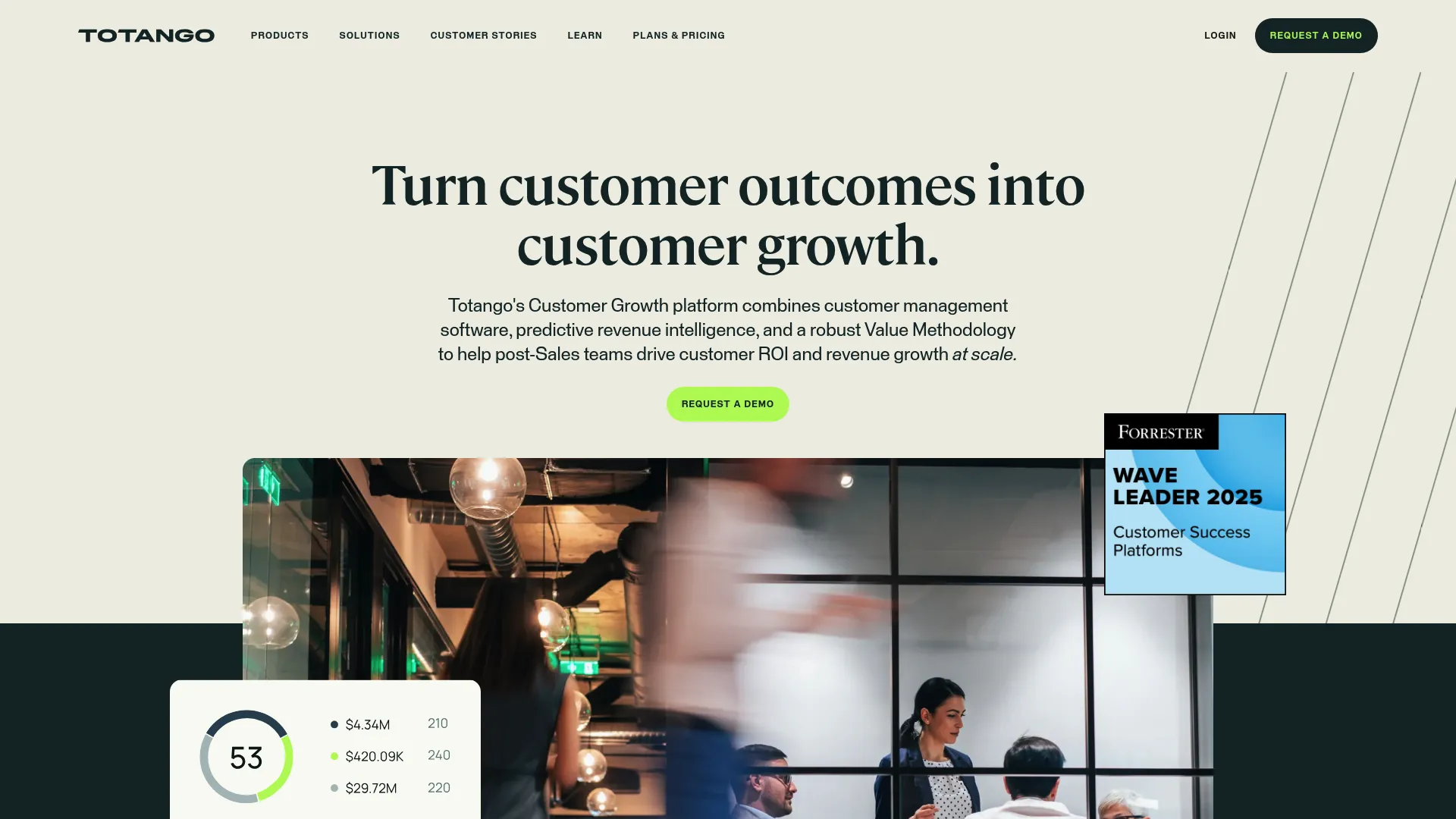
Totango is a customer success platform aimed at enterprise teams managing customer success, renewals, and expansion together. It combines account hierarchies and health models with real-time data streams and pre-built SuccessBLOCs, its term for packaged, automated workflows. The result is a broad platform with operational depth: teams can track health by segment, act on real-time customer context, and run growth motions alongside retention.
Best for: Enterprise teams managing customer success, renewals, and expansion.
Key strengths
- Account hierarchies and configurable health models
- Real-time data streams and customer context
- Pre-built SuccessBLOCs and automated workflows
- Segment-based account management
- Retention plus expansion in one platform
Why choose Totango: If you want a broad CS platform that handles both health monitoring and expansion at enterprise scale, Totango's workflow depth carries it. Its SuccessBLOCs give teams a running start on common motions.
Totango pricing: Totango lists Growth, Premier, and Enterprise packages but does not display public prices. Contact Totango sales for pricing tied to your plan and scale.
6. Planhat

Planhat is a customer platform built for teams that want a highly configurable data layer under their customer success, CRM, and operational workflows. Its unified data model lets you shape health scoring around your own definitions rather than a fixed template, and AI workflows plus conversational AI help teams act on that data. For CS and RevOps teams with specific scoring logic and clean data, Planhat's flexibility is the draw.
Best for: B2B teams that need a highly configurable customer platform for CS, CRM, and operational workflows.
Key strengths
- Unified data model for custom scoring
- AI workflows and conversational AI
- Account-level visibility and analytics
- Access control, SSO/SAML, granular permissions
- CS, CRM, and service in one platform
Why choose Planhat: If you have a specific weighted scoring model in mind and the data to feed it, Planhat gives you the modeling freedom to build it. It rewards teams that want control over configuration.
Planhat pricing: Planhat uses inquiry-based pricing across its CRM, CSP, and PSA products, each listed as "Enquire" rather than a public price, plus add-ons and services. Contact Planhat for a quote.
7. Catalyst

Catalyst is a customer growth platform, now part of Totango, built for CS teams that need stakeholder context alongside product signals. It focuses on customer growth workflows, a customer resources and support hub, and community and knowledge base tooling. For teams that want relationship mapping and account intelligence layered onto health visibility, Catalyst positions health scoring inside a broader growth-and-retention motion.
Best for: CS teams managing customer growth and retention workflows.
Key strengths
- Customer growth workflows
- Account intelligence and relationship context
- Customer resources and support hub
- Community and knowledge base tooling
- Health visibility inside a growth motion
Why choose Catalyst: If you want health signals paired with stakeholder and growth context, Catalyst's growth-platform framing fits. Its place in the Totango family also gives it enterprise backing.
Catalyst pricing: Catalyst does not publish public pricing on its site. Contact the Catalyst team for a quote based on your customer base and workflow needs.
8. ClientSuccess

ClientSuccess is a customer success platform that brings health scoring, journey management, and renewal execution into one place, with a focus on SMB and mid-market teams. It pairs customer health scoring with playbook automation and a unified customer view backed by CRM integrations. Teams that want a more focused CS workflow, with strong implementation support rather than sprawling configuration, tend to fit ClientSuccess well.
Best for: B2B SaaS teams that want a guided customer success platform with strong implementation support.
Key strengths
- Customer health scoring across the account base
- Journey management and playbook automation
- CRM integrations and unified customer view
- Renewal execution workflows
- Guided setup with implementation support
Why choose ClientSuccess: If you are an SMB or mid-market team that wants a focused, well-supported CS platform rather than an enterprise-scale system, ClientSuccess keeps the workflow tight. Implementation support is a stated strength.
ClientSuccess pricing: ClientSuccess offers Startup, Growth, and Enterprise packages but does not publish public pricing. Contact ClientSuccess sales for a quote.
Considerations before you buy
A health score is only as good as the signals feeding it and the actions it triggers. Use this checklist to pressure-test any tool against your reality, not just its feature list.
Signal quality
The score is downstream of your data. Confirm the tool can ingest your real signals: product usage events, support ticket data, survey results, and CRM fields. A platform that only reads lagging commercial data will tell you an account is unhealthy after it already is. Verify which sources connect natively versus which need custom work.
Score flexibility
Your definition of healthy will change. Check whether you can build a weighted scoring model, adjust weights over time, and run more than one scorecard. Rigid, single-formula scoring ages badly as your product and segments evolve.
Lifecycle segmentation
An onboarding account and a mature one are healthy for different reasons. The tool should let you score by lifecycle stage, segment, or product line, so a new customer is not flagged red simply for behaving like a new customer.
Automation and playbooks
A score that does not trigger action is a report. Confirm the platform can fire alerts, assign tasks, and launch playbooks off score changes. This is where health scoring automation turns insight into retained revenue.
Integrations and data hygiene
Score accuracy depends on clean, connected data. Verify integrations with your CRM, product analytics, and support stack, and be honest about your own data hygiene before blaming the tool for a noisy score.
Reporting and adoption
Leadership needs a company-wide view; CS needs account-level detail. Check that both exist, and that the day-to-day interface is something your team will actually open. A dashboard nobody reads changes nothing.
Conclusion
The right customer health score software depends on your team's maturity and the motion you run.
For enterprise lifecycle orchestration across many segments and stakeholders, Gainsight and Totango carry the depth. If you want dashboard-first simplicity your whole team can read, Custify keeps it approachable. For flexible data modeling and custom scoring logic, Planhat gives you the configuration freedom. And for alert-driven renewal and churn workflows, ChurnZero and Vitally turn scores into triggered action. SMB and mid-market teams that want a focused, well-supported system should look hard at ClientSuccess, while Catalyst suits teams pairing health with growth context.
Here is the next step that matters. Shortlist two tools, then map them against your actual health signals, product usage, support data, survey feedback, relationship strength, not just the feature grid. The best platform is the one that scores what you can measure and triggers what you can act on. Pick for your data, and the churn conversations start happening earlier, when you can still change the outcome.
FAQs
Customer health score software combines multiple account signals, product usage, support history, survey feedback, relationship strength, and commercial data, into a single weighted score that predicts renewal, churn, or expansion. It replaces scattered spreadsheets with one operational view CS teams can prioritize against. The goal is to act on risk early, not react to it late.
You assign weights to a set of inputs, then roll them into a composite score or status. A common approach weights product usage and adoption heavily, adds support sentiment and survey data, and factors in relationship and commercial signals. The exact customer health score formula should reflect what actually predicts renewal in your business, and it should be revisited as your product and segments change.
The strongest scores blend quantitative and qualitative signals. Quantitative inputs include login frequency, feature adoption, seat usage, and ticket volume. Qualitative inputs include NPS, CSAT, sentiment, executive sponsor engagement, and champion strength. Combining both gives a fuller picture than usage data alone, which can look healthy right up until the sponsor leaves.
Usually not. An onboarding account and a three-year customer are healthy for different reasons, so a single formula tends to misjudge one of them. The better approach is multiple scorecards segmented by lifecycle stage, segment, or product line. Most mature platforms support this directly.
They surface churn risk earlier than a quarterly review can. Continuous monitoring flags a dropping score the week it happens, giving CS time to intervene while the account is still savable. Paired with automated alerts and playbooks, a declining score triggers action instead of sitting in a dashboard until the renewal call.
CSAT and NPS are single survey signals that capture stated sentiment at a point in time. A health score is a composite that folds NPS and CSAT together with behavioral and commercial data. Someone can give you a high NPS and still churn if usage has cratered, which is exactly the gap a multi-signal health score is built to close.
As often as the underlying data allows, ideally continuously or daily. The value of health scoring is early warning, and a score refreshed once a quarter defeats that purpose. Look for tools that pull real-time or near-real-time data from your product and support systems so the score reflects the account as it is now.
Customer Success typically owns the day-to-day, but health scoring works best as a cross-functional system. RevOps often owns the data plumbing and scoring logic, CS acts on the accounts, and leadership uses the company-wide view for renewal and expansion forecasting. Treating it as CS-only tends to leave the score disconnected from the systems that feed and act on it.