A hospital can know its total annual spend down to the cent while an operating room runs out of a critical supply mid-case. That gap is not a data problem. It is a workflow problem, and most health systems have built their supply chain on software that was never designed to close it.
The healthcare supply chain management market reached $3.93 billion in 2025, according to Fortune Business Insights. Software accounted for 58% of that total, per DelveInsight, as health systems moved procurement, inventory, and logistics off spreadsheets and manual requisitions. Yet spending on software does not automatically mean visibility. A disconnected procure-to-pay system, a clinical inventory module that no bedside nurse will actually use, and a planning tool that cannot respond to a supplier shortage in under 48 hours all represent the same fundamental failure: The right data is not getting to the right person fast enough.
Enterprise healthcare buyers do not buy software for feature lists. They buy fewer supply disruptions, cleaner item data, faster purchasing decisions, and defensible savings they can report to a board.
What's inside
This guide covers 10 healthcare supply chain software tools for 2026, organized by the operational job each one does best.
- Who it is for: Hospital supply chain leaders, procurement executives, materials managers, and SaaS founders mapping the category.
- Selection criteria used:
- Healthcare and hospital workflow fit
- Integration with ERP, finance, and clinical systems
- Coverage across procurement, planning, inventory, and traceability
- Support for multi-facility operations and measurable KPIs
TL;DR
- Best for integrated supply chain and finance: Workday Supply Chain Management for health systems consolidating procurement, inventory, and enterprise reporting into one operating model
- Best for clinical and point-of-use inventory: Tecsys Elite Healthcare for procedural supply visibility, utilization capture, and case costing in ORs and cath labs
- Best for healthcare procurement networks: GHX Exchange for provider-supplier connectivity, purchase order automation, and item data management
- Best for enterprise planning: SAP Integrated Business Planning for demand forecasting, scenario modeling, and complex S&OP requirements
- Best for disruption response: Kinaxis RapidResponse for concurrent planning when supplier capacity shifts faster than a weekly planning cycle can handle
- Best for warehouse-heavy operations: Manhattan Active Supply Chain for high-volume distribution centers and fulfillment operations
What is healthcare supply chain software?
Healthcare supply chain software is a platform that helps hospitals, health systems, and healthcare suppliers plan, buy, receive, track, distribute, and analyze medical supplies across the path from supplier to patient care.
Core functions
Most platforms in this category cover some combination of the following:
- Procurement and purchase order workflows: Requisition creation, approval routing, purchase order generation, and invoice matching
- Inventory visibility and replenishment: PAR level management, Kanban triggers, and location-level stock counts
- Clinical and point-of-use supply management: Consumption capture at the bedside, OR, lab, or cath lab
- Item master and supplier data management: Product identification, unit-of-measure logic, supplier IDs, and contract records
- Demand planning and shortage response: Statistical forecasting, demand sensing, and backorder management
- Warehouse and logistics execution: Receiving, put-away, pick, pack, ship, and distribution center operations
- Traceability, recalls, and lot-level tracking: UDI compliance, expiration date management, and recall workflows
- Analytics for spend and operational KPIs: Supply cost per case, inventory turns, fill rate, and contract compliance
Healthcare supply chain software versus ERP
ERP suites connect supply chain activity with finance, contracts, purchasing, and enterprise reporting. Specialist platforms go deeper into clinical inventory, distribution, demand planning, supplier networks, or logistics execution. Most large health systems run a connected stack rather than expecting one platform to own every workflow.
Capabilities buyers should expect
- Barcode and RFID-enabled receiving
- Mobile inventory workflows for storeroom and point-of-use staff
- PAR level and Kanban replenishment support
- Demand forecasting and shortage alerts
- Contract and supplier management
- Recall and substitute item workflows
- Role-based reporting for finance, supply chain, and clinical leaders
| Category | Primary workflow | Typical buyer | Examples in this list |
|---|---|---|---|
| Enterprise ERP suite | Finance, procurement, inventory, analytics | CFO, CIO, VP Supply Chain | Workday, Oracle |
| Healthcare procurement network | Provider-supplier transactions, item data | VP Procurement, Materials Manager | GHX |
| Clinical inventory platform | Point-of-use, case costing, traceability | OR Director, Materials Manager | Tecsys |
| Planning platform | Demand planning, S&OP, disruption response | Supply Chain Planning Lead | SAP IBP, Kinaxis, Blue Yonder |
| Supply network platform | Supplier visibility, logistics, trade | VP Supply Chain, Global Ops | Infor Nexus, E2open |
| Warehouse execution platform | Distribution, fulfillment, labor | DC Manager, 3PL Operations | Manhattan |
When to use healthcare supply chain software
Reduce stockouts in clinical and procedural areas
Operating rooms, cath labs, imaging suites, and emergency departments operate on tight supply windows. A central warehouse may show adequate stock while a specific department location runs short because consumption is not being captured at the point of use. Platforms with clinical inventory modules close that gap by recording actual utilization and triggering replenishment before a stockout, not after. Barcode inventory software and RFID workflows are the data capture layer that makes this work.
Standardize procurement across a multi-facility health system
Fragmented purchasing across locations produces duplicate item records, off-contract spending, and inconsistent approval paths. A system that connects requisition, purchase order, receiving, and invoice matching across all sites creates the compliance and spend visibility leadership needs to defend savings in a board presentation. Contract management and supplier collaboration tools belong in this workflow.
Model disruptions before they hit patient care
Supplier shortages, backorders, and procedure volume shifts do not announce themselves. Planning platforms let supply chain leaders run scenario analyses before a disruption becomes an operational emergency. When demand signals change, these tools update supply recommendations in near real time rather than waiting for the next weekly planning cycle to catch up.
Healthcare supply chain software comparison
These 10 tools occupy different layers of the healthcare supply chain stack. Shortlisting them against each other directly only makes sense when they cover the same workflow. Use the table to identify which category fits your primary operational problem, then read the relevant tool sections.
| # | Product | Best for | Key use case | Pricing | G2 rating |
|---|---|---|---|---|---|
| 1 | Workday Supply Chain Management | Health systems consolidating supply chain and finance | Procure-to-pay, inventory, sourcing, and enterprise reporting | Contact sales | 4.3/5 |
| 2 | Tecsys Elite Healthcare | Clinical inventory-intensive providers | Point-of-use inventory, case costing, and traceability | Contact sales | 4.7/5 |
| 3 | GHX Exchange | Provider-supplier procurement networks | Purchase order automation, supplier connectivity, item data | Contact sales | N/A |
| 4 | Oracle Fusion Cloud SCM | Large enterprise health systems | Enterprise procurement, planning, inventory, and analytics | From $200/month per module | N/A |
| 5 | SAP Integrated Business Planning | Complex demand and supply planning | Scenario planning, S&OP, and forecasting | Contact sales | 4.2/5 |
| 6 | Infor Nexus | Multi-enterprise supply network visibility | Supplier, logistics, and external network coordination | Contact sales | N/A |
| 7 | Blue Yonder | End-to-end planning and execution | Demand planning, fulfillment, and warehouse operations | Contact sales | 4.1/5 |
| 8 | Kinaxis RapidResponse | Fast disruption response planning | Concurrent planning and what-if scenarios | Contact sales | 4.0/5 |
| 9 | E2open | External supply chain network management | Supplier, logistics, and partner orchestration | Contact sales | 4.1/5 |
| 10 | Manhattan Active Supply Chain | Distribution-heavy healthcare operations | Warehouse execution and inventory movement | Contact sales | N/A |
Best 10 healthcare supply chain software tools for 2026
1. Workday Supply Chain Management
Workday Supply Chain Management connects sourcing, procurement, supplier management, contracts, inventory, and analytics inside the same cloud operating model as Workday's finance and HR applications. For health systems already running Workday for financials, this means supply chain activity and financial reporting share a single source of truth rather than a nightly data transfer between disconnected systems.
Best for: Health systems trying to reduce handoffs between supply chain, finance, purchasing, and enterprise reporting.
Key features
- Spend analysis and planning across categories and suppliers
- Strategic sourcing and supplier management workflows
- Contract lifecycle management from creation to renewal
- Procurement and bill-only purchase processing
- Inventory and recall management with mobile support
- AI-powered assistant for task automation and reporting
Why choose Workday: Workday earns its place on a shortlist when the buying problem is cross-functional consolidation, not a narrow clinical inventory gap. Organizations that need procurement, inventory, finance, and analytics to share data without an integration layer will find the unified model reduces reconciliation overhead.
Workday Supply Chain Management pricing: Workday prices by module and organizational scope through a direct sales process. Contact Workday for a quote specific to your organizational size and selected modules.
Workday holds a 4.3/5 rating on G2, based on reviews for its Spend Management product.
2. Tecsys Elite Healthcare
Tecsys Elite Healthcare is a supply chain platform purpose-built for hospitals, health systems, pharmacies, and healthcare distributors. Its clinical workflow depth sets it apart from general-purpose ERP supply modules: The platform captures consumption at the point of use, supports RFID and barcode workflows in the OR and lab, and generates case costing data that clinical and finance leaders can actually use. It also addresses DSCSA serialization requirements for healthcare distributors.
Best for: Hospitals that need reliable inventory signals where supplies are consumed, including operating rooms, cath labs, and specialty procedure areas.
Key features
- Real-time inventory visibility and end-to-end traceability
- RFID, barcode, and mobile tracking for point-of-use operations
- Warehouse management with system-directed workflows
- Automated case costing tied to procedure utilization
- DSCSA serialization support for healthcare distributors
Why choose Tecsys: This is a stronger fit than a general planning suite when the primary buying problem is clinical inventory accuracy, expiration management, or supply cost per case. It gives OR directors and materials managers data they can act on, not just aggregate spend reports.
Tecsys Elite Healthcare pricing: Tecsys prices by modules, sites, and user count through a direct sales process. Contact Tecsys for a quote.
Tecsys Elite carries a 4.7/5 rating on G2.
3. GHX Exchange
GHX Exchange is a healthcare commerce and supplier network platform that automates provider-supplier transactions. Rather than replacing an ERP, it acts as the electronic ordering layer between a hospital's purchasing system and its supplier base, correcting order-entry errors through intelligent business rules before they generate exceptions that slow receiving and accounts payable.
Best for: Provider organizations solving supplier connectivity, purchasing compliance, and item data quality problems.
Key features
- Automated ordering and purchase order visibility
- Intelligent business rules for correcting order-entry errors
- Transaction dashboards with real-time data and alerts
- Contract compliance monitoring
- Healthcare procurement analytics across supplier relationships
Why choose GHX: GHX fits organizations where the immediate bottleneck is procurement process standardization and supplier connectivity, not clinical inventory operations. It reduces manual exception handling between buyers and suppliers, which matters most for high-volume purchasing departments managing hundreds of supplier relationships.
GHX Exchange pricing: GHX prices through a direct sales process. Contact GHX for a quote.
4. Oracle Fusion Cloud SCM

Oracle Fusion Cloud SCM covers the full spectrum of supply chain and manufacturing operations: Product lifecycle management, procurement, supply chain planning, inventory, order management, logistics, and built-in AI capabilities. Its breadth makes it a natural fit for large organizations that need a single cloud suite spanning multiple supply chain disciplines.
Best for: Large enterprises standardizing procurement, inventory, planning, and financial processes across a complex organizational estate.
Key features
- Product lifecycle management and engineering change control
- Supply chain planning including demand management and S&OP
- Procurement and supplier collaboration portals
- Inventory, manufacturing, maintenance, and quality management
- Order management and logistics execution
- SCM analytics with AI-generated recommendations
Why choose Oracle: Oracle earns consideration when the scope of the program covers manufacturing, product development, or complex logistics alongside procurement and inventory. It often requires a mature implementation partner and clear program ownership. Organizations that need only procurement and clinical inventory should evaluate whether the full suite adds proportional value.
Oracle Fusion Cloud SCM pricing: Oracle publishes module-specific subscription prices in its global price list. The Advanced Inventory Management Cloud Service starts at $200 per user per month for a minimum of 10 hosted named users, billed monthly. Other SCM modules are priced separately. Contact Oracle for a full solution quote.
5. SAP Integrated Business Planning

SAP Integrated Business Planning is a cloud-based supply chain planning application for demand forecasting, inventory optimization, supply planning, and sales and operations planning. It connects directly with the broader SAP ecosystem, making it the natural planning layer for organizations already running SAP ERP.
Best for: Health systems or healthcare manufacturers with complex demand planning, supply balancing, and executive S&OP requirements.
Key features
- Sales and operations planning with real-time scenario simulation
- Demand planning using statistical forecasting and machine learning
- Inventory optimization across multistage networks
- Response and supply planning with multilevel coverage
- Supply chain visibility and event-driven exception management
Why choose SAP IBP: SAP IBP fits planning-led organizations where forecast accuracy, capacity visibility, and supply-demand tradeoff analysis matter more than point-of-use inventory tracking. It is not a substitute for clinical inventory or procurement network tools, but it adds significant capability when disruption response and executive planning alignment are the primary gaps.
SAP Integrated Business Planning pricing: SAP prices through a quote process. Contact SAP for organizational pricing.
6. Infor Nexus
Infor Nexus is a cloud-based supply chain business network designed for organizations managing complex, multinational supply chains across suppliers, logistics providers, manufacturers, and financial institutions. It orchestrates multi-tier visibility, global transportation management, supplier collaboration, and procure-to-pay automation from a single network platform.
Best for: Healthcare suppliers, distributors, or large provider networks managing significant external trading partner and logistics complexity.
Key features
- End-to-end visibility of orders, shipments, and inventory
- Global transportation management across multimode flows
- Supplier management and collaboration tools
- Procure-to-pay automation and supply chain finance
- Multi-tier traceability and sustainability tracking
- AI-powered supply chain control tower capabilities
Why choose Infor Nexus: Infor Nexus earns a shortlist when external supplier and logistics coordination is the primary constraint. A single hospital managing a modest supplier base will find its capabilities exceed the immediate need. The platform makes more sense for large distributors, multi-site health systems, or healthcare manufacturers coordinating global supply networks.
Infor Nexus pricing: Infor prices through a direct sales process. Contact Infor for a quote.
7. Blue Yonder
Blue Yonder provides AI-powered supply chain management spanning planning, fulfillment, warehouse, transportation, labor, and network collaboration. Its scope makes it one of the broadest platforms in this comparison, covering both strategic planning and day-to-day execution across distributed operations.
Best for: Large organizations that need advanced planning and execution across a distributed supply network, including demand forecasting, warehouse operations, and fulfillment optimization.
Key features
- End-to-end demand forecasting and inventory planning
- AI and machine-learning supply chain insights
- Warehouse management with system-directed operations
- Fulfillment optimization across channels
- Common data cloud with real-time network visibility
Why choose Blue Yonder: Blue Yonder fits organizations managing planning and execution complexity across a broad network, not a single facility deployment. Implementations are significant programs that benefit from experienced partners and clear executive sponsorship. Organizations with a narrow initial scope should validate that the platform's breadth justifies the investment before committing.
Blue Yonder pricing: Blue Yonder prices through a direct sales process. Contact Blue Yonder for a quote.
Blue Yonder holds a 4.1/5 rating on G2.
8. Kinaxis RapidResponse
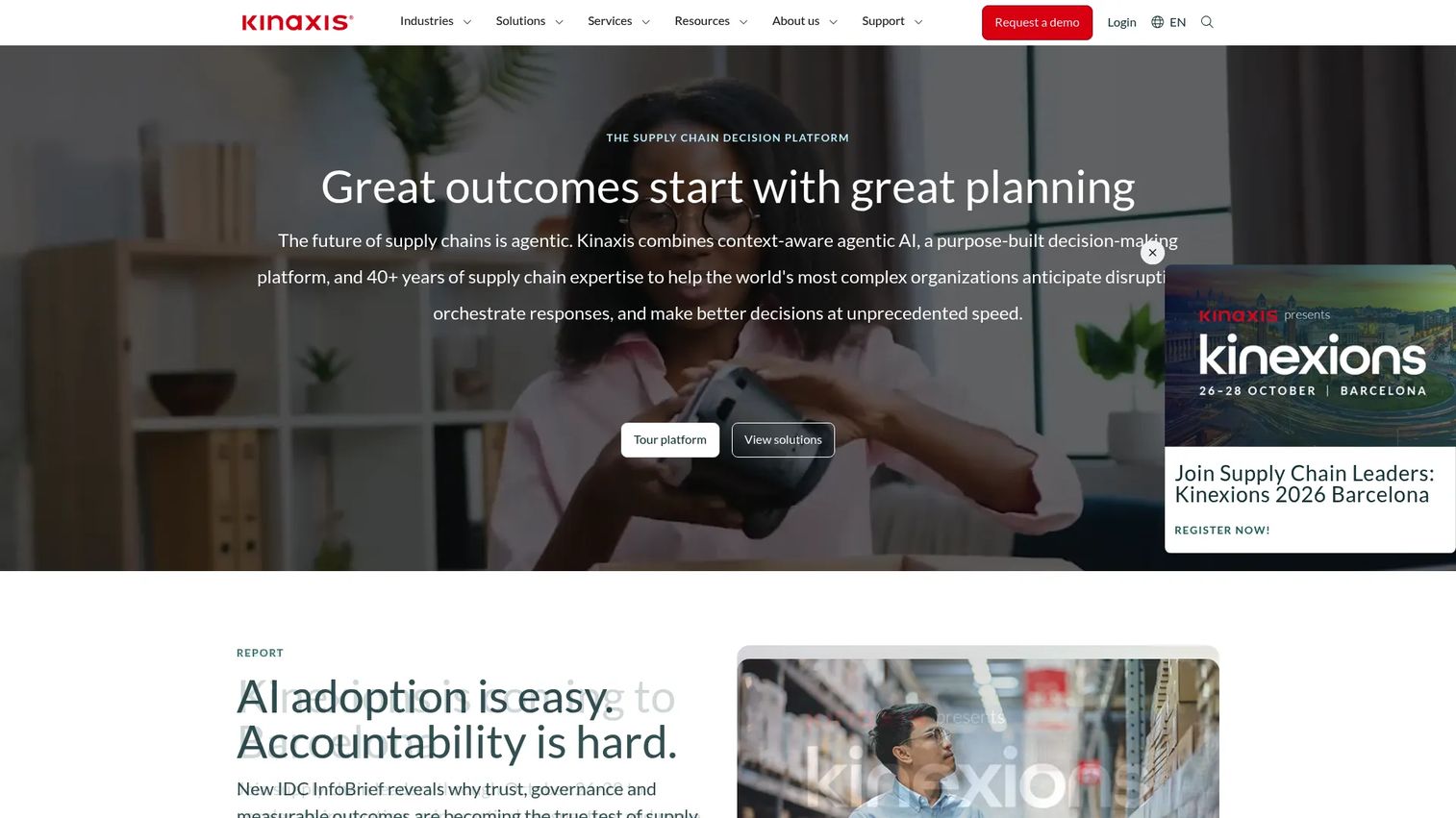
Kinaxis RapidResponse, now marketed as part of Kinaxis Maestro, is a cloud-based supply chain planning platform built around concurrent planning and fast scenario response. Where other planning tools run batch processes, RapidResponse evaluates demand and supply signals simultaneously, allowing planners to model the impact of a supplier disruption or demand shift before committing to a course of action.
Best for: Healthcare organizations or suppliers that need to evaluate supply disruptions and planning changes quickly, without waiting for a weekly planning cycle.
Key features
- Concurrent planning across demand, supply, and inventory
- Real-time what-if scenario modeling
- End-to-end supply chain visibility and control tower
- Cloud-based platform with extensible integrations
- Collaboration workflows across planning teams
Why choose Kinaxis: Kinaxis is strongest when the bottleneck is decision speed. If your planning team spends days preparing scenarios by hand for executive review, concurrent planning changes that dynamic. Organizations that need clinical inventory management or warehouse execution as the primary deliverable should look at purpose-built healthcare platforms first.
Kinaxis RapidResponse pricing: Kinaxis prices through a quote process. Contact Kinaxis for organizational pricing.
Kinaxis holds a 4.0/5 rating on G2.
9. E2open
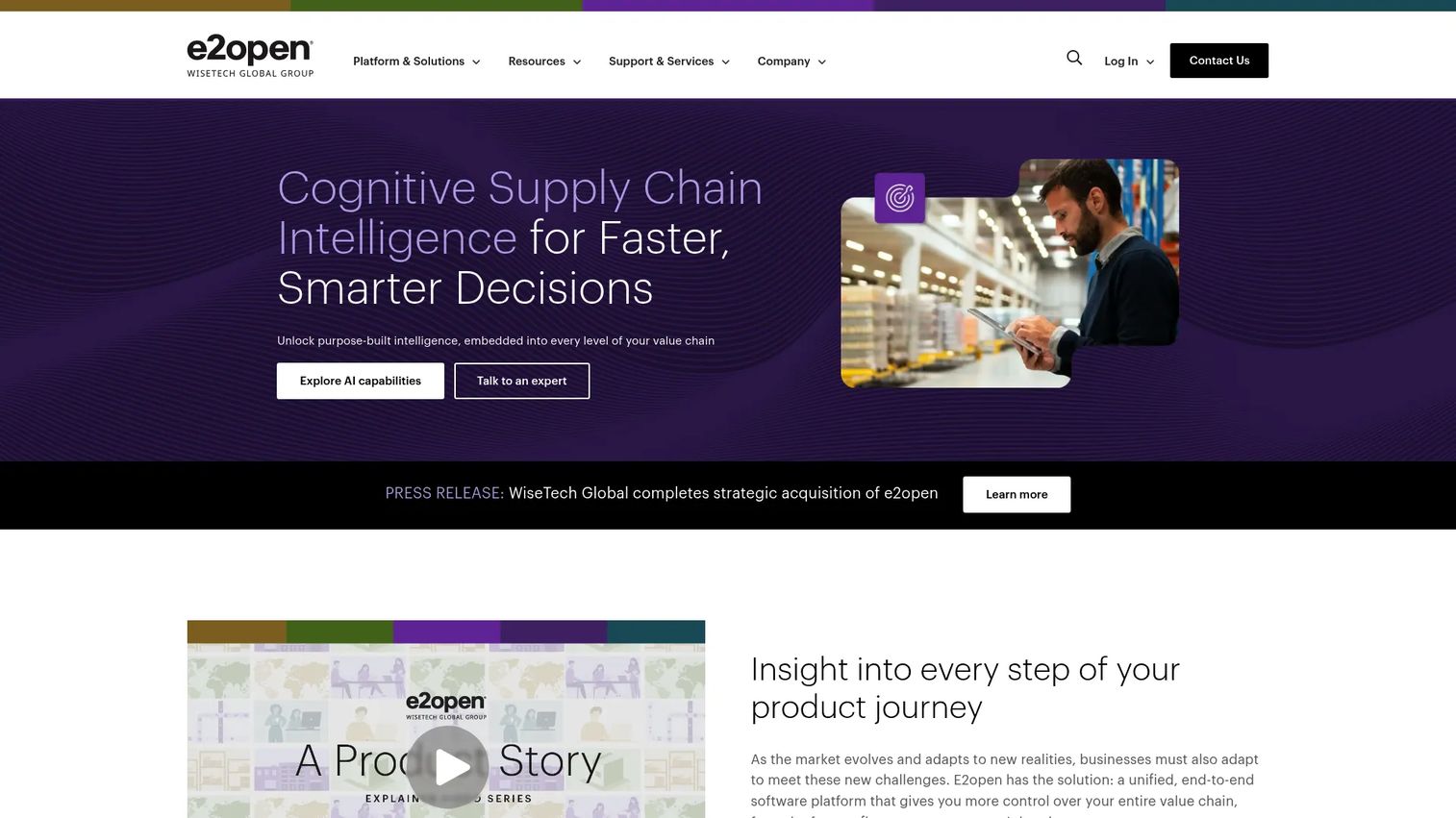
E2open is a connected, cloud-native supply chain platform covering planning, supply chain collaboration, global trade compliance, and logistics execution. It is built for organizations coordinating activity across a broad ecosystem of suppliers, logistics providers, and channel partners.
Best for: Healthcare manufacturers, distributors, and complex provider supply networks with significant external partner dependencies and global trade requirements.
Key features
- Connected planning with AI-powered demand forecasting
- Global trade compliance, screening, and duty filing
- Multimode logistics planning, execution, and shipment visibility
- Multi-tier supplier collaboration
- Partner network orchestration
Why choose E2open: E2open fits businesses coordinating a broad external ecosystem rather than managing internal hospital inventory. A single hospital primarily solving procurement or clinical inventory problems will find the platform's global trade and multi-partner orchestration capabilities exceed their immediate scope. It is well-positioned for healthcare manufacturers and large distributors managing international supply networks.
E2open pricing: E2open prices through a direct sales process. Contact E2open for a quote.
E2open holds a 4.1/5 rating on G2 based on 26 reviews.
10. Manhattan Active Supply Chain
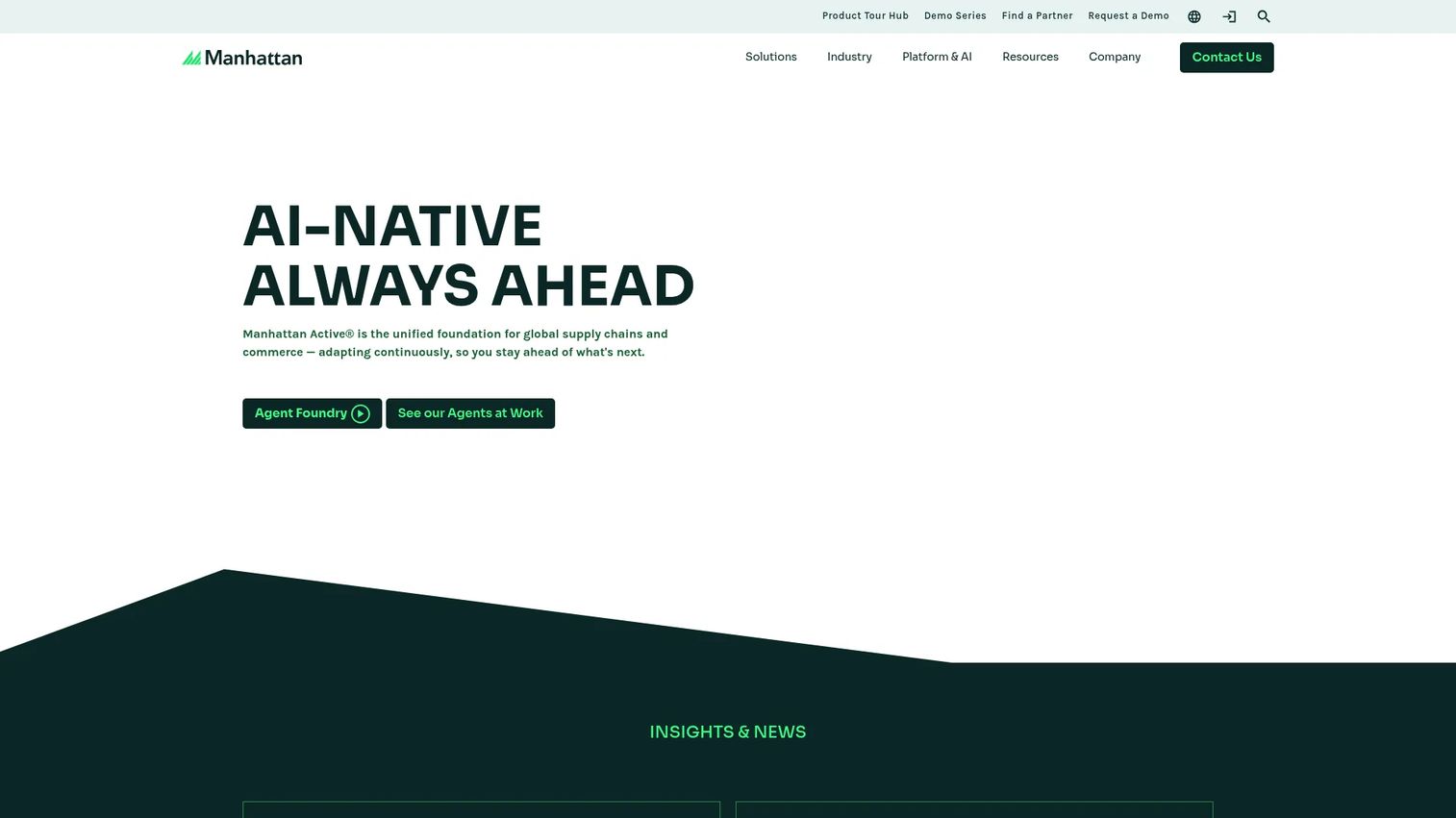
Manhattan Active Supply Chain is a cloud-native supply chain planning platform focused on demand forecasting, replenishment, allocation, and coordination with warehouse and transportation execution. Its architecture keeps planning and execution bidirectionally connected, so a warehouse event updates a supply plan in real time rather than waiting for an overnight batch.
Best for: Large health systems, distributors, and medical suppliers with high-volume fulfillment, distribution center operations, or complex warehouse requirements.
Key features
- AI-powered demand forecasting and replenishment
- Intelligent allocation and order fulfillment
- Unified business planning connected to execution
- Real-time coordination with warehouse and transportation management
- Labor management for distribution center operations
Why choose Manhattan: Manhattan is a strong operational fit when the primary problem is physical distribution throughput and warehouse execution. Pair it with a clinical inventory or procurement platform if those workflows are also in scope. Organizations that want clinical supply chain management alongside distribution should plan for an integrated architecture rather than expecting Manhattan to own both.
Manhattan Active Supply Chain pricing: Manhattan prices through a direct sales process. Contact Manhattan Associates for a quote.
Considerations when choosing healthcare supply chain software
Start with the operational bottleneck
Identify whether the real failure point is procurement, item data, inventory accuracy, clinical consumption capture, warehouse execution, demand planning, or supplier visibility. Buying a planning platform to solve an OR replenishment problem is a common and expensive mismatch. The category you choose should directly address the workflow that fails most often today.
Map the integration architecture before evaluating features
Require your team to document current ERP, EHR, finance, inventory, purchasing, supplier, barcode, RFID, and data warehouse connections. Integration scope drives timeline and cost more than feature checklists. A platform with strong healthcare workflow coverage but poor integration with your existing EHR or ERP creates a data gap that defeats the purpose. Clinical trial management software and other enterprise platforms face the same challenge: Integration quality matters as much as standalone capability.
Test data quality before selecting a platform
Cover item master consistency, supplier IDs, unit-of-measure logic, contract records, location hierarchy, and usage data. A new platform cannot produce reliable supply cost per case reporting or accurate replenishment signals from inconsistent source data. Data remediation is almost always underestimated in implementation scoping.
Validate clinical workflow adoption
Require observation and input from materials management staff, nurses, procedural teams, OR leaders, pharmacy when relevant, finance, and IT. Inventory capture fails when it adds steps at the point of care. Tools that integrate with existing barcode scanners and mobile devices have a higher adoption rate than those requiring new hardware in every location.
Define measurable outcomes before implementation
Agree on a KPI baseline before go-live. Track stockout rate, inventory turns, expired and obsolete inventory, contract compliance, supply cost per case, purchase order match rate, requisition cycle time, fill rate, supplier performance, and days of inventory on hand. Without a baseline, it is impossible to report defensible savings to a board or investment committee.
How to choose the right healthcare supply chain software
Choose an integrated enterprise suite when finance and supply chain data are disconnected
Evaluate Workday Supply Chain Management or Oracle Fusion Cloud SCM when the business problem crosses purchasing, financial reporting, enterprise governance, and inventory. These platforms are the right choice when the organization needs supply chain activity to feed financial reporting without manual reconciliation.
Choose a healthcare-specific operations platform when clinical inventory is the problem
Tecsys Elite Healthcare is the natural fit when point-of-use consumption capture, case costing, or procedural traceability is the primary gap. GHX Exchange belongs on the shortlist when the bottleneck is specifically provider-supplier purchasing connectivity and item data quality rather than clinical inventory operations.
Choose a planning platform when disruptions drive executive attention
Kinaxis RapidResponse, Blue Yonder, or SAP Integrated Business Planning each address planning and scenario modeling, but at different depths. Kinaxis excels at concurrent planning speed. Blue Yonder covers broader planning and execution. SAP IBP fits organizations already invested in the SAP ecosystem.
Choose a network or execution platform when external coordination is the bottleneck
E2open and Infor Nexus are the right tools when the problem is supplier network coordination, logistics visibility, or global trade management. Manhattan Active Supply Chain fits when the constraint is warehouse execution and distribution throughput. Enterprise buyers often run tools from multiple categories in parallel.
Conclusion
Healthcare supply chain software is not a single category. It is a stack of specialized tools covering clinical inventory, procurement networks, enterprise planning, warehouse execution, and supplier network coordination. The shortlist logic follows the operational failure you are trying to fix.
Workday and Oracle suit organizations merging supply chain and finance into one operating model. Tecsys addresses clinical inventory and utilization capture where general planning tools cannot reach. GHX solves the procurement network layer. SAP IBP and Kinaxis serve planning-led environments where disruption response and scenario modeling are the bottleneck. Blue Yonder and E2open cover broader execution and network coordination. Manhattan fits distribution-heavy operations.
Start with the workflow that fails most often. Choose the software category that owns that workflow. Avoid a broad enterprise program until your organization can define the data remediation, integration work, and clinical adoption requirements with specificity.
If you build or sell into the healthcare supply chain market and want to show buyers how your product works before they commit to a demo call, Start your journey with Guideflow today!
FAQs
Healthcare supply chain software is a category of platforms that helps hospitals, health systems, and healthcare suppliers plan, buy, receive, track, distribute, and analyze medical supplies from supplier to patient care. The scope differs significantly by platform: Some focus on clinical inventory and point-of-use operations, others on enterprise procurement and planning, and others on supplier network coordination. Most health systems use tools from more than one category.
ERP systems connect supply chain activity with finance, contracts, purchasing, and enterprise reporting in a unified data model. Specialist healthcare supply chain software can go deeper into clinical inventory, supplier networks, warehouse workflows, or demand planning than most ERP supply modules support. The choice often comes down to whether the organization needs a unified financial and operational model or specialized workflow depth in a specific area.
The priority depends on the operational bottleneck. Hospitals solving clinical inventory and stockout problems need point-of-use consumption capture, barcode or RFID receiving, and case costing. Organizations solving procurement fragmentation need contract management, supplier connectivity, and purchase order automation. Planning-led organizations need demand forecasting, scenario modeling, and shortage response workflows. Analytics for supply cost per case, inventory turns, and fill rate matter across all categories.
It can improve visibility, replenishment signals, demand planning, and substitute item workflows, which are the mechanisms that prevent stockouts. Stockout performance still depends on data quality, supplier availability, workflow adoption, and the accuracy of consumption data at the point of use. Software creates the conditions for better replenishment decisions; it does not remove the operational and data quality work required to act on those signals.
Many platforms support barcode workflows for receiving, inventory movement, and point-of-use capture. RFID support varies by vendor and deployment context. Buyers should validate the hardware compatibility, data capture workflow, and integration requirements early in the evaluation. RFID deployments in OR and procedural areas often require clinical change management work alongside the technology implementation.
Timelines range from focused departmental deployments of a few months to multi-year enterprise programs spanning procurement, inventory, planning, and analytics. The primary drivers are data remediation, ERP and EHR integration complexity, number of facilities, process redesign scope, staff training, and phased rollout design. Organizations that underestimate data quality work consistently experience the longest delays.
Establish baselines before implementation for: Stockout rate, inventory turns, expired and obsolete inventory value, supply cost per case, contract compliance rate, requisition cycle time, fill rate, purchase order match rate, supplier on-time delivery, and days of inventory on hand. These metrics let leadership measure improvement against a pre-implementation baseline and report defensible outcomes to a board or CFO.
Systems can support item, lot, serial number, location, and patient utilization records depending on their architecture and workflows. Recall response speed depends on the quality of receiving data, lot capture at the point of use, and integration between the supply chain system and clinical documentation. Buyers should validate specific traceability requirements against product types, facilities, and operational processes before selecting a platform, rather than assuming a general traceability claim covers their specific regulatory or clinical needs.