You can close a strong quarter and still watch margin erode through shipping. The leak is rarely one carrier invoice. It's the daily accumulation of wrong service levels, manual label work, missed delivery alerts, and returns friction that nobody flags until finance asks why gross margin moved.
U.S. parcel volume hit 23.1 billion shipments in 2025, up 3.3% year over year, according to Pitney Bowes (2026). At that scale, carrier rate differences compound, fulfillment errors multiply, and teams that relied on a spreadsheet at 500 orders per month find themselves drowning at 5,000. The right shipping software replaces that manual layer with a system a VP of Operations can own and improve without the founder in every decision.
This guide cuts through 15 options across full-stack platforms, postage tools, marketplace-native solutions, and carrier-direct tools so you can shortlist the two or three that fit your volume, channels, and geography.
What's inside
This guide compares 15 ecommerce shipping software options for founders and operators building repeatable fulfillment operations. Tools were selected based on:
- Carrier coverage and access to discounted rates
- Ecommerce and marketplace integrations (Shopify, Amazon, marketplaces)
- Automation depth, batch shipping, and tracking capabilities
- Returns management, international workflows, and API availability
- Fit by order volume, operating model, and reporting quality
TL;DR
- Best overall ecommerce shipping platform: ShipStation, for multi-carrier workflows, automation rules, branded tracking, and returns across multiple stores
- Best API-first option: Shippo, for teams embedding shipping into software or building custom fulfillment workflows
- Best free starting point: Pirate Ship, for small-business label printing with discounted USPS and UPS rates and no monthly fee
- Best for Amazon-native and multichannel sellers: Veeqo, for shipping and inventory control in one workflow
- Best for international ecommerce: Easyship or Sendcloud, especially when customs, duties, and cross-border courier choice affect margin
- Best for carrier-direct execution: UPS, FedEx, DHL, or USPS, when most shipments run through a single network
What is shipping software?
Shipping software is a digital platform that helps businesses compare carrier rates, create labels, manage orders, automate fulfillment workflows, track shipments, handle returns, and connect shipping data to ecommerce, marketplace, warehouse, and accounting systems.
The category spans simple postage tools and full-stack fulfillment platforms. What they share is a core set of capabilities:
- Rate shopping: Compare carrier services by cost, delivery speed, destination, and package dimensions
- Label creation: Print labels individually or in batches across multiple carriers
- Carrier discounts: Access pre-negotiated rates or connect existing negotiated carrier accounts
- Order management: Pull orders from stores, marketplaces, and ERP systems into one queue
- Automation rules: Set shipping methods by order value, weight, destination, or SKU without manual intervention
- Tracking and notifications: Send delivery updates and exception alerts to customers automatically
- Returns management: Generate return labels and manage exchange and return portal workflows
- International shipping: Handle customs forms, duties, taxes, and cross-border documentation
- APIs and integrations: Connect shipping data to apps, checkout, WMS, ERP, and custom systems
- Analytics: Track carrier spend, fulfillment speed, delivery exceptions, and cost per shipment
For a Series B founder, this category matters because shipping touches gross margin, customer retention, and operations headcount simultaneously. The goal isn't another dashboard. It's a system your operations leader can own and that surfaces clean enough data for a board-level margin conversation.
If you're evaluating ecommerce platforms for small business alongside shipping tools, that guide covers the commerce layer separately.
When to use shipping software
Compare rates before margin leaks into carrier invoices
Carrier rate differences look small per package. At hundreds of shipments per week, they compound into a material margin line. Shipping software gives your team rate comparison at the point of label purchase rather than after the finance team reconciles the carrier invoice. This is the fastest first-week ROI for most ecommerce operations.
Automate fulfillment as order volume grows unpredictably
Manual label creation, copy-paste tracking updates, and spreadsheet exception management stop working the moment order volume spikes. Shipping automation rules replace those manual steps with pre-set logic: Service level by order weight, carrier by destination, return label by product category. The result is fewer fulfillment errors and more output per operations hire.
Support international and multichannel selling without custom workflows
Selling across Shopify, Amazon, and international markets adds customs data requirements, regional carrier differences, duty handling, and delivery promises that vary by country. Shipping software closes the gap between "we can take the order" and "we can deliver it profitably." Without it, international expansion creates ad hoc manual work that doesn't scale.
Shipping software comparison
The table below summarizes all 15 tools by operating fit, key differentiator, pricing, and G2 rating. Pricing reflects each vendor's current pricing page. Carriers do not use subscription models, so pricing rows for UPS, FedEx, DHL, and USPS reflect their per-shipment rate structure.
| # | Product | Best for | Key differentiator | Pricing | G2 rating |
|---|---|---|---|---|---|
| 1 | ShipStation | Multi-channel ecommerce teams | Broad carrier and integration coverage with automation | From $14.99/mo | 4.3/5 |
| 2 | Shippo | API-first and small business teams | Shipping API plus multi-carrier label workflows | Free; Pro from $17/mo | 4.2/5 |
| 3 | PitneyShip | Small businesses managing shipping and postage | Labels, stamps, Certified Mail, and postage workflows | Free tier; from $34.99/mo | N/A |
| 4 | Veeqo | Amazon sellers and multichannel inventory teams | Amazon-backed shipping with inventory management | Free Shipping tier; Inventory from $19/mo | 4.5/5 |
| 5 | Easyship | International ecommerce sellers | 550+ couriers, duties, taxes, and checkout rates | Free tier available | 4.3/5 |
| 6 | Sendcloud | European ecommerce teams | 170+ carriers, return portal, and checkout delivery options | Free tier; Lite from €28/mo | 4.5/5 |
| 7 | Pirate Ship | Small businesses seeking discounted labels | Free software with USPS and UPS rate access | Free (pay postage only) | 4.5/5 |
| 8 | ReadyShipper X | Warehouse teams needing desktop shipping workflows | Rules-based fulfillment and label printing | Contact vendor | 4.0/5 |
| 9 | Ordoro | Ecommerce teams needing shipping plus inventory | Shipping, inventory, purchase orders, and dropshipping | Free Shipping Essential; from $59/mo | 4.8/5 |
| 10 | Shopify | Shopify merchants wanting native fulfillment | Built-in shipping inside the Shopify admin | From $29/mo (annual) | 4.4/5 |
| 11 | Amazon Shipping | Amazon and ecommerce sellers | Amazon logistics network for eligible shipments | From $5.10/package | N/A |
| 12 | UPS | Businesses standardizing on UPS | Carrier-direct shipping, freight, and business services | From $12.20/shipment | 4.2/5 |
| 13 | FedEx | Businesses using FedEx parcel and freight | Carrier-direct tools and international freight coverage | From $12.75/shipment | 4.4/5 |
| 14 | DHL | Cross-border and global shipping teams | International express and freight logistics | Quote-based | 4.5/5 |
| 15 | USPS | Small businesses and domestic postal shipping | Postal labels, flat-rate options, and pickups | From $0.65/stamp; Ground Advantage from $8.40 | N/A |
Best 15 shipping software tools for ecommerce in 2026
1. ShipStation
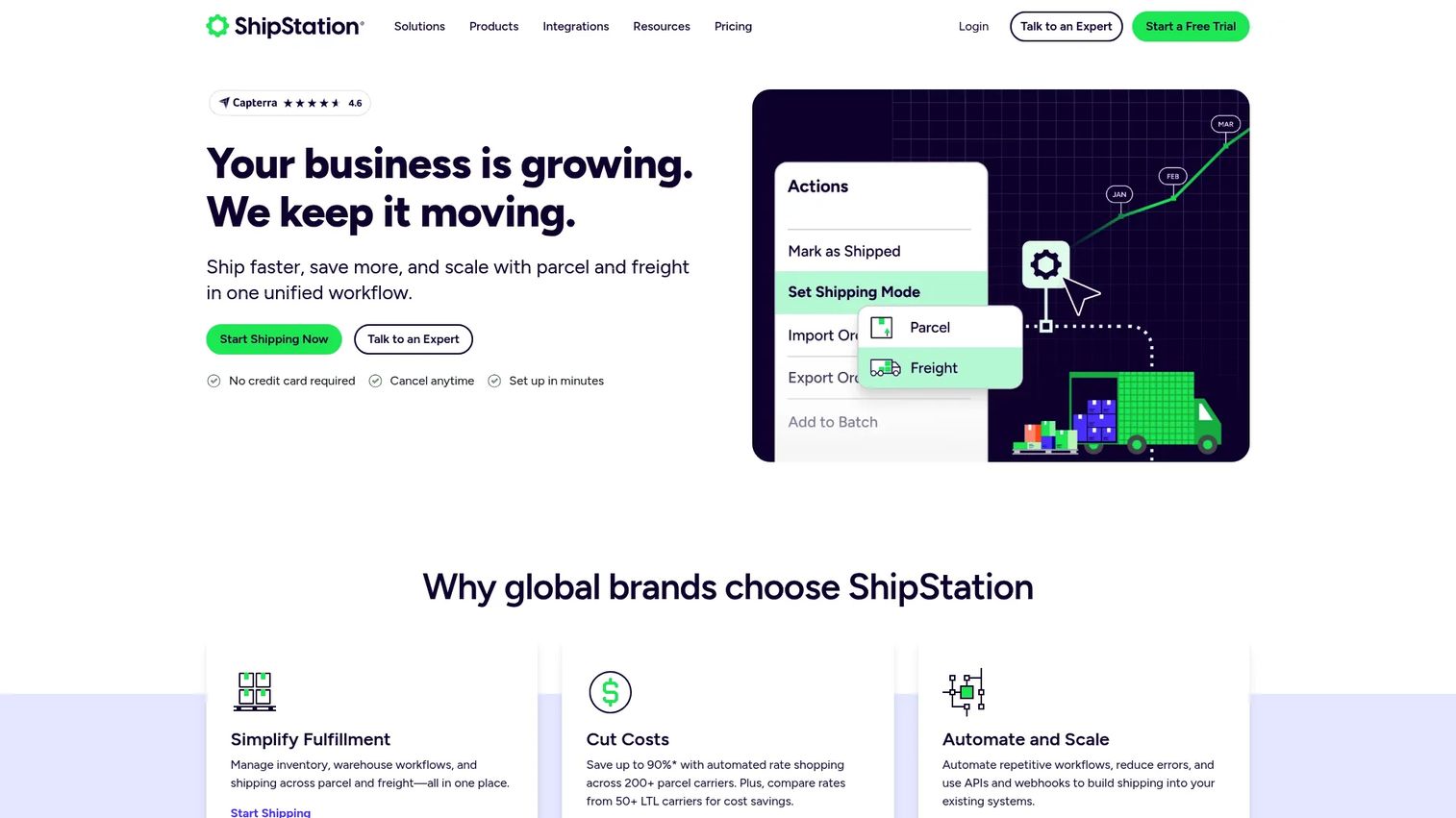
ShipStation is a SaaS shipping and fulfillment platform built for ecommerce teams managing parcel and LTL shipping across multiple stores, marketplaces, carriers, and warehouses. It connects to hundreds of sales channels and carriers, giving operations teams a single place to compare rates, print labels, automate workflows, track shipments, and manage returns. The platform is designed to scale from a small team printing dozens of labels per day to a warehouse running batch fulfillment at volume.
Best for: Ecommerce teams that need one fulfillment operations layer across multiple stores, carriers, and warehouses.
Key features
- Multi-carrier rate comparison and discounted carrier rates
- Batch label printing and fulfillment automation rules
- Branded tracking pages and customer notifications
- Returns and exchange workflows
- International shipping, inventory, and warehouse management
Why choose ShipStation: It's the strongest broad fit for teams that have outgrown carrier portals or single-channel tools and need one place to run all fulfillment decisions. Founders should check whether the team needs the full fulfillment stack or just better rate comparison - ShipStation earns its price at mid-to-high order volumes.
ShipStation pricing: Plans start at $14.99/month (Starter, billed monthly), with Standard at $29.99/month and Premium at $349.99/month. A 30-day free trial is available. Starter covers 3 users; Standard covers 10 with unlimited automations and returns; Premium covers 15 with advanced warehouse management and custom analytics.
G2 rating: 4.3/5
2. Shippo
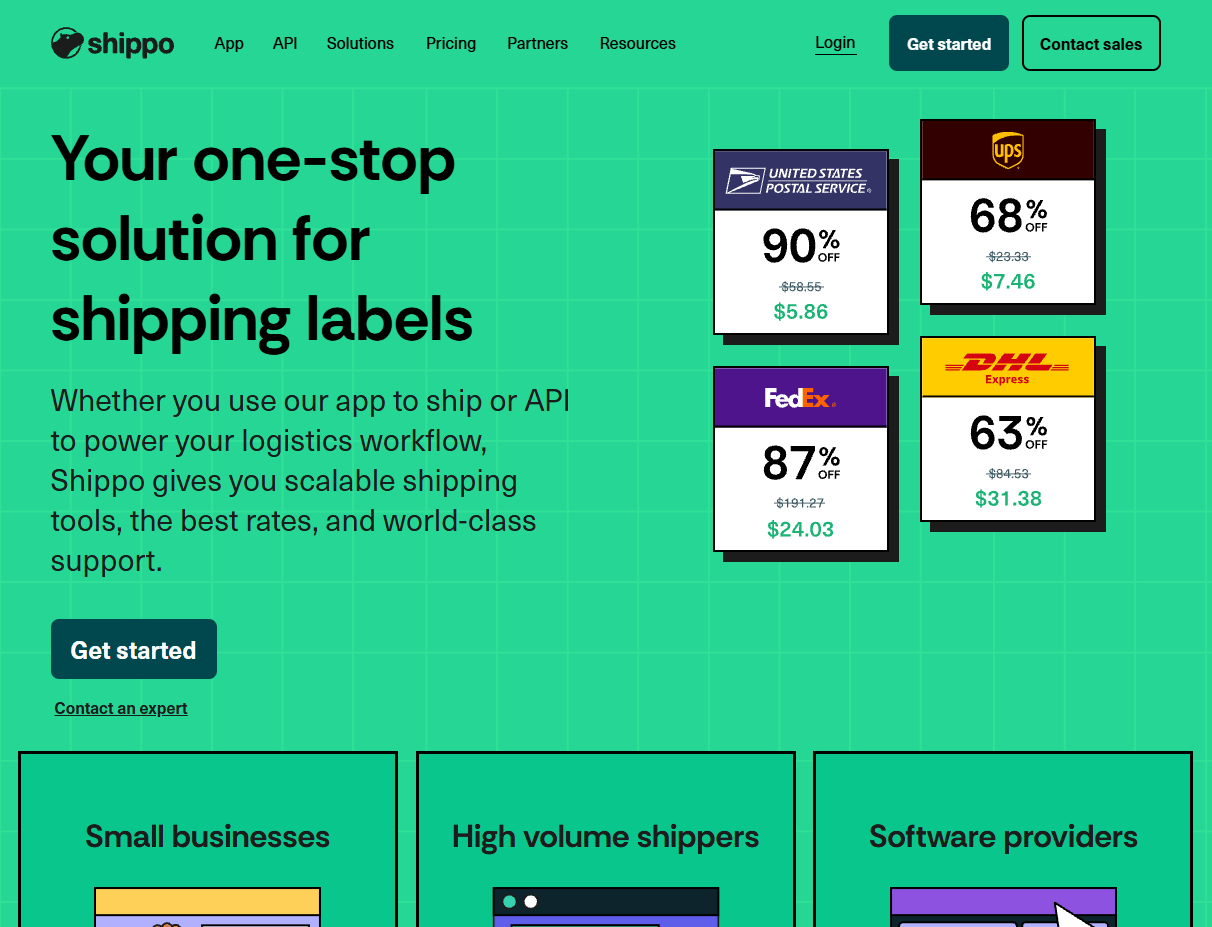
Shippo is a multi-carrier shipping platform and API for comparing carrier rates, buying labels, tracking shipments, managing returns, and automating ecommerce fulfillment. It serves both no-code operations teams and developers embedding shipping logic directly into software products or custom checkout flows. Shippo connects to 40+ carriers and integrates with major ecommerce platforms.
Best for: Teams that need a shipping platform with a developer-friendly API alongside enough no-code workflow for a small operations team.
Key features
- Shipping API for embedded and custom fulfillment workflows
- Discounted multi-carrier rates across 40+ carriers
- Label generation, address validation, and customs documentation
- Automated tracking notifications and return label workflows
- Ecommerce platform integrations
Why choose Shippo: It's worth considering when your product or ecommerce experience needs embedded shipping logic, or when a developer will own the integration but an ops person needs to run day-to-day label work without touching code.
Shippo pricing: The Starter plan is free and covers up to 30 labels per month. Pro starts at $17/month (billed monthly or annually) and supports up to 10,000 labels per month. Premier is custom pricing with unlimited shipments and dedicated support.
G2 rating: 4.2/5
3. PitneyShip
PitneyShip is cloud-based shipping and mailing software from Pitney Bowes for printing postage, stamps, and shipping labels, comparing carrier rates, scheduling pickups, and managing Certified Mail and Registered Mail workflows. It suits businesses that handle both outbound packages and office mailing from the same platform. Mobile access and store connections are included.
Best for: Small businesses that need shipping labels, postage, office mailing workflows, and practical carrier access without a complex fulfillment stack.
Key features
- Postage and stamp printing with discounted USPS, UPS, and FedEx rates
- Shipping label creation and package tracking
- Certified Mail and Registered Mail support
- Batch shipping and scheduled carrier pickups
- Online store connections and order management
Why choose PitneyShip: It's strongest when shipping and office mailing sit together in one workflow. For a lean operations team that needs practical execution rather than a warehouse management system, this avoids adding another tool for postage.
PitneyShip pricing: A pay-as-you-go plan is free monthly but charges a 5% usage fee on labels printed. The Premium plan runs $34.99/month and supports up to 10 users. Enterprise pricing requires a quote from the sales team.
4. Veeqo
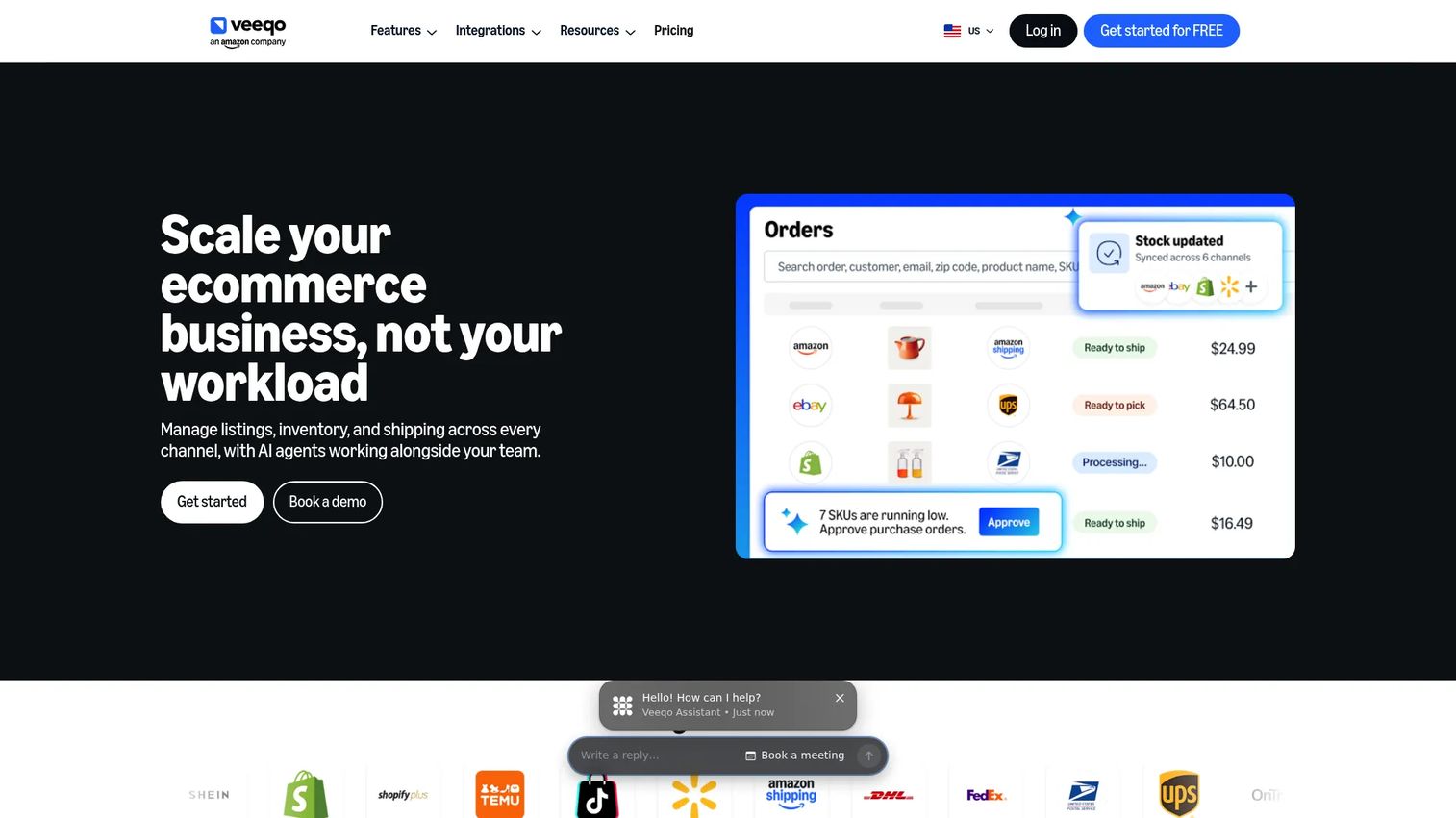
Veeqo is a multichannel ecommerce shipping, inventory, order-management, and fulfillment platform. Amazon-backed and built for sellers managing stock across marketplaces and storefronts simultaneously, it ties inventory accuracy directly to shipping speed. The platform includes digital picking, warehouse workflows, bulk label printing, and a Profit Analyzer for shipping and sales reporting.
Best for: Sellers that need shipping and inventory control in one operational workflow, particularly when Amazon is a major channel.
Key features
- Multichannel order management and bulk label printing
- Inventory synchronization and demand forecasting across channels
- Digital picking and warehouse workflow tools
- Marketplace order sync including Amazon seller tools
- Shipping and sales reporting with Profit Analyzer
Why choose Veeqo: It works well when stockouts, overselling, and fulfillment delays are creating noise at the executive level. If inventory accuracy and shipping speed are coupled problems, Veeqo handles both in one place rather than requiring a separate inventory tool.
Veeqo pricing: The Shipping plan is free. The Inventory plan starts from $19/month and scales by monthly order volume. High Volume plans start from $350/month with priority support and ERP integrations.
G2 rating: 4.5/5
5. Easyship
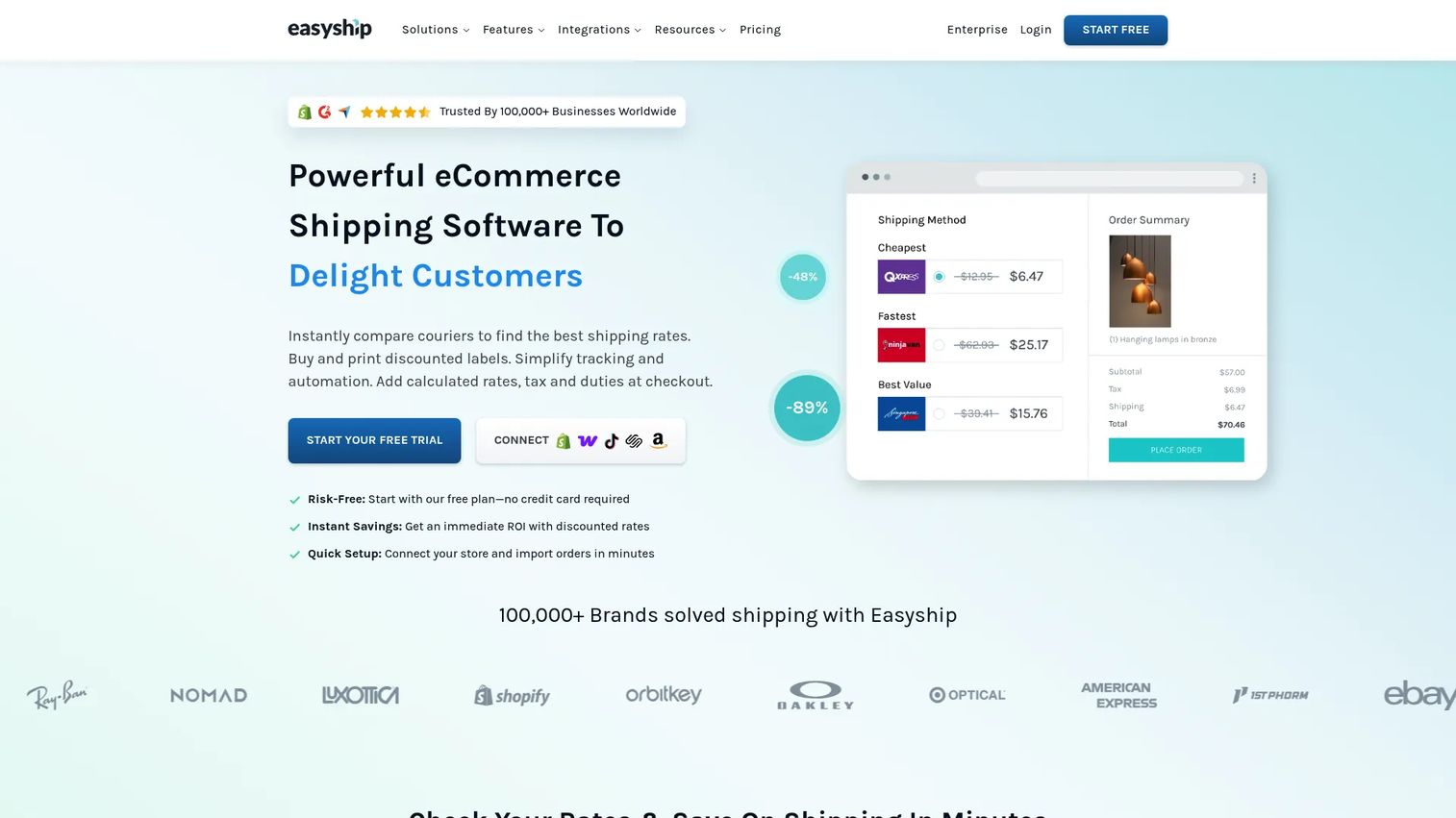
Easyship is an all-in-one ecommerce shipping platform for comparing couriers, managing cross-border shipments, displaying live rates at checkout, and handling duties and taxes. It connects to 550+ shipping services and couriers globally, making it particularly useful for teams selling across borders where courier choice, landed cost, and customs documentation all affect margin.
Best for: Ecommerce teams selling across borders that need more control over courier choice, duties calculation, taxes, and delivery options at checkout.
Key features
- Access to 550+ shipping services and courier comparison
- Duties and tax calculation tools with customs documentation
- Live shipping rates displayed at checkout
- Batch label printing and shipping automation rules
- Branded tracking pages and returns workflows
Why choose Easyship: It's strongest when international shipping complexity is slowing expansion or creating margin uncertainty. If you're shipping to multiple countries and don't know which courier delivers reliably at the best landed cost by destination, Easyship surfaces that data before you print the label.
Easyship pricing: A free plan is available. Contact Easyship directly for paid plan pricing.
G2 rating: 4.3/5
6. Sendcloud
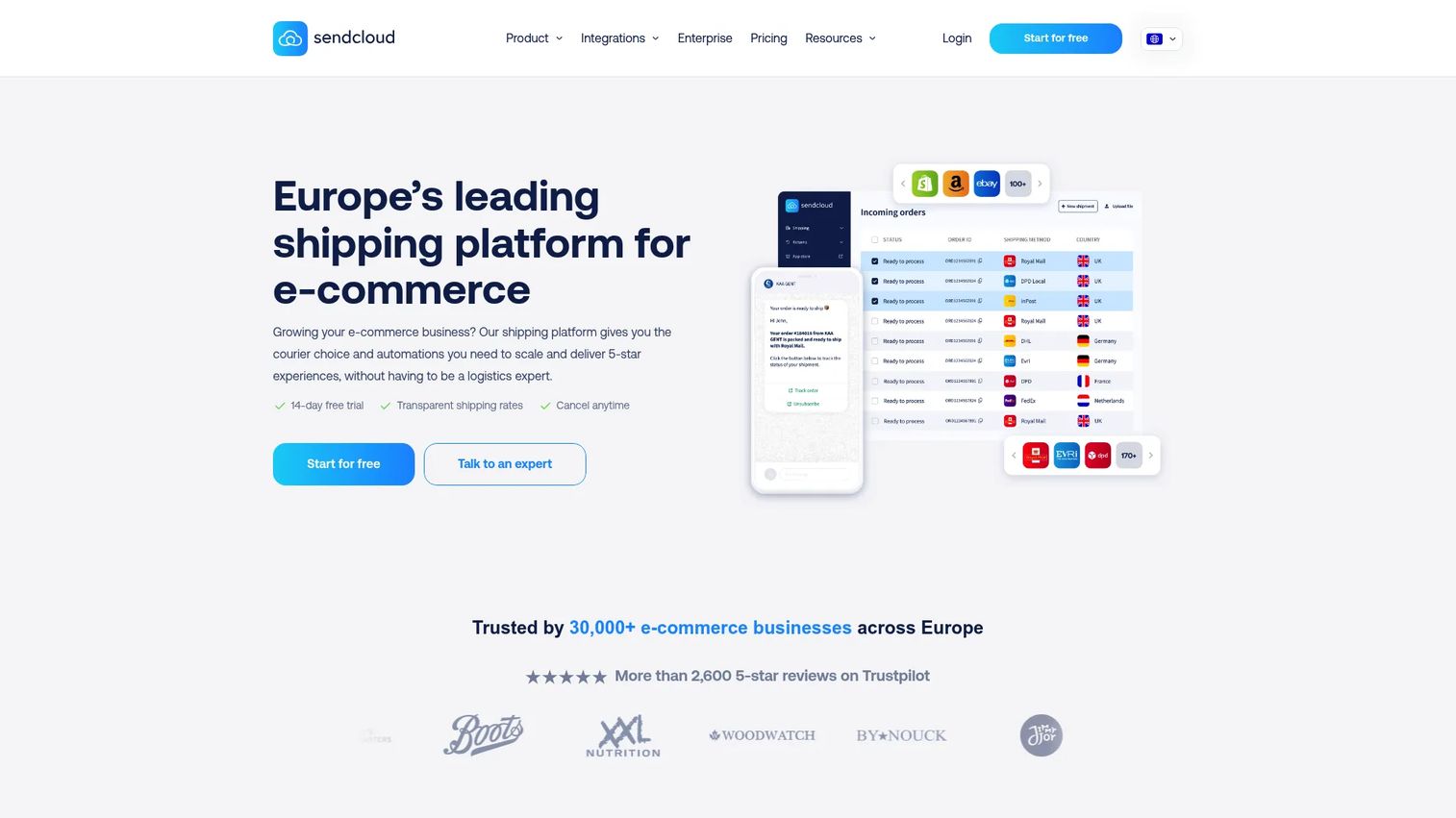
Sendcloud is a shipping platform for European ecommerce businesses, connecting online stores to 170+ carriers and giving teams control over checkout delivery options, branded tracking, return portals, and shipping automation. It's designed around the customer delivery experience as much as the warehouse workflow, which matters when delivery choice and returns experience affect conversion and repeat purchase rates.
Best for: European ecommerce sellers that need carrier coverage, branded delivery experience, and return workflows from one platform.
Key features
- Multi-carrier shipping with 170+ carrier and ecommerce integrations
- Checkout delivery options and service-point pickup
- Branded tracking and customer delivery notifications
- Returns management and return portal
- Shipping automation and carrier performance analytics
Why choose Sendcloud: It earns its place when shipping affects conversion and repeat purchase behavior, not just warehouse execution. If your customer-facing delivery experience is inconsistent or returns create manual work, Sendcloud is worth evaluating.
Sendcloud pricing: A free plan covers up to 20 parcels per month. Paid plans start at €28/month (Lite, billed monthly, plus €0.10 per label). Growth is €87/month, Premium is €175/month, and Pro is €639/month. Annual billing carries a 20% discount. Enterprise is custom.
G2 rating: 4.5/5
7. Pirate Ship
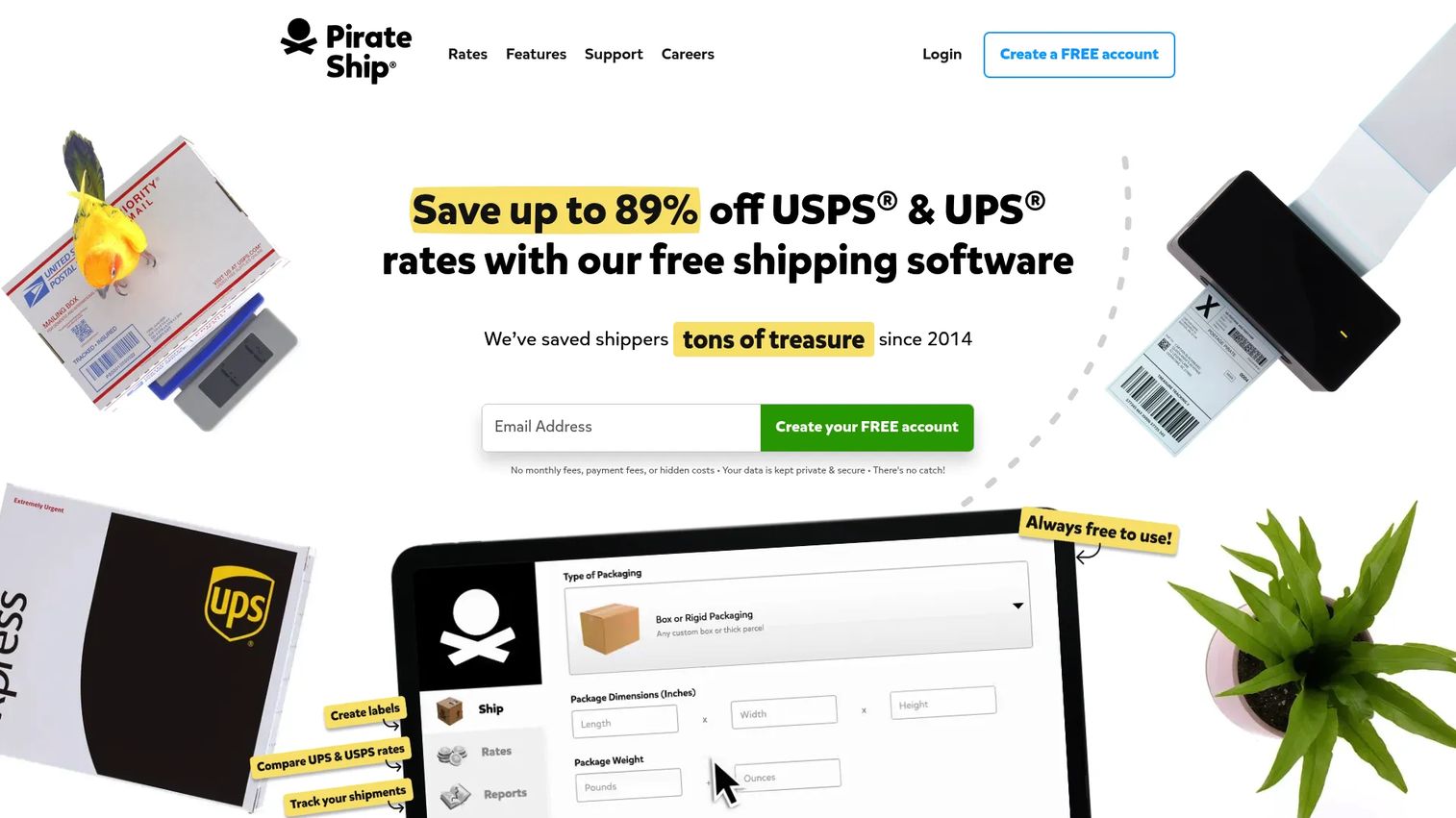
Pirate Ship is free web-based shipping software for buying and printing discounted USPS and UPS labels. There are no monthly fees, no minimums, no commitments, and no markup on postage. Users pay the carrier rate and nothing else. It includes batch label printing, shipment tracking, package presets, and simple reporting.
Best for: Small businesses and sellers that want discounted labels without paying a platform subscription fee.
Key features
- Discounted USPS and UPS shipping rates with no markup
- Batch label printing for volume shippers
- Simple Export Rate international shipping
- Priority Mail Cubic shipping access
- Package tracking and shipment reports
Why choose Pirate Ship: It's the right first serious shipping tool for cost-conscious teams before they need automation rules, inventory workflows, or returns management. When the primary goal is cheaper labels with minimal overhead, nothing else in this list matches its simplicity at this price point.
Pirate Ship pricing: The software is free. Users pay postage to the carrier at discounted rates with no additional fees, subscriptions, or markups.
G2 rating: 4.5/5
8. ReadyShipper X
ReadyShipper X is a shipping workflow tool for ecommerce teams that need a structured packing station experience. It supports rate shopping, rules-based fulfillment automation, label printing, ecommerce integrations, and return management. The platform is positioned for warehouse and fulfillment teams that need daily operational structure rather than enterprise logistics management.
Best for: Ecommerce teams that need a shipping workstation workflow for packing stations and daily fulfillment execution.
Key features
- Rate shopping across carriers
- Rules-based fulfillment automation
- Label printing and packing support
- Ecommerce platform integrations
- Return management workflows
Why choose ReadyShipper X: It fits teams that need practical order-processing structure for packing accuracy and shipping consistency before investing in a broader warehouse management platform.
ReadyShipper X pricing: The vendor's website was unavailable during research. Contact ReadyShipper directly for current plan names, starting price, and billing model.
G2 rating: 4.0/5
9. Ordoro
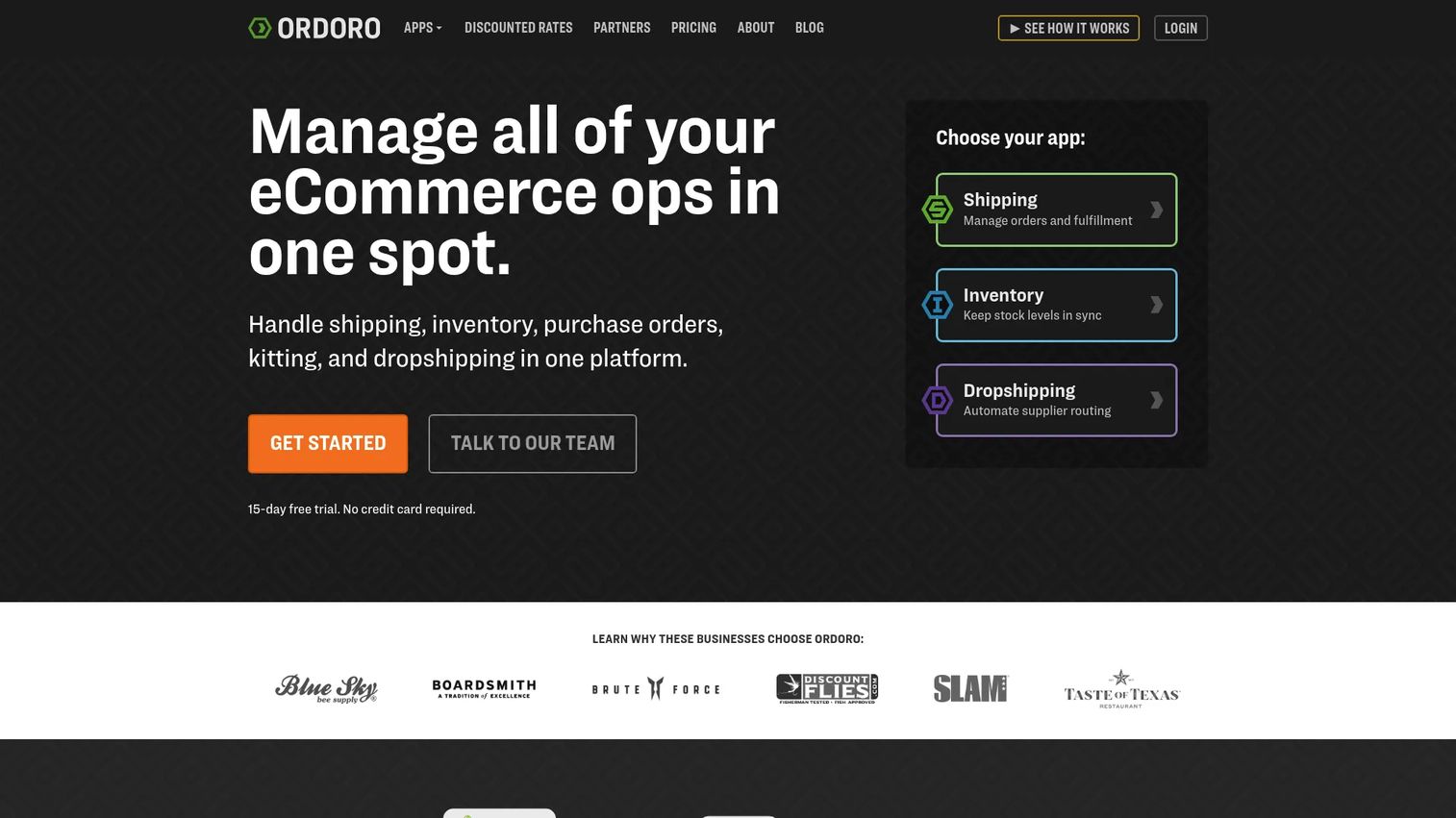
Ordoro is ecommerce operations software combining shipping, inventory management, purchase orders, kitting, dropshipping, and multichannel order management. Its modular structure lets teams start with shipping and add inventory or dropshipping as operations grow. Barcode scanning, batch label printing, and order verification are included.
Best for: Ecommerce teams that need shipping, inventory, purchase orders, and supplier workflows in one operational layer.
Key features
- Batch label printing, barcode scanning, and order verification
- Inventory synchronization across channels and warehouses with kitting support
- Dropshipping order routing, supplier feeds, and tracking writeback
- Purchase order management and warehouse transfers
- Multichannel order management with shipping automation
Why choose Ordoro: It works when shipping decisions depend on inventory and supplier logic. For a founder looking to give a new operations hire a system that covers fulfillment, stock management, and supplier workflows before adding headcount, Ordoro handles that scope.
Ordoro pricing: The Shipping Essential plan is free. Shipping Advanced is $59/month; Shipping Premium is $149/month. Inventory Advanced is $349/month; Inventory Premium is $499/month. Dropshipping Advanced is $299/month. A 15-day free trial is available across plans.
G2 rating: 4.8/5
10. Shopify

Shopify is a commerce platform that includes shipping tools natively inside the admin. Merchants can buy labels, access carrier discounts, set shipping profiles, fulfill orders, and manage tracking without leaving the platform they already use to run the store. The app ecosystem extends shipping capability when the native tools reach their ceiling.
Best for: Shopify merchants that want shipping workflows inside their commerce admin before adding a separate platform.
Key features
- Native label buying and carrier rate access inside Shopify admin
- Shipping profiles by product and destination
- Order fulfillment, tracking, and delivery management
- Returns-related tools and app ecosystem
- Multichannel selling across social, marketplaces, and direct
Why choose Shopify: It's the most convenient starting point when orders, products, inventory, and fulfillment already live in Shopify. Adding another tool creates complexity; starting here avoids that unless volume or carrier needs outgrow what's native.
Shopify pricing: Basic is $29/month billed annually (or $39/month billed monthly). Grow is $79/month annually. Advanced is $299/month annually. Plus starts from $2,300/month. Shipping capabilities differ across tiers, with higher plans offering better carrier rate discounts.
G2 rating: 4.4/5
11. Amazon Shipping
Amazon Shipping is a carrier service from Amazon that lets ecommerce businesses ship orders using Amazon's domestic ground delivery network. It is a carrier service, not shipping software, and complements rather than replaces multi-carrier platforms. It includes branded tracking, photo-on-delivery confirmation, delivery notifications, and scheduled pickups with seven-day delivery operations.
Best for: Ecommerce sellers that want to use Amazon's logistics network for eligible domestic shipments alongside existing carrier relationships.
Key features
- Domestic ground parcel delivery via Amazon's network
- Branded tracking pages and photo-on-delivery confirmation
- Email and SMS delivery notifications
- Scheduled pickup options (one-off and recurring)
- API and third-party software integrations
Why choose Amazon Shipping: Worth evaluating if Amazon's delivery network fits your geography and volume, and your average daily shipments are high enough to access volume pricing. It works best as one carrier in a multi-carrier setup rather than as a standalone shipping solution.
Amazon Shipping pricing: Rates are per-package and volume-dependent. Example rates: $5.10/package at approximately 299 packages per day for a Zone 2 shipment under 1 lb. At 100 packages per day for the same parameters, the rate is $6.89/package. Teams shipping over 300 packages per day receive individually negotiated pricing.
12. UPS
UPS is a global package delivery and supply-chain solutions provider with carrier-direct shipping tools, business accounts, freight services, customs brokerage, warehousing, and fulfillment. Businesses that have negotiated UPS account rates can access them directly through UPS tools. The shipping API and third-party integrations connect UPS to ecommerce stacks.
Best for: Businesses that rely heavily on UPS services and want carrier-direct tools, account rate access, and UPS network coverage.
Key features
- Domestic and international package shipping with carrier-direct tools
- Air and ocean freight forwarding
- Pickup scheduling and shipment tracking
- Customs brokerage and international trade support
- Warehousing, fulfillment, returns services, and shipping APIs
Why choose UPS: Best when UPS is already a strategic carrier and direct account management matters more than multi-carrier rate shopping. Keep in mind that carrier-direct tools solve execution within one network; they don't compare rates across competitors.
UPS pricing: Rates are per-shipment and vary by origin, destination, service level, weight, and dimensions. UPS Simple Rate flat-rate options start at $12.20 for an extra-small box and go up to $30.95 for an extra-large box. Business account pricing requires direct negotiation with UPS.
G2 rating: 4.2/5
13. FedEx
FedEx provides carrier-direct shipping tools for parcel, express, international, and freight shipments. FedEx Ship Manager handles label creation, pickup management, and tracking. Business accounts access account-specific rates. The FedEx API connects carrier capabilities to custom and third-party ecommerce systems.
Best for: Businesses standardizing a meaningful portion of shipments on FedEx parcel, express, international, or freight services.
Key features
- Domestic and international package shipping via FedEx network
- Freight shipping services including LTL and air freight
- FedEx Ship Manager for label creation and pickup scheduling
- Shipment tracking and proof of delivery
- Shipping APIs and digital tools with delivery estimates
Why choose FedEx: It fits teams where carrier relationships and service performance matter more than platform-level abstraction. Direct carrier tools give you full visibility into FedEx network capabilities but won't surface better rates from competing carriers.
FedEx pricing: Per-shipment rates vary by service, packaging, destination, weight, and account terms. FedEx One Rate starts at $12.75 for an envelope via FedEx Express Saver or FedEx 2Day. Business account rates require direct negotiation.
G2 rating: 4.4/5
14. DHL
DHL provides international express delivery, air and ocean freight, supply-chain management, customs support, and ecommerce logistics. For teams with significant cross-border volume, DHL's global network reach is the main draw. Business accounts and ecommerce-specific delivery options are available, with real-time tracking and warehousing capabilities.
Best for: Ecommerce and B2B teams shipping internationally where cross-border delivery performance affects customer retention or expansion.
Key features
- International express shipping across DHL's global network
- Customs support and documentation
- Air, ocean, road, and rail freight options
- Warehousing, fulfillment, and supply-chain services
- Real-time shipment tracking and business account tools
Why choose DHL: It's strongest for international shipping depth, not as a general-purpose domestic platform. If global expansion depends on reliable cross-border delivery and your current carrier is creating exceptions or delays, DHL is worth evaluating as a primary international carrier.
DHL pricing: Shipment pricing is quote-based and varies by origin, destination, service level, weight, and dimensions. Business accounts and ecommerce-specific pricing require a direct quote. A non-standard pickup fee of $4.40 per pickup stop applies in some cases.
G2 rating: 4.5/5
15. USPS
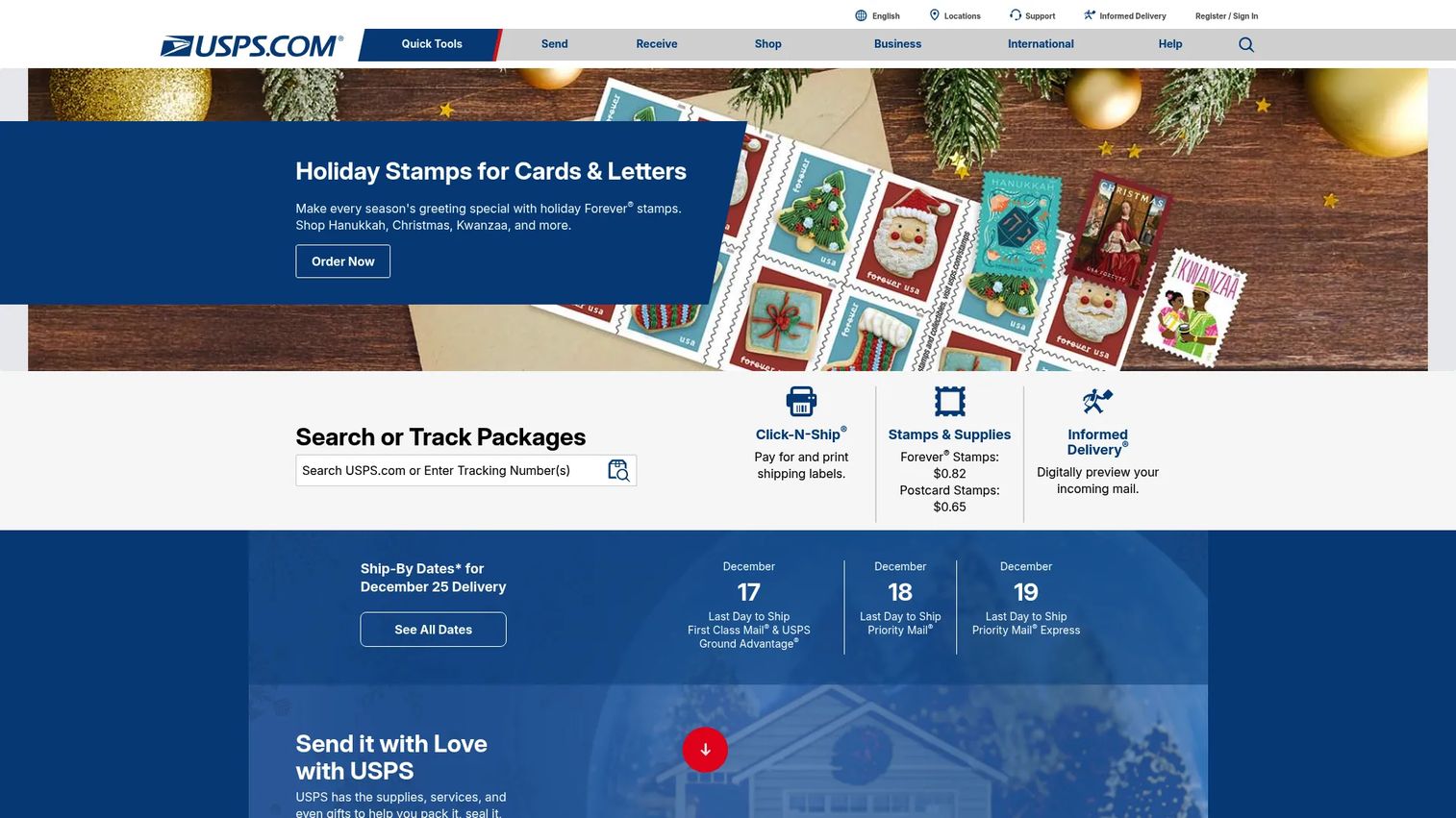
USPS provides domestic and international mail, package shipping, tracking, delivery alerts, and pickup scheduling. Click-N-Ship gives businesses online label creation with discounted commercial rates. Flat-rate packaging removes the guesswork from pricing lightweight to medium-weight domestic parcels. USPS reaches every U.S. address, including rural destinations where other carriers may charge residential surcharges.
Best for: Small businesses and domestic shippers that rely on postal services, flat-rate packaging, and lightweight parcel shipping.
Key features
- Postal label creation and domestic shipping with Click-N-Ship commercial rates
- Priority Mail, Priority Mail Express, USPS Ground Advantage, and First-Class Mail services
- Flat-rate shipping options for predictable domestic parcel cost
- Package tracking, delivery alerts, and pickup scheduling
- Domestic and international mail services
Why choose USPS: A practical fit for lightweight domestic parcels and postal workflows, particularly to rural or residential addresses. High-growth teams often keep USPS as one carrier in a multi-carrier setup and use shipping software to compare USPS against UPS and FedEx per shipment.
USPS pricing: USPS Ground Advantage starts from $8.40 at the Post Office; Priority Mail from $11.50; Priority Mail Express from $37.05. First-Class Mail starts from $0.82 per item. Commercial rates available through Click-N-Ship are lower than retail counter pricing.
Considerations when choosing shipping software
Carrier coverage and rate control
Check whether the tool compares multiple carriers, connects your negotiated rates, or routes all shipments through a single network. For founders, the cost driver isn't the software fee: It's whether the tool saves more on carrier spend per month than it costs. Multi-carrier platforms with rate shopping directly affect gross margin at volume.
Ecommerce and marketplace fit
Verify integrations with the channels your team actually uses: Shopify, Amazon, eBay, Etsy, WooCommerce, ERP systems, and accounting tools. The integration logo grid on a pricing page doesn't tell you whether the connection is real-time, bi-directional, or limited to order import. Test the specific integrations that matter before committing.
Automation depth
Shipping rules, batch labels, service-level mapping, package presets, and return rules all reduce manual decision-making per order. This matters for headcount efficiency. A team processing 500 orders per day manually is a team making 500 small decisions that should be automated. Evaluate what the tool automates on day one versus what requires custom configuration.
International and returns workflows
Cross-border growth creates operational complexity faster than domestic growth. Check whether the tool handles customs forms, duties and tax calculation, carrier selection by country, and return label generation. 53% of global shoppers expect delivery within 2 to 4 days of ordering, according to Blue Yonder (2025), which means international logistics decisions have direct customer-satisfaction consequences.
Reporting and operational handoff
Look for dashboards covering shipping spend, carrier performance, delivery exceptions, and fulfillment speed. If the board asks why gross margin changed by two points, your operations VP should not need five exports to explain what happened in shipping. Clean reporting is a prerequisite for handing operations ownership to a functional leader.
Conclusion
No single shipping tool wins across every operating model. The picks that matter most depend on where your volume, channels, and geography sit today.
ShipStation is the strongest broad platform for multi-channel ecommerce teams managing fulfillment across multiple carriers and stores. Shippo handles both API-led and no-code workflows, making it the right fit when shipping needs to be embedded in software. For small-business label needs without a subscription fee, Pirate Ship is straightforward and cost-effective.
Ordoro earns its place when shipping and inventory management are coupled problems. Veeqo does the same for Amazon-heavy multichannel sellers. Shopify is the obvious starting point when the store already lives there. For cross-border selling, Easyship and Sendcloud cover different geographies, with Sendcloud built around European carrier networks.
UPS, FedEx, DHL, and USPS work as carrier-direct tools, and they perform best as one part of a multi-carrier setup rather than the entire shipping stack.
Shortlist two or three tools based on your order volume, carrier mix, geography, and automation requirements. Run a one-week trial with real order data before committing. The tool that removes the next operational bottleneck is more valuable than the one with the longest feature list.
For related batch management software and business process management software guidance, those guides cover adjacent operations tooling worth reviewing as your stack matures.
FAQs
ShipStation is the strongest broad fit for multi-channel ecommerce teams managing multiple carriers, stores, and fulfillment workflows. Shippo fits API-led teams better. Shopify is the most convenient option for Shopify merchants who want to stay in their existing admin. Easyship and Sendcloud lead for international selling. The right answer depends on your order volume, carrier mix, and channel integrations.
Pirate Ship is free as software - users pay only postage at discounted USPS and UPS rates with no markup. PitneyShip has a free pay-as-you-go plan with a 5% usage fee on labels. Ordoro's Shipping Essential plan is also free. The more useful comparison is total shipping cost per order, not just the software line item, since carrier rate access varies significantly by platform.
Multi-carrier software pays off when rate differences, delivery speed, and carrier reliability affect margin or customer experience at your current volume. If your team ships everything through one carrier at low volume, carrier-direct tools are likely sufficient. Once volume grows or carrier performance becomes a margin variable, rate shopping across USPS, UPS, FedEx, and regional carriers makes the platform cost easy to justify.
Shopify's native shipping tools handle the basics for most merchants without adding a separate platform. For teams that need deeper automation, multi-carrier rate shopping, or advanced returns workflows, ShipStation, Shippo, Easyship, Sendcloud, Veeqo, and Ordoro all integrate with Shopify. Verify the specific integration behavior, particularly whether orders sync in real time, before selecting a third-party platform.
Shipping software focuses on carrier rate comparison, label creation, tracking, returns, and delivery workflows. Fulfillment software typically adds inventory management, warehouse picking, packing, and order routing across locations. Platforms like Ordoro and Veeqo overlap both categories. Teams with physical warehouse complexity generally need fulfillment-layer tools; teams focused on carrier cost and label efficiency often need only shipping software.
Easyship connects to 550+ couriers globally and handles duties, taxes, and checkout rate display. Sendcloud specializes in European carrier networks with return portals and delivery options. DHL, FedEx, and UPS offer carrier-direct international services with business account pricing. Shippo also supports international labels and customs documentation. The choice depends on which regions you ship to, your volume, and whether you need landed cost visibility at checkout.
Carrier-direct tools work well when most shipments run through one network and volume is manageable. Multi-carrier shipping software becomes more useful when the team needs to compare rates across carriers per order, automate service-level selection by weight or destination, connect marketplace and store orders into one queue, or report on carrier spend and fulfillment performance across channels. Many teams use carrier accounts inside a multi-carrier platform to get negotiated rates alongside broader automation.
Check gross margin impact first: How much do you spend on carrier fees per month, and how much would rate shopping save? Then verify setup time - a tool that takes a week to configure isn't earning its keep yet. Confirm it integrates cleanly with your ecommerce platform, marketplace accounts, and accounting stack. Look at whether reporting gives your operations VP the data to manage carrier spend without pulling manual exports. The best signal is whether a functional leader can own and improve the system without routing decisions back to you.