You closed a licensing deal with three royalty tiers, a retroactive escalator, and a quarterly minimum guarantee. Six months later, finance is still reconciling it by hand in a spreadsheet that only one person understands. A recipient emails asking why their statement is short. Nobody can answer in under a day.
That is the moment most teams realize their accounting system was never built for royalties. General ledgers record what happened. They do not calculate what should happen when a contract says one thing for the first 10,000 units and something else after. Every exception becomes a manual entry, every statement a fire drill, and every audit a week of anxiety.
The stakes are rising because the market is. The global royalty management software market was valued at $4.2 billion in 2025 and is projected to reach $9.8 billion by 2034, growing at a 9.8% CAGR, according to Dataintelo (2025). More than 60% of media and entertainment enterprises had already adopted royalty and rights management systems by 2024, per Market Growth Reports (2024). The reason is simple: manual royalty accounting does not scale, and the errors compound quietly until an auditor or a rights holder finds them.
Dedicated royalty reporting software fixes the part your ERP cannot. It stores contract terms as rules, applies them to sales data automatically, and produces statements and payments your finance team can defend. This is a buyer-first comparison built to help you match a platform to your actual complexity, not a vendor pitch. Let's get into it.
What's inside
This guide is for founders, finance leads, and operators evaluating royalty management software when spreadsheets and accounting modules have stopped keeping up. We ranked 7 platforms by four factors that matter most in real royalty workflows: contract complexity handling, reporting depth, payment accuracy, and audit readiness. We cover both broad rights and royalty management software and narrower vertical tools built for publishing, franchising, or music. Each entry includes what it does well, who it fits, and pricing where a vendor makes it public. Ratings come from G2 where a verified listing exists.
TL;DR
- Best for automation and visible time savings: MetaComet® pairs automated royalty calculation with a recipient self-service portal, cutting manual statement work for IP-driven businesses.
- Best for high-complexity, enterprise rights operations: Rightsline handles layered contracts, avails, and configurable royalty accounting at scale.
- Best for publishers: Schilling Publishing covers royalty settlement, rights, and the full publishing lifecycle in one system.
- Best for franchises and multi-location brands: FranConnect ties royalty calculation and payment tracking to operations, compliance, and performance.
- Best for licensors and licensing teams: RoyaltyZone focuses on contract management, compliance monitoring, and royalty reporting.
- Best for music publishing and rights collection: Kobalt Music Group provides global publishing administration and royalty processing for songwriters and rights holders.
What is royalty management software?
Royalty management software is a system that stores contract terms as calculation rules, applies them to sales and usage data, and generates the statements and payments owed to rights holders, licensors, authors, or partners.
The reason it exists is that general tools break down as royalty terms get layered. A spreadsheet works until you have tiered rates, escalators, minimum guarantees, unearned advances, and retroactive adjustments across dozens of contracts. An ERP or general royalty accounting software module records financial activity but does not model who is owed what under which contract clause. Once you cross into multi-channel sales, multi-currency payouts, or exception-heavy deals, manual reconciliation turns into a full-time job with hidden error risk.
Good royalty tracking software replaces that with repeatable logic. The core capabilities to expect:
- Automated royalty calculation: Tiers, thresholds, escalators, and minimum guarantees applied to sales data without manual entry.
- Contract management: Terms stored, versioned, and mapped to products, titles, or territories.
- Statement generation and reporting: Product-level accruals, unearned advance tracking, and recipient-ready statements.
- Royalty payment software features: Bulk payouts, multi-currency conversion, and payment processing tied to earned balances.
- Audit trail: Versioned contract terms and repeatable calculation logic that survive scrutiny.
- Compliance controls: Consistent rules that hold up during rights holder audits and internal review.
The goal is not fancier accounting. It is a process your finance or ops team can own without you in the loop, and records clean enough to survive due diligence.
When to use royalty management software
Not every business needs a dedicated platform. If you pay a flat rate to two people once a year, a spreadsheet is fine. The signal to move is when exceptions outnumber the rule. Here is how to know.
Handle complex contract terms without manual rework
When your contracts include tiered rates, escalators, retroactive true-ups, and per-territory splits, every calculation becomes a judgment call. Dedicated software encodes those terms once and applies them consistently. That removes the founder or finance lead from being the single person who "knows how the Acme deal works," which is exactly the kind of dependency that scares boards during diligence.
Generate royalty statements and recipient payments faster
If closing a royalty period takes days of copy-paste and manual currency conversion, you have a throughput problem that gets worse with volume. Royalty payment software automates statement generation and bulk payouts, so a period close that took a week can drop to hours. Faster, cleaner statements also mean fewer recipient disputes eating your team's time.
Keep audit-ready records for finance and compliance
Rights holders audit. Investors do diligence. Both want to trace a number back to a contract clause. A platform with a real audit trail, versioned terms, and repeatable calculation logic turns audit season from a scramble into an export. That reliability is worth more than any single feature when your metrics need to survive scrutiny.
Comparison table
The table below ranks the 7 platforms, starting with the most general-purpose automation tool, then moving through complexity, vertical focus, and reporting depth. Pricing reflects what each vendor makes public; most royalty vendors quote custom based on modules and scale. Ratings are from G2 where a verified listing exists.
| # | Product | Intent | Key use case | Pricing | G2 rating |
|---|---|---|---|---|---|
| 1 | MetaComet® | Automate royalty accounting | Automated calculation, statements, recipient portal | Custom quote | Not listed |
| 2 | Rightsline | Enterprise rights and royalties | Layered contracts, avails, royalty accounting at scale | Custom quote | 3.8/5 |
| 3 | Schilling Publishing | Publishing back-office | Royalty settlement and publishing lifecycle | Not public | Not listed |
| 4 | FranConnect | Franchise operations | Royalty calculation tied to ops and compliance | Custom quote | 4.2/5 |
| 5 | Kobalt Music Group | Music publishing admin | Global royalty collection and processing | Not public | Not listed |
| 6 | Trustline | Sales workflow tooling | AI-assisted call logging and CRM updates | Not public | Not listed |
| 7 | Kaizan | Client relationship health | Client communications and account management | Custom quote | Not listed |
1. MetaComet®
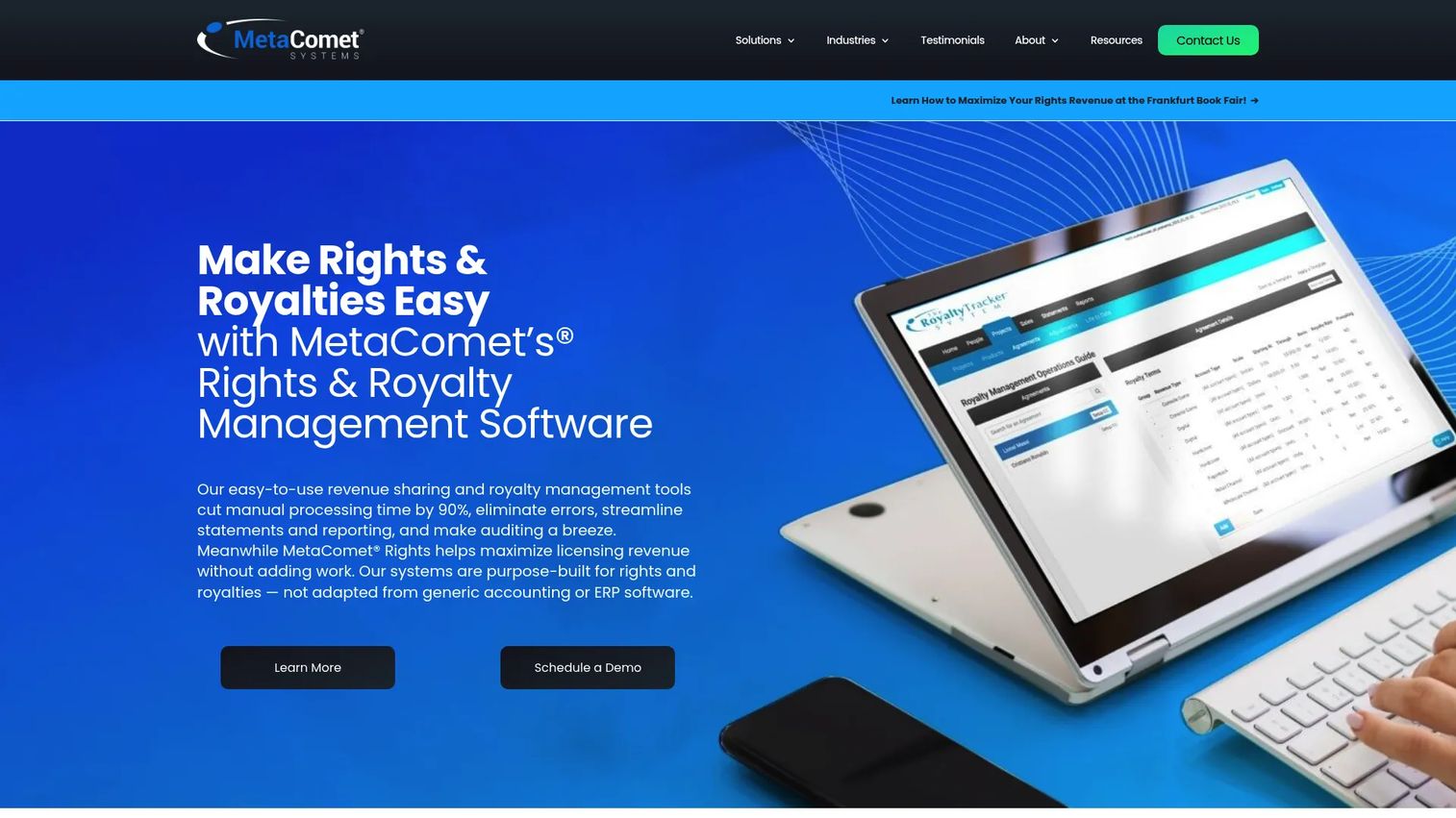
MetaComet® is rights and royalty management software built for IP-driven businesses that want automation and measurable time savings. It ingests sales data from multiple sources, converts currencies, runs automated royalty calculations across complex contracts, and produces recipient-ready statements. A self-service portal lets royalty recipients check balances and statements on their own, which cuts the inbound questions that clog a finance team's week.
The pitch is spreadsheet replacement with visible ROI. Instead of one analyst manually reconciling accruals and unearned advances, the system applies your contract rules and generates statements at scale. That matters for a founder trying to remove single-person dependencies from the finance function.
Best for: IP-driven businesses that need to automate royalty and rights accounting across complex contracts and multiple data sources.
Key strengths
- Automated calculation and statements: Applies contract rules to sales data and produces recipient statements without manual entry.
- Multi-source data and currency conversion: Ingests sales feeds from different channels and handles multi-currency payouts.
- Recipient self-service portal: Lets rights holders view balances and statements themselves, reducing inbound queries.
Why choose MetaComet®: If your primary pain is the sheer manual labor of calculating and issuing royalty statements, MetaComet® is built to make that work disappear. It fits teams that value automation and want a clear before-and-after on time saved, rather than a heavy platform they have to grow into.
MetaComet® pricing: MetaComet® does not publish a price. The site directs buyers to a free consultation and a custom ROI analysis, and it states that implementation is free. Expect pricing scoped to your contract complexity and data sources after that conversation.
2. Rightsline
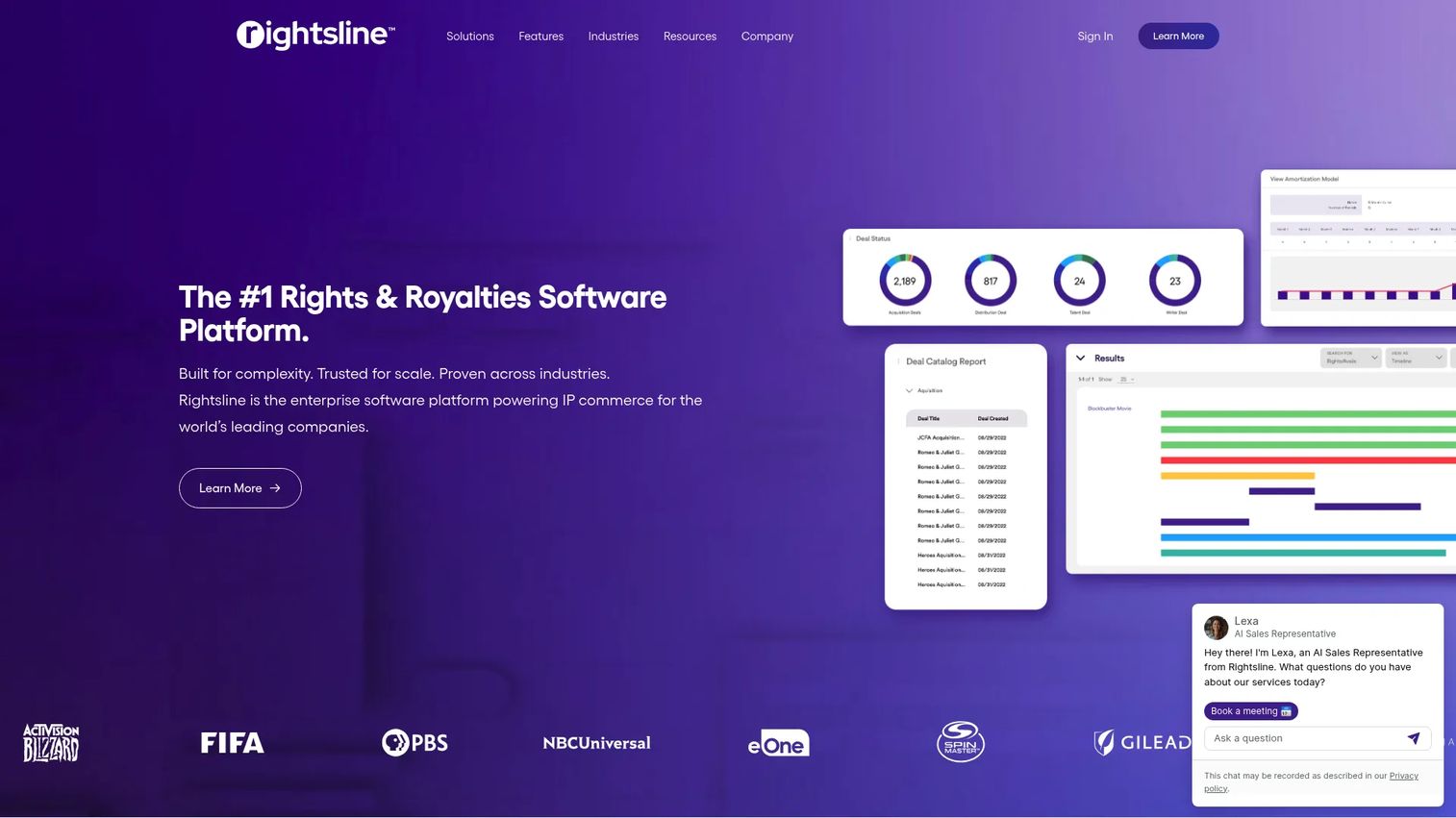
Rightsline is enterprise SaaS for rights and royalties management, aimed at organizations that live and die by intellectual property. It tracks rights, contracts, and avails, flags conflicts, and runs royalty accounting with configurable statement generation. This is the platform for teams where exception handling is the norm and a single deal can carry a dozen interlocking terms.
Where lighter tools assume clean, repeatable contracts, Rightsline is built for the mess: multiple royalty structures, avails windows, territory splits, and layered obligations. That configurability is the point. It bends to how your business actually licenses IP rather than forcing a template.
Best for: Large, rights-heavy organizations that need configurable rights and royalty workflows at scale.
Key strengths
- Rights and royalties management: Tracks IP, contracts, and obligations in one system.
- Avails and conflict tracking: Surfaces licensing conflicts before they turn into disputes.
- Configurable royalty accounting: Generates statements that flex to complex, multi-structure deals.
Why choose Rightsline: Choose Rightsline when your royalty operation is genuinely complex and you need software that configures to your contracts, not the reverse. It carries an enterprise footprint, so it fits organizations with the volume and complexity to justify a configurable platform rather than a lightweight tool.
Rightsline pricing: Rightsline uses custom quote pricing based on modules, deal complexity, and business scale, per its FAQ. There is no public price number. On G2, Rightsline holds a 3.8/5 rating.
3. Schilling Publishing
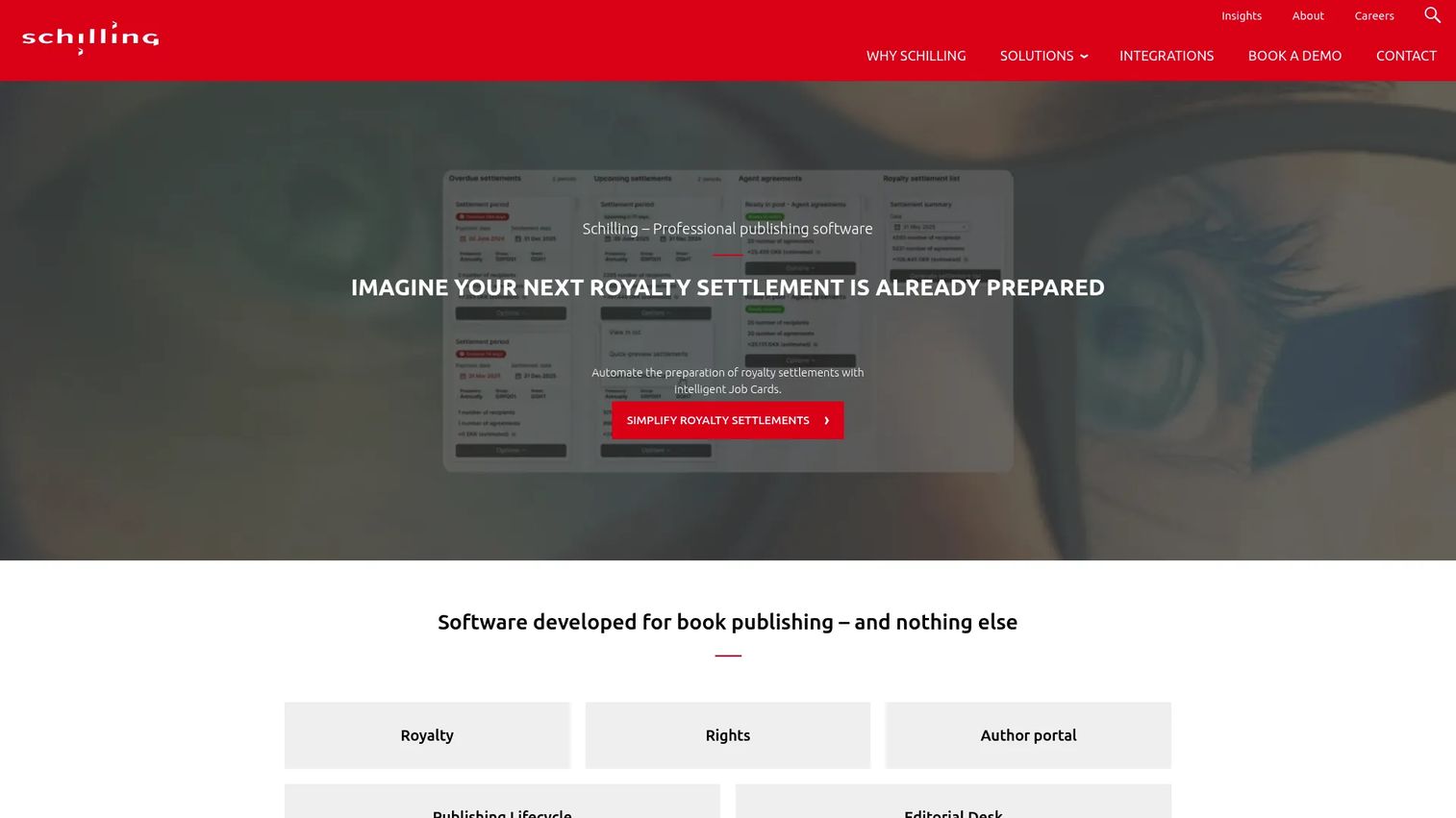
Schilling Publishing is publishing software that manages royalties, rights, subscriptions, and the broader publishing workflow. If your royalty problem is specifically a publishing problem, this vertical fit matters. It handles royalty management and settlement automation alongside rights management and the operational lifecycle a publisher runs day to day.
The advantage of a vertical tool is that it already speaks your language. Contract registration, author and rights workflows, and multi-channel sales tracking are built in rather than configured from scratch. That reduces the gap between how publishing actually works and how the software expects you to work.
Best for: Publishers that need industry-specific back-office software for royalties and workflow management.
Key strengths
- Royalty management and settlement automation: Calculates and settles royalties within a publishing context.
- Rights management: Tracks the rights that drive publishing revenue.
- Publishing lifecycle management: Connects royalties to the wider operational workflow.
Why choose Schilling Publishing: Choose Schilling when you are a publisher and want software shaped around your industry rather than a generic platform you have to bend. The vertical focus means less configuration and a closer match to author and rights workflows out of the box.
Schilling Publishing pricing: Schilling does not display public pricing. The site confirms product capabilities but shows no price page, so expect a scoped quote after a conversation about your publishing operation.
4. FranConnect
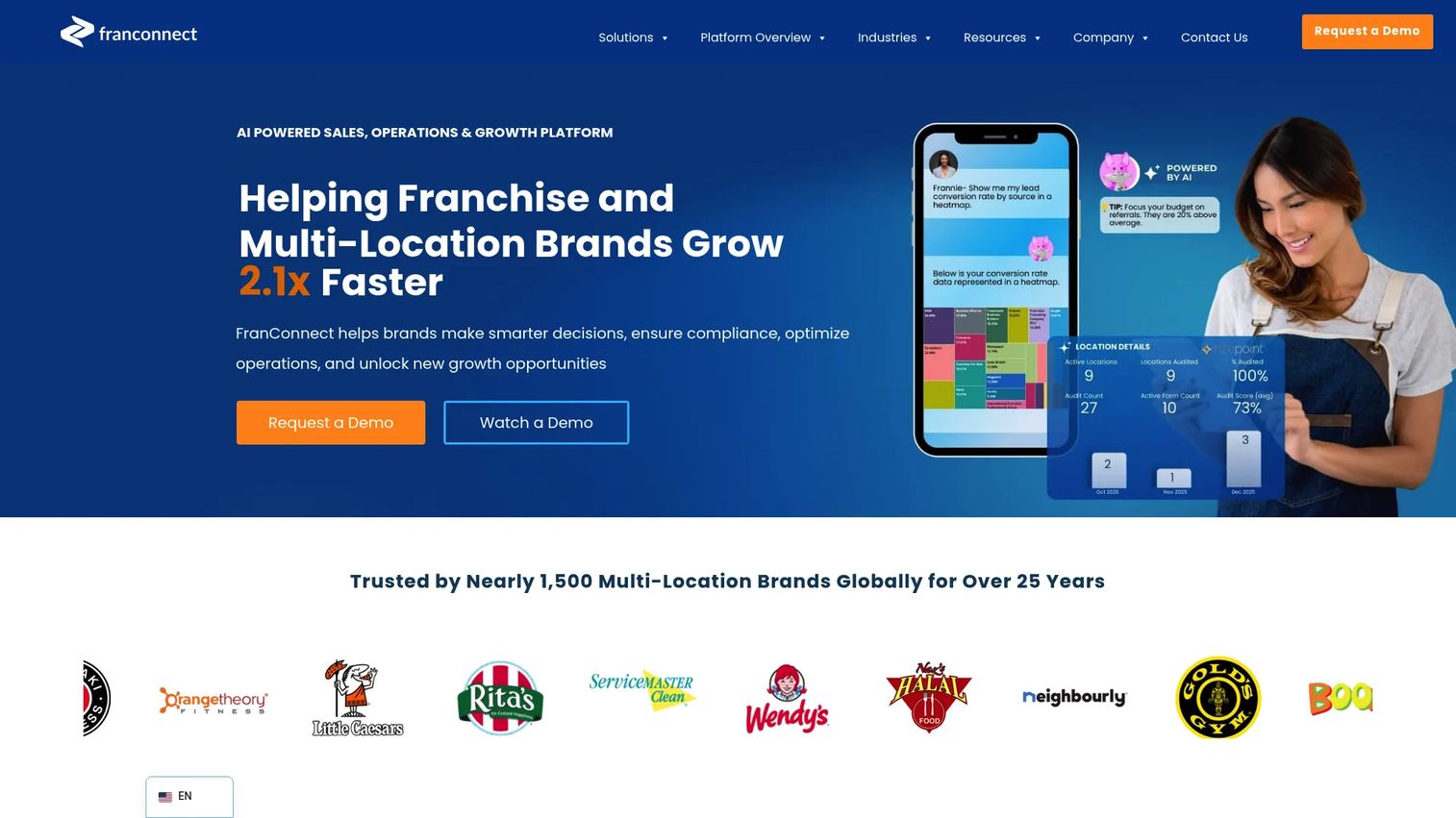
FranConnect is a cloud-native platform for franchise and multi-location brands, and royalty tracking sits inside a broader operating system. It ties royalty calculation and payment tracking to sales, operations, training, compliance, and performance across every location. For franchisors, royalties are not a standalone accounting task; they are tied to how each unit reports revenue.
That integration is the differentiator. Instead of pulling location revenue into a separate royalty tool, FranConnect keeps calculation, bulk payouts, and compliance monitoring in the same system that manages the rest of the franchise relationship. It reduces the reconciliation gap between what a location reports and what it owes.
Best for: Franchise and multi-location brands that need royalty management inside an all-in-one operating system.
Key strengths
- Sales and lead management automation: Captures the revenue signals that royalty calculation depends on.
- Operations and location workflows: Manages the operational data behind each unit's royalty obligation.
- Training, compliance, and performance management: Keeps royalty compliance connected to unit performance.
Why choose FranConnect: Choose FranConnect when royalties are one piece of a larger franchise operations problem. It fits brands that want revenue tracking, compliance, and royalty payment processing in one platform rather than stitched across several. The trade-off is scope: it is a franchise operating system first, not a standalone royalty engine.
FranConnect pricing: FranConnect does not publish pricing and routes buyers through a request-a-demo and contact-sales flow. On G2, FranConnect holds a 4.2/5 rating.
5. Kobalt Music Group
Kobalt Music Group is an independent music publishing and rights management company for songwriters, artists, publishers, and rights holders. It is less a self-serve software product and more a service-plus-platform model, with global publishing administration, royalty collection and processing, and transparency tools that let creators see where their money comes from. Its KOSIGN platform handles publishing royalty collection specifically.
For music rights holders, the challenge is that royalties flow from dozens of sources across territories, formats, and platforms. Kobalt's model is built to collect and process those streams with more visibility than the traditional publishing black box. If your royalty problem is music publishing, this is a category-specific answer rather than a general tool.
Best for: Songwriters, artists, and publishers needing global publishing administration and royalty collection.
Key strengths
- Global publishing administration: Manages rights and collection across territories.
- Royalty collection and processing: Gathers royalty streams from many sources with transparency tools.
- KOSIGN platform: Handles publishing royalty collection with a no-setup-fee, flat-fee model.
Why choose Kobalt Music Group: Choose Kobalt when you are in music publishing and want administration plus collection rather than software you operate yourself. The transparency tooling is the draw for creators tired of opaque statements.
Kobalt Music Group pricing: Kobalt does not publish a fixed price for its core services on its main site. Its KOSIGN product advertises no setup fee and a flat 20% fee, though that is a separate offering. Expect terms scoped to your catalog and needs.
6. Trustline
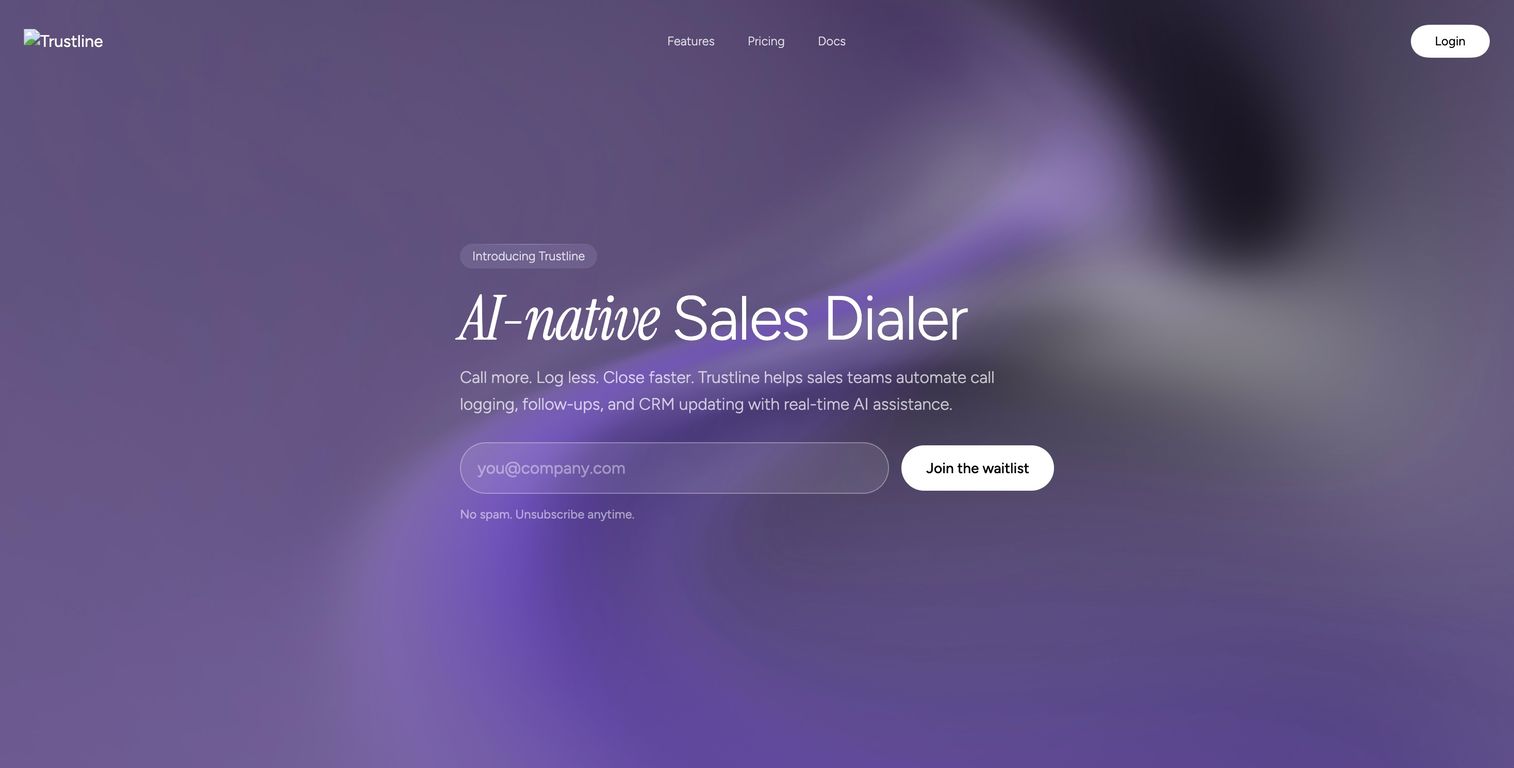
Trustline is an AI-native sales dialer that automates call logging, follow-ups, and CRM updates. It is worth naming here because "trustlines" surfaces in the same searches, but the product itself sits in sales workflow tooling rather than royalty accounting. If your goal is cleaner sales activity data and automated CRM hygiene, it belongs on a different shortlist.
The reason to flag it: teams evaluating royalty platforms sometimes surface adjacent tools with similar names. Knowing what Trustline actually does saves you a wasted demo call. For the revenue-tracking side of a founder's stack, it is a real tool, just not a royalty engine.
Best for: Sales teams wanting AI-assisted dialing and automated CRM updates.
Key strengths
- Automated call logging: Captures call activity without manual entry.
- Automated follow-ups: Triggers next steps after calls.
- Real-time CRM updates: Keeps records current with AI assistance.
Why choose Trustline: Choose Trustline if your problem is sales activity capture, not royalty calculation. It fits founders looking to reduce manual CRM work on the sales side of the house.
Trustline pricing: Trustline's site is currently a waitlist landing page and does not display readable pricing or plan detail. There is a pricing link in the navigation, but no accessible numbers at this time.
7. Kaizan
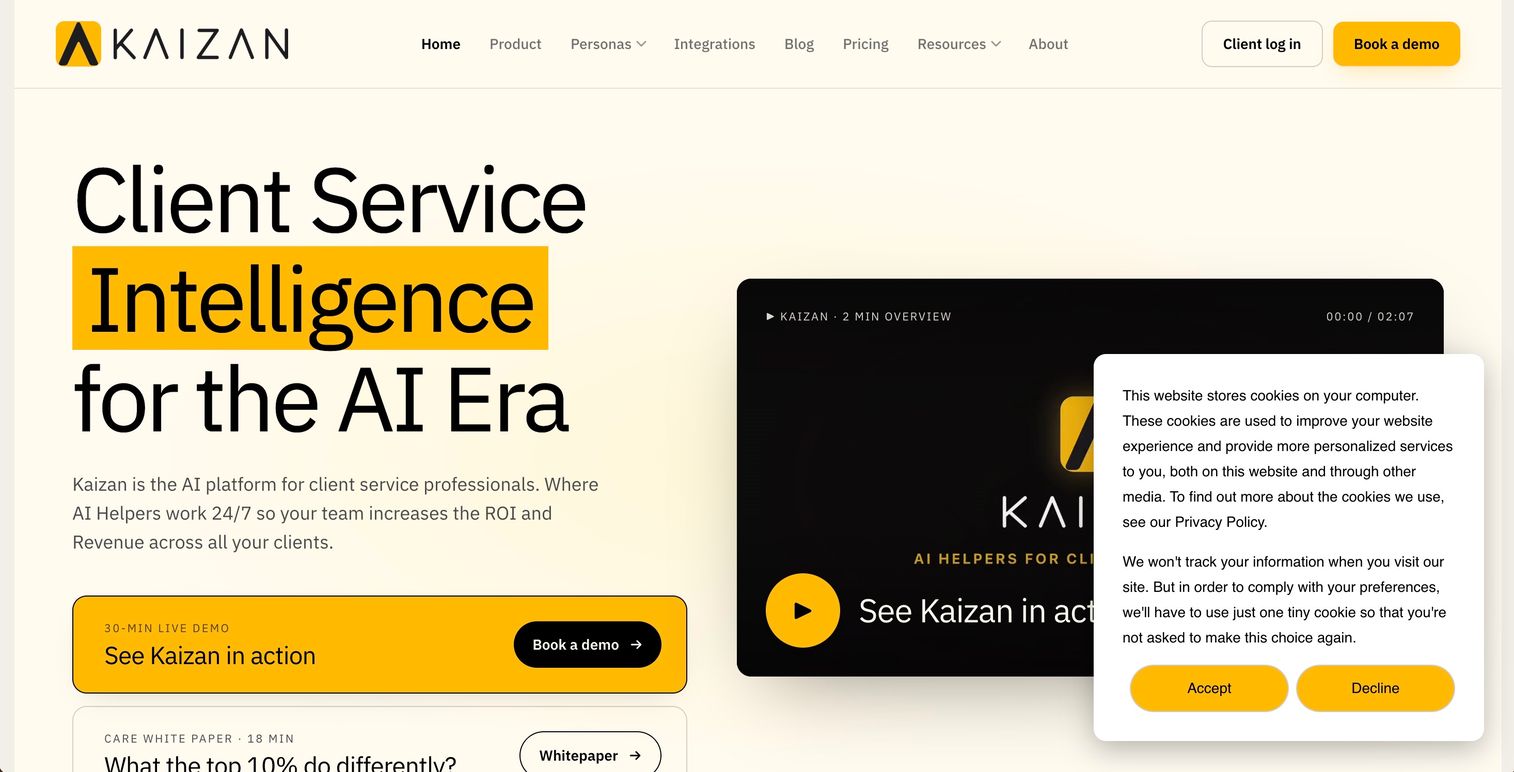
Kaizan is an AI platform for client service teams that unifies client communications, scores relationship health, and drafts next actions. Like Trustline, it appears adjacent to royalty searches without being royalty software. Its focus is account management and customer success: capturing meetings, chats, and emails, then scoring every client relationship with a health model.
For a founder, the relevance is in the retention and expansion motion, not royalty accounting. If your challenge is knowing which client relationships are at risk, Kaizan's CARE health model and AI helpers are built for that job. It is on this list to draw the boundary clearly: powerful for client services, not designed for royalty calculation.
Best for: Client services, account management, and customer success teams at services-led firms.
Key strengths
- Unified client communications: Captures meetings, chats, and emails in one place.
- CARE client health model: Scores every relationship to flag risk and opportunity.
- AI helpers: Draft follow-ups, updates, and expansion plays automatically.
Why choose Kaizan: Choose Kaizan when your problem is client relationship health and account expansion, not royalties. It fits services-led teams that want a clearer signal on which accounts need attention.
Kaizan pricing: Kaizan uses bespoke enterprise pricing and does not show a public numeric price on its pricing page. Expect a scoped quote after a sales conversation.
Considerations
Before you commit budget, run every candidate through this checklist. The right platform is the one that matches your complexity, not the one with the longest feature list.
Contract complexity
Map your hardest contract first. Tiered rates, escalators, minimum guarantees, retroactive true-ups, and territory splits are where lightweight tools break. If a platform cannot model your worst deal cleanly, it will not survive your average one.
Auditability
Ask how the platform handles versioned contract terms and whether every number traces back to a clause. A real audit trail is the difference between an audit that takes an afternoon and one that takes a week. This is also what makes your royalty accounting software defensible during investor diligence.
Reporting depth
Look past summary dashboards. You want product-level accruals, unearned advance tracking, and recipient-ready statements. If the reporting cannot answer a rights holder's specific question without manual work, you have only moved the spreadsheet problem, not solved it.
Implementation and integrations
Check how sales data gets in. Multi-channel and multi-currency ingestion, plus integrations with your ERP or accounting stack, determine how much manual cleanup your finance team still owns. The lower that number, the more the tool earns its place.
Vertical fit
A publishing tool, a franchise operating system, and an enterprise rights platform solve different problems. Match the software's native language to your business. Vertical fit means less configuration and a faster path to a working process your team can own.
Conclusion
The right choice comes down to complexity and vertical, not brand. For IP-driven businesses that want automation and measurable time savings, MetaComet® replaces manual statement work with a clear ROI story. For high-complexity, exception-heavy rights operations, Rightsline configures to your contracts at enterprise scale. Publishers should look hard at Schilling Publishing, franchises at FranConnect, licensors at RoyaltyZone, and music rights holders at Kobalt Music Group.
If you are early and your contracts are still simple, do not over-buy. The signal to move off spreadsheets is when exceptions outnumber the rule and one person becomes the single point of knowledge. When that happens, dedicated royalty tracking software removes the founder dependency, speeds up period close, and produces records clean enough to survive an audit or a fundraise.
Shortlist two platforms that match your complexity level, run your hardest contract through each demo, and pick the one that models it without manual workarounds. That single test tells you more than any feature comparison.
If you build software and want prospects to experience your product before a sales call, Guideflow turns your product into self-serve interactive demos in minutes. Start your journey with Guideflow today!
FAQs
It stores contract terms as calculation rules, applies them to sales and usage data, and generates the statements and payments owed to rights holders. The core jobs are royalty calculation, statement generation, payment processing, and reporting, all with an audit trail that keeps records defensible during rights holder audits or investor diligence.
Accounting software records financial activity after it happens. Royalty software handles the logic that comes before: contract rules, allocations, tiers, unearned advances, and payout calculations. An ERP can post a royalty payment, but it will not tell you how much is owed under a specific contract clause. Dedicated royalty accounting software models that automatically.
Prioritize contract management, automated royalty calculation, reporting depth, audit trails, and payment processing. Multi-currency support matters if you pay across territories. The single most important test is whether the platform can model your most complex contract, since that is where lighter tools break down.
Publishers, licensors, franchises, music rights teams, licensing organizations, and any business with recurring royalty obligations. The practical trigger is complexity, not size. Once tiered rates, retroactive adjustments, and multi-channel sales make manual reconciliation error-prone, a dedicated platform earns its place.
Yes, if the platform supports exception handling, retroactive adjustments, tiers, thresholds, and multiple contract structures. Not every tool does this equally well, so map your hardest deal and confirm the software models it cleanly before you buy. That single test separates enterprise-grade rights and royalty management software from lighter options.
Many platforms ingest sales data from multiple channels and convert currencies automatically before calculating what is owed. If you pay recipients across territories, confirm the tool handles currency conversion at both the calculation and payment stages, not just at reporting.
Yes, especially when it keeps a real audit trail, versioned contract terms, and repeatable calculation logic. That combination lets you trace any number back to the clause that produced it, which is what auditors and rights holders ask for and what makes your process survive scrutiny.
Evaluate contract complexity handling, reporting depth, integrations, payment workflows, and how much manual cleanup your finance team can tolerate. Shortlist two platforms that match your complexity and vertical, then run your hardest contract through each. Pick the one that produces a clean, auditable statement without manual workarounds.