Every software purchase at a 50-person SaaS company can go through Slack. Once you hit 150 people, that stops working. Vendor requests land in DMs. Security sees them after the contract is already negotiated. Finance finds the spend when the invoice arrives. And the founder gets pulled back in because nobody trusts the process enough to own it.
According to The Hackett Group (2025), 56% of organizations have adopted procurement intake and orchestration solutions, yet two-thirds of procurement respondents still use more than 10 procurement tools, per Digital Commerce 360 (2025). The fragmentation is the problem, not the volume.
Procurement orchestration software creates a repeatable operating system for how purchasing decisions get made. It routes requests across Finance, Legal, Security, IT, and Procurement without requiring the founder or CFO to be in every conversation. This guide helps you find the right platform for your operating model, approval complexity, and current stage.
What's inside
- Who it's for: Series B SaaS founders, CFOs, and operations leads modernizing vendor intake and approval workflows
- Tools covered: 12 procurement orchestration platforms evaluated for intake depth, approval routing, supplier workflows, spend visibility, and ERP integration
- Selection criteria: Category relevance, procurement workflow coverage, integration depth, and fit for scaling teams
- Data sourced: Pricing verified against each vendor's pricing page; G2 ratings verified against live G2 listings
TL;DR
- Best overall procurement front door: Zip, for companies building a single intake layer across all business stakeholders
- Best for agentic procurement workflows: ORO Labs, for teams prioritizing AI-driven routing and supplier lifecycle orchestration
- Best for no-code workflow orchestration: Tonkean, for operations teams coordinating procurement across systems they already own
- Best for procurement performance management: Focal Point, for procurement leaders managing intake, pipeline, workload, and savings visibility
- Best for SaaS spend control: Airbase (for procurement-led finance workflows) or Ramp (for finance-led card and expense controls)
- Best for enterprise source-to-pay: Coupa or SAP, for larger teams standardizing global procurement across complex operating models
What is procurement orchestration software?
Procurement orchestration software is a workflow layer that coordinates procurement intake, approvals, supplier checks, purchasing actions, and system handoffs across the tools a company already uses.
Think of it as the connective tissue between your ERP, AP platform, contract management system, ITSM ticketing, and supplier database. It creates a clean front door for vendor and purchase requests, then routes that work to the right people with the right context, in the right sequence.
Unlike procure-to-pay software, which executes purchasing transactions (requisitions, POs, invoices, payments), procurement orchestration focuses on the coordination layer: Getting the right approvals, triggering the right reviews, and pushing the right data to downstream systems. Unlike spend management, which tracks what was already spent, orchestration governs what gets approved before money moves.
Core capabilities to look for:
- Procurement intake forms and request portals
- Approval routing by amount, vendor type, category, or risk level
- Supplier onboarding and compliance workflows
- Integrations with ERP, finance, CLM, ITSM, and AP platforms
- Purchase request and PO workflow support
- Spend visibility and workflow analytics
- AI-assisted routing, document review, and recommendations
- Audit trails, policy enforcement, and governance controls
| Category | Primary job | What it replaces |
|---|---|---|
| Procurement orchestration | Coordinate intake, approvals, routing, and system handoffs | Email chains, Slack approvals, spreadsheet trackers |
| Procure-to-pay | Execute requisitions, POs, invoices, and payments | Manual transaction workflows |
| Spend management | Track, categorize, and analyze what was spent | Finance reporting and expense tools |
| Source-to-pay | Cover sourcing through payment in one suite | Fragmented point solutions across the full cycle |
When to use procurement orchestration software
Centralize purchase intake before spend escapes control
Slack approvals and email threads stop working at scale. A 100-person company with 15 software vendors renewing, five new tools under evaluation, and a new CFO who wants visibility cannot manage that through informal channels. Procurement orchestration gives every request a trackable front door, so Finance and leadership see what is in flight before it becomes a committed cost.
Route approvals across Finance, Legal, Security, IT, and Procurement
Most vendor decisions touch more than one team. A new data processing tool needs Security to review the DPA, Legal to approve the contract, and Finance to confirm the budget. Approval workflow software can model parallel tracks so no single reviewer becomes the bottleneck. Orchestration platforms handle that coordination automatically, triggered by request type, vendor category, or contract value.
Connect new procurement workflows to existing systems
Most scaling companies already have ERP, AP, CRM, and contract tools. The problem is that the process breaks between them. A purchase request approved in one system never flows cleanly to PO creation in another. Procurement orchestration sits above those systems and handles the handoffs, so your team stops manually copying data across tools.
Procurement orchestration software comparison
The table below covers all 12 tools in this guide. Pricing is verified against each vendor's pricing page; G2 ratings are pulled from live listings. Most vendors in this category price by quote, so the Pricing column reflects what each company actually shows prospective buyers.
| # | Product | Best for | Key differentiator | Pricing | G2 rating |
|---|---|---|---|---|---|
| 1 | Zip | Procurement front door | Intake-to-procure orchestration across business teams | Custom pricing | 4.6/5 |
| 2 | ORO Labs | Agentic procurement workflows | AI-powered intake, supplier, and risk orchestration | Custom pricing | 4.7/5 |
| 3 | Tonkean | No-code process orchestration | Cross-system workflow builder for procurement operations | Custom pricing | 4.6/5 |
| 4 | Focal Point | Procurement performance management | Intake, pipeline, workload, and savings visibility | Custom pricing | N/A |
| 5 | Procurify | Mid-market purchasing control | Purchase requests, approvals, budgets, and PO workflows | Custom pricing | 4.6/5 |
| 6 | Arkestro | Predictive sourcing | AI-assisted supplier pricing and sourcing workflows | Custom pricing | 5.0/5 |
| 7 | Ramp | Finance-led spend control | Cards, expenses, bill pay, and procurement controls | Free plan available; Plus from $15/user/month | 4.5/5 |
| 8 | Tipalti | AP automation and supplier payments | Supplier onboarding, tax, payments, and AP automation | From $99/month | 4.5/5 |
| 9 | SpendHQ | Spend intelligence | Spend analytics and procurement performance visibility | Custom pricing | 4.4/5 |
| 10 | Airbase | Spend management for SaaS | Intake, approvals, cards, reimbursements, and bill pay | Custom pricing | 4.7/5 |
| 11 | Coupa | Enterprise business spend management | Source-to-pay suite with procurement and supplier depth | Custom pricing | 4.2/5 |
| 12 | SAP | ERP-led enterprise procurement | Procurement embedded in SAP finance and ERP systems | From $3.46/user/month (SAP Build); strategic procurement modules priced separately | 4.2/5 |
Best 12 procurement orchestration tools for 2026
1. Zip
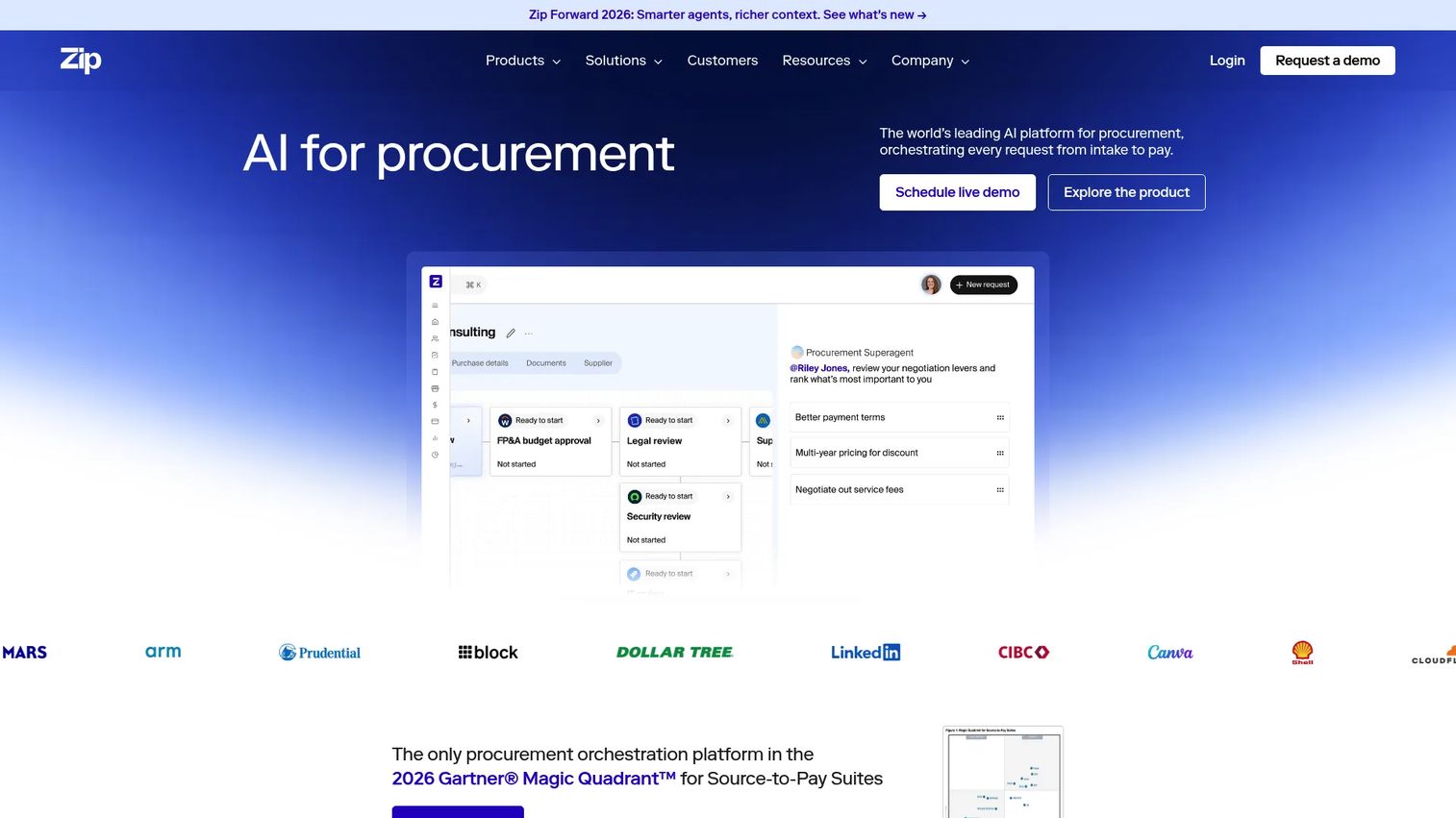
Zip is an AI-powered procurement orchestration platform that manages procurement from intake through payment. It creates a single front door for vendor and purchase requests, then routes each request to the right reviewers across Procurement, Finance, Legal, Security, and IT. Zip covers intake-to-procure and intake-to-pay workflows, including purchase orders, contracts, and invoice management.
Best for: Enterprise procurement and finance teams building a governed, cross-functional intake layer for all vendor decisions.
Key features
- Intake-to-procure and intake-to-pay workflow automation
- Approval routing across multiple business functions
- Supplier onboarding and vendor review workflows
- AI contract orchestration and sourcing workflows
- ERP, CLM, finance, and collaboration integrations
Why choose Zip: Zip fits companies that want procurement to become an easy front door for the entire business, not a bottleneck. It covers the widest intake-to-pay scope of any purpose-built orchestration platform in this guide.
Zip pricing: Zip prices by quote. Reach out to sales for specifics by module, employee count, integration scope, and rollout complexity.
G2 rating: 4.6/5
2. ORO Labs
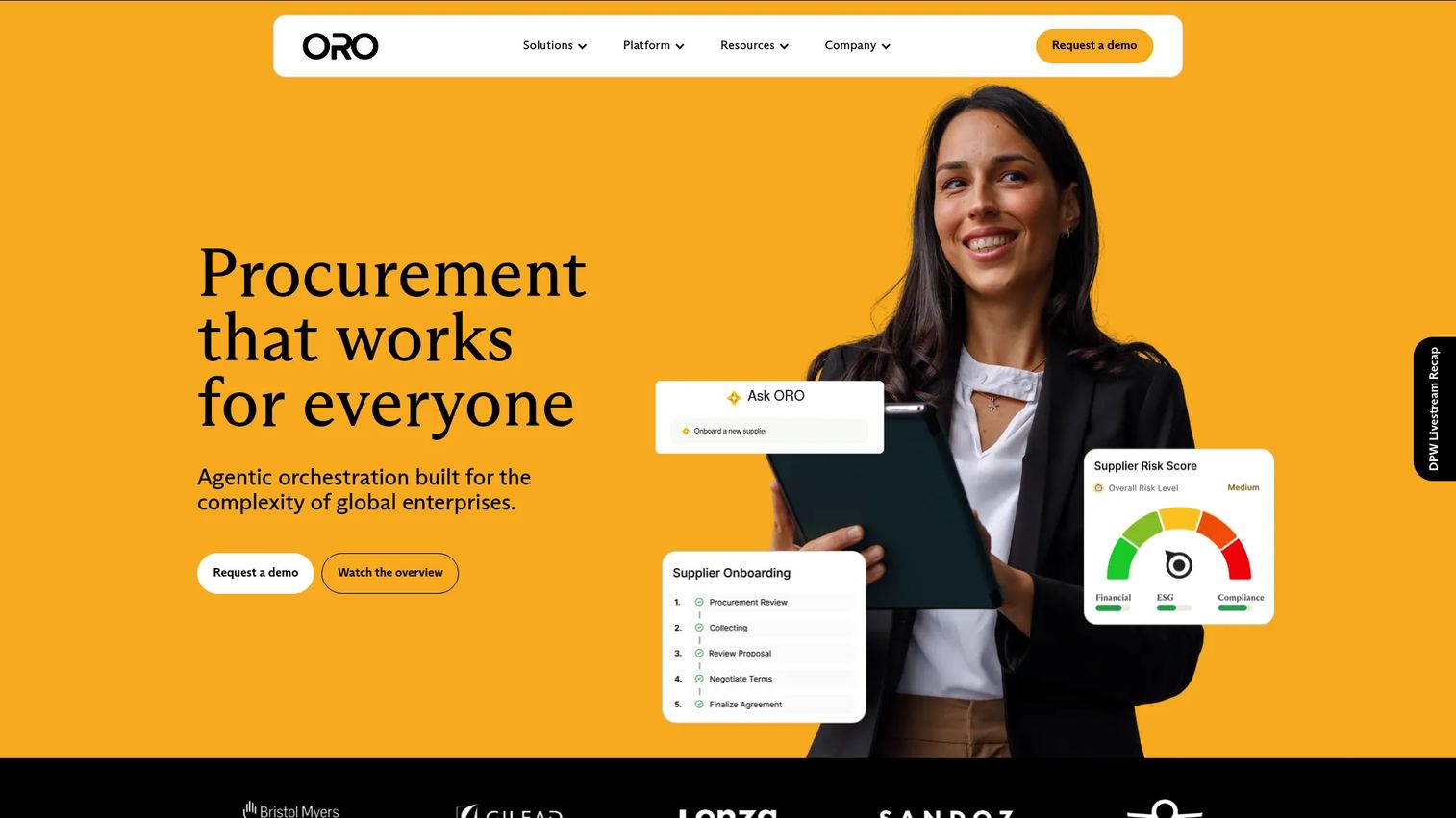
ORO Labs provides agentic procurement orchestration software built for enterprise-scale, cross-system procurement operations. Its platform combines AI-powered intake and request management with composable agentic workflows, supplier onboarding, risk and compliance routing, and deep integrations across ERP, sourcing, invoicing, contract, and risk systems. ORO Labs also holds ISO 42001 certification, covering AI management systems, which matters for enterprises under governance scrutiny.
Best for: Large enterprises and global organizations where procurement spans many departments and supplier risk needs earlier, automated visibility.
Key features
- AI-powered intake and request management with no-code workflow builder
- Composable agentic workflows and agent builder
- Supplier onboarding, risk, and compliance orchestration
- Integrated process mining
- SSO, role-based access, SOC 1/SOC 2 compliance, and ISO 42001 certification
Why choose ORO Labs: ORO Labs fits companies where procurement involves many departments and supplier risk flags need to surface early, before the contract is nearly signed. Human approval and governance remain central; the AI speeds routing and classification, not decision-making.
ORO Labs pricing: ORO Labs prices by quote. Ask sales about modules, AI workflow scope, supplier volume, and integration requirements.
G2 rating: 4.7/5
3. Tonkean
Tonkean is an AI-powered enterprise process orchestration platform. Its no-code workflow builder connects procurement to more than 250 existing applications, so procurement intake, routing, and approvals flow across the tools your team already runs without forcing a platform migration. It includes an AI Front Door for employee-facing intake and AI agents for automating process steps across business teams.
Best for: Enterprise legal, procurement, HR, and shared-services teams that need governed workflows across existing systems, not a replacement for them.
Key features
- AI Front Door and AI agents for employee intake
- No-code workflow and process builder
- Cross-system orchestration across 250+ integrations
- Enterprise governance, controls, and compliance
- Procurement process analytics
Why choose Tonkean: Tonkean fits operations-heavy teams that already have procurement, finance, and ERP tools but need those tools to talk to each other reliably. The no-code approach means procurement leads can build and adjust workflows without engineering support.
Tonkean pricing: Tonkean prices by quote, with cost driven by monthly tracked users, deployment scope, and implementation services.
G2 rating: 4.6/5
4. Focal Point
Focal Point positions itself as an AI-powered procurement operating system for enterprises. It focuses specifically on procurement performance management: Intake management, sourcing event tracking, supplier relationship and third-party risk, contract lifecycle management, and centralized dashboards that give leadership visibility into procurement team workload and savings.
Best for: Enterprise procurement leaders who need to make team activity, savings pipeline, and request status visible to executives and board-level stakeholders.
Key features
- AI-powered request intake and workflow automation
- Procurement activity and sourcing event management
- Supplier relationship and third-party risk management
- Contract lifecycle management
- Centralized dashboards and procurement performance data
Why choose Focal Point: Focal Point fits procurement leaders who need to demonstrate team value upward. If the primary pain is "nobody knows what procurement is working on or what it has saved," Focal Point solves that visibility problem directly.
Focal Point pricing: Focal Point prices by quote. Ask sales about user count, modules, reporting depth, and implementation support.
5. Procurify
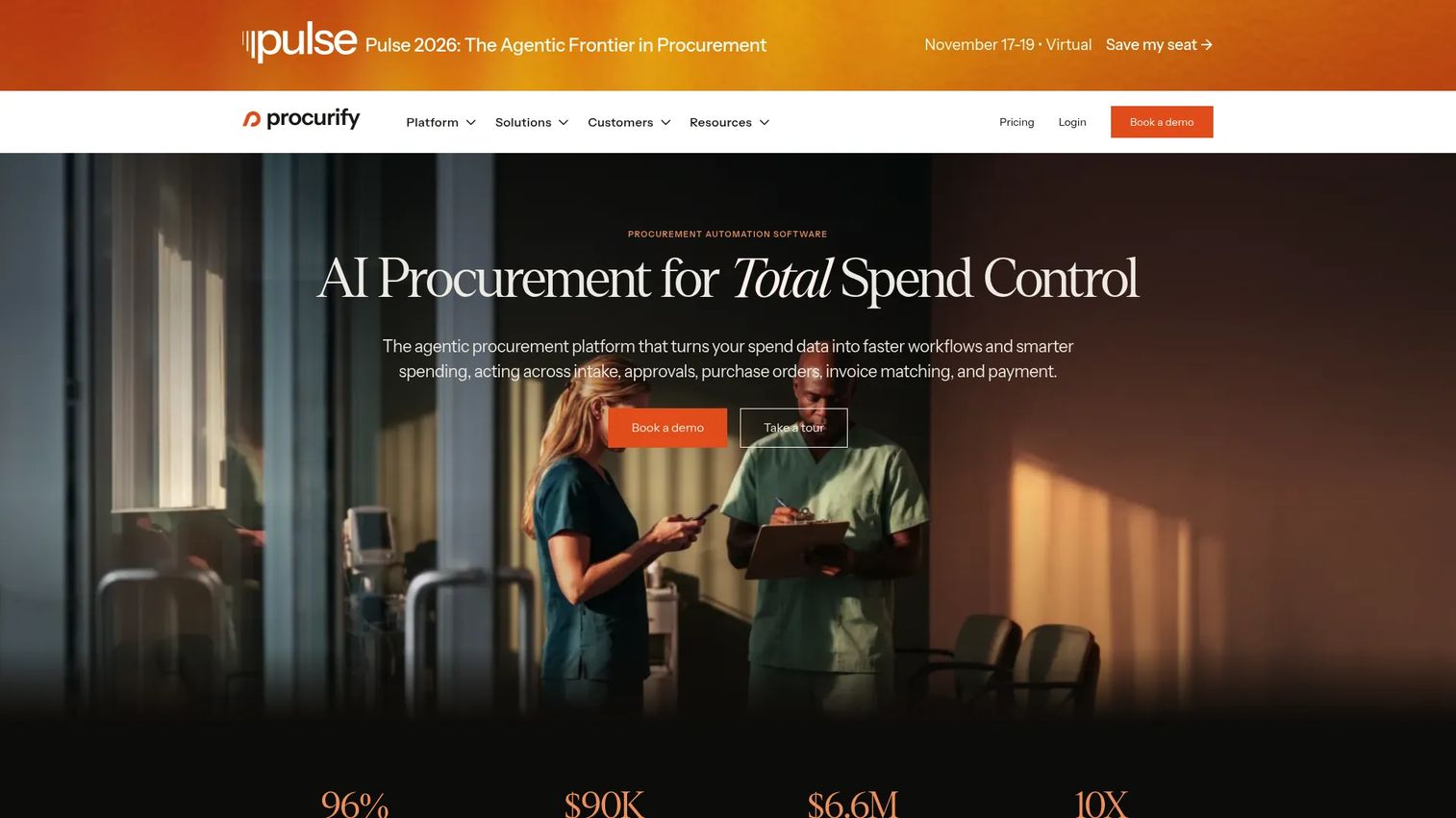
Procurify is an agentic procurement and spend management platform covering purchasing, approvals, purchase orders, invoices, payments, expenses, corporate cards, and analytics. It is modular: Every customer starts with Purchasing, and AP, Expense and Card, Guided Intake, and Contracts can be added based on actual workflow needs. The platform includes a mobile app and PunchOut catalog integrations.
Best for: Mid-market finance and operations teams that need end-to-end purchasing structure without jumping straight into an enterprise suite.
Key features
- Order requests and guided intake
- Approval routing and budget management
- Purchase orders, catalogs, vendors, and contracts
- Invoice capture, matching, and payments
- Spending cards, expense management, and accounting integrations
Why choose Procurify: Procurify fits scaling SaaS companies that need purchasing discipline, real budget controls, and AP automation, but are not ready for a full-scale enterprise procurement transformation. The modular pricing means you can start with the workflows that break first.
Procurify pricing: Procurify prices by modular quote. Contact sales for a breakdown by module combination, user count, and integration requirements.
G2 rating: 4.6/5
6. Arkestro
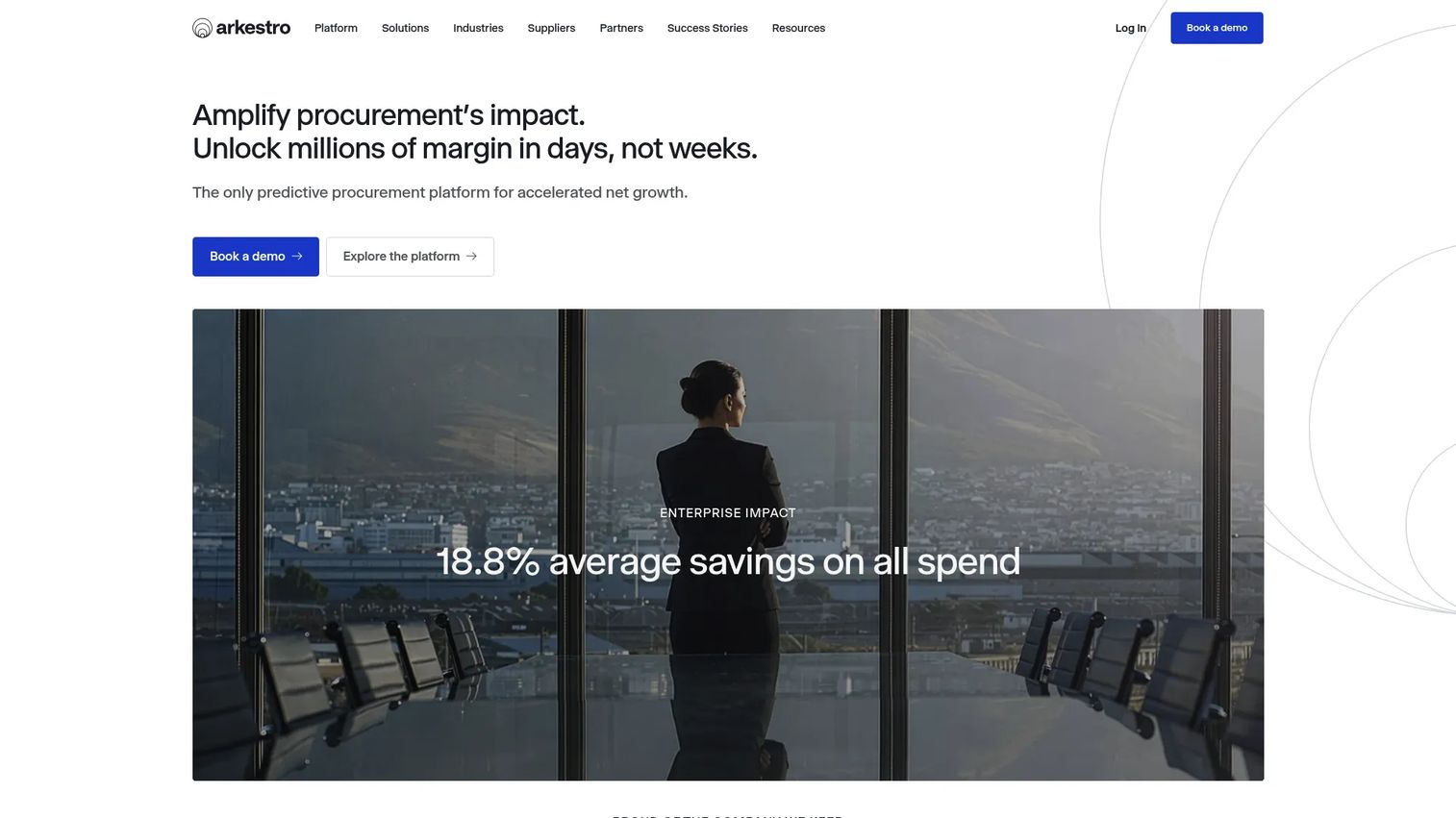
Arkestro applies AI, game theory, and behavioral science to procurement sourcing. It generates predictive pricing recommendations, runs automated multi-round supplier negotiations, and provides award simulation across cost, quality, and risk factors. This is sourcing optimization software, not a broad intake platform, so it fits organizations where supplier pricing and high-volume negotiations are the primary cost driver.
Best for: Enterprise procurement and supply chain teams managing complex, high-volume sourcing events and supplier negotiations.
Key features
- Predictive pricing and AI-generated suggested offers
- Automated multi-round supplier negotiation and real-time engagement
- Award simulation and optimization across cost, quality, and risk
- Savings analytics and negotiation reporting
- Supplier collaboration tools
Why choose Arkestro: Arkestro fits teams where supplier pricing, sourcing events, and negotiated savings are bigger operational problems than basic purchase intake. If your procurement team runs dozens of sourcing events per quarter, Arkestro's AI recommendations can materially change negotiation outcomes.
Arkestro pricing: Arkestro prices by quote. Ask sales about sourcing event volume, supplier count, and deployment model.
G2 rating: 5.0/5 (based on 11 reviews)
7. Ramp
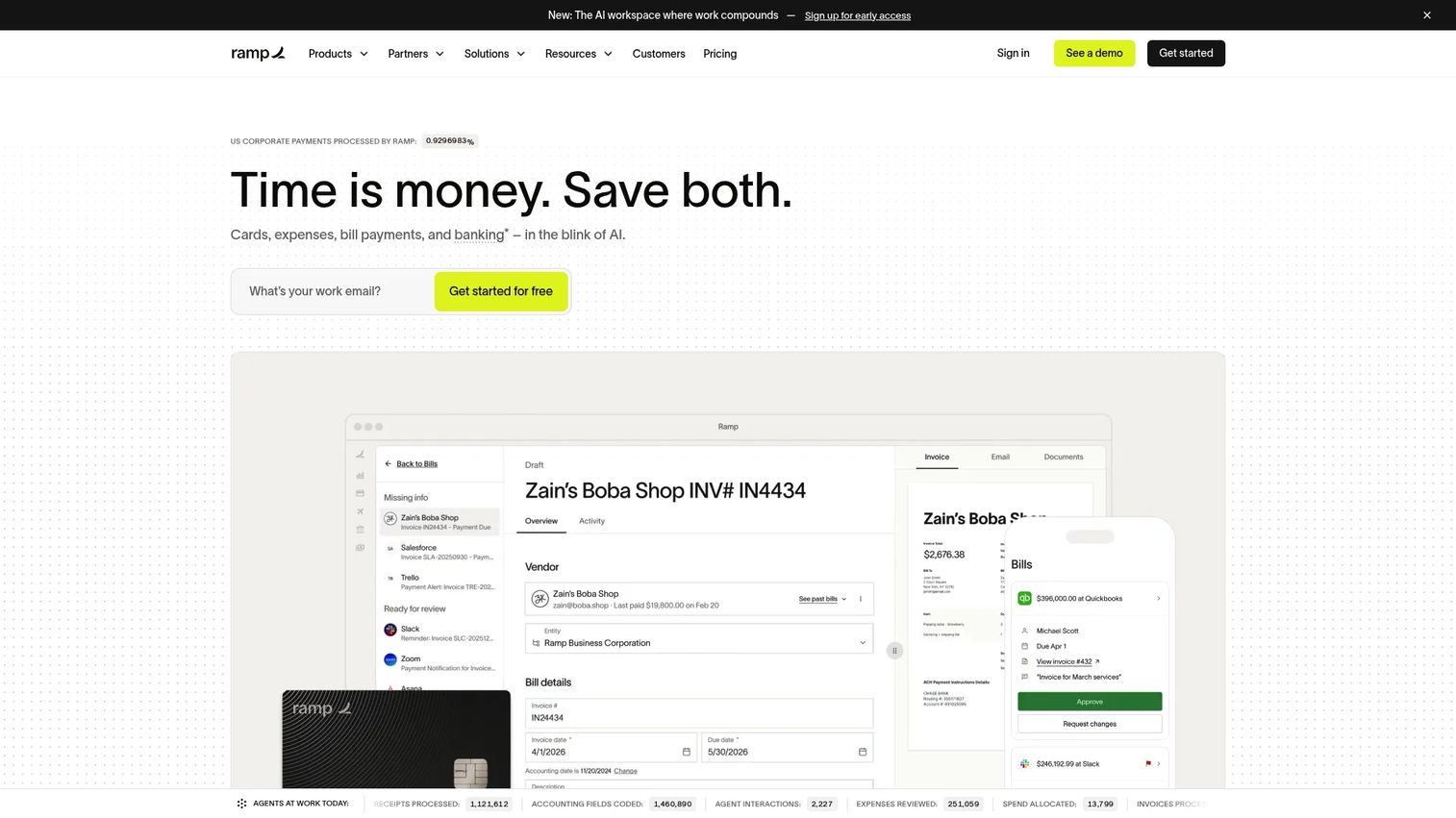
Ramp is a financial operations platform covering corporate cards, expense management, bill payments, procurement controls, travel, banking, and accounting automation. It is finance-led rather than procurement-native: The core is spend control, with procurement workflows layered on top. Ramp has a free plan that includes core card, expense, AP, banking, and reporting features, which makes it one of the few platforms in this guide where a founding team can start without a sales call.
Best for: Finance teams at growth-stage companies seeking integrated spend control across cards, expenses, and bill pay, with lightweight procurement approval workflows.
Key features
- Corporate cards with unlimited physical and virtual cards
- Expense management with receipt matching and reimbursements
- Accounts payable with invoice OCR, approval workflows, and multiple payment methods
- Vendor and spend controls with budget tracking
- Accounting automation and ERP integrations
Why choose Ramp: Ramp fits founders who want spend controls and finance visibility before building a dedicated procurement function. It is the right starting point when the problem is "we have no idea where money is going" rather than "our procurement approval process is broken."
Ramp pricing: Free plan covers core features. Plus plan is $15/user/month (save 20% with annual billing). Enterprise pricing is custom. A platform fee based on team size also applies to the Plus plan.
G2 rating: 4.5/5
8. Tipalti
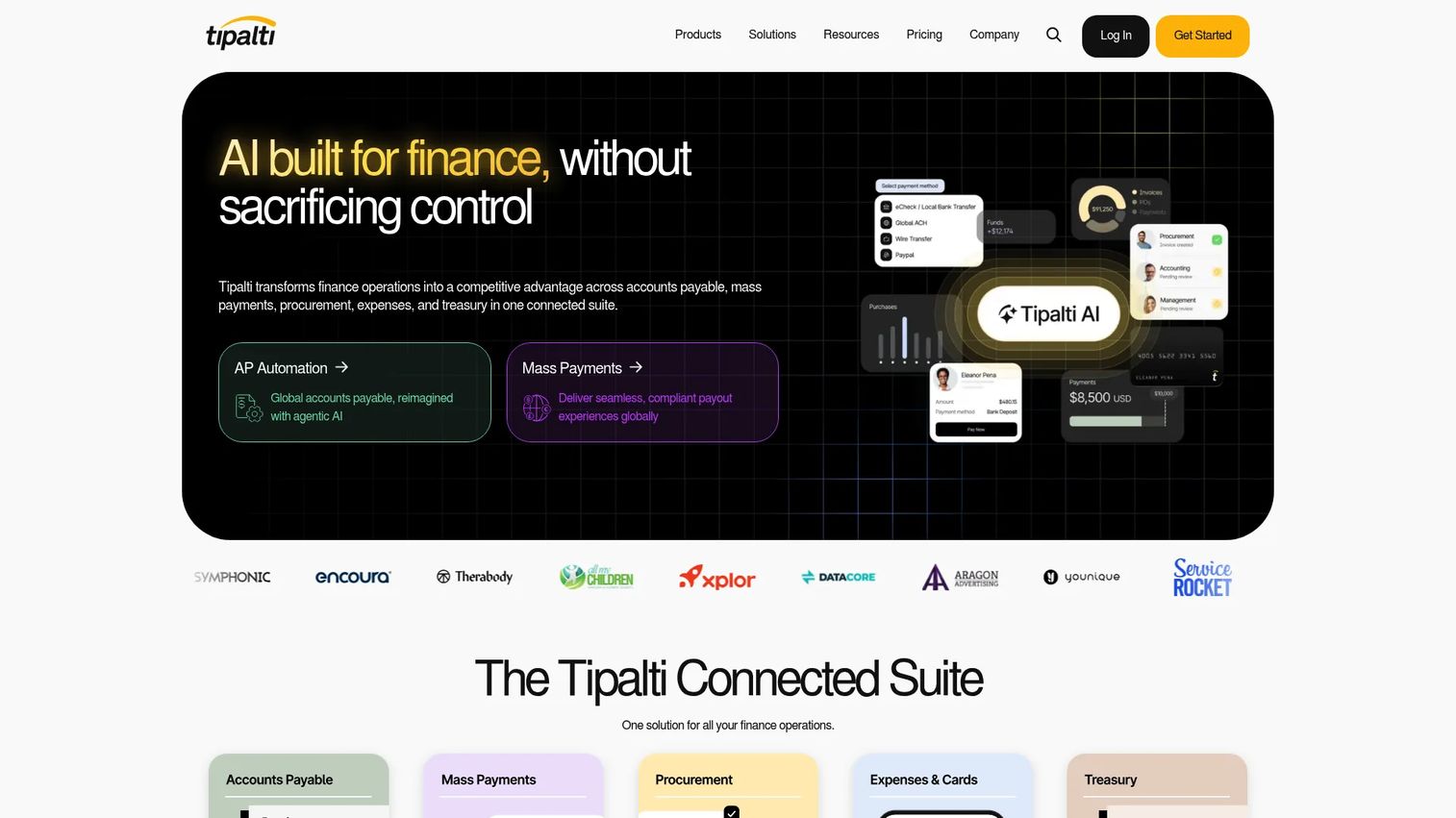
Tipalti is a finance automation platform for accounts payable, mass payments, procurement, expenses, and treasury. Its strength is post-approval finance work: Supplier onboarding, tax form collection (W-9, W-8BEN), global payments to 200+ countries across 120 currencies, invoice processing with PO matching, and built-in fraud controls. It also includes procurement and expense management with corporate card integration.
Best for: Mid-market and enterprise finance teams managing complex AP, supplier payments, and global payouts, especially where supplier onboarding and tax compliance create recurring friction.
Key features
- AI-powered invoice capture, processing, approvals, and PO matching
- Global payments to 200+ countries in 120 currencies via 50+ payment methods
- Supplier and payee self-service onboarding and management
- Built-in tax compliance, fraud controls, and payment reconciliation
- Corporate card integration and expense management
Why choose Tipalti: Tipalti fits companies where procurement pain surfaces after the approval, specifically in supplier setup, invoice processing, tax compliance, and payment execution. It is the right choice when the AP process is the bottleneck, not the intake or routing layer.
Tipalti pricing: Accounts Payable starts at $99/month. Mass Payments starts at $249/month. Additional transaction fees and module costs apply.
G2 rating: 4.5/5
9. SpendHQ
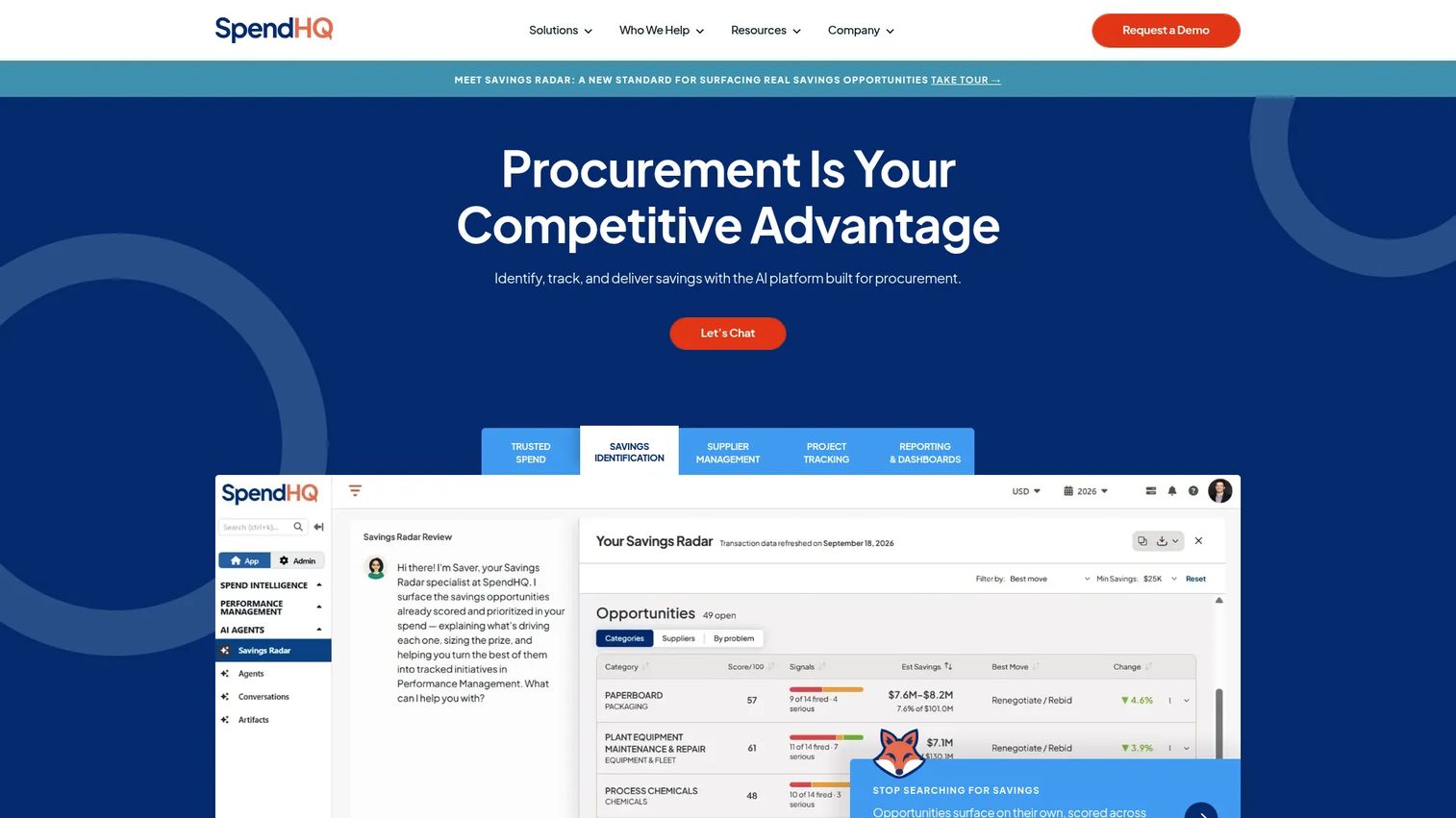
SpendHQ is a procurement intelligence platform combining spend analytics, procurement performance management, and AI-powered execution. Its core capability is spend data: AI-powered cleansing, categorization, and analysis that turns messy financial data into usable category insights. It also includes a Savings Radar for opportunity identification, supplier and contract management, and procurement project tracking with ownership and KPI reporting.
Best for: Enterprise procurement teams that need cleaner spend visibility and savings pipeline tracking before redesigning processes or negotiating supplier strategy.
Key features
- AI-powered spend data cleansing, categorization, and analysis
- Savings Radar for opportunity identification
- Supplier, contract, risk, and ESG management
- Procurement project tracking with ownership and KPIs
- AI-generated category strategies, savings pipelines, and sourcing briefs
Why choose SpendHQ: SpendHQ fits procurement leaders who need to understand their spend picture before committing to process changes. The analytics-first approach makes it a strong complement to an orchestration platform, particularly when category data is fragmented across multiple ERPs.
SpendHQ pricing: SpendHQ prices by quote. Ask sales about data sources, category coverage, refresh cadence, and the analytics modules included.
G2 rating: 4.4/5
10. Airbase
Airbase is a procure-to-pay and spend management platform covering guided procurement, accounts payable automation, expense management, and corporate cards. It is designed for mid-market and enterprise companies where finance owns the procurement motion. Guided procurement includes customizable approval workflows. AP automation handles invoice OCR, bill payments, purchase orders, and a vendor portal. The platform tiers by company size: Standard (up to \200 employees), Premium (up to \500), and Enterprise (up to \~10,000).
Best for: Mid-market and enterprise finance teams seeking one finance-led workflow for purchasing, cards, reimbursements, and bill pay.
Key features
- Guided procurement with customizable approval workflows
- Accounts payable automation with invoice OCR and PO creation
- Expense management with receipt capture and policy controls
- Corporate cards with spend controls
- Accounting integrations and subsidiary support
Why choose Airbase: Airbase fits SaaS companies that want one finance-led system covering purchasing, cards, reimbursements, and bill pay. The tier structure makes it approachable at 200 employees and scalable past 10,000, so it can grow with the company without a platform migration.
Airbase pricing: All three plans (Standard, Premium, Enterprise) are quote-based. Ask sales about subsidiaries, card volume, AP volume, and implementation scope.
G2 rating: 4.7/5
11. Coupa
Coupa is a business spend management platform covering procurement, AP invoice automation, expense management, payments, sourcing, contracts, inventory, and supplier management. It is an enterprise source-to-pay suite with particular depth in supplier management and sourcing workflows. Coupa is suited to organizations that need global process standardization across procurement, AP, and supplier operations.
Best for: Large and enterprise organizations that need an integrated platform for business spend across procurement, AP, suppliers, sourcing, and payments at global scale.
Key features
- Procurement and purchase-order management
- Accounts payable invoice automation and matching
- Sourcing, contract management, and supplier lifecycle management
- Expense management and payment processing
- Spend analytics and supplier risk controls
Why choose Coupa: Coupa fits larger organizations that need procurement depth across sourcing, supplier management, spend, invoicing, and governance, with the integration breadth to cover multiple geographies and operating entities. It is not the right starting point for a 100-person company that just needs intake and approvals.
Coupa pricing: Coupa prices by quote. Cost drivers include modules selected, geographies, integrations, user base, and supplier network scope.
G2 rating: 4.2/5
12. SAP

SAP offers enterprise software spanning cloud ERP, procurement, supply chain, finance, HCM, and more. For procurement specifically, SAP Ariba covers source-to-pay, supplier network, sourcing, and contract management, while SAP S/4HANA embeds procurement natively into core ERP and finance operations. SAP Strategic Procurement is listed publicly at $2,420/month; SAP Build (the low-code platform) starts at $3.46/user/month. Most enterprise procurement deployments involve a sales conversation and implementation partner scoping.
Best for: Large and midsize enterprises that want procurement tightly connected to finance, ERP master data, and global operating controls, particularly those already invested in SAP systems.
Key features
- ERP-native procurement workflows within SAP S/4HANA
- Supplier network, sourcing, and contract management via SAP Ariba
- Purchase orders and invoicing
- Enterprise governance, master data management, and compliance
- Business Technology Platform for data, analytics, AI, and integration
Why choose SAP: SAP fits enterprises where procurement selection is part of a broader architecture decision, not a standalone tool evaluation. Organizations already running SAP finance often find it far more efficient to extend SAP procurement than to introduce a separate orchestration layer that requires ERP integration.
SAP pricing: SAP Strategic Procurement is listed at $2,420/month. SAP Build base user starts at $3.46/user/month on a 3 to 36 month contract. Full enterprise procurement pricing requires a sales conversation, with cost varying by modules, SAP footprint, user count, supplier network needs, and implementation scope.
G2 rating: 4.2/5
Considerations when choosing procurement orchestration software
Start with the workflow that breaks most often
Identify the specific failure point before evaluating platforms. Is it intake (requests disappear into email)? Approvals (requests stall at Security or Legal)? Supplier onboarding (new vendors take three weeks to set up)? Or ERP sync (POs are created manually after approval)? The answer determines whether you need a front-door platform like Zip, an analytics layer like SpendHQ, or an AP-focused tool like Tipalti.
Check whether the tool complements or replaces your current stack
Procurement orchestration platforms often sit above ERP, AP, CLM, and ITSM systems rather than replacing them. Before evaluating features, map what your team already uses and ask each vendor specifically how their platform connects to it. A platform that forces a costly migration when you only need a workflow layer will create more drag than it removes.
Match governance depth to your current stage
Series B SaaS teams need approval controls and audit trails, but not necessarily full enterprise procurement architecture. Evaluate approval depth, role-based permissions, and policy enforcement against your real risk profile. Buying a platform designed for 10,000-employee compliance requirements at 150 employees usually means paying for features nobody uses.
Pressure-test time to value
Ask each vendor what a useful first workflow looks like in 30 to 90 days. A procurement platform that takes 12 months to show value before the next board meeting does not earn its place in the stack. Strong answers from vendors include specific onboarding timelines, rollout milestones, and reference customers at your company size.
Look at adoption from the employee side
If the people submitting purchase requests avoid the tool, procurement reverts to Slack. Evaluate the intake experience, how clearly routing status is communicated to requesters, and how much training employees need to submit a basic request. The best orchestration platform is the one your team will use without being told.
Conclusion
Procurement orchestration earns its place only when it reduces decision drag without becoming a new operating tax. The right platform depends on where the process breaks, not on which vendor has the broadest feature list.
For the procurement front door, Zip covers the most complete intake-to-pay scope. ORO Labs is the strongest choice for AI-led agentic workflows at enterprise scale. Tonkean fits operations teams that need cross-system coordination without ripping out existing tools. Focal Point handles procurement performance visibility and team workload management. Procurify brings mid-market purchasing controls without enterprise complexity. Airbase and Ramp serve SaaS companies from different angles, Airbase from a procurement-led finance workflow, Ramp from a card-and-spend starting point. For analytics-first teams, SpendHQ clarifies the spend picture before process redesign. Tipalti addresses the post-approval AP and global payments layer. Coupa and SAP cover enterprise source-to-pay for organizations with the scale and complexity to justify them.
Build a shortlist of three tools from the comparison table and run the same purchase request scenario through each demo. That single test will tell you more about fit than any feature matrix.
FAQs
Procurement orchestration software is a workflow layer that coordinates purchase intake, approval routing, supplier reviews, and system handoffs across the tools a company already uses. It creates a trackable front door for vendor and purchase requests and ensures the right teams review each request in the right sequence. It often integrates with ERP, AP, CLM, and ITSM platforms rather than replacing them.
Procure-to-pay (P2P) software handles transaction execution: Requisitions, purchase orders, invoices, and payments. Procurement orchestration manages the coordination layer that happens before and around those transactions, including the intake request, cross-functional approvals, supplier compliance checks, and ERP handoffs. Many companies need both, with orchestration sitting above their P2P system to govern what gets approved before a transaction is created.
The right choice depends on the stage and specific pain. Zip and ORO Labs handle the broadest intake-to-procure scope. Procurify fits mid-market teams that need purchasing structure plus AP without heavy enterprise complexity. Airbase and Ramp serve finance-led motions at different points, Ramp with a free starting plan, Airbase with deeper procurement approval depth. Tonkean fits companies that already have procurement tools but need workflows to move cleanly between them.
The indicators are usually operational: Repeated approval delays, spend that Finance discovers after the invoice lands, Security looped in too late to block a risky vendor, suppliers taking weeks to onboard, or a new CFO who needs spend visibility before the next board meeting. The shift from informal approvals to a repeatable operating system typically happens between 75 and 200 employees for SaaS companies.
Usually not. Most procurement orchestration platforms integrate with ERP systems and improve the request, approval, and routing experience around them. For companies already invested in SAP, procurement orchestration may simply be an extension of SAP Ariba rather than a separate layer. For companies using NetSuite or other mid-market ERPs, a platform like Zip or Tonkean typically connects to ERP for PO creation without replacing it.
The highest-impact features depend on the specific bottleneck. For intake chaos, prioritize the request portal and routing logic. For approval stalls, evaluate conditional routing by amount, vendor type, and risk level. For supplier friction, look at onboarding workflows and compliance checks. For visibility gaps, prioritize spend dashboards and audit trails. For ERP-dependent teams, integration depth with your specific ERP matters more than any other capability. On AI features, the practical value is in routing recommendations and document classification, not autonomous decision-making; human approval should stay central.
Most vendors in this category price by quote. Cost factors include employee count, modules selected, transaction volume, supplier count, integration complexity, implementation support, and global rollout scope. Ramp is the only platform in this guide with a free starting plan. Tipalti publishes starting prices ($99/month for AP, $249/month for Mass Payments). SAP publishes some module pricing ($2,420/month for Strategic Procurement). All other vendors in this guide require a sales conversation for pricing, so build that step into your evaluation timeline.
AI adds real value in specific areas: Routing requests to the right reviewers based on vendor type and contract value, classifying spend data automatically, summarizing supplier information for faster review, and flagging risk patterns earlier in the process. ORO Labs and Arkestro have the deepest AI integration in this guide. Tonkean and Zip also incorporate AI into intake and routing. For any AI-assisted procurement workflow, human approval and clear policy design remain essential. Autonomous procurement decisions without human oversight carry governance risk that most companies at Series B are not positioned to manage.