Your donor data is in three places. Your payment processor doesn't sync with your email platform. Your development director is reconciling spreadsheets at midnight before the board meeting. And your major gift officer just left, taking six months of donor relationship notes with her.
This is what nonprofit CRM failure looks like before it shows up in the numbers. According to Omatic's 2025 research, nearly half of surveyed nonprofits are considering changing their CRM within 12 months, up from just 10% in 2024. That's not dissatisfaction with a feature. That's operational pain.
The right nonprofit CRM software consolidates constituent relationship management into one searchable database: Donors, campaigns, volunteers, pledges, and stewardship history. The wrong one adds a migration project and six months of adoption friction to a team that was already stretched.
Pick by your fundraising model first. A major gift institution and a peer-to-peer fundraising shop should not default to the same tool.
What's inside
This guide compares 15 nonprofit CRM software options for 2026. Tools were selected based on recurring presence in nonprofit technology evaluations, fundraising depth, reporting quality, integrations, and scalability.
- A nonprofit CRM software comparison table with pricing and G2 ratings
- Best-fit guidance by organization size and fundraising model
- Per-tool "best for" positioning and negative-fit notes
- A buyer checklist covering migration, integrations, reporting, and adoption
- Practical guidance on total cost of ownership beyond subscription price
TL;DR
- Best all-in-one fundraising CRM: CharityEngine, for organizations that want donor management, payment processing, and campaign tools under one contract
- Best enterprise nonprofit CRM: Salesforce, for large nonprofits with admin capacity and complex configuration needs
- Best for donor retention discipline: Bloomerang, for teams focused on engagement scoring and stewardship workflows
- Best for small nonprofits: Little Green Light at $45/month or Givebutter with a free core plan
- Best for major gift and advancement teams: Kindsight and iWave, for prospect intelligence alongside fundraising operations
What is nonprofit CRM software?
Nonprofit CRM software is a constituent relationship management system that helps nonprofits store donor, volunteer, prospect, campaign, and engagement data in one searchable database.
The category differs from a general-purpose CRM in several important ways. Nonprofit CRMs are built around giving history, pledge tracking, stewardship cycles, and tax-receipt generation. General-purpose CRMs handle contacts and pipeline. The overlap is real but the priorities diverge.
It also differs from adjacent categories:
- Donor management software focuses primarily on donor records and giving history. Many nonprofit CRMs include this as a core module rather than a separate product.
- Fundraising platforms prioritize campaign execution, donation forms, and payment processing. Some include basic CRM capabilities; others rely on integration.
- Prospect research tools like iWave add wealth screening and philanthropic data on top of a CRM, rather than replacing it.
Key capabilities to look for in nonprofit CRM software:
- Donor and constituent profiles with giving history and engagement tracking
- Gift and pledge tracking with recurring donation management
- Campaign and appeal management with segmentation
- Stewardship workflows and automated acknowledgments
- Volunteer and event records
- Reporting dashboards for board, campaign, and retention metrics
- Accounting, email, payment, and website integrations
- Permissions, security, and audit controls
Related terms in use: Donor CRM, donor management system, nonprofit database software, nonprofit donor management software. Many buyers use these interchangeably, though the capabilities behind each label vary.
When to use nonprofit CRM software
Centralize donor and constituent data
When donor records live across a payment processor, an email platform, and two different spreadsheets, you lose retention signal and staff continuity. A CRM for nonprofits gives the development team one source of truth for giving history, communication logs, and relationship notes. That matters most during staff transitions and before major gift asks.
Run fundraising campaigns with fewer manual handoffs
A fundraising CRM should reduce the manual reconciliation between campaign results, gift entry, and donor acknowledgments. If your team is re-entering gift data from a donation platform into a donor database, you're running an integration gap where revenue and relationships fall through. Choose a system where campaign attribution, pledge aging, and recurring gift management live in the same record.
Prepare for migration before the old system breaks
The worst time to migrate donor data is under pressure from an audit, a campaign deadline, or a leadership transition. Plan migration when your current system is working but visibly strained: Duplicate records accumulating, reporting taking hours instead of minutes, or staff working around the system instead of through it. Migration timelines depend on data cleanliness, field mapping, and training. Budget the same as the subscription cost in implementation support.
Nonprofit CRM software comparison
The table below covers all 15 tools in this guide. Pricing reflects verified figures from vendor pricing pages. G2 ratings reflect current listings. For tools with quote-only pricing, the table notes that a sales conversation is required to get a number.
| # | Product | Best for | Key differentiator | Pricing | G2 rating |
|---|---|---|---|---|---|
| 1 | CharityEngine | All-in-one fundraising operations | Payments, CRM, and marketing in one platform | From $450/month | N/A (4.2 on Capterra) |
| 2 | Salesforce | Enterprise nonprofits needing configurable CRM | AppExchange depth and Nonprofit Cloud | Free to $550/user/month | 4.4/5 |
| 3 | DonorPerfect | Established donor management | Mature donor database with custom reporting | From $99/month | 4.4/5 |
| 4 | Bloomerang | Donor retention focus | Engagement scoring and stewardship workflows | From $242/month (annually) | N/A (4.7 on Capterra) |
| 5 | Bonterra | Multi-program nonprofits | Broad nonprofit operations suite | Custom pricing | 4.5/5 |
| 6 | Virtuous | Growth-oriented fundraising teams | Responsive fundraising automation | Custom pricing | 4.3/5 |
| 7 | Neon One | Small and midsize nonprofits | Fundraising, events, and memberships together | From $99/month | 4.2/5 |
| 8 | Little Green Light | Small nonprofits on a budget | Affordable all-features-included pricing | From $45/month | 4.4/5 |
| 9 | Blackbaud | Large nonprofits needing a full vendor | Fundraising, finance, and engagement suite | Custom pricing | 3.9/5 |
| 10 | Raiser's Edge NXT | Established fundraising teams | Moves management and major gift depth | Custom pricing | 3.9/5 |
| 11 | Funraise | Online fundraising campaigns | Free plan for organizations under $1M raised | Free; premium custom | 4.4/5 |
| 12 | Kindsight | Advancement and higher education | Real-time donor intelligence and CRM | Custom pricing | N/A |
| 13 | iWave | Major gift prospect research | Wealth screening with 100+ donor scores | From $4,500/year | 4.6/5 |
| 14 | Microsoft Dynamics 365 | Nonprofits in the Microsoft stack | Power Platform and Microsoft 365 integration | From $65/user/month | N/A (4.4 on Capterra) |
| 15 | Givebutter | Small nonprofits and fast starters | Free core plan with fundraising and donor tools | Free; Plus from $29/month | 4.7/5 |
Best 15 nonprofit CRM software tools for 2026
1. CharityEngine
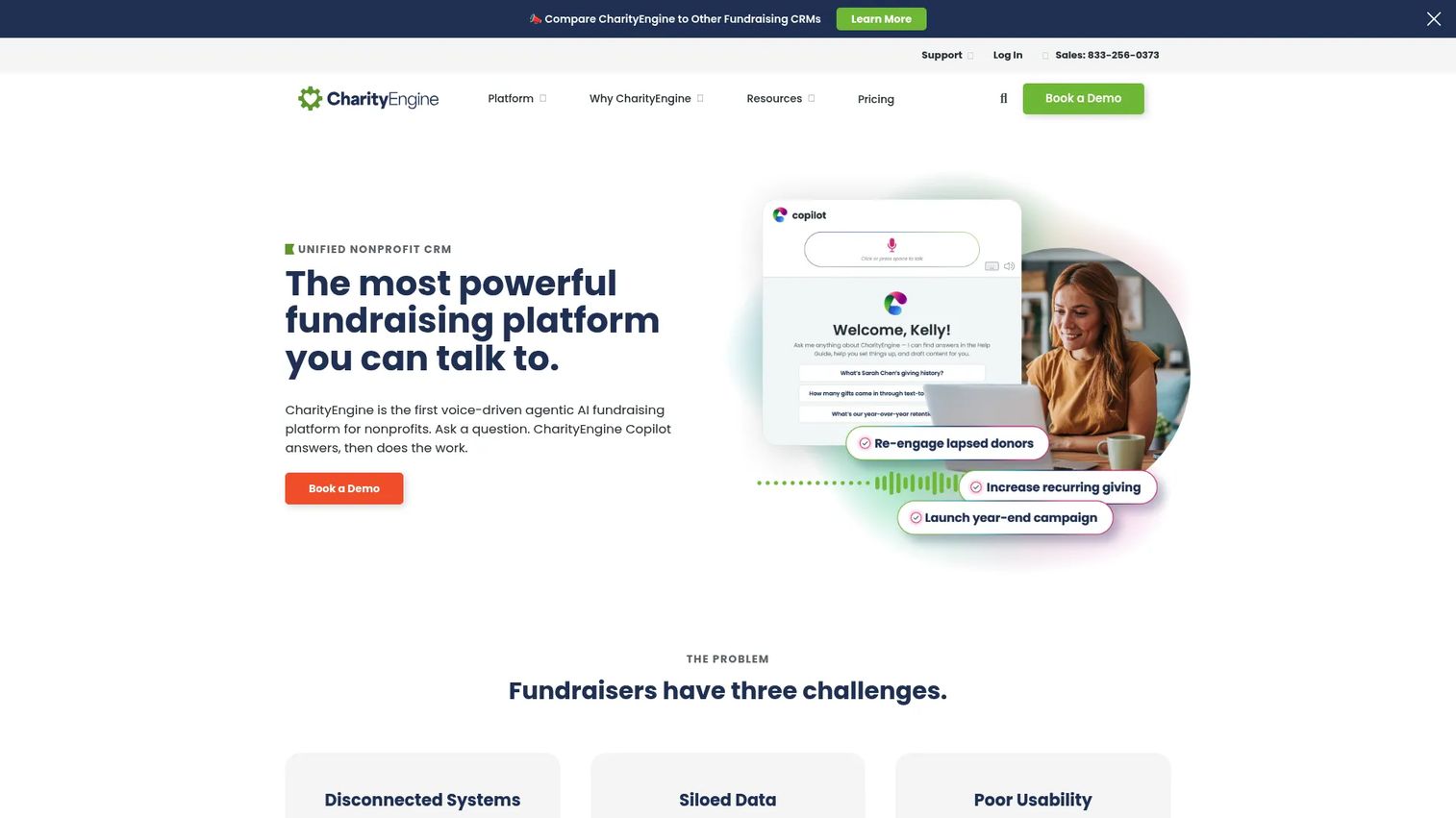
CharityEngine is an all-in-one nonprofit CRM and fundraising platform that combines donor management, fundraising tools, payment processing, email automation, and analytics under a single contract. It serves nonprofits that want to stop managing multiple vendor relationships for CRM, payments, and marketing. The platform includes a voice-first AI assistant called CharityEngine Copilot for workflow automation.
Best for: Nonprofits that want fundraising operations, payments, and donor communications consolidated in one system.
Key features
- Donor database and constituent profiles
- Donation forms and giving pages
- Sustainer and recurring-gift management with failed-payment recovery
- Email marketing automation and segmentation
- Reporting dashboards and custom reports
Why choose CharityEngine: Choose it when your team is managing donor data in one tool and payments in another, and the reconciliation is costing hours per week. Evaluate integration depth carefully if you're already locked into a separate email platform or payment processor.
CharityEngine pricing: Plans start at $450/month for up to 25,000 contacts and 100,000 emails, scaling to $700 to $1,500/month for Professional (up to 100,000 contacts) and custom pricing for Enterprise above that. A quote is required for exact figures at your contact volume.
2. Salesforce
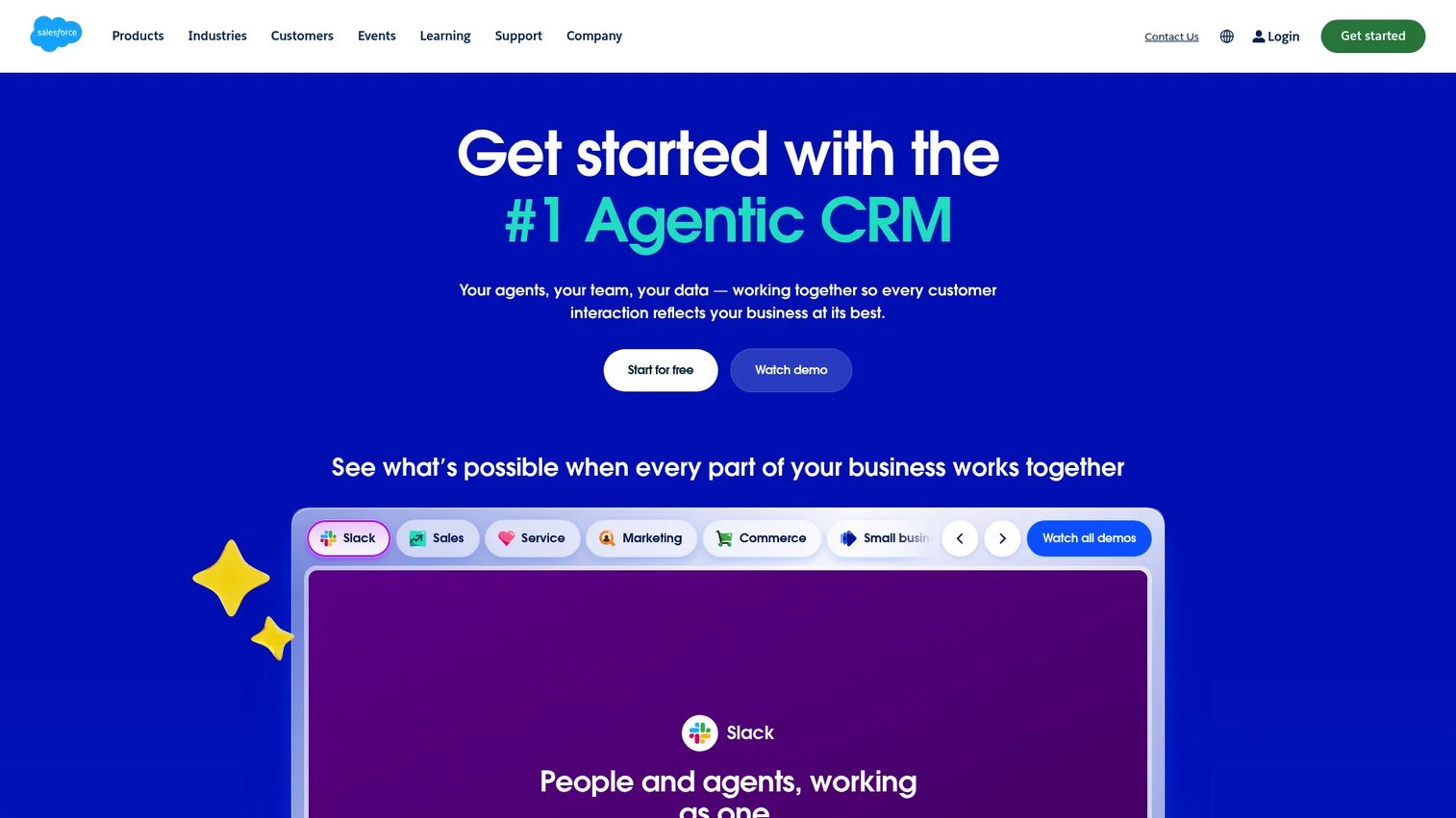
Salesforce is the largest CRM platform in the world, and it offers nonprofit-specific configuration through Nonprofit Cloud and a range of AppExchange apps built for the sector. It handles donor management, fundraising, program management, grantmaking, marketing automation, and analytics. The trade-off is that depth requires admin capacity or implementation partners.
Best for: Enterprise nonprofits with technical staff or implementation partners who need a configurable, data-rich CRM connected to a broader reporting and automation stack.
Key features
- Nonprofit Cloud for fundraising and constituent management
- AppExchange apps for nonprofit workflows
- AI-powered Agentforce capabilities
- Fundraising, program management, and grantmaking modules
- Advanced analytics and reporting dashboards
Why choose Salesforce: It's the right call when your organization needs a CRM that grows across multiple programs, grant management, and donor portfolios without switching platforms. Smaller teams without dedicated admin support will struggle with configuration overhead and should verify setup resources before signing.
Salesforce pricing: The Sales Cloud Free Suite starts at $0. Paid plans run from $25/user/month (Starter Suite) to $550/user/month (Max), billed annually. Nonprofit organizations should ask Salesforce directly about nonprofit pricing programs and any available grant or licensing options.
G2 rating: 4.4/5.
3. DonorPerfect
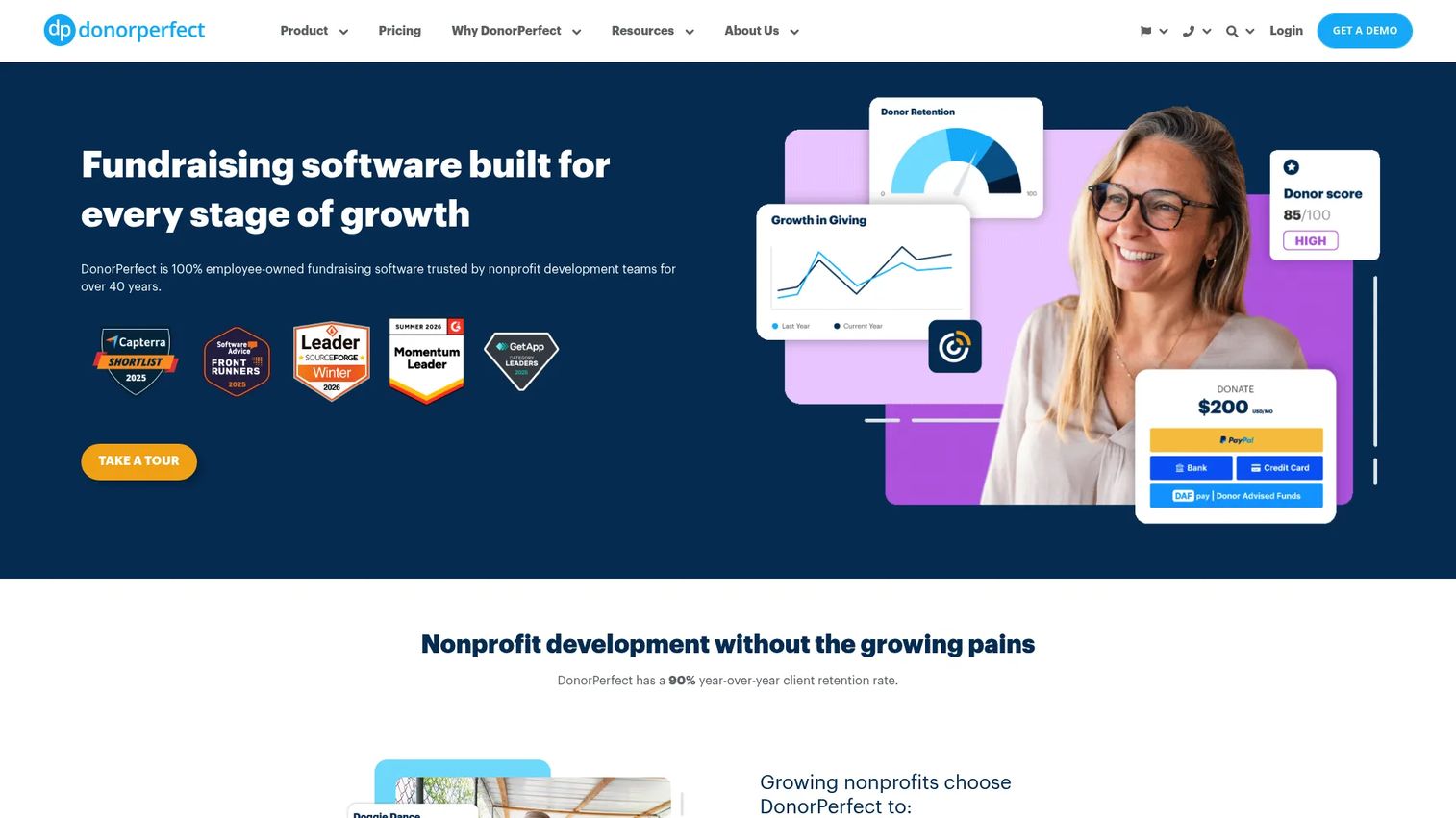
DonorPerfect is a mature donor management and fundraising CRM built for nonprofits that need a configurable donor database with reporting depth. It covers gift tracking, donor records, online donation forms, workflow automation, and email marketing through a Constant Contact integration. The platform has been in the market long enough to have an established user community and training resources.
Best for: Established fundraising teams that need a configurable donor database with strong reporting and gift-tracking workflows.
Key features
- Donor records and giving history
- Custom dashboards, reports, and goal tracking
- Online donation, volunteer, and event forms
- Automated acknowledgments and monthly giving tools
- Mobile fundraising and engagement tracking
Why choose DonorPerfect: It fits teams that want donor operations depth without building a heavily custom system from scratch. Before signing, evaluate which features require add-ons and what implementation support looks like, as both affect first-year cost.
DonorPerfect pricing: Plans start at $99/month across Core, Plus, and Pro tiers. Individual tier prices require a custom quote from the vendor.
G2 rating: 4.4/5.
4. Bloomerang
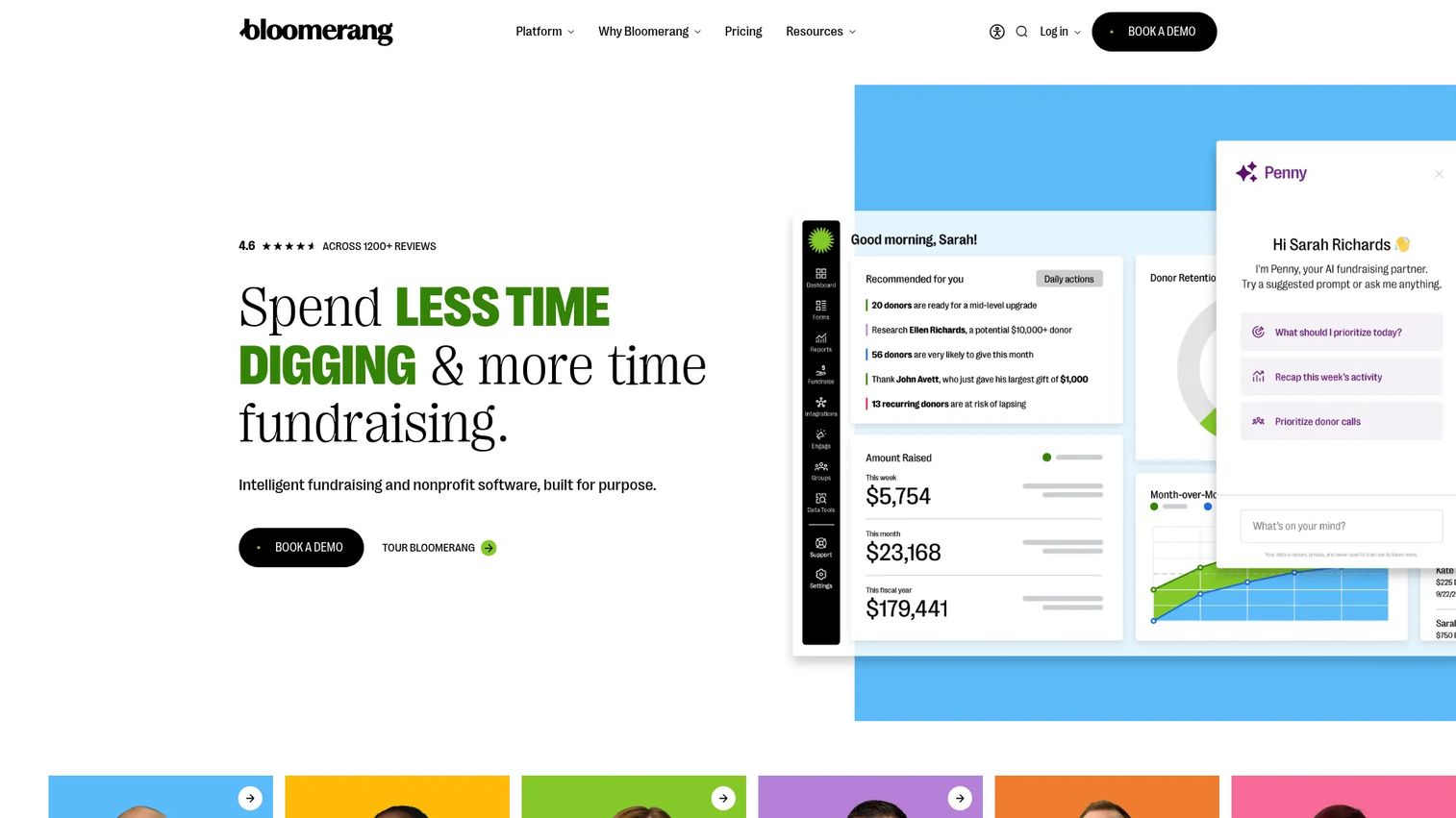
Bloomerang is a nonprofit giving platform built around donor retention. It combines CRM, fundraising tools, volunteer management, and donor engagement tracking. What differentiates it is the emphasis on stewardship workflows, donor timelines, and engagement scoring. According to Omatic's 2025 data, 79% of nonprofits use five or more third-party systems beyond their primary CRM. Bloomerang's design pushes back against that fragmentation.
Best for: Small to midsize nonprofits focused on donor retention, engagement signals, and stewardship workflows.
Key features
- Donor timelines and giving history
- Engagement scoring and retention reporting
- Email, text, and direct mail communications
- Peer-to-peer, event, and auction fundraising
- Volunteer scheduling, messaging, and mobile apps
Why choose Bloomerang: The retention-focused design gives development teams clearer signals on which donors need outreach before they lapse. Enterprise teams should verify depth on permissions, integrations, and custom reporting before committing.
Bloomerang pricing: The Giving Platform starts at $242/month billed annually, which includes fundraising, CRM, volunteer management, Prospect AI, and predictive donor insights. Separate Fundraising and Volunteer products start at $40/month and $119/month respectively (billed annually).
5. Bonterra
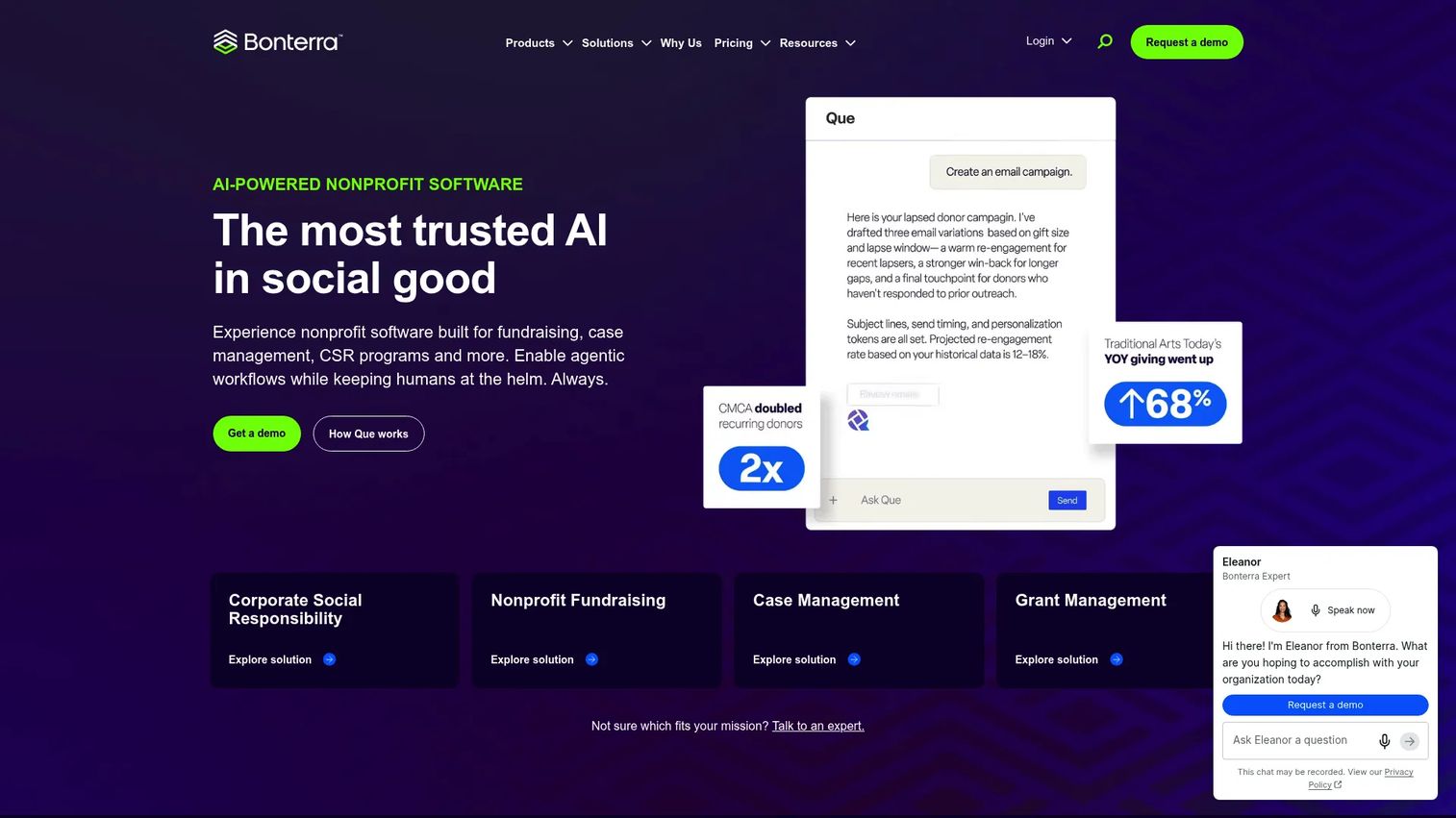
Bonterra is a social good software company offering products across fundraising, case management, volunteer management, corporate social responsibility, and grant management. It serves nonprofits, foundations, and corporations. The breadth is the value and the complication: Buyers need to map exactly which Bonterra product package covers their specific use case before comparing cost.
Best for: Multi-program nonprofits that need fundraising and constituent engagement across several operational areas, including case management or grantmaking.
Key features
- Donor management and fundraising campaigns
- Case management for human services organizations
- Volunteer tools and scheduling
- Grant management and award tracking
- AI-powered fundraising intelligence
Why choose Bonterra: It suits organizations that have outgrown a single-purpose fundraising tool and need a broader nonprofit operations platform. Map the exact product package before evaluating pricing; Bonterra's suite is modular, and cost varies significantly by product combination.
Bonterra pricing: Pricing requires a sales conversation.
G2 rating: 4.5/5 from 2,062 reviews.
6. Virtuous
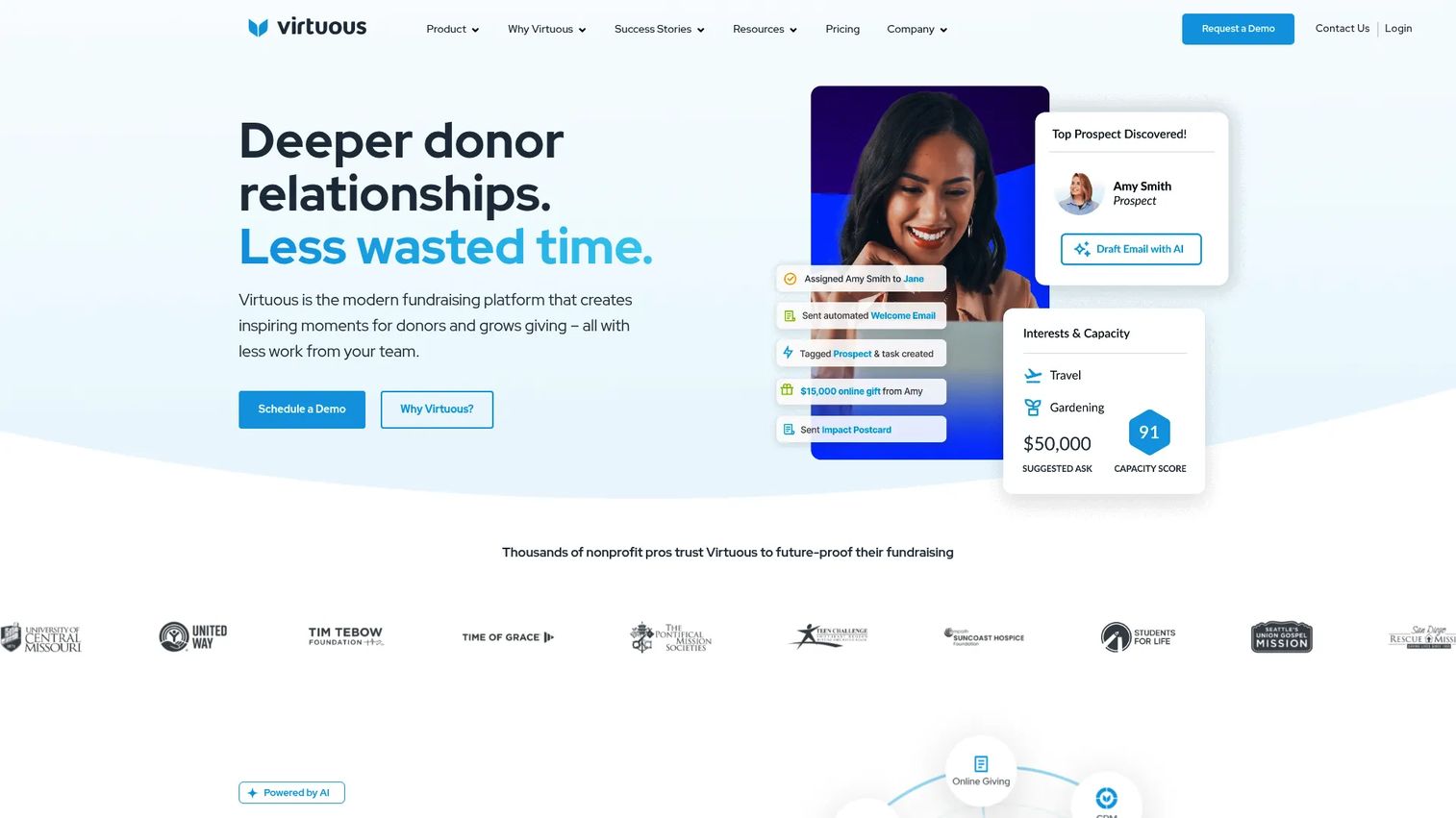
Virtuous describes itself as a responsive fundraising platform. Its CRM includes donor management, marketing automation, personalized stewardship journeys, online giving, and workflow triggers. The platform is positioned for growth-oriented nonprofits that want automation and donor personalization built into the fundraising motion rather than layered on afterward.
Best for: Fundraising teams investing in personalized donor stewardship and automation at scale.
Key features
- Donor profiles and giving history
- Marketing automation and stewardship journeys
- Online giving and campaign management
- Workflow triggers and engagement alerts
- Analytics with predictive donor insights
Why choose Virtuous: It's a strong choice when the development team is manually managing major-donor stewardship and wants to automate more of that cycle without losing personalization. Confirm onboarding timeline and automation setup resources before signing, as the configuration depth can extend go-live.
Virtuous pricing: Platform and Enterprise CRM+ packages are available. Virtuous requires a pricing request.
G2 rating: 4.3/5.
7. Neon One
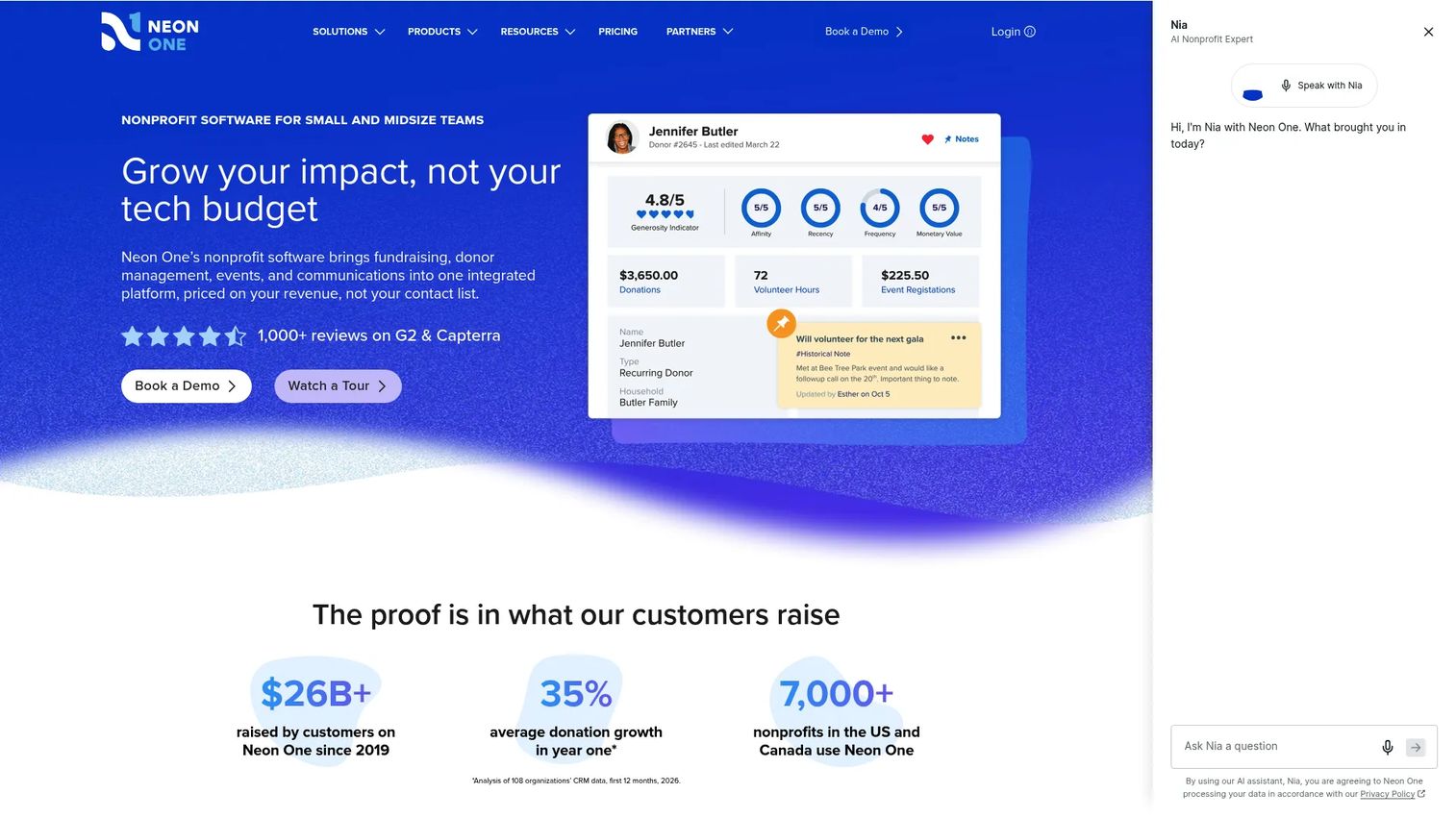
Neon One is a nonprofit relationship management platform covering supporter management, fundraising, events, memberships, email, and payments. It works well for organizations running fundraising alongside membership programs or event-heavy calendars, where a single platform reduces the integration overhead of managing separate tools.
Best for: Small and midsize nonprofits managing fundraising, memberships, and events together in one system.
Key features
- Donor and supporter database
- Donation campaigns, forms, and payment processing
- Event ticketing and attendance tracking
- Membership management with renewals and member portals
- Email campaigns and stewardship journeys
Why choose Neon One: It reduces tool sprawl for organizations running parallel programs across fundraising, events, and memberships. Verify payment transaction fees and confirm that the modules included in the starting price match your actual program needs before committing.
Neon One pricing: Neon CRM starts at $99/month. Neon Fundraise starts at $158/month. Full pricing details require requesting the pricing guide from the vendor.
G2 rating: 4.2/5.
8. Little Green Light
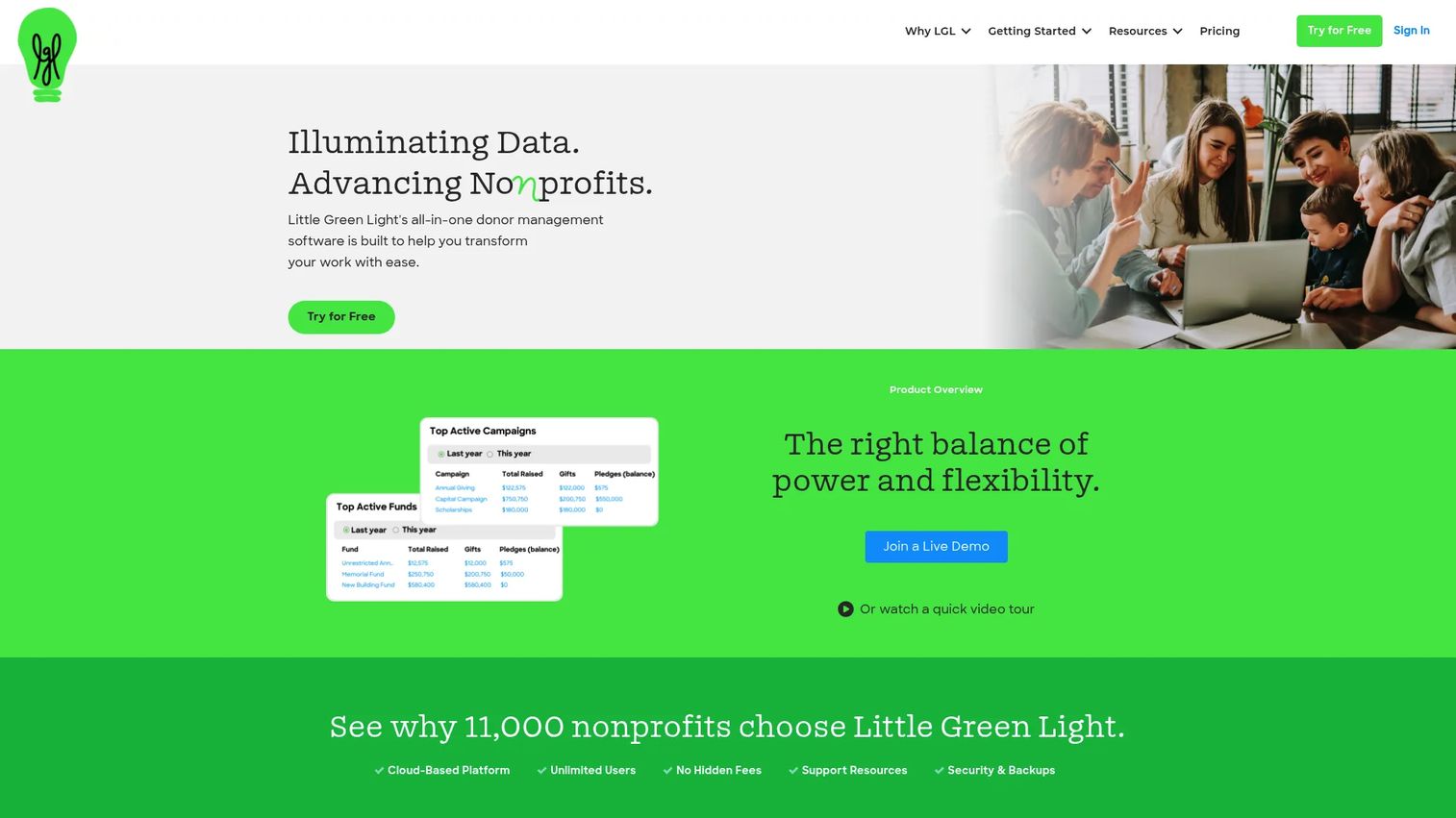
Little Green Light is cloud-based donor management software priced by constituent count. One plan covers all features with unlimited users. It includes donor records, gift tracking, mail merges, campaign tracking, online donation forms, and built-in reporting. The first 30 days are free. It's the most accessible entry point for small nonprofits moving off spreadsheets.
Best for: Small nonprofits that need an affordable, practical donor database with quick adoption and no per-seat pricing.
Key features
- Constituent management and donor records
- Gift tracking and fundraising campaigns
- Mail merges and correspondence tracking
- Custom reports and goal dashboards
- Event, volunteer, membership, and grant management
Why choose Little Green Light: The constituent-count pricing model makes costs predictable and per-seat fees irrelevant. Organizations with more than 50,000 constituent records or complex integration requirements should verify that the feature depth covers their workflow before migrating.
Little Green Light pricing: Plans start at $45/month for up to 2,500 constituents, rising in $15/month increments per 10,000 records. All plans include unlimited users and all features.
G2 rating: 4.4/5.
9. Blackbaud
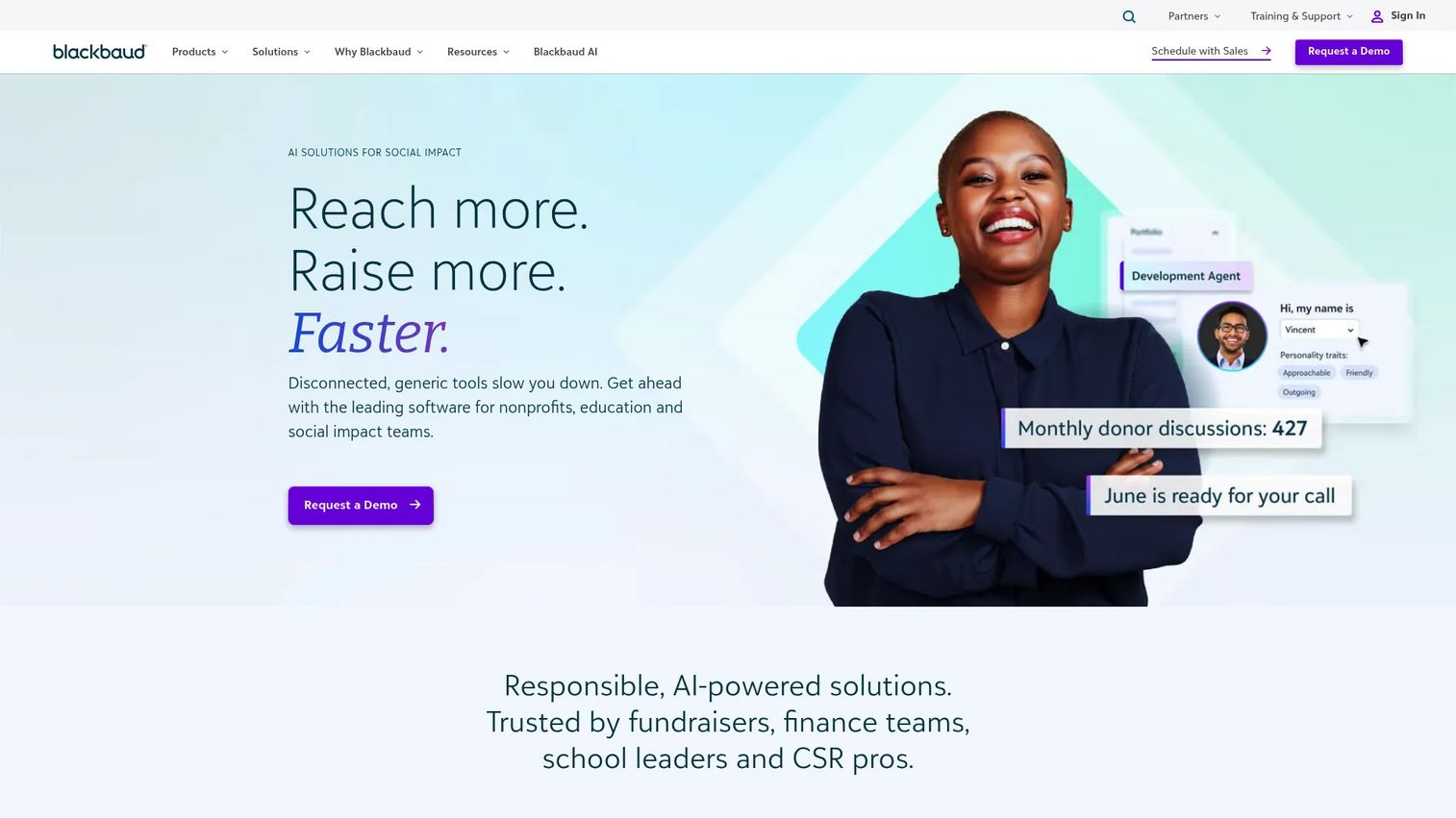
Blackbaud is one of the largest nonprofit technology vendors. Its portfolio includes fundraising, financial management, analytics, payments, events, peer-to-peer fundraising, and donor engagement products. Buyers evaluating Blackbaud need to distinguish between specific products within its suite rather than treating the parent brand as a single CRM.
Best for: Larger nonprofits, schools, and social-impact organizations that want a broad vendor across fundraising, finance, and engagement.
Key features
- Fundraising and donor relationship management
- Financial management and fund accounting
- Grantmaking and award management
- Analytics and reporting tools
- Payment processing and peer-to-peer fundraising
Why choose Blackbaud: It suits organizations that want a single vendor relationship across fundraising, finance, and operational reporting. The most common implementation mistake is buying Blackbaud as a brand without confirming which product handles your specific use case. Ask about product-specific pricing and implementation scope separately.
Blackbaud pricing: Pricing is custom for each product and organization. Contact Blackbaud for a quote.
G2 rating: 3.9/5.
10. Raiser's Edge NXT
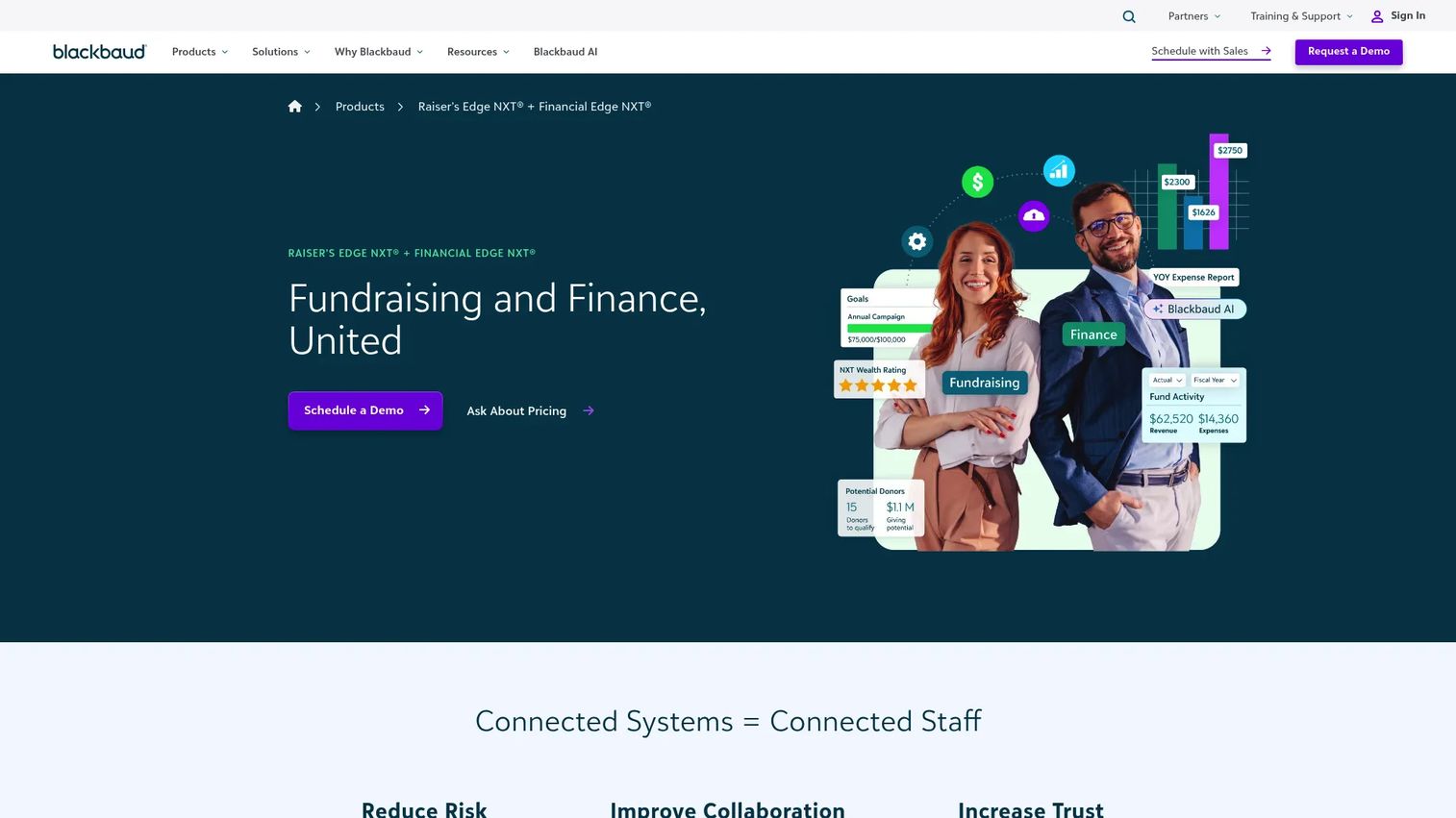
Raiser's Edge NXT is Blackbaud's flagship donor management and fundraising CRM. It combines constituent records, moves management, gift tracking, campaign reporting, and recurring gift management. For established development teams running major gift programs alongside broad fundraising operations, it remains one of the most capable donor management systems in the market.
Best for: Established nonprofits with dedicated development teams, major gift programs, and complex donor management workflows.
Key features
- Unified constituent records with giving history and relationships
- Moves management for major gift portfolio tracking
- Gift processing, pledges, tributes, and campaigns
- Workflow Designer for multi-step email and outreach sequences
- Reporting, dashboards, and fundraising performance insights
Why choose Raiser's Edge NXT: The moves management depth and major gift portfolio tools are stronger than what most mid-market nonprofit CRMs offer. Implementation complexity and ongoing admin requirements are real. Evaluate those costs alongside subscription pricing before signing.
Raiser's Edge NXT pricing: Custom pricing from Blackbaud. Contact sales for a quote; reviewer-reported ranges suggest mid-to-large organization budgets.
G2 rating: 3.9/5.
11. Funraise
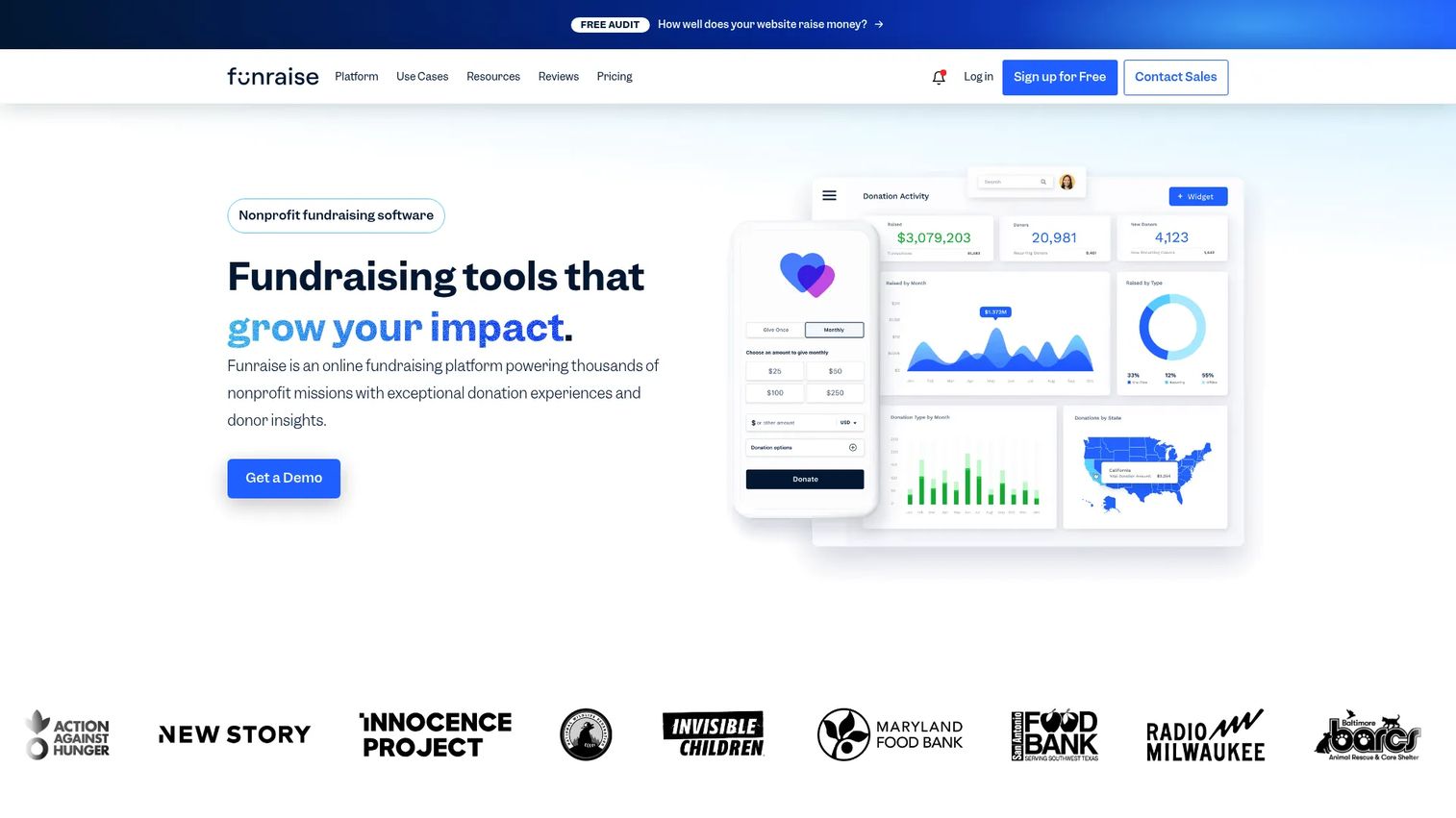
Funraise is an all-in-one nonprofit fundraising platform with CRM-like donor management capabilities. It covers donation forms, peer-to-peer campaigns, events, auctions, donor records, SMS and email engagement, and reporting. The free plan for organizations raising under $1 million annually makes it a low-risk starting point for growing teams.
Best for: Nonprofits focused on online fundraising campaigns and digital donor acquisition who need campaign execution more than a traditional enterprise CRM.
Key features
- Donation forms and giving pages
- Peer-to-peer fundraising and campaign websites
- Donor management and CRM records
- Events, ticketing, and auction tools
- SMS and email engagement tools
Why choose Funraise: It's fundraising-first rather than database-first, which fits organizations running a high volume of online campaigns. Teams that need deep grant management, program tracking, or finance workflows should verify whether Funraise covers those areas or requires a separate tool alongside it.
Funraise pricing: The Free plan handles organizations raising under $1 million annually and includes a 5% platform fee plus standard processing fees (2.9% + 60 cents per card transaction). Premium plans are custom-priced with a 0 to 3% platform fee.
G2 rating: 4.4/5.
12. Kindsight
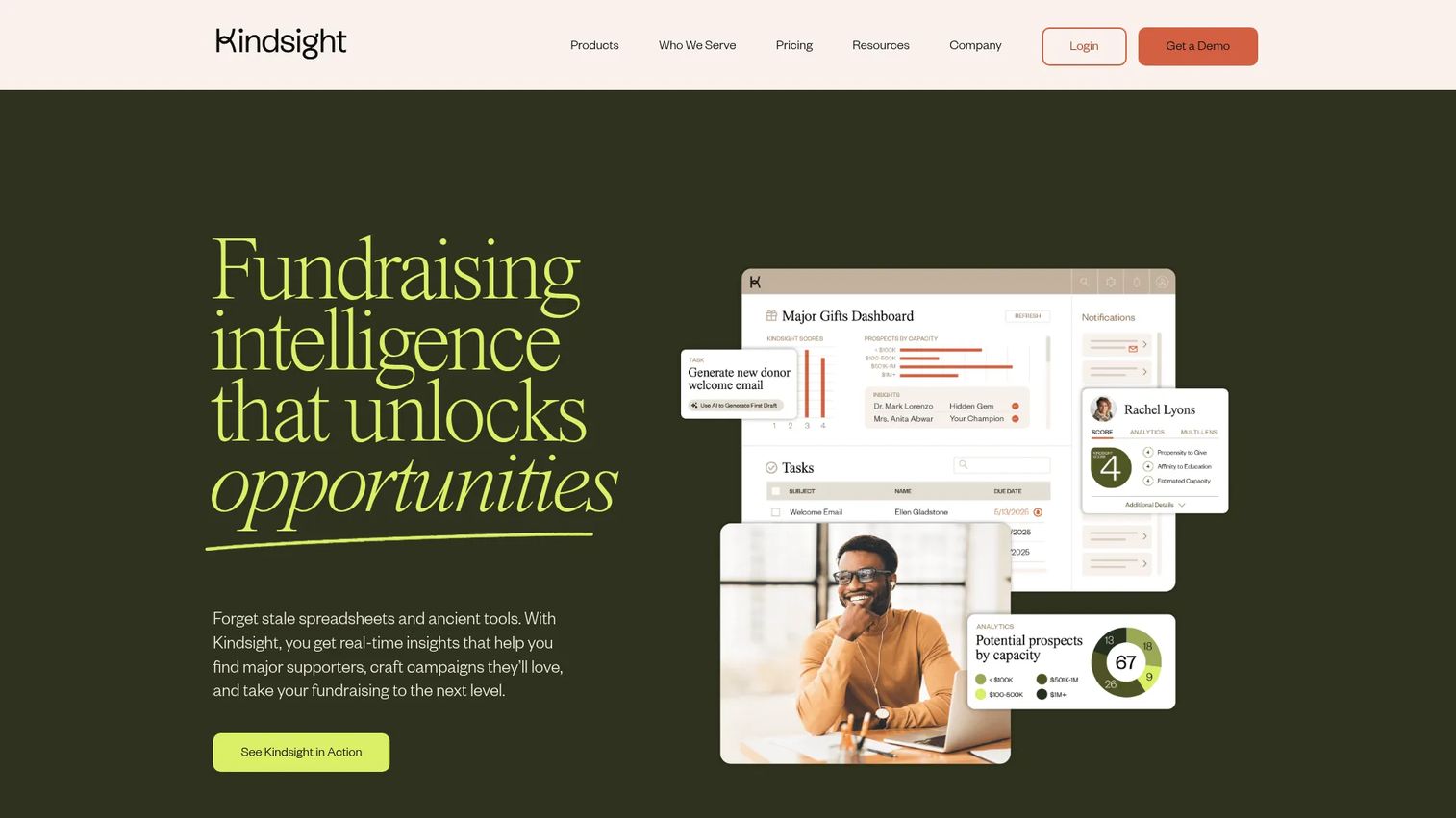
Kindsight is a fundraising intelligence and CRM platform serving nonprofits, higher education institutions, and healthcare organizations. It provides real-time donor profiles, AI-generated personalized communications, automation for pledges and gift matching, and customizable constituent portals. It sits at the intersection of donor intelligence and advancement CRM.
Best for: Advancement teams at nonprofits, universities, and healthcare foundations that need integrated donor intelligence, CRM, and personalized stewardship.
Key features
- Real-time donor profiles and fundraising intelligence
- CRM for fundraising data and relationship management
- AI-generated personalized donor communications
- Automation for pledges, bulk processing, and gift matching
- Customizable constituent portals
Why choose Kindsight: It's the right fit when your team needs prospect intelligence and advancement-grade donor management in the same platform, rather than managing a separate research tool alongside a CRM. General-purpose nonprofits without a dedicated major gift program should confirm that the platform's depth justifies the investment.
Kindsight pricing: Kindsight requires a demo and personalized quote.
13. iWave
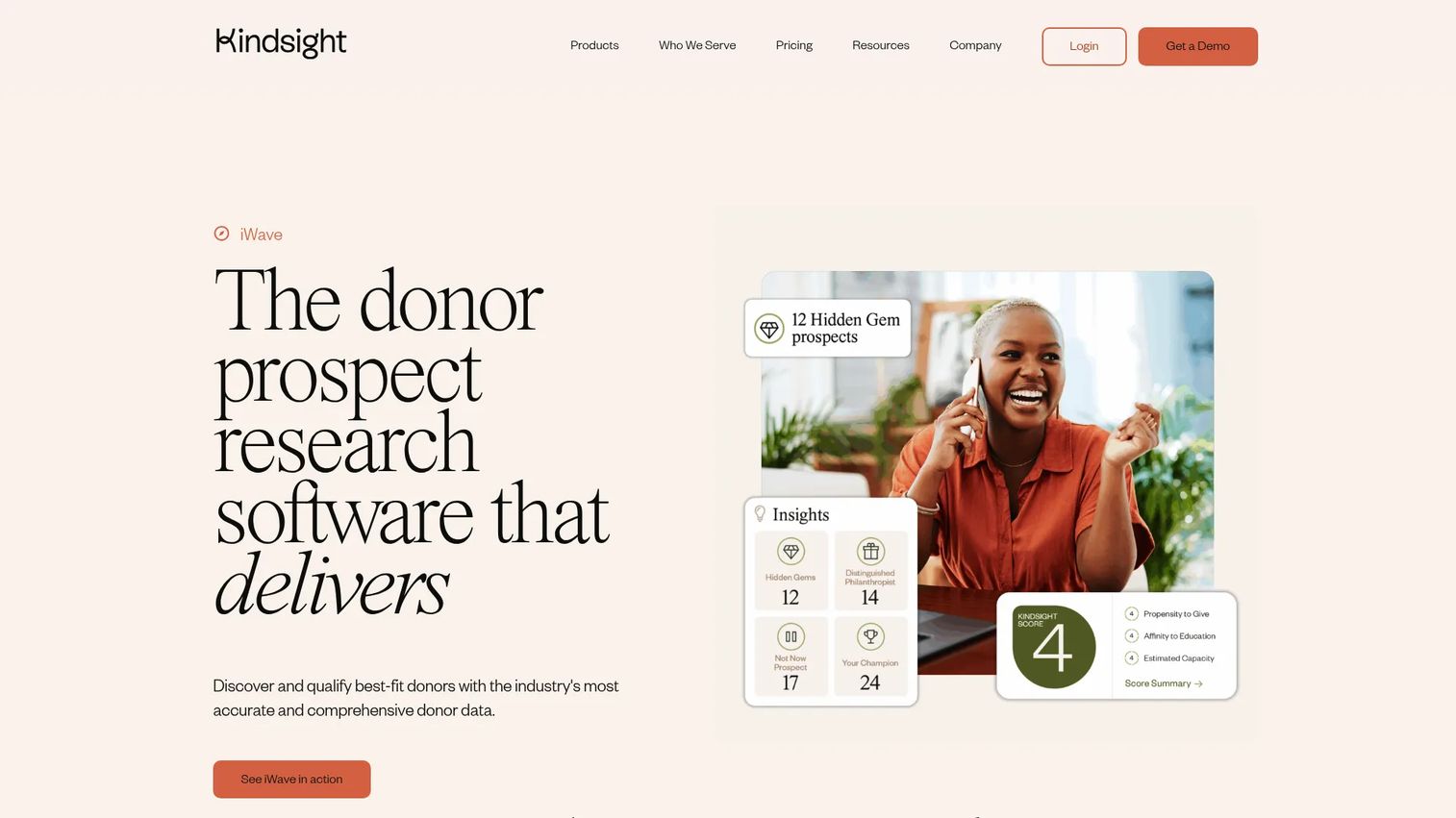
iWave is a donor prospect research and intelligence platform. It provides wealth screening, philanthropic indicators, donor scoring across more than 100 models, data appends, and CRM integrations. It is a research layer that complements a CRM rather than replacing one. Major gift teams use it to identify prospects, prioritize portfolios, and prepare for major asks.
Best for: Major gift teams that need wealth screening and donor intelligence alongside their existing CRM.
Key features
- Wealth screening and philanthropic indicators
- Over 100 donor scores, analytics, and models
- Live Profiles with real-time data updates
- Data appends and enrichment
- CRM integrations for research workflow
Why choose iWave: It gives major gift teams prospect data without requiring a full platform switch. Teams looking for gift processing, constituent records, or campaign management still need a separate CRM alongside iWave.
iWave pricing: Starter plans begin at $4,500/year (1 user, up to 1,500 subscription screens). Professional starts at $5,800/year (3 users, up to 5,000 screens). Premium pricing requires a direct quote.
G2 rating: 4.6/5.
14. Microsoft Dynamics 365
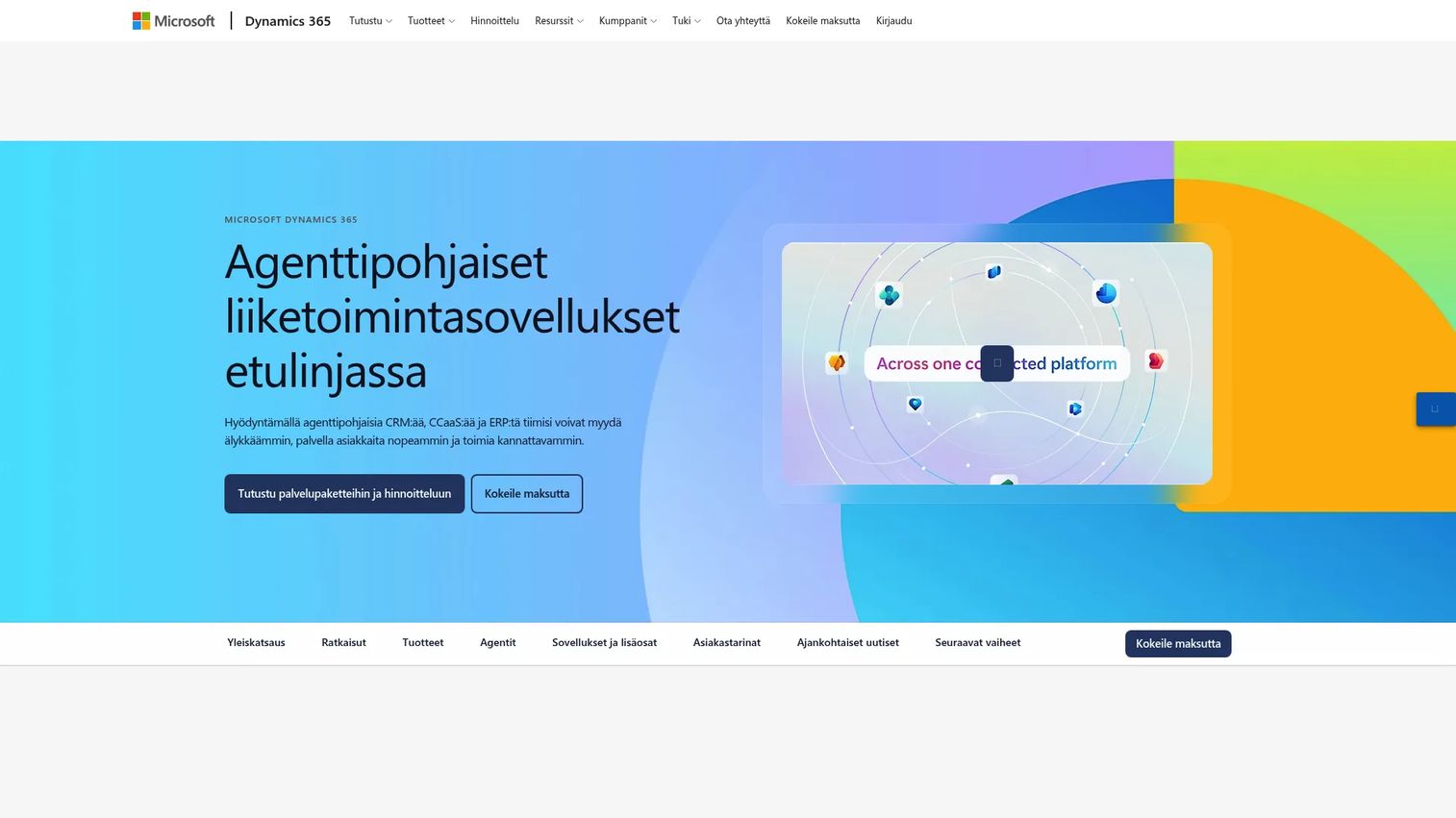
Microsoft Dynamics 365 is a suite of AI-powered CRM and ERP business applications. For nonprofits already invested in Microsoft 365, Teams, Azure, and Power Platform, it offers a configurable path to nonprofit CRM without introducing a new vendor. Donor management, program tracking, and reporting workflows can all be built through the Microsoft stack. The key word is "built," not "out of the box."
Best for: Nonprofits with existing Microsoft infrastructure and technical resources to configure a CRM from a general-purpose platform.
Key features
- CRM customization through Power Platform
- Microsoft 365 and Teams integration
- AI-powered Copilot and autonomous agents
- Advanced analytics and reporting dashboards
- Workflow automation across operations
Why choose Microsoft Dynamics 365: It's a strong choice when the organization already runs Microsoft 365 and wants CRM built on that foundation rather than managing a separate vendor. Without implementation expertise, it will not function as a nonprofit CRM out of the box. Budget for configuration and training accordingly.
Microsoft Dynamics 365 pricing: Dynamics 365 Sales Professional starts at $65/user/month, billed annually. Sales Enterprise starts at $105/user/month. A 30-day free trial is available. Nonprofit licensing options should be confirmed directly with Microsoft.
15. Givebutter
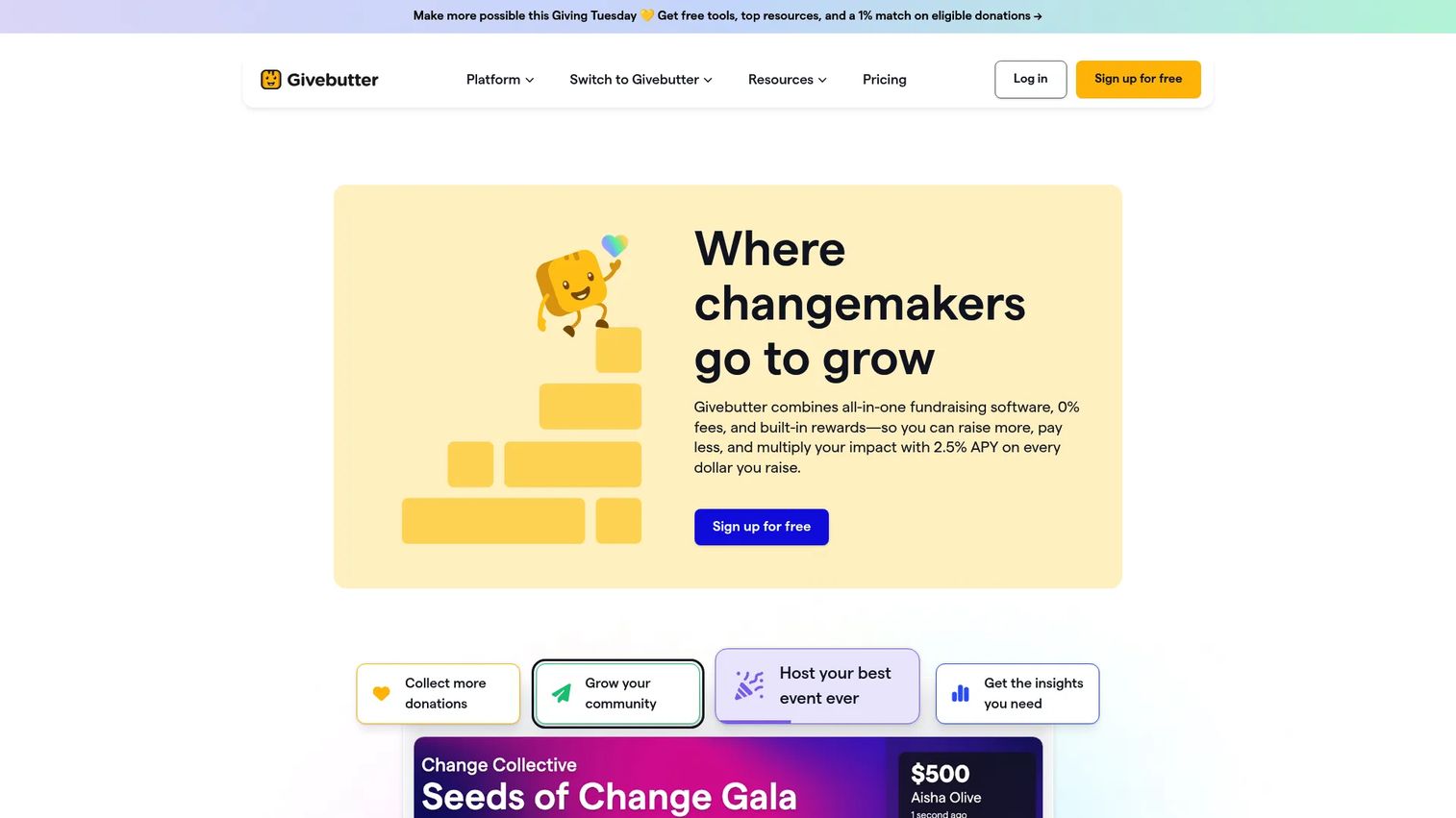
Givebutter is an all-in-one nonprofit fundraising platform with a free core plan. It includes donation forms, peer-to-peer campaigns, events, auctions, text-to-donate, donor records, email and SMS marketing, and integrations. The free model works through optional tips from donors; disabling tips adds a 3% platform fee. It's the fastest path to a fundraising-ready system for small nonprofits, schools, and community organizations.
Best for: Small nonprofits and community organizations that need fundraising tools and basic donor tracking without a heavy CRM rollout.
Key features
- Donation forms and fundraising pages
- Peer-to-peer campaigns and event fundraising
- Donor management and CRM records
- Email and SMS marketing
- Text-to-donate and auction tools
Why choose Givebutter: The free core plan gives small organizations access to donation forms, donor records, and campaign tools without a subscription commitment. Growing nonprofits should evaluate reporting depth, permissions, accounting integrations, and CRM scalability before relying on it as a primary system at larger contact volumes.
Givebutter pricing: The core plan is free forever. Givebutter Plus starts at $29/month (contact-based tiers above that) and adds advanced workflows, reporting, texting, fundraising email blocks, and QuickBooks Online integration. Processing fees are 2.9% + 30 cents for cards and 1.9% + 30 cents for ACH when tips are disabled.
G2 rating: 4.7/5.
Considerations when choosing nonprofit CRM software
Start with your fundraising model
A monthly giving-heavy nonprofit needs different CRM depth than a major gift institution managing a 200-person prospect portfolio. Map your primary revenue streams first: Recurring gifts, major gifts, annual fund, grants, events, or peer-to-peer. The CRM you choose should handle your primary model natively, not through workarounds. Secondary models can rely on integrations.
Price the whole system, not the subscription
The subscription is one line item. Migration, data cleanup, implementation support, payment processing fees, email send limits, extra modules, and consultant time are the rest of the budget. For many nonprofits, the true first-year cost runs two to three times the subscription amount. Ask vendors for an implementation estimate and map payment processing fees against your current transaction volume before shortlisting.
Check reporting before the demo ends
Board reports, campaign attribution, donor retention rates, recurring gift analytics, pledge aging, and gift reconciliation should all be testable during a product demo. Ask the vendor to pull a board-ready report using your data structure. If that request takes more than five minutes, you've found a reporting gap that will cost staff hours every month.
Map integrations before signing
CRM for nonprofits doesn't exist in isolation. Check accounting software, payment processors, email marketing tools, website CMS, event management tools, volunteer systems, and any data warehouse or BI tool the team uses. Get confirmation in writing that the integration is bidirectional, not just a data export. Integration gaps discovered after go-live are expensive to fix.
Plan adoption like a rollout, not a login
A CRM that staff work around is not a CRM. Plan training, permission structures, naming conventions, dashboard setup, field ownership, and weekly data hygiene before launch. Identify one internal champion per team who owns data quality for their area. CRM adoption is an operational project, not an IT project.
Conclusion
The nonprofit CRM software category spans everything from free fundraising tools to enterprise advancement systems. Matching the right tool to your organization's operating model matters more than chasing features.
For all-in-one fundraising operations with payments and marketing under one roof, CharityEngine is the strongest contender. Salesforce suits large nonprofits with admin capacity and a need for enterprise-grade configurability. DonorPerfect and Bloomerang serve established donor management and retention workflows at a more accessible price point. Little Green Light and Givebutter are the practical choices for smaller organizations replacing spreadsheets or getting started quickly.
For major gift and prospect research depth, Kindsight and iWave serve advancement teams that need intelligence layered onto fundraising operations.
Pick three tools to evaluate. Run the same donor lifecycle scenario in each demo: Add a new donor, process a recurring gift, pull a board report, and check how the system handles a lapsed donor. Ask every vendor for a migration timeline estimate and total first-year cost before you shortlist. And verify pricing and G2 ratings directly with vendors before making a final decision.
FAQs
Little Green Light at $45/month and Givebutter's free core plan are the two most practical options for small nonprofits. Little Green Light includes all features with unlimited users, priced by constituent count. Givebutter offers fundraising, donor records, and campaigns at no subscription cost, with fees applied at checkout. The right choice depends on whether the organization needs a mature donor database or primarily runs online fundraising campaigns.
Nonprofit CRM software is broader: It covers constituents, volunteers, campaigns, programs, events, stewardship workflows, and reporting in addition to donor records. Donor management software focuses primarily on donor profiles and giving history. Many tools marketed as one function as both, which is why the categories overlap significantly. The practical distinction is whether the system can track non-donor relationships and program outcomes alongside fundraising data.
Costs vary by contact volume, feature set, implementation, payment processing, and support level. Entry-level tools like Little Green Light start at $45/month. Mid-market platforms like CharityEngine start at $450/month. Enterprise platforms from Blackbaud and Raiser's Edge NXT require a custom quote. The subscription is rarely the full picture. Budget for migration, implementation support, and payment processing fees when calculating total first-year cost.
Yes. Salesforce works for nonprofits through Nonprofit Cloud and a range of AppExchange apps built specifically for the sector. It handles donor management, fundraising, program management, and analytics. The trade-off is that it requires admin capacity or implementation partners to configure correctly. Smaller teams without dedicated technical staff often find the setup overhead outweighs the flexibility benefit and are better served by a purpose-built nonprofit CRM.
Replace spreadsheets when duplicate records, missed stewardship follow-ups, reporting delays, and gift reconciliation create operational risk. The threshold is typically when two or more staff members are editing the same donor data in separate files, or when preparing a board report takes more than a day of manual work. Waiting until after a staff transition or major campaign adds migration risk, since institutional knowledge often leaves with the person who managed the spreadsheet.
Core features include donor profiles, gift and pledge tracking, segmentation, stewardship communications, reporting dashboards, payment and email integrations, permissions and audit controls, and recurring gift management. Major gift teams additionally need prospect research integration and moves management. Volunteer-heavy organizations should look for scheduling and hours tracking. The right feature set follows the fundraising model: A major gift shop and a peer-to-peer fundraising team have fundamentally different requirements.
Implementation timelines depend on data cleanliness, the number of integrations, customization requirements, and staff capacity for training. A straightforward migration from a single spreadsheet to a simple platform like Little Green Light can take two to four weeks. A complex migration from a legacy database to Raiser's Edge NXT or Salesforce often runs three to six months. Plan a data audit, field mapping exercise, parallel testing period, and phased staff rollout before committing to a go-live date.
CharityEngine, DonorPerfect, Bloomerang, Virtuous, and Raiser's Edge NXT are all strong candidates, depending on fundraising model. CharityEngine suits teams that want an integrated payment and campaign platform. DonorPerfect fits established fundraising operations with reporting depth needs. Bloomerang is built around donor retention and stewardship. Virtuous adds marketing automation and personalization. Raiser's Edge NXT leads on major gift and moves management. Test donation forms, donor records, campaign reports, and recurring gift workflows in a live demo before making a final call.